

Family contexts and friendship relations occupy central roles in human development. The contemporary developmental theory emphasises family interactions as an enduring, central influence for the developing person (Bronfenbrenner & Morris, Reference Bronfenbrenner, Morris, Damon and Lerner1998). During development from adolescence toward adulthood, choice in friendships carries increasing importance. Emerging adulthood theory characterises these years after adolescence as the most volitional stage of development (Arnett, Reference Arnett2000, Reference Arnett, Booth, Brown, Landale, Manning and McHale2012). The conscious choices of emerging adults to cultivate positive friendships and build social support during these years have far-reaching effects. Prior research on social support in the adult years has shown links to a wide range of benefits such as positive coping (Henly, Danziger, & Offer, Reference Henly, Danziger and Offer2005), positive parenting (Lee, Anderson, Horowitz, & August, Reference Lee, Anderson, Horowitz and August2009), less depression (Lee et al., Reference Lee, Anderson, Horowitz and August2009), and less risk of living in poverty (Henly et al., Reference Henly, Danziger and Offer2005). The enduring influence of family, combined with the ongoing value of friendships in emerging adulthood warrants investigating potential linkages across these domains.
Among family features that could link these domains is the dimension of parental warmth, characterised by acceptance, support and caring (Rohner, Reference Rohner1986). Prior research provides indirect support for the potential association between family warmth and friendship quality. For example, in adolescence, parental warmth has been linked to adolescent friendship intimacy (Rodríguez, Perez-Brena, Updegraff, & Umaña-Taylor, Reference Rodríguez, Perez-Brena, Updegraff and Umaña-Taylor2014). Also, separate effects for mother or father warmth have been found in relation to peer acceptance (Davidov & Grusec, Reference Davidov and Grusec2006), peer likeability (Kam et al., Reference Kam, Greenberg, Bierman, Coie, Dodge, Foster and Pinderhughes2011), and friendship behaviours (Eiden, Colder, Edwards, & Leonard, Reference Eiden, Colder, Edwards and Leonard2009; Padilla-Walker, Nielson, & Day, Reference Padilla-Walker, Nielson and Day2016). This empirical evidence for links between family and friendship domains throughout childhood and adolescence, together with the salience of friendship in emerging adulthood, support the first hypothesis of this current study that warmth in the family of origin will be associated with friendship quality among emerging adults.
If the assumption that family warmth is associated with friendship quality during emergent adulthood holds, then how does this connection occur? One explanation that connects family warmth to development derives from interpersonal acceptance-rejection theory (IPARTheory; Rohner, Reference Rohner2016). The theory proposes that interpersonal warmth serves an evolutionary role for the human species and provides a psychological foundation for individual adjustment. IPARTheory has evolved from PARTheory (Rohner, Reference Rohner1986, Reference Rohner2008; Rohner & Khaleque, Reference Rohner and Khaleque2010), which focused on parent-child relationships. Although expanded to include interpersonal relationships of all types, Rohner’s theoretical update (Reference Rohner2016) clarifies that despite the name change and broadened applicability, the IPARTheory maintains its valuable, original influence as a conceptualisation for advancing research and understanding of parent-child relationships. Within parent-child dyads, the theory suggests that parental warmth affects the overall psychological adjustment of their children through both internal and behavioural dispositions. The current study tests the theory and examines the internal disposition of self-perception and a behavioural disposition of interpersonal competence as potential mediators between family warmth and friendship quality.
Prior theory and empirical evidence both support the relevance of testing self-perceptions as a potential mediator between family warmth and friendship quality (Booth-Laforce et al., Reference Booth-Laforce, Oh, Kim, Rubin, Rose-Krasnor and Burgess2006). In IPARTheory, warmth is related to multiple dispositions that overlap with self-perceptions, including self-esteem, self-adequacy and positive worldview. Elsewhere, theorising about the self-system has echoed the role of acceptance or rejection in the social environment. As advanced by Leary (Reference Leary2000), for example, feelings about oneself operate as a feedback gauge in response to acceptance or rejection in the social environment. By extension, repeated experiences of acceptance or rejection in primary relationships become internalised into patterns of self-perception. Similarly, prior findings have linked parental warmth to confidence in personal choices among emerging adults (Zimmer-Gembeck, Madsen, & Hanisch, Reference Zimmer-Gembeck, Madsen and Hanisch2011).
In addition to self-perception, theory and evidence also support the relevance of testing interpersonal competence as a potential mediator between family warmth and friendship quality. IPARTheory hypothesises that parental warmth provides a climate that fosters youth development of responsiveness, emotional maturity and interaction skills (Rohner & Khaleque, Reference Rohner and Khaleque2010). Prior research further suggests that family warmth is indirectly related to interpersonal competence. For example, significant associations have been found between maternal sensitivity and peer competence (NICHD, 2001), and between expressive parental warmth and peer empathy (Zhou et al., Reference Zhou, Eisenberg, Losoya, Fabes, Reiser, Guthrie and Shepard2002). Similar links have been found that connect the early experience of low warmth with low interpersonal interest in emerging adulthood (Yoo, Park, & Jun, Reference Yoo, Park and Jun2014). To summarise so far, prior theory and research support a hypothesised connection of family warmth with both self-perceptions and interpersonal competence.
In turn, prior findings further suggest that self-perceptions and interpersonal competence have implications for friendships. Associations between self-perceptions and friendships are well documented in childhood research (Gifford-Smith & Brownell, Reference Gifford-Smith and Brownell2003). Similar links are beginning to appear in emerging adulthood research. Global self-perceptions, for example, have been linked to both friendship duration and friendship stability among college students (Shany, Wiener, & Assido, Reference Shany, Wiener and Assido2013).
In addition to self-perceptions, elements of social competence are expected to link to positive peer relations. Related research has shown links between social competence and relationship quality (Demir, Jaafar, Bilyk, & Ariff, Reference Demir, Jaafar, Bilyk and Ariff2012; Morry & Kito, Reference Morry and Kito2009). Besides, the current study sought to further unpack social competence, drawing from the science of its absence in the study of the autism spectrum disorders (ASD).
The ASD field has advanced two key dimensions of social competence: (a) social interest and (b) social skills. The dimensions are reflected in both theory (Chevallier, Kohls, Troiani, Brodkin, & Schultz, Reference Chevallier, Kohls, Troiani, Brodkin and Schultz2012) and measurement (Hurley et al., Reference Hurley, Losh, Parlier, Reznick and Piven2007). This combination of interest and skills, in both typical and atypical development, places a developing person in a state of readiness for future friendships. Social interest reflects an approach orientation, the anticipation of social rewards, and receptiveness to future social interaction. The importance of social interest is evident in links to both individual mental health (Fung & Webster, Reference Fung and Webster2018) and interpersonal relationship quality (Rennebohm, Seebeck, & Thoburn, Reference Rennebohm, Seebeck and Thoburn2017). If social interest inspires future friendships, social skills facilitate its enactments. Through experiences across development, youth acquire social skills, which are the conventional interaction patterns that signal attention, imply connection, and facilitate communication. Successful acquisition of these conventional social skills has been linked to healthy developmental outcomes in multiple contexts of functioning (Oshri, Topple, & Carlson, Reference Oshri, Topple and Carlson2017). Together, the twin elements of social interest and social skills are examined in the current study using a measure designed to capture variation across the normal and atypical spectrum developed by Hurley and colleagues (Reference Hurley, Losh, Parlier, Reznick and Piven2007). As with self-perceptions, the measured elements of social competence are expected to link to positive peer relations.
In sum, the theory and supporting research suggest three principal hypotheses tested in the current research. First, family warmth will predict friendship quality in early adulthood. Second, self-perceptions and interpersonal competence will predict friendship quality. And third, the effect of family warmth on friendship quality will be mediated by both self-perceptions and interpersonal competence.
Method
Participants
The participants were 393 college students within the age range of 18–22 years, M = 20.01, SD = 1.23. The participants represented both women, 75.1%, and men, 24.9%, across self-identified ethnicities that included Caucasians, 81.7%, Asian-Americans, 10.2%, and additional ethnicities, 8.2%, (African American, Middle Eastern, Hispanic, and multiracial).
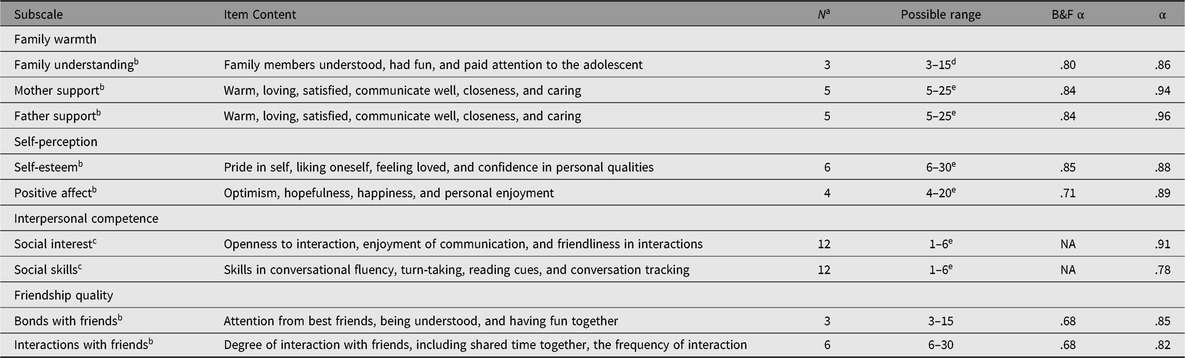
Each participant provided background information and responses to 10 indicator measures, which assessed the four primary constructs of the study. All 10 subscales were drawn from batteries that had shown prior evidence for reliability, factorial validity, and concurrent/predictive validity. Table 1 presents the descriptions of the technical features, reliability, and citation for each measure.
Study Measures by Construct, Items, Response Choice, Range, and Internal Consistency

Note: All scales have five response choices, except for positive affect which has four. aNumber of items on scale. bSubscales from the Battery of Adolescent Measures (Benson & Faas, Reference Benson and Faas2014). cSubscales (reversed) from Hurley and colleagues (Reference Hurley, Losh, Parlier, Reznick and Piven2007). dNot at all to very much. eStrongly disagree to strongly agree. fNever to most of the time. gVery rarely to very often. B&F = Benson and Fass (Reference Benson and Faas2014). NA = not applicable.
The background showed approximately an equal split across grade levels, including freshmen or first-year university students (28%), sophomores or second-year students (27%), juniors or third-year students (25%), and seniors or final-year students (20%). Testing of means across the grade levels showed no differences across study variables, with the exception of a weak age effect noted for the indicators of friendship quality. The age effect for friend bonds (r = −.17, p < .05) and friend interactions (r = −.17, p < .05) reflects a trend, noted in prior research, toward fewer and more stable relationships during the college years (Borarai & Carey, Reference Borarai and Carey2006). Institutional Review Board approval and informed consent were obtained for the study.
Procedure
Participants were recruited through advertisements placed around campus, email listservs sent out to various academic departments, or through an online recruitment system. After receiving the study website information and providing informed consent, participants completed basic demographic questionnaires, a battery of measures that included the scales used in this study. After completing the study, participants were granted extra credit toward a psychology class and a small financial compensation.
Measures
As noted in the method and Table 1, the nine multi-item measures that were used as indicators in this study all showed sufficient reliability for use in research, α > .77.
Seven scales were drawn from an assessment of adolescent assets and risks that yielded evidence for reliability and validity in previous research (Benson & Faas, Reference Benson and Faas2014). These seven previously validated scales included both intact and modified scales from the Battery of Adolescent Measures (Benson & Faas, Reference Benson and Faas2014), which was developed and validated using a nationally representative U.S. sample of adolescents who were 12–18 years of age. Whereas the reliability of the scale items was established with adolescents (Benson & Faas, Reference Benson and Faas2014), the technical adequacy of the scale for use with young adults is evidenced in the current study. Table 1 shows both the original coefficient alphas from Benson and Faas and alphas from the current study. As seen in the table, the internal consistency estimates for each of the scales in the current study with young adults is higher than the earlier study based on responses from adolescents. These seven scales comprised the indicators for family warmth (3), self-perception (2), and friendship quality (2). Examples of the item content for each scale appear in Table 1 of the brief report.
Indicators of social competence were drawn from two scales designed to assess social competence deficits in the ASD field across a range from normal to atypical (Hurley et al., Reference Hurley, Losh, Parlier, Reznick and Piven2007). For ease of readability and interpretation, subtest data (aloof and pragmatic) were reverse coded to yield social interest and social skills scores. The social interest scale items assess enjoyment of social situations and connecting with people. The social skills items assess attention to conversation, speech fluency, and interpretation of social cues. The reliability estimates are in the acceptable range for both social interest (.91) and social skills (.78). Examples of the item content for each of these two scales appear in Table 1. In addition, Table 1 shows the Cronbach’s alpha, item range, response format, and the number of items for all nine indicator scales.
Results
Full model tests (self-perception and interpersonal competence)
The hypotheses were tested with structural equation modelling (SEM) procedures (Jöreskog, Reference Jöreskog, Bollen and Long1993; Kline, Reference Kline2005) with MPlus software, Version 5.1 (Little & Rubin, Reference Little and Rubin2002; Muthén & Muthén, Reference Muthén and Muthén2007). We followed the standard procedures, which begin with examining modification indices for significance and meaning (Byrne, Reference Byrne2012). The modification indices revealed a significant, meaningful coefficient for the path between two indicators, social orientation and interaction frequency. This parameter reflects the substantive link between interest and behaviour, which has been previously hypothesised and empirically documented (Yoo et al., Reference Yoo, Park and Jun2014). Because of this significant and ‘substantively meaningful’ link (Byrne, Reference Byrne2012, p. 88), we estimated the parameter in subsequent models. This subsequent measurement model evidenced a good fit to the data, χ2(21) = 27.05, root mean square error or approximation (RMSEA) .03, standardised root mean square residual (SRMR) .03.
The goodness of fit provided indirect support for the shared variance among related indicators and discriminative validity across unrelated indicators. Examination of the correlation coefficients added support for convergence among related indicators and divergence across unrelated indicators. The median correlation among related indicators significantly exceeded those across unrelated indicators, r = .54 vs. 32, p < .001. The 36 individual correlation coefficients among the nine study indicators further evidenced discriminant validity. After correcting for measurement error, all fell well below the .85 threshold for inferring discriminant validity (Henseler, Ringle, & Sarastedt, Reference Henseler, Ringle and Sarstedt2015; Kline, Reference Kline2011). Two indicators, self-esteem and positive affect, showed substantial overlap, r = .73, and .91 corrected. Because of the distinctly different item content, the disparate origins, and separate purposes for these two scales, subsequent models maintained these as separate indicators.
Mediation testing
Next, the mediation testing examined associations among predictor, mediator and outcome according to the sequence recommended by Holmbeck (Reference Holmbeck1997) for testing mediation using SEM. The sequence follows the classic mediation testing procedure, which involves a prescribed series of steps (Baron & Kenny, Reference Baron and Kenny1986). In addition to testing the significance and significant changes in path coefficients, SEM enables testing the model fits at each step in the testing procedure. Evidence of significance and good model fit tests the baseline assumption of a relationship between the predictor and outcome. If this structural path is significant, the model fit is good, and the researcher proceeds to steps 2 and 3. These steps test the relationship between the predictor and mediator, and the mediator and outcome, respectively. Evidence for a significant path and good model fit documents the relevance of the mediator to its predictor and outcome. In step 4, all variables are included. In step 5, the reduction in the magnitude of the structural path without compromising overall fit provides evidence of mediation.
As shown in Table 2, the series tests the relationships between the predictor and outcome (step 1), the predictor and mediators (step 2), and the mediators and outcome (step 3). In step 4, the full model includes all variables including the path from the predictor to the outcome (step 4).
Fit Statistics from Structural Equation Models Testing Mediation Hypotheses (N = 393)

Note: The mediation model (step 5) shows no decrement in model fit compared to the full model (step 4), Δχ2(1) = 2.76, p = ns, providing the basis for inferring mediation. RMSEA = root mean square error or approximation, SRMR = standardised root mean square residual.
As evident in Table 2, all four models showed a good fit to the data, as indicated by the conservative tests of RMSEA and SRMR, which were below the .05 threshold (Rigdon, Reference Rigdon1996). A good fit was also evidenced by the indices of the confirmatory factor index (CFI) and Tucker Lewis index (TLI), which exceeded .98. Because robust relationships among latent variables have been shown to inflate CFI and TLI coefficients (Kenny, Reference Kenny2015), we followed the recommended conservative procedure of using RMSEA and SRMR (Rigdon, Reference Rigdon1996).
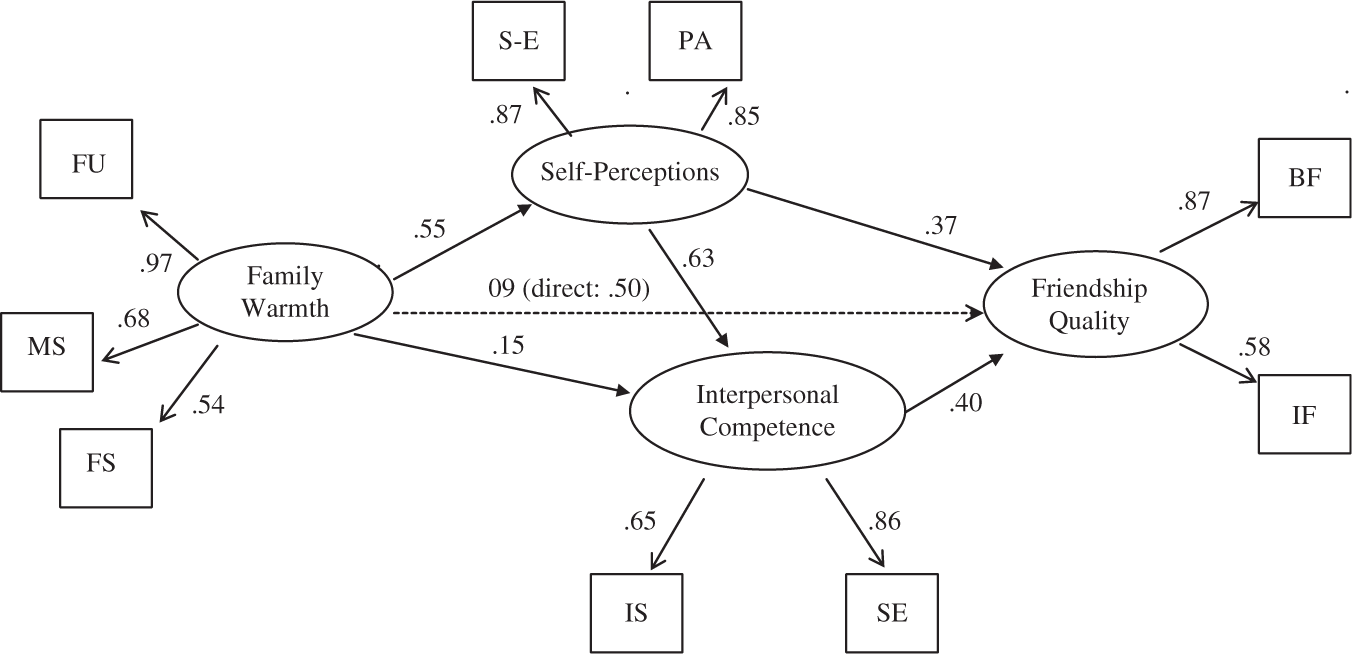
If these first four tests are met, Holmbeck (Reference Holmbeck1997) then recommends testing for fit change between the full model and the hypothesised mediation model, which omits the direct path from predictor to outcome. Together with adequate models in the first four steps, the lack of significant decline in fit between the mediation model relative to the full model provides the final basis for inferring mediation. As shown in Table 2, when compared to the full model, the mediation model in step 5 showed no significant decrement in model fit relative to the full model in step 4, Δχ2(1) = 2.76, p = ns. This provides the basis for inferring mediation. As noted in Figure 1, the structural path between the predictor and outcome, family warmth to friendship quality, declined from a robust significant effect in Model 1, β = .50, p < .001, to non-significance in the full model, Model 4, β = .09, p = ns. In summary, self-perceptions and interpersonal competence mediated the relationship between family warmth and friendship quality. This finding confirms the second hypothesis of the study and supports the underlying theory.
Full model (Model 4). Indicators are: Family Understanding (FU), Mother Support (MS), Father Support (FS), Self-Esteem (S-E), Positive Affect (PA), Interaction Skills (IS), Social Engagement (SE), Bonds with Friends (BF), Interactions with Friends (IF).

Partial model tests
In addition to the twin mediators of self-perception and interpersonal competence as advanced by the theory (Rohner, Reference Rohner1986), we also examined each mediator separately for evidence of partial mediation. With self-perception as the sole mediator, the full model remained a significantly better fit to the data compared to the single mediator model, Δχ2(1) = 5.83, p < .05. Similarly, for interpersonal competence, the full model also proved to be a better fit than the single mediator model, Δχ2(1) = 12.05, p < .01. Although neither mediator independently evidenced complete mediation, each remained a partial mediator. Compared to the direct effect between family warmth and friendship quality, β = .50, the effect reduced to β = .14, with self-perception as a mediator. Similarly, the direct effect reduced when interpersonal competence was added to the model, β = .21. In summary, both self-perceptions and friendship quality played partial mediating roles, and jointly, they fully mediated the relationship between family warmth and friendship quality.
Discussion
The findings confirm two hypotheses: (a) warmth in the family of origin relates to friendship quality during emerging adulthood, and (b) self-perceptions and interpersonal competence together mediate the link between family warmth and friendship quality. Overall, these study findings add specificity to the tenets of IPARTheory (Rohner, Reference Rohner2016), extend knowledge about emerging adulthood, and imply strategies for enhancing friendship quality.
The findings add further evidence to the foundational tenant of IPARTheory (Rohner, Reference Rohner2016) and advance key mechanisms that link warmth and psychological adjustment. Regarding the centrality of parental warmth for psychological adjustment, the findings associate warmth with three important indicators in the lives of emerging adults: self-perceptions, interpersonal competence, and friendship quality. The findings further extend IPARTheory by implicating two overall dispositions that mediate the effects of family warmth in emerging adulthood. The internal disposition of self-perception and the behaviours of interpersonal competence join an expanding list of dispositional and behavioural implications advanced in IPARTheory (Khaleque & Rohner, Reference Khaleque and Rohner2012; Rohner & Khaleque, Reference Rohner and Khaleque2010).
Besides these theoretical contributions, the findings here extend knowledge about development during emerging adulthood. Warmth in the family of origin continues to play a key role in emerging adulthood. As evidenced here, even beyond the adolescent years, family warmth still shows important associations with self-perceptions, interpersonal competence, and friendship quality. Moreover, these family, personal, and friendship qualities have continuing relevance for emerging adults in the areas of marriage and parenthood. Characteristics such as resolved family relations, positive self-perception and interpersonal competencies are among criteria that most young adults view as necessary for marriage (Carroll et al., Reference Carroll, Badger, Willoughby, Nelson, Madsen and Barry2009) and also reflect themes that predict positive parenting in the family of creation (Lee et al., Reference Lee, Anderson, Horowitz and August2009).
In addition to contributing to theory and knowledge, the current study findings have implications for educational and developmental psychologists because they suggest strategies for enhancing development during emerging adulthood. The mediation by self-perception and interpersonal competence provides clues for improving friendships in academic, work and community settings. Emerging adults who experienced rejection or low warmth in the family of origin, for example, retain the potential to change self-perceptions and interpersonal competencies during emerging adulthood. Prior research has documented that change in self-perceptions does indeed occur during emerging adulthood (Chung et al., Reference Chung, Robins, Trzesniewski, Noftie, Roberts and Widaman2014) and that teaching interpersonal skills has benefits for subsequent relationships (Licciardello, Harchick, & Luiselli, Reference Licciardello, Harchik and Luiselli2008). Such changes are consistent with a view of self-perception and interpersonal competence as not merely passive outcomes, but as active processes undertaken by emerging adults. Prior research with emerging adults supports the view that feelings about oneself derive from a dynamic process involving selective perception, active interpretation, and selective memory (Tafarodi, Tam, & Milne, Reference Tafarodi, Tam and Milne2001). The active-processes view is also implied in prior research showing that interpersonal competencies in early adulthood buffered the effects of adverse family conditions (Brown, Oudekerk, Szwedo, & Allen, Reference Brown, Oudekerk, Szwedo and Allen2013).
The contributions and findings from this study are constrained by several limitations. First, the current sample is from a primarily American residential student population. Emerging adults in other living situations or other cultures may vary with respect to family warmth. Prior research suggests that family is important for both college student and worker samples (Crocetti & Meeus, Reference Crocetti and Meeus2014), but the pattern of relations across constructs cannot be assumed for non-residential or working samples. Second, because the data were self-reported, the observed effect sizes may overestimate the underlying relationships. Nevertheless, the higher internal consistency estimates observed in this study relative to earlier measures extend the potential of these measures for use with young adults. Last, theoretical tenets and time precedence support the logical sequence of the variables, but the contemporaneous data collection precludes conclusions of causality.
Though focused on family and friendship contexts, the current study shows potential for educational and developmental psychologists’ future research. Besides family, other contexts, such as education, employment and voluntary organisations, could be examined in relation to the mediators and outcomes. Moreover, the prior evidence linking family of origin and romantic relationships (Anderson et al., Reference Anderson, Johnson, Liu, Zheng, Hardy and Lindstrom2014; Seiffge-Krenke, Overbeek, & Vermulst, Reference Seiffge-Krenke, Overbeek and Vermulst2010) implies the plausibility of testing these specific mediators in the narrower, but salient field of romantic relationships.
Overall, the current study findings suggest a process model for further theory, research, and intervention. Family warmth generates an internal orientation for favourable self-schema and an outward orientation toward interpersonal competence. Concurrently, these internal and outward orientations provide a foundation for developing high-quality friendships. These processes provide clues for researchers, professionals, and organisations about ways to enhance the lives of emerging adults.
Financial support
This research received no specific grant from any funding agency, commercial, or not-for-profit sectors.
Conflicts of interest
None.
Ethical standards
The authors assert that all procedures contributing to this work comply with the ethical standards of the relevant national and institutional committees on human experimentation and with the Helsinki Declaration of 1975, as revised in 2008.