Introduction
With traumatic injuries and cardiovascular disease among the leading causes of death in the world,1 and with the potential increase in disasters due to climate change,Reference O'Brien, O'Keefe, Rose and Wisner2 prehospital emergency health care system development should be viewed as a critical evolutionary step in health system development in developing and lower middle-income countries. Basic prehospital emergency medical care has been proven to reduce morbidity and mortality in injury3 and cardiovascular disease-related emergencies, while also being a key component of planning for disaster response.4 More specifically, low-cost prehospital emergency medical care in developing and lower middle-income countries can have a significant impact on trauma mortality.Reference Husum, Gilbert, Wisborg, Van Heng and Murad5
This report presents the methods, results, and reasons for success in developing a prehospital emergency medical care services (EMS) system in Jaffna, Sri Lanka. The goal of this presentation is to add to the literature surrounding EMS in developing countries by providing insight into implementing prehospital emergency care systems in developing and lower middle-income settings.
The setting of this system development is the governmentally demarcated district of Jaffna, located at the northernmost point of Sri Lanka. Sri Lanka had an estimated population of 21 million in 2009, and an estimated gross domestic product (GDP) of US $4,300 purchasing power parity (PPP) in 2008.6 According to the World Bank's categorization of countries, Sri Lanka is considered to be a lower middle-income country. The Jaffna District had an estimated population of 559,619,7 including an internally displaced persons (IDP) population of approximately 11,000, as of June 16, 2009 (the median time point in the system's development).8 Until recently, the Jaffna District had been a center point in the 26-year civil conflict that engulfed Sri Lanka.
The district of Jaffna has displayed several signs indicating the need for a functioning prehospital EMS system. In 2007, traumatic injuries were listed as the leading cause of hospitalizations in the Jaffna District.9 Of equal importance, many health care personnel have fled the area, the health system has not been developed as quickly as in other parts of the country, and projects for improving the health system have become increasingly difficult to accomplish as a result of its proximity to conflict.Reference Nagai, Abraham, Okamoto, Kita and Aoyama10, Reference Reilley, Simpson, Ford and DuBois11 Additionally, security policies have limited access to health services in Jaffna District. Most noteworthy, when a nighttime curfew was imposed by the military in August 2006, the number of home birth deliveries increased, and the critically ill had difficulty reaching health services.Reference Ketheeswaran12
The office of Jaffna's Regional Department of Health Services (RDHS) previously had been involved in efforts to bring prehospital EMS to its citizens. In 2007, following observation of the effects of the nighttime military curfew on health access, the RDHS initiated a nighttime ambulance program that was authorized by the Sri Lankan Ministry of Health (MOH) and the Sri Lankan army. This program was operated in conjunction with St. John Ambulance and the Sri Lankan Red Cross, both local nongovernmental organizations (NGOs). As a result of this undertaking, which provided increased numbers of ambulances and trained personnel, the RDHS noted a “great relief” to the public. Based on the success of this program, it was decided to expand the nighttime ambulance service to 24-hour service.
Medical Teams International (MTI) partnered with the RDHS of Jaffna, acting as consultant and implementer in the development of a prehospital EMS system in the Jaffna District. The partnership between MTI and the RDHS was a result of existing relationships with the Sri Lankan government and MTI's disaster relief efforts in the country. Additionally, MTI had been operating in Sri Lanka since December 2004, following the Boxing Day Tsunami.13 In 2007, MTI signed a memorandum of understanding (MOU) with the Sri Lanka Trauma Secretariat to act as a technical advisor for the secretariat in the development of prehospital EMS systems in the country. The Trauma Secretariat is the leader of the MOH's efforts to build a complete trauma system, which includes the establishment of a prehospital EMS system. A US paramedic with significant prehospital emergency medical care delivery and administration experience acted as MTI's lead consultant.
System Development and Implementation
Methods of Development
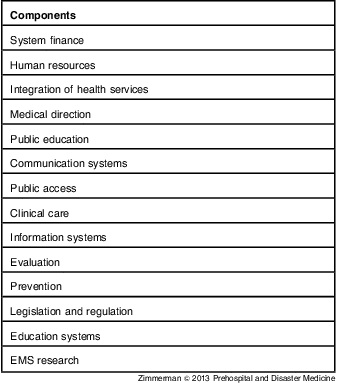
The prehospital development model implemented in Jaffna focused on utilizing the essential components of established prehospital EMS systems in developed countries. Components essential to a prehospital EMS system in the United States have been defined by the National Highway Traffic and Safety Administration (NHTSA), under the US Department of Transportation, and are listed in Table 1. While the development model used in Jaffna did not include all 14 components listed by the NHTSA, the following targeted essential components were agreed upon by implementing partners: (1) system finance; (2) human resources; (3) integration of health services; (4) medical direction; (5) public education; (6) communication systems; (7) public access; (8) clinical care; (9) information systems; and (10) evaluation.
US National Highway Traffic and Safety Administration (NHTSA) Prehospital Emergency Medical Care ComponentsFootnote a
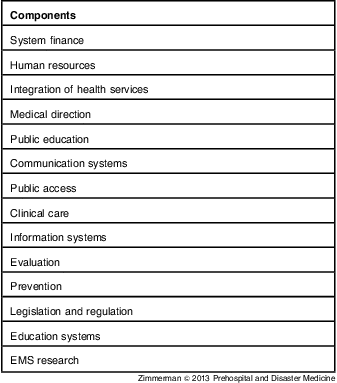
Abbreviation: EMS, Emergency Medical Services
a Source: US National Highway Traffic and Safety Administration
System Finance
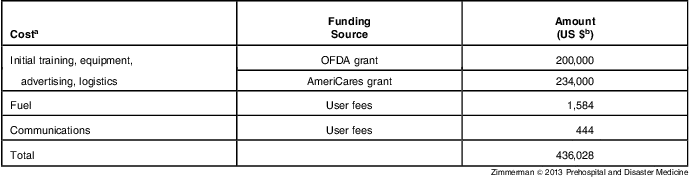
The financing of a prehospital EMS system in Jaffna was diversified and relied on three different sources: (1) two bilateral grants; (2) funding from the existing health system; and (3) a nominal user fee based on the type of services received. A bilateral grant of US $200,000 was awarded to MTI by the US Office for Foreign Disaster Assistance to cover the start-up costs for the system. The start-up grant was awarded on the basis of strengthening the health systems in conflict-affected areas and reaching vulnerable populations. A subsequent grant for US $234,000 was awarded to MTI in July 2009 by AmeriCares, a US NGO, and was used for the development of the system.
The Sri Lankan health system distributes public health funds from the central MOH to regional health systems including Jaffna. These funds are used to operate the public medical system including supplies, equipment, facilities, and human resources. Funding through this mechanism supported the prehospital system in Jaffna by providing human resources to the system. However, this funding was insufficient to cover the additional costs of fuel and communication systems utilized in the prehospital response.
To meet operational costs not covered by governmental funding mechanisms, a nominal user fee based on the type of services performed was agreed upon by the partners of the project. In order to be equitable, and in keeping with the average monthly household income in Jaffna of 36,451 Sri Lankan rupees (LKR),14 a nominal fee of 300 LKR (roughly US $2.70) was established for a non-life-threatening prehospital response. Internally displaced persons, those who had life-threatening traumatic or medical emergencies, or individuals who felt that they could not pay, were exempt from paying the fee.
Human Resources
Ambulance drivers and ambulance attendants were provided emergency medical technician (EMT) training through MTI. In compliance with the standards set by the MOH Trauma Secretariat, training for entry level (Level-1) EMTs in Jaffna was completed after 40 hours of classroom training and successful completion of a comprehensive written examination. Skills taught included those needed to appropriately utilize the equipment. Simultaneously, doctors and nurses who would be involved in receiving emergency patients from ambulances received updated Basic Life Support (BLS) training, as well as training in primary and advanced trauma care. Fifteen of the individuals educated and trained as EMTs for the system also were trained to function as dispatchers for the communication center.
Integration of Health Services
Utilizing start-up funds, 22 government-owned ambulances were upgraded with basic trauma equipment. Facilities that housed an ambulance were integrated into the health system through a communication center. Five large hospitals (Kopai Divisional Hospital, Tellepalai Base Hospital, Chavakachcheri Base Hospital, Chankanai Divisional Hospital, and Delft Island Divisional Hospital) were upgraded with essential trauma equipment in order to facilitate a seamless transition of the patient from prehospital to hospital care. Doctors and nurses were trained to use the equipment as part of their primary and/or advanced trauma care training.
Medical Direction
The Jaffna prehospital EMS system used a combination of on-line and off-line medical direction for out-of-hospital care. First, all EMTs were trained on the standard scope of practice and basic response treatment protocols. Second, through the use of telecommunications, responding EMTs were able to consult with a doctor at a hospital should there be any question concerning medical care. Following the transfer of the patient to the hospital, the receiving doctor provided feedback on the quality or appropriateness of the care provided by the EMT. Additionally, the RDHS office of Jaffna, which is in charge of the administration of the prehospital system, provided medical direction through that administration.
Public Education
Several methods were utilized to educate the public about the development of a prehospital EMS system including mass-media campaigns and direct-education signboards posted throughout the Jaffna District illustrating why and how to access the system. Mass-media education efforts also were undertaken by the RDHS in the form of regular news releases in local newspapers describing the prehospital EMS system in detail. In addition, MTI trained 5,993 community members, teachers, and children in the Jaffna District in the essentials of first aid or first aid awareness. In these programs, participants were taught fracture control, basic airway management, and bleeding control. Included in these programs were instructions on how to access prehospital EMS services for emergencies. Participants were encouraged to share essential first aid skills and knowledge of the new emergency ambulance system with their family members and peers. Each participant was given 10 prehospital EMS informational packets regarding first aid awareness to distribute to 10 other community members.
Communication Systems
The prehospital EMS system relies on a centrally-located call center that can be accessed by any land or mobile telephone by dialing “1-1-0.” The call is answered by an individual, trained as both an EMT and a dispatcher, who responds using a set protocol, dispatches the closest available ambulance, and if required, provides over-the-phone first-aid instructions until the ambulance arrives. When nonemergency calls are received in the call center, the dispatchers are trained to inform the caller that the call center is to be utilized for emergencies only. If needed, the callers are directed to other services such as the police or military.
Public Access
The financial model for this system includes a nominal user fee for services. Under the exception rules, however, those unable to pay for the service are not responsible for the user fee. This waiver is intended to keep the service accessible. Any telephone in the Jaffna District is capable of accessing the 1-1-0 call center, thereby assuring the availability of the service to nearly all of the Jaffna District population.
Clinical Care
The Jaffna District prehospital EMS system implemented basic technology and trained human resources to meet a basic level of clinical care. Twenty-two ambulances were upgraded to meet the World Health Organization's recommendation for basic ambulance equipment4 through a grant from the US Office of Foreign Disaster Assistance. All of the EMTs were provided training in the use of the equipment as part of their overall education. Doctors and nurses also were trained in clinical care using trauma equipment that was provided to the upgraded hospitals.
Information Systems and Evaluation
The call center in Jaffna District has a basic information system that records data including dispatch, type of response, and user fee collection. The dispatcher records the caller information and response data in a spreadsheet. Data are compiled monthly, and the RDHS office evaluates the data.
Other NHST Components
The remaining four prehospital EMS components (prevention, legislation and regulation, education systems and EMS research) recommended by the US National Highway Traffic and Safety Administration are in various stages of development on a national level in Sri Lanka. Prevention is one of the elements envisioned for the complete trauma system under the Trauma Secretariat. The Trauma Secretariat also is a de facto regulator, although no official legislation is in place. At the time of this writing, Medical Teams International, the Sri Lanka Red Cross, and St. John Ambulance–Sri Lanka support prehospital educational efforts throughout the country. Emergency Medical Services research efforts are increasingly being led by the Trauma Secretariat.
Methods
To examine the implementation, both process and operational indicators were used. Using the training logs of MTI as human resource indicators, the numbers of EMTs, doctors, and nurses educated and trained were examined. To show success in communications systems and public access, the initial 11-month utilization rate of the prehospital EMS system was reviewed.
Results
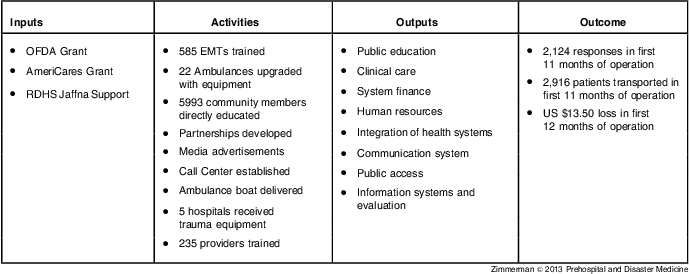
The 24-hour prehospital EMS system has been established, and has been operating in Jaffna since February 11, 2009. An overview of the prehospital system's development and outcomes is in Table 2.
Overview of Jaffna Prehospital EMS System Development Inputs, Activities, Outputs, and Outcomes

Abbreviations: EMS, Emergency Medical Services; EMT, emergency medical technician; OFDA, Office for Foreign Disaster Assistance; RDHS, Regional Department of Health Services
Human Resource and Technical Knowledge Indicators
Three training programs were initiated in November 2008 and continued through July 2009. These programs consisted of: (1) a 40-hour EMT Level-1 training (similar to the US Department of Transportation first responder training); (2) a 16-hour primary trauma care training for nurses; and (3) a 16-hour advanced trauma care courses for doctors and some nurses. A total of 585 persons were provided EMT Level-1 training; of these, 556 individuals (95%) were qualified after passing a comprehensive examination following the 40-hour training session. Of these 556 who were qualified, 220 (39.5%) were nurses who worked within the hospital system; the remaining 336 qualified individuals were available to be used as EMTs in the Jaffna District. These numbers represent a total of 60 EMTs per 100,000 people in Jaffna. For comparison, the US has a rate of 73.4 EMTs and paramedics employed per 100,000 people.15, 16 In addition, 235 health care professionals (85 doctors and 150 nurses) were trained in primary or advanced trauma care. Having human resources educated and trained in recognized emergency medical response standards indicates an achievement in reaching a basic level of clinical care.
Community Awareness Indicators
A total of 90 community awareness/training sessions were conducted, one in each of the district's political subdivisions. Through these sessions, a total of 5,993 people directly received public education related to the use of the prehospital system and first aid awareness. On average, one out of 109 people in the Jaffna District received direct education in first aid awareness. Each of these individuals was encouraged to teach 10 peers or family members, but this was not directly measured.
A countrywide evaluation of prehospital emergency medical services was conducted in 2010 and 2011. Compared with the other districts surveyed, Jaffna residents had the highest rate of awareness of the prehospital care system (59.8%) and knowledge of the importance of first aid before transport (81.8%).Reference Chamara and Raheem17 No baseline measures of these indicators are available for the period before the Jaffna program began.
Anecdotal evidence indicates a shift towards the institutionalization of the system and prehospital emergency care knowledge within the community. It was reported by the RDHS in Jaffna that the curriculum for third grade students at a Jaffna school has been revised to include the quiz question, “How do you call for an ambulance?” (The correct answer was “1-1-0”, the telephone number to access the Jaffna prehospital EMS system.) Additionally, it has been reported that many patients who had the option not to pay the nominal fee would occasionally bring money for payment after being released from the hospital.
Eleven-month Monitoring of System Utilization
During the reporting period following the opening month of February 2009, the prehospital EMS system responded to an average of 208.7 calls per month. Of all emergency ambulance responses, 95% were dispatched as a result of calls received by the 1-1-0 call center. The remaining ambulance responses were dispatched through calls made directly to the hospitals.
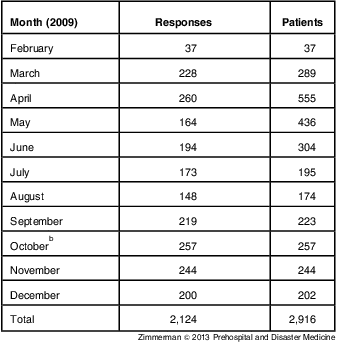
Table 3 displays the total number of responses and the total number of patients who were transported by ambulances within the prehospital EMS system. During the 11-month monitoring period, 2,124 ambulance responses were dispatched, and 2,916 patients were transported by ambulance to Jaffna hospitals. This represents an average of 288 patients per month. The number of patients transported is higher than the total number of ambulance responses because, in some cases, multiple patients were transported from IDP camps to the area hospitals. During March, April, May, and June of 2009, as armed conflict in the neighboring districts came to a conclusion, the national health system was operating in a mass-casualty response mode, and the number of IDP transports was high.
Number of Ambulance Responses and Patients Transported During the First 11 Months of OperationFootnote a
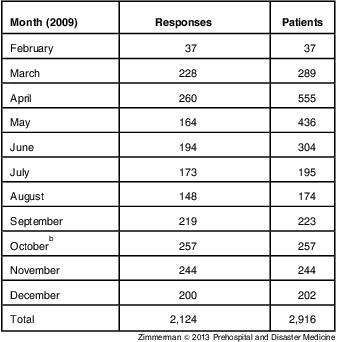
a Source: Call center database, Regional Director of Health Services, Jaffna.
b Patient data were not gathered for October, but at least 257 patients were transported via ambulance responses.
Twelve-month Financial Monitoring
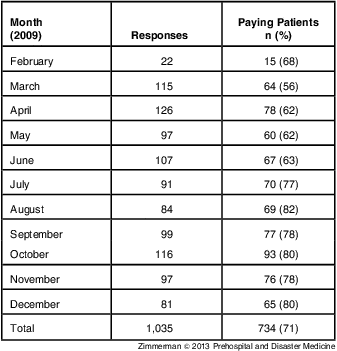
The 1-1-0 call center located at the RDHS office in Jaffna has one ambulance attached to it. It is the most utilized ambulance within the system, and it handled approximately 50% of the responses during the observation period. Table 4 lists the number of emergency responses by the call center ambulance and the user fees received from those responses. During the 11-month observation period, the user fee was received from approximately 71% of the calls responded to by the RDHS office ambulance. This payment rate indicates that the fee was nominal in amount and likely affordable to the public.
Responses by the Regional Department of Health Services (RDHS) Ambulance and the Corresponding Number of Paying Patients during the First 11 Months of OperationFootnote a

a Source: Call center database, Regional Director of Health Services, Jaffna.
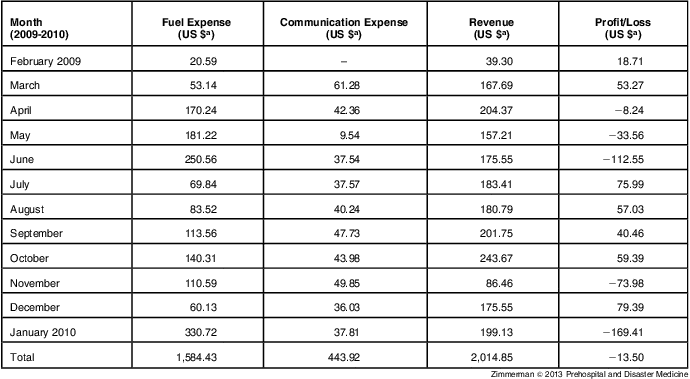
In this system, the expenses of the 1-1-0 call center and the ambulance attached to it include only the communication system and the fuel used by the ambulance to respond to emergencies, both variable costs. Other operational costs, such as human resources, are covered by the Ministry of Healthcare and Nutrition. The separate monthly expenses within the call center, and the revenue generated by the call center ambulance transports are outlined in Table 5. During the 12-month period from the opening of the call center to the end of January 2010, the call center suffered a minimal total loss of approximately US $13.50, and virtually recovered all costs for the communication system and fuel. During the months of April, May, and June 2009 and January 2010, the system experienced a large increase in the cost of fuel required to transport IDPs. Table 6 displays the system start-up and operation costs during the first year of ambulance service. Grant monies were used for all initial training, equipment, advertising and logistics, while communication and fuel became an operational cost to the system as employee salaries were already budgeted for in the existing health system.
Regional Department of Health Services (RDHS) Call Center Profit/Loss During First Year of OperationFootnote b
a Currency was converted at a rate of 114.5 Sri Lankan rupees per US dollar.
b Source: Call center database, Regional Director of Health Services, Jaffna.
System Start-up and First Year Main Ambulance Operational Costs
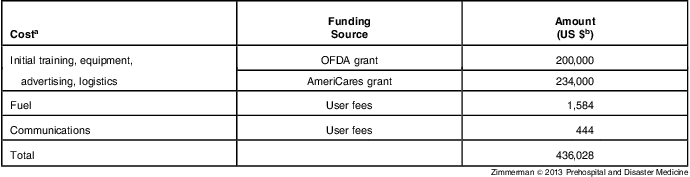
Abbreviation: OFDA, Office of Foreign Disaster Development
aEmployee salaries were already budgeted for in the existing health system.
bCurrency is converted at a rate of 114.5 Sri Lankan rupees per US dollar.
Discussion
When considering the Jaffna system's applicability to other cities, countries, and/or situations, it is important to recognize that one prehospital EMS model does not fit all.Reference MacFarlane and Benn18 As a result, it is prudent to discuss some key conditions that may have led to the successful implementation of the model.
Appropriateness of Developing the Health System and Utilizing Established, Existing Health Services
The Jaffna District of Sri Lanka had an existing health service available to all members of the population as part of its nationalized, government-funded health system. As this system already was providing essential services to the population of Jaffna, health system development efforts could focus on expanding services to deal with existing maladies. In this situation, it was appropriate for a prehospital EMS system to be developed, since injuries had become a major cause of morbidity and mortality. Supplementing the Jaffna health system in coordination with the existing system at an appropriate time in that system's development process likely helped with the acceptance of the prehospital EMS system by the stakeholders in Jaffna.
Coinciding with the Existing Health System and Health Care Norms
While the building of a prehospital EMS system could have been accomplished in other ways, such as establishing a private profit or nonprofit organization to operate existing call services, nearly all of the health services in Jaffna, aside from some pharmaceutical sales, are delivered by the public health care system. As such, the society in Jaffna is accustomed to receiving a majority of health services from that public system. Despite the fact that a user fee is not normally paid for visiting a public health facility, it is common to pay a user fee for drugs in a private pharmaceutical shop, suggesting that it may be considered common practice to pay directly for peripheral health services. Utilizing the existing health system and the norms of health care likely helped with the acceptance of the prehospital EMS system in Jaffna.
Previous Efforts
During the past decade, there has been notable interest in establishing effective prehospital EMS care systems in developing countries in Asia.Reference Joshipura, Hyder and Rehmani19, Reference Kobusingye, Hyder, Bishai, Hicks, Mock and Joshipura20 Prior to the development of Jaffna's prehospital system, efforts had been made to bring prehospital emergency care to different parts of Sri Lanka, especially in the capital city of Colombo. These previous attempts likely helped to promote the need for prehospital emergency care and raise awareness of prehospital EMS among those involved in heath system development efforts. At the same time, valuable lessons were learned from the ongoing development of prehospital EMS in Colombo.
Situational Needs
The need for a prehospital EMS system was apparent in Jaffna. Injuries from accidents already were the leading cause of hospitalization. The area lacked skilled human resources and emergency transportation. These needs were important and likely acted as motivational factors for all partners involved to ensure the success of the system.
Systematic Approach
The framework model used was a systems approach. Utilizing recognized components from an established system in a developed country was essential to the development of Jaffna's prehospital EMS system. Without the completeness of the system, it is likely that the model would not be sustainable or utilized, as flaws in the system would have deterred continued use.
Up-front Support
The receipt of two grants to cover the up-front costs of the system, such as education and training, equipment, and supplies, were critical to the system's development. The Jaffna government does not have the ability to commit funding to many new initiatives, with other priorities needing attention first.
Local Government Support
The local government displayed its commitment to overcoming the adverse effects of the civil conflict by implementing ambulance response efforts in partnership with local NGOs. During the development of the 24-hour 1-1-0 system in Jaffna, the local RDHS oversaw the administration and continuation of the project upon development completion. Without this support, the sustainability and feasibility of the prehospital EMS system would have been in jeopardy.
Ability to Pay
Sri Lanka is a lower middle-income country, which indicates that some disposable income might be available for health care beyond essential services. Without the ability to receive payments, some costs would be difficult to meet, which could impede the sustainability of the system.
Continued Operation
Since the official end of the conflict in Sri Lanka in May 2009, the situation in Jaffna has changed rapidly. Formerly in relative isolation from the rest of the island, a main road now is open that connects Jaffna District with other important cities, thereby allowing the transport of goods from all sectors. The nighttime curfew was lifted in January 2010, which allows for greater movement and access to hospitals. Now that the population of Jaffna District can move freely to reach area hospitals, even during the night, individuals are likely using their own transportation methods to reach in-hospital health care services. This, in turn, has resulted in a lower number of people using the EMS system (although still more than most areas of Sri Lanka), especially people who would normally pay the nominal user fee that subsidizes fuel costs for emergency response situations. Concurrently, advertisement efforts are not as rigorous as they were during the start of the EMS system. These and other developments, while positive for the Jaffna District, already have started to adversely affect the prehospital EMS system. To ensure sustainability of the system, some evolving situations will have to be addressed in the future.
Although a basic data collection system is in place, it does not allow for a complete analysis of the impact of the system. For instance, fee collection and fuel costs were not readily available for ambulances other then the RDHS office ambulance. Additionally, patient transport information, such as presenting ailments, were partially gathered, but not through an organized process.
While the system was close to breaking even financially during the observation period, it begs the question of how new enhancements will be added to ensure that the EMS system can continue to be sustained. How will changes in the physical, environmental, and cultural characteristics of the society be addressed to continue the system? Eventually, equipment will wear out and ambulances will need to be replaced. At the time of this writing, an informal agreement exits with the government, but a formal sustainability commitment in the Northern Province does not exist. Further research and evaluation are needed to examine the changing context in Jaffna, and to, perhaps, modify the current system.
Conclusions
The implementation of a prehospital EMS system and its functioning in Jaffna District, Sri Lanka can be considered successful in terms of utility, and in some regards, financial stability. It has established quality prehospital EMS standards by utilizing trained emergency medical technicians and ambulances that include basic lifesaving equipment. The system has integrated itself as part of the overall health system of the community it is serving, and is accepted by the general public. The system's success should be examined as a potential model for implementing prehospital EMS system development in a similar setting, keeping in mind the factors outside of the model that contributed to its success.
Acknowledgments
The authors would like to thank Dr. Arumugam Ketheswaran and the staff of the Jaffna Health Services Department who work each and every day to provide emergency services to the people of Jaffna. Additionally, the authors would like to extend special thanks and gratitude to Nominathan Raman for his vision and tireless dedication to this project.