Interparental conflict has emerged as a robust predictor of children's externalizing behavior problems (e.g., Cummings, Goeke-Morey, & Papp, Reference Cummings, Goeke-Morey and Papp2004; Cummings, Iannotti, Zahn-Waxler, Reference Cummings, Iannotti and Zahn-Waxler1985; El-Sheikh et al., Reference El-Sheikh, Kouros, Erath, Cummings, Keller and Staton2009; Franck & Buehler, Reference Franck and Buehler2007; Shelton & Harold, Reference Shelton and Harold2008). Few studies, however, have examined how changes in interparental conflict during childhood are related to trajectories of early externalizing behavior problems. Further, research supports that both interparental conflict and children's early externalizing problems are linked with later social functioning. Therefore, empirical studies to date suggest the possible appropriateness of conceptualizing the effect of interparental conflict on children's long-term socioemotional outcomes in terms of a developmental cascade model.
Developmental cascade models posit that early levels and changes in functioning in one domain impact later functioning in a different domain. Propositions consistent with the notion of developmental cascades have been commonly proposed in developmental research, including the development of cognitive and language abilities (Colom, Escorial, Shih, & Privado, Reference Colom, Escorial, Shih and Privado2007; Domsch, Lohaus, & Thomas, Reference Domsh, Lohaus and Thomas2009; Gregory, Marchman, & Fernald, Reference Marchman and Fernald2008; Nettelbeck, Howard, & Wilson Reference Gregory, Nettlebeck, Howard and Wilson2009), and relations between psychosocial functioning and later academic success, substance use, and mental health (e.g., Mason, Hitchings, McMahon, & Spoth, Reference Mason, Hitchings, McMahon and Spoth2007; Masten et al., Reference Masten, Roisman, Long, Burt, Obradović and Riley2005; Oesterle, Hill, Hawkins, & Abbott, Reference Oesterle, Hill, Hawkins and Abbott2008; Schwartz, Gorman, Duong, & Nakamoto, Reference Schwartz, Gorman, Duong and Nakamoto2008). Extending research on the longitudinal associations between interparental conflict and children's adjustment, and consistent with a developmental cascade approach, the present study considered children's early trajectories of externalizing problems as a pathway by which interparental conflict in childhood impacts children's social competence in preadolescence.
Concurrent associations between interparental conflict and child adjustment problems have been demonstrated among a wide age range of children, including children as young as 1 year old, preschool and school-age children, and adolescents (e.g., Benson, Buehler, & Gerard, Reference Benson, Buehler and Gerard2008; Cummings et al., Reference Cummings, Goeke-Morey and Papp2004; Cummings, Zahn-Waxler, & Radke-Yarrow, Reference Cummings, Zahn-Waxler and Radke-Yarrow1981; El-Sheikh et al., Reference El-Sheikh, Kouros, Erath, Cummings, Keller and Staton2009; Jouriles, Pfiffner, & O'Leary, Reference Jouriles, Pfiffner and O'Leary1988; Kouros, Merrilees, & Cummings, Reference Kouros, Merrilees and Cummings2008; Mahoney, Jouriles, & Scavone, Reference Mahoney, Jouriles and Scavone1997). Topics of interparental conflict related to children and child rearing are especially distressing for children and related to higher levels of externalizing problems (e.g., Cummings et al., Reference Cummings, Goeke-Morey and Papp2004; Mahoney et al., Reference Mahoney, Jouriles and Scavone1997). Further, longitudinal links between interparental conflict and child adjustment have also been established. (e.g., Cummings, Schermerhorn, Davies, Goeke-Morey, & Cummings, Reference Cummings, Schermerhorn, Davies, Goeke-Morey and Cummings2006; El-Sheikh & Whitson, Reference El-Sheikh and Whitson2006; Gerard, Krishnakumar, & Buehler, Reference Gerard, Krishnakumar and Buehler2006; Harold & Conger, Reference Harold and Conger1997). These studies typically show that interparental conflict at one time point is related to children's adjustment at a later time point. For example, in a community sample of families with a child between the ages of 8 and 18, Cummings et al. (Reference Cummings, Schermerhorn, Davies, Goeke-Morey and Cummings2006) found that controlling for initial levels of children's externalizing problems, interparental discord predicted higher levels of externalizing problems 2 years later, with children's emotional security emerging as a mediator of this relation. Similarly, VanderValk, de Goede, Spruijt, and Meeus (Reference VanderValk, de Goede, Spruijt and Meeus2007) reported that marital distress predicted adolescent emotional distress 3 years later.
Whereas longitudinal predictions of interparental conflict on later externalizing problems have been investigated, there is a lack of research that considers how changes in interparental conflict and child adjustment are related over time. As noted by Fincham, Grych, and Osborne (Reference Fincham, Grych and Osborne1994), change in marital conflict is not conceptually the same predictor variable as levels of marital conflict. Although levels of early family risk factors, including exposure to interparental conflict, have long-lasting implications for children's development, some family risk processes are not constant, and may vary in level or intensity over time. Specifically, the quality of the marital relationship has been shown to fluctuate and change over time (e.g., Kouros, Papp, & Cummings, Reference Kouros, Papp and Cummings2008; Kurdek, Reference Kurdek1999); thus, it is important to consider how interparental conflict changes over time, and how these changes are related to children's trajectories of adjustment. For example, high initial levels of interparental conflict that decrease over time may have less of a detrimental impact on children's mental and physical health compared to high initials levels of interparental conflict that increase in frequency and severity during childhood.
By focusing on trajectories of interparental conflict, rather than levels of conflict at one point in time, the present investigation advances the study of the time-varying nature of family risk processes. Although the importance of examining changes in interparental conflict and child adjustment has long been underlined as an essential step for process-oriented understanding in this area (Fincham et al., Reference Fincham, Grych and Osborne1994), relatively few studies have examined longitudinal links between trajectories of interparental conflict and child adjustment. Notably, Cui, Conger, and Lorenz (Reference Cui, Conger and Lorenz2005) tested a parallel process model, in which trajectories of marital distress and conflict were examined as predictors of adolescents' adjustment in a five-wave prospectively longitudinal study. Results indicated a positive association between the slope of marital conflict and slope of multiple child outcomes, such that change in marital conflict over time was positively associated with increased delinquency, anxiety, depression, and hostility among adolescent children. The current study builds on Cui et al. by examining how trajectories of interparental conflict and child externalizing problems are related starting in early childhood, a developmental period seldom related to adolescent outcomes in longitudinal research, and following up with assessment of long-term implications for children's social problems in preadolescence.
Interparental conflict has also been related to children's reduced social competence; however, the processes linking interparental conflict with children's later social functioning are not well understood. Studies on relations between interparental conflict and social functioning report that higher levels of interparental conflict are related to peer rejection (e.g., MacKinnon-Lewis & Lofquist, Reference MacKinnon-Lewis and Lofquist1996; Vairami & Vorria, Reference Vairami and Vorria2007), poorer quality of peer relations and friendships (e.g., Lindsey, Caldera, & Tankersley, Reference Lindsey, Caldera and Tankersley2009; Lindsey, Colwell, Frabutt, & MacKinnon-Lewis, Reference Lindsey, Colwell, Frabutt and MacKinnon-Lewis2006; Underwood, Beron, Gentsch, Galperin, & Risser, Reference Underwood, Beron, Gentsch, Galperin and Risser2008), less prosocial behavior (Ladd & Profilet, Reference Ladd and Profilet1996), and impaired social problem solving skills (e.g., Goodman, Barfoot, Frye, & Belli, Reference Goodman, Barfoot, Frye and Belli1999; Pettit, Dodge, & Brown, Reference Pettit, Dodge and Brown1988). Examining relations in the same sample as the present study, McCoy, Cummings, and Davies (Reference McCoy, Cummings and Davies2009) found that interparental conflict when children were in kindergarten was related to less prosocial behavior among children 2 years later, and this association was mediated by children's emotional insecurity. The present paper considers children's early trajectories of externalizing problems as another potential pathway by which interparental conflict is related to children's outcomes in preadolescence.
The developmental psychopathology perspective provides support for the proposition that early trajectories of externalizing problems may be a pathway through which interparental conflict affects later social functioning. That is, a developmental psychopathology approach encourages the study of pathways of behavior and development. Similar to developmental cascade models, a central tenant of this perspective is that early patterns of behavior may set the stage for later maladjustment (Cicchetti & Cohen, Reference Cicchetti, Cohen, Cicchetti and Cohen1995; Cummings, Davies, & Campbell, Reference Cummings, Davies and Campbell2000; Sroufe, Reference Sroufe1997). Difficulties in one domain of functioning may spillover into other domains; therefore, early pathways of development provide valuable information toward understanding the process by which one develops symptoms of psychopathology, or difficulties in another domain of functioning, over time (Masten, Reference Masten2006). Externalizing problems, in particular, may interfere with other developmental tasks (e.g., emotion regulation, coping) that are important for later adjustment (Capaldi & Stoolmiller, Reference Capaldi and Stoolmiller1999; Denham & Holt, Reference Denham and Holt1993; Ladd, Birch, & Buhs, Reference Ladd, Birch and Buhs1999; Ladd, Kochenderfer, & Coleman, Reference Ladd, Kochenderfer and Coleman1996). Children with early behavioral problems are more likely to be rejected by their peers (e.g., Calkins, Gill, & Williford, Reference Calkins, Gill and Williford1999; Coie, Bedling, & Underwood, Reference Coie, Bedling, Underwood, Lahey and Kazdin1988), and children with poor peer relations have less opportunities to acquire and develop social skills. Peer rejection, in turn, has also been linked with lower self-esteem and greater likelihood of developing internalizing problems (Mesman, Bongers, & Koot, Reference Mesman, Bongers and Koot2001; Panak & Garber, Reference Panak and Garber1992). Studies suggest that children with early externalizing problems are more likely to join deviant peer groups, which may serve to maintain or exacerbate children's behavioral problems (Dishion, Reference Dishion2000). Externalizing problems may also reflect deficits in self-regulatory processes, which may interfere with children's social skill development. Accordingly, one pathway by which interparental conflict may be related to children's later social functioning is by placing children on a negative developmental trajectory, which in turn increases their risk for maladjustment in other domains of functioning later in life.
Further reinforcing the possible pertinence of cascade models, empirical studies support that early externalizing problems are associated with other aspects of later social development (Campbell, Reference Campbell1994, Reference Campbell2002; Coie, Dodge, & Kupersmidt, Reference Coie, Dodge, Kupersmidt, Asher and Coie1990; Eiden, Colder, Edwards, & Leonard, Reference Eiden, Colder, Edwards and Leonard2009; Moffitt, Reference Moffitt1993; Newcomb, Bukowski, & Pattee, Reference Newcomb, Bukowski and Pattee1993). Bongers, Koot, van der Ende, and Verhulst (Reference Bongers, Koot, van der Ende and Verhulst2008) examined children's trajectories of externalizing behavior over 7 years, and participants' social functioning in young adulthood was assessed 6 years later. The authors found that trajectories characterized by increasing externalizing problems that began in childhood were related with more severe deficits in social functioning in young adulthood. However, the relation between externalizing problems and later social functioning has not been consistently found (e.g., Burt, Obradović, Long, & Masten, Reference Burt, Obradović, Long and Masten2008), encouraging further study of the longitudinal links between early trajectories of behavioral problems and social competence.
Understanding family and individual factors that may contribute to the development of social functioning is particularly important, as social competence in preadolescents has implications for children's overall well-being, including children's mental health and later academic success. For example, social problems may keep children on a negative trajectory in which externalizing problems are maintained or exacerbated (e.g., Coie, Lochman, Terry, & Hyman, Reference Coie, Lochman, Terry and Hyman1992). Burt et al. (Reference Burt, Obradović, Long and Masten2008) reported that lower levels of social competence in late childhood were associated with higher levels of internalizing problems in adolescence and young adulthood. Similarly, in a Dutch sample of children, Mesman et al. (Reference Mesman, Bongers and Koot2001) found that children's aggression at age 3 predicted increased social problems at age 5, which in turn was associated with later internalizing problems. Thus, impaired social functioning may serve as a risk process by which children remain on negative developmental trajectories and develop other symptoms of psychopathology.
Developmental cascades may look different for boys and girls as a function of exposure to interparental conflict. Gender differences in the association between interparental conflict and children's adjustment are often tested; however, the results across studies are largely inconsistent, with no clear pattern among the findings (Davies & Lindsay, Reference Davies, Lindsay, Grych and Fincham2001, Reference Davies and Lindsay2004). Whereas some studies suggest that interparental conflict is a stronger predictor for girls compared to boys, other studies report the opposite pattern of results. For example, Cui et al. (Reference Cui, Conger and Lorenz2005) reported that marital conflict was related to adolescent hostility for boys, but not girls, whereas Davies and Windle (Reference Davies and Windle1997) found that marital discord was more predictive of girls', but not boys', adjustment problems in adolescence. Several studies report no gender differences in the link between interparental conflict and child adjustment (e.g., Cummings et al., Reference Cummings, Schermerhorn, Davies, Goeke-Morey and Cummings2006; El-Sheikh, Cummings, Kouros, Elmore-Staton, & Buckhalt, Reference El-Sheikh, Cummings, Kouros, Elmore-Staton and Buckhalt2008). Cummings et al. (Reference Cummings, Schermerhorn, Davies, Goeke-Morey and Cummings2006) did not find evidence for gender differences in the relation between interparental conflict and child outcomes in two independent samples of children.
With regard to the relationship between externalizing problems and later social functioning, Bongers et al. (Reference Bongers, Koot, van der Ende and Verhulst2008) proposed that girls may be more likely to have problems with forming quality relationships with peers as a result of externalizing problems; however, this hypothesis was only partially supported. The authors found that both boys and girls with early externalizing problems had difficulty in their peer relationships, although girls with persistent high levels of externalizing problems had greater difficulty compared to boys. In contrast, Mesman et al. (Reference Mesman, Bongers and Koot2001) found significant longitudinal links between externalizing problems in early childhood, social problems when children entered school, and later internalizing problems for boys, but not girls. Yet other studies report no gender differences in the link between externalizing problems and later social functioning (e.g., Keane & Calkins, Reference Keane and Calkins2004).
Thus, based on available evidence, it is unclear whether girls are more or less likely to follow certain developmental trajectories as a function of exposure to interparental conflict in childhood compared to boys. Moreover, there is virtually no precedence for examining relations as a function of child gender across periods as diverse as early childhood and adolescence with regard to developmental issues and challenges. The present study also explores gender differences in the longitudinal pathways between interparental conflict, early trajectories of externalizing problems, and social competence from early childhood to preadolescence.
Present Study
Consistent with notions of developmental cascade models, the present study investigated trajectories of interparental conflict and early externalizing problems, and later social competence in preadolescence. Children and families were followed prospectively for 3 years, beginning when children were in kindergarten, including assessments of interparental conflict, externalizing problems, and social problems. Children's social competence (i.e., social problems, prosocial behavior) was assessed again 5 years later, when children were approximately 12 years old. Children's social competence was assessed using multiple reporters (teachers, parents) in different contexts (school, home). Specifically, three research aims were addressed. First, we examined associations between trajectories of interparental conflict and early trajectories of children's externalizing problems. We hypothesized that trajectories of interparental conflict would positively predict children's trajectories of externalizing problems. That is, higher levels of interparental conflict at the beginning of the study and increased conflict over time (i.e., slope of interparental conflict) would predict increased externalizing problems (i.e., slope of externalizing problems) among children. Second, we tested whether trajectories of interparental conflict and trajectories of externalizing problems in childhood predicted preadolescent social competence, controlling for potential relations between social and externalizing problems already existing in childhood. We hypothesized that there would be a significant indirect effect such that early trajectories of externalizing problems in childhood would be a significant pathway by which interparental conflict in childhood predicts preadolescent social functioning. Third, we explored whether longitudinal pathways between interparental conflict, child externalizing problems, and preadolescent social competence differed as a function of gender. Given inconsistent findings on gender differences in the associations between interparental conflict, externalizing problems, and social competence in previous studies, no specific gender hypotheses were made.
Method
Participants
Participants for this study were part of a larger multisite prospective longitudinal study on family processes and child development, and consisted of 235 mothers, fathers, children (54.9% girls), and their teachers. Families were recruited from a moderate-size city in the Northeast, a small city in the Midwest, and their surrounding areas using flyers sent home with children at local schools, postcards sent to local neighborhoods, sign-ups at community events, and referrals from other participants. To be eligible to participate, couples must have been living together for at least 3 years, have one child currently enrolled in kindergarten, and be able to complete questionnaires in English. The majority of parents were married (88.9%) and couples had been living together on average for 11 years (SD = 4.86 years).
Children's average age at the beginning of the study was 6.0 years (SD = 0.49). Children were 70.2% European American, 14.5% African American, 1.7% Hispanic, and 13.6% biracial. Mothers' and fathers' average age at Time 1 was 36.8 (SD = 6.2) and 35.0 (SD = 5.6) years, respectively. The median and mean yearly combined family income was between $40,000 and $54,999. Approximately 95% of female parents and 89% of male parents were the participating child's biological parents. The retention rate from Time 1 to Time 3 was high, with 91% of the original sample participating at Time 3.
Procedure
During Phase 1 of the study (Time 1–3), families completed measures in a laboratory setting yearly, for 3 years, beginning when children were in kindergarten. Mothers and fathers provided informed consent, and children completed an assent form. The study procedures met the approval of the institutional review board for the protection of human subjects. Mothers and fathers completed questionnaires about themselves, their relationship and their child in separate rooms, and children completed questionnaires with the help of a research assistant. Families were contacted approximately 5 years later, and 194 participated in Phase 2 (Time 4) of the study. Families who did not participate in Phase 2 did not significantly differ from participating families with regard to frequency and severity of conflict or child externalizing problems reported during Phase 1. However, participating families at Time 4 reported significantly higher levels of combined yearly income at Time 1 than families who dropped from the study. At Time 4, children's average age was 12.55 years old (SD = 0.56). In addition, one of the child's teachers (nominated by children and parents as knowing the child well) was contacted to complete questionnaires on children's adjustment at Time 4.
Measures
Interparental conflict
Mothers and fathers reported on interparental conflict on the frequency and severity subscale of the Conflict and Problem Solving Scales (Kerig, Reference Kerig1996) and an abbreviated version of the Child-Rearing Disagreements Scale (CRD; Jouriles et al., Reference Jouriles, Murphy, Farris, Smith, Richters and Waters1991). On the frequency and severity subscale of the Conflict and Problem Solving Scales, parents rated how often they and their partner had minor and major conflicts in the past year on a 6-point Likert scale. Higher scores reflect more frequent and severe conflicts. Cronbach alphas for mothers' and fathers' reports ranged from 0.72 to 0.76 for Time 1 to Time 3. Mothers' and fathers' scores were averaged to create a parent composite of the frequency and severity of marital conflict. The CRD includes eight items describing different topics of disagreements. Parents rated how often they or their partner had disagreements in that area during the past year (e.g., “Being too easy in disciplining our child,” “Not trusting the other person's judgment in certain aspects of child rearing”) on a 6-point scale ranging from 1 (never) to 6 (daily). Items were summed, and higher scores reflect more frequent conflict. Cronbach alpha values for mothers' and fathers' reports across time ranged from 0.75 to 0.80. Mothers' and fathers' CRD scores were averaged to create a parent composite of child-rearing disagreements. An overall composite of interparental conflict was created by standardizing and summing parents' frequency–severity and CRD scores within each time point.
Externalizing problems
Mothers and fathers reported on their child's externalizing problems on the Child Behavior Checklist (Achenbach, Reference Achenbach1991) at Time 1 to Time 3. Parents indicated how true a statement was about their child on a 3-point scale (0 = not true, 1 = somewhat or sometimes true, 2 = very true or often true). The externalizing subscale includes symptoms of aggression and delinquency, and higher scores reflect higher levels of externalizing problems. Internal consistency of mothers' and fathers' reports across the three time points were acceptable (Cronbach α = 0.87–0.90). Mothers and fathers reports were significantly correlated at each time point (r = .51–.55, p < .01) and were averaged within each time point to create a parent composite of externalizing problems.
Early social problems
Parents completed the Child Behavior Scale (Ladd & Profilet, Reference Ladd and Profilet1996), and Time 1 reports were used in the current study to control for relations between social and externalizing problems in early childhood. Parents rated the extent to which a list of descriptions applied to their child on a 3-point scale (1 = does not apply, 2 = applies sometimes, 3 = certainly applies). Three subscales of the Child Behavior Scale were utilized: excluded by peers (seven items; e.g., not chosen as playmate by peers), asocial (six items; e.g., withdraws from peer activities), and prosocial behavior (seven items; e.g., offers help or comfort when other children are upset). Internal consistency of mothers' reports for the three subscales were 0.83, 0.73, and 0.64, respectively. Internal consistency of fathers' reports for the three subscales were 0.84, 0.71, and 0.70, respectively. Items for the Prosocial Behavior Scale were reverse scored and mothers' and fathers' reports across the three subscales were averaged to create a parent composite of Time 1 social problems (composite Cronbach α = 0.61).
Adolescent outcomes
Teachers and parents reported on adolescents' social competence. Teachers completed the Strengths and Difficulties Questionnaire (Goodman, Reference Goodman1997). The Strengths and Difficulties Questionnaire is a widely used measure of psychological adjustment appropriate for use with children and adolescents. The prosocial subscale was used in the current study and includes five items. Teachers rated how true statements were about the participating child on a 3-point scale (0 = not true, 1 = somewhat true, 2 = certainly true). Sample items include “Considerate of others people's feelings” and “Helpful if someone is hurt, upset, or feeling ill.” Internal consistency of this measure was 0.79. Parents reported on children's social problems on the social problems subscale of the Child Behavior Checklist, which includes eight items. Parents rated how true a statement was about their child on a 3-point scale (0 = not true, 1 = somewhat or sometimes true, 2 = very true or often true). Internal consistency of mothers' and fathers' reports were 0.72 and 0.69, respectively. Mothers' and fathers' reports were significantly correlated (r = .58, p < .01), and were therefore averaged to create a parent composite of social problems.
Results
Descriptive statistics
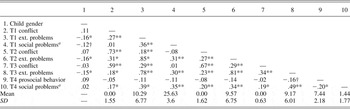
Quantile–quantile plots of the study variables indicated that parent-reported child externalizing problems across time and parent-reported adolescent social problems were positively skewed. A square root transformation was applied to these variables, and the transformed scores were used in analyses (Tabachnick & Fidell, Reference Tabachnik and Fidell2001). The means, standard deviations, and intercorrelations among the study variables are presented in Table 1. Girls had lower levels of externalizing problems compared to boys at Times 1–3; however, gender was not associated with adolescent prosocial behavior or social problems. Interparental conflict was positively correlated with levels of externalizing problems across time, and externalizing problems were positively correlated with adolescent social problems, supporting our theoretical model.
Means, standard deviations, and intercorrelations among study variables

Note: N = 235 at Time 1 (T1), 225 at Time 2 (T2), 215 at Time 3 (T3), and 194 at Time 4 (T4). Ext., externalizing.
aDifferent questionnaires assessed social problems at T1 and T4. For externalizing problems and T4 social problems, means and standard deviations of original variables and correlations with transformed variables are presented. Conflict means and standard deviations of standardized composite.
†p < .10. *p < .05. **p < .01.
Data analysis plan
As a preliminary analysis, a latent growth curve model (LGCM) of children's externalizing problems was fit, controlling for child gender. Structural equation models were fit using the AMOS 17.0 statistical software (Arbuckle, Reference Arbuckle2008). LGCMs measure interindividual differences in intraindividual change (Bollen & Curran, Reference Bollen and Curran2006). Given participants have been assessed three or more time points, LGCMs estimate the average intercept (e.g., initial level) and average slope (rate of change) among participants using maximum likelihood estimation. The intercept and slope parameters are used to describe the average growth curve of the variable of interest for the sample. Variability in these parameters is also estimated, such that predictors can be included in the model to examine individual differences in initial levels of the outcome variable and/or in the rate of change. An advantage of maximum likelihood estimation in LGCMs is that all available data are utilized, so cases with missing data are not excluded (Singer & Willet, Reference Singer and Willet2003).
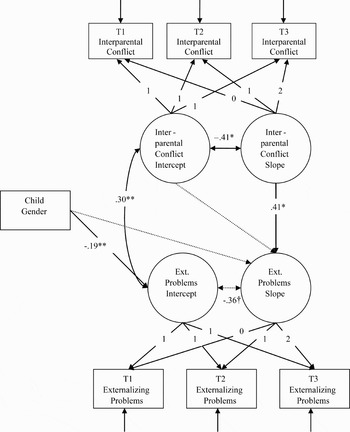
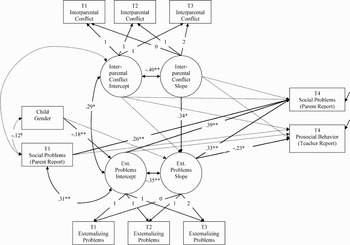
To examine whether trajectories of interparental conflict predicted children's early trajectories of externalizing problems we fit a parallel process model. Parallel process models are an extension of LGCMs in which two separate growth curves and the relations between them are examined (Cheong, MacKinnon, & Khoo, Reference Cheong, MacKinnon and Khoo2003; Flora, Khoo, & Chassin, Reference Flora, Khoo, Chassin, Little, Bovaird and Card2007). Specifically, we fit a model in which the intercept and slope of interparental conflict predicted the slope of externalizing problems over time (Figure 1). This model therefore tests whether levels of interparental conflict at Time 1 and change in interparental conflict over time predict change in children's externalizing problems, controlling for child gender. Next, we fit a parallel process model in which we examined whether early trajectories of interparental conflict and child externalizing problems predicted adolescent social competence, controlling for child gender and for relations between social and externalizing problems that may have already existed in early childhood (Figure 2). Finally, we tested gender as a moderator to examine whether the associations between trajectories of interparental conflict and externalizing problems in childhood and preadolescent social competence differed for boys compared to girls.
The parallel process model examining the trajectories of interparental conflict and early externalizing problems. Standardized parameter estimates are presented. Dotted lines represent nonsignificant paths. †p < .10. *p < .05. **p < .01.

The parallel process model examining the trajectories of interparental conflict and early externalizing problems as predictors of adolescent outcomes. Standardized parameter estimates are presented. Dotted lines represent nonsignificant paths. Residual errors of interparental conflict and externalizing problems variables were estimated but not included in the model. †p < .10. *p < .05. **p < .01.

Preliminary analysis: Univariate LGCM of early externalizing problems
As a preliminary analysis, we first examined linear change in children's externalizing problems in childhood, controlling for child gender. This model provided a good fit to the sample data, χ2 (2, N = 235) = 1.15, p = .56, χ2 (0.58), normalized fit index (NFI) = 0.99, comparative FI (CFI) = 1.00, root mean square error of approximation (RMSEA) = 0.00. Results indicated that on average children's externalizing problems decreased over time (b = –0.08, SE = 0.03, p < .01). Moreover, there were significant individual differences in children's levels of externalizing problems at Time 1 (b = 0.911, SE = 0.11, p < .01) and in their rates of change (b = 0.07, SE = 0.03, p < .05), supporting the inclusion of predictors of children's intercept and slope in the model. Child gender significantly predicted the intercept, such that girls had lower levels of externalizing problems at Time 1 compared to boys (b = –0.32, SE = 0.13, p < .05).
Parallel process model examining changes in interparental conflict and early externalizing problems
Results from the first parallel process model are presented in Figure 1. This model provided a good fit to the sample data, χ2 (12, N = 235) = 27.15, p = .01, χ2 (2.26), NFI = 0.98, CFI = 0.97, RMSEA = 0.07. The slope for interparental conflict was not significant; however, there was significantly variability in the slope parameter (b = 0.34, SE = 0.11, p < .01), indicating individual differences in trajectories of conflict over time. Moreover, trajectories of interparental conflict significantly predicted early trajectories of children's externalizing problems; that is, increased conflict over time was related to increased externalizing problems over time (b = 0.16, SE = 0.06, p < .01). This model predicted 17.2% of the variance in children's change in externalizing problems.
As an alternative model, we also tested whether children's trajectories of externalizing problems predicted interparental conflict over time. Neither children's initial levels of (b = 0.07, SE = 0.06, p = .21) nor change in externalizing problems (b = 1.07, SE = 0.67, p = .11) predicted changes in interparental conflict over time.
Early trajectories of interparental conflict and externalizing problems as predictors of preadolescent social competence
The parallel process model examining trajectories of interparental conflict and externalizing problems as predictors of preadolescent outcomes, controlling for child gender and Time 1 relations between social and externalizing problems, provided a good fit to the sample data, χ2 (23, N = 235) = 44.68, p = .00, χ2 (1.94), NFI = 0.96, CFI = 0.98, RMSEA = 0.06. The results of this model are presented in Figure 2. Trajectories of interparental conflict did not directly predict adolescent outcomes. However, change in interparental conflict positively predicted change in externalizing problems in childhood (b = 0.18, SE = 0.06, p < .05), which in turn predicted increased social problems (b = 0.56, SE = 0.15, p < .01) and less prosocial behavior (b = −1.67, SE = 0.81, p < .05) 5 years later in preadolescence. These indirect effects were tested using the Sobel test. The indirect effect from the slope of interparental conflict to preadolescent social competence was significant (z = 2.41, p < .05); however, the indirect effect from the slope of interparental conflict to preadolescent prosocial behavior was not (z = 1.73, p = .07). In addition, there was a positive association between children's externalizing problems at Time 1 and adolescent social competence (b = 0.20, SE = 0.04, p < .01). This model accounted for 31.4% and 7.6% of the variance in adolescent social problems and prosocial behavior, respectively.
Multigroup parallel process model: Gender as a moderator
Next, we conducted multigroup analyses to examine whether there were gender differences in the associations between early trajectories of interparental conflict and externalizing problems in childhood and preadolescent social competence. Multigroup analyses compared a series of increasingly restrictive nested models, in which parameters are constrained to be equal across groups, to test whether parameters are invariant across group. A significant chi-square difference test would indicate that the parameter(s) differ between groups. A nonsignificant chi-square difference between two models, however, would indicate that the constrained parameter(s) is equivalent across groups, and this constraint(s) is held as additional constraints are placed on the model.
The first series of models established group equivalence in the residual errors of the interparental conflict and externalizing problem variables, the mean level of interparental conflict at Time 1 (intercept), the average rate of change in interparental conflict and externalizing problems over time (slopes), as well as the variance of the intercept parameter for interparental conflict and the variance of the intercept and slope parameters for children's externalizing problems. Next, of central interest to the current study, we tested the pathway between the slope of interparental conflict, the slope of externalizing problems, and preadolescent social problems. Neither the path from change in interparental conflict to change in externalizing problems, Δχ2 (1) = 1.28, nor the paths from change in externalizing problems to social problems, Δχ2 (1) = 1.66, or prosocial behavior, Δχ2 (1) = 2.16, differed for boys as compared to girls. All other pathways also did not differ based on child gender. Gender differences were found, however, in the intercept of externalizing problems, Δχ2 (1) = 8.25, p < .05; that is, boys' had higher initial levels of externalizing problems at Time 1 (b = 3.39, SE = 0.10, p < .01) compared to girls (b = 3.07, SE = 0.08, p < .01). The final model, which included equivalence in all parameters, except the intercept of children's externalizing problems and the variance of the slope of interparental conflict, provided a good fit to the sample data, χ2 (64) = 91.88, χ2 (1.44), NFI = 0.91, CFI = 0.97, RMSEA = 0.04.
Discussion
The present study investigated cascade models for conceptualizing the longitudinal relations between interparental conflict, early externalizing problems in childhood, and social competence in preadolescence. Specifically, building on previous research, the present study examined (a) longitudinal pathways between trajectories of interparental conflict and early externalizing problems in childhood and (b) trajectories of early externalizing problems as a pathway through which changes in interparental conflict in childhood predict social competence in preadolescence. Numerous studies have reported links between interparental conflict and child externalizing problems (e.g., Cummings et al., Reference Cummings, Schermerhorn, Davies, Goeke-Morey and Cummings2006; El-Sheikh et al., Reference El-Sheikh, Kouros, Erath, Cummings, Keller and Staton2009; Franck & Buehler, Reference Franck and Buehler2007). However, research to date has typically examined how levels of interparental conflict at one point in time were related to children's adjustment, thereby not considering that interparental conflict, like other family risk processes, may change over time. Thus, a notable contribution of the current study is capturing the time-varying nature of interparental conflict, and demonstrating how change in interparental conflict predicts change in children's externalizing problems.
Consistent with our hypothesis, the findings indicated that trajectories of interparental conflict and externalizing problems were positively related during childhood, such that conflict that increased predicted increasing externalizing problems over time. Our findings extended the work of Cui et al. (Reference Cui, Conger and Lorenz2005) pertinent to developmental cascades, by showing how trajectories of interparental conflict and child externalizing problems are related in early childhood, a critical period in which children's behavior problems may interfere with other developmental outcomes.
Furthermore, our findings indicated that there was a significant indirect effect, such that increases on interparental conflict were related to increases in children's externalizing problems during childhood, which in turn predicted higher levels of social problems in preadolescents. Although there are likely multiple mediators that jointly account for the longitudinal link between interparental conflict and child adjustment (e.g., children's emotional security, parent–child relationship), the present study highlights that early trajectories of behavior problems as a result of interparental conflict may be an additional mechanism by which children develop later social problems. Therefore, interparental conflict has far-reaching implications for children's development, and its effects are not limited to the short term. Consistent with developmental cascade notions, the findings suggest that interparental conflict sets in motion a chain of processes whereby impairment in one domain of functioning (externalizing problems) can contribute to impairment in other domains of functioning (social competence) across time. It is important that this indirect effect was supported controlling for relations between social problems and externalizing symptoms that may have already existed in early childhood; therefore, the observed cascade effects cannot be fully attributed to early deficits in social functioning. Moreover, this finding illustrates a key theoretical principle of developmental psychopathology: children's developmental outcomes, in this case behavioral problems, are not endpoints, but rather processes in and of themselves that provide valuable information on how and why children may follow certain trajectories of maladjustment versus trajectories toward adaptive behavior.
However, questions remain about the processes or mechanisms that may explain each of the links, including why (a) changes in interparental conflict are related to changes in externalizing symptoms and (b) why increases in externalizing symptoms are associated with social problems in adolescence. Progress has been made in identifying mechanism that account for the longitudinal association between interparental conflict and externalizing problems, including children's emotional insecurity (e.g., Cummings et al., Reference Cummings, Schermerhorn, Davies, Goeke-Morey and Cummings2006; El-Sheikh et al., Reference El-Sheikh, Cummings, Kouros, Elmore-Staton and Buckhalt2008), children's appraisals of threat and self-blame (Buehler, Lange, & Franck, Reference Buehler, Lange and Franck2007; Grych, Harold, & Miles, Reference Grych, Harold and Miles2003), and the quality of the parent–child relationship (Gerard et al., Reference Gerard, Krishnakumar and Buehler2006; Schoppe-Sullivan, Schermerhorn, & Cummings, Reference Schoppe-Sullivan, Schermerhorn and Cummings2007). However, whether these same mechanisms account for the longitudinal links between trajectories of conflict and child adjustment awaits empirical testing. A goal for future research is to understand how increases or decreases in interparental conflict over time impact change in mediating processes that account for increases or decreases in children's behavioral problems. Toward this goal, Richmond and Stocker (Reference Richmond and Stocker2007) found that changes in children's exposure to marital conflict were positively associated with changes in their appraisals of conflict from childhood to adolescence.
Our findings are consistent with previous studies that have reported associations between externalizing problems and social functioning; however, this research was typically limited to examining relations only within early childhood. For example, externalizing problems among preschool children (e.g., aggressive or oppositional behavior, negative emotional responding) have been found to predict social functioning 1 year later in kindergarten (Keane & Calkins, Reference Keane and Calkins2004) and declines in social functioning from kindergarten to third grade (Vaughan Sallquist et al., Reference Vaughan Sallquist, Eisenberg, Spinrad, Reiser, Hofer and Zhou2009). Mesman et al. (Reference Mesman, Bongers and Koot2001) reported that aggressive behavior at age 3 predicted greater social problems at age 5 among boys in a Dutch sample of children. The present study contributed to this literature by demonstrating how early trajectories of externalizing behavior impact children's social competence in preadolescence, a developmental period in which social skills and peer relations have implications for their overall well-being, including self-esteem, internalizing problems, and academic success.
The finding that changes in interparental conflict, and not level of conflict at Time 1 (i.e., intercept), predicted early trajectories of externalizing problems has important and promising implications for prevention and intervention programs. The results suggest that by accounting for early levels of interparental conflict, programs aimed at reducing interparental conflict can have beneficial effects on children's behavioral problems. Initial levels of interparental conflict were low in our community sample, and replication is clearly needed with families experiencing more severe forms of conflict. It may likely be the case that children who witness severe forms of physical aggression, and/or are victims of this aggression, may require additional treatment regardless of whether levels of conflict subside. Notably, this study highlights that risk factors are not static, and it is equally important to consider how these risk processes change over time when investigating children's developmental trajectories.
Although the findings suggest that early trajectories of externalizing problems place children at risk for social problems, the next step in research is identifying what specific aspects of externalizing problems contribute to impaired social functioning. Theoretical and empirical perspectives have posited that children with early externalizing behavior problems are less likely to form quality peer relationships and more likely to join deviant peer groups (Calkins et al., Reference Calkins, Gill and Williford1999; Dishion, Reference Dishion2000). Therefore, these children have fewer opportunities to develop social skills that are critical for normative social competence. In an observational study of young children's interactions during school, Eisenberg and colleagues (Reference Eisenberg, Fabes, Murphy, Shepard, Guthrie and Mazsk1999) found that children's angry reactions toward peers was predictive of poorer social functioning 4 years later, and evidence suggested that a lack of social skills partially mediated this relationship. The findings of the current study, combined with previous research, therefore, offers two potential areas that prevention or intervention may target: programs aimed at reducing negative, destructive interparental conflict, and programs aimed at improving social skills among children who begin to show symptoms of externalizing problems.
Gender differences were not found with regard to longitudinal pathways between interparental conflict, early externalizing problems and later social competence. Whereas some studies have found evidence for gender differences in children's vulnerability to interparental conflict (e.g., Cui et al., Reference Cui, Conger and Lorenz2005; Davies & Windle, Reference Davies and Windle1997), and in the association between externalizing problems and social problems (e.g., Mesman et al., Reference Mesman, Bongers and Koot2001), findings from previous studies have been inconsistent. Although the current study did not find evidence that girls or boys were more vulnerable to either externalizing problems or social problems, research indicates that there are significant gender differences in rates of various types of psychopathology (e.g., externalizing problems, depression). Therefore, elucidating the underlying factors that may place girls or boys at greater risk for impaired functioning in the context of interparental conflict remains a goal for future research.
There are several limitations of the current study that merit mention. Findings from our community sample may not generalize to other families experiencing more severe forms of interparental conflict. For example, children exposed to high levels of physical aggression in early childhood may be less likely to respond to changes in aggression. Replication of the findings in other samples is clearly needed. Our study utilized questionnaire data, whereas observational measures may have better captured some of the constructs. Although we had two reporters of preadolescents' social competence in two difference settings (school, home), observations of children's behavior toward peers, for example, may have provided additional valuable information about children's social competence that teachers and parents may not have been aware of. The current study also assessed interparental conflict but did not include children's perceptions of interparental conflict, which is a key component in the chain of effects from interparental conflict to children's adjustment. For example, children's perceptions of interparental conflict are critical for their emotional security about the family, which has been found to be a robust mediator in the link between conflict and child adjustment (e.g., Cummings et al., Reference Cummings, Schermerhorn, Davies, Goeke-Morey and Cummings2006).
At the same time, this study offers novel contributions to our understanding of how and why interparental conflict is related to children's social problems in preadolescents, and shows that impairments in one domain of functioning during one developmental period (i.e., externalizing problem in childhood) can impact later functioning in a different domain during a different developmental period (i.e., social competence in preadolescence). It is important to note, however, that interparental conflict does not happen in isolation, and evidence suggests that interparental conflict co-occurs with other family risk factors, such as parental depression and problem drinking (e.g., Keller, Cummings, Davies, & Mitchell, Reference Keller, Cummings, Davies and Mitchell2008; Kouros, Papp, et al., 2008). Therefore, the effect of interparental conflict on children's adjustment likely depends on other risk factors (Fincham et al., Reference Fincham, Grych and Osborne1994). For example, Kouros et al. (Reference Kouros, Merrilees and Cummings2008) found that the effect of marital conflict on children's emotional security was stronger in the context of higher paternal depressive symptoms compared to lower levels of fathers' symptoms. Toward a better understanding of children's developmental trajectories, studies should investigate multiple risk factors and how they operate together to contribute to children's developmental trajectories.