Significant outcomes
Lowering the amount of anergy delivered in maintenance ECT patients led to an increase of seizure quality.
Limitations
Our study is retrospective. These results need replication in a larger group of patients included in a prospective study before generalisation.
Introduction
Psychiatrists use electroconvulsive therapy (ECT) to treat various psychiatric conditions such as major depressive disorders (MDD), schizophrenia, mania or catatonia (1). It is a safe and efficient neuromodulation technique (2). Its main side effects are headaches, myalgia and cognitive impairment (including retrograde amnesia) (Reference Andrade, Arumugham and Thirthalli3). It is a medically-controlled seizure delivered by a device, while the patient is under anaesthetic control. The amount of energy depends on several stimulation parameters such as frequency, pulse width, intensity and duration of the stimulation. Theoretical and empirical evidence suggest that stimulation parameters exert neurobiological effects (Reference Peterchev, Rosa, Deng, Prudic and Lisanby4). Both therapeutic effects and adverse events depend on the amount of electricity delivered and the stimulation parameters; nowadays brief and ultra-brief stimuli are preferred because of the equivalent efficiency and lower rates of adverse events (Reference Sackeim, Prudic, Nobler, Fitzsimons, Lisanby, Payne, Berman, Brakemeier, Pereta and Devenand5).
When psychiatrists use ECT as a treatment of acute episodes, one can consider continuation-ECT and maintenance ECT as a reasonable tool to prevent relapse of the current episode. Continuation ECT begins after the index course of treatment and lasts up to 6 months. Its main objective is to prevent relapse of the acute episode. Maintenance ECT on the other hand begins after the end of continuation ECT and intend to prevent recurrences (Reference Elias, Phutane, Clarke and Prudic6). The third American Psychiatric Association Task Force established three indications for continuation and maintenance ECT: treatment resistant disorders, incapacity to administer pharmacotherapy safely and patients’ choice (Reference Rasmussen7).
During the treatment (index course, continuation or maintenance ECT), the psychiatrist defines the amount of electricity delivered, mostly depending on the duration and quality of the last seizure. This amount is defined using either titration or the ‘half-age’ method (Reference Petrides and Fink8). Several articles focused on the changes of seizure thresholds during the treatment (Reference Fink, Petrides, Kellner, Mueller, Knapp, Husain, Rasmussen, Rummans, O'connor and the CORE Group9). These changes lead to a progressive increase of the threshold during the cure. A previous study found that the separation of treatment exceeding 60 days led to a decrease of the seizure threshold and wondered about the necessity of retitrating seizure threshold after this time (Reference Wild, Eschweiler and Bartels10).
Seizure quality can be assessed using several markers such its length, post-ictal suppression index, wave amplitude and synchronicity (Reference Minelli, Abate, Zampieri, Gainelli, Trabucchi, Segala, Sartori, Gennarelli, Conca and Bortolomasi11,Reference MacPherson, Lawford, Simpson, Mahon, Scott and Loo12). In these studies, better quality was associated with higher symptomatology decrease.
From December 2017 to February 2018, due to technical control, our neuromodulation unit in Toulouse University Hospital was given another ECT device. The amount of energy delivered by this device during this period was limited to 614.4 mC, approximately 60% of the usual maximum power (1075 mC). We wondered if lowering the amount of energy delivered during maintenance ECT would lead to an improvement of seizure quality.
Materials and methods
We performed a retrospective study, collecting demographic, clinical, electrophysiological data, stimulation and anaesthetic parameters from patients from our unit undergoing maintenance ECT at a stimulation threshold over 614.4 mC. Using a validated tool created by MacPherson (Reference MacPherson, Lawford, Simpson, Mahon, Scott and Loo12) in its French version (Reference Micoulaud-Franchi, Quilès, Cermolacce, Belzeaux, Adida, Fakra and Azorin13), we assessed seizure quality based on the electroencephalogram (EEG). This score is composed of five sub-scales (time to onset slowing, peak mid-ictal amplitude, seizure regularity, seizure stereotypy and post-ictal suppression). Higher scores on the MacPherson’s scale are linked to better quality seizures, as described in previous articles (Reference MacPherson, Lawford, Simpson, Mahon, Scott and Loo12,Reference Micoulaud-Franchi, Quilès, Cermolacce, Belzeaux, Adida, Fakra and Azorin13). Two evaluators (A.L. and S.T.) independently rated the seizures.
We assessed the severity of the patients using the Clinical Global Impression severity scale. It rates the severity of medical condition on a scale going from 1 (normal) to 7 (among the most markedly ill patients seen). We also looked for the rate of medical relapse within a 5-months period after the changes of the stimulation parameters.
We used a Student’s t-test for paired samples to compare the pre-maintenance and post-maintenance data. We used a two-factor ANOVA for multivariate analysis. We used Cohen’s κ coefficient to assess inter-rater agreement. Data was classified on Excel© for Mac (version 15.31). Statistica© software (version 13.2) was used to analyse the data. The analyses were performed with a type I α risk of 0.05. The type II β risk threshold was 0.2.
This retrospective study was approved by Toulouse University Hospital Ethics Committee (MR003).
Results
Patients
We collected data from 15 patients. Six of them were women. Mean age was 65.0 years old [95% interval confidence (95IC)=57.9, 72.1].
Clinical features
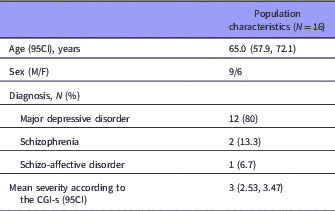
There were 12 patients with MDD, two with schizophrenia and one with schizo-affective disorder. Mean Clinical Global Impression severity score was 3 (95IC=2.53, 3.47). The main results are summarised in Table 1. Within our sample, 5 months after lowering the amount of electricity delivered during ECT treatment, none of the 15 patients included in this retrospective study relapsed according to the data available in the medical records.
Demographic and clinical characteristics of our sample

95CI, 95% confidence interval; CGI-s, Clinical Global Impression severity; ECT, electroconvulsive therapy; F, female; M, male; N, number of subjects.
This table summarises the main characteristics of our sample at baseline, before our device maintenance.
Stimulation and anaesthetic parameters
All patients were stimulated using a Spectrum 5000Q (MECTA corporation, Portland, OR, USA). Stimulation was bilateral both before and after technical control. Before control, patients were stimulated at maximum intensity (1075 mC, frequency=120 Hz, pulse width=0.8 ms, duration=8 s and intensity=800 mA). After technical control, all patients were stimulated at a 614 mC intensity (frequency=120 Hz, pulse width=0.4 ms, duration=8 s and intensity=800 mA).
Before stimulation, all patients underwent anaesthesia. Sedatives were either propofol, etomidate or a combination of the two. The curare drug was suxamethonium chloride. The sedatives or curare drugs did not change in pre- and post-technical control.
Comparison of pre-control and post-control data
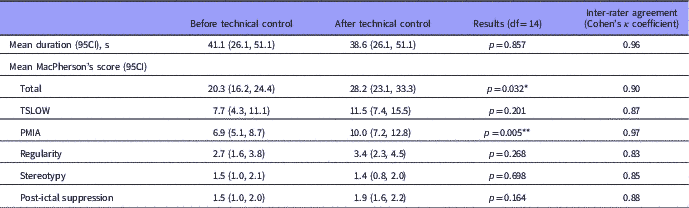
Before the technical control, the main duration of the crisis was 41.1 s (95CI=17.1, 65.2). Eleven patients out of 15 had a seizure considered to be fully efficient (i.e. time of seizure superior to 25 s). Using the MacPherson’s scale, mean quality score for the seizures was 20.3 (95CI=16.2, 24.4). Two patients out of 15 had a seizure duration superior to 1 min.
After technical control, the main duration of the crisis was 38.6 s (95CI=26.1, 51.1). Fourteen patients out of 15 had a fully efficient seizure. Based on the MacPherson’s scale, mean quality score for the seizures was 28.2 (95CI=23.1, 33.3). No patients had a seizure duration superior to 1 min.
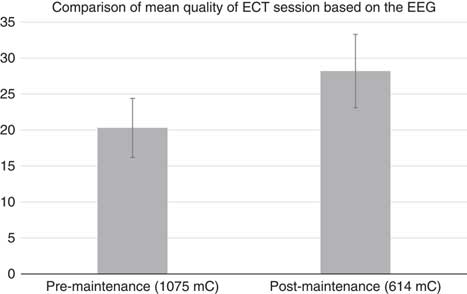
After lowering the amount of energy delivered, we observed an overall increase of 7.9 points on the MacPherson’s score (p=0.032; t=−2.4; df=14; see Fig. 1). When comparing the MacPherson’s score subscales, patients also had a significant increase of peak mid-ictal amplitude of 3.1 points (p=0.005; t=−3.4; df=14). There was no difference in seizure duration. The comparison of pre- and post-control data is summarised in Table 2.
Comparison of mean quality of ECT session based on the EEG.

Comparison of seizure quality before and after limitation of the amount of energy delivered.

95CI, 95% confidence interval; TSLOW, time to onset slowing; PMIA, peak mid-ictal amplitude.
In our sample, lowering the intensity of energy led to better seizure quality, with a significant improvement of the peak mid-ictal amplitude and an overall increase of the MacPherson’s score.
*p-value <0.05; **p-value <0.01.
The calculated Cohen’s κ coefficient for inter-rater reliability ranged from 0.83 to 0.97, demonstrating very good inter-rater reliability. We detailed Cohen’s κ coefficient of the different subscales of the MacPherson’s score in the Table 2.
Discussion
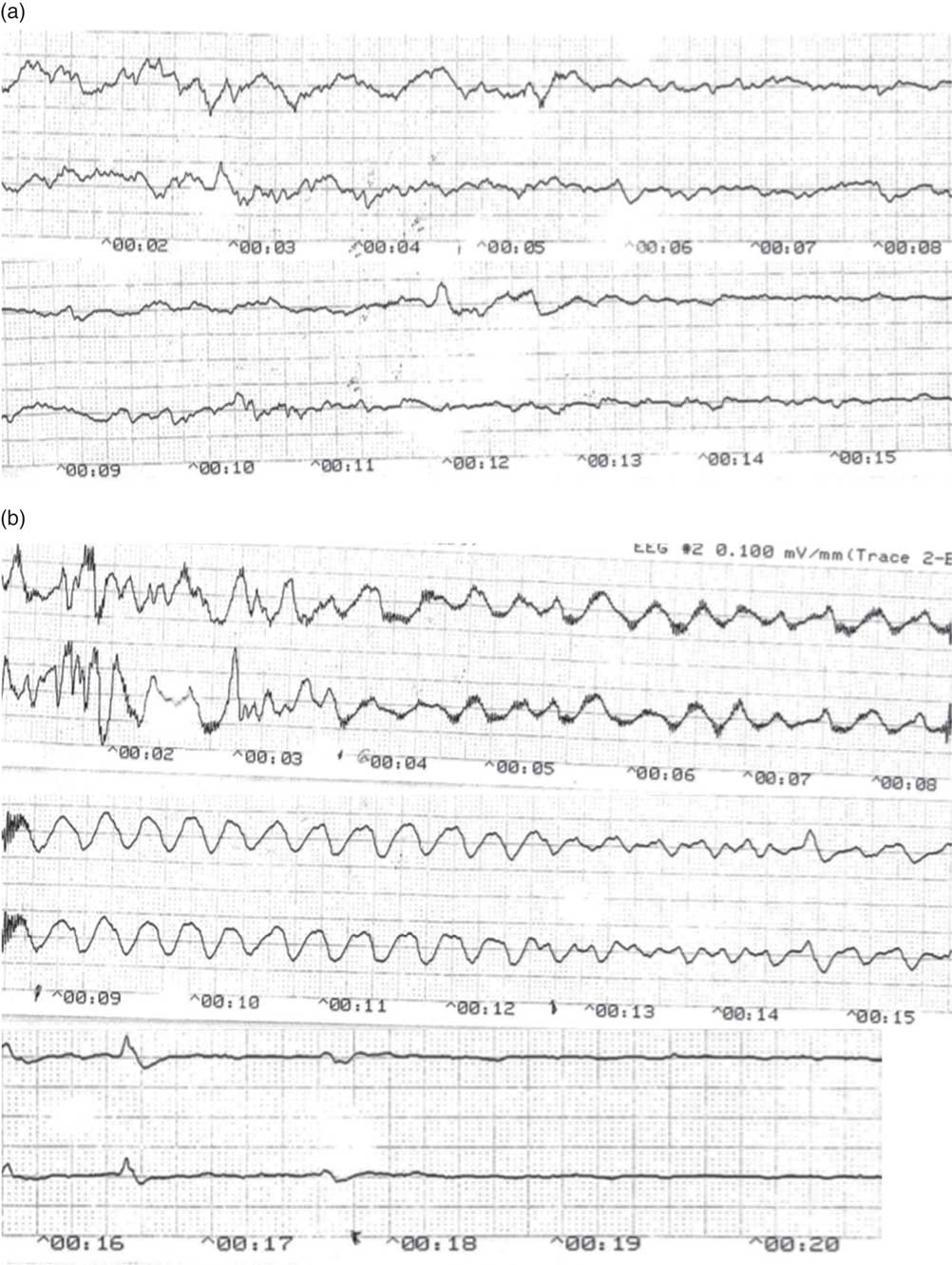
The comparison among our sample showed that lowering the amount of energy delivered during maintenance ECT led to a significant increase in the overall seizure quality, based on the MacPherson’s scale. This improvement was associated with a parallel increase of the peak mid-ictal amplitude in EEG (see Fig. 2). We did not find differences in the duration of the seizures.
(a) EEG trace before lowering the amount of energy delivered. (b) EEG trace after lowering the amount of energy delivered.

Previous studies linked the intensity of stimulation with cognitive sides effects. Patients with a higher delivered dose in ECT had a longer recovery time for orientation (Reference Sackeim, Prudic, Devanand, Kiersky, Fitzsimons, Moody, McElhiney, Coleman and Settembrino14) and more cognitive side effects (Reference Sackeim, Prudic, Devanand, Kiersky, Fitzsimons, Moody, McElhiney, Coleman and Settembrino14,Reference McCall, Reboussin, Weiner and Sackeim15). Due to the retrospective design of our study and the lack of data about cognitive impairment or the duration to recovery of the orientation immediately after the seizure, we were not able to determine if lowering the dose of energy delivered led to an improvement of these parameters. Further studies will be needed to determine this.
We also lack clinical data. Despite the quantification of the initial severity, we were not able to evaluate the evolution of the symptoms of the patients we included. This is directly link to our retrospective design. Prospective studies to come will have to assess the symptoms of the patients with specific tools to correlate the quality of the seizures to a possible clinical improvement.
As we saw, when the time between ECT sessions exceeds 60 days, it might be necessary to titrate again, due to a progressive lowering of the seizure threshold (Reference Wild, Eschweiler and Bartels10). In addition, our results suggest that retitrating may also improve seizure quality. In Minelli’s study, better seizure quality was linked to better treatment response (Reference Minelli, Abate, Zampieri, Gainelli, Trabucchi, Segala, Sartori, Gennarelli, Conca and Bortolomasi11). Among all quality markers in Minelli’s study, brain wave synchronicity and higher wave amplitude were strongly correlated to symptomatology decrease. This echoes our own results. Thus, by lowering the dose and increasing seizure quality and peak mid-ictal amplitude, our results encourage retitrating during maintenance to produce better seizures.
To conclude, our study adds to the body of literature that suggests that titration might be needed regularly during maintenance ECT, leading to an improvement in seizure quality. Lowering the dose may also help reduce cognitive side effects, which are the main complaint of the patients undergoing an ECT cure.