1. A DOCUMENT LINKING VESPASIAN AND THE WATER SUPPLY OF OSTIA
In Ostia, Rome's harbour-town, several parts of an inscription which reveals that the Emperor Vespasian promoted the town's water supply were found in 1983.Footnote 1 Eventually references to the text began to circulate,Footnote 2 then one more fragment turned up and in 2006 the formal and official publication of the text took place, for which the scholarly world is grateful to Alfredo Marinucci.
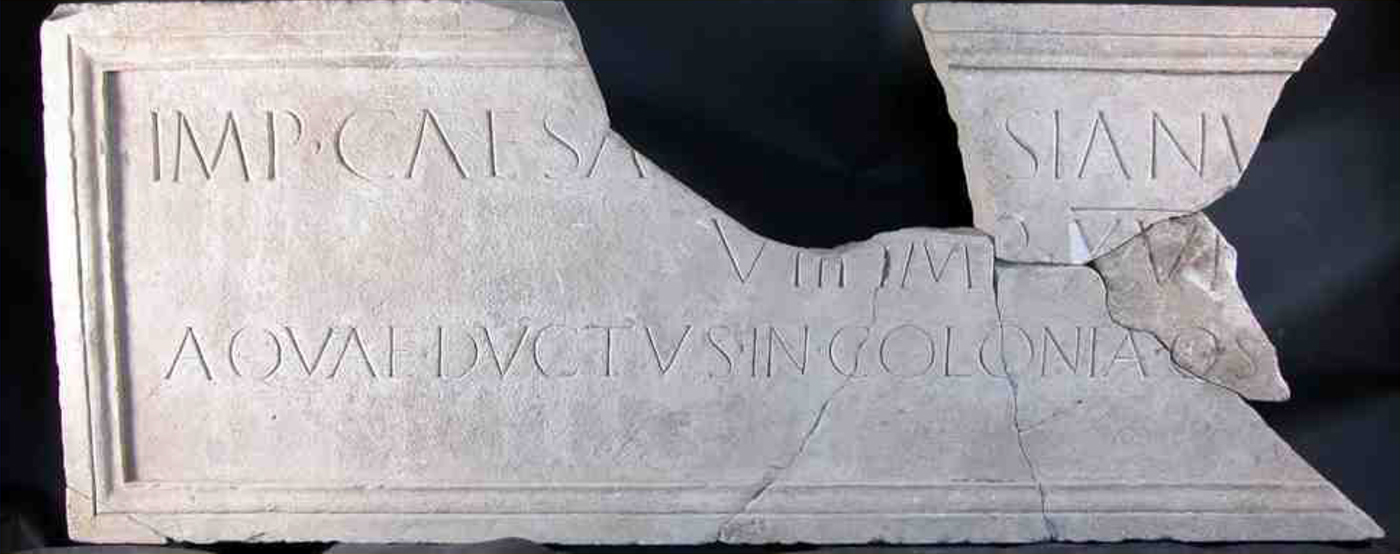
The editio princeps, accompanied by an excellent photograph, shows the preserved inscription (Fig. 1), consisting of six fragments of what was once a large framed marble plaque, which reads as follows:Footnote 3
IMP CAESA[R VESPA]SIANV[S
VIII IMP XVI[–
AQVAE DVCTVS IN COLONIA OS[
The right side of the plaque is completely lost, which introduces an element of uncertainty into the interpretation. It is, however, obvious that line 1 is occupied by Vespasian's titulature, and what can be read of line 2 is dedicated to the same topic, since the figure VIII refers to his tribunicia potestas, which is followed by the (incomplete) number of Vespasian's imperatorial acclamations. That line, which was indented, and surely indented in a symmetrical fashion on both sides, may have contained only elements relating to the emperor's nomenclature. Finally, the actual deed for which Vespasian takes credit is mentioned on line 3, where undoubtedly a verb (possibly more than one) appeared in the part which is now lost.
Inscribed plaque, preserved in the Lapidario Ostiense at Ostia Antica (inv. 44139).

Inscriptions referring to the improvement of urban water supply are very common in the Roman world, yet the new Ostian inscription contains a few features which deserve comment. In fact, it is because we have a fairly good context for the inscription, namely those formulations which one normally encounters in Roman epigraphy when water supply is the issue, that we can single out certain noteworthy aspects.
The first two lines contain no surprise. The Flavian emperor bears no praenomen or gentilicium, but that is the rule. An identical opening can be found, for instance, in CIL 6.40446 from Rome (in a section called ‘tituli operis publici ab imperatore dedicati’): Imp. Ca [esar] Vespasianu [ … ]; or in Vespasian's famous inscription on the Porta Maggiore in Rome (on which more below): Imp. Caesar Vespasianus August. pontif. max. trib. pot. II Imp. VI cos. III desig. III p. p.Footnote 4 The question here is how much of the text to the right is missing in the Ostian inscription; we know that the tribunicia potestas (abbreviated or written out in full) must conclude line 1, but other elements have to be considered as well. Marinucci restored:
Imp(erator) Caesa[r Vesp]asianu[s Aug(ustus) pontif(ex) max(imus) tribunic(ia) potestat(e)]
VIII imp(erator) XVI[II p(ater) p(atriae) co(n)s(ul) VII design(atus) VIII]
aquae ductus in colonia Os[t(iensi) ---]
or, if written out as it originally would have looked on the stone,
IMP CAESAR VESPASIANVS AVG PONTIF MAX TRIBVNIC POTESTAT
VIII IMP XVIII P P COS VII DESIGN VIII
AQVAE DVCTVS IN COLONIA OST - - -
The length of line 1 is relevant to our attempt to deduce information about the wording on line 3. Then again, any restoration of line 1 must also consider how to continue line 2, as that indented line must end some 80 cm before the end of line 1.Footnote 5 The above restoration does fulfil these requirements, although line 1 ought possibly to be shortened somewhat. This could easily be accomplished by, for instance, using the abbreviation pont(ifex) and/or by abbreviating the tribunicia potestas in some other fashion.
2. TWO UNUSUAL EXPRESSIONS
Marinucci presented the view, based on previous scholarship, that, because of the use of the term aquae ductus instead of aqua, it must be a question of restoring or improving an existing structure, instead of building something ex novo.Footnote 6 Others have preferred to see the inscription as documenting the construction of a new aqueduct.Footnote 7
Here we enter the discussion concerning line 3, which, short though the preserved portion is, contains two notable expressions: aquae ductus and in colonia. Both should be taken at face value; it would be methodologically wrong to assume errors by the stonecutter here, i.e. ductus for ductum and in colonia for in coloniam, with the rationale that doing so would simplify the interpretation.Footnote 8
Normally, when someone is responsible for providing a town with a proper water supply by means of an aqueduct, the expression used is in coloniam perduxit or something similar, as can be seen merely from the following examples from Dessau's collection of inscriptions celebrating public works: ILS 5754 (Lepcis Magna): aquam quaesitam et eleuatam in coloniam perduxit; ILS 5755 (Pola): aquam Aug. in superiorem partem coloniae et in inferiorem … perduxit; ILS 5767 (Forum Novum): aquam … in municipium Forum Novom … adduxit; ILS 5771 (near Viterbo): aquam suam Vegetianam … duxi[t] … in uillam suam Caluisianam; ILS 5775 (Aequiculum): aquam in fanum … perduxerunt. To these one can add three Imperial texts from Dessau: ILS 98 (Caracalla): … aquam Marciam … in sacram urbem suam perducendam curauit; ILS 218 (Claudius): … aquas Claudiam … item Anienem nouam … sua impensa in urbem perducendam curauit; and the text in which Trajan celebrates his new aqueduct for Rome: aquam Traianam pecunia sua in urbem perduxit (ILS 290). To be sure, in these cases we find that the term used for referring to an aqueduct is aqua, as Marinucci suggested. Moreover, these aquae normally bear a particular name.
The other feature is that the construction ‘in + accusative’ is used throughout in the examples above.Footnote 9 Thus, when finding the expression in colonia in the Ostian text, an ‘ablative of the place where’ (ablatiuus loci or localis),Footnote 10 it makes sense to suppose that a different situation was at hand.Footnote 11 Vespasian seems to have restricted his actions to something that concerned an existing hydraulic structure in Ostia or perhaps some aspect of the water management in the town.Footnote 12
The archaeological evidence does not help us further in identifying possible interventions under Vespasian, though we do know, from the evidence provided by an inscribed water-pipe, that Ostia had an aqueduct dating back to the reign of the Emperor Gaius.Footnote 13 A recent survey of the extramural remains of aqueducts supplying Ostia has not resulted in any findings that could be dated precisely to the reign of the first Flavian emperor.Footnote 14
What, then, did Vespasian do? Marinucci tentatively advances two suggestions for restoring line 3 (and one has to be grateful for his opening up the discussion): aquae ductus in colonia Ost. specum nouum sua impensa adiecit, or aquae ductus in colonia Ost. formam nouam sua impensa fecit. Footnote 15 As is evident, the Italian scholar here assumes that aquae ductus stands in the genitive, which from a linguistic point of view is possible, as the word belongs to the fourth declension and has the genitive ending in -us. That makes the object of Vespasian's action the specum nouum aquaeductus or the formam nouam aquaeductus. On this interpretation, the message of the inscription would be that, although the emperor did not build a completely new aqueduct, he substantially repaired the old one, as he famously also claimed to have done in Rome in the inscription on the Porta Maggiore.
A comparison with the inscriptions on the Porta Maggiore raises some questions with regard to the above restorations. While in the earliest inscription (part of which was quoted above) Claudius takes credit for introducing the two aquae to Rome, in the two subsequent inscriptions first Vespasian and then Titus refer to repairs that they had ordered to be carried out. The expressions used are aquas Curtiam et Caeruleam perductas a diuo Claudio et postea intermissas dilapsasque per annos nouem sua impensa urbi restituit (Vespasian) and aquas Curtiam et Caeruleam perductas a diuo Claudio et postea a diuo Vespasiano patre suo urbi restitutas, cum a capite aquarum a solo uetustate dilapsae essent, noua forma reducendas sua impensa curauit (Titus) (CIL 6.1257–8 = ILS 218).
In comparison with these monumental texts, line 3 in the Ostian inscription, which was meant to be monumental as well, though on a slightly smaller scale,Footnote 16 looks very contorted indeed in the tentatively restored form cited above. Marinucci has plausibly argued that the width of the plaque indicates that it was originally exhibited in a very public space, likely at the point where the aqueduct, passing on top of the Republican wall (no longer serving any defensive use), crossed one of the main thoroughfares.Footnote 17
Also noteworthy is the fact that the aqueduct, if this is what aquae ductus in the text refers to, is not given any name, contrary to what was the case, for instance, in the inscriptions on Rome's Porta Maggiore. The omission of an aqueduct's name would be very unusual, and one cannot think of any political reason for keeping silent about it here. Many aqueducts sponsored by an emperor were named Aqua Augusta, and Vespasian could have had nothing against citing such a common name. Nor would he have objected to the name Aqua Claudia (if that is what the Ostian aqueduct was called at the time), as can be seen from his inscription on the Porta Maggiore. Then again, had the name been neutral, inspired by topography or by the name of the town itself, there would have been no reason for Vespasian to object. Furthermore, such a name would perhaps have been particularly easy to change, as we know Claudius did in Rome for what became the Aqua Claudia, a project begun by Gaius/Caligula (Plin. HN 36.122; Frontin. Aq. 13.1; Suet. Claud. 20.1), surely not under the name Claudia.Footnote 18 The reason for the plain term aquae ductus in the monumental Ostian inscription likely lies elsewhere, as shall be argued next.
3. THE MEANING OF AQVAE DVCTVS
Before presenting alternative views on what might have stood in line 3, some thoughts must be devoted to the meaning of the expression aquae ductus. These two words are divided by interpunctuation on the Ostian stone, although they are often written together in Roman inscriptions and indeed can form a composite word.Footnote 19 The most recent, albeit short, discussions of the word aquaeductus are by the two scholars, Robert H. Rodgers and Fanny Del Chicca, who independently of each other published editions of Frontinus’ De aquaeductu urbis Romae in 2004. While Rodgers chose to include aquaeductus in the title of Frontinus’ work, he pointed out that the word does not appear in the text itself. That the term, however, is used to mean (urban) ‘water supply’ in general in chapter headings both in the Codex Theodosianus (15.2, approved in 438 c.e.) and in the Codex Justinianus (11.43, published in 534 c.e.) represented one rationale for Rodgers's choice.Footnote 20 Del Chicca, who preferred to write aquae ductus separately in the title of the work, also held that the expression could have the general meaning of ‘water supply’ (‘il senso di “adduzione, perduzione”’).Footnote 21
The division of the material in the TLL can be said to support this general meaning, for the first of two sections under the heading aquae ductus carries the heading ‘ipsa aqua ducta et constructio’.Footnote 22 This also holds open the possibility that the expression can denote ‘the water which is supplied’ or ‘water supply’.
The second section in the TLL brings up a particular context in which the expression aquae ductus (normally with the words separated) is encountered, namely the juridical sources. In particular, one finds references to passages in Justinian's Digest (a compilation of Classical, i.e. much earlier, Roman law) which concern the servitude called seruitus aquae ductus (a right which could be found in the countryside, contrary to the above sections of the Imperial law codes which deal with urban water supply).Footnote 23 In these cases too the term aquae ductus does not so much refer to the physical construction necessary for conveying the water (pipes, canals, arches) as to the actual conveying of water, that is, the seruitus aquae ductus denotes the right to establish and enjoy a supply of water. In the same way, the related seruitutes uiae, itineris and actus do not refer to the actual roads, passageways or drove roads but to the rights of passing through or driving cattle over someone else's land.Footnote 24
Finally, there is the epigraphic evidence to consider, amounting to almost forty instances of the term.Footnote 25 In nearly sixty percent of these cases the term is divided into two words,Footnote 26 while the other inscriptions spell aquaeductus as one word.Footnote 27 In the overwhelming majority of these cases aquae ductus, whether in one word or divided, refers to physical constructions, but one may argue that in some cases the meaning of the term is ambiguous, to say the least. A rather clear case is represented by a Latin inscription from Athens that announced the result of Hadrian's actions to further the city's water supply: aquaeductum in nouis Athenis coeptum consummauit dedicauitque (CIL 3.549 = ILS 337).Footnote 28 And then there is the Augustan edict regarding the aqueduct of Venafrum, CIL 10.4842 line 34 eum aquae ductum corrumpere abducere auertere, where the meaning must be ‘supply’ or ‘flow of water’ rather than ‘channel’, as it would be awkward to abducere or auertere a concrete structure.
There is also one particular and unique inscription, precisely from Ostia, containing the text aquae ductus per / p(uteum) p(ublicum) / p() p() (CIL 14.4147 = NSc 1921, 363). This is a travertine marker (cippus) found next to a water basin inside the large storage building known as the Grandi Horrea in the eastern part of town,Footnote 29 on which lines 2 and 3 only contain abbreviations, in part enigmatic. The reading p(uteum) p(ublicum) on line 2 is simply a conjecture, though generally accepted.Footnote 30 In any case, it makes better sense to take aquae ductus as marking the water supply as such and not the aqueduct itself. A full rendering of the abbreviated words might be along the lines of aquae ductus per p(uteum) p(ublicum) p(ublice)/p(opulo) p(ermittitur)/p(ermissus) or ‘the public is allowed water supply/the drawing of water by means of the public receptacle’.Footnote 31 Against interpreting aquae ductus as a physical construct is the fact that there is no name attached to it, as it is in a text from Rocca Priora (Latium): Aqua Aug. put(eus) p(ublicus) cip(pus) XII (CIL 14.2567a, one in a series of five).
These considerations of the meaning of aquae ductus, of the construction in + abl. in the Ostian inscription as well as of its composition lead to the conclusion that aquae ductus cannot be a genitive coupled with a noun denoting a certain physical construction (such as specus or forma, suggested by Marinucci).
However, if we take aquae ductus in a more abstract meaning, as denoting ‘water supply’ or even ‘water rights’, there may be a possibility for accommodating the genitive. If one is thinking of water rights, one might suggest as the last word on line 2 a term such as ius (or iura, as the rights would have been enjoyed by many residents), copiam, or perhaps modum, followed by a suitable verb at the end of line 3. Some justification can be found for all these concepts. Frontinus mentions the ius ducendae aquae in Rome when he refers to the right for private individuals to draw water from the public water supply of the capital (Frontin. Aq. 103.2; see also 94.1, ius ducendae tuendaeque aquae; 106.1, aquae ducendae ius, a quotation from a senatus consultum; 107.1, ius impetratae aquae). In CIL 12.2493–4 from Albinnum in Gaul one likewise finds a similar expression involving ius: aquas iusque earum aquarum tubo ducendarum … uicanis Albinnensibus d(e) s(uo) d(edit). It is of course clear that the term ius in these instances merely means ‘the right’ of privileged individuals to benefit from a public resource thanks to a private water concession. Conceptually, it is a different matter when Roman jurists, while discussing servitudes, declare that aquae ductus est ius aquam ducendi per fundum alienum (Ulp. Dig. 8.3.1 pr.). If Vespasian used the term ius (or possibly iura) in the Ostian inscription, he could not have been referring to servitudes but only to private water grants. This would result in a restoration of the text in the fashion shown below, where the crucial detail is the addition of ius in line 2. The two variants for line 3 are merely exempli gratia, to show that it is possible to accommodate this message in different ways. In each case 29 letters are added on line 3, while Marinucci estimated that some 30 were missing (his restorations contain 29 and 27, respectively):Footnote 32
IMP CAESAR VESPASIANVS AVG PONTIF MAX TRIBVNIC POTESTAT
VIII IMP XVIII P P COS VII DES VIII IVS
AQVAE DVCTVS IN COLONIA OS[T COLONIS BENEFICIO SVO CONCESSIT] 29
AQVAE DVCTVS IN COLONIA OS[T NOVA FONTE ADDITA COLONIS RESTIT] 29
Setting out from the same interpretation of aquae ductus, one might also suggest copiam at the end of line 2, as a way of indicating the volume of the water which benefited all inhabitants of Ostia. The term appears repeatedly in Frontinus to indicate the amount delivered by the various aqueducts (quanta sit copia quae publicis priuatisque non solum usibus et auxiliis uerum etiam uoluptatibus sufficit, Aq. 23.1).Footnote 33 The meaning, then, would be different and perhaps better suited to such a monumental inscription: the copia was something which the whole town could enjoy, while the iura aquae ductus mainly benefitted the privileged few and their households. Although it has to be said that copia is mostly used in connection with food provisions, it can also appear in connection with aqua. Vitruvius uses the expression ad copiam aquae (Vitr. De arch. 8.6.1), and in an inscription from Cirta in Numidia, dating to the late fourth century, an ablative-absolute construction states prouisa aquae copia (CIL 8.7034 = ILAlg 2.619).Footnote 34
Copia thus seems to be an acceptable word and short enough to fit in the space at the end of line 2. Another possibility could be modus, which is also used in connection with the amount and nature of water delivery, though normally in connection with servitudes.Footnote 35 Frontinus, however, uses modus repeatedly and with almost the same meaning as copia.Footnote 36 Yet, modus is not known to me from any monumental inscription such as our Ostian example. Two terms which Frontinus uses to describe the water distribution in Rome, erogatio and distributio,Footnote 37 seem too long for the available space in line 2.
There is also another way of restoring the text. If we assume that the first two lines only accommodated Vespasian's name and epithets, we have to find an accusative object in line 3 to go with the verb that undoubtedly was placed at the end of the inscription. The best candidate for that object then would seem to be aquae ductus (in the plural), meaning ‘the water supply in general’ and intended for many purposes, hence the plural. This again would lead to a restoration of the following kind, when keeping in mind the tentative limit of some 30 letters:
IMP CAESAR VESPASIANVS AVG PONTIF MAX TRIBVNIC POTESTAT
VIII IMP XVIII P P COS VII DESIGN VIII
AQVAE DVCTVS IN COLONIA OS[T VETVSTATE DILAPSOS COLONIS REST] (29)
AQVAE DVCTVS IN COLONIA OS[T LONGE INTERMISSOS COLONIS RESTIT] (30)
If aquae ductus is an accusative plural, it can only mean ‘water supply’ in general. As was already argued above, it is extremely unlikely that it would be an accusative plural standing for ‘aqueducts’. If that meaning were intended, aquas would surely have been used. It has to be admitted, though, that aquae ductus is not known to appear in the plural when employed with this general meaning.Footnote 38 This may be because of the context in which the term is normally found.
4. DISCUSSION AND CONCLUSION: OSTIA'S SPECIAL RELATIONSHIP TO ROME
Earlier attempts at interpretation have clarified some features of Vespasian's monumental inscription from Ostia, and it is my belief that the fragmentary text can be made to yield further information. All the proposals above suffer from some uncertainties, but I am convinced that the overall picture is clear enough and that it is worth summarizing the results in order to arrive at a conclusion that will reveal something general and valuable about Ostia's relationship with the capital.
First, one should be fully aware of the unusual features present in the inscription. Any proposal for restoration will have to find explanations for these features, explanations which fit our knowledge of the language of monumental Latin epigraphy, as well as of the subject matter, Roman water supply.
From everything we know, it is clear that the inscription does not commemorate the introduction of a new aqueduct to Ostia, nor the repair of an existing extramural construction. The expression in colonia makes it clear that Vespasian was concerned with a feature or a phenomenon within the town itself.
The next issue is to determine the meaning of aquae ductus in this particular inscription. While there are frequent literary cases where the term refers to the physical structures of an aqueduct, in many instances the best translation is in fact ‘water supply’. In the juridical sources, in the context of the seruitus aquae ductus, the meaning is likewise ‘water supply’. The epigraphic sources are much more focussed on physical constructions, which is only natural considering that the relevant inscription may often have been attached to the structure itself, but even here one finds examples of the general meaning ‘water supply’.
Since we are dealing with a noun of the fourth declension, it is not clear whether aquae ductus is genitive singular or accusative plural (the nominative case can be excluded). It seems warranted to explore both possibilities. The genitive is possible if we assume that a noun defined by aquae ductus stood last on line 2, though this arrangement would slightly mar the symmetry and logic of the monumental inscription, since a word extraneous to the imperial names and titles would intrude on line 2. Parallels for such an ordinatio can however be found in Flavian monumental epigraphy.Footnote 39
If the interpretation of aquae ductus as a genitive is accepted, the text can only refer to an improvement of or an innovation in the water supply in Ostia, which is why terms such as ius (iura), copiam, or modum were suggested for line 2. Significantly, Vespasian took credit for such improvements. In this scenario, it is impossible to say more with any kind of certainty. The two different restorations in line 3 suggested above are only to be taken exempli gratia, with the purpose of showing that it is possible to construe a plausible epigraphic text in which aquae ductus is in the genitive.
The other possibility is that aquae ductus is the accusative object of the lost verb in line 3. In this scenario, Vespasian is taking credit either for improving or for establishing the aquae ductus in Ostia, and the explanation for the plural must be that the water distribution was catering to the needs of many and took many forms (such as fountains, private conduits, etc.). This explanation, even though attractive, is weakened by the absence of any parallel cases of the term aquae ductus in the plural with this meaning (cf. n. 38 above).
Regardless of where one's preferences lie when it comes to restoring this inscription of Vespasian's (aquae ductus as genitive singular or as accusative plural?), it is clear that the emperor is taking public credit for having improved the actual water distribution in the town of Ostia. It needs to be pointed out that this is again a highly unusual feature. We have no other evidence, epigraphic or otherwise, for such imperial micromanagement, and there are grounds for believing that in this case ‘absence of evidence is evidence of absence’. As stated above, there is much evidence for emperors financing municipal aqueducts, but nowhere do we hear about the emperor or the imperial administration getting involved in the actual local distribution. The fullest account is given in Augustus’ edict on the Aqueduct of Venafrum in the Regio I (on the border of Samnium and Campania) (CIL 10.4842 = ILS 5743),Footnote 40 though even here decisions regarding the actual distribution are left to the local authorities (lines 37–43).
It seems worth asking to what extent the situation in Ostia may have been different. It so happens that another unique piece of epigraphic evidence, an inscribed lead pipe with the text (or stamp) on two lines [I] mperatoris Domitiani Caesaris Aug. / [– c.11 –] quae ducunt in castris, is known from the town.Footnote 41 The ‘wordiness’ of the text is unique, for it is the only lead pipe stamp that contains a pronoun as the subject.Footnote 42 The castra referred to must be the one belonging to the uigiles in Ostia. It is no surprise that the barracks should have been provided with water, for inscribed fistulae from Rome show that the castra praetoria in the capital had its own water supply, and in two cases the same lead pipe carries the names of both an emperor and the castra praetoria.Footnote 43 Yet, it is noteworthy that at Ostia Domitian's name appears in a similar context, undoubtedly with the function of showing that the water grant had been made possible through his beneficium.
This Domitianic lead pipe stamp is an indication that the emperors, in any event those of the Flavian dynasty, could exercise an unusual influence over the water distribution in Ostia, and it is not the only evidence which points in this direction. A similar, and general, conclusion has been drawn using the collective evidence from the town's inscribed lead pipes (fistulae). When it comes to inscribed lead pipes, Ostia ranks second after Rome in numbers, by far surpassing any other towns in Roman Italy.Footnote 44 In particular, it is noteworthy how common fistulae naming various Roman emperors are in Ostia. The explanation for this pattern cannot be that the Roman emperors owned a large number of residences for their personal use in Ostia. Instead, it must be the case that the emperors’ names were applied to conduits which were supplying structures and buildings that were important for the imperial government and imperial policy (perhaps administrative buildings and storage facilities but also public baths, temples, fountains, etc.). These inscriptions point to imperial investment in the infrastructure of Ostia but not only that. In many cases, the name of the emperor is accompanied by that of an imperial procurator.Footnote 45 This pattern is very rare, for in Italy it is known only in Rome itself, in Ostia and at the sites of a number of imperial uillae in central Italy.Footnote 46 It shows that these imperial officials were at the very least supervising the public works which included the laying out of the conduits in question. These stamps may in fact be evidence for even more active imperial involvement in Ostia's water supply and distribution. We have only very scattered evidence for local Ostian officials involved in the town's cura aquarum, and what is known agrees with a scenario in which imperial officials play a considerable role on a regular basis.Footnote 47
How prominent or decisive the role of imperial supervision over Ostia's cura aquarum was has not been discussed previously. The monumental inscription commemorating Vespasian's activity in Ostia now brings new evidence. It is not a surprise that Ostia, a town of substantial size since the Julio-Claudian period and one crucially important for supplying Rome, was of particular interest to the imperial government. The new inscription referring to Vespasian's aquae ductus in colonia Ost(iensium) can be taken as additional evidence for the particular role played by Ostia. The town's importance led to an imperial involvement that also included organizing or at least influencing the actual water distribution in the urban centre.