INTRODUCTION
Hunting of wildlife to obtain meat for subsistence or trade is important to local economies and a growing problem for wildlife managers in many countries (Arcese et al. Reference Arcese, Hando, Campbell, Sinclair and Arcese1995; Campbell & Hofer Reference Campbell, Hofer, Sinclair and Arcese1995; Fa et al. Reference Fa, Juste, Perez del Val and Castroviejo1995; Barnett Reference Barnett2000; Loibooki et al. Reference Loibooki, Hofer, Campbell and East2002; Rao & McGowan Reference Rao and McGowan2002). The extent to which wildlife populations in Africa are used for meat is high in terms of the number of animals killed and the volume of meat obtained (Hofer et al. Reference Hofer, Campbell, East, Huish, Taylor and Dunstone1996; Mduma et al. Reference Mduma, Hilborn, Sinclair, Newbury, Prins and Brown1998; Noss Reference Noss1998; Barnett Reference Barnett2000). This offtake is mainly achieved through the use of inexpensive methods of prey capture, such as wire snares, self-made traps and poisoned darts or arrows (Turner Reference Turner1987; Noss Reference Noss1998), and the use of non-selective capture methods such as snares has a negative impact on populations of non-target species (Hofer et al. Reference Hofer, East and Campbell1993). The most ubiquitous hunting method is the wire snare, probably because snares cost little and are relatively simple to make; thus hunters can afford to own and set numerous snares. Once set, snares are inconspicuous and law enforcers in areas where hunting is illegal find them difficult to detect.
Use of forage and water can produce conflict between managers of protected areas and local communities (Fleischner Reference Fleischner1994; Arcese et al. Reference Arcese, Hando, Campbell, Sinclair and Arcese1995; Homewood et al. Reference Homewood, Lambin, Coast, Kariuki, Kikula, Kivelia, Said, Serneels and Thompson2001; Madhusudan Reference Madhusudan2004; Mishra et al. Reference Mishra, Van Wieren, Ketner, Heitkönig and Prins2004). In comparison to illegal hunting with snares, livestock ownership requires greater financial expenditure and the illegal presence of livestock in protected areas is more difficult to conceal.
The Serengeti ecosystem straddles the international border between Tanzania and Kenya. The major part of the ecosystem lies within the Serengeti National Park (Serengeti NP) where hunting of wildlife and grazing of livestock are prohibited. Situated along sections of the Serengeti NP boundary are game reserves, where licensed hunting is permitted but livestock and unlicensed hunting are prohibited. These reserves form a buffer zone between the Serengeti NP and surrounding communities.
Given that over one million people live within 45 km of the western boundary of the Serengeti NP and associated reserves (Campbell & Hofer Reference Campbell, Hofer, Sinclair and Arcese1995), and that the main occupation in the area is subsistence farming plus the rearing of livestock (Loibooki et al. Reference Loibooki, Hofer, Campbell and East2002), it is perhaps not surprising that natural resources within the protected areas are used by local communities (Arcese et al. Reference Arcese, Hando, Campbell, Sinclair and Arcese1995; Campbell & Hofer Reference Campbell, Hofer, Sinclair and Arcese1995; Hofer et al. Reference Hofer, Campbell, East, Huish, Taylor and Dunstone1996; Loibooki et al. Reference Loibooki, Hofer, Campbell and East2002). The level of illegal hunting for meat is considerable and has resulted in the local extinction of resident herbivores in some areas (Arcese et al. Reference Arcese, Hando, Campbell, Sinclair and Arcese1995; Campbell & Hofer Reference Campbell, Hofer, Sinclair and Arcese1995; Hofer et al. Reference Hofer, Campbell, East, Huish, Taylor and Dunstone1996). Livestock ownership is viewed as a symbol of wealth and status, and inhabitants of villages close to the Serengeti NP that either own livestock or have access to alternative means to generate income and acquire protein are less likely to participate in illegal hunting (Loibooki et al. Reference Loibooki, Hofer, Campbell and East2002). The link between poverty and illegal meat hunting is also reflected by the fact that illegal hunters arrested in the Serengeti NP were predominantly poorly educated, young males that owned few or no livestock (Loibooki et al. Reference Loibooki, Hofer, Campbell and East2002).
This study aims to build on previous research in the Serengeti ecosystem on how costs and benefits of illegal hunting influence the spatial and temporal distribution of this illegal activity (Arcese et al. Reference Arcese, Hando, Campbell, Sinclair and Arcese1995; Campbell & Hofer Reference Campbell, Hofer, Sinclair and Arcese1995; Hofer et al. Reference Hofer, Campbell, East, Huish, Taylor and Dunstone1996, Reference Hofer, Campbell, East and Huish2000; Loibooki et al. Reference Loibooki, Hofer, Campbell and East2002). Here we compare illegal hunting and illegal livestock grazing to investigate whether the spatial distribution of these activities is consistent with the expectation that natural resources within protected areas will be exploited when likely benefit exceeds estimated cost and to assess which component of cost is likely to matter the most.
METHODS
Study area
The study was conducted in the western section of the Serengeti (Tanzania). The economy of local communities was mainly based on subsistence agriculture with more prosperous farmers owning herds of livestock (Loibooki et al. Reference Loibooki, Hofer, Campbell and East2002). An average herd of livestock in 2001 consisted of 17 animals that had a total sales value of US$ 423–735 (Loibooki et al. Reference Loibooki, Hofer, Campbell and East2002). Inhabitants of villages close to Lake Victoria practised commercial fishing, and those in villages close to all-weather roads practised commercial trade (Loibooki et al. Reference Loibooki, Hofer, Campbell and East2002).
Illegal hunters from local communities chiefly used wire snares to capture wild herbivores for meat that was typically dried before being carried on foot from protected areas (Arcese et al. Reference Arcese, Hando, Campbell, Sinclair and Arcese1995; Hofer et al. Reference Hofer, Campbell, East and Huish2000). Dried meat was used for home consumption, sold to generate income or bartered for other commodities (Hofer et al. Reference Hofer, Campbell, East and Huish2000; Loibooki et al. Reference Loibooki, Hofer, Campbell and East2002). An estimated 53 000 people are involved in illegal hunting, including both hunters and porters that transport meat from hunting camp out of the protected areas (Loibooki et al. Reference Loibooki, Hofer, Campbell and East2002). Hunters arrested in the Serengeti NP come from villages within 45 km of the boundary of the protected areas (Campbell & Hofer Reference Campbell, Hofer, Sinclair and Arcese1995). Although a large proportion of the annual offtake of meat from the ecosystem is obtained from large migratory species such as wildebeest Connochaetes taurinus and zebra Equus burchelli, considerable volumes of meat are also obtained from other migratory and resident herbivores species (Arcese et al. Reference Arcese, Hando, Campbell, Sinclair and Arcese1995; Hofer et al. Reference Hofer, Campbell, East, Huish, Taylor and Dunstone1996). It is not known what proportion of illegally hunted meat is sold for cash, used for home consumption, or bartered for other commodities. For this reason it is difficult to estimate the monetary value of this illegally acquired commodity to the local economy, even though it is undoubtedly important economically (Loibooki et al. Reference Loibooki, Hofer, Campbell and East2002). If only a third of the estimated annual offtake of approximately 11 950 tonnes of useable meat (Hofer et al. Reference Hofer, Campbell, East, Huish, Taylor and Dunstone1996) from migratory and resident herbivore species is sold (at a value of US$ 0.3 per kg fresh weight of meat; Loibooki et al. Reference Loibooki, Hofer, Campbell and East2002), trade in illegal meat would annually generate more than US$ 1 million.
Density of wild herbivores, livestock and snares
Between May 2001 and March 2002, data were collected along ground transects in three areas, namely Kirawira, Mihale and Ndabaka. The Kirawira transect was entirely within the Western Corridor section of the Serengeti NP, two ranger posts both within 1 km of the transect being staffed by a total of 14 rangers. From each ranger post, six rangers patrolled by vehicle and on foot, and one ranger provided patrols with radio communication. There were frequent tourist vehicles in the area, many of which could communicate by radio with the ranger posts. This site was a greater distance from the boundary of the protected areas than the other two study sites. The Mihale transect was on the northern side of the Western Corridor that traversed an equal distance of the Serengeti NP, the Grumeti Game Reserve (Grumeti GR) and the unprotected area outside this Reserve. The Serengeti NP section of this transect was at a greater distance from the protected area boundary than the section of this transect in the Grumeti GR. The nearest ranger post was approximately 15 km from this transect. Grazing of livestock and unlicensed meat hunting were prohibited in the Grumeti GR. Although licensed trophy hunting was permitted within the Reserve, during the study no trophy hunters operated and tourists rarely visited the area. Natural resources outside the Grumeti GR could be legally exploited. The Ndabaka transect was on the southern side and at the western end of the Western Corridor, within 3 km of a ranger post and entrance gate to the Serengeti NP that was staffed by five rangers (three patrolled, one administered the entrance gate, and one was responsible for radio communications). Two-thirds of this transect was within the Serengeti NP and one third was in unprotected land outside the Park. As there was no reserve to act as a buffer zone between the Park and local communities, the distance from the boundary to the section of this transect inside the Park was small.
Each of the three study sites contained a 45-km transect composed of three parallel 15-km transects situated 4 km apart. Transect lines and the location of the National Park and Game Reserve boundaries along transects were determined by a global positioning system (GPS; Garmin 12 XL). A vehicle with a driver and an observer was slowly driven along each transect. In the three study sites, each 45-km transect was driven three times per month for 11 months. The numbers of livestock (cattle, goats, sheep and donkeys) and wildlife observed within 200 m either side of the transect line were counted and the GPS positions recorded. The herbivorous species counted during transects included wildebeest, zebra, eland Taurotragus oryx, Thomson's gazelle Gazella thomsoni, Grant's gazelle Gazella granti, topi Damaliscus lunatus, impala Aepyceros melampus, buffalo Syncerus caffer, giraffe Giraffa camelopardalis, kongoni Alcelaphus buselaphus, and warthog Phacochoerus aethiopicus. All these species are hunted and can be caught by wire snares.
Snares within 20 m of either side of a transect line were recorded. The GPS position of snares was taken and snares were inconspicuously marked with a permanent pen to prevent recounting previously logged snares at a later date.
The densities of wild herbivores, snares and livestock were calculated for each study site using the equation (Caughley & Sinclair Reference Caughley and Sinclair1994):

where D is the calculated mean density of livestock and/or hunting equipment counted,Σx is the sum of mean livestock and/or hunting equipment counted per month, and ΣA is the sum of the mean area covered during the count.
All three sites experienced a similar pattern of precipitation, with the majority of the annual precipitation falling between November and May (the ‘wet season’) and little precipitation between June and October (the ‘dry season’).
Mihale village was approximately 5 km from the Mihale transect and, in 2001, contained 1036 people that owned 0.53 sheep or goats per person and 0.65 cattle per person. Mwabayanda village was within 5 km of the Ndabaka transect and, in 2001, this village contained 2771 people that owned 0.50 sheep or goats per person and 0.99 cattle per person. These two villages were of roughly similar size and were comparable in the number of livestock owned per head, which is an index of village wealth (Loibooki et al. Reference Loibooki, Hofer, Campbell and East2002).
We applied a quasi-experimental design to investigate the relative effects of different factors likely to influence the profitability of illegal activities in different areas, and the same activities conducted outside protected areas. We chose hunting of wild herbivores for meat as a form of resource use known to yield considerably greater benefits when practised inside protected areas (Campbell & Hofer Reference Campbell, Hofer, Sinclair and Arcese1995; Hofer et al. Reference Hofer, Campbell, East and Huish2000; Loibooki et al. Reference Loibooki, Hofer, Campbell and East2002), and contrasted this with grazing and watering of cattle, which are activities unlikely to yield larger immediate benefits when conducted inside protected areas rather than outside such areas. We assumed that the likely benefits of illegal hunting would increase with increasing wild herbivore density and used natural fluctuations in wild herbivore density to test this assumption. We assumed that the value of forage and water resources to livestock owners would increase during periods of low precipitation (dry season), and that herds of livestock would be more easily detected by law enforcers than snares.
As a model of economic costs and benefits of illegal hunting in the Serengeti indicated that travel cost (calculated as the time taken to travel to and from a hunting site multiplied by the opportunity cost of travel) is more important in determining the spatial distribution of hunting activities than the cost of arrest based on penalties incurred if arrested (Hofer et al. Reference Hofer, Campbell, East and Huish2000), our analysis is based on the expectation that travel costs increased with distance travelled, and that the chance of arrest was greater close to ranger posts than in areas without such posts (Campbell & Hofer Reference Campbell, Hofer, Sinclair and Arcese1995; Hofer et al. Reference Hofer, Campbell, East and Huish2000). We selected study areas that varied with respect to both potential costs and benefits and predicted that use should occur where costs are perceived to be low, and where returns from exploitation are likely to outweigh cost.
Statistical analysis
Statistical analyses were performed using SYSTAT 10 (Wilkinson Reference Wilkinson2000). As data were not normally distributed, non-parametric tests were applied. For all tests p < 0.05 (two-tailed) was considered significant. Densities are presented as mean ± standard error (SE).
We used density of wild herbivores as one index of the potential benefit hunters might gain and the density of snares as an index of the effort exerted by hunters in an area. We used a post-hoc Kruskal-Wallis ANOVA test (Conover Reference Conover1980) to compare predicted levels of hunting effort in different areas in relation to the cost of travel and cost of law enforcement. The areas considered were: Kirawira NP, Mihale NP, Mihale GR, Ndabaka NP and Ndabaka outside protected area. The unprotected area of the Mihale transect was excluded from this analysis, as no wild herbivores were observed in this area.
RESULTS
Livestock densities
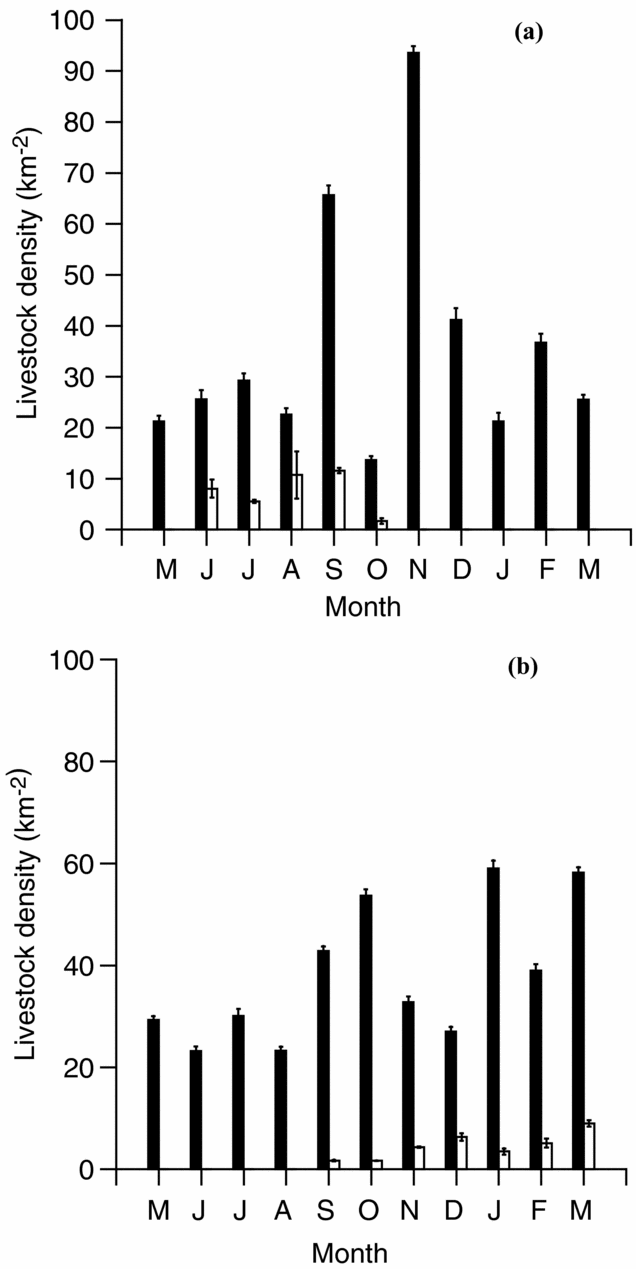
In accordance with our predictions, no livestock were recorded along the Kirawira transect. The density of livestock within the protected area section (Serengeti NP and Grumeti GR) of both the Ndabaka and Mihale transects was lower (Ndabaka 2.8 ± 0.9 animals per km2; Mihale 3.4 ± 1.4 animals per km2) than the high density of livestock legally grazed outside the Serengeti NP on the Ndabaka transect (38.0 ± 4.1 animals per km2; Wilcoxon Signed Rank Z = −2.934, n = 11, p = 0.004; Fig. 1a) and outside the Grumeti GR on the Mihale transect (35.3 ± 7.2 animals per km2; Z = −2.934, n = 11, p = 0.004; Fig. 1b). These results indicate that herders knew the location of the Park and Reserve boundaries and mostly avoided taking their livestock into protected areas.
Mean monthly (May 2001–March 2002) livestock density per km2 in (a) the Mihale transect, and (b) the Ndabaka transect. Solid bars = livestock outside the Serengeti NP and Grumeti GR; open bars = livestock inside the Serengeti NP and Grumeti GR.

During the dry season, the density of livestock within the Serengeti NP and Grumeti GR along the Mihale transect was higher (7.52 ± 1.80 animals per km2) than along the Serengeti NP section of the Ndabaka transect (0.68 ± 0.42 animals per km2; Mann Whitney U = 3.0. p = 0.007, n = 6).
During the wet season, livestock was absent from the protected sections of the Mihale transect, but low densities of livestock were present in the Serengeti NP section of the Ndabaka transect (4.70 ± 1.22 animals per km2), mostly between the Park boundary and the Mbalageti River.
Wildlife densities and illegal hunting effort
When the possible benefit to illegal hunters was scored in terms of wild herbivore densities, the Serengeti NP section of the Ndabaka transect was likely to yield the highest level of benefit (66.93 ± 17.06 animals per km2). Moderate levels of benefit were likely from the Serengeti NP sections in the Kirawira and Mihale transects respectively (31.20 ± 12.01 animals per km2; 25.95 ± 5.99 animals per km2), and the Grumeti GR section of the Mihale transect (22.65 ± 11.39 animals per km2). Low levels of benefit were likely from the unprotected sections of the Ndabaka (2.77 ± 0.01 animals per km2) and Mihale transects (no animals observed).
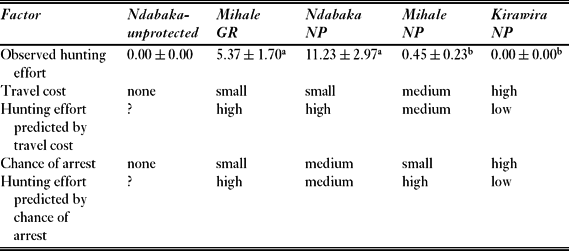
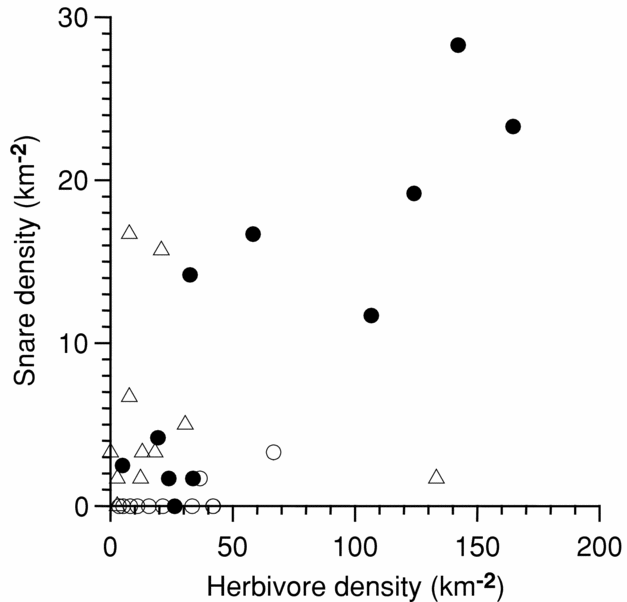
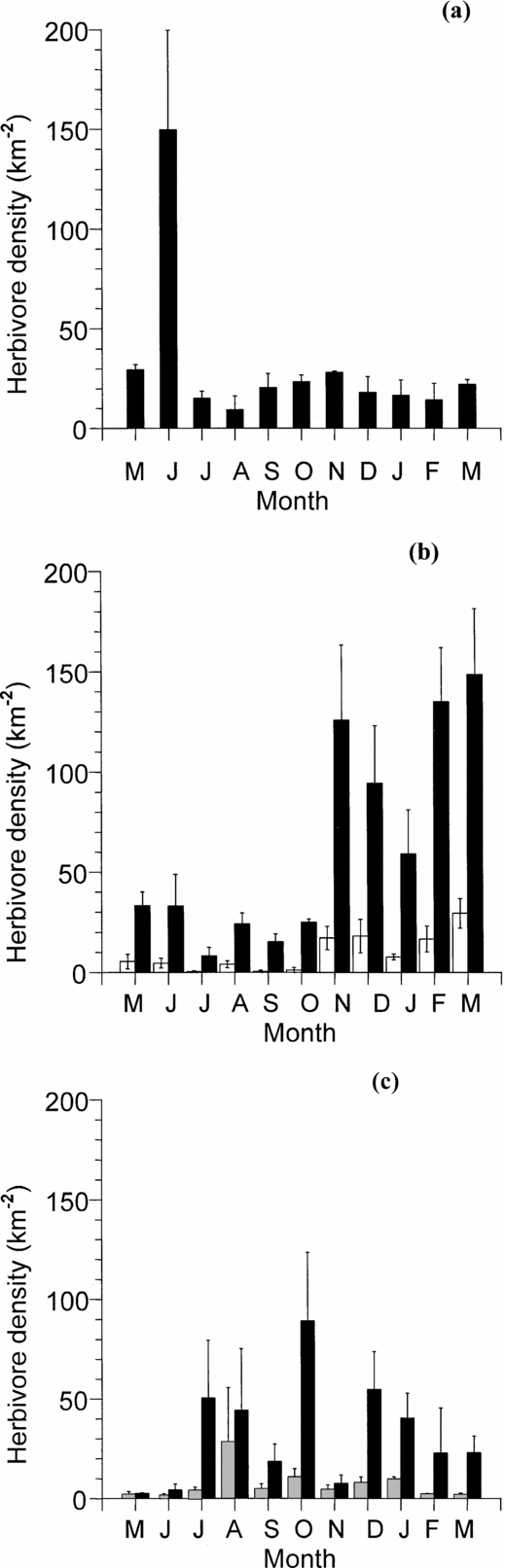
Combined data from the Serengeti NP sector of the Mihale and Ndabaka transect displayed the expected positive correlation between the mean monthly density of snares (hunting effort; Table 1) and the mean monthly density of herbivores (combined data from the Mihale and Ndabaka transects, Spearman Rank Correlation r = 0.641, n = 22, p = 0.002). The expected positive correlation between the mean monthly density of snares and the mean monthly density of herbivores was not found in the Grumeti GR section of the Mihale transect (Fig. 2; Spearman's r = 0.20, n = 11, not significant). Despite high densities of wild herbivores in Serengeti NP at Kirawira (Table 1, Fig. 3a), no evidence of illegal hunting (no snares, pitfall traps, or fences) was recorded along this transect. Owing to a very low density of wild herbivores outside protected areas (Fig. 3b, c), hunters could expect very poor returns and thus snares were rarely set in these areas.
Observed and predicted hunting effort (snare density per km2) based on travel costs and chance of arrest at the Kirawira, Ndabaka and Mihale transects (NP: National Park, GR: Game Reserve, unprotected: area outside both NP and GR). Results of post-hoc comparisons following Kruskal-Wallis test on observed hunting effort data; different letters indicate significant differences between sites, ? = unknown because hunting not observed.

Plot of density of snares per km2 against density of wild herbivores per km2. (○) Serengeti NP section of the Mihale transect, (△) Grumeti GR section of the Mihale transect, (●) Serengeti NP section of the Ndabaka transect. Unprotected areas that contained few or no wild herbivores, and the Kirawira transect that contained no snares, not included.

The density of wild herbivores in the (a) Kirawira transect, (b) Ndabaka transect, and (c) Mihale transect. Black bars = density in areas of the Serengeti NP; grey bars = density in areas governed by a village council; black bars = density in the Grumeti GR. No wild herbivores were observed in the area governed by a village council in the Mihale transect between May 2001 and March 2002.

Factors influencing illegal hunting effort
When areas were ranked according to their likely travel costs, and the hunting effort in these areas was predicted according to these ranks (Table 1), all pairwise comparisons of observed hunting effort between areas conformed to predictions, except for the comparison between the Serengeti NP section of Mihale and Kirawira, for which medium and low hunting efforts were predicted but equally low levels were observed in both areas (Table 1). These results indicate that travel is an important cost factor for hunters.
In contrast, when hunting effort was predicted on the basis of the likely chance of arrest (Table 1), then all pairwise comparisons of observed hunting effort between areas showed differences, however all differences except one were in the opposite direction to that expected. In particular, observed hunting effort in the Grumeti GR section of Mihale was significantly higher than in the NP section of this site when they were predicted to be equal, and, despite the presence of a guard post in the Serengeti NP sector of Ndabaka, the observed hunting effort was significantly higher than in the Serengeti NP sector of Mihale. These results indicate that the likely chance of arrest is perceived by hunters to be low and thus the potential costs associated with arrest do not have the expected influence on hunting effort. The only comparison that followed the expected direction was between the Serengeti NP section of Ndabaka and Kirawira (Table 1).
Seasonal changes in the densities of wild herbivores
Large fluctuations in the mean monthly densities of wild herbivores in each transect (Fig. 3) were caused by the migratory movements of wildebeest and zebra. High densities of wild herbivores were observed in Kirawira in June (Fig. 3a), in the Serengeti NP section of the Ndabaka transect between November and March (Fig. 3b), and in the Serengeti NP and Grumeti GR section of the Mihale transect in July, August, October, December and January (Fig. 3c). Neither resident nor migratory wild herbivores were present in the unprotected area outside the Grumeti GR along the Mihale transect (Fig. 3c) and were present only at very low densities in some months outside the Serengeti NP along the Ndabaka transect (Fig. 3b). This suggests that either the protected areas adequately encompassed the migratory routes or that migratory herds mostly avoided unprotected areas. Few resident herbivores persisted outside the protected areas, suggesting that populations of these species had been overharvested.
DISCUSSION
The results of this study are consistent with the idea that levels of illegal use of natural resources in the west of the Serengeti ecosystem were influenced by the likely value of the resources acquired and the probable costs associated with their acquisition.
Evidence of illegal hunting was found during the 11 months of this study along two of the three transects, suggesting that benefits of hunting mostly outweighed costs in these areas. Our results (Table 1) conformed to the expectation that level of illegal hunting decreased as the distance hunters travelled on foot to hunting areas increased. Travel cost is likely to be assessed not only in terms of distance travelled but also in terms of time that could be devoted to other activities (opportunity cost).
Illegal hunters mostly work at night by themselves or in small groups and use inconspicuous hunting methods. For this reason the likelihood of illegal hunting activities being detected is low, particularly in areas with dense vegetation and certain types of topography (Campbell & Hofer Reference Campbell, Hofer, Sinclair and Arcese1995). This may explain why high hunting effort occurred in the vicinity of the Ndabaka ranger post (Table 1, Fig. 3b). Our data are insufficient to test whether the absence of hunting effort at Kirawira was caused by the high chance of arrest afforded by two ranger posts and numerous tourist vehicles, a high travel cost to this area, or a combination of these factors. In general, the results of this study support optimality models developed for the Serengeti ecosystem that predicted that hunting would be depressed more by the cost of travel than the cost of arrest (Hofer et al. Reference Hofer, Campbell, East, Huish, Taylor and Dunstone1996; Hofer et al. Reference Hofer, Campbell, East and Huish2000).
The relatively lower density of snares in the Serengeti NP section of the Mihale transect compared to that in the Grumeti GR section is most likely the result of a greater travel cost without increased returns, as herbivore densities in both areas were similar (Table 1).
The positive relationship between the density of snares and that of wild herbivores in the Serengeti NP sections of the Mihale and Ndabaka transects (Fig. 2) indicates that hunters increased their effort as the likely level of return increased. Our results cannot discern whether this was the consequence of a relatively stable number of hunters increasing their hunting effort as profitability increased, or was caused by an increase in the number of hunters setting snares in areas with high densities of herbivore, or both of these processes. The observed increase in the density of snares in areas containing high densities of herbivores was likely to be detrimental to wildlife, including non-target species (Hofer et al. Reference Hofer, East and Campbell1993).
The highest densities of migratory herbivores recorded during the study occurred along the Ndabaka transect during the wet season (Fig. 3b). However, when herbivore densities along the Ndabaka transect were high, the density of snares in this area was lower than might have been expected, given the comparatively high snare density recorded in Grumeti GR section of the Mihale transect at far lower herbivore densities (Fig. 2). One possible explanation for this might be that travel by foot and the crossing of rivers in spate during the wet season are likely to be more costly than in the dry season, and drying illegally hunted meat for preservation and ease of transport is likely to be problematic during the wet season. Furthermore, during the wet season, villagers cultivate crops and, as Ndabaka was close to Lake Victoria, fishing may be more profitable than illegal hunting.
High densities of herbivores occurred in the Grumeti GR section of the Mihale site for a brief period of less than a month (Fig. 3c). The density of snares during this month was lower than that found in the Serengeti NP section of the Ndabaka site when similar densities of herbivores were present for several consecutive months (Fig. 2 and Fig. 3b). This indicates that hunters did not easily locate and immediately exploit large, transient herds of migratory herbivores that occupied an area for a brief period.
Overharvesting appears to have eliminated the wild herbivore populations in village managed areas outside the Grumeti GR at the Mihale site, and has decreased the wild herbivore population in village areas outside the Serengeti NP at the Ndabaka site.
During the dry season, the density of livestock within the Serengeti NP and Grumeti GR along the Mihale transect was higher than along the Serengeti NP section of the Ndabaka transect. This is probably because during the dry season the large river in the protected section of the Ndabaka transect (Mbalageti River) did not contain permanent water, and livestock owners moved their stock towards the shores of Lake Victoria where adequate forage and water were available during the dry season. Throughout the dry season the Grumeti River close to the Mihale transect did contain permanent water.
Despite high densities of livestock close to the boundary of the protected areas, domestic stock was rarely illegally present in these areas. This may indicate that livestock owners considered the chance of detection and likely financial penalties (fines or confiscation of livestock) too high in relation to the benefit gained from illegally acquired forage and the use of watering areas inside protected areas. As livestock owners are relatively wealthy members of local communities, they are likely to have less need to engage in illegal activities (Loibooki et al. 2001).
ACKNOWLEDGEMENTS
We thank the Messerli Foundation (Switzerland) and the Leibniz-Institute for Zoo and Wildlife Research (Berlin, Germany) for financial support, the Tanzanian Commission of Science and Technology for permission to conduct the study, the Tanzanian Wildlife Research Institute, Tanzanian Wildlife Division and Tanzanian National Parks for cooperation and support, P.D. Moehlman for helpful comments, K.L.I Campbell for information, F.F. Banyikwa, K. Wilhelm, R. Fyumagwa, D. Thierer, H.Wiik and T. Shabani for assistance, and two referees for their helpful comments.