China is naturally prone to disasters. In particular, earthquakes frequently occur in the Sichuan province. Earthquakes have an enormous social effect given that they damage infrastructures and result in deaths.Reference Green and Miles 1 In the past several years, Sichuan has suffered from devastating losses caused by earthquakes, including the Wenchuan earthquake in 2008, the Lushan earthquake in 2013, and numerous aftershocks of various intensities. Survivors are weak after natural disasters occur and are susceptible to health damage. Given that survivors of natural disasters are more vulnerable, protecting their rights, such as their rights to health, housing, food, water, and life, becomes more difficult.Reference Lewis, Maguire and Stringer 2
The economic and social rights (ESR) of survivors, including the rights to education, food, health, housing, work, and social security, are significant components of human rights. According to the National Economic and Social Rights Initiative, “[ESR] guarantee that every person be afforded conditions under which they are able to meet their basic needs.” 3 Rooted in humanitarianism, the concept of ESR relies on the concept of human rights. To further protect the rights of people in post-disaster zones in earthquake-prone Sichuan, China’s State Council Information Office issued the National Human Rights Action Plan (2009 to 2010) in July 2011. This plan emphasized the protection of human rights during reconstruction after the Wenchuan earthquake. 4
Nevertheless, studies of ESR remain limited, particularly those that focus on earthquake survivors. It is reported that the rights of people with mental disabilities are frequently violated.Reference Drew, Funk and Tang 5 Therefore, from a global perspective, mental health and psychosocial support in humanitarian settings should be strengthened.Reference Tol, Barbui and Galappatti 6 Some studies have focused on the effect of the destruction caused by war on human rightsReference Burrell 7 , Reference Liebling-Kalifani, Marshall and Ojiambo-Ochieng 8 and have reported that human rights violations result in more cases of mental disorders.Reference Priebe, Bogic and Ashcroft 9 Other researchers have explored the protection of human rights among disaster survivors. For example, studies of the Haiti earthquake have focused on the protection of the human rights of childrenReference Todres 10 and enforcing policies to address human rights violations.Reference Phillips, Bergin and Goldsmith 11 Human rights–centered approaches to disaster management help to improve governance mechanisms and prepare countries in responding to disasters.Reference Kumar 12 However, the current humanitarian system is insufficient in dealing with many large-scale disasters per year.Reference Ferris 13 Practical evidence is necessary to further enhance the protection of human rights and the capacity to handle natural disaster emergencies.
As an interdisciplinary measurement with rich connotation and multiple aspects, the quality of life (QOL) measurement has been applied in fields such as medicine, health management, and social science. Although the definition of QOL remains controversial, numerous studies have used QOL to evaluate the general feeling of an individual and his or her surroundings. This sensitizing concept can contribute to the development of policies on public health and allocation of medical resources.Reference Schalock, Brown and Brown 14 The QOL of survivors in hard-hit disaster areas is poor.Reference Liang, Chu and Wang 15 The QOL of the elderlyReference Chou, Chou and Su 16 and womenReference Liang and Cao 17 has been reported to be poorer than that of other survivors. Living conditions are reported to be another important factor.Reference Ardalan, Mazaheri and Vanrooyen 18 Likewise, social support moderates the negative relationship between mental disorders and QOL.Reference Zhao, Wu and Xu 19 Thus, strong social support can help survivors solve their problemsReference Priebe, Marchi and Bini 20 and improve their QOL.Reference Ke, Liu and Li 21 In addition, the post-earthquake assistant policies organized by the government can help to improve the survivors’ QOL.Reference Liang and Wang 22 , Reference Liang and Cao 23 The aforementioned studies have emphasized the importance of social support and government assistance as psychological interventions for people in post-disaster zones. However, most of these studies focused on the effect of mental problems and external support on QOL. New perspectives for studying QOL factors are needed. Thus, studies should explore QOL and its factors from various perspectives to facilitate comprehensive investigations.
Natural disasters can cause considerable loss. To restore such loss, the recovery system should provide people in post-disaster zones with tailored access to basic human needs. Only rapid and timely provision can ensure the promotion of public health.Reference Lawry and Burkle 24 Thus, an assessment of ESR will help to improve public health preparedness. On the basis of these needs and research gaps, the present study explored the satisfaction with ESR and QOL of people in earthquake-prone areas in Sichuan, China. The main purposes of the study were as follows: (1) to evaluate the satisfaction of survivors with ESR and QOL, (2) to explore the association of ESR satisfaction with QOL, and (3) to provide suggestions for the government regarding the protection of survivors’ ESR and how to improve survivors’ QOL. This study is expected to promote research on the QOL of earthquake survivors in China and contribute to the literature on QOL factors.
METHODS
Sampling
Data were obtained through a survey in 5 Sichuan counties in 2013 by multistage sampling. By random sampling, the following 5 cities in 39 hard-hit disaster areas were selected: Aba, Guangyuan, Deyang, Ya'an, and Chengdu. Using the same method, we selected a county in each city as follows: Wenchuan, Qingchuan, Mianzhu, Lushan, and Dujiangyan. In each county, 400 people were randomly selected. Each participant independently completed the questionnaire with the guidance of the investigators. A total of 2000 questionnaires were distributed, and 1672 were returned, with an effective rate of 83.6%. Among the respondents, 807 (48.3%) were men and 865 (51.7%) were women. The mean age of the participants was 46 years, and more than 20% of the respondents were illiterate.
Questionnaires
Previous studies have used the brief version of the World Health Organization Quality of Life instrument (WHOQOL-BREF) to explore the QOL of earthquake survivors.Reference Lin, Huang and Huang 25 , Reference Ceyhan and Ceyhan 26 WHOQOL-BREF is the most useful instrument in clinical trials 27 and has been proven to be reliable and valid among the Chinese.Reference Liang and Li 28 The scale contains four domains, namely, physical health, psychological health, social relationship, and environment, with a total of 26 items. Three of these items are reverse-scored, and 2 are overall questions that pertain to global QOL and health satisfaction. 27 The reverse items are converted according to the method shown in the WHOQOL instructions. The final scores range from 0 to 100. High scores indicate a high QOL among respondents.
The ESR satisfaction scale has 6 questions concerning ESR enjoyment. It contains 6 domains, namely, degree of satisfaction with the right to education, food, health, housing, social security, and work. Respondents are requested to rate their satisfaction with their ESR. For example, one question is, “How do you perceive your satisfaction with your right to education?” Options are similar for each domain, with higher scores indicating a higher degree of satisfaction, as follows: 1 (very dissatisfied), 2 (dissatisfied), 3 (general), 4 (satisfied), and 5 (very satisfied).
Analysis
Reliability is the consistency or stability of measurement results. The consistency of the data obtained by use of the 2 scales was measured through the reliability test. Among the possible models, confirmatory factor analysis (CFA), which is a statistical analysis method for social survey data, was found to be useful. This method is performed prior to structural equation modeling (SEM), which is a multivariate statistical technique that combines factor and path coefficient analysis. We established models to determine the features of the influence of ESR satisfaction on QOL.
RESULTS
Descriptive statistics
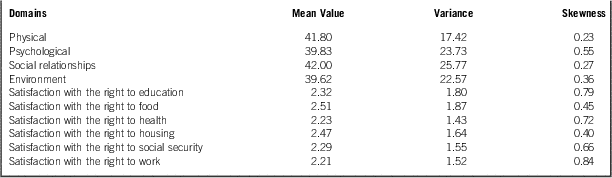
The descriptive statistics of the 2 scales are shown in Table 1. The mean values of the 4 domains of the WHOQOL-BREF were lower than the midpoint of the scale (ie, 50). For the ESR satisfaction scale, the mean values of the other domains were below the midpoint of the scale (ie, 2.5), apart from satisfaction with the right to food. The skewness of all domains was greater than 0, thus indicating that the positive deviations were relatively large (mode<median<mean value). That is, most people reported a QOL lower than the average; only the high scores of a few respondents widened the mean value.
Descriptive Statistics of the WHOQOL-BREF and Satisfaction With ESR Scales

Abbreviations: WHOQOL-BREF, brief version of the World Health Organization Quality of Life questionnaire; ESR, economic and social rights.
Reliability test
Cronbach’s alpha coefficient indicates internal consistency to determine the homogeneity of the data. The total Cronbach’s alpha coefficients of the WHOQOL-BREF and satisfaction with ESR scales were 0.890 and 0.829, respectively. Thus, the overall reliability of the two scales was good. As shown in Table 2, the coefficients were less than the total coefficient if the domains were removed, which indicates that the reliability of the domains was high.
Reliability Test Results of the WHOQOL-BREF and Satisfaction With ESR Scales

Abbreviations: WHOQOL-BREF, brief version of the World Health Organization Quality of Life questionnaire; ESR, economic and social rights.
The correlation coefficients of the four domains of the WHOQOL-BREF are shown in Table 3. These correlation coefficients were significant and moderate, which indicates possible correlations among the four domains.
Correlation Coefficients of the Four Domains of the WHOQOL-BREF Scale

Abbreviation: WHOQOL-BREF, brief version of the World Health Organization Quality of Life questionnaire.
a P<0.01.
Confirmatory factor analysis
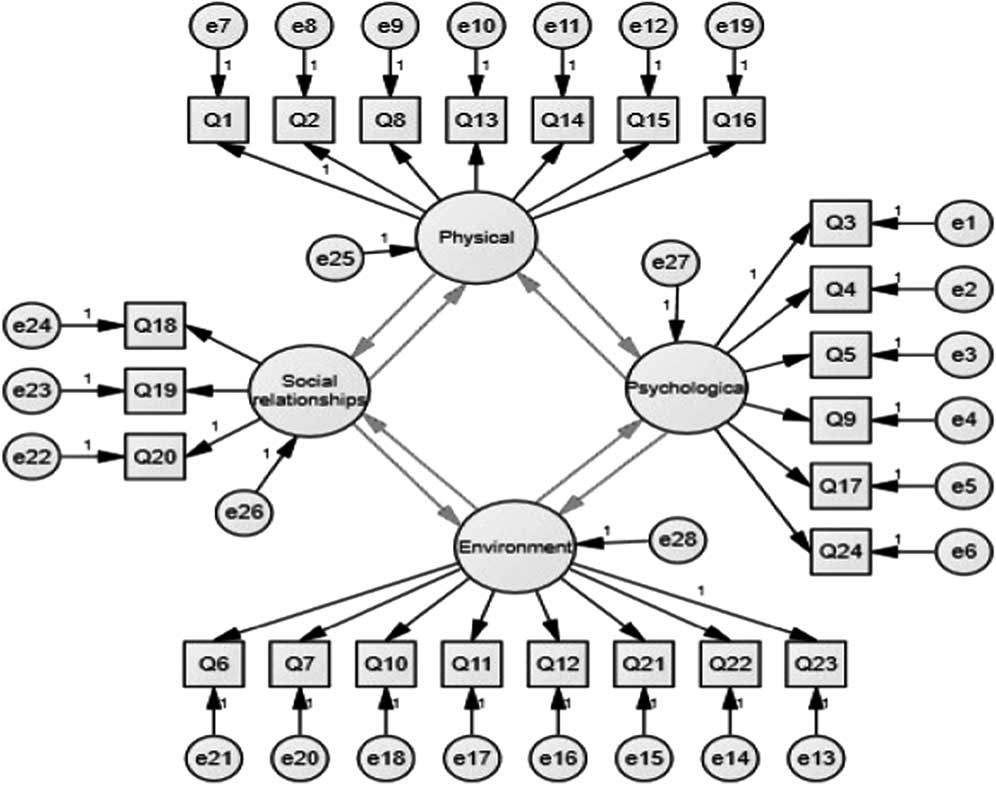
The present study assumed that the 4 domains of the WHOQOL-BREF affected the QOL of people and interacted with one other; thus, we established the CFA (Figure 1). The red arrows indicate the interactions between domains that must be verified. SEM is usually used to compare the general model. The referenced index focuses more on the integrated coefficient than on a single argument. Moreover, the statistical significance of individual indexes was not the focus of the analysis.
Confirmatory Factor Analysis of the Brief Version of the World Health Organization Quality of Life Questionnaire (WHOQOL-BREF). Note: Q1 to Q24 indicate the 24 items of the WHOQOL-BREF. Q1, Pain and discomfort; Q2, dependence on medicinal substances and medical aids; Q3, positive feelings; Q4, spirituality/religion/personal beliefs; Q5, thinking, learning, memory and concentration; Q6, freedom, physical safety, and security; Q7, physical environment (pollution/noise/traffic/climate); Q8, energy and fatigue; Q9, bodily image and appearance; Q10, financial resources; Q11, opportunities for acquiring new information and skills; Q12, participation in and opportunities for recreation/leisure activities; Q13, mobility; Q14, sleep and rest; Q15, activities of daily living; Q16, work capacity; Q17, self-esteem; Q18, personal relationships; Q19, sexual activity; Q20, social support; Q21, home environment; Q22, health and social care: accessibility and quality; Q23, transport; Q24, negative feelings; e1 to e24 indicate the errors of the 24 items.

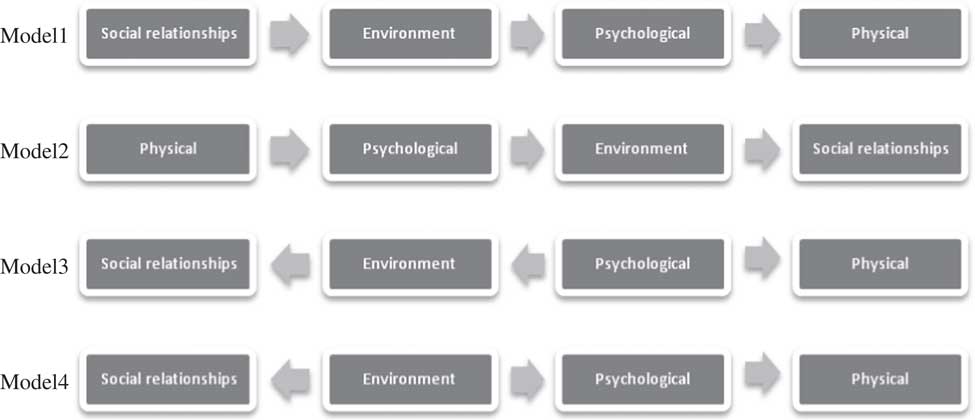
The aforementioned criteria were used to obtain 4 optimal models from the results of the CFA. The models were all used considering their similarity. Figure 2 shows the roadmap of the CFA models. Model 3 shows that psychological health had certain effects on physical health and the perception of the environment, which directly affected social relationships. Psychological health indirectly affected social relationships through the environment. Other models could be explained in a similar manner. A comparison of the 4 models shows that 3 groups of associations existed among the 4 domains, particularly between physical and psychological health, psychological health and environment, and environment and social relationships. The SEM model was established on the basis of the 3 groups of correlations.
Road Map of the Confirmatory Factor Analysis Models.

Structural equation modeling
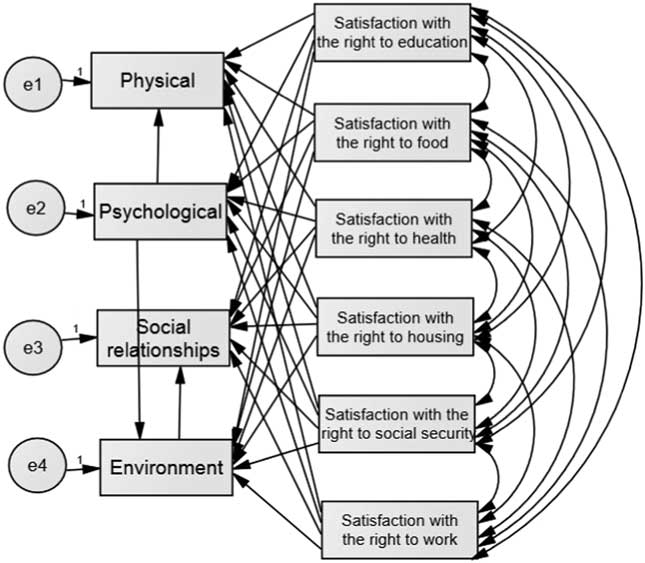
In this study, the SEM demonstrated the effect of satisfaction with the 6 domains of ESR on the 4 WHOQOL-BREF domains (Figure 3). The 4 domains of QOL were calculated into new observed variables before they were introduced into the SEM. The results indicated the following model fitting indexes: χ2/df=1.174 (<2), goodness-of-fit index (GFI)=comparative fit index (CFI)=1, and root mean square error of approximation (RMSEA)=0.010 (<0.05), P=0.279 (>0.05). Thus, the established SEM model had a good fit.
Structural Equation Modeling.

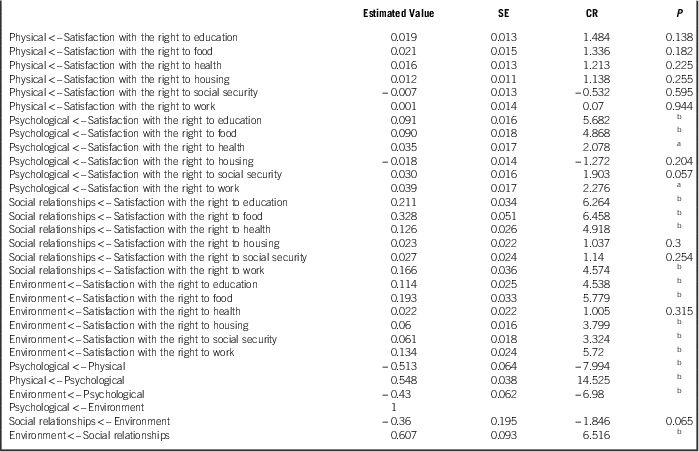
The path coefficients of the SEM are shown in Table 4. The path coefficients that passed the significance test were positive, which indicates that satisfaction with ESR positively affected QOL. The standard error was approximately 0. The specific features were as follows:
-
(1) The effects of the 6 domains of ESR satisfaction in terms of physical health were insignificant (P>0.05).
-
(2) Apart from satisfaction with the right to housing and social security, the estimated value of the other 4 domains of ESR satisfaction on psychological health passed the significance test. However, the coefficients were relatively small; all of the values were below 0.1.
-
(3) Apart from satisfaction with the right to housing and social security, the other 4 domains of ESR satisfaction significantly affected social relationships. Satisfaction with the right to food had the most significant effect on social relationships (0.328, P<0.001), followed by the rights to education, work, and health.
-
(4) Apart from satisfaction with the right to health, the other 5 domains of satisfaction with ESR had significant positive effects on the environment. Sufficient food provision had the strongest effect on the perception of people about their environment (0.193, P<0.001), followed by the rights to work, education, social security, and housing.
-
(5) The last 6 lines in Table 4 show the estimated values of the 3 groups of path coefficients, most of which passed the significance tests. Therefore, the correlations of all domains of the WHOQOL-BREF were statistically significant.
Results of the Structural Equation Modeling

Abbreviations: SE, standard error; CR, critical ratio.
a P<0.05.
b P<0.001.
To sum, among the coefficients that passed the significance test, satisfaction with the right to food had the strongest effect on social relationships (0.328, P<0.001). Satisfaction with the right to education had the second strongest effect on social relationships (0.211, P<0.001). Finally, satisfaction with the right to health had the least effect on psychological health (0.035, P<0.05).
DISCUSSION
We explored the effect of survivors’ satisfaction with ESR on QOL by use of CFA and SEM. The WHOQOL-BREF and ESR satisfaction scales passed the reliability tests. Our key findings were as follows.
First, the descriptive statistics indicated that both the QOL and the ESR satisfaction scores of people in a post-disaster zone were below the midpoint of the scale. Thus, the earthquake survivors in Sichuan rated their QOL poorly and had relatively low satisfaction with their ESR.
Second, the four domains of the WHOQOL-BREF had 3 groups of associations, namely, physical and psychological health, psychological health and environment, and environment and social relationships. Therefore, if the negative effect of earthquakes on the psychological health of people can be resolved, their physical health can be positively affected. Moreover, the environment affects physical health indirectly through psychological health.
Third, apart from physical health, ESR satisfaction significantly affected the 3 domains of QOL. The coefficients of ESR satisfaction on social relationships were greater than those of other domains, thus indicating that ESR satisfaction affected people’s social relationships more than the other domains.
Fourth, different ESR satisfaction domains had relatively significantly positive effects on the QOL. Satisfaction with the right to food had the most significant effect on QOL. Satisfaction with the rights to education and work had a comparatively greater positive effect on QOL, followed by the rights to health, social security, and housing.
Disaster relief and post-disaster reconstruction are the most effective forms of protection and remedies for the rights of survivors. However, the findings of the current study indicate that the survivors were not fully satisfied with the protection of their ESR. Shortly after the earthquake, food and shelter provision are the primary needs of survivors.Reference Kolbe, Hutson and Shannon 29 As the reconstruction proceeds, there arises the need to develop laws that protect the survivors’ right to housing.Reference Barber 30 Thus, governmental efforts are strongly required in the aftermath of the earthquake, as well as during the post-disaster reconstruction process. Furthermore, the government should protect people from diseases, provide them with a safe and peaceful life, and allow them to enjoy a stable social life.
The ESR satisfaction of people in a post-disaster zone affects the 4 domains of QOL differently. Destructive natural disasters violate the basic life needs of the survivors. Thus, sufficiency of food provision can safeguard people’s sense of security. However, earthquakes not only damage infrastructures and disturb the normal order of society but also result in great damage to the social capital of communities and individuals. Hence, professional social work is necessary and important.Reference Liang and Zhang 31 , Reference Mathbor 32 Providing relief for the negative effects of earthquakes on psychological health helps to improve physical health.Reference Liu, Shi, Jiang and Tang 33 Regardless of the housing reconstruction or rehabilitation provided, the government should guarantee a safe, comfortable living space and the provision of major social needs.Reference Zhou, Zhou, Fu and Wang 34 In addition, nations should focus on addressing the problems of people regarding education and work.
Limitations
The current study had several limitations. This study focused only on the ESR satisfaction of survivors, although other aspects of human rights may affect the survivors’ QOL. Moreover, satisfaction with ESR is self-developed but has good reliability. However, its accuracy and repeatability require further justification. In addition, the path coefficients of the effects of ESR satisfaction on QOL were relatively small, which indicates their limited explanatory power. More research perspectives are needed to explore the factors of QOL. Finally, this study used a cross-sectional survey design. The ESR of survivors and the dynamics of QOL were beyond the scope of the study. Future studies can therefore use tracking data to conduct an in-depth discussion.
CONCLUSIONS
The protection of the ESR of survivors has an important legal basis and a strong ethical foundation. The observation and evaluation of ESR might help to contribute to the development of policies regarding public health preparedness. Frequent earthquakes in Sichuan, China, remind us of the need to focus more on survivors’ QOL. The present study provides empirical evidence regarding the ESR satisfaction of people and their QOL and develops a new perspective for studying the factors of QOL. The results indicate that the earthquake survivors rated their QOL as poor and had relatively low satisfaction with their ESR. Satisfaction with ESR has significant positive effects on QOL. Apart from physical health, ESR satisfaction significantly affects psychological health, social relationships, and environment. Moreover, satisfaction with the right to food has the strongest effect on QOL, followed by the rights to education, work, health, social security, and housing. On the basis of the aforementioned findings, we emphasize the urgency and importance of developing policies that protect the ESR of survivors and improve their QOL. Reasonable and timely psychological interventions should be given to people in post-disaster zones.
Acknowledgments
This article was supported by the General Program of the National Natural Science Foundation of China (71473117 & 71173099), Youth Social Science Talent Plan in Jiangsu Province, the Program for New Century Excellent Talents in University (NCET-11-0228), and a subproject of the key project of the National Social Science Fund entitled Countermeasures of resolving China's rigid social contradictions (14ZDA061).