INTRODUCTION
The unsustainable commercial hunting of wildlife is the largest threat to mammal populations throughout West and Central Africa (Barnes Reference Barnes2002; Fa & Brown Reference Fa and Brown2009). As ecological monitoring of changes in wildlife populations is often logistically difficult, changes in the abundance of wildlife are frequently inferred from shifts in the availability of species in the market place and more recently from hunter catchment data (Fa et al. Reference Fa, Juste, Val and Castroviejo1995, Reference Fa, Yuste and Castelo2000; Rist et al. Reference Rist, Milner-Gulland and Cowlishaw2010). To date, few studies have integrated ecological, market and ethnographic research to better understand how wildlife populations and economies change in tandem at a single rural locality. This case study combines ethnographic data and quantitative market surveys with ecological data from wildlife transects conducted over a seven year period, to illustrate the synergistic relationships between humans and wildlife, and to better understand within site variation in wildlife populations, hunting and marketing practices and their implications for sustainable use in the Dzanga-Sangha Reserve (RDS), Central African Republic (CAR).
Human communities across Africa rely on wildlife as a primary protein source and an integral component of daily livelihoods (Bowen-Jones et al. Reference Bowen-Jones, Brown and Robinson2003; Eves & Ruggerio Reference Eves, Ruggiero, Mainka and Trivedi2002). Species most often hunted include duikers (Cephalophus spp.) and primates, primarily arboreal monkey species (Cerbocebus and Cercopithecus) and occasionally apes (Gorilla gorilla gorilla and Pan troglodytes) (Fa & Brown Reference Fa and Brown2009; Fa et al. Reference Fa, Ryan and Bell2005). In the Congo Basin region several species of duikers have been found to represent as much as 71–75% of hunter returns (Noss Reference Noss1998; Yasuoka Reference Yasuoka2006). The unsustainable harvest of duiker populations at sites in Central Africa will inevitably have cascading effects on the entire ecosystem, including human livelihoods, due to their role as seed dispersers and prey (Feer Reference Feer1995). Moreover, because duikers are a preferred protein, the long-term viability of these populations should have direct impacts on the presence of arboreal monkeys and apes as they become more frequently hunted once duiker availability declines (Auzel Reference Auzel1996 in Wilkie et al. Reference Wilkie, Curran, Tshombe and Morelli1998; Barnes Reference Barnes2002; Remis & Hardin Reference Remis and Hardin2009).
Changes in mammal populations have typically been assessed using either ecological line transect or market studies. Line transects can be used to provide both direct and indirect counts of wildlife. One of the primary challenges to studying duiker populations using direct observation transect methods in Central African forests is that many species are becoming cryptic and locally rare (Croes et al. Reference Croes, Laurance, Lahm, Tchignoumba, Alonso, Lee, Campbell and Buij2006; Hodgkinson Reference Hodgkinson2009).
Market studies have been argued to be useful for indirectly answering questions concerning the sustainability of hunting levels when insufficient are data available on actual wildlife populations and hunters’ returns (Fa et al. Reference Fa, Yuste and Castelo2000; Crookes et al. Reference Crookes, Ankudey and Milner-Gulland2005). Specifically, these studies provide details on species abundance and availability, suggesting how changes in these measures speak to the integrity of source populations (Juste et al. Reference Juste, Fa, Perez Del Val and Castroviejo1995; Fa et al. Reference Fa, Yuste and Castelo2000; Cowlishaw et al. Reference Cowlishaw, Mendelson and Rowcliffe2005). Although a useful tool for inferring changes in wildlife populations, market studies do have their limitations. Many market studies have been conducted in urban settings that are supplied with wildlife from multiple rural sources (Crookes et al. Reference Crookes, Ankudey and Milner-Gulland2005; Waite Reference Waite2007), thus implications for particular source sites are not clear. Even in rural settings, markets do not capture all of the wildlife for sale, as animals are also sold informally outside of the marketplace (Noss Reference Noss1998).
Integrating ethnographic research on hunters contributes directly to information on hunter activity, species profiled, hunting territories, direct measures of off-take and variation in behaviour. Hunters may be reluctant to participate in research that monitors their activities and they may falsify their responses to questions and surveys in order to protect themselves against negative consequences (Barber-Meyer Reference Barber-Meyer2010). In this case, our limited association with the local conservation project, good rapport with the community and the use of a local hunter as a research assistant facilitated data collection. Our long-term connections in the region and continual presence in the village allowed us to triangulate our results across multiple informants to validate and confirm our findings (Bernard Reference Bernard2006).
Recent social science research advocates the bridging of cultural and biological inquiries to better address the composite issues surrounding human-wildlife interaction and biodiversity conservation (Fuentes & Wolfe Reference Fuentes and Wolfe2002; Brosius Reference Brosius2006; Phillipson et al. Reference Phillipson, Lowe and Bullock2009). As a discipline, anthropology has long been concerned with human-environment relationships and is well positioned to make contributions to both social and ecological dimensions of biodiversity conservation (Orlove & Brush Reference Orlove and Brush1996; Brosius Reference Brosius1999; West & Brockington Reference West and Brockington2006). However, researchers have yet to adequately demonstrate how anthropological data and insights can contribute directly to environmental policy and the implementation of more effective wildlife management programmes.
The primary aim of this paper is to illustrate the utility of the integration of varied anthropological approaches to biodiversity conservation research. Using data collected in the RDS as a case study, we use results from three methodologically different studies to demonstrate how each would answer the following research questions: (1) Has hunting increased over time in the RDS? and (2) How have critical prey species been affected by hunting? These questions are first addressed by results from an ecological line transect study, and then using a separate dataset on wild meat sold in the local market. Finally, these questions and the results of the previous two datasets are examined through an ethnographic lens, contextualizing each dataset in conjunction with research conducted with local hunters.
Our combined analysis clarifies synergistic impacts operating in the region and provides a more nuanced understanding of changes in both the forest and the market.
METHODS
Study area
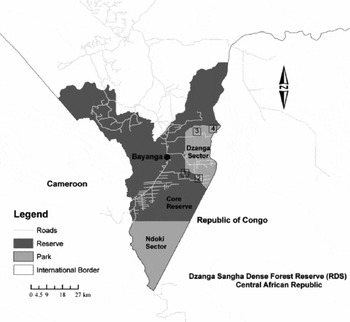
The primary data were collected during January 2008–July 2009 in the Dzanga-Sangha Reserve (RDS), Central African Republic (CAR) (02°13′26″ to 3°24′37″N; and 15°41′20″ to 016°37′20″E). Gazetted in 1990, jointly managed by the CAR government and the World Wildlife Fund (WWF), RDS consists of two protected park sectors, Dzanga (495 km2) and Ndoki (725 km2), and a reserve area (3359 km2) (see Fig. 1). During the study, local development was overseen by the Deutsche Gesellschaft für Technische Zusammenarbeit (German Technical Corporation, GTZ/GFA). The protected area regulations permit safari and subsistence hunting, logging and agriculture in the reserves zones that surround the park sectors (Blom et al. Reference Blom, Zalinge, Mbea, Heitkonig and Prins2004). Despite conservation efforts, illegal artisanal diamond mining and commercial hunting for regional markets persist in the reserve zones.
Location of field sites (data courtesy of Aires Protégées Dzanga Sangha).

Selective logging has occurred in the area intermittently since the 1970s, targeting mostly African mahoganies (Entandraphragma sp.). The logging operation and the conservation project have both attracted influxes of migrants to the region. At the last census in 2005, subsequent to the latest sawmill closure, 6188 people lived within RDS, an increase of 368% since 1991 (Noss Reference Noss1995); 63% of the reserve population lived within the town of Bayanga (Kamiss Reference Kamiss2006).
Transect study
Ecological transect data (135.4 km) were collected within RDS from October 2008 through June 2009 (across wet and dry seasons). These data are compared to those collected earlier using the same methods in the same transect sites in 2002 (60 km) and 2005 (80 km) for a total of 275.4 km (Remis Reference Remis2000; Hardin & Remis Reference Hardin and Remis2006; Remis & Hardin Reference Remis, Hardin, Hanna, Clark and Slocombe2007, Reference Remis and Hardin2009). Selected study sites range across park and reserve sectors of RDS varying in distance from the centralized human population in Bayanga (Fig. 1). The four field sites discussed here are located along two primary logging roads. The sites are divided to represent zones and distances from Bayanga that have historically had varying levels of hunting pressure and logging, including the reserve where registered gun and traditional hunting are permitted and the park sector where hunting is prohibited. Cable snares are illegal throughout the country.
Transects of approximately 5 km in length were established in each of the four study sites, perpendicular to drainage patterns; sampling across a gradient of habitat types. The design for line transect sampling was developed following established protocols (Plumptre Reference Plumptre2000). Transects were systematically located within each of the sites in order to account for the potential influence of primary and secondary logging roads and were positioned 500 m apart to account for variation in duiker home range size. This design enabled us to assess abundance and habitat use of focal mammal species and facilitated comparisons of species’ responses to varying levels of logging and hunting pressures.
This paper analyses a total of 275.4 km of transects walked in the Dzanga Sector and adjacent portions of the Reserve across field periods from 2002 to 2009. Teams of 4–6 observers walked between 0700–1300 h at a pace of 1 km h−1. Each team maintained at least two observers from previous field seasons. Direct observations and sign (for example alarm calls or fecal pellet counts) of non-human primates, ungulates and other mammals were recorded, along with age/sex, location on transect and perpendicular distance from transect or primate to observer distance (Fashing & Cords Reference Fashing and Cords2000; Buckland et al. Reference Buckland, Anderson, Burnham, Laake, Birchers and Thomas2001; Croes et al. Reference Croes, Laurance, Lahm, Tchignoumba, Alonso, Lee, Campbell and Buij2006). Researchers collected ecological data on habitat and understorey vegetation, and indirect sign of human presence (such as trash, snares, shot-gun shells or camps) on transects. Human sign includes sign related to logging and extraction of non-timber forest products, legalized BaAka net hunting, gun and snare hunting. In the analyses that follow, hunting refers to gun and snare hunting, as net hunting signs are not discernable on transects.
The transect data focus on human hunting sign and sign of prey species as indicators of change in hunting strategies and wildlife populations. Primary prey species in the RDS included six species of Cephalophus (C. monitcola, C. dorsalis, C. nigrifrons, C. callipygus, C. leucogaster and C. sylvicultor). The dung of medium-sized red duiker species are difficult to distinguish during line transect surveys, so, for the purposes of this analysis, sign from C. dorsalis, C. nigrifrons, C. callipygus and C. leucogaster were combined. We briefly examined the current status of secondary prey species, arboreal monkeys (Cercopithecus nictitans, C. pogonias, C. cephus, Colobus guereza, Cercocebus galeritus and Lophocebus albigena).
We recognize the difficulties and limitations inherent in analyses of indirect sign on transects as seasonality influences the deposition and decomposition of sign. Where applicable the use of seasonality as a variable in analyses of hunting sign will be noted; however, wildlife data are reported for only dry seasons. In this paper, the data are represented as encounter rates (sign per km) for all species to facilitate comparison with earlier data sets, control for varying sample sizes across census year and because of low sample sizes for many species, although density estimate analyses are underway. The use of encounter rates have been highly correlated with wildlife population densities in other studies (Chapman et al. Reference Chapman, Balcomb, Gillespie, Skorupa and Struhsaker2000; Plumptre & Cox Reference Plumptre and Cox2006). Previous analyses have revealed no significant differences in habitat types between our RDS sampling sites that might potentially differentially impact visibility of sign (Remis & Kpanou Reference Remis and Kpanou2010).
Formal and informal market surveys
The 2008 data from the formal market in Bayanga were collected by a local research assistant working in conjunction with Lesley Daspit and GTZ, following a protocol established in 2006 (Hodgkinson Reference Hodgkinson2009). Data were collected between 0800h and 1300h on 14 days each month for each wildlife unit for sale at the market: species, unit of measure, state (fresh or smoked), the ethnicity of the hunter and seller, the capture method and the total weight in kilograms. For the purposes of this study, GTZ made available an additional formal market dataset from January–December 2008 (n = 157 market days).
Data on meat for sale were also collected within the informal markets of Bayanga (i.e. individuals’ homes and unofficial markets within neighbourhoods). Carcass weights were estimated in the informal market using averages derived from the formal market data, which accounted for species, whether the meat was smoked or fresh, and the cut of the meat. Whenever possible, data in the informal markets were collected on the same days as the formal market (n = 155 days). The number of individuals available for sale was calculated from market data using units in conjunction with knowledge gleaned from participant observation in the markets for all wildlife species based on current commercial practices: butchering of individual animals, date recorded, whether it was offered for sale the previous day, hunting method, and whether the meat was fresh or smoked. Daspit chose to calculate number of individuals using this method as a more accurate representation of the number of actual animals killed for the market place (see Hodgkinson Reference Hodgkinson2009) relative to methodology used in an earlier RDS study by Noss (Reference Noss1998).
Daspit and her assistant had remarkable access to meat sold publicly and were invited into private homes to collect data on protected species. In 2008, protected species including elephants and gorillas were sold openly on market tables. Although an attempt was made to fully record all wildlife for sale in Bayanga through collection in both the informal and formal markets, these data do not account for meat sold directly from hunters exiting the forest to people on the roadsides or meat that was kept for personal consumption or gifted.
These market data on annual estimates of wildlife for sale in 2008 and 2009 are compared to market studies conducted in Bayanga in 1994 and 2006 (Noss Reference Noss1995, Reference Noss1998; Hodgkinson Reference Hodgkinson2009) in order to assess whether there have been changes in wildlife populations and hunting efforts in the RDS. Differences in data collection methods between study periods prevented detailed comparisons of market availability of particular species or changes across informal and formal markets (Noss Reference Noss1998; Hodgkinson Reference Hodgkinson2009).
Hunter interviews and surveys
In 2008 and 2009, Lesley Daspit and Carolyn Jost Robinson conducted semi-structured interviews (n = 268) with cable and gun hunters from Bayanga on hunting methods, the structure of hunting trips (including number of porters, days logged and supplies purchased), hunter preferences, returns, and knowledge of behavioural and population responses of prey species. Given the potentially sensitive nature of hunting related topics, subjects were recruited opportunistically through snowball sampling (Trotter & Schensul Reference Trotter II, Schensul and Bernard1998). In 2009, Jost Robinson administered a standardized survey to 15 local hunters for 34 hunting weeks to collect data regarding off-take. Surveys routinely documented number and length of trips, munitions taken, animals captured by age (adult/juvenile) and sex class, and catch per unit effort data (CPUE) for Cephalophus, Cercopithecus, Cercocebus and Lophocebus.
Data analysis
All data were analysed using SPSS 17.1. Student's t-tests were used to address changes in animal sign on transects and ANOVA analyses with post-hoc pair wise comparisons were used to assess changes in human sign on transects over time (2002–2009). For market data, Pearson's chi-square tests for goodness of fit were used to determine significant trends within the 2008 data and to assess changes in wildlife availability between 1994, 2006 and 2008.
RESULTS
Ecological data
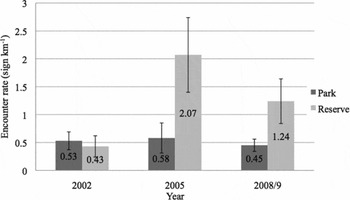
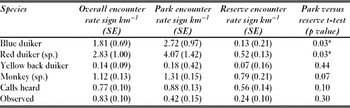
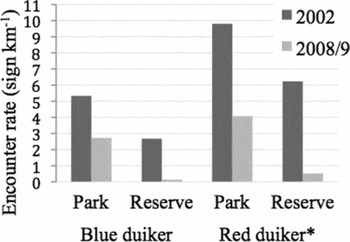
In RDS, human hunting sign increased from 2002 to 2005, and had declined by 2009 (2002 = 0.48 [SE = 0.12] sign km−1, 2005 = 1.10 [SE = 0.31] sign km−1, 2009 = 0.79 [SE = 0.19] sign km−1), though the differences were not significant. In the Reserve sectors, human sign along transects was more common in 2005 and less common in 2009 (2002 = 0.43 [SE = 0.19] sign km−1, 2005 = 2.07 [SE = 0.67] sign km−1, 2009 = 1.24 [SE = 0.40] sign km−1) (Fig. 2). In the 2009 dry season both blue and red duikers were encountered more frequently in the park sectors (blue duikers t = −2.64, df = 10, p = 0.03; red duikers t = −2.48, df = 10, p = 0.03; Table 1). The numbers of yellow back duiker sign across RDS were too few for analysis. In both park and reserve sectors, blue and red duiker dung were less common in 2009 than 2002 (Fig. 3), although only significant for red duikers within the park (t = 3.05, df = 14, p = 0.009).
Encounter rate of hunting sign in RDS, 2002–2009. Error bars represent standard error.

Encounter rates for prey sign in RDS during the 2008/2009 field season. *Significant at p < 0.05).

Encounter rate of duiker sign in RDS, in both 2002 and 2008/2009. *Includes four species of red duiker.

Market data
Between 1994 and 2008 there has been a combined 42% increase in the number of carcasses per year found across both the formal and informal markets. In 1994, 7658 individual carcasses were estimated to be available for sale in Bayanga (Noss Reference Noss1995, Reference Noss1998), whereas 10 865 individuals were available for sale in 2008. Thus the average daily availability of carcasses has increased from 10 individuals per day in 1994 to 30 individuals per day in 2008.
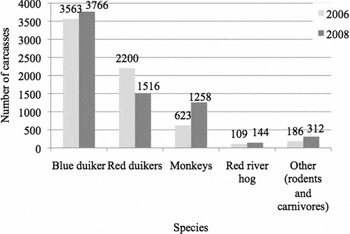
There have also been more recent increases in the estimated number of carcasses sold in Bayanga's formal market. Carcasses for sale increased 7% from 6619 in 2006 (Hodgkinson Reference Hodgkinson2009) to 7705 in 2008 (χ2 = 178.18, df = 1, p < 0.001) (Fig. 4). Between 2006 and 2008 prey species profiles changed, with a 31% decline in the number of red duikers available for sale alongside increases in the abundance of monkey species (102%) and ‘other’ prey species (68%) (χ2 = 19.5, df = 4, p = 0.001).
Estimated numbers of prey available for sale at market in Bayanga.

The market data also reflect changes in RDS hunting methods over the last 14 years. In 1994, most of the carcasses available for sale in Bayanga were reported by sellers to be killed by cable snares (Noss Reference Noss1995, Reference Noss1998). By contrast, in 2006, the most common prey species in the formal market had been killed by guns (Hodgkinson Reference Hodgkinson2009). In 2008, sellers reported that more animals offered for sale were killed by guns (82%) than cable snares (17%) (χ2 = 1,980.82, df = 1, p < 0.001); 1% of carcasses were captured by more traditional methods including net, dog or by hand.
Incorporating ethnography
We integrated the two datasets with our ethnographic data from hunters and hunter surveys. Of the 268 hunters interviewed, 197 were Bantu, while the remaining 71 were BaAka foragers. One hundred and three hunters used guns as their only method of hunting, although 120 hunters (60.9%) used guns in addition to other methods including snares; 23.8% of hunters relied predominantly on snares.
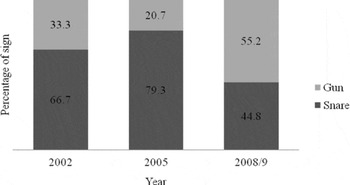
An initial exploratory analysis of hunter interviews revealed an increased reliance on guns since 2005, thus we recoded transect sign for human hunting into gun or snare sign, as each is easily differentiated in situ. Indications of snare hunting sign were more frequent on transects in 2002 and 2005 than in 2008/2009 (Fig. 5). An increase in evidence of gun hunting on transects by 2009 (Fig. 5) corroborates the ethnographic data. Further, since gun hunting leaves fewer traces than snare hunting, it is likely that our transect data provide only a very conservative measure of the level of gun hunting activity at RDS.
Percentage of gun versus snare sign on transects, 2002–2008/2009.

Hunter off-take surveys substantiate market and ethnographic data suggest that gun hunting results in greater returns over snare hunting. Average trip length for gun hunters was shorter (1.41 days) then for snare hunters (1.94 days). Hunters took an average of 12.5 cartridges on each trip (1.4 were lost on escaped prey) and they returned with an average of 9.83 animals trip−1. Snare hunters took an average of 41.1 snares per hunting trip with an average return of 3.07 animals trip−1. Surveys indicated gun hunters returned with a higher proportion of primates (21.4%) relative to snare hunters (1.8%), whereas snare hunter off-take included a higher percentage of other species (21%) than gun hunters (5.3%).
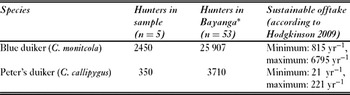
Interview data suggest that hunters preferred to hunt at night, being more likely to kill blue and red duikers than during daylight hours. Hunters also noted the greater effectiveness of guns than snares in interviews. The estimated annual off-take of the five hunters who owned legal firearms (n = 274 hunting trips) was 2450 blue duikers and 350 Peter's duiker (C. callipygus, a commonly captured species of red duiker). We extrapolated these known off-take numbers from our sample of gun hunters to the 53 known registered firearms in Bayanga (Table 2). In these surveys, the gun hunters always returned with a catch, while snare hunters returned without wildlife on 15% of trips (33/229 trips, five snare hunters), further supporting lowered success rates for snare hunters.
Calculated off-take for two primary prey species by known registered gun hunters in RDS in 2009. *Data for the five hunters included in the catchment survey were used to determine off-take estimates for the 53 registered gun hunters in Bayanga.

In general, hunters reported that hunting had become more difficult over the last five years. They commented on having to travel further distances from Bayanga to find animals, or even illegally hunt in park zones. They attributed these changes in hunting to their observation of an increased number of hunters in the RDS along with an influx of firearms, both legal and artisanal. For example, Hunter 10 noted, ‘[Before] I hunted behind [the village of] Yandoumbe, now it is necessary to go [further] to Lossi’, and Hunter 9 noted, ‘we risk the loss [extirpation] of animals because there are too many rifles’. When hunters were asked about their perception of animal stocks and the viability of populations over the next five years, 54.6% of individuals (n = 207) responded that they believed that animals, specifically duikers and arboreal monkeys, would be greatly diminished if not extirpated within the next five years. Hunter 70 stated, ‘If this continues in five years we will bitterly regret the loss of some of our species’.
In response to questions about changes in duiker and monkey behaviour over time, 98.6% of hunters commented that duiker species often avoided and had become visibly afraid of humans in the forest. Of these individuals, 29.5% reported that duikers had changed their activity with particular species becoming increasingly nocturnal as a result of human presence in the forest. Eighty-eight percent of hunters noted that arboreal monkey species had become more likely to avoid alarm calls and remain quiet in the presence of humans, a change hunters attribute to the increase in the presence of guns in RDS.
DISCUSSION
Interpretations of ecological data
By 2009, duiker encounter rates had become significantly higher in park than reserve sectors. Blue and red duiker abundance may have been reduced in the reserve suggesting that the park-reserve models established at RDS may well be functioning as intended as a source-sink system for prey species (Fa & Peres Reference Fa, Peres, Reynolds, Mace, Redford and Robinson2001). The encounter rate data suggest that there have been overall declines in blue and red duiker species since the earliest census (2002), with significant declines in red duiker species in the park sectors. The earlier spike in hunting has likely had a large impact on duiker populations, which have yet to recover given continued hunting pressure. If hunting sign continues to decline, future research might show recovery in prey populations.
Lower frequencies of monkey sign in the reserve may be the result of hunting pressure, increasingly cryptic behaviour, or the result of lagged post logging impacts similar to those observed at Kibale in Uganda (Chapman & Lambert Reference Chapman and Lambert2000). With transect data alone it is difficult to make management suggestions for monkeys in RDS and further research into the behaviour of individual primate species would be needed. To date, behavioural and ecological research has centred on the western lowland gorilla (Gorilla gorilla gorilla), agile mangabey (Cercocebus agilis) and grey-cheeked mangabey (Lophocebus albigena) (Remis Reference Remis1997; Shah Reference Shah2003). Further research is needed in order to separate the possible impacts of hunting and logging pressures on these and other primates at RDS.
Interpretations of market data
Market data indicate an increase in hunting at RDS between 1994 and 2008, especially apparent in the increased availability of carcasses per day. By 2008, guns appeared to be replacing snares at RDS, which were the predominant hunting method reported in the 1990s (Noss Reference Noss1998; Ghuirghi & Lakara Reference Ghiurghi and Lakara2002). The use of more efficient hunting technology coupled with population increases in Bayanga are responsible for the growth of the local wildlife market at RDS since 1994.
The relative availability of the larger more preferred red duiker has declined in Bayanga's formal market between 2006 and 2008, while monkeys and other less preferred species have increased. In West African markets, as larger-bodied, preferred prey species declined or were locally extirpated, less preferred species became more prevalent (Auzel & Wilkie Reference Auzel, Wilkie, Robinson and Bennett2000; Fa et al. Reference Fa, Yuste and Castelo2000; Cowlishaw et al. Reference Cowlishaw, Mendelson and Rowcliffe2005).
Increased proportion of prey captured by guns is likely responsible for increased hunting returns; this is especially the case for monkeys which are more susceptible to guns than snares (Kumpel et al. Reference Kumpel, Milener-Gulland, Rowcliffe and Cowlishaw2008). Duikers are the preferred prey and primary protein base for the RDS and our market data suggest that they are increasingly threatened by hunting in the RDS. Noss (Reference Noss1995) suggested that the hunting of red duikers might already be unsustainable in 1994 and projected future declines across the four red duiker species found in the RDS. In sum, the market data confirm increased hunting in the RDS, while the changes in the availability of duiker and monkey species in the markets indicate how increased hunting levels and shifts in hunting technology have differentially affected prey species.
Integrating ethnography into ecological and market data
Examined separately, ecological and market data differ and would likely lead to different conservation policy recommendations. When ecological and market datasets are re-examined in the context of ethnographic research, a more nuanced interpretation of ecological transect data emerges, as well as support for the validity of market studies for evaluating changes in prey species and human communities. The ecological transect data indicate that overall hunting sign on transects has increased from 2002 to 2009. Transect and ecological surveys show a spike in hunting activity in 2005, likely attributable to fluctuations in human population sizes and the closing of the logging concession in late 2004. These data could suggest to management personnel that hunting may have begun to decline since 2005. However, analysis of ethnographic data enable better understanding that decline in detectable hunting sign is at least partially attributed to change in hunting practices, as gun hunters leave fewer traces than snare hunters. Market data further substantiate the findings that there has been increased rather than decreased hunting in the RDS, as the number of carcasses, especially those taken by guns, available in the marketplace have increased.
Hunting, primarily with illegal cable snares in the years leading to this study, has been an important economic activity for local men (Ghiurghi & Lakara Reference Ghiurghi and Lakara2002). More recently, in the context of civil upheaval and nearby armed conflicts, access to arms and ammunition has increased (Blom & Yamindou Reference Blom and Yamindou2001; Berman & Lombard Reference Berman and Lombard2008). Although hunters and sellers alike report an increase in gun use, it is not possible to adequately estimate their numbers as most guns are not registered. Nevertheless, the number of registered guns in Bayanga has increased from 8 in 1993 to 53 in 2009 (Noss Reference Noss1995; C. Jost Robinson personal communication, 2009). These factors have exacerbated the impacts of hunting on protected wildlife and prey species.
The increase in gun hunting and access to firearms documented in market and ethnographic data leads us to reinterpret duiker sign on transects. At first glance, although animals are hunted in reserve zones, it appears as though the park-reserve model has been successful at maintaining populations of duikers in the park sector. However when examined in light of high hunter off-take data and market research, we can conclude that duikers are being hunted at unsustainable levels in the reserve. If hunting pressure remains constant, future significant declines in park populations are expected, as hunters admit they are encroaching into these sectors and some hunting sign is already evident on transects.
Market and hunter off-take studies show increases in the hunting of primates coupled with declining encounter rates throughout RDS, these changes are similar to those observed in other forest ecosystems following increases in gun hunting (Kumpel et al. Reference Kumpel, Milener-Gulland, Rowcliffe and Cowlishaw2008). Although lag effects from post logging may also be responsible for declines in monkey sign on transect, the multiple lines of data presented here suggest that increases in gun hunting are more likely to be driving changes in the detection, and potentially abundance, of non-human primates on transects in RDS.
At RDS, decreased sign of larger red duikers on transects and in the market points to a shift in prey from the larger-bodied to smaller-bodied duikers at the market, including blue duikers, as well as less-preferred primates, and rodents. These changes suggest unsustainable hunting of the larger-bodied mammals and preferred prey species (such as duikers; Eves & Ruggiero Reference Eves, Ruggiero, Mainka and Trivedi2002; Fa & Brown Reference Fa and Brown2009), most likely tied to the increase in firearms in the area.
These combined data lead us to recommend that management focus efforts on mitigating the effects of gun hunting on mammals in the RDS. We suggest increased anti-poaching patrols and vigilance in the enforcement of laws pertaining to gun licensing and annual bullet quotas, and efforts toward making alternative protein sources more available. Hunters are often not included in developing strategies for mitigating human-wildlife conflict in this region, given that they are perceived as part of the problem and not part of the solution. Better integration of local market women and hunters with project management conservation personnel would serve to decrease existing antagonism and foster collaboration between conservation management and the community. Currently neither market women nor hunters report that they are sufficiently regarded as stakeholders in the future of RDS. Our interviews and data from participant observation illustrate that hunters are cognizant and concerned about wildlife sustainability in RDS. Many suggest the implementation of self-regulated hunting systems and a desire for employment other than hunting. At the same time, market women specializing in the sale of wild meat are also looking for ways to move beyond this commerce toward other goods that are more profitable and environmentally sustainable.
Previous research on RDS communities and hunters cited community beliefs that animals would always be available in the forest, as the forest was there to provide for them (Hardin & Remis Reference Hardin and Remis2006). Moreover, many recent migrants to the area possess a frontier attitude, believing that resources in their new environment are plentiful. They are less likely to be concerned about the impacts of their actions on the surrounding environment (Oglethorpe et al. Reference Oglethorpe, Ericson, Bilsborrow and Edmond2008). Our ethnographic interviews revealed changing perceptions, whereby long-term residents, hunters and recent migrants alike now predict a future without sufficient animal prey to sustain their families. The varied human communities in this area have long histories and particular symbolic relationships that have developed with regard to the forest (Giles-Vernick & Rupp Reference Giles-Vernick and Rupp2006; Remis & Hardin Reference Remis and Hardin2009), thus the dissolution of human wildlife relationships will have significant implications for these communities.
Integration of ecological, market and ethnographic data has allowed detection of changes in hunting methods and intensity of hunting pressure, along with potential declines in critical prey species. Moreover, the increased representation of non-preferred and smaller-bodied prey species at the market, in combination with reduced frequency of their sign on transects in the reserve, signal unsustainable declines in larger-bodied preferred duiker prey. These combined data and analysis of multiple lines of evidence permit better understanding of the dynamic variation and extent of synergistic human impacts on wildlife at RDS. More broadly, they illustrate the challenges faced for conservation in multiple-use protected areas.
In conservation research, attention is often focused on those charismatic species typically observed and studied in RDS, such as the forest elephant (Loxodanta africana) and the western lowland gorilla. Nevertheless, their future, and that of Bayanga and the region as a whole, is tied to solving the problem of sustainable management of duiker prey populations or serious attention to acceptable alternatives (Remis & Hardin Reference Remis and Hardin2009). Our research has shown that whether in times of relative prosperity with logging operations booming or as a fallback when transnational companies pull out, the wildlife of this region support the population's need for protein and increasingly, for cash. The future of the human communities and wildlife in protected areas in the Congo Basin are intertwined; they must be considered together if effective solutions are to be implemented. Nuanced anthropological data and insights derived from collaborative crossdisciplinary work provide a good foundation for designing new community-based adaptive management plans and responses to dynamic human-animal relationships.
ACKNOWLEDGEMENTS
This research was supported by funding from: the National Science Foundation, the Wenner-Gren Foundation, National Geographic Society, World Wildlife Fund, the American Society of Primatologists, Primate Conservation International, the Explorer's Club and Purdue University. We thank the government of the Central African Republic and the Dzanga-Sangha Project for granting us permission to conduct our research. We also thank our research assistants: Jean Bosco Kpanou, Jean Bernard Dickey, the late Carolin Sambo, Eugene Mbea, Emile Wonga, Jean Paul Nyele, Ndondo, Molei, Jacque Epessekele, Christian Sapele, Valentine Memuonga, Romaric Kapita and Benjamin Nzoube. Most importantly, we thank the people of Bayanga for accepting us into their lives.