1 Introduction
Let K be a knot in the
 $3$
-sphere
 $S^3$
and let
 $E(K)$
denote the exterior
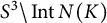 $S^3\setminus \operatorname {Int} N(K)$
of K, where
 $N(K)$
is a tubular neighborhood of K. We write
 $G(K)$
for the knot group of K, that is, the fundamental group
 $\pi _1(E(K))$
. For two knots K and
 $K'$
, if there exists an epimorphism
 $G(K)\twoheadrightarrow G(K')$
, then it is natural to expect that K is more complicated than
 $K'$
in some sense. Let
 $g(K)$
denote the genus of K. In Kirby’s list [Reference Kirby and Kazez1], Jonathan Simon posed the following long standing problem.
Problem 1.1 [Reference Kirby and Kazez1, Problem 1.12(B)]
If there is an epimorphism
 $\varphi \colon G(K) \twoheadrightarrow G(K')$
, does it imply that
 $g(K)\ge g(K')$
?
Note that Simon mentioned Problem 1.1 in [Reference Samelson45, p. 410] as well. A positive answer to this problem is known when
 $\deg \Delta _{K'}(t)=2g(K')$
(e.g.,
 $K'$
is fibered or alternating), where
 $\Delta _{K'}(t)$
denotes the Alexander polynomial. Indeed, the existence of epimorphisms implies that
 $\Delta _{K}(t)$
is divisible by
 $\Delta _{K'}(t)$
(see [Reference Crowell and Fox12, Exercise 9 in Chapter VII]). In [Reference Gabai20, Corollary 6.22] and [Reference Gabai22, Theorem 8.8], Gabai gave an affirmative answer when the epimorphism is induced by a proper map of non-zero degree between the knot exteriors. Also, Friedl and Lück [Reference Friedl and Lück16] solved Problem 1.1 when the knot group
 $G(K')$
is residually locally indicable elementary amenable (e.g.,
 $K'$
is fibered).
Moreover, we observe that when the epimorphism
 $\varphi $
is meridian-preserving and
 $K'$
is prime then
 $g(K)\ge g(K')$
if
 $\varphi (\lambda _K) \neq 1$
in Corollary A.4. This suggests that it is hard to analyze the case
 $\varphi (\lambda _K)=1$
, which happens, for instance, when K is the connected sum of
 $K'$
and its mirror image
 $-K^{\prime \ast }$
. Indeed, we have a map
 $f\colon E(K'\sharp (-K^{\prime \ast })) \to E(K')$
of degree zero such that f is orientation-preserving on
 $E(K') \subset E(K'\sharp (-K^{\prime \ast }))$
and not on
 $E(-K^{\prime \ast }) \subset E(K'\sharp (-K^{\prime \ast }))$
.
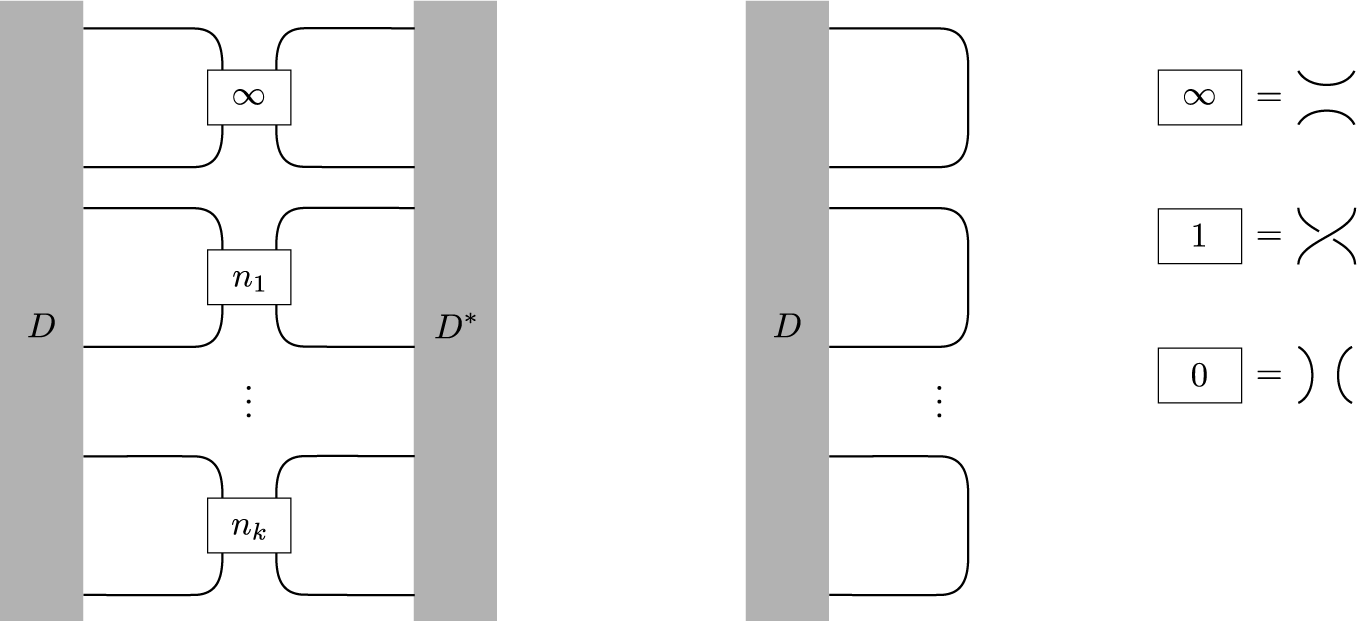
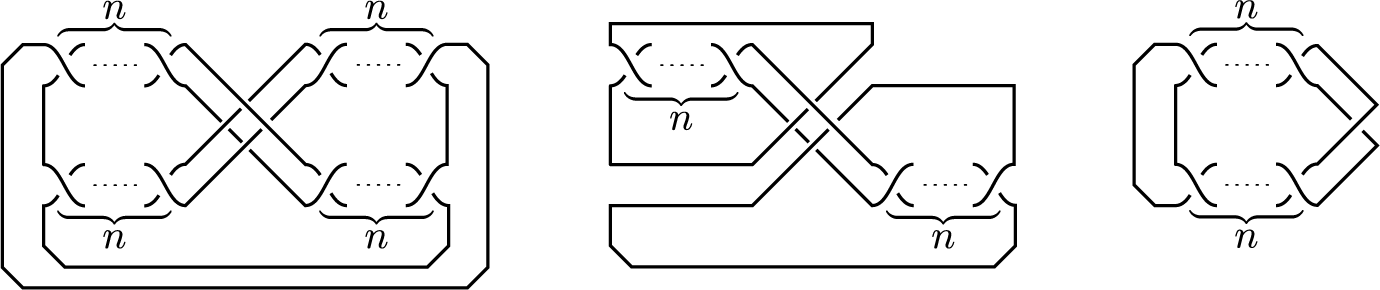
In this article, we focus on a symmetric union of a knot with its mirror image introduced by Kinoshita and Terasaka [Reference Kinoshita and Terasaka30] and generalized by Lamm [Reference Lamm37] as illustrated in Figure 1.
Symmetric union
 $(D \cup D^\ast )(\infty , n_1, \dots , n_k)$
and its partial knot.

Definition 1.2 Let D be an unoriented planar diagram of a knot
 $K_D$
and let
 $D^\ast $
be the diagram obtained from D by reflecting D across an axis in the plane. Let
 $B_0, B_1,\dots , B_k$
be balls along the axis, each of which is invariant by the reflection and intersects D in a trivial arc. One replaces the trivial tangle
 $(B_0, B_0 \cap (D \cup D^\ast ))$
by a
 $\infty $
-tangle to get the connected sum of the diagrams D and
 $-D^\ast $
. For
 $i=1,\dots ,k$
, one replaces each trivial tangle
 $(B_i, B_i \cap (D\cup D^\ast ))$
by an
 $n_i$
-tangle, where
 $n_i \in \mathbb {Z}$
. The knot diagram
 $(D \cup D^\ast )(\infty , n_1, \dots , n_k)$
obtained from
 $D\cup D^\ast $
in this way is called a symmetric union of the diagram D and
 $D^\ast $
. A knot which admits a diagram
 $(D \cup D^\ast )(\infty , n_1, \dots , n_k)$
is said to admit a symmetric union presentation with partial knot
 $K_D$
, where
 $K_D$
corresponds to the closure of the diagram D such that
 $(D \cup D^\ast )(0, 0, \dots , 0) = K_D \cup K_{D}^\ast $
.
When there is a single tangle replacement, the construction is due to Kinoshita and Terasaka [Reference Kinoshita and Terasaka30]. The extension to multiple symmetric tangle replacements is due to Lamm [Reference Lamm37]. The symmetric union construction is not unique and the isotopy type of the knot
 $K = D \cup D^\ast (\infty , n_1, \dots , n_k)$
depends on both the diagram D and the location of the tangle replacements. When the partial knot
 $K_D$
is oriented and all the twist numbers
 $n_1,\dots ,n_k$
are even, the symmetric union
 $D \cup D^\ast (\infty , n_1, \dots , n_k)$
inherits an orientation from the connected sum
 $D \sharp (-D^\ast )$
, but when some twists
 $n_i$
are odd, the orientation of
 $D \cup D^\ast (\infty , n_1, \dots , n_k)$
is not well-defined. A symmetric union
 $D \cup D^\ast (\infty , n_1, \dots , n_k)$
is said to be even if all the
 $n_i$
are even, and then we denote it by
 $D \cup (-D^\ast )(\infty , n_1, \dots , n_k)$
. Otherwise the symmetric union is said to be skew.
The even symmetric union construction, which is a generalization of the connected sum of a knot with its mirror image, provides plenty of examples of pairs of knots K and
 $K'$
with an epimorphism
 $\varphi \colon G(K) \twoheadrightarrow G(K')$
satisfying
 $\varphi (\lambda _K)=1$
(see Proposition 1.5). However, the genus of a symmetric union was not being much studied. Our result on the twisted Alexander polynomials of even symmetric unions allows to get a lower bound on the genus of an even symmetric union and to give a positive answer to Jonathan Simon’s problem in this case.
The symmetric union construction always produces ribbon knots and the following problem is still open.
Problem 1.3 [Reference Brejevs and Feller9, Reference Lamm37]
Does every ribbon knot admit a symmetric union presentation?
Prime ribbon knots up to ten crossings and ribbon
 $2$
-bridge knots admit symmetric union presentations due to Lamm [Reference Lamm37, Reference Lamm39]. This is true also for all but
 $15$
prime ribbon knots with
 $11$
and
 $12$
crossings by Seeliger [Reference Seeliger46] (see [Reference Lamm38]). In fact, there is no obstruction known for a ribbon knot to be a symmetric union. Moreover, there is no a priori upper bound for the number of required twist regions. However, our result gives some useful conditions to restrain possible even symmetric union presentations of a given knot in Section 5.
Despite the dependence on the diagram, a classical fact about symmetric unions is that the Alexander polynomial of it depends only on the parity of the twist numbers as shown in [Reference Lamm37, Theorem 2.4]. In particular, for an even symmetric union, one has the following property.
Proposition 1.4. Let K be a knot admitting an even symmetric union presentation with partial knot
 $K_D$
. Then,
 $\Delta _K(t) = \Delta _{K_D}(t)^{2}$
, up to multiplication by a unit in
 $\mathbb {Z}[t,t^{-1}]$
.
Another useful property relating an even symmetric union presentation to its partial knot is given by the following proposition, which is due to Michael Eisermann.
Proposition 1.5 [Reference Lamm37, Theorem 3.3]
Let K be a knot admitting an even symmetric union presentation with partial knot
 $K_D$
. Then, there is an epimorphism
 $\varphi _D\colon G(K) \twoheadrightarrow G(K_D),$
which sends a meridian of K to a meridian of
 $K_D$
and which kills the longitude.
The epimorphism
 $\varphi _{D}$
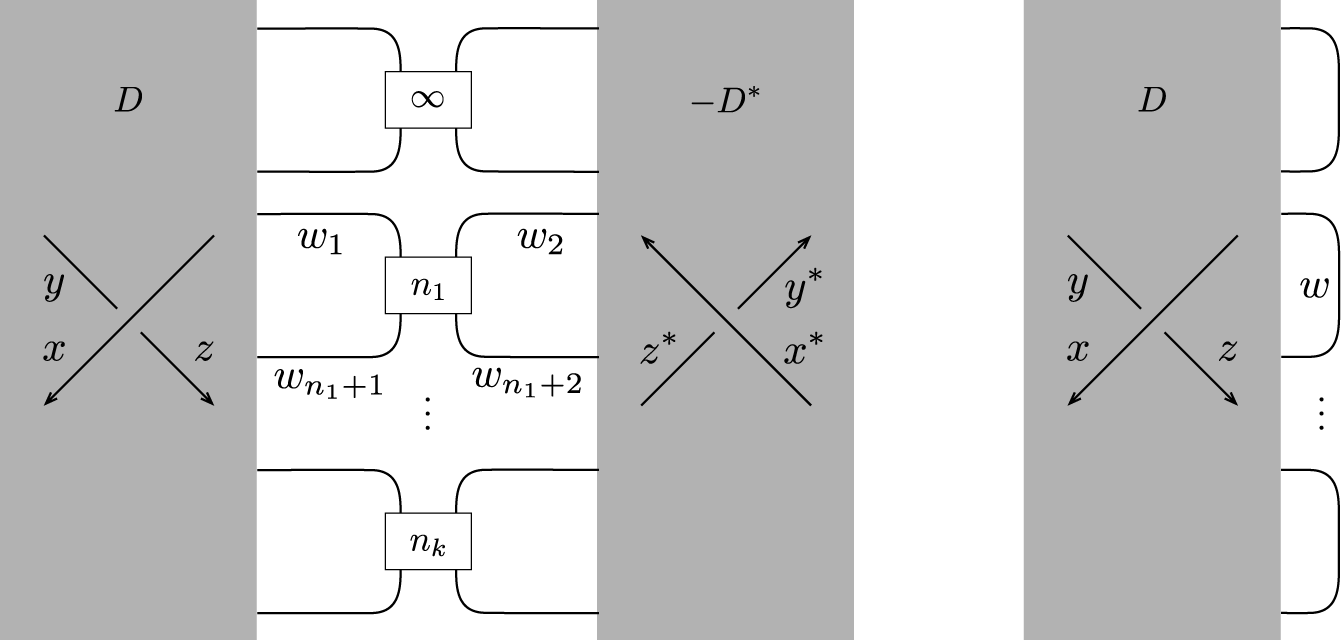
is defined in [Reference Lamm37, Figure 11] by mapping the generators of the Wirtinger presentation of the oriented diagram
 $D \cup (-D^\ast )(\infty , n_1, \dots , n_k)$
of the even symmetric union K to the corresponding Wirtinger generators of the oriented diagram D of the partial knot
 $K_D$
, according to Figure 2. The Wirtinger relations are clearly satisfied, and thus this map induces a well-defined epimorphism between the knot groups.
Wirtinger generators
 $x, y, z, x^\ast , y^\ast , z^\ast $
satisfy
 $yx = xz$
and
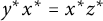 $y^\ast x^\ast = x^\ast z^\ast $
, and
 $\varphi _D(w_i)=w$
when
 $n_1\geq 0$
.

In this article, we use the epimorphism
 $\varphi _D$
given by Proposition 1.5 to generalize Proposition 1.4 in the setting of twisted Alexander polynomials. A representation
 $\rho _D\colon G(K_D) \to \mathit {GL}(d,\mathbb {F})$
over a field
 $\mathbb {F}$
induces a representation
 $\rho _D\circ \varphi _D\colon G(K)\to \mathit {GL}(d,\mathbb {F})$
. We write
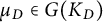 $\mu _D\in G(K_D)$
for a fixed meridian element and prove the following formula.
Theorem 1.6. Let K be a knot admitting an even symmetric union presentation with partial knot
 $K_D$
. Let
 $\varphi _D\colon G(K) \twoheadrightarrow G(K_D)$
be the epimorphism given by Proposition 1.5. For a representation
 $\rho _D\colon G(K_D) \to \mathit {GL}(d,\mathbb {F})$
, the twisted Alexander polynomials satisfy the equality
 $$\begin{align*}\Delta_{K,\rho_D\circ\varphi_D}(t) = \Delta_{K_D,\rho_D}(t)^2 \det(\rho_D(\mu_D)t-I_d) \end{align*}$$
up to multiplication by a unit in
 $\mathbb {F}[t,t^{-1}]$
.
In particular,
 $\deg \Delta _{K,\rho _D\circ \varphi _D}(t) = 2\deg \Delta _{K_D,\rho _D}(t) +d$
, where
 $\deg $
is defined to be the degree of a numerator minus that of a denominator.
Remark 1.7 While the twisted Alexander polynomial is not symmetric in general, we get
 $\Delta _{K_D,\rho _D}(t)^2$
since
 $\Delta _{K_D,\rho _D}(t) = \Delta _{-K_{D}^\ast ,\rho _{D}}(t)$
up to multiplication by a unit in
 $\mathbb {F}[t,t^{-1}]$
. Indeed, the Wirtinger presentation of
 $-D^\ast $
is completely the same as that of D and we consider the common representation
 $\rho _{D}$
(see Figure 2).
Remark 1.8 Theorem 1.6 is an extension of Proposition 1.4 since
 ${\Delta _{K,\rho }(t)=\Delta (t)/(t-1)}$
for the trivial representation
 $\rho \colon G(K)\to \mathit {GL}(1,\mathbb {F})$
(see Section 2).
Combining with [Reference Friedl and Nagel17] or [Reference Friedl and Vidussi18], we obtain the following inequality which implies an affirmative answer to Simon’s Problem 1.1 for an even symmetric union.
Corollary 1.9. For a knot K admitting an even symmetric union presentation with partial knot
 $K_D$
, it holds that
 $g(K)\geq 2g(K_D)$
.
This corollary extends a result by Moore [Reference Moore41] to any even symmetric union, where her result is for an even symmetric union with a single twist region and “symmetric fusion number one” by using Heegaard–Floer theory.
Köse [Reference Köse35, Theorem E] showed that the ribbon Montesinos knot
 $11a_{201}=K(1/3,2/3,4/5)$
does not admit a symmetric union presentation with a single twist region. The next result imposes some strong restrictions on any possible symmetric union presentation of this knot.
Proposition 1.10. If the ribbon Montesinos knot
 $11a_{201} = K(\frac {1}{3}, \frac {2}{3}, \frac {4}{5})$
admits a symmetric union presentation, it must be a skew one with partial knot
 $6_1$
or
 $9_1$
.
It is worth mentioning that the (original) Alexander polynomial does not rule out the possibility of
 $11a_{201}$
being an even symmetric union of
 $6_1$
since
 $\Delta _{11a_{201}}(t)=(2-5t+2t^2)^2=\Delta _{6_1}(t)^2$
.
In a subsequent paper [Reference Boileau, Kitano and Nozaki4], we study the relationship between the knot type of a symmetric union and the knot type of the associated partial knot. In particular, we study whether only finitely many distinct knots can occur as partial knots for a symmetric union presentation of a given knot.
Finally, in Appendix A, we address Simon’s problem in the case where an epimorphism does not kill the longitude. In contrast, Appendix B is devoted to discussing epimorphisms which kill the longitude. Using the Alexander modules, we will prove that, for some pairs of knots, epimorphisms between their knot groups can be realized only by a degree-zero map.
2 Twisted Alexander polynomials
Here, we give a quick review of the twisted Alexander polynomial. In general, it is an invariant for a finitely presentable group with an epimorphism onto a free abelian group. Here, we define it for a Wirtinger presentation of a knot group for simplicity. Let K be an oriented knot in
 $S^3$
. By taking a regular diagram D with N crossings, a Wirtinger presentation of
 $G(K)$
is given as
 $$\begin{align*}G(K)=\langle x_1,\ldots,x_N \mid r_1,\ldots,r_N\rangle, \end{align*}$$
where each generator corresponds to an arc in the diagram D and each relator comes from a crossing in D. Here, it is known that any one relator, for example
 $r_N$
, can be removed and hence:
 $$\begin{align*}G(K)=\langle x_1,\ldots,x_N \mid r_1,\ldots,r_{N-1}\rangle. \end{align*}$$
The abelianization homomorphism
 $$\begin{align*}\alpha\colon G(K)\to H_1(E(K);\mathbb{Z})\cong\mathbb{Z} = \langle t\rangle \end{align*}$$
is given by assigning to each generator
 $x_i$
the meridian element
 $t \in H_1(E(K);\mathbb {Z})$
.
Here, we consider a representation
 $$\begin{align*}\rho\colon G(K)\to \mathit{GL}(d,\mathbb{F}), \end{align*}$$
where
 $\mathbb {F}$
is a field. The maps
 $\rho $
and
 $\alpha $
naturally induce two ring homomorphisms
 $$\begin{align*}\tilde{\rho}\colon {\mathbb{Z}}[G(K)] \to M(d,{\mathbb{F}}) \end{align*}$$
and
 $$\begin{align*}\tilde{\alpha}\colon \mathbb{Z}[G(K)]\to \mathbb{Z}[\langle t\rangle]=\mathbb{Z}[t,t^{-1}], \end{align*}$$
where
 ${\mathbb {Z}}[\Gamma ]$
denotes the integral group ring of a group
 $\Gamma $
and
 $M(d,{\mathbb {F}})$
is the algebra of
 $d\times d$
matrices over
 ${\mathbb {F}}$
.
Then,
 $\tilde {\rho }\otimes \tilde {\alpha }$
defines a ring homomorphism
 ${\mathbb {Z}}[G(K)]\to M(d,{\mathbb {F}}[t,t^{-1}])$
. Let
 $F_N$
denote the free group on generators
 $x_1,\ldots ,x_N$
and let
 $$\begin{align*}\Phi\colon {\mathbb{Z}}[F_N]\to M(d,{\mathbb{F}}[t,t^{-1}]) \end{align*}$$
be the composition of the surjection
 $\tilde {\phi }\colon {\mathbb {Z}}[F_N]\to {\mathbb {Z}}[G(K)]$
induced by the presentation of
 $G(K)$
and the map
 $\tilde {\rho }\otimes \tilde {\alpha }\colon {\mathbb {Z}}[G(K)]\to M(d,{\mathbb {F}}[t,t^{-1}])$
.
Let us consider the
 $(N-1)\times N$
matrix A whose
 $(i,j)$
-entry is the
 $d\times d$
matrix
 $$\begin{align*}\Phi\left(\frac{\partial r_i}{\partial x_j}\right) \in M\left(d,{\mathbb{F}}[t,t^{-1}]\right), \end{align*}$$
where
 $\frac {\partial }{\partial x_j}\colon \mathbb {Z} [F_N]\to \mathbb {Z} [F_N]$
(
 $j=1,\dots ,N$
) denotes Fox’s free differential (see, e.g., [Reference Wada48, Section 2]). We call A the twisted Alexander matrix of
 $G(K)$
associated with
 $\rho $
. For
 $1\leq j\leq N$
, let us denote by
 $A_{x_j}$
the
 $(N-1)\times (N-1)$
matrix obtained from A by removing the jth column
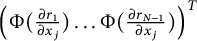 $\left ( \Phi (\frac {\partial r_1}{\partial x_j}) \dots \Phi (\frac {\partial r_{N-1}}{\partial x_j}) \right )^T$
corresponding to
 $x_j$
. We regard
 $A_{x_j}$
as a
 $d(N-1)\times d(N-1)$
matrix with coefficients in
 ${\mathbb {F}}[t,t^{-1}]$
.
Then, Wada’s twisted Alexander polynomial [Reference Wada48] of a knot K associated with a representation
 $\rho \colon G(K)\to \mathit {GL}(d,\mathbb {F})$
is defined to be the rational expression
 $$\begin{align*}\Delta_{K,\rho}(t) = \frac{\det A_{x_j}}{\det\Phi(x_j-1)}. \end{align*}$$
This is well-defined up to multiplication by a unit in
 $\mathbb {F}[t,t^{-1}]$
. In particular, it does not depend on the choice of a presentation of
 $G(K)$
under this equivalence. It can also be proved by taking the greatest common divisor of the numerators when the deficiency is not equal to one.
Remark 2.1 The denominator
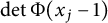 $\det \Phi (x_j-1)$
can be expressed as
 $\det (\rho (x_j)\alpha (x_j)-I_d)=\det (\rho (\mu )t-I_d)$
.
3 Proof of Theorem 1.6
This section is devoted to proving our main theorem. A key of the proof is to choose a suitable Wirtinger presentation of a given even symmetric union. In this section, we use
 $\doteq $
for the equality up to multiplication by a unit in
 $\mathbb {F}[t,t^{-1}]$
.
Proof of Theorem 1.6
We first show the case
 $K=D\cup (-D^\ast )(\infty ,2m)$
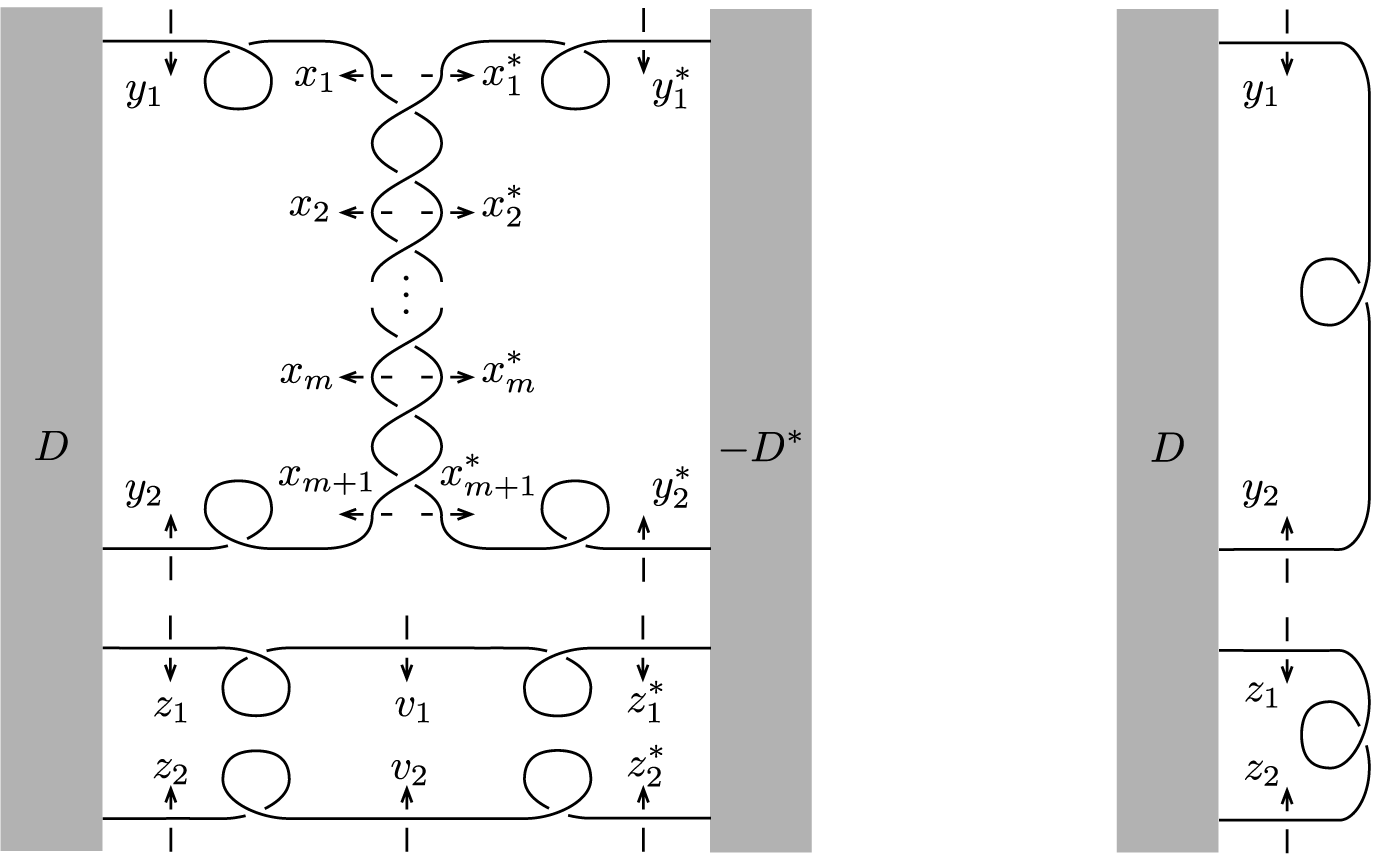
, where m is non-negative. Using the Reidemeister moves, we may assume that K is drawn as Figure 3 and there are
 $c\ (\geq 3)$
crossings and
 $c-2$
arcs in D. Then, we have a Wirtinger presentation such that generators are
 $$\begin{align*}\left\{ \begin{aligned} & u_1, \dots, u_{c-2}, u_1^\ast, \dots, u_{c-2}^\ast, \\ & v_1, v_2, x_1, x_1^\ast, \dots, x_{m+1}, x_{m+1}^\ast, \\ & y_1, y_1^\ast, y_2, y_2^\ast, z_1, z_1^\ast, z_2, z_2^\ast \end{aligned} \right. \end{align*}$$
and relators are
 $$\begin{align*}\left\{ \begin{aligned} & r_1, \dots, r_c, r_1^\ast, \dots, r_c^\ast, \\ & x_1x_1^\ast x_2^{-1}(x_1^\ast)^{-1}, x_1^\ast x_2^{-1}(x_2^\ast)^{-1}x_2, \dots, x_m x_m^\ast x_{m+1}^{-1}(x_m^\ast)^{-1}, x_m^\ast x_{m+1}^{-1}(x_{m+1}^\ast)^{-1}x_{m+1}, \\ & x_1y_1^{-1}, x_1^\ast(y_1^\ast)^{-1}, x_{m+1}y_2^{-1}, x_{m+1}^\ast(y_2^\ast)^{-1}, v_1z_1^{-1}, v_1(z_1^\ast)^{-1}, v_2z_2^{-1}, v_2(z_2^\ast)^{-1}. \end{aligned} \right. \end{align*}$$
Let us drop the last relator. Then, the corresponding Alexander matrix A is
 $$ \begin{align*} \left( \begin{array}{cc|cc|ccccccccc} U & & & & & & & & & & & & \\ & U & & & & & & & & & & & \\\hline & & & & I & X-I & -X & & & & & & \\ & & & & & I & X^{-1}-I & -X^{-1} & & & & & \\ & & & & & & \ddots & & & & \ddots & & \\ & & & & & & & & & I & X-I & -X & \\ & & & & & & & & & & I & X^{-1}-I & -X^{-1} \\\hline & & & & I & & & & & & & & \\ & & & & & I & & & & & & & \\ & & & & & & & & & & & I & \\ & & & & & & & & & & & & I \\\hline & & I & & & & & & & & & & \\ & & I & & & & & & & & & & \\ & & & I & & & & & & & & & \end{array} \right. \\ \left. \begin{array}{cccc|cccc} Y_1 & & Y_2 & & Z_1 & & Z_2 \\ & Y_1 & & Y_2 & & Z_1 & & Z_2 \\\hline & & & & & & & \\ & & & & & & & \\ & & & & & & & \\ & & & & & & & \\ & & & & & & & \\\hline -I & & & & & & & \\ & -I & & & & & & \\ & & -I & & & & & \\ & & & -I & & & & \\\hline & & & & -I & & & \\ & & & & & -I & & \\ & & & & & &-I & \end{array} \right), \end{align*} $$
where
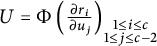 $U=\Phi \left (\frac {\partial r_i}{\partial u_j}\right )_{\substack {1\leq i\leq c\\ 1\leq j\leq c-2}}$
,
 $X=\Phi (x_1)$
,
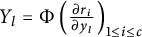 $Y_l=\Phi \left (\frac {\partial r_i}{\partial y_l}\right )_{1\leq i\leq c}$
, and
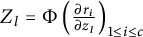 $Z_l=\Phi \left (\frac {\partial r_i}{\partial z_l}\right )_{1\leq i\leq c}$
for
 $l=1,2$
. Note here that, by the definition of
 $\varphi _D$
in [Reference Lamm37, Theorem 3.3], we have
 $\varphi _D(u_i) = \varphi _D(u_i^\ast ) = u_i$
for
 $i=1,\dots ,c-2$
,
 $\varphi _D(x_i) = \varphi _D(x_i^\ast ) = \varphi _D(y_j) = \varphi _D(y_j^\ast ) = y_j$
for
 $i=1, \dots , m+1$
and
 $j=1,2$
. Therefore,
 $U=\Phi \left (\frac {\partial r_i^\ast }{\partial u_j^\ast }\right )_{\substack {1\leq i\leq c\\ 1\leq j\leq c-2}}$
,
 $X=\Phi (x_i)=\Phi (x_i^\ast )=\Phi (y_j)=\Phi (y_j^\ast )$
,
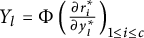 $Y_l=\Phi \left (\frac {\partial r_i^\ast }{\partial y_l^\ast }\right )_{1\leq i\leq c}$
, and
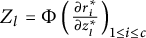 $Z_l=\Phi \left (\frac {\partial r_i^\ast }{\partial z_l^\ast }\right )_{1\leq i\leq c}$
. To compute the numerator of the twisted Alexander polynomial, we remove the last column corresponding to
 $z_2^\ast $
and compute the determinant of the resulting square matrix
 $A_{z_2^\ast }$
. Using elementary column operations, we eliminate the seven I’s above in the last seven rows (at the level of blocks). We get an upper triangular block matrix with a lower
 $7 \times 7$
diagonal block of
 $-I$
entries. Then, the determinant is equal to that of the matrix
 $$\begin{align*}\left( \begin{array}{cc|cc|ccccccccc} U & & Z_1 & Z_2 & Y_1 & & & & & & & Y_2 & \\ & U & Z_1 & & & Y_1 & & & & & & & Y_2 \\\hline & & & & I & X-I & -X & & & & & & \\ & & & & & I & X^{-1}-I & -X^{-1} & & & & & \\ & & & & & & \ddots & & & & \ddots & & \\ & & & & & & & & & I & X-I & -X & \\ & & & & & & & & & & I & X^{-1}-I & -X^{-1} \end{array} \right) \end{align*}$$
up to sign. By adding the jth column to the
 $(j+1)$
st column (at the level of blocks) for
 $j=5,6,\dots ,2m+5$
in this order, the rightmost part is transformed into
 $$\begin{align*}\left( \begin{array}{ccccccccc} Y_1 & Y_1 & Y_1 & & \cdots & & Y_1 & Y_1+Y_2 & Y_1+Y_2 \\ & Y_1 & Y_1 & & \cdots & & Y_1 & Y_1 & Y_1+Y_2 \\\hline I & X & O & & & & & & \\ & I & X^{-1} & O & & & & & \\ & & \ddots & & & & \ddots & & \\ & & & & & I & X & O & \\ & & & & & & I & X^{-1} & O \end{array} \right). \end{align*}$$
For the resulting entire matrix, we add the second row multiplied by
 $-1$
to the first row and then add the first column to the second column. The resulting matrix is
 $$\begin{align*}\left( \begin{array}{cc|cc|ccccccccc} U & & & Z_2 & Y_1 & O & O & & \cdots & & O & Y_2 & \\ & U & Z_1 & & & Y_1 & Y_1 & & \cdots & & Y_1 & Y_1 & Y_1+Y_2 \\\hline & & & & I & X & O & & & & & & \\ & & & & & I & X^{-1} & O & & & & \\ & & & & & & \ddots & & & & \ddots & & \\ & & & & & & & & & I & X & O & \\ & & & & & & & & & & I & X^{-1} & O \end{array} \right). \end{align*}$$
Since
 $(U\ Z_1\ Y_1+Y_2)$
is a
 $c\times c$
matrix and the rows of the three columns containing U,
 $Z_1$
,
 $Y_1+Y_2$
are zero except the second row, after successively permuting the last column with each of the previous
 $2m+2$
columns, the determinant of the above matrix is the product of
 $\det (U\ Z_1\ Y_1+Y_2)$
and that of
 $$\begin{align*}\left( \begin{array}{c|c|cccccccc} U & Z_2 & Y_1 & O & & & \cdots & & O & Y_2 \\\hline & & I & X & O & & & & & \\ & & & I & X^{-1} & O & & & \\ & & & & \ddots & & & & \ddots & \\ & & & & & & & I & X & O \\ & & & & & & & & I & X^{-1} \end{array} \right) \end{align*}$$
up to sign. Adding the
 $(2j-1)$
st column multiplied by
 $-X$
to the
 $2j$
th column and adding the
 $2j$
th column multiplied by
 $-X^{-1}$
to the
 $(2j+1)$
st column for
 ${j=2,3,\dots ,m+1}$
, we transform the above matrix into
 $$\begin{align*}\left( \begin{array}{c|c|cccccccc} U & Z_2 & Y_1 & -Y_1X & Y_1 & & \cdots & & -Y_1X & Y_1+Y_2 \\\hline & & I & O & O & & & & & \\ & & & I & O & O & & & \\ & & & & \ddots & & & & \ddots & \\ & & & & & & & I & O & O \\ & & & & & & & & I & O \end{array} \right) \end{align*}$$
whose determinant is
 $\det (U\ Z_2\ Y_1+Y_2)\det (I^{2m})$
up to sign, after successively permuting the last column with each of the previous
 $2m$
columns. Then,
 $$ \begin{align} \det A_{z_2^\ast} \doteq \det(U\ Z_1\ Y_1+Y_2)\det(U\ Z_2\ Y_1+Y_2). \end{align} $$
Generators for the knot groups of a symmetric union and a partial knot when
 $k=1$
.

Now, in the case
 $k=1$
and
 $m\geq 0$
, the desired equality
 $$\begin{align*}\Delta_{K_D, \rho\circ \varphi_D}(t) \det(\rho\circ \varphi_D(\mu)t-I_d) \doteq \left(\Delta_{K_D,\rho_D}(t)\det(\rho_D(\mu_D)t-I_d)\right)^2 \end{align*}$$
follows from (3.1) and Claim 3.1 whose proof is written after the current proof.
Claim 3.1 For the above matrices U,
 $Y_1$
,
 $Y_2$
,
 $Z_1$
, and
 $Z_2$
,
 $$\begin{align*}\det(U\ Z_1\ Y_1+Y_2) \doteq \det(U\ Z_2\ Y_1+Y_2) \doteq \Delta_{K_D,\rho_D}(t)\det(\rho_D(\mu_D)t-I_d). \end{align*}$$
If m is negative, we use a Wirtinger presentation such that generators are
 $$\begin{align*}\left\{ \begin{aligned} & u_1, \dots, u_{c-2}, u_1^\ast, \dots, u_{c-2}^\ast, \\ & v_1, v_2, x_1^\ast, x_1, \dots, x_{m+1}^\ast, x_{m+1}, \\ & y_1, y_1^\ast, y_2, y_2^\ast, z_1, z_1^\ast, z_2, z_2^\ast \end{aligned} \right. \end{align*}$$
and relators are
 $$\begin{align*}\left\{ \begin{aligned} & r_1, \dots, r_c, r_1^\ast, \dots, r_c^\ast, \\ & x_1^\ast x_1(x_2^\ast)^{-1}x_1^{-1}, x_1(x_2^\ast)^{-1}x_2^{-1}x_2^\ast, \dots, x_m^\ast x_m (x_{m+1}^\ast)^{-1}x_m^{-1}, x_m(x_{m+1}^\ast)^{-1}x_{m+1}^{-1}x_{m+1}^\ast, \\ & x_1y_1^{-1}, x_1^\ast(y_1^\ast)^{-1}, x_{m+1}y_2^{-1}, x_{m+1}^\ast(y_2^\ast)^{-1}, v_1z_1^{-1}, v_1(z_1^\ast)^{-1}, v_2z_2^{-1}, v_2(z_2^\ast)^{-1}. \end{aligned} \right. \end{align*}$$
Note that the order of generators
 $x_i$
and
 $x_i^\ast $
is changed. Then, the left half of the matrix A above is changed to
 $$\begin{align*}\left( \begin{array}{cc|cc|ccccccccc} U & & & & & & & & & & & & \\ & U & & & & & & & & & & & \\\hline & & & & I & X-I & -X & & & & & & \\ & & & & & I & X^{-1}-I & -X^{-1} & & & & & \\ & & & & & & \ddots & & & & \ddots & & \\ & & & & & & & & & I & X-I & -X & \\ & & & & & & & & & & I & X^{-1}-I & -X^{-1} \\\hline & & & & & I & & & & & & & \\ & & & & I & & & & & & & & \\ & & & & & & & & & & & & I \\ & & & & & & & & & & & I & \\\hline & & I & & & & & & & & & & \\ & & I & & & & & & & & & & \\ & & & I & & & & & & & & & \end{array} \right. \end{align*}$$
and the same elementary row and column operations as in the case
 $m\geq 0$
give the desired equality.
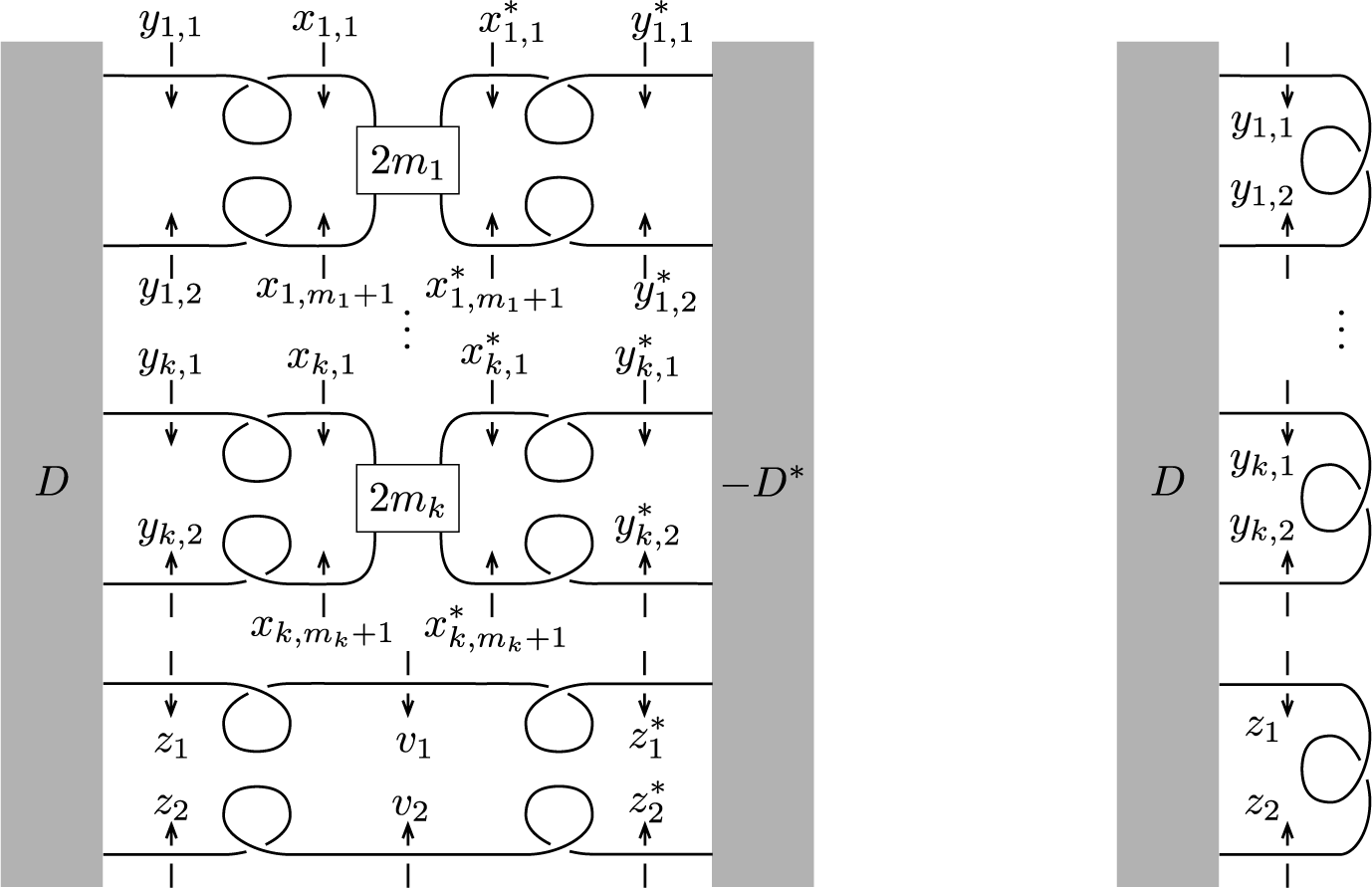
Generators for the knot groups of a symmetric union and a partial knot.

Next, we consider the case of
 $K=D\cup (-D^\ast )(\infty ,2m_1,\dots ,2m_k)$
. For simplicity, we assume that
 $m_l$
are non-negative, but the proof in the negative case is almost the same as mentioned before. We use a diagram of K as illustrated in Figure 4 and a Wirtinger presentation such that generators are
 $$\begin{align*}\left\{ \begin{aligned} & u_1, \dots, u_{c-k-1}, u_1^\ast, \dots, u_{c-k-1}^\ast, \\ & v_1, v_2, x_{1,1}, x_{1,1}^\ast, \dots, x_{1,m_1+1}, x_{1,m_1+1}^\ast, \dots, x_{k,1}, x_{k,1}^\ast, \dots, x_{k,m_k+1}, x_{k,m_k+1}^\ast \\ & y_{1,1}, y_{1,1}^\ast, y_{1,2}, y_{1,2}^\ast, \dots, y_{k,1}, y_{k,1}^\ast, y_{k,2}, y_{k,2}^\ast, z_1, z_1^\ast, z_2, z_2^\ast \end{aligned} \right. \end{align*}$$
and relators are
 $$\begin{align*}\left\{ \begin{aligned} & r_1, \dots, r_c, r_1^\ast, \dots, r_c^\ast, \\ & x_{1,1}x_{1,1}^\ast x_{1,2}^{-1}(x_{1,1}^\ast)^{-1}, x_{1,1}^\ast x_{1,2}^{-1}(x_{1,2}^\ast)^{-1}x_{1,2}, \dots, x_{1,m_1}x_{1,m_1}^\ast x_{1,m_1+1}^{-1}(x_{1,m_1}^\ast)^{-1},\\&\qquad x_{1,m_1}^\ast x_{1,m_1+1}^{-1}(x_{1,m_1+1}^\ast)^{-1}x_{1,m_1+1}, \\ & \quad\vdots \\ & x_{k,1}x_{k,1}^\ast x_{k,2}^{-1}(x_{k,1}^\ast)^{-1}, x_{k,1}^\ast x_{k,2}^{-1}(x_{k,2}^\ast)^{-1}x_{k,2}, \dots, x_{k,m_k}x_{k,m_k}^\ast x_{k,m_k+1}^{-1}(x_{k,m_k}^\ast)^{-1},\\&\qquad x_{k,m_k}^\ast x_{k,m_k+1}^{-1}(x_{k,m_k+1}^\ast)^{-1}x_{k,m_k+1}, \\ & x_{1,1}y_{1,1}^{-1}, x_{1,1}^\ast(y_{1,1}^\ast)^{-1}, x_{1,m_1+1}y_{1,2}^{-1}, x_{1,m_1+1}^\ast(y_{1,2}^\ast)^{-1},\dots, x_{k,1}y_{k,1}^{-1}, x_{k,1}^\ast(y_{k,1}^\ast)^{-1},\\&\qquad x_{k,m_k+1}y_{k,2}^{-1}, x_{k,m_k+1}^\ast(y_{k,2}^\ast)^{-1}, \\ & v_1z_1^{-1}, v_1(z_1^\ast)^{-1}, v_2z_2^{-1}, v_2(z_2^\ast)^{-1}. \end{aligned} \right. \end{align*}$$
Let us drop the same relator
 $v_2(z_2^\ast )^{-1}$
as in the case
 $k=1$
. Then, the corresponding Alexander matrix is divided into blocks similar to the matrix A above. After removing the column corresponding to
 $z_2^\ast $
, we apply elementary column operations and obtain the matrix
 $$\begin{align*}W= \left( \begin{array}{cc|cc|c|c|c} U & & Z_1 & Z_2 & W_1 & \cdots & W_k \\ & U & Z_1 & & W_1' & \cdots & W_k' \\\hline & & & & W_1" & & \\\hline & & & & & \ddots & \\\hline & & & & & & W_k" \end{array} \right), \end{align*}$$
where
 $$ \begin{align*} W_l= \begin{pmatrix} Y_{l,1} & O & \cdots & O & Y_{l,2} & O \end{pmatrix}, \quad W_l'= \begin{pmatrix} O & Y_{l,1} & O & \cdots & O & Y_{l,2} \end{pmatrix}, \\ W_l"= \begin{pmatrix} I & X_l-I & -X_l & & & & & & \\ & I & X_l^{-1}-I & -X_l^{-1} & & & & & \\ & & \ddots & & & & \ddots & & \\ & & & & & I & X_l-I & -X_l & \\ & & & & & & I & X_l^{-1}-I & -X_l^{-1} \end{pmatrix}, \end{align*} $$
and
 $X_l=\Phi (x_{l,i})=\Phi (x_{l,i}^\ast )=\Phi (y_{l,j})=\Phi (y_{l,j}^\ast )$
for
 $l=1,\dots ,k$
,
 $i=1,\dots ,m_{l}+1,$
and
 $j=1,2$
. Now, the process of elementary row and column operations in the case
 $k=1$
can be applied to the matrix W and we deduce
 $$\begin{align*}\det W \doteq \det(U\ Z_1\ Y_{1,1}+Y_{1,2}\ \cdots\ Y_{k,1}+Y_{k,2})\det(U\ Z_2\ Y_{1,1}+Y_{1,2}\ \cdots\ Y_{k,1}+Y_{k,2}). \end{align*}$$
A computation analogous to the one given in the proof of Claim 3.1 shows that
 $$ \begin{align*} \Delta_{K_D,\rho_D}(t)\det(\rho_D(\mu_D)t-I_d) &\doteq \det(U\ Z_1\ Y_{1,1}+Y_{1,2}\ \cdots\ Y_{k,1}+Y_{k,2}) \\ &\doteq \det(U\ Z_2\ Y_{1,1}+Y_{1,2}\ \cdots\ Y_{k,1}+Y_{k,2}). \end{align*} $$
This completes the proof.
Proof of Claim 3.1
We focus on a Wirtinger presentation of
 $K_D$
with generators
 $u_1, \dots , u_{c-2}$
,
 $y_1, y_2, z_1, z_2$
and relators
 $r_1, \dots , r_c$
,
 $y_1y_2^{-1}, z_1z_2^{-1}$
. After dropping the last relation, the corresponding Alexander matrix is
 $$\begin{align*}\left( \begin{array}{c|ccccc} U & Y_1 & Y_2 & Z_1 & Z_2 \\\hline & I & -I & & \end{array} \right). \end{align*}$$
By removing the last column corresponding to
 $z_2$
and adding the third column to the second one (at the level of blocks), we obtain
 $$\begin{align*}\left( \begin{array}{c|cccc} U & Y_1+Y_2 & Y_2 & Z_1 \\\hline & & -I & \end{array} \right). \end{align*}$$
After permuting the last two columns, its determinant is
 $\det (U\ Y_1+Y_2\ Z_1)$
up to sign.
In the same way, by first removing the fourth column corresponding to
 $z_1$
, the determinant is also equal to
 $\det (U\ Y_1+Y_2\ Z_2)$
up to sign.
Proof of Corollary 1.9
By [Reference Friedl and Vidussi19, Theorem 1.2] or [Reference Friedl and Nagel17, Theorem 1.3], there exists a representation
 $\rho \colon G(K_D)\to \mathit {GL}(d,\mathbb {F})$
such that
 $\deg \Delta _{K_D, \rho}(t)=d(2g(K_D)-1)$
. Then, we have
 $$\begin{align*}d(2g(K)-1) \geq \deg\Delta_{K,\rho\circ\varphi_D}(t) = 2\deg\Delta_{K_D,\rho}(t)+d = 2d(2g(K_D)-1)+d. \end{align*}$$
It follows that
 $2g(K)-1\geq 4g(K_D)-2+1$
, and thus
 $g(K)\geq 2g(K_D)$
.
Remark 3.2 The gap
 $g(K)-2g(K_D)$
can be arbitrarily large. In fact, the knot
 $\mathrm {KT}_{r,n}$
in [Reference Gabai21, Figure 5.10] admits an even symmetric union presentation whose partial knot is the unknot U (see [Reference Lamm37, Figure 15(right)]), and we have
 $g(\mathrm {KT}_{r,n})-2g(U)=r$
by [Reference Gabai21, Theorem 5.7]. Moreover, the family of knots
 $\mathrm {KT}_{r,n}$
implies that there is no upper bound for
 $g(K)$
in terms of
 $g(K_D)$
and the integers
 $k, n_1,\dots ,n_k$
.
Remark 3.3 We cannot expect a simple relationship between the twisted Alexander polynomial of a symmetric union which is not necessarily even and that of the associated partial knot (see Section 4).
The next result follows from Proposition 1.4 together with Corollary 1.9. It puts a big restriction on the genus of a partial knot for an even symmetric union presentation of a given alternating or fibered knot.
Corollary 3.4. Let K be a knot admitting an even symmetric union presentation with partial knot
 $K_D$
. If
 $\deg \Delta _K(t)=2g(K)$
, then
 $g(K)=2g(K_D)$
. In particular, if K is homologically fibered, then so is
 $K_D$
.
Here, a knot K is said to be homologically fibered if
 $\Delta _K(t)$
is monic and
 $\deg \Delta _K(t)=2g(K)$
(see [Reference Goda and Sakasai24, Definition 3.1]). Recall from [Reference Kitano and Suzuki33, Proposition 5.2] that if there is an epimorphism
 $G(K)\to G(K')$
and K is fibered, then
 $K'$
is also fibered. Hence, in Corollary 3.4, if K is fibered, then so is
 $K_D$
.
Proof of Corollary 3.4
It follows from Proposition 1.4 that
 $\Delta _K(t) \doteq \Delta _{K_D}(t)^2$
. Thus,
 $g(K)=\deg \Delta _{K_D}(t)$
by the assumption. Combining this equality with Corollary 1.9, we have
 $$\begin{align*}2g(K_D) \geq \deg\Delta_{K_D}(t) = g(K) \geq 2g(K_D). \end{align*}$$
Hence, we conclude that
 $g(K)=2g(K_D)$
.
Remark 3.5 If a knot K admits an even symmetric union presentation, it follows from Proposition 1.4 that the degree of its Alexander polynomial is divisible by
 $4$
. For example, the knot
 $6_1$
is represented as a skew-symmetric union (see [Reference Lamm37]), but cannot be represented as any even symmetric union because its Alexander polynomial
 $\Delta _{6_1}(t)=2t^{-1}-5+2t=(2t^{-1}-1)(2t-1)$
has degree
 $2$
. Furthermore, if K admits an even symmetric union presentation and
 $\deg \Delta _K(t)=2g(K)$
, it already follows from the Alexander polynomial that
 $g(K)$
is even.
4 Skew-symmetric unions
This section shows that the inequality obtained in Corollary 1.9 drastically fails for a skew-symmetric union.
Proposition 4.1. The genus of a partial knot associated with a skew-symmetric union presentation of a knot K can be arbitrarily larger than the genus of K.
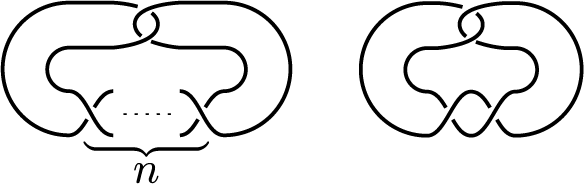
Proof Let n be a positive odd integer and let K be a knot defined as a skew-symmetric union presentation illustrated in Figure 5, where the associated partial knot is the torus knot
 $T(2,2n+1)$
. On the other hand, K is isotopic to the connected sum of the twist knots
 $J(2,-n)^\ast =J(2,n-1)$
and
 $J(2,-n)$
(see Figure 6 for the notation
 $J(2,n)$
). Here, the facts
 $g(T(2,2n+1))=n$
and
 $g(J(2,-n)^\ast \sharp J(2,-n))=2$
complete the proof.
A skew-symmetric union presentation which is isotopic to a connected sum, and the associated partial knot.

The twist knot
 $J(2,n)$
for
 $n\in \mathbb {Z}$
and
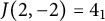 $J(2,-2)=4_1$
.

It is worth mentioning here that skew-symmetric unions in Proposition 4.1 can be taken to be hyperbolic. Indeed, for positive odd integer n, let us consider the skew-symmetric union
 $K_n$
on the left in Figure 7 whose partial knot is again
 $T(2,2n+1)$
, and the knot admits a Seifert surface of genus
 $2$
. Let L be the
 $3$
-component link
 $L14n_{47220}^\ast $
drawn on the right in Figure 7, which is hyperbolic according to SnapPy. Then, the knot obtained from L by Dehn surgery on
 $U_1$
and
 $U_2$
with slopes
 $1/n$
and
 $-1/n$
, respectively, is
 $K_n$
. By Thurston’s Dehn surgery theorem (see [Reference Boileau and Porti5] for instance),
 $K_n$
are hyperbolic for n large enough.
Knot
 $K_n$
, its Seifert surface, and the link
 $L14n_{47220}^\ast $
.

5 The Montesinos knot
 $11a_{201}$

In this section, we prove Proposition 1.10. We begin by recalling from [Reference Burde, Zieschang and Heusener10, Chapter 12.D] some notations about Montesinos knots and their Seifert fibered
 $2$
-fold branched coverings. Let
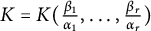 $K = K(\frac {\beta _1}{\alpha _1}, \dots , \frac {\beta _r}{\alpha _r})$
be a Montesinos knot with
 $r \geq 3$
rational tangles of slopes
 $\beta _i/\alpha _i \in \mathbb {Q}$
with
 $\alpha _i> 1$
and
 $\beta _i \neq 0$
coprime with
 $\alpha _i$
. It has been shown by Montesinos [Reference Montesinos40] (see also [Reference Burde, Zieschang and Heusener10, Chapter 12.D]) that the
 $2$
-fold branched cover of K is the closed orientable Seifert fibered
 $3$
-manifold
 $\Sigma _2(K) = V(0; e_0; \frac {\beta _1}{\alpha _1}, \dots , \frac {\beta _r}{\alpha _r})$
with base
 $S^2(\alpha _1, \dots , \alpha _r)$
a two-dimensional orientable orbifold with underlying space
 $S^2$
and r singular points with branching indices
 $\alpha _i$
corresponding to the r exceptional fibers of types
 $(\alpha _i, \beta _i)$
, where
 $\alpha _i \geq 2$
. Its rational Euler number
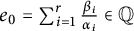 $e_0 = \sum _{i=1}^{r} \frac {\beta _i}{\alpha _i} \in \mathbb {Q}$
verifies that
 $|\Delta _{K}(-1)| = |H_1(\Sigma _2(K); \mathbb {Z})| = |e_0| \prod _{i=1}^{r} \alpha _i$
(see [Reference Jankins and Neumann29, Corollary 6.2]). The Seifert fibered manifold
 $\Sigma _2(K) = V(0; e_0; \frac {\beta _1}{\alpha _1}, \dots , \frac {\beta _r}{\alpha _r})$
is determined, up to orientation-preserving homeomorphism, by the rational Euler number
 $e_0 \in \mathbb {Q}$
and the set of fractions
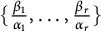 $\{\frac {\beta _1}{\alpha _1}, \dots , \frac {\beta _r}{\alpha _r}\}$
in
 $\mathbb {Q}/\mathbb {Z}$
up to permutations (see [Reference Orlik43], [Reference Jankins and Neumann29, Theorem 1.5]), while the Montesinos knot
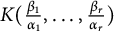 $K(\frac {\beta _1}{\alpha _1}, \dots , \frac {\beta _r}{\alpha _r})$
is determined, up to orientation-preserving homeomorphism of
 $S^3$
, by the rational Euler number
 $e_0 \in \mathbb {Q}$
and the set of fractions
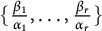 $\{\frac {\beta _1}{\alpha _1}, \dots , \frac {\beta _r}{\alpha _r}\}$
in
 $\mathbb {Q}/\mathbb {Z}$
up to dihedral permutations (see [Reference Burde, Zieschang and Heusener10, Theorem 12.26]).
We first determine the only possible partial knots for a symmetric union presentation of the ribbon Montesinos knot
 $11a_{201} = K(\frac {1}{3}, \frac {2}{3}, \frac {4}{5})$
.
Proposition 5.1. The only possible partial knots, up to mirror image, for a symmetric union presentation of the Montesinos knot
 $11a_{201} = K(\frac {1}{3}, \frac {2}{3}, \frac {4}{5})$
are the
 $(2,9)$
-torus knot or the
 $2$
-bridge knot
 $6_1$
.
Before starting the proof, we need to recall some definitions and result from [Reference Lamm37]. One can associate to a knot
 $K \subset S^3$
the
 $\pi $
-orbifold group
 $G^{\mathrm {orb}}(K) = G(K) /N$
, where N is the subgroup of
 $\pi _1(S^3 \setminus K)$
normally generated by the square of a meridian (see [Reference Boileau and Zimmermann8]). Let
 $\Sigma _2(K)$
denote the
 $2$
-fold cover of
 $S^3$
branched along K. Then, the following exact sequence holds:
 $$\begin{align*}1 \to \pi_1(\Sigma_2(K)) \to G^{\mathrm{orb}}(K) \to \mathbb{Z}/2\mathbb{Z} \to 1. \end{align*}$$
Proposition 5.2 [Reference Lamm37, Theorem 3.3]
Let K be a symmetric union with partial knot
 $K_D$
. Then, there is an epimorphism
 $\varphi _D^{\mathrm {orb}}\colon G^{\mathrm {orb}}(K) \twoheadrightarrow G^{\mathrm {orb}}(K_D),$
which sends the image of a meridian of K to that of
 $K_D$
and which kills the image of the preferred longitude of K.
The epimorphism
 $\varphi _D^{\mathrm {orb}}\colon G^{\mathrm {orb}}(K) \twoheadrightarrow G^{\mathrm {orb}}(K_D)$
sends the image of a meridian of K to the image of a meridian of
 $K_D$
. In particular,
 $\varphi _D^{\mathrm {orb}}$
sends the subgroup
 $\pi _1(\Sigma _2(K))$
of index
 $2$
onto the subgroup
 $\pi _1(\Sigma _2(K_D))$
of index
 $2$
since it preserves the images of the meridians. Therefore,
 $\varphi _D^{\mathrm {orb}}$
induces an epimorphism
 $\tilde {\varphi }_D\colon \pi _1(\Sigma _2(K)) \twoheadrightarrow \pi _1(\Sigma _2(K_D))$
. Here, let us consider the knot
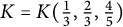 $K= K(\frac {1}{3}, \frac {2}{3}, \frac {4}{5})$
.
Lemma 5.3. The
 $2$
-fold branched cover
 $\Sigma _2(K_D)$
is a small
 $3$
-manifold.
Proof First recall that a closed
 $3$
-manifold is said to be small if it is irreducible and does not contain any orientable closed incompressible surface. Assume that
 $\Sigma _2(K_D)$
is not small and contains an orientable closed incompressible surface F. Then, its fundamental group
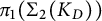 $\pi _1(\Sigma _2(K_D))$
splits along the fundamental group
 $\pi _{1}(F)$
as an amalgamated free product or an HNN extension. In particular,
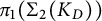 $\pi _1(\Sigma _2(K_D))$
acts non-trivially, without edge inversions, on the Bass–Serre tree
 $\mathcal {T}$
associated with this algebraic decomposition. The epimorphism
 $\tilde {\varphi }_D\colon \pi _1(\Sigma _2(K)) \twoheadrightarrow \pi _1(\Sigma _2(K_D))$
induces a non-trivial action, without edge inversions, of the group
 $\pi _1(\Sigma _2(K))$
on the Bass–Serre tree
 $\mathcal {T}$
. It follows from [Reference Culler and Shalen13] that the manifold
 $\Sigma _2(K)$
splits along some closed orientable incompressible surface.
The
 $3$
-manifold
 $\Sigma _2(K) = V(0; \frac {9}{5};\frac {1}{3}, \frac {2}{3}, \frac {4}{5})$
is Seifert fibered with base the hyperbolic two-dimensional orbifold
 $S^2(3, 3, 5)$
with underlying space
 $S^2$
and three singular points with branching indices
 $\{3, 3, 5\}$
. By Waldhausen [Reference Waldhausen49], a closed incompressible surface in
 $\Sigma _2(K)$
is either a vertical torus which is a union of fibers or a horizontal surface transverse to the fibers. In the first case, the projection of the incompressible vertical torus on the base
 $S^2(3, 3, 5)$
would be an essential simple closed curve, which does not exist on such an orbifold. In the second case, since the base of the Seifert fibration is orientable, the horizontal surface would be non-separating in the rational homology sphere
 $\Sigma _2(K)$
which is impossible. Therefore,
 $\Sigma _2(K)$
cannot split along some closed incompressible surface and
 $\Sigma _2(K_D)$
is a small closed orientable
 $3$
-manifold.
Lemma 5.4. The
 $2$
-fold branched cover
 $\Sigma _2(K_D)$
is a lens space or a Seifert fibered
 $3$
-manifold with three exceptional fibers and a base orbifold
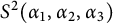 $S^2(\alpha _1, \alpha _2, \alpha _3)$
with underlying space
 $S^2$
and three singular points with branching indices
 $\{\alpha _1, \alpha _2, \alpha _3\}$
. Moreover, at most one of
 $\alpha _1, \alpha _2, \alpha _3$
can be even.
Proof If
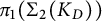 $\pi _1(\Sigma _2(K_D))$
is finite, then by the orbifold theorem (see [Reference Boileau and Porti5]) the
 $2$
-fold branched cover
 $\Sigma _2(K_D)$
carries an elliptic geometry, that is to say, it is either a lens space or an elliptic Seifert fibered
 $3$
-manifold with three exceptional fibers and finite fundamental group. In this last case, the base orbifold
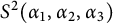 $S^2(\alpha _1, \alpha _2, \alpha _3)$
has a finite fundamental group and the triple
 $(\alpha _1, \alpha _2, \alpha _3)$
is one of the platonic triples
 $(2, 3, 3),\ (2, 3, 4),\ (2, 3, 5),$
or
 $(2, 2, n)$
for
 $n \geq 2$
.
Assume now that
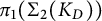 $\pi _1(\Sigma _2(K_D))$
is infinite. The
 $3$
-manifold
 $\Sigma _2(K) = V(0; \frac {9}{5};\frac {1}{3}, \frac {2}{3}, \frac {4}{5})$
is Seifert fibered with base the hyperbolic two-dimensional orbifold
 $ S^2(3, 3, 5)$
. Its fundamental group
 $\pi _1(\Sigma _2(K))$
is infinite and contains a center Z which is infinite cyclic generated by a regular fiber. The quotient
 $\Gamma _K = \pi _1(\Sigma _2(K))/Z$
is the orbifold fundamental group of the base
 $ S^2(3, 3, 5)$
. It is the hyperbolic triangle group
 $T(3, 3, 5)$
which is a discrete subgroup of
 $\mathit {PSL}(2, \mathbb {R})$
generated by rotations of angles
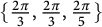 $\{\frac {2\pi }{3}, \frac {2\pi }{3}, \frac {2\pi }{5}\}$
around the vertices of a hyperbolic triangle of angles
 $\{\frac {\pi }{3}, \frac {\pi }{3}, \frac {\pi }{5}\}$
(see [Reference Knapp34]). Therefore, the group
 $\Gamma _K$
is generated by torsion elements.
If
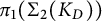 $\pi _1(\Sigma _2(K_D))$
is centerless, then
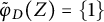 $\tilde {\varphi }_D(Z) =\{1\}$
and
 $\tilde {\varphi }_D$
induces an epimorphism from the orbifold group
 $\Gamma _K = \pi _1(\Sigma _2(K))/Z$
onto
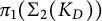 $\pi _1(\Sigma _2(K_D))$
. By Lemma 5.3, the 3-manifold
 $\Sigma _2(K_D)$
is small, hence it is aspherical since
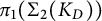 $\pi _1(\Sigma _2(K_D))$
is infinite by assumption. Therefore,
 $\pi _1(\Sigma _2(K_D))$
is torsion-free. On the other hand,
 $\Gamma _K$
is generated by torsion elements. Thus, the image
 $\tilde {\varphi }_D(\Gamma _K)$
must be trivial and this is impossible. Therefore,
 $\pi _1(\Sigma _2(K_D))$
has a non-trivial center. It follows from [Reference Casson and Jungreis11, Reference Gabai23] that
 $\Sigma _2(K_D)$
is Seifert fibered. Since
 $\Sigma _2(K_D)$
is a rational homology sphere, it is a Seifert fibered manifold with base
 $S^2$
and r exceptional fibers with
 $r-1 = \operatorname {rank}(\pi _1(\Sigma _2(K_D)))$
by [Reference Boileau and Zieschang7, Theorem 1.1(ii)]. Moreover,
 $\operatorname {rank}(\pi _1(\Sigma _2(K_D))) \leq \operatorname {rank}(\pi _1(\Sigma _2(K))) = 2$
. Since
 $\Sigma _2(K_D)$
is aspherical, it cannot be a lens space nor
 $S^1 \times S^2$
, and thus
 $\Sigma _2(K_D)$
must have
 $\geq 3$
exceptional fibers. Therefore,
 $\operatorname {rank}(\pi _1(\Sigma _2(K_D))) \geq 2$
, and hence
 $\operatorname {rank}(\pi _1(\Sigma _2(K_D))) = 2$
. It follows that
 $\Sigma _2(K_D)$
is a Seifert fibered manifold with
 $r = 3$
exceptional fibers and a base with underlying space
 $S^2$
and three singular points with branching indices
 $\{\alpha _1, \alpha _2, \alpha _3\}$
.
Since
 $K_D$
is a knot,
 $$\begin{align*}|H_1(\Sigma_2(K_D); \mathbb{Z})| = |e_0|\alpha_{1}\alpha_{2}\alpha_{3} = |\beta_1\alpha_2 \alpha_3 + \alpha_1\beta_2 \alpha_3 + \alpha_1\alpha_2 \beta_3| \end{align*}$$
is odd. This implies that at most one of the
 $\alpha _i$
can be even.
Proof of Proposition 5.1
If the Montesinos knot
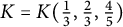 $K = K(\frac {1}{3}, \frac {2}{3}, \frac {4}{5})$
is a symmetric union with partial knot
 $K_D$
, then, by Lemma 5.4,
 $\Sigma _2(K_D)$
is a lens space or a Seifert fibered
 $3$
-manifold with three exceptional fibers and a base orbifold
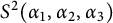 $S^2(\alpha _1, \alpha _2, \alpha _3)$
.
If
 $\Sigma _2(K_D)$
is a lens space, then, by the orbifold theorem,
 $K_D$
is a
 $2$
-bridge knot. Since
 $|H_1(\Sigma _2(K_D); \mathbb {Z})| = {\det K_D} = \sqrt {\det K} = 9$
,
 $K_D$
is the torus knot
 $9_1$
of type
 $(2,9)$
or the
 $2$
-bridge knot
 $K(\frac {9}{2}) = 6_1$
up to reversal of orientation.
If
 $\Sigma _2(K_D)$
is a Seifert fibered
 $3$
-manifold with three exceptional fibers, the base orbifold
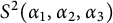 $S^2(\alpha _1, \alpha _2, \alpha _3)$
can be elliptic, Euclidean, or hyperbolic. Since at most one of
 $\alpha _1, \alpha _2, \alpha _3$
can be even, in the elliptic case, the triple
 $(\alpha _1, \alpha _2, \alpha _3)$
can be only one of the platonic triples
 $(2, 3, 3)$
or
 $(2, 3, 5)$
, while in the Euclidean case, it can be only
 $(3, 3, 3)$
. In the hyperbolic case, the orbifold group
 $\pi _1^{\mathrm {orb}}(S^2(\alpha _1, \alpha _2, \alpha _3))$
is the hyperbolic triangle group
 $T(\alpha _1, \alpha _2, \alpha _3)$
with
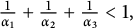 $\frac {1}{\alpha _1} + \frac {1}{\alpha _2} + \frac {1}{\alpha _3} < 1,$
which is a discrete subgroup of
 $\mathit {PSL}(2, \mathbb {R})$
(see [Reference Knapp34]). It follows that, in all the cases, the orbifold group
 $\pi _1^{\mathrm {orb}}(S^2(\alpha _1, \alpha _2, \alpha _3))$
has no center. Let
 $\pi _D\colon \pi _1(\Sigma _2(K_D)) \twoheadrightarrow \pi _1^{\mathrm {orb}}(S^2(\alpha _1, \alpha _2, \alpha _3))$
be the quotient epimorphism by the center. Since
 $\pi _1^{\mathrm {orb}}(S^2(\alpha _1, \alpha _2, \alpha _3))$
has no center, the epimorphism
 $$\begin{align*}\pi_D \circ \tilde{\varphi}_D\colon \pi_1(\Sigma_2(K)) \twoheadrightarrow \pi_1(\Sigma_2(K_D)) \twoheadrightarrow \pi_1^{\mathrm{orb}}(S^2(\alpha_1, \alpha_2, \alpha_3)) \end{align*}$$
kills the center of
 $\pi _1(\Sigma _2(K))$
and induces an epimorphism
 $\bar {\varphi }_D\colon \pi _1^{\mathrm {orb}}(S^2(3, 3, 5)) \twoheadrightarrow \pi _1^{\mathrm {orb}}(S^2(\alpha _1, \alpha _2, \alpha _3))$
between the orbifold groups of the bases. Given the presentation of the group
 $$\begin{align*}\pi_1^{\mathrm{orb}}(S^2(3, 3, 5)) = \langle x, y, z \mid x^3 = y^3 = z^5 =xyz = 1\rangle, \end{align*}$$
the image
 $\bar {\varphi }_{D}(z)$
is not trivial, otherwise
 $$\begin{align*}\pi_1^{\mathrm{orb}}(S^2(\alpha_1, \alpha_2, \alpha_3)) = \bar{\varphi}_{D}(\pi_1^{\mathrm{orb}}(S^2(3, 3, 5))) \cong \mathbb{Z}/3\mathbb{Z}, \end{align*}$$
which is not possible. Therefore,
 $\bar {\varphi }_{D}(z)$
must be of order
 $5$
in
 $\pi _1^{\mathrm {orb}}(S^2(\alpha _1, \alpha _2, \alpha _3))$
. This means that the group
 $\pi _1^{\mathrm {orb}}(S^2(\alpha _1, \alpha _2, \alpha _3))$
must contain an element of order
 $5$
. This is not possible for the finite group
 $\pi _1^{\mathrm {orb}}(S^2(2, 3, 3)),$
which is of order
 $12$
nor the Euclidean group
 $\pi _1^{\mathrm {orb}}(S^2(3, 3, 3))$
since the elements of finite order in this group have order
 $3$
. Therefore, either the orbifold group
 $\pi _1^{\mathrm {orb}}(S^2(\alpha _1, \alpha _2, \alpha _3))$
is the (finite) icosahedral group
 $I = T(2, 3, 5)$
or it is a hyperbolic triangle group
 $T(\alpha _1, \alpha _2, \alpha _3)$
.
If
 $\pi _1^{\mathrm {orb}}(S^2(\alpha _1, \alpha _2, \alpha _3))$
is the icosahedral group,
 $\Sigma _2(K_D)$
is an elliptic Seifert fibered
 $3$
-manifold
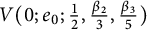 $V(0; e_0; \frac {1}{2}, \frac {\beta _2}{3}, \frac {\beta _3}{5})$
, and then
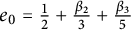 $e_0 = \frac {1}{2} +\frac {\beta _2}{3} + \frac {\beta _3}{5}$
and
 $| H_1(\Sigma _2(K_D); \mathbb {Z}) | = 30\vert e_0 \vert = \vert 15 + 10 \beta _2 + 6\beta _3\vert $
. Since
 $\beta _2$
is coprime with
 $3$
,
 $|H_1(\Sigma _2(K_D); \mathbb {Z})| = \det K_D \ = \sqrt {\det K}$
is coprime with
 $3$
and cannot be equal to
 $9$
. Therefore, the orbifold group
 $\pi _1^{\mathrm {orb}}(S^2(\alpha _1, \alpha _2, \alpha _3))$
is the hyperbolic triangle group
 $T(\alpha _1, \alpha _2, \alpha _3)$
.
Let us consider the induced epimorphism
 $$\begin{align*}\bar{\varphi}_D \colon \pi_1^{\mathrm{orb}}(S^2(3, 3, 5)) = T(3, 3, 5) \twoheadrightarrow \pi_1^{\mathrm{orb}}(S^2(\alpha_1, \alpha_2, \alpha_3))= T(\alpha_1, \alpha_2, \alpha_3) \end{align*}$$
between the orbifold fundamental groups of the bases. The presentation of the triangle group
 $T(3, 3, 5) = \langle x, y, z \mid x^3 = y^3 = z^5 =xyz = 1 \rangle $
shows that each image
 $\bar {\varphi }_{D}(x)$
,
 $\bar {\varphi }_{D}(y),$
and
 $\bar {\varphi }_{D}(z)$
is not trivial otherwise
 $T(\alpha _1, \alpha _2, \alpha _3) = \bar {\varphi }_D(T(3, 3, 5))$
would be trivial or
 $\mathbb {Z}/3\mathbb {Z}$
which is not possible. Therefore,
 $\bar {\varphi }_{D}(x)$
and
 $\bar {\varphi }_{D}(y)$
are of order
 $3,$
while
 $\bar {\varphi }_{D}(z)$
is of order
 $5$
. Thus, the two elliptic elements
 $a = \bar {\varphi }_{D}(y)$
and
 $b = \bar {\varphi }_{D}(z)$
generate the discrete non-abelian group
 $T(\alpha _1, \alpha _2, \alpha _3) \subset \mathit {PSL}(2, \mathbb {R})$
. Up to taking suitable powers
 $u=a^{k}$
and
 $v = b^{\ell }$
to normalize the matrix representatives of u and v in
 $\mathit {SL}(2,\mathbb {R})$
, it follows that at least one of Cases (I)–(VII) in [Reference Knapp34, Theorem 2.3] holds true. Since the triangle group
 $T(\alpha _1, \alpha _2, \alpha _3)$
is co-compact, Case (II) is impossible by [Reference Knapp34, Figures 2 and 3] which exhibit non-compact fundamental domains in this case. Cases (III) and (VI) do not hold because the generators u and v do not have the same order. Case (IV) is not possible because none of the generators u or v has order
 $2$
. Cases (V) and (VII) are not possible either because the generator v is of order
 $5 < 7$
. Therefore, only Case (I) can be true, and thus, by [Reference Knapp34, Proposition 2.2], u and v generate a triangle group
 $T(3, 5, n)$
with
 $n \geq 3$
since the group
 $T(3, 5, n)$
is infinite. Since we have the epimorphism
 $$\begin{align*}\bar{\varphi}_D \colon \pi_1^{\mathrm{orb}}(S^2(3, 3, 5)) = T(3, 3, 5) \twoheadrightarrow \pi_1^{\mathrm{orb}}(S^2(\alpha_1, \alpha_2, \alpha_3))= T(3, 3, n), \end{align*}$$
[Reference Rong44, Lemma 2.5] implies
 $-\chi (S^2(3, 3, 5)) \geq -\chi (S^2(3, 3, n))$
. So,
 $1 - (\frac {1}{3} + \frac {1}{5} + \frac {1}{3}) \geq 1 - (\frac {1}{3} + \frac {1}{5} + \frac {1}{n})$
, and hence
 $n \leq 3$
. It follows that
 $n= 3$
. Therefore,
 $T(\alpha _1, \alpha _2, \alpha _3) = T(3, 5, 3)$
and the induced epimorphism
 $$\begin{align*}\bar{\varphi}_D \colon \pi_1^{\mathrm{orb}}(S^2(3, 3, 5)) = T(3, 3, 5) \twoheadrightarrow \pi_1^{\mathrm{orb}}(S^2(\alpha_1, \alpha_2, \alpha_3))= T(3, 3, 5) \end{align*}$$
must be an isomorphism because triangle groups are Hopfian. In particular,
 $(\alpha _1, \alpha _2, \alpha _3) = (3, 3, 5)$
up to permutations. We have the two exact sequences:
 $$ \begin{align*} & 1 \to Z \cong \mathbb{Z} \to \pi_1(\Sigma_2(K)) \to T(3, 3, 5) \to 1, \\ & 1 \to \tilde{\varphi}_{D}(Z)\cong \mathbb{Z} \to \pi_1(\Sigma_2(K_D)) \to T(3, 3, 5) \to 1. \end{align*} $$
The epimorphism
 $\tilde {\varphi }_D\colon \pi _1(\Sigma _2(K)) \twoheadrightarrow \pi _1(\Sigma _2(K_D))$
induces injective homomorphisms both on the center Z and on the base
 $T(3, 3, 5)$
. Hence, it induces an injective homomorphism on
 $\pi _1(\Sigma _2(K))$
. Therefore,
 $\tilde {\varphi }_D$
is an isomorphism which induces an isomorphism between the first homology groups
 $H_1(\Sigma _2(K); \mathbb {Z})$
and
 $H_1(\Sigma _2(K_D); \mathbb {Z})$
. Then, the orders of the first homology groups must be the same. This is not the case since
 $$\begin{align*}|H_1(\Sigma_2(K_D); \mathbb{Z})| = \det K_D = 9 \text{ and } |H_1(\Sigma_2(K); \mathbb{Z})| = \det K = 81. \end{align*}$$
It follows that
 $\Sigma _2(K_D)$
cannot be a Seifert fibered
 $3$
-manifold with three exceptional fibers and hence it can only be a lens space. Therefore, the only possibilities for
 $K_D$
are the
 $(2,9)$
-torus knot or the
 $2$
-bridge knot
 $6_1$
.
Corollary 5.5. The Montesinos knot
 $K(\frac {1}{3}, \frac {2}{3}, \frac {4}{5})$
cannot be an even symmetric union.
Proof Assume that the Montesinos knot
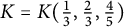 $K= K(\frac {1}{3}, \frac {2}{3}, \frac {4}{5})$
admits an even symmetric union presentation with partial knot
 $K_D$
. By Corollary 1.9,
 $2 = g(K)\geq 2g(K_D)$
, hence
 $g(K_D) \leq 1$
. By Proposition 1.10,
 $K_D$
can be only the
 $2$
-bridge knot
 $6_1$
since the torus knot
 $9_1$
of type
 $(2,9)$
has genus
 $4$
.
To rule out the possibility of K being an even symmetric union with partial knot
 $6_1$
, one cannot use the genuine Alexander polynomial since
 $\Delta _{11a_{201}}(t)=(2-5t+2t^2)^2=\Delta _{6_1}(t)^2$
. However, this can be done by using twisted Alexander polynomials and Theorem 1.6.
Let
 $G(6_1) = \langle x, y \mid w(x,y) = 1 \rangle $
be the standard one-relator presentation of the group of the
 $2$
-bridge knot
 $6_1$
. Consider the representation
 $\rho _0\colon G(6_1) \to \mathit {SL}(2, \mathbb {F}_7)$
given by
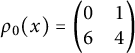 $\rho _0(x) = \begin {pmatrix} 0 & 1\\ 6 & 4 \end {pmatrix}$
and
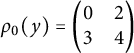 $\rho _0(y) = \begin {pmatrix} 0 & 2 \\ 3 & 4 \end {pmatrix}$
. Then, the associated twisted Alexander polynomial is
 $\Delta _{6_{1},\rho _0}(t) = 1$
up to multiplication by units in
 $\mathbb {F}_7[t^{\pm 1}]$
.
If K is an even symmetric union with partial knot
 $6_1$
, then, by Theorem 1.6,
 $$\begin{align*}\Delta_{K,\rho_0\circ\varphi_D}(t) = \Delta_{6_1,\rho_0}(t)^2 \det(\rho_0(\mu_D)t-I_2) = 1 + 3t + t^2 \end{align*}$$
up to multiplication by units in
 $\mathbb {F}_7[t^{\pm 1}]$
. Using Mathematica, we can check that for the
 $33$
representations
 $\rho \colon G(K) \to \mathit {SL}(2, \mathbb {F}_7)$
,
 $\Delta _{K,\rho }(t) \neq 1 + 3t + t^2$
holds up to multiplication by units in
 $\mathbb {F}_7[t^{\pm 1}]$
.
Now, Proposition 1.10 follows from Proposition 5.1 together with Corollary 5.5.
Remark 5.6 The fact that the torus knot
 $9_1$
cannot be a partial knot for an even symmetric union presentation of the Montesinos knot
 $K(\frac {1}{3}, \frac {2}{3}, \frac {4}{5})$
can be deduced also from the fact that the degree of the Alexander polynomial of the Montesinos knot
 $K(\frac {1}{3}, \frac {2}{3}, \frac {4}{5})$
is twice the degree of the Alexander polynomial of a partial knot:
 $\deg \Delta _{K}(t) = 4 <2 \deg \Delta _{9_1}(t) = 16$
.
Remark 5.7 The property that
 $\Delta _{K,\rho _0\circ \varphi }(t)$
is divisible by
 $\Delta _{K_D,\rho _0}(t)$
is not sufficient to get a contradiction since
 $\Delta _{K,\rho }(t)$
has
 $1 + 3t + t^2$
as a factor for some representations
 $\rho $
.
Remark 5.8 In [Reference Horie, Kitano, Matsumoto and Suzuki25],
 $\mathit {SL}(2,\mathbb {F}_{11})$
-representations were already used to show that there is no epimorphism from
 $G(K)$
onto
 $G(6_1)$
sending a meridian of K to a meridian of
 $6_1$
, but Theorem 1.6 allows us to do that by using
 $\mathit {SL}(2,\mathbb {F}_{7})$
-representations.
Acknowledgements
The authors would like to thank Masaaki Suzuki for his help with the computation in Corollary 5.5. They also thank Jae Choon Cha, Christoph Lamm, and Hidetoshi Masai for valuable comments and discussion. The authors are grateful to the anonymous referee for helpful comments.
A Epimorphisms which do not kill the longitude
Jonathan Simon’s question remains open even when the epimorphism
 $\varphi \colon G(K) \twoheadrightarrow G(K')$
is not killing the preferred longitude
 $\lambda _K$
of the knot K. In this appendix, we give some conditions on the target knot
 $K'$
which are sufficient to get a positive answer when
 $\varphi (\lambda _K) \neq 1$
.
Proposition A.1. Let K and
 $K'$
be two knots in
 $S^3$
and
 $\varphi \colon G(K) \twoheadrightarrow G(K')$
be an epimorphism such that
 $\varphi (\lambda _K) \neq 1$
. If
 $K'$
is not a satellite knot with winding number
 $1$
nor a cable knot, then
 $g(K) \geq g(K')$
. In particular, it is true if
 $K'$
is a hyperbolic knot.
The following lemma must be known. We give a proof for completeness.
Lemma A.2. Let K and
 $K'$
be two knots in
 $S^3$
and
 $\varphi \colon G(K) \twoheadrightarrow G(K')$
be an epimorphism. If
 $\varphi (\lambda _K) \in \pi _1(\partial E(K')) \setminus \{1\}$
, then
 $g(K) \geq g(K')$
.
Proof We can assume that the two knots are non-trivial since the lemma is obvious when K or
 $K'$
is a trivial knot. Since
 $\varphi (\lambda _K) \in \pi _1(\partial E(K')) \setminus \{1\}$
, it follows from [Reference Boileau, Rubinstein and Wang6, Lemma 6.9] that the epimorphism
 $\varphi $
can be realized by a proper map
 $f\colon E(K)\to E(K')$
of non-zero degree. Then, the inequality
 $g(K) \geq g(K')$
follows from [Reference Gabai20, Corollary 6.22] and [Reference Gabai22, Theorem 8.8].
Lemma A.3. Let
 $\varphi \colon G(K) \twoheadrightarrow G(K')$
be an epimorphism. If
 $\varphi (\lambda _K) \neq 1$
, then
 $\varphi (\pi _1(\partial E(K))) \cong \mathbb {Z} \oplus \mathbb {Z}$
.
Proof Since
 $G(K')$
is torsion-free,
 $\varphi (\pi _1(\partial E(K)))$
is isomorphic to
 $\mathbb {Z}$
or
 $\mathbb {Z} \oplus \mathbb {Z}$
. If
 $\varphi (\pi _1(\partial E(K))) \cong \mathbb {Z}$
, there is a non-trivial element
 $\mu _{K}^p \lambda _{K}^q \in \pi _1(\partial E(K))$
such that
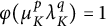 $\varphi (\mu _{K}^p \lambda _{K}^q) = 1$
. Taking the abelianization leads to
 $p[\varphi (\mu _K)] = 0 \in H_1(E(K'); \mathbb {Z})$
. Since
 $[\varphi (\mu _K)] $
generates
 $H_1(E(K'); \mathbb {Z}) \cong \mathbb {Z}$
, we have
 $p=0$
and
 $q\neq 0$
. Hence,
 $\varphi (\lambda _K)^q = \varphi (\lambda _{K}^q) = 1$
. This contradicts the hypothesis
 $\varphi (\lambda _K)\neq 1$
since
 $G(K')$
is torsion-free.
Proof of Proposition A.1
By Lemma A.3,
 $\varphi (\pi _1(\partial E(K))) \cong \mathbb {Z} \oplus \mathbb {Z}$
. Then, by the enclosing property of the JSJ decomposition of
 $E(K')$
, the image
 $\varphi (\pi _1(\partial E(K)))$
is conjugated to the fundamental group
 $\pi _1(W)$
of some geometric piece W of the JSJ decomposition of
 $E(K')$
. So, after conjugation, one can assume that
 $\varphi (\pi _1(\partial E(K))) \subset \pi _1(W)$
.
If
 $\partial E(K')$
does not belong to
 $\partial W$
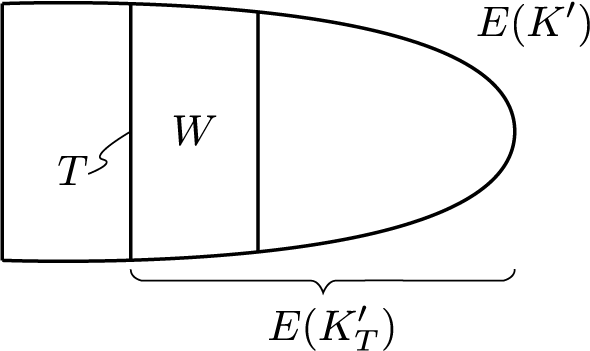
, then there exists a JSJ torus
 $T \subset \partial W \subset S^3$
such that T bounds the exterior
 $E(K^{\prime }_T)$
of a knot
 $K^{\prime }_T$
and
 $W \subset E(K^{\prime }_{T}) \subset E(K')$
(see Figure 8). That is,
 $K'$
is a satellite of the companion
 $K^{\prime }_T$
. The composite map
 $\varphi (\pi _1(\partial E(K))) \to G(K^{\prime }_{T})^{\mathrm {ab}} \to G(K')^{\mathrm {ab}}$
induced by the inclusions is surjective because
 $\varphi (\mu _K)$
generates
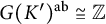 $G(K')^{\mathrm {ab}} \cong \mathbb {Z}$
. It follows that the morphism
 $G(K^{\prime }_{T})^{\mathrm {ab}} \to G(K')^{\mathrm {ab}}$
is surjective. The winding number of
 $K'$
with respect to its companion
 $K^{\prime }_T$
is the index of the image of
 $G(K^{\prime }_{T})^{\mathrm {ab}}$
in
 $G(K')^{\mathrm {ab}}$
, and thus it is equal to
 $1$
.
JSJ decomposition of
 $E(K')$
when
 $\partial E(K')$
does not belong to
 $\partial W$
.

So the hypothesis on
 $K'$
implies that
 $\partial E(K')$
belongs to
 $\partial W$
. If W is Seifert fibered, then W is a torus knot exterior, a cable space or a composing space by [Reference Jaco27, Lemma IX.22], where a composing space is a compact
 $3$
-manifold homeomorphic to an
 $S^1$
-bundle over a disk with holes.
If W is a torus knot exterior,
 $K'$
is a torus knot. In this case, the inequality
 $g(K) \geq g(K')$
holds since
 $\deg \Delta _{K'}(t)=2g(K')$
(see the argument after Problem 1.1). The JSJ piece W cannot be a cable space since
 $K'$
is not a cable knot. If W is a composing space, then
 $K'$
is a composite knot by [Reference Simon47, Theorem 1], which contradicts the hypothesis that
 $K'$
is not a satellite knot of winding number
 $1$
.
Hence, W must be a hyperbolic piece. Since W is atoroidal,
 $\varphi (\pi _1(\partial E(K))) \cong \mathbb {Z} \oplus \mathbb {Z}$
is conjugated into a peripheral subgroup of
 $\pi _1(W)$
, which corresponds to a torus
 ${T' \subset \partial W}$
. If
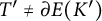 $T' \neq \partial E(K')$
, it corresponds to
 $\partial E(K^{\prime }_{T'})$
for a companion
 $K^{\prime }_{T'}$
, and
 $K'$
is a satellite knot with winding number
 $1$
since
 $\varphi (\pi _1(\partial E(K))) \subset \pi _1(\partial E(K^{\prime }_{T'}))$
generates
 $G(K')^{\mathrm {ab}}$
. This contradicts the hypothesis on
 $K'$
. Hence, we conclude that
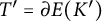 $T' = \partial E(K')$
and
 $\varphi (\lambda _K)$
is a non-trivial peripheral element of
 $G(K')$
. It follows from Lemma A.2 that
 $g(K) \geq g(K')$
.
Another consequence of Lemma A.2 concerns the case of meridian-preserving epimorphisms.
Corollary A.4. Let K and
 $K'$
be two knots in
 $S^3$
and
 $\varphi \colon G(K) \twoheadrightarrow G(K')$
be an epimorphism such that
 $\varphi (\lambda _K) \neq 1$
. If
 $\varphi (\mu _K) \in \pi _1(\partial E(K'))$
and
 $K'$
is prime, then
 $g(K) \geq g(K')$
.
Proof The surjectivity implies that
 $\varphi (\mu _K) \in \pi _1(\partial E(K'))$
is primitive, and thus it is represented by a simple closed curve on
 $\partial E(K')$
. Since
 $\varphi (\mu _K)$
normally generates the knot group
 $G(K')$
, Property P for knots (see [Reference Kronheimer and Mrowka36, Theorem 1]) implies that
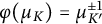 $\varphi (\mu _K)=\mu _{K'}^{\pm 1}$
. Then, Lemma A.5 below shows that
 $\varphi (\lambda _K) \in \pi _1(\partial E(K')) \setminus \{1\}$
since it lies in the centralizer of
 $\varphi (\mu _K)$
. Hence, Lemma A.2 completes the proof.
Lemma A.5. Let
 $K' \subset S^3$
be a prime knot. The centralizer
 $C(\mu _{K'})$
of the meridian element
 $\mu _{K'}$
in
 $G(K')$
is the peripheral subgroup
 $\pi _1(\partial E(K'))$
.
Proof By [Reference Simon47, Theorem 1], if there is an element
 $\gamma \in G(K') \setminus \pi _1(\partial E(K'))$
which commutes with
 $\mu _{K'}$
, then
 $K'$
must be a composite or a torus knot, or a cable knot. Since
 $K'$
is prime, it is a torus knot or a cable knot. The centralizer
 $C(\mu _{K'})$
contains the peripheral subgroup
 $\pi _1(\partial E(K'))$
and hence it is not cyclic. By [Reference Jaco and Shalen28, Theorem VI.1.6(i)] (see also [Reference Friedl15]), up to conjugation,
 $C(\mu _{K'})$
coincides with the centralizer of
 $\mu _{K'}$
either in the fundamental group of the torus knot exterior
 $K'$
or in that of the cable piece of
 $E(K')$
containing
 $\partial E(K')$
. Since in each case,
 $\mu _{K'}$
is not the center of the fundamental group of the torus knot exterior or of the cable piece, the centralizer
 $C(\mu _{K'})$
must be abelian by [Reference Jaco and Shalen28, Addendum VI.1.8(iia’)]. Hence,
 $C(\mu _{K'}) = \pi _1(\partial E(K'))$
because the peripheral subgroup
 $\pi _1(\partial E(K'))$
is a maximal abelian subgroup of the knot group (see [Reference Feustel14, Corollary 1]).
Since the exterior of a composite knot admits a degree-one proper map to the exterior of any of its factor, the following is a straightforward consequence of Corollary A.4.
Corollary A.6. Let K and
 $K'$
be two knots in
 $S^3$
and
 $\varphi \colon G(K) \twoheadrightarrow G(K')$
be an epimorphism such that
 $\varphi (\lambda _K) \neq 1$
. If
 $\varphi (\mu _K)$
is conjugated to
 $\mu _{K'}^{\pm 1}$
and
 $K'$
has a prime factorization
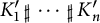 $K^{\prime }_1 \sharp \cdots \sharp K^{\prime }_n$
, then
 $g(K) \geq \max \{g(K^{\prime }_1), \dots , g(K^{\prime }_n) \}$
.
B Longitude-killing epimorphisms
We write
 $K_1\geq K_2$
if there exists a meridian-preserving epimorphism from
 $G(K_1)$
onto
 $G(K_2)$
. In [Reference Kitano and Suzuki32], it is shown that the following pair can be realized by a degree-zero map, that is, by a longitude-killing epimorphism.
Proposition B.1. Any pair of the list
 $$\begin{align*}8_{10}, 8_{20}, 9_{24}, 10_{62}, 10_{65}, 10_{77}, 10_{82}, 10_{87},10_{99}, 10_{140}, 10_{143}\geq 3_1,\ 10_{59}, 10_{137} \geq 4_1 \end{align*}$$
can be realized by a degree-zero map.
The twisted homology
 $H_1(E(K);\mathbb {Q}[t,t^{-1}]_\alpha )$
of
 $E(K)$
by the abelianization
 $\alpha \colon G(K)\rightarrow \langle t\rangle \subset \mathit {GL}(1,\mathbb {Q}[t,t^{-1}])$
is called the Alexander module over
 $\mathbb {Q}$
. It is seen that an epimorphism between knot groups induces an epimorphism between Alexander modules. The following proposition is useful to see that an epimorphism can be induced by a non-zero degree map. It can be proved by the argument similar to [Reference Wall and Ranicki50, Lemma 2.2] (see also [Reference Boileau, Boyer, Rolfsen and Wang3, Proposition 15]).
Proposition B.2. If an epimorphism
 $\varphi \colon G(K)\rightarrow G(K')$
is induced by a non-zero degree map
 $(E(K),\partial E(K))\rightarrow (E(K'),\partial E(K'))$
, then the induced map
 $$\begin{align*}\varphi_*\colon H_1(E(K);\mathbb{Q}[t,t^{-1}]_\alpha)\rightarrow H_1(E(K');\mathbb{Q}[t,t^{-1}]_\alpha) \end{align*}$$
on the Alexander modules over
 $\mathbb {Q}[t,t^{-1}]$
splits. Furthermore, if
 $\varphi $
is induced by a degree-one map, then the induced map
 $$\begin{align*}\varphi_*\colon H_1(E(K);\mathbb{Z}[t,t^{-1}]_\alpha)\rightarrow H_1(E(K');\mathbb{Z}[t,t^{-1}]_\alpha) \end{align*}$$
on the Alexander modules over
 $\mathbb {Z}[t,t^{-1}]$
splits.
By computing the second Alexander polynomial
 $\Delta _K^{(2)}(t)$
, we can see the non-existence of a splitting on Alexander modules. For example, for the pair
 $8_{10}\geq 3_1$
, since
 $\Delta _{8_{10}}(t)=\Delta _{3_1}(t)^3=(t^2-t+1)^3$
and
 $\Delta _{8_{10}}^{(2)}(t)=1$
, we have
 $H_1(E(8_{10});\mathbb {Q}[t,t^{-1}]_\alpha )\cong \mathbb {Q}[t,t^{-1}]/(\Delta _{3_1}(t)^3)$
. Recall here that the ring
 $\mathbb {Q}[t,t^{-1}]$
is a PID. Similarly,
 $H_1(E(3_{1});\mathbb {Q}[t,t^{-1}]_\alpha )\cong \mathbb {Q}[t,t^{-1}]/(t^2-t+1)$
by
 $\Delta ^{(2)}_{3_1}(t)=1$
. Hence, there is no section for an epimorphism
 $$\begin{align*}H_1(E(8_{10});\mathbb{Q}[t,t^{-1}]_\alpha)\rightarrow H_1(E(3_1);\mathbb{Q}[t,t^{-1}]_\alpha) \end{align*}$$
and it is induced only by a degree-zero map.
Similarly, because the second Alexander polynomials of
 $$\begin{align*}8_{10}, 8_{20}, 9_{24}, 10_{62} 10_{65}, 10_{77}, 10_{82}, 10_{87}, 10_{140}, 10_{143}, 10_{59}, 10_{137} \end{align*}$$
are trivial, these Alexander modules can be determined by the Alexander polynomials only. Hence, it is easy to see that there exist no sections for the pairs of the above with
 $3_1$
or
 $4_1$
. For
 $10_{99}$
, since
 $\Delta _{10_{99}}(t)=(t^2-t+1)^4$
,
 $\Delta _{10_{99}}^{(2)}(t)=(t^2-t+1)^2$
, and
 $\Delta _{10_{99}}^{(3)}(t)=1$
by the Mathematica package KnotTheory`, it is also seen that
 $$\begin{align*}H_1(E(10_{99};\mathbb{Q}[t,t^{-1}]_\alpha))\cong \mathbb{Q}[t,t^{-1}]/((t^2-t+1)^2)\oplus \mathbb{Q}[t,t^{-1}]/((t^2-t+1)^2) \end{align*}$$
and then there exists no section for
 $10_{99}\geq 3_1$
. In summary, we have the following.
Proposition B.3. Any pair of
 $$\begin{align*}8_{10}, 9_{24}, 10_{62}, 10_{65}, 10_{77}, 10_{82}, 10_{87}, 10_{99}, 10_{143} \geq 3_1 \quad 10_{59}, 10_{137} \geq 4_1 \end{align*}$$
can be realized only by a degree-zero map.
Although a symmetric union of even type admits a longitude killing epimorphism, the converse is not true in general. More precisely, we can prove the following. Here, the realization is proved in [Reference Lamm37].
Proposition B.4. Any pair of
 $$\begin{align*}8_{10}, 9_{24}, 10_{62}, 10_{65}, 10_{77}, 10_{82}, 10_{87}, 10_{99}, 10_{143} \geq 3_1 \quad 10_{59}\geq 4_1 \end{align*}$$
cannot be realized by a symmetric union of even type. On the other hand,
 $$\begin{align*}8_{20}, 10_{140}\geq 3_1,\ 10_{137}\geq 4_1 \end{align*}$$
can be realized by a symmetric union of even type.
It is natural to ask whether every longitude-killing epimorphism
 $\varphi \colon G(K) \to G(K')$
factors through an epimorphism onto
 $G(K")$
for some even symmetric union
 $K"$
with partial knot
 $K'$
. However, the following example shows that it is not the case.
Proposition B.5. No longitude-killing epimorphism
 $G(9_{24}) \rightarrow G(3_1)$
can factorize through an epimorphism onto
 $G(K)$
for any even symmetric union K with partial knot
 $3_1$
.
Proposition B.5 follows from the following lemma.
Lemma B.6. There is no epimorphism
 $\varphi \colon G(9_{24}) \rightarrow G(K)$
for any even symmetric union K with partial knot
 $3_1$
.
Proof Assume that there is an epimorphism
 $\varphi \colon G(9_{24}) \rightarrow G(K)$
for some even symmetric union K with partial knot
 $3_1$
. Since the knot
 $9_{24}$
is fibered with genus
 $3$
, by [Reference Kitano and Suzuki33, Proposition 5.2], the knot K must be fibered with genus
 $\leq 3$
. Since K is an even symmetric union with partial knot
 $3_1$
, its Alexander polynomial equals
 $\Delta _{3_1}(t)^2$
and hence its degree is
 $4$
. It follows that K is fibered with genus
 $2$
.
It follows from the proof of [Reference Kitano and Suzuki33, Proposition 5.2] that the epimorphism
 $\varphi \colon G(9_{24}) \rightarrow G(K)$
induces an epimorphism from the fundamental group of the fiber surface of the knot
 $9_{24}$
onto that of the knot K. If
 $\varphi $
is a longitude-killing epimorphism, then
 $\varphi $
induces an epimorphism from the fundamental group of a closed orientable surface of genus
 $3$
onto the free group of rank
 $4$
. This is not possible since there is an epimorphism of the fundamental group of a closed, orientable surface of genus
 $3$
onto a free group of rank k if and only if
 $k \leq 3$
by [Reference Jaco26, Corollary 3.3]. Therefore,
 $\varphi (\lambda _0) \neq 1$
for the preferred longitude
 $\lambda _0$
of the knot
 $9_{24}$
.
The knot
 $9_{24}$
is the Montesinos knot
 $K(\frac {1}{3}, \frac {2}{3}, \frac {3}{2})$
. It is a small knot by [Reference Oertel42, Corollary 4(a)]. Since the knot
 $9_{24}$
is small and the epimorphism
 $\varphi \colon G(9_{24}) \rightarrow G(K)$
is not killing the longitude, the knot K cannot be a satellite knot by [Reference Boileau, Boyer, Reid and Wang2, Proposition 1.6]. Therefore, K is either a torus knot or a hyperbolic knot. Since K is an even symmetric union, it is a ribbon knot and K cannot be a torus knot.
Therefore, K is a fibered hyperbolic knot of genus
 $2$
. Moreover,
 $|H_1(\Sigma _2(K); \mathbb {Z})| = \det K = (\det 3_1)^2 = 9$
. If K is a
 $2$
-bridge knot, then K is the
 $(2,9)$
-torus knot or the knot
 $K(\frac {9}{2}) = 6_1$
up to reversal of orientation. This is not possible since the torus knot of type
 $(2,9)$
has genus
 $4$
and the knot
 $6_1$
has genus
 $1$
. Therefore, K must have
 $\geq 3$
bridges.
Let
 $\{\mu _0, \lambda _0\}$
be a pair of meridian and preferred longitude on the boundary
 $\partial E(9_{24})$
of the exterior of the knot
 $9_{24}$
. Since
 $\varphi (\lambda _0) \neq 1$
,
 $\varphi (\pi _1(\partial E(9_{24}))) \cong \mathbb {Z} \oplus \mathbb {Z}$
by Lemma A.3. Then,
 $\varphi (\pi _1(\partial E(9_{24})))$
is conjugate to a subgroup of
 $\partial E(K)$
since
 $E(K)$
is a hyperbolic manifold. Therefore, after conjugation in
 $\pi _1(E(K)),$
one can assume that
 $\varphi (\mu _0)$
belongs to
 $\pi _1(\partial E(K))$
. Then, the argument of the beginning of the proof of Corollary A.4 shows that
 $\varphi (\mu _0) = \mu _{K}^{\pm 1}$
and so the epimorphism
 $\varphi $
is meridian-preserving. Therefore, it induces an epimorphism
 $\bar {\varphi }\colon \Sigma _2(9_{24}) \to \Sigma _2(K)$
between the
 $2$
-fold branched covers of the knots
 $9_{24}$
and K.
The
 $2$
-fold branched cover
 $\Sigma _2(9_{24}) = V(0; \frac {5}{2}; \frac {1}{3}, \frac {2}{3}, \frac {3}{2})$
is a Seifert fibered
 $3$
-manifold with finite fundamental group (see [Reference Orlik43, Section 6.2]). It follows that
 $\Sigma _2(K)$
has a finite fundamental group. By the orbifold theorem,
 $\Sigma _2(K)$
is a Seifert fibered
 $3$
-manifold
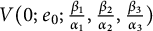 $V(0; e_0; \frac {\beta _1}{\alpha _1}, \frac {\beta _2}{\alpha _2}, \frac {\beta _3}{\alpha _3})$
with
 $(\alpha _1, \alpha _2, \alpha _3) \in \{(2, 3, 3),\,(2, 3, 5)\}$
and
 $e_0 = \frac {\beta _1}{\alpha _1} + \frac {\beta _2}{\alpha _2} + \frac {\beta _3}{\alpha _3} \in \mathbb {Q}$
. These are the only platonic triples with at most one of
 $\alpha _1, \alpha _2, \alpha _3$
even by Lemma 5.4.
If
 $(\alpha _1, \alpha _2, \alpha _3) = (2, 3, 5)$
, then
 $| H_1(\Sigma _2(K_D); \mathbb {Z}) | = 30\vert e_0 \vert = \vert 15 + 10 \beta _2 + 6\beta _3\vert $
. Since
 $\beta _2$
is coprime with
 $3$
, so is
 $|H_1(\Sigma _2(K_D); \mathbb {Z})|$
. This is not possible since
 $\vert H_1(\Sigma _2(K); \mathbb {Z}) \vert = \det K = (\det 3_1)^2 = 9$
is not coprime with
 $3$
.
Therefore,
 $(\alpha _1, \alpha _2, \alpha _3) = (2, 3, 3)$
and
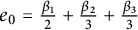 $e_0 = \frac {\beta _1}{2} + \frac {\beta _2}{3} + \frac {\beta _3}{3}$
. Since
 $|e_0| = \frac {| H_1(\Sigma _2(K); \mathbb {Z}) |}{\alpha _{1}\alpha _{2}\alpha _{3}} = \frac {9}{18} = \frac {1}{2}$
, up to reversal of orientation, the only possibility is
 $\Sigma _2(K) = V(0; \frac {1}{2}; -\frac {1}{2}, \frac {1}{3}, \frac {2}{3}),$
which corresponds to the Montesinos knot
 $8_{20} = K(-\frac {1}{2}, \frac {1}{3}, \frac {2}{3})$
. In [Reference Kitano and Suzuki31, Reference Kitano and Suzuki32], the partial order induced by meridian-preserving epimorphism between prime knot groups is completely determined for the Rolfsen table of knots up to ten crossings. It shows that there is no meridian-preserving epimorphism between
 $G(9_{24})$
and
 $G(8_{20})$
. This finishes the proof of the lemma.