Introduction
Weishanite, an alloy of Au, Ag and Hg, was originally described from a silicified zone in the silver-rich part of a gold–silver orebody in the biotite granulite of the Poshan mining district, Tongbai, Henan Province, China (Li et al., Reference Li, Ouyang and Tian1984). The mineral was found associated with pyrite, galena, sphalerite, pyrrhotite, scheelite, acanthite, native silver and native gold. Li et al. (Reference Li, Ouyang and Tian1984) reported the weishanite formula on the basis of 5 atoms, i.e. (Au,Ag)3Hg2, but did not give any clear explanation about why they decided to normalize the chemical data on the basis of 5 atoms and, even more importantly, why Au and Ag were grouped together. These problems were not raised by Hawthorne et al. (Reference Hawthorne, Burke, Ercit, Grew, Grice, Jambor, Puziewicz, Roberts and Vanko1988) in the abstract of the new mineral they reported a few years later in the American Mineralogist. To increase the confusion, the mineral has been reported with the formula (Au,Ag)1.2Hg0.8 in the official IMA list.
Three years after the first discovery of weishanite, Baptista and Baptista (Reference Baptista and Baptista1987) reported the same likely mineral from Sumidouro, Mariana County, Minas Gerais, Brazil. In this case, the authors attributed the formula Au3Hg to the mineral because their powder X-ray patterns were in good agreement with data for synthetic Au3Hg. However, although gold occurs at Sumidouro, mercury minerals are unknown. Thus, it remains an open question to establish if the Brazilian weishanite formed naturally or was the result of mining activity known to have occurred in the region (Tassel et al., Reference Tassel, Rubio, Misra and Jena1997).
Finally, weishanite has been found recently by the mineral dealer Joy Desor, also in the Keystone Mine, Magnolia District, Boulder Co., Colorado, USA. It occurs as well developed hexagonal millimetre-scale prismatic crystals together with magnolite on a magnetite/goethite, quartz matrix.
To help resolve concerns related to the chemistry and structure of weishanite, including its relations with other Au/Ag–Hg alloys, we selected a weishanite crystal from a sample from the Keystone mine and a chemical (electron microprobe) and structural (single-crystal X-ray diffraction) study was undertaken.
Chemical composition
The same weishanite crystal fragment used for the structural study (see below) was analysed by means of a Jeol JXA-8600 electron microprobe. Major and minor elements were determined at 20 kV accelerating voltage and 40 nA beam current, with variable counting times: 30 s were used for Au, Ag and Hg, and 60 s for the minor elements Fe, As, Cu, Bi, Te, S, Pb and Sb. For wavelength-dispersive spectroscopy analyses the following lines were used: AuMα, AgLα, HgMα, FeKα, AsLα, CuKα, BiMβ, TeLα, SKα, PbMα and SbLβ. The estimated analytical precision is: ± 0.30 for Au; ± 0.20 for Ag and Hg; ± 0.02 for Fe, As, Cu and Te; and ± 0.01 for Bi, Pb, S and Sb. The standards employed were: Au, Ag, Bi and Cu pure elements, coloradoite (Hg), marcasite (Fe), synthetic GaAs (As), synthetic Sb2Te3 (Sb and Te) and galena (Pb and S). The crystal fragment was found to be homogeneous within the analytical error. Iron, As, Cu, Bi, Te, S, Pb and Sb were below the detection limits (0.01–0.03 wt.%). The average chemical composition (five analyses on different spots), in elemental wt.%, is Au 46.60, Ag 19.61, Hg 33.01, total 99.22. On the basis of 1 atom, the formula of weishanite is Au0.41Ag0.31Hg0.28.
X-ray crystallography and crystal-structure determination
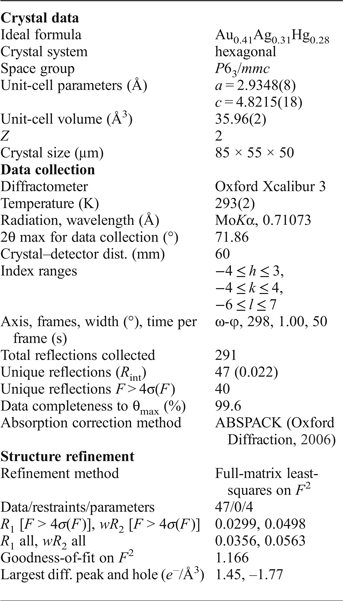
A small crystal fragment (85 µm × 55 µm × 50 µm) was selected for the X-ray single-crystal diffraction study that was done with an Oxford Diffraction Xcalibur 3 single-crystal diffractometer (Table 1). The detector-to-crystal working distance was 6 cm. Intensity integration and standard Lorentz-polarization corrections were performed with the CrysAlis RED (Oxford Diffraction, 2006) software package. The program ABSPACK in CrysAlis RED (Oxford Diffraction, 2006) was used for the absorption correction. Systematic absences and the statistical tests on the distribution of |E| values (|E 2–1| = 0.968) suggested the space group P63/mmc. The only structural position (Wyckoff 2c) was determined by means of the Patterson method included in the SHELX software package (Sheldrick, Reference Sheldrick2008). A least-squares refinement on F 2 using this position and an isotropic temperature factor produced an R factor of 0.106. The occupancy of the site was left free to vary (Au vs. structural vacancy) and it produced a mean electron number of 71(7) e –. Such a value is in excellent agreement with that calculated from the chemical data (Au0.41Ag0.31Hg0.28 = 69.4 e –). A neutral scattering curve for Au was taken from the International Tables for X-ray Crystallography (Wilson, Reference Wilson1992). At the last stage, with anisotropic atomic displacement parameters and no constraints, the residual value settled at R = 0.0299 for 40 observed reflections [4σ(F) level] and four parameters and at R = 0.0356 for all 47 independent reflections. Inspection of the difference-Fourier map revealed that maximum positive and negative peaks were 1.45 and –1.77 e –/Å3, respectively.
Crystallographic data and refinement parameters for weishanite

Details of the data collection and refinement, fractional atomic coordinates, anisotropic displacement parameters and bond distances can be found in the crystallographic information files available as Supplementary material (see below).
Results and discussion
The weishanite structure can be considered a derivative of the zinc structure. The classic 12 metal–metal contacts form two groups of six bonds with distances of 2.9348(8) and 2.9466(8) Å, respectively. The average value is 2.9407 Å, which is intermediate between that observed for gold and silver (2.8793 and 2.8892 Å, respectively; Suh et al., Reference Suh, Ohta and Waseda1988) and that calculated for pure Hg, 3.1 Å, taking into account its metallic radius (Wells, Reference Wells1984).
As shown above, Au, Ag and Hg were found to be disordered at the same structural position. This does mean that the chemical formula must reflect this structural feature. Thus, we suggest that the formula is normalized to 1 atom with Z = 2, and that there is no reason to group together Au and Ag as they have the same crystal-chemical behaviour of Hg in this structure (no ordering). Using the electron microprobe data obtained by Li et al. (Reference Li, Ouyang and Tian1984), the chemical formula of the type weishanite can be thus written as Au0.56Hg0.38Ag0.06.
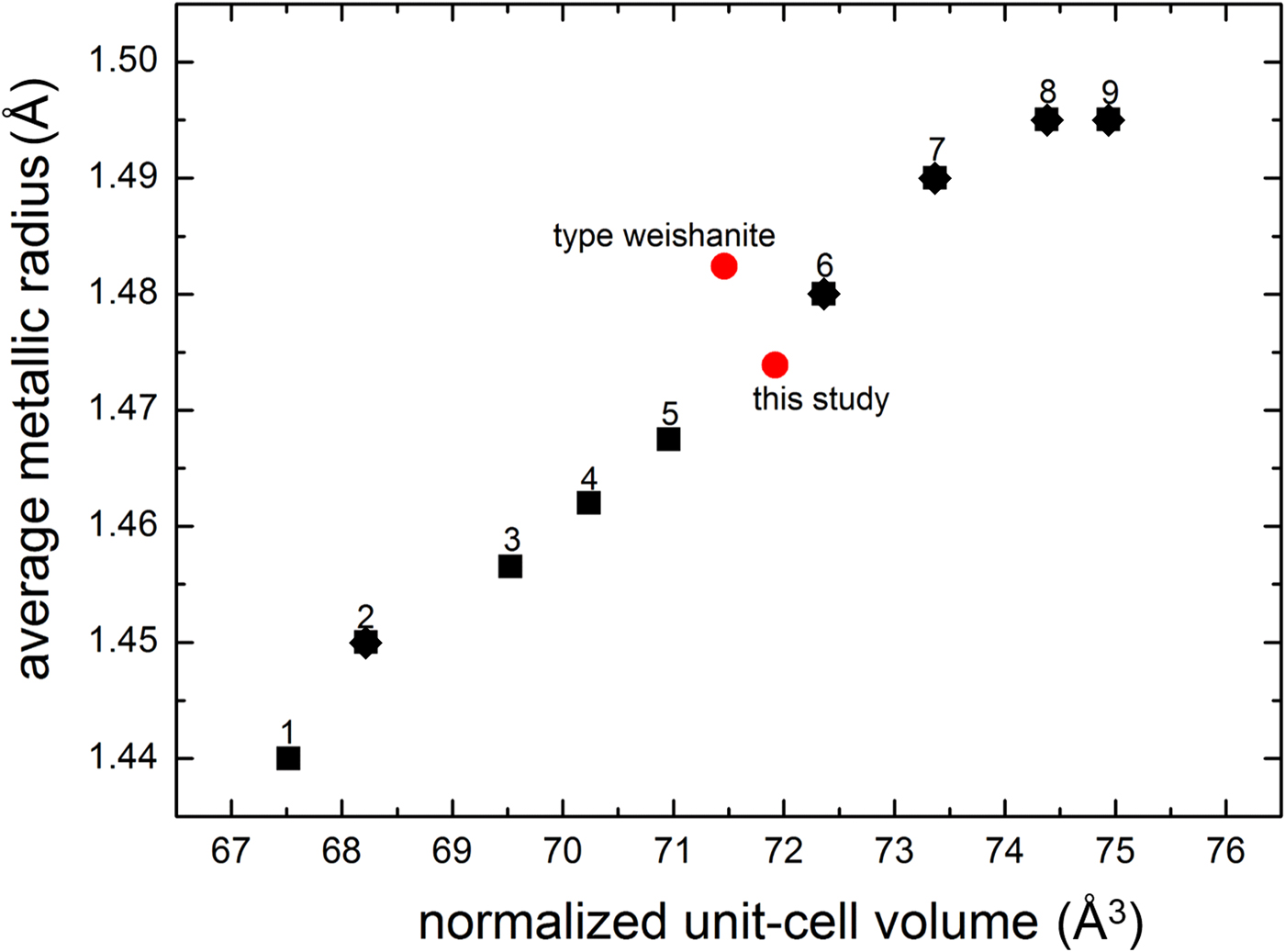
In Fig. 1 we have reported several natural and synthetic Au/Ag–Hg alloys showing structural similarities. In more detail, for these structures it is possible to calculate a normalized unit-cell volume which corresponds to that of the ideal cubic cell of ~4 Å. The normalized unit-cell volume is then plotted against the average metallic radius (using 1.44, 1.45 and 1.55 Å for Au, Ag and Hg, respectively; Wells, Reference Wells1984) calculated from the chemical formulae (normalized to 1 atom) reported in the literature for these natural and synthetic compounds. It appears evident that a linear trend can be observed (R 2 = 0.965) corroborating the hypothesis that the structure of these compounds is a function of the (Au + Ag)/Hg ratio. The only datum plotting off the main linear trend is that related to type weishanite (Li et al., Reference Li, Ouyang and Tian1984). This could be due to some chemical inhomogeneity of the sample and/or to the fact that the unit cell was determined from powder diffraction data.
Average metallic radius (Å) vs. the normalized unit-cell volume (Å3). Red circles refer to weishanite data (this study and Li et al., Reference Li, Ouyang and Tian1984). Black symbols (1–9) refer to data from literature: (1) gold (Suh et al., Reference Suh, Ohta and Waseda1988); (2) silver (Suh et al., Reference Suh, Ohta and Waseda1988); (3) synthetic Au0.85Hg0.15 (Rayson and Calvert, Reference Rayson and Calvert1959); (4) synthetic Au0.80Hg0.20 (Owen and O'Donnell Roberts, Reference Owen and O'Donnell1945); (5) synthetic Au0.75Hg0.25 (Rolfe and Hume-Rothery, Reference Rolfe and Hume-Rothery1967); (6) synthetic Ag0.70Hg0.30 (Rayson and Calvert, Reference Rayson and Calvert1959); (7) paraschachnerite (Seeliger and Mücke, Reference Seeliger and Mücke1972); (8) schachnerite (Seeliger and Mücke, Reference Seeliger and Mücke1972); and (9) synthetic Ag0.55Hg0.45 (King and Massalski, Reference King and Massalski1961). Squares and stars indicate Au- and Ag-compounds, respectively.

It is interesting to note that schachnerite, Ag1.1Hg0.9 (Seeliger and Mücke, Reference Seeliger and Mücke1972), was approved as new mineral species in 1972, twelve years before weishanite, and it is isostructural with weishanite. Thus, weishanite is actually a Au-dominant schachnerite. Also, from a strict crystallographic point of view (and also applying the IMA rules), weishanite and schachnerite would be simple polymorphs of gold and silver, respectively, as the metals are disordered in the same structural position. A similar situation occurs for steinhardtite (Bindi et al., Reference Bindi, Yao, Lin, Hollister, Poirier, Andronicos, MacPherson, Distler, Eddy, Kostin, Kryachko, Steinhardt and Yudovskaya2014), an alloy of Al, Ni and Fe discovered in the Khatyrka meteorite. Although Ni and Fe are fundamental to stabilize steinhardtite, it was considered a polymorph of Al. Likewise, although Hg is essential to form weishanite and schachnerite, it plays a minor role in the chemical formula with respect to Au and Ag in both the minerals. Our preference is to maintain Hg in the formula, but this raises the question about a possible redefinition of weishanite and schachnerite. We are working on a new mass discreditation of metallic minerals and alloys such as that done previously by Burke (Reference Burke2006).
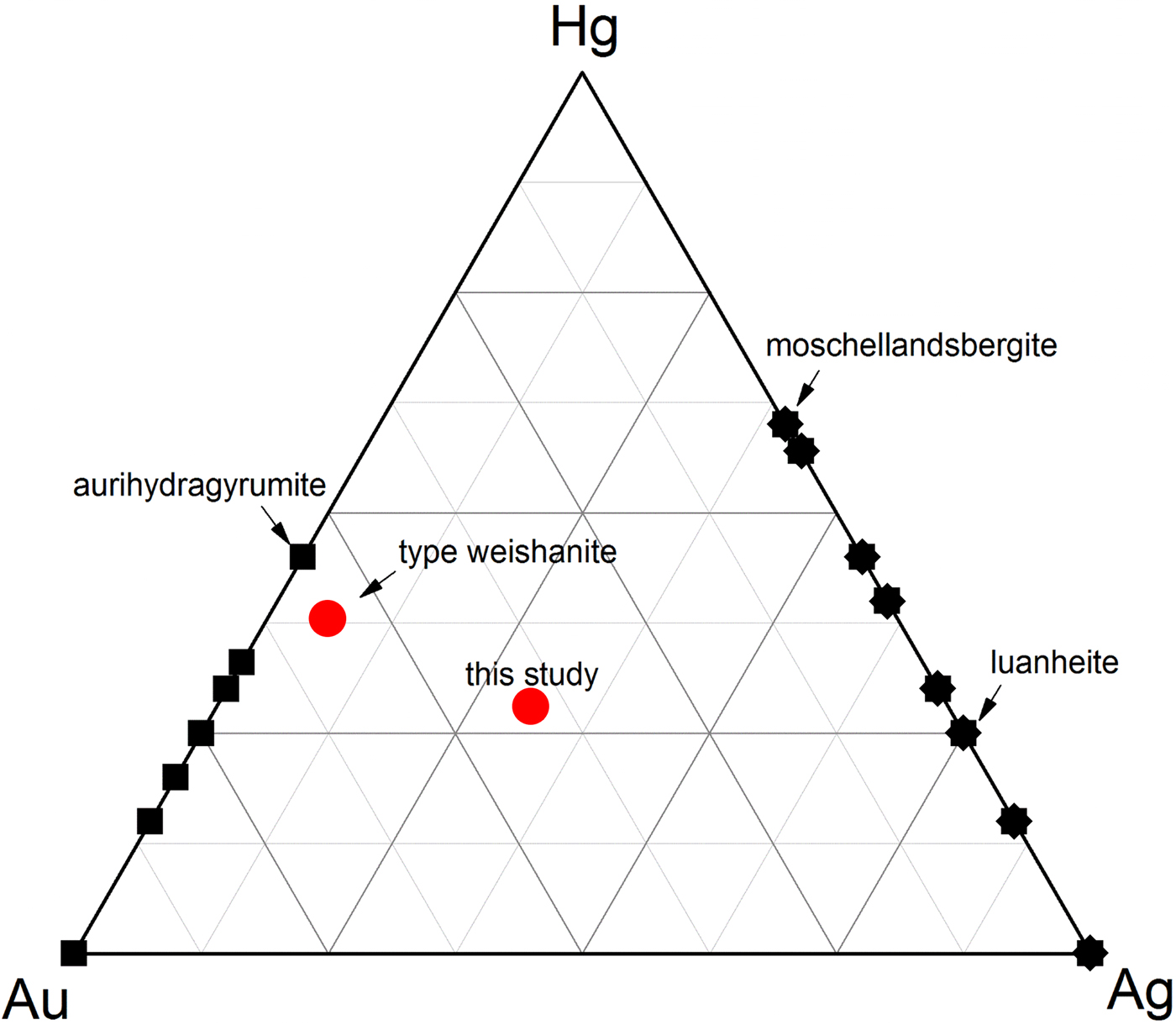
Finally, an interesting note concerns the possible ordering of atoms in Au–Ag–Hg compounds. Moschellandsbergite (Ag2Hg3; Berman and Harcourt, Reference Berman and Harcourt1938), luanheite (Ag3Hg; Dianxin et al., Reference Dianxin, Jianxiong, Jianhong and Daxi1984), and the recent aurihydrargyrumite (Au6Hg5; Nishio-Hamane and Minakawa, Reference Nishio-Hamane and Minakawa2017), exhibit unit-cell values indicating ordered superstructures of the ideal cubic cell of ~4 Å. In particular, in synthetic Ag2Hg3 (Fairhurst and Cohen, Reference Fairhurst and Cohen1972), Ag and Hg occupy distinct positions. Looking at the diagram in Fig. 2, one could hypothesize that the ordering might occur at the highest Hg/Ag (moschellandsbergite) or Hg/Au (aurihydrargyrumite) ratios, but the hypothesis would be immediately ruled out if luanheite were proved to actually exhibit an ordered superstructure. Thus, we think that several structures belonging to the Au–Ag–Hg system should be elucidated before reaching firm conclusions. Special care should also be devoted to the possible role of atom ordering at low temperature.
Minerals and compounds belonging to the Au–Ag–Hg system plotted in the ternary diagram (data in atoms per formula unit). Symbols as in Fig. 1.

Acknowledgements
Joy Desor is thanked for providing the weishanite sample from the Keystone mine. This research received support by the University of Firenze, Italy, through the project “Fondo di Ateneo 2016” granted to LB. Peter Leverett, Stuart Mills and Yves Moëlo are thanked for the review of the manuscript.
Supplementary material
To view supplementary material for this article, please visit https://doi.org/10.1180/mgm.2018.113