In the last 20 years, the age-adjusted rate of deaths of children aged >1-year-old attributable to CHD has been steadily declining.Reference Benjamin, Blaha and Chiuve 1 This has resulted in an increased CHD patient population, estimated at 1 million children under the age of 18 living with CHD in the United States in 2010.Reference Gilboa, Devine and Kucik 2 Meanwhile, in the general school age and adolescent populations, the prevalence of childhood obesity has more than doubled in the last 30 years.Reference Ogden, Carroll and Lawman 3 Childhood and adolescent obesity increases the risk of adult obesity as well as risk factors for cardiovascular disease, including hypertension, type 2 diabetes, and hyperlipidaemia.Reference The, Suchindran, North, Popkin and Gordon-Larsen 4 , Reference Freedman, Khan, Serdula, Dietz, Srinivasan and Berenson 5
Although children with CHD have specific risks of failure to thrive in infancy, many studies across the United States have demonstrated that the rates of obesity in the paediatric CHD population do not differ from the general paediatric population.Reference Pinto, Marino and Wernovsky 6 , Reference Shustak, McGuire, October, Phoon and Chun 7 As individuals with a history of CHD increasingly survive into adulthood, the prevalence of obesity in adults with CHD is rising as well.Reference Lerman, Parness and Shenoy 8 , Reference Zaidi, Bauer and Michalsky 9
To-date, most of the published research have reviewed cross-sectional data to compare prevalence of obesity in CHD patients with the general paediatric population and also the obesity rates within the CHD population by type and severity of lesion.Reference Pinto, Marino and Wernovsky 6 , Reference Shustak, McGuire, October, Phoon and Chun 7 Although these investigations have demonstrated the risk of obesity in children with CHD, they have not used longitudinal data to identify trends in this patient population or to identify ages at which the risk of obesity develops. Only two recently published studies have investigated the longitudinal data. One of them demonstrated a positive correlation between body mass index z-scores and age in six major cardiac lesions, but did not identify specific age ranges associated with body mass index growth.Reference Tamayo, Manlhiot, Patterson, Lalani and McCrindle 10 Another recent investigation characterised long-term body mass index trends in age-stratified cohorts patients who have undergone Fontan repair, but this data is not applicable to the general paediatric CHD population.Reference Chung, Hong, Patterson, Petit and Ham 11
We conducted a retrospective longitudinal study to examine the prevalence of overweight and obesity in an ethnically diverse population of children with CHD and also to investigate the risk factors, including age cohorts, associated with paediatric body mass index growth.
Materials and methods
The study protocol was approved by the Icahn School of Medicine at Mount Sinai Institutional Review Board. Using Epic Software (Epic Systems Corporation, Verona, WI, United States of America) retrospective chart review was performed on all patients aged 5–20 years with an International Classification of Diseases, Ninth Revision visit code for a congenital heart lesion seen by the Mount Sinai Division of Pediatric Cardiology (New York, United States of America) between 2011 and 2015. Age, sex, race/ethnicity, height, weight, body mass index, BMI percentile (BMI%), form of CHD, surgical history, and other clinical characteristics were recorded from the electronic health record. Patients were excluded if they had diagnoses of genetic syndromes.
A control cohort of patients without CHD was randomly generated from the same electronic database of all patients seen within Mount Sinai Hospital for routine health maintenance between 2011 and 2015, matching for age, sex, and race/ethnicity in a 1:1 case–control ratio.
Patients–control pairs were only included in the data analysis if both the CHD patients and paired control had at least two body mass index data points between 2011 and 2015. Subjects were stratified into aged cohorts 5–10, 11–15, and 16+ based on their age in 2015.
BMI% was collected from the electronic health record, as calculated based on Commission for Disease Control body mass index-for-age standards,Reference Kuczmarski, Ogden and Guo 12 and were classified as underweight if BMI<5%, overweight if BMI⩾85% and <95%, and obese if BMI⩾95%.Reference Himes and Dietz 13 , Reference Barlow and Dietz 14 CHD severity was classified as “simple”, “moderate”, or “complex” as per the Bethesda Conference criteria.Reference Warnes, Williams and Bashore 15
Annual prevalence rates of overweight/obese were defined as percentages of the respective cohort with a body mass index data point in that year. BMI% change was calculated as the difference between the subject’s most recent BMI% data point and their initial BMI% data point, divided by the number of years between these two data points. Transition to overweight/obese status was defined as samples whose initial recorded BMI% was <85% and whose most recent BMI% was ⩾85%. Transition from underweight to normal weight was defined as samples whose initial recorded BMI% was <5% and whose most recent BMI% was >5%.
Normally distributed continuous variables were assessed using paired sample t-test. Dichotomous variables were compared using Pearson’s χ2-test. Dichotomous paired variables were compared using McNemar’s test. Linear regression analyses were performed using BMI% change as the dependent variable and age cohort, sex, race/ethnicity, CHD severity, and surgical status as independent variables. A p-value <0.05 was considered statistically significant. Statistical analyses were performed with IBM SPSS Statistics for Windows, Version 22.0 (IBM Corp. Released 2013, Armonk, NY, United States of America).
Results
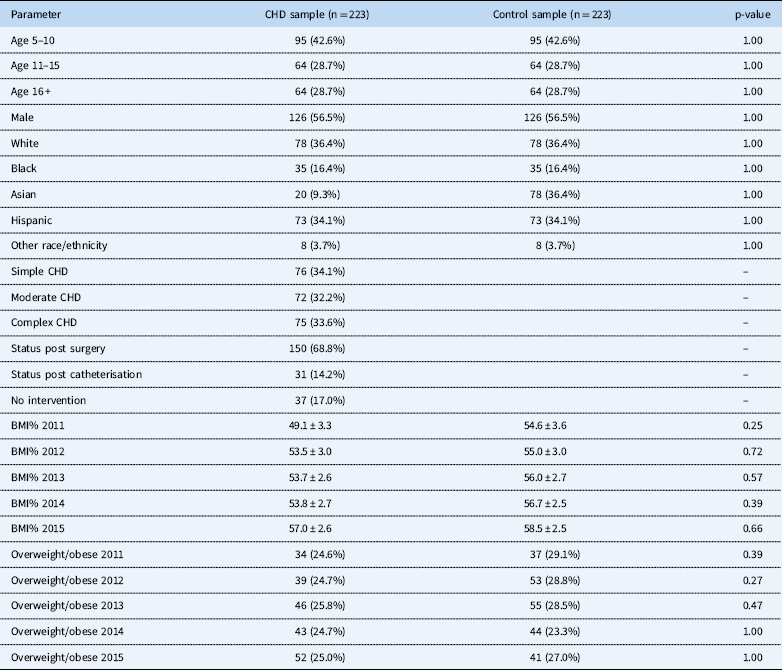
Of the 712 records reviewed, 446 met the inclusion criteria of at least two BMI% data points collected between 2011 and 2015, of which 223 were CHD and 223 were age-, sex-, and race/ethnicity-matched controls. In aggregate, this group was slightly more male, predominantly fell in the 5–10-year-old bracket at the end of the study period, and was ethnically diverse (Table 1). The CHD sample had a balanced mix of simple (34.1%), moderate (32.2%), and complex (33.6%) disease complexity, and a significant majority (83.4%) had undergone at least one lifetime cardiac intervention, either surgery or cardiac catheterisation.
Demographic and clinical characteristics of the study and control cohorts.

Categorical variables are expressed as n (%) and continuous variables as mean±SE. p-values were calculated by Pearson’s χ2-test for categorical variables, McNemar’s test for paired categorical variables, and paired t-test for continuous variables
BMI%=Body mass index percentile
When cross-tabulated by age cohort, it was found that the 5–10-year-old CHD cohort comprised more simple complexity patients, the 11–15-year-old CHD cohort comprised more males and whites, and the 16+-year-old CHD cohort comprised more post-surgical moderate complexity patients. None of these differences were statistically significant.
Mean BMI% between 2011 and 2015 was normally distributed and did not statistically differ between the CHD sample and paired controls (Table 1). Prevalence of combined overweight/obesity did not differ significantly between the CHD cohort and matched controls, ranging over the 5-year period from 24.6 to 25.8% in the CHD cohort and 23.3–29.1% in the control group. Rates of more severe obesity (as defined by BMI%>100) ranged between 0.5 and 2.3% in the CHD cohort and 0 and 3.1% in the control group. Rates of underweight did not differ significantly between the CHD and control samples between 2011 and 2015. There was no statistically significant difference in the number of individuals who transitioned to overweight or obese in the 5-year period: 22 (9.9%) of the CHD sample and 16 (7.2%) of the controls (p=0.781); nor was there a statistically significant difference in the number of individuals who transitioned from underweight to normal BMI% in the 5-year period: 22 (9.9%) of the CHD sample and 15 (6.7%) of the controls (p=0.310). The 22 CHD subjects who transitioned to overweight or obese, in comparison to the overall CHD cohort, were more predominantly male (68%), age 5–10 (59%), white (45%), and simple (41%) or complex (41%) complexity. The annualised BMI% change in these 22 subjects was +8% per year.
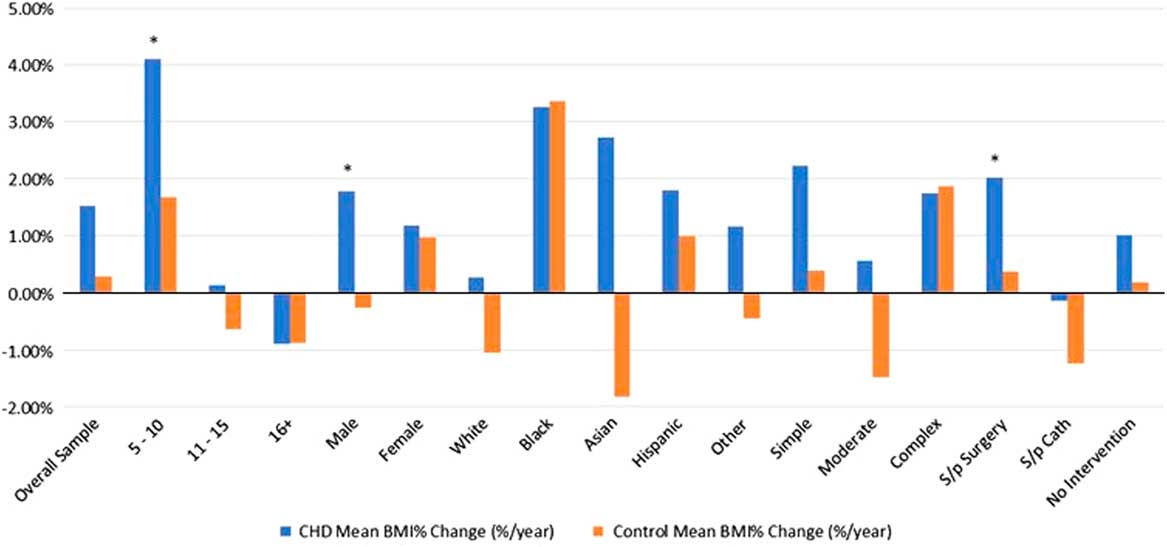
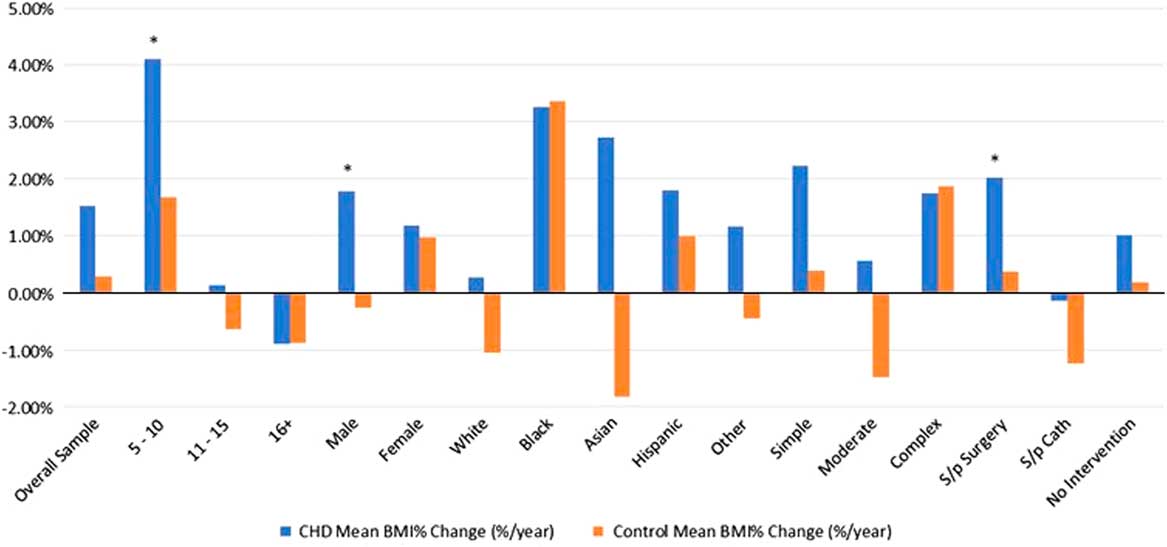
Paired t-test between CHD samples and their paired controls demonstrated that there was nearly a significant difference in BMI% change per year over the 5-year period (CHD +1.5%/year, control 0.3%/year, p=0.055) (Fig 1). When stratified by age cohort, sex, race/ethnicity, CHD complexity, and surgical status, a significant difference of BMI% change per year was seen in the age 5–10 cohort (CHD +4.1%/year, control +1.7%/year, p=0.04), in male sex (CHD +1.8%/year, control −0.3%/year, p=0.01), status-post surgical status (CHD 2.03%/year versus control 0.37%, p=0.02), and nearly significant in moderate complexity CHD (CHD +0.6%/year, control −1.5%/year, p=0.06). Mean BMI% change was not significantly different in any other subgroup analysis. When assessed within the CHD subjects alone, the only significant difference in BMI% change per year was seen when stratified by age cohort, with an increased BMI% change per year seen in the 5–10 age cohort when compared with the other two age cohorts (age 5–10: +4.1%/year, age 11–15: +0.1%/year, p=0.002; age 5–10: +4.1%/year, age 16+: −0.9%/year, p<0.001). Mean BMI% change did not differ significantly within the CHD subjects with any other subgroup analysis.
Mean BMI% change per year, CHD sample versus paired controls, stratified by overall sample and demographic subgroups. *denotes p-value<0.05.
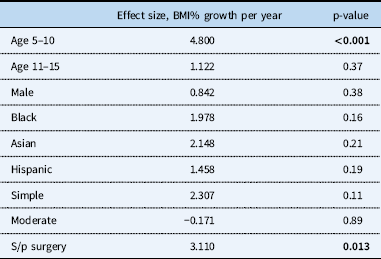
Multivariate linear regression analysis within the CHD subgroup demonstrated that age 5–10 and status-post surgical status were associated with increased BMI% growth, +4.80%/year (p<0.001) and +3.11%/year (p=0.013), respectively (Table 2). No other variables within the model were statistically significant.
Multivariate linear regression within CHD subgroup.

S/p=status-post
Discussion
This is the first longitudinal study to assess risk factors for increased BMI in children with CHD. From this large, ethnically diverse sample, we made several important observations, such as prevalence rates of overweight and obesity did not differ significantly between CHD patients and matched healthy controls over a 5-year period; there was an association between the 5 and 10-year-old cohort and increased BMI% growth, and surgically corrected CHD is also associated with increased BMI% growth.
This data adds additional support to the observations made in the last 15 years regarding the prevalence of overweight and obesity in the CHD children.Reference Pinto, Marino and Wernovsky 6 , Reference Shustak, McGuire, October, Phoon and Chun 7 This study found that the prevalence rate of combined overweight and obesity in CHD patients not to be dissimilar from their matched healthy controls. The CHD cohort’s combined overweight and obesity prevalence rates of 24.6–25.8% within each year of the study were not dissimilar from rates reported in CHD populations in other prominent studies.
This longitudinal study design permits the calculation of annualised body mass index growth rates. There was no significant difference in the transition from underweight to normal weight between the CHD and matched healthy controls, nor were there differences between the mean body mass index or combined overweight and obesity prevalence over the 5-year period. Therefore, one can conclude that the BMI% increase seen in the CHD sample relative to their matched controls does not reflect a relatively underweight CHD population “catching up” to the appropriate weights of their matched healthy controls.
We identified the age cohort of 5–10-year-old as a risk factor of increased BMI% growth, with an effect size measured at 4.80% per year. Tamayo et al reported increasing age as a risk factor for increased body mass index z-score.Reference Tamayo, Manlhiot, Patterson, Lalani and McCrindle 10 No previous study has reported specific ages associated with increased body mass index growth. Literature in the field of paediatric obesity has demonstrated that in obese children, a decrease in body mass index-standard deviation score of 0.25–0.5 over 1 year significantly improves atherogenic profile, insulin resistance, and hypertension.Reference Reinehr, Lass, Toschke, Rothermel, Lanzinger and Holl 16 , Reference Reinehr and Andler 17 Converted to a percentile basis from a baseline z-score of 2.0, this implies that a 1.73–4.40% percentile decrease is associated with improved cardiovascular risk factors. The age range of 5–10 may therefore be a critical time to provide weight management counselling to children and parents.
Status-post surgery was appreciated as a risk factor for increased BMI% growth. Similarly, Tamayo et al demonstrated weight z-scores increasing over time following complete surgical repair.Reference Tamayo, Manlhiot, Patterson, Lalani and McCrindle 10 Many previous studies have implicated that this association may be related to exercise restrictions that may be incorrectly placed on the surgically corrected child.Reference Pasquali, Marino and Pudusseri 18 – Reference Cohen 20 Given that children and adolescents with CHD and their parents have been shown to have a poor knowledge of the appropriate level of exercise activity,Reference Kendall, Parsons, Sloper and Lewin 21 , Reference Cheuk 22 our data suggest that there may be an efficacy to more consistent exercise counselling with this patient population.
Our study is limited by its retrospective design and reliance on the accuracy and availability of coded information within the electronic health record. Therefore, important data was unable to be collected, including parental obesity, socio-economic status, patient-reported exercise tolerance, echocardiographic data, or exercise capacity testing. Though our data is longitudinal, it is limited to a 5-year period and may miss the trends seen over a longer period of time. In addition, our sample is drawn from a single academic centre in New York City. Although our patient demographics may differ from nationwide characteristics, it has afforded our study with significant ethnic diversity not seen in previous longitudinal studies.
Conclusions
In this retrospective longitudinal study, prevalence rates of combined overweight and obesity did not differ between CHD and general paediatric populations over a 5-year period. Longitudinal data suggest that age 5–10 and status-post surgery CHD patients may be at increased risk of BMI% growth relative to peers with structurally normal hearts. A higher power prospective study could further elicit these relationships.
Acknowledgements
This study received funding from the Children’s Heart Fund, Mount Sinai Medical Center, New York, NY, United States of America. The study sponsor supported funding for electronic health record data retrieval, and it did not actively contribute to study design, analysis, or interpretation of data, the writing of the manuscript, or the decision to submit for publication.
Financial support
This research received no specific grant from any funding agency, or from commercial or not-for-profit sectors.
Conflicts of interest
None.