Introduction
Pasture regrowth follows a sigmoid curve with an asymptotic relationship between the leaf area index (LAI) and canopy light interception (LI) (Brougham, Reference Brougham1955). Plant growth is a function of canopy LI and LAI, and the rate of forage dry matter accumulation peaks when the forage canopy intercepts almost all incident light (Brougham, Reference Brougham1955; Korte et al., Reference Korte, Watkin and Harris1982; Parsons et al., Reference Parsons, Johnson and Harvey1988). During the early stages of regrowth, leaves are the main morphological component in the accumulated forage. As LAI increases, canopy light intra-competition increases and plants change their growth pattern to optimize light utilization. Such changes include increasing the proportions of stem and dead material, with a significant impact on the morphological composition of the forage mass (Pereira et al., Reference Pereira, Paiva, Geremia and Da Silva2014) and on forage intake (Fonseca et al., Reference Fonseca, Mezzalira, Bremm, Filho, Gonda and Carvalho2012, Reference Fonseca, Carvalho, Mezzalira, Bremm, Galli and Gregorini2013; Congio et al., Reference Congio, Batalha, Chiavegato, Berndt, Oliveira, Frighetto, Maxwell, Gregorini and Da Silva2018; Geremia et al., Reference Geremia, Crestani, Mascheroni, Carnevalli, Mourão and Da Silva2018). An important feature regarding tropical perennial C4 grasses is the significant stem elongation even during the vegetative phase of development, a mechanism known as ‘shade avoidance’ that optimizes light capture by the sward as it becomes scarce within the canopy (Ballaré, Reference Ballaré1999). This shift in the growth pattern occurs when canopy LI exceeds 95% of the incident light (Da Silva et al., Reference Da Silva, Sbrissia and Pereira2015).
During the vegetative growth stage, using 95% LI as a grazing frequency criterion has been shown to result in greater forage production with a greater proportion of leaves and a lower proportion of dead material (Pereira et al., Reference Pereira, Paiva, Geremia and Da Silva2014). These findings corroborate the central role of LAI and LI as determinants of plant responses to grazing, highlighting the need to understand the aspects related to sward structure, the balance between growth and senescence and the nutritive value under unlimited water and nutrient availability to establish efficient grazing management strategies (Da Silva et al., Reference Da Silva, Bueno, Carnevalli, Uebele, Bueno, Hodgson, Matthew, Arnold and Morais2009).
When LI exceeds 95% (e.g. maximum LI), forage mass is greater resulting in greater dry matter production. Forage mass is one of the most important measurements for pasture-based production systems. However, high productivity of grazing systems is also dependent on the nutritive value of the forage. The nutritive value is often expressed using crude protein (CP), in vitro organic matter disappearance (IVOMD), neutral detergent fibre (NDF), acid detergent fibre (ADF) and lignin concentrations. The increased DM production associated with the maximum canopy LI was also associated with an increased proportion of stems and dead material relative to leaves (Da Silva et al., Reference Da Silva, Bueno, Carnevalli, Uebele, Bueno, Hodgson, Matthew, Arnold and Morais2009). Greater stem proportion is associated with greater lignin content and lower digestibility, resulting in a lower nutritive value (Santos et al., Reference Santos, Corsi, Pedreira and Lima2006).
Despite the relationship observed between LI, LAI and forage mass and nutritive value, and the consensus regarding 95% LI as the optimal pre-grazing target, these are difficult characteristics to assess in the field. Therefore, canopy height has been identified as the characteristic that consistently relates to the LAI, forage mass and nutritive value (Hodgson, Reference Hodgson1990), and it has been used to characterize the LI95% grazing target (Da Silva et al., Reference Da Silva, Sbrissia and Pereira2015). Several studies on tropical grasses have been conducted in order to identify the canopy height that best describes the LI95% condition and to generate practical grazing targets that could easily be used in the field for different forage species (Carnevalli et al., Reference Carnevalli, Da Silva, Carvalho, Sbrissia, Fagundes, Pinto and Pedreira2001, Reference Carnevalli, Da Silva, Bueno, Uebele, Bueno, Hodgson, Silva and Morais2006; Carvalho et al., Reference Carvalho, Da Silva, Sbrissia, Fagundes, Carnevalli, Pinto and Pedreira2001; Da Silva and Carvalho, Reference Da Silva, Carvalho and McGilloway2005), weather conditions (Gregorini et al., Reference Gregorini, Gunter, Bowman, Caldwell, Masino, Coblentz and Beck2011; Pereira et al., Reference Pereira, Paiva, Geremia and Da Silva2014, Reference Pereira, Paiva, Geremia and Da Silva2015) and soil fertility (Congio et al., Reference Congio, Batalha, Chiavegato, Berndt, Oliveira, Frighetto, Maxwell, Gregorini and Da Silva2018; Geremia et al., Reference Geremia, Crestani, Mascheroni, Carnevalli, Mourão and Da Silva2018). In the above studies, LI was monitored with a canopy analyser simultaneously to the monitoring of canopy height during regrowth until the association between 95% LI and pre-grazing canopy height was established. These studies have successfully provided pre-grazing target heights, although other aspects of grazing management remain unclear, such as the post-grazing height (PGH) targets and nutritive value of the forage at the appropriate management targets.
In grazing planning, PGH (and pasture occupation period) is directly related to forage intake, nutrient consumption, animal performance (Carvalho et al., Reference Carvalho, Da Silva, Sbrissia, Pinto, Carnevalli, Fagundes and Pedreira2009) and plant regrowth (Da Silva et al., Reference Da Silva, Bueno, Carnevalli, Uebele, Bueno, Hodgson, Matthew, Arnold and Morais2009). Upper leaves are the first component to be consumed by cattle, followed by lower leaves and stems. The magnitude of stem consumption is dependent on the occupation period and, therefore, PGH. Understanding the changes in stem proportion, morphological and chemical components throughout the regrowth period and along the vertical profile of the canopy would allow for the appropriate determination of PGH that, associated with the LI95% pre-grazing target, maximizes intake and performance.
The objective of the present study was to characterize forage production and morphological composition as a means to identify the combination of pre- and PGHs that would result in a greater nutritive value of Mombaça grass (Panicum maximum Jacq. cv Mombaça). More specifically, the study aimed at understanding the changes in chemical and morphological characteristics of Mombaça grass during different growing seasons and throughout the regrowth period.
Material and methods
Study site and experimental treatments
The experiment was conducted in Araras, SP, Brazil (22°18′S, 47°23′W, 611 m a.s.l.; Ometto, Reference Ometto1981) on a Mombaça grass pasture. The climate at the experimental site is sub-tropical with dry winters and 1312 mm average annual rainfall (CEPAGRI, 2012). The average daily temperature during the experimental period was within the historical data from 1971 to 2001. The lowest temperature was recorded in July (16 °C) and the highest in February (26 °C). The greatest levels of rainfall were observed during summer (January to March, 160 mm on average), and the lowest were observed during autumn–winter and spring (June to October, 42 mm on average), which resulted in soil water deficit (−26 mm on average). The Mombaça grass pasture was established in 1998, at a 3 kg/ha seeding rate, on a Dystrophic Ultisol clay soil (EMBRAPA, 1999). Soil was considered fertile with 35 g/dm3 of organic matter, 12 mg/dm3 of phosphorus (P), 2.5 mmolc of potassium (K) and 57% base saturation. Experimental paddocks were fertilized with 195 kg N/ha fractioned throughout the growing season, always post-grazing.
Treatments were combinations of two pre-grazing conditions (95% and maximum canopy LI; termed LI95% and LIMax, respectively) and two PGHs (30 and 50 cm). Treatments were allocated to experimental units (16 paddocks; 2000 m2 each) according to a randomized complete block design, with a 2 × 2 factorial arrangement. Four blocks were set based on soil type and slope of the experimental site. Grazing began on September 2000, with pre-grazing target of 95% LI and 30 cm PGH. Since establishment, the pastures were rotationally grazed by lactating dairy cows, with fixed 35-day rest periods. In December 2000, paddocks were assigned to the different treatments and managed with 30 or 50 cm PGH, and LI95% or LIMax (adaptation period). The experimental period was from 8 January 2001 to 23 February 2002.
Canopy light interception and sward height
Canopy LI was monitored during regrowth at each 20-cm height increment in sward forage mass, starting on day 1 after grazing (post-grazing) and ending at pre-grazing of each grazing cycle. Once the canopy reached 90%, LI was measured every 2 days with a canopy analyser (LI-COR, model LAI 200; LI-COR, Lincoln, Nebraska, USA). Canopy LI was monitored at six points per paddock. At each point, five readings were taken at the soil surface (at midpoint distance between tussocks) and one reading was taken above the canopy. Canopy height and canopy LI were measured simultaneously using a sward stick in 16 randomly selected points per paddock.
Forage mass, density and accumulation
Forage samples to characterize forage mass, bulk density and accumulation were collected pre- and post-grazing from a 1 m2 frame (0.68 × 1.47 cm). Due to slow regrowth of Mombaça grass if cut at the ground level, samples were collected above a 20-cm stubble height. Three sub-samples were collected per paddock and composited into one sample per experimental unit. Samples were oven dried at 65 °C to constant weight for forage mass determination (dry matter basis; kg DM/ha). The forage bulk density (kg DM/cm/ha) was calculated as the ratio between the forage mass pre-grazing and forage canopy height. Forage accumulation was determined as the difference between the pre-grazing mass of the current cycle and the post-grazing mass of the previous cycle. Forage accumulation was divided by the number of days during the rest period to generate the rate of forage accumulation (kg DM/ha/day). The rest periods were variable according to plant growth but were on average 23 and 24 days for LI95% managed with 30 and 50 PGH, respectively, and 39 and 33 days for LIMax, managed with 30 and 50 cm PGH respectively. Total forage accumulation corresponded to the sum of daily accumulated forage throughout the experimental period.
Forage chemical and morphological composition
Samples to characterize the morphological composition and nutritive value of the forage were collected during two phases of the grazing cycle: regrowth and pre-grazing, and during three seasons of the year. Regrowth was characterized by samples collected at every 20-cm forage increment in canopy height during the period from day 1 post-grazing to the day immediately before grazing. Pre-grazing represented the day before grazing. The three seasons of the year were: summer 2001 and 2002 (January to March), autumn–winter (April to August) and spring (September to December). Three sub-samples were randomly collected per paddock and composited into one sample per paddock. Forage samples pre-grazing were separated into basal and superior strata. For paddocks managed with the 30 cm PGH, basal and superior strata corresponded to 30 to 50 cm and above 50 cm from the ground level, respectively. For paddocks managed with the 50 cm PGH, basal and superior strata corresponded to 50–70 cm and >70 cm from the ground level, respectively. From each stratum, a 250 g sub-sample was separated for morphological composition determination. Morphological components identified were green and dead materials, leaves (green lamina) and stems (leaf sheath and stems). Samples were oven-dried at 65 °C to constant weight and ground for chemical analyses. Each component was weighed and its proportion of the total forage mass determined based on total forage mass.
Forage samples were analysed for CP, NDF, ADF, lignin and IVOMD. The DM and CP contents were determined following procedures proposed by AOAC (2016). The NDF and ADF were determined using the ANKOM A200 Fibre Analyser and Daisy Incubator II (ANKOM Technology Corporation, New York, USA). The lignin content was determined using the method of Van Soest et al. (Reference Van Soest, Robertson and Lewis1991) and IVOMD using the method of Goering and Van Soest (Reference Goering and Van Soest1970). The CP content corresponded to total N content (determined by the Kjeldahl method; FOSS Tecator, 1987) multiplied by 6.25.
Statistical analyses
Treatment effects were tested with a mixed model, with blocks as the random term and season of the year as a repeated measure. Analysis of variance (ANOVA) was performed using the Mixed Procedure in SAS® (version 9.4). Bonferroni adjustment was used to allow for planned comparisons between treatments and seasons of the year. Different structures of the variance-covariance matrix were tested, and the compound symmetry structure was chosen as the best fit for the majority of variables based on the Bayesian information criterion. All tests were performed with 95% confidence (P ⩽ 0.05).
Results and discussion
Sward morphological and structural characteristics
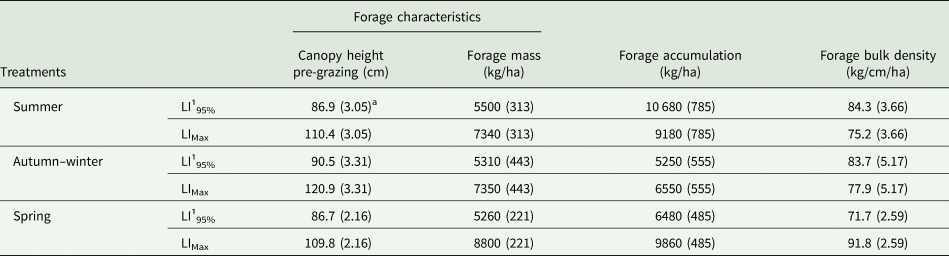
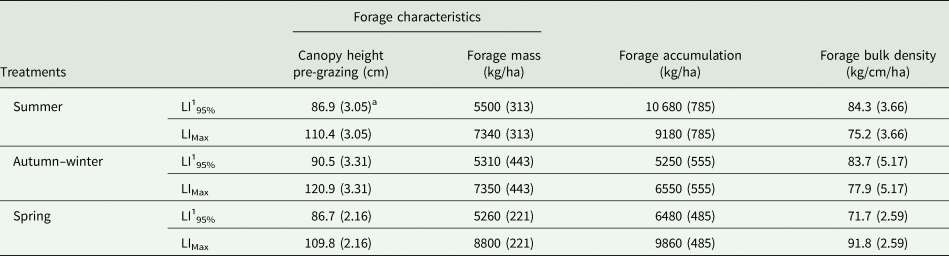
Swards managed with the LIMax target had greater canopy height at pre-grazing, forage mass and accumulation compared to swards managed with the LI95% target, across seasons and PGH (Table 1). Forage bulk density did not vary with LI treatments (Table 1). Morphological characteristics varied with the phase of grazing cycle (P < 0.001). The only characteristics that were not affected by the phase of grazing cycle were green and dead materials. Therefore, means are mainly shown separately by the phase of grazing cycle. Swards managed with LIMax had longer rest periods, leading to a greater canopy height at pre-grazing. Consequently, forage mass and accumulation were greater on swards managed with LIMax compared to swards managed with LI95%, across seasons and PGH. Forage samples were collected at 20 cm-stubble height, and at this height, the sward was composed mainly of leaves, regardless of LI treatment. For that reason, forage bulk density was not different between LI treatments.
Forage characteristics of Mombaça grass subjected to strategies of rotational stocking management characterized by two pre-grazing conditions (95% and maximum canopy LI) and two PGHs from January 2001 to February 2002
LI, light interception.
a Standard error of the mean in parentheses.
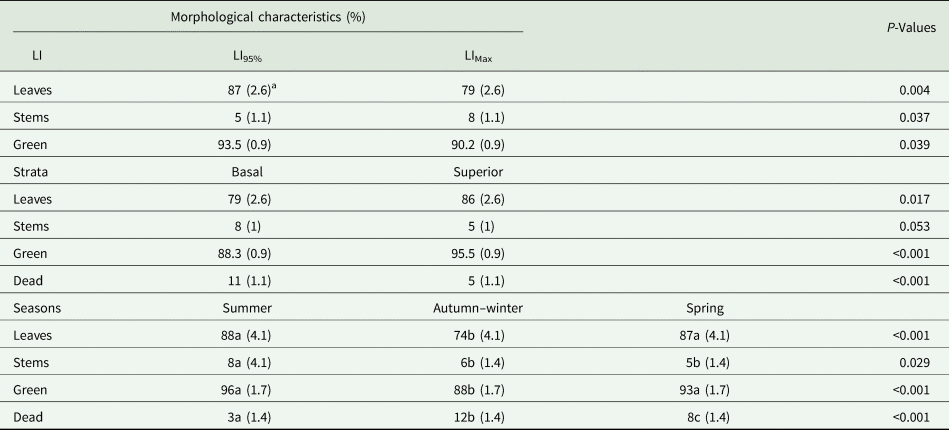
Swards managed with the LI95% target had greater proportions of leaves and green material, and lower proportions of stems than swards managed with the LIMax target during regrowth (Table 2). The superior stratum had greater proportions of leaves and green material and lower proportions of stems and dead material than the basal stratum (Table 2). The proportion of leaves decreased during autumn–winter and no differences were observed between summer and spring (Table 2).
Morphological characteristics of Mombaça grass subjected to strategies of rotational stocking management characterized by two pre-grazing conditions (95% and maximum canopy LI) from January 2001 to February 2002, in different strata of the sward during regrowth

LI, light interception.
a Standard error of the mean in parentheses.
Means followed by different letters differ at P < 0.05.
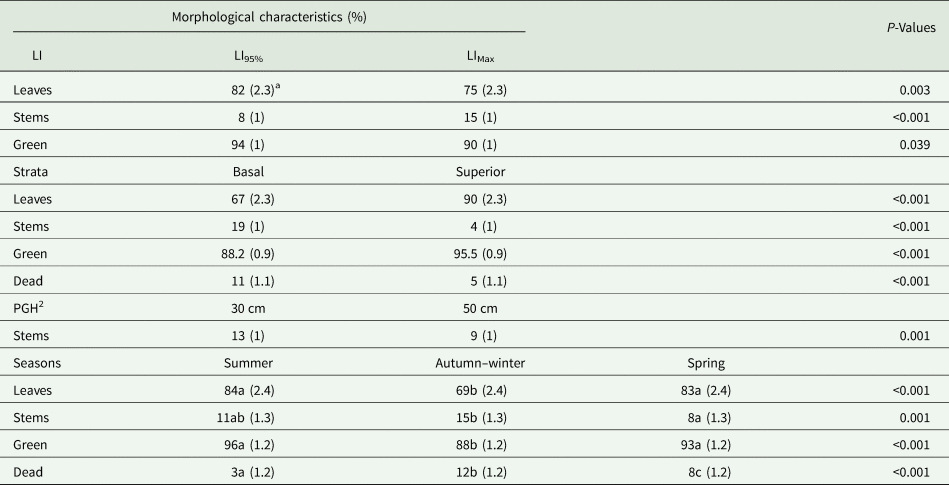
In general, swards managed with the LI95% target had greater proportions of leaves and green material, and lower proportions of stems than swards managed with the LIMax target at pre-grazing (Table 3). There was a significant effect of PGH on the proportion of stems. Swards managed with the 30 cm PGH had greater proportions of stems than swards managed with the 50 cm PGH (Table 3). However, the proportion of leaves was no different on the superior stratum between LIMax and LI95% swards (90.4 and 90.1%, respectively). LI95% swards had a greater proportion of leaves than LIMax swards, mainly on the basal stratum (75.4 and 58.9%, respectively; interaction between LI treatment and strata was significant at P = 0.001). At the same time the proportion of stems was lower on the basal stratum of LI95% swards compared to LIMax swards (0.13 and 0.25 respectively; interaction between LI treatment and strata was significant at P < 0.001). There was no difference between LI treatments in stem proportion in the superior stratum (0.03 and 0.04 for LI95% and LIMax, respectively). The proportion of leaves was considerably lower during autumn–winter and no difference was observed between summer and spring at pre-grazing (Table 3). During regrowth and at pre-grazing, green material was lower and dead material was greatest during autumn–winter. No difference was observed in the proportion of green material between summer and spring. The proportion of dead material during the spring was greater than during the summer (Tables 2 and 3).
Morphological characteristics of Mombaça grass subjected to strategies of rotational stocking management characterized by two pre-grazing conditions (95% and maximum canopy LI) and two PGHs (30 and 50 cm) from January 2001 to February 2002, in different strata of the sward at the pre-grazing condition

LI, light interception; PGH, post-grazing height.
Means followed by different letters differ at P < 0.05.
a Standard error of the mean in parentheses.
Plants continually adopt strategies for adaptation according to a given environment. Such adaptations include short-term responses mediated by physiological aspects, and long-term responses including morphological adaptations, such as the percentage of its components and its distribution within the canopy (Briske, Reference Briske, Hodgson and Illius1996). Under high LI, as in the LIMax treatment, a remarkable adaptation consists of stem elongation, a strategy that grants advantages by elevation of the photosynthetic organs (leaves) and improves the vertical distribution of leaf area, optimizing the interception of photosynthetically active radiation (Morrison et al., Reference Morrison, Kessler and Buxton1994; Birch et al., Reference Birch, Andrieu, Fournier and Kroesen2007). Because of higher stem production on LIMax swards, there is a higher proportion of dead material, since less light is available for the bottom leaves. The increase in stem proportion represents a decrease in leaf proportion, as reported for LIMax compared to LI95%, during the regrowth and pre-grazing conditions.
The vertical distribution of the plant-part composition within the canopy follows a classical pattern of distribution reported for several forage grasses, with higher proportions of leaves in the upper strata in order to optimize light use, and higher proportions of stems and dead material in the lower strata, due to lower light availability and the need to support the plant (Geremia et al., Reference Geremia, Crestani, Mascheroni, Carnevalli, Mourão and Da Silva2018; Silva et al., Reference Silva, Fialho, Carvalho, Fonseca, Carvalho, Bremm and Da Silva2018). As found in the studies mentioned above, such response patterns occur under a large range of sward management height, as observed for both LI95% and LIMax, during regrowth and in pre-grazing conditions.
Forage nutritive value
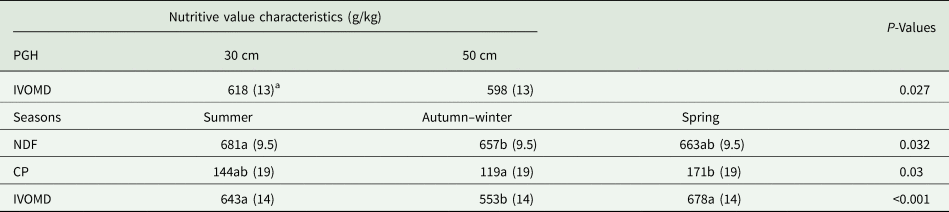
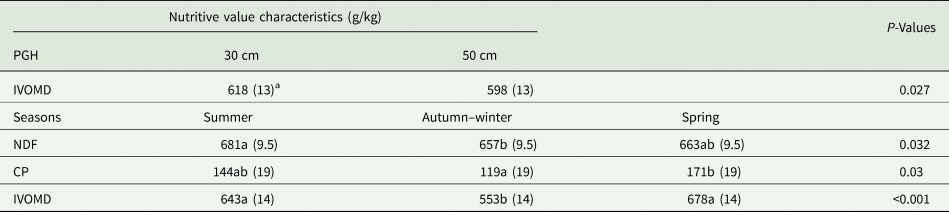
In vitro organic matter disappearance (IVOMD) varied with PGH and season of the year during regrowth. Swards managed with 30 cm PGH had greater IVOMD than swards managed with 50 cm PGH (Table 2). Lower values of IVOMD were observed during autumn–winter, summer and spring had similar values (Table 4). During regrowth, NDF varied with season of the year (P < 0.05). Greater values were observed during the summer when compared to autumn–winter and spring (Table 4). There was no difference in NDF content between autumn–winter and spring. There were no significant effects on ADF and lignin contents during regrowth. On average ADF content was 369 g/kg and lignin content was 55 g/kg, across LI treatments, PGH, sward strata and seasons of the year. CP content varied with season of the year. Lower values were observed during autumn–winter and no difference was observed between summer and spring (Table 4).
Nutritive value characteristics of Mombaça grass subjected to strategies of rotational stocking management characterized by two PGHs (30 and 50 cm) from January 2001 to February 2002, during regrowth
NDF, neutral detergent fibre; CP, crude protein; IVOMD, in vitro organic matter disappearance; PGH, post-grazing height.
a Standard error of the mean in parentheses.
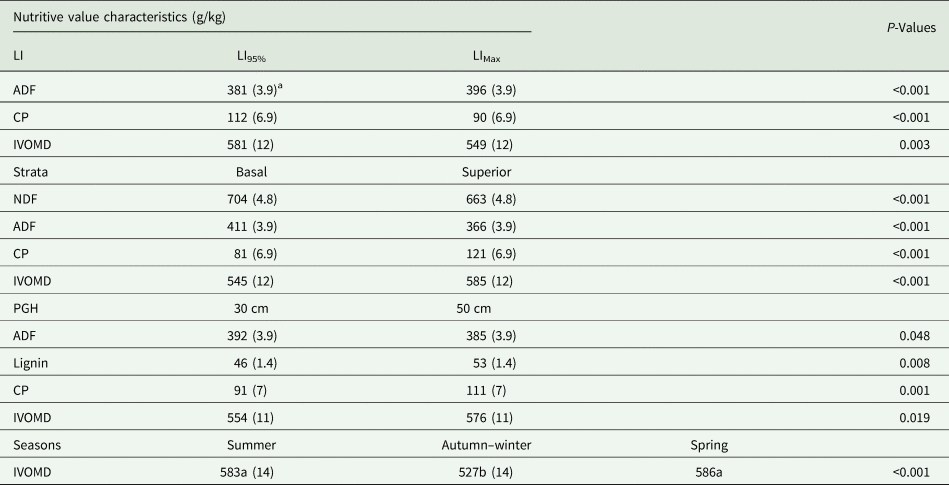
At pre-grazing, swards managed with the LI95% target had greater CP and IVOMD, and lower ADF concentrations than swards managed with the LIMax target (Table 5). However, during the summer no difference was observed in IVOMD between swards managed with LI95% and LIMax, characterizing a significant LI treatment and season of the year interaction (P < 0.01). The superior stratum had greater CP content and IVOMD, and lower NDF and ADF content than the basal stratum (Table 5). Swards managed with 50 cm PGH had greater lignin and CP content and IVOMD, and lower ADF content than swards managed with 30 cm PGH (Table 5). IVOMD varied with season of the year and lower values were observed during autumn–winter than summer and spring (Table 5).
Nutritive value characteristics of Mombaça grass subjected to strategies of rotational stocking management characterized by two pre-grazing conditions (95% and maximum canopy LI) and two PGHs (30 and 50 cm) from January 2001 to February 2002, in different strata of the sward at the pre-grazing condition
IVOMD, in vitro organic matter disappearance; LI, light interception; ADF, acid detergent fibre; CP, crude protein; NDF, neutral detergent fibre; PGH, post-grazing height.
a Standard error of the mean in parentheses.
The nutritive value of the forage is associated with the ratio between structural and metabolic tissues and is closely related to the morphological traits (Violle et al., Reference Violle, Navas, Vile, Kazakou, Fortunel, Hummel and Garnier2007; Duru et al., Reference Duru, Cruz, Raouda, Ducourtieux and Theau2008). The higher stem proportion for the LIMax swards led to a greater proportion of lignified tissues and lower protein content, conferring greater values of poorly digestible plant components (Choong et al., Reference Choong, Lucas, Ong, Pereira, Tan and Turner1992; Bruinenberg et al., Reference Bruinenberg, Valk, Korevaar and Struik2002). The differences in the nutritive value between basal and superior strata appeared at pre-grazing. Significant interactions between the LI treatment and strata suggested that LI95% target allowed increased proportions of leaves and decreased proportions of stems in the basal stratum at pre-grazing. A higher proportion of leaves in the basal stratum represents a greater distribution of leaves along the canopy height and a greater leaf mass for the LI95% swards, which resulted in greater residual LAI. The leaf area has been found to correlate positively to digestibility and nutritive value (Duru et al., Reference Duru, Cruz and Magda2004; Pontes et al., Reference Pontes, Carrère, Andueza, Louault and Soussana2007). Therefore, the increased residual LAI associated with greater leaf availability resulted in a greater allowance of high-quality forage on LI95% swards.
Sward management under intermittent stocking should provide post-grazing conditions with sufficient leaf area to ensure fast regrowth, avoiding stem accumulation and favouring high forage intake by grazing animals (Sbrissia et al., Reference Sbrissia, Duchini, Zanini, Santos, Padilha and Schmitt2018). Despite the greater proportion of leaves in the LI95% swards' basal stratum, increased grazing severity to 30 cm PGH did not seem advantageous. Although there were no significant effects of PGH on morphological characteristics, 50 cm PGH swards had a greater nutritive value than 30 cm PGH swards across LI treatments. These differences were clearer at pre-grazing than during regrowth. Therefore, the best combination regarding nutritive value would be LI95% and 50 cm PGH. These findings are in accordance with the results of Euclides et al. (Reference Euclides, Lopes, Nascimento, Da Silva, Difante and Barbosa2015), who measured daily weight gain of 0.392 and 0.655 kg BW/day of beef heifers on rotationally grazed Mombaça grass managed with the LI95% target and the 30 and 50 cm PGH, respectively.
The grazing strategy based on LI95% and PGH of 50 cm corresponded to defoliation of 44% of the pre-grazing height on average, which could be considered lenient defoliation. The lenient defoliation (LI95% and 50 cm PGH) resulted in high nutritive value forage but increased residual forage mass, underlining the frequent dichotomy between the forage nutritive value and grazing efficiency. Grazing severity of 0.40–0.50 was observed to ensure high forage accumulation (Giacomini et al., Reference Giacomini, Silva, Sarmento, Zeferino, Trindade, Souza Júnior, Guarda, Sbrissia and Nascimento Júnior2009; Voltolini et al., Reference Voltolini, Santos, Martinez, Clarindo, Penati and Imaizumi2010; Zanini et al., Reference Zanini, Santos and Sbrissia2012) and forage intake rates (Fonseca et al., Reference Fonseca, Mezzalira, Bremm, Filho, Gonda and Carvalho2012; Mezzalira et al., Reference Mezzalira, Carvalho, Fonseca, Bremm, Cangiano, Gonda and Laca2014).
Conclusion
Grazing schedule based on the pre-grazing target of 95% LI of canopy resulted in forage of the greater nutritive value than the pre-grazing target of maximum LI. Additionally, the pre-grazing target of 95% LI of canopy combined with 50 cm PGH was the combination that resulted in a greatest nutritive value. The pre-grazing target of 95% LI increased the distribution of leaves across the sward profile, increasing the proportion of leaves and decreasing the proportion of stems in basal stratum. The variability of morphological characteristics was primarily associated with seasonality, whilst the nutritive value was primarily affected by grazing management.
Financial support
This work was supported by the São Paulo Research Foundation (FAPESP).
Conflict of interest
The authors declare there are no conflicts of interest.