Recent originalist scholarship presents a case study in the problem of interdisciplinary inquiry in contemporary law. Borrowing insights from outside of the law without fully engaging with the relevant theoretical debates in other fields has resulted in a misapplication of key concepts.Footnote 1 Rather than help originalists develop a more sophisticated approach to history and respond to earlier critiques of their methods, much recent originalist scholarship has used these insights as a means to avoid direct engagement with these earlier criticism. The result of such borrowing has been greater distortion of the historical meaning of the Constitution, not less.Footnote 2 Nothing better illustrates the problems inherent in recent originalism than Second Amendment scholarship and jurisprudence. The Supreme Court's ruling in District of Columbia v. Heller relied heavily on originalist scholarship, and leading originalists have praised the case as the best example of their method in practice. Yet, scholars from across a wide ideological and methodological spectrum have criticized Heller's many historical errors and anachronistic interpretations of Anglo-American legal texts. Rather than praise the “gravitational pull of originalism,” as one prominent originalist and Heller defender has done, it might be more apt to characterize originalism as a scholarly black hole that has systematically warped legal and constitutional texts, in some instances almost beyond recognition.Footnote 3
Moving beyond the current flaws in originalism will require developing a genuinely historical approach to reading Founding Era texts that draws on the best interdisciplinary methods available. Despite paying lip service to ideas about reading the Constitution historically, originalism continues to invoke the authority of history without actually engaging in a genuinely historical practice.Footnote 4 The assumptions at the root of most originalist inquiry are dubious at best, and in many instances demonstrably false. Originalists continue to treat eighteenth-century constitutional speech and communication as if it were little different that ordinary interpersonal communication, but virtually all of the texts consulted by originalists were generated as part of a rhetorical public debate that shares little with everyday speech situations. Other originalists claim to avoid the problems of this linguistic approach by adopting one focused on the legal, not the ordinary, meaning of the text. This approach also ignores the profound differences between American law in the eighteenth century and modern law.Footnote 5
Originalism has already gone through two major paradigm shifts during the last generation.Footnote 6 Originalism 1.0 was focused on intent. By contrast, originalism 2.0 eschewed intent and instead focused on public meaning. Originalism appears to be morphing yet again: version 3.0 is still somewhat inchoate, but its champions have turned away from an emphasis on linguistic meaning, stressing instead legal meaning. Footnote 7 Either conceived in terms of the “language of law” or as “an inclusive originalism” the most recent variants of originalism continue to approach the contentious and discordant constitutional and legal culture of post-revolutionary America from the perspective of an outdated model of consensus history that few serious historians would recognize as accurate.Footnote 8 All of these variants of originalism have failed to deal with the remarkable vitality and diversity of the intellectual and cultural world of the Founders. The result is a flat one-dimensional account of Founding Era constitutional debates. As the Heller decision attests, the stakes in this debate are not merely academic. Although a few left-leaning examples of originalism have emerged, the approach continues to be largely the province of the political right. Indeed, originalism has been effectively weaponized by those eager to advance an ideological agenda that not only includes advancing the cause of gun rights, but ultimately aims to undo much of the modern regulatory and administrative state.Footnote 9
Instead of addressing the fundamental historical problems with their methodology, leading originalists have turned to a variety of theoretical fixes. Some originalists have borrowed from modern philosophy of language, analyzing constitutional communication as if it were essentially little different than ordinary face-to-face communication between social equals engaged in a rational exchange of ideas. Another prominent group of originalists favors the use of ideal imaginary readers constructed by modern legal scholars from Founding Era sources.Footnote 10 Finally, supporters of originalism 3.0 claim that by treating the Constitution as a legal text or a text written in the “language of law” one can arrive at an objective fixed meaning: the long sought after originalist holy grail. None of these theoretical fixes solves the core problem with originalism: the absence of a rigorous historical methodology for dealing with the complexity of Founding Era constitutional thought and culture. Reading legal texts historically will require that originalism adopt standard historical practices, not reject them. Scholars must get the history right before deciding if any of the historical meanings recoverable from a careful study of the original debate over the Constitution might be relevant to modern law. Determining which meanings might be probative or dispositive for modern legal issues is a separate task from the process of uncovering the legal meaning of Founding Era constitutional texts. Deciding what, if any, relevance such historical meaning ought to have in contemporary law is at its core a legal question, and not one that history can answer. Still, if legal scholars are going to cite history as authority, they have an obligation to get the history right.Footnote 11
Public Meaning Originalism and the Perils of Law Office Philosophy and Linguistics-Lite
The turn to the philosophy of language and linguistics for insights to ground originalism in is most closely associated with the work of Lawrence Solum, who has also been one of the harshest detractors of historical critiques of originalism.Footnote 12 Solum believes that the philosophy of language can provide a work-around to historical critiques of originalism. His theory draws on the philosopher of language Paul Grice. Footnote 13 This intellectual move seems odd for three reasons. First, Grice's entire philosophical project was grounded in an intentionalist view of meaning, so his theory seems ill equipped to provide a work-around for earlier critiques of originalism that focused on the problem of dealing with multiple and potentially conflicting intents.Footnote 14 Second, Grice was focused on a narrow range of speech situations, primarily those in which speakers were engaged in direct face-to-face communication guided by a clear set of rules governing conversation. Political and legal communication in post-revolutionary America are, therefore, not a good fit for Grice's assumptions. Finally, Grice's model assumes that one can easily determine who the relevant parties to the conversation are in any given situation. If anyone can jump into a conversation and import a different set of assumptions or conversational rules, a Gricean model is not much help. Thus, the early American public sphere shares little with conversational situations in which speakers conform to a clear set of rules governing communication. In the case of the Constitution it is not really clear who the parties to the original conversation were: would the relevant parties be the framers, the ratifiers, the whole American people in 1787, some subset of the literate American population during ratification, or future generations of Americans reading the Constitution? Nor is it obvious which of several competing sets of rules and assumptions ought to be taken as normative for this constitutional conversation. Although some originalists have suggested limiting this inquiry to Founding Era lawyers, this hardly solves the core problem.Footnote 15 There was no monolithic legal culture in 1787. Lawyers were as deeply divided, possibly more divided, over basic issues of constitutional meaning and interpretation as any group in America in 1787.Footnote 16
There has been a certain amount of theoretical confusion and drift in Solum's writings about originalism. Earlier incarnations of his theory were cast largely in terms of semantic meaning, but over time, Solum has gradually introduced additional pragmatic elements into the theory, borrowing most recently from philosopher of language Scott Soames's theory of pragmatic enrichment.Footnote 17 In its most recent version, Solum's theory is built around a concept that he calls “communicative content.”Footnote 18 It is important to distinguish between the Gricean notion of “communicative intent” and Solum's concept of “communicative content.” Meaning is fixed in the Gricean scheme because speakers’ intentions are the foundation of meaning. By contrast, Solum's theory is built around linguistic meaning, not speakers’ intentions.Footnote 19 Grice's theory was intended to explain ordinary face-to-face communication among individuals sharing the same language, common rules of communication, and background assumptions. In such cases, Grice argued that one could define speaker meaning in terms of speakers’ intentions, and that one could use this to explain the public intersubjective nature of communication in terms of the shared patterns of intentionality associated with predictable patterns of linguistic usage in a community of language users. In short, Grice's entire model assumes that discerning intent and summing intents is an unproblematic exercise. In the case of many ordinary language situations in which speakers are part of the same speech community this model works,Footnote 20 but public constitutional debate, particularly in a revolutionary age, is not one of them. To conform to Grice's model one would have to assume that constitutional debate in post-revolutionary America was typically truthful, concise, relevant, and maximally informative. In reality, constitutional speech in this historical context was often exaggerated, rambling, opaque, and in some instances deliberately deceptive.Footnote 21 Ratification was not a battle conducted between Federalist and anti-Federalist dictionaries; nor can it be analogized to a spirited, but polite conversation between Anglo-American philosophers of language conducted around a seminar table in a faculty lounge at Oxford or Berkeley. To understand Founding Era legal texts one must situate them in the rhetorical and ideological contexts of post-Revolutionary Era political and legal culture, not analogize them to an ordinary conversation around the dinner table or a philosophy seminar.Footnote 22
Solum's misunderstanding and misappropriation of Grice's concept of speaker meaning is also at the root of his muddled critique of intellectual history. According to Solum, the main difference between originalists and historians arises from the former's focus on “communicative content” and the latter's emphasis on motive or subjective intent. “The originalist method of immersion aims to recover the communicative content of the constitutional text.” By contrast, Solum erroneously asserts that “historical immersion typically has different aims, including the construction of narratives that illuminate causal connections and the discovery of the motives and aim of historical actors.”Footnote 23 Solum's approach is at odds with much intellectual history.Footnote 24 The tradition of text-based close reading and exegesis is one of the main tools used by intellectual history. Solum's theoretical confusion about historical methodology appears to stem from a flawed reading of a single article written by Quentin Skinner more than 50 years ago.Footnote 25 If one looks at the entire body of Skinner's writing, particularly his histories of early modern political thought, one could hardly accuse him of ignoring the meaning of texts. Indeed, historian Jonathan Gienapp shredded Solum's caricature of Skinner's method in a critical symposium on history and originalism, but this trenchant critique has had little impact on Solum's subsequent scholarship, which continues to make wildly inaccurate claims about historical scholarship and methodology. Solum is certainly correct that few historians have any interest in applying his defective concept of “communicative content.” The reasons for this are not hard to discern. Solum's concept of communicative content turns out to be a repackaged version of the disembodied history of ideas that Skinner's work displaced more than a half a century ago.Footnote 26 Thus, Solum's critique of intellectual history rests on a twofold error: it misunderstands Gricean theory and misconstrues the practice of intellectual history over the last half century.
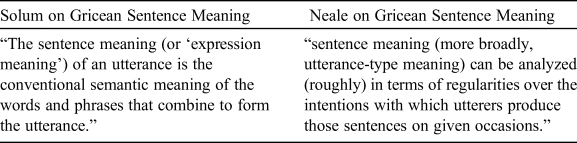
Solum's problematic foray into philosophy of language is not limited to his flawed reading of Grice's concept of speakers’ meaning, but his philosophical confusion has been compounded by a misinterpretation of the related Gricean concept of sentence meaning. In Gricean terms, speakers’ meaning is fixed by speakers’ intentions to communicate and have that intention recognized by members of their speech community. Sentence meaning in Gricean terms is defined by speakers’ meaning.Footnote 27 Unfortunately Solum badly misconstrues this aspect of Grice's theory. If one compares Solum's explanation of the concept of sentence meaning with a gloss on this concept by the philosopher of language, Stephen Neale, a leading interpreter of Grice, the philosophical error at the root of Solum's approach becomes obvious. The left column of Table 1 is Solum's gloss on Gricean sentence meaning. The right column is Stephen Neale's account of the same concept.
Solum and Neale on Gricean Sentence Meaning.

Source: For left column: Lawrence B. Solum, “Communicative Content and Legal Content,” Notre Dame Law Review 89 (2013): 479–519, at 491. For right column: Stephen Neale, “Paul Grice and the Philosophy of Language,” Linguistics and Philosophy 15 (1992): 515. For a better legal gloss on Grice, see Heidi M. Hurd, “Sovereignty in Silence,” Yale Law Journal 99 (1990): 945, 964.
When the two texts are placed side by side, Solum's error becomes obvious. Neale and all true Griceans believe that analyzing sentence meaning requires an ability to discern patterns of intentionality in a particular linguistic community. Solum, by contrast, omits the key Gricean concept of intention entirely, and by an act of orginalist alchemy, transmutes the sturdy metal of Gricean theory into originalist gold. But it is important to recall that Solum's entire originalist project was designed to find a way around the problem posed by the absence of a calculus to deduce intents.Footnote 28 Thus, Gricean theory does not, and could never, provide a solution to the historical critiques of earlier intentionalist theories of originalism. Grice offers no empirical methodology, and certainly no historical method, for dealing with the empirical problems posed by orignalism's summation problem.Footnote 29 Grice's approach assumes that one already has such an empirical methodology because one is dealing with a simple face-to-face conversation between social equals in a homogenous linguistic community.Footnote 30 Larry Alexander and Richard Kay, leading champions of traditional intentionalist originalism have charged on multiple occasions that Solum's theory is essentially “parasitic” on earlier intentionalist theories of original meaning. Once again, Solum has largely ignored these critiques in much the same way he has dodged the equally scathing criticisms leveled by historians. When the philosophical jargon is stripped away from Solum's faux Gricean variant of originalism, all one is left with is the old- fashioned intentionalist originalism, including all of its historical flaws.Footnote 31
Ratification violates almost everyone one of Grice's conversational maxims.Footnote 32 It was a contentious political contest in which each side sought political advantage, not an open rational exchange of information among social equals.Footnote 33 Speech under such circumstances is guided by strategic rules, not the rules of ordinary conversation. The state conventions and newspapers of the Founding Era were part of a public sphere that was fragmented, contentious, and shaped by rhetorical conventions that shared little with Grice's maxims.Footnote 34 It is hardly surprising that some of the most incisive criticism of the Gricean paradigm has come from the fields of linguistic anthropology and sociolinguistics. Rather than assume that Gricean maxims apply to communicative situations across time and space, studies of how speech actually functions in the real world have largely abandoned Grice's model.Footnote 35 Although Solum often invokes the authority of linguistics to justify his approach, it turns out that his theory is incompatible with theoretical and empirical work in linguistics.
A key flaw in Solum's model is his conflation of the idea of speech community and linguistic community, an error that leads him to assert a degree of linguistic homogeneity in Founding Era America that is hard to reconcile with post-Revolutionary Era history or the relevant linguistic theory that he claims supports his model. Alessandro Duranti, a leading linguistic anthropologist, succinctly captures the importance of this concept, noting that “one of the reasons for taking the speech community as the starting point for linguistic research was to avoid the assumption that the sharing of the same ‘language’ implies shared understanding of its use and meaning in various contexts.”Footnote 36 Founding Era America was a complex society in which constitutional speech was inflected by distinctive regional, class, and ideological differences. Solum and other originalists have simply ignored these differences, and the result is an account of the past that reduces its rich polyphony to a monotonous drone. Indeed, if Solum and other originalists’ consensual models of constitutional communication were correct, it would mean that Founding Era America attained a level of linguistic and ideological homogeneity that sets it apart from virtually every society studied by anthropologists. This is an example of the long- discredited notion of American exceptionalism taken to new extremes. Rather than start with Solum's implausible notion of linguistic homogeneity it makes far more sense to recognize the pluralistic and contentious nature of post-Revolutionary Era constitutional discourse.
There are important theoretical insights to be gained from a serious engagement with linguistics, but they do not support Solum's model. Instead, a genuine interdisciplinary engagement with linguistics leads in a direction diametrically opposed to the one suggested by Solum and other originalists. Although English speakers in America in 1787 may have been part of the same linguistic community, they were not all members of the same speech community.Footnote 37
Reader Response without Readers: New Originalism as Historical Ventriloquism
Originalist Randy Barnett summarizes one of the key assumptions at the core of one influential strand of originalism 2.0 when he notes: “it is important for me to stress that the New Originalism seeks to identify what a reasonable speaker of English would have understood the words of the text to mean at the time of its enactment.” Gary Lawson takes the argument one step further, asserting that fictive constructs are actually preferable to focusing on what actual historical actors believed: “The reasonable American person of 1788 determines, for 1788 and today, the meaning of the federal Constitution. Thus, when interpreting the Constitution, the touchstone is not the specific thoughts in the heads of any particular historical people.”Footnote 38 Such an approach is not only historically unsound, but it undermines one of the main legal foundations for originalism itself: popular consent. Although the concept of “the reasonable man” is a familiar construct in many areas of law, the search for a reasonable reader of the Constitution poses particular empirical and methodological challenges. In contrast to contract law or even statutory interpretation, two modern legal fields in which the notion of a reasonable person continues to be important, constitutional law in the Founding Era was faced with unprecedented interpretive issues and challenges: there were no commonly agreed-upon rules for reading the novel legal text created by the Philadelphia Convention.Footnote 39
Another serious problem for originalist theories based on fictive readers arises from the model of reading employed by originalists. Once again, originalists have borrowed insights from beyond the law, but neglected to engage with the theoretical debates relevant to understanding the methodology that they have chosen to employ. Imagined readers were a key part of German reception theory, a movement that gained some currency in American literary criticism during the 1980s. Early enthusiasm for such an approach faded as insurmountable problems soon emerged, as studies of actual readers demonstrated that erroneous assumptions and ideological bias invariably distorted the ideal readers constructed by modern scholars. Eventually, most literary scholars working on reader response scholarship abandoned the use of imagined readers.
Reading is a dynamic process and readers are actively engaged in constructing the meaning of the texts that they read.Footnote 40 Empirical studies of reading have repeatedly confirmed this fact, and historical studies of reading, despite encountering unique evidentiary challenges, have validated this conclusion time and again. In complex literate societies there are typically more than one distinctive reading community. Indeed, individuals may inhabit multiple communities that can overlap or be nested: the result looks more like a complex Venn diagram than a simple circle of readers.Footnote 41
Although it is certainly true that individual authors may imagine their audiences and even go to great lengths to instruct them about how to read the text that they have written, actual readers are not passive vessels into which an author pours his or her intended meanings. Most originalists simply read the Constitution as if Founding Era lawyers and judges shared the same assumptions as modern lawyers and jurists. The results are typically deeply anachronistic and marred by presentism.Footnote 42
Reader-based models of originalism have failed to acknowledge the tensions and divisions that were pervasive in Founding Era legal culture. Therefore, the seemingly common sense suggestion that interpreting the Constitution requires mastering the relevant interpretive assumptions and techniques that would have been applied to legal texts in the eighteenth century ignores the fact that there was no agreement on which assumptions and methods ought to guide constitutional interpretation.Footnote 43 Nor did these disagreements abate over time; constitutional contestation increased, not decreased in the decades following ratification. Deciding which of several existing modes of interpretation was appropriate to a novel experiment in government and law was far from clear: was the Constitution properly analogized to a contract or a Parliamentary statute, or was it an entirely new type of text requiring new methods of interpretation? Nor was there agreement on which background assumptions were appropriate to interpreting the Constitution. Should constitutional provisions be read as continuing well-established common law practices or did they evidence a sharp break with the English past? Was the Constitution best read against Revolutionary Era fears of centralized power or against the Confederation Period's frustrations and apprehensions about the imbecility of the national government? Depending on which of these assumptions one takes as normative, it is possible to construct radically different meanings for many of the Constitution's key provisions. A reasonable reader might have adopted any of these assumptions and still have been within the constitutional mainstream.
John McGinnis and Michael Rappaport have attempted to distance themselves from originalism 2.0, developing their own variant of “original methods originalism,” an approach that treats the Constitution as if it were written in something they describe as “the language of law.”Footnote 44 “The enactors,” they argue, “would have understood the Constitution against the background of the relevant interpretive rules of the time.”Footnote 45 As was true for other variants of originalism, it is not clear who counts as an enactor in their modelFootnote 46 Nor is it obvious which rules or background assumptions are relevant to establishing the content of the Founders’ “original methods.”Footnote 47 Despite efforts to cover their theory in a thin veneer of history, McGinnis and Rappaport approach their subject matter in an anachronistic fashion, treating Founding Era legal culture as if it were little different than modern American law. Again, a faux interdisciplinarily approach stands in for a genuine interdisciplinary inquiry. As is true for many originalists, McGinnis and Rappaport seldom venture beyond articles in student-edited law reviews for information about Founding Era legal history.Footnote 48 The parochialism of this approach has left most originalists, including McGinnis and Rappaport, with a limited grasp of the complexity of Founding Era legal culture. Some sense of the scope of this problem can be illustrated in their remarkable claim about the nature of the public debate over ratification:
[T]he people decided whether to ratify the Constitution based on an explanation of its meaning by those with legal knowledge. Pamphleteers of all kinds wrote lengthy explications of the Constitution precisely so that the people could be informed. It is not too much to say that they translated the condensed, sometimes technical language of the legal document into familiar language more easily accessible to the electorate as a whole. Moreover, the people did not vote directly on the Constitution, just as they did not vote directly on the passage of statutes. They instead relied on their representatives-who were more likely to be either schooled in legal understanding or able to consult more learned colleagues.Footnote 49
It is too much to say that the people simply deferred to their betters in 1787. The sole support for this simplistic, and false historical claim, is an essay on federalism by fellow originalist John Yoo. Needless to say Yoo has absolutely no expertise on Founding Era print culture, so citing him for proof about the production and distribution of print materials has little scholarly value.Footnote 50 The notion that ordinary Americans in 1787 quiescently accepted the views of a lawyerly elite is a modern originalist fantasy, not an eighteenth-century reality. Such a view would have shocked Amos Singletary, an anti-Federalist farmer and delegate to the Massachusetts state ratification from a strongly Shaysite region of the state. When Singletary rose to address the Massachusetts convention, he denounced the Constitution in terms that showed hostility, not deference to the type of legal knowledge that McGinnis and Rappaport claim that the people begged their social betters to provide them with: “These lawyers, and men of learning, and monied men, that talk so finely and gloss over matters so smoothly, to make us poor illiterate people swallow down the pill, expect to get into Congress themselves; they expect to be the managers of this Constitution and get all the power and all the money into their own hands, and then they will swallow up all us little folks, like the great Leviathan, Mr. President, yes, just as the whale swallowed up Jonah.Footnote 51”
As was true for many New Englanders, Singletary was steeped in the intensive habit of close Bible reading, but his anti-lawyer rhetoric was hardly unique to Massachusetts.Footnote 52 Similar ideas were espoused in virtually every state.Footnote 53 Indeed, in some cases, anti-lawyer animus fueled populist protests that spilled into the streets. Anti-Federalists in Carlisle, Pennsylvania showed scant respect for James Wilson's legal erudition, choosing instead to burn him in effigy.Footnote 54 Leading Federalists, were well aware of the danger that such potent populist rhetoric posed to the Constitution and often bemoaned the class-tinged diatribes of their opponents. Pleas to the public to ignore this type of invective were frequently articulated by Federalists across the nation, a fact that further undercuts the consensus model of law and politics assumed by originalists, including McGinnis and Rappaport. There would have been little need to repeatedly issue such dire warnings in both private and public if the type of deference assumed by Yoo, McGinnis, and Rappaport had been the norm.Footnote 55
Despite strident protestations that their theory does not assume consensus and can account for the complexity of Founding Era legal culture, McGinnis and Rappaport have only offered vague unsubstantiated generalizations in rebuttal to their critics who have pointed out that their method has no discernible historical method for ascertaining which interpretive methods were normative.Footnote 56 The two scholars suggest that “we should look to how many people supported a rule when the rule was relevant, how well the rule coheres with the rest of the Constitution, and how it comports with legal conventions of the time.”Footnote 57 Elaborating on their first precept, they advocate “a 51%-to-49% rule for determining the meaning of constitutional provisions.”Footnote 58 Unfortunately, they do not explain how they propose to quantify support for different interpretive positions in play during the debate over ratification. Discussing percentages in this context is worse than meaningless given that the data does not lend itself to quantification.Footnote 59
The other metric suggested by McGinnis and Rappaport is hardly any more useful. Claiming to use the Constitution's text as a fixed yardstick against which to measure which method was correct hardly solves the problem. In fact, this argument is circular. One needs to choose a method to read the text before using the Constitution as a measure against which to determine which method of reading is correct. Even among elite Federalists, most notably Hamilton and Madison, there was no consensus about how to read the Constitution, so it is illusionary to think that modern originalists can find such a neutral vantage point to determine the correct interpretation more than 200 years later. Ultimately, there is no escape from having to take sides in the Founding Era's own debates over constitutional meaning and interpretation.
Certainly there were many parts of the Constitution's text that were not subject to much disagreement at the time and are unlikely to provoke much dispute today. There was little chance that new states seeking admission to the union would have demanded three Senators, instead of the two proscribed by the text. Nor would many have disputed the age qualifications for federal office holding spelled out in the Constitution. Still something as simple and straightforward as the meaning of the term “appointment” could be swept up into the fraught public debates over constitutional interpretation in post-revolutionary America and provoke a bitter and divisive debate over constitutional meaning. There was even more protracted and bitter disagreement over other parts of the Constitution, such as its provisions on federalism or the limits of Congressional power under the Necessary and Proper Clause.Footnote 60
Given the contentious nature of ratification and the unprecedented nature of the new Constitution, there is no objective way to construct a set of “neutral principles” or a master “rule of recognition” that would provide a foundation for the construction of a reasonable person, a competent reader, or fully informed lawyer. Footnote 61 Is the correct choice for the reasonable person an elite member of the South Carolina bar, a bastard son of West Indian planter in New York City, or a self-taught back-country lawyer? Was he a Jeffersonian or a Federalist? Even if one restricted the inquiry to the victorious Federalists and only focused on the legal elite, there is still no way to construct an objective reader or a neutral set of interpretative principles, or to assign a percentage to the interpretive positions voiced during ratification. To put the point bluntly, there is no way to decide if Hamilton's or Jefferson's views of constitutional interpretation were more reasonable in 1787 or 1791, nor is it possible to figure out what percentage of the relevant body of “enactors” supported Hamiltonian loose construction as opposed to Jeffersonian strict construction.
Constitutional Discourse and the Communication Circuit: Reading Texts in Context
The methodological failings of originalism are readily apparent in District of Columbia v. Heller. Building on the work of originalist scholars, Justice Scalia constructed a vision of the Second Amendment that is almost a mirror image of historical reality. In this topsy-turvy world, pistols, not muskets, are the core weapon protected by the Second Amendment, constitutional provisions are read backwards, and nineteenth-century rules of construction are used to decode the meaning of eighteenth-century texts. The historical flaws, interpretive errors, and illogical inferences in the opinion have been well chronicled by a multitude of scholars from across a broad ideological and methodological spectrum so that there is little need to elaborate on Heller's many textual and “temporal oddities.” Still, Heller and the scholarship it cited illustrate the multiple flaws in originalism.Footnote 62
One can elucidate the serious problems with originalism by focusing on the way Justice Scalia misread a key text in Heller, The Pennsylvania Dissent of the Minority. A favorite text of Second Amendment originalists, Justice Scalia described the text as “highly influential.” Of course, this claim begs the question: what do we mean by influence? The Dissent was certainly an important statement of a particular strain of anti-Federalist belief, but conceding this fact hardly supports the use that originalists and Scalia made of the text to effectively recast the Second Amendment as if its meaning was identical to the Dissent.
The importance of the Dissent to Scalia's revisionist account of the Second Amendment's meaning follows from its use of the term “bear arms” to describe hunting, a civilian activity. Prior to Heller, a number of scholars had demonstrated that the most common use of the phrase “bear arms” in the print culture and legal thought of the era of the Second Amendment was in reference to militia-related activity, a claim that has since been validated by a number of scholars writing after Heller and making use of the techniques of corpus linguistics.Footnote 63 By asserting that the Dissent was influential, without actually defining what that might mean, Scalia is able to sidestep the fact that most common use of the term “bear arms” in 1791 was understood to refer to the use of arms in relation to militia service. The fact that it was possible in 1787 or 1791 to construct an intelligible sentence using the phrase “bear arms” to describe the non-military use of firearms does not establish that this was how it was most often used in 1787 or 1791. Nor does it prove that this was what framers of the Second Amendment thought bearing arms meant when they wrote the Second Amendment. It certainly does give us much insight into how readers would have interpreted the Second Amendment in 1791. Analyzing how texts were read is an exceedingly complex historical problem, and constitutional scholars would do well to recognize the insights to be gained from the methods of the history of the book and reading. Historian Robert Darnton's model of the “communication circuit” seems especially helpful in this regard.Footnote 64 Darnton reminds historians that understanding the meaning of a text historically requires analyzing its production, distribution, and reception.Footnote 65 Applying the communication circuit model to constitutional meaning during ratification is especially illuminating in the case of the Dissent, and renders the originalist interpretation of it historically implausible.
The first point to note is that this anti-Federalist text was the “The Address and Reasons of Dissent of the Minority of the Convention of Pennsylvania to Their Constituents,” not the assent of the majority. It represented the views of back country anti-Federalists in Pennsylvania. Understanding the Dissent's production requires recognizing that it was really two texts combined together. It included a list of amendments drafted by back country anti-Federalists that had been rejected by the Pennsylvania Ratification Convention. It also included an explanatory text authored by anti-Federalist polemicist Samuel Bryan, who wrote the influential Centinel essays. Reading this text historically, one must understand both the rhetoric of ratification and the constitutional ideas of anti-Federalists. Sadly, few originalists, including Scalia, appear to have much understanding of either.Footnote 66
Another fact about the Dissent's composition that merits close attention is its repetitiousness and careless composition. The Dissent was drafted in a hurry. Both the timeline of its composition and the repetitive nature of its argument make this fact clear. The Dissent fused together two rights that were treated separately in the Pennsylvania Constitution of 1776: the right to bear arms and the right to hunt. An additional textual oddity in the Dissent's formulation of the right to bear arms is that it repeats the right to hunt in two separate provisions. Given these facts about its composition, none of which were discussed by Second Amendment originalists, including Justice Scalia, the case for using it as a good proxy for broader patterns of usage or belief makes little historical sense.Footnote 67
Analyzing the distribution of the text undermines its utility for understanding the meaning of the Second Amendment. Despite being widely reprinted, both as a pamphlet and in newspapers, no other state ratification convention or anti-Federalist author borrowed its idiosyncratic formulation of the right to bear arms. Neither the subject of hunting nor the individual right of self-defense figured prominently in the ratification debates in the press or state ratification conventions that followed in the wake of Pennsylvania ratification. Thus, although the Dissent's formulation of the right was readily available to readers and potential authors, nobody bothered to emulate its odd usage of the term “bear arms.” This casts further doubt on Scalia's decision to treat its formulation as influential. In fact, many of the other suggestions for amendments made by the Dissent were widely copied by other authors and state conventions making recommendatory amendments. So, according to the logic of originalism, modern legal interpreters ought to give the greatest weight to the one part of the Dissent that had little or no influence at the time.Footnote 68
Turning to the debates in the first Congress that wrote the Second Amendment, the case for the Dissent's influence seems even more strained. The first federal elections were in part a referendum on amendments to the Constitution. Yet, none of the signers of the Dissent were elected to the first Congress that actually debated and wrote the Second Amendment. Pennsylvania anti-Federalists suffered an embarrassing defeat at the hands of their Federalist opponents in the elections for the First Federal Congress. Moreover, because it was not an official recommendation of the Pennsylvania Ratification Convention, the Dissent was not included in the collection of potential amendments that Madison consulted when he actually framed his preliminary draft of the Second Amendment in Congress. Therefore, if one pays attention to the text's distribution, the evidence casts further doubt on Scalia's heavily reliance on it.Footnote 69
Turning to the elusive goal of reconstructing the way actual historical readers responded to the arguments made by the Dissent, in 1787 there are some tantalizing pieces of evidence about its reception. Anti-Federalists praised it and Federalists heaped scorn on it.Footnote 70 The Dissent's author Samuel Bryan was a savvy eighteenth-century political operative who bragged in a letter that his essay was “highly celebrated throughout the United States” and “occasioned more consternation among the friends of this government than anything that had preceded it or followed it.” Leading Federalists agreed with this assessment, but saw it as a vice, not a virtue. Pennsylvania Federalist Thomas Hartley wrote to a correspondent that Bryan's essay was deliberately crafted to “inflame the minds” of its readers. A similar view was expressed by Federalist Rufus King who dismissed the Dissent by noting that its purpose was “inflammation,” not rational “argumentation.”Footnote 71 Neither Federalists nor anti-Federalists approached the Dissent with the assumptions about communication and meaning favored by originalist scholars and judges. Ironically, Founding Era readers, including Federalists and anti-Federalists, were much more skeptical and savvy consumers of texts than most modern originalists.
Conclusion
Moving beyond the errors and confusion at the root of recent originalist scholarship will not be easy. Correcting these defects will require more serious engagement with historical scholarship and a mastery of some of the basic methods of historical methodology. Although this is arduous and exceedingly rare, originalism is possible without one compromising historical standards. In this regard, Keith Whittington's work stands out, both for its theoretical sophistication and the depth of his historical research. In contrast to much work in originalism by legal scholars, Whittington's scholarship is built on a foundation that is empirically rich and draws widely from other relevant disciplines beyond law. The result is a rare example of originalism that meets the highest standards of historical inquiry.Footnote 72 Unfortunately, rather than emulate Whittington, most leading originalists have opted for theoretical fixes. The results of such shallow interdisciplinary borrowings have only compounded originalism's inherent flaws. In most instances, originalist theory has obscured, not clarified, the search for a richer understanding of Founding Era constitutional meaning. It has made it easier, not more difficult, to cherry-pick evidence to support results-oriented outcomes and produce inaccurate accounts of the past. Until originalist scholars develop a genuinely historical approach to understanding the way the Constitution was read in the Founding Era, they will continue to distort the past, not illuminate it.Footnote 73