

%20--%3e%3c!DOCTYPE%20svg%20PUBLIC%20'-//W3C//DTD%20SVG%201.0//EN'%20'http://www.w3.org/TR/2001/REC-SVG-20010904/DTD/svg10.dtd'%3e%3csvg%20version='1.0'%20id='Layer_1'%20xmlns='http://www.w3.org/2000/svg'%20xmlns:xlink='http://www.w3.org/1999/xlink'%20x='0px'%20y='0px'%20width='64px'%20height='64px'%20viewBox='5.5%20-3.5%2064%2064'%20enable-background='new%205.5%20-3.5%2064%2064'%20xml:space='preserve'%3e%3cg%3e%3ccircle%20fill='%23FFFFFF'%20fill-opacity='0'%20cx='37.785'%20cy='28.501'%20r='28.836'/%3e%3cpath%20fill='%23595959'%20d='M37.441-3.5c8.951,0,16.572,3.125,22.857,9.372c3.008,3.009,5.295,6.448,6.857,10.314%20c1.561,3.867,2.344,7.971,2.344,12.314c0,4.381-0.773,8.486-2.314,12.313c-1.543,3.828-3.82,7.21-6.828,10.143%20c-3.123,3.085-6.666,5.448-10.629,7.086c-3.961,1.638-8.057,2.457-12.285,2.457s-8.276-0.808-12.143-2.429%20c-3.866-1.618-7.333-3.961-10.4-7.027c-3.067-3.066-5.4-6.524-7-10.372S5.5,32.767,5.5,28.5c0-4.229,0.809-8.295,2.428-12.2%20c1.619-3.905,3.972-7.4,7.057-10.486C21.08-0.394,28.565-3.5,37.441-3.5z%20M37.557,2.272c-7.314,0-13.467,2.553-18.458,7.657%20c-2.515,2.553-4.448,5.419-5.8,8.6c-1.354,3.181-2.029,6.505-2.029,9.972c0,3.429,0.675,6.734,2.029,9.913%20c1.353,3.183,3.285,6.021,5.8,8.516c2.514,2.496,5.351,4.399,8.515,5.715c3.161,1.314,6.476,1.971,9.943,1.971%20c3.428,0,6.75-0.665,9.973-1.999c3.219-1.335,6.121-3.257,8.713-5.771c4.99-4.876,7.484-10.99,7.484-18.344%20c0-3.543-0.648-6.895-1.943-10.057c-1.293-3.162-3.18-5.98-5.654-8.458C50.984,4.844,44.795,2.272,37.557,2.272z%20M37.156,23.187%20l-4.287,2.229c-0.458-0.951-1.019-1.619-1.685-2c-0.667-0.38-1.286-0.571-1.858-0.571c-2.856,0-4.286,1.885-4.286,5.657%20c0,1.714,0.362,3.084,1.085,4.113c0.724,1.029,1.791,1.544,3.201,1.544c1.867,0,3.181-0.915,3.944-2.743l3.942,2%20c-0.838,1.563-2,2.791-3.486,3.686c-1.484,0.896-3.123,1.343-4.914,1.343c-2.857,0-5.163-0.875-6.915-2.629%20c-1.752-1.752-2.628-4.19-2.628-7.313c0-3.048,0.886-5.466,2.657-7.257c1.771-1.79,4.009-2.686,6.715-2.686%20C32.604,18.558,35.441,20.101,37.156,23.187z%20M55.613,23.187l-4.229,2.229c-0.457-0.951-1.02-1.619-1.686-2%20c-0.668-0.38-1.307-0.571-1.914-0.571c-2.857,0-4.287,1.885-4.287,5.657c0,1.714,0.363,3.084,1.086,4.113%20c0.723,1.029,1.789,1.544,3.201,1.544c1.865,0,3.18-0.915,3.941-2.743l4,2c-0.875,1.563-2.057,2.791-3.541,3.686%20c-1.486,0.896-3.105,1.343-4.857,1.343c-2.896,0-5.209-0.875-6.941-2.629c-1.736-1.752-2.602-4.19-2.602-7.313%20c0-3.048,0.885-5.466,2.658-7.257c1.77-1.79,4.008-2.686,6.713-2.686C51.117,18.558,53.938,20.101,55.613,23.187z'/%3e%3c/g%3e%3c/svg%3e)
%20--%3e%3c!DOCTYPE%20svg%20PUBLIC%20'-//W3C//DTD%20SVG%201.0//EN'%20'http://www.w3.org/TR/2001/REC-SVG-20010904/DTD/svg10.dtd'%3e%3csvg%20version='1.0'%20id='Layer_1'%20xmlns='http://www.w3.org/2000/svg'%20xmlns:xlink='http://www.w3.org/1999/xlink'%20x='0px'%20y='0px'%20width='64px'%20height='64px'%20viewBox='5.5%20-3.5%2064%2064'%20enable-background='new%205.5%20-3.5%2064%2064'%20xml:space='preserve'%3e%3cg%3e%3ccircle%20fill='%23FFFFFF'%20fill-opacity='0'%20cx='37.637'%20cy='28.806'%20r='28.276'/%3e%3cg%3e%3cpath%20fill='%23595959'%20d='M37.443-3.5c8.988,0,16.57,3.085,22.742,9.257C66.393,11.967,69.5,19.548,69.5,28.5c0,8.991-3.049,16.476-9.145,22.456%20C53.879,57.319,46.242,60.5,37.443,60.5c-8.649,0-16.153-3.144-22.514-9.43C8.644,44.784,5.5,37.262,5.5,28.5%20c0-8.761,3.144-16.342,9.429-22.742C21.101-0.415,28.604-3.5,37.443-3.5z%20M37.557,2.272c-7.276,0-13.428,2.553-18.457,7.657%20c-5.22,5.334-7.829,11.525-7.829,18.572c0,7.086,2.59,13.22,7.77,18.398c5.181,5.182,11.352,7.771,18.514,7.771%20c7.123,0,13.334-2.607,18.629-7.828c5.029-4.838,7.543-10.952,7.543-18.343c0-7.276-2.553-13.465-7.656-18.571%20C50.967,4.824,44.795,2.272,37.557,2.272z%20M46.129,20.557v13.085h-3.656v15.542h-9.944V33.643h-3.656V20.557%20c0-0.572,0.2-1.057,0.599-1.457c0.401-0.399,0.887-0.6,1.457-0.6h13.144c0.533,0,1.01,0.2,1.428,0.6%20C45.918,19.5,46.129,19.986,46.129,20.557z%20M33.042,12.329c0-3.008,1.485-4.514,4.458-4.514s4.457,1.504,4.457,4.514%20c0,2.971-1.486,4.457-4.457,4.457S33.042,15.3,33.042,12.329z'/%3e%3c/g%3e%3c/g%3e%3c/svg%3e)
%20--%3e%3c!DOCTYPE%20svg%20PUBLIC%20'-//W3C//DTD%20SVG%201.0//EN'%20'http://www.w3.org/TR/2001/REC-SVG-20010904/DTD/svg10.dtd'%3e%3csvg%20version='1.0'%20id='Layer_1'%20xmlns='http://www.w3.org/2000/svg'%20xmlns:xlink='http://www.w3.org/1999/xlink'%20x='0px'%20y='0px'%20width='64px'%20height='64px'%20viewBox='5.5%20-3.5%2064%2064'%20enable-background='new%205.5%20-3.5%2064%2064'%20xml:space='preserve'%3e%3cg%3e%3ccircle%20fill='%23FFFFFF'%20fill-opacity='0'%20cx='36.924'%20cy='28.403'%20r='28.895'/%3e%3cpath%20fill='%23595959'%20d='M37.442-3.5c8.99,0,16.571,3.085,22.743,9.256C66.393,11.928,69.5,19.509,69.5,28.5c0,8.992-3.048,16.476-9.145,22.458%20C53.88,57.32,46.241,60.5,37.442,60.5c-8.686,0-16.19-3.162-22.513-9.485C8.644,44.728,5.5,37.225,5.5,28.5%20c0-8.762,3.144-16.343,9.429-22.743C21.1-0.414,28.604-3.5,37.442-3.5z%20M12.7,19.872c-0.952,2.628-1.429,5.505-1.429,8.629%20c0,7.086,2.59,13.22,7.77,18.4c5.219,5.144,11.391,7.715,18.514,7.715c7.201,0,13.409-2.608,18.63-7.829%20c1.867-1.79,3.332-3.657,4.398-5.602l-12.056-5.371c-0.421,2.02-1.439,3.667-3.057,4.942c-1.622,1.276-3.535,2.011-5.744,2.2%20v4.915h-3.714v-4.915c-3.543-0.036-6.782-1.312-9.714-3.827l4.4-4.457c2.094,1.942,4.476,2.913,7.143,2.913%20c1.104,0,2.048-0.246,2.83-0.743c0.78-0.494,1.172-1.312,1.172-2.457c0-0.801-0.287-1.448-0.858-1.943l-3.085-1.315l-3.771-1.715%20l-5.086-2.229L12.7,19.872z%20M37.557,2.214c-7.276,0-13.428,2.571-18.457,7.714c-1.258,1.258-2.439,2.686-3.543,4.287L27.786,19.7%20c0.533-1.676,1.542-3.019,3.029-4.028c1.484-1.009,3.218-1.571,5.2-1.686V9.071h3.715v4.915c2.934,0.153,5.6,1.143,8,2.971%20l-4.172,4.286c-1.793-1.257-3.619-1.885-5.486-1.885c-0.991,0-1.876,0.191-2.656,0.571c-0.781,0.381-1.172,1.029-1.172,1.943%20c0,0.267,0.095,0.533,0.285,0.8l4.057,1.83l2.8,1.257l5.144,2.285l16.397,7.314c0.535-2.248,0.801-4.533,0.801-6.857%20c0-7.353-2.552-13.543-7.656-18.573C51.005,4.785,44.831,2.214,37.557,2.214z'/%3e%3c/g%3e%3c/svg%3e)
The legal theory of post-war German counter-revolutionists was decisively influenced by international events and the concept which permitted an unlimited sovereignty to ignore international law is the source of the theory that political activity is not subject to legal regulation. This was the presupposition for the theory of the Prerogative State.
These are difficult times. Populist and authoritarian leaders are dismantling rule-of-law norms domestically, and they are working to do so internationally. Although political actors increasingly deploy rule-of-law discourse, they frequently abuse it to legitimate authoritarian rule, often in the name of law and order. How to measure these shifts is a challenge given the variety of institutional means to advance or undermine the rule of law, yet both qualitative and quantitative analyses indicate overall declines in rule-of-law protections transnationally, which are essential for individuals to lead lives not subject to domination.
We conceive of the rule of law as an ideal – or meta-principle – under which individuals are not to be subject to the arbitrary exercise of power. We examine the interaction of domestic and international factors in eroding the rule of law, including the rise of populist, authoritarian leaders in traditionally democratic countries, the intensification of repression in existing authoritarian regimes, and the relative decline of Europe and the United States in relation to an authoritarian China and other emerging powers. These shifts weaken the diffusion and settling of rule-of-law norms within states, which, in turn, affects normative development and institutional practice internationally. They also are generating robust responses that we evaluate.
Challenges to the rule of law raise a series of conceptual and empirical questions that are transnational in their scope and implications. This introductory chapter is in five parts. Part I explains our conceptualization of the rule of law, necessary for the orientation of empirical study and policy responses. Following Martin Krygier, we formulate a teleological conception of the rule of law in terms of goals and practices, which, in turn, calls for an assessment of institutional mechanisms to advance these goals given varying social conditions and contexts. Part II sets forth the ways in which international law and institutions are important for rule-of-law ends, as well as their pathologies, since power also is exercised beyond the state in an interconnected world. Part III examines empirical indicators of the decline of the rule of law at the national and international levels. It notes factors that explain such decline, and why such factors appear to be transnationally and recursively linked. Part IV discusses what might be done given these shifts in rule-of-law protections. It responds to the Biden administration’s rallying of a coalition of democracies to combat authoritarian trends at home and internationally, and it assesses tensions between political and economic liberalism. We then conclude in Part V, noting the implications of viewing the rule of law in transnational context for conceptual theory, empirical study, and policy response.
I Conceptualizing the Rule of Law: What’s the Point?
We develop concepts because they are useful for understanding the world and intervening within it. The starting point for developing the concept of the rule of law is to assess what is at stake for individuals and the communities of which they form part – that is, what is the problem that the rule of law aims to address. We start with Krygier’s conception of the rule of law in terms of social goals and practices, after which we turn to different normative and institutional means to advance these goals. It is both the ends and the means that can – and must – be assessed empirically to inform any effective response.
We posit that the rule of law is a normative ideal that should be viewed teleologically in terms of its ends. The goal of the rule of law is to oppose the arbitrary exercise of power by setting boundaries on, and channeling, power’s exercise through known legal rules and institutions that apply to all.Footnote 3 The rule of law aims to limit, through legal rules and institutionalized practices, the exercise of power by some persons over others. Arbitrary power can be terrorizing. People internalize its threat.Footnote 4 Through self-suppression and self-protective collaboration, individual freedom and civil society wither. The goal is thus to create restraints on government, as well as private power, together with channels for cooperative and coordinative activities,Footnote 5 which provide security and predictability so that people can plan and organize their pursuits and do so without fear. Power can be used for good or ill. For us, as for theorists ranging from Judith Shklar in the last century to Montesquieu earlier, “the fear of violence and the threat of arbitrary government provide an essential context in which the rule of law takes its meaning.”Footnote 6 As a goal, the rule of law is best viewed as a principle and not simply as a set of rules, because rules can be manipulated to subvert goals.Footnote 7 As an ideal, the rule of law will never be fully attained given human failings, but that does not make the principle any less important. In this chapter, we focus predominantly on public power, while noting that effective state power also is required to temper the arbitrary exercise of private power, particularly as states delegate and outsource traditional public tasks to private actors.Footnote 8
Ultimately, for the rule of law to become effective, it must be institutionalized as part of a culture of conduct. It must become a practice.Footnote 9 It is for this reason that we apply a broader conception of law that includes institutionalized practice.Footnote 10 From a socio-legal perspective, the rule of law provides restraints on arbitrary state and private behavior through norms that enable people to reasonably know what is required of them, what is prohibited, what they may do, and what can be done to them, combined with the institutionalization of these norms so that they “count as a source of restraint and a normative resource.”Footnote 11 These restraints facilitate the advancement of multiple social goals.Footnote 12 Where institutionalized, the rule of law becomes a habit or routine.Footnote 13
A teleological perspective reasons both forward in terms of an ideal, and backward in light of experience. It is the history of the arbitrary exercise of power, the real experience of abuse, that inspires conceptualization, empirical study, and social intervention. Our study of the rule of law is a legal-realist one, grounded in practice and experience and not in deductive reasoning.Footnote 14 Pragmatically, we know the value of the rule of law through historical and contemporary experiences of the arbitrary exercise of power. But our study is also based on a goal and purpose, or – to use the terminology of the pragmatist John Dewey – an “end in view.”Footnote 15
Before developing our argument regarding the rule of law from a transnational perspective, some caveats are in order. First, the rule of law is obviously not enough by itself and needs to be understood in relation to other social and institutional goals and practices. People and societies pursue multiple “goods,” including the satisfaction of basic human needs to enhance individual autonomy to make choices. As Michael Oakeshott writes, the rule of law “bakes no bread, it is unable to distribute loaves or fishes.”Footnote 16 Yet, the rule-of-law conception used in this chapter has powerful ties to theories of liberty based on furthering people’s real-life capacities. It contributes to a vision (in Amartya Sen’s terms) of “expanding the real freedoms that people enjoy,” thereby expanding their capacity to make choices in furtherance of what they value.Footnote 17 People are thus better situated to resist domination, from a republican perspective, and protect their autonomy from the arbitrary exercise of power.Footnote 18 The rule of law, in this sense, can be viewed as a complement to other (nonlegal) means of tempering power, and thus as supportive of this broader ideal.
Second, from a critical perspective, the pursuit of the rule of law is also linked to the substance of law. When only the powerful determine law’s substance, adherence to rules is less a matter of choice and more a reflection of power relations. Democratic participation in the determination of law’s substance is thus a necessary complement to rule-of-law ideals.Footnote 19 Contestation over the content of rules is a critical dimension of a robust, inclusive society protected by the rule of law.Footnote 20 The relation of the rule of law to democracy is complex.Footnote 21 Rule-of-law norms can be, and have been, advanced outside of democratic governance to different degrees in certain areas,Footnote 22 and democratic governments can exercise arbitrary power and claim democratic legitimation to do so. Illiberal democracies have proliferated, as illiberal governments borrow from each other’s playbooks to exercise power arbitrarily.Footnote 23 Their aim is to use rule-of-law language for their own illiberal ends.
The principles of democracy and the rule of law respond to different but interrelated questions and social problems. The issue of democratic governance poses the question of who exercises power. Rule-of-law concerns examine the question of how power is exercised.Footnote 24 Democracy and the rule of law nonetheless are related – even though, at times, in tension – since the rule of law provides a check and counterbalance to the unbridled exercise of power through majority rule. To start, the rule of law is a necessary condition for democracy. It is needed to assure that officials impartially conduct elections and count votes. In addition, the rule of law protects individual autonomy from domination so that citizens may freely participate in public processes that, in turn, affect them. As Jürgen Habermas writes, “on the one hand, citizens can make adequate use of their public autonomy only if, on the basis of their equally protected private autonomy, they are sufficiently independent,” and “on the other hand, they can arrive at a consensual regulation of their private autonomy only if they make adequate use of the political autonomy as enfranchised citizens.”Footnote 25 Both constitutional democracy and the rule of law provide institutional checks as moderating mechanisms that disincentivize the exercise of arbitrary power.Footnote 26 Because they serve as complements, they often rise and decline in parallel, as Part III shows.
Third, there is a long tradition of socio-legal and critical scholarship assessing the role of capital, class, race, and other attributes where law helps to constitute unequal social relations. As Robert Gordon writes, “legal relations … don’t simply condition how the people relate to each other but to an important extent define the constitutive terms of the relationship, relations such as lord and peasant, master and slave, employer and employee.”Footnote 27 For many scholars who criticize the liberal tradition, the rule of law is viewed more in terms of establishing “order” through the legitimating mechanism of law and legal institutions than “justice” in any substantive sense.Footnote 28 They are rightly wary of how law can mask, normalize, legitimate, and maintain unjust social relations. Within democracies such as the United States, minorities have been systematically subject to greater rule-of-law violations, whether formally under slavery and Jim Crow laws in the eighteenth, nineteenth, and twentieth centuries, or in institutional practices today in criminal, immigration, public health, and other areas of law.Footnote 29 Similarly, at the international level, critical scholars assess much of international law as a remnant of colonialism and imperialism.Footnote 30 Historical studies depict how colonizers exercised power under law to establish order and legitimate rule,Footnote 31 although clearly in violation of this book’s conception of the rule of law.Footnote 32 Those in power in postcolonial states likewise can deploy colonial forms of state control in the name of the rule of law to dominate their populations.Footnote 33
These critiques support conceptualizing the rule of law in terms of its goals – its point – and differentiating the ends from any particular formal and substantive means to attain it. It is thus important to distinguish the “rule of law” from “rule by law” and not collapse them into a single formal concept of “legality.” Governments around the world embrace rule-of-law rhetoric while instantiating a “rule of some groups over others by and through the law.”Footnote 34 “Rule by law” implies that those holding the power to make and enforce legal norms do so to regulate and control the population, while those who govern are not themselves subject to the rules that they impose. The rule of law requires that both the governed and those who govern are subject to the same rules so that all are protected from the arbitrary exercise of power. It is distinguished from rule by law both in terms of purpose and consequence. Conceptualizing the rule of law in this way, and differentiating it from rule by law, clarifies how law – whether local, national, or international – can be used for good or ill, can curtail and temper, or support and legitimate, the arbitrary exercise of power.
The rule of law and rule by law are ideal-type constructs. In reality, “arbitrariness comes in degrees,” and practices vary along a continuum.Footnote 35 State practices vary across issue areas and as regards different populations. Singapore operates as a “dual state,” Jothie Rajah writes, “in that it matches the ‘law’ of the liberal ‘West’ in the commercial arena while repressing civil and political individual rights.”Footnote 36 In this regard, Singapore, given its economic success, can serve as a model for other authoritarian regimes that wish to attract domestic and transnational investment. Relatedly, Tamir Moustafa and others theorize how authoritarian regimes often provide for pockets of judicial independence for different functional reasons, including for controlling administrative agents.Footnote 37 The rule of law also can be applied variably to different populations. Michael McCann and Filiz Kahraman document how the US legal system has long operated as a “dual state” for Blacks and other minorities,Footnote 38 while Eric Foner describes the United States in the Jim Crow South as “a quasi-fascist polity … embedded within a purported democracy.”Footnote 39 Ji Li similarly assesses variation in rule-of-law protections in China as a function of the issue and parties in a dispute.Footnote 40
A central reason to define the rule of law in terms of goals and practices is the risk of creating formulaic checklists based on specified, formal characteristics. Authoritarians have become proficient in adopting formal institutions deemed important for the rule of law, but which – in practice – serve to subvert it, and replace it with the rule of a particular party, faction, or person that rules by law. Many scholars, moreover, tend to derive these checklists parochially from their own legal traditions – particularly European legal traditions – and not others. Countries can produce quite different sets of rules for regulating social life in furtherance of rule-of-law principles. As Laurence Rosen writes regarding Islamic conceptions of the rule of law: “One need not, therefore, be an unrepentant relativist or a claimant of universal values to nevertheless respect the organizing principles by which others place limits on power and treat one another with that degree of consideration to which they would expect any valid system of law to treat them as well.”Footnote 41 Similarly, Makau Mutua stresses that Western concepts should not be simply transplanted to Africa, but rather varying cultural traditions and contexts must be recognized.Footnote 42 There are, in other words, a variety of means to advance rule-of-law goals, adapted to local traditions and conditions.
In practice, one must advance beyond goals to address means. It is at this stage, we maintain, that the concept of the rule of law becomes more contested.Footnote 43 One way to understand perennial debates over whether to adopt a “thin” or a “thick” concept of the rule of law is that scholars turn to different means for the protection of the goal of the rule of law. Proponents contend that these thin and thick conceptions provide particular “promise” for attaining rule-of-law ends.Footnote 44 Specifying different means is necessary, but they must be empirically evaluated with the end always in view, and they must be adapted to fit different social conditions and contexts that will vary over time and place.
Many focus on, and argue for, a “thin” concept of the rule of law that views it only in procedural terms. Many legal theorists adopt formal conceptions, such as the law’s generality, equality of application, and certainty. Lon Fuller notably advanced eight elements that constitute conditions for the rule of law (or, in his terms, “excellence toward which a system of rules may strive”). Law should be “general, publicized, prospective, clear, non-contradictory, compliable, consistently applied, and reasonably stable.”Footnote 45 Joseph Raz specified similar principles and divided them into two groups, the first focused on formal standards that provide certainty and predictability to guide action, and the second focused on legal machinery to make the first effective.Footnote 46 These proponents highlight the coordinative and channeling functions of legal norms in providing a framework through which individuals and organizations might orient action, interact, and plan.Footnote 47 They stress, in the words of Raz, that the rule of law’s value lies in “curtailing arbitrary power, and in securing a well ordered society, subject to accountable, principled government.”Footnote 48 The checklists, however, should not define what the rule of law is. They rather incorporate important means to achieve rule-of-law goals because, as we argue below, they address key sources of arbitrariness.
It is when the conception of the rule of law includes substantive norms and goals, such as a democratic form of government, participation, deliberation, and individual rights, that it becomes more contested. Leading philosophers and social theorists advance thicker conceptions of the rule of law that vary in their inclusion of substantive issues, such as participatory rights and human rights.Footnote 49 As Gianluigi Palombella puts it, the rule of law cannot “coincide with the mere existence of a legal order.”Footnote 50 Theorists such as Ronald Dworkin, Jeremy Waldron, Jürgen Habermas, and Philip Selznick all incorporate a discursive quality of reason-giving and argumentative justification in their conception of the rule of law.Footnote 51 Proponents likewise advance these attributes as important checks on arbitrariness. Indeed, the lack of reason-giving constitutes an important source of arbitrariness, as we explain below.
Going further, Palombella insists that the rule of law requires democracy “paired with fundamental rights.”Footnote 52 Terry Nardin similarly argues that the rule of law should not be confused with the mere existence of laws: “The expression ‘rule of law’ does no intellectual work if any effective system of enacted rules must be counted as law, no matter what its moral qualities.”Footnote 53 These moral qualities, he insists, must include rights: “The expression ‘rule of law’ … should be used only to designate a kind of legal order in which law both constrains decision-making and protects the moral rights of those who come within its jurisdiction.”Footnote 54 United Nations reports on the rule of law similarly incorporate substantive conceptions, including consistency with “international human rights norms and standards.”Footnote 55
More controversially, some World Bank reports have offered definitions of the rule of law that support market-oriented development policies grounded in property rights and contract enforcement.Footnote 56 Secure property and contract rights can be important means to advance the rule of law in that they provide for certainty and predictability and thus protection from power’s arbitrary exercise. However, democratically governed societies will differ in how they define property and contract rights. It is important not to tether the concept of the rule of law to a particular form of political or economic ordering, such as a neoliberal model.Footnote 57
Whether one takes a thinner or thicker view of the means to advance the rule of law, the common goal among these conceptions is to oppose arbitrariness. Although we do not incorporate human rights within the definition of the rule of law, there are clear overlaps – such as regards due process rights – and the two are intertwined and complementary in protecting individuals from power’s unbridled exercise.Footnote 58 Critically, the rule of law is a necessary condition and prerequisite for the protection of human rights, just as it is for democracy. If one can persecute individuals with impunity to stay in power, then formal rights lack bite.
From a socio-legal perspective, the ultimate challenge is implementation in practice (the law-in-action), which will be mediated by social institutions and legal culture. Because law is frequently ambiguous, involving the interplay of standards, rules, and exceptions, the application of the rule of law will always be contested. No legal process is “discretion-free” because law’s meaning is mediated through the operation of institutions and interactions involving people.Footnote 59 The rule of law thus should not be confused with the rule of courts or any other institutional means. It is an end that must be pursued through some form of institutionalization, of which courts can be an important exemplar. But any institutional means can be co-opted, abused, and subverted in practice. It is thus essential to keep the end always in view, and never confuse the existence of a particular institutional apparatus with the rule of law.
To develop appropriate means to protect rule-of-law goals, it is best to start with the source (or sources) of the problem – the different sources of arbitrariness.Footnote 60 Theorists define arbitrary power in slightly different ways, but the term generally refers to power that is subject to no constraints and, in particular, is not made to take account of the interests of those subject to it.Footnote 61 In this vein, Philipp Pettit writes that an arbitrary act is one that “is chosen or not chosen at the agent’s pleasure. And in particular … it is chosen or rejected without reference to the interests, or the opinions, of those affected.”Footnote 62 For a dictionary-oriented, legal definition, the tribunal in the case of Siemens v. Argentina cites Black’s Law Dictionary and defines arbitrariness as follows: “In its ordinary meaning, ‘arbitrary’ means ‘derived from mere opinion,’ ‘capricious,’ ‘unrestrained,’ ‘despotic.’ Black’s Law Dictionary defines this term as ‘fixed or done capriciously or at pleasure; without adequate determining principle,’ ‘depending on the will alone,’ ‘without cause based upon the law.’”Footnote 63
Building from Krygier, we note five sources of arbitrariness to which different rule-of-law prescriptions respond.Footnote 64 A first, primordial concern is where the wielder of power is not subject, in practice, to the law, its controls and limits.Footnote 65 Authoritarian governments, in particular, violate this first and most critical dimension. They may pack institutions with their friends, or institutional decision-makers will decide in their favor out of fear. Democratic governments can as well, as illustrated by the 2024 US Supreme Court decision in Trump v. United States, where the Court granted “absolute” and “presumptive immunity” to the President, respectively for “core constitutional powers” and “official acts.”Footnote 66 When the law does not apply to those who rule, autocrats can attack opponents with impunity. When this dimension is lacking, the rule of law cannot guarantee fair elections and democratic government. The separation of powers and systems of institutional checks and balances are important means to hold rulers to account in support of rule-of-law goals and practices, but they too may be insufficient.Footnote 67
A second source of arbitrariness is where individuals are unable to know and predict how power will be wielded over them. It is because of these risks that many theorists define the rule of law in terms of known, nondiscriminatory, relatively stable, prospective, consistently applied rules. These attributes are important for all areas of law, but they are particularly important for criminal law and the application of sanctions. Individuals then can plan their lives with reasonable certainty and predictability regarding the law, and thus be less subject to coercion. It is this source of arbitrariness that inspired theorists such as Hayek, Fuller, and Raz, as well as the broader Rechtsstaat tradition.Footnote 68 These attributes contribute to greater social trust, facilitating cooperation.
A third source of arbitrariness is where individuals have no place to be heard, inform, question, or respond to how power is exercised over them. Due process assured by impartial institutions is critical for the protection of the rule of law. Raz highlights the importance of institutional machinery, and Waldron the need for contestation, to ensure the rule of law. If citizens have no place to contest decision-making and no institutional mechanism to access justice, the exercise of public power becomes less subject to controls, and decision-makers face fewer incentives to act in a nonarbitrary manner.Footnote 69
A fourth source of arbitrariness, articulated by Habermas and Selznick among others, is where authorities do not engage in public reason-giving in issuing their decisions, which reasons then can be contested, including before judicial, political, and administrative processes. One may, and indeed will, often disagree with the reasons given, but the very practice of public reasoning can provide important constraints on power’s arbitrary exercise. Under the rule of law, in Justice Brandeis’s words, “deliberative forces prevail over the arbitrary.”Footnote 70
A fifth source of arbitrariness is the proportionality of any measure in terms of the reasonable relationship of means and ends.Footnote 71 Decision-makers may create clear rules and provide access to courts but apply sanctions that are clearly disproportionate to the offense. Any restrictive measure should be grounded and justified as regards its proportionate relation to a public goal.
These five sources of arbitrariness all call for institutional checks. Different “thin” and “thick” conceptions of the rule of law respond to these concerns. These conceptions have given rise to numerous rule-of-law “checklists,”Footnote 72 which are important, but only provided that the focus remains on the goal and actual practices. In this chapter, we thus conceptualize legal and institutional attributes advanced by theorists as important means to respond to the above sources of arbitrariness, as opposed to the definition of the rule of law itself.
Because sources of arbitrariness differ, rule-of-law protections can decline or improve along different dimensions in different substantive areas, as documented in the literature on dual states. For example, many authoritarian regimes create rule-of-law protections in commercial and administrative law to attract investment and spur economic growth. In contrast, they do not subject themselves to the law when that would threaten their hold on power. A key test for the rule of law thus lies in the civic and political domains to constrain governments from engaging in repression to maintain power.
In the end, any meaningful understanding of the rule of law must be based on cultures of practice embedded in rule-governed institutions. To quote Nicholas Barber, “the rule of law amounts to a normative demand, a requirement that a certain set of mechanisms for the coercion and regulation of law is desirable.”Footnote 73 Implementing this goal will give rise to variation, in reflection of different traditions, circumstances, and ideologies.Footnote 74 In this vein, Fuller rightly maintained that pursuit of the rule of law is ultimately a “practical art” of developing institutions.Footnote 75 We thus must turn from the question of goals to the question of means. We must address the question of how to – or, as Nicola Lacey writes, “how to develop legal arrangements capable of constraining abuses of power and of addressing such abuses.”Footnote 76 The means entail different forms of checks on power’s uncontrolled exercise.
II The International Rule of Law from a Transnational Perspective
Many are skeptical about transporting the rule-of-law concept to international law. To start, many note the relatively “primitive” nature of international law in international relations, especially given the lack of institutions to enforce compliance.Footnote 77 Simon Chesterman, for example, cites the early rule-of-law theorist Dicey, who suggests international law is “miscalled” law and rather involves “rules of public ethics.”Footnote 78 International relations realists continue in this vein, arguing that international law is epiphenomenal and reflects the interests of powerful states. From this vantage, international law still can be useful for purposes of interstate coordination and cooperation, but powerful states will ignore it when it does not advance their interests.Footnote 79
The political scientist Ian Hurd maintains that one can still conceptualize the international rule of law from an international relations perspective, but one must do so distinctly in terms of the role of “law talk.” For Hurd, international law involves a practice of argumentation in which actors use international law strategically to justify state behavior, which he calls “lawfare.”Footnote 80 Powerful states “have the greatest influence over the design of international rules and the greatest capacity to both deploy and evade them.”Footnote 81 They seek to justify their conduct by offering self-serving interpretations of international law, and those interpretations shape “future readings of the law.”Footnote 82 For these reasons, third world approaches to international law (TWAIL) point to the biases in international law structures and practices that advantage powerful states and powerful constituencies within them.Footnote 83 They nonetheless stress the need and potential for international law.Footnote 84
We see no reason to create a distinct conception of the “international rule of law.” Rather, we maintain that the concept of the rule of law ultimately addresses the relation of authorities to individuals,Footnote 85 but that international law’s horizontal dimension of governing interstate relations is critical directly and indirectly for protecting individuals from power’s arbitrary exercise. We thus retain our conception of the rule of law in terms of goals – to protect individuals from arbitrary power through legal rules and institutionalized practices, while providing channels for cooperative and coordinative activities. We nonetheless contend that international law is critical for advancing the rule of law in multiple direct and indirect ways that affect individuals and societies. At a minimum, the recognition of state boundaries and prohibition of the use of force except in self-defense helps ensure international peace and reduce the violence of war, thus protecting individuals and communities from power’s arbitrary exercise in war. Going further, states can be viewed as agents or trustees in advancing rule-of-law goals, and not simply as subjects and beneficiaries of international law. International law creates norms, institutions, and mechanisms that aim to protect individuals from arbitrary power, whether directly or indirectly. At the same time, international institutions, multinational companies, and foreign states can wield power arbitrarily in ways that affect individuals. International law is thus critical for tempering their unbridled exercise of power as well.
Our assessment of the role of international law and institutions in advancing rule-of-law goals and practices is a transnational one. It incorporates international law and institutions within dynamic processes that implicate rule-of-law concerns within and across states, affecting individuals and societies. From a transnational perspective, we contend that international norms and institutions are important for protecting individuals from the arbitrary exercise of power. However, they also can advance the rule of the powerful by and through law. They thus also must be subject to critical scrutiny and transnational checks.
We build a socio-legal theory of the relation of international law and institutions to the rule of law conceptually and apply it empirically. As we will see in Part III, in an interconnected world trends regarding rule-of-law protections are transnational in scope. They involve shifting norms, institutions, and practices at the local, national, and international levels. These developments are often enmeshed; they interact and recursively implicate international law and institutions, and, in turn, are implicated by them. Following World War II, and, more saliently, following the collapse of the Soviet Union and the end of the Cold War in the early 1990s, international law shifted from “classical Charter-based international law with its emphasis on state-oriented principles and underdeveloped human rights obligations towards a more value-based order which is actually capable of protecting and serving individuals,” including from the arbitrary exercise of power.Footnote 86 Rule-of-law norms and institutions became more salient around the globe, both in discourse and in actual practices.Footnote 87 The empirical question arises as to whether these trends are now in reverse, such that there are cycles in which rule-of-law norms advance and retreat at both the national and international levels.
To assess these trends, one should place international and national law and institutions within a single analytic frame in dynamic relationship with each other. Halliday and Shaffer conceptualize these processes in terms of “transnational legal ordering” that can give rise to the settlement and unsettlement of legal norms as part of “transnational legal orders” (TLOs) in different substantive domains.Footnote 88 TLOs are normative orders that implicate law and legal practice across and within multiple national boundaries. They consist of working equilibria of relatively settled legal norms and practices that can vary in their substantive and geographic reach. Halliday and Shaffer define them as “a collection of formalized legal norms and associated organizations and actors that authoritatively order the understanding and practice of law across national jurisdictions.”
Transnational legal ordering arises out of the transnational framing and understanding of a social problem, which catalyzes actors to seek a resolution through law. Such problems affect all areas of social life and range from global warming to a lack of capital for economic development to the exercise of arbitrary state power. TLO theory thus concords with viewing the rule of law as a solution concept – as a response to a problem, the problem of the arbitrary exercise of power.
Transnational legal ordering entails dynamic processes that lead to the settlement and unsettlement of legal norms. Various facilitating circumstances and precipitating events catalyze lawmaking and changing practices at different levels of social organization, which, in turn, interact in a recursive manner over time. Different factors drive these processes at the transnational, national, and local levels. These factors include diagnostic struggles over the nature of the problem, actor mismatch between the codifiers and implementers of legal norms, indeterminacies in the law, and ideological tensions and contradictions within the norms.Footnote 89 Where certain mechanisms are ineffective, actors may develop new tools. Where new tools are operationalized, actors may seek new ways to harness or thwart them. Through these processes, transnational legal orders can become more or less settled and institutionalized, varying in their geographic and substantive scope, including but not limited to regions. These legal orders also can vary in their alignment with an underlying problem, whether addressing it directly or only tangentially, or addressing all or only a part of it.Footnote 90 For example, the legal order could address a broad definition of the problem (climate change) or narrower ones (such as the regulation of air transport, cargo ships, or energy infrastructure). Legal orders also may overlap and be in competition, as illustrated by advocates contesting the primacy of intellectual property and public health legal orders regarding access to medicines, or of anti-terrorism and national security law in light of due process requirements. Over time, transnational legal orders may rise, transform, and fall as legal norms settle and unsettle transnationally.
Our use of TLO theory in this book departs slightly from the way we have deployed it in the past. In the past, Halliday, Shaffer, and their collaborators viewed legal concepts in terms of how actors at different levels of social organization – ranging from the international to the national and local – framed problems and gave legal concepts meaning through recursive processes. In this way, they examined how legal norms develop, settle, unsettle, and change transnationally, such that their substantive meaning may alter, obscure, or become taken for granted. For example, Shaffer earlier conceptualized “transnational law” from a socio-legal perspective in terms of the “transnational construction and flow of legal norms,” “in which transnational actors, be they transnational institutions or transnational networks of public or private actors, play a role in constructing and diffusing legal norms, even if the legal norm is taken in large part from a national legal model.”Footnote 91
Had we taken this approach, we would study how the meaning of the “rule of law” changes over time transnationally, settling and unsettling in practice in ways that transcend national boundaries. Such an approach would have applied a “phenomenological” conception of the rule of law, as developed elsewhere by Jens MeierhenrichFootnote 92 and applied by Jothie Rajah, who examined different transnational rule-of-law scripts developed by the World Bank, United Nations, and World Justice Project.Footnote 93 In this introductory chapter, in contrast, we define the rule of law as a principle and practice (constraints on the arbitrary exercise of power by setting boundaries on, and channeling, power’s exercise), and we then assess the extent to which the principle and practice are under serious challenge today. This principle (or meta-principle) implicates law’s practice across substantive domains. We still assess changes in legal practice transnationally, but here we do so in light of a principle that we define in terms of goals and practices in response to different sources of arbitrariness. Both approaches (phenomenological and normative) are important for empirical investigation, critique, and policy responsiveness to different social and political contexts.
In this Part II, we assess the direct and indirect relation of international law and institutions to rule-of law goals and practices as we have defined them. We contend that, in an interconnected world, the rule of law should be viewed as a normative social order that involves the horizontal, vertical, and transversal interaction of domestic and international law, which, in turn, reciprocally affect each other.Footnote 94 Any equilibrium at the international, national, or local level will be subject to influence by norms that are conveyed, settle, and unsettle transnationally.
International law and institutions implicate rule-of-law protections for individuals in the following three ways. First, from a minimalist perspective, international law and institutions can help to secure international peace, which ultimately affects individuals and societies. Second, international law and institutions can indirectly affect domestic rule-of-law practices in relation to individuals. National law often incorporates international law; national courts and other bodies may reference it; and national actors may otherwise harness it, including to protect rule-of-law concerns. Third, international law and institutions can directly grant rights to individuals and impose duties on national governments, international institutions, and private actors.
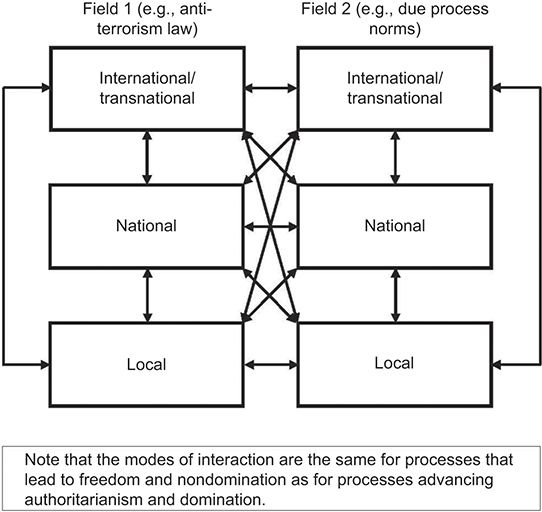
In each case, we note how international law can either support rule-of-law practices or undermine them. As law generally, it can validate practices of freedom or of domination, which is why it is important to differentiate the concept of rule of law from that of rule by law. Because international law is part of larger, transnational, norm-making processes, one should assess interactions between international, national, and local norms, institutions, and practices that implicate the rule of law. Figure 1.1 captures these processes of interaction as regards anti-terrorism and due process norms at different levels of social organization, which we further address below.
The transnational web of rule-of-law interactions.
1 Minimalist Perspective of Rule of Law for Nonviolence, Peace, and Public Order
The rule of law links analytically with the concept of peace by stressing the use of law to resolve conflicts in lieu of unbridled coercion and violence. At the international level of interstate relations, one of the core features of a “liberal international order” is the creation of multilateral institutions for the resolution of disputes under international law, thereby enhancing the security of states and their constituents.Footnote 95 There is no greater risk of arbitrary power exercised over individuals than the violence of war. As the philosopher Bernard Williams writes, the “Hobbesian question” of securing “order, protection, safety, trust, and the conditions of cooperation” is the “first” political question: “[S]olving it is the condition of solving, indeed posing, any others.”Footnote 96 It is for this reason that Steven Ratner prioritizes international law’s potential in providing a “pillar of peace” as a core aspect of theorizing international law in terms of justice.Footnote 97 The same is true as regards the rule of law. In a “thin” sense, international law is foundational to political order. It supports the maintenance of secure political communities and thus enhances the prospects of rule-of-law protections for these communities’ members.Footnote 98 Simply put, war and the immediate threat of war subject individuals and communities to increased risks of coercion and violence, whether by a foreign state, their own state, or nonstate actors. Practically, international law can protect, and has protected, individuals and communities from power’s arbitrary exercise.Footnote 99
Relatedly, from a transnational perspective, democratic peace theory provides powerful evidence that democracies grounded in the rule of law are less likely to go to war against each other than are authoritarian states, the latter being more likely to go to war against both each other and democratic states.Footnote 100 Where democratic norms grounded in the rule of law diffuse transnationally, the prospect of peace should increase, giving rise to “security communities.”Footnote 101 These communities may be tied together through shared norms and broader legal orders that become institutionalized, particularly at the regional level.Footnote 102 These two perspectives – democratic peace theory and transnational diffusion of norms – can be combined to show how rule-of-law norms at the national and international levels mutually and recursively support each other to enhance the prospects of peace and nonviolence, and thus reduce the likelihood of arbitrary power inflicted on individuals.
The international institutions created in the decades after World War II, at a minimum, provided rules for governing interstate relations and reducing the risk of armed conflict. One of the goals of promoters of the United Nations and its family of specialized international organizations was to ensure peace among states. The UN Charter prohibits the use of force – and thus war – to settle international disputes other than for self-defense against an armed attack (Article 51) or when authorized by the UN Security Council (Article 42). Regional regimes developed in parallel, with the aim of not only preserving peace within the region but also promoting nonviolent, law-governed, democratic transitions within states. After the end of the Cold War, international institutions grew in prominence. The UN Security Council has never lived up to its purpose under the UN Charter of ensuring “the maintenance of international peace and security.” Following the end of the Cold War, it reached consensus in a few prominent cases, giving rise to interventions, including to promote peace and security in post-conflict settings. Most notably, the Security Council authorized interventions in Iraq in 1991 following Iraq’s invasion of Kuwait (Resolution 688), in Bosnia in 1992 (Resolution 770), in Somalia in 1992 (Resolution 794), in Haiti in 1994 (Resolution 940), and in Afghanistan in 2001 (Resolution 1386). Regional organizations in Africa – ECOWAS and the African Union – even acquired the authority to intervene militarily in their member states to uphold law-governed, democratic transitions.
Among the core aims of international courts and other institutions is the peaceful resolution of disputes. The International Court of Justice (ICJ) offers a general-purpose mechanism for resolving disputes when states grant it jurisdiction. Counterfactually, without the ICJ and other international tribunals, it would be more difficult for states to peacefully resolve disputes.Footnote 103 Take, for example, international boundary disputes. The ICJ has been particularly effective in peacefully resolving disputes in this area, complemented by the Permanent Court of Arbitration (PCA) and the International Tribunal for the Law of the Sea (ITLOS). From 1951 to 2021, there were 53 boundary disputes decided by international tribunals, comprising 22 land boundary disputes, 19 maritime boundary disputes, and 12 disputes involving land and sea questions. As shown in Table 1.1, the ICJ decided 37, the PCA 13, and ITLOS 3 in total.Footnote 104 Overall, states complied either fully or partially with 45 (around 85 percent) of these judgments.
| Compliance | Partial compliance | Noncompliance | Total cases | |
|---|---|---|---|---|
| ICJ | 26 | 7 | 4 | 37 |
| PCA | 7 | 0 | 4 | 13 |
| ITLOS | 3 | 0 | 0 | 3 |
| Total | 38 | 7 | 8 | 53 |
The ICJ is complemented by other general purpose and specialized international tribunals. For example, the World Trade Organization (WTO) provides a legalized system for resolving trade disputes. Without it, trade wars are much more difficult to restrain, since tit-for-tat retaliation can lead to greater distrust and conflict, as evidenced both by the tariff and currency wars of the 1930s and the US–China trade war launched by the Trump administration in 2018 as the United States blocked appointments to the WTO’s Appellate Body. Indeed, US Secretary of State Cordell Hull believed that “economic blocs of the 1930s, practiced by Germany and Japan but also Britain, were the root cause of the instability of the period and the onset of the war.”Footnote 105 Among the aims of international investment arbitration is to resolve disputes over the treatment of aliens and their property that earlier had led to armed interventions. Although the investment law regime is subject to significant critique from a rule-of-law perspective, the illegality of the use of force to protect citizens’ property claims abroad represents, at a minimum, a significant advance.
Other international and regional fora provide jurisdiction for a range of disputes within their competence. The European Union (EU) provides a regional model. In this case, the EU and its predecessor organizations, starting with the European Coal and Steel Community, tied a powerful state (Germany) to a regional economic integration project with the aim of ensuring peace within Europe. Alec Stone Sweet analogously conceptualizes the European Court of Human Rights (ECtHR) under the Council of Europe as a Kantian “cosmopolitan legal order” advancing “Kant’s blueprint for achieving Perpetual Peace.”Footnote 106 These international institutions provide settings in which states can air their differences and resolve them through law and third-party institutions.
Global threats other than war affect the security of borders. Most saliently, there are the increasing risks posed by climate change, which have led to severe droughts and storms, cataclysmic fires and flooding. These threats can spur new interstate conflicts, whether over access to scarce water from shared lakes and river systems or because internal upheaval spills over borders, increasing the risks of power’s arbitrary exercise. International cooperation is required to address the underlying causes of climate change, since one state’s efforts go to naught if greenhouse gas-intensive production shifts elsewhere and other states take no action. International law and institutions can facilitate such cooperation, such as through binding rules, reciprocal pledges, and the generation of funding to address climate change risks. As with international law aimed at reducing the risks of war, international law and institutions addressing climate change also can indirectly support rule-of-law goals by reducing the underlying risks of power’s arbitrary exercise.
Yet, international law and institutions also can support invasions and facilitate domination by powerful states over others. The 1884–85 Berlin Conference carved up Africa, which authorized King Leopold’s brutal exploitation of the Congo. The League of Nations’ and United Nations’ mandate and trusteeship systems served to legitimate Western nations’ continued rule over their colonies, with the UN Trusteeship Council continuing to operate until 1994 when the last trusteeship territory, the island of Palau, became independent from the United States. Powerful states remain dominant in shaping and enforcing international law today, as reflected in the veto powers of the five permanent members of the UN Security Council. The fact that these nations can block the application of any measure as applied to themselves when they violate the UN Charter and invade other countries undermines the rule of law – the first source of arbitrariness discussed earlier. Moreover, when the Security Council authorizes action, there is no international court or other institution to hold it, or countries acting under its authorization, accountable. For example, US and NATO excesses in enforcing a Security Council resolution for a “no-fly zone” in Libya in 2011 led to the overthrow of the Qaddafi regime, and increased insecurity, suffering, and mass violence in that country.Footnote 107 In theory, interventions authorized by international institutions or referencing international law can reduce violence and conflict, but they also can worsen situations, rendering individuals more vulnerable to violence and arbitrary power.Footnote 108 Rule-of-law norms thus must apply to international institutions themselves.Footnote 109
Powerful actors also reference international law to authorize invasions that can lead to increased violence. For example, human rights claims helped frame the creation of a “responsibility to protect” doctrine, which can serve to justify “humanitarian interventions” and thus armed conflict in the name of human rights enforcement.Footnote 110 President Putin’s rhetoric to legitimize Russia’s 2022 invasion of Ukraine in the name of “humanitarian intervention” illustrates how powerful actors deploy humanitarian rhetoric and international law for self-interested reasons. Russia’s veto of a Security Council resolution calling on it to halt its attacks and withdraw from Ukraine illustrates how the Council’s permanent members block the application of international law against themselves.
2 Indirect Processual Links Supporting Rule-of-Law Practices within States
International institutions and international law are important for norm-making, oversight, assessment, and funding of rule-of-law initiatives that indirectly affect institutional practices within states.Footnote 111 They are best viewed as part of larger transnational normative processes involving the conveyance of norms, which ultimately are applied within states toward individuals. Since World War II, international institutions have aimed to delimit state prerogatives affecting the rights of all persons, for which the rule of law is fundamental. They create focal points for transnational networks of civil society groups that can help to embolden and empower those advancing rule-of-law goals domestically. Domestic groups can use reporting, peer review, and judicial or other transnational mechanisms to enhance their positions in domestic political, judicial, and administrative institutions and processes, potentially “locking in” domestic rule-of-law reforms.Footnote 112
One way that scholars have framed the so-called liberal international order in the post-World War II era is to view states as agents of higher-order international rules for the protection of human rights, for which the rule of law provides a foundation. Political scientists Tanja Börzel and Michael Zürn labeled this a “postnational liberal international order” in that it comprised conditionally sovereign states, which gained legitimacy by enforcing and guaranteeing liberal rights, rules, and decisions implicating the rule of law.Footnote 113 The Universal Declaration of Human Rights sets out fundamental individual rights that states are obligated to respect through “the rule of law.”Footnote 114 The International Covenant on Civil and Political Rights (ICCPR) and the International Covenant on Economic, Cultural and Social Rights, together with other global and regional treaties, elaborate these rights and create international mechanisms to oversee their application. Over time, these treaties’ membership, scope of coverage, and enforcement mechanisms have expanded.
We conceptualize the protection of human rights, as noted in Part I, as important means that complement and overlap with the rule of law in advancing rule-of-law goals. These rights are almost universally recognized in national constitutions,Footnote 115 which, in turn, reflect transnational processes of constitution-making and constitutional practice.Footnote 116 To be a modern state is to have a constitution, and increasingly since 1945 national constitutions define individual rights and obligate the state to respect and protect them through institutionalized means founded on the rule of law.Footnote 117 The Universal Declaration of Human Rights has been particularly influential in shaping rights provisions in national constitutions.Footnote 118 Such rights are developed recursively in international and domestic law and institutions through transnational processes.Footnote 119 In the words of the late ICJ judge James Crawford, one of the main roles “of international law is to reinforce, and on occasions to institute, the rule of law internally.”Footnote 120 In this vein, in 2004 UN Secretary-General Kofi Annan stressed:
States are now widely understood to be instruments at the service of their peoples, and not vice versa. At the same time individual sovereignty – by which I mean the fundamental freedom of each individual, enshrined in the charter of the UN and subsequent international treaties – has been enhanced by a renewed and spreading consciousness of individual rights. When we read the charter today, we are more than ever conscious that its aim is to protect individual human beings, not to protect those who abuse them.Footnote 121
These protections are contingent on the rule of law.
The protection of individual rights against the arbitrary exercise of power is part of the mission of a range of international and regional institutions. Eight of the principal international human rights treaties include provisions that allow the relevant treaty bodies to receive individual communications alleging violations. The Human Rights Committee, for example, established under the ICCPR, can receive and decide on individual claims of ICCPR rights violations by the 106 states that have accepted the First Optional Protocol to the ICCPR.Footnote 122 The Human Rights Committee lacks power to enforce these rights directly, but states are obliged to respond to its findings. In 2022, for example, it found that Australia had arbitrarily interfered with the rights of indigenous Torres Strait Islanders by failing to protect them adequately from the effects of climate change.Footnote 123
This is just one part of the architecture of international human rights institutions, which include the UN Human Rights Council, the Office of the High Commissioner for Human Rights under the UN Secretary-General, the committees created to oversee the other international human rights treaties, and various reporting and investigative bodies, such as the system of UN special rapporteurs. States are accountable to these bodies, and constituents within states can reference and appeal to their work to advance rule-of-law goals. For example, under the UN Paris Principles, over one hundred countries created national human rights institutions, which generated a transgovernmental system of monitoring that facilitates norm diffusion.Footnote 124 Similarly, more reporting mechanisms can have catalytic impacts within countries through media coverage, nongovernmental advocacy, legislative references, and administrative follow-up.Footnote 125
Regional bodies are particularly important for overseeing and monitoring human rights protections implicating rule-of law goals.Footnote 126 The European Union established conditions for membership under which state institutions must guarantee democracy, the rule of law, and human rights (the “Copenhagen criteria” of 1993). It also established a mechanism for holding states accountable for violations of rights contained in the EU’s Charter of Fundamental Rights (CFR). National judges can hear individual complaints regarding violations of the Charter, and, where there is uncertainty, they can seek interpretive guidance from the Court of Justice of the European Union.Footnote 127 The Court of Justice has found that Article 2 of the Treaty of the European Union “contains values [including the rule of law] which … are an integral part of the very identity of the European Union as a common legal order, values which are given concrete expression in principles containing legally binding obligations for the Member States.”Footnote 128 It has applied the value of the “rule of law” embedded in Article 2 to require member states to maintain an independent judiciary, which is a major concern in Hungary and Poland.Footnote 129 In parallel, the European Commission for Democracy and Law (the “Venice Commission”), within the Council of Europe, is charged with helping states that wish “to bring their legal and institutional structures into line with European standards and international experience in the fields of democracy, human rights and the rule of law.”Footnote 130 These regional bodies can contribute to the formation of regional legal orders, although these too will show internal variation in terms of the concordance of regional, national, and local practice.Footnote 131 Variation among regional legal orders can reflect different regional traditions and transnational borrowings among neighboring countries.Footnote 132
International human rights law and institutions arguably are most powerful when national institutions, such as national courts, reference and enforce international norms within national systems.Footnote 133 This transnational framing of international law resonates with Kim Lane Scheppele’s assessment of international courts in “three-dimensional space.” As she maintains, international courts should not be viewed hierarchically as super appeals courts or primarily as “back stops” to national courts, but rather as part of broader normative orders that horizontally among themselves and vertically in relation to national courts affect institutional practices, particularly for the protection of the rule of law.Footnote 134 All members of the Council of Europe must incorporate the European Convention on Human Rights into national law, and national judges in these countries reference the Convention in applying national law.Footnote 135 The UK Human Rights Act, for example, requires that UK judges interpret statutes, so far as possible, in ways that are compatible with the UK’s international human rights commitments.Footnote 136 In Germany, courts generally are obliged “to take note of and consider the relevant case law of the international courts with jurisdiction for Germany.”Footnote 137
Direct decisions of a human rights court against one state can have effects in other states, illustrating transnational processes at work. Laurence Helfer and Eric Voeten, for example, provide evidence that ECtHR decisions against one country substantially increase the probability of national-level policy change across Europe, such as in the area of the protection of LGBT equality.Footnote 138 Relatedly, within many Latin American countries one cannot meaningfully study constitutional law developments without incorporating their relation to the inter-American human rights system and changes in legal culture regarding the rule of law.Footnote 139 These bodies generate interpretations that courts outside of their regions reference, including other regional courts and other national courts (such as in the United States and India).Footnote 140
Courts also frequently apply or otherwise consider international law in interpreting national law.Footnote 141 In doing so, they participate in, and are critical to, international law’s implementation, development, and practice. As the Supreme Court of Canada stated in the case Nevsun Resources Ltd. v. Araya et al., “Canadian courts, like all courts, play an important role in the ongoing development of international law.”Footnote 142 They are important not only in “implementing” international law, but also in “advancing” it. In that way, they “contribute … to the ‘choir’ of domestic court judgments around the world shaping the ‘substance of international law.’”Footnote 143 The opinion affirmatively cites former member of the Canadian Supreme Court Gérard La Forest, who writes, “our courts – and many other national courts – are truly becoming international courts in many areas involving the rule of law.”Footnote 144
Many international organizations have incorporated and promoted rule-of-law norms in their rules and jurisprudence. For example, WTO panels have found that a central goal of the WTO legal system is to provide individual traders with certainty and predictability from the arbitrary action of other governments. In the United States – Section 301 case, the European Union challenged US unilateral legislation used to threaten US sanctions against it before the WTO dispute settlement system had completed its review. The panel found that such legislation could be challenged “as such” given its “‘chilling effects’ on the economic activities of individuals.” The panel stressed, “it would be entirely wrong to consider that the position of individuals is of no relevance to the GATT/WTO legal matrix … . The multilateral trading system is, per force, composed not only of States but also, indeed mostly, of individual economic operators. The lack of security and predictability affects mostly these individual operators.”Footnote 145
Relatedly, in the United States – Shrimp case, a group of south and southeast Asian nations challenged a US ban on shrimp imports from countries that did not require certain shrimp trawling practices to protect endangered sea turtles. The Appellate Body found that, although the US objective was legitimate, the United States had failed to provide “due process” rights to the other countries to defend themselves and adapt to the new measure. It found that the application of the US measure was “arbitrary” in that the certification process was not “transparent” or “predictable,” did not provide any “formal opportunity for an applicant country to be heard or to respond to any arguments that may be made against it,” did not result in a “formal written, reasoned decision,” and offered “no procedure for review of, or appeal from, a denial of an application.”Footnote 146 The Appellate Body focused, in particular, on the transparency obligations set forth in Article X of the GATT, pursuant to which WTO members are to publicize their laws and regulations so as to give foreign traders proper notice.Footnote 147 These requirements respond to two of the sources of arbitrariness we foregrounded in Part I – the provision of transparent, published rules, and of an impartial tribunal where persons can respond to and challenge an authority’s decisions against them.
The United Nations, World Bank, and other organizations, including regional and national agencies, have created a rule-of-law industry of consultants giving technical advice, which intensified in the 1990s and 2000s.Footnote 148 Discourse on the rule of law proliferated in Security Council resolutions, in Secretary-General reports, and in other UN groups, particularly as relates to UN peacebuilding and rule-of-law assistance in post-conflict settings.Footnote 149 Some of these processes focused on legal empowerment to support civil society and grassroots organizations within states.Footnote 150 As one UN document declares, the rule of law is a concept “at the very heart of the UN mission,” which is “interlinked and mutually reinforcing” with human rights and democracy.Footnote 151 In parallel, rule-of-law promotion became central within the World Bank and other development agencies.Footnote 152
International and transnational processes are also critical for targeting the practices of nonstate entities, such as multinational corporations that operate in countries with few rule-of-law protections. The United Nations developed Guiding Principles on Business and Human Rights in 2011, to which multinational corporations agree to adhere.Footnote 153 Private organizations and national regulatory agencies have promoted reporting on adherence to legal norms involving expanded environmental, social, and governance practices (ESG), as under the Global Reporting InitiativeFootnote 154 and the Equator Principles.Footnote 155 At times, different public and private initiatives combine in complex ways to bolster rule-of-law protections, such as in the industrial workplaces of global supply chains.Footnote 156
However, just as international law and institutions can support rule-of-law processes, they also can undermine them. The turn to securitization after the September 11, 2001, terrorist attacks offers a powerful example. The UN Security Council created an Al-Qaida and Taliban sanctions regime in which a sanctions committee, mirroring the composition of the Security Council, could require the global freezing of an individual’s assets with no transparency or due process. Following the Security Council’s lead, countries around the world passed anti-terrorism laws that governments then used in repressive ways.Footnote 157 Some human rights and other regional courts responded to these developments, most notably in the European Union in the Kadi case. There, the European Court of Justice voided an EU regulation implementing UN Security Council mandates to freeze the assets of suspected terrorists and their financiers on the grounds that it violated the accused’s due process rights.Footnote 158 Other courts followed suit.Footnote 159 This response catalyzed some Security Council reforms, notably the creation of an Office of the Ombudsperson, although its powers were limited.Footnote 160
Private actors, such as multinational companies, also harness rule-of-law rhetoric to advance their material interests. Public and private actors have developed different indicators to measure the rule of law, some of which reflect a neoliberal tilt that can favor foreign capital.Footnote 161 The Heritage Foundation’s rule-of-law index, for example, focuses on the security of property rights.Footnote 162 Bilateral investment treaties and investor–state arbitration highlight how businesses may use international law to challenge government regulations that, investors contend, undermine certainty and predictability under the rule of law. The Tecmed arbitration, for example, recalling Hayek’s attack on social welfare legislation, set a standard for “fair and equitable treatment” under which “the foreign investor expects the host State to act in a consistent manner, free from ambiguity and totally transparently in its relations with the foreign investor so that it may know beforehand any and all rules and regulations that will govern its investments.”Footnote 163 Because democratic political processes legitimately change environmental, labor, and other regulations over time, the Tecmed standard of fixing all rules and regulations in advance could be highly constraining. Business can use it not only to sue states for billions of dollars when new regulations violate business “expectations.”Footnote 164 They also can chill regulation by threatening legal claims.Footnote 165 Yet, domestic institutions often operate corruptly and arbitrarily, which is a central reason to create international institutional complements. It is thus critical to retain focus not only on rule-of-law goals but also on institutional alternatives to pursue them, all of which will be imperfect, but where some will be better or worse in different contexts.Footnote 166
3 Direct Links between International Institutions and Individuals
International law also, in some cases, provides direct legal protections and legal accountability for individuals in support of the rule of law. It can do so in jurisdictions where international law is directly applicable as a cause of action before national courts, and under treaties granting individuals the right to bring direct claims against states before regional courts. The most active regional human rights court is the ECtHR, followed by the Inter-American Court of Human Rights (IACtHR), and the African Court on Human and Peoples’ Rights. These regional human rights courts receive and adjudicate individual claims of state violations of the relevant regional treaties.
In these cases, international law and institutions serve, in part, as a backstop to protect the rule of law, while also potentially shaping the normative field transnationally. International human rights courts, like the ECtHR and the IACtHR, can accept jurisdiction over a petition only after all domestic legal recourse has been sought and exhausted. In those cases, where domestic courts are to enforce rights under the convention but fail to do so, individuals retain the right to bring claims directly to the regional court in question. Stone Sweet labels such tribunals “trustee courts,” since they are charged not with advancing state purposes but rather with holding states accountable for violations of treaty-based rights against those within the state’s jurisdiction.Footnote 167 As regards criminal law, international criminal law and courts primarily serve to establish responsibility for international crimes when domestic institutions are incapable of, or prevented from, doing so. The International Criminal Court (ICC) was designed to provide for legal accountability when state institutions fail. The ICC Office of the Prosecutor prosecutes genocide, crimes against humanity, war crimes, and the crime of aggression only when states are unwilling or unable to do so. In practice, it has catalyzed national investigations and some prosecutions for atrocity claims, and it can have other indirect effects.Footnote 168 Likewise, in investment law, under the World Bank’s Convention on the Settlement of Investment Disputes, a “Contracting State may require the exhaustion of local administrative or judicial remedies as a condition of its consent to arbitration under this Convention,” although this requirement often is not applied in practice.Footnote 169
These complementarity mechanisms prioritize legal decision-making within domestic jurisdictions. They recognize domestic authorities as the primary guardians of the rule of law, but subject to an international accountability mechanism. In the process, they can enhance legal certainty and equal application of the law. By empowering domestic courts to oversee compliance with legal obligations (which directly or indirectly reflect international law), complementarity mechanisms can broaden international law’s reach within states.Footnote 170 There is some (preliminary) empirical evidence that they may do so better than the alternative of using international tribunals as substitutes for domestic courts.Footnote 171
In practice, international institutions are both promoters (on the offensive) and subjects (on the defensive) of the rule of law. Although there is no centralized public power at the international level, international and regional institutions began to exercise increasing authority directly over individuals following the collapse of the Soviet Union and the end of the Cold War, particularly in relation to peacekeeping operations, sanctions, the use of force, and the US-pronounced “war on terror.” Given its new regulatory roles, the United Nations’ adherence to the rule of law has been seriously challenged. While the UN established thirteen peacekeeping operations between 1946 and 1988, with constrained roles that were primarily tasked with monitoring ceasefire lines, the UN Security Council has created fifty-eight additional operations around the globe since 1988, whose operational scope significantly expanded, including the provision of basic policing functions.Footnote 172 The Security Council authorized peacekeeping and rule-of-law-building mandates in Afghanistan, Iraq, Haiti, Sierra Leone, and Timor Leste, as have NATO and the European Union in Kosovo and the African Union in Somalia. When UN personnel were accused of murder, rape, torture, corruption, and other tortious acts, the United Nations claimed immunity, in violation of fundamental rule-of-law accountability norms, spurring protestations against UN practices.Footnote 173 Similarly, while the Security Council applied only two sanctions regimes in its first forty-three years (against the racist, white minority regimes of Rhodesia and South Africa), since 1989 it has imposed thirty-two additional ones.Footnote 174 The Security Council also increasingly authorized the use of force in its resolutions, rising from one extraordinary instance during the Cold War (in Korea when the Soviet Union briefly absented itself from the Security Council) to forty-eight resolutions between 1990 and 2014.Footnote 175
The Security Council has been particularly challenged for exercising legislative and administrative power to combat “terrorism.” After the September 11, 2001, terror attacks, the Security Council issued a series of resolutions, most notably Resolution 1373 which, among other matters, required states to criminalize terrorism in domestic law and freeze assets of individuals and groups that the Security Council blacklists.Footnote 176 Anti-terrorism laws proliferated globally, and government officials used them to advance their own agendas, including to criminalize dissent.Footnote 177 The Security Council ordered the seizure of an accused’s assets with little to no due process, as noted in Section 2. As Scheppele writes, “for states whose commitment to international law is part of their own deep devotion to the rule of law as a basic principle of state legitimacy, new draconian anti-terrorism laws could be portrayed as necessary in order to comply with international law,” regardless of the lack of due process.Footnote 178
From the vantage of TLO theory, national and regional courts can intervene to protect rule-of-law concerns involving international institutions, just as international institutions have done regarding national practices.Footnote 179 They are part of a broader transnational legal process. As we have seen, some regional and national courts responded by constraining compliance with Security Council asset seizure orders where they were deemed to violate rule-of-law requirements within regional and national legal orders, as in the Kadi case.Footnote 180 The Security Council responded in 2009 by creating the Office of the Ombudsperson, empowered to investigate and make “delisting” recommendations. In this transnational sense, the late judge James Crawford was not wholly correct when he wrote that only when the International Court of Justice has “clear jurisdiction judicially to review action of all United Nations political agencies, including the Security Council … could the rule of law be said to extend to international political life.”Footnote 181 Nonetheless, serious challenges remain, illustrated by the ombudsperson’s resignation in 2021 on rule-of-law grounds, including the lack of institutional independence of the Office of the Ombudsperson, the Security Council’s extensive reliance on confidential evidence, and a refusal to permit petitioners to examine the reasons for their inclusion on the sanctions list.Footnote 182 These ongoing challenges continue to catalyze responses and reform proposals from within and outside the Security Council by state and nonstate actors.Footnote 183
Because international law and institutions not only support rule-of-law protections but also affect individuals directly in ways that implicate the rule of law, scholars have turned to analytic frames borrowed from constitutional and administrative law for assessing and constraining international institutions. Global administrative law theorists foreground tools of accountability, transparency, and reason-giving as checks on international and domestic institutions.Footnote 184 Other scholars have developed global constitutionalist frames,Footnote 185 transnational pluralist ones,Footnote 186 and constitutional pluralist hybrids,Footnote 187 for reconceptualizing international law in ways that place greater focus on the individual and individual rights.Footnote 188 These normative projects aim, in different ways, to advance rule-of-law concerns globally, including in response to the enhanced role and authority of international institutions since the 1990s. These conceptions of international law are components of viewing the rule of law within a broader transnational context involving transnational legal ordering.Footnote 189
III Empirical Trends in Transnational Context
International and national law and practice interact to shape norms across substantive fields. These interactions are recursive in that developments in one site can have intended and unintended effects in others, which in turn can spur new normative development and institutional change. For example, national legal norms, especially those of powerful states, often shape international ones, but the norms may be revised and recalibrated in the process. In turn, international legal norms and institutions provide normative resources for actors at the national and local levels, new strategies of justification and argument, and new alternatives for social action. These processes also can catalyze national and local resistance that spurs new institutional strategies and normative change.
In this Part III, we first lay out our argument that the world risks a deepening negative cycle of overall decline in rule-of-law protections at the national and international levels (Section 1). After addressing the challenge of measuring rule-of-law practices (Section 2), we then examine existing evidence of national (Section 3) and international (Section 4) trends. We conclude by appraising possible explanatory factors for the parallel decline of multiple rule-of-law indicators (Section 5).
1 Our Argument
From a transnational perspective, this volume assesses whether there might be common trends regarding rule-of-law protections at the national and international levels, involving cycles of settlement and unsettlement of rule-of-law norms and practices. We ask: Do rule-of-law norms and practices shift at the national and international levels in parallel? Our working hypothesis is that they do, although with variation across and within regions. Given the transnational enmeshment of national and international norm-making and practice, we contend that developments at one level can have reinforcing – and subverting – effects on the other in a recursive manner. These trends can give rise to virtuous and vicious cycles. Where national rule-of-law practices erode, especially in powerful states, and where authoritarian states become more powerful globally, we expect that such erosion and power shifts will implicate international law and practice. Where international rule-of-law norms and monitoring and enforcement institutions weaken, national and local actors will have fewer institutional and normative resources available to protect the rule of law.
To flesh out our claim, we note that rule-of-law promotion proliferated as part of transnational legal ordering processes after the collapse of the Soviet Union in 1990.Footnote 190 Liberal norms diffused transnationally, backed by significant economic incentives, such as the carrot of joining the European Union, spurring studies of “the global diffusion of markets and democracy.”Footnote 191 The wave of democratization and transnational constitutional processes, in turn, spurred greater openness of state legal systems toward international law.Footnote 192 At the time, as former Soviet bloc states gained independence, they joined the key international institutions at the core of an international order grounded in law: the European Union, the European Convention on Human Rights under the Council of Europe, the World Trade Organization, and the various specialized organizations of the United Nations system. International courts and cases before them proliferated beyond Europe. As captured by the Project on International Courts and Tribunals, the number of international courts rose from six to over two dozen between 1989 and 2014, which collectively issued over 37,000 binding legal rulings.Footnote 193 In parallel, states adopted new constitutions and institutions that created new resources and mechanisms for national and local actors to enhance rule-of-law protections. These constitutions incorporated international norms and created new institutional oversight and enforcement processes. During this period, indicators on the rule of law and neighboring concepts such as democracy reached their peaks.Footnote 194 There were, of course, severe challenges in advancing the rule of law in many jurisdictions, especially those with weak institutions.Footnote 195 Nonetheless, the overall trends were positive, captured in Kathryn Sikkink’s claim of a transnational “justice cascade.”Footnote 196
In the last decade, by contrast, indicators measuring the rule of law, together with complementary concepts such as democracy, have declined, while national demands for greater autonomy from regional and multilateral institutions and their normative constraints have increased. Overall, we appear to be moving from what Thomas Carothers characterized as a “rule-of-law revival”Footnote 197 in the 1980s to what can be characterized as authoritarian relapse and rule-of-law decline today.Footnote 198 In an interconnected world, we have turned from a period characterized by the development of institutions and transnational processes promoting “transitional justice,” as reflected in a profuse literature,Footnote 199 to processes consolidating what can be viewed as “gradual autocratization.”Footnote 200 In this shift, authoritarian regimes do not simply terminate institutions developed during the rule-of law-revival. Rather, having inherited them, they mimic and harness formally liberal mechanisms for authoritarian ends.Footnote 201 Witness Victor Orbán referencing other countries’ institutional mechanisms while adapting them in new ways to defend his authoritarian, anti-liberal aims.Footnote 202 Anti-liberal movements learn from and adapt these processes for similar authoritarian purposes.Footnote 203 These strategies illustrate the risks of focusing exclusively on rule-of-law checklists as opposed to goals and practices. As David Law writes, the role of law and courts in authoritarian regimes “deserves attention for the insights that it contains into the biases and vulnerabilities concealed within the structure of our own judicial institutions.”Footnote 204 One can add the vulnerabilities contained within our executive, legislative, and administrative institutions as well.
There can be considerable resistance to these developments, so that change will be neither linear nor determined. Challenges to the rule of law in Hungary and Poland, for example, have catalyzed responses from the European Union, as well as from internal groups.Footnote 205 Yet, there are also powerful forces aimed at constraining regional oversight, whether through exit (such as Brexit) or voice, which will weaken regional institutions, their influence, and the resources they provide to local actors (say, following the election of Georgia Meloni in Italy or if Marie Le Pen were to triumph in France). Other international shifts will affect these internal regional developments, such as resurgent nationalism and coercive geopolitics in powerful states such as China, Russia, and the United States. Sections 3, 4, and 5 provide empirical evidence and explanations regarding enmeshed trends at the international and national levels, and the cycles they represent.
2 The Challenge of Measurement
Before discussing the empirical evidence, we stress both the challenge of measuring trends in rule-of-law protections and the importance of doing so. Given different conceptions of what constitutes the rule of law and the means to achieve it, different indicators measure different things. Measurements use different sources of information, which raises challenges regarding validity, reliability, and bias in the data, especially as regards uneven cross-country data. Moreover, even where common trends are identified regarding rule-of-law practices, it is very difficult to establish the causal forces behind these trends.Footnote 206
A number of indexes purport to measure the rule of law, but they measure different things, highlighting certain goals and means over others. Mila Versteeg and Tom Ginsburg examined rule-of-law indicators developed by the World Bank, the Heritage Foundation, Freedom House, and the World Justice Project, assessing their different focuses and their overlaps.Footnote 207 These indexes differ in emphases, with the Heritage Foundation focused to a greater extent on property rights and Freedom House more on human rights, while the World Bank and World Justice Project examine broader ranges of issues. One might thus expect these indicators to be weakly correlated.
Despite the use of different component measurements, Versteeg and Ginsburg find “the four indicators … to be remarkably similar.”Footnote 208 They show that the measurement of “corruption,” which – like the rule of law – encompasses the goal of “government impartiality,” closely correlates with all four rule-of-law indicators.Footnote 209 The correlation of these measurements could suggest that they indeed capture something broadly about empirical trends. Corruption, for example, affects each of the five sources of arbitrariness noted in Part I, as it leads to non-transparency, inconsistency, partiality, and a lack of proportionality, which the powerful can harness for authoritarian ends.
Versteeg and Ginsburg nonetheless raise caution. In particular, they question the extent to which convergences in measurement may reflect a common reliance on expert perceptions and information constraints given the challenges of gathering data. They also note that, by combining multiple factors into a single ordinal number, indexes will conflate different aspects of the rule of law and the means to attain it.Footnote 210 They thus applaud the World Justice Project’s index for being modular, so that researchers can use the database to focus on particular aspects (or sources of arbitrariness),Footnote 211 which then can be assessed in different contexts.
Lon Fuller long ago wrote that we need “standards against which the degree of attainment of a condition of legality could be evaluated.”Footnote 212 Developing and revising such standards, nonetheless, should always focus on the ends of the rule of law and not be fixed on particular institutional mechanisms. Given differences in social, cultural, and institutional contexts and heritages around the world, as well as the role of informal institutions, there is no one means to advance the rule of law. Since advancing the rule of law will take different forms in different contexts, the promotion of the rule of law will always bedevil advocates and institutions.Footnote 213
Despite these challenges, we contend that empirical study is crucial, and quantitative and qualitative data and studies are improving thanks to sustained efforts, ranging from ethnographies to large-n statistical analyses. The large-n studies tend to rely on surveys and thus assess perceptions within countries. The World Justice Project has developed extensive surveys, which it uses to assess the perceptions of lawyers and lay persons within countries.Footnote 214 These perceptions are important from the perspective of TLO theory, since the law in action depends on the mentalities of actors, what they take as norms for appropriate behavior, affecting social expectations, communication, and behavior.Footnote 215 To assess social context and institutional behavior, one needs empirical study, which calls for the integration of law and the social sciences.Footnote 216 If our argument is correct, then such empirical work must engage with transnational processes to assess how national and international trends interact.
3 National Rule-of-Law trends
The past decade has witnessed a worrisome decline in the rule of law at the domestic level across a range of countries, on a variety of measures. In this section, we look at several of those indicators.Footnote 217 Each of them relies on a different set of observable features of governments – features that plausibly capture key behavioral implications of our conception of the rule of law (legal rules that set limits on the arbitrary exercise of power by some persons over others) in light of different sources of arbitrariness.Footnote 218 Each set shows overall declines in the rule of law within both democracies and authoritarian regimes. These declines generally do not reflect sudden transitions, such as following a military coup, but rather are gradual declines in the degree of rule-of-law protections within countries at different starting points.
According to World Justice Project (WJP) data (Figure 1.2),Footnote 219 over the past eight years forty-three states show a significant decrease in the rule of law, whereas only three show a significant improvement.Footnote 220 Table 1.2 lists the states with the largest declines. Most of the states with a drop in the rule of law started from a relatively low point, though two (Poland and the Republic of Korea) began with scores above 0.70 (on a scale of 0–1).Footnote 221 For those distrustful of quantitative indicators, the list of states – which includes Brazil, Egypt, Hungary, Poland, the Philippines, Turkey, and Venezuela – resonates, in our view, with common understandings. Overall, the WJP reports that in every year since 2015 the rule of law diminished in about 60 percent of countries, with a peak of 74 percent of countries showing a decline in 2020.Footnote 222
Changes in the rule of law, 2015–23, World Justice Project.
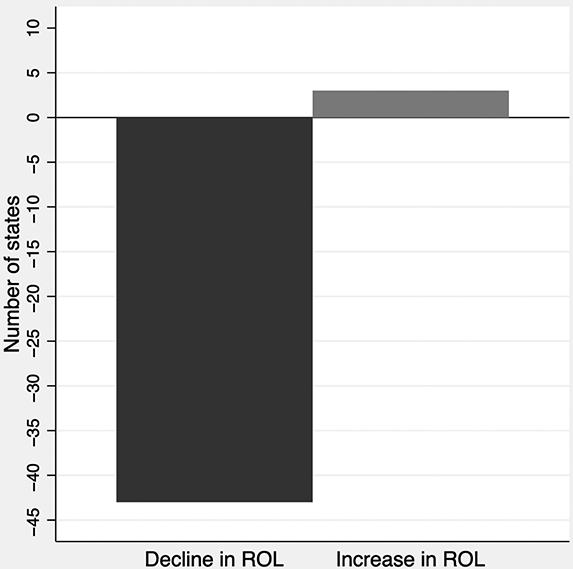
| Country | WJP 2015/2016 | WJP 2023 | Change |
|---|---|---|---|
| Belarus | 0.53 | 0.45 | −0.08 |
| Egypt | 0.43 | 0.35 | −0.08 |
| Poland | 0.72 | 0.64 | −0.08 |
| Hungary | 0.58 | 0.51 | −0.07 |
| Mexico | 0.48 | 0.42 | −0.07 |
| Nicaragua | 0.42 | 0.35 | −0.07 |
| Brazil | 0.55 | 0.49 | −0.06 |
| El Salvador | 0.51 | 0.45 | −0.06 |
| Georgia | 0.66 | 0.60 | −0.06 |
| Grenada | 0.66 | 0.60 | −0.06 |
| Myanmar | 0.41 | 0.35 | −0.06 |
| Philippines | 0.52 | 0.46 | −0.06 |
| Bosnia and Herzegovina | 0.56 | 0.51 | −0.05 |
| Ghana | 0.60 | 0.55 | −0.05 |
| Iran | 0.44 | 0.39 | −0.05 |
| Republic of Korea | 0.79 | 0.74 | −0.05 |
| Trinidad and Tobago | 0.57 | 0.52 | −0.05 |
| Turkey | 0.46 | 0.41 | −0.05 |
| Venezuela | 0.31 | 0.26 | −0.05 |
Note: World Justice Project, WJP Rule of Law Index (2023). World Justice Project scores range from 0 to 1. The table shows the nineteen largest declines. An additional eleven countries had a decline of 0.04. For most countries, the first year included in the data is 2015; for two countries in the table (Grenada, Trinidad and Tobago) it is 2016.
When we disaggregate the WJP data in terms of those indicators most directly tied to the five sources of arbitrariness that we identified in Part I, we find similar declines, as captured in Table 1.3. Using WJP data, we constructed indicators for three of the five sources of arbitrariness.Footnote 223 We then compared countries’ performance on these measures in 2015 and 2023. Strikingly, for all three sources of arbitrariness, far more countries underwent an increase in arbitrariness than experienced a decline, as shown in Table 1.3. It is also telling that 58 countries showed greater arbitrariness on all three counts in 2023. Out of 113 countries for which we have data, 88 showed an increase in two or more of the sources of arbitrariness.
| Sources | Number of countries | |
|---|---|---|
| Less arbitrariness | More arbitrariness | |
| 1. Wielder of power is not subject to controls, limits, or accountability mechanisms. | 35 | 78 |
| 2. Individuals unable to know how power may be wielded over them. | 24 | 89 |
| 3. Individuals have no place to question or respond to how power is exercised over them. | 33 | 80 |
Figure 1.3 charts the number of countries showing an increase and the number undergoing a decline in the Freedom House rule-of-law indicator. Strikingly, in no year since 2005 has the number of countries showing an increase in the rule of law exceeded the number suffering a decline. Since 2017, the number of countries expanding the rule of law has dropped dramatically, while the number with a declining rule of law has remained high. Rule of law scores from the Varieties of Democracy project depict a similar trend. Rule of law scores began a steady rise after the 1990 collapse of the Soviet Union. From 1990 until 2012, states showing increases outnumbered states undergoing declines in all but two years. By contrast, from 2013 through 2021, declines were more numerous than increases in all but two years.Footnote 224
Freedom House rule of law index.
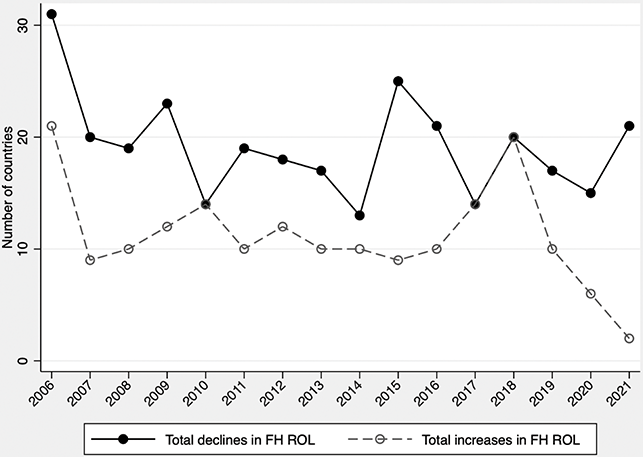
In some instances, autocratic governments expanded their powers (as in Niger and Belarus). In others, elected governments eroded the rule of law by bringing formerly independent regulatory bodies under executive control and replacing judges on supreme courts (as in Hungary and Poland). Table 1.4 lists the twenty countries with the largest declines in the rule of law under two measures (V-Dem and Freedom House). Turkey has undergone an especially striking retreat. Notably, Freedom House lists the same democracies that display declines in the V-Dem rule-of-law indicator, but it also includes the United States.
| V-Dem | Freedom House | ||
|---|---|---|---|
| Country | Decrease (on a scale of 0–1) | Country | Decrease (on a scale of 0–16) |
| Turkey | −0.43 | Turkey | −5 |
| Zambia | −0.30 | Nicaragua | −4 |
| Thailand | −0.20 | Rwanda | −4 |
| Comoros | −0.14 | Tanzania | −4 |
| El Salvador | −0.14 | Ukraine | −4 |
| Ivory Coast | −0.14 | Venezuela | −4 |
| Poland | −0.14 | Azerbaijan | −3 |
| Brazil | −0.13 | Bosnia and Herzegovina | −3 |
| Philippines | −0.13 | Burundi | −3 |
| Belarus | −0.11 | Central African Republic | −3 |
| Bosnia and Herzegovina | −0.11 | Gabon | −3 |
| Hungary | −0.11 | Hungary | −3 |
| Mauritius | −0.11 | Lesotho | −3 |
| Niger | −0.11 | Philippines | −3 |
| Mauritania | −0.10 | Tajikistan | −3 |
| Nicaragua | −0.10 | United States of America | −3 |
| Serbia | −0.10 | Indonesia | −2 |
| Moldova | −0.09 | Moldova | −2 |
| Slovenia | −0.08 | Poland | −2 |
| Togo | −0.08 | Yemen | −2 |
Democracy and the rule of law are tightly interlinked. On the one hand, the rule of law is an essential prerequisite of democracy, since people cannot freely participate if they fear being subject to the arbitrary exercise of power, and election results can be manipulated without a trustworthy, independent, and institutionalized election system. On the other hand, strong democratic institutions can serve as an important bulwark of the rule of law, tempering the exercise of power (although not necessarily, as Hungary and Poland demonstrate). Measures of democracy show striking declines over the past decade. Figure 1.4 shows the net change in the level of democracy in the world according to two V-Dem indicators. The first measures the extent to which countries meet the criteria of polyarchy. It captures the “electoral principle of democracy,” which, through free and fair electoral competition, makes “rulers responsive to citizens.”Footnote 225 The second, liberal democracy, “emphasizes the importance of protecting individual and minority rights against the tyranny of the state and the tyranny of the majority,” in addition to free elections.Footnote 226 The graphs indicate the balance between the number of states showing an increase in a given indicator (greater democracy) and the number of states exhibiting a decrease (diminished democracy). For each of the last ten years, declines have been more numerous, sometimes dramatically so.
Decline in democracy indicators.
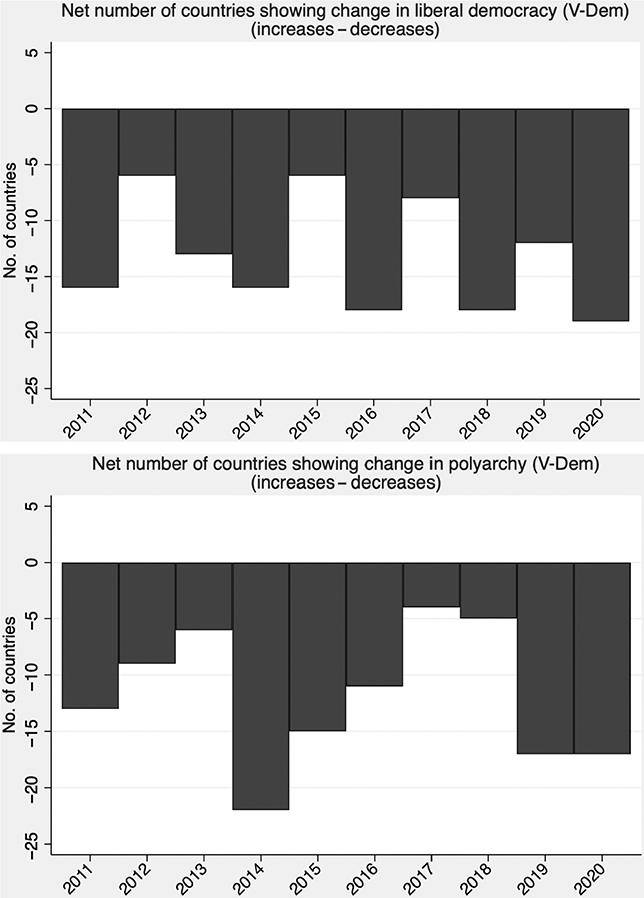
Table 1.5 lists the countries showing the greatest declines in both measures. Many of the same democracies that suffered drops in measures of the rule of law (Brazil, Hungary, Philippines, Poland, Turkey, United States) also show declines in measures of democracy. India appears in both lists as well. In parallel, the Economist Intelligence Unit downgraded Japan, South Korea, and the United States from “Full Democracies” to “Flawed Democracies” between 2014 and 2019. For the first time in three decades, it found that over half of the world’s countries, governing over half of world population, are neither “Full” nor “Flawed Democracies.”Footnote 227 Similarly, in its Freedom in the World 2021 report, Freedom House warned that 2020 “marked the 15th consecutive year of decline in global freedom. The countries experiencing deterioration outnumbered those with improvements by the largest margin recorded since the negative trend began in 2006.”Footnote 228 In other words, three complementary mechanisms for tempering the arbitrary exercise of power (rule of law, democracy, and civil and political rights) declined in parallel.
| V-Dem polyarchy | V-Dem liberal democracy | ||
|---|---|---|---|
| Country | Decrease | Country | Decrease |
| Bolivia | −0.36 | Poland | −0.34 |
| Hungary | −0.32 | Hungary | −0.29 |
| Serbia | −0.27 | Brazil | −0.28 |
| Poland | −0.26 | Turkey | −0.28 |
| Thailand | −0.26 | Serbia | −0.25 |
| Turkey | −0.26 | India | −0.23 |
| India | −0.25 | Mauritius | −0.23 |
| Yemen | −0.22 | Benin | −0.22 |
| Nicaragua | −0.21 | Thailand | −0.21 |
| Venezuela | −0.21 | Bolivia | −0.18 |
| Brazil | −0.20 | Comoros | −0.17 |
| Comoros | −0.20 | Philippines | −0.16 |
| Mauritius | −0.20 | Zambia | −0.16 |
| Benin | −0.19 | Botswana | −0.15 |
| Zambia | −0.19 | Nicaragua | −0.15 |
| Bangladesh | −0.17 | Moldova | −0.14 |
| Mali | −0.14 | Slovenia | −0.14 |
| Botswana | −0.13 | United States of America | −0.12 |
| Burundi | −0.13 | Czech Republic | −0.11 |
| Philippines | −0.12 | Mali | −0.11 |
Note: The V-Dem polyarchy variable captures the extent to which “the ideal of electoral democracy” is “in its fullest sense achieved.” The V-Dem liberal democracy variable captures the extent to which the “liberal principle of democracy” – including protection of individual and minority rights – is achieved. Both variables range from 0 to 1 (V-Dem Codebook 2021, 43–44).
Sandholtz examines three key indicators of decline that implicate the rule of law: judicial independence, independent media, and civil society.Footnote 229 Civil society organizations are key compliance constituencies needed to keep governments and other powerful actors accountable, and independent media and independent courts provide important support for their efforts. These institutional actors help protect the rule of law by casting light on and countering power’s arbitrary exercise, and all three are under attack. Judicial independence has declined globally through the purging and intimidation of judges and the packing of courts with government loyalists, as illustrated by authoritarian strategies in Hungary and Poland.Footnote 230 The Hungarian government even passed legislation voiding the entire jurisprudence of the country’s constitutional court in order to thwart institutional checks on its power.Footnote 231 Freedom House documents, in parallel, continuous attacks on and deterioration of media independence around the world over a decade, “with new forms of repression taking hold in open societies and authoritarian states alike.”Footnote 232 Governments in traditional democracies have increasingly cracked down on independent media, with many launching tax and other civil and criminal investigations in retaliation for adverse coverage. Reporters Without Borders dropped Japan to 71st in “world press freedom rankings,” while India, under President Modi, fell to 150th.Footnote 233 UNESCO’s 2022 report finds that “[o]ver the past five years, approximately eighty-five percent of the world’s population experienced a decline in press freedom in their country.”Footnote 234 Governments, in addition, increasingly repress civil society organizations, including by cutting off financial support from foreign sources.Footnote 235 Following the lead of China and Russia, dozens of countries have adopted new restrictions on foreign funding of nongovernmental organizations, and many have prohibited such funding.Footnote 236 UN High Commissioner for Human Rights Michelle Bachelet rebuked Israel, for example, when it not only cracked down on civil society groups but, in December 2021, designated without substantiation as “terrorist organizations” six Palestinian civil society groups that had long defended human rights and delivered humanitarian aid.Footnote 237 These trends bode ill for the rule of law.
4 International Trends
There is parallel evidence of decline in international law and institutions, which some now call a “crisis,” a decline that implicates rule-of-law protections.Footnote 238 The evidence that we present is largely of a qualitative nature. It concerns challenges to, and constraints placed on, international courts, a turn away from treaties to informal agreements and understandings, the neutering of international institutional scrutiny of human rights and rule-of-law violations, and the distortion and harnessing of international law to support repression, such as in the name of suppressing “terrorism,” “separatism,” and “extremism” to maintain “public order.”
First, states have negatively responded to international judicial oversight over the last decade, and in particular by international human rights courts.Footnote 239 To start, there has been considerable backlash against the flagship human rights court, the ECtHR, which addresses the “rule of law” in its jurisprudence, building on the preamble to the European Convention on Human Rights.Footnote 240 States have done so through threats of withdrawal, pressures for greater accommodation through the principles of subsidiarity and the margin of appreciation, reduced support from national courts, and executive neglect of the Court’s rulings. It was the rising number of claims – and their increased political and economic stakes – that triggered state responses. For example, the number of individual applications charging Russia with human rights violations nearly doubled from 1999 to 2001, and they rose to 12,328 in 2013. Following the ECtHR judgment in Yukos v. Russia, which ordered 2.51 billion dollars in compensation to Yukos shareholders for unfair tax proceedings,Footnote 241 President Putin signed a law that gave the Constitutional Court of Russia the authority to decide whether to comply with ECtHR judgments.Footnote 242 Following its invasion of the Ukraine in 2022, Russia was expelled from the Council of Europe and ceased being a party to the European Convention on Human Rights on September 16, 2022.Footnote 243
Long-standing democracies also challenged the Court, including Denmark, Switzerland, and the United Kingdom. The United Kingdom, for instance, had generally shown a high rate of compliance with ECtHR judgments, but a pair of cases – one involving prison inmates’ right to vote and another involving the deportation of a Muslim cleric to Jordan – raised the British government’s ire and fueled a rise in public opinion favorable to withdrawing from the Court. At the 2012 Brighton ministerial conference on the future of the ECtHR, the British government sought to trim the Court’s powers,Footnote 244 a project that so far has failed.Footnote 245 However, Conservative governments in power until mid 2024 considered withdrawing from the Convention and replacing the Human Rights Act so that the Convention is no longer incorporated into UK law.
There has been similar backlash against other regional human rights courts, as well as the International Criminal Court. In the Americas, after a series of rulings by the IACtHR against Venezuela, the Constitutional Chamber of the country’s Supreme Tribunal of Justice blocked six IACtHR judgments from being applied. President Hugo Chávez then withdrew Venezuela from the Inter-American Convention on Human Rights in 2012, following Trinidad and Tobago earlier. After the IACtHR ruled in 2014 that the government of the Dominican Republic violated the Inter-American Convention on Human Rights by denying identity documents and Dominican nationality to Haitian immigrants and their descendants, and detaining and expelling them, the Dominican Constitutional Tribunal issued a decision that appeared to nullify the country’s IACtHR membership and remove it from the IACtHR’s jurisdiction.Footnote 246 In April 2019, Argentina, Brazil, Chile, Colombia, and Paraguay issued a joint declaration to the Inter-American Commission on Human Rights calling for greater national “autonomy,” signaling that the inter-American human rights system had become too intrusive in challenging state failures to respect individual rights. The African Court on Human and Peoples’ Rights has faced similar pressures, with only eight states currently permitting nationals to bring cases to the Court, after four states – Rwanda, Tanzania, Benin, and Côte d’Ivoire – withdrew their permission for direct access, following decisions against them.Footnote 247 Similarly, Burundi and the Philippines have withdrawn from the International Criminal Court, and other states have threatened to follow suit.Footnote 248
The backlash is not limited to human rights courts. China rejected a ruling of the Permanent Court of Arbitration against its claims in the South China Sea, calling the decision “wastepaper.”Footnote 249 The United States neutered the Appellate Body of the World Trade Organization by blocking the appointment of new members after existing members’ terms expired, a tactic that Zimbabwe (under President Mugabe) earlier used against the South African Development Community Tribunal following unfavorable rulings regarding its land seizures.Footnote 250 The United States then increasingly deployed its economic power unilaterally to challenge foreign practices it did not like, in violation of WTO law, a tactic that China also adopted. Similarly, a number of states terminated (or allowed to expire) bilateral investment treaties instituting investor–state dispute settlement (including India, Indonesia, South Africa, and the United States regarding NAFTA’s investment chapter), and some withdrew from the International Centre for Settlement of Investment Disputes, which provides a procedural framework for such arbitrations. Investor–state arbitral tribunals themselves have raised rule-of-law challenges given their asymmetric nature, where only investors can bring claims and investors appoint one of the three arbitrators. Still, if the goal is enhanced rule-of-law protections within states, the better institutional alternative will vary with different contexts, which alternatives should include international venues, especially when national rule-of-law indicators decline.Footnote 251
Second, in addition to challenges to international courts, states have turned away from treaty-making and increasingly made use of informal, nonbinding mechanisms.Footnote 252 Since the early 2000s, there has been a quantitative decline in new treaties, and the International Law Commission’s work has ceased giving rise to treaties.Footnote 253 Nonbinding international norms – sometimes referred to as “soft law” – can exercise normative influence in support of problem-solving, and thus help develop international law and enhance its effectiveness and legitimacy.Footnote 254 The turn to less formal mechanisms thus should not necessarily worsen rule-of-law protections.Footnote 255 Nonetheless, the move away from multilateral treaties and from publicized written commitments monitored by third-party institutions reflects systemic changes that are worrisome, especially with the rise in power of authoritarian states and heightened geopolitical competition and conflict. As geopolitics and security become more pervasive concerns and more issues are viewed in zero-sum terms, states use less formal and less transparent means to govern their relations. These shifts toward informal, nontransparent mechanisms reduce accountability and enhance the ability of powerful states to deploy coercive leverage to advance their interests. For example, China’s Belt and Road Initiative illustrates the use of informal mechanisms, such as memoranda of understanding and undisclosed contracts, through which ruling elites form economic and political ties. Deploying these mechanisms, China is well positioned to exercise leverage as it works to create a China-centric economic order.Footnote 256 Given a lack of public scrutiny, these types of arrangements, in turn, raise corruption concerns, which is a key source of arbitrariness and thus an indicator of the undermining of the rule of law.Footnote 257 Authoritarian governments are likely to rely on these types of less formal arrangements, which provide fewer specific legal commitments backed by third-party dispute settlement.Footnote 258
Third, authoritarian governments, in parallel, have worked to neutralize existing international institutions’ scrutiny of human rights practices, while developing and harnessing international norms to enhance state control. China’s and Russia’s leaders have viewed international civil and political rights in support of rule-of-law norms as a tool used by the West to weaken their governments’ standing internationally and to destabilize their governments internally. In response, they aim to reshape international law to protect their hold on power, whether by curtailing existing institutions’ oversight of compliance with international law commitments, or by creating new institutions and new legal norms.Footnote 259
These governments use different forms of leverage to curtail international scrutiny of their internal practices by engaging, as Ginsburg writes, in a “concerted effort to neutralize multilateral forums as vehicles for democracy promotion,” human rights, and the rule of law.Footnote 260 China has a seat on the Human Rights Council, where (for the 2020 Council session), nearly half of the membership (21 out of 47 countries) consisted of autocracies,Footnote 261 despite the formal requirement that members of the Council have a strong record of respecting human rights. Following the issuance of a report by the Office of the United Nations High Commissioner for Human Rights in August 2022, which found that China’s human rights violations in Xinjiang could amount to crimes against humanity, China called the Office a “thug and accomplice of the US and the West.”Footnote 262 China then won a vote in the Human Rights Council to block further scrutiny of the report’s findings, defeating a US proposal.Footnote 263 In parallel, China has attempted to defund human rights promotion in UN peacekeeping operations, block the accreditation of civil society groups before the UN, and curtail the role of UN Special Rapporteurs.Footnote 264 The result could be a decline in human rights monitoring and enforcement and, more generally, a reduced use of third-party institutions, including international courts.Footnote 265
Fourth, authoritarian governments aim to reshape the content of international law in ways that they can deploy domestically to support their hold on power. They do so, in part, through increasing their participation and leadership roles within international organizations in order to exercise influence. China, for example, has successfully pursued leadership roles for Chinese nationals. In 2020, Chinese nationals headed four of the UN’s fifteen agencies; no other country’s nationals led more than one.Footnote 266 Chinese nationals led the Food and Agricultural Organization (FAO), critical for issues of food security and standard setting; the UN Industrial Development Organization (UNIDO), which has praised and supported China’s Belt and Road Initiative; the International Civil Aviation Organization (ICAO), which controversially worked to isolate Taiwan; and the International Telecommunications Union (ITU), which helps shape the governance of information and communications technologies, implicating government controls. In addition, a Chinese national almost became Director General of the World Intellectual Property Organization (WIPO) in 2020, losing only after concerted US and European lobbying for an alternative candidate from Singapore.Footnote 267 In parallel, China has dramatically increased its leadership positions in international standard-setting bodies across councils, technical management boards, technical committees, subcommittees, and working groups. Such standards are crucial for infrastructure projects, including for telecommunications, where Chinese companies are among the world’s leaders. China regularly volunteers to host standards meetings and provide secretariat services. Chinese nationals held the presidencies of the International Standardization Organization (ISO) from 2015 to 2017, and of the International Electrotechnical Committee (IEC) from 2020 to 2022. A Chinese national also presided over Interpol, the International Criminal Police Organization, until (ironically) China arrested him on a trip home in 2018, in the middle of his term, on charges of corruption and bribery.
Through enhancing their engagement in international institutions, authoritarian governments can reshape, develop, and then harness international norms for authoritarian ends at home. China and other authoritarian states have promoted international law norms of sovereignty and noninterference in a state’s internal affairs. In this way, China hopes to counter the individualist turn of international law, with its increased emphasis on human rights, which the United States and Europe championed during the Cold War, and which became more institutionalized after the Soviet Union’s collapse. China and other authoritarian states, in particular, have championed the development of international norms and mechanisms that they can use for repressive purposes. China, for example, has worked within the International Telecommunications Union to develop a new internet infrastructure that facilitates state control. It successfully supported a UN General Assembly resolution on “Countering the Use of Information and Communications Technologies for Criminal Purposes” that it and others can reference to justify internal suppressive measures. It also promulgates regional norms that it can use to repress internal dissent and counter foreign critique, such as regards China’s suppression of Uyghurs, Tibetans, and the people of Hong Kong. Through the Shanghai Cooperation Organization, China cooperates with neighboring countries to combat the “three evils” of “terrorism, separatism, and extremism,” including through international extradition agreements.Footnote 268 These agreements serve to legitimize China’s targeting of human rights and democracy activists, including their lawyers, and its suppression of free expression and the free flow of information on national security grounds. Russia and other states have followed its lead. The result of these shifts could be the recasting of international law and institutions to better serve authoritarian interests, leading to an “authoritarian international law.”Footnote 269
One should be careful not to idealize the turn to international law and institutions in the 1990s and 2000s given the exercise of Western hegemony.Footnote 270 At the same time, one should assess the implications of existing trends for the rule of law from a comparative institutional perspective. That is, one should ask whether the rising challenges to international institutions and law will advance or undermine rule-of-law goals. The evidence presented above indicates that domestic rule-of-law protections are declining overall, and that they parallel challenges to international law and institutions. These dual challenges to rule-of-law goals at the domestic and international levels, we contend, are part of a broader, transnational, interactive, negative cycle.
5 The Enmeshment of National and International Trends
Rule-of-law norms are part of a liberal tradition that can have quite radical political implications.Footnote 271 They are increasingly contested through a combination of illiberal domestic developments within traditional democracies (including in the United States) and shifts in international power with China’s rise as an authoritarian state. Internally, a populist, anti-globalist backlash against the international order has upended domestic politics in many countries. President Donald Trump’s “America First” attacks on the international legal order, which the United States had predominantly forged, illustrate the links between national processes and international institutional checks. The Trump administration and its allies within the United States promoted and forged new ties with nationalist and authoritarian parties and leaders abroad while attacking, neutering, and withdrawing from international institutions and treaties, from the UN Human Rights Council to the International Criminal Court and its Office of the Prosecutor. Externally, international anti-terrorism norms and institutions promoted by the United States in the early 2000s already had created new institutional and normative resources for authoritarian governments.Footnote 272 These authoritarian governments, most notably China, rose as global economic powers, creating new challenges for international institutions, and particularly international courts. The result could be the “dejudicialization of international politics.”Footnote 273
The upsurge of illiberalism and economic nationalism within the United States undercut the liberal international order from within, as the United States under the Trump administration paradoxically became a revisionist power. Europe has faced parallel internal contestations, illustrated by Brexit, the rise of illiberal parties within member states, especially but not only within Central and Eastern Europe,Footnote 274 and an increasingly aggressive Russia. Externally, an authoritarian China now vies for regional and global leadership to shape international norms and institutions, and its repressive politics are fundamentally at odds with liberal values. These domestic and international developments interrelate, and they pose severe challenges to the advancement of rule-of-law goals and practices.
The transnational development and conveyance of norms occur through different mechanisms, including through coercion, reciprocity, socialization, and modeling.Footnote 275 In parallel, iterative transnational processes of norm development are driven by the indeterminacy of legal texts, ideological tensions and contradictions within texts, diagnostic struggles over the nature of the problem (including as contexts change), and actor mismatch between those that adopt norms and those that implement them in practice.Footnote 276 For example, the term “rule of law” is vague and its meaning contested, reflecting a degree of indeterminacy. To the extent that actors view the rule of law in terms of legality or as defined by checklists, authoritarians can deploy rule-of-law rhetoric and adapt formal measures in ways that advance authoritarian ends.Footnote 277 International norms, in turn, often reflect compromises that incorporate ideological tensions and contradictions. For example, take the tensions between international law norms for the suppression of terrorism and norms to ensure due process and proportionality. Authoritarian governments can advance one aspect (suppressing terrorism) while ignoring the other (ensuring due process and proportionality).Footnote 278 Relatedly, there will be ongoing tensions concerning the conceptualization of problems, which implicates legal responses. For example, the governing norms of the trade regime are being redefined in national security terms, and they have moved away from concerns about nondiscrimination and fairness toward nonnationals.Footnote 279 Finally, there are always mismatches between those who negotiate and enact international legal norms and those who implement them. Implementing institutions and officials at the state and substate levels shape the law in action.
From the perspective of transnational legal ordering, the question becomes, What are the facilitating circumstances and precipitating conditions that give rise not only to a transnational legal order but also to its decline, including through the formation of rival transnational legal orders?Footnote 280 There have been a number of facilitating circumstances over the last decade, including power shifts, unintended consequences, legitimacy challenges, effectiveness concerns, and a reconceptualization of problems. There has been a shift in global power with the economic and political rise of China and the relative decline of the United States and Europe. These shifts have increased China’s leverage over others while decreasing those of the United States and European Union. China’s economic rise was, in part, an unintended consequence of the legal architecture for economic globalization that the United States had erected. After China joined the WTO, foreign capital invested massively in China, as well as in global supply chains linked to new Chinese manufacturing. This legal architecture also favored transnational capital over domestic labor, since capital was free to invest elsewhere and use that leverage in labor–capital relations. The result was a significant rise in income for capitalists, high-level management, and many professionals, accompanied by stagnant income for most Americans, which drove income inequality to levels not seen in the United States since the 1920s.Footnote 281 These developments undercut a sense of the legitimacy and effectiveness of the trade regime. They triggered a growing invocation of national security exceptions that enhance executive power at the expense of legislative and judicial oversight.Footnote 282 They help explain why, paradoxically, the United States (as the incumbent power) and not China (the emerging power) has become revisionist in upending the regime.Footnote 283
China’s emergence as a regional and global power, and rising concerns about inequality, in turn, catalyzed a shift in the conceptualization of international “problems” within US and European policy circles, spurring a rethinking of international law and institutions’ role. In international economic law, there has been a shift toward a focus on geopolitics, national security, supply chain resiliency, and social inclusion, away from one on economic efficiency, which had been foundational for an international legal system supportive of economic globalization. As a result, national security bureaucracies’ power has risen both in the United States and China at the expense of trade ministries.
These facilitating circumstances create the conditions for precipitating events that implicate rule-of-law practices. For example, the North Atlantic financial crisis of 2008 helped accelerate China’s gains in economic power, called into question the superiority of the US economic model in relation to China’s state-driven alternative, and further contributed to economic precarity for working-class Americans.Footnote 284 The combination of facilitating circumstances and precipitating conditions catalyzed backlash against the international economic order and helped empower populist, economic nationalist leaders within countries.Footnote 285 Ongoing crises could further these trends, including ecological crises driven by climate change,Footnote 286 which, in turn, exacerbate “migration crises” that populist leaders can harness.
Leaders around the globe – from Modi in India, Duterte and then Marcos in the Philippines, Orbán in Hungary, Erdogan in Turkey, and (when in power) Trump in the United States – embrace a populism, which, following Jan Werner Müller, we conceptualize as a combination of anti-elitism and moralized anti-pluralism.Footnote 287 Anti-elitism justifies populist challenges to institutional constraints since institutions – whether they be independent courts, agencies, the civil service, or media – allegedly have been populated and controlled by elites.Footnote 288 A moralized anti-pluralism differentiates the “real people” from others, who tend to be minorities, migrants, and political opponents. Populists cast these “others” as immoral, disloyal, and corrupt.Footnote 289 International institutions and civil society organizations are dismissed and attacked as foreign or “foreign agents.” The exclusionary politics of “Us” (the “real people”) versus “Them” (not “Us”) – with opponents and critics labeled as “enemies of the people” – puts serious strains on rule-of law norms. “For my friends, everything; for my enemies, the law,” becomes the norm.Footnote 290 Populist, nativist parties have shaped public agendas even when they are not elected to power, especially as regards migrants and policing.Footnote 291 The global COVID pandemic appears to have further emboldened many national governments to expand their powers relative to civil societyFootnote 292 – a creeping authoritarianism that bodes further ill for rule-of-law protections. Montoya and Ponce show a strong statistical correlation between populist, anti-pluralist platforms and declines in the rule of law.Footnote 293
The rise of populism and erosion of democracy within countries correlates with increased challenges to international institutions.Footnote 294 For instance, US president Trump drove a populist, nativist agenda in which he undermined US governance norms, expressed admiration for authoritarian leaders and disdain for democratic ones, and sought repeatedly to block the transfer of power, including through pressuring election officials to “find” him enough votes, scheming to create fake, pro-Trump electors, and then rallying an attack on the US capitol, all as part of an attempted coup.Footnote 295 In parallel, in line with his “America First” policies, Trump undercut international institutions and agreements. He withdrew the United States from the Paris Agreement on climate change, the Trans-Pacific Partnership, the Iran nuclear deal, the Open Skies Treaty, the Intermediate Nuclear Forces Treaty, and the Optional Protocol to the Vienna Convention on Diplomatic Relations, and he withdrew US participation in the Global Compact on Migration.Footnote 296 He likewise withdrew, or initiated withdrawal, of the United States from the UN Human Rights Council, the World Health Organization, and the UN Economic, Social, and Cultural Organization (UNESCO), while neutering the World Trade Organization’s dispute settlement system, challenging and threatening to withdraw from NATO and the WTO, and sanctioning the Prosecutor for the International Criminal Court as if she were a terrorist threat.Footnote 297 Similarly, within Europe, authoritarian regimes in Hungary and Poland took advantage of the consensual decision-making processes in the European Union to bring some EU actions to a virtual halt.Footnote 298 More generally, populism has led to reduced references in domestic courts to international law, further limiting international law’s reach, such as its ability to provide normative resources for protecting minorities.Footnote 299
Authoritarian leaders in Russia and China also have moved in totalitarian directions that have implications for international law and the normative resources that it provides. Xi Jinping has clamped down on independent voices in China and is extending his rule well into the future. In parallel, because China is the world’s largest trading nation and provider of development finance, it exercises significant leverage over countries that are dependent on it for trade, investment, and finance to curtail international scrutiny and support of rule-of-law practices, while developing and harnessing international norms, such as those of anti-terrorism, for illiberal ends. Russia further illustrates the enmeshment of national and international developments for the rule of law. Its internal autocratic turn and its war of aggression against Ukraine interrelate. President Putin’s fear of an internal threat to his rule helped spur his war on Ukraine, since Ukraine’s democratization and ties with Europe facilitated the conveyance of liberal norms. In his televised address announcing Russia’s invasion of Ukraine, for example, Putin blamed “the West” for its attack on Russia’s traditional values, including through imposing attitudes that “are contrary to human nature” – referencing the extension of legal rights and cultural acceptance of LGBTQI peoples.Footnote 300 Putin since has used the Ukraine war to shut down independent Russian media and “self-cleanse” Russia of opposition to his rule – labeling opponents “scum and traitors” that should be “spit out like a midge.”Footnote 301 One of the fallouts of the Ukraine war is Russia’s departure from the Council of Europe and withdrawal from the European Convention on Human Rights, curtailing the normative resources and international oversight they provide. In the process, Putin has upended European security and the settlement of Europe’s borders.
Overall, the combination and enmeshment of populist, authoritarian trends within states and shifts in global power toward authoritarian states will reshape international law and institutions, which, in turn, could further support authoritarian practices within states. In his foundational work on multilateralism, John Ruggie stressed the importance of a “permissive domestic environment” for multilateral cooperation.Footnote 302 He argued that the “post-World War II situation” reflected “less the fact of American hegemony,” than “of American hegemony.” He maintained, in turn, that “the durability of multilateral arrangements … is also a function of domestic environments.”Footnote 303 In short, a decline of multilateralism and international promotion of the rule of law will echo changes in the domestic environment of powerful states, including within the United States. To play off the title of Ruggie’s book, transnationalism matters.Footnote 304 It is the interaction of domestic and international factors that give rise to positive and negative cycles for the rule of law.
IV What Might Be Done?
At the national level, institutions can have resilience. Although we assessed challenges to the rule of law in Part III, these challenges are occurring within the context of transnational rule-of-law institutional developments over the last three decades that provide normative resources to those resisting authoritarian trends. Pou Giménez, for example, notes the importance of constitutional developments in Mexico and elsewhere in Latin America over the last three decades that gave rise to new institutions providing fora for professional and activist networks to resist executive encroachments on rule-of-law protections.Footnote 305 In the United States, there was considerable resistance to the Trump administration’s decrees, including from civil servants within the executive branch.Footnote 306 The American Civil Liberties Union alone filed over four hundred lawsuits against the administration, ranging from its ban on Muslims entering the United States to its separation of migrant children from their parents and placing them in cages.Footnote 307 International institutions also have resilience, and many of them support rule-of law norms and practices.Footnote 308 For example, the most active regional human rights courts – the ECtHR and the IACtHR – so far have withstood efforts by states to curtail their formal authority. Moreover, when international institutions have become complicit in rule-of-law violations, they have spurred regional, state, and civil society responses, as reflected in the Kadi line of cases and efforts to reform Security Council procedures.Footnote 309 Nonetheless, the erosion of rule-of-law and democratic norms within states, combined with the economic and political rise of powerful authoritarian states, pose considerable challenges. What might be done to return to a virtuous transnational cycle that advances rule-of-law goals?
First, because national and international norms regarding the rule of law recursively interact, responses to the current negative cycle must occur at multiple levels, including domestically, regionally, and globally. Developments elsewhere matter for rule-of-law developments at home, as illustrated by the vicious and virtuous cycles of rule-of-law developments that this introductory chapter and the volume as a whole document. As Kwame Anthony Appiah writes, “[while] populist demagogues around the world exploit the churn of economic discontent, the danger is that the politics of engagement could give way to the politics of withdrawal.” Forgetting that “we are all citizens of the world – a small, warming, intensely vulnerable world – would be a reckless relaxation of vigilance.”Footnote 310 “Elsewhere,” Appiah stresses, “has never been more important.”Footnote 311
The Biden administration actively reengaged the United States at the international level. It rejoined the UN Human Rights Council, UNESCO, the Paris Agreement on climate change, and the Migration Compact, among other organizations and treaties. In 2021, it hosted a “Summit for Democracy” to address the authoritarian challenge.Footnote 312 In parallel, it launched a new Joint Transatlantic Agenda with the European Union that aimed to reinvigorate transatlantic cooperation and to counter China and Russia.Footnote 313 Russia’s invasion of the Ukraine spurred transatlantic cooperation to levels not seen since the end of the Cold War. This new transatlantic agenda linked with the administration’s efforts to develop a new transpacific governance framework with allies in Asia through an “Indo-Pacific Economic Framework.”Footnote 314 Both involve predominantly soft law, in contrast to the Obama administration’s earlier proposals for a Transatlantic Trade and Investment Partnership and a Trans-Pacific Partnership, which were to create a broad array of new binding rules backed by third-party dispute settlement. These initiatives are admirable in rallying governments to defend and promote democratic, rule-of-law values through bolstering old alliances and developing and engaging new ones.
Nonetheless, the administration’s rhetoric and strategic initiatives pose risks. They could deepen nationalist reactions domestically in China and elsewhere and, in the process, empower authoritarian leaders who, viewing such alliances as threats, expand their powers in defense of “national security.” They also risk dividing the world into opposing blocs, catalyzing new authoritarian alliances, such as between Russia and China. They thus could threaten the underlying Hobbesian task of securing order, trust, and peace through providing the conditions for cooperation.Footnote 315
Balancing the creation and invigoration of organized clubs of like-minded, democratic states as part of broader security alliances, on the one hand, with commitments to multilateral institutions and bilateral mechanisms to defuse conflicts and respond to global challenges, on the other hand, will be a key challenge for the future.Footnote 316 The United States needs to engage with China in and through international institutions and bilateral processes to address global and transnational risks, reduce conflict, and resolve disputes peacefully. Shaffer elsewhere proposed a framework for governing US–China relations in this vein across the three dimensions of economic relations, national security, and concerns over human rights, which will be necessary to manage and defuse conflict and create conditions for cooperation, especially when crises arise.Footnote 317 It provides a contrasting template to that pursued by the Trump and Biden administrations vis-à-vis China, although the Biden administration recognized the need to manage the US economic relationship with China in more tailored ways.Footnote 318
Second, much analysis of international law and institutions has focused on their relation to state practices because states are most frequently the direct subjects of international law. However, given the ability of transnational capital to exercise arbitrary power, and given that state and private power interact (including through the regulation, or lack of regulation, of private power), it is mistaken to assess international law and international rule-of-law concerns as only regarding states. Globalization processes arguably need to be reined in to equalize the bargaining power of transnational capital and labor, which raises the issue of arbitrary power exercised by corporations over workers. Before the industrial revolution, in the age of Adam Smith and his advocacy of free trade to enhance the wealth of nations, political theorists had better grounds to view market capitalism and trade liberalization as means to dismantle hierarchies and advance egalitarian prospects.Footnote 319 In contrast, the contemporary age of mega-oligopolists, billionaire capitalists, and precarious working conditions for mass labor call for new forms of regulation.Footnote 320 Otherwise, there will be fertile ground for populist, exclusionary forces that challenge fundamental rule-of-law norms. The Biden administration’s proclamation of a “worker-centered trade policy,” its reframing of trade relations in terms of “resilience, sustainability, and inclusion,” and its aim to coordinate tax policies to preserve the ability of states to tax high-wealth individuals and corporations and thus fund domestic policies to redress gaping inequalities need to be worked out.Footnote 321 Yet, they reflect real concerns about the impact of market processes on society.
Democracies need to address tensions within liberalism, both at home and in international agreements, and, in particular, between political and economic liberalism.Footnote 322 In earlier theorizing, Hayek and others promoted international norms of economic liberalization to constrain national democratic choices regarding economic regulation.Footnote 323 In contrast, more recently, following Karl Polanyi’s classic account,Footnote 324 the economist Dani Rodrik has stressed the trade-offs among economic globalization, national sovereignty, and democracy in terms of a “trilemma” – one could have any two of them but not all three, he contended.Footnote 325 Rodrik stressed that “we need to place the requirements of liberal democracy ahead of those of international trade and investment,” as trade and investment policy can undermine domestic social bargains and increase inequality.Footnote 326 We agree with Rodrik in this regard. There is evidence that increased economic integration under a neoliberal economic model helped spur the rising inequality and job precarity that sparked populist and nationalist reactions.Footnote 327 Studies show a correlation of higher inequality with acceptance of authoritarianism, as struggles over economic distribution become more salient.Footnote 328
To respond to these challenges within liberalism, global governance institutions and norms should be recalibrated to facilitate greater protection for domestic economic policy space. The application of international economic law norms should be revisited to provide greater room for countries to ensure social inclusion, and thus preserve economic liberalism from the risks of overreach. Domestic social welfare policies can be combined with policies that combat harmful tax avoidance and deter social dumping through trade.Footnote 329 In this way, governments would enhance their ability to fund domestic initiatives, and capital would have greater incentives to work with domestic labor representatives and not move or threaten to move offshore to jurisdictions without protections. Such a shift does not signify a return to sovereignty-based norms, as advocated by economic nationalists, populists, and authoritarians. Transnational processes will remain critical for the advancement of economic and social rights, the coordination of policies to combat tax evasion and avoidance, and the bolstering of economic resilience and sustainability. These policies should be viewed as part of a broader complementary package in support of rule-of-law goals.
Finally, the rising challenges to democracy and the rule of law are more than economic. They also reflect cultural backlash against the relative success of liberal, pluralist norms from those who feel a loss of status or a sense that their ways of life are under threat.Footnote 330 Immigration becomes an easy target, reflecting rising social cleavages in the United States and Europe.Footnote 331 Norms of social community, solidarity, and cooperation decline.Footnote 332 Minorities and foreigners become scapegoats, creating social conditions ripe for authoritarianism. Hannah Arendt’s analysis of the rise of totalitarianism in the twentieth century is chillingly foreboding:
The preparation has succeeded when people have lost contact with their fellow men as well as the reality around them; for together with these contacts, men lose the capacity of both experience and thought. The ideal subject of totalitarian rule is not the convinced Nazi or the convinced Communist, but people for whom the distinction between fact and fiction (i.e., the reality of experience) and the distinction between true and false (i.e., the standards of thought) no longer exist … . It [totalitarianism] bases itself on loneliness, on the experience of not belonging to the world at all, which is among the most radical and desperate experiences of man.Footnote 333
Today, populist, nativist politicians and partisan media capitalize on and stoke anxieties through a politics of fear, anger, and resentment,Footnote 334 giving rise to Schmittian friend–enemy politics of social identity.Footnote 335 Climate change, political repression, war, and other crises will spur further migration, potentially heightening social conflict.Footnote 336 The policy implications are challenging. Economists generally maintain that societies economically benefit from increased migration, but the domestic politics continue to raise barriers, indeed physical walls.Footnote 337 To start, policies addressing rising economic inequality and social precarity could help stem such cultural backlash. Yet, those policy changes also face political blockages.
It is not for this chapter to provide definitive responses to the rise of populism and the decline of the rule of law around the world. Our central aim is to show how international norms and institutions interact with domestic ones, and how they can do so in positive as well as in unintended and negative ways, including by exacerbating inequality, empowering populists, and thereby undermining rule-of-law goals. Policies to counter existing trends need to be adopted at both the domestic and international levels to advance rule-of-law objectives. At the national level, they need to be responsive to and calibrated for local contexts to ensure social and economic inclusion, local engagement, and thus legitimacy.
V Conclusion
History is not linear. It involves cycles of advances and retrenchments in light of ongoing struggles. Rule-of-law protections that temper the arbitrary exercise of power are under challenge globally. In contrast, rule by law – the deploying of legal rules to serve the interests of autocratic power-holders – is on the rise. One of the critical challenges is how to stabilize and then revitalize rule-of-law principles and institutions within countries where they are under assault. An interlinked challenge is to reinforce and recalibrate regional and international legal norms and institutions, which are also under stress, in order to support the rule of law domestically.
To address these challenges, we must conceptualize and empirically study the rule of law in transnational context. Most rule-of-law scholarship does not engage transnational processes. The analytic framework of transnational legal ordering and transnational legal orders, in contrast, foregrounds them. The rule of law affects all substantive areas implicated by these processes, shaping legal practice and its consequences.
Although the concept of the rule of law applies ultimately to the protection of individuals from the arbitrary exercise of power, and thus is not focused on interstate relations per se, international law and international institutions are critical in an interconnected world. They directly and indirectly implicate rule-of-law practices in light of the normative and material resources that they provide. Challenges to the rule of law are part of broader domestic and international contests over governing norms and institutions, which have transnational implications. This book makes the case that trends at the national and international levels enmesh, and they can reinforce a turn toward or away from rule-of-law goals and practices. By expanding our understanding of these transnational dynamics, we hope to contribute to the assessment and recalibration of means to advance rule-of-law goals.
I Introduction
A decade ago, Jeremy Waldron published an influential article arguing that sovereign states are not entitled to the benefits of the rule of law. Pared to the core, his argument is: (1) “the point of the ROL [rule of law] is to protect individual values like liberty, dignity, etc.”;Footnote 1 (2) “the ‘true’ subjects of IL [international law] are really human individuals (billions of them)”;Footnote 2 (3) in domestic legal systems, government officials and agencies are not entitled to rule-of-law protections like private individuals;Footnote 3 (4) sovereign states should be seen as “officials” or “agents” of the international law system rather than as subjects;Footnote 4 and (5) “then maybe it is inappropriate to think that sovereign states are entitled to the same ROL protections at the international level as individuals are entitled to at the municipal level.”Footnote 5 This narrow construction, I argue in this chapter, is an unwarranted and undesirable theoretical limitation of the benefits of national and international rule of law.
A few words about the current Russian invasion of Ukraine will help set up this argument. Russian president Vladimir Putin justified the invasion as necessary to protect Russian-speaking residents of the Donbas region (who he claims want to be part of Russia) from genocide by Ukraine; he claimed that Ukraine is not a genuine state but a historic part of greater Russia, and that NATO’s expansion into Eastern Europe is a threat to Russia’s security.Footnote 6 The UN General Assembly voted overwhelmingly to condemn Russia’s invasion as a violation of Article 2(4) of the UN Charter prohibiting the use of force against the territorial integrity and political independence of another state.Footnote 7 The first line of the resolution states: “Reaffirming the paramount importance of the Charter of the United Nations in the promotion of the rule of law among nations.”Footnote 8 Ukraine filed a complaint against Russia at the International Court of Justice (ICJ), arguing that Russia falsely claimed Ukraine was committing genocide as a pretext for its invasion. By a vote of 13 to 2 (the dissenting judges were from Russia and China), the ICJ ordered that “[t]he Russian Federation shall immediately suspend the military operations.”Footnote 9 Russia has ignored this order. After holding a “referendum” in areas under its occupation, Putin signed a law annexing nearly 20 percent of Ukrainian territory, proclaiming it part of Russia.Footnote 10 The UN General Assembly rejected this purported annexation as illegal under international law by a vote of 143 to 4 (with 35 abstentions).Footnote 11
Waldron is likely aghast at the murderous and horrifically destructive Russian invasion of Ukraine. Still, those who argue that sovereign states are not subjects entitled to the benefits of the international rule of law should be given pause by this latest reminder of the danger that states pose to one another and their populaces. They should consider why states view actions like this as a violation of the rule of law, and consider whether granting states the benefits of the rule of law has important positive consequences.
On descriptive, theoretical, and normative grounds, I argue that sovereign states, along with all persons and entities, should be regarded as subjects fully entitled to all benefits of international rule of law. Part II elaborates the fundamental international law principle of sovereign autonomy, comprising a nested arrangement that protects both states and individuals. Depicting the rule of law as the ideal of a legally ordered community, Part III shows that the rule of law advances several vertical and horizontal functions – not only individual liberty. Part IV reveals that Waldron overlooked the horizontal rule of law treatment of government within domestic legal systems. Articulating the international rule of law as the ideal of the legal ordering of the international community, Part V argues that sovereign states already are, and should be, entitled to the benefits of the international rule of law. Part VI closes the chapter with brief comments about how this understanding is well suited to addressing the emerging transnational legal order. In the course of this critical engagement with Waldron’s position, I lay out a broad understanding of the rule of law that applies within states and the international community.
II International Law’s Nested Dualism of States and Individuals
“The real purpose of IL and, in my view, of the ROL in the international realm is not the protection of sovereign states but the protection of the populations committed to their charge,”Footnote 12 Waldron asserts. This stance, however, tends to erase the pivotal role international law accords to states, protecting state autonomy as well as individuals in a nested arrangement.Footnote 13 Respect for state sovereignty, noninterference, and sovereign equality are fundamental principles of international law that enable states to serve their responsibilities to their populations. Primary responsibility for the protection of individuals in this arrangement is accorded to the nation-state, while direct protection for individuals under international law is largely limited to human rights.
This nested arrangement has long been a staple of international law. Samuel Pufendorf articulated a view variously expressed by many theorists in the past four centuries during the consolidation of the state system: “[T]he over-riding purpose of states is that, by mutual cooperation and assistance, men may be safe from the losses and injuries which they may and often do inflict on each other.”Footnote 14 Emer de Vattel, an influential early international law writer, similarly held that nations are “societies of men united together for the purpose of promoting their mutual safety and advantage by the joint efforts of their combined strength.”Footnote 15 The duty of the state is to ensure the safety and welfare of the populace.Footnote 16 “States are now widely understood to be instruments at the service of their peoples, and not vice versa,” observed UN secretary-general Kofi Annan.Footnote 17
Sovereign states discharge this duty through the right and power to act on behalf of their populace both internally and externally. “It is an evident consequence of the liberty and independence of nations, that all have a right to be governed as they think proper, and that no state has the smallest right to interfere with the government of another,” Vattel observed.Footnote 18 “The sovereign is he to whom the nation has entrusted the empire and the care of the government,” he continued. “It does not then belong to any foreign power to take cognizance of the administration of that sovereign, to set himself up for a judge of his conduct, and to oblige him to alter it.”Footnote 19 Immanuel Kant’s fifth article for peace among nations declares: “No state shall violently interfere with the constitution and administration of another.”Footnote 20 Article 2(4) of the UN Charter codifies this position: “All Members shall refrain in their international relations from the threat or use of force against the territorial integrity or political independence of any state, or in any other manner inconsistent with the Purposes of the United Nations.” Consistent with this position, the ICJ asserted: “Every State possesses a fundamental right to choose and implement its own political, economic and social systems.”Footnote 21
The right of sovereign states to noninterference is upheld, not out of a naive faith in states or misplaced dedication to sovereignty as an abstract notion, but because it serves several crucial purposes. A major impetus in the development of international law was to diminish incessant wars in Europe and the carnage they wrought on civilian populations. Wars of aggression occur when a state (or coalition of states) seeks to expand its territory or access to resources by conquering or absorbing or controlling another state or its territory; and also when a governing regime feels its internal hold on power is threatened by rising internal discontent or by aggression from another state, which it attacks to rally the populace and to reduce the perceived external threat. Respect for sovereignty and noninterference protects individuals by dampening wars.
Nonetheless, many international law scholars (particularly from Western societies) disfavor sovereigntyFootnote 22 – a shield behind which states all too often abuse their own citizens – and insist that the primary objective of international law is to protect individuals. Carmen Pavel argues that state autonomy has no intrinsic value of its own: “State autonomy is valuable to the extent it protects individual autonomy.”Footnote 23 This position links state sovereignty to a deeper ultimate purpose that provides a critical standard and justification for outsiders coercively penetrating state autonomy when necessary to protect citizens from bad actions by their own governing regime.
Owing to conflicting interests, mutual distrust, nationalist sentiments, global pluralism of values, and the prioritization of peace, however, it is not acceptable to penetrate state sovereignty for other than the most blatant violations of human rights. States are not in a position to determine in an unbiased way – one not colored by their own interests and values – whether or when other states are in fact serving or harming their citizens. The leaders of every state are skeptical and critical of the actions of other states (including allies), while at the same time they reject criticisms from others of their own conduct. Officials in the United States, Germany, and Japan, no less than officials in Russia and China, and every other country, insist that they, and they alone, are in the best position to recognize and advance the interests of their populace. All states legislate morality, set up economic and political systems, specify the status of religion, impose criminal law and taxation, create and utilize coercive policing, restrict political opposition within certain parameters, and limit protests by citizens, in certain states suppressing the press (through criminal or civil sanctions) or using brutal crackdowns in the name of maintaining public security and order. In these and other matters states make choices and take actions that other states do differently. Self-determination and political and moral pluralism – which give rise to contrasting views of substantive justice and the common good within societies – are moral considerations that underlie sovereign autonomy.Footnote 24 Finally, coercively penetrating sovereignty may provoke a violent backlash by the governing regime, leading to further abuses and possibly outright war.
State sovereignty and noninterference have become entrenched in the primary international law principle of sovereign equality: all states must be treated equally in their capacity to act on behalf of their respective populations (self-determination) and all states enjoy the same legal rights as sovereigns within international law.Footnote 25 What sovereign equality means, Arthur Watts wrote, “is that since all States are sovereign, they are thus neither subject to any external authority nor themselves possessors of authority or pre-eminence over other States, and are accordingly in those respects in principle legally equal with one another as members of the international community.”Footnote 26 Sovereign equality is especially necessary to protect weak states against the coercive intrusions of powerful states.Footnote 27 The 2012 declaration of the high-level meeting of the UN General Assembly on the rule of law emphasized: “We rededicate ourselves to support all efforts to uphold the sovereign equality of all states, to respect their territorial integrity and political independence … .”Footnote 28 A country-by-country study by Noora Arajarvi found that nonaligned countries (120 in total) collectively and individually have “consistently demanded that the international rule of law must be anchored in the principle of sovereign equality.”Footnote 29
Russia and China have affirmed the principle of “sovereign equality,” which includes that “[s]tates enjoy their rights on the basis of independence and on an equal footing” along with “the principle of non-intervention in the internal or external affairs of States.”Footnote 30 A joint statement they issued three weeks before Russia’s invasion of Ukraine states:
The sides [Russia and China] believe that the advocacy of democracy and human rights must not be used to put pressure on other countries. They oppose the abuse of democratic values and interference in the internal affairs of sovereign states under the pretext of protecting democracy and human rights, and any attempts to incite divisions and confrontation in the world. The sides call on the international community to respect cultural and civilizational diversity and the rights of peoples of different countries to self-determination.
The sides [Russia and China] note that the Charter of the United Nations and the Universal Declaration of Human Rights set noble goals in the area of universal human rights, set forth fundamental principles, which all the States must comply with and observe in deeds. At the same time, as every nation has its own unique national features, history, culture, social system and level of social and economic development, universal nature of human rights should be seen through the prism of the real situation in every particular country, and human rights should be protected in accordance with the specific situation in each country and the needs of its population.Footnote 31
Significantly, Russia and China affirm their commitment to international law and human rights, as well as their obligation to serve their populace; they also support democracy, tailored to the conditions of each society. Russia contends that its conduct in Ukraine is justified under international law, as described at the outset. On its treatment of Uyghurs, which has received international condemnation, China denies that it has mass imprisonment camps and insists that the Uyghurs who have been detained have engaged in terroristic acts. Their joint statement contends that foreign critics are imposing their own values and agenda, failing to respect the unique cultural, social, economic, political, and legal circumstances of Russia and China.
Skepticism about Western motives has ample grounds. Many examples of uses and abuses of international law by Western countries to bludgeon other societies can be cited, from Western colonization of large parts of the globe, to the United States invasion of Iraq to topple Saddam Hussein, to torture of detainees by the Bush administration.Footnote 32 The Chinese no doubt recall the Opium War, in which Britain seized control of Hong Kong and, in the name of international law and free trade, forced China to allow in opium brought by the British East India Company.Footnote 33 International law was born of European notions and practices that were applied as standards to adjudge other nations.Footnote 34 As Terry Nardin describes, this “generated a bifurcated international order: an egalitarian horizontal international law for relations between European states and a hierarchical imperial law for relations between European and non-European peoples.”Footnote 35 International lawyers may insist (exasperatedly) that this is all in the past and not relevant today, but the invasion of Iraq is a recent event, not to mention ongoing US drone strikes in other nations without their permission.Footnote 36 In an article on the international rule of law, James Crawford, a prominent international lawyer who subsequently served on the ICJ, wryly commented: “The United States these days appears to apply the policy: international law for others and not for itself.”Footnote 37
Past and present illegal actions by Western states, of course, do not absolve Russia and China of their own violations of international law. States regularly make factual claims and offer legal justifications for their actions that are not true or not consistent with international law. The factual premises of the US invasion of Iraq were false, and its overthrow of the government and subsequent occupation violated Iraq’s sovereignty, resulting in the deaths of several hundred thousand Iraqi civilians from war-related causes.Footnote 38 Russia’s invasion and attempted annexation of eastern and southern Ukraine patently violates the territorial integrity of Ukraine, and its deliberate attacks on civilians are war crimes;Footnote 39 and strong evidence has been compiled that China is violating the human rights of Uyghurs.Footnote 40
The point of this discussion is that, owing to well-founded concerns about wars, conflicting interests, a mutual lack of trust, nationalism, contrasting political and moral values, and the depredations of powerful states on weak states, international law constructs a nested dual arrangement in which states have the primary duty to protect their populace and are shielded from coercive foreign interference in their treatment of their own citizens (except when this treatment rises to the level of flagrant and extreme human rights violations, and even then with great reluctance). This arrangement gives a state regime great scope to harm its populace – a sadly common occurrence but no other approach is currently viable. For these reasons, the preservation of state autonomy within a community of states is a direct objective of international law, even as it strives to protect individuals.
Waldron may be correct that “ultimately, international law is oriented to the well-being of human individuals, rather than the freedom of states.”Footnote 41 But international law serves this goal via protections for state autonomy and equal sovereignty to act on behalf of citizens. Protections for state sovereigns, I argue below, are and should be included within the benefits of the international rule of law for the good of individuals in societies around the world.
III Horizontal and Vertical Functions of the Rule of Law
Disagreement over what the rule of law means and its defining features, requirements, and purposes is endemic.Footnote 42 Even greater disagreement exists over the rule of law in the international context – including doubts about whether the rule of law applies beyond the nation-state.Footnote 43 Given this pervasive state of disagreement, declarations about the rule of law should be taken, not as generally agreed-upon descriptive or conceptual claims, but as arguments offered by theorists to persuade others about how the rule of law should be understood.
When evaluating these arguments, one must be wary of shifts from conditional assertions to unconditional assertions. Early in his essay, Waldron states: “We usually say that the point of the ROL is to protect individual values like liberty, dignity etc.”Footnote 44 (“Usually” is a conditional assertion.) It is true that many theorists highlight liberty and dignity – Waldron calls it “Hayekian freedom”Footnote 45 – though there is no consensus that this is the point. Later in the essay, Waldron puts it in stronger terms: “[T]he whole point of the ROL is to secure individual freedom … . To eliminate uncertainty in the interests of freedom and to furnish an environment conducive to the exercise of individual autonomy – that is the raison d’etre of the ROL.”Footnote 46 But this statement is too unequivocal for a concept that Waldron himself famously called “essentially contested.”Footnote 47 And this assertion carries much of his argument. Once he identifies the point of the rule of law as advancing individual autonomy, and the purpose of international law as being to protect individuals, it all but follows that states are not entitled to the benefits of international rule of law – since states are not individuals and, Waldron emphasizes, “are not the bearers of ultimate value.”Footnote 48
Martin Krygier, another influential rule-of-law theorist, recognizes that “many problems have been identified for the rule of law to solve.”Footnote 49 “And in truth, all sorts of goods are today claimed to flow from it – e.g., economic development, human rights, and democracy.”Footnote 50 While rule of law is linked to various benefits and solutions to various problems, he writes: “Rule of law traditions have particularly focused on arbitrary exercise of power, often using precisely that word, as the antihero in the rule of law story.”Footnote 51 Krygier identifies the telos of the rule of law as restraining the arbitrary exercise of power, and he analyzes various implications of seeing the rule of law in terms of this end.Footnote 52
Presenting the rule of law in terms of a singular purpose or point or end is problematic for several reasons. To start with, various purposes have been identified by theorists, including Waldron and Krygier, who correctly assert that theories about the rule of law have often referred to the (different) purpose each highlights. But centering on liberty produces different emphases and implications for the rule of law than centering on restraining the arbitrary exercise of power. Why pick one as the end when both have been identified for sound reasons? Furthermore, the assertion that the rule of law serves a specific purpose (telos) that explains its existence (raison d’etre) fits uneasily with how the rule of law has come about. The rule of law (whatever it means) was not designed or created by anyone for a particular purpose, but rather evolved over centuries owing to a confluence of beliefs, motivations, circumstances, and institutional developments in connection with cultural, religious, economic, political, legal, and other factors.Footnote 53 Every rule-of-law society has a unique history, institutional arrangement, and set of consequences. Assertions about the purpose is a projection by given theorists based on their particular priorities. For instance, consistent with his liberal commitment to economic liberty and his antagonism to the social welfare state, Hayek proclaimed that the rule of law is about individual freedom.Footnote 54 Another objection to claims about the purpose or point is that that social institutions commonly have multiple uses and do various things, so selecting one downplays or obscures others that may also be significant. Encompassing various functions provides a fuller understanding and appreciation of the rule of law at the national and international levels. In a study of historical and conceptual discussions of the rule of law, Richard Fallon gleans three purposes: “to protect against anarchy and establish a scheme of public order, to allow people to plan their affairs with advance knowledge of the legal consequences, and to protect against at least some types of official arbitrariness.”Footnote 55
Rather than project a single purpose, let us instead focus on function, understood in terms of what the rule of law does (its effects). Bypassing the theoretical impasse over definition and elements, my starting point is a basic proposition about when the rule of law exists: the rule of law exists in a society when government officials and legal subjects are bound by and abide by law. “Legal subject” includes people as well as entities with legal personality (i.e., corporations, organizations, states, etc.) that engage in actions addressed by the law. The rule of law, then, is an ideal that strives to achieve an effective legal ordering within a community. As I show, this conception of the rule of law applies within states as well as at the international level.
This formulation does not reduce the rule of law to simply following the law. It is the ideal of a legally ordered community. Law does not address all actions and no society is completely legally ordered – matters not regulated by law always exist and legal violations always occur. This ideal is actualized as a matter of degree; its degree of achievement varies across locations as well as across areas of legal regulation (economic transactions, criminal conduct, government actions, etc.); and it is achieved to a greater extent in rule-of-law societies than at the international level.
Now let me summarily identify five major functions of an effective legal ordering within a community grounded in the ideal of universally binding law (others functions may exist as well).Footnote 56 The first two functions, as Waldon and Krygier respectively assert, is that the rule of law enhances individual freedom and dignity, and restrains the arbitrary exercise of power.Footnote 57 A third crucial function the rule of law provides is overall security and trust that one is protected from intentional and negligent injuries by others, that one’s property is protected, that economic exchanges will be effective, that the government will carry out its duties, and so forth, allowing actors to rely upon the presence of legal rules and institutions that protect, enable, and stand behind their activities in case something goes wrong.Footnote 58 A fourth function is that rule of law in modern society gives rise to (constructs or constitutes) a multitude of institutions and relationships in society – from the creation of corporations, to property ownership and contractual relations, to business transactions, to employment relations, to the creation and operation of government and private organizations, and vastly more. Fifth, drawing on the preceding functions, the rule of law enhances economic development.
All five functions matter greatly. Personal liberty is important, to be sure, but theorists inclined to prioritize individual liberty among these various benefits should recognize that not all cultures and circumstances share this priority, nor is it obviously the most fundamental. Protection from arbitrary government power is essential, though other threats and concerns exist. If a pervasive lack of security and trust prevails, social interaction would be limited and productive activities would freeze. Large scale societies function vastly more effectively thanks to the constitutive power of law. Economic development provides basics like food, water, clothes, shelter, sanitation, medical care, and education, which are prerequisites to exercising freedom.
For the purposes of analysis, it is useful to subdivide these functions into two perspectives on the rule of law: vertical and horizontal. The vertical perspective emphasizes coercive government treatment of citizens, whereas the horizontal perspective emphasizes actions and intercourse within society. The first two functions identified above – enhancing liberty and restraining arbitrary power – are based on the vertical perspective, derived from liberalism’s concerns about government tyranny and individual liberty.Footnote 59 The other three functions – bringing security and trust, constituting relations and institutions, and enhancing economic development – are based on the horizontal perspective that encompasses the benefits of the rule of law within society generally.Footnote 60 The horizontal benefits of the rule of law are enjoyed by all actors within society, including the state, and, as explained shortly, they have particular relevance to the international rule of law.
IV What Waldron Overlooked When Excluding Sovereigns
Waldron’s argument that states are not subjects entitled to the benefit of the rule of law is sophisticated and lengthy, so only a summary of his core points can be provided here. As mentioned, he identifies the purpose of the rule of law as enhancing individual freedom, and the purpose of international law as protecting individuals.Footnote 61 He points out that since the rule of law is about placing legal restraints on government in furtherance of individual liberty, its primary thrust is to constrain the liberty of government. “Governmental freedom is not the raison d’etre of the ROL.”Footnote 62 Waldron challenges the conventional analogy between states in the international community under international law and the position of individuals within society under domestic law. This analogy is misleading, he contends, for “it must be understood that the state is not just a subject of international law; it is additionally both a source and an official of international law.”Footnote 63 So “regulating a sovereign state in international law is more like regulating a law-maker in municipal law than like regulating a private individual.”Footnote 64 Sovereign states at the international level have the same potential for governmental abuse that the domestic rule of law guards against.Footnote 65
The governmental character of the nation-state does not evaporate when we move up a level to the international realm. It remains a governmental entity the dangerousness of which continues to generate ROL concerns. We may also have ROL concerns about IL and international institutions apart from nation-states, but most of those ROL concerns will be motivated by our interest in the well-being, liberty, and dignity of natural human individuals, who are vulnerable directly or indirectly to IL in various ways, not by our interest in the freedom of action of natural sovereigns.Footnote 66
It follows, therefore, that sovereigns are not entitled to the benefits of the rule of law.
A notable feature of Waldron’s analysis is the determinative weight he places on the domestic rule of law in his analysis of the international rule of law. He does not seriously contemplate whether or how the rule of law in such different arenas can be understood on their own terms.Footnote 67 Before suggesting an alternative starting point for the international rule of law in Part V, this discussion identifies an aspect of domestic rule of law that Waldron overlooked, tied to the horizontal benefits of the rule of law identified above.
Waldron overlooks that a comparable coexistence of official capacity and legal subject also holds in the national context: government entities operate in public roles while exercising rights as legal subjects in their various activities. At the domestic level, recognition that government officials are limited by law, as the rule of law holds, does not diminish or detract from the benefits the government obtains through the rule of law in its activities like any other actor within a legally ordered society. To put this point in terms of the preceding discussion, Waldron’s conception of government in the national context was limited to the vertical dimension of the rule of law that emphasizes legal limits on government actions against the populace, but he ignored the horizontal dimension of the rule of law in which government benefits from the rule of law. Within domestic legal systems, the horizontal dimension operates vis-à-vis private actors (people and entities), and vis-à-vis other government entities.
In its interaction with private actors, the government itself relies heavily on, and benefits from, a legally bound order because many of its daily activities are legally constituted and arranged. Think of government contracts with employees, suppliers of goods and services, banks for loans and bond issues, landlords for rental property rented for government use, and in other ways, utilizing law in its undertakings; ordinary tort law, property law, and criminal law also apply to and protect governmental activities and assets. The government benefits from the predictability, certainty, security, trust, and constitutive aspects achieved by an effective legal order. In myriad contexts when carrying out its public role, the government holds, utilizes, and exercises the same legal status and rights as all actors in society.
Governments also rely on and benefit from the legal ordering in their relations with other governmental entities in the furtherance of their public responsibilities. In the United States, individual states have sued other states on a variety of matters, including boundary disputes, distribution of water rights from shared rivers, harm from pollution, contract claims, acquisition of property from people who die without heirs, disputes over domicile for tax purposes.Footnote 68 Individual states have also brought suits against the federal government as well as against federal agencies in support of “the State’s sovereign interest in the continued enforceability of state law.”Footnote 69 And the United States has sued states on a variety of federal matters.Footnote 70
Consider the situation as a coexisting bifurcation of governmental roles. In domestic rule-of-law systems, on the one hand, government officials are subject to legal restraints in their actions directed at citizens and entities (vertical dimension), and, on the other hand, governments are legal subjects with enforceable powers and rights like all actors (private and public) within a legally ordered community (horizontal dimension). The fact that we want government to be limited by law does not erase the fact that the government has rights as a legal subject entitled to equal treatment under law, to predictability and certainty, to the application of public, prospective rules, to an unbiased judge, and to all other aspects of the rule of law. Which aspect of this bifurcation matters in a given instance depends on what is at issue in that situation. This same coexisting bifurcation holds in the international arena.
V Why International Rule of Law Does Benefit Sovereigns
A great deal of sophisticated theoretical analysis has been written on the international rule of law. Disagreement prevails. Every account of the rule of law – including the one I sketch here – is proffered by theorists in the conviction that their particular articulation is descriptively, theoretically, and/or normatively useful. Remember that political and legal theorists do not have exclusive or final authority over what the rule of law means. Many theoretical analyses are grounded on what theorists (Dicey, Hayek, Raz, Waldron, and others) have said about the rule of law, but it is an ideal shaped by how people collectively understand the rule of law. When states and other international actors repeatedly express their desire for and commitment to an international rule of law, it makes sense to try to discern what they mean by this, and in what sense it is achievable and desirable.
Waldron’s position is substantially weakened by the fact that it contradicts past and recent pronouncements about the rule of law by actors on the international level, and is inconsistent with international law treatment of states. The UN General Assembly condemned Russia’s aggression against Ukraine as a breach of “the rule of law among nations,” in contravention of international law prohibitions against “the threat or use of force against the territorial integrity or political independence of any state.”Footnote 71 The clear import of these statements is that Ukraine – in its status as sovereign state – is entitled to the benefits of the rule of law.
The unanimously adopted 2012 Declaration of the High-Level Meeting of the General Assembly on the Rule of Law at the National and International Levels expressed agreement in being “guided by the rule of law, as it is the foundation of friendly and equitable relations between States and the basis on which just and fair societies are built.”Footnote 72 Paragraph 2 specifies who is subject to, as well as benefits from, the rule of law:
We recognize that the rule of law applies to all States equally, and to international organizations, including the United Nations and its principal organs, and that respect for and promotion of the rule of law and justice should guide all of their activities and accord predictability and legitimacy to their actions. We also recognize that all persons, institutions and entities, public and private, including the State itself, are accountable to just, fair and equitable laws and are entitled without any discrimination to equal protection of the law.Footnote 73
Subsequent paragraphs reaffirm a commitment, consistent with the rule of law, to “all efforts to uphold sovereign equality of all States”;Footnote 74 to respect for “territorial integrity and political independence”;Footnote 75 to “non-interference in the internal affairs of states”;Footnote 76 to refraining from the use of force against other states;Footnote 77 to the duty to peacefully settle disputes;Footnote 78 to the universal value of human rights and democracy;Footnote 79 to the belief that “the rule of law and development are strongly interrelated and mutually reinforcing” and necessary to eradicate poverty;Footnote 80 to recognizing “fair, stable and predictable legal frameworks” as necessary for international trade;Footnote 81 to the importance of international cooperation in combating transnational criminal networks (trafficking in drugs, money laundering, arms, people, terrorism);Footnote 82 and much more.
Three seminal points about the international rule of law stand out from these passages. First, they portray the rule of law as the basis for friendly and equitable relations among the international community of states. That is consistent with my characterization of the rule of law as an ideal that strives to achieve an effective legal ordering within a community. Second, they state that all persons and entities in the international arena, explicitly including the state, are bound by law and also entitled to the protection of law. Under this formulation, the state is not treated differently from any other person or entity within the community, which is consistent with my earlier description of legal “subject” as covering both people and entities with legal personality (corporations, organizations, states, etc.) that engage in actions addressed by the law. Third, consistent with the expressed desire for friendly and equitable relations within the international community, the bulk of matters mentioned relate to the horizontal dimension of the rule of law. The passages emphasize respecting sovereignty in order to generate mutual security and trust, creating certainty and predictability for economic exchanges and development, and cooperating to fight crime and terrorism and control money flows – all of which are about the benefits of the rule of law to nations and international society. This account encompasses a number of rule-of-law benefits beyond enhancing individual freedom.
In fairness to Waldron, the Declaration was issued a year after his article, but this perspective on the international rule of law is not a recent development. Under the heading “Rule of Law,” the 2005 UN World Summit Outcome stated:
Recognizing the need for universal adherence to and implementation of the rule of law at both the national and international levels, we:
(a) Reaffirm our commitment to the purposes and principles of the Charter and international law and to an international order based on the rule of law and international law, which is essential for peaceful coexistence and cooperation among States.Footnote 83
Again, the rule of law is presented as the (horizontal) ordering of the community of states under international law. In 1970, a UN Declaration on Principles of International Law adopted by the General Assembly cited “the paramount importance of the Charter of the United Nations in the promotion of the rule of law among nations.”Footnote 84 Commenting on this and similar statements, three decades ago, Arthur Watts observed that the international rule of law must be understood as “legal ordering of affairs within [the international] community.”Footnote 85
“International society is a society of states; international law seeks to achieve the goals and values of that society; it does so primarily by regulating states,” Anne-Marie Slaughter declared.Footnote 86 The vision of international law as a society of states subject to legal regulations matches Kant’s celebrated outline of the conditions for perpetual peace:
Nations, as states, may be judged like individuals who, living in the natural state of society – that is to say, uncontrolled by external law – injure one another through their very proximity. Every state, for the sake of its own security, may – and ought to – demand that its neighbour should submit itself to conditions, similar to those of civil society where the right of every individual is guaranteed.
…
For states, in their relation to one another, there can be, according to reason, no other way of advancing from that lawless condition which unceasing war implies, than by giving up their savage lawless freedom, just as individual men have done, and yielding to the coercion of public laws.Footnote 87
In an article on international rule of law, Terry Nardin recognizes that “states can be subjects of law – ‘legal persons’ with rights and duties under international law. International law makes that assumption by treating states as artificial persons who associate, like citizens, on the basis of law.”Footnote 88 The international rule-of-law ideal entails a legally ordered international community of states and other actors.
Waldron argues that it is wrong to see the international community of states as analogous to individuals within society.Footnote 89 But this analogy is ingrained within international law, and it is an apt depiction of the international situation. Interpersonal violence and abuse of power within society – say, when a powerful person or gang attacks a weaker person to injure them and seize their assets – is directly analogous to when a strong state or coalition attacks or seizes the territory of a weaker state. Both contexts involve the lawless, violent, arbitrary abuse of power, antithetical to the (horizontal) rule of law. When a few states are militarily and economically strong, while many states are weak, Arthur Watts wrote, only through international legal ordering “can the conditions be established for increased prosperity and security, whether of individual States or of the international community as a whole.”Footnote 90
Russia illegally and arbitrarily utilized its superior military might against the government, territory, and citizens of Ukraine, killing and maiming people and causing millions to flee, disrupting the functioning of government, destroying their collective security, trust, and economy. The United States also inflicted grievous harm on the state and populace when it illegally invaded Iraq. The respective actions of Russia and the United States, in turn, had severe regional and global consequences that harmed people in many societies around the globe. To vindicate their sovereign equality and repair their governments and the lives of their people, Ukraine and Iraq should be entitled to access legal tribunals and remedies for these violations of international law. The geopolitical reality that great powers cannot be forced to acknowledge and rectify their illegal wrongdoings does not mean international law is weak or not law – no legal system successfully holds all law violators (particularly powerful ones) accountable. Rather, their lawless conduct is exposed as all the more reprehensible by its very abuse of power, flouting the rule of law of international ordering with devastating consequences, while shamelessly claiming legal justifications for their actions.
There are multiple examples, beyond wars and invasions, where international law secures the benefits of the rule of law for sovereign states and their populace. Treaties and international agreements between states cover trade, aviation, communications, intellectual property, climate change, and numerous other matters. International and transnational laws and regulations combat illegal drug trade and terrorism, secure borders, manage cross-border financial flows, limit nuclear weapons and waste, biohazards, and so forth.
It is true that sovereign states act as officials and agencies with the power to create law at the international level, as Waldron points out, but they are also legal subjects with enforceable legal rights and powers. Only states can bring cases before the ICJ for violations of international law, and only states can file complaints with the World Trade Organization’s Dispute Settlement Body against other states for violating trade agreements. The vast majority of cases at the International Tribunal of the Law of the Sea involve conflicts between states over violations of national maritime rights. European nations have brought actions in the European Court of Justice against another European nation for breach of EU law.Footnote 91 Sovereign states also have enforceable rights in the courts of other nations that provide for such suits. For instance, foreign states have filed over 300 suits in US courts against private parties as well as government defendants, raising commercial claims, treaty violations, and other legal claims.Footnote 92 In many of these suits the sovereign state is defending its own powers and rights (the state’s trade agreement, the state’s territory, the state’s maritime border, etc.), while in others it is acting to vindicate the rights and interests of its citizens or private companies.
The common treatment of sovereign states as legal subjects with enforceable rights in both national and international contexts requires Waldron to draw a tenuous line: although states are subjects with enforceable legal rights, nonetheless they are not beneficiaries of the rule of law. This stance works only if one accepts that the only benefit of the rule of law is individual freedom and only the vertical dimension of the rule of law matters.
It is plain, however, that legal principles, rules, and regulations at the international level constitute relations and institutions, and provide and enhance certainty, predictability, security, trust, and economic development within the international community, which are important benefits of the rule of law. These benefits accrue to all legal subjects with rights and obligations, including individuals, corporations, international organizations and agencies, sovereign states, and other entities in the international arena, consistent with the 2012 Declaration’s affirmation that sovereign states (like all other entities) are “without discrimination entitled to equal protection of the law.”Footnote 93
In debates about how the rule of law should be understood, one must consider whether particular accounts are descriptively apt, theoretically sound, and normatively beneficial – the latter considering whether desirable consequences follow therefrom. The ideal of an international rule of law as the basis for the legal ordering of friendly and equitable relations that benefits individuals, states, and all other legal subjects, fits international law principles and matches the expressed understanding and desires of international actors. It is a theoretically sound way of seeing the benefits of the rule of law in holistic terms within a legally ordered society. As a pragmatic matter, furthermore, states will see it as being in their self-interest to commit to the international rule of law if they stand to benefit therefrom, which will help bring about a more effective legal ordering. Ian Hurd remarks: “The international rule of law refers to the intellectual and political commitment … to the idea that all state behaviour should conform to whatever international legal obligations relate to it and that the result of executing this commitment faithfully is a well-ordered international space.”Footnote 94 Individuals around the globe – and every sovereign state – would be better off if this ideal was substantially realized at the international level.
VI The Emerging Transnational Legal Ordering
The discussion thus far has been framed in terms of the international rule of law – with an emphasis on international law, to comport with Waldron’s framework – but my analysis applies more generally to the emerging transnational legal ordering of the international community.Footnote 95 Transnational legal ordering encompasses all forms of law and regulation that address matters between and across states, a great deal of which is outside of international law proper. This includes local, national, and international law and regulations and it involves public and private actors, organizations, and tribunals. It addresses cross-border matters like trade in goods and services; migration; money flows and banking; pollution control and environmental regulation; regulation and taxation of multinational corporations; shipping, rail, and air travel; telecommunications and the internet; terrorism; global health matters like pandemics; intellectual property; and much more. Much of this regulatory activity has been prompted by the expansion and intensification of capitalism around the globe and technological advances in telecommunications and transportation. All nations are now mutually intertwined in multiple ways with other nations that require coordination and regulation. This ongoing proliferation of law and regulatory regimes and institutions constitutes an extension and thickening of legal ordering in connection with activities and consequences that cross state borders. Absent world-devastating man-made or natural catastrophes – looming possibilities in an age of nuclear weapons and rapid global warming – the extension and thickening of law addressing these matters appears likely to continue.
A substantial portion of intercourse between and across nations involves commercial activities, which have beneficial consequences beyond merely economic ones. Montesquieu observed over two-and-a-half centuries ago: “The natural effect of commerce is to lead to peace. Two nations that trade with each other are reciprocally dependent.”Footnote 96 (Think of China and the United States today.) Kant made the same point: “The commercial spirit cannot co-exist with war, and sooner or later it takes possession of every nation.”Footnote 97 Commerce at a distance is facilitated by legal rules, regulations, and tribunals.Footnote 98 The European Union is a nonpareil, economically based transnational legal ordering built on the ideal of the rule of law. National, bilateral, regional, and global regulatory regimes dealing with transnational economic activities (not to mention private elements like arbitration, model contract terms, commercial usages, and so forth) are abundant and increasing.Footnote 99 One commentator on transnational economic law estimated that “90 percent of international law work is in reality international economic law in some form or another.”Footnote 100
Many actors operate within and utilize the transnational legal ordering of the international community: individuals, municipalities, state agencies, private corporations, public corporations, NGOs, regional and international organizations (United Nations, World Trade Organization, World Bank, International Monetary Fund, and a multitude more), sovereign states, and others. Rule-of-law theorists who emphasize individual freedom and preventing governmental abuse of power should bear in mind that states are not the only actors who pose dangers to individuals. International organizations like the UN Security Council and the World Bank have enormous power; transnational corporations rival states in wealth and influence;Footnote 101 and both have the capacities to coerce states (particularly weak states) and harm their populaces. Seeing the rule of law as an ideal of effective legal ordering within, between, and across nations in the international community that restrains and benefits all actors provides the most adequate way to address the global situation.
Let me close with a note of optimism, albeit not easy to hold on to with so many dire events occurring in the world today. Over centuries of gradual development, the rule of law emerged within societies that embraced the rule-of-law ideal that everyone – people and corporate entities, rich and poor, government officials, monarchs – is bound by and should abide by law. Indications of this ideal taking hold on the international level are evident, at least in word if not always in deed. Keep in mind that when the domestic rule of law developed, sovereigns routinely swore oaths to abide by the law, which they nonetheless violated when it suited their interests, although they endeavored to justify their actions as consistent with law. This pattern of conduct is being repeated on the international level today, as sovereign states, transnational corporations, international organizations, and everyone else, increasingly claim to uphold the rule of law. The universal avowal of this ideal is a necessary step on the path to achieving the national and international rule of law, though there is a long way to go.
I Introduction
The rule of law – understood as a societal equilibrium in which state and society are bound by law, and in which the state provides an enabling environment for people to enjoy their rights – is considered an essential element to guarantee the development of modern societies. Around the world, however, strengthening the rule of law remains a pending task. Despite the democratizing waves that emerged after the Cold War and multiple advances in the areas of transparency and justice, the world seems to have entered a stage of institutional stagnation and democratic backsliding. In 2019, more than 5 billion people lacked access to justice,Footnote 1 and few countries made significant progress against corruption in the last decade.Footnote 2 Moreover, democracy has been in decline worldwide. In 2021, Freedom House reported the sixteenth consecutive year of democratic erosion and the Varieties of Democracy (V-Dem) institute reported that the level of democracy enjoyed by the average global citizen in 2021 fell to 1989 levelsFootnote 3, which means that the advances of the third wave of democratization have receded.
In response to this crisis, scholars have recently turned their attention to documenting these trends and to examining why democracies are breaking downFootnote 4. These studies have focused on democratic backsliding but have neglected to study rule-of-law backsliding. There are virtually no empirical studies examining this issue, and the existing theoretical sources that discuss it only do so in reference to the European Union.Footnote 5 Although the principles of democracy and the rule of law are closely related, they are not the same. As stated by Shaffer and Sandholtz in Chapter 1, “The issue of democratic governance poses the question of who exercises power. Rule-of-law-concerns examine the question of how’ power is exercised.” More specifically, definitions of democracy are typically centered on free and fair elections (electoral democracy) and on the provision of civil liberties and political rights (liberal democracy). In contrast, definitions of the rule of law focus on compliance with and enforcement of the law, and the imposition of limits on the exercise of power, although there is no consensus on the specific elements to be included in a universal definition. Rule of law is therefore a broader concept than democratic governance and demands a more comprehensive analysis.
In this chapter, we explore whether the rule of law has deteriorated around the world in recent years, and if so, how this shift has occurred and where. We generate indicators using various conceptualizations of the rule of law, including some focused on the imposition of limits on the arbitrary use of power by agents of the state – such as proposed by Shaffer and Sandholtz in Chapter 1 – as well as thicker conceptualizations that include not only the imposition of limits on executive discretion but also the creation of an enabling environment where citizens can enjoy their rights. We then examine the variations in these indicators with a view to unpacking the sources of the rule-of-law backsliding. We also explore whether such backsliding has occurred in countries with high or lower levels of rule of law, and whether this trend is associated with the recent rise to power of leaders with populist or antipluralist tendencies.
It is clear to see that authoritarian leaders may seek to dismantle institutional checks and balances – or dismantle the “guardrails of democracy” mentioned by Levitsky and ZibblatFootnote 6 – in order to restrict fundamental freedoms and weaken transparency and accountability. However, it is not obvious that authoritarian leaders are interested in encouraging particularism and corruptionFootnote 7 or in causing a deterioration in administrative agencies or security and justice systems. Indeed, autocratic leaders have mixed incentives to develop state capacity. On the one hand, state-building can help address citizens’ demands and strengthen the control apparatus. On the other hand, state-building can generate resistance – for example, through the strengthening of bureaucracy – and fuel collective demands for the right to participate in the decision-making process.Footnote 8
To explore these questions, we use data from the World Justice Project’s WJP Rule of Law Index covering more than 100 countries from 2015 to 2022. This dataset contains indicators on various dimensions of the rule of law, including those that capture the limits on the exercise of power by state agents and the limits imposed by the state on the actions of members of society. These indicators’ scores are generated from assessments by the general public and in-country legal practitioners and range from 0 to 1, with 1 representing strongest adherence to the rule of law.
We find that the rule of law has indeed deteriorated in recent years around the world. Aggregate WJP Rule of Law Index scores, which capture perceptions about the functioning of the state and institutional checks and balances, fell in 74 percent of countries between 2015 and 2022, with the decline averaging −3.1 percent This fall, however, has not been homogeneous across indicators. The indicators of fundamental rights and constraints on government powers fell during this period in 76 percent and 68 percent of countries and by an average of −6.7% and −5.1%, respectively. Other indicators’ scores, constructed from disaggregated WJP Rule of Law Index data, tell a similar story. The scores of the indicators capturing the sources of arbitrariness proposed by Shaffer and Sandholtz fell in more than 60 percent of countries. Similarly, scores measuring anti-authoritarianism fell in 68 percent of countries by an average of −5.5%. In contrast, scores under the state capacity indicator, which capture perceptions of the functioning of the regulatory, security, and justice systems, fell in only 56 percent of countries and by an average of only −0.3%. To further investigate the backsliding and examine the countries in which it has occurred, we use cluster analysis of the change over time in the main indicators of the WJP Rule of Law Index. We identify three groups of countries. The first is composed of countries that have experienced a deterioration in all indicators, but most notably in those measuring limits to state power, open government, and respect for human rights, and that already had low rule-of-law levels in 2015. The second group is composed of countries where overall rule-of-law trends have also declined, but less severely. These countries had different levels of rule of law in 2015, although higher than the levels of the first group, and have also experienced considerable declines in the indicators measuring limits to state power and respect for human rights. The third group is composed of countries where most indicators have experienced slight improvements. This group is composed of countries in transition, such as Kazakhstan, and countries with high levels of rule of law located mainly in the European Union.
These results suggest that the rule-of law-backsliding has been incremental and driven by the weakening of limits on state power, as measured by the governmental and nongovernmental checks and balances and the protection of fundamental rights and freedoms, rather than by an acute deterioration in the application or enforcement of the law or in access to justice (except in those cases that have experienced a sharp decline). Furthermore, although significant, backsliding in most countries has been less pronounced, probably due to less severe shocks, greater institutional strengthFootnote 9, economic developmentFootnote 10, state capacityFootnote 11, developed bureaucracy, effective oppositionFootnote 12, free and critical press and civil society, or changes in administration during the period. Overall, our results indicate that the weakening of the rule of law appears to be associated, in part, with an increase in the authoritarian tendencies of certain regimes and, in part, with the rise of antipluralist and populist leaders. Our analysis is limited to the years 2015 to 2022, as the data for previous years is not comparable. Nonetheless, other data sources show improvements in the earlier periods, which may indicate a wave effect, rising in the preceding three decades and then falling more recently.
Our contribution to the literature is threefold. First, our chapter is the first to analyze empirically the issue of rule-of-law backsliding at the transnational level, approaching it from a broad perspective bearing in mind that there is no consensus about the meaning of this concept. Second, our chapter contributes to the debate on the way in which the ascension of antidemocratic leaders affects various dimensions of the rule of raw and, more broadly, to the literature on democratic decline. Finally, methodologically, very few studies have applied cluster analysis to analyze and group different trends across countries. In this regard, our work is closely related to the “democracy cluster classification” index developed by Ristei and Centellas, where the authors use hierarchical cluster algorithms to classify countries according to their regime types and trends in democratic governance.Footnote 13 Our work has several limitations. Our analysis is mostly descriptive and does not explore the causes of the rule-of-law backsliding or the different institutional structures that might explain the cross-country variations. The analysis focuses on national trends and omits subnational variations, which can be important in federalist and decentralized countries. Our analysis is also limited to recent years and uses perception data. In spite of this, the analysis is useful for laying the groundwork for in-depth comparative analysis and case studies.
The rest of this chapter proceeds as follows. In Part II, we explore the concept of the rule of law. In Part III, we describe the data. In Part IV, we develop our analysis. Finally, in Part V, we conclude.
II The Rule-of-Law Concept
The first step in determining whether the rule of law has deteriorated in recent years is to define the concept. Although the rule of law is considered central to achieving a wide variety of social goals –such as promoting peace, justice, and economic development – there is little consensus on what it means, and little literature exploring the notion of rule-of law-backsliding, its sources, or how the rule of law emerges or recovers in environments where it has deteriorated or does not exist.Footnote 14
Across the literature, it is possible to identify two principal conceptions of the term: a formalist, or “thin,” definition and a substantive, or “thick,” definition. Formalist definitions of the rule of law do not make a judgment about the legitimacy or justness of the laws themselves. Instead, they focus on procedure. They focus on whether rules exist and scrutinize whether those rules are followed by all, including the sovereign: “Stripped of all technicalities this means that government in all its actions is bound by rules fixed and announced beforehand.”Footnote 15. In contrast, substantive or “thick” definitions take into consideration certain rights that are seen to be fundamental to the rule of law and incorporate adherence to normative standards of rights, fairness, and equity.Footnote 16
A central element in most of these conceptualizations is that the law imposes limits on the arbitrary exercise of power by the government and other social actors, although the emphasis is usually put on the restraints imposed on the ruler. This approach can be found, for instance, in the working definition offered by the European Commission in 2014 in a communication titled A New EU Framework to Strengthen the Rule of Law, where it distinguished six core components based on various rulings by the Court of Justice of the European Union (CJEU): legality; legal certainty; prohibition of arbitrariness on the part of executive powers; independent and impartial courts; effective judicial review including respect for fundamental rights; and equality before the law. Subsequently, this definition was slightly refined in a 2019 communication, Further Strengthening the Rule of Law Within the Union: State of Play and Possible Next Steps, in which the Commission observed: “Under the rule of law, all public powers always act within the constraints set out by law, in accordance with the values of democracy and fundamental rights, and under the control of independent and impartial courts.” Shaffer and Sandholtz similarly refer to some of these elements in their discussion of sources of arbitrariness and attendant rule-of-law definitions – i.e., application of law to rules, predictability of published rules, fora for bringing challenges, proportionality of means to ends, and reason-giving.Footnote 17
Other conceptualizations have gone beyond this narrow formulation – protection from the sovereign or from each other – to include additional organizational features of a society, such as the existence of an environment in which people can enjoy their rights, use the law proactively to pursue their goals, and secure redress when those rights are violated. This is captured, for instance, in the definition proposed by the United Nations: “The rule of law … refers to a principle of governance in which all persons, institutions and entities, public and private, including the State itself, are accountable to laws that are publicly promulgated, equally enforced and independently adjudicated, and which are consistent with international human rights norms and standards.”Footnote 18 A similar approach can be found in the definition used by the World Justice Project (WJP):
The rule of law is a durable system of laws, institutions, norms, and community commitment that delivers four universal principles: accountability, just law, open government, and accessible and impartial justice.
Accountability
The government as well as private actors are accountable under the law.
Just Law
The law is clear, publicized, and stable and is applied evenly. It ensures human rights as well as property, contract, and procedural rights.
Open Government
The processes by which the law is adopted, administered, adjudicated, and enforced are accessible, fair, and efficient.
Accessible and Impartial Justice
Justice is delivered timely by competent, ethical, and independent representatives and neutrals who are accessible, have adequate resources, and reflect the makeup of the communities they serve.Footnote 19
These various definitions all consider the rule of law in terms of its goals or outcomes, as opposed to means (or inputs), which is important as it allows “rule of law” to be distinguished from “rule by law” and for different types of institutional arrangements to be used to attain them.
In this chapter, we distance ourselves from questions about how legal orders arise, or how various conceptualizations differ, and instead follow a practical approach to operationalize some of these definitions. We use the indicators of the WJP Rule of Law Index as a starting point. Taken together, these indicators capture the idea of the rule of law as a societal equilibrium in which the state and members of society are bound by law,Footnote 20 and in which the state limits the actions of members of society and provides an enabling environment so that the public interest is served, people enjoy their rights and are protected from violence, and all members of society have access to dispute settlement and grievance mechanisms. This approach has three advantages. First, it looks at the rule of law not only as an ideal of societal coexistence but also as an equilibrium arising from the interaction of institutions and beliefs that shape the behavior and collective actions of members of society. This equilibrium varies depending on the sphere of action of the law and, more importantly, the functioning of the legal and institutional frameworks, the relative power of the agents to whom they apply, and the role of social norms and voluntary compliance. In particular, the normative frameworks, which range from the constitution to secondary laws, executive regulations, and public policies, and the way in which the state agencies in charge of interpreting, enforcing, or making use of them function (congresses, judicial system, police, government agencies, etc.) shape agents’ behavior and beliefs and generate different types of incentives and equilibria.Footnote 21 These institutional frameworks reflect the fundamental patterns of social organization and power distribution in society and are shaped by the agents through institutional and political processes. Second, this approach is consistent with the definitions in the literature and envisages the rule of law comprehensively, incorporating classic guidelines on the exercise of power by the state as propounded in Hobbesian and Madisonian thinking.Footnote 22 It is state-centered and focuses on how governments perform – that is, how they exercise authority and how they administer and enforce laws. Thirdly, our approach is tailored to the data, allowing us to empirically assess the status and evolution of various rule-of-law outcomes and to dissect the factors contributing to the backsliding.
III Data
In this chapter, we explore three hypotheses: (1) The rule of law has deteriorated around the world in recent years. (2) This deterioration has manifested itself through a weakening of the limits on state power (i.e., the weakening of institutional checks and balances and a deterioration in civil liberties reflected in escalating authoritarian behaviors and legal, organizational, administrative, or budgetary changes (the first element of our definition)). In contrast, regressions in the rule of law have not been characterized by increased particularism or a deterioration in the functioning of state agencies in charge of interpreting, applying, administering, or enforcing the law (i.e., police, prosecutors, courts, ombudsmen, anticorruption agencies, regulatory bodies, etc.). (3) This backsliding has been brought about, in part, by a deterioration in institutional checks in authoritarian countries and, in part, by the rise, through relatively democratic processes, of leaders with antipluralist and populist tendencies during this period.
Through the lens of these hypotheses, we examine a selection of annual country indicators that measure different dimensions of the rule of law in a large number of countries around the world. Over the last ten years, the World Justice Project has been collecting information from citizens and legal practitioners in the countries surveyed in order to measure adherence to the rule of law in practice and comprehensively. This information, which forms the basis of the WJP Rule of Law Index, is structured around forty-four outcome indicators (or subfactors) and eight dimensions (or factors): constraints on government powers, absence of corruption, open government, fundamental rights, order and security, regulatory enforcement, civil justice, and criminal justice. These dimensions incorporate the two elements that characterize various rule-of-law definitions – constraints on executive discretion and an enabling legal environment that provides justice for the people. The scores under the eight factors and forty-four subfactors of the index are drawn from surveys of the general public and legal practitioners, experts, and academics with expertise in civil and commercial law, constitutional law, civil liberties, criminal law labor law and public health in the countries concerned. These data sources capture citizens’ and professionals’ experiences and perceptions of the performance of the state and its agents and the operation of the legal framework in their respective countries or jurisdictions. Therefore, these data capture the situations perceived within countries and do not touch on transnational institutions. The scores in the 2022 edition of the WJP Rule of Law Index were derived from more than 150,000 household surveys and 3,600 legal practitioner and expert surveys in 140 countries and jurisdictions.
In our analysis, we use aggregate index scores, the scores of the index’s eight factors, and composite indicators constructed from combinations of the index factors and subfactors. The indicators use a scale of 0 to 1, where 1 signifies higher adherence to the rule of law. The data in our sample covers 102 countries and the following years:2015, 2016, 2017–18, 2019, 2020, 2020, 2021, 2022. This selection of years is for two reasons: First, it was in 2015 that the concept of rule of law began to have greater visibility. Figure 3.1 shows the relative importance in Google of various terms related to rule of law and authoritarianism, as well as some controls (such as corruption). In these graphs, the positive trend in recent years starts in 2015. These patterns are confirmed in longitudinal cross-country data sources measuring various governance aspects over a longer time frame, such as V-Dem (see Figure 3.2). The second reason is practical: the WJP data is not comparable to data published before 2015 due to the addition of new countries, changes in the methodologies of normalization, and the addition of concepts and questions from that year onwards. Our final data comprises 714 country–year observations (102 countries and 7 years of data).
Google trends of selected terms over time.
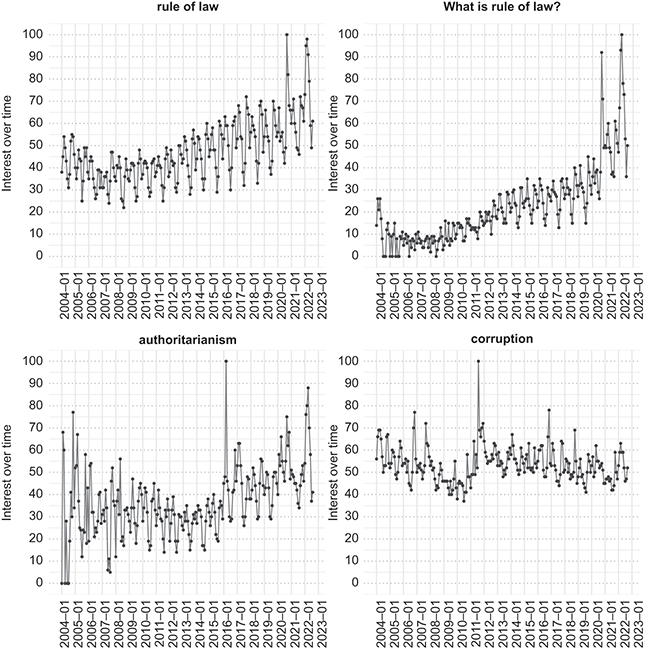
Percentage of democratic vs. authoritarian regimes (2005–21).
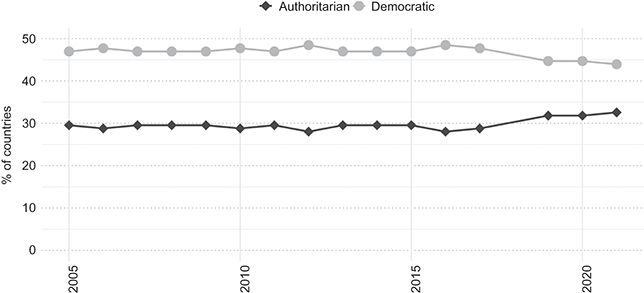
The main advantage of the WJP data is that it is multidimensional, which allows us to explore variations across the different dimensions of the rule of law and not just variations in aggregate scores. The underlying data captures information not only on respect of the law by state agents (or on the functioning of institutional checks and balances) but also on the state’s effectiveness in ensuring that citizens respect the law, enjoy their rights, and obtain access to justice. The data can be reorganized to form new indicators that approximate concepts used in different definitions, including those proposed by Shaffer and Sandholtz.Footnote 23 A further advantage is the data’s numerical nature, which allows us to calculate changes in the different indicators in percentage instead of ordinal terms, and to construct scores from a large number of variables that cover multiple facets of the concepts evaluated. The main disadvantage is that the time frame is relatively short. Nevertheless, the data covers the period of interest. Additionally, the data is based on perceptions and may not reflect the true underlying situation. However, perceptions are important to legal orders as they shape the behavior and beliefs of actors.Footnote 24 To test our third hypothesis, we supplement the WJP data with the V-Party dataset. The latter allows us to construct variables on countries’ exposure to authoritarian regimes over the years. Specifically, we use the V-Party dataset to construct two variables on the political party platforms of candidates coming to power (i.e., antipluralism and populism).
In the analysis, we focus on the percentage changes in the various indicators of the dataset between 2015 and 2022. We use four sets of indicators. The first two are from the WJP: its aggregate rule-of-law indicator, which is an unweighted average of the eight factors that make up the WJP index, and the eight factors of its index. Third, we indicators to approximate the sources of arbitrariness described by Shaffer and Sandholtz. We construct these indicators using the factors and subfactors of the WJP index; however, the matching between the concepts behind the sources of arbitrariness and the data is not very close, as the index indicators come from a different conceptual framework. Fourth, we approximate the indicator of application of law to rulers to the indicator of constraints on government powers of the WJP index (factor 1). This indicator measures the functioning of checks and balances, including legislative constraints, judicial constraints, auditing and review, sanctions, nongovernmental checks, and legally compliant power transitions.
The indicator of predictability of published rules is equivalent to the open government indicator (factor 3). This indicator measures the openness of government defined as “the extent to which a government shares information, empowers people with tools to hold the government accountable, and fosters citizen participation in public policy deliberations.”Footnote 25 The indicator of fora for challenges is equivalent to the civil justice indicator (factor 7), which measures “whether ordinary people can resolve their grievances peacefully and effectively through the civil justice system,”Footnote 26 and the indicator of proportionate link of means to end and reason-giving is the average of the indicators of judicial constraints (subfactor 1.2) and the absence of improper government influence in civil and criminal justice (subfactors 7.4 and 8.6, respectively). Finally, we also use indicators to capture the concept of control of authoritarianism (or anti-authoritarianism), control of particularism (or anti-particularism), and state capacity. We constructed the anti-authoritarianism indicator using the average of the scores of the indicators of constraints on government powers (factor 1), fundamental rights (factor 4), open government (factor 3) and absence of improper government influence in civil and criminal justice (average of sub-factor 7.4 and 8.6). The anti-particularism indicator is equal to the absence of corruption indicator (factor 2), while the state capacity indicator is the average of the indicators of absence of crime (subfactor 5.1), regulatory enforcement (factor 6), and civil justice and criminal justice (factors 7 and 8). We focus on changes over the last seven years because in most countries changes in the rule of law from one year to the next remain relatively small. In part of our analysis we nonetheless show changes over different time periods in order to encompass variations in indicators when a new administration takes over. Table 3.1 describes the factors used as measures in the WJP Rule of Law Index.
| Factor | Concepts measured |
|---|---|
| 1. Constraints on government powers | Factor 1 measures the extent to which those who govern are bound by law. It covers the means, both constitutional and institutional, by which the powers of the government and its officials and agents are limited and held accountable under the law. It also includes nongovernmental checks on the government’s power, such as a free and independent press. This indicator addresses the effectiveness of the institutional checks on government power by the legislature (1.1), the judiciary (1.2), and independent auditing and review agencies (1.3), as well as the effectiveness of nongovernmental oversight by the media and civil society (1.5), which play an important role in monitoring government actions and holding officials accountable. The extent to which transitions of power occur in accordance with the law is also examined (1.6). In addition to these checks, this factor also measures the extent to which government officials are held accountable for official misconduct (1.4). |
| 2. Absence of corruption | Factor 2 measures the absence of corruption in a number of government agencies. The factor considers three forms of corruption: bribery, improper influence by public or private interests, and misappropriation of public funds or other resources. These three forms of corruption are examined with respect to government officers in the executive branch (2.1), the judiciary (2.2), the military and police (2.3), and the legislature (2.4), and encompass a wide range of possible situations in which corruption – from petty bribery to major kinds of fraud – can occur. |
| 3. Open government | Factor 3 measures open government defined as a government that shares information, empowers people with tools to hold the government accountable, and fosters citizen participation in public policy deliberations. The factor measures whether basic laws and information on legal rights are publicized and evaluates the quality of information published by the government (3.1). It also measures whether requests for information held by a government agency are properly granted (3.2). Finally, it assesses the effectiveness of civic participation mechanisms – including the protection of freedoms of opinion and expression, assembly and association, and the right to petition (3.3), and whether people can bring specific complaints to the government (3.4). |
| 4. Fundamental rights | Factor 4 measures the protection of fundamental human rights. It encompasses adherence to the following fundamental rights: effective enforcement of laws that ensure equal protection (4.1), the right to life and security of the person (4.2), due process of law and the rights of the accused (4.3), freedom of opinion and expression (4.4), freedom of belief and religion (4.5), the right to privacy (4.6), freedom of assembly and association (4.7), and fundamental labor rights, including the right to collective bargaining, the prohibition of forced and child labor, and the elimination of discrimination (4.8). |
| 5. Order and Security | Factor 5 measures how well a society ensures the security of persons and property. Security is a defining aspect of any rule of law society and a fundamental function of the state. It is also a precondition for the realization of the rights and freedoms that the rule of law seeks to advance. This factor encompasses the effectiveness in controlling crime (5.1), the limitation of civil conflict (5.2), and the prevention of resorting to violence to redress personal grievances (5.3). |
| 6. Regulatory enforcement | Factor 6 measures the extent to which regulations are fairly and effectively implemented and enforced. Regulations, both legal and administrative, structure behaviors within and outside of the government. Strong rule of law requires that these regulations and administrative provisions are enforced effectively (6.1) and are applied and enforced without improper influence by public officials or private interests (6.2). Additionally, strong rule of law requires that administrative proceedings are conducted timely, without unreasonable delays (6.4), that due process is respected in administrative proceedings (6.3), and that there is no expropriation of private property without adequate compensation (6.5). |
| 7. Civil justice | Factor 7 measures whether ordinary people can resolve their grievances peacefully and effectively through the civil justice system. The delivery of effective civil justice requires that the system be accessible and affordable (7.1), free of discrimination (7.2), free of corruption (7.3), and without improper influence by public officials (7.4). The delivery of effective civil justice also presupposes that court proceedings are conducted in a timely manner and are not subject to unreasonable delays (7.5). Finally, recognizing the value of alternative dispute resolution (ADR) mechanisms, this factor also measures the accessibility, impartiality, and efficiency of mediation and arbitration systems that enable parties to resolve civil disputes (7.7). |
| 8. Criminal justice | Factor 8 evaluates the criminal justice system. An effective criminal justice system is a key aspect of the rule of law, as it constitutes the conventional mechanism for redressing grievances and bringing action against individuals for offenses against society. Effective criminal justice systems are capable of investigating and adjudicating criminal offenses successfully and in a timely manner (8.1 and 8.2), through a system that is impartial and nondiscriminatory (8.4), as well as free of corruption and improper government influence (8.5 and 8.6), all while ensuring that the rights of both victims and the accused are effectively protected (8.7). The delivery of effective criminal justice also needs correctional systems that effectively reduce criminal behavior (8.3). Accordingly, an assessment of the delivery of criminal justice should take into consideration the entire system, including the police, lawyers, prosecutors, judges, and prison officers. |
IV Empirical Analysis
1 Is the Rule of Law in Decline?
We first explore the hypothesis that the rule of law has been in decline around the world since 2015 and identify the types of countries in which it has regressed. Table 3.2 shows the percentage changes in the rule-of-law scores for the 102 countries analyzed between 2015 and 2022. Three facts stand out. First, the aggregate rule-of-law score has dropped over time. The average percentage change revealed by this indicator during the period of analysis was −3.1 percent. Approximately 74 percent of countries experienced a decline during these years, in some cases of significant magnitude, and only a few experienced improvements. Those that experienced a decline represent 69 percent of the world’s population. Figure 3.3 presents these changes in the form of a histogram. Moreover, the decline has affected all regions of the world, but particularly the Middle East and North Africa, Latin America, and East Asia and the Pacific.
| Backsliding | |||||||
|---|---|---|---|---|---|---|---|
| Country | Δ15–16 | Δ16–17 | Δ17–19 | Δ19–20 | Δ20–21 | Δ21–22 | Δ15–22 |
| Egypt, Arab Rep. | −16.7% | −1.0% | −1.1% | 0.1% | −2.8% | −3.7% | −23.5% |
| Cambodia | −12.2% | −1.1% | 0.5% | 0.7% | −2.3% | −2.3% | −16.1% |
| Venezuela, RB | −13.7% | 4.0% | −3.5% | −2.6% | −1.5% | 3.0% | −14.4% |
| Nicaragua | −1.1% | 3.2% | −6.9% | −2.6% | −3.7% | −3.0% | −13.6% |
| Myanmar | 4.0% | −3.2% | −0.5% | 0.0% | −6.3% | −6.6% | −12.3% |
| Belarus | 1.4% | −4.6% | 0.8% | −0.5% | −7.5% | −2.2% | −12.2% |
| Bolivia | −2.7% | −5.2% | 0.0% | 0.3% | 0.9% | −5.0% | −11.4% |
| Philippines | −3.6% | −7.7% | 0.4% | 0.8% | −2.9% | 1.7% | −11.0% |
| El Salvador | −3.2% | −2.8% | −0.4% | 3.2% | −3.3% | −4.1% | −10.3% |
| Poland | −0.2% | −5.8% | −0.9% | −1.1% | −2.4% | 0.2% | −9.9% |
| Turkey | −7.2% | −3.1% | 2.7% | 0.3% | −2.5% | −0.3% | −9.9% |
| Mexico | −1.7% | −0.7% | −0.2% | −2.8% | −2.9% | −1.8% | −9.8% |
| Cameroon | −8.0% | −0.1% | 2.8% | −4.4% | −2.1% | 2.1% | −9.7% |
| Hungary | −1.3% | −3.9% | −2.2% | −1.1% | −1.4% | 0.8% | −8.8% |
| Georgia | −0.2% | −6.7% | −0.2% | −1.1% | 0.5% | −0.9% | −8.3% |
| Ghana | −3.7% | 2.4% | −2.5% | −1.9% | −2.2% | −0.5% | −8.2% |
| Bosnia and Herzegovina | −1.7% | −4.9% | −0.2% | −1.4% | −0.8% | 0.9% | −8.0% |
| Brazil | 2.9% | −3.1% | −1.2% | −2.9% | −2.9% | −0.5% | −7.6% |
| Iran, Islamic Rep. | 7.5% | 1.8% | −6.2% | −4.2% | −2.3% | −3.1% | −6.9% |
| Cote d’Ivoire | −1.4% | 1.4% | −1.3% | −0.4% | −3.4% | −1.2% | −6.1% |
| Albania | −3.2% | 0.8% | −0.3% | −1.2% | −1.7% | −0.6% | −6.1% |
| Bangladesh | −2.1% | 0.2% | 1.4% | −1.6% | −2.8% | −0.1% | −4.9% |
| China | 0.3% | 3.8% | −2.7% | −1.5% | −1.9% | −0.8% | −2.9% |
| Tanzania | −1.4% | 0.2% | −0.3% | 0.5% | −1.1% | −0.1% | −2.1% |
| Average | −2.9% | −1.5% | −0.9% | −1.1% | −2.5% | −1.2% | −9.7% |
| Neutral | |||||||
| Country | Δ15–16 | Δ16–17 | Δ17–19 | Δ19–20 | Δ20–21 | Δ21–22 | Δ15–22 |
| Korea, Republic of | −7.7% | −1.0% | 1.7% | 0.0% | 0.4% | −0.4% | −7.0% |
| Botswana | −9.9% | 1.3% | 1.3% | 1.7% | −1.5% | 0.7% | −6.9% |
| Morocco | 1.4% | −3.4% | −1.2% | −0.5% | −2.6% | −0.2% | −6.4% |
| Zambia | 0.5% | −0.8% | −1.2% | −2.6% | −2.3% | 0.0% | −6.4% |
| Honduras | −0.5% | −3.9% | −0.3% | 0.2% | −2.2% | 0.2% | −6.3% |
| Tunisia | −4.6% | 0.3% | −0.2% | 0.7% | −1.5% | −0.8% | −6.0% |
| Lebanon | −5.4% | 2.7% | 0.2% | −3.3% | −0.9% | 1.0% | −5.8% |
| Uganda | −4.1% | 2.6% | 0.6% | −1.8% | −0.9% | −0.7% | −4.3% |
| Russian Federation | −4.1% | 3.2% | 1.0% | −1.4% | −0.7% | −2.0% | −4.1% |
| Hong Kong SAR, China | 1.3% | −0.4% | −0.2% | −0.4% | −2.0% | −2.3% | −4.1% |
| Singapore | 1.0% | −2.6% | 0.0% | −0.9% | −1.0% | −0.6% | −4.0% |
| Colombia | 1.2% | −0.4% | −1.4% | 0.8% | −2.2% | −2.0% | −4.0% |
| North Macedonia | −1.7% | −2.3% | 1.8% | −0.9% | −0.3% | −0.2% | −3.6% |
| Thailand | −0.3% | −1.8% | −0.4% | 0.9% | −2.2% | 0.1% | −3.6% |
| United States | 1.4% | −1.1% | −1.5% | −0.6% | −2.9% | 1.2% | −3.6% |
| United Arab Emirates | −2.1% | −1.5% | −0.7% | 0.6% | −0.9% | 1.2% | −3.6% |
| Liberia | 0.1% | 1.2% | 1.4% | −1.3% | −2.6% | −2.0% | −3.3% |
| Panama | −1.9% | −0.3% | −0.2% | 0.5% | −0.7% | −0.7% | −3.2% |
| Jordan | 4.1% | 1.5% | −4.8% | −0.1% | −3.0% | −0.6% | −3.2% |
| Madagascar | 0.6% | −3.9% | −1.4% | 2.4% | −0.6% | −0.1% | −3.2% |
| Peru | 3.1% | 1.7% | −2.9% | −1.5% | −2.0% | −0.8% | −2.6% |
| Vietnam | 2.9% | −2.1% | −2.4% | 0.6% | −0.6% | −0.7% | −2.3% |
| Austria | 1.3% | −2.4% | 1.0% | −0.6% | −0.6% | −1.0% | −2.3% |
| Chile | 0.8% | −2.4% | 1.5% | −0.9% | −0.8% | −0.2% | −2.0% |
| Portugal | 1.7% | 0.9% | −0.8% | −1.1% | −0.6% | −2.0% | −1.9% |
| Australia | 0.5% | 0.2% | −0.4% | −0.3% | −1.2% | 0.1% | −1.2% |
| India | 1.4% | 0.9% | −1.2% | −0.5% | −1.9% | 0.3% | −1.0% |
| France | −2.9% | 2.8% | 0.0% | −1.3% | −0.9% | 1.6% | −0.8% |
| New Zealand | 0.0% | −0.3% | −0.5% | 0.3% | 0.7% | −0.6% | −0.4% |
| Costa Rica | 0.4% | −0.1% | 0.3% | −0.5% | −0.8% | 0.4% | −0.2% |
| Japan | −0.8% | 1.1% | −0.8% | 0.0% | 0.8% | 0.0% | 0.3% |
| United Kingdom | 3.0% | −0.1% | −0.7% | −1.7% | −0.4% | 0.3% | 0.4% |
| Netherlands | 3.4% | −0.7% | −1.5% | −0.5% | −0.5% | 0.2% | 0.4% |
| South Africa | 1.7% | 0.3% | −1.6% | 1.4% | −0.4% | −1.0% | 0.4% |
| Guatemala | −0.1% | 0.1% | 4.6% | −2.3% | −1.2% | −0.6% | 0.4% |
| Sri Lanka | 0.6% | 2.8% | −0.9% | −0.2% | −3.0% | 1.2% | 0.4% |
| Uruguay | 1.9% | −1.9% | −0.6% | 0.7% | 0.6% | 0.0% | 0.5% |
| Sweden | 1.3% | 0.2% | −0.4% | 0.2% | 0.0% | −0.5% | 0.8% |
| Dominican Republic | −3.4% | −0.4% | −0.4% | 3.1% | 0.0% | 2.1% | 0.9% |
| Pakistan | 1.1% | 1.9% | −0.2% | −0.7% | −0.4% | −0.6% | 1.0% |
| Belize | −2.8% | −0.2% | 0.8% | 0.1% | 0.0% | 3.6% | 1.3% |
| Nigeria | 9.0% | −1.2% | −1.0% | −0.9% | −3.7% | −0.2% | 1.5% |
| Croatia | 1.0% | 1.0% | −0.6% | 1.1% | −1.0% | 0.7% | 2.3% |
| Norway | 1.7% | 0.8% | 0.7% | 0.1% | 0.5% | −1.5% | 2.3% |
| Romania | 6.6% | −0.7% | −1.9% | −1.5% | −0.8% | 0.9% | 2.4% |
| Canada | 3.8% | 0.3% | −0.1% | −0.2% | −1.0% | 0.1% | 2.9% |
| Slovenia | 1.9% | −0.3% | 0.5% | 1.7% | −0.4% | −0.4% | 3.0% |
| Average | 0.2% | −0.2% | −0.3% | −0.2% | −1.1% | −0.1% | −1.8% |
| Improving | |||||||
| Country | Δ15-16 | Δ16-17 | Δ17-19 | Δ19-20 | Δ20-21 | Δ21-22 | Δ15-22 |
| Ethiopia | −9.4% | −0.8% | 3.3% | 5.6% | −1.0% | −2.7% | −5.6% |
| Serbia | −0.7% | −0.3% | 0.1% | 0.6% | −1.8% | −0.9% | −3.0% |
| Afghanistan | −2.2% | −0.3% | 0.9% | 4.3% | −2.7% | −2.8% | −2.8% |
| Nepal | −2.2% | 1.1% | 0.8% | −0.7% | −1.1% | 0.5% | −1.7% |
| Kyrgyz Republic | −0.7% | 0.7% | 0.9% | 1.4% | −3.7% | −0.2% | −1.7% |
| Malaysia | −5.2% | −0.5% | 3.6% | 5.1% | −1.4% | −2.4% | −1.1% |
| Bulgaria | −0.8% | −2.4% | 2.4% | 0.5% | −1.0% | 0.8% | −0.6% |
| Senegal | 0.8% | −4.0% | 0.3% | −0.1% | 0.5% | 2.7% | 0.2% |
| Mongolia | 1.1% | 0.8% | 0.3% | −2.2% | 2.0% | −1.7% | 0.3% |
| Ecuador | −3.4% | 3.7% | 1.2% | 2.0% | −0.1% | −2.5% | 0.7% |
| Kenya | −3.5% | 4.0% | 0.5% | −0.2% | −0.9% | 1.0% | 0.7% |
| Indonesia | −0.1% | −0.9% | 0.9% | 1.3% | −1.0% | 1.2% | 1.3% |
| Czech Republic | 4.1% | −1.2% | −1.4% | 0.6% | −0.4% | 0.5% | 2.1% |
| Germany | 2.7% | 0.0% | 0.0% | 0.1% | 0.4% | −1.0% | 2.3% |
| Finland | 3.0% | −0.3% | 0.6% | −0.1% | 0.4% | −0.9% | 2.6% |
| Sierra Leone | 0.1% | −0.9% | −1.5% | 1.3% | 2.8% | ||
| Jamaica | 1.5% | 0.7% | −2.0% | 0.8% | 0.4% | 1.4% | 2.8% |
| Greece | −0.2% | 0.5% | 2.3% | −0.9% | −0.5% | 1.9% | 3.1% |
| Belgium | 2.8% | −2.0% | 2.4% | −0.5% | 0.6% | −0.1% | 3.1% |
| Denmark | 1.9% | 0.6% | 0.8% | 0.0% | 0.0% | 0.3% | 3.6% |
| Malawi | 0.7% | 0.6% | 0.8% | 0.7% | 1.0% | 0.2% | 4.0% |
| Italy | 0.1% | 0.6% | 0.9% | 0.5% | 0.2% | 1.6% | 4.1% |
| Ukraine | 1.9% | 1.6% | 1.0% | 0.8% | 0.6% | −1.3% | 4.7% |
| Kazakhstan | 1.3% | 2.2% | 0.9% | 0.9% | 0.3% | −0.9% | 4.9% |
| Argentina | 6.7% | 5.0% | 0.1% | −0.5% | −3.7% | −1.9% | 5.4% |
| Burkina Faso | 3.1% | 4.8% | 0.5% | −0.1% | −0.9% | −1.4% | 6.1% |
| Estonia | 1.8% | 1.2% | 1.3% | 0.0% | −0.1% | 1.7% | 6.2% |
| Spain | 2.0% | 0.9% | 2.4% | 1.3% | 0.1% | −0.2% | 6.6% |
| Zimbabwe | 0.8% | 0.6% | 7.1% | −1.5% | 0.0% | 0.7% | 7.7% |
| Moldova | 2.4% | −0.5% | −1.0% | 2.2% | 3.2% | 1.9% | 8.6% |
| Uzbekistan | −1.4% | 1.9% | 1.0% | 1.7% | 4.1% | 1.4% | 8.9% |
| Average | 0.3% | 0.6% | 1.1% | 0.7% | −0.3% | 0.0% | 2.5% |
Distribution of year-to-year changes in rule-of-law scores (2015 to 2022).
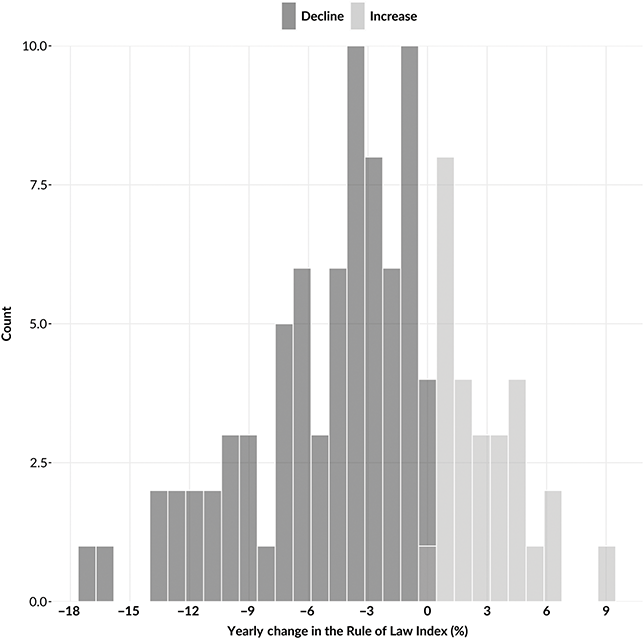
Second, rule-of-law backsliding has been more pronounced in countries that were already authoritarian and where the rule of law was already weak (i.e., Belarus, Cambodia, Nicaragua, and Venezuela) or in countries that have been exposed to emerging leaders with authoritarian tendencies (i.e., Brazil, El Salvador, Hungary, Poland, Philippines, Turkey). The average rule-of-law score for the ten countries in which the decline was steepest is 0.48, while the score for the remaining countries with negative changes is 0.58. In contrast, countries that experienced moderate declines between 0 and −5 percent during the study period (42 percent of the countries) are found across the entire rule-of-law spectrum. Countries that experienced improvements during these years comprise those that underwent ambitious reform processes (i.e., Kazakhstan, Moldova, and Uzbekistan), regime changes (Zimbabwe), changes of administration with ups and downs (i.e., Argentina and Burkina Faso), or minor improvements over the years (countries in the European Union). Finally, with the exception of countries that have experienced significant deterioration, in most countries the rule of law has waxed and waned over the years. In some cases, the rule of law strengthened at the beginning of the period and has weakened in recent years (i.e., Nigeria, Morocco, and Peru). In others, changes have occurred intermittently throughout the period (i.e., United Kingdom and South Africa). Interestingly, in some cases, year-to-year changes in the rate of changes – particularly when downwards – or changes from positive to negative, or vice versa, appear to be associated with changes in administration (i.e., Philippines in 2016, and the United States in 2016 and 2020). In other cases, however, they reflect small changes in the course of an administration (i.e., France since 2017). The greatest overall deterioration occurred notably during the COVID-19 pandemic.
Next, we explore changes in the index components and other indicators developed from the disaggregated data. Table 3.3 presents the descriptive statistics. In comparison with the overall rule-of-law scores, the scores for institutional checks on executive discretion, particularly factors 1 (constraints on government powers) and 4 (fundamental rights), have shown a much more pronounced deterioration during this period, both in terms of magnitude and number of countries. Factor 1 declines were experienced in 64 percent of countries and factor 4 declines in 76 percent of countries. The average percentage change for these indicators was −4.8 percent and −6.7 percent. The scores of other indicators constructed from the disaggregated data show similar trends. Scores for the sources of arbitrariness fell in more than 60 percent of countries, while those measuring anti-authoritarianism fell in 68 percent of countries (i.e., authoritarianism increased in 68 percent of countries), with the drop averaging −5.5 percent. In contrast, the indicators that measure the functioning of the legal system and, more broadly, the application of the law by state agents – i.e., security, regulatory enforcement, civil justice, and criminal justice – fell relatively little. Scores for the state capacity indicator fell in only 56 percent of countries, by an average of −0.3 percent.
| Scores | Changes over time | |||||
|---|---|---|---|---|---|---|
| Average score in 2015 | Average score in 2022 | Δ 2015–22 | Proportion of countries that improved | Proportion of countries that declined | Δ 2019–22 | |
| Rule-of-law score | 0.57 | 0.55 | -2.4% | 40% | 60% | −1.4% |
| F1. Constraints on government powers | 0.58 | 0.55 | -4.8% | 36% | 64% | −2.2% |
| F2. Absence of corruption | 0.52 | 0.51 | -0.9% | 40% | 60% | −1.9% |
| F3. Open government | 0.55 | 0.53 | -2.6% | 48% | 62% | −0.5% |
| F4. Fundamental rights | 0.60 | 0.57 | -6.3% | 24% | 76% | −2.7% |
| F5. Order and security | 0.73 | 0.73 | 0.0% | 44% | 66% | −0.3% |
| F6. Regulatory enforcement | 0.54 | 0.54 | 0.9% | 60% | 40% | −1.0% |
| F7. Civil justice | 0.55 | 0.54 | -1.1% | 46% | 54% | −1.2% |
| F8. Criminal justice | 0.49 | 0.48 | -1.8% | 44% | 56% | −1.2% |
2 Unpacking the Backsliding: Country Groupings
These findings suggest that the rule of law has indeed weakened worldwide, and this drop appears to have been caused by a weakening of limitations on the exercise of state power and a deterioration in fundamental rights (including the closure of civic space). In this section, we explore this hypothesis and unpack the backsliding of the rule of law. Given the slight variation in the aggregate scores, our analysis is based on variations over time in the different dimensions (or factors) of the WJP Rule of Law Index. We use cluster analysis to group countries according to how far each country lies from the others in terms of the overall change in factor scores between 2015 and 2022. To use the maximum possible variations, our main analysis focuses on the percentage change in the factor scores of the index. Later, we perform a similar analysis using the percentage change in the scores of the other two sets of indicators to classify countries. This numerical method allows us to organize the information efficiently and assign labels that provide a concise description of patterns of similarities and differences in rule-of law-trends. Once the information is organized, we can explore (a) the variations in the rule of law over time for the different countries, (b) the characteristics of the countries that have experienced declines, (c) the variations in the components of the index that explain the movements in the rule of law for different countries, and (d) factors that could be associated with the declines and, more broadly, with variations in the rule of law over time. Since the number of groups to classify is unknown, we use hierarchical clustering techniques.Footnote 27
In our analysis, we identify three clusters. The dendrogram in Figure 3.4 shows the distribution of countries in each of these clusters. The first cluster comprises seventeen countries, the second sixty-two countries, and the third twenty-three countries. These groups show clear differences in rule-of-law trends. The panels of Table 3.2 present the cluster in which each country is located: backsliding, neutral, or improving. Although there are some exceptions, the clusters closely resemble the patterns identified in this table showing the aggregate scores. Figure 3.5 shows the changes in the aggregate rule-of-law indicator for the countries in each of the three groups. The countries in the first cluster experienced a drop in the rule-of-law score of −9.7 percent during the period. We label this group the “severe backsliding” cluster. Countries in the second group underwent a decline, but not as severe, with an average change of −3 percent. We call this group the “moderate backsliding” cluster. In contrast, the countries in the third cluster slightly improved their scores during the period, with an average change of 2.5 percent. We call this group the “improving” cluster. The difference between the three groups is statistically significant at the 5 percent level.
Distribution of countries by cluster.
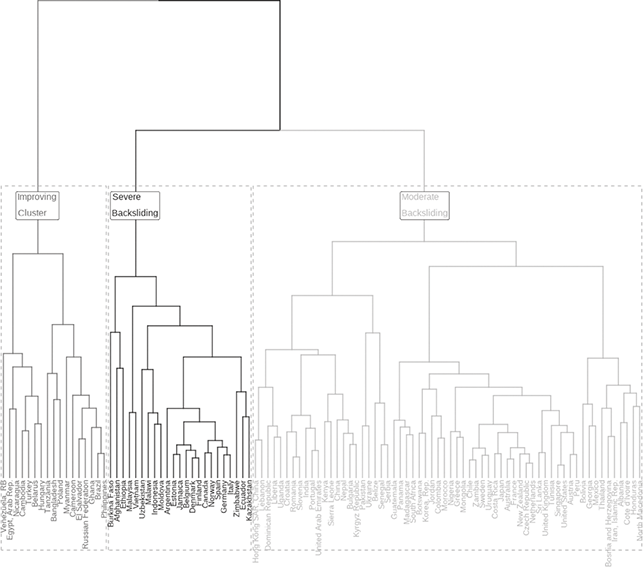
Percentage changes in rule-of-law scores between 2015 and 2022, by clusters.

Table 3.4 shows additional statistics for the countries in the three clusters. The first section (A) presents the distribution of the clusters by region, the second (B) by income level, and the third (C) by socioeconomic characteristics. The fourth section (D) shows the rule of law scores at the beginning of the period. Three points deserve attention. First, as shown in Table 3.3, backsliding occurred in all regions of the world. Second, severe backsliding occurred mainly in middle-income countries, while moderate backsliding occurred mainly in high- and middle-income countries. Finally, countries in the backsliding cluster had lower scores than the other countries in 2015. Figure 3.6 is a scatter plot showing changes in the WJP Rule of Law Index between 2015 and 2022 and the levels of the rule of law in 2015 for the three groups of countries. Countries in the first group tend to have lower levels of rule of law, with the exception of Poland, while those in the second and third groups are spread across the entire rule-of-law spectrum.
| Average for all countries | Backsliding | Neutral | Improving | |
|---|---|---|---|---|
| A. Distribution across regions | ||||
| EU, EFTA, and North America | 24% | 8% | 26% | 32% |
| East Asia and Pacific | 15% | 17% | 17% | 10% |
| Eastern Europe and Central Asia | 13% | 21% | 4% | 20% |
| Latin America and Caribbean | 19% | 25% | 21% | 10% |
| Middle East and North Africa | 7% | 8% | 11% | 0% |
| South Asia | 6% | 4% | 6% | 6% |
| Sub-Saharan Africa | 18% | 17% | 15% | 22% |
| B. Distribution across income groups | ||||
| High | 32% | 8% | 47% | 29% |
| Upper-middle | 30% | 42% | 28% | 26% |
| Lower-middle | 29% | 50% | 19% | 29% |
| Low | 8% | 0% | 6% | 16% |
| C. Socioeconomic characteristics | ||||
| Δ% GDP per capita (2015–22) | 1.13% | 0.57% | 2.15% | 1.24% |
| Unemployment rate (2015) | 7.46% | 7.35% | 7.31% | 7.74% |
| Share of world population (2021) | - | 37% | 48% | 15% |
| D.: Rule of law | ||||
| Rule-of-law score in 2015 | 0.57 | 0.48 | 0.61 | 0.56 |
Rule-of-law changes and levels, by clusters.

3 Drivers of the Decline
We next examine the main drivers of these rule-of-law patterns. Figure 3.7 shows the average change in the indicators (factors) of the WJP Rule of Law Index over the 2015–22 period for the countries in each of the three clusters. Three findings stand out. First, the indicators in each of the groups tend to move in the same direction. The countries in the severe backsliding cluster show a statistically significant drop in almost all indicators. The indicators in the moderate backsliding group experienced statistically significant declines in almost all indicators, albeit of lesser magnitude, while the indicators in the third group experienced improvements in most indicators. Second, the indicators that fell most in the severe backsliding cluster are those measuring constraints on government powers, fundamental rights, criminal justice, and open government, which fell by 20 percent, 21 percent, 17 percent and 13 percent respectively. The indicators measuring constraints on government powers and fundamental rights also fell in the moderate backsliding group and in some countries in the improving cluster. Figure 3.8, a scatter plot showing the percentage changes in these two indicators, confirms the clear differences that exist in these areas between the three groups of countries. The chart also reveals a clear link between checks and balances and the protection of individual rights. Finally, the indicators measuring corruption, order and security, regulatory enforcement, and civil justice fell much less in the countries in the severe backsliding cluster, declined slightly or remained unchanged in those in the moderate backsliding cluster, and improved in the third cluster countries.
Percentage changes in rule-of-law factor scores between 2015 and 2022, by clusters.
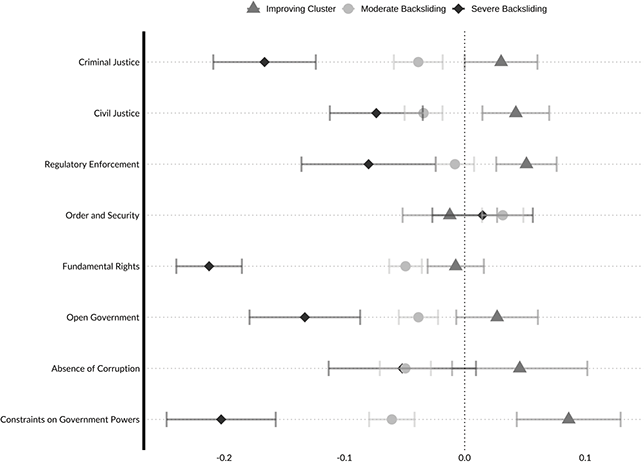
Percentage changes in scores for constraints on government powers and fundamental rights between 2015 and 2022, by clusters.

These differences between clusters are robust to different rule-of-law definitions. Figures 3.9 and 3.10 show the changes over time in different rule-of law-indicators for the three groups of countries. Figure 3.9 shows the average change in the indicators proposed by Shaffer and Sandholtz over the 2015–22 period for the countries in each of the three clusters. These indicators focus on the imposition of limits on the exercise of power. Countries in the first group (severe backsliding) suffered declines under all indicators, with more pronounced declines under those measuring application of the law to rulers and proportionate link of means to end and reason-giving. The countries in the second group (moderate backsliding) also worsened under all indicators, although to a lesser extent and in a more homogeneous manner. Finally, the indicators in the third group showed improvements in all areas. Figure 3.10 shows the average changes for the indicators measuring control of authoritarianism (anti-authoritarianism), control of particularism (anti-particularism) and state capacity. The results confirm the above patterns. Countries in the first group suffered significant declines according to the indicators measuring control of authoritarianism, and more moderate declines according to the other two indicators. The countries in the second group (moderate backsliding) suffered similar declines in all areas and of lesser magnitude. Countries in the third group improved in all areas.
Percentage changes in the scores under indicators measuring sources of arbitrariness between 2015 and 2022, by clusters.

Percentage changes in the anti-authoritarianism, anti-particularism and state capacity scores between 2015 and 2022, by clusters.
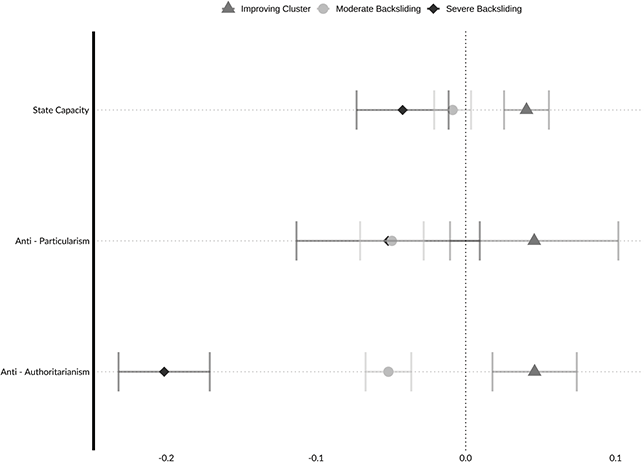
To explore the type of countries found in each of the groups, Figure 3.11 shows the percentage changes in different indicators over the study period and their levels in 2015. Consistent with the results in Table 3.2, rule-of-law backsliding has been more pronounced in authoritarian countries that began with weak rule of law. Countries with a less severe decline in the rule of law constitute a mixed group, some of them having strong institutions and higher levels of rule of law (France, Korea, Portugal), and others weak institutions and low levels of rule of law (India). Countries that have improved are either countries in transition, with weak rule of law, or countries with strong rule of law producing marginal changes. Although there is no single pattern, these results support the idea that the level of deterioration in the rule of law depends on the strength of institutions. Leaders of states with weak institutions have fewer constraints and can accelerate autocratization. In contrast, leaders of states with stronger institutions face greater constraints and checks, which serve as a buffer against backsliding. The source of these checks can be varied, and may include stronger legal and institutional frameworks, a developed bureaucracy, an effective opposition, a critical and free civil society and press, or free elections and democratic processes that allow for change of government.
Percentage changes (2015–22) and levels in 2015 for the indicators measuring constraints on government powers and fundamental rights, by clusters.

The clustering of countries may vary due to year-to-year variations in the different indicators or to different ways of organizing the rule-of-law data. To check the robustness of our results, we performed two exercises. First, we repeated the cluster analysis by changing the starting periods. We found that 47 percent of the countries in the 2015–22 severe backsliding cluster remained in this group in three of the five exercises conducted for the different study periods. This figure rose to 65 percent when we considered the countries in the severe and moderate backsliding groups. In contrast, many countries in the improving group moved after changing the initial periods.
These results make sense. The countries in the severe backsliding group have experienced a significant and steady deterioration in the rule of law, measured through declines in all or almost all of the index indicators/factors. In contrast, countries in the other groups have suffered less severe downturns, or even experienced improvements, but these have been of lesser intensity, shorter, and linked to changes in administrations throughout the study period. At the same time, these countries have made little progress in improving regulatory enforcement, fighting corruption, or advancing justice, their scores for the other index factors having changed (positively or negatively) to a lesser extent depending on the period of analysis. Second, we performed cluster analyses for the two groups of indicators explored above. In both cases, the classification yields three groups, one with severe declines and two other groups that are quite similar and less susceptible to change over the time period, in part because these exercises rely on fewer indicators. In spite of this, 82 percent of the countries in our original severe backsliding cluster fall into the clusters grouping countries with largest deteriorations resulting from the exercises involving the other two sets of indicators. In addition, we performed a cluster analysis on changes in index factors between 2015 and 2022 and the respective levels of these indicators in 2015. This analysis yielded a different classification comprising three groups: one similar to the severe backsliding cluster, another consisting of countries with high levels of rule of law, and a residual group containing the remaining countries.
Taken together, these results confirm the initial data trends. Of the countries in which the rule-of-law scores fell, 87 percent experienced a decline in the scores for constraints on government powers and 85 percent a decline in the scores for fundamental rights. In 79 percent of countries, both indicators fell. Similarly, 90 percent of countries in which the rules of law fell experienced a decline in the scores for freedom of opinion and expression or freedom of association, which are a proxy for civic space. These results lend support to our hypothesis that the deterioration in the rule of law is the result of a weakening of limitations on state power and a deterioration in fundamental rights, not the result of an increase in the level of particularism (or a rise in corruption) or a deterioration in the functioning of the legal system (i.e., law enforcement agencies, regulatory agencies, or judicial actors).
We now turn from manifestations of the decline trends in the rule of law to focus on political factors that could explain these trends. As we saw in Table 3.2, in many countries the rule of law moves in cycles – that is, an abrupt trend change between two years led to a situation that lasted several years until another abrupt trend change occurred. The length and extent of these cycles vary from country to country, which suggests that rule-of-law changes may be linked to changes in political leadership, and thus in the structure of government. Recent literature has shown that populism and antipluralistic trends are dangerous for the rule of law. According to the literature, populist and antipluralistic leaders rise to power because of the failure of governments, elites, and institutions to meet citizens’ growing demands. Such leaders use narratives centered on people and antigroups, often the political elite (antiestablishment). These narratives change little when the leaders come to power; on the contrary, they expand to include democratic institutions, media, and civil society. Bugaric and Kuhelj assert that the surge of populism and authoritarian populism in countries whose core principles no longer enjoy democratic support put the rule of law and liberal institutions in danger, largely because populist leaders have the legitimacy to change laws and even constitutions – as in Hungary – that protect minorities, limit discretion, and give voice to different political groups.Footnote 28 Sato and Arce argue that populist and antipluralistic leaders could be associated with democratic backsliding.Footnote 29 They found that the exclusionary rhetoric of populist leaders in some countries in Latin America and their attack on existing democratic norms have been used as a tool to win elections. In other cases, backsliding occurs through participatory processes, such as referendums or assemblies.Footnote 30
We examine this hypothesis using the V-Party dataset to construct a measure of exposure to authoritarian platforms. More specifically, we use two composite annual indicators based on the platforms and speeches of the political parties that have come to power in each country between 2015 and 2019:Footnote 31 (a) an antipluralism index that measures the extent to which representatives of a given party show a lack of commitment to democratic norms prior to elections; and (b) a populism index that measures the extent to which representatives of a given party use a populist rhetoric. The first indicator is an aggregate score that a group of experts assign to a political party based on the treatment of political opponents and minority groups by its leaders or the respect they show for free and fair elections or political freedoms, among other aspects. The second indicator is an aggregate score that a group of experts assign to a political party based on the use of antielite rhetoric or the frequency with which they glorify ordinary people and identify with them, among other aspects. We use these indices to define two binary variables that equal one if the head of government resulting from the election belongs to a political party whose antipluralism or populist index is above the seventieth percentile of the value for all parties recorded between 2015 and 2019. We say that a country experienced a change of party administration to an antidemocratic platform if at least one of these two variables is equal to one. Conversely, we say that a country experienced a change of party administration to a democratic platform if both these variables are equal to zero.
Table 3.5 shows the change in the rule of law between 2015 and 2022 for each of the countries in the three clusters, together with categorical variables indicating whether, during the 2015–19 period, there was a regime change in which the winning party used an antipluralist or populist (antidemocratic) platform, whether there was a regime change in which the winning party did not use either of these platforms (democratic), whether there was no platform change (although there may have been a change of party), or whether there were both democratic and antidemocratic changes in the country during the period of analysis. Although the data does not indicate whether the parties that came to power in 2019 were still in power in 2022 or whether there was a platform change after 2019, it reveals some interesting patterns. First, the vast majority of countries did not experience regime changes with different political platforms, which may simply reflect the shortness of the time frame. Despite this, the rule of law fell in many of them. Second, most of the countries listed as backsliding did not experience a regime change. This makes sense since many of those countries are autocracies, which supports the idea that a weakening of the rule of law, checks and balances, and accountability mechanisms tends to lead to a weakening of democratic processes. Nevertheless, several countries, including Poland, Turkey, Mexico, Brazil, Iran, and Côte d’Ivoire, did experience power changes and new leaders rising to power on antipluralist or populist platforms. On average, the rule of law in countries with no regime change and those with regime changes to antidemocratic platforms deteriorated by approximately the same amount within the backsliding cluster. Third, in general, the rule of law improved (or deteriorated less) in countries where leaders came to power on pluralist and nonpopulist (what we call democratic) platforms, compared to countries where the leaders used antipluralist or populist platforms.
| Backsliding | ||
|---|---|---|
| Country | Δ2015–22 | Regime change |
| Egypt | −23.5% | No change |
| Cambodia | −16.1% | No change |
| Venezuela | −14.4% | No change |
| Nicaragua | −13.6% | No change |
| Myanmar | −12.3% | Democratic to antidemocratic |
| Belarus | −12.2% | No change |
| Bolivia | −11.4% | No change |
| Philippines | −11.0% | No change |
| El Salvador | −10.3% | No change |
| Poland | −9.9% | Change to antidemocratic |
| Turkey | −9.9% | Antidemocratic |
| Mexico | −9.8% | Antidemocratic |
| Cameroon | −9.7% | No change |
| Hungary | −8.8% | No change |
| Georgia | −8.3% | No change |
| Ghana | −8.2% | No change |
| Bosnia and Herzegovina | −8.0% | Democratic/antidemocratic |
| Brazil | −7.6% | Antidemocratic |
| Iran | −6.9% | Antidemocratic |
| Côte d’Ivoire | −6.1% | Antidemocratic |
| Albania | −6.1% | No change |
| Bangladesh | −4.9% | No change |
| China | −2.9% | No change |
| Tanzania | −2.1% | No change |
| No change | −10.2% | 16 |
| Antidemocratic | −8.4% | 6 |
| Democratic | - | 0 |
| Democratic to antidemocratic | −10.2% | 2 |
| Neutral | ||
| Country | Δ2015–22 | Regime change |
| Korea, Republic of | −7.0% | Democratic |
| Botswana | −6.9% | No change |
| Morocco | −6.4% | No change |
| Zambia | −6.4% | No change |
| Honduras | −6.3% | No change |
| Tunisia | −6.0% | No change |
| Lebanon | −5.8% | No change |
| Uganda | −4.3% | No change |
| Russian Federation | −4.1% | No change |
| Hong Kong SAR, China | −4.1% | No change |
| Singapore | −4.0% | No change |
| Colombia | −4.0% | Antidemocratic |
| Thailand | −3.6% | Democratic |
| Thailand | −3.6% | Antidemocratic |
| United States | −3.6% | Antidemocratic |
| United Arab Emirates | −3.6% | No change |
| Liberia | −3.3% | No change |
| Panama | −3.2% | Antidemocratic |
| Jordan | −3.2% | No change |
| Madagascar | −3.2% | No change |
| Peru | −2.6% | Democratic |
| Vietnam | −2.3% | No change |
| Austria | −2.3% | Democratic |
| Chile | −2.0% | Democratic |
| Portugal | −1.9% | Democratic |
| Australia | −1.2% | Democratic |
| India | −1.0% | Antidemocratic |
| France | −0.8% | Democratic |
| New Zealand | −0.4% | Democratic |
| Costa Rica | −0.2% | Antidemocratic |
| Japan | 0.3% | No change |
| United Kingdom | 0.4% | No change |
| Netherlands | 0.4% | No change |
| South Africa | 0.4% | No change |
| Guatemala | 0.4% | Democratic/antidemocratic |
| Sri Lanka | 0.4% | Anti-democratic |
| Uruguay | 0.5% | Democratic |
| Sweden | 0.8% | Democratic |
| Dominican Republic | 0.9% | No change |
| Pakistan | 1.0% | Antidemocratic |
| Belize | 1.3% | No change |
| Nigeria | 1.5% | Antidemocratic |
| Croatia | 2.3% | Democratic |
| Norway | 2.3% | Democratic |
| Romania | 2.4% | No change |
| Canada | 2.9% | Democratic |
| Slovenia | 3.0% | Democratic |
| No change | −2.9% | 22 |
| Antidemocratic | −1.4% | 9 |
| Democratic | −0.7% | 15 |
| Democratic/antidemocratic | 0.4% | 1 |
| Improving | ||
| Country | Δ2015–22 | Regime change |
| Ethiopia | −5.6% | No change |
| Serbia | −3.0% | Anti-democratic |
| Afghanistan | −2.8% | No change |
| Kyrgyz Republic | −1.7% | No change |
| Malaysia | −1.1% | Antidemocratic |
| Senegal | 0.2% | No change |
| Mongolia | 0.3% | Antidemocratic |
| Ecuador | 0.7% | No change |
| Kenya | 0.7% | Democratic/antidemocratic |
| Indonesia | 1.3% | Antidemocratic |
| Czech Republic | 2.1% | Democratic/antidemocratic |
| Germany | 2.3% | No change |
| Finland | 2.6% | Democratic |
| Greece | 3.1% | Democratic |
| Greece | 3.1% | Antidemocratic |
| Belgium | 3.1% | Democratic |
| Denmark | 3.6% | Democratic |
| Malawi | 4.0% | No change |
| Italy | 4.1% | Democratic |
| Ukraine | 4.7% | Antidemocratic |
| Kazakhstan | 4.9% | No change |
| Argentina | 5.4% | Democratic/antidemocratic |
| Burkina Faso | 6.1% | Democratic/antidemocratic |
| Estonia | 6.2% | Democratic |
| Spain | 6.6% | Democratic |
| Zimbabwe | 7.7% | No change |
| Moldova | 8.6% | Antidemocratic |
| Uzbekistan | 8.9% | No change |
| No change | 1.9% | 10 |
| Antidemocratic | 2.0% | 7 |
| Democratic | 4.2% | 7 |
| Democratic To antidemocratic | 3.6% | 4 |
Taken together, these results show that the rule of law has indeed deteriorated in most countries around the world. In some countries, this deterioration has been continuous; in others, it has varied over the years. The deterioration in the rule of law is associated with a weakening of limitations on state power, as measured by governmental and nongovernmental checks and balances and the protection of fundamental rights and freedoms. Except in those cases that have experienced a sharp decline, the weakening of the rule of law is not associated with an acute deterioration in the application or enforcement of the law or diminished access to justice. These indicators, however, have shown little improvement in recent years. The weakening of the rule of law appears to be associated, in part, with an increase in the authoritarian tendencies of already authoritarian regimes and, in part, with the rise of antipluralist and populist leaders. In general, the rule of law has strengthened in most high-income countries (although the United States is a noteworthy exception), which reveals an emerging global divergence between high-rule-of-law countries (liberal democracies) and low-rule-of-law countries (autocracies).
V Conclusion
In this chapter we have presented evidence of the backsliding in the rule of law around the world. This deterioration has been caused by the weakening of institutional checks and balances and the closing of civic space, and has not been homogeneous around the world. This backsliding of the rule of law raises important challenges.
From an academic point of view, there are questions that require immediate attention. For example, what are the mechanisms that have led to rule-of law-backsliding? What factors explain this deterioration over time? What institutional or social safeguards are most effective in preventing this erosion? Is it possible to reverse these trends? How does this type of backsliding impact other rule-of-law outcomes? How does it affect other socioeconomic outcomes? Answering these questions requires detailed cross-country datasets that go beyond perceptions, case studies, and the segmentation of the problems analyzed. More importantly, it calls for the rule of law to be understood as the result of interplay between a multiplicity of institutions and actors, each with differing degrees of power and incentives.
From a practical point of view, the deterioration of the rule of law can have an enormous social impact. The weakening of institutional checks and balances – by restricting the independence and autonomy of democratic institutions and closing civic spaces – reduces government accountability and the incentives of state agents to deliver results or improve their performance, as well as the ability of citizens to exert pressure or seek change through the ballot box. This is particularly worrisome, given other shortcomings in the rule of law that afflict people around the world – i.e., corruption, violence, legal marginalization, and lack of access to justice. Meanwhile, this deterioration continues to expand across the apparatus of government and the legal system, becoming all the harder to reverse.
Combating these tendencies is a complicated political problem, given the lack of incentives for authoritarian leaders and power groups to accept being bound by certain rules and the citizens’ growing disaffection with existing institutions and the establishment that populist and antipluralist leaders have been quick to exploit. That said, the fact that rule-of-law backsliding is often gradual means that it potentially can be reversed if a new administration that is more committed to the rule of law takes office.


 Open access