Introduction
Alzheimer's disease (AD) is a chronic, degenerative brain disease that causes deterioration in the mind, memory, and behavior of patients (Au et al., Reference Au, Lau, Koo, Cheung, Pan and Wong2009). AD is the most common neurodegenerative disorder, it affects almost 30 million people worldwide (Au et al., Reference Au, Lau, Koo, Cheung, Pan and Wong2009). The number of people affected in Saudi Arabia is not known due to insufficient information regarding the current prevalence, but a community study reported prevalence of 0.22/10,000 among neurological patients (Al Rajeh et al., Reference Al Rajeh1993). The website of the Ministry of Heath quotes that of the 50,000 Saudis affected by the disease, most are females. The Saudi AD Association indicates that the chances of getting the disease double every five years among individuals aged 65 years and over, whereas half of those aged over 85 years were diagnosed with the disease (Ministry of Health Portal, 2013).
Caring for someone with AD is very challenging, due to the progressive nature of the disease, the demand for care increases and it becomes very taxing for the caregiver, increasing the risk of physical and psychiatric illnesses, as well as exerting a financial impact on the caregiver (Piercy et al., Reference Piercy2012). This may be especially the case in Saudi Arabia. The healthcare system in Saudi Arabia developed over time and the researchers show that there are positive effects to the increased attention healthcare received since it has been prioritized by the government (Qureshi et al., Reference Qureshi, Al-Habeeb and Koenig2013). However, the healthcare system still suffers from some significant disadvantages. For example, there is insufficient Saudi healthcare staff, services provided by the system are free, but that creates extremely high demand that leads to poorer quality of services. Additionally, there is no crisis management policy at the national level and a number of healthcare facilities are out of reach for most users of the healthcare system (Qureshi et al., Reference Qureshi, Al-Habeeb and Koenig2013).
Research studies have shown that caregivers of AD patients are at risk of developing anxiety and depressive symptoms or disorders (Draženka et al., Reference Draženka, Domagoj, Ana, Petrana and Vlado2014). Recently, there has been an escalating interest in the condition of caregivers. It has been shown that caregiver's anxiety and depression cannot be attributed solely to the duties of care and assistance, there are other factors (e.g. social support) that can make a difference in the quality of life and depressive symptoms in the caregivers of AD patients (Gozzoli et al., Reference Gozzoli, Giorgi and D'Angelo2013).
In the literature, two types of caregivers are described – informal and formal caregivers. An informal caregiver is usually a family member, a friend, or neighbor taking care of the patient without receiving any payment for it. Mahoney et al. (Reference Mahoney, Regan, Katona and Livingston2005) defined caregiver as someone who spends at least four hours a week caring for a patient with AD. On the other hand, a formal caregiver is a trained person, being paid for taking care of AD patients. For this study, only the role of informal caregivers was investigated and included.
In research studies, the profile of a primary informal caregiver usually matches a married female member of the family, about 60 years of age, either a daughter or a wife of the patient, residing in the same home, who spends almost three hours taking care of the basic activities of daily living, with a depressed mood and high levels of anxiety (Rodriguez et al., Reference Rodriguez, De Leo, Girtler, Vitali, Grossi and Nobili2003; García-Alberca et al., Reference García-Alberca, Lara and Berthier2011). The support that informal caregivers usually provide has been divided into four distinct categories including:
-
1. personal care such as bathing, toileting, eating etc.;
-
2. healthcare, e.g. giving medicines and injections, taking care of doctors’ appointments;
-
3. daily household chores, e.g. preparing meals, cleaning, doing laundry, etc.;
-
4. aide service for transportation and shopping
-
5. (Riedel et al., Reference Riedel, Fredman and Langenberg1998; García-Alberca et al., Reference García-Alberca, Lara and Berthier2011).
The stress resulting from the duties performed as the caregiver of an AD patient has often been termed as the caregiver burden. Gozzoli et al. (Reference Gozzoli, Giorgi and D'Angelo2013) describe it as the burden that caregivers’ experience, often leading to an extensive and protracted condition of stress and anxiety. Rodriguez et al. (Reference Rodriguez, De Leo, Girtler, Vitali, Grossi and Nobili2003) investigated aspects of life affected most by the caregiver burden and reported that the responses of the participants fell into the categories of sleep disorders (in 80%), depressive symptoms (in 30%), non-availability of any free time (in 28%), continuous need for assistance due to social isolation and continuous mental stress (in 16%), and loss of friendships (in 15%).
The most common scales used in research to assess the caregiver burden are the Hamilton Depression Rating Scale (HDRS), State-Trait Anxiety Inventory (STAI), and the number of hours of attention to the basic activities of daily-living (Mahoney et al., Reference Mahoney, Regan, Katona and Livingston2005; García-Alberca et al., Reference García-Alberca, Lara and Berthier2011; Draženka et al., Reference Draženka, Domagoj, Ana, Petrana and Vlado2014; Samadi et al., Reference Samadi, Mokhber, Faridhosseini, Baghban Haghighi and Assari2015). The prevalence of depression in these caregivers, as estimated in several studies, ranges from 11% to 23% (Mahoney et al., Reference Mahoney, Regan, Katona and Livingston2005; Samadi et al., Reference Samadi, Mokhber, Faridhosseini, Baghban Haghighi and Assari2015). However, Draženka et al. (Reference Draženka, Domagoj, Ana, Petrana and Vlado2014) in their study from Croatia reported a higher percentage (27%) for pathological depression. This study further proclaimed these figures may increase up to 57% for depression, if caregivers with borderline HDRS score were also included in the count (Draženka et al., Reference Draženka, Domagoj, Ana, Petrana and Vlado2014).
Various factors associated with the depression and quality of life in informal caregivers of AD patients can be broadly categorized as care recipient factors and caregiver factors. Researchers have shown that the duration of disease, and patient's behavioral and cognitive status are the main care recipient predictors for caregiver's psychological stress and resultant dissatisfaction with life (Sansoni et al., Reference Sansoni, Anderson, Varona and Varela2013; Vespa et al., Reference Vespa2015). The level of depressive symptoms increases in a direct proportion to the duration and severity of the disease (García-Alberca et al., Reference García-Alberca, Lara and Berthier2011).
Other care recipient factors associated with the risk of depression in caregiver are male care recipient (being cared for by a female family member in 94% of cases), greater activity of daily life impairment and total Neuropsychiatric Inventory (NPI) score (Mahoney et al., Reference Mahoney, Regan, Katona and Livingston2005), and lower educational status of the patients (García-Alberca et al., Reference García-Alberca, Lara and Berthier2011).
From the point of view of the caregiver, the gender of a caregiver, total amount of time per day spent in care, physical and mental stress, social isolation, relationship of the caregiver with the patient, and presence of a support system are the main predictors affecting life satisfaction and depression risk in caregivers (Sansoni et al., Reference Sansoni, Anderson, Varona and Varela2013). Mahoney et al. (Reference Mahoney, Regan, Katona and Livingston2005) examined the independent predictors for anxiety and depression separately and found out that risk of depression was independently predicted by a higher NPI irritability score, along with the caregiver's perception of poor health and low quality of a relationship with the patient.
Yurtsever et al. (Reference Yurtsever, Özge, Kara, Yandım, Kalav and Yeşil2013) in their study used the multidimensional scale of perceived social support (MSPSS) to determine the caregiver's perceived social support status and a Zarit Burden Interview (ZBI) to assess the caregiver's care burden. The analysis of the results showed that older caregivers (more than 51 years old) showed significantly more care burden (higher ZBI score) and self-reported very poor social support (low MSPSS) as compared to younger caregivers. Similarly, married caregivers expressed greater care burden and less self-perceived social support (lower MSPSS and higher ZBI scores) compared to single caregivers. Education and socio-economic status correlated directly with the risk of depression, but the educational level showed an inverse correlation with ZBI scores showing that the higher the level of education of the caregiver, the lower the perceived care burden is. On the other hand, economic status displayed a positive correlation with MSPSS score revealing a better self-perception of social support in caregivers with better socio-economic background. Patients fully dependent on a caregiver were associated with higher care burden in caregivers as compared to semi-dependent patients (Yurtsever et al., Reference Yurtsever, Özge, Kara, Yandım, Kalav and Yeşil2013).
Due to its importance for this research topic, experts have adapted the stress and coping models in order to provide a theoretical model for understanding the caregiver's burden and stress. Haley et al. (1987) (as cited by Romero-Moreno et al., Reference Romero-Moreno, Márquez-González, Mausbach and Losada2011) explained in this model that despite the presence of similar conditions for all caregivers, outcomes in terms of mental health status, e.g. depression, differ greatly among caregivers. This is because moderator variables greatly influence the impact of stressors such as disruptive behavior of a patient on mental health outcomes of caregivers. Among these variables, social support and coping strategies are of special interest for the researchers involved in caregiver research (Romero-Moreno et al., Reference Romero-Moreno, Márquez-González, Mausbach and Losada2011).
Social support may be also categorized as formal and informal social support. The informal social support is provided without any pay by family members, friends, neighbors, and other community members. The activities of informal social support may adopt many forms such as considerable help in personal or household tasks, providing financial help through monetary assistance or other resources, providing companionship, advice or guidance, and emotional encouragement (Kaufman et al., Reference Kaufman, Kosberg, Leeper and Tang2010). Yurtsever et al. (Reference Yurtsever, Özge, Kara, Yandım, Kalav and Yeşil2013) suggested that despite the presence of strong stress factors, caregivers who received some type of social support were more likely to have a lower perceived care burden as compared to those without such social support. The study also reported that the provision of support from family or other informal social networks helped in alleviating the negative effects of the patient's cognitive and behavioral problems on the mental well-being of the caregiver.
Au et al. (Reference Au, Lau, Koo, Cheung, Pan and Wong2009) in their study aimed to explore the relationship of different types of social support to caregiver depression symptoms and quality of life. The tool used was the MacArthur Social Support Scale and the study results confirmed the researcher's hypothesis that informal social support played a significant role in better mental health outcomes for caregivers. The findings further displayed that regardless of the type of the social support, family members i.e. spouse and family were the main and strongest providers of social support especially emotional support, as compared to friends and relatives, and contributed toward lower levels of depression and improved life satisfaction in caregivers. However, the type and source of support influenced the caregiver's depressive symptoms and life satisfaction differently.
The present study
The morbidity due to psychiatric and neurological disorders including AD is underestimated in Saudi Arabia and rest of the Arab countries. This is because there is complete lack of epidemiological data regarding the prevalence of AD as well as the other aspects of disease, such as the risk factors both epidemiological and personal specific to the Saudi population; moreover, there is a scarcity of knowledge about the daily challenges that the patients and caregivers face. Continual improvement in the healthcare system with other social progress has increased average life expectancy in the Saudi population to 73.8 years, with male and female life expectancy being 72.8 and 75.2 years, respectively. This life expectancy exceeds the regional average by 5.8 years and exceeds the global average by 3.8 years (Ministry of Health – Saudi Arabia, 2012). With an aging population, the incidence of AD is expected to rise and according to the WHO dementia report, the Middle East and North Africa will see a 125% increase in cases by 2050 and it also estimates that almost 6% of those over 60 years of age would suffer from it (Abyad and Hammami, Reference Abyad and Hammami2016). With the typical Saudi tradition of respect for elderly adults and a very low trend of care in residential nursing homes, it is expected that the responsibility of taking care of AD patients would rest with the informal caregiver, and this informal caregiving system needs support (Abyad and Hammami, Reference Abyad and Hammami2016). Given this expectation, this study was very pertinent and much needed to understand if social support has any mediating effect on the relationship of depression and life satisfaction in caregivers of patients with AD in the Saudi population.
Participants
For this study, 122 caregivers of patients with AD were voluntarily recruited from the patients registered with Saudi AD Association and some Alzheimer's clinics in government hospitals. The varied selected caregivers were contacted in the clinics or at social events organized by the Alzheimer's association. Caregivers who met the inclusion criteria and gave written informed consent were included in the study. The sample was composed of participants from various regions of the Kingdom of Saudi Arabia.
Caregivers who were included were primary family caregivers of patients with AD who had given care to the patients for at least six months after the patient had been diagnosed with the disease and resided at the patient's home. Caregivers who were excluded were pregnant caregivers, persons with a history of depression, persons taking antidepressant or psychotropic drugs, and persons in recent mourning (less than six months). The interviews were conducted either at Saudi AD Association events, in Alzheimer's clinics in government hospitals, or at their homes.
A total of 122 care recipients of these caregivers were also included in the study. The diagnosis of AD was confirmed by experienced psychiatrists based on the diagnostic criteria in the Diagnostic and Statistical Manual of Mental Disorders – 4th Edition (DSM-IV) (American Psychiatric Association, 2000). The patients were either being cared for on an out-patient basis or receiving follow-up from these centers.
Measures
Caregiver's demographic data including age, gender, marital status, educational level, economic status based on the monthly income, and average number of hours as per information from caregivers (derived from daily time spent with the patient) was measured. Care recipients’ characteristics included gender, marital status, and duration of illness and receipt of any support in form of revenue was measured. The questionnaires were administered after translation into Arabic. The English versions of the questionnaires were adapted and translated using the back-translation method. After the translation process, final versions were checked once more to establish that they are similar to the original English versions. The following measuring scales for assessing caregivers’ informal social support, depressive symptoms, and general life satisfaction were used.
The multidimensional scale of perceived social support (MSPSS)
The MSPSS first developed by Zimet et al. (1988) is aimed to determine how social support factors are perceived by individuals. The scale measures support from family, friends, and significant others such as relatives; therefore, it is primarily used for evaluating informal support. The evaluation uses a Likert-type scale, with 12 questions, each of which offer seven reactions to choose from, ranging from 1 that corresponds to “very strongly disagree” to 7, meaning “very strongly agree.”
This scale has three subscales to evaluate support by family, friends, and significant others. All three subscales have four questions. Individual subscale scores vary between 4 and 28, and the total scores vary from 12 to 84. The higher the score, the more perceived social support the person is reporting. There have been many validation studies that have revealed MSPSS to be having well to excellent internal consistency and test-retest reliability with Cronbach's α of 0.81–0.98 in non-clinical samples, and 0.92–0.94 in clinical samples (Clara et al., Reference Clara, Cox, Enns, Murray and Torgrudc2003; Pedersen et al., Reference Pedersen, Yagensky, Smith, Yagenska, Shpak and Denollet2009). In the present sample, Cronbach's α values for the total score and support by family, friends, and significant others were 0.83, 0.83, 0.74, and 0.72, respectively.
Satisfaction with life scale (SWLS)
Developed by Diener et al. (1985), this is a five-item scale designed to assess the global cognitive judgments of one's life satisfaction.
Respondents indicated their agreement or disagreement with each of the five items using a seven point Likert scale, wherein responses range from 1 “strongly disagree” to 7 “strongly agree.” The scoring was continuous with adding up of scores on each item. Scores ranged from 5 being the minimum score to 35 being the maximum score. Higher scores represented higher satisfaction with life. SWLS has been assessed for its validity in various studies and it has shown adequate sensitivity to detect the degree of life satisfaction during the course of intervention and it shows a degree of temporal stability (e.g. 0.54 for four years) in longitudinal studies. Moreover, SWLS shows discriminant validity from emotional well-being measures (Pavot and Diener, Reference Pavot and Diener1993). In the present sample, Cronbach's α for the total score was 0.84.
Beck Depression Inventory 2nd Edition (BDI-II)
The Beck Depression Inventory – Second Edition (BDI-II) is designed to measure the severity of depression in adults and adolescents (13 years or older). The instrument consists of 21 items, based on diagnostic criteria in the DSM-IV.
The 21 items in the instrument were self-rated on a four point scale ranging from 0 to 3. According to the BDIII, total raw scores may range from 0 to 63, which then can be converted into descriptive classifications based on cut points as minimal, mild, moderate, and severe range of symptoms. The BDI-II items were developed to address all aspects of depression based on criteria in the DSM-IV.
Outpatients and studies examining the internal consistency reported Cronbach's α of 0.92–0.93 for different groups such as outpatient department patients or students. Significant correlations were observed when performing item total correlations with scores from different sample groups (Dozois et al., Reference Dozois, Dobson and Ahnberg1998). In the present sample, Cronbach's α for the total score and support by family, friends, and significant others was 0.87.
Data collection procedures
Approval was obtained to conduct the research investigation at the clinics prior to data collection. Consent was obtained from Alzheimer's clinics or social activities from Saudi AD Association first and from the caregivers of patients. Caregivers gave assent by signing a consent form prior to their participation in the study. Caregivers of patients were informed that participation was voluntary and that confidentiality of the data obtained continued even after the study results are disseminated. All caregivers were informed and a note was given about the objective of the study and the contents of the questionnaires and informed written consent was taken from the caregivers. The interviewers were given interviewing skills training on the three questionnaires prior to collecting data. The interviews were conducted with the caregivers before or after an appointment at Alzheimer's clinics or social activities at the Saudi AD Association.
Data analysis
The data were analyzed using SPSS v.23. Descriptive analysis was used to present demographic characteristics of caregivers and care recipients. Analytic techniques included correlation analyses as well as a series of regressions with the purpose of conducting moderator analysis. Bivariate correlations were conducted to evaluate relationships between caregiver and patient demographic information and depression, social support, and life satisfaction. The moderation analysis was conducted according to the guidelines provided by Hayes (2013). The first step in the analysis was checking whether both depression and social support are predictors of life satisfaction. In the next step, the actual moderator variable was computed by multiplying depression and social support. Finally, once the moderator variable was computed, it was included in the regression analysis as a predictor.
Results
Descriptive analysis
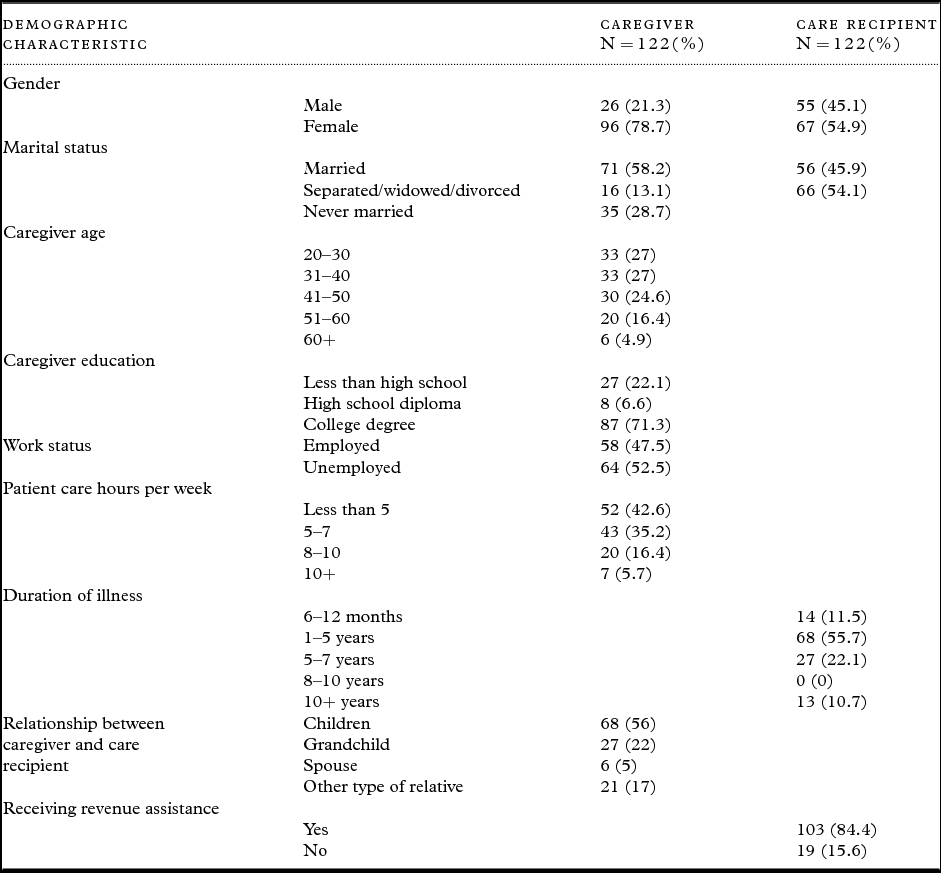
A total of 122 caregivers participated in this study. Age of caregivers was seen to be less than 50 years in most of the cases, 79% (n = 96) of caregivers were between the age of 20 and 50. Caregiver and care recipient demographic information showed that 79% (n = 96) of caregivers were females, as compared to care recipients in which 55% (n = 67) were female. Most of the caregivers were married (58%), followed by never married (29%), and only 13% were separated/widowed/divorced. In care recipients, a considerably higher proportion was separated/widowed/divorced (54%). Most of the caregivers had a college degree (71%) but surprisingly most were unemployed (52.5%). Majority of the caregivers (42%) spent less than five hours per week in patient care. In care recipients, 68 (58%) had a duration of illness between one and five years followed by five and seven years in 22% (n = 27) of patients. For the relationship between caregiver and care recipient, we found 58% (n = 68) were children (daughter/son), 22% (n = 27) were a grandchild, 17% (n = 21) were another type of family member, and 5% (n = 6) were a spouse.
Majority of patients received revenue support (84%). Details of the caregiver and care recipient demographic characteristics can be seen in Table 1.
Demographic characteristics of caregivers and care recipients

Descriptive statistics for measured variables
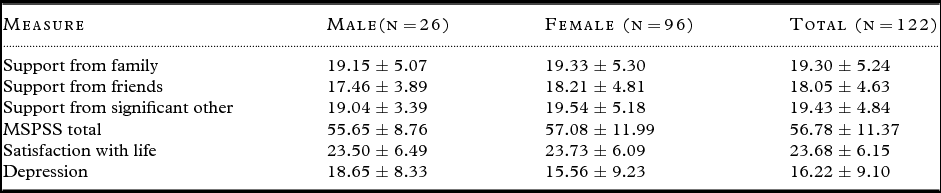
The descriptive statistics of the scores on the measured tools showed that the MPPSS total score was 57, which according to the MSPSS scoring falls in the category of moderate support. The perceived support in the sub-categories of friends, family, and significant others all came out as moderate support. The caregivers were observed to be “slightly satisfied” with their life, based on their score of satisfaction with life of 24 in males and females separately as well as the aggregated total. Mean depression scores for the caregivers as a total and for females and males were categorized under mild depression; however, the mean score in males (18.65 ± 8.33) was greater than the females (15.56 ± 9.23). The details of the descriptive statistics of measured variables are elaborated in Table 2.
Descriptive statistics of the measured variables

Note: MSPSS = the multidimensional scale of perceived social support.
Bivariate analysis
Bivariate correlations were conducted to evaluate relationships between caregiver and care recipient demographic information and depression, social support, and life satisfaction. Individuals on revenue support had lower life satisfaction scores (r = −0.302, p < 0.001) and lower total social support scores (r = −0.227, p < 0.05). Caregivers with higher economic status reported higher life satisfaction scores (r = 0.222, p < 0.05); however, given that relatively fewer participants reported high economic statuses, this result should be interpreted with caution. Because there were so few statistically significant correlations between demographic variables and depression, social support, or life satisfaction, demographic variables were not included in further regression analyses.
Correlation analysis
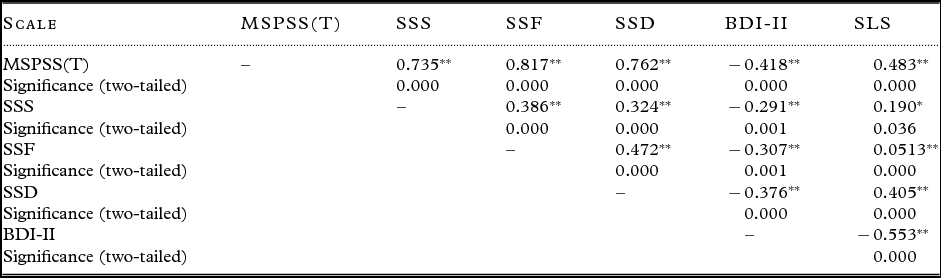
The regression analysis to report the correlations between social support, life satisfaction, and depression was conducted. Analysis showed that individuals who reported higher levels of social support also reported higher levels of life satisfaction, r = 0.483, p < 0.001. However, life satisfaction was positively correlated with social support from family and friends (r = 0.513 and 0.405, respectively, p < 0.001), but not from significant others. Depression was negatively correlated with social support (r = −0.418, p < 0.001) and life satisfaction scores (r = −0.553, p = < 0.001), thus showing that depression is associated both with decreased social support and life satisfaction. All three components of social support (significant other, family, and friends) correlated strongly with the total social support scores (r = 0.735, 0.817, and 0.762, respectively), suggesting the measure is structurally sound. Correlations between social support, depression, and life satisfaction are reported in Table 3.
The bivariate correlation between social support, depression, and life satisfaction

Note: MSPSS = the multidimensional scale of perceived social support (total degree), SSS = Social support significant other, SSF = social support family, SSD = social support friends, BDI-II = Beck Depression Inventory 2nd Edition (BDI-II), and SLS = satisfaction with life scale.
**Correlation is significant at the 0.01 level (two-tailed).
*Correlation is significant at the 0.05 level (two-tailed).
Regression analysis
A series of linear regressions as specified by Baron and Kenny (Reference Baron and Kenny1986) were conducted to examine a potential mediating effect of social support on the relationship between depression and life satisfaction using a program written by Dudley and Benuzillo (Reference Dudley and Benuzillo2004).
Baron and Kenny (Reference Baron and Kenny1986) outline several steps in a mediation analysis. First, a relationship between the independent variable and dependent variable must be established. Next, the relationship between the mediator and the dependent variable is examined. Finally, the mediating variable is included in the model with the independent variable such that both predict the dependent variable. If the relationship between the independent variable and the dependent variable fails to reach statistical significance in this model, the mediating variable can be considered a full mediator. If the relationship between the independent and dependent variable is still statistically significant, but is lower than in the original analysis, a Sobel test can be conducted to see if the mediating variable enacts enough of a change in the relationship between the independent variable and the dependent variable such that it can be considered a partial mediator.
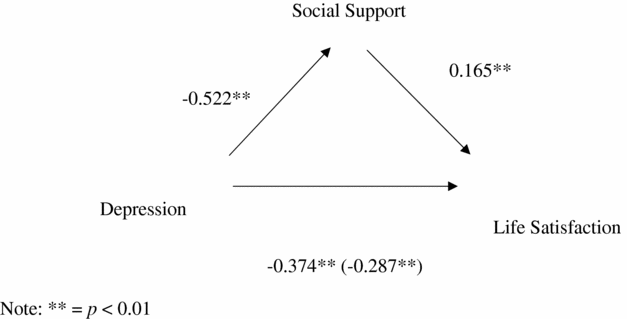
The first step of the analysis indicated a statistically significant effect of depression on life satisfaction, b = −0.374, t = −7.267, p < 0.001. The second step of the mediation analysis showed that the regression of life satisfaction scores on social support was also statistically significant, b = −0.522, t = −5.043, p < 0.001. The third step of the analysis showed a statistically significant effect of both depression and social support on life satisfaction, b = 0.165, t = 3.841, p < 0.001. Results of these analyses are displayed in Figure 1.
Mediation model of depression, social support, and life satisfaction. Note: **p < 0.01.

In other words, higher depression scores are generally predictive of both lower life satisfaction scores and low social support. However, having good social support can increase ratings of life satisfaction in some cases.
A Sobel test (Sobel, Reference Sobel1982) was then conducted to evaluate the extent to which social support acts as a mediator between depression and life satisfaction. In general, a Sobel test evaluates the extent to which a mediating variable mitigates the relationship between an independent variable and a dependent variable. The regression analysis has established that social support is a mediator in this model, Sobel tests ascertain how much of a mediator it is. The program written by Dudley and Benuzillo (Reference Dudley and Benuzillo2004) also provides a calculation of the Sobel test. Results indicated that social support is a partial mediator, mediating approximately 23.05% of the total effect of depression on life satisfaction (Sobel = −3.056, p = 0.002).
Further support for this model is provided by the findings of Wang et al. (Reference Wang, Cai, Qian and Peng2014) who found that social support can play a vital role as a mediator on depression. They found that the relationship between life stress and depression is affected by social support statistically in a significant way. Therefore, the results of this study are logical and in line with the findings of the previous literature.
Discussion
This research study explored the role of social support as a mediator variable on the relationship between depression and life satisfaction in AD caregivers in Saudi Arabia. The literature has cited various models elucidating the phenomenon of effect of mediator variables, one such model presented by Haley et al. (1987) (as cited by Romero-Moreno et al., Reference Romero-Moreno, Márquez-González, Mausbach and Losada2011) explained that despite the presence of similar conditions for all caregivers, outcomes in terms of mental health statuses e.g. depression and life satisfaction differ greatly among caregivers. This is because mediator variables, social support being the foremost amongst them, greatly influence the impact of these stressors (Romero-Moreno et al., Reference Romero-Moreno, Márquez-González, Mausbach and Losada2011). In congruence with this model, the study results showed that social support acts as a mediator, responsible for about 23% of the relationship between depression and life satisfaction in caregivers of AD patients. This study also showed that individuals who reported higher levels of social support also reported higher levels of life satisfaction, whereas depression was negatively correlated with both life satisfaction and social support .The results of this study are in agreement with the findings of previous studies exploring relationships of the social support and life satisfaction.
Further analysis of our findings showed that life satisfaction was positively correlated with social support from family and friends but not from significant others, which points to the presence of cultural differences in the value of informal social support. Earlier research studies, especially involving western cultures, have shown that friends were more likely to provide emotional support as compared to family members. Our study went a step further by making a distinction between family support and support from friends by introducing significant others, which proved to be relevant. The concurring findings in our study may also be resultant of the fact that Saudi culture also look up to social support from kin relationships rather than non-kin relationships.
Findings of this study also showed that individuals receiving revenue support had lower life satisfaction scores and lower total social support scores. This emphasizes the observations made by earlier research (Au et al., Reference Au, Lau, Koo, Cheung, Pan and Wong2009) that providing positive emotional support to the caregivers in form of companionship, support and showing regard for their feelings, can assist them in feeling loved and valued and can help in relieving the psychological distress brought on by caregiving.
As reported in earlier studies (Mittelman et al., Reference Mittelman, Roth, Coon and Haley2004; Draženka et al., Reference Draženka, Domagoj, Ana, Petrana and Vlado2014; Vespa et al., Reference Vespa2015), the caregivers in this study showed the presence of symptoms of depression, the aggregate score of depression, according to BDIII scoring, lay within the limits of the mild symptoms.
The majority of the caregivers in our study were females, as expected (Rodriguez et al., Reference Rodriguez, De Leo, Girtler, Vitali, Grossi and Nobili2003; García-Alberca et al., Reference García-Alberca, Lara and Berthier2011). It was also in line with expectations that female caregivers in our study reported higher levels of social support than male caregivers (Kaufman et al., Reference Kaufman, Kosberg, Leeper and Tang2010). Contrary to the findings of previous studies (Mahoney et al., Reference Mahoney, Regan, Katona and Livingston2005; Sansoni et al., Reference Sansoni, Anderson, Varona and Varela2013), our study results showed that depression scores were higher in male caregivers in comparison with female caregivers. This might be explained by the concurrent finding that most of the caregivers in this study had a college degree (71%), but most were unemployed (52.5%) and the stress of not being able to acquire employment due to caregiving responsibilities might increase the depressive symptoms in male caregivers. However, due to the small number of male caregivers in this study, no further analysis to examine possible explanations for this finding could be done.
Our study had a few limitations including, a small sample size especially of male caregivers that rendered further analyses of the exclusive male factors implausible, and the cross-sectional study design as it could not establish the cause-effect relationship between social support, depression, and life satisfaction. The study may be replicated with a longitudinal study design to affirm this association. The care recipient factors such as disease severity, psychological, and emotional impairment, greater activity of daily life impairment and total NPI score were not studied that might have a confounding effect on the relationship of depression in life satisfaction in caregivers.
In conclusion, the findings of this study showed that there is a possibility that social support can act as a mediator variable in relationship of depression and life satisfaction in caregivers of AD patients. The informal social support provided by the family and friends was found to be of greater significance. These results call for further research to explore other factors that contribute to the life satisfaction and depression in caregivers of persons with AD as there is only limited possibility for drawing conclusions as the research is descriptive. The role of caregiver is vital for the community care of AD patients and the role is expected to become more crucial with increasing numbers of the AD patients in Saudi Arabia.
Conflict of interest declaration
None.
Description of authors’ roles
S. Khusaifan collected the data and assisted with designed the study and writing the paper. M. El Keshky designed the study, collected the data, carried out the statistical analysis and wrote the paper.
Acknowledgments
This project was funded by the Deanship of Scientific Research (DSR), at King Abdulaziz University, Jeddah, under grant no. (G-282/ 246/1436). The authors, therefore, acknowledge with thanks DSR for technical and financial support.