Gut residence time (GRT) (the interval between first consumption of an item and its first appearance in faecal material) has often been reported to be extremely variable amongst crustaceans. For example Murtaugh (Reference Murtaugh1984) found GRT for the mysid Neomysis mercedis to vary from <1 to >13 h when fed on copepods followed by exposure to Daphnia. Median passage times defined as time for 50% of stomach contents to be egested were much longer (up to 151 h) for non-feeding mysids. The GRT is reported to be dependent on temperature (Chipps, Reference Chipps1998), food availability and possibly quality (Pond et al., Reference Pond, Priddle, Sargent and Watkins1995), ingestion rate and stomach content (Murtaugh, Reference Murtaugh1984), starvation period (Persson, Reference Persson1979) and egestion rate (Murtaugh, Reference Murtaugh1984; Roast et al., Reference Roast, Widdows and Jones2000). The purpose of this paper is to test how variable GRT is in mysids when they are feeding, and to examine whether there is a simple relationship between GRT and size within crustaceans when they are feeding. Ritz (Reference Ritz2000) showed that the metabolic rate of non-swarming mysids was much greater than that of swarming ones. An additional objective of the present paper was to test whether isolation influenced GRT.
The experimental animal was the mysid Paramesopodopsis rufa Fenton, a swarming species found in shallow waters around Tasmania (Fenton, Reference Fenton1992). Mysids were collected from Kingston (42°59′N 147°19′E) using a hand held net and transported to the university in 20-l containers. Prior to use in experiments they were transferred to 150 l holding tanks and fed daily with crushed fish pellets (Ritz et al., Reference Ritz, Osborn and Ocken1997). To measure gut passage time, mysids were tethered individually to fine wire rods (Metillo & Ritz, Reference Metillo and Ritz1993) and positioned in a perspex tank (35 × 15 × 15 cm) in the field of view of a stereo microscope to which a video camera was attached. Uptake of food and appearance of faecal pellets were clearly visible on the video monitor. Two sets of experiments were conducted, one in which the tethered individual was isolated in its tank and another set in which 20 free swimming mysids were added. Food (1 g powdered fish pellets suspended in 0.5 l seawater) was delivered within 10 mm of the tethered mysid continuously by means of a peristaltic pump through a fine plastic capillary tube. Estimated final concentration at the level of the mysid was estimated to be 2 × 10⁻⁴ %. Seawater temperature was 15.3 ± 1.5°C and salinity was 31.5 ± 1 ppt. A total of ten mysids was tested while isolated from conspecifics and ten were tested while free swimming mysids were present. Timing started when the peristaltic pump was switched on and food was delivered to the mysid. The total time interval between the start of feeding and voiding of the first faecal pellet was recorded, and also time for this pellet to pass from the first abdominal segment to the exterior. Once this had occurred the mysid was removed from the tether, measured and it was replaced with a fresh one. Mean length of mysids was 9.3 mm measured from the telson to the anterior margin of the eyes.
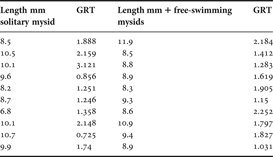
Results are given in Table 1. Gut residence time averaged 1.65 h (both experimental regimes combined; 1 SE = 0.42 h; range 0.725–3.121 h) from when feeding started, to when the first faecal pellet was voided. Time for this pellet to pass from the first abdominal segment to the exterior averaged 8.2 seconds. There was no significant difference between those mysids that were solitary and those accompanied by free swimming conspecifics (t18 = 0.012, P > 0.05), though it should be noted that the latter did not form a coherent swarm. Thus, when feeding continuously, GRT was quite consistent.
Gut residence time (GRT) for mysids (Paramesopodopsis rufa) held solitarily and together with free-swimming conspecifics, and fed continuously.

Murtaugh's (Reference Murtaugh1984) data yielded coefficients of variation (CV) of 0.51 and 1.09 for his experiments 1 and 2, respectively. My experiment (both regimes combined) yielded a CV of 0.35. A test of the difference between these values (Zar, 1984: p. 125) showed that both the former (F9,19 = 3.1 P = 0.05) and the latter (F20,19 = 10.58 P < <0.001) were significantly greater than for my data, i.e. Murtaugh's data showed a greater variability.
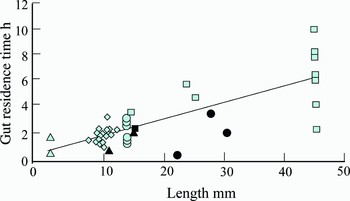
Figure 1 shows GRT vs length reported in the literature for a range of pelagic crustaceans (copepods, mysids, fairy shrimps and euphausiids) feeding continuously. Continuous feeding while animals were contained in various sized vessels, was induced by addition of charcoal particles (Pakhomov & Perissinotto, Reference Pakhomov and Perissinotto1996; Perissinnotto et al., Reference Perissinotto, Pakhomov, McQuaid and Froneman1997; Li et al., Reference Li, Sun and Zhang2001) following a method introduced by Willason & Cox (Reference Willason and Cox1987); by addition of concentrated zooplankton, mainly copepods (Atkinson & Snyder, Reference Atkinson and Synder1997), or ad libitum cladocerans (Chipps, Reference Chipps1998); and addition of carmine particles (Brendonck, Reference Brendonck1993). Note that individual sizes and individual GRT values are not always given by the authors. Where only a range is reported, average values have been used in compiling this figure. Apart from Antarctic species (0–1°C) and fairy shrimps (25°C), water temperatures were 15 ± 1°C. The relationship is given by:

Murtaugh (Reference Murtaugh1984) showed that there was an inverse relationship between gut passage time (GPT—assumed to be equivalent to GRT though not stated) and ingestion rate for Neomysis mercedis feeding on Daphnia. In his experiments, mysids were held singly and offered relatively low densities of food (up to 3.3 ind l−1). Gut residence time was generally between two and ten hours and he concluded that it was very variable.
The present results show that, provided animals are feeding continuously, GRT is linearly and positively correlated with body length. DeMott (personal communication) also showed that GPT increased linearly with increasing body size in Daphnia pulex feeding on green algae. Despite the fact that GRT is a function of water temperature (Chipps, Reference Chipps1998), it appears as though body size exerts a stronger influence since the temperatures incorporated into the data in Figure 1 range from about 0–25°C. Chipps (Reference Chipps1998) found that GRT of Mysis relicta was negatively correlated with temperature. Recent work by Fockedey et al. (Reference Fockedey, Mees and Vincx2005), suggests that GPT in Neomysis integer varies considerably depending on food source, so the relationship given here must be considered preliminary until more data are available.
Gut passage time vs length in a range of crustaceans: Δ, Calanus and Metridia—Li et al., Reference Li, Sun and Zhang2001; ◊, Paramesopodopsis rufa—this paper; □, Euphausia superba—Perissinotto et al., Reference Perissinotto, Pakhomov, McQuaid and Froneman1997; ○, Mysis relicta—Chipps, Reference Chipps1998; •, Euphausia crystallorophias—Pakhomov & Perissinotto, Reference Pakhomov, Perissinotto and Battaglia1997; ■, Euphausia pacifica—Willason & Cox, Reference Willason and Cox1987; ▴, Streptocephalus proboscideus—Brendonck, Reference Brendonck1993.

ACKNOWLEDGEMENTS
I am grateful to Liz Foster for help with these experiments and to Edwina Hollander with help locating references.