Introduction
Reptiles harbour a high diversity of parasites from different groups, including helminths (Carlson et al. Reference Carlson, Dallas, Alexander, Phelan and Phillips2020). Among reptiles, snakes act as intermediate, paratenic, or definitive hosts for a diverse range of helminth taxa (Kuśmierek et al. Reference Kuśmierek, Pyrka and Popiołek2020). In the Neotropics, biodiversity studies on reptile parasites in Peru and northeastern Brazil showed that among snakes, Nematoda exhibits the greatest species richness (Cuellar et al. Reference Cuellar, Sáez, Cantú, Sánchez, Mendoza, Conga, Cruces, Luque and Chero2022; Lacerda et al. Reference Lacerda, Santana, de Araújo Filho and Ribeiro2023). In contrast, in Argentina, the subclass Digenea (Platyhelminthes) represents the most diverse group of metazoan endoparasites. Despite the high richness of the phylum, studies on nematodes parasitic in snakes from Argentina remain incipient (Caraballo et al. Reference Caraballo, Ulibarrie, Hamann, Guerrero, Arzamendia and González2024).
Family Rhabdiasidae Railliet, 1916 (Nematoda: Rhabditida) includes more than 100 species that parasitize amphibians and reptiles (Kuzmin and Tkach Reference Kuzmin and Tkach2025). Species in this family exhibit homogonic or heterogonic life cycles, with or without an intermediate host. Larval females or mature parasites are fecundated by free-living males, producing numerous eggs, which develop into larval stages (Tkach et al. Reference Tkach, Kuzmin and Snyder2014), before colonizing the host. From this family, Acanthorhabdias Pereira, 1927, and Serpentirhabdias Tkach, Kuzmin and Snyder, 2014 are reported as parasites of snakes (Tkach et al. Reference Tkach, Kuzmin and Snyder2014).
Serpentirhabdias is a genus with 22 valid species described to date. This genus includes lungworms parasitizing exclusively snakes from the African, Australian, Holarctic, and Oriental realms. Forty-five percent of all described species from Serpentirhabdias are reported in the Neotropical snakes (Kuzmin and Tkach Reference Kuzmin and Tkach2025). This supports the hypothesis of the high potential diversity of Serpentirhabdias in the Neotropics, considering the high host diversity in this realm (Machado et al. Reference Machado, Kuzmin, Tkach, Nascimento dos Santos, Costa Gonçalves and Vasconcelos Melo2018). Life cycles in this genus are poorly understood to date, with only two Neotropical species with life cycle fully known (Kuzmin et al. Reference Kuzmin, Tkach and Vasconcelos Melo2020; Machado et al. Reference Machado, Kuzmin, Tkach, Nascimento dos Santos, Costa Gonçalves and Vasconcelos Melo2018). These life cycles are characterized by a combination of heterogony and direct development, with eggs maturing completely within the definitive host (Tkach et al. Reference Tkach, Kuzmin and Snyder2014).
Family Typhlopidae Merrem, 1820 comprises snakes inhabiting tropical and subtropical areas of Africa, Asia, Australia, and America, including 18 genera and 281 recognized species (Uetz et al. Reference Uetz, Koo, Aguilar, Brings, Catenazzi, Chang, Chaitanya, Freed, Gross, Hammermann, Hosek, Lambert, Sergi, Spencer, Summers, Tarvin, Vredenburg and Wake2021). In African typhlopids, aspects such as reproductive and ecological characteristics are well documented (Webb et al. Reference Webb, Branch and Shine2001). Contrastingly, in South America, some recent studies have focused on their cryptic diversity and comprehensive studies in ecological aspects of these species are still lacking (Graboski et al. Reference Graboski, Arredondo, Grazziotin, da Silva, Prudente, Rodrigues, Bonatto and Zaher2019, Reference Graboski, Arredondo, Grazziotin, Guerra–Fuentes, Da Silva, Prudente, Pinto, Rodrigues, Bonatto and Zaher2023).
Amerotyphlops brongersmianus (Vanzolini 1976) is the unique typhlopid reported in Argentina to date. The species distribution reaches Colombia to northern and central Argentina, including the Espinal, Humid Chaco, Dry Chaco, and Paranaense ecoregions. It has been reported in the provinces of Misiones, Corrientes, Entre Ríos, Santa Fe, Formosa, Chaco, Salta, Tucumán, Córdoba, and northeastern Buenos Aires (Williams et al. Reference Williams, Vera and Di Pietro2021). A. brongersmianus is an oviparous species with 7–11 eggs per clutch, with 55 days of incubation (Williams et al. Reference Williams, Vera and Di Pietro2021). It is fossorial, living mainly under rocks, foliage, and logs, where its main food source is adults and larvae of the orders Coleoptera, Hymenoptera (family Formicidae), Isoptera, and also earthworms (Williams et al. Reference Williams, Vera and Di Pietro2021). It is considered a species of least concern (Giraudo et al. Reference Giraudo, Arzamendia, Bellini, Bessa, Calamante, Cardozo, Chiaraviglio, Costanzo, Etchepare, Di Cola, Di Pietro, Kretzschmar, Palomas, Nenda, Rivera, Rodriguez, Scrocchi and Williams2012; Gutiérrez-Cárdenas et al. Reference Gutiérrez-Cárdenas, Caicedo, Rivas, Cacciali, Scott, Montero, Pelegrin, Kacoliris and Murphy2019), and although A. brongersmianus has been reported as a common species in the Argentine Humid Chaco, information on various aspects of its biology is scarce (Pesci et al. Reference Pesci, Sánchez, Muniz Leão and Pelegrin2018).
To date, two studies of the Brazilian Pantanal and Restinga, and Argentine Dry Chaco have included some population features of A. brongersmianus such as reproduction, sexual maturity and dimorphism, diet, and morphometric characters (Ávila et al., Reference Ávila, Ferreira and Souza2006; Pesci et al., Reference Pesci, Sánchez, Muniz Leão and Pelegrin2018; Khouri et al., Reference Khouri, Almeida-Santos and Fernandes2023; Sandoval et al., Reference Sandoval, Ruiz García and Álvarez2024).
The few helminthological records available for hosts of the Typhlopidae family worldwide were made during the 20th century (Baylis 1940 quoted in Sprent Reference Sprent1978; Schad Reference Schad1962; Sharpilo 1976 quoted in Baker Reference Baker1987; Barus and Coy Otero Reference Barus and Coy Otero1978). The most recent report is Kalicephalus viperae chunkingensis (Hsü 1934) Schad, Reference Schad1962 collected in Indotyphlops braminus (Daudin 1803), from the Philippines islands (Goldberg et al. Reference Goldberg, Bursey and Telford2005). In contrast, no surveys on helminths have yet been conducted on helminths in the family Typhlopidae in Argentina; there is a lack of research addressing the population ecology of helminths – such as their distribution in host populations, parasitological descriptors, seasonality, and intraspecific interactions – not only snakes in general but also in this family in particular (Caraballo et al. Reference Caraballo, Ulibarrie, Hamann, Guerrero, Arzamendia and González2024).
The study of helminth parasites, whether descriptive or quantitative, proves to be an interesting approach for gaining indirect knowledge about the diet and habitat use of amphibians and reptiles (Aho Reference Aho, Esch, Bush and Aho1990; Leung and Koprivnikar Reference Leung and Koprivnikar2019). The specificity and life cycles of helminth parasites provide important clues about the feeding and activity patterns of their hosts and allow us to infer how their ethology and ecology may influence the recruitment of these parasites, considering them as biological markers (Aho Reference Aho, Esch, Bush and Aho1990; Leung and Koprivnikar Reference Leung and Koprivnikar2019).
With the aim of increasing knowledge about the biodiversity of helminths of the family Typhlopidae in the Neotropical region, and evaluating the relationships between the biological characteristics of the host (such as sex, weight, and sexual maturity), parasitological descriptors, as well as metric characters, a component population of lungworms in A. brongersmianus from an area located in Argentine Humid Chaco was analyzed.
Materials and methods
Site of study
The study was carried out at the Centro de Ecología Aplicada del Litoral (CECOAL), a research institute located 8 km from Corrientes city (27°30’S, 58°45’W), northwest of the homonymous province, Argentina (Figure 1). A map showing the relative location of the site of study was created using ArcGIS Pro 10.5 (ESRI, 2016). Its extension preserves floristic and environmental elements of the Argentine Humid Chaco ecoregion (Morello et al. Reference Morello, Matteuci, Rodriguez and Silva2012). This ecoregion is characterized by forests with a dominant herbaceous component and the presence of permanent, semi-permanent, and temporary ponds. The mean annual temperature is 23°C and the mean annual precipitation is 1500 mm, without a defined dry season (Carnevali Reference Carnevali1994; Morello et al. Reference Morello, Matteuci, Rodriguez and Silva2012).
Relative geographical location of the study area and pitfall traps.

Environmental variables
Data on rainfalls and mean temperatures by season are presented by year in Table 1. Mean accumulated rainfalls and mean temperatures employed in subsequent analysis were calculated considering the sum of monthly precipitations and mean temperature for every season during the period of study (2013–2018). Environmental data was consulted on the Instituto Correntino del Agua y del Ambiente website (ICAA 2024).
Mean temperature (°C: Celsius grades) and rainfalls (mm: accumulated millimetres) by season in the period of study

Samplings and collection of lungworms
Samplings were made between November 2013 and February 2018 using six pit-fall trap systems without fixative, which allows surveying with live specimens. Traps were monitored daily in the morning and in the afternoon (15–20 consecutive days/month), and were covered through periods in which they were not checked, in order to prevent the accidental fall of individuals. Forty-six A. brongersmianus (Figure 2) were collected and euthanized with an intraperitoneal injection of carticaine clorhydrate, 4%; L-adrenaline 1:100.000 units. Snakes were weighed using an electronic scale in g and snout-vent length (SVL) was measured in mm. Mean ± one standard deviation (SD) was registered.
Amerotyphlops brongersmianus (Vanzolini 1976).

Lungworms were fixed in hot formaldehyde 10% v/v and studied in temporal mountings, clarified with Aman’s lactophenol, and observed with a Leica light microscope DM-200 with a micrometric scale for measurements. Photographs of parasitological material were obtained with a Leica DFC-295 digital camera adapted to a microscope. Body length measurements are given in micrometers (μm) as mean ± one standard deviation. Nematode systematics follows Anderson et al. (Reference Anderson, Chabaud and Willmott2009) for family level. Lungworms are deposited in the Reference Helminthological Collection from Centro de Ecología Aplicada del Litoral (CONICET-UNNE; accession number: CECOAL 15110301; 3 specimens).
Data analysis
Differences in weights and lengths among sexes and maturity stages were tested with a Mann–Whitney U test. A snout-cloaca vent incision was practiced on each specimen and body organs were isolated and surveyed (trachea, heart, lungs, oesophagus, stomach, small and large intestines, kidneys, mesenteries, and coelomic cavity). Snakes were sexed by direct observation of the gonads or eggs in the uterus. When the observation of the morphology of the gonads was not possible, they were classified as juveniles. Snake systematics follows Uetz et al. (Reference Uetz, Koo, Aguilar, Brings, Catenazzi, Chang, Chaitanya, Freed, Gross, Hammermann, Hosek, Lambert, Sergi, Spencer, Summers, Tarvin, Vredenburg and Wake2021). A. brongersmianus specimens were deposited in the Herpetology Collection of Universidad Nacional del Nordeste (UNNEC), numbered from 14309 to 14337 as voucher material.
Lungworms were counted in order to obtain parasitological descriptors: prevalence (%), mean abundance (MA), and mean intensity (MI), according to Bush et al. (Reference Bush, Lafferty, Lotz and Shostak1997) and mean crowding (MC) according to Reiczigel et al. (Reference Reiczigel, Marozzi, Ibolya, Rózsa, Gardner and Gardner2024). Prevalence, MA, and MC are presented with 95% confidence intervals (CI). Prevalence was obtained using the Clopper-Pearson method, and MA and MC were obtained using BCa bootstrap with 9999 permutations. MI is presented with minimum and maximum values. These descriptors were calculated for juveniles, adults (males and females), and the total sample of A. brongersmianus. Additionally, these descriptors were qualitatively compared among seasons. Relation between sex (male/female) or sexual maturity (juvenile/adult), and presence/absence of lungworms was tested by Fisher’s exact test using 2 x 2 contingency tables. Qualitative linear correlation assessment between host weight (W), SVL, and the number of lungworms was assessed using Spearman’s rank correlation coefficient (ρ).
Distribution and site selection of lungworms
Distribution of lungworms in host population was plotted and compared with expected values of a theoretical binomial negative distribution from the expansion of the expression cited by Crofton (Reference Crofton1971). In this model,
 $ \boldsymbol{p} $
represents the number of theoretical “successes” (probability of finding a determinate number of hosts infected by a given number of parasites); “
 $ \boldsymbol{k} $
” is a positive parameter and
 $ \boldsymbol{q}=\boldsymbol{1}-\boldsymbol{p} $
. Adjustment of observed and expected values was tested through a χ 2 test for goodness of fit. Changes in parasite aggregation were comparatively assessed among seasons using the “variance-mean” (σ2/X) ratio for each one (σ2/X << 1 when rhabdiasids followed a normal distribution; σ2/X = 1 when rhabdiasids followed a Poisson distribution; σ2/X >> 1 when rhabdiasids followed a negative binomial distribution). For the infection site, anatomical terminology of the respiratory system followed Pough et al. (Reference Pough, Andrews, Cadle, Crump, Savitzky and Kentwood2002): vascular and saccular lung for the anterior and posterior region of the right lung, respectively.
Lungworms’ mean body length, intraspecific relationships, and parasitological descriptors among seasons
Relationship between lungworm intensity and body length was evaluated using Spearman’s correlation coefficient (ρ). Mean intensities and prevalence were plotted by season, and mean abundances were compared with temperature and rainfall data. Differences in abundances and intensities of lungworms among seasons were tested with a Kruskal–Wallis test. All statistical analyses were performed using Paleontological Statistics (PAST 4.16c) (Hammer et al. Reference Hammer, Harper and Ryan2001) with a significance level of 95% (α = 0.05).
Results
Morphological identification of parasites and relationship with length, weight, and sexual maturity of the host
The collected lungworms belonged to one taxon: Serpentirhabdias aff. vellardi (Nematoda: Rhabdiasidae). Their identification was based on morphological concordance with the description of Rhabdias vellardi Pereira, Reference Pereira1928. The characteristics considered for taxonomic identification were: anterior end rounded; body cuticle slightly inflated, especially in the anterior extremity. Oral opening with six lips, scarcely salient or not differentiated. Claviform oesophagus. Intestine with brown to black content. Amphidelphic genital system with pre-equatorial to equatorial vulva. Uterus full of oval eggs with thin membranes, with larvae inside them. Conic tail (Figure 3 a–d).
Serpentirhabdias aff. vellardi from Amerotyphlops brongersmianus. (a) General view; (b) anterior part of the body; (c) detail of uterus and vulva, lateral view; (d) caudal region, lateral view. Scale bar: (a): 1000 μm; (b): 200 μm; (c) and (d): 50 μm.

Of 46 snakes collected, 21 specimens were juveniles and 25 were adults (16 females; 9 males). Hosts were numerous warmer seasons (nspring = 17; nsummer = 18) compared to colder ones (nautumn = 2; nwinter = 9). Eighty-three S. aff. vellardi specimens were collected during the sampling period. Nineteen snakes (41.3%) were infected with at least one specimen. In the total sample, the mean abundance was 1.54 and mean intensity was 3.74. Prevalence was lower in juveniles (9.5%) compared to adults (> 60%); mean abundance and mean crowding were higher in adults than in juveniles, although mean intensity was similar across sexual maturity groups (Table 2).
Prevalence (%), mean abundance (MA) and mean crowding (MC) with lower value (LV) and upper value (UV) of confidence intervals at 95%, mean intensities (MI), and minimum-maximum (Min. – Max.) values of intensity of S. aff. vellardi in A. brongersmianus in both sexes, in different stages of sexual maturity, and in a total sample

Significant differences were found between adults and juveniles in both weight (6.9 ± 3.1 vs. 3.3 ± 2.9 g; U = 67; p = 0.0001) and SVL (207.5 ± 36.7 vs. 149.6 ± 45.8 mm; U = 79; p = 0.0002). The presence of S. aff. vellardi specimens and host maturity (juvenile/adult) were dependent variables (p = 0.00006).
Serpentirhabdias aff. vellardi infection and host sex were independent (p = 0.66). No statistically significant difference was found in mean weight between sexes (Wmales = 5.9 ± 2.2; Wfemales = 7.6 ± 3.5; U = 93.5; p = 0.47). Spearman’s correlation coefficient showed a weak positive correlation between intensity of S. aff. vellardi and host weight in females (ρ females = 0.03; p = 0.91) and adults (ρ adults = 0.26; p = 0.20), with the exception of males (ρ males = 0.64; p = 0.07).
No statistically significant differences were found in mean length among sexes (SVLmales = 200.5 ± 41.1; SVLfemales = 211.4 ± 34.7; U = 61; p = 0.54). Spearman’s correlation coefficient showed a weak to strong positive correlation between intensity of S. aff. vellardi and host length in females (ρ females = 0.38; p = 0.14), males (ρ males = 0.64; p = 0.075), and adults in general. Only correlations in adults were statistically significant (ρ adults = 0.49; p = 0.01).
Distribution and site selection of lungworms
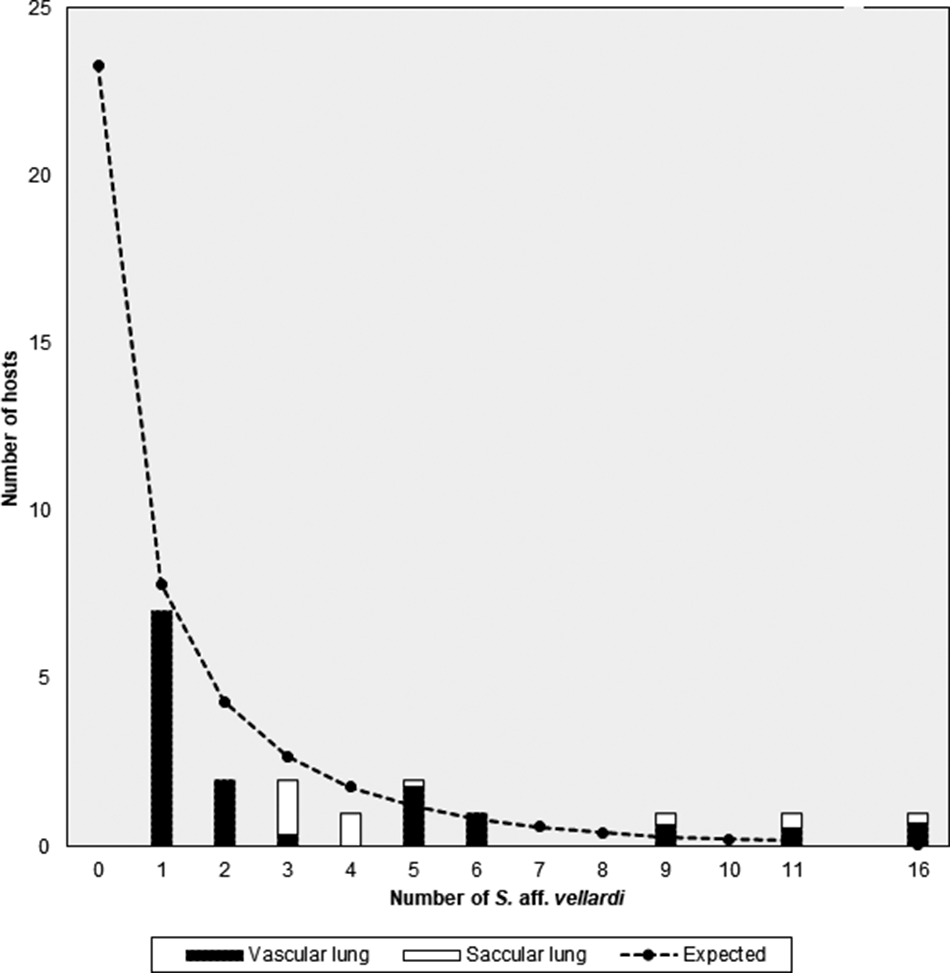
Serpentirhabdias aff. vellardi population distribution resembled a theoretical negative binomial distribution with parameters p = 0.23 and k = 0.43. The observed data fitted to expected values from this function (χ2 = 11.56, df = 10; p = 0.51) (Figure 4). Aggregation was over-dispersed and followed a binomial negative distribution in winter (σ2/X = 3.58), spring (σ2/X = 14.4), and summer (σ2/X = 3.1). In autumn, no nematodes were collected.
Distribution of S. aff. vellardi in a population of A. brongersmianus from Humid Chaco. Bars show the number of S. aff. vellardi.

Of the 83 specimens of S. aff. vellardi collected, 69.8% (n = 58) were found in the vascular lung. Most frequent abundances were between 1 and 5 nematodes. On the other hand, saccular lung presented abundances of 1, 3, and 5 nematodes (Figure 4).
Mean body length of S. aff. vellardi collected in both regions of the lung was 4744.8 ± 533.5 (n = 48). Serpentirhabdias aff. vellardi collected in the vascular lung (L = 4884 ± 988.7, n = 5) was slightly smaller than those collected in the saccular lung (L = 4947.9 ± 616.6, n = 7).
Lungworms’ mean body length, intraspecific relationships, and parasitological descriptors among seasons
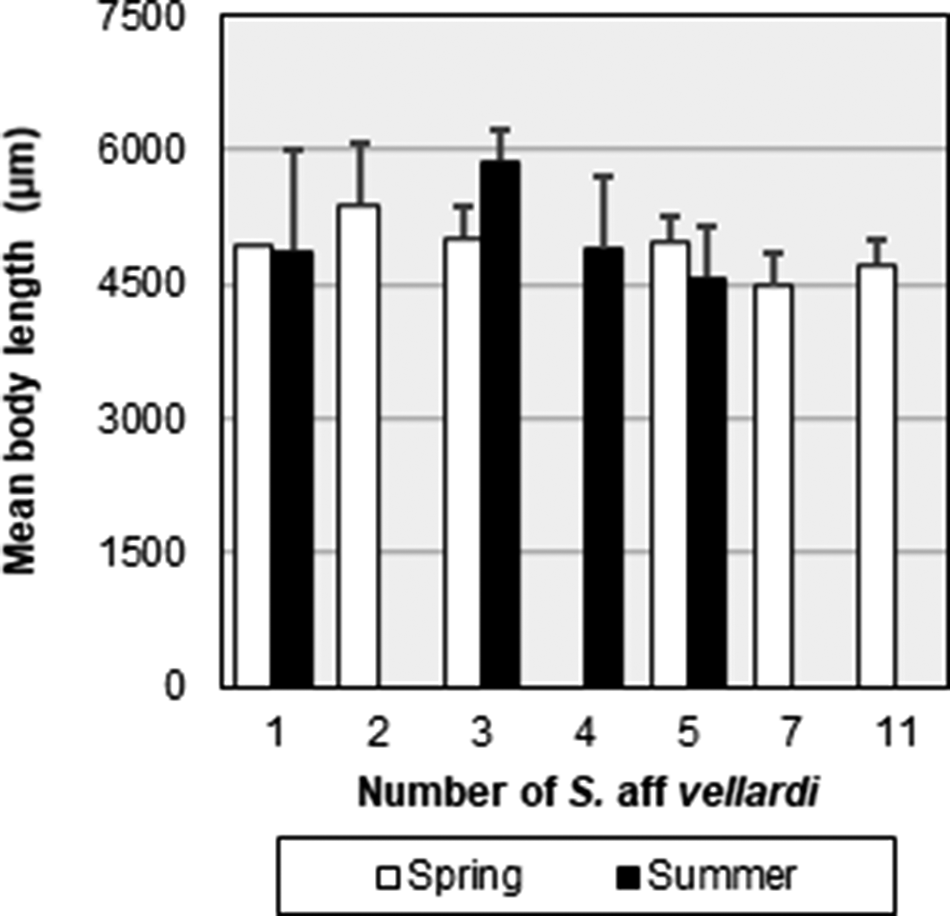
Serpentirhabdias aff. vellardi specimens collected in spring were smaller (Lspring = 4724.5 ± 407.7, n = 37) compared to those collected in summer (Lsummer = 4881.4 ± 806; n = 21). Mean body length of S. aff. vellardi collected in both seasons was 4781.3 ± 582 (n = 58). Serpentirhabdias aff. vellardi collected in spring had the greatest mean body lengths at an abundance of two specimens, with body length decreasing at higher abundances. Specimens collected in summer showed their largest mean body lengths at an abundance of three specimens, with body length decreasing at higher abundances, and no infections with more than five specimens were recorded (Figure 5).
Mean body length S. aff. vellardi at different intensities by season. Standard deviations are shown by vertical lines limited by horizontal bars.

Despite the season, a weak negative correlation was observed between the mean body length of S. aff. vellardi and its intensity (ρ both seasons = -0.32, p = 0.01); nevertheless, this correlation was statistically significant in the spring (ρ spring = -0.33; p = 0.04) compared with summer (ρ summer = -0.35; p = 0.11).
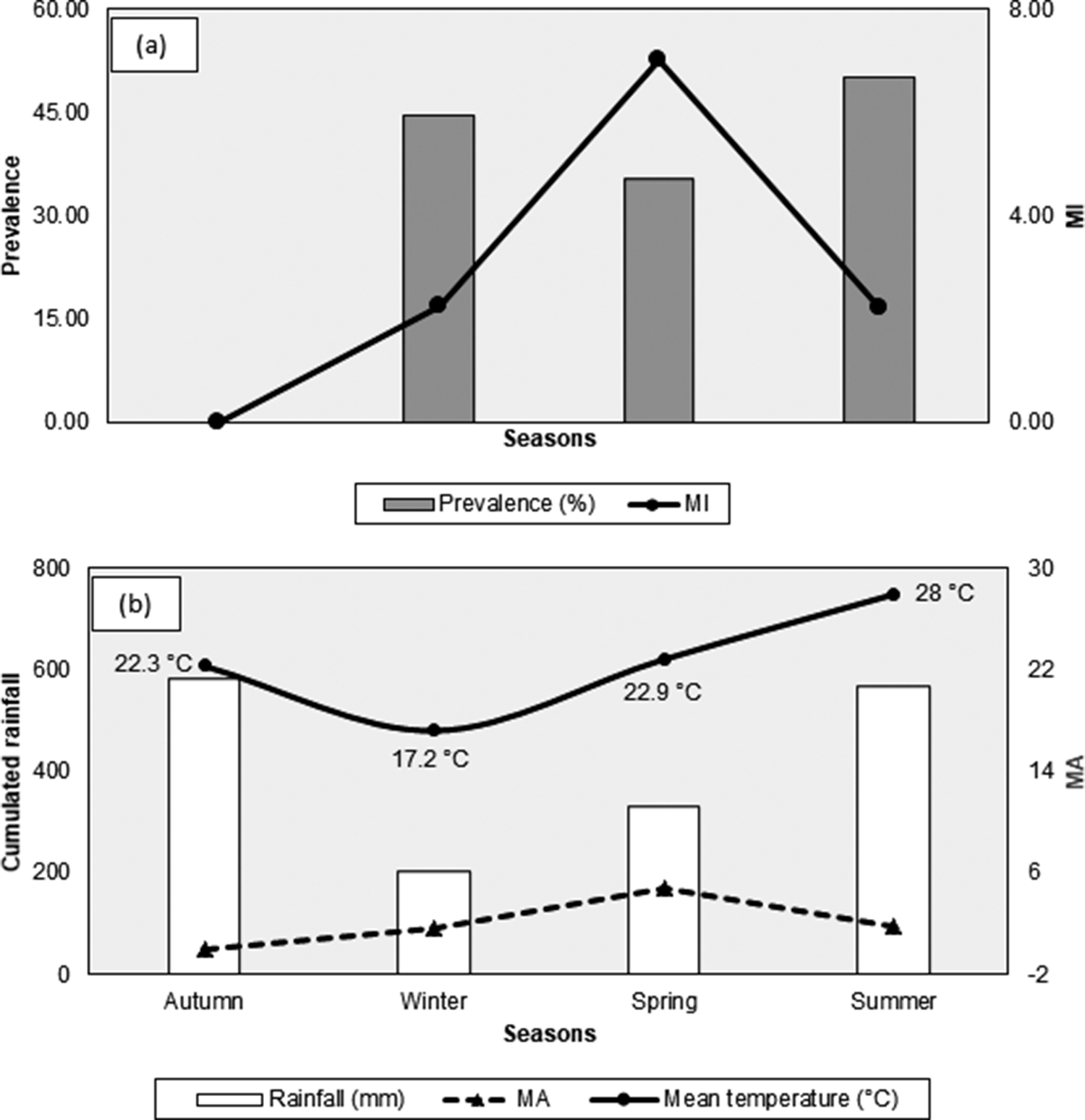
Prevalence was highest in winter and summer, whereas the highest mean intensity was observed in spring (Figure 6a). Similarly, lower mean abundances were observed in seasons with high rainfall (summer or autumn) or extreme mean temperatures (winter or summer). Conversely, the highest mean abundance was observed in spring, when mean temperatures and rainfall were moderate compared to other seasons during the same period (Figure 6b). No differences among seasons in intensities (H = 3.61, p = 0.13) and abundances (H = 1.11, p = 0.70) were found.
(a) Seasonal variations in prevalence and mean intensity (MI) of S. aff. vellardi in A. brongersmianus. (b) Seasonal variations in the mean abundance (MA) of S. aff. vellardi infections in A. brongersmianus along with cumulative rainfall (mm) and mean temperature (°C) for each season from 2013 to 2018.

Discussion
Eight taxa of nematodes, including those reported herein, have been recorded in typhlopids around the globe (Table 3). This is the first report of Serpentirhabdias parasitizing a typhlopid snake worldwide, and the first published report for a nematode of the genus parasitizing A. brongersmianus in Argentina. In addition, this is the first study at the population level in nematodes from this host family in the Neotropics.
Nematoda – Typhlopoidea relationships in different biogeographic realms.

* After Anderson (Reference Anderson2000).
+ : Synonymous with: Kalicephalus nankingensis Hsu, 1934; Kalicephalus willeyi (Linstow, 1906), and Kalicephalus radicus Bhalerao, 1931.
++ : According to Schad (Reference Schad1962), Kalicephalus ersiliae (Stossich 1896) Yorke and Maplestone, 1926 is considered a species inquirenda that could be synonymized with Kalicephalus willeyi.
+++ : Synonymous with: Kalicephalus obliquus (Ortlepp, 1923) Lichtenfels, 1980 and Kalicephalus minutus (Baylis et Daubney, 1922).
Studies on helminth parasite ecology in snakes in Argentina are scant (Caraballo et al. Reference Caraballo, Ulibarrie, Hamann, Guerrero, Arzamendia and González2024), and studies on nematode population ecology in this host group, including parasitological descriptors, distribution, preferences for the site of infection, seasonal effects, and their role across size classes and intraspecific relationships, are non-existent, especially in the Neotropics. In this sense, our results can be difficult compared with findings of other parasite populations in different host species or environments.
General features of parasite-host system: ontogenetic and diet relationships in parasite acquisition
Regarding its taxonomic aspects, Pereira’s original description uses specimens collected from Pseudablabes patagoniensis (Girard 1858) (= Philodryas shotti) and Oxyrhopus trigeminus Duméril, Bibron, and Duméril, 1854 (Pereira Reference Pereira1928). Emmerich et al. (Reference Emmerich, Morais and Da Silva2018) noted a considerable morphometric variation compared to Pereira’s (Reference Pereira1928) original description. They suggest the involvement of multiple taxa in Pereira’s description, due to the presence of two host species as host type. In this sense, we assign the specimens to S. aff. vellardi to indicate their morphologic similarities with S. vellardi, while acknowledging that their conclusive identification is pending further taxonomic and molecular analysis.
Serpentirhabdias vellardi had been reported in parasitizing other snake species in the Neotropics, including Agkistrodon bilineatus Günther, 1863 from Guatemala (Lamothe-Argumedo et al., Reference Lamothe-Argumedo, García-Prieto, Osorio-Sarabia and Pérez-Ponce de León1996) and as S. cf. vellardi in Brazil, parasitizing Xenodon merremii Wagler, 1824(Emmerich et al. Reference Emmerich, Morais and Da Silva2018).
Amerotyphlops brongersmianus is a fossorial species (Williams and Vera Reference Williams, Vera and Povedano2023). This could be coherent with the absence of helminths with complex life cycles and aquatic intermediate hosts in this snake (e.g., digeneans), which are abundant in aquatic herps and snakes from the Nearctic realm (Aho Reference Aho, Esch, Bush and Aho1990; Fontenot and Font Reference Fontenot and Font1996).
Field or experimental studies on rhabdiasids’ life cycle in reptiles are scarce, and the life cycle of S. vellardi remains unknown. Based on available knowledge, we suggest two possible acquisition routes of lungworms by the host: active skin penetration, as in Rhabdias Stiles and Hassall, 1905 species from amphibians; or involving a suitable transport host (Anderson Reference Anderson2000). Experimental approaches to the life cycle of rhabdiasids in snakes, such as S. fuscovenosa (Railliet 1899) and S. elaphe (Sharpilo 1976), included subcutaneous injection and oral administration of larvae, with recovery percentage between 6% and 35% of adult worms in lungs after 3–4 weeks, at least (Chu Reference Chu1936; Kuzmin and Miskov Reference Kuzmin and Miskov1999).
Langford and Janovy Jr. (Reference Langford and Janovy2009) assessed both mechanisms in Rhabdias (= Serpentirhabdias) species from snakes, identifying the use of transport hosts as the most likely route. They argued that skin penetration is unlikely due to the thick and dry skin in snakes. Consistent with the limited mobility and unexposed life history of typhlopids, the involvement of a suitable transport host appears plausible. In their study, several transport hosts were tested, including Physa spp. (Gastropoda: Physidae), Tenebrio molitor Linnaeus, 1758 (Coleoptera: Tenebrionidae), Lithobates blairi (Mecham, Littlejohn, Oldham, Brown and Brown, 1973) (Anura: Ranidae), and Eisenia fetida (Savigny in Cuvier, 1826) (Oligochaeta: Clitellata). Except for T. molitor, where third-stage larvae failed to penetrate, the remaining species supported larval survival, indicating their potential as experimental transport hosts.
In A. brongersmianus and related genera (e.g., Epictia), ants and termites (both larval and adult stages) were reported as the most frequent trophic items. These prey represent quantitatively the highest proportion of the stomach contents in these snakes (Sccrochi et al. Reference Scrocchi, Moreta and Kretzschmar2006; Ávila et al. Reference Ávila, Ferreira and Souza2006; Cacciali Reference Cacciali2009; Cabrera Reference Cabrera2015). For their part, earthworms are a common to occasional prey item, but are of lesser quantitative importance (Di Pietro et al. Reference Di Pietro, Williams, Cabrera, Alcalde, Cajade and Kacoliris2020; Williams et al. Reference Williams, Vera and Di Pietro2021). In this sense, a variety of soft-bodied invertebrates in soil meiofauna could be considered as plausible transport hosts for rhabdiasids, until research on the detailed life cycle for this parasite-host system in natural conditions.
Coleopterans had been reported as transport hosts for rhabdiasids in African Chamaeleo Laurenti, 1768 species, and were considered as a parasite strategy for avoiding desiccation (Lhermitte-Vallarino and Bain Reference Lhermitte–Vallarino and Bain2004). Reduced viability in rhabdiasids L3 larvae had been observed in conditions of low soil moisture, showing their sensitivity to this environmental variable (Langford and Janovy Jr. Reference Langford and Janovy2016). However, the plausibility of earthworms or additional not tested transport hosts in S. aff. vellardi life cycle needs to be confirmed by experimental studies in this host and locality.
Serpentirhabdias species were reported in studies of helminth ecology at the population or community level in the Nearctic and Palearctic realms (Fontenot and Font Reference Fontenot and Font1996; Jiménez-Ruiz et al. Reference Jiménez-Ruiz, García-Prieto and Pérez-Ponce de León2002; Santoro et al. Reference Santoro, Aznar, Mattiucci, Kinsella, Pellegrino, Cipriani and Nascetti2013; Ratnarathorn et al., Reference Ratnarathorn, Thaenkham, Chan, Laoungbua, Tawan, Vasaruchapong, Charoennitiwat and Chaisiri2025) and seasonality studies from the Nearctic realm (Rau and Gordon 1976), showing high variations in their parasitological descriptors across environments and host species (Table 4).
Comparison between parasitological descriptors from Serpentirhabdias spp. included in helminth ecological studies in different snakes worldwide as hosts. n: sample size, P: prevalence, MA: mean abundance, MI: mean intensity

* Before erection of Serpentirhabdias genus in Tkach et al. (Reference Tkach, Kuzmin and Snyder2014), all taxa cited in the literature were reported as members of Rhabdias.
In African and Australian Typhlopoidea, trophic ecology had been studied (Webb et al. Reference Webb, Branch and Shine2001). In contrast, for South American Typhlopoidea, trophic ecology remains unknown. Additionally, diet and ontogeny, as well as comprehensive reviews or descriptions of anatomical features related to prey size selection and feeding preferences in snakes, are generally based on data obtained from Caenophidia snakes, while patterns on these features in Scolecophidia snakes show radical differences (Glaudas et al. Reference Glaudas, Glennon, Martins, Luiselli, Fearn, Trembath, Jelić and Alexander2019).
Caenophidia snakes use pterygoid walk and consume relatively larger prey in proportion to their head size, especially during immature stages, which is marked by high trophic activity and muscle growth (Glaudas et al. Reference Glaudas, Glennon, Martins, Luiselli, Fearn, Trembath, Jelić and Alexander2019). In contrast, blind snakes typically employ mandibular raking; rely on chemical cues due to poor vision, and prey size did not increase with head size (Kley Reference Kley2001; Webb et al. Reference Webb, Branch and Shine2001).
Nonetheless, both Caenophidia and Scolecophidia species often show a high percentage of empty stomachs in adults and juveniles (Su et al. Reference Su, Sun-Chio and Ming-Chung2005; Webb et al. Reference Webb, Branch and Shine2001). In addition, trophic diversity tends to increase with development, being lower in juveniles (Ford and Hampton Reference Ford and Hampton2009; Su et al. Reference Su, Sun-Chio and Ming-Chung2005). According to Aho (Reference Aho, Esch, Bush and Aho1990), species-specific vagility and foraging strategies across life stages could influence the structure of helminth communities in herpetofauna.
Parasitological descriptors: sexual maturity, length, and weight in relation to the host
Our data showed a monospecific infection with lower prevalence in juveniles than in adults. Assuming that S. aff. vellardi is acquired through ingestion of a suitable transport host, we suggest that differences in trophic activity between adults and juveniles could affect the success in capturing prey with L3 larvae. Effects of seasons on trophic resources supply could be a modulating factor in patterns of feeding activity of A. brongersmianus juveniles, limiting the possible acquisition of S. aff vellardi in the sampled locality.
Lettoof et al. (Reference Lettoof, von Takach, Bateman, Gagnon and Aubret2019) assessed the influence of urbanization, wetlands, rainfall, temperature, topography, and SVL on Ophidascaris phyrrus Johnston and Mawson, 1942 (Nematoda: Ascarididae) infections in Notechis scutatus (Peters, 1861) (Elapidae) in Australia. Their findings showed environmental variables as the most accurate predictors of parasite burden, while SVL was significant in only one of five models. In our study, weight and SVL are considered proxy variables of body condition and sexual maturity. In this sense, we hypothesize that environmental variables influencing reproductive traits of A. brongersmianus, along with the species’ diet and ecology, may serve as more informative variables for understanding infection with S. aff. vellardi than body condition alone.
Due to the small number of studies on the role of body condition in helminth infections in snakes, further studies with larger sample sizes and additional condition-related variables (e.g., SVL, presence, and weight of fat bodies) are needed to improve our understanding of these interactions.
Distribution and site selection of lungworms
Lung asymmetry in snakes is a particular anatomic feature. Left lung could be vestigial, with poor vascular irrigation or directly absent; Amerotyphlops species are not an exception for this anatomical pattern (Pough et al. Reference Pough, Andrews, Cadle, Crump, Savitzky and Kentwood2002; Pyron and Van Wallach Reference Pyron and Wallach2014). Lung asymmetry may influence the site selection of S. aff. vellardi and could lead to higher frequencies of infection in the vascular region of the right lung. A single vascularized portion in the functional lung could represent a constraint in the parasite spatial niche, affecting the size of individuals, especially in warmer seasons.
Experimental studies on intestinal helminth parasites in mice have demonstrated the importance of carbohydrates in cestodes and acanthocephalan growth (Crompton et al. Reference Crompton, Singhvi, Nesheim and Walters1981, Reference Crompton, Singhvi and Keymer1982; Keymer et al. Reference Keymer, Crompton and Singhvi1983). These findings highlight the influence of certain molecules and their concentration in the growth of helminths without a digestive system. In contrast, S. aff. vellardi have a complete digestive tract and exhibit high specificity for the site of infection, relying primarily on erythrocyte consumption. This specialization is evident under light microscopy, with preserved specimens showing darkened intestinal contents due to haemoglobin degradation – a pattern also observed by Da Silva (Reference Da Silva2004) in Opisthogonimus lecithonotus Lühe, 1900 (Digenea: Opisthogonimidae) parasitizing lungs and mouth, where erythrocytes were found in 58% of digeneans collected from 77% of infected snakes.
Slight size differences observed in S. aff. vellardi collected from different lung regions could possibly reflect the variation in the quality of resources and available space. However, the scarce number of lungworms collected from the saccular region and unknown aspects of efficiency in resource utilization prevent a more conclusive interpretation. Future experimental studies are needed to clarify this.
Lungworms’ mean body length, intraspecific relationships, and parasitological descriptors among seasons
Binomial negative distribution is the most frequent distribution reported in parasites in wildlife host populations. In this distribution, a few hosts are heavily infected; meanwhile, most harbour few or no parasites (Anderson and Gordon Reference Anderson and Gordon1982; Crofton Reference Crofton1971). From a metapopulation perspective, this distribution facilitates parasite transmission. Infected hosts serve as ‘colonized patches’, while the abundant non-infected hosts act as ‘non-colonized’ ones. This dynamic sustains overdispersion and promotes continued transmission over time (Thrall and Burdon Reference Thrall and Burdon1997).
Variations in aggregation among seasons had been observed in anuran-nematode in Humid Chaco, showing that overdispersion is common in warmer seasons, but regularity in distribution is observed in colder ones (González and Hamann Reference González and Hamann2012), likely due to reduced nematode abundance with lower temperatures.
Five studies examined the effect of seasons in helminth–anuran systems from Argentine Humid Chaco. Three of them focused on two digenean species in Pseudis limellum Cope, 1862 (= Lysapsus limellus) (Hylidae) (Hamann and Kehr Reference Hamann and Kehr1999; Hamann Reference Hamann2004, Reference Hamann2006). The rest of them considered Cosmocerca podicipinus Baker and Vaucher, 1984 (Nematoda: Cosmocercidae) in two species of Pseudopaludicola Miranda-Ribeiro, 1927 (Leptodactylidae) (González and Hamann Reference González and Hamann2009, Reference González and Hamann2012). In these studies, seasonal variation in parasite size classes, sex ratios, distribution, and parasitological descriptors was analyzed.
In all helminth–anuran systems considered, and despite environmental factors or variations in life cycle, prevalence was higher in warmer seasons. Digenean exhibited higher mean intensities in warm periods (Hamann Reference Hamann2004, Reference Hamann2006; Hamann and Kehr Reference Hamann and Kehr1999), while nematodes showed less variation among seasons (González and Hamann Reference González and Hamann2009, Reference González and Hamann2012). In digeneans, specimens from smaller size classes were more abundant in spring, while those from larger sizes were observed in autumn, winter, and summer. Finally, all size classes could be present in the host population in all seasons, showing a not-clear pattern of maturation.
Considering these common patterns, we propose that S. aff vellardi could follow an annual maturation-recruitment cycle, similar to previously studied helminth-herp systems studied in the same ecoregion (González and Hamann Reference González and Hamann2009, Reference González and Hamann2012; Hamann Reference Hamann2004, Reference Hamann2006; Hamann and Kehr Reference Hamann and Kehr1999). Nevertheless, we prefer to be conservative in our comparisons, considering the cryptic habitat and specialized diet of A. brongersmianus and gaps in the life cycle knowledge of S. aff. vellardi.
Holmes’ (Reference Holmes2002) experimental work showed that crowding in monospecific or mixed infections in mice could affect population density in cestodes and acanthocephalans. Measuring the weight and size of worm populations, indirect effects of competition and crowding were detected when initial densities of one species were manipulated. In our study, a significant negative correlation between the intensities of S. aff. vellardi and its body lengths was observed, particularly during the spring. This could possibly suggest that higher crowding in the vascular region of the lung – due to better quality of trophic resources and supply – may limit individual growth through spatial or resource constraints.
Studies on immune response and experimental removal of Rhabdias pseudosphaerocephala Kuzmin, Tkach, and Brooks, 2007 in Rhinella marina (Linnaeus, 1758) enhanced host mating, feeding, and locomotion activities, showing the cost of infections in wild poikilotherms (Finnerty et al. Reference Finnerty, Shilton, Shine and Brown2017, Reference Finnerty, Shine and Brown2018). Contrastingly, Mayer et al. (Reference Mayer, Brown, Zimmerman and Shine2015) observed increased body conditions in Tropidonophis mairii (Gray 1841) (Natricidae) heavily infected with Tanqua anomala (von Linstow 1904) (Nematoda: Gnathostomatidae), and no differences in body condition in response to an anthelmintic treatment in hosts. Maybe parasitism by intestinal nematodes could represent small fitness costs for snake species, but this could not be generalized to pulmonary ones. In this sense, helminth abundance and its effects on snake body condition and fitness remain unclear and could not be considered.
Rau and Gordon (Reference Rau and Gordon1978) found that abundances of Rhabdias sp. in Thamnophis sirtalis sirtalis (Linnaeus 1758) did not decline during winter, despite nematode hypobiosis. A similar pattern was observed in this study, showing that a less active pattern of activity in hosts does not necessarily increase the mortality of the parasite population. Instead, nematode populations did not reduce their sizes and continued to develop in spring. Nevertheless, no infected A. brongersmianus were found before winter (nematode pre-hypobiosis), but infections were observed in spring (nematode post-hypobiosis).
Precipitation regime in the study area is an additional factor to consider alongside seasonality. Carnevali (Reference Carnevali1994) considers the precipitation regime in Corrientes province as irregular, varying from more than 1500 mm in the northeast to less than 1000 mm in the southwest. Considering our study site, precipitation primary maximum and minimum could occur in autumn and spring, while secondary maximum and minimum take place in winter and summer, respectively. This variability could explain the seasonal differences in prevalence and mean intensity.
Considering the direct or indirect infection routes of this lungworm species in A. brongersmianus, seasonal hydric excess could reduce infection risk by increasing transport host mortality (indirect cycle) or by diluting infective stages (direct cycle), as suggested by Pereira et al. (Reference Pereira, Sousa and de Souza Lima2012) for Parapharyngodon bainae Pereira, Souza, and De Souza Lima, 2011 in Tropidurus torquatus (Wied-Neuwied, 1820) from Brazil. Additionally, flooding may limit shelter availability for this fossorial snake.
We hypothesize that environmental conditions in the study area may hinder the S. aff. vellardi life cycle. In drier and warmer seasons, A. brongersmianus could be more active and recruit nematodes easily, which is consistent with higher mean abundances in spring compared with autumn and summer, where rainfall is more intense and mean temperatures are low. However, these explanations need to be tested in longitudinal field experiments.
Given the limited research on parasite ecology at the population and community levels in snakes from Argentina, and the global scarcity of parasitological studies involving species from Typhlopidae, our work presents novel insights into seasonal patterns of lungworm abundance and their relationships with host biological features and environmental factors. These findings highlight the importance of further research in taxonomy, life cycle, and parasite-host ecology for a better understanding of the dynamic features of understudied snake-helminth host-parasite systems in the Neotropical realm. Expanding this research line in time could help to assess potential impacts of drastic changes in seasonal environmental factors in the transmission of emerging helminth parasite infections, wildlife health, and regulation of their populations in a climate change context.
Acknowledgements
We would like to thank Dr. Francisco Tiago Vasconcelos Melo for his collaboration in the identification of the nematode. To Dr. Eduardo Schaefer and Dr. Marta Inés Duré for their assistance with host capture and photography. To Dr. Víctor Zaracho for allowing the deposit of host voucher material, and to BSc. Carla Rudolf and Dr. Félix Ignacio Contreras for helping with nematode figure edits and map designing, respectively. We also thank the anonymous reviewers for their valuable comments and suggestions, which helped improve the manuscript.
Financial support
Financial support was received from Universidad Nacional del Nordeste (Grant number PI 21Q001 to C.E.G.), CONICET (PIP 11220200101582CO to C.E.G.), Universidad Nacional del Litoral (CAID- UNL 2020 to V.A.), and Agencia Nacional de Promoción de la Investigación, el Desarrollo Tecnológico y la Innovación (PICT-2020-SERIEA-01341 to V.A.).
Competing interests
None.
Ethical standard
All applicable institutional, national, and international guidelines for the care and use of animals were followed. We certify that the snake species reported in the study is not threatened, and all procedures were made following the recommendation of the ASIH/HL/SSAR Guidelines for the Use of Live Amphibians and Reptiles. The Dirección de Recursos Naturales, Corrientes Province, Argentina, authorized the capture of the snakes for this research.