Introduction
A recent trend in pork production is the incorporation of alternative production methods. This trend is primarily driven by the lower cost of production (Thornton, Reference Thornton1988), and growing consumer interest in alternatively produced pork. In addition, some consumers are willing to pay more for pork products from pigs grown in outdoor systems (Dransfield et al., Reference Dransfield, Ngapo, Nielsen, Bredahl, Sjoden, Magnusson, Campo and Nute2005). Opportunities for niche marketing accompanied with lower investment costs have caused some producers to switch from standard confinement (CON) systems to semi-outdoor, alternative systems (Honeyman, Reference Honeyman1996). Extensive systems such as outdoor, free-range and deep-bedded semi-outdoor systems are the alternative systems utilised in the pig industry (Miao et al., Reference Miao, Glatz and Ru2004). Deep-bedded hoop structures (also referred to as hoop barns or simply hoops) are tent-like structures consisting of metal pipe arches, or trusses, covered by a polyethylene fabric tarp attached to concrete or wooden sidewalls. Pigs are kept inside the hoop with most of the floor area covered by bedding such as straw or cornstalks (Honeyman et al., Reference Honeyman, Harmon, Kliebenstein and Richard2001).
Several items differ between hoop structures and standard confinement systems, including the use of straw for bedding and subjection of animals to a greater variety of seasonal weather changes. In addition, using deep-bedded structures is an environmental enrichment strategy that has been shown to stimulate foraging and/or explorative behaviour (De Jong et al., Reference De Jong, Ekkel, Van de Burgwal, Lambooij, Korte, Ruis, Koolhaas and Blokhuis1998; O’Connell et al., Reference O’Connell, Beattie and Moss2004). Housing pigs in alternative environments also supports increasing spontaneous exercise and exploratory behaviour (Barton-Gade and Blaagjerg, 1989; Gentry et al., Reference Gentry, McGlone, Miller and Blanton2002b; Morrison et al., Reference Morrison, Hemsworth, Cronin and Campbell2003a), which may lead to changes in stress susceptibility, thereby influencing growth performance and ultimate pork quality (Klont et al., Reference Klont, Hulsegge, Hoving-Bolink, Gerritzen, Kurt, Winkelman-Goedhart, De Jong and Kranen2001; Morrison et al., Reference Morrison, Hemsworth, Cronin and Campbell2003b). Few studies have compared growth characteristics from confinement systems to deep-bedded systems (Gentry et al., Reference Gentry, McGlone, Blanton and Miller2002a; Honeyman and Harmon, Reference Honeyman and Harmon2003). Substantial variation in growth performance and pork quality has been noted in opposing seasons, as well as between confinement and deep-bedded systems (Lebret et al., Reference Lebret, Massabie, Granier, Juin, Mourot and Chevillon2002; Honeyman and Harmon, Reference Honeyman and Harmon2003). Seasonal alterations in fatty acid profiles (Cava et al., Reference Cava, Ventanas, Ruiz, Andres and Antequera2000; Bee et al., Reference Bee, Guex and Herzog2004), flavour attributes of fresh pork, including intensity and pork flavour (Gentry et al., Reference Gentry, McGlone, Miller and Blanton2002b), and overall flavour acceptability (Enfalt et al., Reference Enfalt, Lundstrom, Hansson, Lundeheim and Nystrom1997) have also been noted between pigs finished in deep-bedded and outdoor systems compared with indoor systems.
No research has been conducted comparing pork quality and fatty acid composition specifically between deep-bedded hoop systems and confinement systems. Increased physical activity, less consistent environmental temperature and the use of straw-bedding differ from hoops to standard confinement environments. This study was undertaken to determine the extent to which finishing environment influences pig growth performance, pork quality and fatty acid composition of the longissimus muscle and adipose tissue.
Material and methods
Animals
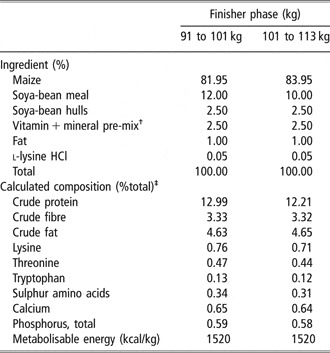
Use of animals for the described experiments was approved by the Iowa State University Institutional Animal Care and Use Committee. At 4 months of age, 68 gilts were weighed into allotment blocks by weight. From those weight allocation blocks, gilts ranging in weight from 59 to 71 kg were randomly assigned to treatments of either hoop (Hoop, n = 50) or confinement (CON, n = 18). Stocking density in each treatment environment was 0.70 m2 per pig. Gilts assigned to Hoop treatment were transported to the Iowa State University Western Research Farm, Castana, IA, USA, while gilts allocated to the CON treatment were moved into finishing pens at the ISU Swine Nutrition Farm, Ames, IA, USA. Gilts were ad libitum fed a two-phase diet (Table 1) for a period of 45 days. At 45 days, gilts were weighed and allocated into pre-slaughter groups stratified by weight. One gilt was randomly chosen to represent each weight group for a total of six pigs from each treatment group. All pigs were transported 200 km prior to delivery to the Iowa State University Meat Laboratory for processing to alleviate the confounding effect of travel on one group of pigs. These studies were replicated a total of five times.
Description of nutritional rations fed to gilts during the finishing period, as-is basis

†Vitamin + mineral premix contained phytase.
‡Calculated composition based on NRC (1998) values.
Initial weight, 21- and 45-day weight, and pre-transport, and slaughter weight were obtained for each pig. Average daily gain (ADG, g/day), feed conversion (gain : feed), and shrink (%) during transport and lairage were calculated for each pig, and percentage shrink was calculated: [(farm weight – slaughter weight)/farm weight] × 100. Feed was removed 18 h prior to slaughter. Gilts were randomly assigned to a process order at the ISU Meat Laboratory. After electrical stunning, and exsanguination via jugular depletion, carcasses were eviscerated, washed and chilled. Carcasses were placed in a 0°C cooler and chilled for 24 h. Temperature and pH measurements were taken by a penetration probe at 1, 6 and 24 h post mortem on right-side loins using a Hanna 9025 pH/ORP meter (Hanna Instruments, Woonsocket, RI, USA). The pH probe was calibrated with temperature at each time period using two buffers (pH 4.2 and pH 7.1), and was calibrated after each carcass. For measurements taken under refrigeration temperatures, buffer was cooled to ambient temperature prior to calibration.
Sample collection
After 24 h, carcasses were ribbed between the 10th and the 11th rib interface for carcass composition and pork quality evaluation. Two 20-g samples of adipose tissue from the blade end of the loin were obtained for fatty acid analysis and fat firmness measurement. Four subsequent 2.54-cm chops were obtained for Star Probe analysis; the first two chops were assigned an ageing period of 24 h and the second two were assigned an ageing period of 120 h. Three subsequent 2.54-cm chops were obtained for objective colour and drip loss analysis. Sirloin ends of pork loin were obtained for purge analysis. All samples were vacuum-packaged and held until analysis was conducted.
Carcass composition and pork quality
A trained panel (n = 2) used the National Pork Board (1 = pale, 6 = dark) standards to determine a colour score for each exposed loin eye at the 10th rib (National Pork Board, 2000). Firmness and wetness were evaluated on a three-point scale (1 = soft and wet, 3 = firm and dry; National Pork Board, 2000). Marbling values were based on National Pork Board standards correlated to the concentration of intramuscular lipid (National Pork Board, 2000). Backfat measurements at the 10th rib and last rib off the midline were obtained using a pig backfat probe. Longissimus area was measured using carcass grid. Percentage fat-free lean (FFL) was calculated using the National Pork Board percentage FFL calculation (National Pork Board, 2000).
Four 2.54-cm chops from right-side loins were stored in a vacuum bag at 4°C for 24 or 120 h post mortem. After ageing, chops were frozen in a −20°C blast freezer until needed for Star Probe analysis. Chops were then thawed at 4°C, weighed and cooked in a convection oven (140°C) until an internal end-point temperature of 72°C, flipping once at a mid-cook cycle temperature of 35°C. Pre- and post-cooked weights were recorded and used to calculate cooking loss percentage. After cooking, chops were cooled at 4°C overnight prior to measurement. Chops were allowed to equilibrate at room temperature for 2 h prior to Star Probe analysis. An objective, instrumental measure of tenderness was evaluated on two chops per ageing period per pig using a circular, five-point Star Probe attached to a TA-XT2 Texture Analyser (Texture Technologies, Scarsdale, NY). The Star Probe was 9 mm in diameter with 6 mm between each point. The angle from the end of each point to the centre is 48°. A 10-kg load cell was used with a cross-head speed of 3.3 mm/s (Lonergan et al., Reference Lonergan, Stalder, Huff-Lonergan, Knight, Goodwin, Prusa and Beitz2007). Force (kg) required to puncture and compress the chop to 20% of sample height was recorded, and the mean of four measurements per chop was used for statistical analysis.
Hunter L*(light–dark), a*(red–green) and b*(yellow–blue) values were determined at 1 day post mortem on 2.54-cm-thick chops. Samples were allowed to bloom for 1 h at room temperature and were analysed on a calibrated Hunter Labscan colorimeter (Hunter Associates Laboratories Inc., Reston, VA, USA). A CIE D/65 10° standard observer and a 2.54 cm viewing port were used to obtain three colour measurements on each of three chops. All nine colour measurements were used to determine an average colour score for each loin (Lonergan et al., Reference Lonergan, Huff-Lonergan, Rowe, Kuhlers and Jungst2001).
Drip loss was determined using 2.54-cm-thick boneless chops (two per loin) (Gardner et al., Reference Gardner, Huff-Lonergan, Rowe, Schultz-Kaster and Lonergan2006). Chops were towel dried to remove excess surface moisture, weighed and stored in a sealed plastic bag held under atmospheric conditions at 4°C. The liquid lost as drip was removed from each bag and measured after 120 h of storage. Purge loss was measured on the sirloin after 120 h of storage at 4°C in a vacuum bag. Samples were towel dried and weighed in a similar fashion to drip loss chops. Purge and drip loss were recorded as a percentage of the original weight of the sirloin by {[(initial chop/sirloin weight) − (final chop/sirloin weight)]/initial weight} × 100.
Total lipid and fatty acid analysis
The inner layer of adipose tissue was chosen for adipose analysis as it has been shown to be the most susceptible to depositional changes during finishing (Leymaster and Mersmann, Reference Leymaster and Mersmann1991; Warnants et al., Reference Warnants, VanOeckel and Boucque1996). Lean samples were cut directly underneath the sample taken isolated adipose tissue analysis. Total lipid analysis was carried out by the method of Folch et al. (Reference Folch, Lees and Stanley1957). For each tissue sample, an amount of Folch extract containing 2.5 mg total lipid was placed into a 20 ml methylation tube. Fatty acid methyl esters were prepared according to the method of Morrison and Smith (Reference Morrison and Smith1964) and were separated according to Jo and Ahn (Reference Jo and Ahn2000). Analysis of fatty acid composition was performed with a HP 6890 gas chromatograph (Hewlett-Packard Co., Palo Alto, CA, USA) equipped with an autosampler, a flame ionisation detector and an SP-2560 fused silica capillary column (100 m × 0.25 mm × 0.2-μm film thickness). Peak areas and percentages were calculated using HP ChemStation™ software (Hewlett-Packard Co.). Fatty acid methyl esters were identified by comparison with retention times of standards (Sigma-Aldrich, St Louis, MO, USA). Fatty acid values and total lipids were expressed as percentages of adipose or lean tissue sample.
Adipose tissue firmness
Adipose samples were cut into 5 × 3-cm squares and analysed for firmness using a method modified from Nishioka and Irie (Reference Nishioka and Irie2005). Samples were evaluated using a TA-XT2 Texture Analyser (Texture Technologies, Scarsdale, NY, USA) with a 0.25″-diameter ball-shaped probe. Sample height was noted by the testing machine, and the probe was driven downward at 2 mm/s to a depth of 20% of the sample height. Force exerted (kg) and sample height (cm) were recorded for three separate positions on the square, and were averaged by sample for statistical analysis.
Volatile profile analysis
Approximately 20 g of subcutaneous adipose tissue and 20 g of lean was excised from the blade end of the longissimus dorsi. Samples were packaged and sealed under vacuum pressure and kept at −20°C until further analysis. Volatile organic chemicals were analysed using a Solatek 72 Multimatrix-Vial auto sampler/sample concentrator 3100 (Tekmar-Dohrmann, Mason, OH, USA) connected to a GC/MS (Model 6890/5973; Hewlett-Packard Co.) according to the method of Ahn et al. (Reference Ahn, Nam, Du and Jo2001). Samples (3 g) were minced and placed in a 40 ml sample vial, flushed with helium gas (2.8 kg/cm2) for 3 s, and then capped airtight with a Teflon*fluorocarbon resin/silicone septum (I-Chem Co., Rockwood, TN, USA). The maximum waiting time for a sample to be in a loading tray (4°C) for analysis was less than 2 h to minimise oxidative changes. Meat samples were purged with helium (40 ml/min) for 14 min at 80°C. Volatiles were trapped using a Tenax/charcoal/silica column (Tekmar-Dohrmann) and desorbed for 2 min at 225°C, focused in a cryofocusing module (−80°C), and then thermally desorbed into a column for 60 s at 225°C. For acids, phenols and indoles, an HP-Wax column (60 m, 0.25 mm i.d., 0.25 μm nominal) was used. For sulphur compounds, an HP-624 column (7.5 m, 0.25 mm i.d., 1.4 μm nominal) an HP-1 column (60 m, 0.25 mm i.d., 0.25 μm nominal), and an HP-Wax column (7.5 m, 0.25 mm i.d., 0.25 μm nominal) were connected using zero dead-volume column connectors (J and W Scientific, Folsom, CA, USA). Ramped oven temperature was used to improve volatile separation. The initial oven temperature of 0°C was held for 1.5 min. Then, the oven temperature was increased to 15°C at 2.5°C/min, increased to 45°C at 5°C/min, increased to 110°C at 20°C/min, and then increased to 210°C at 10°C/min and held for 2.25 min at that temperature. Constant column pressure at 154 945 Pa was maintained. The ionisation potential of the mass spectrometry was 70 eV, and the scan range was 19.1 to 350 m/z. The identification of volatiles was achieved using the Wiley library (Hewlett-Packard Co.). The area of each peak was integrated using ChemStation™ software and the total peak area (total ion counts × 106) was reported as an indicator of volatiles generated from the samples. Data are reported as ion counts.
Statistical analysis
Gilt performance, pork quality, and adipose and tissue fatty acid composition data were analysed using general linear model (GLM) procedures of Statistical Analysis Systems (SAS, Institute, Cary, NC, USA). Experimental model included environmental treatment (Hoop or CON), replication, and interactive effects of treatment and replication as independent variables. The experiment was replicated five times. Pairwise comparisons of means were carried out using Tukey’s test with an α = 0.01.
Results
Growth performance
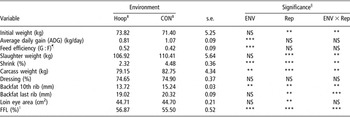
Initial weight and slaughter weight were not influenced by treatment (Table 2). Pigs finished in Hoop gained less per day, but had a more efficient feed efficiency than CON-finished pigs (P < 0.01). Hoop-finished pigs exhibited less shrink during transport and lairage (2.32% v. 4.48%) compared with CON pigs. Hot carcass weights differed between the two treatments (P < 0.05), though there were no significant differences in dressing percentage at slaughter. No treatment differences in loin eye area were detected, but carcasses from CON-finished pigs were fatter at the 10th rib (P < 0.05) and had lower calculated FFL percentages than Hoop-finished pigs. Replication differences were noted in beginning weight, live weight, carcass weight, FFL and backfat thickness at the 10th rib as well as at the last rib. These effects were not noted in growth characteristics such as ADG and feed efficiency.
Effect of finishing environment on pig performance and carcass compositionFootnote †

† Presented as least squares means.
‡Hoop = hoop-finished pigs; CON = confinement-finished pigs.
§Significance: **P < 0.05; ***P < 0.01; NS: P > 0.05; ENV = environmental significance, Hoop v. CON; Rep = replication group of experiment significance; ENV × Rep = treatment-by-group interaction significance.
¶G : F calculated by daily weight gain/daily feed consumed.
∥Fat-free lean (FFL) percentage calculated using National Pork Board % FFL equation (National Pork Board, 2000).
Pork quality
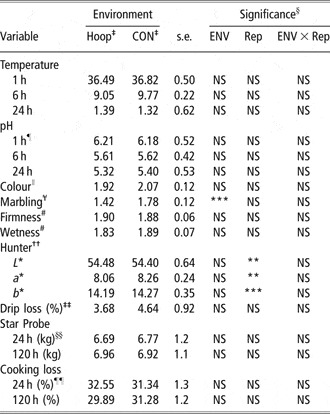
Differences between the two environments on pork quality were limited to lipid attributes (Table 3). Carcasses from CON pigs had higher levels of marbling in the loin compared with Hoop pigs (P < 0.01). There were no differences in the temperature or pH decline between Hoop- and CON-finished pigs. There were no significant differences in National Pork Board colour, firmness or wetness of the loin. No differences were observed in objective colour measurements, percentage drip or purge loss between the two treatment groups. Star Probe texture measurements taken at 24 and 120 h of ageing did not differ between Hoop- and CON-finished pigs. Significant replication effects were noted only for objective loin colour measurements.
Effect of finishing environment on pork quality attributesFootnote †

† Presented as least squares means.
‡Hoop = hoop-finished pigs; CON = confinement-finished pigs.
§Significance: **P < 0.05; ***P < 0.01; NS: P > 0.05; ENV = environmental significance, Hoop v. CON; Rep = replication group of experiment significance; ENV × Rep = treatment-by-replication interaction significance.
¶pH was measured at the 10th and 11th rib interface of the Longissimus muscle.
∥Colour scores range from 1 to 6, 1 = pale, pinkish-grey and 6 = dark, purplish-red.
¥Marbling scores range from 1 to 10, 1 = devoid and 10 = moderately abundant or greater.
#Firmness and wetness scores range from 1 to 5, with 1 = very soft and watery and 5 = very firm and dry.
††Hunter L* values range from 1 to 100 with 1 = pure black and 100 = pure white. Hunter a* values represent the amount of red to green colours and a higher value indicates a redder colour.
‡‡Drip and purge loss calculated as [(initial chop/sirloin weight) – (final chop/sirloin weight)]/initial chop weight × 100.
§§Star Probe texture evaluated at 24 and 120 h ageing periods using TA-XT2 Texture Analyser with probe driven downward at 2 mm/s to 20% of sample height. Peak force exerted (kg) is presented.
¶¶Cooking loss calculated as (raw chop weight – cooked chop weight)/(raw chop weight) × 100.
Adipose composition and firmness
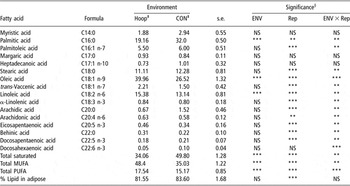
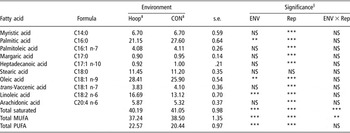
Hoop-finished pigs had lower proportions of palmitic acid and higher deposition of oleic and linoleic acids in the inner layer of adipose tissue compared with CON pigs (Table 4). These differences led to overall differences in proportions of saturated fatty acids (SFA), monounsaturated fatty acids (MUFA) and total polyunsaturated fatty acids (PUFA) in the adipose tissue, where total SFA was lower and total PUFA was higher in Hoop-finished pigs. There was a significant replication effect noted for the individual fatty acids within the inner layer of adipose tissue, with the exception of myristic acid, margaric acid, heptadecanoic acid and docahexaenoic acid (DHA).
Effects of finishing environment on fatty acid composition and total lipid concentration of adipose tissueFootnote †

Abbreviations are: MUFA = monounsaturated fatty acids; PUFA = polyunsaturated fatty acids.
† Analysis conducted on inner layer of backfat tissue. Presented as least squares means of percentage of total lipid.
‡Hoop = hoop-finished pigs; CON = confinement-finished pigs.
§Significance: **P < 0.05; ***P < 0.01; NS: P > 0.05; ENV = environmental significance, Hoop v. CON; Rep = replication group of experiment significance; ENV × Rep = treatment-by-replication interaction significance.
Effects of finishing environment on fatty acid composition and total lipid concentration of Longissimus dorsi muscleFootnote †

Abbreviations are: MUFA = monounsaturated fatty acids; PUFA = polyunsaturated fatty acids.
† Presented as least squares means of the percentage of total lipid in the lean tissue.
‡Hoop = hoop-finished pigs; CON = confinement-finished pigs.
§Significance: **P < 0.05; ***P < 0.01; NS: P > 0.05; ENV = environmental significance, Hoop v. CON; Rep = replication group of experiment significance; ENV × Rep = treatment-by-replication interaction significance.
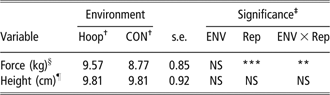
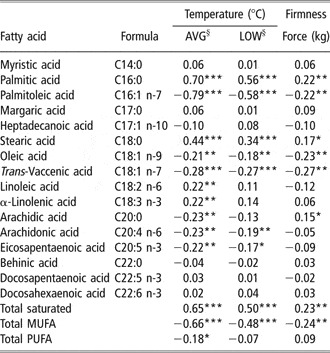
Adipose tissue firmness was similar between treatments (Table 6). In an effort to ascertain whether concentrations of individual fatty acids affect the firmness of adipose tissue, Pearson correlation coefficients were calculated for each fatty acid on the firmness measurement of force (Table 7). Saturated fatty acids, such as palmitic and stearic, were significantly (P < 0.01) correlated with adipose firmness. Therefore, as saturation increased, the samples were firmer. Unsaturated acids, such as palmitoleic, oleic, trans-vaccenic and linoleic acids, were negatively (P < 0.01) correlated to force. A negative (P < 0.01) correlation (−0.24) was reported from percentage of MUFA in the adipose tissue and adipose tissue firmness. There were no significant (P > 0.01) correlations between the proportion of polyunsaturated lipid and firmness within these samples.
Effects of finishing environment on adipose tissue quality
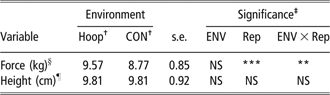
†Hoop = hoop-finished pigs; CON = confinement-finished pigs.
‡Significance: **P < 0.05; ***P < 0.01; NS: P > 0.05; ENV = environmental significance, Hoop v. CON; Rep = replication group of experiment significance; ENV × Rep = treatment-by-replication interaction significance.
§Measured as peak force (kg) exerted to compress to 20% of sample height with 0.25″ diameter probe at 2 mm/s.
¶Height of fat sample measured from inner layer to outer layer.
Pearson correlation coefficients – fatty acids and average and low temperaturesFootnote † and fat firmness of adipose tissueFootnote ‡

Abbreviations are: MUFA = monounsaturated fatty acids; PUFA = polyunsaturated fatty acids.
† Temperatures taken in 1-min increments using HOBO® LCD Temperature Loggers (Onset Computer Corporation. Bourne, MA, USA) placed at three different areas within the hoop structure and two different places within the confinement pens.
‡ Firmness measured as peak force (kg) exerted to compress to 20% of sample height with 0.25″ diameter probe at 2 mm/s.
§Data presented as correlation coefficient: *P < 0.05; **P < 0.01; ***P < 0.001
Longissimus fatty acid composition
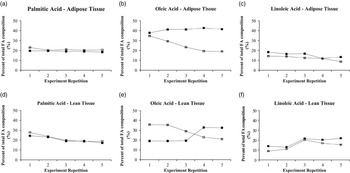
The fatty acid composition of the lean tissue was similar to the adipose tissue composition for each treatment (Table 5). Longissimus muscle from Hoop-finished pigs had lower levels of palmitic acid, and higher levels of oleic and linoleic acid compared with longissimus muscle from CON-finished pigs. Differences were also seen between Hoop- and CON-finished pigs in total SFA, MUFA and PUFA, where Hoop pigs had significantly higher levels of SFA and PUFA in lean tissue. There were similar replication effects on the lean fatty acid composition as noted in adipose tissue, where fluctuations occurred in every fatty acid except for stearic acid. Figure 1a–f depicts the changes in those fatty acids that had an environmental effect over the five replications of the experiment in adipose tissue as well as in the lean. Oleic acid dramatically increased in Hoop-finished pigs over the five replications in adipose tissues, where it decreased in the same fashion in CON-finished pigs. There was a clear tendency for total MUFA to increase in the tissues of Hoop-finished pigs as replications increased. This trend coincides with decreasing environmental temperature.
The effects of finishing environment on lipid composition in lean and adipose tissue. Changes in the concentration of palmitic, oleic and linoleic acids were compared between Hoop- and confinement (CON)-finished pigs over the five repetitions of the experiment. a = palmitic acid, adipose tissue, b = oleic acid, adipose tissue, c = linoleic acid, adipose tissue, d = palmitic acid, lean tissue, e = palmitic acid, lean tissue, f = linoleic acid, lean tissue. For all graphs, □ = CON and ▪ = Hoop.

Volatile organic profile
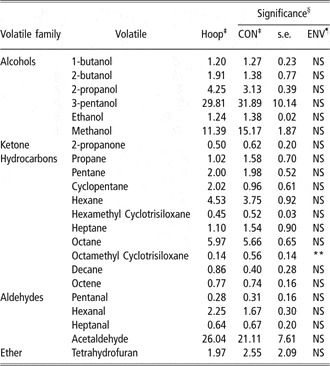
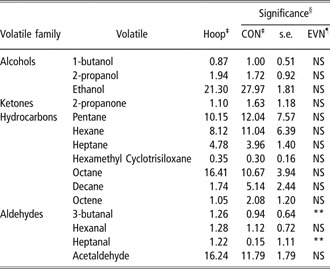
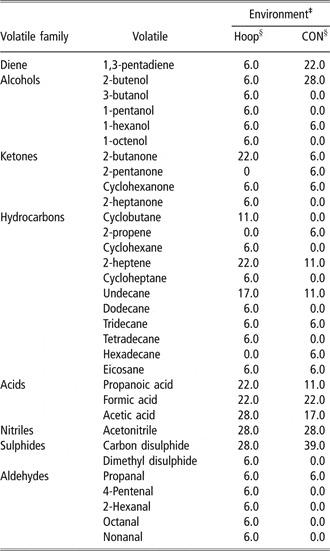
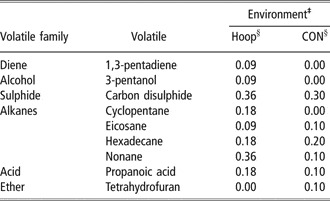
Common volatiles were defined as those that were observed in each treatment and each replication, unique volatiles were those observed in only one treatment. There were limited variations in the common volatile organic profile between Hoop and CON treatments in lean and adipose tissue (Tables 8 and 9). The lean tissue of Hoop-finished pigs had less concentration of octamethyl cyclotrisiloxane, a common hydrocarbon found in fresh pork (Ho et al., Reference Ho, Oh and Bae-Lee1994). Adipose tissue of Hoop pigs had higher amounts of 3-butanal and heptanal, which are both products of lipid oxidation (Ho et al., Reference Ho, Oh and Bae-Lee1994). Overall, the lean tissue had higher amounts of volatile organic compounds than adipose tissue. Table 10 denotes the frequency of unique volatile organic compounds that were observed in lean tissue. Pigs fed in the CON environment had higher deposition of alcohols and sulphides, whereas Hoop pigs had higher observed frequencies of ketones, hydrocarbons, acids and aldehydes than the lean tissue. Mimicking the common volatile profile, the unique volatile profile of the adipose tissue was more limited than the lean tissue, with less total volatiles comprising the profile (Table 11). Subcutaneous adipose from Hoop pigs had higher observed frequencies of alkanes, alcohols and sulphides.
Effect of finishing environment on the volatile organic profile of lean (Longissimus dorsi) – common volatilesFootnote †

† Common volatiles observed in all samples. Least square means of total ion counts for each volatile compound.
‡Hoop = hoop-finished pigs; CON = confinement-finished pigs.
§Significance: **P < 0.05; ***P < 0.01; NS: P > 0.05.
¶Environemental significance, hoop v. confinement.
Effect of finishing environment on volatile organic profile of adipose – common volatilesFootnote †

† Common volatiles observed in all samples. Least square means of total ion counts for each volatile compound.
‡Hoop = hoop-finished pigs; CON = confinement-finished pigs.
§Significance: **P < 0.05; ***P < 0.01; NS: P > 0.05.
¶Environemental significance, hoop v. confinement.
Effect of finishing environment on volatile organic profile of lean (Longissimus dorsi) –unique compoundsFootnote †

† Unique compounds not observed evenly in all lean muscle samples throughout experiment.
‡Presented as frequency (%) of observation within environment over five replications.
§Hoop = hoop-finished pigs; CON = confinement-finished pigs.
Effect of finishing environment on volatile organic profile of adipose tissue – unique compoundsFootnote †

† Unique compounds not observed evenly in adipose tissue throughout experiment.
‡Presented as frequency (%) of observation within environment over five replications.
§Hoop = hoop-finished pigs; CON = confinement-finished pigs.
Discussion
Few studies have been conducted comparing alternative environments to confinement systems on pig performance and carcass composition. Honeyman and Harmon (Reference Honeyman and Harmon2003) examined the use of hoop structures for finishing pigs compared with an unbedded confinement system and determined that pigs finished in hoops had a higher ADG and lower feed efficiency than pigs finished in confinement. These results are similar with the current study, with the exception of feed efficiency. In the current study, Hoop-finished pigs had a higher feed efficiency than CON-finished pigs. Overall, Hoop-finished pigs ate less, grew slower and had less fat at the 10th rib than pigs finished in confinement (Table 2). In addition, carcasses from Hoop-finished pigs had a higher percentage of calculated FFL (56.9% v. 55.5%) compared with CON-finished pigs. Several other studies have noted lower levels of backfat in pigs finished outdoors or semi-outdoor systems compared with indoor-finished pigs (Warriss et al., Reference Warriss, Kestin and Robinson1983; Enfalt et al., Reference Enfalt, Lundstrom, Hansson, Lundeheim and Nystrom1997; Gentry et al., Reference Gentry, McGlone, Blanton and Miller2002a). One commonality between these studies is that the pigs were finished in fall or winter months. Interestingly, the opposite trend is seen when pigs are finished in alternative environments during the summer months. Honeyman and Harmon (Reference Honeyman and Harmon2003) reported that pigs finished in hoop structures during the summer months had greater amounts of backfat at the 10th rib than CON-finished pigs, and noted no difference in backfat measurements between Hoop- and CON-finished pigs during the winter months. Therefore, it appears that differences in feed intake and backfat deposition are related to ambient temperature.
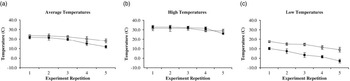
In the current study, replications spanned the months of August to November, 2004. The thermoneutral zone for pigs ranges from 17.2°C to 22°C. Within the thermoneutral zone, pigs are able to maintain heat production approximately constant for a given energy intake (Bruce and Clark, Reference Bruce and Clark1979). Consequently, with the temperature fluctuations noted in this experiment (Figure 2), both Hoop- and CON-finished pigs were exposed to temperature fluctuations above and below their thermoneutral target, with the more extreme exposure being in the Hoop-finished pigs. Generally, pigs exposed to colder temperatures will have increased levels of feed intake with a decrease in feed utilisation for lean gain due to maintenance requirement of the animal for body heat (Quiniou et al., Reference Quiniou, Dubois and Noblet2000). Interestingly, there were no replication effects on ADG or feed efficiency on either treatment group. Therefore, as temperatures decreased in each treatment (Figure 2), there were no significant effects on ADG or feed efficiency of the pigs. However, there were replication effects, and treatment-by-replication interactions noted for live weight, carcass weight, backfat deposition at the 10th and last rib, as well as percentage FFL. With no change in feed intake, it is probable that the effect of ambient temperature may play a role in metabolism, specifically in fat deposition and lean gain.
Ambient temperature fluctuations. Fluctuations in average, high and low temperatures (°C) were recorded over the five repetitions of the experiment. Temperatures were recorded every min using a HOBO Pro Series™ temperature recorder (Ben Meadows Company, Janesville, WI, USA). Temperatures are recorded as averages of triplicate measures taken throughout the systems. For all graphs, □ = CON and ▪ = Hoop.

Grandin (Reference Grandin2003) considered that environmental enrichment (access to toys, outdoor rearing, etc.) reduced excitability in hogs, which in turn allowed easier handling and less stress prior to slaughter. One of the hypotheses of the current study was that deep-bedded semi-outdoor finishing environments may reduce stress susceptibility and behaviours that have been noted to lead to aberrant pork quality (Sather et al., Reference Sather, Jones, Schaefer, Colyn and Roberston1997; Klont et al., Reference Klont, Hulsegge, Hoving-Bolink, Gerritzen, Kurt, Winkelman-Goedhart, De Jong and Kranen2001). In the current experiment, the effect of finishing environment had minor influence on pork quality attributes, with the main difference between the two finishing treatments being an increase in marbling within the loin in CON-finished pigs.
Fatty acid profiles of the lean and adipose tissue were affected by environmental treatment (Table 5). Hoop-finished pigs had greater deposition of linoleic and oleic acid, and lower deposition of palmitic acid in both their lean and adipose tissues. These differences corresponded to significant alterations between environments within the adipose tissue, with lipid from adipose in Hoop pigs being significantly less saturated than confinement pigs. Main factors affecting fatty acid composition are diet, fatness, age/body weight, gender, breed, environmental temperature depot site, maintenance and hormones (Wood and Enser, Reference Wood and Enser1997; Nürnberg et al., Reference Nürnberg, Wegner and Ender1998). With the exception of four fatty acids (myristic acid, margaric acid, heptadecanoic acid and DHA), fatty acids varied by replication and were affected by an interactive effect of treatment and replication. This suggests that individual fatty acids were being deposited at different levels from replication to replication, and were also differing within the two treatments. One characteristic differing from replication to replication was ambient temperature (Figure 2). The replication differences in ambient temperature were more pronounced in hoop systems compared with confinements. Fluctuations in ambient temperature due to alternative production systems have been shown to influence fatty acid composition in pigs (Lefaucheur et al., Reference Lefaucheur, Ledividich, Mourot, Monin, Ecolan and Krauss1991; Lebret et al., Reference Lebret, Massabie, Granier, Juin, Mourot and Chevillon2002; Bee et al., Reference Bee, Guex and Herzog2004). Overall, outdoor-produced pigs have been shown to deposit more PUFA than their confinement counterparts (Bee et al., Reference Bee, Guex and Herzog2004). Specifically, decreasing environmental temperature affected the fatty acid composition of the back fat, leading to higher MUFA and lower SFA and PUFA contents of cold-exposed pigs.
The three fatty acids representing the largest variation from environment and replication to replication in this experiment were palmitic, oleic and linoleic acid (Figure 1a–f). These observations were interesting in that temperatures did not vary as dramatically in confinement as in hoop systems. The large deviation in oleic acid created significant difference in MUFA, and a significant difference in PUFA between treatment groups. In an effort to discern these deviations, Pearson correlation coefficients were analysed for each individual fatty acid against daily average and low temperatures taken throughout the experimental replication (Table 7). The proportions of palmitic and stearic acid were significantly correlated with average and low temperatures. Unsaturated fatty acids such as palmitoleic, oleic, linoleic and arachidonic acids were all negatively correlated with average and low temperatures. These relationships resulted in a strong positive correlation between total saturation and low temperature. A strong negative correlation between proportion of MUFAs and low temperature was also observed. These data verify that fluctuations in ambient temperature below the thermoneutral zone for pigs accompanied an increased proportion of monounsaturated lipid in the adipose tissue of pigs. Bee et al. (Reference Bee, Guex and Herzog2004) reported that higher PUFA content was compensated by both a lower saturated and MUFA content in the outer layer of backfat tissue from outdoor reared pigs. In that study, pigs were finished during winter months in an intensive outdoor system with igloos for shelter. The ambient temperatures of the outdoor system averaged 5°C to 27°C. One possible reason Bee et al. (Reference Bee, Guex and Herzog2004) did not observe the increase in monounsaturation as in the current study is that the temperatures were colder in the current study. Figure 2 reports an average low temperature of −2.9°C. If low temperatures drive the deposition of MUFA, then it seems probable that more MUFA would be deposited in the current experiment. Bee et al. (Reference Bee, Guex and Herzog2004) measured the outer layer, as the current experiment was conducted on the inner layer. These two layers differ significantly in deposition and metabolic behaviour, which is another reason as to why the increase in the proportion of monounsaturated lipid was not observed in that study (Bee et al., Reference Bee, Gebert and Messikommer2002).
One component of meat quality influenced by fatty acids is fat tissue firmness. Higher levels of unsaturation will lead to softer, less-firm fat (Wood et al., Reference Wood, Richardson, Nute, Fisher, Campo, Kasapidou, Sheard and Enser2004). Soft fat is a major issue related to fat quality. Problems from soft fat arise during cutting, grinding and slicing operations and can result in lower processing yields and reduced value. There were significant replication effects on the firmness of the tissue, as well as environment-by-replication interactions. When CON and Hoop temperatures were similar, fatty acid profile and firmness was similar. However, when CON and Hoop temperatures varied, fatty acid composition and firmness varied as well. The correlations provided in Table 7 are apparent indicators of total saturation and increasing firmness. In a recent review by Wood et al. (Reference Wood, Richardson, Nute, Fisher, Campo, Kasapidou, Sheard and Enser2004), it was reported that the concentrations of stearic and linoleic acids are the best predictors of firmness of adipose tissue itself, the former being softer and the latter being firmer. This was not the case in the current experiment.
Although environment did not affect fat firmness in this experiment, it is likely that replication differences in fat firmness are the result of proportions of monounsaturated lipid in the adipose tissue. The negative correlation of MUFA to fat firmness indicates that, in this experiment, percentage of monunsaturation is a more apparent driver of adipose tissue firmness than polyunsaturation.
Hansen et al. (Reference Hansen, Larsen, Jensen, Hansen-Møller and Barton-Gade1994) suggested that deep-bedded pigs housed intensively without continuous bedding change may increase the risk of pork taint, negatively affecting pork flavour. Specific compounds relating to meat taint in that experiment (Hansen et al., Reference Hansen, Larsen, Jensen, Hansen-Møller and Barton-Gade1994) were skatole and indole, which are directly related to bore taint and stored in the adipose tissue (Rius and García-Regueiro, Reference Rius and García-Regueiro2001). Other compounds negatively identified with flavour are aldehydes, furans and sulphides (Mottram, 1991; Ho et al., Reference Ho, Oh and Bae-Lee1994).
There were limited differences in common volatiles between treatments in the current study (Tables 8 and 9). Adipose tissue of Hoop pigs had significantly higher amounts of 3-butanal and heptanal compared with CON pigs. These two aldehydes are produced primarily by autoxidation of lipids, and are related to the amount of oleic and linoleic acids composing the adipose tissue (Grueb and Gatfield, Reference Grueb, Gatfield, D and TH1989). It is not surprising that these compounds were associated with Hoop pigs granting previous discussion of the amounts of oleic and linoleic acid being much higher in Hoop pigs. Tables 10 and 11 provide insight into environmental effects of certain volatile organic compounds. Given the observed frequencies, it seems that tissues from Hoop-finished pigs had higher amounts of alcohols, acids and sulphides compared with CON-finished pigs. Without performing similar profile analysis of bedded materials, it cannot be stated that these frequencies were changed due to exposure to excreta.
An experiment by Schiffman et al. (Reference Schiffman, Bennett and Raymer2001) reported that 1,3-pentadiene, 2-butenol, 2-butanol, 1-hexanol, cyclobutane, 2-heptene, propanoic and formic acid, carbon and dimethyl disulphide, propanal, 2-pentanal and 2-hexanal contribute to excreta emissions from pig production facilities. When comparing these compounds to unique compounds observed in this experiment, they are very similar. Therefore, variations in volatile organic profiles between Hoop and CON pigs may be explained by the increased exposure to emissions in hoops (Edwards, Reference Edwards2005).
Conclusions
Variations in finishing environment had specific effects on pork adipose attributes. Hoop-finished pigs had lower backfat deposition and higher degree of unsaturation in the inner layer of adipose tissue and in lean tissue. Replication effects and treatment-by-replication interactions caused variations within growth subsequently affecting fatty acid composition and adipose tissue firmness. The specific role of ambient temperature fluctuation on these attributes needs to be further evaluated within these systems. Seasonal variations in lipid deposition, fatty acid composition and firmness are not yet understood and need to be critically investigated.
Acknowledgements
Mention of a trade name, proprietary product or specific equipment does not constitute a guarantee or warranty by the USDA and does not imply approval to the exclusion of other products that may be suitable. This project was supported by Hatch Act and State of Iowa funds, USDA Special Grants and the Leopold Center for Sustainable Agriculture. The authors recognise the significant efforts of the Iowa State University Western Research Farm and the Iowa State University Swine Nutrition Farm for animal care. The authors also recognise the technical support provided by Randall Petersohn and the Iowa State University Meat Laboratory.