New Zealand’s friendly people, scenic national parks and numerous species of endemic flora and fauna make it a destination worth visiting. New Zealanders are passionate about many things. Care for the environment and conservation of native species are two that stand out and together give people living in New Zealand a sense of national identity. Nonetheless, delve a little deeper into the lives of people living in New Zealand and it does not take long to discover a blanket hatred towards a marsupial mammal; so much hate that it can be said that the animosity shown towards the Australian brushtail possum (Trichosurus vulpecula) is innate. Possums are one of many animal species that are classified as invasive, unwanted and alien under the biosecurity system in New Zealand. However, it is against the possums that a relentless campaign is perpetrated. This article attempts to explain some of the many reasons behind such intense negativity, and in doing so, show a link between ecological restoration theory, nationalism, the management of invasive species as a biosecurity risk, and young people’s nativist views.
Ecological restoration is ‘an intentional activity that initiates or accelerates the recovery of an ecosystem’ (Society for Ecological Restoration, 2002) and is an attempt to return an ecological system to some form of its original state (Palmer, Zedler, & Falk, Reference Palmer, Zedler and Falk2016). Such a process could involve the reintroduction of original flora, fauna and conditions, and/or the removal of other introduced species or conditions that may cause interference to the regeneration of indigenous species in the ecosystem (Allen et al., Reference Allen, Savage, Falk, Suckling, Swetnam, Schulke and Klingel2002; United Nations, 2010).
Ecological restoration has been widely used to right the wrongs of 200 years of colonialism in New Zealand. Eager to draft New Zealand into one of the many nations that could contribute towards the upkeep of the British Empire, early settlers brought with them a cacophony of plants, animals — many that quickly gained pestilent status — and ideas that severely transformed the New Zealand landscape, flora and fauna (Pawson & Brooking, Reference Pawson, Brooking, Pawson and Brooking2002). A startling example is found in the number of native and non-native plant species. New Zealand has approximately 2,418 recorded native plant species in comparison to 2,536 species of plants that have been classed as non-natives and naturalised in New Zealand (New Zealand Plant Conservation Network, 2012).
The colonisers had done far too much damage to the pristine New Zealand environment. It was under the guise of improvement that vast areas of New Zealand bush were cut and/or burnt to create pasture for sheep and cattle, turning once densely forested areas into windswept hills vulnerable to soil erosion (Wynn, Reference Wynn, Pawson and Brooking2002). Marsh, bog and swamp drainage resulted in an 85% reduction of New Zealand’s wetlands. The drainage of wetlands not only affected the Indigenous Māori people but reduced biodiversity dramatically by destroying natural habitat. Wetlands were breeding grounds for 20% of New Zealand birds and served as a nursery and migratory routes for native fish; both the birds and fish were a food source for local Māori (Park, Reference Park, Pawson and Brooking2002).
Nonetheless, ecological restoration has been highly successful in New Zealand in restoring both biodiversity and landscape. The ecological restoration strategy has been so successful that the New Zealand government has not only commercialised the brand ‘100% Pure New Zealand’ to market itself overseas, but has also set a goal of becoming predator free by the year 2050 (Key, Reference Key2016). A predator-free New Zealand would be devoid of the most destructive introduced animals, including possums that ‘threaten our nation’s natural taonga [treasure], our economy and primary sector’ (Predator Free New Zealand, 2018). However, although successful, the concept of ecological restoration has been criticised. Elliot (Reference Elliot1982) regards ecological restorations as fake because naturalness cannot be restored when ‘natural’ means untouched by humans. An ecosystem, for example, evolves out of natural processes, not human intervention (Elliot, Reference Elliot1997). Jordan (Reference Jordan, Gobster and Hull2000) likens ecological restoration to reparation by humans for the death and destruction they have brought upon nature.
Katz (Reference Katz, Gobster and Hull2000) argues that when humans intervene in nature, as with ecological restoration, it is to further their own interests and because they believe that advancements in science and technology can solve any problem. Advocates for ecological restoration are adding fuel to fire by setting precedents that there is no moral limit to changing, manipulating and/or managing the natural world. Human innovation will eventually restore nature from the brink of collapse. Armed with this rhetoric, humans continue to exploit new frontiers, marginalising the real argument, which is the preservation of nature.
Ecological restoration has also faced criticism from its connections to promoting nativism (O’Brien, Reference O’Brien2006; Peretti, Reference Peretti1998; Subarmanium, Reference Subarmanium2001; Warren, Reference Warren2007). It is from this premise, this article argues, that ecological restoration practices, such as the biosecurity practice in New Zealand that targets the eradication of animals deemed invasive, unwanted and/or alien, is linked to rousing a spirit of nationhood. Moreover, unbeknown to authorities, the framing and treatment of invasive animals such as possums is leading young people to develop nativist views.
The possum narrative
The spread of exotic plant and animal diseases, and destruction of native species is a major biosecurity issue in New Zealand, and possums are connected to this destruction. Because New Zealand’s economy is driven by the export of primary produce, there is added pressure to maintain market dominance by remaining disease free at all costs. The Australian brushtail possum has been a concern since its introduction to New Zealand for the fur trade in 1858 (Cowan, Reference Cowan and King2005). The possum is a cat-sized omnivorous marsupial mammal, with an appetite for leaves of native trees, eggs and chicks of nesting native birds, and it is also a vector for bovine tuberculosis (TB) (Cowan, Reference Cowan1991; Department of Conservation, 2015; Hutching, Reference Hutching2014). As a result, possums in New Zealand are anathema because of the threat they pose to the economy, natural environment, and the conservation of native animals.
Although possums have become a reservoir for TB in New Zealand, there is no record of this disease in wild possum populations in Australia. It is presumed that TB was transferred from cattle in New Zealand to possums, which are now the number one vector for bovine TB (Julian, Reference Julian and Bell1981). Nevertheless, possums are shown no mercy, and leading organisations such as Dairy NZ, Federated Farmers, Department of Conservation, and the New Zealand Government have taken it in their stride to eradicate the marsupial mammal (TBfree, 2001, 2015).
Other introduced animals that destroy flora, fauna and the landscape, such as wild horses and some that are vectors for TB, such as wild deer, feral pigs and ferrets (Ryan et al., Reference Ryan, Livingstone, Ramsey, De Lisle, Nugent, Collins and Buddle2006), do not receive as much negative attention as possums. Even though evidence has been presented to show that wild deer spread TB over greater distances in forested areas than any other vector and, equally incriminating, that wild deer will be the source of reinfection for possums when populations of other vectors have been eradicated (Ryan et al., Reference Ryan, Livingstone, Ramsey, De Lisle, Nugent, Collins and Buddle2006; TBfree, 2015), possums remain accused of all things bad in New Zealand. The argument that follows shows how some in mainstream media have used the negative popularity of the possum to their advantage, while other media sources have been instrumental in bringing to light the animosity possums have been shown by the New Zealand public.
Mainstream media and possums
The blanket hatred towards possums from all factions of society in New Zealand has not gone unnoticed, and mainstream media, especially television, has been engaged in creative ways to take advantage of this phenomenon. The use of smart advertising has been used to engage the community on television by using the invasive nature of possums as a front to advertise products. Renowned and reputable, not to mention very expensive advertisers, have been commissioned and have created animated caricatures of possums for advertising campaigns.
An advertisement created by Saatchi and Saatchi for Toyota New Zealand to advertise its popularity features two animated possums named Dave-O and Steve-O discussing a violent end to their lives by getting run over by a Toyota vehicle (Saatchi & Saatchi, 2015). The advertisement appears to imply that in purchasing a Toyota-branded vehicle, the customer is not only acquiring the most popular vehicle but also helping eradicate possums in New Zealand. The demonisation of the possum has moved from mainstream media into New Zealand schools, where their ill-treatment can be said to have become part of popular culture.
Young people of all ages, with support from their teachers and parents, have been cajoled onto the possum-hate bandwagon. At a fundraising event at a school outside of Auckland city, a teenage volunteer was seen taking young joeys from dead possum mothers and drowning them (Nightingale, Reference Nightingale2017). At another fundraising event organised by Colyton School, near Palmerston North, New Zealand, a possum gala was held where money was raised by asking young people to throw carcases of dead possums. Young people who were able to throw the carcass of a possum furthest won the competition (South, Reference South2010).
Similarly, Uriti School, also located in Palmerston North, went one step further in their quest to raise funds for their school. To win prizes, children aged from 6 to 14 years had to dress up a dead possum in various doll costumes. Entries received included half-skinned possums in boxing gloves, a possum dressed as a patient, a possum in a bikini, and a possum in a wedding gown. Other entries included a possum dressed as a child riding a child’s scooter and possums dressed in baby clothes. The macabre nature of the event drew an outcry from the local SPCA, but the school principal saw dead possum dressing as harmless fun and likened it to dressing humans after their death. The event was so popular that the school raised NZ$8,000, double the expected amount (Moir, Reference Moir2012).
Possums are unwanted animals, so officially people have the right to eradicate them through shooting, trapping and/or poisoning. In this instance, because the throwing, skinning and dressing of dead possum carcases, were condoned by teachers and displayed in schools, gave this practice added legitimacy. These gruesome actions promote the message to a wider group of young impressionable future citizens, that as part of biosecurity practices, it is all right to treat animals deemed a biosecurity risk in a violent inhumane manner. This raises questions of ethics and morality — how young people balance national biosecurity interests with personal respect for animals. The risk is that young people receive mixed messages. The following argument looks at how ecological restoration practices like biosecurity can be addressed in schools through education.
Educational implications
To draw the ire of the public for biosecurity purposes, authorities have resorted to psychology. The Australian rainbow skink (Lampropholis delicata), has been renamed the ‘Plague Skink’ (Department of Conservation, 2017) — a move by the authorities to influence young impressionable people and the public to develop preconceived assumptions about certain animals.
In light of this, education about controversial topics such as the eradication of invasive animals is needed, because it is not only missing from the school curriculum, it is also needed to allow young people to develop a balanced view around this issue. Simonneaux (Reference Simonneaux, Bruguiere, Tiberghien and Clement2014) sees polemic issues such as the killing of possums as socioscientific and a key challenge for educators and learners. Hodson (Reference Hodson2011) claims that environmental education must be relevant and provide young people opportunities to tackle real-world issues that have a scientific or environmental component. One way to achieve relevance could be through including environmental concepts that are important to a nation, such as the control of invasive species. This could create a base for young people to construct a balanced understanding that is personally relevant, meaningful and important. Furthermore, it is postulated that in-depth knowledge that is relevant, and interrelationships between environments, people and culture, and targeted learning of an issue are crucial for getting young people emotionally connected with environmental problems such as biosecurity (Hungerford & Volk, Reference Hungerford and Volk1990; Jensen, Reference Jensen2002).
An educational perspective that promotes emotional connection between humans and their environment is through looking at intraspecies relationships. Malone (Reference Malone2016), using a post-humanist approach, concluded that shifting away from the anthropocentric view of the child/human as the only self-conscious ‘being’ in nature allowed her to theorise child-animal encounters through a new perspective. For example, interspecies encounters are not based on actors shaping each other but rather one of ‘intra-species interdependence as children and animals co-shape and co-emerge in shared spaces — interconnectedness with the human and the more-than-human-world’ (p. 52). Lloro-Bidart (Reference Lloro-Bidart2018), using a feminist posthumanist approach, reported that learning about the negative impacts of invasive species led to positive outcomes. For example, she reports that a young person’s encounter with a pest insect, the Asian citrus psyllid (Diaphorina citri), led her to develop a concern for plants that the Hemipteran attacked.
To allow young people to make their own decisions related to the environment, Howlett, Ferreira, and Blomfield (Reference Howlett, Ferreira and Blomfield2016) call for changes in both curriculum and pedagogical practices in environmental education to build capabilities in young people for critical and reflective thinking. They advocate for an interdisciplinary environmental curriculum and see transformative learning occurring when a constructivist pedagogical stance is taken that promotes deeper learning.
However, the dominant narrative appears to be negative: possums are an unwanted, alien and an invasive species. Positive narratives of invasive species’ colonisation are missing from education. Possums and other introduced invasive animals support entire communities. As a teacher at a rural school in the Bay of Plenty in New Zealand, I found one of the reasons young people were late to class in the morning was because they were out checking possum traps that were set the night before. The possum fur industry is worth NZ$130 million (Watson, Reference Watson2016) and supports rural communities.
Similarly, information related to the economic benefits of other introduced invasive mammals, such as deer and wild pigs, are missing. These introduced invasive mammals support game hunting industries and monthly magazine publications such as the NZ Hunter and NZ Pig Hunter series. It appears that information available to the public about biosecurity is biased and prevents young people from making their own judgments about biosecurity issues. Next, an argument is made to show why ecological restoration practices such as biosecurity are linked to stirring a spirit of nationalism in New Zealand.
National identity: the New Zealand narrative
What does it mean to be a New Zealander? New Zealand academics, artists and writers, provide a snapshot. King (Reference King1991), a historian growing up in New Zealand in the 1950s, felt ‘a deep attachment to the land and to its flora and fauna’ (p. 12): ‘We moved from the belief that the land belongs to us to the feeling that we belong to the land’ (p. 21). Similarly, Head (Reference Head and King1991), an author and academic growing up in the 1940s, saw ‘the landscape [as] more crucial to our identity’ (p. 23); and Catley (Reference Catley and King1991), a writer and publisher growing up in the 1920s, claims ‘adventure, freedom, space … these things most of all give me my New Zealandness’ (p. 36).
The admiration of the indigenous landscape, flora and fauna was not merely an appreciation but also satisfied an emotional need — perhaps atonement for the recklessness with which early settlers tried to tame nature. Postage stamps depicting New Zealand fauna and landscape started circulating in early 1898, followed by school curriculum reform with a shift away from learning about British fauna to an emphasis on learning about New Zealand’s native flora and fauna. In other words, the beginnings of connections between nature, the individual and national identity (Star & Lochhead, Reference Star, Lochhead, Pawson and Brooking2003). It appears that an ingrained connection to the land, landscape, flora and fauna united people in New Zealand and gave them a sense of national identity.
According to Anderson (Reference Anderson1991), the belief of togetherness that grips people living in different parts of a country and brings them together under one national identity is imagined. Individual people in nations both large and small will never know, hear or meet each other, but are connected through a common image that lives in the minds of each individual, uniting them together. Bell (Reference Bell2003) acknowledges that imagination plays a part in understanding nationalism but also posits the concept of mythology. Myths about a nation do not just spring out of nothingness; myths are shaped and constructed, even manipulated (see Bone, Reference Bone2016, for a manipulated myth of Soviet heroism and self-sacrifice during World War II). It can be said that although the plight of the environment was not a myth, the common understanding during the early colonising years, that ‘New Zealand was a paragon of racial tolerance and goodwill’ (Laidlaw, Reference Laidlaw and King1991, p. 162), was a widely accepted myth.
In this way, the unique natural landscape and the plight of native species from invasive species became the focus, taking the emphasis away from the main issue, the ill-treatment of Indigenous Māori during the early colonising years. Landscape, flora and fauna became a symbol for political identity and led to the creation of a style of imagination where everyone perceived that to be a New Zealander, one had to be affectively connected to the land, flora and fauna. In light of this, the argument that follows is about how ecological restoration practices such as biosecurity are spreading a message of nationalism.
Biosecurity and nationalism
The plight of possums in New Zealand has not gone unnoticed. Potts (Reference Potts2013) links the demonisation of possums to patriotism and nationalism. The Australian brushtail possum has become the ‘scapegoat’ for all destruction. It is ‘unpatriotic’ to question the treatment of possums: ‘the only good possum is a dead possum’ (p. 202).
In New Zealand, links to nationalism have also been made with other campaigns. Dürr (Reference Dürr2007) investigated the ‘100% Pure New Zealand’ campaign, where stereotypes of untouched, unspoilt and a pure island refuge are used to market New Zealand as a tourist destination. Dürr states that a romanticised past of connections to an imaginary unspoilt nature has been used to shape New Zealand’s national identity. Potts and Dürr’s arguments both show that national identity is linked to the eradication of unwanted animals like possums because to achieve a ‘pure island refuge status’, all non-pure or non-native animals must be removed.
The New Zealand government has also been inculpated in promoting jingoism with their support for mass eradication of possums through poisoning. Barker (Reference Barker2010) claims that the New Zealand government is promoting a biosecure citizenship. This is a form of citizenship, where an individual’s loyalty is not only measured by his or her connections to the state, but also their connections to other non-human animals in the environment. In New Zealand, this entails the government setting the biosecurity agenda and the public providing the government with free labour and support for its policies of mass eradication of possums, and at the same time developing a new national passion— the killing of animals.
Further links between biosecurity and nationalism can be seen in the proclamation made by key government ministers. In her opening statement for the ‘New Zealand’s threatened species strategy’ campaign, The Minister for Conservation stated, ‘New Zealand’s unique plants, birds, reptiles and other animal species help us to define who we are as a nation’ (Barry, Reference Barry2017 p. 1). The Director General of the Department of Conservation reaffirms the Minister’s statement by claiming that ‘Our nature defines us as New Zealanders … as we strive towards a predator-free Utopia’ (Sanson, Reference Sanson2017, p. 2). These statements further support Potts (Reference Potts2013) and Dürr’s (Reference Dürr2007) claims that Zealand’s national identity is linked to the eradication of unwanted animals.
The aspirations of becoming a predator-free island refuge and restoring lost landscapes can be said to be part of a nation-building exercise in New Zealand, because this concept has been historically used by other nations for nation-building purposes. For example, Carruthers (Reference Carruthers1995) states that national parks generate emotive thoughts and this gives people an alternative way to connect with the land, and so are important in nation building. Lissovsky (Reference Lissovsky2012) states that after Israel’s independence in 1948, a rigorous plan was put in place to preserve nature and landscape to forge Israel’s national identity. Rennie (Reference Rennie2006) reported that the unanimous support of the National Parks Act by the Scottish Parliament was because national parks appealed to a nationalist nation building agenda. The argument that follows shows how ecological restoration practices such as biosecurity are linked to nativism and xenophobia.
Biosecurity: alien versus native
Conservation and/or biosecurity principles of exclusion or eradication are based on the classification of flora and fauna as either native or alien (Peretti, Reference Peretti1998). Possums are regarded as an alien species in New Zealand. There is debate that the control of introduced species is steeped in xenophobia, racism, and nativism (Warren, Reference Warren2007). There are arguments linking the desire to remove unwanted species to racist policies in Nazi Germany (see Gröning & Wolschke-Bulmahn, 1992, as cited by Gröning & Wolschke-Bulmahn, Reference Gröning and Wolschke-Bulmahn2003).
As early as the 1920s, the link between national identity and the removal of exotic species was made in New Zealand. Star and Lochhead (Reference Star, Lochhead, Pawson and Brooking2003) report that it was realised very early that indigeneity had immense value in creating a sense of national identity. Pioneers called for an environment free of ‘exotics’ and saw as ‘abominable … a sin against posterity’, the mixing of exotics with native species. It appears that the emotive language used to draw attention to the issue was also extended to humans.
From the 1880s to the 1960s, immigration authorities in New Zealand preferred Britons over any other European people. Asians were the least preferred immigrants, with Chinese bearing the brunt of these policies. Charged £200 for a good behaviour bond, they were referred to as ‘Aliens’ and were the only immigrant group that were not given permits to bring their wives and children as part of the government’s 1950 immigration policy (Bellich, Reference Bellich2001). A possible reason for this animosity could be fear of immigrants engulfing the country, and may be why xenophobic rhetoric such as ‘alien’, ‘exotic’ and ‘illegal’, used to describe plants and animals, were extended to humans (Subarmanium, Reference Subarmanium2001). Similarly, the fear of immigrants overwhelming Britain prompted David Cameron, the Prime Minister of the United Kingdom, to use the term ‘swarm of people’ to describe North Africans trying to enter England (Elgot & Taylor, Reference Elgot and Taylor2015).
Journalists at the New Zealand Herald frequently use xenophobic language like ‘Mediterranean invader found at marina’ (Laird, Reference Laird2015) and ‘Aussie invader triggers swoop’ (Koubaridis & Shuttleworth, Reference Koubaridis and Shuttleworth2012) to draw attention to the issue of invasive species. In 2006, the mayor of Auckland city obtained resource consent to cut down mature established deciduous non-native trees and replace them with natives. This was part of a $30 million upgrade of Auckland city, to give the city a more distinctive New Zealand indigenous flavour. This action was interpreted by many Aucklanders as misguided nationalism; the felling of mature exotics was likened to ethnic cleansing (Oarsman, Reference Oarsman2006).
The policies that drive the rhetoric against the possums stem from successive New Zealand political parties who are democratically elected by members of the public who are 18 years or older. This brings into perspective the views of the non-voting public, especially adolescents. An investigation conducted to gauge 13-year-old young people’s knowledge of biosecurity gives an insight into the views of adolescents towards unwanted species, including possums in New Zealand.
Research design
An interpretive mode of inquiry was adopted for the study to allow the researcher to gather personal points of views and interpret their meaning by finding relationships within data and linking them to young people’s understandings (Neuman, Reference Neuman2003). Following ethical approval (Ethics approval number 9198), purposive sampling was used to identify two urban multicultural schools from Auckland, with rolls reflecting the multicultural nature of Auckland City — New Zealand’s largest city. Thirteen-year-old, Year 9 students were chosen for this study because it was the researcher’s view that young people reflected the next generation of New Zealanders’ views of biosecurity and their opinions about its importance to the economy, environment and society. Young people are seen as agents for change and are usually the target group in environmental education (Horton, Hadfield-Hill, & Kraftl, Reference Horton, Hadfield-Hill and Kraftl2015). For example, Birdsall (Reference Birdsall2010) reported that young adolescents’ knowledge of the environment is critical for solving future environmental problems.
Two data-gathering methods were used, a questionnaire and interviews. While there are vast methodologies in environmental education research, questionnaires are a popular method for generating data in social science (Bryman, Reference Bryman2008). The use of a questionnaire allowed large amounts of data to be gathered quickly for fast results in a short period of time. The absence or presence of the researcher meant researcher effects were eliminated and participants could complete the questions in any order or speed they wanted (Bryman, Reference Bryman2004). The questionnaire included Likert-scale type questions and open-ended questions and was completed by 171 young people, of whom 89 were males and 82 females. Only responses from a select group of questions in the questionnaire are presented because these responses reveal the nativist views of young people.
The questionnaire was developed by Sheley, Jacobs, and Floyd (Reference Sheley, Jacobs and Floyd1996) to investigate public knowledge about noxious weeds via a telephone survey. The questionnaire was adapted for use in this study by rewording the questions. For example Shelley et al. asked, ‘In your opinion, how serious a problem are noxious weeds in Montana?’ (p. 593). This question was reworded to, ‘In your opinion how serious a problem are unwanted organisms in New Zealand?’
A total of 14 students were chosen for face-to-face interviews, but only 9 students were interviewed, 5 males and 4 females. Five students were absent. Students who had provided rich descriptive accounts of their biosecurity experience were chosen for interviews in the hope that these students’ awareness of biosecurity may provide the researcher with a better understanding of how students perceived biosecurity. The students were taken from their class and interviewed individually in a designated room (a classroom). The interviews were audiotaped and lasted for approximately 20 minutes.
Data analysis
The analysis of the open-ended questions was conducted by thematic coding into categories. The categories were derived from thematic analysis of the data. Post transcription, data were analysed using thematic analysis (Braun & Clark, Reference Braun and Clarke2006). The themes emerged from coded data and were ideas or words captured in the transcript that indicated a response that could be placed in a category. For example, to mitigate against the risk from unwanted organisms, preventative measures such as monitoring through placing pheromone traps around seaports, airports and industrial areas and selectively checking goods that arrive into the country are routinely undertaken by the authorities. Hence, all responses related to the question ‘How unwanted animals arrive in New Zealand’, such as ‘boats’ and ‘containers’, were placed in the ‘Transport agent’ category.
Categorised data and related Likert-scale data were entered into the SPSS qualitative analysis software program, through which frequency tables for each question were generated. This allowed data related to each response to be viewed as a frequency and percentage and enabled patterns and trends in the young people’s responses data to be determined.
Results
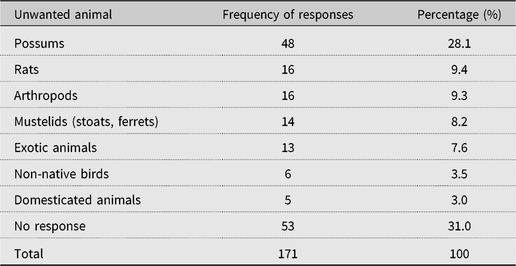
A common perception in New Zealand is that unwanted animals are a biosecurity issue because they are responsible for the destruction of native flora and fauna (Department of Conservation, 2018). To determine young people’s knowledge of this issue, data were gathered by asking them to name an unwanted animal in New Zealand. Responses to the question are displayed in Table 1.
Types of unwanted animals

Mammalian animals identified by young people included ‘Possums’ (28%), ‘Rats’ (9%), and ‘Mustelids’ (8%). The ‘Domesticated animals’ category included the subcategories ‘Cats’ and ‘Dogs’, the former receiving three and the latter two responses. The ‘No response category’ had 31% responses.
The ‘Arthropod’ category consisted of the ‘Insects’ and ‘Arachnids’ subcategories. The Arachnids subcategory had 10 responses, such as ‘scorpions’. The ‘Insects’ subcategory had six responses, such as ‘ants’. The ‘Exotic animals’ category included responses such as ‘tigers’, and included within this category, the ‘Reptiles’ subcategory had responses such as ‘lizards’. The ‘Non-native bird’ category received 3.5% responses such as ‘black bird’.
Problems caused by unwanted animals in New Zealand
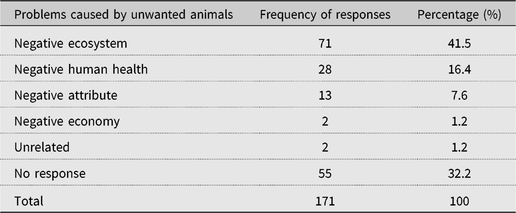
Unwanted animals cause many problems for native species; for example, competition for food and habitat. To gather knowledge of this disruption, young people were asked to describe problems caused by unwanted animals. Young people’s responses to the question are displayed in Table 2.
Problems caused by unwanted animals

The ‘Negative ecosystem’ category had 41% of the responses, with examples such as damages environment, ruins habitat and eats everything. The ‘Negative human health’ category had 16% of the responses, such as ‘sucks your blood while you sleep’.
The ‘Negative attribute’ category had 8% of the responses, with examples such as ‘breeds quickly’, ‘sharp claws’ and ‘venomous attacks’. The ‘Negative economy’ category (1% response) included examples such as ‘farms get destroyed’ and ‘gives diseases to cows’. The ‘Unrelated’ category (1% response) included examples such as ‘kill them’. The ‘No response’ category received 32% of the responses.
How unwanted animals arrived in New Zealand
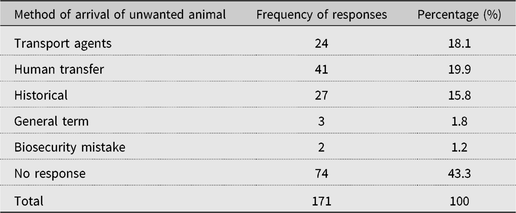
Only marine mammals and two native bats are mammalian fauna native to New Zealand; all other mammals have been introduced. To gauge knowledge of this issue, young people were asked to answer an open question on how unwanted animals arrived in New Zealand. Responses to the question are displayed in Table 3.
Method of arrival of unwanted animals into New Zealand

The ‘Transport agents’ category, which had responses such as ‘containers’, had 18% of responses, and included the subcategory ‘Animal agents’, which had responses such as ‘swimming’. The ‘No response’ category had 43% of the responses.
The ‘Human transfer’ (20% responses) category included the subcategory ‘Human agents’. Thirty-four responses were recorded for unwanted animal arrival through the ‘Human transfer’ category and seven responses were received for the ‘Human agents’ subcategory. Examples of responses in the ‘Human transfer’ category included ‘foreigner’, ‘travellers’ belongings from foreign countries’, ‘people from different countries bring animals as part of their culture’, and ‘immigrants’, and examples of responses in the ‘Human agents’ subcategory included ‘smuggling by people’ and ‘Australians’.
The ‘Historical’ category had 16% of the responses. Examples of responses included ‘settler’, ‘James Cook’ and ‘Europeans’. The ‘Biosecurity mistake’ category received 1% of the responses and the ‘General term’ category, 2% of the responses.
Stopping the spread of unwanted animals
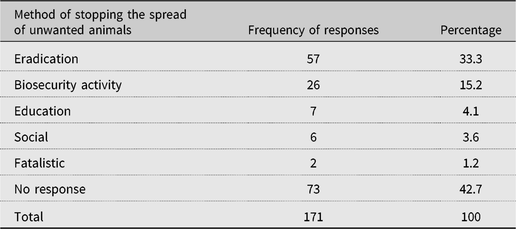
Unwanted animals tend to spread very quickly in New Zealand. Young people were asked to provide their views on how to stop the spread of unwanted animals. Responses to the question are displayed in Table 4.
How can unwanted animals be stopped from spreading

Fifty-seven (33%) young people alluded to stopping the spread of unwanted animals through ‘Eradication’ and provided responses such as ‘kill’, ‘shoot’ and ‘poison’. The ‘Education’ category had 4% of responses. The ‘No response’ category had 42% of the responses.
Included in the ‘Biosecurity activity’ category (15% responses) were subcategories such as ‘Quarantine’, with 14 responses; ‘Monitoring’, with 8 responses; and ‘Tighten biosecurity’ with 4 responses. Examples of responses for the ‘Quarantine’ subcategory were ‘restrict’; ‘contact Department of Conservation, DOC’ for the ‘Monitoring’ subcategory; and ‘have better security at the airport’ for the ‘Tighten biosecurity’ subcategory. The ‘Social’ category had 3% of the responses, with examples such as ‘support biosecurity’; and the ‘Fatalistic’ category recorded 1% of the responses, such as ‘unstoppable’.
How unwanted plants arrived in New Zealand
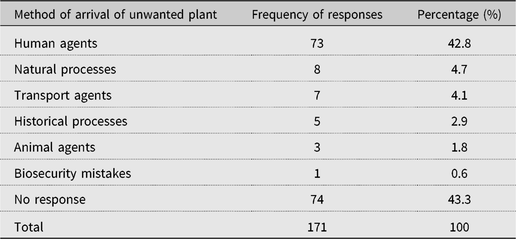
Keeping pest plants out is a major task for the authorities, as introduced plants such as gorse have inundated native plants. To gauge knowledge of this issue, young people were asked in an open question to state how unwanted plants arrived in New Zealand? Responses to the question are displayed in Table 5.
Methods of arrival of unwanted plants into New Zealand

The ‘No response’ category had 43% of the responses. The ‘Human agents’ category had 42% of responses, such as arrival through illegal activity like ‘concealed inside books’ and others that alluded towards arrival of unwanted plants (unknowingly), such as ‘arrival through soles of shoes’.
Other responses in the ‘Human agents’ category pointed towards people such as ‘immigrants wanted to sell them’, ‘immigrants brought them’, ‘brought in by people travelling to New Zealand’, ‘over-stayers bring them to New Zealand’, ‘secretly shipped by foreigners’, ‘secretly shipped by foreign countries’, ‘tourists travelling to New Zealand’, ‘brought in by people from different countries’, ‘people from other countries like Jamaica’ and ‘people from overseas’.
Responses such as ‘seeds carried by wind’ were included in the ‘Natural processes’ category, which had 4% of responses. The ‘Historical processes’ category (3% responses) included the subcategory ‘General term’, which had one response. Examples of responses included in the ‘Historical processes’ category were ‘humans introduced them when they came’, ‘Europeans brought different seeds’, and ‘has been here naturally from the start’. The ‘Animal agents’ category (2% responses) included examples such as ‘plants brought by animals’. The ‘Biosecurity mistakes’ category (1% response) included the response ‘got into the country before anyone knew it was a pest’.
Discussion
Ecological restoration processes such as the biosecurity practice of restoring indigenous fauna by removing fauna that are framed as exotic, unwanted and/or alien appears to have a nationalistic and nativist past in New Zealand (see Bellich, Reference Bellich2001; Isern, Reference Isern, Pawson and Brooking2002; Star & Lochhead, Reference Star, Lochhead, Pawson and Brooking2003). This claim can be made because biosecurity messages in the public domain are carefully designed and framed to evoke a sense of nationalism by educing a connection to a romanticised past of untouched nature (Dürr, Reference Dürr2007) through promoting a type of citizenship (Barker, Reference Barker2010) that supposes, patriotic (Potts, Reference Potts2013) the ill-treatment of possums and any other animals deemed invasive in New Zealand.
Possums were identified by young people as the most common invasive animal in New Zealand (see Table 1) and further implicated by responses such as ‘damages environment’, ‘ruins habitat’, ‘eats everything’, ‘farms get destroyed’, ‘breeds quickly’, ‘[has] sharp claws’ and ‘give[s] diseases to cows’ (see responses for ‘Negative ecosystem and ‘Negative attribute’ categories, Table 2) as one of the main unwanted animal causing such problems. These insinuations support Potts’ (Reference Potts2013) claim that possums are the scapegoat for all things bad in New Zealand, in spite of evidence showing that other unwanted animals such as wild deer are capable of more damage (Ryan et al., Reference Ryan, Livingstone, Ramsey, De Lisle, Nugent, Collins and Buddle2006; TBfree, 2015).
To eradicate the possums, the authorities have in place a relentless, well-designed campaign that seeks to desensitise individual feelings towards possums and other invasive animals, such as the campaign waged against the Australian rainbow skink, which has been renamed the ‘Plague Skink’. This is to manipulate the public into emotionally disconnecting from the issue and to offer unwavering support to biosecurity-related policies — a form of citizenship where the ill-treatment of possums has become popular culture.
By using the risk of the spread of bovine tuberculosis and the risk of the extinction of native species, the authorities legitimise the ill-treatment of possums by poisoning, shooting and trapping as morally responsible ways to eradicate invasive animals (see Table 4 for examples of young people’s responses). The community operates by politicising this form of citizenship to show a moral stance and expects its members to act morally by killing possums when called upon. An example of such an action can be seen within the Auckland and Palmerston North school communities in New Zealand, and the advertisement created by Saatchi and Saatchi.
However, unbeknown to authorities, communities appear to be developing their own moral compass. Parents see fit to allow their children to not only throw dead possums but also skin and dress them, all for harmless fun. It appears that the actions the community takes to protect the environment from possums are justified because individual actors in the community imagine and believe that throughout New Zealand people are of the same mind. In this way, the community’s judgment aligns with Anderson’s (Reference Anderson1991) theory that the concept of nation is imagined.
It appears that the driver of the anti-possum rhetoric in the community stems from the message that it is indeed only possums that pose a significant risk to native flora, fauna and the economy. The treatment of animals such as possums are not isolated incidents but are inherently linked to the treatment of other peoples (O’Brien, Reference O’Brien2006).
Nativism
Biosecurity practices promote nativism by desensitising people through normalising the use of the terms ‘alien’, ‘exotic’ and ‘unwanted’ to describe animals and plants, and which are then extended to describing humans. The use of nativist language to frame the pure native species as distinct from the impure non-native species in New Zealand has led young people to believe that ‘immigrants’, ‘Australians’ and ‘foreigners’ (see Table 3 categories) are impure and thus responsible for bringing non-native animals into New Zealand.
Easily understood, one-sided narratives like New Zealand trying to shape an identity by becoming predator free are the building blocks of forging a national identity because they show a struggle for recognition (Bell, Reference Bell2003). The use of nativist language to frame invasive species appears to communicate this struggle. However, nativist language is distorting the way young people think. For example, young people believe that unwanted plants were brought into New Zealand because ‘immigrants wanted to sell them’ or because they were ‘secretly shipped by foreigners’, or ‘secretly shipped by foreign countries’. It appears that young people are trying to find a scapegoat, similar to how possums have become the scapegoat for all things bad (Potts, Reference Potts2013). In this way, young people see ‘over-stayers’, ‘tourists travelling to New Zealand’, ‘people from different countries’, ‘people from other countries like Jamaica’, and ‘people from overseas’ (see Table 5) as responsible for all things bad in New Zealand.
Nativist language used to describe invasive species appears to propel young people to become emotive and choose a stance or a side, a ‘them against us’ scenario. In this way the politics of national identity appears to have crossed paths with the issue of managing invasive species, supporting previous claims (O’Brien, Reference O’Brien2006; Peretti, Reference Peretti1998; Smout, Reference Smout2003; Subarmanium, Reference Subarmanium2001; Warren, Reference Warren2007) that the control of introduced species is steeped in xenophobia and racism.
Alternatively, young people’s views can be interpreted as a manifestation of the word ‘nation’, which in Latin infers birth. Although a powerful metaphor, it has been postulated that the concept of connectedness to a nation through landscape, nativism, blood and ancestry excludes immigrants (Olwig, Reference Olwig, Herb and Kaplan2006). The results from this study show that young people appear to have taken a stance where they separate themselves from everything foreign. Young people see themselves connected to New Zealand by blood ties of birth and perceive immigrants and foreigners (see Table 5 categories) or anybody not connected to New Zealand by ancestry or birth as responsible for bringing into New Zealand invasive species.
Conclusion
More up-to-date information about invasive species such as possums should be officially released by the authorities. New Zealand parliamentary records show that when questioned about infection rates in possums, the Minister for Primary Industries reported that between 2007 and 2014, a total of 124,213 possums had autopsies conducted to check for TB and a total of 54 possums were found with TB infections (Guy, Reference Guy2015).
Young people should be given the freedom to make up their own minds about how they perceive invasive animals. This could be done by implementing programs such as education through outdoor programs (Malone, Birrell, Boyle, & Gray, Reference Malone, Birrell, Boyle and Gray2015) that develop in young people the concept of stewardship — a critical component in biosecurity. Opportunities must be provided for young people to discuss controversial issues such as the politics around the management of invasive species in the classroom (Simonneaux, Reference Simonneaux, Bruguiere, Tiberghien and Clement2014). Discussion is vital, because it exposes an individual’s beliefs by opening it up to challenges, consequently influencing an individual’s thinking (Osborne, Erduran, Simon, & Monk, Reference Osborne, Erduran, Simon and Monk2001).
The support given by authorities for the use of macabre methods to eradicate invasive animals such as possums is encouraging the community to use even more macabre methods. This is a moral dilemma, and one can imagine the mixed messages young adolescents are getting from this hoopla. On the one hand, children are encouraged to acknowledge animal interiority and responsibility by connecting and caring for pet animals, but on the other hand, children are encouraged to disregard any form of interiority in animals considered invasive.
All animals have interiorities and are not entities to be abused or dominated. Children need to be taught that all animals possess intelligence and find their own unique ways to exist in this world (Morris, Reference Morris, Snaza and Weaver2015). Biosecurity laws appear to be disconnecting children from the environment by distorting children’s perceptions of nature; authorities are presenting to children a perception of nature that is largely artificial, one where children are prevented from connecting with all animals because some are selectively removed. It could also be argued that biosecurity practices such as mass eradication programs have the potential to damage a lucrative and thriving tourism-based economy by portraying New Zealand as a nation obsessed with killing animals.
Evidence from this study suggests that the management of invasive species in New Zealand has led young people to develop nativist views because arguments against possums in the media are always based around their foreign origin; for example, ‘Aussie invader’. It is this rhetoric that has softened the ground and made it easier for young people to relate unwanted species to immigrants. This phenomenon is described by Subarmanium (Reference Subarmanium2001) as ‘living in a cultural moment where anxieties of globalization are feeding nationalisms through xenophobia’ (p. 34). A way forward could be through societies ‘letting go’ (Oakley et al., Reference Oakley, Watson, Russell, Cutter-Mackenzie, Fawcett, Kuhl and Warkentin2010) of language such as ‘unwanted’, ‘alien’, and ‘exotic’, which is used to frame biosecurity-related species.
Young people have some knowledge that invasive species have a historical origin (see Tables 3 and 5). Nonetheless, it can be said that the majority of the young people blame modern-day immigrants and travellers for introducing invasive species into New Zealand. These ill-informed views have developed as a result of the one-sided argument waged against possums and other invasive species as part of biosecurity practices. It is only fair that young people understand that the numerous species of animals and plants that help beautify local parks and drive the economy are non-natives in New Zealand.
With nationalism encouraging anti-globalisation around the world, nativism is adding fuel to fire, inciting unsuspecting men and women to support policies that at times question the fabric of liberal societies. The politics associated with the management of invasive species must become part of teaching and learning to help young people develop an abstract understanding of biosecurity policies and not become seduced by rhetoric that pits the survival of native species against a horde of alien, invasive, exotic and unwanted species.
Author ORCIDs
Rajesh Ram 0000-0002-1847-1340
Rajesh Ram is a Science/Biology teacher at the School of Secondary and Tertiary Studies, Manukau Institute of Technology campus, Auckland. His research interests are in environment education.