Introduction
Mobility decline, falls, and physical disability are common among older individuals. In addition, the prevalence of abnormal gait in community-dwelling older adults is 35 percent and increases with age (Verghese et al., Reference Verghese, LeValley, Hall, Katz, Ambrose and Lipton2006). As such, gait speed declines have been associated with limitations in activities of daily living (e.g., walking inside the home, climbing up and down stairs, and bathing; Verghese, Wang, & Holtzer, Reference Verghese, Wang and Holtzer2011) and greater risk of falls (Ayers, Tow, Holtzer, & Verghese, Reference Ayers, Tow, Holtzer and Verghese2014; Verghese, Holtzer, Lipton, & Wang, Reference Verghese, Holtzer, Lipton and Wang2009). Falls are quite common in the elderly, with up to one-third of older adults experiencing a fall at least once per year, and may result in distressing effects, including loss of mobility, placement in assisted living facility, and increased mortality (Sattin, Reference Sattin1992; Tinetti, Speechly, & Ginter, Reference Tinetti, Speechley and Ginter1988; van Bemmel, Vandenbroucke, Westendorp, & Gussekloo, Reference van Bemmel, Vandenbroucke, Westendopr and Gussekloo2005; Verghese et al., Reference Verghese, LeValley, Hall, Katz, Ambrose and Lipton2006).
Walking becomes more problematic and more volitional with age (Woollacott & Shumway-Cook, Reference Woollacott and Shumway-Cook2002). Dual-task paradigms that involve walking while performing a cognitive task have been used to establish a causal relationship between attention resources and gait performance (Hausdorff, Schweiger, Herman, Yogev-Seligmann, & Giladi, Reference Hausdorff, Schweiger, Herman, Yogev-Seligmann and Giladi2008; Holtzer, Mahoney, Verghese, Reference Holtzer, Mahoney and Verghese2014; Holtzer, Verghese, Xue, & Lipton, Reference Holtzer, Verghese, Xue and Lipton2006; Holtzer, Wang, & Verghese, Reference Holtzer, Wang and Verghese2014; Reference Holtzer, Wang and Verghese2012; Kemper, Herman, & Lian, Reference Kemper, Herman and Lian2003; Springer et al., Reference Springer, Giladi, Peretz, Yogev, Simon and Hausdorff2006; Verghese et al., Reference Verghese, Buschke, Viola, Katz, Hall, Kuslansky and Lipton2002). Dual-task performance costs represent the effect of increased attention demands on the walking and the cognitive tasks in comparison to their respective single task conditions. These costs are especially evident when older adults are compared to younger-counterparts (e.g., Li, Lindenberger, Freund, & Baltes, Reference Li, Lindenberger, Freund and Baltes2001; Lindenberger, Marsiske, & Baltes, Reference Lindenberger, Marsiske and Baltes2000). Indeed, robust evidence exists in support of age-related decline in the ability to allocate attention to competing task demands during dual-tasking (for reviews, see: Glass et al., Reference Glass, Schumacher, Lauber, Zurbriggen, Gmeindl, Kieras and Meyer2000; Hartley, Reference Hartley1992; Verhaeghen, Steitz, Sliwinski, & Cerella, Reference Verhaeghen, Steitz, Sliwinski and Cerella2003). Compromised executive control (Holtzer, Stern, & Rakitin, Reference Holtzer, Stern and Rakitin2004, Reference Holtzer, Stern and Rakitin2005), and structural capacity limitations (Pashler, Reference Pashler1994) have been both implicated in dual-task performance costs. In the context of walking dual-task paradigms poor attention and executive functions predicted slower gait velocity and reduced stride length during both single- and dual-task walking conditions (Holtzer et al., Reference Holtzer, Wang, Lipton and Verghese2012), and also moderated dual-task performance costs in gait and cognition in healthy older adults (Holtzer, Wang, Verghese, Reference Holtzer, Wang and Verghese2014).
As stated earlier, walking dual-task paradigms are used to determine the causal relationship between cognitive load and resources and mobility outcomes (Beauchet et al., Reference Beauchet, Annweiler, Dubost, Allali, Kressig, Bridenbaugh and Herrmann2009; Bootsma-van der Wiel et al., Reference Bootsma-van der Wiel, Gussekloo, de Craen, van Exel, Bloem and Westendorp2003; Sheridan, Solomont, Kowall, & Hausdorff, Reference Sheridan, Solomont, Kowall and Hausdorff2003). In such paradigms the cognitive load may be experimentally manipulated. For example, the cognitive interference tasks vary, and may include memorizing words (e.g., Lindenberger et al., Reference Lindenberger, Marsiske and Baltes2000), reciting alternate letters of the alphabet (Verghese et al., Reference Verghese, Buschke, Viola, Katz, Hall, Kuslansky and Lipton2002), or performing serial 7’s subtractions (Li, Verghese, & Holtzer, Reference Li, Verghese and Holtzer2014). Another study found that greater difficulty with increased cognitive load, measured by one’s ability to maintain a conversation while walking, was associated with a greater incidence of falls in healthy older adults (Lundin-Olsson, Nyberg, & Gustafson, Reference Lundin-Olsson, Nyberg and Gustafson1997). Walking While Talking (WWT), one type of dual-task paradigm, which requires reciting alternate letters of the alphabet, has been conceptualized as a mobility stress test shown to predict falls (Ayers et al., Reference Ayers, Tow, Holtzer and Verghese2014; Verghese et al., Reference Verghese, Buschke, Viola, Katz, Hall, Kuslansky and Lipton2002) and incident frailty, disability, and mortality (Verghese, Holtzer, Lipton, & Wang, Reference Verghese, Holtzer, Lipton and Wang2012).
Given that some non-demented older adults show modest gait costs during dual-tasking, whereas others show more substantial decrements (e.g., Pajala et al., Reference Pajala, Era, Koskenvuo, Kaprio, Alen, Tolvanen and Rantanen2005; Springer et al., Reference Springer, Giladi, Peretz, Yogev, Simon and Hausdorff2006) researchers have been interested in examining interindividual differences that account for these costs. In addition to limitations in executive functions and attention resources, discussed earlier, other factors have also been examined including the presence of clinical gait abnormalities (Holtzer, Wang, & Verghese, 2014), measures of mobility history of falls (Hausdorff, et al., Reference Hausdorff, Schweiger, Herman, Yogev-Seligmann and Giladi2008), history of falls (Springer et al., Reference Springer, Giladi, Peretz, Yogev, Simon and Hausdorff2006), and mood (Hausdorff et al., Reference Hausdorff, Schweiger, Herman, Yogev-Seligmann and Giladi2008). The presence of neurological disorders, including mild cognitive impairment (Montero-Odasso et al., Reference Montero-Odasso, Bergman, Phillips, Wong, Sourial and Chertkow2009), Alzheimer’s disease (Camicioli, Howieson, Lehman, & Kaye, Reference Camicioli, Howieson, Lehman and Kaye1997; Sheridan et al., Reference Sheridan, Solomont, Kowall and Hausdorff2003), and Parkinson’s disease (Hackney & Earhart, Reference Hackney and Earhart2010; Morris, Iansek, Smithson, & Huxham, Reference Morris, Iansek, Smithson and Huxham2000; Yogev et al., Reference Yogev, Giladi, Peretz, Springer, Simon and Hausdorff2005) has also been associated with increased WWT dual-task costs. Overall, findings suggest that performance on dual-task paradigms that involve walking is influenced by cognitive, physical, psychological, and neurological variables.
Personality characteristics may also contribute to variation in WWT dual-task performance. This builds upon extant research in areas examining how personality influences (1) cognitive and (2) mobility function in older adults. For example, high neuroticism, or chronic trait-anxiety, has been associated with poorer cognitive performance (Jorm et al., Reference Jorm, Mackinnon, Christensen, Henderson, Scott and Korten1993; Wetherell, Reynolds, Gatz, & Pedersen, Reference Wetherell, Reynolds, Gatz and Pedersen2002), greater report of memory problems (Mroczek & Spiro, Reference Mroczek and Spiro2003; Neupert, Mroczek, & Spiro, Reference Neupert, Mroczek and Spiro2008; Ponds & Jolles, Reference Ponds and Jolles1996), and increased risk for both cognitive decline (e.g., Wilson, Begeny, Boyle, Schneider, & Bennett, Reference Wilson, Begeny, Boyle, Schneider and Bennett2011) and dementia (Duchek, Balota, Storandt, & Larsen, Reference Duchek, Balota, Storandt and Larsen2007; Wilson, Arnold, Schneider, Li, & Bennett, Reference Wilson, Arnold, Schneider, Li and Bennett2007) in older adults. Furthermore, individuals with high neuroticism experience stressful situations as more aversive and with higher levels of negative affect compared others with low neuroticism (Bolger & Schilling, Reference Bolger and Schilling1991; David & Suls, Reference David and Suls1999). With regards to mobility, high neuroticism has also been associated with greater fear of falling (Mann, Birks, Hall, Torgerson, & Watt, Reference Mann, Birks, Hall, Torgerson and Watt2006) and worse subjective and objective physical functioning (Jang, Haley, Mortimer, & Small, Reference Jang, Haley, Mortimer and Small2003) later in life.
To date, only one study has used a dual-task paradigm to examine the effect of neuroticism on procedural learning under experimental manipulations of attentional demands (Corr, Reference Corr2003). Attentional control and processing efficiency theories of anxiety-attention associations propose that anxiety decreases processing efficiency of the goal-directed system and increases stimulus-driven processing and focus on threat-related stimuli (Derakshan & Eysenck, Reference Derakshan and Eysenck2009; Eysenck, Reference Eysenck1997; Eysenck, Derakshan, Santos, & Calvo, Reference Eysenck, Derakshan, Santos and Calvo2007). Based on this theoretical framework, the author hypothesized that neurotic individuals would be more negatively impacted by task-irrelevant and perseverative cognitive processes (e.g., anxiety and worry), leading to reduced ability to appropriately moderate behavior between the single (i.e., reaction to a moving target) and dual-task conditions (i.e., reaction to a moving target while counting of syllables). As expected, results confirmed that individuals with high neuroticism demonstrated impaired procedural learning of target locations only during the more cognitively-demanding dual-task condition, suggesting that greater stress may be underlying this association (Corr, Reference Corr2003).
In contrast to the negative effects of high neuroticism, individuals with high extraversion show less cognitive decline (Barnes, Mendes de Leon, Wilson, Bienias, & Evans, Reference Barnes, Mendes de Leon, Wilson, Bienias and Evans2004; Bassuk, Glass, & Berkman, Reference Bassuk, Glass and Berkman1999; Ertel, Glymour, & Berkman, Reference Ertel, Glymour and Berkman2008; Fratiglioni, Paillard-Borg, & Winblad, Reference Fratiglioni, Paillard-Borg and Winblad2004; Lövdén, Ghisletta, & Lindenberger, Reference Lövdén, Ghisletta and Lindenberger2005; Zunzunegui, Alvarado, Del Ser, & Otero, Reference Zunzunegui, Alvarado, Del Ser and Otero2003), better cognitive performance (Hultsch, Hertzog, Small, & Dixon, Reference Hultsch, Hertzog, Small and Dixon1999), and reduced risk for dementia (Fabrigoule et al., Reference Fabrigoule, Letenneur, Dartigues, Zarrouk, Commenges and Barberger-Gateau1995; Karp et al., Reference Karp, Paillard-Borg, Wang, Silverstein, Winblad and Fratiglioni2006; Saczynski et al., Reference Saczynski, Pfeifer, Masaki, Korf, Laurin, White and Launer2006). High extraversion has also been associated with more stable gait speed in old age (Tolea et al., Reference Tolea, Costa, Terracciano, Griswold, Simonsick, Najjar and Ferrucci2010), higher levels of physical activity (Rhodes & Smith, Reference Rhodes and Smith2006), and lower rates of disability (Krueger, Wilson, Shah, Tang, & Bennett, Reference Krueger, Wilson, Shah, Tang and Bennett2006).
As described above, traditionally neuroticism and extraversion have been studied separately. More recently, the importance in examining the interaction between extraversion and neuroticism in relation to cognitive outcomes has been identified (Robinson, Reference Robinson2001). One theory of personality suggests that anxiety and impulsivity are based upon four different permutations of neuroticism and extraversion combinations (Gray, Reference Gray1981). In this four-quadrant model, anxiety spans from a high neuroticism-low extraversion quadrant (hypothesized to be high anxiety) to a low neuroticism-high extraversion quadrant (hypothesized to be low anxiety). Impulsivity spans from a high neuroticism-high extraversion quadrant (high impulsivity) to a low neuroticism-low extraversion quadrant (low impulsivity). One-large scale study found that in a community-based sample of individuals, those with high neuroticism-low extraversion demonstrated greater odds of cognitive impairment 25 years later relative to others (Crowe, Andel, Pedersen, Fratiglioni, & Gatz, Reference Crowe, Andel, Pedersen, Fratiglioni and Gatz2006). Similarly, effects of the combination of low neuroticism-high extraversion has been found to be protective and associated with better episodic memory performance (Meier, Perrig-Chiello, & Perrig, Reference Meier, Perrig-Chiello and Perrig2002) and reduced risk of mortality (Wilson et al., Reference Wilson, Krueger, Gu, Bienias, Mendes de Leon and Evans2005).
It is important for clinicians to appropriately recognize older adults at risk for cognitive and mobility decline to identify individuals who may benefit from early interventions and increased supportive services before injury or disease progression. Part of early detection is identifying measureable and reliable factors (e.g., cognitive, psychological, physical) that may serve as markers of vulnerability. As detailed above, neuroticism and extraversion have been separately linked to cognitive (e.g., Barnes et al., Reference Barnes, Mendes de Leon, Wilson, Bienias and Evans2004; Wetherell et al., Reference Wetherell, Reynolds, Gatz and Pedersen2002) and mobility (e.g., Jang et al., Reference Jang, Haley, Mortimer and Small2003; Tolea et al., Reference Tolea, Costa, Terracciano, Griswold, Simonsick, Najjar and Ferrucci2010) outcomes in older adults, whereas the combination of neuroticism-extraversion has only been associated with greater risk of cognitive deficits in community-dwelling individuals (Crowe et al., Reference Crowe, Andel, Pedersen, Fratiglioni and Gatz2006). That is, the effect of the neuroticism-extraversion combination on mobility and/or on WWT dual-task performance has not yet been examined. As a result, personality and/or anxiety dimensions have not been given prominence in current fall prevention guidelines or strategies (Gray-Miceli & Quigley, Reference Gray-Miceli and Quigley2012; Kenny et al., Reference Kenny, Rubenstein, Tinetti, Brewer, Cameron, Capezuti and Lundebjerg2011), though they may be of importance.
The present study was novel in that it was designed to investigate the association between neuroticism-extraversion personality groups and performance on a walking dual-task paradigm in a sample of community-dwelling non-demented older adults. In light of the previously reviewed literature, we aimed to examine whether the combination of high neuroticism-low extraversion was associated with greater dual-task costs in both gait velocity and cognitive performance relative to the other three personality combination groups (i.e., high neuroticism-low extraversion, low neuroticism-high extraversion, low neuroticism-low extraversion, and high neuroticism-high extraversion) after controlling for the individual contributions of neuroticism and extraversion, medical and demographic confounders. These aims were based on (1) Gray’s (Reference Gray1981) theoretical model hypothesizing that individuals with high neuroticism and low extraversion will demonstrate the greatest levels of anxiety, (2) empirical evidence supporting associations among high anxiety and cognitive (Derakshan & Eysenck, Reference Derakshan and Eysenck2009; Eysenck, Reference Eysenck1997), motor (Calvo, Alamo, & Ramos, Reference Calvo, Alamo and Ramos1990), and gait outcomes (Jahn, Zwergal, & Schniepp, Reference Jahn, Zwergal and Schniepp2010), (3) empirical findings indicating that individuals in this personality group demonstrate greater cognitive declines later in life (Crowe et al., Reference Crowe, Andel, Pedersen, Fratiglioni and Gatz2006), and (4) the association found between neuroticism and dual-task costs (Corr, Reference Corr2003).
Methods
Study Population
Participants were 295 men and women aged 65 and older who were enrolled in the Central Control of Mobility in Aging (CCMA) study, a cohort study investigating cognitive and brain predictors of mobility functioning in healthy, community-dwelling older adults (see Holtzer, Mahoney, & Verghese, Reference Holtzer, Mahoney and Verghese2014; Holtzer, Wang, & Verghese, Reference Holtzer, Wang and Verghese2014). Potential participants residing in the lower Westchester County, NY were recruited via an institutional review board-approved letter in the mail and a follow-up telephone call screening for study eligibility. Persons were excluded if they reported physician diagnosed dementia, acute or terminal illness, progressive neurodegenerative diseases, major psychiatric illnesses, traumatic brain injury, seizures, hearing or vision loss, were unable to ambulate independently or recently underwent surgery affecting mobility (therefore, overall, older adult participants were relatively healthy), did not speak English, or did not reside in the catchment area.
Procedures
Eligible participants were scheduled for two visits at our research center. Procedures on both days were standard for all participants. During the first visit, participants received comprehensive neuropsychological evaluation (including a brief cognitive screening measure, Repeatable Battery for the Assessment of Neuropsychological Status (RBANS; Randolph, Tierney, Mohr, & Chase, Reference Randolph, Tierney, Mohr and Chase1998) and other measures assessing a variety of cognitive domains) and mobility assessments (i.e., dual-task WWT protocol, described below), and completed several psychological, medical, and health questionnaires During the second visit, which took place approximately 2 weeks after the first, participants completed additional psychological, medical, and health questionnaires and a structured neurological and gait examination by the study clinician (for more details regarding procedures, see Holtzer, Mahoney, & Verghese, Reference Holtzer, Mahoney and Verghese2014; Holtzer, Wang, & Verghese, Reference Holtzer, Wang and Verghese2014). Following the evaluations, cognitive status (normal, mild cognitive impairment, dementia) was determined at consensus clinical case conferences as previous described (see Holtzer, Verghese, Wang, Hall, & Lipton, Reference Holtzer, Verghese, Wang, Hall and Lipton2008). CCMA participants are followed longitudinally at annual intervals. The current study included data from individuals with normal cognitive status enrolled in the study between July 2011 and January 2012. Written informed consent was obtained from participants in person according to study protocols approved by the institutional review board.
Single- and dual-task protocol
Participants were asked to walk on the instrumented gait walkway and perform a cognitive task (i.e., serial 7’s subtractions) in a quiet, well-lit room, dressed in comfortable clothes and shoes without any attached monitors. Participants completed one trial for each of the three task conditions: (1) normal pace walking (NW; single walking condition), (2) standing in-place while performing the cognitive task (Normal Talking, NT; single talking condition), and (3) normal pace walking while performing the cognitive task (WWT; dual-task condition for both walking and talking). These study methods enabled the examination of the two main outcome variables, which include dual-task costs in: (1) gait speed (NW vs. WWT) and (2) cognitive performance (NT vs. WWT). The NT and WWT conditions used serial 7’s subtractions as the cognitive task, which has been validated in a sample of relatively healthy older adults and was found to be more complex than reciting alternate letters of the alphabet (Li et al., Reference Li, Verghese and Holtzer2014). During the NW condition participants were told to walk using his/her normal, everyday walk. During the WWT condition, participants were told to pay equal attention to both tasks to minimize task prioritization effects, as previously described (Holtzer et al., Reference Holtzer, Verghese, Xue and Lipton2006). The order of the NW, NT, and WWT tasks was counterbalanced to reduce practice effects.
Measures
Gait speed
Participant’s gait speed served as the first outcome and was measured using an instrumented walkway with embedded pressure-sensitive sensors, which quantify temporal and spatial parameters of gait (GAITRite, CIR systems, PA). The walkway measurements are: 8.5 m×0.9 m×0.01 m (L×W×H) with an active recording area of 6.1 m×0.61 m (L×W). The GAITRite system calculates key gait parameters, including velocity, based on recorded footfalls. The system has been used extensively in clinical and research settings, and has demonstrated excellent test–retest reliability for gait speed during normal pace and WWT conditions (Holtzer, Wang, & Verghese, Reference Holtzer, Wang and Verghese2012; McDonough, Batavia, Chen, Kwon, & Ziai, Reference McDonough, Batavia, Chen, Kwon and Ziai2001; Oh-Park, Holtzer, Xue, & Verghese, Reference Oh-Park, Holtzer, Xue and Verghese2010). Gait speed was measured in centimeters per second.
Cognitive interfere task- serial 7’s subtractions
Participant’s cognitive performance on the serial 7’s subtraction task served as the second outcome and was measured by calculating percent correct responses (i.e., [number of correct responses] ÷ [number of total responses] ×100; for similar procedure see Li et al., Reference Li, Verghese and Holtzer2014). This calculation was used to account for differences in assessment time between single (i.e., fixed 10 s) and dual-tasks (i.e., variable time it took to walk across the instrumented walkway).
Big Five Inventory
The Big Five Inventory (BFI; John, Donahue, & Kentle, Reference John, Donahue and Kentle1991) is a self-report measure designed to assess the Big Five dimensions of personality using a 5-point Likert scale (John et al., Reference John, Donahue and Kentle1991; John & Srivastava, Reference John and Srivastava1999) and was used to quantify neuroticism and extraversion in the present study. The BFI has good internal consistency, retest reliability, convergent and discriminant validity, and appropriate and expected factor structure (John & Srivastava, Reference John and Srivastava1999). Two studies have published normative data for the BFI in older populations (John & Srivastava, Reference John and Srivastava1999; Srivastava, John, Gosling, & Potter, Reference Srivastava, John, Gosling and Potter2003). In the present study, neuroticism-extraversion combination groups (high neuroticism-low extraversion-reference group, low neuroticism-high extraversion, high neuroticism-high extraversion, and low neuroticism-low extraversion) were generated based on a median split using the sample distribution (neuroticism=17; extraversion=26). This empirical approach is consistent with that used by other researchers studying combined personality dimensions (see Crowe et al., Reference Crowe, Andel, Pedersen, Fratiglioni and Gatz2006).
Covariates
While the premise of the study was to examine the association of the combined effect of neuroticism-extraversion, we included neuroticism and extraversion separately, as continuous covariates in both models to examine their individual contributions. Consistent with our previous studies, participants’ report of physician diagnosed medical conditions (i.e., diabetes, chronic heart failure, arthritis, hypertension, depression, stroke, Parkinson’s disease, chronic obstructive lung disease, angina, and myocardial infarction) was used to calculate an illness comorbidity score (range 0–10; Holtzer et al., Reference Holtzer, Verghese, Xue and Lipton2006; Verghese, Wang, Lipton, Holtzer, & Xue, Reference Verghese, Wang, Lipton, Holtzer and Xue2007). Depressive symptoms were assessed using the 30-item Geriatric Depression Scale (GDS), which has been reported to have good reliability, validity, and external consistency with other measures (Yesavage et al., Reference Yesavage, Brink, Rose, Lum, Huang, Adey and Leirer1983). As noted above, participants completed the RBANS to screen cognitive functioning (Randolph et al., Reference Randolph, Tierney, Mohr and Chase1998). The RBANS has demonstrated good test–retest relability, and validity (Wilk et al., Reference Wilk, Gold, Bartko, Dickerson, Fenton, Knable and Buchanan2002) and has been effective in both detecting and characterizing dementia of different etiologies (Randolph et al., Reference Randolph, Tierney, Mohr and Chase1998). Additional covariates included gender, age, and education.
Statistical Analysis
Two separate linear mixed-effects models (LMEMs) were conducted. In each LMEM, the single task condition (i.e., normal walking, NW or normal talking, NT) and dual-task condition (i.e., WWT) served as a within-subjects factor. Personality group (i.e., high neuroticism-low extraversion-reference group, low neuroticism-high extraversion, low neuroticism-low extraversion, and high neuroticism-high extraversion) served as a four-level between-subject variable. The moderating effects of personality groups on dual-task costs were assessed via two-way interactions. Gait velocity and cognitive performance (percent accuracy) served as the dependent measures in each model. Individual contributions of neuroticism and extraversion were assessed by entering both as separate continuous covariates in the models. Statistical analyses were performed using SPSS version 20 for Apple. Level of statistical significance was set to p=.05.
Results
Sample Characteristics and Descriptive Data
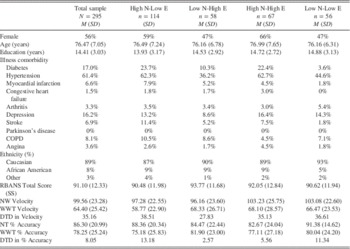
Descriptive information for key demographic characteristics, gait and cognitive performance during single- and dual-task conditions for the total sample and each of the four neuroticism-extraversion combination groupings are provided in Table 1.
Key demographic characteristics and dual-task performance scores for the total sample and four neuroticism-extraversion combination groups

Note. N=neuroticism; E=extraversion; M=mean; SD=standard deviation; COPD=chronic obstructive pulmonary disease; RBANS=Repeatable Battery for the Assessment of Neuropsychological Status; SS=Standard Score; NW= Normal Walking; NT= Normal Talking; WWT= Walking While Talking; DTD=Dual-Task Decline; % Accuracy=measure of cognitive performance on serial 7’s subtraction task.
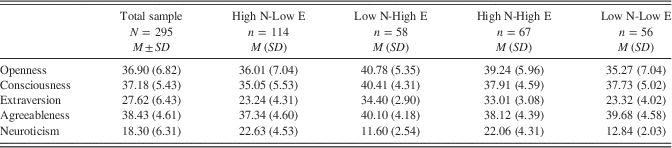
As shown, there were slightly more females (56%) than males. Participants’ average age was 76±7.05 years, and their average education exceeded a high school diploma (14.41±3.03 years). The majority (89%) of participants were Caucasian, and 8% African American, which is relatively representative of the racial composition of the catchment area. The RBANS total score revealed that their cognitive functioning was in the average range and similar across the four personality groups (Standard Score range for total sample, 62–137). Table 1 also summarizes data on velocity and performance on the cognitive interference task during single- and dual-task conditions. These data reveal that as expected, gait velocity during the single condition was faster than during the dual condition across all four groups. Similarly, percent accuracy was higher in the single versus dual-task condition. BFI means and standard deviations for the total sample and each of the four neuroticism-extraversion groupings are presented in Table 2, and reveal substantial variations in all personality dimensions.
Big Five Inventory means and standard deviations for the total sample and four N-E combination groups

Note. N=neuroticism; E=extraversion; M=mean; SD=standard deviation.
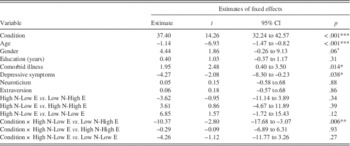
The summary of the LMEM examining the effects of neuroticism-extraversion groupings on costs to gait velocity is presented in Table 3. As expected, gait velocity for all individuals declined from the NW (single) condition to the WWT (dual) condition (estimate=37.40; positive estimate reflects faster velocities at baseline relative to the referent dual-task condition; 95% CI: 32.57 to 42.57; p<.001).
Linear mixed effects model analysis: Contribution of demographic variables and neuroticism-extraversion Personality Combination to the decline in gait velocity

Note. Condition: dual-task (WWT; reference) vs. single-task (NW). + p<.10, *p<.05, **p<.01, ***p<.001.
N=neuroticism; E=extraversion.
There was no effect of personality group status on gait velocity during the dual-task condition. However, personality group status moderated the effect of task on gait performance. Specifically, participants in the high neuroticism-low extraversion group showed a greater decline in gait velocity during the WWT condition compared to the NW condition relative to individuals in the low neuroticism-high extraversion group (estimate=−10.37; 95% CI: −17.68 to −3.07; p=.006), with a moderate effect size (d=.45).
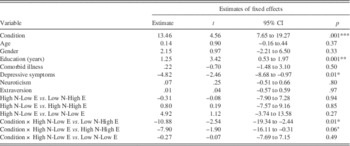
Summary of the LMEM examining the effect of combined neuroticism-extraversion groupings on costs to percent accuracy of serial 7’s subtraction interference task is presented in Table 4. Individuals’ percent accuracy was higher on the NT condition compared to the WWT condition (estimate=13.46; again, positive estimate reflects higher scores at baseline relative to dual-task; 95% CI [7.65 to 19.27]; p<.001).
Linear mixed effects model analysis: Contribution of demographic variables and neuroticism-extraversion personality combination to the decline in cognitive performance on Serial 7’s Subtraction Task

Note. Condition: dual-task (WWT; referent group) vs. single-task (NT). + p<.10, *p<.05, **p<.01, ***p<.001.
N=neuroticism. E=extraversion.
There was no effect of personality group status on cognitive performance during the dual-task condition. However, group status moderated the effect of task on cognitive performance. Specifically, participants in the high neuroticism-low extraversion group showed a significant cost in their accuracy on the serial 7’s subtraction task in the WWT condition compared to the NT condition relative to individuals in the low neuroticism-high extraversion group (estimate=−10.89; 95% CI [−19.34 to −2.44]; p=.01). Additionally, there was a trend for individuals in the high neuroticism-low extraversion group to show a greater decline in cognitive performance compared to the high neuroticism-high extraversion group (estimate=7.90; 95% CI [−16.11 to 0.31]; p=.06), with a moderate effect size (d=.41).
Discussion
Our findings reveal that non-demented older adults with high neuroticism-low extraversion incur greater dual-task costs in gait and cognitive performance relative to other neuroticism-extraversion combination groups. Results from the current study are consistent with previous studies indicating that individuals with high neuroticism-low extraversion show greater cognitive impairment later in life (Crowe et al., Reference Crowe, Andel, Pedersen, Fratiglioni and Gatz2006) and that individuals with high neuroticism demonstrate worse dual-task performance (Corr, Reference Corr2003). These results are also in line with studies examining neuroticism and extraversion alone reporting that high neuroticism is associated with cognitive decline (Wilson et al., Reference Wilson, Begeny, Boyle, Schneider and Bennett2011), while high extraversion is related to better cognitive performance (Hultsch et al., Reference Hultsch, Hertzog, Small and Dixon1999).
Revisiting Gray’s (Reference Gray1981) theory of personality, individuals with high neuroticism-low extraversion are most prone to high anxiety, given negative affect (high neuroticism) and reduced sociability (low extraversion). Therefore, based on attentional control and processing efficiency theories (Derakshan & Eysenck, Reference Derakshan and Eysenck2009; Eysenck, Reference Eysenck1997; Eysenck et al., Reference Eysenck, Derakshan, Santos and Calvo2007) of anxiety and attention, individuals with high neuroticism-low extraversion should evidence greatest interference in performance during dual-tasking. Our results are the first to corroborate this theory in the context of WWT, as findings suggest that the combined effect of high neuroticism-low extraversion had an incremental contribution to both gait and cognitive outcomes even after controlling for neuroticism and extraversion separately. Of interest, when examined separately, neuroticism and extraversion were not associated with dual-task costs. These findings further our understanding of how the combination of personality dimensions relates to dual-task costs. However, findings also raise questions regarding underlying etiology of the negative association between WWT performance and the high neuroticism-low extraversion personality group. Previous neuroimaging studies have found white matter changes in the prefrontal cortex in individuals with chronic anxiety disorders (Charney, Reference Charney2003; Phan et al., Reference Phan, Orlichenko, Boyd, Angstadt, Coccaro, Liberzon and Arfanakis2009; Rauch et al., Reference Rauch, Savage, Alpert, Dougherty, Kendrick, Curran and Jenike1997). The pre-frontal cortex has been identified as a key brain region that is involved in executive control (Koechlin, Ody, & Kouneiher, Reference Koechlin, Ody and Kouneiher2003; MacDonald, Cohen, Stenger, & Carter, Reference MacDonald, Cohen, Stenger and Carter2000). Moreover, recent studies using functional near infrared spectroscopy (fNIRS) have shown that this brain region is functionally involved in allocating and monitoring cognitive resources to support task performance during walking while talking in aging (Holtzer et al., Reference Holtzer, Mahoney, Izzetoglu, Izzetoglu, Onaral and Verghese2011; Holtzer et al., Reference Holtzer, Mahoney, Izzetoglu, Wang, England and Verghese2015). Hence, while admittedly speculative, the association between high neuroticism-low extraversion and worse walking dual-task performance maybe attributed, in part, to compromised pre-frontal cortex structure and function.
Limitations
Several limitations of the present study should be noted. First, the baseline (single task) cognitive condition and the dual-task condition were not consistent in terms of assessment times. In the single cognitive task, individuals were asked to count backward by 7 starting from 100 and were timed for 10 s. The dual-task condition consisted of individuals walking on a 20-foot long instrumented walkway while counting backward from 100 by 7. Because individuals varied in their walking speed (NT M=99.56 cm/s, range=26.70–170.20 cm/s; WWT M=64.40, range=10.00–156.30) time during the task varied as well; in turn the number of responses was partly a function of time. To control for time (and by proxy number of responses), a percent accuracy score was calculated, a method previously validated (Li et al., Reference Li, Verghese and Holtzer2014). Given that different time windows may have influenced the validity of calculated percent scores we empirically evaluated the relationship between total score and percent correct stratified by condition. Pearson’s correlations revealed significant associations (single condition, r=.68; dual-task condition, r=.74). Thus, the method above appears to have adequately controlled for the time variability between tasks.
Second, the present study examined the relation between neuroticism-extraversion combination and dual-task performance on a cognitively demanding serial 7’s subtraction task. Whether effects of personality dimensions on dual-task performance would generalize to other paradigms will have to be determined in future research. Third, the sample included only adults aged 65 and older and conclusions regarding the influences of personality on dual-task performance may not apply to younger adults or to disease populations.
Future Directions
In the present study, we found that the combination of high neuroticism-low extraversion was associated with greater dual-task costs even after controlling for the individual components (i.e., neuroticism and extraversion separately) and other key demographics. The association between the high neuroticism-low extraversion and dual-task performance may be mediated by other cognitive factors. For example, performance on measures of executive functioning has been associated with gait velocity during dual-tasking in healthy older adults (Holtzer et al., Reference Holtzer, Verghese, Xue and Lipton2006; Holtzer, Wang, Lipton, & Verghese, Reference Holtzer, Wang, Lipton and Verghese2012). Future studies may wish to examine links between neuroticism-extraversion combinations and cognitive performance on measures of executive functioning. It may be that the high neuroticism-low extraversion personality type interferes with higher order executive processes, which influences dual-tasking.
Furthermore, high neuroticism is often used as a proxy for anxiety and high neuroticism-low extraversion has been theorized as putting individuals at risk for even higher levels of anxiety (Gray, Reference Gray1981). Anxiety may be a potential moderator in the association between neuroticism or neuroticism-extraversion combination and dual-task performance on cognitive and motor tasks. Thus, future research should focus on the intersections of personality, attention and executive abilities, anxiety, and cognitive and motor functioning among older individuals.
Finally, risk of dementia is associated with high neuroticism (Wetherell et al., Reference Wetherell, Reynolds, Gatz and Pedersen2002), whereas high extraversion may protect against risk of dementia (Fabrigoule et al., Reference Fabrigoule, Letenneur, Dartigues, Zarrouk, Commenges and Barberger-Gateau1995). Therefore, individuals with high neuroticism-low extraversion may be considered to be in “double jeopardy.” That is, not only are they at greater risk for cognitive impairment given high and life-long predisposition to anxiety and negative affect, but they are less sociable and may lack key social interactions/relationships (i.e., low extraversion) and, therefore, lack the buffer against degenerative neurological processes that has been associated with individuals with high extraversion (e.g., Barnes et al., Reference Barnes, Mendes de Leon, Wilson, Bienias and Evans2004; Ertel et al., Reference Ertel, Glymour and Berkman2008). These findings highlight that individuals with high neuroticism-low extraversion are at increased risk for gait and cognitive decline when engaging in concurrent tasks. Future studies may wish to investigate the relation between these two variables, as this personality combination may be an independent risk factor for dementia.
Clinical Implications
A major issue in the field of neuropsychology involves the assessment of seniors to aide in differentiating between declines associated with benign aging compared to the declines associated with progressive neurological disorders (Attix & Welsh-Bohmer, Reference Attix and Welsh-Bohmer2006). As such, it is important for neuropsychologists and other clinicians to be involved in research aimed at understanding the normal developmental process of cognitive aging and continue to be involved in assessing cognition, activities of daily living, and functional abilities of older adults with non-pathological cognitive changes. Better understanding of healthy age-related declines will improve knowledge regarding progressive dementia and other neurological conditions. Moreover, neuropsychological testing and research in healthy older adults provides data for understanding individuals at risk for mild cognitive impairment, dementia, and forms of other malignant neurological insult. Experimental walking dual-task testing provides additional information beyond typical neurocognitive assessment, as these types of paradigms allows neuropsychologists to measure gait and cognitive abilities under manipulations of task demands. These paradigms also help investigators differentiate between individuals with “healthy” gait and cognitive performance costs and those with greater, “at risk” costs. Individuals with greater dual-task costs may be at risk for developing a neurodegenerative disorder. Furthermore, given that concurrent WWT requires divided attention and behavioral modifications (such as altered gait), this type of “everyday task” may put older adults at increased risk for falls (Chu, Tang, Peng, & Chen, Reference Chu, Tang, Peng and Chen2012). A recent study found that WWT performance was a more powerful predictor of falls than other gait variables, especially velocity (Ayers et al., Reference Ayers, Tow, Holtzer and Verghese2014). Additionally, experimental WWT dual-task paradigms have been found to be highly predictive of frailty, disability, and mortality (Verghese et al., Reference Verghese, Holtzer, Lipton and Wang2012), as well as falls (Verghese et al., Reference Verghese, Buschke, Viola, Katz, Hall, Kuslansky and Lipton2002). Seniors that demonstrate greater dual-task interference costs compared to age-matched individuals are at increased risk of falls (e.g., Beauchet et al., Reference Beauchet, Annweiler, Dubost, Allali, Kressig, Bridenbaugh and Herrmann2009).
Determining the association between dual-task costs and personality traits (i.e., neuroticism-extraversion combinations) will help identify novel contributors and provide insights to develop interventions to potentially improve locomotion by modifying traits in older adults. As such, the results from the present study suggest that individuals with high neuroticism-low extraversion incur the greatest dual-task costs in gait velocity (i.e., a measure of altered gait) and suggest a reduced ability to allocate attention to competing task demands. Such individuals may be at increased risk for falls, especially when walking while simultaneously engaging in other activities. Thus, the present study highlights the importance of determining inter-individual markers, such as personality traits, when evaluating who among older individuals may be at increased risk for mobility declines (e.g., falls) and less cognitive preservation. Identification of such individuals may allow for tailored gait and cognitive interventions at earlier time-points in the aging process. For example, older adults with high neuroticism-low extraversion may tend to avoid activities requiring dual-tasking (e.g., walking with friends while talking, interactive classes requiring both cognitive and physical activity, like dance classes) and, therefore, have less practice multi-tasking and using executive control than other less neurotic-more extraverted individuals. Additionally, given the vulnerability that this group of individuals has toward chronic anxiety, they may benefit from interventions aimed at reducing symptoms of worry, stress, and related negative emotions. Alternatively, given the protective effects of extraversion (e.g., Barnes et al., Reference Barnes, Mendes de Leon, Wilson, Bienias and Evans2004; Saczynski et al., Reference Saczynski, Pfeifer, Masaki, Korf, Laurin, White and Launer2006) novel treatments developed to increase social engagement and interaction, may improve outcomes in older adults. Taken together, interventions aimed at increasing participation in cognitively demanding tasks, decreasing anxiety, and increasing sociability may help those older adults at risk for mobility and cognitive decline. Measurement of neuroticism-extraversion may be an important aspect of early identification of these individuals at risk.
Acknowledgments
This research was funded by NIA grant R01 1R01AG036921-01A1. The authors have no conflicts of interest to declare.