In summer of 1034 CE, Ezra ben Samuel, the representative of the merchants (pakid ha-soḥarim), asked prominent members of the Jewish community in Fustat (old Cairo) to go to his sister Mubāraka and convince her to retract her claim to their father's inheritance.Footnote 1 The members of the community approached Mubāraka and warned her that if she persists in her claim, she would be severed from the Jewish community. According to their testimony, “Mubaraka ignored our words and went to the (Muslim) chief judge.”Footnote 2 This judge ordered foot soldiers to seize Ezra, thereby humiliating him. The members of the Jewish community reported that Mubāraka “insists on her claim and insolently demands her father's inheritance from her brother in Muslim courts.”Footnote 3 They wrote down their testimony so it will be sent to the court of the head of the Palestinian yeshiva in Jerusalem, probably so he can pronounce a ban against Mubāraka.
Ezra and Mubāraka's dispute over their father's inheritance is remarkable for several reasons. First, the sister-brother bond was one of the most important social ties among the Jews of medieval Egypt, and it is surprising to see it break down so publicly in a prominent family.Footnote 4 Second, it is difficult not to be impressed with the way Mubāraka was able to resist the overtures of the Jewish communal leaders and appeal directly and successfully to the highest legal authority in the Fatimid Empire. Third, the dispute reflects a key difference between Jewish and Islamic law of inheritance. According to rabbinic law, a daughter does not inherit from her father if she has a brother. However, Islamic law grants a daughter half the share of her brother (i.e., Mubāraka stood to inherit a third of the inheritance in a Muslim court if no other heirs were involved). To make matters even more complicated, Mubāraka came from a Karaite family, and according to some Karaite views daughters inherit even if they have brothers.Footnote 5 Finally, even though this is only a snapshot of a dispute that probably had a history both before and after its surviving documentation, we see the complex interplay between legal venues: Ezra turns to Jewish communal leaders, they approach Mubāraka, she appeals to the Muslim chief judge, leading to the actions of foot soldiers, and finally an appeal is made to the highest Jewish legal authority in the empire. Thus, this inheritance dispute attests to the way a Jewish woman maneuvered within the complex legal arena of medieval Egypt, using a Muslim legal venue to resist the pressure of a Jewish one in a dispute with her brother.
Mubāraka was not alone. The Cairo Geniza and Moses and Abraham Maimonides's responsa yield many cases from 1000 CE to 1250 CE from Egypt and Palestine of Jewish women using Muslim legal venues or threatening to do so. This phenomenon was widespread in terms of time, geographic location, social class, and the type of Muslim legal venue employed. Jewish women and their male kin used Muslim legal venues both to pursue conflicts and to formalize agreements in a wide variety of matters: inheritance, marriage, divorce, and commercial arrangements. The Jewish community did not view Jewish women using Muslim venues favorably and took a variety of legal measures to prevent them from doing so. Women who persisted in their claims tend to be depicted in the documents more negatively than men who did the same.
Examining why Jewish women used Muslim legal venues allows us to complement the traditional “pull” explanations given to Jewish use of Muslim legal venues (such as legal difference between Jewish and Islamic law and the greater means of enforceability of Muslim institutions) with an important “push” explanation grounded in women's experiences in Jewish legal institutions. By examining how Jewish women accessed such venues, we learn about their points of contact with the broader Islamic society and the relationship between Jews and the Islamic state.
From the Jewish communal perspective, Jewish courts were an essential part of communal autonomy within Islamic society. However, from an Islamic perspective, the legal institutions of the dhimmī communities were part of the Islamic state administration.Footnote 6 Jews in medieval Egypt could bring civil cases to Jewish courts, but they could also choose to avail themselves of Islamic legal venues. The old scholarly consensus that Jews adhered faithfully to their communal courts and made use of Muslim courts only in exceptional cases is no longer tenable.Footnote 7 A series of groundbreaking studies has proven conclusively that Jewish use of Muslim courts was pervasive, whether in the geonic or in the modern period.Footnote 8 At least for the medieval period, however, the gendered aspects of using Muslim legal venues remain unexplored.Footnote 9 Furthermore, studies of pre-Ottoman periods tend to assert the phenomenon of Jews using Muslim legal forums in general terms and then explore its consequences, while peppering their discussion with specific incidents. While such an approach works well for examining the responses of the Jewish leadership, this study offers the beginning of a systematic corpus of cases of women's use of Muslim legal forums. Such a corpus shifts our focus from elite responses to individuals’ choices and actions.Footnote 10 Furthermore, it makes it possible to pose and answer specific questions about women's use of such forums. Finally, a corpus based on Geniza documents and Jewish responsa will also enable future comparative studies of Jewish recourse to non-Jewish courts in other locations and periods.Footnote 11
Looking at the Forest of Evidence
The corpus listed in the appendix includes fifty-five cases (45 from the Geniza, 9 from Maimonides's responsa, and 1 non-Geniza document) that form the core of the collection, and twenty-eight further cases that for reasons explained in the appendix are not included in the main corpus. This corpus is not the result of an exhaustive survey of the entire Geniza, which remains mostly unpublished and insufficiently catalogued 120 years since its “discovery,” but rather a collection of cases encountered in the past couple of years during intensive Geniza research. Since there has not been a systematic study on the use of Muslim legal forums in the Geniza, I cannot compare this corpus to the number of cases in which no woman appears. This does not mean much, because men dominate the historical record anyway. In any case, Geniza studies never developed a clear methodology of determining when a certain amount of cases is significant. However, I believe scholars of the documentary Geniza would agree that the number of cases collected here suggests that, to echo William Chester Jordan's formulation regarding women's role in credit, “there is something distinctive and significant” about Jewish women's use of Muslim legal forums.Footnote 12 Fifty-five or eighty-three cases are too many to present with a close reading of the details of the text. Therefore, the following survey looks at the outline of the forest, so to speak, rather than examines leaves and branches.Footnote 13
Before turning to the evidence, it is important to stress that we are looking at Jewish sources for Jewish use of Muslim legal venues. While the picture may change as work continues on Arabic papyri or Arabic-script Geniza documents, for the moment we do not have enough evidence produced by Muslim institutions themselves.Footnote 14 This means that we are looking at Jewish use of Muslim venues mostly through documents that reflect the perspective of Jewish communal authorities, rather than that of Muslim institutions.Footnote 15 Moreover, these sources do not provide straightforward accounts of Jews explaining why they chose to bring their cases before a Muslim forum (although such motives can often be reconstructed, as shown below).
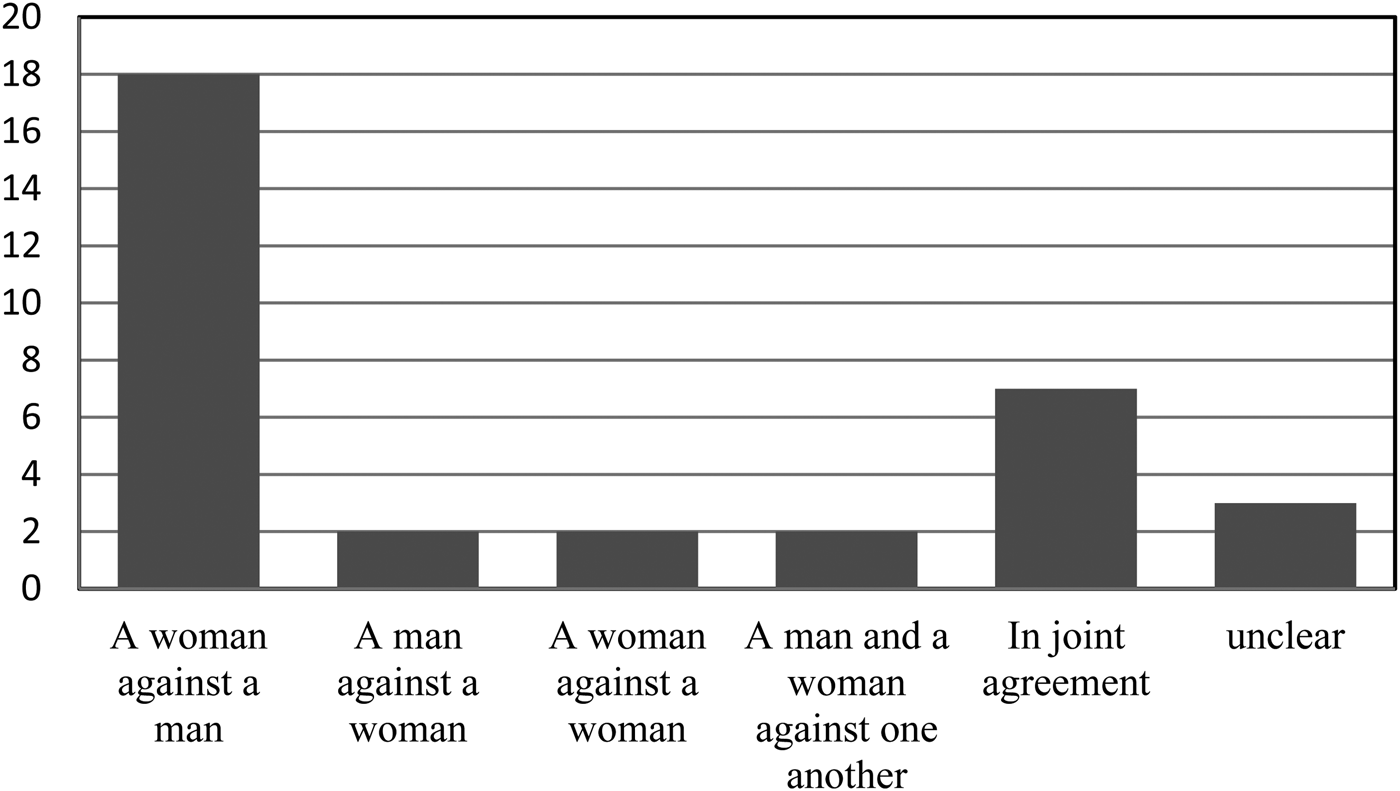
This corpus reveals that Jewish women frequented Muslim legal forums in significant numbers. Further, in the vast majority of cases it was a woman who brought, or threatened to bring, the case against a man (see fig. 1).
Who brought the case to a Muslim forumFootnote 16

We also find a similar pattern in cases in which an agreement or a legal act was registered in a Muslim court. Jews in medieval Egypt often registered debt or transfer of real estate in Muslim courts, an ordinary procedure generally condoned by Jewish law and Jewish communal authorities.Footnote 17 Out of the twenty-one cases that record agreements of debt, sale, gift, or transfer of inheritance conducted with a Muslim record involving a woman, in seventeen of them the rights of women are registered, or sought to be registered. In the remaining four cases, men are either creditors of women or hold a Muslim document guaranteeing their right against the claims of a woman. Out of the seventeen cases in which women's rights are registered, five involve a debt of some kind, six registering a gift or an inheritance, five a purchase of real estate, and one the right to divorce.Footnote 18 While Jewish law recognizes non-Jewish deeds of debt or sale but not deeds of gift and inheritance, for our purpose they can be treated together because from the perspective of social practice they have the same goal of protecting monetary rights.Footnote 19 In some of these cases, women do not appear to have been involved or even present in the proceedings. However, these cases are significant because Jewish women's monetary rights were registered in Muslim courts to facilitate defending them in these courts in the event of future contestation. While it can be argued that women generally tend to hold monetary rights against men, and thus the ratio found with Muslim venues merely reflects the overall pattern, there are no references to cases of registration in Muslim courts where wives gave gifts to their husbands or released them from debt.Footnote 20
Another striking feature in the twenty-one cases of monetary agreements is that all seventeen cases in which a woman's rights are registered in a Muslim court involve her close family relations. The cases of gifts and inheritance usually involve a father or a mother, and the cases of debt and sale usually involve a husband (often a former one). However, in three out of the four cases in which a man's rights are registered in a Muslim court his relation to the woman is not clear, and in the fourth case it is not a close relationship (the man is the husband of the sister of the woman's late husband). This preponderance of close family relationships in securing women's rights in Muslim courts leads to two conclusions. First, this attempt to protect women's rights was not carried out within the Jewish community and by its leadership, but was conducted outside communal institutions by close relatives of the women.Footnote 21 In “The Jewish Community Strikes Back” section below, I show that Jewish communal institutions were particularly averse to registering Jewish women's rights in Muslim legal venues. Second, monetary matters within the close family circle often led one set of close relatives to protect a woman's rights in Muslim courts from claims by other close family relatives. The most obvious examples for such a scenario are the cases in which parents assert their daughter's inheritance in a Muslim deed to protect it from a future claim by her brother or husband.Footnote 22 Extracommunal institutions were especially useful in regulating the relationships of Jewish women with the males who were closest to them: brothers and husbands.
The corpus also shows great diversity in terms of period, geographic location, social class of women involved, subject of cases, the types of Muslim legal forums and the ways they were addressed. This diversity indicates that Jewish women using Muslim venues was a general phenomenon that cannot be explained by particular conditions in a specific time or place. In addition to cases in which Jews used Muslim legal venues to contest other people's claims or enforce their own (i.e., litigation) and cases in which they used them to register (mostly) monetary rights and transactions, Jews also used the threat of appealing to these forums to advance their interests. The logic of threatening to use Muslim legal venues lies in the fact that, as Marina Rustow observed, “Jews called upon authorities outside the Jewish legal and administrative apparatus in order to solve problems within it.”Footnote 23 Threatening to make use of such authorities can be seen as a way of deploying the effect of stepping outside the community without actually doing so.
While contesting and registering monetary rights were the most common uses of Muslim legal venues, they were also used to enact marriage and divorce. Since matters of personal status are often seen as the bedrock of Jewish identity and communal life, evidence for such uses is of particular interest. A Jewish businesswoman in eleventh-century Fustat declared before officials of the Jewish court that she married a fellow Jew in a Muslim court.Footnote 24 Sometime before 1085, a woman in Ashkelon declared that if a certain man will marry her by the government or by force she would throw herself down a well.Footnote 25 Moses Maimonides issued a strongly worded ban (ḥerem) against a kohen and a divorcée who married in a Muslim court in Alexandria.Footnote 26 A query to Moses Maimonides expresses a concern that a woman suspected of being a “killer wife” because her two previous husbands died would marry in a Muslim court.Footnote 27 In a query to Abraham Maimonides, we find a Karaite woman who seems to have been married to a Jewish convert to Islam, who then divorced her in a Muslim court. Since from a Jewish legal point of view she was still married, another Jew married her in a Muslim court and wrote her a Muslim marriage document.Footnote 28 Around the same time, a Jewish judge wrote a short note expressing his disappointment to a Jew who conducted a marriage agreement for his daughter in a Muslim court.Footnote 29
As for divorce, a couple from the small town of Sahrjaht divorced in a Muslim court around 1032.Footnote 30 A Jewish woman who appears to have stayed with her husband after he converted to Islam asks a Muslim muftī whether she can be divorced from him after he had been in India for some ten years.Footnote 31 In two cases, women threaten to make use of Muslim forums if their wish to be divorced from their husbands would not be addressed by the Jewish authorities.Footnote 32 The efficacy of threats, of course, depends on divorce in Muslim courts being a viable possibility. As remarked in the notes below, while uncertainties and caveats can be raised about several of these cases, the resulting picture is clear enough: some Jews used Muslim legal venues for marriage and divorce.Footnote 33 Unfortunately, the sources do not give us a sense of how such actions were understood by the Jews who pursued them, nor is it clear how Muslim legal institutions understood performing Islamic marriage and divorce for non-Muslims.
We find Jewish women using Muslim legal venues throughout the “classical Geniza period” (1000–1250 CE) in a wide variety of places. While most of the cases documented in the Geniza took place in Fustat/Cairo, we also have cases from other locations in Egypt (Alexandria, al-Maḥalla, Sahrajt, Minyat Ghamar, Minyat Ziftā, al-Ashmūnayn), Palestine (Ashkelon, Rafaḥ, and Jerusalem), and even Yemen. The majority of cases are from the eleventh century, with fewer from the second half of the twelfth and the first part of the thirteenth century. This decline appears to be significant and is probably related to the rise of the Ayyubids and the increasing attempts of the Jewish leadership to curtail the use of Muslim legal venues.Footnote 34
The most commonly mentioned legal venue used by Jewish women is Muslim courts with their qāḍīs. These are followed by references to the sulṭān (or the Hebrew equivalent shilton and malkhut). Sulṭān in Arabic can mean different things, but in our context it seems to refer to a venue distinct from qāḍī courts, which I translate as the “government.”Footnote 35 We see this in clauses prohibiting contesting an agreement “in Muslim courts or the hand of the government” (be-dine goyyi[m] 'o be-yad al-malkhut) or “she will not harass him nor sue him in Muslim courts and will not bring him before the government (shilton).”Footnote 36 A group of people discontent with the ruling of the Palestinian gaon in a matter of inheritance turned to the Muslim judge (qāḍī/shofet al-goyyim). Unhappy with his ruling, they turned to the government/governor (al-shilton, al-qāʾid).Footnote 37 In a complicated inheritance dispute, “(the two girls) overpowered him in the government (bi-l-salṭana) through the ʿudūl deeds in their hands so that he went and admitted in the court of the qāḍī that….”Footnote 38 Sulṭān seems to be a general term for the government that includes the process for redress of wrongs known as maẓālim.Footnote 39 The Geniza reveals that people turned to the government also for personal status and inheritance issues.Footnote 40 Beyond qāḍī courts and the government, there are also a couple of cases in which Jewish women submitted queries to Muslim muftīs.Footnote 41 This variety of Muslim venues meant that Jewish women had options in pursuing conflict, a fact that is consequential to our understanding of the relationship between individuals and the state.Footnote 42
A quick glance at the corpus shows cases involving both socially weak and strong Jewish women. A more careful inspection reveals an intriguing trend: while socially well-placed Jewish women indeed made substantial use of Muslim legal forums, socially weak Jewish women more often threatened to appeal to Muslim legal forums.Footnote 43 Threats to use Muslim venues thus appear to have been a weapon of the socially weak in their attempt to get the attention of communal institutions. To give just one example, when in 1085 the Jewish court in Fustat forbade the former wife of Ṣāliḥ from holding sit-ins in Ṣāliḥ’s home, she met their censure head on by declaring: “I do not accept this. You took a bribe to divorce me (from him). The house is my house and I will not leave it. I will bring this to […] the government!” The document goes on to report that she spoke of committing enormities and that anyone who tried to speak with her met with threats and curses.Footnote 44
How were Jewish women able to access these venues?Footnote 45 Since our sources are mostly Jewish documents that ended up in the Geniza, they offer only scattered hints. However, even these hints are quite suggestive. Goitein suggested that in an 1156 case in which a mother promised not to contest her daughters’ inheritance settlement in a wide variety of Muslim venues, she had to do so because she was a daughter of a late kātib, a government official. In other words, because her father used to be an official in the Muslim government, she enjoyed easy access to it, which explains why she turned to it and why the settlement had to be especially stringent in forbidding her to do so again.Footnote 46 It is striking that she retained that access even though her father was dead.Footnote 47 Many middle- and upper-class Jews worked in the government administration. The connections they developed there help explain the use of Muslim legal forums by socially well-placed Jewish women.Footnote 48
People lower on the social ladder seem to have been able to use their Muslim neighbors to pursue conflict and to secure their rights. Jews in medieval Egypt lived side by side with Christian and Muslims, often sharing the same courtyards.Footnote 49 Living in close proximity meant that much of the trivia of domestic life was probably shared between neighbors, regardless of their religion.Footnote 50 Such neighbors could easily turn to allies when domestic conflict erupted. This happened in a case of a Jewish husband who lodged his wife and eight-year-old daughter among Muslim neighbors and failed to maintain them. Asking for help, his wife used the fact that her husband lodged her among Muslims to enlist sympathy. At the same time, she relates that her Muslim neighbors offered to help her obtain her monetary rights and be rid of him.Footnote 51 An 1140 letter reports how a plurality of venues was used by some young men when the writer, a brother of a well-known India merchant, tried to collect on a debt they owed. They sought the help of their Muslim neighbors against him, complained that he is harassing them while they are ill, and claimed that their mother will go and protest to the government.Footnote 52
Another way by which Jewish women may have been able to access Muslim legal venues is suggested in a recent join between two Geniza fragments.Footnote 53 Even with the two pieces joined it is a difficult to understand the details of this twelfth-century inheritance dispute. It seems that both the widow and the other relatives of the deceased made use of Muslim legal forums. The most interesting detail is found right at the join, where we learn that the widow came to “the wife of the qāḍī.” How did the wife of the Muslim judge figure in this Jewish inheritance dispute? The state of the fragments does not yield a ready answer; the only reconstruction that I can offer is that the Jewish widow may have been able to access the Muslim judge through his wife.Footnote 54 There is supportive evidence from Jewish and Muslim sources that wives and slave women of government officials served as a gateway to power in the period.Footnote 55 A systematic approach to Jewish use of Muslim legal venues thus yields important clues about how gender and social status may have influenced one's ability to access such venues, as well as about points of contact between Jewish women and wider Islamic society.Footnote 56
The Jewish Community Strikes Back
The Jewish communal leadership saw the pervasive use of Muslim legal forums by their flock as a threat both to their authority and to the autonomy and integrity of Jewish communal life. Since they could not stem the tide, and on occasion needed to use the very same Muslim forums themselves, Jewish leaders instead tried to limit and control the phenomenon. They did so through various mechanisms, from imposing a communal ban on those like Mubāraka who defied their instructions, to giving formal permission to take a certain action in a legal venue outside the community.Footnote 57 The examination of some of these mechanisms along with these documents’ portrayal of women who used Muslim venues shows that women were held suspect when it came to using Muslim legal venues, greater stringency was used to prevent them from doing so, and they were treated more harshly once they did.
The most common mechanism to control the phenomenon was a clause in legal agreements in which one or both parties committed themselves not to use Muslim venues. Often, this was part of a general clause that forbade contesting the agreement in any other court, whether Jewish or gentile.Footnote 58 For example, in a 1045 Fustat divorce settlement a wife relinquished her son's maintenance for three years for the right of custody and agreed to pay a fine of fifteen dinars if she were to sue her husband “either in Jewish courts or Muslim courts.”Footnote 59 Similarly, in an 1120 Fustat divorce settlement, the brother of the wife “stands surety for her in Jewish and Muslim (courts)” and agrees that “whenever she breaks (this agreement) and sues him (i.e., her former husband) for anything to do with her aforementioned daughter's maintenance, her cover or anything to do with her, whether in Muslim or Jewish (courts), everything that may be imposed on him (i.e., her former husband) will be incumbent on him (i.e., her brother).”Footnote 60 That women or their allies undertook such clauses may tell us about the dynamics of divorce settlements, but they do not reveal a special inclination to use Muslim legal venues.Footnote 61
However, when such clauses are unbalanced both in terms of the gender of the individuals involved and the emphasis on the use of Muslim venues, they tell us of a special concern regarding the use of Muslim legal venues by Jewish women. Thus, we find in a 1055 Fustat inheritance settlement reached in a joint Karaite-Rabbanite session:
Before they examined anything to do with the inheritance, a complete and rigorous purchase (kinyan) with a fitting instrument was made from the heir, Mevorakh b. Israel, that he accepts upon himself the courts of Israel in the matter of this inheritance, from beginning to end. He consented to this before the elders.
Then, a purchase was made from Aaron b. Isaac, the maternal grandfather of the orphan, Samuel b. Yehudah, that he stands surety for his daughter, the mother of Samuel,Footnote 62 the orphan, who was the wife of the deceased Yehudah b. Tammām and he divorced her, that whenever she ventures to Muslim courts claiming something from this inheritance, this Aaron will owe all of what this Mevorakh will be charged by Muslim courts and upon her will be whatever the Jewish courts require her to pay due to her going to Muslim courts.Footnote 63
While we have a clause for each party of the agreement, the clauses are clearly different. Mevorakh accepts upon himself that the inheritance will be divided by Jewish courts. However, the possibility that Samuel's mother will venture to Muslim courts is not only raised but discouraged by both a commitment from her father to pay Mevorakh whatever he might be charged by the Muslim court and the requirement that she will pay whatever the Jewish courts charge her for going to Muslim courts.
In other cases, there is a clause only concerning the woman. In a 1052 divorce settlement, a Jewish wife committed that “she will not harass him, nor sue him in Muslim courts, nor bring him before the government (shilton). We (i.e., the court) made it clear to her that were she to break (this agreement) she would be banned with her name and ostracized.”Footnote 64 After another wife obtained a deed obligating her former husband to pay maintenance for six years in a Muslim court, her relative reached an agreement in a Jewish court. When asked to produce the Muslim deed so it could be torn, he claimed that the deed was lost, and instead declared that “whenever she or her agent present this (deed of) maintenance to a Muslim court and sue him (i.e., her former husband) for what it contains during the period of six years written in the deed … I will provide it to him for her. … (The husband) was satisfied with this.”Footnote 65
By far the most extensive clause of this kind is found in an 1156 inheritance settlement in which Abū al-Rabīʿ promised each of his two sisters the enormous sum of two hundred dinars as a gift,
on the condition that whenever Sitt al-Khāṣṣa, their mother … return to harass Abū al-Rabīʿ … in Muslim courts or in the hand of the government, or in the hand of anyone connected with the government, about what concerns her in Muslim courts or about what concerns her [aforementioned] daughters in Muslim courts, or she breaks any of the conditions upon which this gift was built and it has been confirmed that she brought Abū al-Rabīʿ … before the government or before a deputy of the government (here the document continues in the same vein for another four lines), or if his sisters … reach the age of majority and [one] of them sues him to recover what is due to her from the estate [of her father in] Muslim courts or one of them sues him for anything concerning [this] gift before its time,Footnote 66 when Sitt [al-Khāṣṣa] or one of her aforementioned daughters breaks anything [explained above] then this gift is null as of now.Footnote 67
While this long clause (or clauses) take up some eighteen lines, the conditions pertaining to Abū al-Rabīʿ take up a meager five lines and do not mention any use of Muslim legal venues. The imbalance in reference to Muslim venues shows the strong association between Jewish women and the use of Muslim legal venues. In some cases, this association was based on suspicion, while in others it was founded on past actions, but in any case, we see the antagonism that it aroused and the effort taken to prevent it.
This was the case not only when the use of Muslim venues was prohibited, but also when it was condoned. As demonstrated above, the monetary rights of Jewish women were often registered in Muslim deeds. While Jewish law and Jewish communal authorities generally condoned the registration of debts and sales in Muslim courts, in some of the cases in which a woman had or tried to obtain such documents we find a combination of antagonism and prevention similar to those seen above. In a query to Moses Maimonides we learn about a Jew who, instead of giving his former wife her delayed marriage gift upon divorce, acknowledged it as a debt in a Jewish deed. When the wife asked him to have the debt also recorded in a Muslim deed, he refused; moreover, the query itself portrays the woman's motives negatively, claiming that “she aims to harass him, confiscate and seize (his property).” Maimonides had to remind the questioner that demanding that a debt recognized in a Jewish court also be recorded in a non-Jewish court was within the right of the creditor.Footnote 68 The negative portrayal of the wife's legitimate request speaks volumes on the attitude of the local community to women's use of Muslim legal venues.
We also see that when women were involved, a Muslim deed of debt spurred the Jewish court to conduct a process meant to replace the Muslim document. Even though Jewish law condoned the use of Muslim deeds of debt, in practice, Jewish courts in Egypt tried to prevent their use in cases involving women. That gender was a factor is indicated in a 1057 case from Fustat in which a man had a Muslim deed of debt against a Jewish woman, but sued her in the Jewish court “because he had mercy on her honor for she is a married woman.” Later, the court gently pressured the woman's husband to cover some of his wife's debt “so that his wife would not be dragged to Muslim courts.”Footnote 69 In other cases the Jewish court simply arrived at a compromise meant to prevent a wife from using a Muslim deed in Muslim courts.Footnote 70 A greater effort was undertaken to prevent women from using Muslim legal venues than to prevent men from doing so.
Beyond the negative reaction to the tendency to assert the monetary rights of Jewish women in Muslim courts, women who used Muslim legal forums were depicted more negatively than men. In the case of Mubāraka with which we opened this study, it is possible that her claim to the inheritance of her father was connected to Karaism or to her father giving her part of the inheritance in a Muslim court, as other Jewish fathers had done. However, the legal record does not provide the content of her claim and simply portrays her as insolent and headstrong.Footnote 71 In another case, a sister presented the Jewish court with a Muslim deed in which her father bequeathed her real estate. However, the court followed the lead of her brother, who claimed that the deed in her hand was forged, and the Jewish legal record describes the sister as obstinate and deceptive.Footnote 72 In a letter to the communal leader of al-Maḥalla, the head of the Jews of Egypt writes that the mother-in-law of a prominent member of the community “keeps coming to him, using stratagems against him and harasses him in Muslim courts although (he had done) no wrong (Isaiah 53:9, Job 16:17).”Footnote 73 These cases, and others like them, not only describe the women using Muslim legal venues as insolent, harassing, and deceptive, they suggest that such women ought to be placed under a communal ban.Footnote 74
Since a comparable corpus of documents involving men turning to Muslim forums has not been assembled, it is not presently possible to systematically compare the presentation of men and women who used Muslim legal forums. There are documents in which men who used Muslim forums are depicted negatively and documents in which women who did the same are portrayed in neutral terms.Footnote 75 However, the overall impression that emerges from the corpus collected here and from dozens of cases in which men used Muslim venues is that women tend to be depicted more negatively. A comparison between two Geniza documents illustrates this difference. A 1032 Hebrew letter from the Jewish communal leader of the small delta town of Ṣahrajt to the capital reports that a man married the sister of his deceased wife, but the marriage was not a success:
She took him to a Muslim judge and divorced him according to her will against his will.Footnote 76 (The Muslim judge) awarded her maintenance for three months …. When (the couple) fought, she took the deeds of the apartment and lied saying “I did not see them!” … We spoke to her thus: “Let go of all that is past. It is between you and your creator. Go back to your husband as you were of yore in love and fondness.” … She refused to listen and misled the congregation with unbecoming speech. Afterward, we sent her several messengers, but she did not listen to them but rather remained maliciously insolent. We had to act with her in a reprimanding manner because she said bad things about her husband and because she went with her ketubah to Muslim courts and divorced her husband through them and because of her refusal to accept the courts of Israel and her being rebellious. (Therefore,) we cast her out as she deserved and banned her and ostracized her and exposed her shame in public as is proper with the daughters of evil who do not return to the fold except through punishment.Footnote 77
The depiction of the headstrong, insolent, and lying woman who uses Muslim courts and is placed under the ban is by now familiar. This document is especially valuable because the other side of the page offers us an alternative narrative of the events. Apparently, the wife (we now learn that her name was Saʿīda bt. David) was discontent with the handling of her case in her home town and travelled to the capital seeking justice. The legal record reveals how two official accounts of the same case could differ from one another:
Saʿīda bt. David, mentioned in this letter, appeared before the permanent court in Fustat … protesting and claiming that everything said about her on the other side of this letter has no truth. It was her husband who took her to Muslim courts and it is she who was wronged in what was done to her. The honored, holy, Isaac b. Samuel was present and was asked what he knows about what transpired between this woman and her husband. He said: “What I know from a group of the people of Ṣahrajt is that their going to Muslim courts was by their joint agreement.” Then he returned and said “The man and the woman admitted to me that they went to Muslim courts by joint agreement.” The wife mentioned she has another witness who will testify to what will clear her from (the accusations found) on the other side of this letter.Footnote 78
While this is not the place to delve into this eleventh-century Rashomon, the later testimony highlights the constructed and scripted nature of the image of the headstrong women who appeals to Muslim legal venues in the earlier letter. Like in the Maimonides query mentioned above, it was relatively easy to cast the blame on the wife, even when Muslim venues were used by joint agreement.
A very different attitude to the threat of turning to Muslim authorities is found in a query submitted to Abraham Maimonides. A freedwoman died and was buried by the Jewish community of a small town. She left a sum of money to several women; however, a certain Abū al-Ṭāhir, the son of her former master, claimed the money and threatened to appeal to Muslim courts to receive it. The head of the local Jewish community asked Abraham Maimonides whether the money ought to remain with the women, be spent on the needs of the community, or be given to Abū al-Ṭāhir. Although Jewish law does not grant the son of the manumitter any rights in the inheritance of the freed slave and despite Abū al-Ṭāhirʼs credible threats to appeal to Muslim courts, the writer of the query goes out of his way to describe Abū al-Ṭāhir positively and sympathetically:
The master of the deceased,Footnote 79 the elder Abū Ṭāḥir … is in great harm, need and destitution. He has debts to Muslims and his tax farm has collapsed. He is in distress. Since the aforementioned (freedwoman) died, he hinted to me several times to examine her affairs and what she has left him and to issue a ban over it for he is her [heir] according to Muslim law.Footnote 80 … The aforementioned (Abū Ṭāhir), despite his poverty and his need, is beloved by the people, most intelligent, very sociable, with great manliness, bashful among all the people and his good qualities are greatly renowned. He will find relief even in a dirham of this…. He is able (to act) regarding what he says (i.e., appealing to Muslim courts) and he will do so and people will forgive him.Footnote 81
The sympathy to Abū Ṭāḥir and the understanding shown to his threats stand in sharp contrast to the depiction of Saʿīda bt. David. Admittedly, these are two extreme examples. However, I am not aware of a case of a man depicted as negatively as Saʿīda bt. David, nor of a woman presented as positively as Abū Ṭāḥir.
The negative portrayal of women who made use of Muslim legal venues and the stricter attitude towards them can be explained by three related factors. First, because Jewish women used Muslim legal venues against men more than the other way around, the Jewish communal authorities may have castigated them more harshly to combat what they perceived as a widespread social evil. Second, while men usually brought commercial disputes to Muslim forums, women brought cases dealing with marriage, divorce, and inheritance, matters that are more problematic from the perspective of Jewish law, which recognizes non-Jewish deeds of sale and debt but is not so accommodating in issues of inheritance, marriage, and divorce. In addition, cases of personal status and inheritance were regarded as more threatening to Jewish communal autonomy and identity than commercial cases. From an internal perspective, as the most basic social unit the family is the primary site for socialization and guaranteeing Jewish continuity. From an external perspective, Muslim rulers recognized the autonomy of Jewish communities and tasked their appointed leaders with overseeing matters of personal status, as can be seen in letters of appointment given to non-Muslim leaders. Finally, men were assumed to circulate in public and brush with the surrounding Muslim society in their economic pursuits, while women were supposed to remain, as much as possible, in private quarters. Thus, when men used Muslim venues it probably generated less resistance from Jewish communal authorities than when women did the same.Footnote 82 Put differently, when Jewish men came before Muslim forums they went against the communal fold. When Jewish women did the same not only did they they go against the communal fold, they also defied male domination.Footnote 83
Despite the negative portrayal of Jewish women who used Muslim legal forums and the accompanying threat of the ban, in the great majority of cases Jewish women turned to Muslim forums only after a process took place in Jewish forums. In other words, Jewish forums were the first port of call even for these women depicted as contrary. Jewish forums either sided with their opponents, or more commonly, never reached a decisive resolution. It was when their needs were not met by Jewish forums that they turned to Muslim venues.
Contending Explanations: Legal Difference, Enforceability, ResistanceFootnote 84
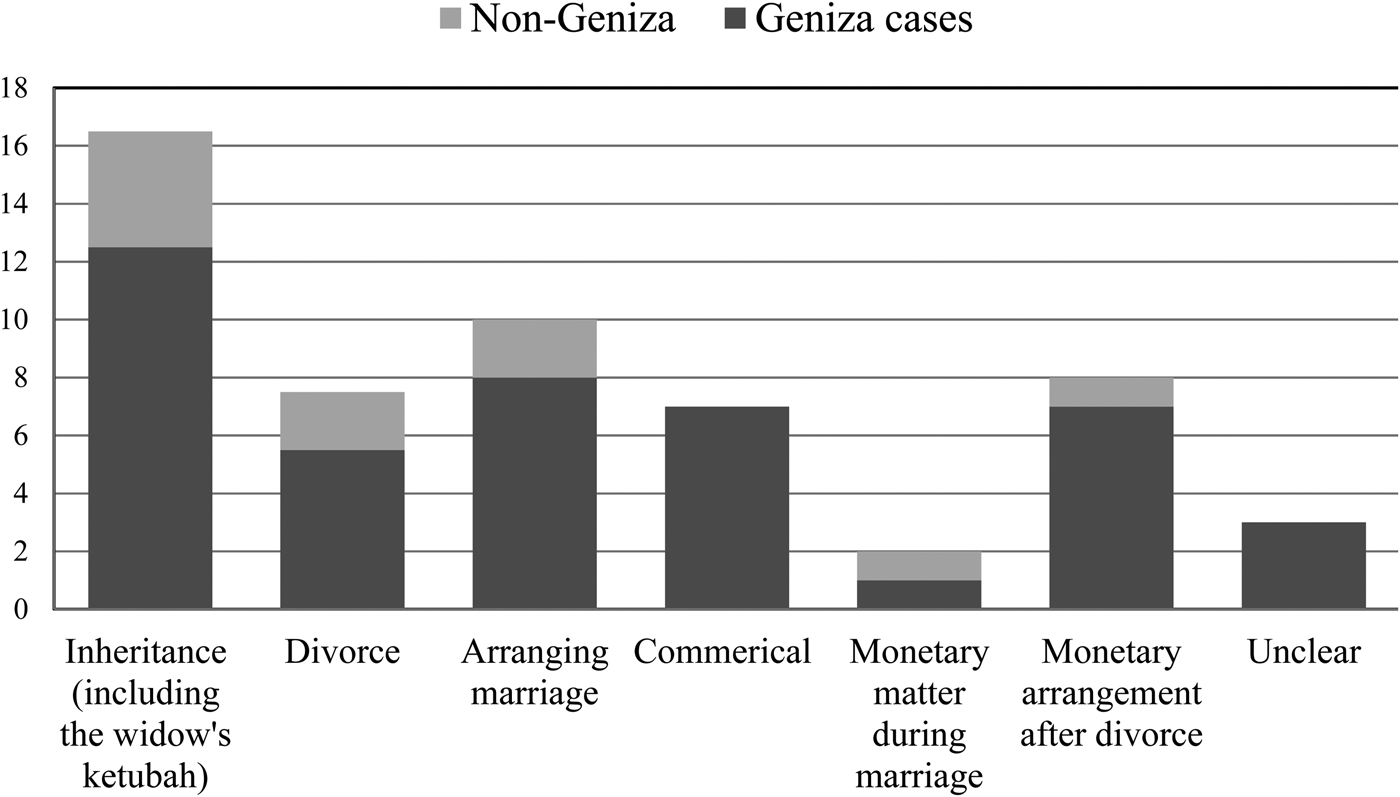
How can the gendered aspects of Jewish use of Muslim legal venues in medieval Egypt be explained? A readily available explanation is that Islamic law offered women several specific advantages over Jewish law, namely inheritance rights as daughters and wives, as well as the possibility of carrying out divorce by the court rather than only by the husband and for a longer list of recognized causes. Thus, we might expect that in the judicial bazaar of medieval Egypt, Jewish women would forum-shop and turn to Muslim venues in matters of inheritance and divorce. However, the picture that emerges from our corpus is more complicated, as can be seen in figure 2.
The division of cases according to subjectFootnote 85

About half the cases revolve around inheritance and divorce.Footnote 86 This suggests that legal difference is indeed a significant factor in Jewish women's use of Muslim legal forums. However, the substantial number of cases in the other categories suggests that it is not the full explanation.Footnote 87 Indeed, a closer look at the cases of inheritance and divorce reveals that many of them do not seem to revolve around a difference between Jewish or Islamic law. Without doubt, there are cases where a sister takes her brother to a Muslim court for their father's inheritance, or a wife seeks divorce in a Muslim forum. However, in many of the inheritance and divorce cases, I have not been able to point to a legal difference that explains why the case was brought to a Muslim forum.Footnote 88 In fact, the only case in which a legal difference is explicitly mentioned is Abū Ṭāhir's declaration that according to Islamic law he stands to inherit from the slave woman his father manumitted.Footnote 89
That often the matter at stake was not legal difference can be seen in the many cases where monetary rights were registered in Muslim courts. Jewish law allows for freedom of contract in monetary matters and in these cases one could presumably have recorded the same agreement in a Jewish deed. Thus, the several examples in which a daughter's inheritance, dowry, or even divorce settlement was recorded in a Muslim deed should not be attributed to specific rulings of Islamic law. Rather than particular strictures of Islamic law, it seems Jewish women (or their relatives) may have been seeking enforceability. Jewish courts, as a rule, could not physically coerce recalcitrant members of the community who refused to abide by the courts’ rulings. Therefore, one possible reason to use Muslim forums was to be able to access the violence of the state.Footnote 90 In fact, while Jewish law strongly opposes the use of non-Jewish courts, it makes an exception in cases in which a litigant uses the non-Jewish forum to enforce a ruling made by a Jewish court. Due to the structural framework of family and marriage, it was often women who had to claim property from men. Since these men could refuse to pay or even take off and disappear, Jewish women had a strong motive to employ the more powerful Muslim venues.
While enforceability certainly explains a part of the picture, it does not explain all of it. First, the Jewish courts were not powerless. In a society in which one's status is largely determined by his or her social ties, the communal ban could serve as powerful means of coercion and deterrence.Footnote 91 Second, if using Muslim forums was merely a matter of enforcing the decisions of the Jewish courts, we would not expect to see the effort to replace Muslim deeds with action in Jewish courts nor the negative depiction of women using Muslim courts that we saw above. As already mentioned, Jewish law permits the use of some non-Jewish deeds and the employment of non-Jewish venues to enforce the decisions of a Jewish court. Jewish communal authorities would have approved of having their decisions enforced by the Muslim authorities; that they did not suggests that enforceability was not the only factor involved.Footnote 92 Third, among the corpus of cases, instead of cases in which a Jewish court reached a decision subsequently ignored by the losing side and therefore appealed by the winner to Muslim venues, more common are cases in which Jewish women resented the way their cases were handled by their communal institutions and chose to use Muslim venues instead. In some cases, the Jewish courts refrained from arriving at a decisive ruling, and in other cases women were unhappy with their procedure or decisions. Indeed, women's threats to use Muslim legal venues suggest their unhappiness with the proceedings and decisions of Jewish institutions, rather than a hope to employ the greater enforceability of Muslim institutions.
Frustration with Jewish communal institutions must be understood within a larger context. Elsewhere, I have argued that Jewish courts in medieval Egypt were male spaces that tended to pressure women disproportionately in the attempt to reach a compromise.Footnote 93 These pressures at court combined with pressures at home to constitute a broader dynamic that compromised women's monetary rights during marriage, divorce, and widowhood.Footnote 94 Faced with threats to their monetary rights, Jewish women and their male relatives preferred to rectify monetary agreements through Muslim deeds. Pressed by communal courts to compromise, Jewish women threatened to appeal to Muslim courts or the government. In other cases, they used Muslim venues either to goad Jewish authorities into action, or to overturn decisions they were not happy with. Pressures at court and general threats to monetary rights were factors that pushed women away from Jewish courts, which complemented factors of legal difference and greater enforceability that pulled women to Muslim venues.
Some of the appeal of Muslim legal venues can be understood by revisiting Goitein's description of Jewish courts in medieval Egypt: “The members of the Jewish courts were, as a rule, personally known to the parties either from the synagogue or otherwise, and, in any case were regarded by them as people of their own kind. Finally, since the Jewish court was composed of three or more members, litigants themselves frequently had experience of the bench, which naturally made them more inclined to entrust their cause to an authority and a procedure with which they were familiar.”Footnote 95 This may be a good description of how the Jewish court was experienced by a middling merchant. However, women's circle of acquaintance was more limited than that of men. Women could not be members of court nor is there reason to believe that they saw court members as “people of their own kind.” For Jewish women, the court was a male space with which they were less familiar than their male opponents. Faced with pressure to compromise their rights and the reluctance of Jewish courts to make decisive rulings, it was to women's advantage to use the available Muslim forums. Muslim forums were of course also male spaces, but at least they were removed from the Jewish community, and thus may have provided women with a more level playing field in which their opponents did not enjoy the extensive networks of social relations they had in the Jewish courts.Footnote 96 By going or threating to go to Muslim forums, Jewish women were able to answer the pressures of the courts with a threat to the courts’ sense of authority. Furthermore, it often allowed women to “restart” an ongoing dispute by bringing it before a different forum.Footnote 97 In environments of legal pluralism, it has been observed that socially weak groups often choose to bring their disputes outside their own community to secure better outcomes. This has been observed, for example, in colonial India, where local women sought out the colonial courts as an opportunity to escape their social subordination.Footnote 98
* * * * *
Based on the evidence presented here we cannot argue categorically that Jewish women tended to use Muslim legal venues in greater numbers than Jewish men, but it is clear that Muslim venues functioned differently and were especially important for women. Jewish women came to Muslim forums for different legal matters and they may have had different ways of accessing and appearing in these forums. Within the Jewish community, a woman's social capital stemmed primarily from her relations with men (her father, her brother, her sons, and her husband). These relationships were critical for her ability to successfully access and employ Jewish communal organizations. However, if she defied one of these men, if she did not have their backing, or if her opponent was better connected in the Jewish community, Muslim legal venues were an important resource that she could employ even without these social ties (although, as we saw, they certainly helped there as well). Whether to capitalize on legal difference, guarantee greater enforceability, resist the pressures of Jewish institutions, or escape the socially embedded Jewish legal arena, Muslim legal venues provided an outlet for medieval Jewish women to pursue conflict.Footnote 99
Amassing a systematic corpus of cases allows us to shift our focus from the policies of the Jewish leadership to the predicament and actions of individuals. In doing so this study is part of a broader investigation of the everyday experiences of laymen in the legal system. Rather than studying legal institutions as instruments of top-down supervision and discipline, they can be viewed as spaces for negotiation, contestation, and manipulation in a way that allows for both bottom-up agency as well as top-down instruction and coercion.Footnote 100 The ways in which Jewish women used Muslim legal venues highlights their experiences in the Jewish community together with their individual agency. While our corpus does not attest to women having profound knowledge of Jewish or Islamic law, it shows that Jewish women had the practical knowledge and skill to maneuver the Egyptian legal arena.Footnote 101 The importance of gender, social class, and personal connections to such maneuvers suggests the degree to which legal practice was entangled within the social fabric. Thus, we can go beyond the oft-encountered dichotomy between “law” and “practice” to explore how Jewish women experienced the legal arena in medieval Egypt and how they in turn participated in its performance.
The means by which Jewish women accessed Muslim legal venues also reveal their integration within Muslim society. While their freedom of movement was occasionally contested and renegotiated as individuals and collectives, they were neither “a separate people” nor was their world confined to their homes or the Jewish community.Footnote 102 Women felt secure approaching a variety of Islamic legal institutions, which they accessed either by themselves or through their male relatives, Muslim neighbors, or wives of Muslim officials.Footnote 103 For Jewish women, Muslim legal institutions were not frightening spaces in which they encountered pressures to convert, but places where they could secure their monetary rights and find redress of wrongs.Footnote 104
This conclusion has repercussions for our understanding of the relationship between the Islamic state and its non-Muslim subjects. Marina Rustow has been developing the work of Roy Mottahedeh on the centrality of reciprocal vertical social ties in the cohesion of medieval Islamic societies.Footnote 105 Rustow argues that the Fatimid and Ayyubid states secured taxation and generated political legitimization by forming open-ended vertical relationships that invited even socially weak people to make use of state institutions. Thus, the state fostered Jewish leaders and tasked them with administering the Jewish population, while at the same time held their position and authority in check by allowing members of their community to bypass their authority and receive justice at state institutions. This model departs from Yosef Yerushalmi's presentation of the Jewish “royal alliance” by abandoning Jewish particularism and by suggesting that the state fostered relations directly with individuals and not solely through courtiers functioning as communal leaders.Footnote 106 This study confirms the openness of these networks even to Jewish women from the lowest social strata. As has been observed in other settings, this subaltern participation in legal institutions had the net result of increasing state power.Footnote 107
At the same time, this study complicates the picture by looking at Muslim courts and juriconsults alongside the government. These were at least partially state institutions and yet the interests of qāḍīs and muftīs often differed from those of the state.Footnote 108 Furthermore, our exploration revealed hints of the importance of horizontal relations for accessing these legal institutions, which the emphasis on vertical relations tends to obscure. Thus, the question of why Islamic legal institutions were receptive to Jewish women is not fully answered.
Two further explanations may be suggested that for the moment must remain speculative. The first is that subordinating Jewish women was probably not as appealing to the sense of authority of a Muslim official (whether government officials, qāḍī, or muftī) as demonstrating his (and the state's) domination over Jewish men. Thus, by using Muslim legal venues, Jewish women provided Muslims officials an occasion to perform their authority over Jewish men. The second explanation is that assisting Jewish women who felt wronged by their male relatives or by Jewish communal institutions fit well with the self-image of Muslim jurists. By helping the weakest of the weakest, Muslim judges demonstrated the superiority of Islamic justice over that of the ahl al-kitāb.Footnote 109 That gender played a central role in this conception of justice can be seen in Ibn Ṣayrafī’s observation that most of those coming to the maẓālim courts are “the weak, the destitute and women without effective male kin.”Footnote 110 Indeed, the figure of the woman throwing herself at the feet of a figure of authority to protest injustice is a recognized cultural topos.Footnote 111 These two answers are not mutually exclusive and it is certainly possible that Jewish women understood them and performed dramas that played into these narratives of domination and justice.Footnote 112 The combination of gender and religious affiliation thus both constrained and offered opportunities to individual agency.
The phenomenon of Jewish women stepping out of their religious community has a long diachronic history, ranging from Salome and the geonic “rebellious woman” enactment until modern times.Footnote 113 Now that we have the beginnings of a systemic corpus for medieval Egypt, future study can undertake a comparative approach to distill what is unique to medieval Egypt and what may be structural to Jewish women or the Islamic world. The documentary Geniza offers an especially valuable perspective to the study of Jewish use of non-Jewish legal venues, which often relies either on the archives of non-Jewish institutions or on rabbinical works. Attesting to quotidian actions in sources not meant for prosperity, Geniza documents allow us to recover what non-Jewish courts meant for nonelite Jewish groups. One possible future line of comparison lies in the fact that, generally speaking, in late medieval southern Europe when Jews were making use of non-Jewish legal venues they were using what scholars call secular courts.Footnote 114 In the medieval Islamic world, Jews used sharīʿa courts regularly and even when they turned to the government, this venue was religious and should not be considered “secular.”Footnote 115 A comparative study of Jews using secular courts on one side of the Mediterranean and religious courts on the other may seek to explore the difference religion makes.
Appendix
This study is based on a corpus of Geniza documents and contemporary responsa by Moses and Abraham Maimonides. It consists of a core list of documents that forms the basis for the statistics presented above, and a supplementary list of cases. The key criterion that guided allocating documents to the core list is the choice of going to a Muslim court. Thus, I included cases of litigation in a Muslim court in which at least one of the parties was a Jewish woman. In cases of registering agreements in courts, I included cases that would result in a Jewish woman possessing a Muslim legal document against a man or vice versa, even if no woman was apparently involved in the proceedings. I excluded from the core list cases involving a Jewish woman and a Muslim or a convert to Islam, since such cases had to be brought before Muslim venues. I also excluded cases of litigation in which a Jewish woman was represented in the Muslim court by a male relative.Footnote 116 Similarly, cases in which the dispute was basically between men and the Jewish woman's role was either tangential or resulted from the male dispute were also omitted. The supplementary list also includes cases in which a Jewish woman is mentioned in a Muslim legal venue but the details are too obscure to allow for a sufficient understanding.
Shelfmark legend:
Bodl. – Oxford, Oxford University, Bodleian Library.
CUL Or. – Cambridge, Cambridge University Library, Oriental Collection.
ENA – New York, Jewish Theological Seminary, Elkan Nathan Adler Collection.
Freer – Washington DC, the Freer Gallery in the Smithsonian Institute.
Mosseri – currently in Cambridge, Cambridge University Library.
NLR, Yevr. – Arab. I – St. Petersburg, the National Library of Russia (also called Russian National Library - RNL). Yevr. – Arab. I (or Eʙp.-apaб. I) is part of the second Firkovitch collection.
Rylands – Manchester, Manchester University, John Rylands Library.
T-S – Cambridge, Cambridge University Library, Taylor-Schechter Collection.
Core corpus:
1. Bodl. MS Heb. b 3.7–8 – unpublished.
2. Bodl. MS Heb. d 66.133, to be edited in Zinger, “Jewish Women in Muslim Legal Venues in Medieval Egypt: Seven Documents from the Cairo Geniza,” in Language, Gender and Law in the Judeao-Islamic Milieu, ed. Amir Ashur and Zvi Stampfer, forthcoming in Brill's Cambridge Geniza Studies Series.
3. Bodl. MS Heb. d 68.104 – unpublished.
4. ENA 2560.6, ed. Moshe Yagur, “Zehut datit u-gevulot kehilatiyim be-ḥevrat ha-genizah (meʾot 10–13): Gerim, ʿavadim, mumarim” (PhD diss., Hebrew University, 2017), doc. 27.
5. ENA 2727.18d, ed. Mordechai Akiva Friedman, Ribuy nashim be-Yisraʾel: Mekorot ḥadashim mi-genizat Kahir (Jerusalem: Mosad Bialik, 1986), doc. IV-2.
6. ENA 2348.1, ed. Moshe Gil, ʾEreẓ Yisraʾel ba-tekufah ha-muslemit ha-risho'nah (634–1099), 3 vols. (Tel Aviv: Tel Aviv University Press, 1983), doc. 217.
7. ENA NS 7.43, ed. Mordechai Akiva Friedman, “Divorce upon the Wife's Demand as Reflected in Manuscripts from the Cairo Geniza,” Jewish Law Annual 4 (1981): 117–21.
8. Freer 5, 1908.44E, ed. Gil, ʾEreẓ Yisraʾel, doc. 54.
9. Mosseri VII.7v – unpublished.
10. Mosseri VII.27, ed. Elinoar Bareket, Yehude Miẓrayim 1007–1055: ʿAl pi ‘arkhiyon ha-teʿudot shel ‘Efrayim ben Shemaryah (Jerusalem: Yad Ben-Zvi, 1995), doc. 67.
11. Mosseri VII.43 + T-S Ar. 53.53 and T-S AS 145.299 + T-S AS 135.261 + T-S AS 104.178 + T-S NS 145.160 + T-S NS 324.75 + T-S 6J2.26, ed. Oded Zinger, “A Karaite-Rabbanite Court Session in Mid-eleventh Century Egypt,” Ginzei Qedem: Genizah Research Annual 13 (2017): 95*–116*.
12. Mosseri VII.131, to be edited in Zinger, “Jewish Women in Muslim Legal Venues in Medieval Egypt: Seven Documents from the Cairo Geniza.”
13. NLR, Yevr. – Arab. I 1700, 3 – unpublished.
14. NLR, Yevr. – Arab. I 1700, 9 – unpublished.
15. NLR, Yevr. – Arab. I 1700, 13r – unpublished.
16. NLR, Yevr. – Arab. I 1700, 22 – unpublished.
17. P. Prag. I 3 fr. d recto, ed. Alain Delattre and Naïm Vanthieghem, “Nouveaux fragments d'un rouleau liturgique grec de l’époque fatimide,” Études coptes 15 (forthcoming).
18. Rylands A 1043 – unpublished.
19. T-S 12.558, ed. Amir Ashur, “Shidukhin ve-ʾerusin ʿal pi teʿudot min ha-genizah ha-kahirit” (PhD diss., Tel Aviv University, 2006), doc. H-10.
20. T-S 12.591 + Mosseri IV.81, ed. Miriam Frenkel, “Ha-’ohavim ve-ha-nedivim”: ʻIlit manhigah be-kerev yehude ʾAleksandriyah bi-yeme ha-benayim (Jerusalem: Yad Ben-Zvi, 2006), doc. 24 (only T-S 12.591).
21. T-S 20.32, to be edited in Zinger, “Jewish Women in Muslim Legal Venues in Medieval Egypt: Seven Documents from the Cairo Geniza.”
22. T-S 28.19, ed. Frenkel, Ha-ʾohavim ve-ha-nedivim, doc. 42.
23. T-S 8J4.17, ed. Jessica Marglin, “Jews in Sharīʿa Courts: A Family Dispute from the Cairo Geniza,” in Jews, Christians and Muslims in Medieval and Early Modern Times: A Festschrist in Honor of Mark R. Cohen, ed. Arnold E. Franklin, Roxani Eleni Margariti, Marina Rustow and Uriel Simonsohn (Leiden: Brill, 2014), 207–25.
24. T-S 8J6.8 + T-S 13J30.3, to be edited in Zinger, “Jewish Women in Muslim Legal Venues in Medieval Egypt: Seven Documents from the Cairo Geniza.”
25. T-S 8J16.4, ed. S. Shtober, “Sheʾelot she-hufnu ʾel R. Avraham ben ha-Ramba”m: Ḥomer ḥadash min ha-genizah,” Shenaton ha-mishpat ha-ʿivri 14–15 (1988–89): 262–68.
26. T-S 8J25.16 – unpublished.
27. T-S 10J7.10, ed. S. D. Goitein, “A Jewish Business Woman of the Eleventh Century,” Jewish Quarterly Review 57 (1967): 235–39 and 241–42.
28. T-S 10J20.21 – unpublished.
29. T-S 13Ja1.1, ed. Gil, ʾEreẓ Yisraʾel, doc. 593, and Sabīḥ ʿAodeh, “Ha-mikhtavim ha-ʻaraviyim shel ha-soḥarim ha-yehudim bi-genizat Kahir ba-meʼah ha-ʾaḥat-ʻesre” (PhD diss., Tel Aviv University, 1992), doc. 61.
30. T-S 13J3.3, ed. S. D. Goitein, “Ẓavaʾot mi-Miẓrayim mi-tekufat ha-genizah,” Sefunot 8 (1964): 122–25.
31. T-S 13J8.1, to be edited in Zinger, “Jewish Women in Muslim Legal Venues in Medieval Egypt: Seven Documents from the Cairo Geniza.”
32. T-S 13J19.13, ed. S. D. Goitein, Mordechai Akiva Friedman, and Amir Ashur, Ḥalfon ha-soḥer ha-maskil ve-ha-noseʿa ha-gadol: Teʿudot mi-genizat Kahir (sefer hodu IV/B) (Jerusalem: Yad Ben-Zvi, 2013), doc. VIII, 78.
33. T-S 13J20.22, transcribed by Renée Levine Melammed, “A Look at Women's Lives in Cairo Genizah Society,” in The Festschrift Darkhei Noam: The Jews of Arab Lands, ed. Carsten Schapkow, Shmuel Shepkaru and Alan T. Levenson (Leiden: Brill, 2015), 84–85.
34. T-S 18J2.5, to be edited in Zinger, “Jewish Women in Muslim Legal Venues in Medieval Egypt: Seven Documents from the Cairo Geniza.”
35. T-S 18J3.2, ed. Elinoar Bareket, Shafrir Miẓrayim: Ha-hanhagah ha-yehudit be-Fusṭaṭ ba-maḥaẓit ha-risho'nah shel ha-meʿah ha-’aḥat-ʻesre (Tel Aviv: Tel Aviv University Press, 1995), doc. 18.
36. T-S J3.47v, ed. Judith Olszowy-Schlanger, Karaite Marriage Documents from the Cairo Geniza: Legal Tradition and Community Life in Mediaeval Egypt and Palestine (Leiden: Brill, 1998), doc. 7.
37. T-S Ar. 38.98, ed. Geoffrey Khan, Arabic Legal and Administrative Documents in the Cambridge Genizah Collections (Cambridge: Cambridge University Press, 1993), doc. 46.
38. T-S Ar. 39.16, ed. Khan, Arabic Legal and Administrative Documents, doc. 62.
39. T-S Ar. 49.33, ed. S. D. Goitein and Mordechai Akiva Friedman, Yosef al-Lebdī soḥer-hodo ha-gadol: Teʿudot mi-genizat Kahir (sefer hodu I) (Jerusalem: Yad Ben-Zvi, 2009), doc. I, 28b.
40. T-S Ar. 40.56, ed. S. D. Goitein and Mordechai Akiva Friedman, Maḍmūn negid ʾereẓ Teman ve-saḥar hodo: Teʿudot mi-genizat Kahir (sefer hodu II) (Jerusalem: Yad Ben-Zvi, 2010), doc. II, 64.
41. T-S Ar.40.96, ed. Yagur, “Zehut datit,” doc. 23.
42. T-S Ar. 53.66, ed. Khan, Arabic Legal and Administrative Documents, doc. 16.
43. T-S Misc. 22.285, ed. Khan, Arabic Legal and Administrative Documents, doc. 48.
44. T-S Misc. 28.234 – unpublished.
45. T-S NS J102 – unpublished.
46. T-S NS J485 + T-S 8J20.16 + T-S NS 283.96 – unpublished.
Responsa of Maimonides:
1. Maimonides, Responsa, no. 15.
2. Maimonides, Responsa, no. 70.
3. Maimonides, Responsa, no. 73.
4. Maimonides, Responsa, no. 106.
5. Maimonides, Responsa, no. 193.
6. Maimonides, Responsa, no. 196.
7. Maimonides, Responsa, no. 260.
8. Maimonides, Responsa, no. 349.
9. Maimonides, Responsa, no. 371.
Supplementary documents:
Cases involving Muslims:
1. ENA 4010.67, to be edited in Zinger, “Jewish Women in Muslim Legal Venues in Medieval Egypt: Seven Documents from the Cairo Geniza.”
2. T-S 28.8, ed. Khan, Arabic Legal and Administrative Documents, doc. 98.
3. T-S 13J20.5, ed. Khan, Arabic Legal and Administrative Documents, doc. 79.
4. T-S Ar. 51.110, ed. Khan, Arabic Legal and Administrative Documents, doc. 24.
5. Maimonides, Responsa, no. 37 and no. 90.
6. Maimonides, Responsa, no. 9.
Cases involving converts:
1. Mosseri VII.178, ed. M. A. Friedman, “Ketaʿim ḥadashim min ha-genizah mi-shu”t ha-Ramba”m (ʿim miluʿim la-shu”t ha-nidpasot),” in Ḥikre ʿever ve-ʿarav mugashim le-Joshua Blau, ed. H. Ben-Shammai (Jerusalem: Tel Aviv University, 1993), 444–52.
2. (Rylands A 1043 – unpublished) – appears in main corpus.
3. Abraham Maimonides, Responsa, no. 52.
A Jewish woman represented in a Muslim venue by a man:
1. Bodl. MS Heb. c. 28.67, ed. Gil, ʾEreẓ Yisraʾel, doc. 101.
2. T-S 8J4.13 + T-S 20.92, ed. S. D. Goitein, “Bate yehudim ba-ʿarim Damesek ve-Ẓor: Lefi mismakhim min ha-genizah ha-kahirit,” ʾEreẓ-Yisraʾel: Meḥkarim be-yediʿat ha-ʾareẓ ve-ʿatikotehah (sefer E. L. Sukenik) 8 (1967): 288–93.
3. T-S Ar. 50.197, ed. Mordechai A. Friedman, “Hitʿarvut ha-shilton be-Kayrawān be-girushe ʾarusah: Ketaʿ ḥadash me-koveẓ gadol shel su”t ha-geonim (ve-heʿarot le-ketaʿim ʾaḥerim),” Mikhaʾel: Meʾasef le-toldot ha-yehudim ba-tefuẓot 5 (1978): 215–42.
4. Maimonides, Responsa, no. 5.
5. Maimonides, Responsa, no. 191.
(In T-S Ar. 39.16, a Jewish woman nominates a man to represent her, however, since she herself came to the Muslim court to make this nomination, I counted it in the core corpus.)
Cases of female slaves in Jewish households brought (or threatened to be brought) before a Muslim judge:
1. CUL Or. 1080 J30 – unpublished.
2. T-S 8J22.18 – unpublished.
3. Abraham Maimonides, Responsa, no. 98.
4. Maimonides, Responsa, no. 211.
Cases in which the Jewish woman's role was either tangential or resulting from the male dispute:
1. T-S 12.16, ed. Gil, ʾEreẓ Yisraʾel, doc. 43.
2. T-S 12.582, trans. S. D. Goitein, Letters of Medieval Jewish Traders (Princeton, NJ: Princeton University Press, 1973), 335–38.
3. T-S 13J8.31, ed. Frenkel, Ha-ʾohavim ve-ha-nedivim, doc. 60.
Documents in which a Jewish woman is mentioned in a Muslim venue but the details are unclear:
1. Mosseri VII 42.3, recto, first entry – unpublished.
2. T-S 8J10.12 – unpublished.
3. T-S Ar. 38.99, ed. Khan, Arabic Legal and Administrative Documents, doc. 17.
4. T-S Ar. 38.123v, ed. Khan, Arabic Legal and Administrative Documents, doc. 20.
5. T-S AS. 165.167 – unpublished.
6. T-S Misc 28.79.8, transcribed in Gershon Weiss, “Legal Documents Written by the Court Clerk Halfon Ben Manasse” (PhD diss., University of Pennsylvania, 1970), doc. 187.
7. T-S NS J226v, bottom of left column – unpublished.
8. Maimonides, Responsa, no. 1.