Introduction
There seems to be a general lack of awareness amongst ENT surgeons regarding drug–drug interactions between human immunodeficiency virus (HIV) antiretroviral therapy and intranasal steroids. Although there are reports of these interactions in the literature, they are cited in pharmacology and HIV journals. No articles have been written for ENT journals.
Antiretroviral therapy is a combination of two or three antiretroviral drugs, often co-formulated into single-tablet regimens. In the UK, patients with HIV who have access to and are adherent to antiretroviral therapy enjoy immune reconstitution and a near-normal life expectancy.
Chronic rhinosinusitis is a common diagnosis characterised by inflammation of the nasal mucosa and paranasal sinuses. It can occur with or without nasal polyps. Symptoms commonly include nasal obstruction, rhinorrhoea, reduced sense of smell and facial pain. Intranasal corticosteroids are used to reduce sinonasal mucosa inflammation, to improve patients’ symptoms. There is some debate as to which intranasal steroids should be used as first-line treatment. A 2016 Cochrane review of intranasal steroids (comparing beclomethasone dipropionate, triamcinolone acetonide, budesonide, fluticasone furoate, fluticasone propionate and mometasone furoate) found insufficient evidence to suggest that one type of intranasal steroid is more effective than another in treating chronic rhinosinusitis.Reference Chong, Head, Hopkins, Philpott, Burton and Schilder1
Ritonavir and cobicistat are potent inhibitors of several cytochrome p450 isoenzymes. These are utilised to increase the bioavailability of protease inhibitors and elvitegravir (an integrase inhibitor) used in the management of some patients with HIV. The metabolism of some steroids (e.g. fluticasone, budesonide, mometasone and triamcinolone), which are inhaled or taken intranasally or intra-articularly for the medical management of asthma, hay fever, arthritis and joint disease, is inhibited by ritonavir and cobicistat. This results in increased exposure of corticosteroids, leading to Cushing's syndrome, and the potential for subsequent adrenocortical suppression and secondary adrenal insufficiency.
This article reviews the literature on reported cases of drug–drug interactions between intranasal steroids and antiretroviral therapy. This paper is used as a platform to discuss the importance of this drug–drug interaction, and to provide management options for using intranasal steroids in HIV-positive patients.
Pharmacology of steroids and HIV medications
The choice of antiretroviral therapy depends upon: specific clinical issues (e.g. expected adherence to treatment, avoidance of known drug–drug interactions, avoidance of known side effects and toxicities), patient and clinician choice, and HIV commissioning frameworks.
Antiretroviral therapy currently generally consists of two or three agents. The 2015 British HIV Association guidelines recommend the use of two nucleoside inhibitors and a third agent, which can either be a protease inhibitor (atazanavir or darunavir), an integrase inhibitor (dolutegravir, elvitegravir or raltegravir) or a non-nucleoside reverse transcriptase inhibitor (rilpivirine).2 Protease inhibitors (darunavir, atazanavir) and the integrase inhibitor elvitegravir require the addition of a potent cytochrome p450 3A4 (CYP3A4) inhibitor (either ritonavir or cobicistat) to increase their serum concentration and bioavailability, and allow them to be dosed once daily. Without ritonavir or cobicistat, therapeutic levels of protease inhibitors and elvitegravir are not achieved and are not effective.
CYP3A4 is the dominant isoenzyme of the hepatic cytochrome P450 system and is the main metabolic step for the breakdown of many prescribed drugs including some corticosteroids.Reference Elliot, Theodoraki, Jain, Marshall, Boffito and Baldeweg3 The corticosteroids most affected are fluorinated steroids such as fluticasone, but there are also potent drug interactions with budesonide, mometasone, triamcinolone and oral prednisolone. The metabolism of these steroids is inhibited by ritonavir and cobicistat, resulting in serum steroid accumulation, even from parenteral use such as intranasal, inhaled or inter-articular administration.Reference Elliot, Theodoraki, Jain, Marshall, Boffito and Baldeweg3
This can result in iatrogenic Cushing's syndrome and its sequelae, which include hypertension, diabetes, osteoporosis, psychosis and decreased cluster of differentiation 4+ cell count.4 In iatrogenic Cushing's syndrome driven by the drug–drug interaction between ritonavir or cobicistat and the steroid, the hypothalamic–adrenal axis is inhibited because of the reduction in hypothalamic gonadotrophin release. When the corticosteroid is stopped, the patient can experience symptoms of adrenal insufficiency (fatigue, weight loss, nausea and hyperpigmentation).
Diagnosis of Cushing's syndrome and iatrogenic adrenal failure can be challenging for ENT surgeons given the non-specific clinical signs and symptoms, and may therefore go undetected. Patients can present with fatigue, skin changes (acne, bruising and hirsutism), weight gain, cognitive impairment, diabetes, hyperlipidaemia or hypertension.Reference Elliot, Theodoraki, Jain, Marshall, Boffito and Baldeweg3 These effects can be temporary, or can even result in permanent adrenal insufficiency through decreased corticotropin-releasing hormone and corticotropin secretion and adrenal cortical atrophy.Reference Elliot, Theodoraki, Jain, Marshall, Boffito and Baldeweg3 Ritonavir-induced Cushing's syndrome and subsequent adrenal insufficiency was first reported in 1999.Reference Elliot, Theodoraki, Jain, Marshall, Boffito and Baldeweg3 Despite awareness of this interaction, new cases continue to occur.
Materials and methods
This systematic review followed the Preferred Reporting Items for Systematic Reviews and Meta-Analyses (‘PRISMA’) guidelines.Reference Moher, Liberati, Tetzlaff, Altman and ;5
Studies were identified by searching Medline, Embase and Google Scholar databases, using the search terms: adrenal insufficiency; Cushing syndrome; iatrogenic; glucocorticoids; steroids; HIV protease inhibitors; drug-drug interactions; ritonavir; cobicistat; fluorinated steroids; fluticasone; budesonide; triamcinolone; prednisolone; beclomethasone; HIV; and human immunodeficiency virus.
Two authors independently reviewed all articles. Cross-referencing of the original references was then carried out and additional relevant articles were selected for inclusion in the review. The full-length manuscripts of all selected publications were obtained and the relevant data were extracted.
Inclusion criteria
Papers were included that were written in or translated into the English language. There was no limit to the date range. Single case reports were also included.
Exclusion criteria
Papers were excluded if they comprised patients who took steroids both intranasally and via another route of administration (e.g. inhaled) concurrently.
Results
The initial literature search identified 85 reports regarding drug–drug interactions with the use of inhaled (n = 71), injected (intra-articular, epidural or intrabursal steroids) (n = 6), combination inhaled and intranasal (n = 4), and intranasal (n = 4) corticosteroids. Eighty-one of these studies were excluded based on their apparent lack of relevance (Figure 1).
Literature search flow diagram.

Further cross-referencing yielded three additional reports of intranasal corticosteroids. Therefore, in total, there were seven reports on drug–drug interactions of intranasal corticosteroids and HIV protease inhibitors.Reference Williams, Reicher, Mohammed and Richardson6–Reference Hillebrand-Haverkort, Prummel and ten Veen12
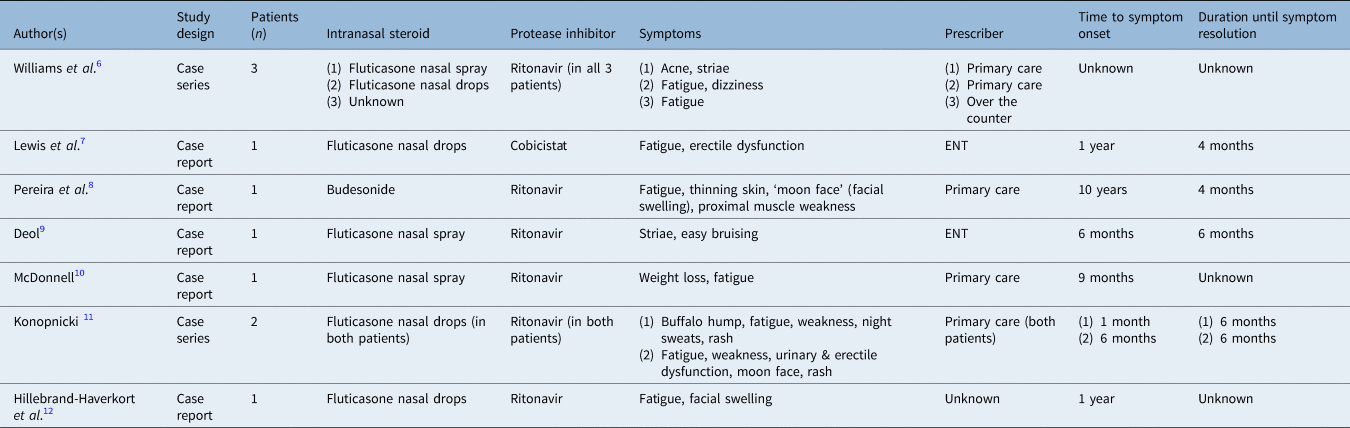
The seven papers were published between 1999 and 2019. There were 5 case reports of single patients receiving intranasal steroids, and 2 case series of 3 and 2 patients respectively, giving a total of 10 patients. All reports were of adults. Ritonavir was part of the antiretroviral regimen in nine patients and cobicistat was used in one patient. Table 1 provides a summary of the papers.Reference Williams, Reicher, Mohammed and Richardson6–Reference Hillebrand-Haverkort, Prummel and ten Veen12
Summary of papers included in systematic review

Eight patients used intranasal fluticasone, one patient used budesonide and one patient had an unknown intranasal steroid. The mean daily dose of intranasal fluticasone ranged from 200 to 800 mcg, with a mean of 400 mcg per day. If the patients’ maximum daily dose was 200 mcg, the formulation used was fluticasone intranasal spray. If the maximum daily dose was 400–800 mcg, the formulation was fluticasone propionate nasal drops.
Cushing's syndrome symptoms included mainly fatigue, as well as facial swelling (‘Cushing facies’), facial hirsutism, weight gain, dorsocervical fat pad (‘buffalo hump’), striae, easy bruising and erectile dysfunction. Onset of symptoms ranged from 1 month to 10 years. Most symptoms presented within a year of commencing the intranasal steroid treatment.
Prescriptions were given by the general practice in six cases, ENT department in two cases, over the counter in one case and was unknown in one case.
Symptoms generally resolved by six months in patients who were provided with follow-up information, and for whom management consisted of: reducing and then eventually discontinuing the intranasal steroid, discontinuing the intranasal steroid, or changing the protease inhibitor based regimen to a non-nucleoside reverse transcriptase inhibitor based regimen.
In all cases, adrenal suppression was investigated and confirmed by a low 9.00 am cortisol level (normal range, 140–500 nmol/l), with a low adrenocorticotropic hormone level and an abnormal short synacthen test result.
Discussion
There was notably a delayed onset of symptoms in many cases, as outlined in Table 1. The delayed onset of intranasal steroids may be due to the relatively lower systemic bioavailability of intranasal fluticasone (1.8 per cent) versus inhaled fluticasone (13–29 per cent).Reference Foisy, Yakiwchuk, Chiu and Singh13
Compared to other steroids, fluticasone has the longest glucocorticoid receptor binding half-life, of 10 hours. It is also the most lipophilic; it is reported to be 3 times more lipophilic than beclomethasone and 300 times more lipophilic than budesonide.Reference Foisy, Yakiwchuk, Chiu and Singh13 These factors increase the systemic accumulation of fluticasone, and may explain the delayed onset of symptoms.
Symptoms of adrenal suppression secondary to intranasal fluticasone are well documented in this review, and should certainly be avoided in HIV patients who take ritonavir or cobicistat. Within the normal dosage range, nasal and inhaled corticosteroids do not usually have systemic effects on the hypothalamic–pituitary–adrenal axis, but caution must be taken when these are used alongside inhibitors of cytochrome P450.Reference Foisy, Yakiwchuk, Chiu and Singh13
There are a few published cases of mometasone interaction, but the symptom effects are unclear.Reference Foisy, Yakiwchuk, Chiu and Singh13,Reference Okasaki-Gutierrez, Poole, Troia-Concio and Asmuth14 Therefore, while not thought to cause as much cortisol suppression as fluorinated steroids, mometasone is still metabolised via CYP3A4 and caution is advised. Beclomethasone is not predicted to cause cortisol suppression.Reference Elliot, Theodoraki, Jain, Marshall, Boffito and Baldeweg3 A 40 per cent increase of active blood level prednisolone has been reported in healthy volunteers taking prednisolone with ritonavir.Reference Penzak, Formentini and Alfaro15
How to treat patients with HIV and rhinosinusitis
The use of potent steroids metabolised via CYP3A4, such as fluticasone and budesonide, is not recommended for patients taking ritonavir or cobicistat. These agents are also contained in several single-tablet regimens and therefore the individual components of these need to be considered. Until further research findings are available, mometasone should be used cautiously with ritonavir because of pharmacokinetic similarities to fluticasone.Reference Okasaki-Gutierrez, Poole, Troia-Concio and Asmuth14
If taking these steroid preparations has a strong benefit for the patient, the prescribing HIV physician should be contacted to review the possibility of a switch to a non-ritonavir/cobicistat containing regimen. Beclomethasone is a reasonable alternative in patients taking CYP3A4 inhibitors who require treatment with an intranasal corticosteroid with strong CYP3A4 inhibitors,Reference Okasaki-Gutierrez, Poole, Troia-Concio and Asmuth14,Reference Duman and Fulco16 as it requires decreased CYP3A4 metabolism.
Conclusion
Intranasal steroids (fluticasone, budesonide and mometasone) should be avoided in HIV patients, and beclomethasone is the preferred alternative. Patients who are prescribed ritonavir or cobicistat should be counselled by their HIV team about potential interactions with inhaled and intranasal steroids. They should consult with a pharmacist or doctor specialising in HIV prior to taking any medications. Further training about drug interactions is evidently required for ENT specialists, general practitioner pharmacists and all drug prescribers.
Competing interests
None declared