Researchers have long been interested in the ways languages can influence each other within the (emerging) bilingual's mind. Typically, however, this interest has been unidirectionally focused in that the question has centered on the extent to which a learner's first language (L1) might influence or affect in some way the developing second language (L2). The empirical and practical interest in this question gave rise to Lado's (Reference Lado1957) now famous contrastive analysis approach that suggests that learners’ errors should be predictable, based on the linguistic features of the L1. This work in turn ultimately led to a more specific focus on differential types of errors and what they might mean for the developing interlanguage. Until relatively recently, however, researchers had not examined the relationship in the other direction: whether and to what extent developing L2 knowledge influences L1 knowledge. Cook's (Reference Cook2003a) volume is arguably the first of its kind that was devoted to specifically examining this question. Cook and the other contributors to the volume illustrate how, in various contexts, the L2 can have a measureable impact on L1 knowledge and linguistic performance. The theoretical foundation for these questions most directly rests within Cook's (Reference Cook1991) multicompetence model.
Multicompetence is a term that Cook (Reference Cook1991) developed to refer to the notion of knowledge of both an L1 and an L2 together within a bilingual mind. Whereas interlanguage is a term used to specifically describe the L2 learner's knowledge of the L2, Cook (Reference Cook and Cook2003b) noted that no comparable term existed that referred to knowledge of L1 and L2 together, hence the origin of the term multicompetence. The important issue here is that L2 and L1 knowledge together form part of the language user's mind and that, therefore, the L2 could theoretically exert an influence over L1 knowledge in much the same way as the L1 might influence the L2. Some of the research in Cook's (Reference Cook2003a) volume identifies how knowledge of an L2 can exert a negative influence on the L1, for example, where the effect of developing the L2 results in L1 attrition (e.g., Laufer, Reference Laufer and Cook2003). Other research in this volume shows that the L2, while influencing the L1, produces neither harmful nor particularly beneficial effects, just differences (e.g., Jarvis, Reference Jarvis and Cook2003). The only chapter in the volume which identified beneficial effects of the L2 on the L1 was by Murphy and Pine (Reference Murphy, Pine and Cook2003), who showed that young bilingual children's knowledge of specific rules in the L1 could be rendered more explicit as a function of learning an L2. We do not believe it is a coincidence that the only chapter in Cook's (Reference Cook2003a) volume demonstrating a beneficial impact of L2 on L1 was also the only chapter in the volume that focused on young children as L2 learners.
Quite rightly in our view, there is an increased interest in how young learners develop knowledge of an L2 (e.g., Philp, Oliver, & Mackey, Reference Philp, Oliver and Mackey2008; Pinter, Reference Pinter2011; Nikolov, Reference Nikolov2009). Part of the reason for this renewed interest must lie in the fact that, increasingly, young children within the primary school setting often are being required to learn an L2 as part of their primary curriculum. For example, Cameron (Reference Cameron2001) notes that while teaching foreign languages to young learners has been happening for some time, the last two decades or so has seen a considerable increase in English classes for young children, particularly in Europe and South America. However, it is not just Europe and South America experiencing a surge in Modern Foreign Language (MFL) instruction (often English being the target language). Countries in Eastern Asia, such as China, have modified their primary curriculum to include English language instruction (Qiang, Reference Qiang2002).
The notion of multicompetence and the impact of the L2 on the L1 is arguably most acute when considering the case of the young learner. This is because the L1 of the young learner is still in development and, therefore, theoretically more susceptible to influence. When certain aspects of the L1 system are not fully entrenched, one can imagine that introducing an L2 might have a bigger influence on the still-developing L1. As mentioned above, Murphy and Pine (Reference Murphy, Pine and Cook2003) illustrated that learning an L2 in younger learners can lead to more explicitly represented L1 knowledge. Bialystok (Reference Bialystok2001) has also shown metalinguistic advantages for learners of L2s such that bilingual children can (on certain tasks) demonstrate greater metalinguistic awareness than monolingual children. One area of language in which metalinguistic awareness is known to be an important variable is literacy. Phonological awareness, for example, is a crucial variable in predicting reading skills (e.g., Chiappe & Siegel, Reference Chiappe and Siegel1999), and similarly, morphological awareness has been shown to predict both reading and spelling (e.g., Carlisle, Reference Carlisle and Feldman1995; Deacon & Bryant, Reference Deacon and Bryant2006).
Taken together, the above issues (L2 on L1, multicompetence, and the relationship between metalinguistic awareness and literacy) led to the development of the study described here, where we explored the question of whether children's developing L1 literacy could be positively influenced by learning an L2 as a result of instruction in primary school.
GRAPHEME–PHONEME CORRESPONDENCE (GPC) AND LITERACY IN ENGLISH AND OTHER LANGUAGES
Children learning to become literate in their native languages with transparent mappings between phonemes and graphemes typically acquire literacy skills earlier than those whose GPCs are more opaque. In transparent GPCs there is a very high correspondence between how the sounds of language map on to the written, orthographic symbols representing those phonemes. For example, in a language like Italian, each of the five vowel sounds has one (and only one) graphemic representation, consonants have only one grapheme with only a few very minor exceptions. Opaque GPCs, however, are found in languages where graphemes are used for numerous different phonological realizations. For example, the words bough, cough, and dough in English all share the –ough grapheme, yet each word is pronounced differently. The relationship between the transparency of GPCs and developing literacy skills is clearly presented in an international comparison of literacy achievement by the International Association for the Evaluation of Educational Achievement (Elley, Reference Elley1994). In this work, word reading in children aged 9 was compared across 32 countries. The best word reading performance was found in children reading a phonologically transparent orthography such as Finnish and Italian. (See also Borgwaldt, Hellwig & De Groot, Reference Borgwaldt, Hellwig and Groot2005, for a discussion of spelling–sound correspondences across seven different languages showing that deviation from consistent mapping increases word naming.)
Other international comparisons similarly show that English children have more difficulty in acquiring their writing system relative to their European counterparts. For instance, a study comparing German and English first-year primary school children spelling cognate words in their respective languages found that English children made more, and more diverse, errors than German children (Landerl, Wimmer, & Frith, Reference Landerl, Wimmer and Frith1997). This is a particularly interesting finding as Landerl et al. (Reference Landerl, Wimmer and Frith1997) afforded a rare opportunity to compare words with similar properties across two languages, as word properties usually represent a significant range of possible (confounding) variables when comparing word reading across languages. A study comparing Welsh-speaking children learning to read Welsh with English-speaking children learning to read English in Wales found that at ages 5–7 the Welsh readers outperformed English readers in both word and pseudoword reading (Spencer & Hanley, Reference Spencer and Hanley2003). At age 10, English children seem to catch up in high-frequency word and pseudoword reading but not in medium- or low-frequency word reading, and the English poor readers were performing much worse than the Welsh poor readers in a study by Hanley, Masterson, and Spencer (Reference Hanley, Masterson and Spencer2004).
Similar effects have been found in other studies. For example, a comparison of English-speaking first graders in Scotland with children from various European countries found that English-reading children performed significantly worse in word reading accuracy and speed and pseudoword reading accuracy and speed and showed much stronger lexicality effects (i.e., read familiar words much faster than unfamiliar words; Seymour, Aro, & Erskine, Reference Seymour, Aro and Erskine2003). Seymour and colleagues attribute these differences to two reasons: syllabic complexity (i.e., whether the language has consonant clusters or only open syllables) and orthographic depth (i.e., whether the writing system has a one-to-one correspondence between letters and phonemes). It is clear from studies such as these that the transparency of the GPC system is a variable that influences children's literacy development, and as children acquiring literacy skills in English are learning a system with opaque GPCs, English-speaking children develop at a slower rate than other children learning languages with less opaque GPCs.
A comprehensive study examining orthographic depth in relation to other variables implicated in word reading was carried out by Ziegler et al. (Reference Ziegler, Bertrand, Tóth, Csépe, Reis and Faísca2010). In their study, which was carried out across five different countries (Finland, France, Hungary, The Netherlands and Portugal), 1,265 children in Grade 2 were asked to complete a range of tasks, including single-word reading, phonological decoding, phonological awareness, and phonological short term memory. The five languages included in this study varied with respect to how closely phonemes map on to graphemes. One of the important findings that emerged from their study that is particularly relevant here is that GPCs modulated the role of phonological awareness in word reading. In other words, while phonological awareness was found to be a powerful predictor of reading performance in their study, across the range of languages tested, the strength of phonological awareness was mediated by the transparency of the sound-to-spelling mappings, where phonological awareness was a stronger predictor in languages with more opaque orthographies relative to more transparent ones, such as Finnish (Ziegler et al., Reference Ziegler, Bertrand, Tóth, Csépe, Reis and Faísca2010). These findings underscore the importance of examining further the influence of GPCs across a range of literacy measures in different languages.
GPCs and literacy acquisition in English and Italian
Italian has highly consistent GPCs, and there are some interesting findings arising from comparisons between the development of reading in English- and Italian-speaking children. As suggested earlier, Italian children perform better in reading, spelling and phonological awareness and acquire their writing system faster than English children. Italian children reach 97% accuracy in word reading by the middle of their first year of school (Cossu, Gugliotta, & Marshall, Reference Cossu, Gugliotta and Marshall1995). In terms of phonological awareness, Italian preschoolers outperform American children on phonological segmentation at the syllable and phoneme level (Cossu, Shankweiler, Liberman, Katz, & Tola, Reference Cossu, Shankweiler, Liberman, Katz and Tola1988). In Seymour et al.'s (Reference Seymour, Aro and Erskine2003) comparison of word and pseudoword reading in 6-year-old English-speaking children and Italian children, English children performed significantly worse, although they had actually been in primary school for 1 year longer than the Italian children. Word reading accuracy was lower and word reading times were longer in English-speaking children than in Italian children. In pseudoword reading, reading accuracy was 63% for English-speaking children and 89% for Italians, and reading speed was 3.17 and 1.99 s per word, respectively. Seymour et al. (Reference Seymour, Aro and Erskine2003) concluded that these differences were due to the complexities of English orthography and phonology relative to the more transparent Italian.
As indicated above, some research has shown that knowing more than one spoken language can facilitate the development of some aspects of metalinguistic awareness that normally appear during the early stages of literacy acquisition. This improved metalinguistic awareness could help bilinguals in the early stages of (bi)literacy acquisition. Bilingualism (regardless of the languages involved) seems to facilitate the development of some aspects of metalinguistic awareness, such as awareness of the arbitrariness of the association between words and their referents. (e.g., Bialystok, Reference Bialystok2002; Bialystok, Luk, & Kwan, Reference Bialystok, Luk and Kwan2005; Bialystok, Majumber, & Martin, Reference Bialystok, Majumder and Martin2003). In particular, if the L2 is less phonologically complex than English (the L1), some research has shown a facilitative effect of the L2 on the L1. Loizou and Stuart (Reference Loizou and Stuart2003), for example, compared four groups of 5-year-old children: literate English monolingual children, literate English–Greek bilinguals, preliterate Greek monolingual children and preliterate Greek–English bilinguals on six different phonological awareness tasks. The results indicated that the literate English–Greek bilingual children outperformed the English monolingual children, although they had the same levels of literacy in English. Neither group was literate in Greek, so the bilingual advantage could not be due to literacy in the more phonologically transparent Greek writing system. Loizou and Stuart (Reference Loizou and Stuart2003) account for this finding as a consequence of exposure to an L2 that is phonologically simpler than English. Conversely, the Greek–English bilinguals performed the same as Greek monolinguals, because English, being more phonologically complex than Greek, does not positively affect their phonological awareness. This study indicates a bilingual advantage in L1 phonological awareness among children who were literate in the L1 when the L2 is a more phonologically transparent language.
If knowing an L2 can facilitate phonological awareness in the L1, then what is the evidence that learning an L2 (or being bilingual) can facilitate L1 literacy skills? Bialystok et al. (Reference Bialystok, Luk and Kwan2005) tried to disentangle the effects of bilingualism and biliteracy on English literacy in first graders. They compared English monolingual children with Cantonese–English, Hebrew–English, and Spanish–English bilingual children and found that the Cantonese–English bilinguals did not perform better than the English monolinguals on a phonological awareness and a pseudoword reading task. However, both Hebrew– and Spanish–English bilingual children performed better than the monolinguals, which was explained as a consequence of having literacy skills in more phonologically transparent writing systems (Hebrew and Spanish).
Yelland, Pollard, and Mercuri (Reference Yelland, Pollard and Mercuri1993) looked at the development of word awareness and word reading skills in monolingual English-speaking children and English-speaking children who had minimal exposure to spoken Italian (1 hr/week of Italian for a few months). Word reading skills were measured by means of an Australian standardized reading test (Primary Reading Survey Test, level AA) at the end of the first year of reading instruction. The children who were taught Italian displayed higher word reading skills than monolinguals. They also performed better in a word awareness task that measured their ability to distinguish between the word and its referent by evaluating the length of a word while ignoring the length of its referent, for instance, recognizing that caterpillar is a long word (more than one syllable long), although an actual caterpillar is small, and that whale is a short word (one syllable long), although an actual whale is big. These findings suggest that exposure to Italian in school facilitates early reading by heightening phonological awareness before the onset of literacy: an advantage that is still observable at the end of the first grade.
Research on the effects of knowing two writing systems on L1 literacy has evaluated the script-dependent hypothesis against the central processing hypothesis, that is, whether the reading and writing of two different writing systems varies as a consequence of dissimilarities between the two writing systems (e.g., transparent or opaque GPCs), or whether reading and writing in different systems is a result of common underlying cognitive processes (e.g., memory skills; for a review, see Geva & Siegel, Reference Geva and Siegel2000). In general, researchers have found that literacy skills developed to use one writing system can be used for the other, dissimilar writing system as well, at least when both writing systems are alphabetic. Yelland et al.'s (Reference Yelland, Pollard and Mercuri1993) research is consistent with the script-dependent approach.
Bialystok et al. (Reference Bialystok, Luk and Kwan2005) also found that even a small amount of literacy in a more phonologically transparent L2 writing system (such as Spanish and Hebrew) has positive effects on English literacy, at least on the performance on phonological awareness and pseudoword reading tasks in the early stages of literacy acquisition. In this study, however, knowing an L2 per se did not facilitate these literacy skills, as the Cantonese–English children were not improved over the monolinguals.
D'Angiulli, Siegel, and Sierra (Reference D'Angiulli, Siegel and Serra2001) recruited children aged 9–13 years with higher levels of L1 English literacy and L2 Italian proficiency than in other studies (such as Yelland et al., Reference Yelland, Pollard and Mercuri1993). These children had received 35 min of Italian instruction every day since the beginning of school and were literate in both Italian and English. They were not balanced bilinguals but had some limited knowledge of both spoken and written Italian. Children were administered (a) a word reading test (the reading subtest from the Wide Range Achievement Test [WRAT-R]), (b) a pseudoword reading test (the word attack subtest from the Woodcock Reading Mastery Test), and (c) a word spelling test (the spelling subtest from the WRAT-R). Children were also tested in Italian word and pseudoword reading and spelling. The researchers found that at ages 9–10, bilingual children who were skilled L1 readers (i.e., those who scored at or above the 30th percentile on the WRAT-R test) outperformed monolingual skilled readers in word reading and spelling but not in pseudoword reading. There were no differences between less skilled bilinguals and less skilled monolinguals. At ages 11–13, bilingual skilled readers outperformed monolingual skilled readers in word reading, pseudoword reading, and word spelling. Less skilled bilinguals outperformed less skilled monolinguals in word spelling but not in word and pseudoword reading. These findings support the claim that knowing spoken and written Italian facilitates L1 English word reading and spelling. D'Angiulli and colleagues conclude that “exposure to Italian is likely to benefit children learning to read in English” (2001, p. 501). They propose three explanations for these positive effects of L2 Italian on L1 English reading and spelling: (a) the regularity of the Italian phonological structure, (b) the phonological transparency of the Italian orthography, and (c) the positive effects of bilingualism on metalinguistic awareness. However, it is worth noting that they do not specify precisely how the regularity and transparency of the Italian GPC system might impact on English reading and spelling.
The discussion above has highlighted some of the evidence suggesting that learning an L2 can have an impact on aspects of L1 phonological awareness and, further, that learning an L2 with a transparent GPC system (e.g., Italian) can have specific benefits on developing L1 literacy skills with a less transparent system, such as English. What is not yet known is the extent to which L2 instruction within classroom-based settings can have the same impact on developing L1 literacy skills. Children around the world are being increasingly taught an L2 as an MFL as part of the primary curriculum. In relation to the context of the present study (i.e., primary schools in England), after a long absence from the primary curriculum, foreign language instruction will be reintroduced in 2014 (Department for Education, 2013). This shift in policy has been motivated, at least in part, by the general and widely held belief that “younger is better” in L2 learning (but see Muñoz & Singleton, Reference Muñoz and Singleton2011, for a critical review of this work). Somewhat paradoxically, this younger is better belief does not always hold in specific instructed contexts where exposure to the L2 input is limited (cf. Muñoz, Reference Muñoz2006). As a result, it is worth asking a different kind of question regarding age and L2 learning; namely, are there concomitant benefits on the L1 as a result of participating in MFL instruction in primary school? Furthermore, are there specific benefits to learning an L2 that has a transparent GPC system relative to the L1? To more precisely address this issue, the present study directly compares the impact of learning two different L2s: one with highly transparent GPCs (Italian), and the other with less transparent GPCs (French), which is still more transparent than the L1 (English). This comparison is particularly relevant for the context of this study, as in the United Kingdom 89% of the children who currently receive L2 instruction at primary school are being taught French (Enever, Reference Enever2011). Both French and Italian are included in the list of possible instructed languages that will form part of the new primary curriculum introduced in the United Kingdom in 2014 (Department for Education, 2013). It would be useful to know, therefore, whether there are specific advantages of learning one rather than the other with respect to developing L1 literacy skills. The research discussed above would suggest that there might be, and that facilitating L1 literacy could very well be one of the many benefits of L2 instruction.
METHOD
Design
This study adhered to a 3 × 2 mixed design with one independent samples variable (GROUP) tested at three levels (L2 Italian, L2 French, control) and one dependent samples variable (TIME) tested at two levels (pre- vs. posttest). The dependent variables consisted of a range of different measures of English (L1) reading- and spelling-related skill (see the Tests and procedures section). Children were randomly assigned into one of the three groups. This design enabled us to address the following questions:
1. Do children who are being instructed in an L2 show any change relative to a control group on measures of English (L1) reading and spelling skill?
2. Do children being instructed in Italian as an L2 show any advantage over those instructed in French as an L2 on measures of English (L1) reading and spelling skill?
Participants
The population of interest for this research consisted of 7- to 9-year-old native English speakers attending Year 3, Year 4, or mixed Year 3 and 4 classes in mainstream primary schools. The sampling frame was limited to include only those schools in commutable distance from Oxford; thus, primary schools in Oxfordshire, Berkshire, and Warwickshire were identified for possible inclusion in the project. Years 3 and 4 in primary school (when the child is 7–9 years old) were identified as an appropriate population for this research, because, at the time of the study, these children typically were unlikely to have yet received any L2 instruction. In addition, English literacy skills in this age group are still developing, such that any significant influence of L2 instruction on L1 reading and spelling ability could be observable. Approximately 200 schools were initially contacted to take part in the study; however, only 28 of these were schools in which children in Years 3 and 4 had not received any formal or systematic L2 instruction. All 28 of these eligible schools were invited to participate, and 9 of these agreed. A total of 120 children, whose parents gave formal consent to take part in this study, were included on the basis of the following criteria:
• ages 7–9 (i.e., in Years 3 or 4);
• native speakers of English who had no or only very minor exposure to other languages and who had never received formal instruction in an L2;
• cognitive ability in the normal range as assessed by the Raven's Standard Progressive Matrices (SPM; Raven, Reference Raven1998); and
• normal cognitive functioning or absence of any clinical condition (e.g., high-functioning autism, dyslexia) as reported by the class teacher.
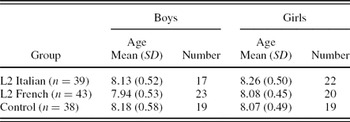
Table 1 presents the specific ages and gender breakdown of each group.
Participant characteristics by group

Note: L2, Second language.
Tests and procedures
The following tests were used to assess different aspects of the child's L1 (English) reading and spelling skill, help match groups, and identify whether and to what extent the L2 instruction was both effective and interesting for the children.
Standard Progressive Matrices (SPM)
The SPM (Raven, Reference Raven1998) was used in this study to eliminate nonverbal IQ as a potential confounding variable and to ensure the three groups were matched on their performance on the SPM. The SPM was administered at pretest only. The SPM has been used extensively in language research with young children is an appropriate screening measure of nonverbal ability in educational settings, and is standardized on a relevant sample of children.
Single Word Spelling Test (SWST)
The SWST (Sacre & Masterson, Reference Sacre and Masterson2000) was used in the current study to assess children's English spelling ability at pre- and posttest. This test was adopted because it is a well-established and widely used standardized spelling test and can be administered in groups. The SWST consists of nine different tests (from Test A to Test I) for children between the ages of 5 and 14. In the current study, children were given the test appropriate for their age and school year (Tests C and D). These two tests consisted of 45 and 50 words, respectively, and took approximately 30 min to be administered.
Phonological Assessment Battery (PhAB)
The PhAB (Frederickson, Frith, & Reason, Reference Frederickson, Frith and Reason1997) was used in this study to assess children's phonological processing ability, that is, their ability to process sounds in spoken language. This battery was designed for individual administration. The PhAB battery is suitable for children aged between 6 and 14 years, therefore was appropriate for the participants in this study. The PhAB battery was also particularly useful for the scope of this study, as a significant body of research demonstrates an important link between phonological processing and reading and writing skills acquisition in primary school children (e.g., Deacon & Kirby, Reference Deacon and Kirby2004).
The PhAB consists of six subtests, five of which were administered in this study: alliteration, naming speed, rhyme, spoonerism, and nonword reading.Footnote 1
THE ALLITERATION TEST
The alliteration test assesses children's ability to isolate the initial sounds in monosyllabic words. Children were asked to listen to three words and asked to say which two of the three words started with the same sound (e.g., ship, fat, fox). The test was scored on a scale from 0 for incorrect responses to 1 for correct answers. The maximum score was 10.
THE NAMING SPEED TESTS
The naming speed tests are designed to assess children's speed in phonological production. These tests comprise a “picture naming speed test” and a “digit naming speed test.” In each test the child is required to name a random sequence of 50 pictures (e.g., a table, a door, a ball, a hat, a box) or 50 numbers (from 1 to 9) as fast as he or she can. Each test was administered twice with the same stimuli (pictures and numbers) but in a different order. For each stimulus the elapsed time to the nearest second was recorded.
THE RHYME TEST
The rhyme test assesses children's ability to identify rhymes in monosyllabic words. Children were asked to listen to three words and identify which two of the three words ended with the same sound (e.g. made, hide, fade). The test was scored on a scale from 0 to 1. The maximum score possible was 21.
THE SPOONERISM TEST
The spoonerism test assesses whether children can segment monosyllabic words and then combine the segments to create new words or word combinations. This test is divided in two parts. In the first part, children were asked to replace the first sound of a word with a new sound (e.g., cot with a /g/ makes got). In the second part, children were asked to exchange the initial sounds of two words (e.g., sad cat makes cad sat). The time limit in each part of the test was 3 min. In Part 1, 1 point was attributed to the correct answers; in Part 2, fully correct answers were scored 2 points and half correct answers were scored 1 point. The maximum score was 30.
THE NONWORD READING TEST
The nonword reading test is designed to assess the decoding of letter strings. This test is divided in two parts. In the first part children are asked to read 10 monosyllabic nonwords (e.g., tib), and in the second part they are asked to read 10 bisyllabic nonwords (e.g., haplut). Using nonwords instead of real words is particularly useful as children cannot employ other strategies, such as sight vocabulary recognition, thus allowing for a measure of the child's ability to decode words. The nonwords read correctly were scored 1 point. The maximum score possible was 20.
Neale Analysis of Reading Ability, Second Edition (NARA II)
The NARA II (Neale, Reference Neale1997) was used in this study to test the rate, accuracy and comprehension of children's oral reading in children aged 6–12. This test was adopted for the current study because it has been widely used in educational and research settings in English-speaking countries (e.g., Ricketts, Cocksey, & Nation, Reference Ricketts, Cocksey, Nation, Ellis and McCartney2011). Moreover, it is a flexible instrument that uses a form of adaptive testing where children start reading at a level that is judged to be appropriate for them. However, as is the case with many standardized assessments, it is not without controversy; some researchers have identified that it can underestimate children's reading comprehension skills (Spooner, Baddeley, & Gathercole, Reference Spooner, Baddeley and Gathercole2004). Nonetheless, any potential inherent weaknesses in the instrument would equally affect each group of participants in this study such that any group differences would not be masked or confounded by possible problems with this test. The NARA II comes in two parallel standardized forms, but for the scope of this study, only standardized Form 1 was adopted to assess the participants’ progress following the intervention.
Italian and French language test
This test was created specifically for this study to determine the level of children's linguistic competence in Italian and French after the 15-week intervention and in order to ensure that sufficient learning had taken place for the intervention to be considered the key independent variable. The test consisted of two forms, Italian and French versions, which were identical in terms of structure and content but different in language. The test material was constructed on the basis of the activities developed for the language intervention. The test was administered in about 20 min and consisted of four different parts: listening, reading, spelling, and inferencing. Each part started with a practice item to familiarize the children with the activity. It is worth noting that, as this test was developed specifically for this study, we do not have indices of the test's reliability and validity. Nonetheless, the items on the test map closely on to the activities that were carried out across the 15-week intervention and are activities that are very commonly used within the L2 classroom.
LISTENING
The listening activity was a “fill in the gaps” type of activity. The children listened to a recording of a native Italian or French girl talking about herself. Pupils were provided with the script and had to fill in the gaps with the missing words. The recording was played twice and was stopped after each sentence in order to give the children time to write down the missing word. The test was scored on a scale from 0 to 1. The maximum possible score was 9.
READING
In the reading activity, pupils were provided with a short paragraph in the L2. The paragraph was followed by seven sentences in the L1. Children were asked to read the paragraph in the L2 and state whether the sentences in the L1 were true or false. The test was scored on a scale from 0 for incorrect responses to 1 for correct answers. The maximum score was 6.
SPELLING
The spelling task consisted of a dictation. The pupils were asked to write down nine words. The items were words the children had learned during the 15-week intervention. The words were recorded on a CD by a native speaker of the L2. Each word was played twice and approximately 1 min was given to the pupils to write each word down. The test was scored on a scale from 0 for incorrect answers, 1 for correct answers with one spelling mistake (e.g., additions, omissions, reversals) and 2 points for correct responses without spelling mistakes. The maximum score was 18.
INFERENCING
This subtest aimed to assess children's ability to use information from L2 simple sentences to work out the meaning of unknown L2 words and make sense of the entire sentence. The sentences used were created on the basis of the children's learning of Italian and French vocabulary during the 15-week intervention. Children were presented with seven simple L2 statements written entirely in the L2. All of the words in these sentences were words the children would have learned in the intervention, with the exception of one novel word. Children were asked to work out the meaning of this unknown word based on their understanding of the rest of the sentence. The type of inference that children were requested to make were knowledge-based inferences (Graesser, Singer, & Trabasso, Reference Graesser, Singer and Trabasso1994). The inferencing relies on the children's Italian or French knowledge of vocabulary, without which the unknown word could not be guessed, combined with their world knowledge. The unknown words were scored 0 when they were attributed the wrong meaning (e.g. “Victoria Beckham è la moglie di David Beckham” became “Victoria Beckham the football player di David Beckham”); 1 point score was attributed when the unknown word was translated with a meaning very close to the exact translation (e.g. “Victoria Beckham è la moglie di David Beckham” became “Victoria Beckham è is married di David Beckam”); 2 points were given when the unknown words were translated correctly (“Victoria Beckham è la moglie di David Beckham” became “Victoria Beckham è the wife di David Beckham”). The maximum score was 14.
General procedure
Pretesting
Children were assessed in their school in two testing sessions. During the first session the SPM and SWST were administered to establish baseline nonverbal intelligence and to assess English spelling ability. Both tests were administered in groups, and children were given 15- to 20-min intervals between tests. In the second session, the children were tested individually. The NARA II and PhAB were administered in this second session. All the tests were administered in quiet places free from distractions. Prior to administering the tests, the researchers ensured that the children being tested were relaxed and receptive and that they had given their verbal assent (all parents and guardians having already given their written consent). The researchers followed the relevant test instructions provided in the manual for the standardized tests. The children were not given any feedback for correct responses (except for practice items) but were given praise for their effort and encouragement throughout the tests.
Intervention
The intervention was delivered by two different researchers, a native speaker of Italian and of French, respectively, to groups (extracted from their classrooms) ranging from 5 to 20 students each. We were not able to control exactly the number of children participating in the L2 instructed groups as this depended on the number of available children in individual classes. However, we attempted to match this as closely across conditions as possible. One hour of L2 instruction was given per week for the duration of 15 consecutive school weeks simultaneously to the two L2 groups. Groups were randomly assigned to each of the three treatment conditions. The students in the control group remained with their regular teacher and carried out their regular classroom-based activities.Footnote 2 Those children who were randomly assigned to the control group were offered opportunities for L2 instruction after completion of the study. All children participated in their normal “literacy hour” as prescribed by the National Curriculum of England (i.e., the children were never removed from class during this aspect of the curriculum) and therefore, as much as could be determined by their normal in class activities, had comparable levels of literacy instruction in English (their L1).
Overview of the L2 instructional intervention
The lessons focused on the teaching of vocabulary, and very few elements of grammar were taught. The vocabulary taught was relevant to the children's age (colors, animals, food) and the little grammar that was taught focused on the difference between feminine and masculine and the difference between singular and plural. Games and songs were used throughout the lessons to practice the vocabulary and to motivate the children to interact with each other using the L2. The Italian and French intervention materials were closely matched. Two websites were used to help the researcher–teachers prepare the resources. Songs in both Italian and French were taken from the Languages Online website (http://www.education.vic.gov.au/languagesonline/default.htm); the Tools for Educators website (http://www.toolsforeducators.com/) was used to create crosswords, word searches, and board games. The lessons were divided in 15 sessions (1 per week).
Structure of the lessons
A typical hour's session proceeded as follows:
1. register,
2. introduction of the new vocabulary,
3. core repetition and practice of the vocabulary through games or songs,
4. worksheet, and
5. reading of a segment from The Wreck of the Zanzibar by Michael Morpurgo
The material was constructed to reflect that children had no prior knowledge of or experience in learning an L2 and to give them the opportunity to become familiar with the sounds and written form of Italian and French. The intervention material included speaking, listening, reading, and writing activities as follows:
LISTENING
The L2 was the predominant language in which the researcher–teachers interacted with the pupils. The register was always carried out in the L2, and behavior management, classroom instructions, and activities instructions were always given in the L2. This was possible as the tasks were usually very straightforward and self-explanatory. When more complicated tasks had to be explained, the teachers would resort to miming and would ask the pupils to guess the meaning of key words and the general meaning of the instruction. This approach helped the children feel fully involved in the explanation of the activities and gave them a great sense of satisfaction as they realized they could understand a language that had been until recently completely foreign to them.
SPEAKING
The children were given many occasions to interact with the teachers and with each other in the L2. As a routine, every lesson would start with the register where each child was asked a question in the L2 (e.g., Come ti chiami?) and invited to answer it in the L2. As the lessons progressed, the pupils were introduced to a variety of questions and given the occasion to practice how to ask and to answer them in the L2. Pupils enjoyed these interactions as they were also allowed to make up their own answers and experiment with the language.
WRITING AND READING
The researcher–teachers ensured that every lesson included one main writing activity. These activities were planned to be fun and engaging for the students. Children were given a worksheet that they collected in their language folders. The worksheets included several activities such as labeling pictures, crosswords, filling in the gaps in a paragraph or in a speech bubbles, linking pictures with the correct words, word searches, and “True or false” quizzes. The children were also asked to read a variation of The Wreck of the Zanzibar by Michael Morpurgo (1995). This new version of the book was developed not only to allow the children to practice their inferencing skills but also to help them notice the different GPCs of the two L2s they were learning. The original book was carefully read by the two researchers, who created a shorter version by selecting the most relevant parts of the story and made sure that the flow of reading would not be compromised. Words that could be easily understood from the context, cognates, or near cognates were then translated in the respective L2 throughout the book, and the teachers referred to them as “surprise words.” In each lesson the book was read by the teacher for 10 min and the students were invited to guess what the surprise words meant. The intention was to create a challenge for the pupils and a sense of reward when they understood or recognized the word. As the pupils progressed through the book and became more involved in the story, they appeared to the researcher–teachers to look forward to knowing how it would end. Once a word was introduced in the L2, it would appear for the rest of the book in the L2. This gave the children the chance to see the same word over and over again and memorize it without even trying to do so. This instructional method has been successfully used in previous interventions by Macaro and Erler (Reference Macaro and Erler2008) and Macaro and Mutton (Reference Macaro and Mutton2009).
Posttesting
Following the intervention, children in the three groups were reested on all measures except for the SPM.
RESULTS
Pretest results
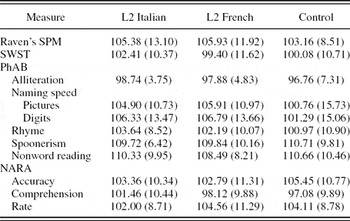
The data on the pretest and screening measure (Raven's SPM) were first analyzed to ensure that the random assignment to the three different groups had resulted in groups that were matched across all of the relevant dependent variables. Table 2 identifies the means and standard deviations broken down by group for each of the measurements. Standard scores are reported unless otherwise indicated.
Standardized score means (standard deviations) across the three groups on each dependent measure at pretest

Note: L2, Second language; SPM, Standard Progressive Matrices; SWST, Single Word Spelling Test; PhAB, Phonological Assessment Battery; NARA, Neale Analysis of Reading Ability.
Separate one-way analyses of variance (ANOVAs) were carried out on each of the dependent variables identified in Table 2, with group as the one independent samples variable. The results of these ANOVAs indicated that there were no group differences on any of these dependent variables at pretest, suggesting that the groups were sufficiently matched before the L2 instruction was delivered to the two instruction groups.
L2 test results
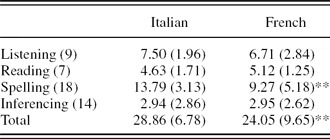
Having demonstrated the groups were matched at pretest, the next step was to identify whether those children who received the L2 instruction learned any L2. Table 3 presents the means (and standard deviations) achieved by the students in the two L2 instruction groups on each of the four aspects of the test described in the Method Section.
Means (standard deviations) of the language test for the second language groups

**p < .01.
We carried out t tests to compare the two groups on these means. The only statistically reliable differences between the groups were on the spelling measure (t = 5.47, p < .001) and on the overall total measure (t = 3.00, p < .01), indicating that the L2 Italian group's mean on the spelling and overall score was higher than the L2 French group's score. It is interesting to note that on the listening, reading, and spelling measures both groups were above 50% accuracy. These findings suggest therefore that both L2 groups learned some aspects of the L2, participating in only 15 hr of instruction, although on the spelling skills aspect the L2 Italian group performed better than the children in the L2 French group.
Posttest results
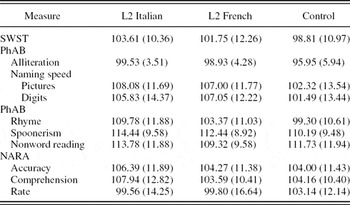
The posttest data were analyzed in a similar fashion as the pretest results. Table 4 presents the posttest means and standard deviations for each group and each dependent measure. The results of statistically reliable analyses will be reported below.
Standardized score means (standard deviations) of each dependent measure by group at posttest

Note: L2, Second language; SWST, Single Word Spelling Test; PhAB, Phonological Assessment Battery; NARA, Neale Analysis of Reading Ability.
A mixed ANOVA model was carried out on the NARA accuracy standard scores, with one dependent samples variable Time (pre- vs. posttest) and one independent samples variable Group (L2 Italian, L2 French, control). The results of this ANOVA indicated no effect of Time, no effect of Group, but a significant Time × Group interaction, where F (2, 111) = 4.93, p < .01, η2 = 0.08. To identify the locus of this interaction, separate t tests were carried out indicating that there was a significantly reliable difference for the L2 Italian group between pre- and posttest (t = 2.97, p < .01), but no such effects for either the L2 French or control groups. This finding suggests then that only the L2 Italian group's NARA accuracy score improved significantly from pre- versus posttest.
The groups differed at posttest on the PhAB alliteration subtest where F (2, 111) = 6.22, p < .01. Tukey post hoc tests indicated that the Italian group scored higher than the control group (p < .01) and the French group scored higher than the control group (p < .05), but there was no difference between the Italian and French groups. This finding suggests an advantage for L2 instruction on L1 phonological processing but no specific advantage for children learning Italian rather than French.
There was also a statistically reliable group difference on the posttest PhAB rhyme subtest. The Time × Group interaction was just reliable, where F (2, 111) = 2.99, p = .05, η2 = 0.05. Post hocs indicated that the Italian group scored higher than the French group (p < .05) and the control group (p < .001) but that there was no difference between the French and control groups. This effect suggests that learning L2 Italian confers an advantage on the ability to identify words that rhyme in English (L1).
There was a significant interaction between Time and Group on the PhAB spoonerism subtests where F (2, 111) = 3.84, p < .05, η2 = 0.06. Further tests indicated the Italian group was marginally higher than the control (p = .05) where the French group was no different from the control group. Although the effects were marginal, this finding further suggests an advantage for the L2 Italian group on phonological processing in English (L1) over the other two groups.
For both the PhAB nonword reading subtest, F (1, 111) = 3.80, p < .05, η2 = 0.03, and the NARA comprehension test, F (1, 111) = 66.55, p < .001, η2 = 0.37, all groups made gains from pre- to posttest, but there were no group effects and no interactions with time of test.
In summary, the analyses reported above are suggestive that learning an L2 can have a facilitative influence on some aspects of English (L1) reading skills. Most notably, single-word reading as measured by the NARA accuracy scores indicates a benefit for learning an L2, but this effect was limited only to the L2 Italian group. Furthermore, there are some aspects of phonological processing that seemed to be improved as a function of participating in an L2 Italian instructional program (alliteration, rhyme, spoonerisms). Only the alliteration subtest of the PhAB, however, revealed an advantage of the L2 French group over the control group children.
DISCUSSION AND CONCLUSION
The purpose of this study was to investigate whether learning an L2 in primary school has a facilitative influence on developing L1 literacy skills. In addition, a further question under consideration was whether there were more pronounced benefits on L1 literacy having learned an L2 with transparent GPCs relative to an L2 with more opaque GPCs.
The results described above suggest that there are definitely benefits from learning an L2 on L1 literacy skills and that there are specific effects of learning a transparent L2 (Italian) relative to a less transparent L2 (French). The L2 Italian children outperformed the L2 French and control children on single-word reading accuracy in English and scored higher on the Rhyme and spoonerism subtests of the PhAB as well. Only the PhAB alliteration subtest revealed an advantage of the L2 French group over the control group. These effects are small, but they do suggest a clear effect of L2 learning on L1 literacy, at least on single-word reading and some aspects of phonological processing, which are known to be predictive of later reading skill (Deacon & Kirby, Reference Deacon and Kirby2004). It is interesting that there were no effects on the spelling measure (SWST), suggesting that whatever small advantages to L1 literacy the L2 instruction facilitated did not transfer to English single-word spelling skills.
These results are in line with previous work that was discussed in the introductory section of this paper: L2 learning/knowledge can promote phonological awareness in the L1 (e.g., Campbell & Sais, Reference Campbell and Sais1995), languages with shallow orthographies can influence languages with deeper orthographies (i.e., the script-dependent hypothesis; Geva & Siegel, Reference Geva and Siegel2000), and only a relatively small amount of exposure to an instructed L2 with transparent GPCs can have a facilitative effect on L1 literacy skills (e.g., Yelland et al., Reference Yelland, Pollard and Mercuri1993). It is important to note here that, although the effect sizes were small, the sample size was also quite small for each group, and these relatively small sample sizes taken together with only 15 hr of L2 instruction lead us to wonder what the effects of L2 instruction might be across the entire primary curriculum. If such effects are observable after only 15 hr, what might we be able to see after years of appropriate L2 instruction? It will be important to investigate this matter further with more systematic research on this issue and with larger scale studies. It will be important, too, to include more systematic controls in these future, larger scale studies, which eliminate some of the potential confounds in this study, such as possible teacher effects (though random assignment to groups did mitigate against that somewhat) and other possible confounds that might contribute to between-group differences.
It is also useful to note that the L2 instruction itself did not focus specifically on literacy skills in the L2 (apart from reading and writing single words); therefore, what we have observed in this study cannot really be considered a transfer of literacy skill from L2 to L1. Rather, it is more likely that being exposed to transparent mapping of graphemes to phonemes in Italian raised the learners’ phonological awareness skills, as evidenced by increased performance on the PhAB, which is likely in turn to have had a concomitant facilitative effect on the single-word reading component of the NARA. What we are not able to identify, however, is the precise reason for the effects observed in this study. The facilitative effect of L2 Italian on L1 English single word reading and phonological processing could be due to the transparent nature of the phonological structure of Italian, the transparent mapping of grapheme on to phoneme in Italian, or some combination of both leading to an increase in metalinguistic awareness. Note that the advantage of the L2 did not transfer on to nonword reading, there were no advantages to the L2 groups on the PhAB nonword reading subtest, suggesting that while single-word reading was improved, it was notably in words that might be known or at least more familiar sounding to the children. This in turn raises questions about the role of semantics. If it was simply a question of improved English decoding as a function of L2 Italian we might have expected an improvement on the PhAB nonword reading subtest as well. Perhaps, therefore, the children's phonological representations of known words was somehow more elaborated or more explicitly represented as in Murphy and Pine's study with young bilinguals (2003). If the children's phonological representations were elaborated as a result of learning the L2, it was only limited to more receptive knowledge (i.e., reading), as there were no improvements on the spelling test (a more productive measurement).
Finally, it is also worth noting that the L2 Italian group did score statistically higher on the spelling and total score elements of the L2 test than the L2 French group. One could argue then that their knowledge of Italian was superior relative to the L2 French group and that this might be the cause of the advantages observed in the L2 Italian group. This conclusion might well be accurate to a point, since the superior productive knowledge exhibited on the spelling element of the L2 test could have indicated improved or more elaborated explicit knowledge leading to greater metalinguistic (phonological) awareness. However, this argument cannot be the entire explanation for the findings presented here since the groups were matched on reading, listening, and inferencing L2 skills. On most aspects of the L2 therefore, the groups were matched.
As mentioned earlier in this paper, governments across the globe are lowering the starting age at which primary school children are being taught an L2, despite the fact that those studies that have carefully examined the effectiveness of L2 learning at primary have consistently shown that young primary school learners in input-limited environments tend to make slow progress in actual L2 outcomes (e.g., Enever, Reference Enever2011; Muñoz, Reference Muñoz2006). However, what our study further supports is a point that was made by Hawkins nearly 40 years ago (Hawkins, Reference Hawkins and Perren1974, Reference Hawkins1999), which is that apart from the obvious benefits of learning an L2, such as actually learning some basic L2 language, perhaps having a greater appreciation for another culture, and providing a good basis for later L2 learning at secondary level, L2 learning can also be viewed as language awareness training: an appreciation for, and understanding of language as a system of sounds, words, and structure that can be manipulated in different ways. In this way, and with empirical evidence such as that reported in this paper, L2 learning at the primary level has even further advantages to offer. This heightened language awareness can then possibly lead to improvements in the developing L1 in the primary school learner. Because the primary school learner's linguistic system and literacy skills in the L1 are not yet fully established or overly entrenched, it may more permeable to the facilitating influence of the L2 in heightening language awareness. Such an assertion needs to be empirically investigated further. In considering important questions, such as when children should start learning an L2, we should be considering not only the ultimate attainment in the L2 and understanding of the L2 culture but also the ways in which the L2 can influence the L1.
ACKNOWLEDGMENTS
We thank The Leverhulme Trust, who funded this research (F/08606/B), and all of the schools, children, and families who participated. Further thanks to Patsy Lightbown for offering helpful comments on this work.