Appropriate quantities and types of medical supplies must be accessible to the public in the event of a public health emergency; however, local and state supplies may not be adequate.1 To prepare for a potential public health emergency that exceeds a state’s capacity to respond, Congress charged the Department of Health and Human Services and the Centers for Disease Control and Prevention with the establishment of the National Pharmaceutical Stockpile in 1999, renamed the Strategic National Stockpile (SNS) in 2003.1,Reference Prior2 The SNS maintains a reserve of medical countermeasures (MCM; drugs, vaccines, and medical items) for delivery throughout the United States (US).3 Large-scale distribution of SNS supplies occurred many times throughout the United States in 2001, 2005, 2008, 2009-2012, and 2014-2017.4
The Federal Emergency Management Agency (FEMA) prescribes a 48-h timeline between the declaration of an emergency and the treatment of the last person with SNS MCMs.5-7 The first 12 h of the timeline are reserved for delivery from undisclosed federal locations to the state Receipt, Stage, and Store (RSS) site, and the second 12 h for delivery from the RSS to the locality in which they are needed.Reference Nelson, Chan and Chandra8,9 Thus 24 h are available for dispensing to the target population. A primary dispensing method is by means of Points of Dispensing (PODs), which are mass dispensing stations operated and overseen by local authorities.9 PODs can be categorized as either: (a) Open PODs operated by the government and open to the entire public, or (b) Closed PODs, which are establishments, such as large churches or private businesses, that are limited in the clientele they serve.Reference Kennedy10
Even with the best available deployment of trained staff, many states struggle to meet the 48-h window.11,12 Issues surrounding adequate staffing, critical to maintaining necessary POD throughput, are noted in the literature. One recent study surveyed public health disaster planners about their Open POD preparedness plans; only 42.6% reported having adequate staff for POD operations.Reference Rebmann, Loux and Swick13 Officials in Michigan also cite issues regarding staffing PODs to ensure the necessary throughput.12 Recognizing these challenges, the Institute of Medicine (IOM) lists the assessment of alternative means of distribution to the entire at-risk population as a priority research need.11 One alternative some jurisdictions have used to increase throughput is a head of household distribution method.Reference Rebmann, Loux and Swick13,14 This involves allowing the “head of household” to pick up MCMs from Open PODs for the entire family.Reference Renard, Vagi and Reinold15,16 Other creative strategies for augmenting distribution of MCMs include delivery through the mail, workplace dispensing, and door-to-door delivery by means of school buses.11
The use of public and private partnerships in the health-care sector may also improve POD throughput.12 Such partnerships allow for existing infrastructure to be leveraged if those partners already perform distribution and/or dispensation as a normal part of their operations. This study describes a novel strategy for partnering with home health agencies (HHAs) to augment MCM distribution. An HHA is an organization that provides licensed skilled nursing and therapy services to clients in their homes.17 Medicare beneficiaries receiving home health care must be homebound, which indicates leaving the home on a normal basis requires a considerable, taxing effort.18 Over 3.4 million Americans used home health services in 2017.19 Authorizing HHAs to provide in-home dispensing to their usual clients extends the beneficial reach of SNS to this vulnerable population segment. The HHA In-Home Dispensing Model we propose in this study authorizes HHAs to act as Closed PODs following a head of household model. Thus, HHAs will dispense to their own staff and clients in their homes, plus other persons present during the home visit.
The purpose of this research is to evaluate the effectiveness of the HHA In-Home Dispensing Model using a case study of a mixed rural/urban area. First, we provide an overview of the methods used to estimate the duration of in-home nurse dispensing shifts. We then present the results for our case study area. Next, we discuss how the model can be used and its limitations. Finally, we make concluding remarks and suggest directions for future research.
METHODS
Model Overview
The HHA In-Home Dispensing Model calls for licensed skilled nurses who are employed by HHAs to dispense SNS MCMs to all current clients and staff members of the HHA and their families, in their homes. From an operations standpoint, each HHA nurse begins their dispensing shift at their own home or a central location, such as an HHA office. Where the shift originates depends on whether the nurse must visit a pickup point to retrieve the SNS countermeasures they will be dispensing. Next, the nurse visits a sequence of clients and/or staff members in their homes to provide dispensing, and then concludes the shift by returning to the starting location. Note this model of operations is nearly identical to typical daily operations of an HHA nurse. In routine scenarios, HHA nurses visit clients in their homes to provide skilled nursing services, such as wound management and intravenous medications.20 The difference in the HHA In-Home Dispensing Model is the nurse will provide MCMs to all persons present in the home, in contrast with providing a specific skilled nursing service only to the HHA client in the home.
For modeling purposes, the dispensing shift is separated into in-home and in-transit portions. We refer to the durations of these as service time and driving time, respectively. Methods used to estimate service and driving times are described below.
Service Time Estimation
The in-home portion of the dispensing shift includes the time required to park and enter a home, provide service to all individuals present, and return to the vehicle (everything in the shift except driving). To estimate service time, we: (i) determine the required nurse tasks, (ii) conduct a time study to collect observations on each task duration, (iii) fit distributions for each task duration using the collected data, and (iv) conduct a Monte Carlo simulation (with fitted task duration distributions as input) to determine the overall service time distribution. Service time estimations assume only MCMs are provided in the visit, not regularly scheduled care. This assumption is consistent with the IOM’s Crisis Standards of Care, which dictate that, in an emergency, legal/regulatory powers and protections are afforded to health-care providers in making necessary changes in the allocation and use of scarce medical resources.21,22
A list of tasks required for the in-home portion of the dispensing shift is developed based on the experience and clinical expertise of the authors. First, the nurse parks, exits the vehicle, knocks on the door, greets the client, and enters the home (park and enter). The nurse provides more formal introduction to the client, including credentials (introduction to client). Next, the nurse unpacks needed supplies from a transport container or bag (gather supplies). Then, the nurse readies supplies for use by arranging syringes for medication administration and placing alcohol swabs, band aids, and medications within reach (organize supplies). After this, client-specific tasks begin. The nurse educates the client regarding the medication to be administered, inquires about any allergies, answers questions posed by the client, and obtains client signature on a required consent form (client education). Then the nurse draws the appropriate amount of medication into the syringe (pull medication). After this, the nurse administers the drug (dispense drug). After repeating the client-specific tasks once per each client receiving treatment in the current home, the nurse packs up the supplies and returns to the vehicle (pack and exit).
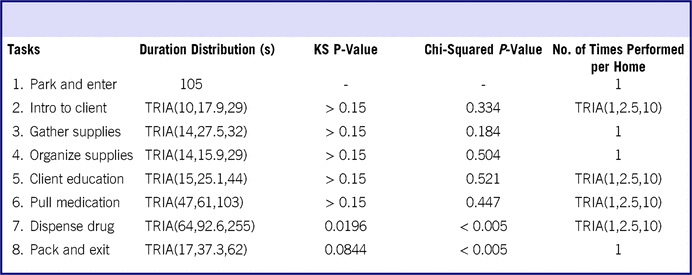
A time study is conducted to collect observations for all tasks described above. For park and enter, which is entirely nonclinical, the research team selected two homes and recorded the time required to park a vehicle, exit the vehicle, and approach the front door. The two homes selected were representative of a single-family dwelling and a multi-family dwelling. The average of the two times is taken as a deterministic estimate of park and enter duration. University nursing students performed each of the remaining 7 tasks (organize supplies through pack and exit) 30 times. The Input Analyzer tool from Arena® simulation software is used to fit a triangular distribution for each task. The goodness of fit for each distribution is assessed using Kolmogorov-Smirnov and chi-squared P-values at a 0.05 level of significance.
A Monte Carlo simulation model of HHA nurse dispensing shift service time is created. For each of N homes visited on the shift, the model samples from the distributions of all in-home tasks having stochastic durations. The model also samples from a household size distribution to represent the number of persons per home that receive treatment. A triangular distribution with minimum, maximum, and most likely parameter values taken from the literature is used for household size. The minimum parameter is set to 1 person, as no fewer than 1 client can receive treatment in a home. The most likely parameter value is 2.5 persons, based on author conversations with public health partners and on average household size data from Esri. ArcGIS’ ArcGIS® software23; the same data are accessible through other publicly available data sets. The maximum parameter is set to 10 persons; this is supported in practice in some states, such as Michigan.24 Because the household size distribution returns a continuous (ie, noninteger) value, yet per-person tasks are only performed an integer number of times, each observation sampled from the household size distribution is rounded to the nearest integer. The output of the Monte Carlo simulation model is the distribution of total dispensing shift service time across visits to N homes. Five hundred replicates are used to produce the service time distribution.
Driving Time Estimation
The in-transit portion of an HHA nurse dispensing shift consists of the travel between locations visited during the shift. The driving time is computed as the sum of these travel durations. We assume that, in a dispensing operation, where completing dispensing to the target population as soon as possible is the goal, an HHA will optimize their logistics operations. Specifically, the HHA administration makes client-to-nurse assignment decisions such that clients assigned to a nurse are geographically near each other. Then, a nurse follows the shortest route possible to visit all client locations they have been assigned.
The problem of finding the shortest route possible through all client locations assigned to a specific nurse can be modeled as the classic traveling salesman problem (TSP).25 Given a set of locations to visit (nodes) and a set of arcs connecting them with known costs (eg, distances), the TSP is to find the shortest route that visits each node exactly once and returns to the start node. In this context, the start/end node is the nurse’s home or the HHA office (or other central location the nurse visits to retrieve supplies). The nodes to be visited are the homes in which service will be delivered.
The length of a TSP tour through a set of N points uniformly distributed across an area of size A can be estimated as  $k\sqrt {NA}$, where the parameter k is a constant, taken here as 0.7214.25,Reference Beardwood, Halton and Hammersley26 This estimator is most accurate for large N. In this research, the number N represents the number of homes (plus start/end node) on each nurse route. We assume clients receiving service from an HHA and its staff members will be equally divided among dispensing nurses. Therefore, for an agency with J homes to visit and m nurses, the number of homes per nurse route is N = J/m. We also assume the service region of an HHA will be equally divided among nurses, so for an agency with service area K and m nurses, the area served per nurse is A = K/m. With service area measured in square miles, the
 $k\sqrt {NA}$ route length estimator will return a distance measured in units of miles. Dividing this distance by an assumed vehicle speed of v miles per hour yields a drive time estimate in hours for an entire route.
RESULTS
Model Inputs
For each in-home dispensing task, the Monte Carlo simulation model requires inputs describing duration distribution and the number of times the task is performed. Table 1 provides these inputs. The first column provides the task number and name, and the second column provides the task duration distribution in seconds. Task 1 duration is modeled as a constant; triangular distributions are used for tasks 2-8. Each of these distributions is significant at the 0.05 level except task 7 (dispense drug). The final column provides the number of times each task is performed per home. Tasks 1, 3, 4, and 8 are performed once per home; tasks 2 and 5-7 are client specific and are thus performed between 1 and 10 times per home, with 2.5 times being most likely.
Monte Carlo Simulation Model Inputs

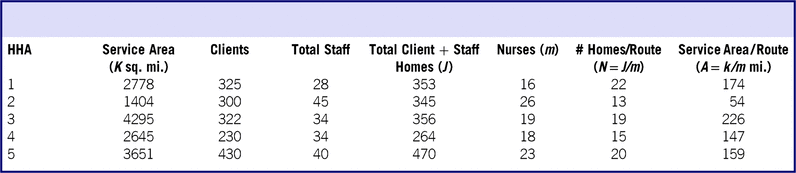
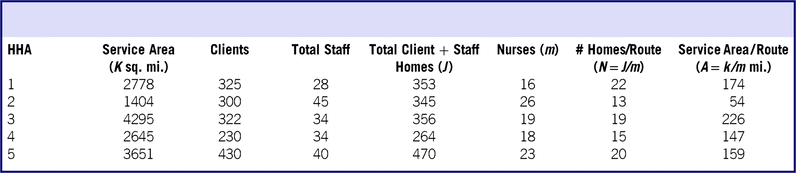
With the exception of vehicle speed v, for which 30 miles per hour is assumed, the inputs to the driving time estimation are specific to an HHA. The number of nurses, total staff, clients, and service region size of an HHA are required. Table 2 summarizes these inputs for 5 HHAs in our case study region. Note that “Total Staff” is inclusive of all types of HHA staff (eg, administrative, physical and occupational therapy, nursing, aide, etc.), whereas “Nurses” refers only to RNs and LPNs who will be administering the countermeasures. Service area size is retrieved from the Medicare Home Health Compare database.Reference Çavdar and Sokol27 Client and staff counts are obtained in interviews the authors conducted with HHA directors. The staffing data reported by the agencies were measured in full-time equivalents (FTEs). In Table 2 and in our simulation model, all noninteger valued FTEs are rounded to the next integer. In summary, the driving time model takes v and the last three columns of Table 2 (m, N, and A) as input, whereas the service time model uses parameter N from Table 2 and columns 2 and 5 (task duration and number of times performed) from Table 1.
Driving Time Estimation Model Inputs
Service Time Estimation Results
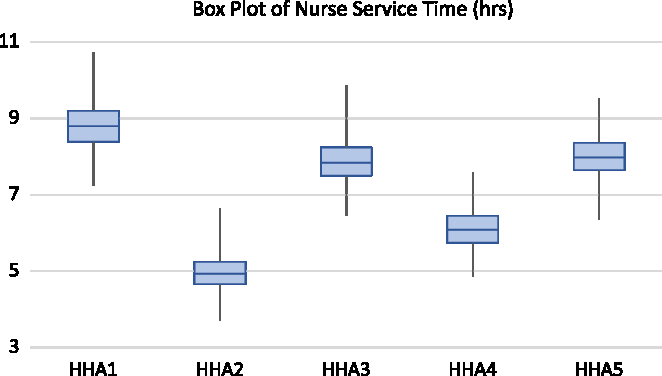
Task durations and the number of times they are performed per home do not depend on a particular HHA. However, nurse service time across an entire route does depend on HHA because this determines the number of homes on a route. A boxplot of service time distribution per nurse is reported for each of 5 HHAs in Figure 1. The squares in the boxplot represent the middle 50% of observations with the median noted by the horizontal line inside the square. The lines below and above the squares represent the bottom 25% and top 25% of observations, respectively. As observed in the figure, nurses working for HHA1 experience the longest service times, ranging from approximately 7 to 11 h. The middle 50% of service times for HHA1 nurses are between 8.4 and 9.2 h. In contrast, nurses working for HHA2 see the shortest service times, ranging from 3.7 to 6.7 h. The middle 50% of service times for HHA2 nurses are between 4.7 and 5.2 h. The variation in service times among nurses working for the same HHA are due to variation in task distributions and household size. The variation between HHAs is due in part to task duration and household size, but primarily due to variation in the number of homes visited.
Service Time Distribution Per Nurse

Driving Time Estimation Results
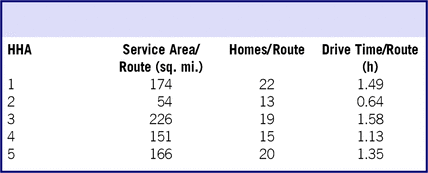
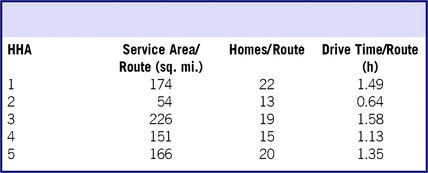
Driving time for a nurse depends on the HHA, because this determines the number of homes on a tour and the size of the service region served. HHAs with large service areas per route and/or large numbers of homes per route will see longer driving times than agencies with smaller service areas and/or fewer homes. These differences can be observed in Table 3, which presents the driving time per nurse per agency. The shortest drive times occur at HHA2, which has the smallest service area per nurse among the 5 agencies, and also the fewest homes per route. Nurses working for HHA2 experience estimated drive times of 0.64 h (38 min) across their dispensing shifts and visit 13 homes each. In contrast, nurses working for HHA3 experience estimated drive times of 1.58 h (95 min) and visit 19 homes each. Whereas nurses working for HHA1 visit the most homes per route, their drive times are slightly less than HHA3, because the geographic area across which routes are dispersed is smaller than HHA1 (174 vs 226 square miles).
Driving Time per Nurse per Agency
Combined Service and Driving Time Estimation Results
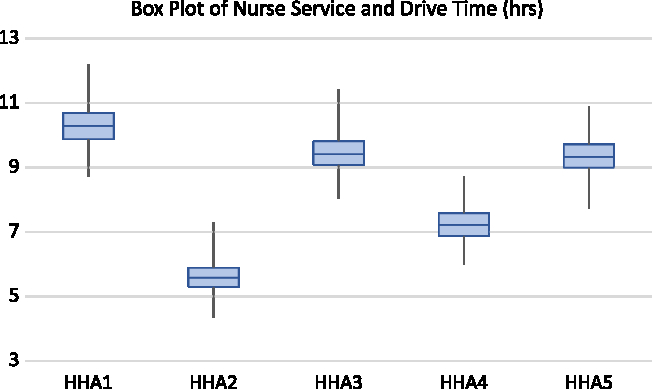
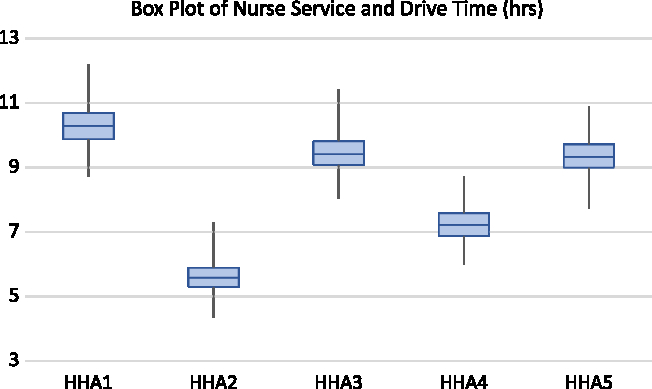
Combining service and driving time results provides an estimation of total dispensing shift duration per nurse. A boxplot of nurse dispensing shift duration is provided in Figure 2 for each HHA. The maximum across all agencies is approximately 12 h at HHA1. From this, we can conclude it is possible a nurse working for HHA1 may need to work a 12.2-h dispensing shift. However, the likelihood of this is small. The third quartile shift duration at HHA1 is 10.7 h (75% of shifts are shorter), and the median is 10.3 h (50% of shifts are shorter). Nurses working for HHA3 and HHA5 may also experience shift lengths over 10 h. The maximum shift durations at those agencies are 11.4 and 10.9 h, respectively. However, the median shift durations at HHA3 and HHA5 are under 10 h, at 9.4 and 9.3, respectively. Nurses working for HHA2 experience the shortest shifts, ranging from 4.4 to 7.3 h, with a median of 5.6 h.
Nurse Dispensing Shift Duration
DISCUSSION
The dispensing shift durations estimated in this research are reasonable given overall SNS distribution plans and timelines. Federal officials have established a 48-h target for dispensing to impacted populations after a public health emergency declaration, with the first 24 h reserved for transport (federal to state to local level) and the last 24 h for dispensing.5-9 A maximum HHA nurse dispensing shift duration of approximately 12 h is well under the 24-h limit. The surplus time will likely be useful to the HHA as they retrieve MCMs from local authorities and activate portions of their emergency operations plans. For example, HHA administrators may need to bring in necessary staff to dispense medication to all current clients, perform route planning, and conduct patient prioritization.28
Most clients in HHAs do not require daily visits; however, there may be clients whose condition may deteriorate or require inpatient admission if they are not seen. For this reason, a determination of those clients who need skilled care in addition to receipt of MCMs must be made.28 All other less acute clients would receive only the MCMs and would return to normal care visits after all clients received the prescribed MCM. Upon receipt of the MCMs, the HHA should also consider administration to all dispensing staff before route dispatch to prevent transmission of infectious disease.29,30 The model in this study assumes this will occur at the route origination point.
The time nurses would need for breaks, to include lunch, would need to be added to the total shift duration based on individual state requirements.31 This time added ranges from approximately 30 min to 90 min, depending on the shift length and the state in which the nurse is employed. Despite the added time for such breaks, most nurses would remain below the 12-h mark and well within the 24-h timeline for distribution of MCMs. Other considerations that might add time to the combined service and drive time would include donning and doffing personal protective equipment before entering a client home, depending on the response scenario.
Emergency response plans and important tasks to be performed by administrators in response to a public health emergency should be outlined far in advance of such an emergency. Tasks that would need to occur in the planning phase of the emergency management cycle to facilitate the receipt and dispensation of MCMs include the clear delineation of administrative responsibilities in an emergency (eg, whether clinical administrative staff will augment HH nurses and deliver to a route themselves), outlining of documentation requirements, identification of surge capacity, assessment of communication plans in an emergency, etc.28 Furthermore, nurses in many settings frequently work varying shift lengths ranging from 8 h to 12 h, to include nurses working in HHAs.Reference Martin, Clement and Harris32 Administrators must consider nurse fatigue and derive an evidence-based staffing plan to address nurse responsibilities in unusual situations such as disasters.33 The specifics of such planning endeavors are outside the scope of this study.
Whereas this study provides an important first step in estimating in-home dispensing shift durations, some modeling limitations are noted. First, the in-home task durations are based on nursing student use in a time series analysis. More experienced nurses may take more or less time given a client’s overall health condition, familiarity with the client, or real-time assessment of client needs. It is likely that the estimation of time taken in the client’s home is optimistic in that, in a public health emergency, the client and their family members would have unanticipated questions or needs. Furthermore, the established nurse-client relationship is usually one of trust, where open dialogue is encouraged in the normal provision of care.Reference Haviari, Bénet and Saadatian-Elahi34 This typically caring relationship would need to be much briefer in an emergency, yet some nurses may struggle to forgo normal pleasantries and dialogue usually undertaken during an in-home visit. This could lead to a systemic under-estimation of in-home service times, but education around alternative in-home operation protocols to eliminate nonessential tasks and conversations can minimize this disparity.21,22
The driving time estimations are based on several simplifying assumptions as well. First, clients are assumed to be uniformly distributed across a service area; real home addresses often do not follow this spatial pattern. When client locations follow a nonuniform pattern, then an equal partition of an HHA’s service area among its nurses (ie, A = k/m) may not also result in an equal number of homes to visit per nurse (ie, N = J/m). Finally, it is documented in the literature that the route length estimator  $k\sqrt {NA}$ is most accurate for a large N.25 The routes in this research visit 22 homes at most, which would not in general be considered large. Combined, it is unclear whether these limitations lead to an under- or over-estimation of travel times. Answering this question would require designing and measuring actual route durations for a set of real client addresses. This is recommended as an area for future study.
A strength of this study is that data needed for model inputs can be easily obtained for generalizable results from the Centers for Medicare & Medicaid Services Home Health Compare Database and Healthcare Cost Report Information System Data Set - Home Health Agency.Reference Çavdar and Sokol27,Reference Leslie and Lonneman35-37 Although the authors obtained data for this study directly from the HHA directors in the case study region, other regions can replicate the model using their own records or publicly available data sites. Thus, the methodology described here can easily be replicated for any region in the United States.
CONCLUSIONS
In current SNS distribution scenarios, many states struggle to meet the 48-h window between the declaration of the emergency and the treatment of the last person with MCMs.11,12 For this reason, alternative methods of dispensing MCMs are needed. The development of partnerships leveraging existing infrastructure to augment the distribution and/or dispensation of MCMs during an emergency can achieve two important goals: (a) decreasing the demand at Open PODS, and (b) increasing the beneficial reach of MCMs after an emergency to vulnerable populations who might otherwise have difficulty receiving them.12 These results demonstrate that an HHA In-Home Dispensing Model for HHA clients, staff, and their families shows promise. Dispensing shift durations of 12 h in the worst case, and often, much less, are well within an acceptable nurse shift length. Furthermore, up to 12 h of the target dispensing timeline is retained for accomplishing the remaining elements of an overall HHA dispensing model.
We envision several user groups for this research. Based on our results, an individual HHA can estimate average shift duration for their own nurses using only three inputs: total staff plus clients (J), total nurses (m), and service region size (K). The equation needed to do so is as follows:
 $$\eqalign{{\rm{Expected \ shift \ duration }} = \cr {\rm{ }}\left( {22 \ {\rm{ min/home }}*J/m\,{\rm{homes \ per \ route}}} \right){\rm{ }} \cr	\hskip -24pt+ {\rm{ }}0.7214\sqrt {(J/m)*(K/m)} $$
Whereas this does not provide an estimate of maximum shift length, it does provide an expected value. An individual county or other authority could use these results to analyze whether it is feasible to enact an in-home dispensing model for all HHAs in their jurisdiction. Finally, a state-level user could work backward from these results to determine how much time can be budgeted for distribution from the state to the local level and arrange their logistics network accordingly.
Care should be taken with the results from this preliminary model. Model outputs (shift length estimation) will become more reliable as model inputs (eg, task duration distributions, driving estimators) become more reliable. Calls for further research to advance this agenda include: (i) obtaining real-life time series analysis of home health nurses operating under normal conditions to improve in-home service time estimates, (ii) validating route length estimations through comparison with durations of actual routes for real patient addresses, and (iii) further development of administrative/education protocols necessary for implementation of an HHA In-Home Dispensing Model.
Ethical Consideration
Due to the nature of the research performed, the project was exempt from institutional review board approval.
Authors’ Contribution
C.M. and A.B.M performed the data collection, analysis, writing, and editing of manuscript.