The surprising ascendance of President Donald J. Trump has disrupted U.S. politics and public policy. From immigration to health care, President Trump is blunt in his intention to revise fundamentally the policies of his predecessor. This is certainly true when it comes to counterterrorism policy. On the campaign trail President Trump insisted that “torture works” and advocated for the resumption of waterboarding “and hell of a lot worse.”Footnote 1 Since assuming office, President Trump has signaled that he intends to fulfill this campaign promise. Amidst the flurry of Executive Orders issued by President Trump during his first weeks in office, a draft order on the “Detention and Interrogation of Enemy Combatants” was leaked, which appeared designed to allow the Trump administration to return to the Bush-era policy of secret kidnapping, detention, and interrogation of suspected terrorists.Footnote 2 One of the key sections in the draft order requests a “policy review” to “recommend to the President whether to reinstate a program of interrogation of high-value alien terrorists to be operated outside the United States and whether such a program should include the use of detention facilities operated by the Central Intelligence Agency.” Although the Trump administration later publicly backed away from some aspects of the draft order, given the mixed signals coming from the administration on torture, it remains important to examine the consequences of such a decision.Footnote 3 Based on a detailed empirical evaluation of the Bush administration policy, we argue here that one consequence would be a worsening in the human rights practices of the countries that aid the Trump administration in implementing this policy.
Public and academic debate concerning the Bush-era policy, known as the Rendition, Detention, and Interrogation (RDI) program, has been both heated and narrowly construed.Footnote 4 Academic research has focused on the program’s legality and morality, rather than assessing its broader policy impact.Footnote 5 Policy debates, on the other hand, have focused primarily on the program’s “effectiveness” in terms of whether it generated intelligence that disrupted terrorist plots and saved American lives. In 2014, for instance, the U.S. Senate Select Committee on Intelligence released a major report concluding that the RDI program had not produced unique intelligence that prevented terrorist attacks; a response to the report by some of the Republican senators on the committee contended that it had. Several former high-ranking CIA officials published concurrently a website defending themselves, citing the program’s lifesaving results.Footnote 6 Despite their differences, all shared a narrow definition of the program’s efficacy: it “worked” if it generated actionable intelligence.
Assessing whether or not the RDI program worked requires a broader evaluation of its policy consequences.Footnote 7 A recent article argues that the strategic costs of the U.S. decision to use torture far outweigh any possible benefits obtained.Footnote 8 Similar research by Robert Pape explores the consequences of U.S. torture in the Iraq War, including how U.S. torture fueled suicide bombing in Iraq and undermined support for the war among the U.S. public.Footnote 9 We investigate the human rights impact of the RDI program, exploring how the security practices of the CIA’s partner governments changed following their cooperation in the RDI program. By assessing statistically the repressive behavior of 168 independent countries during the period from 1992 to 2011, we show that countries that collaborated actively with the CIA adopted worse human rights practices in comparison to countries that were not involved. This pattern is especially strong for non-democratic partners of the CIA, and appears consistently across a variety of different ways of measuring human rights. Ongoing litigation and political opposition to a policy of torture and black sites will make it difficult for Trump to revive the secret CIA prison system. Yet if Trump succeeds, the consequences for human rights may be worse than those of the Bush administration’s policy.
These findings have implications for practitioners and scholars alike. They highlight how U.S. policies can shape the domestic security practices of the country’s allies in ways that are at odds with broader U.S. foreign policy objectives, a critical problem in any situation involving the cooperation of allies with divergent interests.Footnote 10 They also clarify how governments learn from and influence one another through covert security cooperation, a common instrument of international security policy that is not often amenable to rigorous research and evaluation. We refer to the process of states learning from one another through participation in policy implementation as “learning by doing.” There is a shortage of systematic analysis in international relations about the impact of specific covert activity, due in part to the difficulties in securing data.Footnote 11 This is the first quantitative analysis of the impact of covert policy on human rights practices, illustrating the possibility of such research. Covert action continues to be a central part of international politics, as evidenced by the rise of cyber attacks and the Russian covert intervention in foreign elections; therefore, it is imperative that we better understand the policy consequences of covert action.
Practitioners have long been concerned with how U.S. foreign and security policy can advance human rights; our findings suggest that covert interventions like the RDI program can undermine core human rights.Footnote 12 Not surprisingly, U.S. behavior has more influence than its discourse, especially if it has direct bearing on agents of government repression. Our analysis shows how scholars can, and should, apply their toolset to international security problems in a manner that spotlights the larger consequences of policies like the RDI program, in addition to continuing the crucial legal and normative critiques of policy.Footnote 13
The remainder of this article proceeds in four sections. First, we provide a brief overview of past U.S. positions on human rights and international law and of the RDI program itself in order to demonstrate that the program marked a historic break in U.S. policy and practice. Second, we review the relevant theoretical and empirical literature on the impact of U.S. foreign and security policy on the repression of human rights. We then conduct a series of statistical analyses, which reveal a clear association between participation in the RDI program and worsening government human rights practices. We conclude with a discussion of the impact of these findings for research and policy, anticipating the possibility that President Trump will be able to return to these Bush-era policies and the likely consequences if he proves successful in doing so.
Rendition, Detention, and Interrogation
From September 2001 until January 2009, the CIA ran the RDI program, which involved the disappearance, extrajudicial detention, and torture of suspects in the so-called war on terror.Footnote 14 This program was global in scope and involved the cooperation of a multitude of foreign governments. For example, Abu Zubaydah, the first individual targeted by the program, was captured in a joint raid by U.S. and Pakistani officials in Faisalabad, Pakistan, in 2002. He was then detained and interrogated, sometimes under torture, in Thailand, Poland, Guantánamo Bay, Morocco (where he was held and interrogated by Moroccan officials), Lithuania, and Afghanistan before being returned to Guantánamo Bay in 2006 for long-term detention.Footnote 15 Like Zubaydah, many other prisoners were shuffled through a complex network of detention sites in foreign lands.Footnote 16 The program held at least 119 prisonersFootnote 17 and entailed the cooperation of 53 foreign governments plus Hong Kong.Footnote 18 As the specifics of the program have become public, it has been condemned as violating both domestic and international criminal law in a variety of jurisdictions, including that of the United States.Footnote 19 The European Court of Human Rights has ruled that five European countries that cooperated with the U.S. rendition program had violated multiple rights in the European Convention on Human Rights, including the prohibition on torture and ill-treatment and the right to liberty and security, and has ordered them to pay damages to their victims.Footnote 20 It is thus not hyperbole to say that the CIA and its collaborators were indeed partners in crime. The U.S. government claimed its techniques did not constitute torture. But from the very first days of the program, the pushback from some lawyers within the administration and the CIA’s intense maneuvering for protection from prosecution made it clear that many within the government knew they would be seen as committing crimes.Footnote 21
Throughout this period the Bush administration flouted previously accepted legal obligations, at times publicly, and more often privately, through secret memos, through the use of coercive interrogations at Guantanamo Bay, and through the CIA’s RDI program. The administration sought to conceal its actions, as well as immunize its officials from criminal punishment.Footnote 22 Although the RDI program was clandestine, sufficient information is now available from credible public sources, including the Senate Select Committee on Intelligence, investigations by foreign governments and international organizations, and reputable human rights organizations, for researchers to have a clearer picture of the scope and practices of the program.Footnote 23
The RDI program involved a combination of kidnapping, disappearance, torture, and arbitrary detention. The least familiar of these terms is disappearance. While often associated with the dictatorships in Latin America, the UN definition of “enforced disappearance” is a technically accurate description of what happened in the RDI program: “the arrest, detention, abduction or any other form of deprivation of liberty by agents of the State . . . followed by a refusal to acknowledge the deprivation of liberty or by concealment of the fate or whereabouts of the disappeared person, which place such a person outside the protection of the law.”Footnote 24 U.S. “black sites” were secret prisons holding disappeared individuals, some of whom were subjected to torture or died while in captivity.Footnote 25
The RDI program marked a historic break in U.S. policy and practice. Prior to the creation of the program in 2001, there was little contestation of the norm against torture, disappearance, and arbitrary detention in the United States. The United States ratified a number of treaties that impose international legal obligations not to use these practices, including the Geneva Conventions of 1949, the International Covenant on Civil and Political Rights (ICCPR), and the Convention against Torture and Cruel, Inhuman, or Degrading Treatment or Punishment (CAT). The United States was deeply involved in drafting these treaties and worked hard to make them more precise and enforceable. The U.S. Senate ratified the four 1949 Geneva Conventions in 1955, each including Common Article 3, which specified minimum conditions for treatment of prisoners during a non-international armed conflict, including the absolute prohibition of torture and cruelty. The U.S. Senate also unanimously ratified the ICCPR in 1992. Articles 7, 9, 10, 14, and 16 of the ICCPR prohibit the various practices that formed part of the extraordinary rendition program.Footnote 26 The administration of George H.W. Bush submitted the Convention against Torture to the Senate in 1990 and supported ratification, and a bi-partisan coalition in the Senate worked to ensure that the Senate gave its advice and consent for ratification in 1994. These treaties also reflect rights long present in the U.S. Constitution and domestic law. U.S. treaty reservations and legislative and judicial action have rendered human rights treaties “not self-executing,” meaning that they need to be implemented in domestic law before they can be enforceable in U.S. courts.Footnote 27 As a result, provisions of both the CAT and the Geneva Conventions were implemented in hard-hitting domestic statutes carrying heavy penalties for violations.Footnote 28
In 1999, in its initial report to the UN Committee against Torture after its ratification of the CAT, the U.S. government said that
torture is prohibited by law throughout the United States. It is categorically denounced as a matter of policy and as a tool of state authority. Every act constituting torture under the Convention constitutes a criminal offence under the law of the United States. No official of the Government, federal, state or local, civilian or military, is authorized to commit or to instruct anyone else to commit torture. Nor may any official condone or tolerate torture in any form. No exceptional circumstances may be invoked as a justification of torture. United States law contains no provision permitting otherwise prohibited acts of torture or other cruel, inhuman or degrading treatment or punishment to be employed on grounds of exigent circumstances (for example, during a “state of public emergency”) or on orders from a superior officer or public authority.Footnote 29
As this statement makes clear, there was little ambiguity in U.S. legal and ethical commitments to the prohibition on torture and cruel and unusual punishment prior to 2001. While there is evidence that some parts of the United States government condoned torture in U.S. training programs in the past, there are important differences between past practices and those of the RDI program.Footnote 30 Prior to 2001, high-level policymakers did not publicly condone or justify practices that can be considered torture and cruel, inhuman, and degrading treatment. In the 1970s, for example, when members of Congress learned of accusations that U.S. personnel were complicit with torture in Brazil and Uruguay through a USAID project called the Public Safety Program, the Executive agreed to close it down.Footnote 31 In the 1990s, when critics found training manuals used at the Army School of the Americas that gave a green light for torture, the Pentagon decided to discontinue use of the manuals.Footnote 32 Although the Army did not discipline any of the individuals responsible for writing or teaching the lesson plans or retrain any students, and so failed to enforce its policy, prior to 9/11 high-level U.S. officials did not make public statements in support of torture. Whatever the debates over some legal issues, it is quite clear that before 2001, the U.S. had accepted obligations under both domestic and international law not to commit grave human rights violations such as those carried out in the RDI program.
Similar differences apply to U.S. rendition practices before and after the attacks of 9/11.Footnote 33 During the Reagan administration, the United States apprehended individuals wanted for acts of terrorism against U.S. citizens and then transported them to the United States for prosecution in federal courts; this process occurred outside the legal extradition process and was known as rendition. The Clinton administration expanded this policy to include the rendering of terror suspects to third countries for prosecution, a process that was later called extraordinary rendition. Egypt received the vast majority of prisoners extraordinarily rendered by the Clinton administration and several of these prisoners were tortured and executed once they came into Egyptian custody.Footnote 34 There are, however, important differences between these policies and those of the RDI program. Rendition and extraordinary rendition cases prior to 2001 involved few foreign governments; the United States was not involved in interrogation; detainees were sent to countries where they were wanted for criminal prosecution; and the goal of these policies was not to interrogate suspects for intelligence gathering purposes.Footnote 35 All of this changed following the implementation of the RDI program.
Human Rights Repression and Foreign Policy
A review of relevant international relations theory on the topic suggests three possible arguments linking U.S. policies to the human rights practices of other states in the years after the attacks of 9/11. The first is that U.S. actions could worsen human rights practices at the global level. The U.S. decision to authorize abduction, forced disappearance, and torture would reconfigure international norms and worsen the human rights practices of other countries. Other countries could easily emulate U.S. rhetoric and action in the war on terror, leading to worsening human rights outcomes. Realists, for example, argue that powerful states will promote international norms and law that further their interests, and that other states will follow these norms if they are embraced and espoused by the hegemon. According to this view, norms spread when they reflect the concerns of powerful states and when these states are willing to use their power to influence weaker countries to adopt these principles and norms.Footnote 36 In related arguments, many critical constructivists, drawing on theorists like Gramsci and Foucault, also believe that hegemonic states shape the predominant norms and practices in international politics. The structural position of the United States in the international system allows it to fix meaning and the terms of action of subordinate countries. In this model, U.S. power to produce categories such as “enemy combatants” or euphemisms like “enhanced interrogation” or “extraordinary rendition” shapes the very meanings and understandings that other states draw upon for action.Footnote 37 When the most powerful state in the system undermines powerful prohibition norms, it is plausible that its actions would lead to regression in both human rights norms and the corresponding practices of other countries in the world. From a more rational choice point of view, U.S. policy could change the external constraints that shape the cost-benefit calculations of domestic agents responsible for repression.Footnote 38 Elites may also benefit politically and economically from repressive actions against their opponents.Footnote 39 If U.S. policy also points in that direction, it may give a green light for repressive policies elites wish to pursue. Each of these theories supports the argument that U.S. RDI policy would cause a global worsening of human rights, and particularly a rise in torture, detention, and disappearance.
A second set of literature suggests that U.S. RDI policy would be unlikely to have homogenous global negative effects. Research on the effects of U.S. foreign and security policy instruments leads to much narrower expectations about the impact of U.S. RDI policy on human rights practices. This research has focused on the relationship between certain instruments of U.S. foreign policy, such as sanctions, aid, and arms sales, and the human rights practices of other countries.Footnote 40 Scholars have long debated the impact of U.S. foreign aid on human rights practices, with mixed results; findings show that foreign aid can both undermine and improve human rights.Footnote 41 Recent research on sanctions and U.S. arms trade has found that these instruments either have no impact or a negative impact on human security, democratization, or human rights.Footnote 42
What this literature reveals is that the effectiveness of foreign policies in shaping other states’ security practices is conditioned by a variety of factors that are relevant to the RDI program, including communication, message consistency, and socialization. Poe suggests that “the communication process between the donor and recipient, the messages sent, and their strategic interactions are apt to be important to our understanding of the linkage between aid and repression.”Footnote 43 Message coherence and consistency has been found by others to be important as well. Research has highlighted that consistent messages from a unified state are most effective.Footnote 44 Instances of strategic interaction also present opportunities for socialization. Although little has been written about socialization in and by intelligence agencies, the literature on training and socialization in the military or in insurgent groups suggests that training techniques as well as group processes of witnessing and wielding violence can have relevant effects on the behavior and culture of groups. Individuals are socialized to group norms and habituated to violence, while victims are often dehumanized. Training and socialization can be both formal and informal, involving the social dynamics of small groups.Footnote 45 Such literature would lead us to expect that extensive collaboration between the CIA and other security groups, especially intelligence agencies, could have a more focused impact on the human rights practices of those countries that actually collaborated actively with the U.S. RDI program.
The RDI program provides a unique opportunity to investigate how different types of messages can have different effects. Governments do not communicate solely though public proclamations; rather, officials interact in private settings, often in ways that signal their preferences candidly to one another. Through security cooperation, in particular, governments signal to one another how they perceive their national security interests and what they deem necessary and appropriate action. These interactions provide strong messages, especially if the governments aid one another in the policy implementation process and if the nature of these private interactions is contradicted by public messaging. The RDI program presents a glimpse into this process. It allows us to explore the possibility that private messages and strategic interactions are stronger signals than pubic proclamations and discourse. Covert security cooperation may be an especially strong medium by which governments learn from and influence one another, a process we refer to as “learning by doing.”
Finally, the literature on causes of state repression also provides insights into where the U.S. RDI program is likely to have an impact. This largely quantitative literature focuses mainly on domestic determinants of repression, especially economic and political factors such as poverty, violence, and authoritarianism, rather than specific foreign and security policies that target the human rights practices of other states.Footnote 46 One key finding of this literature is that democratic countries are much less likely to use repression than authoritarian countries.Footnote 47 This finding, known as the domestic democratic peace, suggests that only at the highest levels of democracy are states’ coercive practices diminished; a “threshold effect” is thus an accurate characterization of the relationship.Footnote 48 This finding leads us to expect that U.S. RDI policy will have a different impact on democratic and authoritarian countries, even those democratic countries that collaborated actively with the program. While institutions may shield more democratic states from the influence of U.S. policy, authoritarian collaborators are likely to adopt worse physical integrity practices as a result of their cooperation with the United States. More democratic countries in Europe, for instance, are under the jurisdiction of the European Court of Human Rights, where victims of the RDI program have brought cases against Italy, Romania, Poland, Macedonia, and Lithuania. No such institutional checks, domestic or international, exist to limit the impact of collaboration with the RDI program in more authoritarian countries.
Taken together, these literatures suggest three possible arguments linking U.S. policies to the human rights practices of other states in the years after the attacks of 9/11. The broadest possibility is the expectation that U.S. policies may have caused a negative global shift in human rights practices. Given the United States’ unparalleled power in the international system combined with its longstanding advocacy of international human rights, a sudden shift in U.S. behavior could have wide-ranging negative repercussions for the practices of other states. Second, building on the insights of the foreign policy literature, it may be that only those states exposed directly to U.S. clandestine actions would change their behavior. Finally, applying the lessons of the domestic democratic peace literature, it could be that only those states lacking democratic constraints would change their behavior when exposed directly to U.S. actions. These arguments are developed further and tested statistically in what follows.
A Statistical Assessment of the RDI Program
In this section, we present a statistical analysis of trends in government human rights practices. Our analysis focuses on two independent variables and their interaction: regime type and participation in the CIA RDI program. Our dependent variable throughout is government respect for core physical integrity rights. Our analysis first evaluates trends in human rights during the 1992–2011 period at the global level. It then turns to the impact of participation in the CIA program, presenting both descriptive statistics concerning those who participated and a statistical assessment of the impact of participation on government human rights practices.
Our dependent variable involves four core physical integrity rights violations by governments—disappearance, torture, political imprisonment, and extrajudicial killing—each characteristic of the RDI program.Footnote 49 Our analysis employs several widely used indicators of these practices, allowing the validation of findings across datasets. To reduce redundancy in presentation, we only present a selection of our findings using two datasets.Footnote 50 First, we present results using the aggregate physical integrity rights index from the CIRI Human Rights Data Project and its measurements of political imprisonment and disappearances.Footnote 51 We complement our analysis of CIRI data with the Dynamic Standard Latent Variable model developed by Christopher Fariss, which uses statistical techniques to adjust for monitors’ “changing standards of accountability.”Footnote 52 For all measurements, higher scores are associated with more respect for human rights and lower scores are associated with more abuse of human rights.
To categorize countries by regime type, we use the Revised Combined Polity Score from the Polity IV Project.Footnote 53 We use a simple dichotomy of democratic and autocratic states because the literature on the impact of democracy on repression has shown that the association between democracy and improved human rights practices holds only for countries with high scores on the polity scale.Footnote 54
We begin by combining these indicators into a dataset consisting of all independent states with populations of at least a half million citizens during the years 1992 to 2011.Footnote 55 In limiting our study to independent states, we ignore country-years of states under foreign military occupation. Countries under occupation cannot exclude external actors, either de jure or de facto, from domestic decision-making and, therefore, cannot formulate their security policies independently. For instance, even though Afghanistan was home to one of the first CIA secret prisons (a facility known as the Salt Pit), because of the presence of foreign forces, the government of Afghanistan had little say or involvement in the prison. Occupation allowed the United States to establish, maintain, and run the prison unilaterally. Countries lacking sovereignty like Afghanistan fall outside the scope of our research.
In addition to our dependent variables and measure of democracy, we include a number of control variables in our dataset, which allow us to account for alternative explanations and test the robustness of our findings to different model specifications. These variables include log population and log GDP per capita in constant 2005 U.S. dollars, data for which is taken from the World Development Indicator dataset produced by the World Bank. We also control for whether or not a country is undergoing a political transition defined as the regime being less than six years old as recorded by the Polity IV project, the number of armed internal conflicts per country-year as recorded by the UCDP/PRIO Armed Conflict Dataset, the number of terrorist attacks recorded within each country-year by the Global Terrorism Database, the log of total U.S. bilateral trade, and the log of U.S. military assistance to each country.Footnote 56
With all of these variables combined into a dataset, we are presented with the challenge that slightly more than 8% of the values in our dataset are missing. When confronted with missing data, the conventional practice in applied research is to use listwise deletion—that is, dropping all observations from regression models in which a missing value exists. However, this practice can induce bias if there are systematic differences between observations with and without missing data. Research in statistics and quantitative social science has shown that multiple imputation is a better practice.Footnote 57 Multiple imputation involves computing several datasets with estimated values in the place of the missing values in the initial dataset. Researchers then conduct statistical analyses on each imputed dataset and combine results using well-established procedures. Recent research in international political economy has shown that the key findings of many studies are sensitive to imputing missing data, likely because country-years with missing economic data tend to be poorer than country-years without missing data.Footnote 58 We suspect similar issues apply to quantitative research on human rights and political violence; therefore, we use multiple imputation to estimate the missing values in our dataset.Footnote 59 These considerations lead us to focus our analysis on a sample of 168 independent countries from 1992 through 2011.
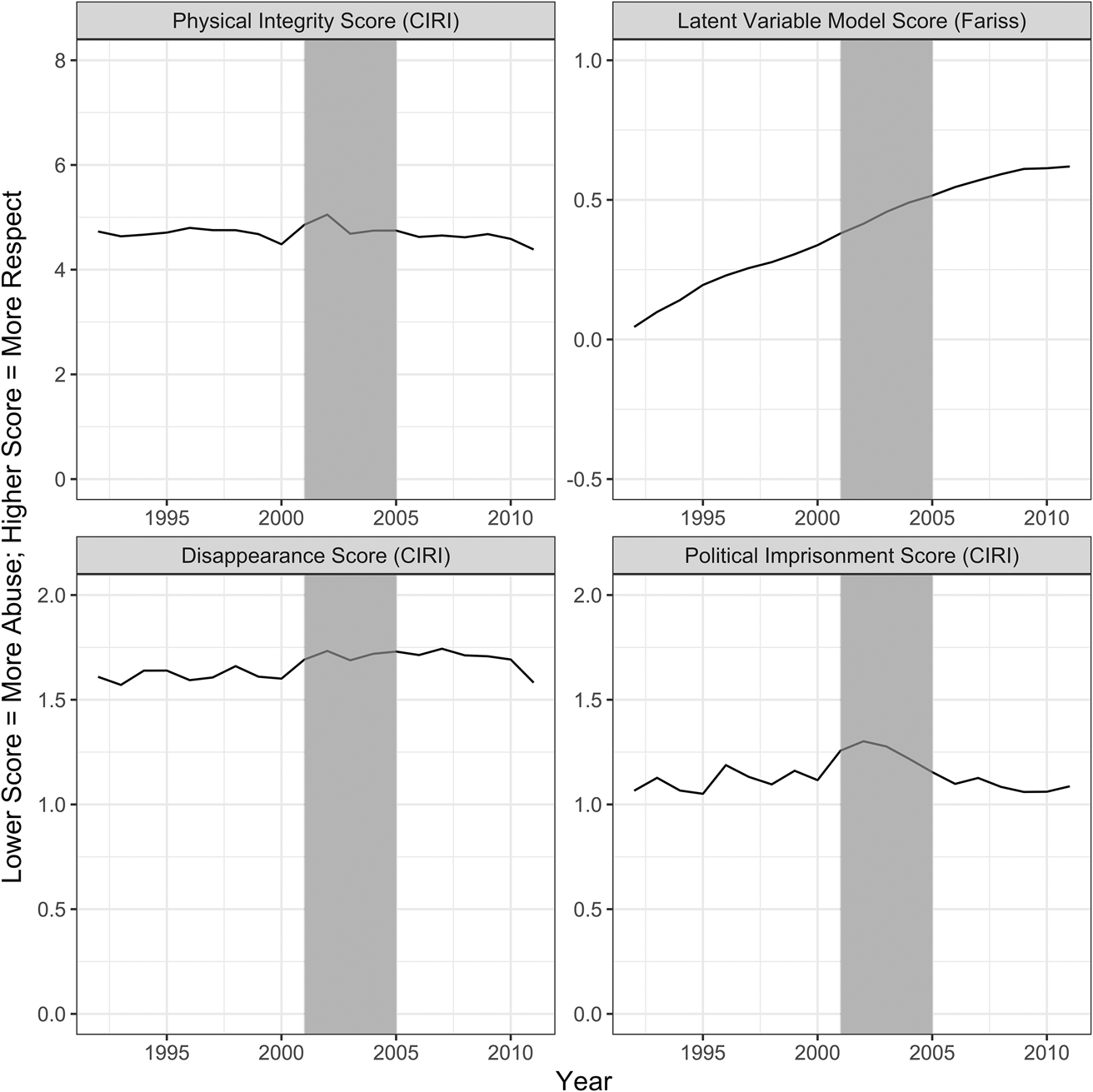
Turning to our first argument drawn from the literature, it is possible that the U.S. decision to adopt RDI policies could have a negative impact on global human rights practices. Our data, however, provides little indication that trends in government human rights practices at the global level have worsened over time; if anything, they have remained markedly consistent. Figure 1 shows that the CIRI data present no change in human rights practices, positive or otherwise, during the study period. The Fariss data, on the other hand, shows that human rights practices have improved consistently since the end of the Cold War. Like the other indicators, this data shows that trends have not changed in a way that one would expect if the RDI program had impacted global human rights practices. Had it done so, we would observe a decrease in countries’ average respect for human rights during or after the 2001–2005 period when countries began cooperating with the RDI program—this period is indicated by the shaded region in each graph. Indeed, difference of means tests show that there is not a statistically significant decrease in global-average respect for human rights for each measurement when comparing countries before and after the implementation of the RDI program.Footnote 60 Our initial findings suggest that U.S. RDI policies did not have a negative effect on core human rights practices at the global level. This is good news indeed.
Global average respect for human rights, 1992–2011

Actions speak louder than words, however, and it is possible that those countries that learned of the RDI program through collaboration may have been impacted by it more than countries that learned of it by word of mouth. Therefore, we next explore the impact “learning by doing”—the effect of U.S. policy in those countries that collaborated actively with the RDI program.
The reports on the RDI program reveal that the CIA worked with a wide variety of collaborators, ranging from bounty hunters in Afghanistan to the Canadian Mounted Police. But the great bulk of their collaborators were national intelligence agencies in the cooperating states.Footnote 61 Although the number of individuals detained in the RDI program was relatively small, perhaps under 150 people, each individual was moved multiple times across borders to a range of states, thus permitting interaction and socialization between the CIA and a much larger group of actors than would have been the case if each prisoner was held only in a single country. In many cases individual prisoners were held for quite long periods of time, and thus the number of foreign government officials, guards, or interrogators who interacted with the prisoner and the CIA was presumably large.
Although collaboration took many forms, a few examples help to illustrate what “learning by doing” looks like. Consider the Horn of Africa.Footnote 62 Beginning in 2002, Kenya, Somalia, Djibouti, and Ethiopia helped the United States disappear and clandestinely imprison individuals with suspected links to Al-Qaeda.Footnote 63 According to the annual human rights reports of the U.S. State Department and Amnesty International, from 1997 through 2001—the five-year period before any of these governments first collaborated with the RDI program—Ethiopia is the only one of these governments reported to have perpetrated disappearances.Footnote 64 Yet years after collaborating with the RDI program, as refugees flowed from Somalia into Kenya following the fall of Islamist authorities in Mogadishu and as Ethiopia fought against the Ogaden National Liberation Front and the Oromo Liberation Front, these countries adopted similar policies to those developed by the United States. In 2007 Kenya detained and rendered to Somalia 85 refugees with suspected terrorist links. Once in Somalia, these prisoners were turned over to Ethiopian authorities and rendered once more to Ethiopia. Throughout this process, these individuals were denied contact with their families, embassies, and the International Committee of the Red Cross. Like victims of the CIA RDI program, these individuals were effectively disappeared, transported illegally across international borders, and many of them were tortured.
In another example, Malawi appears to have worked closely with the CIA to facilitate the initial disappearance of terror suspects.Footnote 65 In May 2003, Tanzanian officials turned over an Algerian terror suspect to plain-clothed Malawian officials at a border crossing. Once in Malawi, the detainee came under the joint custody of United States and Malawian officials and was later transferred to a secret detention site in Afghanistan. Then, in another joint raid the following month, the CIA and the Malawi National Intelligence Bureau captured five suspected terrorists and rendered them extraordinarily to Zimbabwe.
Thailand appears to have served as a similar hub in Southeast Asia.Footnote 66 Thailand allowed the CIA to establish a secret prison on a Thai military base in early 2002, where the CIA first used the so-called enhanced interrogation techniques. Thailand also helped the CIA disappear suspected terrorists. From at least 2002 to 2004, Thai officials detained Indonesian, Malaysian, Yemeni, and Libyan citizens suspected of terrorism, turned these individuals over to the CIA, and allowed the CIA to transport the prisoners to its clandestine detention facilities elsewhere. Several Arab states, including Morocco, Jordan, Egypt, and Syria, served as torture proxies for the CIA, interrogating suspects on behalf of the United States and then returning these individuals to U.S. custody.Footnote 67
By collaborating with other governments in the violation of physical integrity rights, the United States sent a strong signal about its private preferences. States that knew this information firsthand were likely to update their expectations of U.S. preferences for the protection of human rights during the war on terror. For example, The Gambia helped the U.S. extraordinarily render two individuals to Afghanistan in 2002. Four years later, in the aftermath of an alleged coup attempt, The Gambian government arrested at least 27 individuals, keeping them in incommunicado detention and subjecting some to torture.Footnote 68 In July 2006, when a U.S. official raised concerns with Belinda Bidwell, the Speaker of The Gambian National Assembly, Bidwell replied that “the world is different since 9/11 and Al Qaeda, and when it comes to matters of national security and the safety of the population, extraordinary measures must occasionally be taken.”Footnote 69 She then compared her government’s policies to those of the United States at Guantanamo noting, “such things even happen in developed countries.”Footnote 70
Syria and Uzbekistan, two other governments that participated in the RDI program, later cited U.S. policies to defend their own human rights violations. In late December 2007 U.S. Senator Arlen Specter and Representative Patrick Kennedy visited Damascus for meetings with President Assad and Foreign Minister Walid Muallem. In both meetings Representative Kennedy raised U.S. concerns about the jailing of Syrian opposition figures. In the first meeting with Muallem, the tenor of the conversation turned acrimonious when Kennedy threatened to send a letter protesting the arrests. Muallem responded by suggesting he send a letter of his own citing “Abu Ghraib, Guantanamo, and US ‘flying prisons’.”Footnote 71 Similarly, when a 2007 meeting with the U.S. Ambassador-at-large for Religious Freedom touched on the topic of torture, Uzbek Foreign Minister Vladimir Norov alluded to U.S. abuses at Abu Ghraib and Guantanamo to undermine U.S. diplomacy.Footnote 72 Both Syria and Uzbekistan participated actively in the RDI program.
Active cooperation with the United States may also have increased the capacity of local security organizations to carry out repression. We could plausibly expect this result when the United States removed threats to regimes or provided agents of repression with cash or new skills.Footnote 73 For instance, with the help of its partners the CIA captured and extraordinarily rendered from Malaysia, Thailand, Pakistan, and Hong Kong members of the Libyan Islamic Fighting Group, an organization dedicated to the overthrow of the Libyan government that the CIA suspected was linked to Al-Qaeda.Footnote 74 In Somalia, the CIA contracted out the kidnapping and detention of terror suspects to local warlords, incentivizing what the International Crisis Group called a “small industry in abductions.”Footnote 75 Alternatively, if U.S. policies increased the power or influence of intelligence agencies and security agencies more generally vis-à-vis other state institutions, such as courts, we might also expect cooperation to have a negative impact on physical integrity rights. Therefore, several mechanisms could have led countries to adopt worse human rights practices after collaborating in the CIA program.
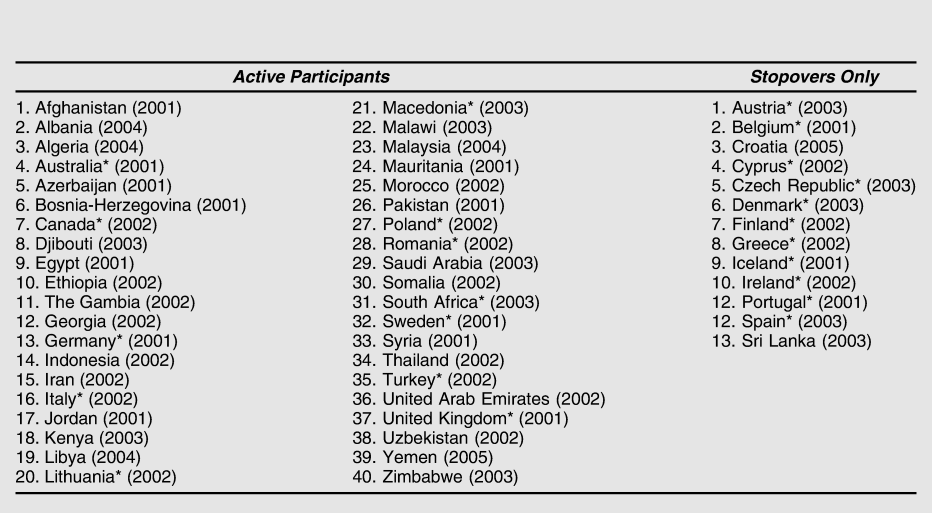
To test this “learning by doing” argument, we developed a dichotomous independent variable indicating whether or not a state actively participated with the United States in its RDI program. This variable is drawn from a 2013 report by the Open Society Justice Initiative, which identifies 53 countries and Hong Kong as collaborators with the program.Footnote 76 Of these 53 states, 13 states only allowed the CIA to use its airports for flight stopovers. The remaining 40 states helped the CIA more actively such as by facilitating the kidnapping of suspected terrorists, hosting secret detention facilities, or torturing prisoners, among other activities. From the OSJI report we code a variable indicating whether or not a country was one of these 40 “active participants” in the program.Footnote 77 Table 1 provides a list of the 53 participating states, noting which ones were active participants, which ones were used for CIA flight stopovers only, and the year that the OSJI report first documents a state collaborating with the RDI program. (For simplicity, we refer to “active participants” as “participants” for the remainder of this article.) Unfortunately, the report does not always make clear when each state’s collaboration ended. We do know that collaboration was typically intermittent, such as assisting the CIA with an abduction or torturing prisoners on the CIA’s behalf and then returning them to CIA custody. Few countries helped consistently throughout the life of the program; it appears that most helped only on an as-needed basis. Nevertheless, the relevant detail for the current analysis is when countries learned of the CIA’s actions through collaboration. We also know that President Obama ended the program with an executive order on January 22, 2009. As discussed later, the fact that observed effect persists after 2009 is evidence that the human rights consequences of the RDI program lingered well after the program’s conclusion.
States that participated in the CIA RDI program

Note: * denotes states categorized as democracies. The year in parentheses is the first year that the OSJI report documents the country participating in the RDI program. The end of the countries involvement is not always documented, but the program was officially ended by President Obama on January 22, 2009.
There are limitations to using observational data to pin down causality and eliminating endogeneity is not always possible. That said, a key factor in establishing the plausibility of observational studies is the comparability of treatment and control groups in the pre-treatment period, which are in this case participants and all other states. In the years before the beginning of the RDI program, countries that participated in the program were statistically similar to countries that did not, suggesting that the United States did not single out, on average, certain types of countries as collaborators.Footnote 78 Difference-of-means tests comparing participants’ and non-participants’ average human rights practices in the three year period before 2001 (1998–2000) shows no statistically significant differences between participants and non-participants across each of our measurements of government respect for human rights. It appears that the United States did not seek, on average, the assistance of states known for human rights violations when implementing its RDI program. This is not to say that the United States did not seek the assistance of individual states known for violating human rights, but only that the group of states that participated actively with the RDI program is not statistically different from the group of states that did not participate with the program in terms of human rights practices. Notably, participants also do not differ from non-participants in terms of democracy, per capita GDP, whether or not they were in conflict, the number of internal opposition groups they faced, whether or not they were in a period of political transition, the number of terrorist attacks they experienced, their total trade with the United States, or the amount of military assistance they received from the United States. Even though participants and other states appear to be comparable in the years before the onset of the RDI program in 2001 across all of these dimensions, it remains possible that other unobserved factors account for the observed relationship.
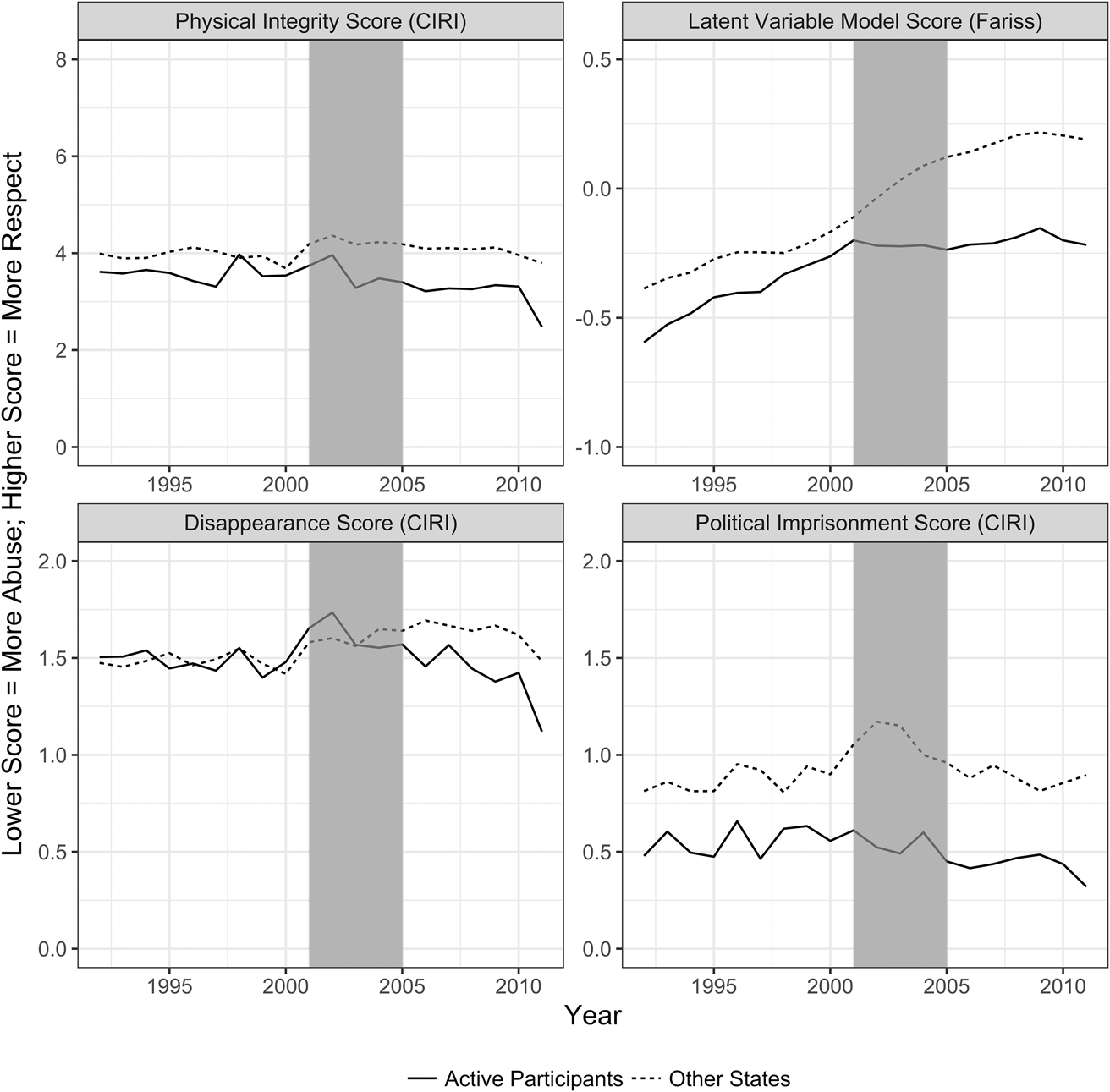
Breaking down human rights practices by participation in the RDI program reveals a somewhat different picture than we get from looking at global human rights practices. Figure 2 plots the average human rights practices for states that participated in the RDI program relative to those that did not for the period 1992–2011. These graphs confirm that participating countries did not have worse human rights practices on average in the years before the development of the RDI program. These graphs also show intimations of divergent trends among participants and non-participants after participation began. The average respect for human rights of participating states appears to worsen relative to other countries following the period when countries began assisting with the program.
Average respect for human rights by participation, 1992–2011

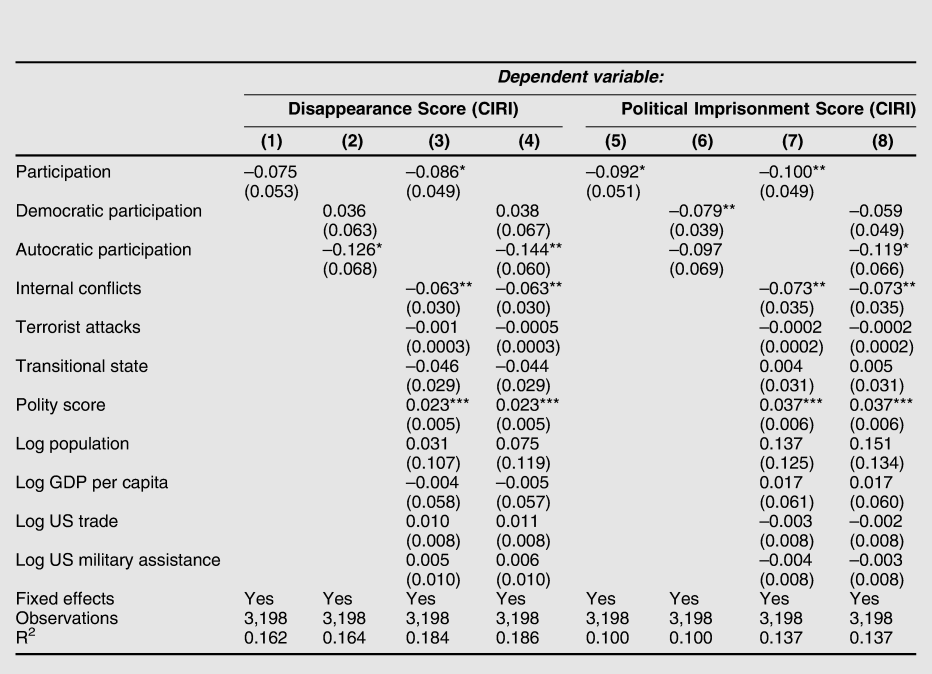
To assess these observations statistically we estimate a series of difference-in-difference models for each measurement of human rights using country and year fixed effects as well as a lagged dependent variable (later we add an array of control variables). Model 1 in tables 2 and 3 presents the results of this model when computed for each measure of our dependent variable. This analysis shows that there is, in fact, a negative correlation between participation in the RDI program and government respect for human rights as measured by the CIRI Physical Integrity and Political Imprisonment scores. There is not, however, a statistically significant association between participation in the RDI program and government human rights practices as measured by Fariss’s Latent Variable model or the CIRI Disappearance score. These mixed results provide suggestive evidence that participation in the RDI program is associated with a worsening in government human rights practices.
Participation in RDI program and state respect for human rights, 1992-2011

Note: All models include country and year fixed effects and a dependent variable lagged one year. Country level cluster-robust standard errors in parentheses. *p < 0.1; **p < 0.05; ***p < 0.01
Participation in RDI program and state respect for human rights, 1992–2011

Note: All models include country and year fixed effects and a dependent variable lagged one year. Country level cluster-robust standard errors in parentheses. *p < 0.1; **p < 0.05; ***p < 0.01
We are also interested in exploring the impact of regime type on our findings to see if democracies and autocracies responded differently to collaboration in the CIA program. To test this proposition we disaggregate the participation variable into two groups based upon their average polity score as described earlier. The result is a group of 62 democratic states, including 12 participating states, and another group of 106 autocratic states, including 28 participating states. We plot, in figure 3, our measures of respect for human rights for participants and non-participants among the subset of autocratic states. These figures show remarkably parallel trends prior to the 2001–2005 period when states began collaborating with the RDI program and significant divergence thereafter. Although the evidence presented in these graphs is not sufficient for a causal interpretation of our findings, it does confirm the validity of the parallel trends assumption necessary for a causal interpretation.Footnote 79 We then estimate our difference-in-difference model for each dependent variable using this disaggregated independent variable.
Respect for human rights among non-democracies by participation, 1992–2011

The results of this analysis, presented in Model 2 on tables 2 and 3, provide three key insights. First, participation in the RDI program appears to have had no statistical impact on the human rights practices of more democratic states as measured by the two aggregate measures of human rights practices as well as the CIRI Disappearance score. There is some evidence, however, that democratic participants subsequently engaged in more political imprisonment, a possibility we rule out later. Second, collaboration in the program had a statistically significant and negative association with human rights practices in less democratic countries according to Fariss’s Latent Variable model and the CIRI Disappearance score. Third, the magnitude of the coefficients for autocratic participation presented in Model 2 are notably larger than those presented in Model 1, suggesting that participation in the RDI program has a stronger association with the behavior of the subset of autocratic collaborating states than with the entire set of collaborating states.
The plots in figure 3 combined with the statistical analysis presented in Model 2 provide initial descriptive evidence that participation in the RDI program corresponded with a worsening of the human rights practices of autocratic governments. We now add control variables to test the robustness of these findings to alternative model specifications and rule out alternative explanations for government repression identified by the literature on state repression. The results of this analysis are presented in Models 3 and 4 in tables 2 and 3.
This analysis reveals a clear pattern. Participation in the RDI program has a strong negative correlation with the human rights practices of less democratic countries even when holding constant regime type, population size, per capita GDP, number of terrorist attacks, bilateral trade flows with the United States, amount of U.S. military aid, and whether or not states are undergoing a political transition or experiencing an intrastate war. This analysis also confirms the finding that participation in the program had no relationship to the behavior of more democratic states—the correlation between democratic participation and political imprisonment is now statistically insignificant. The analysis also shows that the RDI program had lingering effects, persisting well after President Obama ended the program in January 2009. Even though the inherent limitations of observational studies means that this analysis cannot establish causality, these findings are consistent with the inference that the RDI program caused more abuse of human rights by the CIA’s authoritarian partner states.Footnote 80 In short, autocratic states that aided the United States in its kidnapping, detention, and torture of terror suspects soon adopted worse human rights practices themselves. This result suggests that participation in the program came at the expense of human rights in less democratic countries.
Conclusion: Taking the Broader View
Well-crafted foreign policies pursue multiple goals simultaneously. The current debate over reinitiating the RDI program ignores this broader view of foreign policy. It is here where scholars can assist decision-makers by assessing the policy’s trade-offs, such as its likelihood of success with respect to specific goals and targets, its costs, and how it compares to alternative policy options. As Baldwin puts it, failing to consider these issues “may lead to serious policy mistakes.”Footnote 81
Our analysis shows that the RDI program had significant policy costs. Far from promoting human dignity and the rule of law, participation in the RDI program is associated with a statistically significant worsening in the human rights practices of partner governments. Combining this finding with other research suggesting the dearth of intelligence gleaned from the program and its wide-ranging diplomatic and military consequences suggests that the benefits of the RDI program were tenuous and few, but its costs were vast and considerable.Footnote 82 This highlights the importance of looking at the broader consequences of the Bush administration’s policies of detention, torture, and cruelty, and the need to move beyond the counterfactual arguments about “what worked” in a narrow sense of producing intelligence.
Our findings also say much about the ability of the United States to shape the security practices of other states. Active collaboration in repression has a far greater effect than simple knowledge of U.S. practices. States appear to learn through participation in policy implementation, a process we refer to as “learning by doing.” This insight is especially noteworthy because the results of research on whether or not the United States can actively promote human rights, democracy, and human security have been quite thin. What accounts for this disparity in findings? Part of the answer likely has to do with the unique nature of the RDI program itself. Unlike economic sanctions, trade conditionality, and other instruments of U.S. foreign policy that aim to shape the security practices of other states, the RDI program engaged directly with intelligence agencies and police in foreign countries in precisely the type of behavior that these other policies intend to discourage. Another part of the answer likely has to do with timing and context. Collaboration in the RDI program was covert, part of a global war on terror, and came after several high-ranking U.S. officials stated publicly the need to get tough. U.S. behavior changed dramatically following the attacks of 9/11, especially from the perspective of those states with firsthand knowledge of U.S. practices. All of this suggests that the United States worsens the human rights practices of authoritarian regimes when it collaborates directly with them in violating human rights. Critically, however, our findings also underscore the importance of democracy for human rights, since those countries with democratic institutions that collaborated with the United States did not experience worse repression as a result.
The political and legal landscape has also changed in important ways since 2001, so there are reasons to suspect that the Trump administration would face more significant domestic and international obstacles to implementing its draft executive order.Footnote 83 Domestically, officials in the U.S. intelligence and military communities might resist. Michael Hayden, for instance, claimed that the U.S. military would not follow an “unlawful order” from Trump, while then-Director of the CIA John Brennan claimed that the “overwhelming majority” of CIA officers would not want to return to the use of waterboarding.Footnote 84 U.S. government officials have good reason to resist implementing Trump’s prospective order. The ACLU brought a case against the two psychologists who designed the CIA’s notorious “enhanced interrogations techniques” on behalf of three of their former victims, a lawsuit that was later settled for an undisclosed sum.Footnote 85 Twenty-three other U.S. officials were convicted in absentia for kidnapping an imam in Milan in 2003.Footnote 86
Both democratic and non-democratic states collaborated with the earlier U.S. rendition, detention, and interrogation program. Today, the picture is more complicated. Some of the United States’ closest allies present another obstacle to President Trump’s prospective order. The European Court of Human Rights has ruled that Macedonia, Poland, Italy, Romania, and Lithuania had violated the European Convention on Human Rights by collaborating with the CIA program and has ordered these counties to pay damages to their victims. These cases establish the precedent that Council of Europe countries are legally accountable for complicity in U.S. enhanced interrogations, secret detention, and extraordinary renditions. Together with the onslaught of national inquiries into U.S. torture, kidnapping, and arbitrary detention in Canada, Germany, Italy, Spain, and the United Kingdom, as well as by the European Parliament and the Council of Europe, these cases make it unlikely that the Trump administration will find partners in Europe.
A Trump-administered RDI program will therefore not only face greater opposition within the United States, it will also be opposed by more of the United States’ democratic allies than were the policies of the Bush administration. If the Trump administration revived the Bush-era policy, it would likely find few democratic allies willing to help out. This is both reassuring and troublesome. On one hand, it means that the Trump administration will be less likely to succeed in implementing this policy. On the other hand, if the Trump administration does succeed in implementing this policy, without democratic states willing to aid and abet its policies, the Trump administration will be forced to turn to undemocratic states to find hosts for its secret prisons and partners for the abduction, transport, and abuse of suspected terrorists. Our research suggests that U.S. use of secret detention, torture, and extraordinary rendition can damage government human rights practices the most in precisely those states. If Bush-era policies hurt human rights internationally, Trump-era policies might well have worse consequences.
Supplementary Materials
1. Summary
2. Data and Imputation Model
3. Assessing Global Shifts in Respect for Human Rights
4. Participation in the RDI Program
5. Assessing the Impact of Participation
6. Additional Tests Described in Footnotes
7. Additional Considerations
The below supplementary materials are available at https://doi.org/10.1017/S1537592717004224