In 1992, then-French Prime Minister Pierre Bérégovoy gave a televised interview addressing a wide range of current events in France. When asked about the situation in the banlieues—suburbs of major French cities known for elevated rates of poverty, joblessness, and conflict between ethnoracial minorities and the police—the prime minister stated, “I frankly do not believe that we can compare France to the United States” (Le premier ministre à l’heure 1992). This rhetorical move to contrast France and the United States—or avoid doing so—when it comes to race and racism is common in French political discourse. It operates as a frame, providing an easily accessible interpretation and deflection of racial inequality and racist incidents as rare exceptions in an otherwise racially egalitarian France.
Challenging this narrative of an egalitarian France, some French anti-racism activists are centering the role of race and racism in their indictments of the French state and its unfulfilled promise of liberté, égalité, fraternité. This is not a new phenomenon; but our contemporary global moment, marked by the visibility of police violence towards Black populations and the Black Lives MatterFootnote 1 movement in the United States, has contributed to renewed anti-racism demands within France. These activists pay particular attention to the subject of police violence, variously referred to as “violence policière” and “bavures.”Footnote 2 In response to their demands, some within French politics, the media, and the public sphere have once again employed the U.S./France contrast frame, arguing that these activists are importing U.S. concepts and strategies that have no place in France. This response has the effect of delegitimizing these contemporary French anti-racism activists.
In this article, amid the background of how race has and continues to play a role in French politics and law despite France’s official difference-blindness, we examine the U.S./France contrast frame, unpacking how it depicts today’s “U.S.-style” anti-racism as a threat to French values and equality. Based on ethnographic research and media analyses, we interrogate how anti-racist demands in France, both in the past and today, have made conscious use of claims and concepts that are in conversation with global (not merely U.S.) conversations about white supremacy and how to fight it. We argue that in doing so, French anti-racist activists are both anticipating and responding to uses of the U.S./France contrast frame. Moreover, in looking at actual and alleged connections between French and global anti-racism movements, we highlight the relationship between the Black Lives Matter movement in the United States and similar movements against systemic racism in France. Ultimately, we demonstrate that as the U.S./France contrast frame is deployed to deny the existence of racism in France, it also reveals the necessity and difficulty of anti-racist struggles in France.
In discussing the effect the U.S./France contrast frame has on discourse on race and racism in France, we rely upon the voluminous literature tracing the formulation of race in France, and in Europe more broadly. A plethora of research has documented that race as a category does matter in France, both in the historical formulation of France and presently, in areas as varied as boundaries of inclusion and exclusion, Islamophobia, slavery and remembrance thereof, employment, educational attainment, colonial rule, citizenship and nationality, policing and harassment (Beaman Reference Beaman2017; Bleich Reference Bleich2000; Fleming Reference Fleming2017; Fredette Reference Fredette2014; Keaton Reference Keaton2010; Ndiaye Reference Ndiaye2008; Quillian et al Reference Quillian, Heath, Pager, Midtbøen, Fleischmann and Hexel2019; Silberman Reference Silberman, Alba and Waters2011; Silverstein Reference Silverstein2018). We build on this literature by contributing a sustained analysis of how one popular and long-standing rhetorical move (the U.S./France contrast frame) shapes the terrain of the anti-racism struggle for French activists.
Moreover, our intervention here is not just relative to the French public sphere or French politics, but also relative to French academia and scholarship. This matters because part of the complications of invoking race and racism in France is also a scholarly silencing of these discussions. Relatedly, in bringing attention to the U.S./France contrast frame, we reject what Pierre Bourdieu and Loïc Wacquant (Reference Bourdieu and Wacquant1999) term as “cultural imperialism” in their critique of how scholars reference U.S.-based ideas when analyzing race and racism in other societies. Instead, we rely upon how ethnoracial minorities have conceptualized race and racism within the French context.
This article proceeds in four steps. First, we situate our analysis by discussing the context of race, racism, and policing in France. Second, after a brief discussion of the methodological approach we used in this analysis, we introduce the U.S./France contrast frame—both the work it purports to do and the work it actually accomplishes. Third, we discuss how the contrast frame impacts anti-racist mobilization in France, delineating the contours of present mobilization against systemic racism and police violence. In this discussion, we highlight how some of this mobilization is in conversation with the Black Lives Matter movement in the United States, and how some of it relates to specificities of the French context. Fourth, we conclude by addressing the implications for global movements against racism and debates about the resonance of Black Lives Matter outside of the United States.
Background: Race, Racism, Policing, and Police Violence in France
Before interrogating how the U.S./France contrast frame shapes conversations about police violence in France, we need to first consider the role of race in French politics and policing. Race as a concept was created in Europe, and as many scholars have demonstrated, ideas about race and racial difference in the United States were greatly influenced by French thinkers. Early U.S. leaders, including Thomas Jefferson, were greatly influenced by such notions as they codified the institution of slavery in the colonies (Wright Reference Wright1999). Later, aristocrat Arthur de Gobineau influenced U.S. thinking on race with his theories about the natural superiority of the white race as compared to Blacks whom he described as animal-like (Thomas Reference Thomas2007). And of course, France participated in the slave trade and supported the use of enslaved labor in its overseas colonies, which solidified both physical and symbolic boundaries around what is considered France and what is not. Many scholars of French history have documented how logics of racial difference were codified during France’s colonial period, and how these persist to the present moment (Boittin Reference Boittin2009; Fanon Reference Fanon1967; Jugé and Perez Reference Jugé and Perez2006; Kastoryano and Escafre-Dublet Reference Kastoryano, Escafré-Dublet, Zapata-Barrero and Triandafyllidou2012; Keaton, Sharpley-Whiting, and Stovall Reference Keaton, Sharpley-Whiting and Stovall2012; Peabody and Stovall Reference Peabody and Stovall2003; Wieviorka Reference Wieviorka1992).
Despite the historical relevance of race and racism within Europe, David Theo Goldberg (Reference Goldberg2006, 336) notes that “for Europe, the Holocaust is the defining event, the mark par excellence, of race and racially inscribed histories.” According to Goldberg, this narrow association of racism in Europe with the Holocaust produces a threefold erasure of race and racism in Europe. First, because the Holocaust came to represent for Europeans “the horrors of racial invocation and racist summation,” Europeans have sought to “implode” the concept of “race in the wake of World War II” (Goldberg Reference Goldberg2006, 334 and 336). Of course, as Goldberg (Reference Goldberg2006, 334) notes, “This is a wishful evaporation never quite enacted, never satisfied.” Yet it explains some of the European discomfort with racial categories and analysis. Second, this association of racism in Europe with the Holocaust has pushed other instances of European racism to the margins. “In making the Holocaust the referent point for race, in the racial erasure thus enacted in the European theatre another evaporation is enacted. Europe’s colonial history and legacy dissipate if not disappear” (Goldberg Reference Goldberg2006, 336). Third, Goldberg describes how white Europeans following World War II locate race and racism outside of Europe, for example in the United States, rather than acknowledge its role in constituting the very boundaries of Europe and European identity. Race therefore is positioned as something outside of and irrelevant to Europe, rather than integral to Europe. Goldberg terms this framework “racial Europeanization” to refer to this combination of wishful evaporation, erasure, and displacement of race within Europe. The U.S./France contrast frame is just one articulation of the displacement side of racial Europeanization.
In this article, we focus on the growing social problem of police violence targeting Black and North African-origin individuals and activism against this problem. By police violence, we are referring both to harassment by the police through such practices as identity control checks (contrôles d’identité) and actual deaths by the police. A 2009 Open Society Institute report demonstrated that identity control checks disproportionately target “visible minorities.”Footnote 3 Additionally, a 2012 Human Rights Watch reportFootnote 4 found that the majority of Black and North African-origin individuals reported identity checks by the police as a major problem; they are six to eight times more likely than whites to undergo “pat-downs” (Beaman Reference Beaman2020). As to actual deaths by the police, these estimates vary, but one estimate states that between 1977 and 2020 703 people died due to the police.Footnote 5 , Footnote 6
Modern French policing and law and order politics developed within a colonial order that used racial logics to determine membership and even personhood. Some police practices were transplanted from the colonies to the metropole; some developed in the metropole were sent to the colonies; and some developed in the very nexus between colony and metropole. For example, Parisian law enforcement officials who had formerly worked in the colonies sought to “adapt their approach to law enforcement when they returned to the mainland,” which ultimately produced a “less violent but much more invasive means of stamping out dissent” (Rosenberg Reference Rosenberg2006, 11). These means included a massive campaign of information gathering on all foreigners, particularly colonial subjects. In their aim to know the whereabouts and doings of foreigners, the Prefecture of Paris had collected “over a million dossiers … by the end of 1921” (Rosenberg Reference Rosenberg2006, 52).
This early technological advance in police surveillance would have tragic repercussions for minority populations in France for decades to come. Rosenberg (Reference Rosenberg2006, 202) notes that the fichier juif, the census of Jewish residents in Paris that had been ordered by the Germans under Vichy, was “modeled on the card files of foreigners kept by the Prefecture” and “was maintained by the same subaltern personnel, in the same room, and kept current by the same active service of the RG.”Footnote 7
According to House and Macmaster (Reference House and Macmaster2006), techniques employed by the fichier juif were later used to police Muslim Algerians as demands for decolonization grew following World War II. Even the police personnel were sometimes the same: “in many instances we find senior police officers or administrators, who during the course of their career were involved in both forms of repression, drawing on a shared body of practices” (House and Macmaster Reference House and Macmaster2006, 35). One notable example is Maurice Papon: as Prefect of Paris, Papon oversaw the police during the October 17, 1961 massacre of unarmed Muslim Algerians protesting their discriminatory night curfew. Celebrated throughout much of his lifetime, Papon would later be convicted for his earlier, Vichy-era role in “the deportation of Jews from Bordeaux” (House and Macmaster Reference House and Macmaster2006, 34).
As alluded to earlier in our discussion of Goldberg’s concept of racial Europeanization, the French state’s involvement in the systematic genocide of French Jews generated wariness among many politicians and the general public after World War II regarding state use of religious, ethnic, and racial categories. Moreover, the dominant understanding of French republicanism denies political relevance to the category of race. This race-blindness can, on the surface, appear similar to post-Civil Rights Era reactionary articulations of U.S. conservatism that have sought to minimize and even erode efforts toward dismantling white supremacy. In France, however, race-blindness is largely embraced across the political aisle, particularly by the left, as an egalitarian bulwark against backsliding into the kind of politics that enabled Vichy France and the Holocaust.
None of this is to say, however, that race has ceased to be relevant in France. The present-day French policing practices of racial profiling for stop-and-searches (les contrôles aux faciès) and race-based evictions from public areas (les contrôles-éviction) have inherited the racial logic and surveillance tactics of this earlier colonial order (Body-Gendrot and Wenden Reference Body-Gendrot and de Wenden2014; Boutros Reference Boutros2018; Open Society 2009). Both authors of this paper have independently learned in their ongoing ethnographic research that anti-racist and anti-Islamophobia activists themselves identify present-day police violence and harassment, including les contrôles d’identité, as a continuation of police violence experienced under French colonial rule.
Yet despite the ubiquity of race in France—or what Trica Danielle Keaton (Reference Keaton2010) refers to as a “consciousness of race,” which is to say, the opposite of race-blindness—it is silenced due to French universalist and Republican ideology. Moreover, race is simultaneously implicitly referenced and explicitly avoided. References to “immigrants,” “ethnicity,” “origins,” and “culture,” for example, often serve as ostensibly race-neutral euphemisms for visible minority populations.
In short, with French colonial history so enmeshed in the development of modern French policing, we must consider the role of the colonial mindset, and racism itself, in French law and order agencies.Footnote 8 Anthropologist Didier Fassin (Reference Fassin2013) has also argued that the French police establish racial boundaries despite the absence of state-level categorization. So when French anti-racism activists today speak about racist police violence, it is important to recognize that many of them are speaking in two registers simultaneously: they are addressing this local, very French context and history of policing, as well as broader, global anti-racist struggles for Black liberation.
Methods
We now discuss the methods and data that guide our analyses. First, while we come from different disciplines, we both draw on the tradition of scholars who use what Ellen Pader (Reference Pader, Yanow and Schwartz-Shea2006, 161) calls an “ethnographic sensibility” to analyze socially and politically significant acts of meaning-making (Geertz Reference Geertz1973, Schatz Reference Schatz2009, Wedeen Reference Wedeen2010). In this article, we do not seek to, for example, assess the veracity or track the chronological prevalence of the contrast frame. Instead, we are concerned with what the frame means to those who deploy it and those who must respond to it, and the influence it has on the broader conversation about race and racism in France today. Broadly, we conclude that the contrast frame helps to deny and provide an alibi for systemic racism and racial inequities in French society. Similarly, while we observe how French anti-racism activists who reject race-blindness understand the influence of the contrast frame on their work, we do not assess the relative conditions of and challenges to anti-racist politics in France and the United States in this article.
Second, the data we deploy in this article comes from historical examples, original ethnographic research, and observations of contemporary French political discourse and media coverage stemming from our past and ongoing projects concerning French anti-racism activism that rejects the colorblind model. Both of us have conducted qualitative research, including interviews and participant observation, with minoritized populations in France for over a decade. Specifically, one of us (Beaman) has been conducting ethnographic research since 2017 on mobilization against police violence in the Parisian metropolitan region. As part of this research, she has participated in many anti-racist demonstrations and protests for victims of police violence, as well as conducted interviews with various activists, and friends and family members of victims of police violence. Meanwhile, one of us (Fredette) has analyzed elsewhere, using text analysis and interviews, how some French anti-racism activists use new media as a wedge to agentically insert themselves into media conversations that are typically difference-blind, hostile to criticisms of difference-blindness, and overwhelmingly white.Footnote 9
Finally, we use Goffman’s (Reference Goffman1974) concept of a “primary framework” to guide our analysis of the U.S./France contrast frame. This concept helps us to identify what French elites are invoking when they employ the U.S./France contrast frame, and how it communicates suspicion about French anti-racist activists who target police violence and systemic racism. We expand upon this in the next section.
The U.S./France Contrast Frame
The U.S./France contrast frame, exemplified by the Bérégovoy quote at the beginning of this article, works as what Goffman (1974) calls a “primary framework,” aiding individuals as they seek to make sense of and understand race and racism in France. Goffman (1974, 21) describes primary frameworks as heuristics that have the power “to locate, perceive, identify, and label a seemingly infinite number of concrete occurrences.” When French elites invoke the U.S./France comparison frame, they present the United States as a kind of racist bogeyman against which France can be favorably compared. Because of this, the use of anti-racism demands or actions that are influenced by (or even seemingly influenced by) the United States—which is to say, those that are not difference-blind, or those that suggest that racism is systemic in France—can be depicted as a dangerous rapprochement with the less desirable state of racial affairs in the United States.Footnote 10
As Scheufele and Tewksbury (Reference Scheufele and Tewksbury2007, 12) put it, primary frames are “invaluable tools for presenting relatively complex issues, such as stem cell research, efficiently and in a way that makes them accessible to lay audiences because they play to existing cognitive schemas.” As Goldberg’s concept of racial Europeanization indicates, Europeans are already primed to think of racism as something that occurs outside of Europe. Hence, French elites can draw on that existing cognitive schema to deny or downplay the extent of racism in France, as well as to delegitimize those French anti-racist activists who challenge republican difference-blindness and claim that racism in France is systemic. In this way, the U.S./France contrast frame acts as both an analytical shortcut and a rhetorical move. The comparison to the far more publicized nature of systemic racism in the United States seeks to downplay deviations from Republican difference-blindness, like police violence or the ethnoracial homogeneity of the French elite, and it seeks to persuade the public that certain articulations of anti-racism are dangerous imports that threaten to introduce a foreign strain of racism into the Republic.
The U.S./France contrast frame works in three ways. These interrelate, but for analytical clarity, we distinguish between the three here. First, the frame minimizes the extent of racism in France. A common example of this is the invocation of the history of African American expatriates living in France, such as writers Richard Wright and James Baldwin, to argue that not only is France not a racist society, the United States is the racist society and therefore the locus of racism. It is the United States that is obsessed with race and racism. As the logic goes, how could France be racist when Josephine Baker chose to move here? Or Langston Hughes? According to this articulation of the U.S./France contrast frame, any invocation of racism in France ignores how Black Americans have sought out France as an alternative refuge from U.S. racial segregation. These famous expatriate authors and artists are thus conscripted for an argument from authority that ignores the nuance of their experiences and discoveries while living in France. For example, writer James Baldwin (Reference Baldwin1955) critiqued French racism towards North African and Black individuals, as well as discussed the relative privileges he had possessing a U.S. passport.
Second, the U.S./France contrast frame denies the relevance or appropriateness of race as a meaningful category for understanding French politics and society. One domain where this is especially evident is in French political critiques of the “Americanization” of French academia.Footnote 11 For example, French President Emmanuel Macron said in 2020: “The academic world is to blame. It has encouraged the ethnicization of the social question, thinking it was onto something. Now, the outlet can only be secessionist. That comes back to breaking the Republic in two” (Fressoz and Pietralunga Reference Fressoz and Pietralunga2020).Footnote 12 In another example, Minister of Education Jean-Michel Blanquer placed some of the blame for the decapitation of Samuel Paty (a schoolteacher who had shown students some cartoons depicting the Prophet Muhammad as part of a lesson on free speech) on French universities’ “intellectual complicity in terrorism” (Jean-Michel Blanquer dénonce l’islamo-gauchisme dans 2020). He referred to this allegedly university-bred thinking as “Islamogauchisme,” which he further defined in a subsequent interview as:
An intellectual matrix coming from American universities and intersectional theses that want to essentialize communities and identities, which is the polar opposite of our Republican model that supposes equality between human beings, independent of their characteristics of origin, sex, religion. It is the breeding ground for a fragmentation of our society and a world view that converges with the interests of Islamists. This reality has especially plagued a significant portion of French social sciences. (in Aeschimann, de La Porte, and Noyon Reference Aeschimann, de La Porte and Noyon2020)
When Blanquer references “intersectional theses” he is referring to intersectionality, a concept that was introduced by U.S. critical race and legal scholar Kimberlé Williams Crenshaw.Footnote 13
The U.S./France contrast frame is at work in both Macron and Blanquer’s comments. For Macron, the “Americanization” of French academia, referring to the use of ethnicity or race to understand societal problems, will inevitably exacerbate social divisions. In Blanquer’s logic, the United States (a multicultural nation of interest group politics) and France (a republic of common good politics) are such different contexts that any use of U.S. social theory in the French context can only produce social ruptures that will threaten France. Both comments suggest it is inappropriate and even dangerous to consider major social questions through a supposedly U.S. lens of race and racism.
This second aspect of the U.S./France contrast frame also draws on the French republican suspicion of “communautarisme.” Since the early 1990s, this term in France has taken on a negative connotation and evokes the fracturing of society based on particularist ethnic or religious identity categorizations (Dufoix Reference Dufoix, Mohammed and Talpin2018, 14). According to Dufoix (Reference Dufoix, Mohammed and Talpin2018, 17), the term as it is currently used by French elites “develops from the critique of the multiculturalism of American society, as opposed to French republicanism.”
Third, the U.S./France contrast frame delegitimizes anti-racist discourse, demands, and activism, particularly those that are influenced by (or merely perceived to be influenced by) the United States. As seen earlier, French academics who research race and racism, some of whom are also engaged in anti-racist activism, are discredited for smuggling in foreign concepts that endanger the nation. In Blanquer’s words, they are complicit with terrorism. This condemnation also extends, then, to French anti-racist activists who draw on this well of scholarship. As white French sociologist Éric Fassin said in response to Blanquer and to the death threats he has received for his scholarship on race and racism, “Why attack white allies of discriminated minorities, if not to prevent solidarity?” (Fassin 2020).
A vivid example of the U.S./France contrast frame working to delegitimize French anti-racist activists is evident in a 2020 speech by President Macron that alludes to the debate surrounding Confederate and colonial monuments (such as of Christopher Columbus) in the United States and the reduction of that debate to “cancel culture,” as well as the toppling and “drowning” of a statue of slave trader Edward Colston in Bristol by anti-racist protesters. In a public address on June 14, 2020, Macron acknowledged the continued existence of racism in France and the need to fight against it—with a caveat:Footnote 14
But this noble combat is led astray when it transforms into communitarianism, in the hateful or false rewriting of the past. This fight is unacceptable when it is seized upon by separatists. I tell you very clearly tonight, my dear fellow compatriots, the Republic will not erase a single trace or name from its history. The Republic will not topple statues. We must instead lucidly consider the whole of our history, all our memories, our relationship with Africa in particular, to build a present and a possible future, from one side of the Mediterranean to the other, with a desire for truth and in no case to revisit or deny who we are. (Adresse aux français, 14 juin 2020)
In this statement, Macron distinguishes France from the United States (and the U.K.), insisting that France can and will address the racism of its “past” without erasing the nation’s history.Footnote 15 To erase France’s history, suggests Macron, would be to erase its identity.Footnote 16
What is the significance of Macron’s statement for those anti-racist activists who seek to challenge the veneration of historical figures who made major contributions to the institution of white supremacy in France? Consider Franco Lollia, a French anti-racist activist with the Anti-Negrophobia Brigade (an anti-racist collective). Fewer than ten days after Macron’s statement that “the Republic will not topple statues,” Lollia defaced the statue of Jean-Baptiste Colbert that stands outside the National Assembly. He spray-painted “state Negrophobia” in red paint. Colbert famously wrote the Code Noir, or Black Code, which defined slavery and its conditions in France’s overseas territories. His is only one of the many monuments to white supremacy and colonial rule we can identify in present-day France.Footnote 17 Lollia himself described his gesture as a political act responding to the state’s anti-Black racism: “We feel deeply insulted. They spit in our face democratically every day with this statue in front of the National Assembly, the so-called house of the people” (Bona Reference Bona2021). Lollia’s lawyers depicted his defacing of the statue as an alternative political strategy he chose to pursue after years and years of his more traditional political interventions (like letters to state institutions) had proven ineffective (Politi Reference Politi2021). With this act, Lollia challenged France to acknowledge its actual history of racism—its roots in French colonialism and slavery, and their reverberations in the present.
Macron’s statement, however, discredits Lollia and all anti-racism activists who seek to decenter the hegemonic, white narration of French history, particularly those parts related to colonialism and slavery. Macron condemns their fight, which he depicts as an ignoble and “unacceptable” version of the struggle against racism. In other words, it is in line with French republicanism to fight against racism—but not this way. Macron’s vision of an appropriately French anti-racism is quite different. We see it clearly in his 2020 speech “on the fight against separatism” (Discours du président de la 2020).Footnote 18 In that speech, Macron sketches out a legislative agenda that would see France commit to a difference-blind mission to “enable everyone to build their own lives” (Discours du président de la 2020, para. 60) and to realize “empowerment” (Discours du président de la 2020, para. 67). This is to be achieved through “public sector impartiality” that frees citizens from social tyrannies (racism, but also religion, family, country of origin) and social policy that frees citizens from the kind of precarity that limits their ambitions. For Macron, anti-racism is paternalist and state managed. Additionally, Macron wonders in the speech about young anti-racism activists who never personally experienced French colonization, implicitly asking what their connection with colonization could be; he then associates post-colonial and anti-colonial discourse with radical Islamic separatists (Discours du président de la 2020, para. 17). His vision of anti-racism is both a utopian and presentist one, where the French state of today solves the racial inequalities of today through egalitarian policy. Macron was not the only state actor to discount or discredit the political nature of Lollia’s action. The state brought Lollia to criminal court (the tribunal correctionnel de Paris) under section 322-1 of the penal code (Bariéty Reference Bariéty2021). Additionally, the National Assembly itself joined in the suit as a civil party (something Lollia’s defense team saw as a violation of the separation of powers) (Bariéty Reference Bariéty2021). Ultimately, Lollia was sentenced to a 500 euro fine and required to pay 1,040 euros in damages to the National Assembly for the statue (Lenoir Reference Lenoir2021).
To summarize, the legitimacy of Lollia’s anti-racist activism was challenged by a French president, prosecutor, criminal court, and the National Assembly. In a particularly revealing statement, Saida Benouari, the lawyer representing the National Assembly stated that
I hear the argument about symbolic action, but what about material damage? What sense is there in defacing goods belonging to the public domain? There are more civic ways to provoke the debate. (Bariéty Reference Bariéty2021)
This statement first silences, then delegitimizes Lollia’s anti-racist activism. First, Benouari sidesteps the symbolic meaning of Lollia’s action by foregrounding the material damage to the statue. She may “hear” it, but she does not engage with it or even attempt to characterize what the action was symbolic of. Second, the National Assembly’s lawyer suggests that there are “more civic ways” to induce a conversation on racism in France. This statement delegitimizes Lollia’s direct action tactic while ignoring the argument his defense team made about the ineffectiveness of traditional political means for encouraging conversations about anti-Black racism
The fact that a French president, prosecutor, criminal court, and the National Assembly responded to Lollia’s action primarily by bemoaning an attack on the statue of a historical figure and gatekeeping what counts as “appropriate” antiracist activism, rather than engaging with Lollia’s explicit accusation of “state Negrophobia” further supports his claim that it is nearly impossible to address state racism in France. This, in fact, is what Lollia expected would happen, and what he wanted to put on display:
One of the reasons for this action, why we did it, was to make this trial a platform … . It was to force white French justice to take off its mask of so-called democracy, equality for all and social and racial justice for all. (Bona Reference Bona2021)
Lollia’s action and the elite responses it garnered remind us that longstanding oppressions that are normalized in the public (in this case, systemic racism) often only reach the front page through provocation, and that loss can be part of a social movement’s broader strategy.
But Lollia is not the only anti-racist activist in France today to be criticized for his approach to anti-racism, or to see his work delegitimized through the U.S./France contrast frame. To better understand the goals and strategies of some of today’s more controversial French anti-racism activists, we must also examine their connection to previous periods of French and global anti-racism.
“New” French anti-racism and the U.S./France contrast frame
There is a common elite narrative that there are “new” articulations of anti-racism in France today, and that, unlike their French-born predecessors, these pose a danger to the Republic. We see this in Macron and Blanquer’s criticism of the “Americanization” of French academia. We also see an example of this in a Reference Joffrin2016 editorial from Laurent Joffrin, the managing editor of the center-left French newspaper Libération: Joffrin introduced a series of profiles about activists engaged in what he referred to as a “new anti-racism” that is “deliberately communautaire. The Muslims defend the Muslims, the Blacks defend the Blacks.”
Yet we argue that while some younger organizations and activists today do in fact engage in discourse and tactics that differ from the more established French anti-racism organizations that emerged in the twentieth century, their ideas are more accurately seen as a continuation of an internationalist, anti-colonial anti-racism that has long been present in France.
Three of the most prominent anti-racism organizations in France today emerged roughly in the first half of the twentieth century, and their founding was shaped by their commitment to human rights and their resistance to antisemitism. The Human Rights League (Ligue des droits de l’homme [LDH]) was founded in 1898 to support Alfred Dreyfus, the French and Jewish officer falsely convicted of treason (De 1898 à nos jours n.d.). In 1927, the Ligue internationale contre le racisme et l’antisémitisme (International League Against Racism and Antisemitism [LICRA]) was founded to support Samuel Schwartzbard, a “Jewish anarchist and refugee” who assassinated an exiled Ukranian military officer he blamed for pogroms there (26 octobre 1927 : Le procès n.d.). And 1949 saw the establishment of the Mouvement contre le Racisme, l’Antisémitisme et pour la Paix (Movement Against Racism and Antisemitism and for Peace), which later became the Mouvement contre le racisme et pour l’amitié entre les peuples (Movement Against Racism and for Friendship between Peoples [MRAP]), an organization inspired by the struggle against “Nazism and fascism” and founded by members of the Resistance (Présentation du MRAP 2017). A fourth organization, SOS Racisme, emerged in the wake of 1983’s March for Equality and Against Racism, a demonstration inspired by police violence and racism against North Africans and Black individuals in France’s banlieues, though its connection to the aims of the marchers is contested (Hajjat Reference Hajjat2013). As Martin (Reference Martin2015, 79) notes, SOS Racisme has emphasized “practical action to reinforce republican values” while resisting calls from other anti-racists “to look back critically at the colonial past and accept its links with the present.”
These groups all share a commitment to universalism and human rights: racism is objectionable because it divides humanity and introduces a hierarchy that is inimical to the idea of equal human rights. Additionally, the first three groups were fundamentally shaped by the history of antisemitism in France.Footnote 19
While there are certainly some differencesFootnote 20 among the aforementioned anti-racism organizations, an altogether different approach to fighting racism emerged in the 1930s from the Paris salon of two sisters from Martinique. The Nardal sisters, Paulette and Jane, moved to Paris to study at the Sorbonne in 1920 and 1924, respectively, and established the Clamart salon in their Left Bank apartment in 1929 (Church Reference Church2013). The Clamart salon served a crucial role in advocating for Black self-assertion and international Black solidarity, and creating a cosmopolitan Black community in Paris during the 1930s among African Americans, Caribbeans, and Black Parisians. These salon discussions established the foundation for the Negritude movement.Footnote 21 Negritude was an affirmation of a global, anti-colonialist, and anti-assimilationist Blackness, the legacy of which continues to affirm anti-racist struggles around the world, including in France. These solidarities formed regardless of differences in histories of slavery and colonialism. Black individuals, whether from France, the United States, or from former colonies in the Antilles and West Africa, bonded over the unique experiences of being racialized and subjugated as Black individuals, and resisting that subjugation.Footnote 22
While the U.S./France contrast frame seeks to distinguish France from the United States when it comes to race and racism, French anti-racism activists have long argued that racism must be understood as a global phenomenon, and not a dynamic limited to any one nation-state. From the beginning, anti-racist thought born of the French context has had a connection to global conversations about the need to fight anti-Blackness, white supremacy, and colonialism, for example during the Haitian revolution, the Negritude movement, and the decolonial struggle. What is perhaps the most ironic about the debate surrounding the importation of U.S. ideas of racism and anti-racism to the French context is that many of these so-called U.S. ideas were actually forged in France, and in Europe more broadly.
Some younger anti-racist organizations and activists in France today draw on this rich historical vein of French internationalist, anti-colonial anti-racism. Unlike the established anti-racist organizations that emerged in the twentieth century, these younger organizations and activists explicitly seek to link contemporary racism in France with the history of French colonialism and a contemporary postcolonial reality: a reality in which elite roles continue to primarily be filled by white French citizens and police violence and social precarity continue to be disproportionately experienced by France’s visible minorities. In this way, they engage in what Fleming (Reference Fleming2017, 16) has called “time work,” which she defines as “resistance to the collective forgetting, denial, or marginalizing of the racial past and its connections to the present.”
This kind of time work is what Lollia was doing in defacing the statue of Colbert. His symbolic gesture drew a throughline between the Code Noir and contemporary French racism. Additionally, he correctly anticipated that his act would draw immediate criticism and even legal punishment, hence dramatizing elite resistance to discussing this aspect of French history. Finally, Lollia employed his expected spotlight to share a message: as a Black French citizen, he experiences as an insult the presence of the author of the Code Noir seated, larger than life, and without any commentary, outside the legislature.
Whereas organizations like LDH, LICRA, MRAP, and SOS Racisme seek to end racism in today’s France by promoting equal human rights and Republican unity, these newer anti-racist organizations and activists that engage in time work seek to challenge the nation to recognize three interrelated things: a) the “human” in human rights was initially a legally restricted category; b) social, political, and even legal consequences for this racial hierarchy persisted long after the Code Noir was abandoned; and c) the seemingly paradoxical reality of a Republican France that engaged in colonialism and slavery tells us that racism flourishes in difference-blind universalism. Their tactics include direct action, legal mobilization, and interventions in public space.
The influence of this internationalist, anti-colonial anti-racism is visible in the way activists have married global and local knowledge and discourse about racism in response to the death of Adama Traoré. On June 2, 2020, just one week and one day after Minneapolis Police Department’s Derek Chauvin murdered George Floyd by kneeling on his neck during an arrest, roughly 20,000 demonstrators gathered outside a courthouse in Paris to protest the 2016 death of a young Black Frenchman named Adama Traoré (Yang Reference Yang2020). Similar to Floyd, Traoré had died in police custody, his last words being that he could not breathe. While no police have been officially faulted for his death, Traoré’s family has remained suspicious about the circumstances of Adama’s death.Footnote 23 Medical expert reports have reached conflicting conclusions about the cause of his death: some have attributed his death to heart trouble, either caused by underlying conditions or exertion in the heat; some have attributed his death to asphyxiation due to “plaquage ventral” (Couvelaire Reference Couvelaire2020; Quentel Reference Quentel2020; Yang Reference Yang2020).Footnote 24 Some participating in the demonstration drew clear connections with the deaths of Floyd and Traoré. In discussing media coverage of the death of George Floyd, one demonstrator bluntly stated: “France’s specialty is pointing out other countries when exactly the same thing happens here!” (Yang Reference Yang2020).
It bears noting that the timing of this demonstration, so soon after Floyd’s death, was coincidental: Assa Traoré and “Le comité vérité et justice pour Adama” [Committee for Truth and Justice for Adama] had already planned a demonstration in Paris, inspired by the death of Traoré four years earlier. So French politicians’ invocations of U.S. academics and activists in response to Assa and this demonstration are a strategic ignorance and disavowal of systemic racism facing visible minorities in France. And the contrast with the United States is deployed to minimize these anti-racist struggles.
Moreover, references to Black Lives Matter, as both a movement and ideology, are part of long-standing and ongoing mobilization against systemic racism in France, including, but not limited to, harassment and killings by the police. This is yet another example of movements for Black liberation, not necessarily emanating from the United States, but rather, also circulating globally, as was the case with the Negritude movement and decolonization movements throughout Africa.
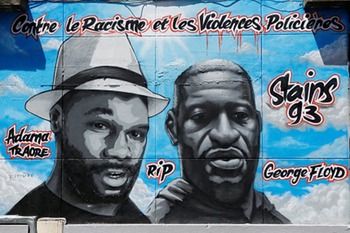
Throughout Beaman’s ethnographic research, she regularly encountered people at demonstrations invoking, through protest signs and chants, Black Lives Matter and other movements for Black liberation such as the Civil Rights Movement. Moreover, activists mention victims of police violence in the United States, including Michael Brown in 2014, Freddie Gray in 2015, and Sandra Bland in 2015 (this was also present in the June 2, 2020, demonstration). Floyd’s death only heightened these references, as evident in figure 1 from a mural in the département of Seine-Saint-Denis in summer of 2020.
Mural of Adama Traoré and George Floyd in Seine-Saint-Denis, France
Source: “Fresco honouring George Floyd and Adama Traoré” (2020).

Unsurprisingly, the U.S./France contrast frame has been employed against Assa Traoré, Adama’s sister and a Black French activist, who has been at the forefront of movements against police violence in France. She has received increased national and international attention, and relatedly been accused of being overly influenced by U.S. ideas of race, racism, and anti-racism. According to this accusation, she sees the French police as racist and the death of her brother as due to him being Black only because she is influenced by Black Lives Matter activists in the United States who frame the U.S. police and police violence as racist.
After Traoré’s death in July 2016, and the protests that immediately followed, the New York Times’ editorial board published an op-ed with the headline, “Black Lives Matter in France, Too,”Footnote 25 arguing that despite the different histories of the United States and France, racism and police brutality against Black and North African-origin individuals are also a problem and therefore it should not be surprising that Black Lives Matter resonates in France.
Yet we argue that this resonance actually reflects how anti-racism and struggles for Black liberation remain global struggles. Assa and other anti-racist activists are not blindly consuming and applying anti-racist discourse from the United States to France. Rather, they are agentically bringing their mobilization in conversation with anti-racist mobilization outside of France, including but not limited to the United States. And they are doing so not only in a context that both historically and presently denies the existence of systemic racism, but also in a context that, due to notions of French universalism and Republicanism, denies the existence of “Black lives.” Indeed, how could Black lives need to matter or be articulated to matter when the only lives that do matter, or even exist, are “French lives”? In this way, we can see the contrasts between Black Lives Matter in the United States with analogous movements in France, in terms of how they are able to name systemic racism and mobilize against it.
When Beaman first met Assa in 2017 through the course of her ongoing ethnographic research, Assa initially expressed skepticism about Black Lives Matter and its effectiveness, primarily because of the differences in identity politics between the two societies, despite their similarities in police violence. Another activist she met with, Mamadou, who collaborates with Assa, mentioned to Beaman how every time he sees videos of Black Lives Matter protests in U.S. cities on social media or elsewhere, there are primarily Black Americans who are demonstrating; these are not multiracial coalitions of activists. “How does BLM connect to non-Black Americans, to all Americans?”, he wondered aloud. Moreover, at the June 2020 demonstration, as well as at other protests, Assa has argued that everyone in France needs to be concerned about violence and repression by the police and included in the fight against it, not just the ethnoracial minorities directly impacted by this violence. The conclusion here is that anti-racist activists like Assa and Mamadou are strategic in their reading of Black Lives Matter—they find it resonant and relevant to their struggles, but also critique it. For example, in Beaman’s conversations with Assa and Mamadou, they questioned how effective BLM can be as a broader social movement if only Black Americans are involved in the movement, and what it means to separate out Black Americans from other Americans and Black French from other French individuals.
Based on these observations, we argue that anti-racist activists are critiquing French police and the French state more broadly as racist, yet are not arguing for a different model of societal membership or identity politics. They are calling France out for denying systemic racism through the language of difference-blindness, but they still believe that the anti-racist movement in France ought to reflect the ethnoracial diversity of the nation. So the causes of the activism and mobilization are similar, even if the specific goals are different. Activists use struggles for Black liberation outside of France, including Black Lives Matter, as a referent, but Assa and others are also attentive to a) the particularities of racism, and denial of racism, in the French context; b) France’s specific colonial histories that inform the experiences of “visible minorities” today; and c) an aspirational vision of French citizenship in which equality and fraternity demand collective action against all forms of injustice. So they are not mimicking Black Lives Matter in the United States, but rather deploying this contrast and connection to further their own mobilization. This is an agentic response to the U.S./France contrast frame’s minimization of accusations of state racism. We argue that understanding such nuances are important as it challenges a simplistic binary regarding the relevance of BLM outside of the United States.
As Assa, in particular, has received more and more international attention (especially since Floyd’s murder and ensuing protests), the national attention she has received has only intensified—as have the accusations that she is unduly influenced by BLM and academia in the United States.Footnote 26 In some ways, this opposition makes these anti-racist struggles stronger, as more people outside of France are bringing attention to what is happening within France, including the rhetorical gymnastics involved in denying the relevance of race and racism. For example, in one 2020 article in Le Figaro, Assa was labeled “new Angela Davis” with her Afro and raised fist, swept up in African American activism and imitating the Civil Rights movement of the 1960s in avenging the death of her brother.Footnote 27 And in June 2020, she was honored with the BET International Global Good Award, and stated that “this award is an acknowledgment of four years of struggle. They won’t erase my little brother’s name; this award will make his name resonate even louder. My brother will be associated with the history of BET. Through his name and BET we keep fighting for our Black brothers all over the world.”Footnote 28 Similarly, she was named a Guardian of the Year by TIME Magazine in 2020.Footnote 29 Yet this brought additional charges that she was too allied with the causes and activism of Black Americans.
Assa Traoré is, of course, not the only anti-racist activist in France to be depicted as too “American” as a way of arguing she is too extreme. Fania Noël, a member of the Afrofeminist collective MWASI, was attacked in 2016 when she, along with fellow anti-racist activist Sihame Assbague, organized a “decolonial summer camp” (Zappi Reference Zappi2016). One aspect of the event drew a great deal of attention, and criticism: attendance was limited to “victims of racism.” The notion of an anti-racism activist gathering being off-limits to whites violates the French republican notion of difference-blind universalism, as well as the related concept of mixité (literally “mixed”; this is a French term for diversity that is typically employed when talking about gender-mixed schooling). Critiques about the event reveal a French mainstream concern that addressing racism in anything other than a color-blind fashion counterproductively strengthens the concept of race and makes it harder to eliminate racism. For example, then-Minister of Education, Najat Vallaud-Belkacem, condemned the event as “strengthening a racialized and racist vision of society” (Zappi Reference Zappi2016). And French political scientist Laurent Bouvet had this response: “Under the cover of anti-racism, our country risks seeing ‘Reverse Ku Klux Klans’ emerge where the only criteria that matters will be skin color” (in Zappi Reference Zappi2016). The reference to “Reverse Klux Klans” is of course as reference to the U.S. white supremacist group, the inference being that Noël and Assbague were racist themselves in constructing “non-mixed” events.
The reaction to the attendance policy of the summer camp illustrates the French political mainstream’s resistance to anti-racism and discourse that begin from an acknowledgement of the role of white supremacy in the oppression of people of color. Then-president of the Representative Council of France’s Black Associations [Conseil représentatif des associations noires de France, or CRAN], Louis-Georges Tin, brought this into sharp relief when he roundly dismissed critiques of the summer camp attendance policy: “What hypocrisy! … no one is shocked by another lack of diversity [non-mixité], that which is omnipresent in the milieus of the dominant” (in Zappi Reference Zappi2016). Indeed, it is the omnipresence of the white majority in France that the organizers of the decolonial summer camp were hoping to avoid through their attendance policy. Like the salon hosted by the Nardal sisters, the summer camp was more concerned with creating a space for mutual support and free expression among ethnoracial minorities without concern for the white majority. Such gatherings suggest that some anti-racist actions can and should be done within communities of the racially othered and for their own benefit, without regard for the concerns of the white majority. This also illustrates the variation in ideologies and strategies among anti-racist activists, including in response to the U.S./France contrast frame.
Interestingly, while Bouvet suggests these French activists are paving the way for a U.S. style of racism, his reference to “Reverse Ku Klux Klans” is an echo of the “reverse racism” narrative heard quite frequently among U.S. politicians and pundits who seek to silence anti-racist activists who challenge white supremacy. It is impossible to discuss white supremacy, after all, if the topic of race and racism is dismissed. As we discussed earlier, this rhetorical move in the French context has different connotations—it is often deployed by those on the Left, and it can even be deployed by anti-racists as part of the French Republican conviction that equality is best achieved through universalism. But even when this rhetorical move stems from a supposedly egalitarian impulse, the “reverse racism” critique understands racism as personal bigotry or administrative process or policy failures that are to be weeded out on a case by case basis, and not as an institutional form of oppression that is built into society and the state—that, indeed, helped to create the modern French state and the United States—and that requires fundamental change in the social contract and political power to dismantle.
Thus, a key strategy for challenging racism, the direct address of white supremacy itself, is differently difficult for French anti-racism activists than it is for their U.S. counterparts, given the difference in identity politics and legitimacy of race as a category in the two societies. Amid a context of the avowed denial of race, French anti-racist activists find themselves fighting across the political spectrum for the recognition of systemic racism, and anti-racist activists who are also ethnoracial minorities find themselves additionally criticized (once again, across the political spectrum) if they engage in actions intended for affirmation specifically as people of color in France.
Conclusion
In this article, we have unpacked uses of the U.S./France contrast frame to illustrate how they are deployed against anti-racist activists mobilizing against police violence, and how these activists respond to this frame. Suggestions that French anti-racism activists are merely transposing Black Lives Matter from the U.S. to the French context are overly simplistic and inaccurate as they miss the long-standing history of anti-racist struggles within France and its former colonies. In demonstrating that racism is endemic to French policing and French society, activists have to respond to the U.S./France contrast frame and challenge the idea that they are not mimicking the United States in making such claims. And this context is important, particularly as mobilization against police violence, as well as backlash to that mobilization, intensifies.
One recent example of this backlash is the growing controversy about the use of U.S. frameworks of critical race theory and other “woke” ideas in French academia—again, another contrast reference to the United States.Footnote 30 Last fall in France, two pieces of legislation spoke directly to the desire of French political leaders to limit the growing movement against racism and police violence in France and their supposed “American” influence. The first (which failed) would have limited French academics from conducting research that questioned “values of the Republic,” particularly secularism—an attempt to halt research on Islamophobia in France and engagement with research frameworks like critical race theory.Footnote 31
French activists and scholars engaged in critiques of police violence face additional challenges as well. The emergence in recent years of videos of forceful crowd dispersal and police violence against mostly white demonstrators—such as with Nuit Debout, Gilets Jaunes [Yellow Vests], or COP 21 protesters—has increased French public interest in holding police accountable for the violence they commit during demonstrations. This has led to a legislative backlash: a recent security bill included a provision that would have made it illegal to “maliciously” share images of police, making it that much more difficult for activists and reporters to gather evidence on police violence (Loi « sécurité globale » : le Conseil 2021).Footnote 32 Although that conversation is not directly about the fight against systemic racism, French anti-racism activists must contend with this broader legislative resistance to holding police to account for the violence they commit.
The murder of George Floyd in May 2020 drew global attention to anti-racist struggle. Beyond fighting police violence, one aim of the Black Lives Matter movement is to affirm the full humanity of Black individuals. In their mobilization, anti-racist activists challenge France to not acknowledge systemic racism and police violence as U.S. phenomena, but also a French one. But questions remain as to the extent to which France can acknowledge its own racism, discrimination, and excessive policing, outside of a reference to other societies—and whether or not Black lives can matter to France in and of themselves.
Acknowledgements
Beaman and Fredette thank their reviewers for thorough suggestions and comments. Beaman thanks her research participants for their generosity and time.