Introduction
Epistaxis accounts for 1 in every 200 patients seen by emergency departments and approximately 6 per cent require admission for further treatment.Reference Pallin, Chng, McKay, Emond, Pelletier and Camargo1 A significantly higher rate of admission for epistaxis among Caucasians, compared with Asians, has previously been demonstrated,Reference Daniel, Jaberoo, Stead, Reddy and Moir2 with one possible explanation being higher prevalence of blood group O among Caucasians (Caucasians 46 per cent versus Asians 31 per cent).Reference Mourant3 There is evidence suggesting that blood group O confers a relative bleeding tendency due to a lower expression of von Willebrand factor, though the clinical significance of this is unclear.Reference Favaloro, Soltani, McDonald, Grezchnik, Easton and Favaloro4, Reference Gill, Endres-Brooks, Bauer, Marks and Montgomery5 The aim of this study was to identify whether blood group O is associated with a higher incidence of admission for epistaxis.
Materials and methods
A retrospective study was conducted using Hospital Information Support Systems to identify all Caucasian patients admitted with epistaxis between 1 January 2000 and 31 December 2005. Patients admitted on more than one occasion were counted once only. The decision to admit patients was made by the attending ENT junior doctor, with patients admitted due to active bleeding, nasal packing, lack of social support or transport or presence of significant risk factors such as anticoagulant use.
The blood group of patients fulfilling inclusion criteria was ascertained from the hospital blood bank database. Patients were split into two groups; blood group O and others (groups A, AB, B). The control group consisted of 500 consecutive Caucasian patients undergoing primary total hip arthropasty and 500 consecutive Caucasian patients who gave birth in the delivery suites of our hospital trust. These patients were chosen to comprise the control group because they are generally healthy individuals whose blood group is known. This is done routinely for these patients so that cross-matched blood can be readily obtained for total hip anthroplasty patients who require transfusion post-operatively, and in the case of pregnant women the rhesus status is established so that appropriate treatment can be provided to prevent haemolytic disease of the newborn. There is no sex bias with blood groups. Data analysis was by chi-square test using SPSS 13, SPSS Inc., Chicago, USA.
Results and analysis
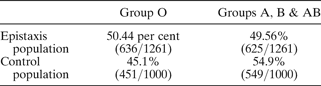
The total number of Caucasian patients admitted with epistaxis during the study period was 1979, but 375 were repeat admissions, thus leaving 1604 patients. Blood group information was available in 1261 of those (79 per cent). The median age of patients was 72.33 years (range 4 months to 97 years). The group consisted of 666 males (52.82 per cent) and 595 females (47.18 per cent). The distribution of blood groups in the study population and controls is shown in Table I.
Distribution of blood groups in epistaxis and control populations

The hip replacement and delivery suite controls had similar blood group distribution to each other (blood group O was found in 45.8 per cent of hip replacement patients (229 patients) and in 44.4 per cent of delivery suite patients (222 patients) (chi-squared p = 0.656). The controls' blood group distribution was also similar to the United Kingdom-wide Caucasian population data collected by the National Blood Service (blood group O 46 per cent).
The higher prevalence of blood group O among those patients admitted with epistaxis, compared with controls, was statistically significant when compared using the chi-square test (p = 0.008).
Discussion
Among Caucasian patients requiring admission for epistaxis at our unit the proportion with blood group O was significantly higher when compared to a control Caucasian population (50.44 per cent versus 45.10 per cent).
• Blood group O confers a relative bleeding tendency due to a lower expression of von Willebrand factor (factor IX)
• This study demonstrates a higher prevalence of blood group O in patients admitted with epistaxis compared with controls
• This suggests blood group O may be a risk factor in the development and/or persistence of epistaxis
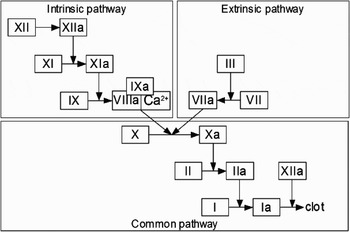
Blood group O is associated with a lower expression of von Willebrand factor (also known as factor IX) compared with non O blood groups.Reference Miller, Haff, Platt, Rawlins, Drews and Dilley6 Individuals with blood type O are more likely to be diagnosed as having a mild form of von Willebrand disease.Reference Favaloro, Soltani, McDonald, Grezchnik, Easton and Favaloro4, Reference Gill, Endres-Brooks, Bauer, Marks and Montgomery5 The role of von Willebrand factor in the clotting cascade includes complex formation with factor VIII and calcium in the final stage of the intrinsic pathway which activates factor X of the common pathway (Figure 1). A longer bleeding time has been demonstrated in patients with blood group O compared with non O groups.Reference Caekebeke-Peerlinck, Koster and Briet7 The risk of deep vein thrombosis is increased in individuals of non O blood groups who have a higher von Willebrand factor concentration compared with individuals of blood group O.Reference Koster, Blann, Briet, Vandenbroucke and Rosendaal8 This suggests that blood group O confers a relative bleeding tendency and may be protective against thrombosis.Reference Favaloro, Soltani, McDonald, Grezchnik, Easton and Favaloro4 However, a previous study of elective abdominal and urological surgery demonstrated no significance of blood group O on bleeding tendency intra-operatively, although the study relied on subjective measures of ‘bleeding tendency’ by the operating surgeon at the end of the operation.Reference Halonen, Linko, Wirtavuori, Hastbacka and Ikkala9
The clotting cascade (clotting factors indicated).

This study describes a large cohort involving 1261 epistaxis patients and 1000 controls. Caucasian patients only were analysed to exclude ethnicity as a possible confounding factor, but other factors associated with epistaxis such as trauma, prior alcohol consumption, bleeding diathesis, anticoagulation and antiplatelet medications have not been addressed. Data were collected retrospectively and therefore only patients admitted with epistaxis (rather than having epistaxis in the community) were included. Additionally, the blood types could not be identified in 17 per cent. For a true representation of the distribution of blood groups among individuals affected by epistaxis, a prospective community study would be required involving blood typing on all people and an assessment of whether they have epistaxis. Data presented here are therefore applicable only to those that were admitted and had their blood group determined (i.e. a more severe group).
Conclusion
Blood group O is over-represented among Caucasian patients admitted with epistaxis compared with controls. Although a causal relationship cannot be confirmed by this study, the findings suggest that blood group O may be a risk factor in the development and/or persistence of epistaxis, though this warrants further research.
Acknowledgements
The authors wish to thank the National Blood Service for providing national blood group distribution data, Mr A. Patel (Information Analyst, University Hospitals Leicester) and Ms C. Smith (Blood Transfusion Data Officer, University Hospitals Leicester).