Face-to-face diplomacy has long been the lynchpin of international politics. Leaders and diplomats throughout the modern period have described the virtues of personally sitting down with partners and adversaries, both in peace and in conflict, in order to better understand each other.Footnote 1 Yet scholars of international relations (IR) have largely been pessimistic about such activities. As Sanders suggests, “personal diplomacy, whether practiced by Franklin D. Roosevelt with the cool disdain of a Hudson River patroon or Henry Kissinger with his accent ‘mit schlag,’ has largely led to disaster.”Footnote 2 This pessimism is based in the belief that personal diplomacy is cheap talk, or irrelevant. Costless communication that is expected to reveal preferences often fails to do so, because diplomats and leaders have incentives to deceive during crisis bargaining.Footnote 3
Eschewing diplomacy as irrelevant puts scholars in the uncomfortable position of having to argue that a prevalent variable of political practice does not matter when leaders tell us that it often matters a great deal. This creates an important puzzle. Does face-to-face contact actually improve the prospects for understanding intentions, as many leaders believe and, if so, what is it specifically that sometimes results in mutual understanding and in other cases creates misperception? Or is this simply a case of decision makers displaying naiveté or overconfidence in their ability to persuade and read others? Further still, could the positive cases of personal diplomacy be explained by incentives by leaders to overemphasize their influence for posterity?
Face-to-face interaction is a unique signaling mechanism in international politics. The mechanism is the physical simulation of the intentions of others. This simulation occurs through a discrete set of neurons, aptly titled mirror neurons, whose function is to replicate what occurs in the brain of another person during a social interaction. In a face-to-face interaction the brains of individuals are actively simulating what is going on in each partner's head. The ability to mirror brain activity creates what some have termed a shared circuit or “brain-to-brain coupling,” connection between people.Footnote 4 The shared connection serves a number of purposes. First, mirror neurons are heavily implicated in empathy, the ability to understand what it is like to be someone else and feel what they are feeling. Neuroscientists and philosophers of science have argued that these neurons provide the physical apparatus required for intersubjectivity and are involved in a key component of it, specific intention understanding. The shared neural connection, while not fail proof, allows individuals to better understand what the other intends to do, how they intend to act, and whether they are being truthful with respect to their intentions under certain conditions.
The innate ability to mirror or simulate another person's intentions helps to explain why diplomats and leaders put so much faith in the productivity of face-to-face meetings and also how face-to-face interaction leads to accurate intention understanding under some conditions and not others. The shared circuit predicts that face-to-face interaction will be most useful with respect to intention understanding when salient questions involve the specific intentions of others. There is evidence to suggest that the circuit is implicated in successful deception detection as well. This hypothesis is a significant departure from rational or economic models of bargaining that predict little or no value from face-to-face personal connections with respect to substantive information exchange. The finding therefore not only challenges rationalist accounts of diplomacy but informs the long-standing problem of intentions and uncertainty in IR theory. Finally, because the information exchange occurs at the neural level, face-to-face interaction allows diplomats to transmit credible information to each other even when they have strong incentives not to. It is not just that diplomats believe that face-to-face interactions are important; they are important because of the information that is shared about the other.
The discovery of mirror neurons suggests a new physical baseline for our thinking about diplomacy. It generates hypotheses about face-to-face interaction that are different from rationalist or economic models. Although it is difficult to assess directly and systematically what work the mirror neurons are doing in real-world diplomacy, we can nevertheless test the new physical baseline indirectly by testing the hypotheses it generates in real-world diplomatic interactions. Therefore I propose a new theory of intention understanding that relies on evidence from the neural level to generate specific hypotheses that are testable at the diplomacy level, not to provide a systematic test of the physical baseline itself. I will interweave neuroscientific evidence with diplomatic history illustrations, specifically the Concert of Europe, German reunification at the end of the Cold War, and Neville Chamberlain's interactions with Adolf Hitler before World War II. In each case face-to-face interactions aided in reading specific intentions.
The Problem of Intentions and Diplomacy in IR Theory
The problem of intentions is central to IR theory. Realists and rationalists argue that states are necessarily uncertain about each other's intentions because they exist not in tanks or airplanes, but in the minds of leaders. It is therefore always difficult to credibly communicate those intentions that reside in the mind, but particularly so in an international system characterized by anarchy. Scholars have looked at the cost of sending signals about intentions as a potential solution. While noncostly signals, such as private talking, can easily be issued, they may lack credibility. Costly signals, those that make significant gestures to show trustworthiness, on the other hand may carry credibility because they may induce a state to be honest about its intentions. Fearon identifies audience costs as an important part of a costly signal. He proposes that leaders can expect to be punished politically if they back down in front of a domestic audience that cares about foreign policy.Footnote 5 According to this theory, a state leader can credibly communicate intentions by going public, establishing a hands-tying mechanism that creates audience costs.Footnote 6 The empirical record of audience costs serving as credible signal, however, is more problematic, with recent studies suggesting that audience costs might not actually matter or, at the very least, are somewhat ethereal in nature.Footnote 7
Liberal institutionalists, constructivists, and social theorists are more optimistic than realists about the ability to successfully approximate intentions. For institutionalists the problem of uncertainty is essentially ignorance, a nonpejorative lack of information about other states.Footnote 8 Institutions can, under certain conditions, provide clues or inferences to state intentions through information-sharing mechanisms. Constructivists take a similar social-learning approach and suggest that states can approximate the intentions of others through identity construction and reflected appraisals. States can overcome their anxiety of being cheated through common identity formation and by reflecting on the interactions they have with others, which can lead to common expectations regarding future behaviors. As Wendt notes, states can learn to view each other as friends or enemies based on how significant others treat them.Footnote 9
Social psychology and cognitivist approaches address the problem of imputing intentions by looking at the social identities, heuristics, and images individuals rely on to make sense of the world and approximations of others. The difficulty, as cognitivists point out, is that information processing and provisioning is fraught with complexity—cognitive biases make it difficult to accurately read the intentions of others. This does not suggest that individuals cannot overcome these biases under certain conditions, though they face significant constraints in doing so with respect to accurately processing intention information.Footnote 10
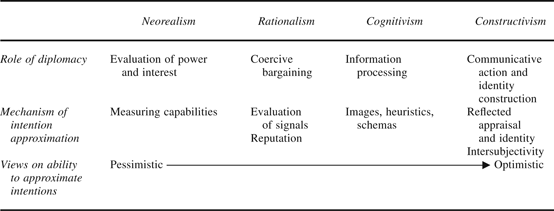
Each of these perspectives shares a mechanism of intention approximation. Whether through interpretation of signals, balance of power, capabilities, regime type, iterative interaction in an institutional setting, or reflected appraisals, actors approximate intentions by theorizing about them given available data. Capabilities, behaviors, and words serve as the basis for attempted intention understanding: not able to see directly into the minds of diplomats, scholars fall back on theorizing about the meaning of material and actions. As the table on the next page illustrates, each IR theory utilizes a different principle in theorizing about intentions, but in each case the core mechanism of approximation through reflection is the same.
Perspectives on diplomacy and intention understanding in IR theory

In short, the fundamental problem of intentions in IR lies in the inability to get inside others' heads to read their mental states. As Wendt notes, “It is hard to read individual minds because we cannot see inside them. Lacking telepathic powers, we have to fall back on context and behavior to infer what others are thinking.”Footnote 11 Mearsheimer agrees, noting “intentions … are ultimately in the minds of policymakers, making them impossible to observe and measure.”Footnote 12 The counterfactual seems clear: if we had direct access to other minds then the intentions problem would be severely undercut, if not solved. We would not need to rely on theorizing intentions—we would simply experience the intentions of others. In the context of face-to-face diplomacy there are conditions under which diplomats do exactly that: they gain experiential belief about the intentions of others, a type of knowledge not based on theorizing but direct simulation of what the other is thinking.
The Neural Basis of Experiential Intention Understanding
Understanding Intentions: Third-Person Observation
Research in biology aimed at understanding social phenomena has received widespread attention in many social sciences, particularly economics. Social neuroscience (SN), a field that emerged in the early 1990s, focuses on how biological systems both implement social processes and how social processes affect biological systems. Put simply, SN uses multilevel analysis to determine how neurons affect behavior and vice versa. The goal is not to reduce social behavior to neurons, but rather to understand how neurons and the social environment interact.Footnote 13 Increasingly, advanced technologies, such as functional magnetic resonance imaging (fMRI), have been used to advance social science knowledge by creating precise three-dimensional pictures of functional processes in the brain. We are now gaining the ability to assess many of the assumptions about how individuals see the world, how they interact with others, and how they process information. This new knowledge has driven both theory construction and empirical testing in economics and, increasingly, political science.
SN has revolutionized our understanding of how we read and understand others' intentions. Two perspectives have traditionally dominated this literature on “other minds.” The first, termed “theory-theory” (TT) posits that we rely on innate theories of mental states that we have derived throughout life.Footnote 14 A simple example illustrates this perspective. A person witnessing someone sitting in a restaurant crying, holding their face in their hands, may well infer from their life experience that the crying individual is sad. TT suggests that we are applying a folk-psychological theory of how others think and behave to the situation. The mechanisms of intention understanding at work in this example are third-person perspectives of reasoning, observation, and intuition.
If the TT mode of approximating the intentions and behaviors of other actors seems natural and intuitive, it is likely because positivist social science in general and much of IR scholarship in particular implicitly support this view and operate along these lines. As behaviorism declined in the 1950s and 1960s, cognitive scientists looked inward rather than outward for explanations of mental states. Cognitivists argued that individuals possessed inner representations of the world and that the word theory described what these representations constituted and how they operated. If we knew how such representations and symbols were created, we could understand and deduce them through lawlike or probabilistic rules and algorithms. The differing views of behaviorists and cognitivists become clear in the following basic situation: a person leaves the house carrying an umbrella. A behaviorist might suggest “X believes that it is raining, if X takes an umbrella when X goes out.” This logic works only if the rain believer does not like getting wet. A person might not take an umbrella, yet still believe that it is raining. Behavior does not necessarily reflect a person's underlying mental state. Cognitivists attack this problem by suggesting it is not solely behavior that matters, but that inner beliefs and desires explain mental states. There is no straight line from behavior to mental state. We invoke a theory of desire plus belief, in conjunction with behavior, to understand mental states. Therefore, from a TT perspective one might possess a folk theory about individuals who enjoy walking in the rain and those who do not, a theory constantly updated by experience.
Based on this TT/folk psychology perspective, the self and the other are distinct and separate entities. Each side in an interaction responds to presentations of the other's signals, identity, and so forth, and deduces an explanation of behavior through a theoretical or (nonpejorative) folk-psychology perspective.Footnote 15 The incoming data is then subconsciously checked against the database of experiences that the individual has amassed over time.
The TT perspective has also been identified as crucial to self-projection and implicated in “resemblance-to-self” bias.Footnote 16 If we deduce the mental states of others by consulting our personal database of knowledge and experience, then how that database was created becomes critically important. If the database is constructed with experiences from particular in-groups, for example, then we might expect a bias in understanding out-group members.
Finally, as other scholars have pointed out, many theories, particularly in foreign policy analysis, be they realist, liberal, or constructivist perspectives, invoke either implicitly or explicitly these cognitivist perspectives.Footnote 17 These existing approaches to the problem of intentions in IR have utilized this TT folk-psychology perspective of approximating intentions.
An Alternative Explanation: First-Person Experience
The second approach, called “simulation theory” (ST), proposes that we come to understand the mental states of others not through theorization but rather through simulation. ST stems from skepticism about TT's claim that individuals possess a database complete with vast theories of social behavior. Rather, ST proponents suggest that understanding the mental states of others involves activating mental processes that, if actually carried out, would produce similar behaviors. This simulation, for many neuroscientists, is the basis for empathy, the ability for individuals to know what it feels like to be in another's position.Footnote 18 The ST insight is that we often do not need to theorize about what someone else is experiencing—we simply know. Participants in a laboratory experiment who watch a video of a spider crawling on the back of another human being often report that they get the chills watching the video. The participants do not need to theorize or think about what the experience feels like—they know, because they are simulating, or mirroring, in their own minds, in real time, what the experience is. As de Vignemont and Singer argue, this simulation and empathy is crucial from an evolutionary perspective for quick communication and decision making. “Empathy might enable us to make faster and more accurate predictions of other people's needs and actions and discover salient aspects of our environment.”Footnote 19 Thus, there are certain conditions of daily life that require quickly gaining a “read” of particular mental states.Footnote 20
As with TT, the ST perspective may involve self-projection, but in a different manner than TT. Simulation and empathy are affected by group dynamics as well. Participants in empathy studies show less simulation for members of different races, thus supporting the existence of a so-called “empathy gap” that privileges understanding of simulation of like-others.Footnote 21 These findings produce important scope conditions for empathy. Crucially, however, ST is universal or polycentric in a number of respects. Neuroscientists and philosophers of the mind have suggested that the simulation circuit created between individuals is a universal phenomenon, with most individuals possessing the architecture required for simulating the mental states of even dissimilar others. As Goldman argues, unlike with TT, there is a lack of evidence that self-projection is required for ST to work.Footnote 22 The debate regarding self-projection is less important in the context of this article than the empirical question of whether and when self-projection is more likely to occur and cloud successful intention reading.
Finally, there is significant debate among philosophers of science and mind regarding the epistemic status of the simulation experience. Goldman argues that a distinctive feature of ST is the self-knowledge that is created. The problem with this terminology, as Goldman notes, is that “knowledge is a thick epistemological concept, connoting more than just attribution or belief.”Footnote 23 Philosophers tend to view knowledge “as something like justified true belief, or reliably formed true belief.”Footnote 24 Since it would be difficult to objectively justify the beliefs that result from simulation without first checking up on their accuracy empirically, Goldman suggests we should be epistemologically neutral with regard to the knowledge question and focus instead on how the strong beliefs are created in the first place.
Others suggest that there is justification for ascribing the simulation experience a privileged status, if not reliably formed true belief, because of the doctrine of privileged access. This doctrine suggests that there is a fundamental difference between experiencing something for oneself, in one's own mind, and relying on something that comes from the outside, such as a third-person report. Further, because the ability to detect intentions plays a key evolutionary role, scholars have suggested that we have a very refined simulation ability that produces reliable results.Footnote 25 From this perspective it may be epistemologically justifiable to refer to reliable belief as knowledge with certain boundary conditions, such as delusion or self-deception.
For the purposes of developing a new theory of intentions, the question of whether beliefs about intentions are accurate is more important than what those beliefs are called. Without further engaging in the epistemological question I will refer to simulation-based belief as “strong belief” that inspires confidence by virtue of the privileged access doctrine. Whether the beliefs are accurate depends on a number of conditions, such as successful deception, that can be studied empirically.
To emphasize the critical point: there are multiple views on how one comes to understand the mental states of others. One perspective, TT, is a detached third-person activity while ST is a first-person attempt to replicate or mirror the mental states of the other. In ST, there is a “correspondence between the mental activity of the simulator and target” that does not exist in TT.Footnote 26 Crucially, the complexity of human intention understanding may not involve only one type of process but rather each under different conditions. Current IR theory was developed on the assumption that intentions need to be approximated and theorized (a TT process). If, however, intentions can be simulated and understood from a first-person experience under certain conditions (an ST process), then this implies very different predictions about individuals' ability to strongly believe intentions.
Using Neuroscience to Understand the Intentions Problem
The Discovery of Mirror Neurons as Intention Simulators
Recently, Italian neuroscience researchers were amazed at a discovery involving monkeys. A distinctive class of neurons fires when a monkey executes a motor act and also when it observes another monkey, or a human researcher, performing the same motor act.Footnote 27 If a monkey saw someone else eating an ice cream cone, neurons would fire in the monkey's brain as if the monkey itself was eating an ice cream cone. These neurons do not discharge when a simple presentation of an ice cream cone or banana is made. Nor do they fire when the monkey observes hand actions without a target. Rather, the neurons fire only when someone's hand is intentionally interacting with an object. These neurons have thus been termed “mirror neurons” because of the functional role they play in the brain: they actively replicate, or mirror, the intentional actions of others. Subsequent research has demonstrated that humans possess these mirror neurons as well and has suggested that the neurons form the physical basis for understanding intentions.Footnote 28
Neuroscientists have identified the “what” and the “why” as two distinct elements that characterize each intentional action and are processed by mirror neurons. The “what” refers to a simple observation of the action. Actor A grabs a basketball. The “why” represents an inference of intention. Actor A grabs a basketball because A intends to shoot it at the basketball hoop. SN researchers hypothesized that mirror neurons serve as the link between the action “what” and the inference “why.” That is, the mirror neurons help us to understand/infer the intentions of the actor by observing the action. Recent fMRI experiments have supported this hypothesis of “action what” to “action why” mapping. One experiment, for instance, presented subjects with two conditions. The first involved viewing hand actions without a particular information context. The second involved viewing hand actions executed in a context that would allow the subject to infer the intention, or the why of the action. The result was striking: actions embedded in a context produced activation of the mirror neuron system (MNS), whereas those actions without context did not.Footnote 29
Critics of using this type of experimental approach to draw conclusions about understanding intentions suggest that the context affects the outcome more than the neurons do. This criticism is derived from a sociological view: the structure, or context of the situation, provides the clues to intentions, not the neurons.Footnote 30 That is, we can understand intentions if the context is thick enough. To be convinced that the mirror neurons are doing the work, we need evidence of specific mechanisms underlying the understanding of intentions and not just context. A second experiment addresses these concerns and attempts to illustrate these mechanisms of intention understanding separate from context alone.Footnote 31 Monkeys were trained to perform two actions with different goals. The first monkey was trained to grasp an object in order to place it into a container. The second was trained to grasp an object in order to eat it. The initial act, grasping the object, was identical in both cases, but the final goal of the two actions, which shows intention, was different. The results of the experiment showed that while a few neurons fire when the first act (grasping) is executed, most fire only when the subsequent act takes place (placing or eating). In other words, the context is not providing information about the intention, but the intention is nevertheless understood.
Face-to-Face Intention Simulation Mechanisms
Additional studies with humans have looked at the mirror neurons firing explicitly during face-to-face interaction. As Schulte-Rüther and colleagues have shown in a study of mirror neuron activation in face-to-face interaction, the process of recognizing the other's affective and cognitive states strongly invokes the MNS and, as they hypothesize, this system allows for understanding of interpersonal cognition.Footnote 32 They point out that the constant firing of mirror neurons engenders mutual understanding as individuals attempt to understand the other person's overt and inferred meanings.Footnote 33 This finding suggests a significant difference between face-to-face and other communication modalities: during face-to-face interaction we move from private to shared experiences.Footnote 34 “During conversation, the participants focus or orient toward the other person's mind, inferring meanings and relevancies rather than just decoding the verbal messages. The interaction involves, as probably the most important part, the recognition of the other person's affective and cognitive states.”Footnote 35
Critically for the purposes of understanding political intentions, a number of scholars have found evidence to suggest that mirror neurons and simulation are activated not only with simple low-level instrumental action understanding, but through higher-level abstract thinking as well.Footnote 36 Indeed, Keysers and Gazzola recently theorized that abstract thinking may be derived from the same simulation and mirroring processes involved with perception of action, making abstract thinking a form of an inner motor action.Footnote 37 As Schulte-Rüther and colleagues note, “activation of mirror neurons in a task relying on empathic abilities without explicit task-related motor components supports the view that mirror neurons are not only involved in motor cognition but also in emotional interpersonal cognition. An interplay between [theory of mind] and mirror neuron mechanisms may hold for the maintenance of a self–other distinction during empathic interpersonal face-to-face interactions.”Footnote 38 Indeed brain imaging studies of children with autism often show damaged MNS. “Unlike typically developing individuals, children with [autism] tend not to imitate other individuals in a mirror fashion when viewing them face-to-face. This imitation peculiarity is probably attributable to a deficit in the ability of the mirror mechanism to superimpose another person's movements on one's own.”Footnote 39 These studies have led scholars to view mirror neurons as the apparatus responsible for interpersonal understanding of specific intentional mental states that are engendered from a first person, inside-out perspective.
Simulating Specific Intentions in Diplomacy
The finding that individuals simulate the specific intentions of others in face-to-face contexts helps to shed light on the variety of outcomes of intention understanding in diplomatic history, from the Concert of Europe to the end of the Cold War. I apply simulation theory to three cases, each illustrating a different type of intention understanding in high-level diplomacy. First, I analyze how face-to-face interaction aided diplomats in communicating and clarifying intentions during the Belgian independence crisis (Concert of Europe), an example of sincere intentions communicated. I next discuss shielded intentions during negotiations over German reunification at the end of the Cold War. Finally, I assess the role of mirror neurons in deception detection. Using the infamous Chamberlain/Hitler encounter outside Munich in 1938 as a test case, I explore individuals' ability to pick up clues regarding deceptive intentions. In each case my theory is supported by evidence that diplomats not only believe that face-to-face diplomacy matters, but that such meetings make a material difference in intention understanding as well.
In fact, IR scholars already often implicitly accept the notion that face-to-face diplomacy leads to better intention understanding, though the reasons why and under what conditions it fails are not tested. The Concert of Europe continues to be debated and many scholars argue that it serves as an example par excellence of diplomacy that led to greater intention understanding and lasting peace.Footnote 40 Schroeder suggests that it represented nothing less than a “revolution” of diplomacy and international relations.Footnote 41 While the mechanism of peace is often disputed, be it in publicity effects,Footnote 42 information sharing,Footnote 43 or otherwise, the salient role of face-to-face diplomacy in the forum setting, as it relates to intention understanding, is implied. Lindley notes of the Concert, “if diplomats suspect misinformation, would they rather not be in a forum setting where they could meet their counterparts face-to-face and quickly cross-check information with allies?”Footnote 44 The implication is that face-to-face interaction provides an intention verification that other types of interaction do not. Indeed, the large number of interactions between diplomats through a variety of interaction types, such as letters and personal meetings, provides an opportunity to compare how intentions were understood through each modality.
The importance of face-to-face communication was not lost on the major players in the Concert. British foreign secretary Lord Castlereagh believed that constant personal communication, or “the habits of confidential intercourse which a long residence with the principal actors has established,”Footnote 45 was integral to the success of the system. In instructing British representatives, Castlereagh wrote:
It is impossible to have resided at allied headquarters even for the short period I have myself passed at them without perceiving how much the interests of the Confederacy are exposed to prejudice and disunion from the want of some central council of deliberation, where the authorized Ministers of the respective Powers may discuss face to face the measures in progress, and prepare a result for the consideration of their respective sovereigns[,] You must all be aware how deep was the distrust and alarm which existed some days ago as to supposed divergences of opinion, which it was feared were irreconcilable in themselves, and how soon these differences disappeared when the allied Ministers were ordered officially to enter upon their discussion. To such a degree did this happen, that every individual question which they were called upon to deliberate has been decided, not only unanimously, but with cordial concurrence.Footnote 46
Lord Castlereagh draws a clear contrast between the alarm and distrust that existed prior to the face-to-face meetings of the allied ministers and the “cordial concurrence” that resulted from them. Crucially, sharing a common interest was not enough to engender peace and prevent the misunderstanding of intentions. The diplomats themselves understood that only regular face-to-face meetings could reduce uncertainty in negotiations.
For demonstrating that face-to-face interaction actually helped to clarify intentions, it is useful to compare what each side believed before and after the encounters. The crisis severely tested the European powers' ability to communicate and clarify intentions. There were strong reasons to believe that a major European war would follow.Footnote 47 A turning point occurred in October 1832, when Britain and France joined forces to provide pressure against the Dutch.Footnote 48 The French and British could make this move successfully only if they had calculated the dangers of war accurately, which would have been possible only if Belgian and Prussian intentions were correctly understood. Lindley concurs, “To calculate the danger of war correctly, the French and British had to know of Belgium's impending threat to attack Holland and of Prussian intentions to support the Dutch in case the French intervention crossed into Dutch territory.”Footnote 49 The memoirs of French envoy to the London Conference, Prince Talleyrand, and letters between him and Victor Duc de Broglie, the French Foreign Ministry official, make clear that the French and British exchanged information about their intentions in London and Paris and that the Prussians had made their intentions clear as well.Footnote 50 Bilateral diplomacy in Paris and conference diplomacy in London reduced the significant uncertainty that typically makes strategic planning difficult. Knowledge about intentions gained as a result of personal encounters was critical according to the diplomats themselves who considered face-to-face interaction instrumental for negotiations. The successful reading of Prussian and Belgian intentions averted a European war.
The lack of face-to-face interaction may also provide insight into significant challenges to the Concert, particularly the Crimean War, 1854–56. Mitzen argues that as late as 1853 the great powers faced problems reading Russian intentions regarding protection of the Ottoman Empire and, contrary to much extant scholarship, the decision to engage in wide war was not inevitable.Footnote 51 Mitzen points out that few European decision makers wanted war and unlike in the 1820s when the powers met to agree to a single commitment to guarantee the Ottoman Empire, a similar commitment was not provided in the 1850s. Indeed while each power had an individual intention to not exploit Ottoman weakness, they doubted each other's intentions. Mitzen thus raises a compelling counterfactual: Would war have erupted had the powers followed a similar collective meeting strategy in the 1850s as they did in the 1820s? If face-to-face interaction aided the powers in understanding intentions with respect to the Belgian crisis, as I have argued, the counterfactual regarding lack of face-to-face interactions in a collective setting is worth raising. Therefore, it may be that in the context of the Concert, face-to-face diplomacy helped to clarify intentions while its absence kept intentions clouded.
Mirroring Shielded Intentions
In addition to being able to understand the specific sincere intentions of individuals in a social interaction, individuals often have to be able to read shielded or hidden intentions. The capability to read individuals not just for what they want to share, but what they may not want to share as well—shielding their intentions—serves as a useful, evolutionary adaptation. It is important to distinguish shielded intentions from deception where the intention is being explicitly masked by generating claims about an alternate intention. Mirror neuron research suggests that mirroring enables individuals to make strong inferences about the other's intentions, even when significant aspects of those intentions are hidden. For instance, in one of the most influential mirror neuron studies, the neurons in a monkey fired when the monkey observed an experimenter's hand moving toward a small box to grasp it. They did not fire, however, when the hand made the same motion without the box present as the goal of the intentional act. The researchers then placed an opaque screen in front of the box. The same neurons fired, but the monkey had seen the box there previously.Footnote 52 The finding suggests that MNS is involved not only in discriminating intentions, but also in inferring intentions that are partially shielded or hidden from the participant. They are filling in gaps when information is omitted.
This ability to understand omitted information or shielded intentions, colloquially referred to as “reading between the lines,” helps to explain why face-to-face interaction leads to clarifying intentions, even when information is omitted or shielded. The timing of Germany's reunification illustrates this point. In 1988 European leaders considered it unlikely if not inconceivable that Soviet leadership would accept an end to the Cold War including a unified Germany integrated into the North Atlantic Treaty Organization (NATO).Footnote 53 As late as October of that year, Helmut Kohl, Chancellor of Germany, responded to the likelihood that Soviet leader Mikhail Gorbachev would agree to unify Germany as “in the realm of fantasy.”Footnote 54 Yet less than one year later events in Hungary kicked off a political chain reaction that ultimately resulted in the fall of the Berlin Wall in November 1989. German unification and NATO membership quickly followed in 1990. In very short order what was once considered fantasy had become reality. The U.S. negotiators involved in the reunification talks, including Dennis Ross from the State Department, Condoleezza Rice of the National Security Council, and President George H.W. Bush, credit the face-to-face initiatives they undertook with their Soviet counterparts.Footnote 55 Ross, for instance, notes that these personal meetings fundamentally changed the entire situation, transforming reunification from inconceivable to inevitable:Footnote 56
The president and the secretary of state conducted a highly personal diplomacy that involved an extraordinary number of face-to-face meetings with other leaders. Certainly phone calls were made, especially in the interim between meetings or to brief other leaders on the meetings that had just taken place with their fellow leaders… Though these calls, and meetings at lower levels, were an essential part of the diplomacy, there can be no doubt that the face-to-face meetings at the president's and secretary's level were the heart of the effort.Footnote 57
At the time, the U.S. diplomacy team considered it critical to determine whether the Soviets actually had a sincere intention of agreeing to a unified Germany. If the Soviets were understood to be insincere or deceptive, the U.S. delegation was on the receiving end of cheap talk. U.S. Secretary of State James Baker notes that, “[The Soviets] were saying the right things, but it was important that we match action with words.”Footnote 58 At least privately the Soviets were suggesting they could be pushed, though their public pronouncements were still negative. In order to gauge the Soviets' intentions, Baker sought a series of meetings with his Soviet counterpart, Edward Shevardnadze. Baker had noted that the meetings would determine whether the Soviets could be pushed toward reunification with the negotiations, as they provided “a determination in my own mind that it was time to move forward.”Footnote 59 In other words, Baker himself has attributed his understanding of Soviet intentions regarding German reunification to his face-to-face interactions with the Soviet foreign minister.
The Soviet side assessed the effect of face-to-face interactions similarly. Sergey Akhromeyev, Chief of the General Staff of the Soviet Armed Forces under Gorbachev, was heavily involved in negotiations with the U.S. Joint Chiefs. He stated in an interview that before 1988 he was very skeptical and distrustful of U.S. intentions though this would soon change. Hines summarizes Akhromeyev's position based on the interview: “The first and several subsequent meetings reassured him that the joint chiefs were thoughtful and responsible people. The mutual understanding that came from face-to-face discussions helped to create a fairly stable situation in Europe. The intentions ascribed for many years by each side to the other were incorrect.”Footnote 60 In the interview Akhromeyev attributes intention understanding to the face-to-face encounters he had with American counterparts. Akhromeyev himself acknowledged that he had entered the face-to-face interactions with one understanding of U.S. intentions and concluded them with a different understanding.
His main U.S. counterpart, former chairman of the Joint Chiefs of Staff, Adm. William J. Crowe Jr. echoed similar sentiments, noting that Akhromeyev told him that prior to 1988 he had believed that the United States would attack the Soviet Union, a position that changed only after visiting with his counterparts.Footnote 61 This understanding developed through numerous face-to-face encounters. Crowe writes in his memoir, “Sitting opposite each other with our interpreters, we had the time and privacy for exchanges that eventually gave both of us a better perspective on the U.S.-Soviet relationship and where both sides were coming from as we made our way past the rocks and shoals of the Cold War.”Footnote 62 The substance of the meetings was about intentions. Akhromeyev noted on one flight, “I don't want to do anything on this flight but talk.”Footnote 63 Crowe notes that what he wanted to talk about were Soviet intentions: “[Akhromeyev] had come prepared to convince me that the Soviet military was not the threatening offensive machine we considered it to be.”Footnote 64 For his part Crowe had similar aims, noting that his goal was to convey to Akhromeyev the American psychology, or “deep background against which a more understanding approach to our nations' geopolitical concerns might be achieved.”Footnote 65 Both sides were communicating their intentions to each other in a face-to-face context. Ultimately Crowe believed, as Akhromeyev did, that these encounters allowed both to understand each other and “break through a legacy of fear and misunderstanding.”Footnote 66
Yet, the effectiveness of face-to-face interactions for clarifying intentions can be measured only if it can be shown that these meetings made an actual difference and not just that the negotiators believed that they did. Soviet archives are now open to researchers. Together with the translator reports they help to establish what the Soviets gained from these meetings. For instance, Soviet interpreter Pavel Palazhchenko notes that it was the actual meeting between Gorbachev and Bush in Malta that clarified the leaders' intentions. Palazhchenko quotes Gorbachev as commenting on the Malta discussion, “It is the best proof that President Bush's administration has made a policy decision on its relations with the Soviet Union.”Footnote 67 Palazhchenko suggests that Gorbachev went into the meeting unclear about U.S. intentions and “in a rather critical mood,” believing the U.S. support for perestroika was weak, but that the meeting had changed his impression.Footnote 68 Bush experienced the face-to-face meetings similarly. Zelikow and Rice have reported that Bush understood that Gorbachev was belying his public stance against unification in the private meetings.Footnote 69 Indeed, Akhromeyev later lamented that Gorbachev had not been able to keep his intentions closer to the vest.Footnote 70 As Palazhchenko reports, by December 1989 it was already clear to the Soviet group that “unification was inevitable.”Footnote 71 The remaining questions revolved around how unification would be perceived in the Soviet Union, not whether it could be stopped.Footnote 72 This was a position that Gorbachev tried to shield by keeping it close to his chest, but in the determination of Palazhchenko and Akhromeyev, he was unsuccessful at doing so in the face-to-face interaction.Footnote 73 As the historian Shumaker notes, Malta was about sincerity assessment. “Both Gorbachev and Bush came away convinced of the other's sincerity and trustworthiness.”Footnote 74
Unlike Others, Deception Detection, and Emotional Mirrors
Finally, and critically for purposes of diplomacy, mirror neurons have also been implicated in understanding intentions of so-called unlike others. One potential criticism of the previous illustrations of intention reading is that they all involved leaders who may have shared fundamental worldviews or outlooks. That is, European leaders and U.S. leaders likely share many perspectives and may even consider themselves to be part of similar in-groups. I address this criticism by investigating the extent to which face-to-face interaction engenders simulation of intentions when individuals are very dissimilar.
Because philosophers of the mind have long understood the ethnocentric biases of TT, early research focused on determining to what extent ST processing was similarly ethnocentric. One way neuroscientists explore this is by analyzing the face-to-face simulation functioning of individuals with different life experiences. Capoeira (a Brazilian martial art combining dance and music) dancers and classical ballet dancers will begin to simulate dance movements when viewing dancers from each group, though the level of simulation is higher for members of their own group. That is, capoeira dancers display a higher degree of simulation when viewing capoeira dance moves, while classical ballet dancers demonstrate a higher degree of simulation when viewing classical ballet moves.Footnote 75 Learned experiences, such as training, mediate simulation activities. American subjects viewing Americans and Nicaraguans performing Nicaraguan-specific gestures each demonstrate higher levels of mirroring and simulation than they would if they mirrored across cultures. This finding suggests an in-group or cultural-mediation effect.Footnote 76 While the simulation mechanisms may be universal, there is an important cultural effect as well: dissimilar others also evoke simulation, but to a lesser degree.
In order to understand the scope of simulation with unlike others, neuroscientists went beyond cultural differences and examined responses in individuals with very different physical attributes. Researchers monitored individuals who were born without hands observing individuals make a series of hand actions. If one's experience prevented simulation of a dissimilar other, then neuroscientists would expect to see no simulation of hand movements in the subjects without hands. Instead, researchers found that the subjects without hands simulated the hand actions with their feet.Footnote 77 This suggests that physically very dissimilar others may nevertheless simulate the intentional actions of others.Footnote 78 This finding is crucial to criticisms of self-projection bias because it suggests that individuals are able to simulate the mental states of very dissimilar others, a long-standing problem that TT-based approaches of empathy have had difficulty overcoming.
The discovery of mirror neurons has raised additional questions about the robustness of simulation of intentions. For example, to what extent can individuals differentiate sincere intentions from deceptive intentions? Just as there is an evolutionary reason to need to read others' intentions, there is a similar evolutionary need to differentiate sincerity from deceit. As Putnam has noted in his review of the values of social interaction, “it seems that the ability to spot nonverbal signs of mendacity offered a significant survival advantage during the long course of human evolution.”Footnote 79 Or, as Jay explains, “species who can't tell the difference between what is true and what is not are unlikely to prosper for very long. The ability to detect deception is, after all, just as functional in evolutionary terms as the ability to deceive.”Footnote 80 Clearly, deception-detection capabilities help to ensure the survival of the species. This insight led researchers to ask whether discrete brain architecture exists that has evolved for that particular purpose.
A seminal experiment in face-to-face deception detection conducted by Grèzes has provided important answers. Her findings demonstrate that individuals routinely perform better than chance in the detection of deceptive intentions and that distinct brain architecture is invoked when making judgments about those intentions.Footnote 81 The study asked participants to view other individuals lifting boxes and assess how heavy the boxes appeared to be. By watching how the individuals picked up the boxes, the observers could infer the boxes' weight, because the movements required for heavy boxes differed from light boxes. The researchers then instructed the individuals lifting the boxes to pretend they were lifting a heavy box when it was actually light. The participants who recognized the deception were able to do so because they detected the mental state of the person trying to deceive. The finding allows neuroscientists to begin theorizing about the ways in which the brain processes deceptive intentions.Footnote 82 Ekman and O'Sullivan, whose research specializes in deception detection, identify this type of mirroring as “emotional.” They suggest that human beings detect lies in face-to-face encounters by understanding the emotions on display.Footnote 83
This research is particularly important for refining the conditions under which individuals can simulate sincere intentions and detect deception. Psychologists have long known that, while it is difficult to detect deception, face-to-face interaction makes it easier to do so, because individuals can utilize nonverbal behavior in making judgments about deception.Footnote 84 Economic models of exchange often emphasize face-to-face engagement as a truth-detection device. As Storper and Venables put it, “for complex context-dependent information, the medium is the message. And the most powerful such medium for verifying the intentions of another is direct F2F contact.”Footnote 85 People with the best deception-detection skills rely on nonverbal cues more than verbal ones. In sum, while deception detection is not easy, it is much easier in a face-to-face context than it is in other interaction modalities. The discovery of brain regions associated with that detection helps to define the precise conditions where detection is successful.Footnote 86
Detecting Deception in Diplomacy
Deception has always served as a hard case for diplomacy since incentives to dissemble are believed to be great and detecting deception considered quite difficult. Deception detection in diplomacy often occurs as a result of checking what is said through talk with empirical evidence or other intelligence that exists. Outright lies and deceptive half-truths, while arguably quite rare in diplomacy, are believed to be caught not in conversation but through analysis of objective evidence.Footnote 87 The research findings suggest reasons to believe that personal diplomacy may be a method of detecting lies, or inclinations regarding lies, in an international context.
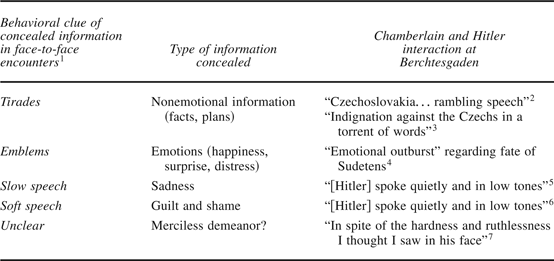
Chamberlain's meeting with Hitler in Berchtesgaden in the 1930s, where Germany's sincere intentions were supposedly communicated, provides a telling example of failure to detect intentions. When Chamberlain returned to London he proclaimed confidently to his cabinet that Hitler could be trusted to do as he said. Hitler's intentions were supposedly clear. As later events demonstrated, Hitler had left Chamberlain with the wrong impression. The episode represents the failure of personal diplomacy par excellence. Yet, a careful reading of the transcript of the meeting and Chamberlain's words both during and after the encounter, suggest a more complicated scenario. First, the conversation with Hitler was characterized by a veritable checklist of emotions and nonverbal cues that deception-detection research, such as that of Ekman, suggests should lead to detection. That is, Hitler was providing clues and Chamberlain noticed them, writing them down in his reflections. Table 2 below identifies Chamberlain's emotional mirroring of Hitler in his diary and letters.
Emotional mirroring and behavioral detection clues in Berchtesgaden
1 Ekman Reference Ekman2009, 366–68.
2 Faber ref link example: Reference Faber2009, 292.
4 Faber Reference Faber2009, 291.
5 Self Reference Self2006, 312.
7 Letter to Ida from Chamberlain, 19 September 1938. In Self Reference Self2006, 314.
Matching descriptions of what occurred in the meeting and deception clues garnered from studies on emotional mirroring and processing of intentions, such as the role of facial expressions, suggests that, at the very least, Chamberlain was simulating Hitler's emotions in his own brain. However, he was unable to draw the conclusion that Hitler was lying.
Careful analysis of Chamberlain's diary and letters to his sister reveal a much weaker confidence than that displayed in London in front of his cabinet. While there is no specific evidence to show that Chamberlain strongly believed Hitler was lying, there is evidence that during the encounter Chamberlain had picked up on some of the detection-deception clues. Chamberlain wrote of his impression of Hitler, “in spite of the hardness and ruthlessness I thought I saw in his face, I got the impression that here was a man who could be relied upon when he had given his word.”Footnote 88 Chamberlain admits to parsing clues that Hitler was merciless, perhaps even cruel, yet does not privilege them in the final analysis. Deception specialists who have reviewed this encounter suggest that Chamberlain likely had a sense that he was being lied to. The deception ultimately succeeded because Chamberlain colluded with the lie himself.Footnote 89
Applied to Chamberlain, this collusion interpretation is compelling. First, he would have been distressed by the realization that appeasement had not worked and that the time and political capital invested in it had been wasted. More importantly, “if Chamberlain were to have recognized Hitler's lie, he would have had to confront the fact that his policy of appeasement had put his country at grave risk.”Footnote 90 At the time of the meeting Britain was left with few options; if Chamberlain was wrong then war was inevitable. If Chamberlain was right, then war need not follow. As Self argues, Britain simply had no favorable options if Chamberlain was wrong.Footnote 91 Episodes of successful deception and misperception need not mean that simulation or experiencing intention has failed or that the rationalist perspective on the inability to share information through cheap talk is accurate. Rather, the evidence suggests that information is being transmitted at the neural level, though there may be other levels of analysis and variables affecting the final outcome, such as post hoc rationalization and collusion.
The Limits of Mirror Neurons and Neuroscience
Relatively speaking, MNS research is still in its infancy. Scholars are still debating how far they should take claims regarding explanations of social behaviors such as intention understanding. The MNS was discovered two decades ago and despite an extraordinary amount of attention and research, significant questions remain, both from theory and methodological perspectives.Footnote 92 From a theory perspective, the early MNS literature was plagued by a lack of precision about what exactly mirror neurons were doing in the human brain and how they were doing it. The methodological problem is similar: mirror neurons are difficult to isolate and study.
For instance, single-cell recording has been the “gold standard” technique for studying mirror neurons.Footnote 93 It means that researchers must identify and measure activity in a single cell and by surgically opening the skull and implanting an electrode directly on the neurons in question. Understandably, such an invasive technique has been mostly limited to animal research or small samples of humans when available. Second, assuming a single-cell recording can be done, it is not necessarily clear what activation of the neuron means. As Glenberg asks, “If a cell responds to visual stimulation with, say, 50 percent of the activity observed when the action is produced, does that count as mirroring?”Footnote 94 In other words, in many instances researchers can identify MNS activation, either through single-cell recording, fMRI, or behavioral methods, but interpreting this activation and the role the activation plays in social cognition requires theory-building and development.
Despite the absence of a comprehensive theory of mirror neurons and lack of knowledge about their role in social cognition, there is widespread agreement that mirror neurons challenge the mainstream view in cognitive science that action, perception, and cognition are separate domains.Footnote 95 Mirror neurons suggest that these elements are intimately connected, with simulation serving as the mechanism that ties them together. Developments in methods and theory are needed to further clarify the interrelationship between each of these functions, but the key point from the literature is this: IR scholars have accepted a received view of action, perception, and cognition as separate domains, which has led to theories of political action that rest upon folk psychology.
Next Steps in Intention-Understanding Research
Arguing that face-to-face interaction provides a unique mechanism for intention understanding, I have hypothesized that this mechanism is most useful for understanding specific sincere intentions—and that the neurons involved are robust enough to aid in understanding of hidden or shielded intentions as well. A broad approach to testing my theory more systematically places emphasis on principles that should guide the study of intentions. The approach includes what this theory testing might entail, what type of evidence to look for, what is important to know, and how counterexplanations may be examined. In particular, I outline special problems that are likely to occur in testing a theory of intentions, some of which concern the neuroscientific basis for the theory and others concerning the difficulty of measuring intentions.
Special Problems Posed by Intentions
Studying intentions is notoriously difficult because it requires an independent measure of intentions. If “intention” is defined as a diplomat's reading of intentions, the key question becomes how to measure that reading's accuracy. For a compelling empirical case, the true intentions of the interlocutor need to be available as well as what intentions the diplomat is reading from the interlocutor. For example, it is important to demonstrate that diplomats not only believe that face-to-face interaction makes a difference from an intention-understanding perspective, but to provide evidence that it actually does. It is also important to ensure that the actual intentions are being measured and not post hoc insights or rationalizations. This requirement creates a high standard of evidence. In any given case, the observer has to measure what the diplomat believes the other's intentions are, as well as what the interlocutor's true intentions are. Such a standard of evidence creates a high bar for empirical research by scholars and policymakers alike.
One reason the bar is not often reached is that intention research tends to be conducted from a TT/folk psychology perspective. Edelstein carefully examines the methods states use to determine other states' intentions and suggests that they investigate a large portfolio of cues, including behavioral and domestic characteristics, such as regime type, in order to draw conclusions.Footnote 96 This relies on a TT perspective that suggests intentions can be read by matching behaviors and beliefs. The problem, as Edelstein readily admits, is that “domestic characteristics and behavioral signals are of only limited value as indicators of intentions.”Footnote 97 This is likely why many existing theories of intentions and communicating those intentions tend to sidestep the empirical problem of independently measuring the actual intentions. Instead they assume intentions based on behaviors. Indeed any theory that invokes reading someone's mind, either implicitly as an assumption, such as rational decision making, or explicitly as a statement, such as a psychological argument about biases in decision making, faces these difficult empirical problems.
Testing the proposed theory faces another hurdle: the analysis of face-to-face interactions. Researchers may be able to empirically demonstrate the sincere intentions of the interlocutor as well as the diplomat's reading of those intentions, but it is far more difficult to prove that it was the face-to-face interaction that led to that assessment. One interaction as a source of information cannot be isolated easily from among many sources of information. If, for instance, a diplomat has an interaction with another diplomat and uses that meeting as a data point together with data points from classified documents, military intelligence, and so forth, how can the researcher determine that the face-to-face meeting was the decisive factor? Scholars face serious empirical problems in distinguishing the source of intention understanding when there are many potential sources that need to be disaggregated.
Finally, when analysts invoke evidence at the neural level, they face further challenges. Neural activity can be measured in a laboratory, but because it is impossible to measure diplomatic history like that, empirical claims about intention understanding that invoke historical examples will always have a strong internal validity burden. Further, because of principles of differential isomorphism in neuroscience, we know that individual brain functioning is not identical from person to person. Some may have more developed MNS areas than others, for example. It is therefore important empirically to measure where particular diplomats fall in the continuum of MNS development, as it may have an effect on their ability to read intentions. Stated another way, individual differences among diplomats, or diplomats as a group relative to groups of nondiplomats, may explain variation in intention understanding.
Each of these special problems represents difficult empirical questions and a thorough discussion goes beyond the scope of this article. Rather, I will outline a specific research design for dealing with each of these problems in hopes that it will spur a new agenda in intention research. While no single method will satisfy all of the problems identified, triangulation of methods will address, in the aggregate, each of the problems identified. While the empirical hurdle is indeed high, it is not impassable.
Research Design: Studies from Diplomatic History
One of the key empirical questions is the face-to-face causal mechanism in diplomatic history. If the theory is correct, then we would expect variation in interaction modality (independent variable) to have an effect on intention understanding (dependent variable). The outcome of a diplomat attempting to understand an interlocutor's intentions that are communicated in a letter or cable wire should be different than a diplomat attempting to understand intentions through a face-to-face interaction. Research grounded in diplomatic history would look at cases where significant variation of the interaction modality exists in order to measure difference in intention understanding. Importantly, the information provided in both interaction modalities should be the same. For instance, an interlocutor sends the diplomat a cable wire with a proposal at time t 1. The interlocutor then meets the diplomat in a face-to-face interaction and presents the same proposal at time t 2. The researcher would look for independent measures of the intentions of both the interlocutor and diplomat at t 1 and t 2 to measure any change in the dependent variable that resulted from the change in interaction modality. There are many confounding variables that need to be accounted for in such cases, such as preference change between t 1 and t 2 or the presence of words or actions that may be construed as costly signals. Systematic discourse analysis of the meetings will aid in identifying signals and preference changes as a result of new information.
The creation of a data set of such observations would be particularly useful. Researchers would be able to hold confounding variables constant as the number of observations increases, potentially increasing explanatory leverage and the ability to more thoroughly address counterexplanations, such as costly signaling and commitments. If one can identify a large number of observations of intention reading, then one may be able to determine the extent to which public statements or other representations of intentions are generally true reflections. This would have significant methodological implications for scholars who study preferences and code them based on public statements, providing greater confidence that statements, while nevertheless cheap talk, might well be accurate reflections.
Whether analyzed qualitatively or quantitatively, assessing intentions in diplomatic history raises issues of internal validity. Researchers must fall back on what is left behind in memoirs, diaries, transcripts of meetings, observations by others, and so forth. Standards of historical interpretations, including corroboration of reports, will be useful in getting an understanding of what sincere intentions may have been, though a true independent observation of intentions remains difficult. While diplomatic history allows us to test the external validity of the theory, we cannot rerun the tape of history to independently measure the effect of isolated variables.
Research Design: Political Experiments
One of the recent advances in empirical IR studies is the use of laboratory experiments to address the internal validity problem of historical analysis. A key benefit of experimental design is the ability to estimate causal effects while limiting bias through strategies such as random assignment, control groups, and variable manipulation.Footnote 98 Utilizing an experimental approach in testing an intentions theory offers multiple benefits. First, we can assess the extent to which participants are able to read sincere intentions. This is difficult in diplomatic history because ascertaining what the sincere intentions of an individual were at any given time is challenging. In an experimental design the intentions can be controlled by the researcher and given to the participants in the negotiation. We can ask participants what they believe the intentions of the interlocutor to be, at various moments in time and in various conditions, and match those readings with the intentions of the interlocutor. Additionally, by controlling the intentions themselves, experimenters will be able to control for the specificity of both intention and deceptive intentions, providing insight into how specific an intention needs to be before it is reliably understood and how successful deception detection is with respect to those intentions.
Second, through iterative rounds of experimentation and pretest surveys we can control for a wide range of competing explanations while also measuring important individual and group attributes, such as personality, identity, prejudice, trust levels, and culture. It may be, for instance, that better intention understanding follows trust: individuals are more likely to understand others' intentions if they first trust their counterpart. This is a compelling competing explanation that finds resonance with contact theory. This type of alternate explanation can be examined by controlling for and measuring levels of trust, prejudice, and so forth, in an experimental setting. Through multiple rounds of experimentation with the same participants, researchers can engender trust or distrust between participants and then assess their intention-reading abilities in interactions that are face to face and those that are not.
Similar strategies measure individual characteristics. Personality measurementsFootnote 99 can help assess to what extent personality has an effect on intention understanding, a claim that is often made in explaining diplomatic outcomes.Footnote 100 Similarly, empathy measurements such as the Hogan model allow for measurement of individual dispositional empathy-capacity characteristics.Footnote 101 While experiments have routinely been criticized for the problem of extrapolating how undergraduates perform in controlled settings to the real political environment, it is possible through participant selection to utilize actual diplomats, either active or retired, in the laboratory.Footnote 102 This would allow researchers to improve the external validity of their claims by involving individuals who practice or have practiced international diplomacy.
Finally, brain-imaging studies have become increasingly employed in the social sciences because they allow researchers to open up the black box of human psychology that traditional laboratory political experiments may not be able to open.Footnote 103 In particular, fMRI experiments involving subjects in face-to-face interaction have been recently highlighted as a new tool in understanding social cognition and the underlying neural correlates of prosocial/antisocial behaviors.Footnote 104 By pursuing similar experimental designs I identified earlier with the added technology of fMRI, researchers will be able to identify, with precise detail, the brain mechanisms invoked in face-to-face intention understanding, deception detection, and so forth. One benefit of deriving a theory from brain functioning is falsifiability. If mirror neurons are not engaged in diplomatic negotiations, the mechanism proposed in this article is problematic. Further, if the specificity of the intention does not result in variance in simulation, the theory would also be falsified. With imaging techniques we are able to quite literally see causal mechanisms in action, a privilege that is quite rare in IR scholarship.
One benefit of attempting to tackle the special problems of intentions from a neuroscientific physical baseline perspective is that it increases the dialogue between political science and neuroscience. McDermott has argued that political science need not merely be a consumer of neuroscientific insight but a producer of knowledge as well.Footnote 105 Both fields can benefit, she argues, through increased dialogue. This is particularly true in the case of intentions, which political scientists and neuroscientists alike have found puzzling. Research by IR scholars into the thick context of diplomatic history, an area that they know well, provides a stronger conditional evidentiary base for simulation-based intention-understanding theory. In this way the research agenda proposed here is interdisciplinary in a meaningful way: both fields may be pushed forward by this research.
Conclusion
Face-to-face diplomacy is undoubtedly one of the most prevalent forms of international political practice, yet it has largely been ignored by theories of international relations. This is not necessarily surprising given that the discipline has had difficulty understanding the importance of diplomacy at all, let alone the face-to-face variety. As Jönsson and Hall suggest, “IR theory … has yet to give a theoretical account of what diplomacy is.”Footnote 106 Sharp has gone so far as to suggest that “what diplomacy is remains a mystery.”Footnote 107 This article attempts to shed light on this puzzle of what diplomacy is, and why the face-to-face variety may be important, by suggesting a mechanism of intention understanding.
Rather than approximating the intentions of others through folk theories of behavior interpretation and observations from the outside, which is the perspective taken by all other approaches to the intentions problem in IR theory, I have argued that face-to-face interactions provide a mechanism by which individuals can understand each other's intentions from the inside under certain conditions. Through the mirroring system in the brain, individuals are able to actively simulate the mental states of others and replicate for themselves what is occurring in the other's brain. This allows agents to physically experience intentions rather than approximate them. I have argued that this ability is likely mediated by a variety of factors, including the specificity of intention. These brain mechanisms suggest that diplomats are able to transmit information to each other, even when they have incentives to distrust the other. They thus suggest new reasons why face-to-face diplomacy should be taken seriously: signaling is not as difficult in diplomatic settings as IR theories have suggested.
More generally, this article makes two main meta-theoretical contributions. First, it contributes to a renewed emphasis on the role individuals play in international politics. Specifically, I put forth a contribution to diplomacy as a theory of agency. I suggest that diplomats' activities, and in particular the interaction methods in which they engage with each other, can help to explain outcomes. What matters is not just structure or independent material factors; the diplomats and the activities they engage in matter a great deal as well. By bringing the individual back in, we are able to transcend state-centric perspectives and better understand the importance of face-to-face international meetings among individuals in the international system.
Second, I suggest that the problem of intentions in IR theory need not be as thorny as scholars often make it out to be. Rather than needing telepathy to understand the political intentions of friends and adversaries, we may just need mirror neurons and specific intentions. This resonates with our experience in day-to-day life. We use a sophisticated brain apparatus to read the minds of others on a daily basis and we normally do so quite well. Perhaps scholars need to flip the default switch of uncertainty characterizing the international system under anarchy from constantly being uncertain about the intentions of others to believing that we are more certain than previously believed. It appears that arguments privileging paths to war and peace based on certainty rather than uncertainty may have material-level support.Footnote 108
While clearly a bold hypothetical move that would require further development, it is worth initially considering how IR theory might be affected by flipping the default switch. If individuals are actually relatively certain about the intentions of others, even in a system characterized by anarchy, then a core principle shared by IR theories must be reevaluated. This would have profound effects on theory construction because the latent uncertainty that drives much of state action, such as self-help, would be more difficult to explain. This would not be a problem just for realists, but indeed each of the paradigms of IR theory that embrace uncertainty, albeit in different forms.Footnote 109
This analysis has significant policy implications. If my theory is correct, then scholars should be able to create robust and precise structures that outline when personal diplomacy should be sought and when it should be avoided. There are times when leaders will want to be as forthcoming with intentions as possible and therefore seek strategies that aid in intention understanding. There are also times when leaders will want to be able to keep intentions close to the vest, yet still participate in diplomatic visits. Understanding the conditions under which intentions can be read accurately suggests strategies of diplomacy that move beyond simple dichotomies of engagement or nonengagement.