Introduction
The efficiency of fertilization is crucial to the survival of sessile species of marine invertebrates, especially in species that release gametes into the water column. In such cases, sperm concentrations are diluted rapidly, reducing the frequency of sperm–egg collisions (Levitan & Petersen, Reference Levitan and Petersen1995). In the case of sessile marine invertebrates, such as corals, efficiency of fertilization is critical for the maintenance of their life cycle. Acropora is one of the most widespread, abundant, and species-rich (113–180 species) genera of coral (Wallace, Reference Wallace1999; Veron, Reference Veron2000). Acropora species release their gametes as buoyant bundles into the water column, and fertilization occurs at the sea surface. This situation suggests that a fertilization event of Acropora species would be easily affected by environmental changes.
Global warming (GW) and ocean acidification (OA) caused by increased atmospheric CO2 partial pressure (pCO2) through human activities are environmental problems of high concern at present (Hoegh-Guldberg et al., Reference Hoegh-Guldberg, Mumby, Hooten, Steneck, Greenfield, Gomez, Harvell, Sale, Edwards, Caldeira, Knowlton, Eakin, Iglesias-Prieto, Muthiga, Bradbury, Dubi and Hatziolos2007). Current estimates predict that the temperature would increase ~4°C and pCO2 could reach around 1000 μatm by the end of this century (IPCC, 2007). Reef-building corals are known to be sensitive to such environmental changes by GW and OA. In particular, increased temperature is considered to be a key driver of coral bleaching, which results in the collapse of the association between reef-building corals and their symbiotic algae (zooxanthellae, genus Symbiodinium; Hoegh-Guldberg, Reference Hoegh-Guldberg1999). Ocean acidification has been recently recognized as a new threat to corals because their calcification rates are generally reduced by the decrease in carbonate ion concentrations (Kleypas et al., Reference Kleypas, Feely, Fabry, Langdon, Sabine and Robbins2006; Hoegh-Guldberg et al., Reference Hoegh-Guldberg, Mumby, Hooten, Steneck, Greenfield, Gomez, Harvell, Sale, Edwards, Caldeira, Knowlton, Eakin, Iglesias-Prieto, Muthiga, Bradbury, Dubi and Hatziolos2007).
Early life history stages of corals have been recently reported to be sensitive to thermal stress and acidified seawater (Negri et al., Reference Negri, Marshall and Heyward2007; Albright et al., Reference Albright, Mason, Miller and Langdon2010; Morita et al., Reference Morita, Suwa, Iguchi, Nakamura, Shimada, Sakai and Suzuki2010; Suwa et al., Reference Suwa, Nakamura, Morita, Shimada, Iguchi, Sakai and Suzuki2010; Albright & Mason, Reference Albright and Mason2013; Chua et al., Reference Chua, Leggat, Moya and Baird2013). However, reports on the interacting effects of thermal stress and acidified seawater on the early life history stages of corals are still limited (Albright & Mason, Reference Albright and Mason2013; Chua et al., Reference Chua, Leggat, Moya and Baird2013). In this study, by assuming future environmental changes, we tried to evaluate the effects of thermal stress and CO2-driven acidified seawater on fertilization of a reef-building coral, Acropora digitifera, which is one of the dominant species around the Ryukyu Archipelago, Okinawa, Japan (Nakajima et al., Reference Nakajima, Nishikawa, Iguchi and Sakai2010).
Materials and methods
Four seawater conditions (normal temperature and pCO2, normal temperature and high pCO2, high temperature and normal pCO2, and high temperature and pCO2) were prepared in four aquaria (12 l). The seawater temperature was maintained with a thermostat and a heater. Precise and stable pCO2 conditions (each pCO2 value was maintained within a 10% fluctuation during the experimental period) were achieved by using a pCO2 control system called the Acidification Impact on CALcifiers (AICAL) system (Fujita et al., Reference Fujita, Hikami, Suzuki, Kuroyanagi, Sakai, Kawahata and Nojiri2011), which monitors pCO2 using a non-dispersive infrared absorption (NDIR) system with a LI-COR 840 detector (LI-COR Biosciences Co., Lincoln, NE, USA). Seawater was filtered using an inline filter system (1 μm). The chemical and physical conditions of each treatment are summarized in Table 1. The pH, HCO3−, CO32−, Ωarg were estimated from pCO2, temperature, mean total alkalinity of 2152 ± 86 μmol/kg (mean ± standard deviation), and salinity of 34.5 using the computer program CO2SYS (Lewis & Wallace, Reference Lewis and Wallace1998).
Summary of physical and chemical conditions in each treatment

Mean values and standard deviations are shown for each parameter. (a) normal temperature and pCO2, (b) normal temperature and high pCO2, (c) high temperature and normal pCO2, (d) high temperature and pCO2.
Gravid coral colonies were collected from a fringing reef at Sesoko Island, Japan in May 2009. All samples were collected in strict accordance with good animal practice as defined by the relevant national and/or local animal welfare bodies, and all sampling that required permission for this study within Okinawa Prefecture was approved by the prefecture. Gametes were collected and prepared in accordance with Morita et al. (Reference Morita, Nishikawa, Nakajima, Iguchi, Sakai, Takemura and Okuno2006). Five sperm/egg crosses using five colonies of A. digitifera were performed (sperm from one colony and eggs from another one for each cross). For these crosses, five colonies were used for sperm preparation, and eggs were obtained from four colonies. All crosses were performed in 10 ml volumes (20 ml vial) and replicated three times in each cross. Four egg batches without addition of sperm were also prepared using eggs from four colonies as negative controls (three replicates). The lids of vials that contained seawater adjusted to treatment values were firmly closed and vials were floated in each aquarium. Between 30 and 80 eggs were incubated for 15 min in vials that contained adjusted seawater before sperm were added. An optimal concentration of 105 sperm/ml (Willis et al., Reference Willis, Babcock, Harrison and Wallace1997) was used for each cross. Finally, 30 min after addition of sperm, sperm were removed to avoid the excess of fertilization in accordance with Iguchi et al. (Reference Iguchi, Morita, Nakajima, Nishikawa and Miller2009). This process would also help to reduce the effect of change of pCO2 in vials on fertilization. Fertilized eggs were fixed with 3–4% formalin 6 h after addition of sperm, and the numbers of unfertilized eggs and developing embryos were counted under a dissecting microscope.
We applied the Generalized Linear Model (GLM) fitted with a binomial error distribution and logit link function to analyze fertilization data (explanatory variables: crosses, temperature, pCO2, temperature × pCO2). However, over-dispersion was observed in the GLM analysis (data not shown), thus, the Generalized Linear Mixed Model (GLMM) fitted with a binomial error distribution and logit link function was applied with the same responsive variables as above, but based on an Akaike information criteria (AIC; Burnham & Anderson, Reference Burnham and Anderson2002). These statistical analyses were performed using R (R Development Core Team, 2011).
Results and Discussion
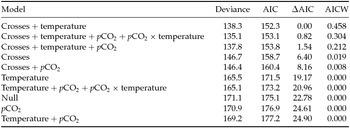
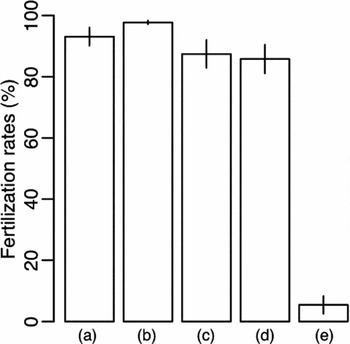
In our fertilization trial, high fertilization rates of A. digitifera were observed in all treatments (average 92.1 %; Figure 1). The low fertilization rates detected in some self crosses were probably due to low levels of cross-contamination that occurred during removal of sperm from each treatment. In the statistical analysis, we applied GLM for fertilization data, but over-dispersion was observed. To overcome this problem, we applied GLMM and temperature and crosses were selected in the best-fitted model (Table 2). In a previous study, we found some variations among crosses in coral fertilization (Iguchi et al., Reference Iguchi, Morita, Nakajima, Nishikawa and Miller2009), thus we incorporated crosses in our model. But considering that our GLM analysis that included crosses as an explanatory variable was not enough for avoiding over-dispersion, variations among fertilization replicates within a cross could not be ignored.
The top-ranked candidate models for each explanatory variable

Model deviance, AIC, difference in AIC from the best-fitted model (∆AIC) and weight (AICW) values are given for each model.
Fertilization rates (%) of Acropora digitifera eggs in each treatment. Bars show average fertilization rates and standard errors for five crosses (n = 15) and four egg batches (n = 12). Each treatment was repeated three times. Sperm were added at a concentration of 105 sperm/ml. (a) Normal temperature and pCO2. (b) Normal temperature and high pCO2. (c) High temperature and normal pCO2. (d) High temperature and pCO2. (e) Eggs without the addition of sperm.

Decreases in fertilization rates were observed at high temperatures conditions of both non-acidified and acidified seawater in comparison with that at the normal temperature control. This finding is consistent with the previous finding for the fertilization rates of A. millepora, which also decreased under thermal stress (Negri et al., Reference Negri, Marshall and Heyward2007). However, the decrease in fertilization rates was not evident between non-acidified and acidified seawater. The interaction between thermal stress and acidified seawater on fertilization was also unclear. These results were also supported by the statistical analysis using GLMM of which best-fitted model incorporated only crosses and temperature as explanatory variables.
Contrary to the previous finding that reduced flagellar motility was observed in A. digitifera even with only a slight decrease of pH (Morita et al., Reference Morita, Suwa, Iguchi, Nakamura, Shimada, Sakai and Suzuki2010), we could not detect a decrease in fertilization rates for A. digitifera in acidified seawater. We tried to avoid the excess fertilization by removal of sperm in accordance with the method by Iguchi et al. (Reference Iguchi, Morita, Nakajima, Nishikawa and Miller2009), but a decrease in sperm binding of 99.99% may still allow fertilization to occur (Iguchi et al., Reference Iguchi, Márquez, Knack, Shinzato, van Oppen, Willis, Catmull, Hardie and Miller2007). The reason why we could not detect decreases in fertilization rates in acidified seawater could be attributed to our experimental conditions that used only a single sperm concentration (105 sperm/ml), because previously researchers have reported decreases in fertilization rates in acidified seawater using several lower sperm concentrations (Albright et al., Reference Albright, Mason, Miller and Langdon2010; Albright & Mason, Reference Albright and Mason2013). Although the sperm concentrations used in our study were high, in order to detect the effect of OA on fertilization rates, it seems likely that fertilization of A. digitifera is more sensitive to future GW than to OA.
In the field, high sperm concentrations to enable sufficient fertilization rates are also observed during coral mass spawning (Willis et al., Reference Willis, Babcock, Harrison and Wallace1997; Omori et al., 2001), but the decrease in coral cover followed by that of sperm concentration might cause interacting negative effects of GW and OA on the fertilization of A. digitifera, as Albright & Mason (Reference Albright and Mason2013) reported interacting negative effects of GW and OA on the fertilization of Acropora tenuis at low sperm concentrations. To further understand the interacting effects of future GW and OA on the coral reef ecosystem, these effects on the early life history stages of corals should also be taken into account.
Acknowledgements
This study was supported by an AICAL project funded by the Global Environment Research Fund A-0804 from the Ministry of the Environment of Japan and KAKENHI (No. 23241017) to YN. We are grateful for N.H. Kumagai for his advise on statistical analysis.