INTRODUCTION
The English Channel is a maritime domain characterized by strong tidal currents, with surficial sediments dominated by coarse sand, gravel and pebbles which cover about 80% of the sea bed (Larsonneur et al., Reference Larsonneur, Bouysse and Auffret1982). Among these coarse habitats, the Branchiostoma (ex-Amphioxus) clean coarse sand community is known to show a high species richness of the small interstitial fauna, mainly composed of small polychaetes and amphipods, and generally associated with low abundances (Dauvin, Reference Dauvin1988a, Reference Dauvinb). The Syllidae family (Annelida, Polychaeta) is very well represented in such clean coarse sand sediments, both in the subtidal and intertidal zones (Dauvin & Lee, Reference Dauvin and Lee1983; Olivier et al., Reference Olivier, Grant, San Martín, Archambault and McKindsey2012). Moreover, the Syllidae family is one of the more diverse families of marine Polychaeta, comprising 74 genera and more than 700 species (San Martín, Reference San Martín and Ramos2003; San Martín & Aguado, Reference San Martín, Aguado and Schmidt-Rhaesa2014; San Martín & Worsfold, Reference San Martín and Worsfold2015).
At the scale of the English Channel, an updated list of the polychaetes recorded was established by Dauvin et al. (Reference Dauvin, Dewarumez and Gentil2003). This inventory was based on benthic and systematic studies available at the beginning of the year 2000; a total of 493 species were recorded, with the Syllidae making up one of the more diversified families including 78 species (16% of all species). In their inventory, San Martín & Worsfold (Reference San Martín and Worsfold2015) listed 63 Syllidae species in United Kingdom (UK) waters, which is of the same order of magnitude as the number of species recorded for the EC in both UK and French waters.
Nevertheless, recent European studies on the taxonomy of the families have revealed that several Syllidae species are in fact a complex of species, while others have been confused with other existing species as synonymies. The description of new species in addition to the synonymies of several species have created much confusion about the existing species in an area such as the English Channel.
This paper focuses on two main aspects: (1) taxonomic inventory of the Syllidae found in the coarse sediment of the Dieppe-Le Tréport site; and (2) taxonomic features, i.e. comparing the list of the Syllidae collected in this area of the eastern part of the EC with analogous sediment types in the western part of the EC, and re-analysing the list of the Syllidae recorded in the EC.
MATERIALS AND METHODS
Dieppe-Le Tréport study area and sampling design
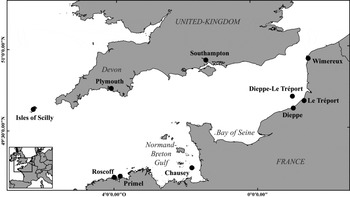
In view of the future siting of a wind farm offshore Dieppe-Le Tréport (eastern part of the English Channel) (Figure 1), 25 benthic stations were sampled twice-yearly from September 2014 (Campaign 1: C1), March 2015 (C2), September 2015 (C3) and March 2016 (C4) with a 0.1 m2 Van Veen grab (five replicates per station and per sampling date). The water depths ranged from 12 to 25 m. Two main benthic assemblages were identified corresponding to the clean fine and medium sand Nephtys cirrosa community (six stations) and the clean coarse sand Branchiostoma lanceolatum community (19 stations).
Location of coarse sand sampling stations used for compilation of the regional inventories (see Dauvin et al., Reference Dauvin, Dewarumez and Gentil2003). Roscoff: Cabioch et al. (Reference Cabioch, l'Hardy and Rullier1968); Plymouth: MBA (1957); Musk et al. (Reference Musk, Faulwetter and McIlwaine2016); Normand-Breton Gulf: Retière (Reference Retière1979); de Saint Joseph (Reference de Saint-Joseph1887, Reference de Saint-Joseph1888, Reference de Saint-Joseph1895); Olivier et al. (Reference Olivier, Grant, San Martín, Archambault and McKindsey2012); Bay of Seine: Bellan (Reference Bellan1961); Wimereux: Glaçon (Reference Glaçon1977).

Comparison with other studies
The Dieppe-Le Tréport Syllidae list is compared with lists compiled by:
-
– Dauvin & Lee (Reference Dauvin and Lee1983), who established a list for the subtidal coarse sand Branchiostoma lanceolatum (ex-Amphioxus lanceolatus) – Clausinella (ex-Venus) fasciata community in the Bay of Morlaix at 25 m depth (Dauvin, Reference Dauvin1988a, Reference Dauvinb). This community was sampled quarterly from August 1977 to August 1980 (13 dates) with a 0.25 m2 Hamon grab (10 replicates per date) covering a total sampling area of 32.5 m2;
-
– Olivier et al. (Reference Olivier, Grant, San Martín, Archambault and McKindsey2012), who recorded fauna from a Glycymeris coarse sediment habitat in 192 samples on six intertidal sites of the Chausey Archipelago (English Channel, France). Sampling was carried out in 2007 with a 1/50 m2 hand corer (total of 3.84 m2);
-
– Dauvin et al. (Reference Dauvin, Dewarumez and Gentil2003), who compiled a list of all the benthic polychaetes recorded over the entire EC at the beginning of the year 2000.
RESULTS
Importance of species-level identification of Syllidae in ecology studies
ENVIRONMENTAL CHARACTERISTICS
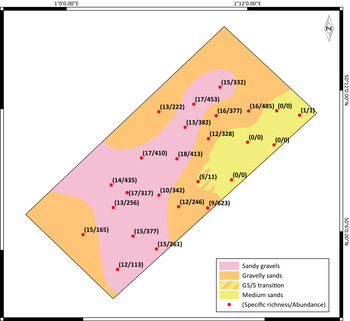
The salinity of the study area is homogeneous between the surface and the bottom as well as during the year with a mean value of 34.5‰. The sea temperature varies from 16°C in summer to 7.5°C in winter. The turbidity is of 0.33 NTU in summer and 3.61 NTU in winter (J.P. Pezy, unpublished data). The water depth ranges from 12 to 25 m. Three sedimentary types are found in the study area during the sampling period with a grain-size increasing gradient from south-east with sand to north-west with gravelly sand and sandy gravel, the sediment classes are determined according to Folk (Reference Folk1954) (Figure 2). Supporting the entire dataset, two communities were identified according to the EUNIS classifications: the Branchiostoma lanceolatum community in circalittoral coarse sand with shell gravel (A5.145) for coarse sediments and the Echinocyamus pusillus, Ophelia borealis and Abra prismatica community in circalittoral fine sand (A5.251). On the gravelly sand and sandy gravel sediments, patches of live Spirobranchus were collected that could provide a potential habitat for Syllidae. Syllids were collected mostly in the coarse sand community (99.8%) and thus only data relevant to this habitat were considered in this study, accounting for a total sampling area of 38 m2.
Specific richness and total abundances of Syllidae collected by stations during the four campaigns at the Dieppe-Le Tréport site superimposed with sedimentary types (based on Folk, Reference Folk1954).

SPECIES RICHNESS AND ABUNDANCES
A total of 29 taxa including 27 species were identified among the 6549 individuals of Syllidae collected during the four campaigns for the sandy (five species for 12 individuals) and gravelly sandy communities (27 species for 6537 individuals). For the sandy habitat, 11 of 12 individuals are localized on a transitional station between medium sands and gravelly sands. In the gravelly sand community (19 stations), the total Syllidae species richness (SR) is comprised of between nine and 18 species per station. The seasonal SR is evaluated as 20 for C1 (1786 individuals), 15 for C2 (1565 individuals), 23 for C3 (2175 individuals) and 19 for C4 (1023 individuals) (Figure 2). Highest occurrences and the highest abundances during the four campaigns were observed for the three species Syllis garciai, Syllis variegata and Trypanosyllis (Trypanosyllis) coeliaca. The polychaetes represent between 34 (C1) and 62% (C3) and, among them, the Syllidae between 5 and 9% of the total number of individuals collected during the monitoring.
Taxonomic traits of Syllidae species new for the EC or the eastern part of the EC
The English Channel can be divided into two main parts with different physical and ecological characteristics. The Atlantic Ocean and warm waters influence the Western basin (from Brest to La Hague) and the North Sea and cold waters influence the Eastern basin (from La Hague to Calais) (Dauvin, Reference Dauvin2012).
Only two taxa (three Dioplosyllis and 35 Myrianida) out of a total of 29 taxa were not identified to species level. Among the 27 other species, seven are new for the EC fauna and six others are sampled for the first time in the eastern part of the EC. For each of these 13 species, we give some general information about the Dieppe-Le Tréport material examined and their general distribution in the world ocean.
NEW RECORDS FOR THE ENGLISH CHANNEL
Prosphaerosyllis xarifae (Hartmann-Schröder, Reference Hartmann-Schröder1960)
Sphaerosyllis xarifae Hartmann-Schröder (Reference Hartmann-Schröder1960): 103–104, pl. 14 figures 121–122, pl. 15. figures 123–124.
Sphaerosyllis xarifae San Martín (Reference San Martín and Ramos2003): 225–227, figures 119–120.
material examined: One individual sampled in September 2015.
distribution: Red Sea; Mediterranean Sea; Australia; North-east Atlantic from the Canary Islands to the Bay of Biscay; eastern part of the English Channel.
Sphaerosyllis pirifera Claparède, Reference Claparède1868
Sphaerosyllis pirifera Claparède (Reference Claparède1868): 515–516, pl. 14 figure 2.
Sphaerosyllis pirifera San Martín (Reference San Martín and Ramos2003): 212–215, figures 111–113.
material examined: Two individuals sampled in September 2015.
distribution: Eastern Mediterranean Sea; North-east Atlantic from the Gibraltar Strait to Galicia; eastern part of the English Channel.
Streptodonta pterochaeta (Southern, Reference Southern1914)
Opisthodonta pterochaeta Southern (Reference Southern1914): 30–32, pl. 4 figure 6A–G.
Opisthodonta pterochaeta San Martín (Reference San Martín and Ramos2003): 51–54, figures 13–14.
Streptodonta pterochaeta San Martín & Hutchings (Reference San Martín and Hutchings2006): 353, figure 81 A–E.
material examined: 15 individuals, one in September 2014, 11 in September 2015 and three in March 2016.
distribution: North-east Atlantic, from the North Sea to Gibraltar Strait; eastern part of the English Channel, but in its range of geographic distribution.
Syllis columbretensis (Campoy, Reference Campoy1982)
Typosyllis columbretensis Campoy (Reference Campoy1982): 413–418, pls. 46–47.
Syllis columbretensis San Martín (Reference San Martín and Ramos2003): 443–447, figures 244–245.
material examined: One individual in September 2014.
distribution: From the southern part of the Bay of Biscay to the eastern part of the Mediterranean Sea; eastern part of the English Channel.
Syllis mauretanica (Licher, Reference Licher1999)
Typosyllis mauretanica Licher (Reference Licher1999): 78–81, figures 35–36.
material examined: 272 individuals, 42 in September 2014, 13 in March 2015, 68 in September 2015 and 149 in March 2016.
distribution: Banc d'Arguin, Mauritania (Licher, Reference Licher1999), Alicante, Spain, Mediterranean Sea (Del-Pilar-Ruso & San Martín, Reference Del-Pilar-Ruso and San Martín2012); eastern part of the English Channel.
Syllis parapari San Martín & López, Reference San Martín and López2000
Syllis parapari San Martín & López (Reference San Martín and López2000): 426–429, figures 1–2.
Syllis parapari San Martín (Reference San Martín and Ramos2003): 409–413, figures 224–225.
material examined: 501 individuals, 381 in September 2014, 42 in March 2015, 62 in September 2015 and 16 in March 2016.
distribution: From the Gibraltar Strait to the southern part of the Bay of Biscay; eastern part of the English Channel.
Syllis pulvinata (Langerhans, Reference Langerhans1881)
Typosyllis pulvinata Langerhans (Reference Langerhans1881): 104, pl. 4 figure 9.
Syllis pulvinata San Martín (Reference San Martín and Ramos2003): 372–375, figures 202–204.
material examined: One individual in September 2014.
distribution: Red Sea and Mediterranean Sea, North-east Atlantic from the south of the Bay of Biscay to the Canary Islands; eastern part of the English Channel.
NEW RECORDS FROM THE EASTERN PART OF THE ENGLISH CHANNEL
Palposyllis prosostoma Hartmann-Schröder, Reference Hartmann-Schröder1977
Palposyllis prosostoma Hartmann-Schröder (Reference Hartmann-Schröder1977): 87, figures 41–43.
Palposyllis prosostoma San Martín (Reference San Martín and Ramos2003): 57–61, figures 17–18.
material examined: 92 individuals, six in September 2014, 12 in March 2015, 64 in September 2015 and 10 in March 2016.
distribution: North-east Atlantic, from Britain and English Channel to Canary Islands; eastern part of the English Channel.
Parexogone hebes (Webster & Benedict, Reference Webster and Benedict1884)
Paedophylax hebes Webster & Benedict (Reference Webster and Benedict1884): 716–717, pl. 3 figures 31–36.
Exogone (Parexogone) hebes San Martín (Reference San Martín and Ramos2003): 236–239, figures 125–126.
material examined: Seven individuals collected in March 2015.
distribution: Both sides of North Atlantic, from the North Sea to the Mediterranean Sea; eastern part of the English Channel, but in its range of geographic distribution.
Sphaerosyllis taylori Perkins, Reference Perkins1981
Sphaerosyllis taylori Perkins (Reference Perkins1981): 1140–1143, figure 26.
Sphaerosyllis taylori San Martín (Reference San Martín and Ramos2003): 206–208, figure 108.
material examined: 17 individuals, three in March 2015, six in September 2015 and six in March 2016.
distribution: Atlantic Ocean, Mediterranean Sea, western part of the English Channel; eastern part of the English Channel.
Syllis garciai (Campoy, Reference Campoy1982)
Langerhansia garciai Campoy (Reference Campoy1982): 386–389, pls. 36–38.
Syllis garciai San Martín (Reference San Martín and Ramos2003): 400–405, figures 219–221.
material examined: 2387 individuals, 790 in September 2014, 630 in March 2015, 859 in September 2015 and 108 in March 2016.
distribution: North-east Atlantic, Mediterranean Sea; eastern part of the English Channel.
Syllis hyalina Grube, Reference Grube1863
Syllis hyalina Grube (Reference Grube1863): 45–46, pl. 4 figure 8.
Syllis hyalina San Martín (Reference San Martín and Ramos2003): 426–429, figures 234–235.
material examined: 49 individuals, 27 in September 2014, eight in March 2015, six in September 2015 and eight in March 2016.
distribution: Cosmopolitan species in temperate and tropical waters; eastern part of the English Channel.
Xenosyllis scabra (Ehlers, Reference Ehlers1864)
Syllis scabra Ehlers (Reference Ehlers1864): 244–248, pl. 11 figures 1–3.
Xenosyllis scabra San Martín (Reference San Martín and Ramos2003): 303–307, figures 167–168.
material examined: Four individuals, one in September 2014, one in March 2015 and two in September 2015.
distribution: North-east Atlantic from the English Channel to the eastern part of the Mediterranean Sea. Mexico Gulf; eastern part of the eastern Channel which is the eastern boundary of the species.
DISCUSSION
The Dieppe-Le Tréport Branchiostoma lanceolatum coarse-sand community appears particularly rich in Syllidae, with 6537 individuals from a total sampling area of 38 m2, i.e. a mean density of 172 ind. m−2. In comparison, those sampled on the same benthic habitat at the Primel station in the Bay of Morlaix, from a similar total sampling area of 32.5 m2, had a mean density of 41 ind. m−2 and 1359 individuals belonging to 18 species of Syllidae (Dauvin & Lee, Reference Dauvin and Lee1983). During the 3-year monitoring programme on this western station of the English Channel, the total number of collected species was 181, 86 of which were collected only occasionally (one or two times). Polychaetes represent nearly 50% of the total species recorded (87 species), and are numerically dominated by small-sized species (Dorvilleidae, Glyceridae and Syllidae) which account for 39% of the total number of sampled macrofauna and 20% of the Syllidae.
On the Dieppe-Le Tréport stations, the total number of Syllidae (29 taxa including 27 species) was higher than that found at Primel, with a higher number of taxa and individuals in summer than in winter. The Syllidae account for 9–10% of the species richness and 6–9% of the total number of individuals collected during our monitoring, which are particularly high proportions for the coarse sand community at the scale of the EC (Dauvin Reference Dauvin1988a, Reference Dauvinb). Among the Syllidae, five species are dominant: Syllis garciai (191 ind. m−2), Syllis variegata (99.6), Trypanosyllis (Trypanosyllis) coeliaca (69.2), Syllis parapari (40) and Syllis armillaris (33.8) which represent 83% of the sampled Syllidae. From a Glycymeris coarse sediment habitat in the intertidal zone of the Chausey Archipelago (western English Channel, France), Olivier et al. (Reference Olivier, Grant, San Martín, Archambault and McKindsey2012) sampled 5700 individuals of Syllidae belonging to 21 species (based on 192 benthic samples collected in May 2007) and described two new species Prosphaerosyllis chauseyensis and Prosphaerosyllis laubieri. Five species dominate the collection: Sphaerosyllis taylori (560 ind. m−2), Sphaerosyllis bulbosa (417.5), Syllis garciai (176) Salvatoria swedmarki (124.5) and Streptosyllis campoyi (77.5), which together represent 91% of the total number of Syllidae.
Recently, Musk et al. (Reference Musk, Faulwetter and McIlwaine2016) collected three specimens of a new species for the EC, Streptosyllis nunezi (Faulwetter, Vasileidadou, Papageorgiou & Arvanitidis, Reference Faulwetter, Vasileiadou, Papageorgiou and Arvanitidis2008), from sites off Devon and in the Scilly Isles (UK) associated with three other Streptosyllis species.
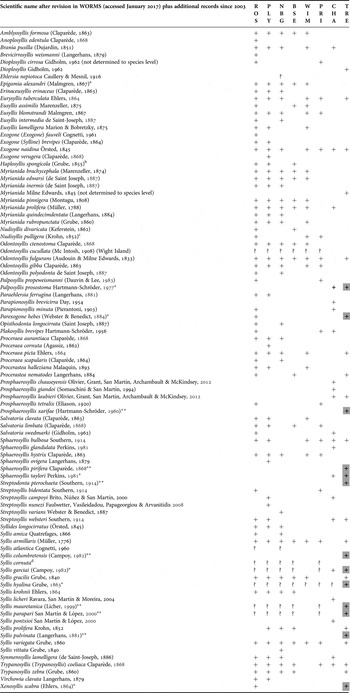
Finally, the list of Syllidae given by Dauvin et al. (Reference Dauvin, Dewarumez and Gentil2003) for the EC is amended taking into account the more recent publications, the revisions of species names and synonymies according to WORMS (http://www.marinespecies.org; accessed 1 July 2016) (see Table 1). A total of 91 species of Syllidae are recorded in the EC, as against 78 recorded at the beginning of the year 2000 (Dauvin et al., Reference Dauvin, Dewarumez and Gentil2003). Thus, 14% of the Syllidae have been recorded recently in the EC due to the particular attention paid to the identification of species stemming from new publications and fauna collections (San Martín, Reference San Martín and Ramos2003; San Martín & Worsfold, Reference San Martín and Worsfold2015). It is probable that other species new to science will be found in future collections mainly on the coarse sand community, as in the case of the Chausey Archipelago, as well as new species for the EC inventory. The benthic assemblage related to subtidal coarse sands includes abundant interstitial fauna such as Syllidae, and covers a very large area of sea bed in the EC. It is remarkable that, out of the 14 new records for the EC reported in Olivier et al. (Reference Olivier, Grant, San Martín, Archambault and McKindsey2012) and in this study, 13 correspond to warm temperate species, the EC representing the northern limit of the Syllidae in the North-east Atlantic. Streptodonta pterochaeta is the only species that is present also in the North Sea in coarse sand, from depths of 6 to 50 m (San Martin & Hutchings, Reference San Martín and López2006). Although it is difficult to be certain considering the numerous errors of identification and the sparse research on the taxonomy of Syllidae over the last two decades, we think that many recent records in the English Channel could reflect a northward extension of their geographic limits in response to the increase in sea temperature in the EC due to climate change.
Syllidae in the English Channel. ROS: Roscoff; PLY: Plymouth; NBG Normano-Breton Gulf; BSE: Bay of Seine; WIM: Wimereux, from Dauvin et al. (Reference Dauvin, Dewarumez and Gentil2003), Olivier et al. (Reference Olivier, Grant, San Martín, Archambault and McKindsey2012) and Musk et al. (Reference Musk, Faulwetter and McIlwaine2016). PRI, Primel from Dauvin & Lee (Reference Dauvin and Lee1983); CHA, Chausey, from Olivier et al. (Reference Olivier, Grant, San Martín, Archambault and McKindsey2012); TRE: Dieppe-Le Tréport, this study; *grey boxes new species for the eastern part of the English Channel; **grey boxes new species for the Channel. ? Doubtful occurrence which remains to be confirmed.

a Ex-Autolytus alexandri Malmgren, 1867 and Autolytus paradoxus de Saint Joseph (Reference de Saint-Joseph1887).
b Ex-Haplosyllis spongicola (Grube, 1855), Haplosyllis spongicola spongicola (Grube, 1855) and Haplosyllis spongicola tentaculata Marion, 1877.
c ex-Pionosyllis pulligera (Krohn, 1852) and Pionosyllis serrata Southern (Reference Southern1914).
d Ehlersia (Syllis) cornuta (Rathke, 1843) not in this area = Syllis garciai (Campoy, Reference Campoy1982)*; or Syllis mauretanica (Licher, Reference Licher1999)** or Syllis parapari San Martín & López (Reference San Martín and López2000)**.
The Syllidae family appears highly sensitive to organic enrichment pollution and to other kinds of stress (Giangrande et al., Reference Giangrande, Delos, Musco, Licciano and Pierre2004, Reference Giangrande, Licciano and Musco2005; Musco et al., Reference Musco, Cavallo and Giangrande2004). Del-Pilar-Ruso et al. (Reference Del-Pilar-Ruso, de-la-Ossa-Carretero, Giménez-Casalduero, Sánchez-Lizaso and San Martín2014) revealed that Syllidae distribution is influenced by environmental features which can also alter the original habitat such as the change of depth and the modification of grain size as also found at small scale under mussel farming constraint (Grant et al., Reference Grant, Archambault, Olivier and McKindsey2012). The most abundant species in the Dieppe-Le Tréport area, S. garciai (Campoy, Reference Campoy1982), is considered a sensitive species to organic enrichment (Simboura & Zenetos, Reference Simboura and Zenetos2002). All these features seem to indicate that the Dieppe-Le Tréport area is of a high ecological status that allowed the development of a high diversity and abundance of Syllidae.
ACKNOWLEDGEMENTS
The authors thank the captain and the crew of the Oceanographic Vessel ‘Celtic Warrior’. We are grateful to Prof. G. San Martín and Prof. F. Olivier for the course on Syllids in July 2015 at the Marine Station of Banyuls-sur-Mer, France. The authors also wish to thank Dr M.S.N. Carpenter for revising the English style and grammar. The authors thank the two reviewers G. San Martín and F. Olivier for the useful comments and the editor T. Darbyshire for the additional corrections.
FINANCIAL SUPPORT
JPP benefitted from a CIFRE grant for the ‘Compagnie du Vent’.