

This book explores the visual imaginary of Russia in Europe in the era of humanism (ca. 1500 to ca. 1650). It details how Europeans learned about Russia through the visual, how that knowledge was disseminated and how it contributed to Europeans’ understanding of themselves.Footnote 1 It joins a broad literature in history, art history and the history of science on the use of the visual in knowledge production in the early modern world. Historians of science have explored how naturalists devised standards for depiction of plants, animals and anatomy, and in the process created scientific communities across Europe.Footnote 2 Other historians have explored how Europeans depicted outsiders, from New World natives to neighboring Europeans, to make sense of their expanding world.Footnote 3 Here I explore how the visual was used to create knowledge about the familiar and unfamiliar people and cultures on Europe’s borderlands; our case study is Muscovy and its surrounding steppe and forest.
I explore images of Russia and Russians from the early sixteenth century to the mid-seventeenth, finding them in maps, broadsheets, travel accounts (by Sigismund von Herberstein and Adam Olearius) and costume books. Such images were remarkably few for a century when print illustration boomed. I examine how these images were produced, taking a deep dive into patronage, design, publishing and dissemination. In so doing I end up displaying the world of European book culture more than Russia itself. Thus, this introduction lays out some current thinking about the world of printing in its formative century.
The thriving field of “history of the book” laid the foundations for studies of the production and dissemination of knowledge through imagery. Founders of the field in France explored the social and material context of book production, focusing beyond authors on publishers, engravers and printers.Footnote 4 At the same time Elizabeth Eisenstein’s path-breaking study of the “print revolution” made an immense impact regarding knowledge production, particularly with her (and others’) concept that print created a “fixity” of text that allowed communities (scientific, confessional and other) to form around shared discoveries and views.Footnote 5 All well and good, Adrian Johns and others have since argued, but such “fixity,” if ever achieved, was the product of long and arduous struggle by authors and publishers well into the eighteenth century.Footnote 6
Johns argues that “print culture” in the sixteenth century started out in chaos, by modern standards. Early modern printing, he noted, did not begin with “any obvious or necessary bond to enhanced fidelity, reliability, or truth. That bond had to be forged.”Footnote 7 Medieval manuscript culture had no firm sense that a creative work was linked to a single author (other than great, named classical authors). Going into the sixteenth century, then, there was little sense of intellectual property and no privileged claims for authors; those ideas and legal protections were hammered out, generally in the eighteenth century, starting in England.Footnote 8 Rather, sixteenth-century practice included what we would call today plagiarism or piracy or unattributed excerpting or republication or repurposing of text and image … the list goes on. Johns chronicles how authors and publishers developed publication strategies to overcome skepticism about the printed word, to assure readers that the new “knowledge” their books disseminated was authentic. Establishing the readers’ “trust,” Johns reminds us, was a difficult process.
There were myriad such strategies. Patronage and privileges were one. Authors and artists sought patrons to support their work, particularly because institutions of knowledge production were few and scattered.Footnote 9 Writers and artists could be associated with universities, particularly in the Germanies; in the seventeenth century national academies of sciences began to be created. But in the sixteenth century and beyond, patronage at imperial, princely and noble courts was a necessity. When an author introduced a book with lavish dedications to patrons, those words of praise honored the mécénat and paved the way for further support, but it also helped to authenticate an author’s work by association with such eminent people.
Privileges played a similarly symbolic authenticating role. Authors and particularly publishers sought “privileges” from a political figure – emperor, municipality, notable – that forbade copying the work, usually for a fixed amount of time to allow the publisher to recoup expenditures. Privileges were weak protections, however: There was little provision for enforcement, and even then they only applied within the jurisdiction of the granting power. Symbolically, however, trumpeting an official privilege on a map or title page gave the reader a reassuring imprimatur.
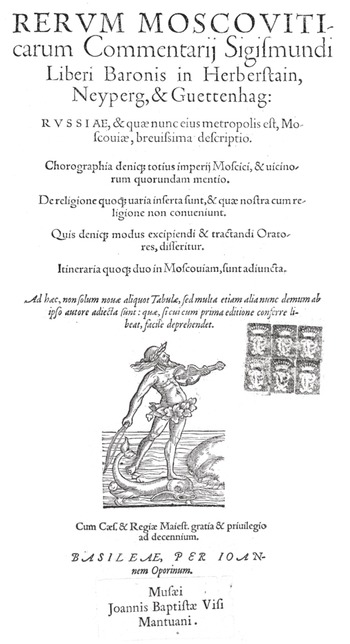
Publishers also developed ways of designing a book’s front matter, or paratext, to project authenticity. They heralded the stature of the author, for example, by identifying his rank on the title page and even including his coat of arms, portrait or encomia to him. In their texts, authors claimed to be writing or sketching from eyewitness, what Anthony Pagden and others call the “autopic” stance; that claim could be visually represented by depicting an artist sketching in the foreground of an illustration (Fig. 9.1).Footnote 10 Signatures of engravers and authors on maps and illustrations also asserted authenticity, particularly when those individuals enjoyed a respected reputation, as we will see in our books and maps about Russia.Footnote 11 Over the sixteenth century, publishers designed the title page toward what we have today, with title, name of author and some identifying status for him, city, publisher and date; a privilege was cited where possible and sometimes a printer’s mark verified the press (that of the Oporinus firm in Basel depicted a man playing an stringed instrument and standing on a dolphin) (Fig. I.1).Footnote 12

Knowledge production was stymied without effective presentation. Over the century publishers also worked to make it easier for readers to acquire the knowledge contained within their books. They appealed to the myriad forms of literacy in the sixteenth century. Readers, elite and lay, could read “intensively,” taking notes, reading word for word and page by page, and writing marginalia. Or they could read “extensively,” dipping into a book for entertainment or research. In a century of massive encyclopedic works (catalogs of botany, anatomy and animals, atlases and cosmographies), the latter was common. Extensive reading was also used for reading the Bible, a practice encouraged by Protestant confessions.Footnote 13 To aid such reading, publishers designed didactic page and book formats. They divided long texts into volumes, parts and chapters and marked those locations at the top of the page; they added indexes and bibliographies; they added notes in the margins identifying the theme of the paragraph. They interspersed graphics, such as genealogies and tables, to illustrate points.Footnote 14 They titled maps but did not, as a rule, provide captions for illustrations (Chapter 9).
“Book culture” was hammered out in the fast-paced world of sixteenth-century communication. The common language of Latin offered transregional communication and helped to create communities around shared interests and publications. Publishing in the vernacular increased the audience and did not splinter the intellectual world since humanist readers were adept both in their vernaculars and in Latin. Not until the seventeenth century did such splintering happen at levels below elite science (where Latin and French endured as international languages).Footnote 15 Knowledge was disseminated by many networks. The “Republic of Letters” linked communities of scientists by correspondence and travel, but not in a pan-European whole quite yet. There were many centers of knowledge production: Zurich, home of the great natural historian Conrad Gessner; the Habsburg courts; great publishing houses in Basel, Venice, Antwerp and Amsterdam; the University at Basel; Bordeaux in France. Some publishers had shops around Europe; all depended on book fairs, particularly in the Germanies at Frankfurt and elsewhere, whose catalogs listed thousands of titles circulating in the century.Footnote 16
All this effort to authenticate publications was not immediately accomplished, of course. It pushed against the reality that it was easier for publishers to make money by plagiarizing books and cutting-and-pasting excerpts from many sources than to support a new work, as the fate of Sigismund von Herberstein’s travel account demonstrates (Chapter 4). Lucien Febvre and Henri-Jean Martin note that piracy was often the only way for a smaller printer to survive.Footnote 17 Furthermore, “knowledge” about the broader world was disseminated not only in books and maps whose publishers were conscientious about truth value but also in many less scrupulous genres, particularly broadsheets. There the scandalous and wondrous played fast and loose in text and image. Particularly with the visual, print culture struggled to create and enforce standards for ensuring that a visual image represented what it purported to depict.
That fact is all the more distressing since the visual was one of the central, even the central, medium in the presentation of new knowledge in sixteenth-century Europe. Dana Leibsohn argues that “increased emphases on optical authority” were humanist Europe’s response to the flood of new information it encountered or produced.Footnote 18 Despite some Protestant distrust of imagery, religious imagery continued to be the most common form of the visual, but more and more secular imagery appeared.Footnote 19 Scholars embraced the visual to display their growing categorization of the world’s flora and fauna, of anatomy, technology and geography. The sixteenth century saw a boom in cosmographies and collections of portraits, costumes and atlases, all illustrated; by the end of the century travel literature leaped on to the illustration bandwagon (Chapters 1 and 7).Footnote 20
Encounters with foreign lands and the creation of new knowledge required new ways of “making what was seen knowable and rendering the unknowable visible.”Footnote 21 Artists and publishers turned to the “visual culture” of their time to apprehend all this new stimuli.Footnote 22 They constructed ways of depicting based on their own social and intellectual backgrounds. As Margaret Topping remarks, “We never simply see the world in a direct, unmediated sense-perception; rather, what we see and how we see are always conditioned by the observer’s specific conjunction of ‘field’ and ‘habitus.’” Deploying Pierre Bourdieu’s categories – “field” being the social, cultural, political and economic frameworks that one inhabits and “habitus” the “second-nature” attitudes one absorbs from that field – Topping reminds us that as readers and viewers we adapt the new to categories, narratives and imagery that we already know.Footnote 23 In creating images of Russia and Russians or steppe nomads and forest people in the sixteenth century, Europeans generally did not create fantasies (with some exceptions), nor did they convey snapshots of reality. Rather, travelers and artists used a range of conventions (including familiar stereotypes and artistic techniques such as perspective, composition, repetition and text) to make sense of the new. Many professionals were engaged in the process – authors, engravers, printers, publishers – which usually meant that the image strayed far from an eyewitness sketch or an original intent. Artists transformed eyewitness observation of foreign cultures for the European market: They classicized and modernized people and scenes; they bowdlerized sketches made by eyewitness observers; they repurposed and invented imagery. They applied biblical and classical categories to make the unfamiliar familiar. By the seventeenth century debates about the New World had flipped the evidence to create “a new paradigm of cultural difference,” and visual culture provided symbolic vocabularies for such depictions as well.Footnote 24
Jeffrey Chipps Smith argues that the turn to the visual reflected its flexibility of impact. Imagery could “heighten experience” in a century of religious fervor and proselytism, of encounter with “monstrous” peoples and creatures from abroad. Imagery could also epitomize whole concepts of self and society. Books of “emblems” symbolizing concepts taught readers how to interpret the symbolism of a rose, or a dog, or other motifs they would encounter in art and domestic decoration such as tapestries. In our world of primarily ethnographic imagery of Russia and points east, such tropes were more straightforward. Readers and viewers came to understand that cityscapes in veduta form – the urban skyline with scenes in the foreground – connoted a sort of European civilization, while fur clothing and camels epitomized barbarity. In the circulation of images in sixteenth-century print culture, some that started out as eyewitness became transformed into emblem-like symbols and or mere decorative embellishment.Footnote 25
Confronting the flood of the visual in the sixteenth century, in a setting where “print culture” started out with few guidelines for truth, viewers had to develop what Smith calls “visual acuity.” They looked for labels such as “contrafactum” to suggest true image; they compared text and image, and they used common sense, particularly in enjoying the sensationalism of European broadsheets. Humanist scholars made consistent efforts to define visual strategies to represent “truth to nature,” as I discuss in Chapter 1.Footnote 26 But their conscientiousness was missing in much other use of the visual: It was too expensive. In the wild and wooly world of print culture, efficiency and cost-cutting generally shaped how imagery was produced; even if given sketches based on eyewitness, producers often redesigned them.Footnote 27
Such improvisations and a resort to tropes were particularly evident as publishers looked across the Atlantic and to the East. Humanists were as eager to explore the Ottoman Empire, Persia, India and China as they were to discover the New World and test it against the classical scholarship they had been taught. Russia and its forest and steppe borderlands posed a difficult challenge, as they sat between familiar Europe and the exotic cultures of the New and Old Worlds. Here humanist-trained travelers encountered the familiar – what looked like a monarchy and nobility, towns and artisans, a peasant-based agrarian economy, Christianity (in the Orthodox variant) – and the unfamiliar or unknown – serfdom and a centralized bureaucratic empire, nomads of the steppe and tribes of the Siberian forest. Observers had to make complex adjustments to assess Muscovy, the steppe and beyond.
The various European engagements with Russia and its borderlands represented in our imagery were rarely based on direct encounters. Tomasz Grusiecki has chronicled how Dutch artists in the seventeenth century created a range of images of Poles as “close others,” whom the Dutch saw both as familiar because of the many day-to-day encounters with Poles on the streets of Amsterdam in a century of the booming Polish grain trade and as different because of the exotic robes, sashes and swords of the Polish Sarmatian style.Footnote 28 But Europeans did not have the opportunity to see Russians regularly. A few Muscovite diplomats traveled, but not merchants; a few European diplomats and merchants went to or through the Russian Empire and returned with impressions. But European interest in Muscovy – sparked by its diplomatic overtures to the West, by European desires to cross Muscovy to the Silk Road or by the humanistic desire to describe the known world – confronted a vacuum of information. Russians were not “close others” but neither were they complete aliens. Muscovy’s steppe and forest neighbors, however, did indeed seem alien. So Europeans had to fit Muscovy into their visual culture.
Here we will explore how practices of early modern visuality and print culture were implemented when Europeans encountered Muscovites and their neighbors. We will consider a range of perspectives on how an image conveys information and emotional impact. Dress, bodily pose, gesture, composition – all might associate Russia semiotically with the familiar or make it seem exotic. The social context of an image’s production – who commissioned, designed and published it, the genre in which it was set – also shaped meaning.Footnote 29 Meaning could be altered again as imagery moved into new publications and new genres.
We find our images in travel accounts, such as those by Sigismund von Herberstein (1549) and Adam Olearius (1647, 1656), and in maps, broadsheets, costume books and occasional other sources. We will find no single visual interpretation of Russia, no consensus in learned discourse, no authoritative institutional source. Rather, Europeans were presented with many views of Russia in many genres, written with different purposes by different authors and circulating in different knowledge communities. Our sources focus on a few geographical areas where most visual depictions of Russia circulated. The Holy Roman Empire and its German-speaking lands constituted one; England with its artistic and trade connections with the Dutch was another; Italy with Venice’s voluminous publication of maps and costume books yet another.Footnote 30 The Dutch “art of describing” extended far beyond its borders,Footnote 31 as did Dutch mapping (where we find decorative images of Russians), since Latin was usually the first language of publication of maps, and Dutch booksellers had international networks. There was no one Europe to which a single story about Russia could be disseminated; rather, we will discern the many ways in which Europeans presented Muscovy and its borderlands.
*****
Scholars of Russia have been interested in the visual, but not quite in this way. Most attention has been, sensibly, on work produced in Muscovy itself. Scholarship on Russian iconography from imperial Russia through Soviet times to the present is vast and distinguished.Footnote 32 Western scholars have built on it, often bringing in semiotic, anthropological or other angles to Muscovite visuality.Footnote 33 As for European images of Russia, D. A. Rovinskii’s collections of European engravings are encyclopedic, while on portraiture Frank Kämpfer and Ursula Mende have provided a more critical analysis.Footnote 34 Early modern European maps of Russia have been analyzed for cartographic advancements, but little attention has been given to their decorative features.Footnote 35 No one has looked at early modern European images of Russia as a body of information shaped by humanism and the evolving world of print culture.
We begin with the first visual encounters with Russia through mapping and diplomacy in the early sixteenth century and end with the magisterial blending of text and image in the travel account (1656) of Adam Olearius, who has been called “a late humanist.”Footnote 36 We close there, at mid-seventeenth century, when Europeans’ exposure to Russia significantly increased, as newspaper coverage and mail services were being developed and more Europeans traveled to Russia and returned. It was a time when the European art of the Baroque flooded in from Ukraine, and the Russian court began to produce secular images of its members, as I discuss in the Conclusion. Information about Russia became more normalized; in the era we are considering, Russia was still a rare object.
We also end at mid-seventeenth century because the visual world was taking a turn toward a more categorical approach to foreign cultures. From the seventeenth century a more rational, critical assessment of human experience began to establish boundaries between the “scientific” and the “wondrous”; disciplines were beginning to be carved out. Europeans began conceptualizing hierarchies of civilization and producing exclusionary or exoticizing rhetoric for non-European lands.Footnote 37 We will see some of this already with Olearius. Visuality proliferated even more but the openness of humanist information-gathering and the exuberance of “Baroque curiosity” were being tamed.
The chapters move chronologically from about 1500 to about 1650 and describe an arc from imagery intended to be iconographic or that became so over time to Adam Olearius’s plethora of genre images. Despite their being artistically “curated” distillations of his eyewitness experience (Chapter 9), Olearius’s illustrations exposed Europeans to so many more aspects of life in Eurasia – from Muscovy down the Volga to Persia – that a more complex body of knowledge about Europe’s periphery resulted.
After exploring European print culture in more detail (Chapter 1), I examine the earliest portraits and maps of Russia (Chapter 2). Then we consider Sigismund von Herberstein’s 1549 Rerum moscoviticarum commentarii, with a map and illustrations (Chapters 3–4), a chorographic map of Muscovy and the steppe attributed to Anthony Jenkinson in 1562 (Chapters 5–6) and an explosion of visuality at the end of the century in genres from broadsheets to costume books and maps (Chapter 7). We end with Olearius’s copiously illustrated travelogue to Russia and Persia (Chapters 8–9), where his studiously designed illustrations evoke Dutch landscape painting while conveying dense ethnographic information, laced with predictable critiques from a Protestant German humanist scholar. Each of these episodes is a case study in the interconnected world of engravers, authors and publishers in early modern humanist print culture.
Since I am concerned with the production, dissemination and reception of knowledge about Russia in the sixteenth and seventeenth centuries, I am omitting two illustrated accounts that modern readers might know of. Each contains eyewitness images of travels to Russia, but neither was published in its day. Participating in a Swedish embassy to Moscow in 1673–74, Erich Palmquist sketched maps, military objects and a few scenes of daily life. Augustin von Meyerberg traveled to Russia in 1661 with an official painter, Rudolph Storn, who produced an album of images of Muscovite towns and the Kremlin court. But both works languished in archives until the nineteenth century.Footnote 38 I examine works that circulated in their time.
In conclusion we will reflect on what Europeans did with that new knowledge, which opens up the difficult question of “reception.” We cannot say much about it for the sixteenth-century conditions. We cannot know how readers understood the pictures they saw; there were no book reviews or art critics for these publications. We do not have marginal comments in the scores of publications in which our images appeared.Footnote 39 But we can speak about the general corpus and cite ample indirect indications of Europeans’ interest in illustrated works about Russia. The lively reprinting of books about Russia displays a ready audience. Sigismund von Herberstein’s Rerum moscoviticarum commentarii went through several Latin and German editions overseen by the author himself, as well as pirated editions of the full or excerpted text, both with and without the imagery (Chapter 4). The same held for Adam Olearius’s account (Conclusion). Many reprints were put into cheaper quarto and octavo editions, denoting an interested public.
Another indication of reception is the repetition of imagery; publishers recognized an audience for images of Russia and its borderlands and satisfied that curiosity by disseminating images in broadsheets, books, maps and other sources. Those images were often pirated from previous works and went on to be reproduced by other authors and publishers in different settings (Chapter 7 particularly).
All art packs an emotional impact, as David Freedberg has shown, but just what it was for individual viewers is hard to say, for lack of direct reporting.Footnote 40 But clearly some of our images of Russia intended to trigger an emotional response. Some shocked. Stylized as they were, images of Ivan IV “the Terrible” and his wars, for example, evoked the horror of the Turk and of Dracula on which they were based (Chapter 7). Herberstein’s images were remarkably static, but they were intended to inform and might have conveyed something reassuringly familiar to the European eye (Chapter 4). Olearius’s engravers made full use of genre painting’s engagement with the viewer. A gun battle and a brutal beating in Isfahan should have shocked, while people posed in “typical” dress might elicit admiration (for beautiful Estonian embroidery) or fascination (for fur-clad Greenlanders) (Chapter 9). Our Russian engravings made ready use of tropes: Camels evoked exotica; churches, civilization; a crown, legitimacy. And many of our images straddled the line of familiarity and exoticism, encouraging viewers to open their minds.
We know theoretically that encounters with other cultures change people, and we can postulate such an effect on our individual travelers and a less intense one on their readers.Footnote 41 Herberstein, the Muscovy Company men, Olearius and his pal Mandelsloh trod over hill and dale, talking to everyone, making sketches, bringing home to their personal or ducal cabinets of curiosities strange and beautiful objects. Olearius’s collections turned the Holstein duke’s palace into the foremost collection of Persian artifacts in Europe. These humanist-trained men heeded the instructions of ars apodemica to open their minds to what they saw,Footnote 42 even though, as we will see, their images often domesticated foreign objects to make the unfamiliar familiar. To judge by the popularity of their books, maps and images, their enthusiasm spread.
Russia and its borderlands were only one, and certainly not the most important, foreign culture about which Europeans were curious in the humanist era. Discoveries in the New World and encounters with the Ottoman Empire and China were more sensationalist, and frankly most humanist knowledge production concerned Europe – its history, geography, flora and fauna and natural science. But narrative accounts of Muscovy held their own in the booming world of travel literature in the sixteenth century,Footnote 43 and many encyclopedic compendia, from costume books to atlases and cosmographies, included Muscovites. More than the range of tropes and information that these sources distributed about Muscovy, the ways in which that knowledge was created, depicted visually and disseminated are significant. They provide an unparalleled case study of humanist print culture in the making.