The rise of new powers in the international system is profoundly transforming the environment in which international actors and institutions have to operate. Aware of the significance of these developments, scholars have already embarked on intense debates about the likely consequences of today’s global power shifts for the future of a whole range of institutions, norms, and values of international society, such as the global governance regimes inherited from the post-war era, global peace, and security – primarily the question of the peaceful rise of China and others – and the universal validity of liberal visions of world order. Almost at the same time, there has been much talk of the emergence of a ‘regional architecture of world politics’, and of the impossibility of understanding the emerging world order without taking the role of regions into consideration (Acharya Reference Acharya2007, Reference Acharya2014, 84). It is therefore surprising that the link between an emergent global multipolar constellation and regionalism has remained understudied in the literature, especially when regionalism has been historically very sensitive to the international political environment in which it unfolded. Fawcett (Reference Fawcett1995, Reference Fawcett2008) and Mansfield and Milner (Reference Mansfield and Milner1999), for instance, identify several successive waves of regionalism since the second half of the 19th century, each following quite different logics as a result from, or adaptation to, radically different international conditions. Considering that the form and scope of regionalism has varied so widely over history, it would be unrealistic to expect that in the face of the current global power shifts, the landscape of world regionalism as depicted by the ‘new regionalism’ literature of the 1990s will remain unchanged as a permanent characteristic of the post-Cold War international order.
This article explores the possibilities of regionalism in an increasingly multipolar world with a particular focus on economic regionalism.Footnote 1 From the perspective of International Political Economy (IPE), a particularly relevant question seems to be whether the emergence of new economic powers is a force working in favour of the reorganization of political authority over larger territories and markets or if, instead, it will foster a more fragmented IPE in a way that perhaps may end shoring up the nation-state as a viable economic unit. Given the latter, what kind of economic regionalism, if any, will prosper in a multipolar world? As Acharya put it, ‘the rise of China, India, Brazil and others creates the potential for redefining the purpose of regionalism and the role of regional institutions, either by strengthening or undermining them’ (Reference Acharya2012, 10).
The fact that most of the rising powers are also the sole regional powers of more or less defined world regions – for instance, South America (Brazil), Southern Africa (South Africa), the post-Soviet space (Russia), and South Asia (India) – has led some scholars to assert that the advent of a multipolar world can only increase the level of political and economic organization of regions, thereby strengthening a general trend towards a ‘more regionalised international order’ (Buzan Reference Buzan and Waever2011; Acharya Reference Acharya2014). Consequently, many authors have tended to emphasize the role of regional powers and different forms of regional leadership as the main drivers of regional transformation (e.g. Kupchan Reference Kupchan1998; Pedersen Reference Pedersen2002; Destradi Reference Destradi2010; Prys Reference Prys2010; Nolte Reference Nolte2011; Steward-Ingersoll and Frazier Reference Tovias2012). Even when such assertions have remained mostly at the theoretical level and lacked deep empirical examination, they have become dominant in scholarly and policy circles. In this contribution, I challenge this interpretation by arguing that the emergence of multipolarity could actually generate powerful centrifugal forces within regions that would adversely affect the formation of complex forms of economic regionalism. This is due to the distinctive system–region dynamics generated by the combined operation of global- and unit-level variables, these variables being the parallel emergence of new economic powers in different regions of the world, on one hand, and the change that this new international environment produces in the cost–benefit calculations informing the strategies of international insertion of smaller states, on the other. The way these variables play into each other adversely affects the supply-side conditions of well-known models of economic regionalism that diverse regional groupings have been pursuing thus far.
In the following pages, I first present a review of different visions of multipolarity and of the role regions might play within this emerging international system. In the context of this debate, I then propose and develop an alternative model, which I label decentred multipolarity, which in my view reflects a more realistic pattern of system–region interaction. Third, by making the most of the explanatory insights gained by the discipline on the emergence of economic regionalism from a rational-choice perspective, I discuss how two competing models of multipolarity as an outside-in variable may impinge on two dominant types of complex economic regionalism that have traditionally served as blueprints or models for regional groupings in the developing world and elsewhere – namely, supranational regional integration and open regionalism. The focus here is on how different scenarios of multipolarity can affect the structure of incentives that underpin these two particular types of economic regionalism. I share the view that regionalism is a broad term to denote a ‘states-led project designed to reorganise a particular regional space along defined political and economic lines’ (Payne and Gamble Reference Payne and Gamble1996, 2), but I also contend that these ‘political and economic lines’ may vary substantially across time and space, giving way to different types of regionalisms that regional states can establish in order to deal with collective action problems relative to each other or to their international environment.
In the second part of the paper, I situate these theoretical models and expectations against the backdrop of real world developments or empirics. First, I demonstrate how the theorized causal mechanisms of decentred multipolarity are in operation in South America, a region that until recently had displayed a different, for several decades stable pattern of system–region interactions. Second, I trace how these dynamics are responsible for the unravelling of the complex forms of economic regionalism set out by South American states in the early 1990s. Finally, I extend the analysis to other world regions by briefly examining and discussing aggregated data regarding the evolution of trade regionalization dynamics (mostly during the last decade) within the home regions of some of the large states that are widely acknowledged as emerging powers.
Imagining regions in a post-hegemonic world
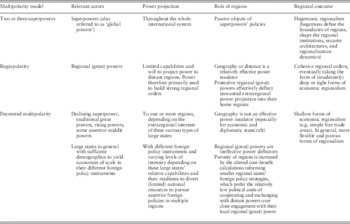
Visions of the place regions might hold in a multipolar world have depended on working hypotheses and conjectures about the actual nature of the multipolar constellation that is unfolding. A survey of the literature reveals that the scholarly debate has been revolving around at least two general models of the role that regions could play in a multipolar world. First, we can imagine a multipolar world characterized by the ascendance of one or two new superpowers, which together (and in competition) with the current superpower would project power across the entire globe similarly to the way the United States and the Soviet Union did during the Cold War, or the European empires before them. Within this scenario, regionalism is expected to follow old historical patterns of what has been called ‘hegemonic regionalism’, which has been defined as when hegemons discursively define the boundaries of regions and decisively shape the regional institutions, security architectures, and regionalization dynamics of their own regions and of those they penetrate (Acharya Reference Acharya2009, 4, Reference Acharya2014, 82).Footnote 2
A second model draws heavily on the old notion that, in a world in which the geopolitics of regions matters, systemic unipolarity can be replaced by multipolarity only by means of ‘regional unification or the emergence of strong regional unipolarities’ (Wohlforth Reference Ramírez1999, 30). This paradigm seems to have captured the imagination of prominent scholars. For instance, Buzan argued that the most likely end scenario for an international system in transition is the advent of a world order with ‘no superpowers but several great powers’ (Buzan Reference Buzan and Waever2011, 16–17). This means that, via a progressive weakening of the United States and the inability of the currently most obvious superpower candidates (China and the European Union) to surmount the formidable obstacles standing in their way, no state will be able to project power throughout many regions or the whole international system. The natural outcome of this development would be a ‘more regionalised international order’ because the removal of the superpower overlay would automatically increase the influence of regional (great) powers in their home regions (Buzan Reference Buzan2004, 143). Unlike superpowers, regional (great) powers lack the necessary means to project substantial power beyond their own regions (with the exception possibly of proximate regions lacking strong protective regional powers). Therefore, they would use their superior material capabilities primarily to build strong regional orders or ‘zones of influence’ around them. Similarly, and perhaps more straightforwardly, Acharya (Reference Acharya2009, 7) contends that the coming world can be better described as one of ‘regiopolarity’ rather than multipolarity. The logic underpinning this proposition is analogous to that of Buzan’s in the sense that Acharya also expects emerging powers ‘to remain fundamentally embedded in their regional strategic and economic contexts’ and unlikely to become true global powers (Acharya Reference Acharya2014, 85–86). According to him, ‘in such a world, regions are likely to test the limits of power projection by the old or the rising powers’ since ‘no great power […] will have the ability to have its say over distant regions because of the countervailing local influence of the regionally dominant powers’ or regional hegemons (Acharya Reference Acharya2009, 6, Reference Acharya2014, 86).Footnote 3
Even though these two different interpretations have been circulating for a while, it is not clear whether there is an actual theoretical debate among them. Recent international developments like the EU’s profound financial crisis, China’s economic slowdown and its inability to make allies beyond small and poor countries and, most important, a noticeable decline in the ability of the United States to shape regional orders in most regions, have rendered the first scenario increasingly unlikely and, therefore, less popular among scholars.Footnote 4 The second interpretation, by contrast, has not only remained unchallenged but has diffused widely among scholars and policymakers. This level of diffusion is not surprising since it establishes a very plausible and straightforward causal mechanism between (a) shifts in material power at the global level and (b) regional outcomes, which is based on a few assumptions about the geopolitics of regions as relatively effective power insulators and the nature of ‘power projection’. The logic of this paradigm can be summarized as follows: as some of the emerging powers are also the sole regional powers of more or less clearly defined geopolitical regions (such as South America, the post-Soviet space, Southern Africa, and South and Southeast Asia), they will increasingly reorder their regions around their regionally preponderant power in a kind of ‘hub-and-spoke’ pattern of economic and political influence, at the same time as they successfully protect their regions from extraregional intrusion.Footnote 5 This latter task will be less costly as the power projection capabilities of the established great powers decline. Relatively insulated from global-level power influences, these large ‘region-states’ may therefore adopt a variety of internal forms of political organization, such as ‘old-style spheres of influence, hegemonically centered institutionalism, and unequal forms of federal union’ (Hurrell Reference Hurrell2007, 141).
Decentred multipolarity: an alternative system–region interaction model
As mentioned above, the persuasive logic of the second proposition concerning the place of regions within a multipolar world (which, for practicality, I will refer henceforth to as regiopolarity) has remained unchallenged. In this section, I argue that the emerging multipolar configuration might be transiting towards an alternative scenario that can be conceived of in terms of a crisscrossing, decentred multipolar constellation. It may be easier to explain this concept by bringing in its main differences relative to the regiopolarity model into the foreground. In contrast to regiopolarity, within decentred multipolarity the bulk of the regional political and economic linkages among states (and therefore influence) does not end up converging in the core regional (great) power in a kind of hub-and-spoke structure. Instead, these linkages transcend the region in all directions in which significant extraregional power concentrations tune in to regional actors in ever-shifting issue areas of cooperation and exchange. The causal mechanism that produces this outcome can be found in the combined operation of global- and unit-level variables, which are the simultaneous emergence of new poles of power in different regions of the world, and the propensity of smaller states to engage in an adaptive form of foreign policy behaviour that seeks to minimize political costs while accessing the external resources they need – such as markets, investments, and aid.Footnote 6
With regard to changes in global-level variables, the rise of new poles of power in the international system also means, from a regional outside-in perspective, a larger number of more or less powerful states with the capacity, and arguably the will, to project (economic) power (with varying levels of intensity, depending on their capabilities) into one or more world regions. Here, decentred multipolarity mends two flaws of the regiopolarity model. First, there is no reason to assume that these powers may not have (or may not develop in the future) a range of extraregional interests such as accessing scarce natural resources, seeking the political support of other states in international organizations, opening new outlet markets for their products, or even the often unspoken political goal of offsetting the advancements of another (rival) power. As the interests of emerging powers expand in tandem with their material capabilities (Zakaria Reference Zakaria1999), there is no a priori reason to assume that these interests will be defined in a narrower regional manner, especially given the current degree of interdependencies in a broad range of global policy issues. As a matter of fact, mounting empirical evidence shows that emerging powers are increasingly operating in multiple regions. As Etzioni (Reference Etzioni2013, 27) observes with regard to Russia:
Russia continues to seek to play a role in all regions of the world, despite its relative weakness as a power. It strongly supports the Assad regime in Syria, actively participated in the six-party talks with North Korea, sought to improve its relations with China, cooperates with Japan in the area of energy, and has increased its sphere of influence in Africa […] All this shows that, unlike other powers who tend to limit their influence to their own region, Russia has extended its reach to almost every corner of the globe.Footnote 7
What Etzioni identified as an anomaly in his model of ‘devolution’,Footnote 8 has in the meanwhile become common practice for almost all emerging powers. Chinese economic power projection reaches not only nearby areas or weak points of resistance such as Central Asia or Africa but also Latin America and even Europe (Pavlicevic Reference Pavlicevic2015). Brazil is transferring important economic resources to Africa in the form of loans and development assistance (Stolte Reference Wohlforth2012), and India is just beginning to play the same game (Destradi and Küssner Reference Destradi and Küssner2013).
Second, proponents of regiopolarity have tended to view ‘power projection’ in very absolute terms. According to this interpretation, only superpowers or also ‘global powers’ are able to project power throughout the entire international system, great powers could do so to more than one region, and all the remaining states would have only a regional reach (Buzan and Waever Reference Buzan2003; Buzan Reference Buzan2004). In practice, however, power projection varies considerably as much in terms of the instruments employed as in intensity. An extreme form of power projection is certainly a full-fledged military intervention such as that undertaken by the United States in Iraq in 2003. The amount of military and economic resources that the United States was able to project towards this distant country eventually changed the structure of Middle Eastern regional order and had the potential (via the now-failed post-conflict state building plans) to fundamentally transform the targeted societies. Such an intense form of power projection can certainly only be undertaken by a healthy superpower. Weaker states playing in a different league such as middle powers may also be able to project resources towards the extraregional world through alternative instruments and with lower levels of intensity – like, for instance, the way Brazil decided to direct more than half of its technical cooperation resources to Africa (Stolte Reference Wohlforth2012). Brazil is certainly not a great power but this condition does not prevent it from projecting (economic) power to distant regions and thereby having an impact on other societies overseas. Therefore, superpower or great power status is not a prerequisite for projecting power extraregionally. Power projection is a function of the amount of resources that large states usually manage to allocate to their different foreign policy instruments precisely by virtue of the economies of scale that their demographics (in combination with their level of development) permit them to achieve. Power projection is also a function of political will. As mentioned above, even a weak power such as Russia can have a global reach if its foreign policy elites calculate that it is worth to invest a higher share of their limited national resources (and therefore necessarily diverted from other valuable domestic policy goals) to pursue an active foreign policy on a multiregional scale. Finally, the cost of power projection over large distances varies according to the instruments employed. Military interventions are usually very costly, less so loans, foreign aid or joint investment funds.Footnote 9
A third important difference pertains to the geopolitical function assigned to regions. Like the regiopolarity scenario, the region also plays a geopolitical role in decentred multipolarity in terms of diminishing or filtering out the power being projected ‘into’ it by virtue of both geography (or distance) and, primarily, the resistance that regional states can coordinate or mount to repel such influences. Within this model, however, neither of these checks really works as effective ‘power insulator’ from global-level influences. Distance is the weakest insulator of the two as most of the instruments of foreign policy employed for power projection, especially economic and diplomatic statecraft, easily surmount large distances. Only in the military field can geography prove a formidable obstacle if a state lacks substantial force projection capabilities. More relevant seems what regional states are able to do to either welcome or repel the projection of power coming from the extraregional world. In this respect, regional states can act on an individual or a collective basis. With regard to individual or unilateral state actions, what comes to mind first is the key role often ascribed to local regional (great) powers by proponents of regiopolarity in driving extraregional influences away from their home regions (e.g. Prys Reference Prys2010, 499; Steward-Ingersoll and Frazier Reference Tovias2012, 11). Conceding that regional (great) powers have an interest in doing so, when it comes to practice, it is difficult to imagine how, in the absence of Cold War-like levels of securitization, a regional (great) power could prevent other regional states from welcoming the involvement of extraregional actors or from establishing economic and political linkages with the latter or even becoming outright regional gateways for deeper extraregional penetration. As the case of India demonstrates, even when regional (great) powers actively securitize their own regions, they cannot completely suppress smaller states’ bids to pull out, especially if there is an external power ready to assist them (Destradi Reference Destradi2012). Therefore, under the current levels of securitization in the international system, state action as an insulator from extraregional influences may only be effective if it is agreed upon and there is a certain level of regional interstate coordination.
On the other side of the causal mechanism that makes decentred multipolarity work, the availability of more potential extraregional partners with the capacity and will to pursue different extraregional interests can considerably alter the cost–benefit calculations informing the strategies that smaller states usually follow in order to attain key foreign policy goals. The adaptive foreign policy behaviour of smaller states can be conceived of as the constant search for an acceptable point of equilibrium or trade-off between the often mutually exclusive goals of accessing external resources and preserving political autonomy (Handel Reference Handel1990, 121–22). Thus, under conditions of multipolarity in a multiregional international system, smaller regional states may prefer the relatively low political costs of cooperating and exchanging with distant powers over closely engaging with the neighbouring regional (great) power; the latter may not only be bad business in the sense of forfeiting diversification of economic linkages, but may also entail potential long-term political costs in terms of asymmetric economic dependency and the consequent loss of freedom of action to pursue the preferred range of policies. In Keohane and Nye’s (Reference Keohane and Nye2001) terminology (see also Nye Reference Nye2011, 53–55), multipolarity provides lesser states with the opportunity and the incentives to make a bid to manipulate the ‘asymmetries of interdependence’ to their own advantage, not only to reap material gains but also to deny more powerful actors the exercise of economic (and other kinds of) power over them. In this sense, as a consequence of the interplay of global-level variables (the emergence of new poles of power) and unit-level variables (disequilibria in the cost–benefit calculations of smaller states’ strategies), multipolarity as an outside-in force with respect to regions may not prompt less powerful regional states to gravitate around the regional preponderance of their local regional (great) power. Quite the contrary: it might actually be the source of powerful centrifugal forces within regions conspicuously militating against the formation of strong regional unipolarities.
This, of course, does not mean that smaller states avoid cooperation or exchange with their local regional (great) power. Regional (great) powers are likely to remain important trade and political partners for the smaller states of their own regions in any multipolarity scenario. Within decentred multipolarity, however, they become just one pole among others. Regional (great) powers may or may not decide to use their superior material capabilities to attempt to create strong regional orders around them. If they do (complying thus with the behavioural pattern expected by proponents of regiopolarity), my expectation is that they will find this task more and more difficult to accomplish as they will have to implement their policies within an international environment in which the compounded variables of decentred multipolarity are in operation (Table 1).
Multipolarity scenarios and their effects on the configuration of regions

Multipolarity and the future of economic regionalism
This section examines the potential consequences for economic regionalism of these two competing models of multipolarity as an outside-in variable. I circumscribe my argument to economic regionalism because the centrifugal dynamics of decentred multipolarity are likely to operate with more intensity in the economic sphere. This is due to the above-mentioned greater effectiveness of geography (or distance) in increasing the costs of extraregional power projection in the military field – whereas economic and diplomatic statecraft can easily surmount large distances, and are also less prone to become the objects of securitization. The main reason, however, that suggests that the trajectories of economic and security regionalism are likely to diverge in a multipolar world is that the interdependencies that motivate the emergence and maintenance of security regional arrangements remain for their most part linked to local security externalities (Lake and Morgan Reference Lake and Morgan1997; Buzan and Waever Reference Buzan2003).Footnote 10
The sophistication of economic regionalism has been often regarded as reflecting the cohesiveness of regions. From a rational/institutionalist perspective, the sophistication of economic regionalism can be operationalized in terms of what has been called its ‘depth’ or level of policy coordination complexity. This may range from ‘shallow’ to ‘deep’ regionalist arrangements (Hancock Reference Hancock2009, 6). Free trade agreements (FTAs), in which states have to coordinate tariff rates only relative to each other but not relative to outsiders, are examples of shallow regionalism – that is, the policy coordination problem is minimal.Footnote 11 Supranational integration agreements and customs unions are examples of (moderately) deep or tight regionalism. In these cases, the policy coordination problem is more complex. In supranational integration states decide first to delegate political authority to a supranational body and then to submit to the norms and regulations emanating from it. In customs unions states have to coordinate tariff rates not only relative to each other but also relative to outsiders. It is the emergence and spread of these relatively complex types of economic regionalism that have drawn the most attention of scholars and inspired the general positive outlook about the possibilities of regionalization and regional consolidation after the Cold War (Fawcett Reference Fawcett2008). The following analysis focusses therefore on how the models of multipolarity presented above may affect the structure of incentives that makes these forms of (moderately) deep or tight economic regionalism possible.
From a rational-choice perspective, two well-accepted theories have been developed in the field of IPE to account for the emergence of real world instances of different types of complex economic regionalism: Mattli’s ‘regional integration theory’ (Reference Mattli1999) and ‘open regionalism theory’ (also known as the rationalist variant of the ‘new regionalism’ literature). I choose these two theories for two important reasons: first, unlike most endogenous or inside-out approaches to regionalism – which often emerge from a single regional integration experience – both of them more or less specify the (international) political parameters that are ‘common to most cases’ (Mattli Reference Mattli1999, 17) in which economic regionalism develops. Accordingly, both have been applied to explain the emergence of economic regionalism (often comparatively) in different regional contexts.Footnote 12 Second, and most importantly, though with different emphases, each theory conceives of its respective strand of regionalism as the outcome of a given structure of incentives that regional states face with respect to each other as well as to their international environment. This is important because (setting aside the question of why a regional grouping of states would choose to embark upon either of these strategies in the first place) the structure of incentives relates directly to the conditions under which such strategies are more or less likely to succeed.
Following Haas, (supranational) regional integration can be defined parsimoniously as a strategy by which nation-states decide to ‘voluntarily mingle, merge and mix with their neighbors so as to lose the factual attributes of sovereignty while acquiring new techniques for resolving conflicts among themselves’ (Reference Haas1970, 610). That is, supranational regional integration is a particular type of regionalism in which regional states set up supranational institutions to which ‘political authority’ or ‘parcels of sovereignty’ over ‘key areas of domestic regulation and policy’ are delegated (Mattli Reference Mattli1999, 41; see also Börzel Reference Bonet2012, 508). In practice, most regional groupings that have pursued a strategy of supranational integration have sought to reap economic gains. Open regionalism, on the other hand, can be concisely defined as the use of regional ‘preferential integration agreements and […] other policies in a context of [external] liberalisation and deregulation, geared towards enhancing the competitiveness of the countries of the region’ (Economic Commission for Latin America and the Caribbean 1994, 8). In open regionalism, regional states band together to form a larger market not so much in pursuit of the direct gains of trade among each other but as part of an outward-looking strategy to insert themselves under better conditions into the world economy, primarily by using the structural advantages of a bigger integrated market to enhance both: their attractiveness to foreign investors and their bargaining clout in international trade negotiations with third parties.
Multipolarity and supranational regional integration
The most important consequence of the values in the global- and unit-level variables bringing about decentred multipolarity is that they logically countervail the values of some key variables that rational-choice theories of regional integration have identified as contributing to a successful strategy of supranational regional integration. Mattli identified two sets of necessary conditions for successful supranational integration: demand and supply conditions. Echoing well-known neofunctionalist arguments, ‘demand conditions’ refer to the potential gains of market exchange within a region. These potential gains must be perceived as high enough to generate a strong demand for integrated governance structures in the form of regional rules, regulation and policies. Generally, cross-border transaction costs are likely to take a heavier toll on firms if there is already a relatively dense network of market exchange among countries. ‘Supply conditions’ refer to the ‘conditions under which political leaders are willing and able to accommodate demands for functional integration’ (Mattli Reference Mattli1999, 50). According to Mattli, there are two types of ‘strong’ supply conditions for integration. The first relates to the readiness of governments to incur the costs of integration in terms of sacrificing political autonomy to supranational agents for the prospective gains in terms of enhanced economic performance for their polities. Specifically, the expected economic gains must be significant enough to offset losses in political autonomy. The second condition refers to the presence of an undisputed regional leader with sufficient resources to use side payments and cost internalization to ease the inevitable distributional conflicts emerging among states when attempting to integrate.
Ceteris paribus, the dynamics of decentred multipolarity are likely to adversely affect the first strong supply condition identified by Mattli by providing governments of smaller regional states with more opportunities to pursue trade and other kinds of resource exchanges with extraregional partners, thereby reducing the incentives to incur the political costs of integration with neighbours by delegating sovereignty to supranational bodies. If we adhere to the logic of theoretical approaches emphasizing the role of strong states or regional powers in promoting regional integration (e.g. Pedersen Reference Pedersen2002) – that is, the second strong condition – at least decentred multipolarity raises the ceiling of the resources that powerful states must mobilize if they are to build attractive integration schemes. Thus, by affecting supply-side conditions, an emergent multipolar constellation resembling the decentred multipolarity model is likely to make a strategy of supranational regional integration more difficult to implement.
By the same logic, the development of a regiopolarity scenario would also affect Mattli’s first strong supply condition for integration, but this time positively. By assuming that major powers cannot or choose not to project economic power to distant regions, within this model smaller regional states could not easily establish significant economic linkages with extraregional powers, leaving them with no choice but to seek economic integration with their local regional (great) power. This is reminiscent of a situation (very often assumed by scholars) in which regional integration is occurring within a political vacuum. By the same token, the material incentives that regional powers must mobilize in order to build attractive integration schemes would have a lower ceiling, which would positively influence the second strong supply condition. From a longer-term perspective, one could also even hypothesize that, due to the cumulative effect of trade and investment diversion, regionalization dynamics might grow stronger over time, thereby also affecting demand-side conditions of integration. Thus, contrary to decentred multipolarity, regiopolarity may positively affect the values of the condition variables that make a strategy of supranational regional integration more likely to succeed.
Multipolarity and open regionalism
Rational-choice theories of the ‘new regionalism’ conceived of open regionalism as an outward-oriented strategy devised by developing countries to attain two important goals simultaneously: to attract market-seeking foreign direct investment (FDI) and to enhance their bargaining power in international trade negotiations (Ethier Reference Ethier1998; Fernández and Portes Reference Fernández and Portes1998, 211; Mansfield and Milner Reference Mansfield and Milner1999, 614). In open regionalism, the ultimate goal of clustering the national markets of different states is less about fostering intraregional trade among them and more about forming a larger market that could prove more attractive for market-seeking investors from abroad. First, it was hoped that a larger market would increase the economic viability of many lumpy investments (Fernández and Portes Reference Fernández and Portes1998, 202) – that is, investments that only make economic sense above a certain size. Second, the prospect of a larger consumer market should lure extraregional exporters to ‘jump’ the regional agreement’s external tariff by investing in manufacturing facilities inside the customs union. At the same time, the bargaining chip of allowing access to this larger market – or the threat of denying it – might allow member states to strike better deals in trade negotiations with third parties if they negotiate collectively.
However, the structure of incentives underpinning this sort of complex economic regionalism rests on two important assumptions. First, it presupposes that the distribution of (low) bargaining leverage is more or less even among the regional states trying to cooperate. That is, if the market of one of the member states were to become considerably larger than those of its regional partners, this state may, in theory, be able on its own to attract large amounts of market-seeking FDI or strike advantageous deals in international trade negotiations with third parties. Second, it assumes that extraregional partners, at least in principle, agree to negotiate with the regional grouping as a whole and abstain from pursuing a selective bilateral strategy.
Under a multipolar configuration showing the traces of decentred multipolarity, it is not clear whether both of the above premises would still hold with the same strength as they once did, at least in world regions harbouring an emerging regional (great) power. On one hand, as these rising states increase their share of the regional market, their incentives to use this newly gained market leverage in a more independent manner, either to attract market-seeking investments or to negotiate favourable trade agreements with extraregional partners, may prove very difficult to resist. Anticipating a situation in which the local regional (great) power ends up capturing a disproportionate share of the incoming FDI to the region, smaller regional states may in turn lose interest in participating in open regionalism. On the other hand, as emerging powers project their economic power to distant regions, they are interested in making the most of their bargaining leverage. This increases their incentives to deal with individual countries instead of regional groupings; more so if they face a certain level of competition from other extraregional powers attempting to seize economic opportunities within the same target region.
The issue of the asymmetrical distribution of bargaining leverage does not appear to be solved within the regiopolarity model either, so the use of the regional market as a bargaining tool remains more in the realm of the regional powers’ foreign economic policies than in any real interstate coordination game. However, since in this model smaller regional states have less opportunity to develop significant economic and political linkages with extraregional powers – due to the latters’ inability or unwillingness to project (economic) power – their bargaining leverage is likely to be very low, so that their loyal adherence to the regional project, and the privileged access to the regional power’s market that their membership in the regional agreement should guarantee may be the only sources of their ability to draw FDI, as is common in cases of ‘north–south regionalism’ (Fernández and Portes Reference Fernández and Portes1998, 211). This would ease the collective action problem of having to agree on an open regionalist strategy. Furthermore, less pressure and cajoling on the part of extraregional powers may, in principle, give regional states more time and space to coordinate common positions in their dealings with extraregional actors.
Hence, the combination of an asymmetrical distribution of market leverage within a region and the presence of multiple extraregional powers competing to grab economic opportunities within the same region is likely to render strategies of open regionalism more difficult to coordinate. The removal of this last variable within the regiopolarity scenario improves this strategy’s prospects of success relative to decentred multipolarity.
The dynamics of decentred multipolarity: South America’s shifting patterns of international alignments
The proposition that emerging powers are increasingly projecting their economic power towards distant regions has been substantiated by multiple recent case studies on the foreign policy behaviour of these states (e.g. Buszynski Reference Buszynski2006; Roett and Paz Reference Sanahuja2008; Mawdsley and McCann Reference Mawdsley and McCann2011; Stolte Reference Wohlforth2012; Destradi and Küssner Reference Destradi and Küssner2013; Pavlicevic Reference Pavlicevic2015). What has been less in the focus of attention is how this pattern of behaviour is altering the cost–benefit calculations that inform the foreign policy strategies of smaller states. I argued that the perception of these changes at the systemic level is moving smaller regional states to prefer the relatively low political costs of cooperating and exchanging with distant powers over close engagement with their local regional (great) power. In the following, I demonstrate how this unit-level component of the causal mechanism of decentred multipolarity is operating in the case of the South American region. South America is a hard case for this proposition since US hegemony, especially during the Cold War, has historically prevented extraregional powers from meddling in regional affairs. As a consequence, South America never featured the patterns of extraregional power penetration that other world regions such as Southeast Asia or the Middle East do. This more or less hierarchically organized regional order endured throughout the 1990s even after the constraints of the Cold War had vanished (Hurrell Reference Hurrell2005). Geopolitically, South America is also a clearly unipolar region in which Brazil concentrates nearly 50% of the regional population and 60% of the regional nominal GDP (Garzón Reference Garzón2014). The United States and Brazil constitute therefore the two natural poles around which smaller South American states should gravitate. The selected small- and medium-sized South American states – namely, Bolivia, Colombia, Ecuador, and Peru – constitute also hard cases themselves: first, these states are not regional powers, nor do they perceive themselves as such in terms of possessing the resources to pursue active foreign policies on a multiregional scale, as oil-rich Venezuela until recently did. Second, none of these states is acknowledged as having a long-standing profile of ‘trader state’ in the sense of having traditionally privileged integration into the extraregional world as, most prominently, Chile has. Instead, due to their small size and geographical position, all used to subscribe to regional integration as the keystone of their strategies of international insertion. Thus, in terms of both relative power and geographical remoteness from the most important world markets, they can be considered as the least suited regional candidates to follow cross-regional international strategies. However, this is precisely what they have tried to do in recent years.
Peru and Colombia
Being the largest and geographically best placed countries of the sample, these two medium-sized regional states have always enjoyed a greater ability to integrate into the extraregional world, even though, until recently, this world consisted of little more than the intermittent but strong pulling force of the United States. At least since the presidency of Alberto Fujimori (1990–2000), Peru has strived to strengthen economic and political links with the superpower. Above all, Fujimori played the cards of drug trafficking and terrorism to obtain US foreign aid and support on debt relief (St. John Reference Stolte2011, 123). Trade relations were mainly conducted through the unilateral and non-reciprocal Andean Trade Preference Act (ATPA), enacted in 1991, and the Andean Trade Promotion and Drug Eradication Act (ATPDEA) of 2002, both of which also included other Andean countries. During the first half of the 2000s, however, while the Toledo administration (2001–06) continued cultivating Peru’s special relationship with the United States, this time by subscribing to a bilateral FTA, it also turned the country towards the region by concluding a strategic alliance with Brazil. Along with the main goal of launching a new-generation regionalism project, this alliance also included important bilateral trade and investment agreements (St. John Reference Stolte2011, 126). Toledo’s intention of making another turn, this time to the Asia-Pacific region, could not fully materialize until the García administration (2006–11), in which we witness a dramatic move towards the proliferation of extraregional alignments, which started with a strategic partnership between Peru and China in 2008, followed shortly thereafter by a bilateral FTA between those two nations, signed in 2009. In addition to these new political and trade linkages with China, Peru also received funding for large mining projects, drawing up to 4.4 billion USD in Chinese investments. At almost the same time as it weaved these special bonds with the Asian giant, Peru negotiated two further bilateral FTAs with Singapore and Canada (both signed in 2008 and in force by 2009). A bundle of additional FTAs came shortly thereafter, this time with Thailand and South Korea (2009–11), the EFTA countries (2010–12), and Japan, Mexico, Panama, and Costa Rica (throughout the 2011–12 period).Footnote 13 Hence, of the countries examined, Peru undoubtedly constitutes the most striking case of a complete turnaround in foreign policy towards a multi-vectorial strategy of international insertion.
Even though Colombia enjoys a better international position than Peru, it did not espouse in practice the same impetus towards an increasing diversification of extraregional linkages that many of its peers did. Both the legacy of decades of economic, military, and political dependency on the United States and the heavy weight that internal insurgency and the cultivation of illegal narcotics traditionally bore on the formulation of foreign policy still seemed to loom large in Colombian foreign policymaking throughout the 2000s. The Uribe administration (2002–10), with its focus on defeating insurgency, only contributed to exacerbate these trends (Randall Reference Rathbone and Leahy2011). However, since the Santos administration took office in August 2010, most analysts have tended to converge on the view that Colombia’s foreign policy is beginning to show more traces of change than continuity (Pastrana Buelvas and Vera Piñeros Reference Pastrana Buelvas and Vera Piñeros2012; Palacio Reference Palacio2014). To start with, a general desecuritization of the country’s external relations is being brought forward as the basis for a broader strategy of ‘thematic and geographic diversification’. These new guiding principles, captured by Colombian strategists as respice omnia (‘look to all’) – in substitution of the respice polum (‘look to the north’), which dominated Colombian foreign policy until recently (Palacio Reference Palacio2014) – are enshrined in the National Development Plan 2010–14 as well as reflected in multiple public speeches by President Santos (Pastrana Buelvas and Vera Piñeros Reference Pastrana Buelvas and Vera Piñeros2012, 72; Ramírez Reference Randall2011, 80). Yet, as already mentioned, though at the discursive level Colombia seems to fit with the increasingly prevalent strategic thinking in South America, in practice its diversification activities have been more modest than those of its neighbours, as Colombia’s foreign endeavours remain overly concentrated in the Americas – as the FTAs signed with the United States (2006–12) and Canada (2008–11) testify – and because the country is only timidly looking for new spaces in the extraregional world. Although it has already signed an FTA with South Korea, the Colombian strategy of insertion into the Asia-Pacific region has been, unlike its South American peers, prominently multilateral, primarily characterized by its seeking of membership in APEC. Bilaterally, Colombia is only beginning to establish political and economic linkages with those extraregional states that form what has become known as the CIVETS (Colombia, Indonesia, Vietnam, Egypt, Turkey, and South Africa), a group of countries with rapidly growing economies and similar international standings, but just beneath the BRICs (Brazil, Russia, India and China) in terms of size (Ramírez Reference Randall2011, 90). An FTA with Turkey is already in the negotiation phase.
Bolivia and Ecuador
Being, or perceiving themselves to be, more vulnerable to the risks of negotiating trade agreements with much more powerful players, Bolivia and Ecuador have so far refrained from emulating the extent of Peru’s strategy of commercial diversification.Footnote 14 However, this has not prevented these two countries from having avidly turned to a varied number of extraregional powers, including China, Russia, Iran, and France, arguably to attain two key foreign policy goals: to diminish their traditional dependency on the United States while still getting the investments they need to exploit their large endowment of natural resources. Thus, counting on the availability of alternative sources of investment, Ecuador and Bolivia have both actively tried to distance themselves from the United States. Ecuador chose not to renew an agreement giving the United States access to a military base on its soil, and Bolivia has gone further by expelling the United States Drug Enforcement Administration (DEA) and the United States Agency for International Development from the country and suspending official diplomatic relations. As a result of this policy, Bolivia lost the benefits from the ATPDEA and ATPA, which gave it preferential access to the US market (Mathis Reference Mathis2009, 4). In June 2013, Ecuador followed suit by unilaterally renouncing the same agreements (El Universo 2013). Interestingly, this policy of ‘cutting ties’ with the United States has not, as one might expect, been accompanied by a bandwagoning policy towards the regional power, Brazil. On the contrary, both countries have re-signed contracts and nationalized stocks of the Brazilian oil company Petrobras. In November 2008, Ecuador further repudiated a debt it incurred with Brazil’s development bank BNDES for the construction of a hydroelectric plant and expelled the Brazilian company responsible for the project. Bolivia later proceeded similarly by cancelling a contract with the BNDES and the Brazilian construction company OAS in January 2013 (Latin American Security & Strategic Review 2008, 10).
Bolivia and Ecuador have found the resources necessary to pursue these policies in their own region as much as in the extraregional world. Whereas regionally, both states have engaged in the alternative regional project Bolivarian Alliance for the Peoples of Our America – Peoples’ Trade Treaty (ALBA-TCP) – wherein they have found the opportunity to draw on resources of the oil-rich ‘secondary’ regional power, Venezuela, which granted these states generous trade and energy concessions – extraregional powers have eventually come to fill the empty slot left by either the United States or Brazil. In Ecuador, the re-signing of contracts with Petrobras has also meant the entry of the Chinese companies Andes Petroleum, Sinopec, and PetroOriental. China has also lent the Ecuadorian government up to seven billion USD and is currently constructing a self-financed two billion USD 1.5 GW hydroelectric plant (Ellis Reference Ellis2009, 10; Agostinis Reference Agostinis2013, 510). Russia, meanwhile, signed a strategic partnership on trade and security cooperation with Ecuador on the occasion of the first visit of an Ecuadorian president to Moscow, in October 2009. Initially, Russia issued the Andean country a 200 million USD concessional loan for military procurements (Bonet Reference Börzel2009). Later, in November 2013, during another high-level visit to Russia, Ecuadorian authorities secured Russian funding for the construction of several renewable energy plants worth 1.5 billion USD (Latin American Andean Group Report 2013, 7). In Bolivia, the Russian state-owned oil company Gazprom is part of a 4.5 billion USD joint venture together with the French Total and the Bolivian Yacimientos Petrolíferos Fiscales Bolivianos (YPFB) for gas and oil exploration (Latin American Weekly Report 2009, 4). China, Russia, Venezuela, and Brazil are separately providing Bolivia with the crucial technical assistance and military hardware it needs to continue its fight against drugs since the departure of the DEA (Mathis Reference Mathis2009, 5; Fox Reference Fox2012). Although Iran and Ecuador have held various high-level conversations on defense and energy cooperation, the Middle Eastern regional power has gained a stronger foothold in Bolivia, with which it has established a mechanism for political consultation and an industrial cooperation accord including one billion USD for investments, mainly to help strengthen YPFB (Latin American Andean Group Report 2007, 8).
This survey of ‘least likely’ South American cases suggests that irrespective of the ideological inclinations of the different administrations, there is a general convergence towards a certain type of strategic thinking that advises diversification of political and economic linkages with a preferably wide range of extraregional actors. Small South American states are not confronted with a situation, in which they have few alternatives but to seek integration with the local regional (great) power as a regiopolar scenario would expect. Quite the contrary, their behaviour shows how, at the unit level, perceptions of changes, and the opening of new opportunities in the international system have motivated sometimes outright reconsiderations of traditional foreign policy practices.
The demise of the ‘new regionalism’ in South America
In this section I show that, contrary to the expectations of a regiopolarity scenario, the emergence of a multipolar political economy has been rather detrimental to the development and stability of (moderately) deep or tight forms of economic regionalism. This was the case of the South American region. In the early 1990s, South American states started to subscribe to complex forms of economic regionalism as their main strategy of international insertion by relaunching or creating new regional organizations such as the Andean Pact (relaunched in 1991 and renamed Andean Community (AC) in 1996) and the Common Market of the South (Mercosur), created in 1991. Both of these regionalist schemes had the ultimate goal of establishing a common market and constituted paradigmatic instances of open regionalism, as they were designed to make their member states more competitive in the world economy. With varying emphases, they pursued a mixed institutional strategy of intergovernmentalism and supranational integration to attain their goals.Footnote 15 Having been conceptualized as forming part of the third wave of regionalism (also known as the ‘new regionalism’), they remained relatively stable for nearly 15 years.
Today, however, most observers of Latin American politics would agree that these regionalist schemes are undergoing a deep crisis or have, at best, stagnated in recent years (Sanahuja 2008–09, 13; Phillips and Prieto Reference Phillips and Prieto2011; Malamud and Gardini Reference Malamud and Schmitter2012). Different explanations have been proposed to account for this decline. While some pundits have emphasized the role of endogenous variables,Footnote 16 others have begun to point to external variables and to identify a ‘propensity of emerging powers towards bilateralism’ (Malamud and Gardini Reference Malamud and Schmitter2012, 128–29) or an ‘increasingly pronounced tension between regionalist strategies and global priorities’ (Phillips and Prieto Reference Phillips and Prieto2011, 121) but without really fleshing out what these variables consist of or why they operate in the way they do. Unlike this literature, I am not concerned here in accounting for the overall crisis of these regional schemes. Instead, what I briefly show is how the policies of established extraregional powers towards the region and the entrance of new (rising) powers into the regional scene have proved decisive in disrupting de facto the basic commitments supposed to sustain a strategy of open regionalism by giving individual states strong incentives to renege on the rules of cooperation in place since the 1990s – namely, the collective negotiation of trade agreements and the coordination of a common external tariff.
The AC, the direct successor of the Andean Pact of 1969, started to function as open regionalism at least since 1993–94, when the free trade area and the common external tariff entered into operation. By the end of the first decade of the 21st century, however, this strategy was foundering as some member states decided to go it alone and negotiate individually with a number of large extraregional partners, thereby making the AC’s common external tariff part of the negotiations with non-member parties. A first assault on this regional scheme came from the north. After failing to persuade South American states to form the continent-wide Free Trade Area of the Americas (FTAA), the United States decided to resort to a selective bilateral strategy to engage the region first by negotiating and signing a FTA with Chile. Yet, Chile was not taking part in any open regionalist scheme at the time. The same year this agreement came into force (2004), however, the United States repeated the exercise and started bilateral FTA negotiations with two key AC member states, Peru and Colombia. Both sets of negotiations concluded in 2006, and the corresponding FTAs came into effect in 2009 and 2012, respectively. At almost the same time, a pulling force from the east emerged, as China attempted to brace its rapidly growing volume of trade with Latin America by seeking to establish bilateral FTAs. The first of them, signed with Chile, entered into force in 2006. A second FTA came into force in 2010, this time with a member state of the AC, Peru. Meanwhile, an additional FTA with AC member Colombia is said to be currently under discussion.Footnote 17 Perhaps in fear of being left behind the United States and China, the European Union forewent its interregional, bloc-to-bloc negotiation approach and signed bilateral FTAs with Colombia and Peru in 2011 – both of which came into effect in 2013.Footnote 18
Mercosur, created in 1991 along the strategic lines of open regionalism, performed better in resisting extraregional temptations than its Andean counterpart. However, it may be approaching the limits of its ability to withstand such centrifugal forces as a bilateral EU–Brazil FTA seems likely to follow anytime soon the strategic partnership already signed by both parties in 2007. Indeed, after more than a decade of discontinuous and ultimately unfulfilled interregional negotiations for a comprehensive EU–Mercosur trade agreement, Brazil seems about to succumb to the temptation of making the most of its privileged bargaining position as the world’s seventh-largest economy and as a special EU partner as evinced by its proposal in August 2013 to start negotiations over an FTA with the EU.Footnote 19 The future of Mercosur was also a prominent topic in the last Brazilian presidential race, fought between Dilma Rousseff (Partido dos Trabalhadores) and Aécio Neves (Partido da Social Democracia Brasileira). Neves suggested replacing Mercosur’s customs union with a free trade area that would allow Brazil to conclude partnerships with countries with which it has economic complementarities (Ruck Bueno 2014). However, judging by the behaviour of the smaller Mercosur member states, these unilateral impulses of Brazil seem not to be foreordained to transform Mercosur into a kind of ‘north–south regionalism’ (Fernández and Portes Reference Fernández and Portes1998, 211), in which smaller states are left in a difficult bargaining position and with no other option but to loyally adhere to the regional project in the hope of drawing some resources from abroad. Instead, small Mercosur member states seem equally eager to pull out. Uruguay, for instance, has unsuccessfully devoted much of its diplomatic efforts to obtaining temporary authorization from Mercosur to conclude a bilateral FTA with the United States. Likewise, in the midst of Paraguay’s readmission to the regional bloc after its temporary suspension, the new president Horacio Cartes called for Mercosur countries to be granted more ‘independence’ to look for new markets and negotiate agreements (Infobae 2013). Uruguay and Paraguay’s requests for observer status in the Pacific Alliance may be interpreted as another signal that they are facing similar incentives as their Andean counterparts.
Thus, in less than a decade, the new way in which both established and rising powers have engaged the region has practically dismantled the operation of open regionalism in the AC and rolled it back to the earlier stage of a free trade area – a regression from (moderately) deep to shallow economic regionalism. Meanwhile, within Mercosur, the preferences of most member states seem to be moving in the same direction: towards a downgrading of the regional scheme to more shallow forms of economic cooperation. Following Phillips and Prieto, it is therefore possible to conclude that the new regionalism ‘has essentially run aground as a force for structural transformation of the political economy in Latin America’ (Reference Phillips and Prieto2011, 116).
While multipolarity has had these deleterious effect on the AC and Mercosur, the new Latin American regional organizations that have appeared in the last decade such as the Union of South American Nations (UNASUR) (2008), ALBA-TCP (2004), the Community of Latin American and Caribbean States (2011), and the Pacific Alliance (2012) have all refrained from following the main strategic lines of open regionalism. None of them requires the coordination of common external tariffs and common negotiation positions in international trade negotiations. The Pacific Alliance can be seen as the posterchild of shallow economic regionalism, namely: a free trade area in which member states have only to coordinate tariff rates among themselves. What is more, supranational integration, or the delegation of ‘parcels of sovereignty’ to supranational institutions, has been completely discarded by all of them both as a model and as an aspiration.
What about other world regions?
For reason of space it is not possible here to evaluate whether the dynamics of decentred multipolarity are having the same effects in other world regions. However, aggregated empirical data shows that during the last decade – a period widely viewed as having witnessed the emergence of new economic powers – the same emerging states became in general less important in shaping the regionalization dynamics of their own regions. It is true that a relatively high level of regionalization is not a necessary condition for the emergence of complex forms of economic regionalism. For instance, open regionalism required relatively complex policy coordination for the sole purpose of improving the bargaining position of member states in their interactions with extraregional actors. In general, however, following Mattli’s logic of regional integration, the less significant regional exchanges become, the less attractive the economic gains of regionalism relative to the political costs that regional economic policy coordination always implies.
For instance, using ‘regional introversion indices’ to measure the degree of trade regionalization, economists Iapadre and Tajoli (Reference Iapadre and Tajoli2014, 95–97) identified a ‘common and pronounced downward trend of regional introversion’ between 1995 and 2011 in Mercosur, the Commonwealth of Independent States (CIS), the South Asian Free Trade Area (SAFTA), and the Association of Southeast Asian Nations plus China (ASEAN+China).Footnote 20 Particularly eye-catching are the declines observed in CIS and SAFTA. Within CIS, regional trade introversion has fallen continuously since 1995, a time at which member states traded almost exclusively among themselves. The downward trend continued until the last year of observation (2011), despite the financial crisis in extraregional export markets and, more interestingly, the relative recovery of the Russian Federation as a regional power throughout the last decade.Footnote 21 Within SAFTA, regional trade introversion dropped dramatically: in 2011 was only one-third of what it was in 1995.
Shifting the focus to the role of emerging powers within their own regions – specifically, the question whether these states represent a hub around which regional trade networks are organized – by using network analysis, Iapadre and Tajoli measured the degree of centrality of China, India, Brazil, and Russia in ASEAN, SAFTA, Mercosur, and CIS, respectively.Footnote 22 Their most interesting finding is that whereas the centrality of these emerging powers with respect to the global trade network has increased significantly in the last decade, this is not the case within their home regions. Instead, they found a marked decrease in the importance of Brazil and Russia as outlet markets for their respective neighbours’ exports. Within SAFTA, the above-mentioned drop of trade introversion was also accompanied by a downward trend in the regional centrality of India (Iapadre and Tajoli Reference Iapadre and Tajoli2014, 101–06). With the exception of China, emerging powers seem to be consolidating as ‘local suppliers’ for their regions, and despite being well-connected exporters within the global economy, they are not ‘regional hubs’ in the sense of absorbing the produce of smaller neighbours to transform them into final goods directed towards global markets.Footnote 23 Instead, the inputs that feed their export role come predominantly from the extraregional world. Ultimately, the authors concluded that ‘the larger country in each region in terms of economic size and sheer trade volume is not always also the main attractor of the region’s trade flows, or the centre of the regional trade structure’ (Iapadre and Tajoli Reference Iapadre and Tajoli2014, 107).
In another study, economists Chen and De Lombaerde (Reference Chen and De Lombaerde2014) looked at a different pair of important indicators revealing trends in patterns of international exchange affecting the configuration of regional spaces. First, the authors brought forward an indicator of regional powers’ ‘hubness’ that aims to capture the ‘degree of relative market interdependence’ between a regional power and its smaller neighbours,Footnote 24 and used it to measure the evolution between 2000 and 2010 of the relative market dependence on Brazil, Russia, India, and China of their respective home regions, institutionally defined as UNASUR, CIS, South Asian Association for Regional Cooperation (SAARC), and ASEAN+3 (ASEAN plus China, Japan, and South Korea), respectively. Their findings were mixed, showing that only ASEAN+3 significantly increased its relative market dependence on Chinese imports and exports. Within SAARC, the small landlocked states of Bhutan and Nepal also reinforced their traditional dependence on India in the time period, less so Sri Lanka, the Maldives (by an increment of <0.1) and Afghanistan (<0.2). The South Asian secondary regional powers, Bangladesh, and Pakistan, successfully resisted the pull of the Indian market and have maintained their historical marginal levels of exchange with India. Within UNASUR and CIS, however, regional states were generally more dependent on Brazil and Russia, respectively, in 2000 than they were in 2010. This reveals an overall decrease of these regions’ relative market dependency on their regional powers during the first decade of this century. In South America, only Bolivia shows an increase >0.1 points, whereas Paraguay, Uruguay, Venezuela, Ecuador, and Argentina all reduced their reliance on the Brazilian market. Within the post-Soviet space, the only country that became more dependent on the Russian market was Ukraine (Chen and De Lombaerde Reference Chen and De Lombaerde2014, 122).
The same authors looked also at the evolution of the degree of globalization of regional powers (measured by the KOF Globalization IndexFootnote 25 ) against the backdrop of the average level of globalization of their regional neighbours. In this respect, a revealing indicator of regional scenarios moving towards the formation of hub-and-spoke structures would be to see regional powers featuring a considerably higher degree of globalization and globalizing at a faster pace than their neighbours. However, data from 1990 to 2009 shows that even when regional powers displayed slightly higher levels of globalization than their home regions, overall neighbours globalized at a similar pace to their regional powers. In the case of South America, Brazil’s level and pace of globalization were almost identical to that of the rest of UNASUR (Chen and De Lombaerde Reference Chen and De Lombaerde2014, 123–24). Last, Chen and De Lombaerde’s study corroborates Iapadre and Tajoli’s results by also finding that the increased participation of these regional powers in global markets does not induce them to import more products from their regions; instead, they source inputs from extraregional suppliers, thereby reducing their role in intraregional trade to that of ‘local suppliers’ (Chen and De Lombaerde Reference Chen and De Lombaerde2014, 125–26).
What is causing this overall decrease in several indicators of regionalization in most of the home regions (with the possible exception of China’s) of the BRIC countries? Could it be ascribed to an intensification of ‘globalization’, possibly to a drop in transportation and communication costs, as one pair of authors suggests (Iapadre and Tajoli Reference Iapadre and Tajoli2014). In thinking about ‘globalization’, however, it is important to distinguish between two concepts or set of variables that are often blended together but that separately have the potential to affect the configuration of regions, namely ‘globalization’ and ‘internationalization’. According to Katzenstein (Reference Katzenstein2005, 13–17), while globalization refers to new developments that ‘transcends space and compresses time’ such as transport and telecommunication technologies and to the emergence or empowerment of new players such as corporations with the capacity to reorganize global production networks, internationalization refers to ‘territorially based exchanges across borders […to the] continued relevance of existing actors and the intensification of existing relations […] Internationalisation is thus an eminently political process in which different actors seek to exploit asymmetric power relations to their advantage […] Internationalisation describes processes that reaffirm nation-states as the basic actors in the international system’. In other words, internationalization refers to the political drivers, to states’ strategic decisions that may spur (or not) globalization in a wider sense.
Economists have mostly centred their attention on the first set of variables (globalization in Katzenstein’s first sense) without being able to find a satisfactory explanation. For instance, by seeking to account for the substantial growth of trade among developing countries (which, judging by the findings listed above, do not seem to be clustering on a regional basis), Hanson (Reference Hanson2012)Footnote 26 concluded that falling trade costs, as predicted by standard gravity models such as the reduction of tariff barriers, the fall of transport costs, or the expansion of WTO membership, are insufficient on their own to explain why trade-to-GDP ratios have risen so much in low- and middle-income countries.Footnote 27 In the same vein, Hummels (Reference Hummels2007) provided evidence that the costs of ocean shipping have not decreased significantly during the period of observation. Variables of the same sort, such as the expansion of multistage global production networks or the emergence of a finer degree of international specialization, can also tell only part of the story (Hanson Reference Hanson2012, 56–60).
In view of these inconclusive findings, the role played by internationalization variables in producing part of the results obtained by the aforementioned studies should not be discounted, especially when internationalization strategies have recently took the form of different types of rapidly proliferating north–south and south–south cooperation agreements (including new strategic partnerships, bilateral FTAs, and other kinds of hybrid intergovernmental arrangements) between states belonging to different world regions.Footnote 28 These agreements involve governments’ purposeful decisions to expand trade and other kinds of exchanges with selected partner countries, and are also often the diplomatic instruments of choice through which powerful states project their economic power overseas.Footnote 29 If these new internationalization dynamics are contributing in part to the overall decreasing regionalization indices observed in several world regions, this may be an indicator that decentred multipolarity is affecting other world regions in the same way, as we have seen, it affects South America.
Conclusions
As Fawcett (Reference Fawcett2008) has showed, the development of regionalism has never been linear and sustained but has instead waxed and waned according to the international environment, to which regionalism itself has usually been a strategic adaptive response. The literature of the ‘new regionalism’ has repeatedly highlighted that the international conditions prevalent during the early years of the post-Cold War era have been remarkably favourable for the development and expansion of world regionalism. However, this might be set about to change. As I attempted to demonstrate, distinctive system–region dynamics, or what I called ‘decentred multipolarity’ – namely, the parallel emergence of new economic powers and the latter’s increasing preference for projecting their newly gained economic power to distant regions, on one hand, and the change that this new perceived international environment produces in the cost–benefit calculations informing the strategies of international insertion of smaller states, on the other – are shaping a world in which economic and political interstate relations are not clustering regionally, much less forming hub-and-spoke structures around the material preponderance of local regional (great) powers, but are instead increasingly transcending the various regions’ geopolitical boundaries in all directions in which regional actors manage to link up with extraregional poles. These patterns are certainly not completely new in multipolar regions like East Asia or the Middle East, but seem counterintuitive in regions that have historically exhibited different forms of hierarchical ordering structures as I showed was the case of South America. A detailed analysis of similarly structured unipolar regions such as South Asia or the post-Soviet space would certainly arrive to similar conclusions as suggested by both regions’ decreasing regionalization indexes.
The theoretical implication is that contrary to the international conditions prevalent during the 1990s, this new environment is more hostile to the development of complex forms of so-called (moderately) ‘deep’ or ‘tight’ economic regionalism, such as regional supranational integration and open regionalism, in which a more or less stable structure of incentives is expected to sustain a relatively complex policy coordination game among regional states on the supply side of integration. An emergent multipolar system resembling the decentred multipolarity model is likely to adversely affect precisely this set of variables, thereby making the pursuit of this kind of regionalist strategies less likely to succeed. This applies especially, but not exclusively,Footnote 30 to the global south, where regionalism has traditionally been the result of supply-side forces. In these areas, we can expect an emergent decentred multipolar constellation to affect these forms of regionalism more severely as I shown already had in South America. In light of these findings, I agree with Malamud and Gardini’s (Reference Malamud and Schmitter2012, 125) contention that ‘the world is not going the regional way’ and that ‘further deepening of regionalism in Latin America [and elsewhere] is not to be expected’. Economic regionalism will, of course, not vanish from world politics, but an increasingly multipolar constellation is likely to carve it in new forms: more flexible, shallow, and porous.
Acknowledgements
The author would like to express his gratitude to Detlef Nolte, Andrés Malamud, Anja Jetschke, Nele Noesselt and two anonymous reviewers for their valuable comments on previous drafts of this research article. This work was made possible by a scholarship grant from the Friedrich Ebert Foundation. All remaining errors are the authors’ own.