According to Roger Parker in the Oxford Companion to Music, the term ‘virtuoso’ has, since the late eighteenth century, been ‘generally used to dignify a singer or instrumentalist of great talent … its most common association being with such celebrated 19th-century soloists as Paganini and Liszt’. Parker also points to a more negative connotation that has existed since the nineteenth century, though, wherein the term describes ‘a performer whose talent was “merely” technical, unduly crowd-pleasing, and lacking in good taste’.Footnote 1 This understanding, which might be dubbed ‘“mere” virtuosity’, comfortably describes common perceptions of the two drummers discussed in this article: Andrew Neiman and Buddy Rich. Neiman, played by Miles Teller, is the fictional protagonist of the film Whiplash (dir. Damien Chazelle, 2014); Rich was the famous real-life virtuoso who Neiman idolizes. In what follows, I offer a more productive analysis of their popular drum kit virtuosity, primarily by finding a more central place for visuality in our understanding of how such performance works, while interrogating the ideas of musical authenticity that underpin critics’ complaints.
In Whiplash, Neiman, an ambitious first-year student at the fictional Shaffer Conservatory in New York City, is invited to join the institution's competitive big band by its director, Terence Fletcher (J. K. Simmons). Fletcher draws Neiman into a relationship of emotional and physical abuse, means by which he hopes to inspire at least one of his students to greatness. By the film's end, it appears he has succeeded, as Neiman triumphs over the odds Fletcher has stacked against him by performing an impromptu drum solo in a Carnegie Hall concert. Whiplash was a critical and commercial success overall, nominated for ‘Best Picture’ at the Academy Awards and grossing nearly $49 million in worldwide box office against a budget of only $3.3 million.Footnote 2 It has also been criticized, though, for its depictions of music – and specifically jazz – education and performance. Richard Brody decries Fletcher's methods as ‘utter, despicable nonsense’, for instance, and is disappointed that the young musician characters ‘don't play much music’, the film thereby suggesting that ‘the musician's life is about pure competitive ambition … and nothing else’.Footnote 3 Neiman's triumph is to the detriment of relationships with family and friends, and largely athletic, as we see him in practice sessions sweating profusely and bandaging his bloodied hands, striving only to play at ever faster tempi. Drummer Peter Erskine describes even the flashy final solo as ‘a very passé sort of thing’ that would be unlikely to succeed on a real stage today.Footnote 4
Simple criticisms of Whiplash's accuracy are misguided. Beyond the obvious and valid ‘but it's a film’ defence, Ian Pace points to real histories of teacher–student abuse in music education, for example, suggesting that the film ‘makes some very pertinent points about bullying and the pervasive power games that conservatoires promote’.Footnote 5 Nicolas Pillai's reading of the climactic drum solo as ‘the moment when one psychopath [Fletcher] creates his successor [Neiman]’ is also significant here: Whiplash does not celebrate the process it depicts.Footnote 6 There are bigger targets for the critics’ distaste, however. As Richard Williams writes:
Whiplash … is about the education of a young jazz drummer. And my problem is that the student drummer in question … is white, and idolises Buddy Rich. He is also being taught to play a cold, unfeeling kind of music that has nothing to do with jazz as I understand it – and reminds me very much of the sort of stuff the members of Rich's own big band were trained to play.Footnote 7
For Williams, jazz's African origins are critical, ‘most particularly and obviously – although not at all exclusively – in the area of rhythm’. The portrayal of a battle for the big band's drum stool between several white students (all men, too) therefore appears problematic, while Williams further suggests that Elvin Jones, Tony Williams, or any one of the many significant African American jazz drummers would be a more appropriate idol than Rich. Rich was also white, of course, but for Williams he was, moreover, ‘a boorish show-off to whom technique was everything’;Footnote 8 for Brody, similarly, ‘[a] loud and insensitive technical whiz, a TV personality, not a major jazz inspiration’.Footnote 9 A ‘mere’ virtuoso, in other words, who inspires similar qualities in Neiman.
Without wishing to downplay valid concerns about representation in Hollywood film (concerns also raised in relation to writer–director Chazelle's next film, La La Land (2016), whose male lead is another white jazz musician),Footnote 10 we should again acknowledge authentic aspects of Whiplash's depictions. Rich enjoyed much popular success in his long career as (primarily) a big-band drummer and leader, and today remains a relative household name. Whether we admire him or not, he is therefore an entirely plausible hero for Neiman, a naïve white teenager. Furthermore, while not formally trained himself, Rich tended to hire musicians for his band (almost always white and male) directly from Shaffer Conservatory's real-life counterparts.Footnote 11 Along with the big-band tradition as a whole, these institutions have often been criticized for encouraging conformity (cold and unfeeling, perhaps) over individuality in their (often white and male) jazz musicians.Footnote 12 Williams's problem, then, is arguably not with ‘the way it [Whiplash] presents jazz to a general cinema audience’ as such, but rather with what jazz the film presents to its audience.Footnote 13 Or, to counter Brody's parallel point, Whiplash's idea of jazz might be narrow and exaggerated, but it is hardly ‘a grotesque and ludicrous caricature’Footnote 14 – that is, unless a popular form of jazz performed commonly by white men, and in which a white drummer can be applauded for apparent ‘mere’ virtuosity, is itself such a caricature.
Visual aspects of virtuosity have long been acknowledged, perhaps especially in relation to Liszt, about whom Robert Schumann famously wrote in 1840, ‘[i]f Liszt were to play behind the scenes, a considerable portion of the poetry would be lost’.Footnote 15 Visual aspects of various kinds of percussion performance have also been recognized, such as in Aiyun Huang's assertion that ‘[a]ll percussion works are inherently theatrical because of the visceral nature of percussive gesture and corporeal sensibility required of the performer’.Footnote 16 Supplementing observations from her own performing experience with the findings of music cognition research,Footnote 17 Huang suggests that ‘percussionists have long used their intuition to “act out” what their instruments cannot naturally do’.Footnote 18 The visual attractions of those instruments are additionally significant, of course: one 1924 trade article appealing to dance orchestra musicians, for example, claimed that
[t]he drummer not only needs a good battery of traps and equipment to carry out the proper effects, but he also appreciates the advertising value to his orchestra of the showy appearance of a big drum section. His pedal-played cymbal must be augmented with at least one oriental crash cymbal and his bass drum must have a special artistically decorated head with electric light attachment.Footnote 19
For some, though, visuality is musically suspect. Lawrence Kramer ties it directly to criticisms of ‘mere’ virtuosity in Liszt's case, arguing that ‘Liszt's association with visuality is at least partly responsible for the persistent suspicion attached to him even by many of his admirers, and for the curbs put on his prestige from his own day to ours’.Footnote 20 The story is similar in the jazz drumming context at hand here. Rich has been criticized specifically for his ‘antics and theatrics’,Footnote 21 as we shall see, yet even he proclaimed in a 1968 interview, ‘I don't use gimmicks, I don't use lights or painted sticks or a turn-around platform. I'm not supposed to be a clown or a showman. I concentrate on what I play – because I want to play good.’Footnote 22
In the following, an analysis of Whiplash reveals a visual bias in its depiction of drum kit performance and suggests a similarly crucial role for visuality in Rich's career. To fully appreciate that role, I approach visuality as a feature rather than a flaw of popular drum kit virtuosity. I examine the nature of biases against ‘showmanship’ in jazz, as well as related concerns over the visibility of white musicians in the jazz tradition, in order to more critically assess the positions of Whiplash and Rich – and the ‘mere’ virtuosity they allegedly represent – relative to that tradition. Most broadly, I consider how analysis and criticism can account for the multiple potential layers of visual appeal and mediation present in performances by Neiman and Rich. By affirming the essential visuality of those performances, we gain a better understanding of why they have captivated many audience members, and more generally of how drumming and the drum kit are experienced in today's Western culture.
Visual bias in Whiplash
In an interview on The Tonight Show, Jimmy Fallon prompts Miles Teller about his role playing Neiman – and the drums – in Whiplash: ‘it has to be really you playing’. ‘Oh yeah, I mean, I started playing when I was fifteen’, replies Teller, avoiding the point somewhat before describing the training that transformed him from a self-taught ‘rock drummer’ into a convincing ‘jazz drummer’ for the film.Footnote 23 Teller has also implied that his drumming was authentic in other interviews: ‘It would look weird if you were holding back because you didn't want to make the noise, so you just actually have to play. It was all a seamless kind of process. My mum's saying that this will always be her favourite movie. Because it's her son, playing music.’Footnote 24 Numerous articles and discussions can be found online on the topic of whether Teller actually performed the drumming in Whiplash, and these often reach the same conclusion: ‘it's really him playing in the movie’,Footnote 25 or ‘that is, indeed, Teller playing the drums’.Footnote 26
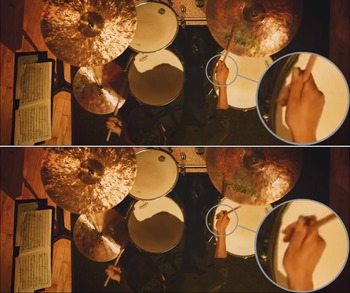
Missing in these observations is the crucial distinction between what we see and what we hear. ‘We had a visual double occasionally for a few little shots of hands. But almost everything you see on-screen is Miles himself’, according to Chazelle.Footnote 27 While some audio was also recorded live on set, though, most of what we hear, notably including the tracks for the more difficult performance scenes, was pre-recorded by an uncredited studio musician.Footnote 28 The reactions of viewers, and Teller's own remarks (whether he misleads by omission intentionally or notFootnote 29), are nonetheless revealing. For one, there is an apparent lack of ‘imaginative resistance’ among audience members here, in the sense that Ben Winters invokes in describing how his own immersion in a film's fiction is disrupted when actors fail to convincingly impersonate classical musicians.Footnote 30 Trained observers may notice the problems in Whiplash: Erskine asserts that ‘his [Teller's] hands are a mess in terms of technique, holding the sticks, etc.’;Footnote 31 in Figure 1, for example, note how the pad of Teller's right thumb does not appear to be in contact with the stick, where it should form the basis of the fulcrum. General audiences seem to be convinced by what they see, though, and if Teller looks convincing, there is no question for many viewers that ‘it's really him playing’. Along with Teller's claims, this points to the importance of visuals to the film's idea of drum kit performance.
Two stills from the same shot of Whiplash's climactic drum solo, with my zoom showing Miles Teller's right-hand grip.

It is worth examining the visual construction of Whiplash's climactic drum solo – the film's most focused depiction of performance – in detail. This comprises 101 shots (up to and including the last shot of the film, which covers the band's re-entry for a final chord, and accounting only for visible cuts), of which only six clearly show Teller's face, hands, and instrument in the same frame. More often we see close-ups of Teller's face and upper body or the instrument being struck. Though it may be Teller we most often see on screen (and Chazelle notably claims that, ‘even shots where we didn't have to have him, a lot of the times we ended up having him’Footnote 32), it is therefore possible that those ‘few little shots of hands’ for which the director admits using a visual double carry relatively significant weight in terms of authenticating the performance. Even where we do see Teller, though, framing and editing obviously played a crucial role in making the actor look believable. ‘It was a matter of choosing the best takes to keep his drumming in sync’, recounts editor Tom Cross.Footnote 33 The scene's short average shot length of just 2.85 seconds (at the original 24fps) may, in part, have been a matter of necessity in this regard.
The fast editing style did have other intended functions, though. For one, Chazelle suggests that the visual style was partly a means of illustrating musical movement:
When someone is playing drums, they aren't actually moving around a space, they're just moving their arms and limbs. They're stuck behind the drum set. So to film someone playing the drums and make it feel as kinetic as a car chase or a shootout or a battle scene was the challenge. It comes down to the tempo of the camera moves, the tempo of the cuts, the alternation between close and wide. I was just trying to think as musically as possible – to make a movie the way a musician would.Footnote 34
Cross clarifies that ‘Damien wanted to create a rhythm and a pace through the quick cutting … He wanted the cutting to be overt so the audience would feel the editing and the speed.’Footnote 35 He further suggests Chazelle ‘wanted the viewer to feel the physicality of practicing and playing’;Footnote 36 ‘he really wanted the cuts to feel brutal and violent. He told me that he wanted the music scenes to feel like the boxing scenes from Raging Bull [dir. Martin Scorsese, 1980].’Footnote 37 The final such boxing scene (Jake La Motta's 1951 rematch with Sugar Ray Robinson) was, in turn, modelled on the famously quick-cutting shower-murder montage in Psycho (dir. Alfred Hitchcock, 1960).Footnote 38
The content of the images was also important to Whiplash's creators, however. William Forde Thompson, Phil Graham, and Frank A. Russo distinguish between filmed performances in which a performer's whole body is generally shown (suggesting ‘a total performer’), and those – like in Whiplash – in which ‘contemporary and highly edited cinematography works montage-like with extreme close-ups and fast-cuts to “dismember” bodies, lingering on isolated body parts’.Footnote 39 In a montage, meaning inheres in the differences and relationships between shots, and in Whiplash the filmmakers took care to balance shots of the mechanics of performance with emphasis on the faces of – and eye contact between – Neiman and Fletcher. Close-ups of Neiman's face (or parts of it) in fact comprise roughly a quarter of the final solo's shots, and in several cases last considerably longer than the average 2.85 seconds. Cross reports that this emphasis on ‘our characters’ was added because an original version of the scene ‘didn't work emotionally’.Footnote 40 The filmmakers thus avoided a potential pitfall of the ‘dismembering’ editing style, when research shows that one role of visual aspects of music is, as Thompson et al. summarize, to ‘personalize the music, drawing performers and listeners closer together in a shared experience’.Footnote 41
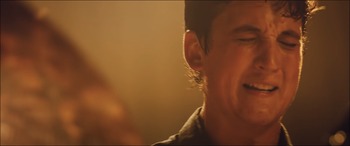
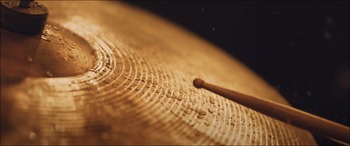
That most shots during the final solo are close-ups of Neiman or his instrument paints him as an isolated figure, notwithstanding those moments of connection with Fletcher. This sense is amplified by the roughly ten seconds mid-solo during which the sound of the instrument fades from the audio track, replaced by a faint ‘whooshing’ sound – of the blood flowing around Neiman's body, perhaps. The absence of active audio directs the audience's attention to the visual, where successive shots show Neiman's face, glistening with sweat and carrying a pained expression (Figure 2), and a drumstick hitting a cymbal (itself covered with beaded sweat) in ‘out of time’ slow motion (Figure 3). These techniques again recall Raging Bull's final boxing scene, in the subjects and forms of the shots (close-ups of Robert De Niro as a sweaty La Motta (Figure 4); the use of slow motion), and how in large part – as Tom Shone puts it – ‘[w]e hear nothing but Jake's breath, and flashbulbs, through whistling wind. He might as well be alone, with his demon – the minotaur become his own maze.’Footnote 42 Just as Scorsese wanted to communicate the fighter's own experience,Footnote 43 Whiplash's creators suggest in this moment not only the great physical effort Neiman expends (as in the many other shots of grimacing, sweat, and even blood) but also the mental demands of his solo.Footnote 44 Neiman's performance is full, then, of the ‘desperation and peril’ of Carolyn Abbate's drastic music (‘real music: the performances’, with all their ‘responsibilities and anxieties’ for the performer),Footnote 45 a concept I cite again via Winters and his discussion of film depictions of musical performance. Those depictions, writes Winters, tend to emphasize ‘the physical and mental demands of performance and the concomitant effort such performance is seen to require’.Footnote 46 In Neiman's solo, that effort is certainly seen.
Shot of Andrew Neiman's (Miles Teller) face, from Whiplash's climactic drum solo.

Shot of a drumstick hitting a cymbal, from Whiplash's climactic drum solo.

Shot of Jake La Motta's (Robert De Niro) face, from Raging Bull's final boxing match.

The fast editing style of the solo scene is the exception rather than the rule in Whiplash, but the film also emphasizes those physical and mental demands through the blood, sweat, and tears present in its other performance scenes and broader narrative. In one shot showing Neiman immediately after a gruelling rehearsal, for example, Chazelle notes in a commentary track the intention that the character's face appear swollen like a boxer's post-fight,Footnote 47 while a scene of Neiman dipping his bloody, practice-damaged hand into a jar of ice is once more lifted from Raging Bull. Neiman faces competition throughout Whiplash, such as for the Shaffer big band's drum stool or in formal band contests,Footnote 48 and further events notably include his involvement in a violent car crash while travelling to one such contest (curiously foreshadowing the crucial event in Bleed for This (dir. Ben Younger, 2016), in which Teller portrays real-life boxer Vinny Pazienza and his battle to recover from a similar accident).Footnote 49 Whiplash's suggestion of parallels between drumming and boxing specifically is not novel: a 2007 All About Jazz article argues that the practices ‘share qualities both primal and sublime’, for instance.Footnote 50 More generally, while Pillai reads Whiplash primarily as a horror film, the more obvious model is surely the sports film, in which the protagonist – often paired with the authoritarian coach – overcomes various obstacles on their rise to athletic greatness.Footnote 51 During his final solo, Neiman pushes himself towards a climax that can easily be interpreted as sexual, too: read again those pained expressions, vigorous hand movements (often ambiguously out of shot, but physically reflected in Teller's shoulders), and phallic drumsticks (Figures 3 and 4). The solo, especially as seen, is a masturbatory demonstration of Neiman's virility, through which he attains the conventional masculine-heroic status of the virtuoso. As Robert Walser notes, virility and virtuosity share the Latin root vir, man, and virtuosity consistently appears ‘concerned with demonstrating and enacting a particular kind of power and freedom that might be called “potency”’.Footnote 52 This may be particularly true in what Alex Stewart calls ‘the almost exclusively male or homosocial universe of jazz’,Footnote 53 as well as for drumming, which is traditionally coded as masculine.Footnote 54 Clearly, Whiplash works only to cement such associations.Footnote 55
Though Whiplash won the Academy Award for editing, Brody argues that it ‘has no music in its images. There are ways of filming music that are themselves musical, that conjure a musical feeling above and beyond what's on the soundtrack, but Chazelle's images are nothing of the kind.’Footnote 56 It is significant, though, that the filmmakers’ conception of the music – fast, violent, and mastered through individual athletic prowess and commitment – is actually communicated primarily through their images. Regarding the final solo, editor Cross even states that they ‘looked at the scene silently to make sure it played purely visually’.Footnote 57 Like Brody, we might find the film's vision of virtuoso drumming problematic, but here again we should consider its relationship to a broader reality in which precisely that – vision – is key. In the remainder of this article, I present a visually conscious assessment of Neiman's inspiration: Buddy Rich.
Buddy Rich: ‘mere’ virtuoso
From the beginning, Buddy Rich's career was an audiovisual one.Footnote 58 Born in September 1917, by just eighteen months old Rich was a feature in his parents’ vaudeville show as a novelty child drummer. As ‘Traps, the Drum Wonder’, Rich soon became the main attraction and apparently, for a period, the highest-paid child star in the world.Footnote 59 At age 12, he appeared in a short Vitaphone film: Buddy Traps in ‘Sound Effects’ (dir. Murray Roth, 1930). The video is lost, but the audio survives, and the marketing copy gives a further sense of the short's content and Rich's now well-rounded abilities: ‘Buddy twirls his drumsticks, tap dances unbelievably, and sings amazingly well. He beats music out of chairs, paintings, pots and pans, glasses and everything imaginable. He is one of a kind!’Footnote 60
By the 1940s, Rich was a well-known big-band drummer, and appeared in several feature films as a member of Tommy Dorsey's orchestra as well as leader of his own band. With Dorsey in Ship Ahoy (dir. Edward Buzzell, 1942), for instance, Rich stars in two numbers: ‘Hawaiian War Chant’ features a drums-and-trumpet duet with Ziggy Elman, while at the climax of ‘I'll Take Tallulah’ Rich abandons his kit to dance and juggle drumsticks with Eleanor Powell. There are no close-ups or quick cuts here; whether drumming (or rather miming, albeit to his own playingFootnote 61) or dancing, Rich's whole body is shown, framing him as the ‘total performer’ referenced by Thompson et al.Footnote 62 Rich continued to develop this identity elsewhere: in two 1947 live reviews of Rich's own band, Hal Webman tellingly refers to ‘those infrequent occasions when Rich sits in at the tubs’,Footnote 63 and how he ‘wisely holds his drumming efforts to a minimum’ (despite calling him ‘unquestionably … one of the greatest drummers ever’), while praising his singing, dancing, and ‘clowning’.Footnote 64 Later, Rich recorded three vocal albums (the first, Buddy Rich Sings Johnny Mercer, in 1956), opened two ill-fated New York City clubs (Buddy's Place, 1974, and Buddy's Place II, 1975–6), and hosted three pilot television episodes of his own variety Buddy Rich Show (1982). In his biography of Rich, Mel Tormé argues that it was through regular guest appearances on The Tonight Show, hosted by Johnny Carson and beginning in 1966, that Rich became ‘an identifiable personality in his own right … to the mass public, who instantly loved the give-and-take of quips, barbs, and laughs between Buddy and Johnny’.Footnote 65
Rich's fame was nonetheless founded on his drumming ability – his talk show appearances invariably included a performance – and it was as a drummer that he continued to have most success. ‘The Drum Wonder’ became, in adulthood, ‘The World's Greatest Drummer’, a label that sticks more than thirty years after his death in 1987.Footnote 66 Notably, Rich is revered by fellow drummers, topping Modern Drummer magazine's list of ‘The 50 Greatest Drummers of All Time’ in 2014.Footnote 67 For Matt Brennan, ‘Rich's key contribution was to raise the benchmark for technique and execution on the drums’, and indeed his technical ability continues to impress even by modern standards.Footnote 68 The criticisms that we have already seen applied to Whiplash – that there was little substance behind Rich's speed and that he was problematically individualistic – have a long history, though. In 1939, for example, critic George T. Simon wrote that Rich, playing with Artie Shaw's band, was ‘cursed with the misconception that the drummer is supposed to do more than supply a good background. As a result, Buddy in his enthusiasm plays too much drums, consequently breaking up the general rhythmic effect.’Footnote 69 Shaw himself recalled complaining to Rich in that same year that his playing was ‘like a drum solo accompanied by the band’.Footnote 70 Even the actual solos for which Rich became famed are not immune to criticism: in a 1960 review of the drum-battle album Rich Versus Roach, for instance, Max Harrison compared Rich unfavourably with his peer Max Roach, asserting that ‘Rich's contributions are little but technical displays while Roach shows, as everyone would expect, a great deal of rhythmic imagination and a more flexible approach to his instruments. There is a great variety, more light and shade, in his solos.’Footnote 71
Rather as in much nineteenth-century criticism of classical virtuosity, Rich is here seen to be in service of himself more than the music. The parallel is inexact, of course: classical music became firmly established as a composer's art in the nineteenth century, with influential critics promoting ideals of werktreue and of instrumental music's aesthetic autonomy, and judging virtuosic liberties and physicality harshly against them,Footnote 72 whereas jazz has always been primarily a performer's art. It is for this reason that Antoine Hennion hears ‘an aesthetic of virtuosity’ in John Coltrane's Giant Steps: in jazz, the bodily act of performance is the making of the work of art, rather than a reading of the work that can only (per Romantic and then Modernist aesthetics) either realize or detract from it.Footnote 73 The art, and a jazz performer's contribution to the making of it, might still be judged more or less successful, though, and for reasons similar to those used in arguments against classical virtuosi. A vein of Rich criticism closely echoes one put against Liszt, in fact, for his performing style that, in Kramer's words, ‘courts visual excess and foregrounds the performer's body’.Footnote 74 Pianist Ethan Iverson, in a critique of both Rich and Whiplash, finds fault again with Rich's aural ‘hyperactivity’ – the way he ‘would cram everything he could into every corner’, playing ‘almost as much during the band parts as during the solos’ – but also notes his ‘antics and theatrics’ and labels him a ‘stage band drummer’ (‘“Stage band” suggests a big band in a floor show [in] Las Vegas, playing for burlesque, crooners, dinner, dancing, and the occasional hot instrumental capped by drum fireworks and a final blaring “Ta-dah!”’).Footnote 75 Rather like Williams, Iverson thereby distances Rich from a central tradition of jazz drummers exhibiting what he terms a ‘devotional’, specifically African attitude to performance. According to Iverson, jazz drummers should be concerned with the collective and with the ‘feel’ of the music, and not with individual – and implicitly visual – showmanship.Footnote 76
Much of the recent criticism of Rich, as exemplified by those articles that link him to Whiplash, is an understandable and welcome corrective to the ‘world's greatest drummer’ line of celebration he has inspired elsewhere. Such celebration is especially fraught in recognition that Rich – a white and conventionally handsome man – achieved his status with the support of an institutionally racist and sexist entertainment industry. This is a particularly important acknowledgement in a visually conscious assessment of Rich: put simply, he would not have had the same opportunities (and especially the many audiovisual opportunities) to become a star had he looked different. Moreover, though Rich worked with and professed admiration for many significant African American jazz musicians,Footnote 77 those opportunities towards stardom involved his contributing to a relatively white, commercial, and arguably exploitative corner of the jazz world. One of the more famous Rich performances, for example, is his drum battle with Gene Krupa in a 1952 Jazz at the Philharmonic (JATP) concert at Carnegie Hall (later released on record as The Drum Battle: Gene Krupa and Buddy Rich at JATP, in 1960; the battle also toured other venues with JATP). Addressing the relationship of publicly staged instrumental battles to the contests that had a long history in private jazz and pre-jazz jam sessions, Katherine Walker argues that ‘the promotion of sensationalized, combative cutting in publicly staged battles – such as those featured in the Jazz at the Philharmonic concert series – detached the surface act of cutting from the spirit, purpose, and meaning of competition’ in the latter.Footnote 78 Specifically, private jam sessions offered ‘a competitive environment that was nevertheless highly cooperative, productive, and community-centered’, directed towards the education and elevation of black music and musicians, whereas their public equivalents exploited white fascination with supposedly ‘primitive’ black culture for commercial gain.Footnote 79
Iverson makes the point in deliberately polemical terms: ‘if you think Buddy Rich is the greatest jazz drummer, you are racist’.Footnote 80 He affirms elsewhere that ‘all the very greatest jazz drummers have been African American’.Footnote 81 There is no doubt that Rich's stardom comes at the ongoing expense of popular recognition for the contributions of black jazz drummers in particular. In a recent Reader's Digest feature on ‘7 Greatest drummers of all time’, for example, Rich appears alongside fellow white jazz drummers Krupa and Joe Morello in a list that features Art Blakey as its only person of colour.Footnote 82 While calling out this injustice, though, we can also recognize that certain jazz ideals cited by those who downplay Rich's significance are constructs, much like the ideals that concerned earlier critics of classical virtuosity. Authentic jazz is commonly proposed to be spontaneous, essentially African American, and a form of art. The conventional story of the jazz tradition, furthermore, is one of continuous stylistic evolution. By default, Rich does not meet the bar set here for jazz ‘greatness’. He was a white man best known for promoting composed, commercial, swing-oriented music decades after the advent of bebop (the innovations of which he railed against).Footnote 83 He performed with great speed, power, and precision, and developed a style identifiably his own, but did not instigate wider changes in how the instrument (and, more broadly, the music) was played in the manner of, say, Kenny Clarke (who established new roles for the bass drum and ride cymbal and thereby helped to invent bebop itself).Footnote 84 Rich is therefore not a major figure in most ‘serious’ jazz histories, but greater fault here may lie with those histories: Scott DeVeaux argues that the aforementioned ideas about jazz authenticity originated in association with specific social and political goals, particularly at the time of the bebop revolution (which explicitly opposed swing-era big-band commercialism), and were adopted by the broader jazz world for reasons of cultural and historical legitimation – the idea of a unified, evolving jazz tradition being attractive even as it ignores obvious discontinuities between styles.Footnote 85 Other conceptions of the music and its history are possible, and one's estimation of Rich's contribution to both will depend largely on one's chosen perspective.
Rich, and Neiman after him, belong to a jazz tradition that has visuality at its centre. Krupa was their key predecessor as a drummer: Brennan notes how ‘flamboyant showmanship … combined with the visual of Krupa's commanding, grunting presence and cinematic good looks’ to give him ‘his irrepressible star quality’.Footnote 86 Jazz showmanship is not the sole preserve of drummers, though. Much early jazz and swing-era performance was visual in nature: Catherine Tackley discusses the Original Dixieland Jazz Band's (ODJB) ‘awareness of the demands of variety theatre, in which acts had to be visually as well as aurally attractive’, for instance, and shows that the consequent integration of dancers into their 1919 London performances resulted in these being ‘perceived as an “act” which was visually and choreographically, rather than solely musically, entertaining’.Footnote 87 (Tackley also challenges those who dispute the ODJB's broader authenticity, arguing that the band and their music ‘were clearly rooted in and representative of the New Orleans musical tradition’, reflecting that city's ‘wide racial mix’ and productive mingling of musical practices.Footnote 88) While some later jazz moved away from visuality, there was also continuation, not least where the careers of musicians such as Rich successfully spanned several supposed ‘eras’ of jazz history. There are important disclaimers to make around this visual tradition – the connections to minstrelsy, the privileging of certain identities and pandering to racist tastesFootnote 89 – but it has also been consumed by large audiences and for valid reasons, and therefore warrants attention.
To be clear, I do not mean to equate prejudice against Rich's playing with the considerably more damaging prejudice still faced by black musicians, for which Rich holds some responsibility as a willing participant in a racist industry. Nonetheless, the former prejudice exists and clouds assessments of Rich, balancing the ‘world's greatest’ label but only by placing him in the similarly uncritical category of ‘mere’ virtuoso, via judgements based on subjective taste and constructed ideas of authenticity. Moving forward, I wish primarily to understand Rich's work, and in that regard, to dismiss him for failing to live up to ideals held by others is unhelpful.Footnote 90 Instead, Rich must be met on his own terms, and those of his audience. In particular, while Rich might have claimed that he was not a ‘showman’,Footnote 91 I am convinced that such a visual identity – understood in a neutral rather than derogatory sense – was an intentional and central part of his appeal. Indeed, for it not to have been seems improbable, given that Rich's performances were so often – and still are – seen, his legacy stretching from vaudeville now on to YouTube videos with sensational titles and millions of views (e.g., ‘BUDDY RICH IMPOSSIBLE DRUM SOLO *HQ*’, nineteen million views at time of writingFootnote 92). The next section therefore explores visual aspects of Rich's playing in more detail.
Rich's visuality
To see Rich sitting behind his drums, grimacing, covered with perspiration, bearing down on an extended single-stroke roll as if focusing a laser upon the head of his snare drum, then exploding around his set in a staggering display of coordination and endurance, was to witness high drama.Footnote 93
Tom Piazza's evocative description of a Rich solo (which could apply just as easily to Neiman's final solo in Whiplash) draws attention to both the visual appeal of Rich's playing (‘To see Rich’) and the particular nature of that appeal. Today, the dominant image of Rich is not of the joyful, carefree performer seen in Ship Ahoy. In Iverson's terms, it is of ‘the sweating white athlete’.Footnote 94 Particularly in the extended, climax-of-the-set solos of his later career leading his own big band, from 1966 until his death in 1987, Rich promotes an idea of the drum solo as athletic endeavour. He does so largely visually (‘grimacing, covered with perspiration’, so exhibiting Abbate's desperation and peril) and to great effect (‘high drama’).
Generally speaking, the virtuoso-as-athlete trope is less common than its effective opposite. James Deaville notes how ‘evident visible and audible ease in performance has been valorized as a sign of virtuosity, within the paradox that only hard work could produce such apparent effortlessness’.Footnote 95 Liberace might be compared to Rich in many regards, as another popular twentieth-century virtuoso whose fame spread through performances on audiovisual media – performances which emphasized visuality, moreover, and which have been derided by ‘serious’ critics for displaying style over substance (in this case relative to the norms of the classical tradition).Footnote 96 Yet Liberace's performances convey effortlessness and a domestic intimacy, in the way his hands glide across the keyboard, in his knowing smiles to the audience and camera, and in the fancy-domestic candelabra that adorns his piano. Rich is different perhaps simply because his instrument and style do require more physical effort; certainly, his perspiration was not ‘fake’. Then again, the athletic style was one that he deliberately pursued through his musical choices, one that the evidence of Ship Ahoy and other screen appearances suggests could have been replaced wholly or partially by an impression of ease, and one that notably also aligns with long-standing – and commercially exploitable – ideas of drumming as ‘primitive’.Footnote 97
In a 1985 televised interview with Larry King, Rich spoke clearly of the potential effects of visuals in response to King's question about whether an audience could be ‘fooled by histrionics’:
There's a million things you can do, there's all kinds of gyrations to go through, and faces, and, er, making it look a lot more difficult than it is, because it really isn't that difficult. And you can make an audience feel, by the visual aspect of playing, that you are playing way above what you are really playing musically.Footnote 98
Rich's remarks do not constitute a mea culpa as such – he again insisted he was ‘not so much of a showman’ and appeared to aim the words above at drummers who ‘can't play’. Some level of showmanship is inevitable, though. I draw here on Philip Auslander's notion of musical personae, wherein ‘[w]hat musicians perform first and foremost is not music, but their own identities as musicians, their musical personae’.Footnote 99 These personae ‘reflect the priorities of the performance context’ and are thus not fixed, though they are subject to expectations based on the audience's prior knowledge of the same performer; Auslander stresses that the audience co-creates the persona by negotiating a ‘working consensus’ with the performer.Footnote 100 Rich projected a ‘serious’ attitude in interviews as well as performances (recall ‘I concentrate on what I play – because I want to play good’Footnote 101), and that attitude was also apparent when he was unknowingly recorded ranting at his band on their tour bus.Footnote 102 We do not need to decide here whether Rich's serious, athletic musical persona was ‘genuine’ or not, though, or how consciously he might have performed it; the important point is to acknowledge that we do always see a persona when we see him perform and that it is always a creation. To quote Jenny Doctor, Peter Elsdon, and Björn Heile in the introduction to their edited volume Watching Jazz: Encounters with Jazz Performance on Screen, ‘[t]his way of thinking should dispel any idea that watching jazz performers on screen can or should be seen as thoroughly different from watching actors’.Footnote 103
In his own chapter in Watching Jazz, Elsdon furthers the musician–actor comparison by arguing that ‘jazz on film is never unmediated’.Footnote 104 Actors are only one cog in the filmmaking machine, and when we see Rich on screen – the only opportunity we now have to see him – we must always account similarly for his mediation by camera operators, directors, and editors. This is as true of a documentary concert film as it is of Ship Ahoy. It is as true of watching Rich as it is of watching Neiman. Rich's contribution to the creation of his own persona is greater than Teller's contribution to the Neiman persona, of course, and those who filmed Rich have relatively less influence than did Chazelle and his colleagues. Yet that influence is still present, and both Neiman and Rich are therefore mediated virtuosi.
With all this in mind, I turn now to examine one common component of a Rich solo – a component that was, in fact, imported directly into Neiman's final solo in Whiplash. Bill Reddie's West Side Story Medley, an arrangement of themes from the Leonard Bernstein musical, was commissioned by Rich for the 1966 engagement of his then-new band at the Chez Club in Hollywood, and recorded there for the album Swingin’ New Big Band. Thereafter, it was a popular element of Rich's performances – including several that were filmed – until his death, generally ending the final set. On record, the piece lasts for nearly eleven minutes, passing through renditions of Bernstein's ‘Prologue’, ‘Somewhere’, and ‘Something's Coming’ before a ninety-second Rich solo that leads to a brief band finale. Live, however, Rich treated the medley's structure flexibly and primarily as a vehicle for his solo display. The piece could run up to and beyond fifteen minutes, incorporating one or two extended drum solos totalling half or more of its duration, and often cutting one or both of ‘Somewhere’ and ‘Something's Coming’. The most extreme format, in which the ‘medley’ actually consisted only of the three-minute ‘Prologue’ and a longer solo, was common from the mid-1970s onwards.Footnote 105 Whatever the structure, though, a Rich solo always brought the piece towards climax and the band finale, and this solo regularly featured a gradually accelerating single-stroke roll – that is, a roll executed with the hands playing alternate single strokes: right, left, right, left – performed on the snare drum. Rich began the roll slowly and deliberately, before quickening to a visual and sonic blur.
The accelerating single-stroke roll was so common that Tormé describes it at length. The West Side Story solo ‘was different every time Rich played it’, he writes, but nevertheless ‘took on a specific form’ that included the roll – ‘a supersonic display of precision and speed that left even the most jaded watchers and listeners gaping in disbelief’ – to build to a climax and the band's re-entry.Footnote 106 The tension between jazz as a supposedly improvisational music and the use of such a stock device is worth noting here. Heile examines audiovisual recordings of ‘serial’ live performances by Duke Ellington's band to challenge the myth of jazz as essentially improvisatory, arguing that Ellington instead gave the audience what they wanted – namely, what they recalled from his records, including solos repeated almost note-for-note.Footnote 107 Drawing again on Auslander, Heile finds that Ellington's musicians still performed spontaneity, including through visual means, and thereby encouraged their audience to understand what they experienced as spontaneous at least in quality, if not as literally improvised. Rich's repetition is less straightforward because the roll is not present on the Swingin’ New Big Band recording, and is part of a solo that changed in shape and detail in other ways, too. It is nonetheless possible that some audience members would expect it, from having previously seen and/or heard (or heard about) other performances in which it occurred. From today's perspective, when we can see Rich perform the roll in several videos on YouTube alone, this expectation is more likely to be present when we encounter another West Side Story solo. It is therefore key to the device's effect that Rich appears invested in its execution, so that the roll does not seem a mere obligation.
Visuals are not just an ‘addition’ or ‘enhancement’ here, though. The accelerating single-stroke roll is as much a visual device as a musical one. Sonically, the roll has an overt narrative drive that should not be underestimated (and that perhaps partly explains why it is also the first sound heard in Whiplash, over a black screen),Footnote 108 but no timbral or dynamic variation, and is also unmetered. It is, then, relatively unmusical. The audience's attention is thereby directed to the visual, and not only to Rich's ancillary ‘investment’ gestures (effortful facial expressions and so on; gestures that represent ‘a link between the music and the expressive intention of the musician’) but also to his instrumental actions (those ‘responsible for sound production)’.Footnote 109 Simplicity is crucial here. Rich starts the roll slowly so that we can see what he is doing, and we therefore see that there is no ‘trick’ involved. He could generate much the same sound using a double-stroke roll (right, right, left, left), for instance, exploiting the way the stick rebounds off and back on to the drumhead to achieve high velocity more efficiently (with two strikes per downward stroke). Instead, he uses a single-stroke roll for a clearer – and, at faster speeds, more spectacular – cause-and-effect relationship of action to sound. This is drumming in its most elementary form, reduced to a straightforward and largely visual expression of athleticism – the musical equivalent of the 100-metre sprint (and a challenge that has since become the basis of the ‘World's Fastest Drummer’ competition, marketed as ‘extreme sport drumming’).Footnote 110
Rich's deliberately didactic and unmusical use of single strokes encourages not merely an abstract comprehension of his athletic ability but more particularly a ‘bodily empathy’ with his actions even among non-drummers and non-musicians and perhaps to the extent that the audience member actually moves their body in mimicry.Footnote 111 Paul McIntyre discusses this effect in filmed jazz performance, drawing on observations from psychology regarding ‘embodied cognition’ (the idea, quoting Marc Leman, that ‘music is performed and perceived through gestures whose deployment can be directly felt and understood through the body’Footnote 112) and ‘motor resonance’ (‘observers feel physically stimulated by others’ actions’Footnote 113). McIntyre concludes that ‘performers’ use of gesture, embodied cognition, and motor resonance … allow viewers not only to empathize with musicians but also to feel “part of the music”, partaking of a shared experience’.Footnote 114 Rich's apparent success in this regard is evidenced by his audiences’ responses: on live recordings, the roll can reliably be heard to elicit loud cheers of both encouragement and celebration (rather like those that might be directed at a sportsperson). Audience members understand what Rich is doing here – for a while they can even do what he is doing – and are therefore all the more impressed when he proceeds beyond their own limits and expectations.
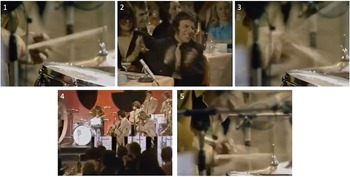
That the roll seems to ‘work’ for Rich's live audiences calls into question McIntyre's further suggestion that the perception of a shared experience ‘depends … crucially’ on filming and broadcast technologies to create ‘an illusion of intimacy and direct presence’.Footnote 115 It might be that one or more of drumming, Rich, and the accelerating single-stroke roll present a special case, given factors such as the size and simplicity of the instrumental gestures involved.Footnote 116 Undoubtedly, though, those technologies still amplify the effect. The framing of the roll in a 3 January 1970 BBC broadcast – Buddy Rich at the Talk of the Town (prod. Terry Henebery) – is typical (see Figure 5). As the roll begins, an on-stage camera zooms in to show only Rich's hands, sticks, and snare drum, responding to Rich's focus on that instrument and offering a clear view of the roll's execution. As the roll accelerates into the climactic section of the solo, this close-up shot alternates first with a view of audience members applauding, and then with a long shot from the audience's perspective showing Rich in the context of his band (who are all turned to watch him), zooming towards a front view of the drum kit. This long shot draws attention to the posture and movement of Rich's entire upper body, which hunches over the snare, and moves up and down with apparent effort as he uses the bass drum to re-establish metre underneath the continuing roll. The original close-up then returns with a slightly wider angle, showing Rich's face hunched into the top of the frame, dripping sweat as he stares down at almost ninety degrees.
Sequence of shots from Buddy Rich at the Talk of the Town, covering the accelerating single-stroke roll in Rich's West Side Story Medley solo.

The same core elements are emphasized by the camera's mediation here as in Whiplash: the movements of hands, the concentration and physical effort required, and the connection established with others (the live audience, in Rich's case). Aside from their power to bring Rich into the audience's own space (on television or, now, computers and other devices), the close-ups in the BBC broadcast additionally enhance the inherent intimacy of his accelerating roll. Rich cradles the snare drum not only between his legs, as is standard, but also with his upper body. He consistently played with poor posture, but his hunch here is an exaggeration, and the final shot in the sequence further emphasizes it by using Rich's torso and head as a visual frame for his hands and instrument. While the intimacy conveyed may be constructed, though, it is clearly opposed to the exhibitionist ‘gimmicks’ that Rich derided in rock drum solos, and which Brennan traces from the ‘ever-larger drum kits’ of the 1970s onwards to the ‘ridiculous heights’ (quite literally) of Mötley Crüe's Tommy Lee, whose live performances have been enhanced by stage set-ups including two ‘which effectively saw Lee and his kit riding on an actual roller coaster during his solo’.Footnote 117 Rich was often showier, of course, particularly in more obviously entertainment-led contexts – he even once performed upside down, on an episode of the television show What's My Line? Footnote 118 By contrast, his performance of the accelerating single-stroke roll – an essential component of his virtuoso-soloist act – was more serious, drawing attention inward to the body and a purer kind of musical-athletic challenge. However, it was nonetheless showmanship, in which a visual impression of effort and commitment authenticated what was unashamedly ‘mere’ technical display. This may have been unconscious, Rich's formative and continuing experiences on stage and screen having moulded him into an instinctive showman, but in any case – and whatever his own protests about such a label – Rich the virtuoso clearly was a showman who must be understood visually as well as aurally.
Conclusion
Rich competed against his peers in numerous drum battles throughout his career, but even a Rich solo can be understood as a kind of battle – against his own limitations, and those of his instrument. The former understanding is illustrated by ongoing discussions about the relationship between Rich's drumming and his general health. Rich suffered from heart and back problems through the latter years of his career yet kept a busy touring schedule. The aforementioned ‘IMPOSSIBLE DRUM SOLO’ YouTube video comes from a West Side Story Medley performance at the Concert for the Americas festival, held in the Dominican Republic in 1982.Footnote 119 This now also circulates in online discourse as the solo during which Rich had a heart attack, but managed to finish the performance anyway.Footnote 120 The truth is less certain: band member Dave Stahl recalls that Rich might have been ‘close to a heart attack’, and it is not clear if he saw a doctor.Footnote 121 Yet the myth itself is instructive in how it draws on and feeds broader perceptions of drumming as physically demanding. Rich, we are encouraged to believe, had a heart attack during a solo because a drum solo is a physical challenge; Rich is great because he could overcome even a heart attack to deliver a performance, thereby demonstrating his ultimate commitment to the music. The image of Rich sweating and grimacing authenticates the myth, to the extent that some of that online discourse focuses on where in the video one can supposedly see the heart attack occur.Footnote 122 Such comments can only be speculative, but one thing is certain: we cannot hear a heart attack occur, just as we cannot hear Rich's perspiration and facial expressions.
The idea of drumming as physically demanding was picked up in Whiplash, of course. It can also be seen elsewhere today: the Pound workout encourages participants to ‘[c]hannel your inner rockstar with this full body cardio-jam session inspired by the infectious, energizing, and sweat-dripping fun of playing the drums’,Footnote 123 for instance, while a 2008 BBC News story claimed that ‘[p]laying the drums for a rock band requires the stamina of a Premiership footballer’,Footnote 124 on the basis of a limited study involving Blondie drummer Clem Burke. More substantial studies focusing on rock and heavy-metal drumming have since confirmed that these can be relatively athletic activities, but again, for the present purposes, the existence of the idea is more important than the evidence for it.Footnote 125 Millions have seen Rich and Neiman perform, and the images of those performances therefore wield significant influence over popular understandings. To what extent a virtuoso-drummer-as-athlete trope has now solidified, and whether its place in the cultural imagination might be challenged by a more nonchalant vision of drumming virtuosity, are questions worthy of future study.
The development of the drum kit during the twentieth century places special emphasis on the role of audiovisual media in communicating the instrument's performance practices. This is another area that warrants further enquiry. Such media undoubtedly amplify the inherent visuality of drumming in the performances discussed here, not only by broadcasting them to large audiences but also through specific visual tactics executed by filmmakers. Andrew Neiman, as the audience experiences him, is therefore obviously a collaborative construction, but so is Buddy Rich, and not just in contexts such as Ship Ahoy where composition and choreography extend filmmakers’ control to the gestural level. Rich performed his ‘serious’ virtuoso persona live, but the audience members who co-create that persona have done so in far greater number via mediated visions of his musicianship. The screen seemingly gives us direct access to Rich's body, a clearer view of his mastery of his instrument, yet the filmmakers’ choice of what we see is still that: a choice that informs our understanding in particular ways. Alongside acknowledging that Rich's virtuosity is visual, then, any analysis must recognize that his visuality is not entirely his own.
That Rich nonetheless used visuality as a component of his playing, thereby attracting the attention of filmmakers and audiences and bringing the drum kit into the musical foreground, returns us to that other idea: that we see him battling against the limitations of his instrument. Drummers have been stereotyped as noisemakers rather than musicians, and the drum solo as an uninteresting part of any concert.Footnote 126 Recalling Huang's suggestion that percussionists tend to ‘“act out” what their instruments cannot do’, visual appeal arguably substitutes for the ‘missing’ musical elements of melody and harmony in the performances examined here. The accelerating single-stroke roll, in particular, is a considerably more engaging device when seen as well as heard, at least when performed with the apparent commitment of Rich or indeed Neiman. This suggests that visuality is especially important – or even essential – to popular drum kit virtuosity, and therefore that drummer-soloists aiming for broad appeal are bound to face critical opposition: their playing will either be heard as meaningless noise or seen as excessively theatrical. The commonly held musical ideals of which visuality, and ‘mere’ virtuosity more broadly, fall foul – in jazz as earlier in classical music – are not inherently correct, however. That visuality is part and parcel of performances by Neiman and Rich should not automatically lead to their dismissal on the basis of pre-existing values, but instead encourage the reappraisal of those values in light of how the performances are shown to work. Returning to Brody's opinion that Rich was ‘a TV personality, not a major jazz inspiration’, then, we might ask: can he not be both?