According to reports from GLOBOCAN 2020, gastric cancer (GC) was ranked fifth in incidence and fourth in mortality globally, with estimated worldwide age-standardised incidence rates of 15·8 and 7·0 per 100 000 for males and females, respectively(Reference Sung, Ferlay and Siegel1). Following this pattern, in South Korea, even though the incidence of GC has consistently declined from 1999, it remains one of the three leading cancers in terms of incidence (lung cancer, colorectal cancer and GC)(Reference Sung, Ferlay and Siegel1,Reference Kang, Jung and Bang2) . The age-standardised incidence rates are about 44·3/100 000 males and 18·3/100 000 females(Reference Kang, Jung and Bang2). Therefore, developing policies for GC prevention is an important health concern, particularly through identifying specific potential risk factors, including lifestyle behaviours and diet consumption.
Numerous high-risk factors for GC have been confirmed, including Helicobacter pylori (H. pylori) infection, which the International Agency for Research on Cancer categorises as a group 1 carcinogen(Reference Tio, Andrici and Cox3). Dietary factors are considered modifiable risk factors, contributing to about 35 % of all cancer causes. Thus, it is essential to identify diet-related factors linked to cancer(Reference Doll and Peto4,Reference Willett5) . Several molecules are involved in one-carbon metabolism (OCM), including vitamin B group, methionine, choline, betaine and cysteine(Reference Dugue, Bassett and Brinkman6). Among these nutrients, epidemiological research suggests that vitamin B related to OCM and methionine could have significant impacts on GC(Reference Lu, Gunathilake and Lee7–Reference Galvan-Portillo, Cantoral and Onate-Ocana9). The potential biological mechanism of the association between OCM and cancer could be the synthesis of nucleotides, the building blocks of DNA and RNA, and the process of DNA methylation(Reference Dugue, Bassett and Brinkman6). However, findings from epidemiological studies are inconsistent. For example, a meta-analysis showed that higher folate intake and GC risk were not significantly associated(Reference Tio, Andrici and Cox3). Meanwhile, a prospective study from Japan indicated no association between any dietary intakes of folate, vitamin B6, vitamin B12 and methionine with the risk of GC(Reference Khairan, Sobue and Eshak10). In contrast, some studies have found higher riboflavin, folate and vitamin B6 intake might reduce the risk of GC(Reference Lu, Gunathilake and Lee7–Reference Galvan-Portillo, Cantoral and Onate-Ocana9). Therefore, dietary intake of B vitamins and methionine might play an essential role in the development and progression of cancer(Reference Bassett, Hodge and English11), and genetic contributions to GC risk could be an important factor.
OCM includes a range of complex biosynthetic reactions involving a cycle of one-carbon units. OCM consists of the folate cycle, the remethylation of methionine and the transsulfuration pathways(Reference Xu and Sinclair12,Reference Newman and Maddocks13) . In the methionine cycle, S-adenosylhomocysteine hydrolase (AHCY) facilitates the reversible breakdown of S-adenosylhomocysteine (AdoHcy) into adenosine and homocysteine(Reference Clare, Brassington and Kwong14). When AHCY activity is reduced, AdoHcy levels can rise, leading to a decreased S-adenosyl methionine to AdoHcy ratio and disrupted methylation processes(Reference Feng, Keshtgarpour and Pelleymounter15). These changes in DNA methylation might be crucial in the initiation and progression of cancer. Consequently, abnormal DNA methylation has been identified in multiple types of cancers, such as those affecting the colon, stomach, cervix, prostate and breast(Reference Mahmoud and Ali16). In addition, there is a diversity of genes that participate in regulating the activities of enzymes in OCM. However, most previous studies focused on the methylenetetrahydrofolate reductase(Reference Galvan-Portillo, Cantoral and Onate-Ocana9,Reference Chen, Yuan and Duan17,Reference Chang, Chang and Butler18) , methionine synthase reductase and methionine synthase genes(Reference Chang, Chang and Butler18,Reference Zhao, Gu and Xu19) to observe the interaction among these genes and cancer risk. However, the evidence of the association related to the AHCY gene has been less elucidated in recent years. Thus, it is important to focus on the interaction between nutrients related to OCM intake and AHCY genetic polymorphisms in the risk of cancers. Additionally, a variant that potentially causes an associated disease could affect the function of the related gene by altering transcript expression or protein levels(Reference Pyun, Gunathilake and Lee20). A population-based colorectal cancer case–control study lists the AHCY rs819173 variant in their large research as a potential candidate single nucleotide polymorphism (SNP) of folate-associated OCM and colorectal cancer risk(Reference Levine, Figueiredo and Lee21). In addition, the AHCY rs819173 is considered to be associated with obesity among Indian children(Reference Tabassum, Jaiswal and Chauhan22), which is known as a risk contribution for GC(Reference Bae23). Therefore, it is hypothesised that there might be an interactive effect between nutrients related to OCM intake and AHCY rs819173, a potential candidate SNP influencing colorectal cancer susceptibility and related to obesity in previous studies(Reference Levine, Figueiredo and Lee21,Reference Tabassum, Jaiswal and Chauhan22) .
Thus, we aimed to determine whether dietary nutrients related to OCM intake (including vitamin B2, vitamin B3, vitamin B6, vitamin B9, vitamin B12 and methionine) play a protective role against GC and whether this preventative effect interacts with AHCY rs819173 in a Korean population.
Materials and methods
Study population
This study used data from a hospital-based case–control study at the Korean National Cancer Center (KNCC). Details of this study can be found elsewhere(Reference Gunathilake, Lee and Jang24). The recruitment of participants was carried out from March 2011 to December 2014 at KNCC. Initially, a total of 1727 participants were recruited, including 1227 controls and 500 GC patients. GC cases were primarily diagnosed with GC within 3 months prior to enrolment and confirmed as invasive carcinoma at the Center for Gastric Cancer, KNCC. Individuals with severe chronic illnesses (diabetes mellitus, a history of cancer within the past 5 years, advanced GC, or severe systemic or mental disease), as well as pregnant or breast-feeding women, were not included. Meanwhile, controls agreed to participate in this study when they had a physical examination at the Center for Cancer Prevention and Detection at KNCC, which verified that they had no prior history of cancer or other significant co-morbid conditions (diabetes mellitus, gastric ulcers and H. pylori treatment). Data were collected through a semi-quantitative FFQ (SQFFQ) and a self-administered questionnaire. Participants with incomplete information on the SQFFQ or a total energy intake below 500 kcal or above 4000 kcal were excluded. The control and case groups were then matched in terms of age (within 5 years) and sex at a ratio of two controls to one GC patient. Subsequently, the sample included 1245 participants, with 830 controls and 415 GC patients, to determine the association between nutrients related to OCM intakes and the GC risk. In addition, after the quality control process of genetic information, forty-four cases and ninety-two controls were excluded because of missing genotype data. Finally, a total of 371 GC cases and 738 healthy controls were included in the examination of the interaction between the AHCY rs918173 polymorphism and nutrients related to OCM intake in GC risk (Fig. 1). This study was conducted according to the guidelines laid down in the Declaration of Helsinki and was approved by the Institutional Review Board of KNCC (NCCNCS1138 and NCC2021-0181). All participants provided written consent before joining our study.
Flow chart of the study participants.

Data collection
Information regarding the participants’ demographics and lifestyle factors was obtained from structured questionnaires administered by experienced and well-trained interviewers. Demographic data included age, sex, body mass index (BMI) (kg/m2, categorised as < 23, 23–< 25 or ≥ 25), education level (middle school or lower, high school, college or higher), occupation (group 1: professionals, administrative management; group 2: office, sales and service positions; group 3: agriculture and labourers; group 4: unemployed or other), marital status (married, other) and income level (in 10 000 won/month, categorised as < 200, 200–400 or ≥ 400). Lifestyle factors information included smoking status (current smoker, ex-smoker and never smoker), alcohol consumption (current drinker, ex-drinker and never drinker) and regular exercise (yes and no). Medical history data included first-degree family history of GC (yes and no). H. pylori infection (yes and no), which was assessed using a rapid urease test and histological evaluation.
The validated 106-item SQFFQ was utilised to determine the participants’ dietary intake of nutrients. This questionnaire consisted of nine categories for food consumption frequency (never or rarely, once a month, 2–3 times a month, once or twice a week, 3–4 times a week, 5–6 times a week, once a day, twice a day and 3 times a day) and three portion-size categories (small, medium and large) in the past year. The validity and reproducibility of the SQFFQ for Koreans have been reported elsewhere(Reference Ahn, Kwon and Shim25). Briefly, the validation of this FFQ was evaluated by comparing it with 3-d diet records (DR), while its reproducibility was assessed by two trained dietitians administering the FFQ at the start and end of the study. The cross-classification between the DR and FFQ for assessing the intake of two OCM nutrients (vitamin B6 and vitamin B9) was deemed reasonably acceptable. After adjusting for age, sex and energy, the de-attenuated correlation coefficients for vitamin B6 and B9 density between the DR and FFQ1 and FFQ2 were 0·50 and 0·40 for vitamin B6, and 0·44 and 0·34 for vitamin B9, respectively. Additionally, Pearson’s correlation coefficients between FFQ1 and FFQ2 for vitamin B6 and B9 intake were 0·44 and 0·43, respectively, while the values for vitamin B6 and B9 density were 0·27 and 0·28, respectively. To calculate the daily nutrient intake for each participant, the CAN-PRO 4.0 (Computer Aided Nutritional Analysis Program, Korean Nutrition Society) was used. Total energy intake (kcal/d) was determined by summing the energy amounts obtained from various food groups.
SNP genotyping
Initially, blood samples were obtained from the study participants to isolate their DNA, utilising the MagAttract DNA Blood M48 Kit (Qiagen) along with the BioRobot M48 automatic extraction equipment (Qiagen). Subsequently, SNP genotyping was carried out using the Illumina MEGA-Expanded Array (Illumina Inc.) consisting of 123 000 SNPs. Details of this approach can be found elsewhere(Reference Lu, Kweon and Cai26). Additionally, during quality control, ineligible genetic markers were excluded based on predefined criteria, namely a minor allele frequency below 0·05, Hardy–Weinberg equilibrium with a P-value less than 1 × 10⁻⁶, and a low call rate (< 98 %). Ultimately, the AHCY rs918173 was identified as the target SNP for subsequent analysis.
Statistical analysis
For the data analysis, the χ 2 test was utilised for categorical variables, and the Student’s t test was applied for continuous variables to assess the distinction of demographic characteristics between GC cases and controls. Each type of dietary vitamin B intake and methionine were adjusted for total energy intake using the residual method. In order to determine the association between dietary nutrients related to OCM consumptions and GC risk, the intakes of those nutrients were categorised into tertiles based on the distribution in the control group, with the lowest tertile used as the reference category. Total nutrients related to OCM intake score was created to evaluate the effect of five types of vitamin B and methionine intakes on GC. In detail, 1, 2 and 3 scores were assigned to participants in tertiles 1, 2 and 3 of each type of vitamin B (including vitamin B2, vitamin B3, vitamin B6, vitamin B9 and vitamin B12) and methionine, respectively(Reference Poursalehi, Lotfi and Mirzaei27,Reference Kadam, Dalloul and Hausser28) . The total nutrients related to OCM intake score for each participant was then calculated by summing a participant’s values assigned to those six nutrients; scores range from 6 (lowest) to 18 (highest); participants were categorised into three groups by tertiles, low intake, medium intake and high intake. The OR and 95 % CI were calculated using unconditional logistic regression models. In addition, we adjusted for confounding factors in the multivariable models. Specifically, model I was a crude model; model II was adjusted for age, sex, BMI, educational level, income, marital status, occupation, family history of GC, smoking status, regular exercise, alcohol consumption, supplements use and Na intake; and model III was additionally adjusted for H. pylori infection. Furthermore, we analysed GC risk stratified by smoking status (current and ex-smoker and non-smoker), alcohol consumption (current and ex-drinker, non-drinker), BMI group (< 23, 23–< 25 and ≥ 25 kg/m2), regular exercise (yes and no), family history of GC (yes and no), H. pylori infection (yes and no). We performed a test for trends by using the median value of each tertile category as a continuous variable to ascertain the association between nutrients related to OCM intakes and the risk of GC. The relationship between AHCY rs819173 polymorphism and GC risk was assessed in the dominant model with participants who were major homozygous (TT) as the reference group. The OR estimates were calculated for the combination of nutrients related to OCM tertiles and the dominant model of AHCY rs819173 using those who have the lowest intake of OCM nutrients and carrying major homozygous (TT) as the reference group. The interaction between dietary nutrients related to OCM intakes and the AHCY rs819173 was assessed in the multivariate logistic regression model using the likelihood ratio test, which incorporated the multiplicative interaction term (SNP × OCM nutrients). Statistical analyses were conducted using SAS version 9.4 software, with significance determined by a two-sided P-value of less than 0·05.
Results
The general characteristics of participants
Table 1 demonstrates the general characteristics of participants. The GC patients showed a tendency to have a higher percentage of H. pylori infection (92·1 % v. 58·6 %, P < 0·001) and family history of GC (19·8 % v. 12·4 %, P = 0·001), a lower percentage of those who had never smoked (40·2 % v. 46·3 %, P < 0·001) and those who exercise regularly (35·4 % v. 56·1 %, P < 0·001), a lower level of education (23·4 % v. 51·3 %, P < 0·001), and a lower level of monthly household income (23·1 % v. 32·9 %, P < 0·001) than those in the healthy participant group. Comparable trends were noted in both sexes.
The general characteristics of participants

GC, gastric cancer.
Missing data are included in the total %. Values are presented as the means (sd) or n (%); P-values for continuous variables and categorical variables were calculated using Student’s t test and the χ 2 test, respectively.
Comparison of nutrients related to one-carbon metabolism intakes between gastric cancer cases and controls
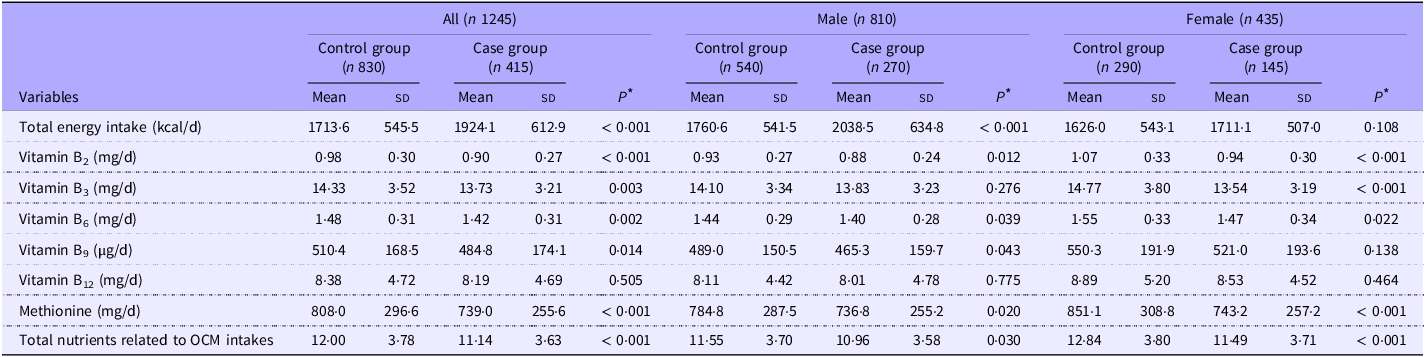
Table 2 presents a comparison of nutrients related to OCM intakes between GC cases and controls. In total population, case group consumed more energy (1924·1 (sd 612·9) kcal v. 1713·6 (sd 545·5) kcal, P < 0·001) and less vitamin B2 (0·90 (sd 0·27) mg/d v. 0·98 (sd 0·30) mg/d, P < 0·001), vitamin B3 (13·73 (sd 3·21) mg/d v. 14·33 (sd 3·52) mg/d, P = 0·003), vitamin B6 (1·42 (sd 0·31) mg/d v. 1·48 (sd 0·31) mg/d, P = 0·002), vitamin B9 (484·8 (sd 174·1) µg/d v. 510·4 (sd 168·5) µg/d, P = 0·014) and methionine (739·0 (sd 255·6) mg/d v. 808·0 (sd 296·6) mg/d, P < 0·001) than control group. Similar patterns were observed in both sexes. Meanwhile, the amount of intake of vitamin B12 was not significantly different between two groups (P > 0·05). Importantly, compared with cases, the control group had a lower score of nutrients related to OCM intakes (11·14 (sd 3·63) v. 12·00 (sd 3·78), P < 0·001), which implies they consumed less nutrients related to OCM.
Comparison of nutrients related to one-carbon metabolism intakes between GC cases and controls

OCM, one-carbon metabolism.
* P was obtained using the Student’s t test.
The association between dietary nutrients related to one-carbon metabolism intakes and gastric cancer risk
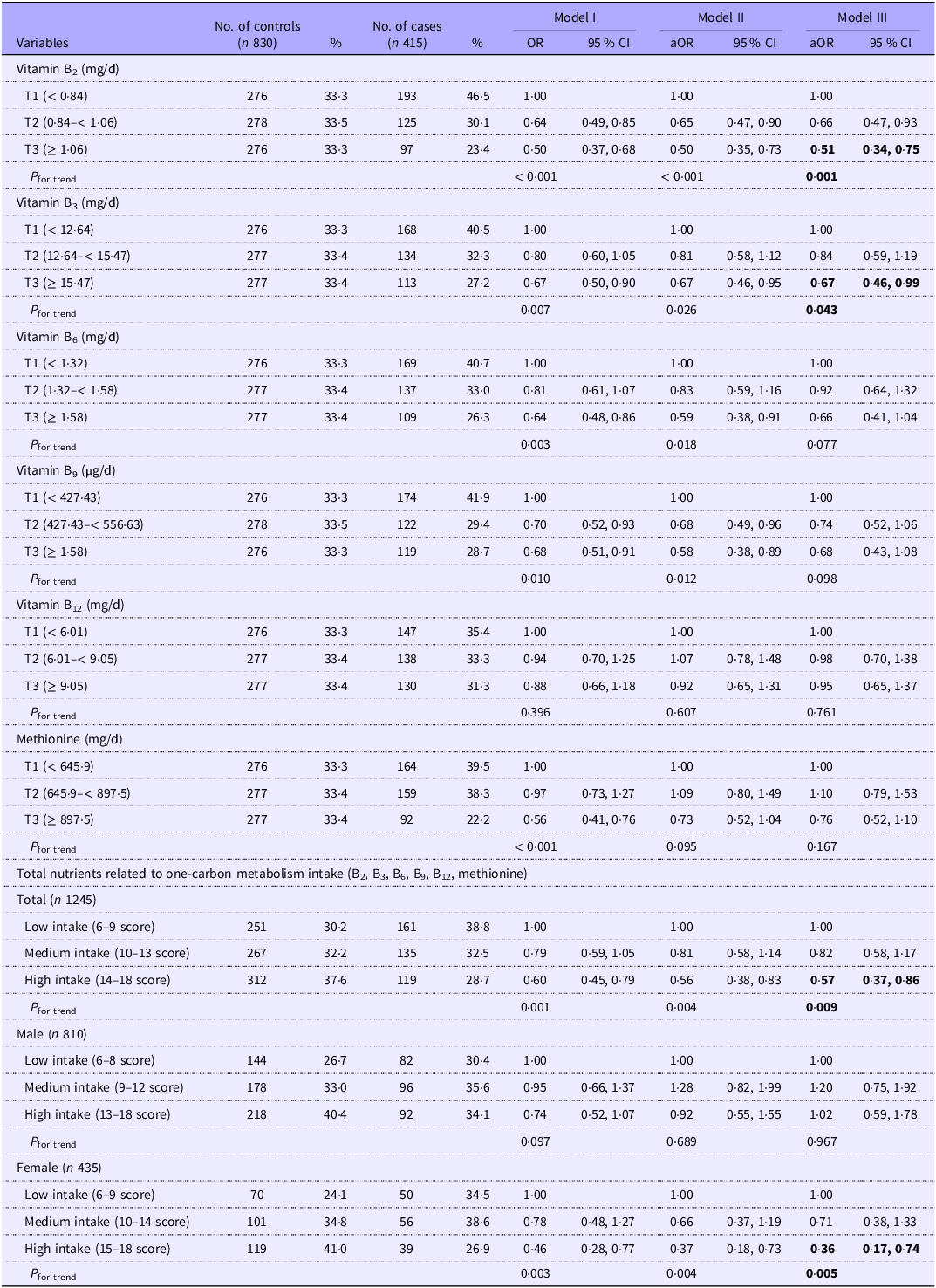
Table 3 represents the GC risk for dietary nutrients related to OCM intakes categorised by sex. In comparison to the lowest tertile, significant inverse relationships were observed in the highest tertile of dietary vitamin B2 and vitamin B3 intakes and the risk of GC across all participants in the fully adjusted model (model III, adjusted OR (aOR) = 0·51, 95 % CI 0·34, 0·75, P for trend = 0·001), (aOR = 0·67, 95 % CI 0·46, 0·99, P for trend = 0·043), respectively. More importantly, a similar pattern was found for total nutrients related to OCM, higher intakes might reduce the GC risk in model III (aOR = 0·57, 95 % CI 0·37, 0·86, P for trend = 0·009). When analysed by sex, consistent trends were evident among women in model III (aOR = 0·36, 95 % CI 0·17, 0·74, P for trend = 0·005).
Association between nutrients related to one-carbon metabolism intakes and gastric cancer risk

aOR, adjusted OR; GC, gastric cancer. The results with significant associations in model III are highlighted using bold terms..
Model I: Crude model.
Model II: Adjusted for age, sex, BMI, educational level, income, marital status, occupation, family history of GC, smoking status, regular exercise, alcohol consumption, supplement use, sodium intake.
Model III: Additionally adjusted for Helicobacter pylori infection.
Moreover, online Supplementary Table 1 illustrates the relationship between total nutrients related to OCM consumption and the risk of GC when considering various lifestyle factors. Surprisingly, increased consumption of nutrients related to OCM was associated with a reduction in GC risk among those who were current or ex-drinker (aOR = 0·47, 95 % CI 0·28, 0·77, P for trend = 0·004) and those who were obese (BMI greater than 25) (aOR = 0·25, 95 % CI 0·11, 0·54, P for trend < 0·001), and positive for H. pylori (aOR = 0·49, 95 % CI 0·31, 0·77, P for trend = 0·07). Additionally, we observed a reduced GC risk with higher consumption of dietary nutrients related to OCM intake compared to individuals with lower consumption among non-smokers and those who engage in regular exercise or have no family history of GC.
The association between AHCY rs819173 polymorphism and gastric cancer risk
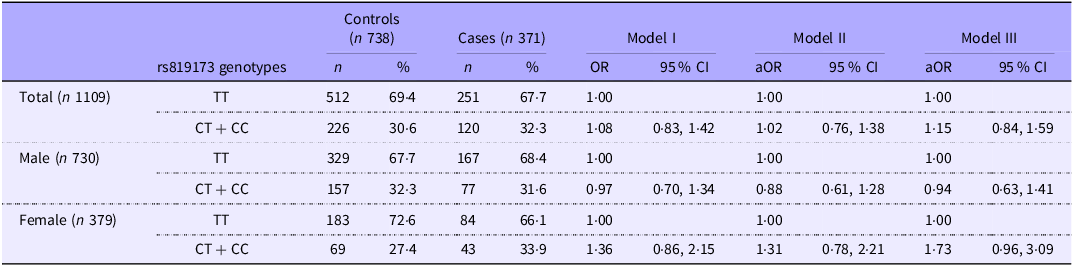
There are three genotypes of AHCY rs819173 including TT, CT and CC. A dominant model was used to investigate the association between AHCY rs819173 polymorphism and GC risk in two groups (TT and CT + CC) (Table 4). Specifically, there was no relationship between this variant and GC risk in the total population (aOR = 1·15, 95 % CI 0·84, 1·59) and for each sex.
Association between AHCY rs819173 polymorphism and gastric cancer risk in the dominant model stratified by sex

aOR, adjusted OR; GC, gastric cancer.
Model I: Crude model.
Model II: Adjusted for age, sex, BMI, educational level, income, marital status, occupation, family history of GC, smoking status, regular exercise, alcohol consumption, supplement use, sodium intake.
Model III: Additionally adjusted for Helicobacter pylori infection.
The interaction between AHCY rs819173 polymorphism and nutrients related to one-carbon metabolism intakes in the gastric cancer risk
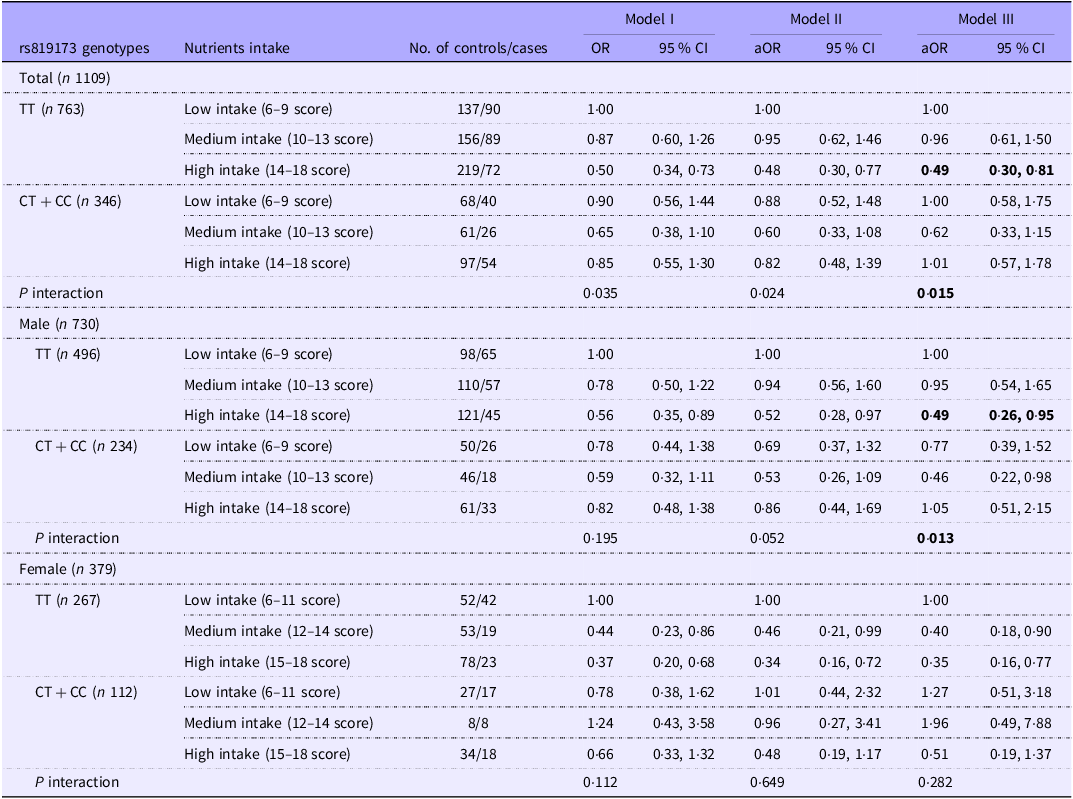
As presented in Table 5, the interaction between nutrients related to OCM intakes and the AHCY rs819173 variant with GC risk was determined in the dominant model. Our findings reveal that the combination of this genetic variation and the intake of nutrients related to OCM showed a mutually beneficial protective influence. In the overall population, individuals possessing major homozygous (TT) with higher nutrients related to OCM intakes exhibited a notably decreased GC risk compared with those with lower consumption (OR = 0·50, 95 % CI 0·34, 0·73) in the crude dominant model. The association result was consistent in model III (aOR = 0·49, 95 % CI 0·30, 0·81). In addition, a similar pattern was observed among males, who consumed higher nutrients related to OCM and carried major homozygous (TT), which could decrease the GC occurrence (aOR = 0·49, 95 % CI 0·26, 0·95, P interaction = 0·013) in the model III. Nevertheless, females did not exhibit the protective effect across all levels of nutrients related to OCM intakes. Moreover, those who had at least a single minor allele (C) and had a higher intake of nutrients related to OCM showed an elevated risk of GC, although the result was not significant (aOR = 1·01, 95 % CI 0·57, 1·78) Importantly, we found a notable interaction between the AHCY rs819173 variant and nutrients related to OCM intakes for the total population (P interaction = 0·015).
Interaction between AHCY rs819173 polymorphism and nutrients related to one-carbon metabolism intake (vitamin B2, B3, B6, B9, B12 and methionine intake) in gastric cancer risk in the dominant model stratified by sex

aOR, adjusted OR; GC, gastric cancer. The results with significant associations in model III are highlighted using bold terms.
Model I: Crude model.
Model II: Adjusted for age, sex, BMI, educational level, income, marital status, occupation, family history of GC, smoking status, regular exercise, alcohol consumption, supplement use, sodium intake.
Model III: Additionally adjusted for Helicobacter pylori infection.
Discussion
In our study, higher intakes of nutrients related to OCM, especially higher B2 and B3 intakes, were found to play a protective role against GC. In addition, the significant associations remain unchanged among females, non-smokers and those who engage in regular exercise or have no family history of GC. Interestingly, there is an inverse association between dietary nutrients related to OCM intakes and GC risk among individuals who were current or ex-drinkers, obese, and positive for H. pylori. Although AHCY rs819173 genetic polymorphism was not significantly associated with GC risk, participants who possess the major homozygous (TT) carriers and consume more nutrients related to OCM have notably reduced GC occurrence compared with those with a lower intake who carried at least one minor allele (C).
Although the results were inconsistent, the association between nutrients related to OCM intakes and the risk of GC has been well documented in a few studies. A couple of meta-analysis from observational studies showed no significant association between diet folate intake and risk of GC(Reference Tio, Andrici and Cox3,Reference Larsson, Giovannucci and Wolk29) . Similarly, no associations between any dietary intakes of folate, vitamin B6, vitamin B12 and methionine with the risk of GC in several cohort studies have been reported(Reference Khairan, Sobue and Eshak10,Reference Xiao, Freedman and Ren30,Reference Kweon, Shu and Xiang31) . In a cohort study with 86 820 Japanese individuals and 2269 GC cases, no associations between any of the dietary intakes of folate, vitamin B6, vitamin B12 or methionine with the risk of GC were determined by 138 food items SFFQ(Reference Khairan, Sobue and Eshak10). Another prospective cohort study consisting of 492 292 Chinese reported similar results to the previously mentioned study(Reference Xiao, Freedman and Ren30). In contrast, a higher intake of folate might reduce the risk of GC with 271 cases matching 542 controls in Korea(Reference Kim, Woo and Lee8). Furthermore, a population-based case–control study (248 histological confirmed GC patients and 478 age and sex-matched controls) in Mexico showed a significant reduction in diffuse GC risk among individuals with high consumption of folate and B6 by using 127 foods SFFQ(Reference Galvan-Portillo, Cantoral and Onate-Ocana9). The variability in findings may be due to differences in sample sizes and dietary assessment methods across studies. Furthermore, the inconsistency in linking nutrients related to OCM intakes to GC risk might stem from geographical variations in terms of culture, dietary patterns and religions, and it may be attributed to genetic variations.
To date, a biological mechanism has been identified that explains the protective impact of nutrients related to OCM on the onset of cancer, as well as the interaction between OCM nutrients and the AHCY gene. The majority of different types of vitamin B and methionine are involved, either directly or indirectly, in OCM(Reference Mahmoud and Ali16,Reference Lyon, Strippoli and Fang32) . Particularly, vitamins B2, B3, B6, B9 and B12 serve as cofactors in both the folate and methionine cycles(Reference Lyon, Strippoli and Fang32,Reference Franco, Seabrook and Nguyen33) . In terms of the folate cycle, dietary folate is first converted to dihydrofolate by the enzyme dihydrofolate synthase and then to tetrahydrofolate (THF) by the enzyme dihydrofolate reductase, with vitamin B3 acting as a cofactor in both steps. THF is subsequently converted to 5,10-methyl THF by the enzyme serine hydroxymethyltransferase, which uses vitamin B6 as a coenzyme. This is followed by the reduction of 5,10-methyl THF to 5-methyl THF via the enzyme methylenetetrahydrofolate reductase, with vitamin B2 serving as a coenzyme. Finally, 5-methyl THF is converted back to THF by the enzyme 5-methyltetrahydrofolate-homocysteine methyltransferase, which utilises vitamin B2 as a coenzyme(Reference Mahmoud and Ali16,Reference Lyon, Strippoli and Fang32,Reference Pan, Fan and Liu34) . The demethylation of 5-methyl THF completes the folate cycle and then starts the methionine cycle(Reference Pan, Fan and Liu34). 5-methyl THF provides a methyl group to convert homocysteine back into methionine, a process catalysed by methionine synthase, which requires B12 as a cofactor. To produce S-adenosylmethionine, a crucial methyl donor for various methyltransferases, an adenosine is transferred to methionine by methionine adenosyltransferase 2A. During the methylation reactions, S-adenosylmethionine is demethylated to form AdoHcy, which is then hydrolysed by AHCY to regenerate homocysteine and complete the entire methionine cycle(Reference Mahmoud and Ali16,Reference Lyon, Strippoli and Fang32,Reference Pan, Fan and Liu34) . In summary, OCM is powered by the interconnected folate and methionine cycles, which together control DNA synthesis and methylation processes(Reference Lyon, Strippoli and Fang32). The main regulators of OCM, which include methionine, vitamin B9 and vitamin B12, are all essential components of a healthy diet(Reference Lyon, Strippoli and Fang32). Obviously, once an imbalance of most types of vitamin B and methionine consumption occurs, OCM might be affected. Similar to other metabolic processes, the biochemical reactions are intricately controlled and interconnected within OCM(Reference Sanderson, Gao and Dai35). Disruption at any single point in this network can cause significant cellular dysfunction, which is frequently observed in diseases like cancer(Reference Sanderson, Gao and Dai35). Importantly, OCM is crucial for producing methyl donors, specifically S-adenosylmethionine, which is the primary methyl donor used by methyltransferases for DNA, RNA, histone and protein methylation(Reference Lyon, Strippoli and Fang32,Reference Pan, Fan and Liu34) . Moreover, the abnormality of DNA methylation might modify cancer risk and tumour behaviour, consequently leading to the development of several cancers, such as colon, and stomach cancers(Reference Mahmoud and Ali16).
The AHCY gene plays a crucial role in regulating the AHCY enzyme in OCM. AHCY is responsible for catalysing the reversible hydrolysis of AdoHcy, homocysteine and adenosine(Reference Levine, Figueiredo and Lee21,Reference Lyon, Strippoli and Fang32,Reference Vizan, Di Croce and Aranda36) . Therefore, it is essential to sustain appropriate AHCY activity to control the cell’s methylation potential, which is determined by the ratio of AdoHcy to S-adenosylmethionine metabolites(Reference Caudill, Wang and Melnyk37). The importance of AHCY in controlling the cellular methylation potential has been highlighted by the identification of AHCY deficiency in humans. This rare and potentially fatal multisystem disorder is caused by mutations in the AHCY gene, leading to decreased AHCY enzyme activity and significantly elevated levels of the metabolites AdoHcy and S-adenosylmethionine(Reference Baric, Fumic and Glenn38–Reference Honzík, Magner and Krijt40). Clearly, elevated levels of AdoHcy are linked to greater cell proliferation, migration and invasion. This is likely due to disruptions in methylation status and changes in the expression of crucial genetic factors that regulate these essential cellular activities. To date, AHCY deficiency has been associated with various metabolic disorders, including tumorigenesis. Moreover, inhibiting AHCY disrupts DNA methylation, resulting in the misregulation of genes that control OCM(Reference Boczki, Colombo and Weiner41), which leads to the development of several cancers such as colorectal or GC(Reference Mahmoud and Ali16).
There are strengths and limitations in our study. A validated SQFFQ was utilised for gathering diet information by well-trained interviewers for estimating Korean dietary patterns(Reference Ahn, Kwon and Shim25). Therefore, we truly believe that our results provide probably evidence regarding the protective role of nutrients related to OCM in GC prevention strategies for the Korean population. In addition, several possible confounding variables of GC were included, especially H. pylori infection which is considered as a high-risk factor for GC. Nevertheless, it is crucial to consider specific limitations when interpreting the results. In this case–control study conducted in a hospital, there might be selection bias since the control group consisted of individuals who had joined in the health check-up. Additionally, our results may be susceptible to recall bias, as participants had to recall and report their diet consumption over the past 1 year, which is quite a long period. However, we attempted to reduce bias associated with over and/or under-reporting of vitamin intake using the residual method as a statistical method. Furthermore, the dietary habits of GC patients may be changed since their early symptoms. Therefore, our collecting data team tried to gather diet information from GC patients as soon as they were confirmed with GC, which might contribute to mitigating potential biases. Despite collecting dietary information at the time of diagnosis, we acknowledge that the long incubation period of GC and potential symptom-induced dietary changes may introduce reverse causality. Future studies with prospective dietary assessments are needed to address this limitation. Although we adjusted for total energy intake using the residual method, we acknowledge that imbalanced distributions of key foods and nutrients between cases and controls may still introduce residual confounding. Future studies should further explore the potential influence of dietary patterns and other nutrient interactions on the observed associations.
Conclusion
In summary, our study presents the beneficial impact of consuming higher amounts of nutrients related to OCM in reducing the risk of GC, with possible influence from the genetic polymorphism of AHCY rs819173. However, we did not find a notable relationship between this genetic variant and GC risk. These findings contribute to understanding of gene–environment interactions in cancer prevention strategies. Nevertheless, more extensive studies involving larger participants are necessary to fully elucidate this association.
Supplementary material
For supplementary material/s referred to in this article, please visit https://doi.org/10.1017/S0007114525103528
Acknowledgements
This work was supported by the International Cooperation and Education programme (NCCRI•NCCI 52210-52211, 2024) of the National Cancer Center, Korea, and grants from the National Research Foundation of Korea, Korea (2021R1A2C2008439).
Conceptualisation, H. T. M. N.; Formal analysis, H. T. M. N., M. G. and J. L.; Preparation of original draft, H. T. M. N.; Writing – review and editing, M. G and J. K.; Data curation, J. L., I. J. C., Y-I. K. and J. K.; Investigation, J. L., I. J. C. and Y-I. K.; Methodology, I. J. C., Y-I. K. and J. K.; Funding acquisition, J. K.; Project administration, J. K; Supervision, J. K. All authors have read and approved the final version of the manuscript.
The authors declare that they have no conflicts of interests.