


1. Introduction
The Gwna Group is a spectacular, regional scale mélange, estimated to be up to 3000 m thick (Gibbons & McCarroll, Reference Gibbons and McCarroll1993), which crops out over an area of at least 200 km2 in northwest Wales. This unit was the first such chaotic deposit ever to be described in the literature and to which the term ‘mélange’ was first applied (Greenly, Reference Greenly1919), thus it may be considered the informal ‘type-locality’ for mélange. Although mapped by Greenly (Reference Greenly1919) and Matley (Reference Matley1928), and in parts of Llŷn more recently by Gibbons & McCarroll (Reference Gibbons and McCarroll1993), the age of mélange deposition remains contentious. Palaeozoic microfossil evidence for its age (e.g. Muir et al. Reference Muir, Bliss, Grant and Fisher1979) has been contested (Peat, Reference Peat1984) and appears to contradict metamorphic data (e.g. Kawai et al. Reference Kawai, Windley, Terabayashi, Yamamoto, Maruyama and Isozaki2006). Quoted ages range from Neoproterozoic (Ediacaran) (Gibbons & Horák, Reference Gibbons, Horák, Nance and Thompson1996; Kawai et al. Reference Kawai, Windley, Terabayashi, Yamamoto, Maruyama and Isozaki2006) to early Ordovician (Barber & Max, Reference Barber and Max1979; Collins & Buchan, Reference Collins and Buchan2004). This paper forms part of a broader study of the provenance and age of clasts within the mélange, and presents radiogenic and stable isotope evidence to establish the age of limestone megaclasts, thereby providing a constraint on the depositional age of the mélange.
2. Gwna Group mélange
The Gwna Group mélange has traditionally been placed at the top of the Monian Supergroup succession, a thick (up to 7500 m), low-grade, polydeformed, metasedimentary sequence exposed across North Wales on Anglesey and on northwest Llŷn (Shackleton, Reference Shackleton1954, Reference Shackleton and Wood1969; Gibbons et al. Reference Gibbons, Tietzsch-Tyler, Horák, Murphy, Gibbons and Harris1994) (Fig. 1). This succession has an unproven original relationship with the adjacent crystalline Neoproterozoic rocks (the Coedana and Sarn complexes on Anglesey and Llŷn, respectively) and its age of deposition and tectono-sedimentary setting have invoked much debate. The Monian Supergroup has been interpreted as part of a Neoproterozoic, peri-Gondwanan, forearc accretionary complex (Gibbons & Horák, Reference Gibbons, Horák, Nance and Thompson1996). However, the age of the mélange formation must now be reviewed in light of recent detrital zircon U–Pb SIMS data for the South Stack Group, the basal unit of the Monian Supergroup. These data indicate a maximum depositional age for the South Stack Group of late Early Cambrian to early Middle Cambrian (Collins & Buchan, Reference Collins and Buchan2004) and imply that the New Harbour and Gwna groups (Fig. 1) were deposited after this, but prior to the deposition of the overlying Arenig sediments. However, these data are inconsistent with the Gwna Group being formed during Neoproterozoic subduction. This has led to a wider re-evaluation of Monian Supergroup stratigraphy, of which this study forms a part, and provokes the suggestion that it may not be one contiguous succession as originally defined by Greenly (Reference Greenly1919) and modified by Shackleton (Reference Shackleton1954, Reference Shackleton and Wood1969).
Schematic stratigraphy for the Monian Supergroup (after Shackleton, Reference Shackleton1954, Reference Shackleton and Wood1969; revised after M. Kohnstamm, unpub. Ph.D. thesis, Univ. Wales, Cardiff, 1983; Phillips, Reference Phillips1991). Large ornamented clasts within the Gwna Group are a schematic representation of megaclasts of limestone, quartzite, volcaniclastic sandstone and pillow lava. No stratigraphic relationship is implied by the relative position of the clasts.

The mélange typically forms spectacular coastal outcrops on Anglesey and Llŷn (Fig. 2) but is poorly exposed inland. Clasts range in scale from boulders through to megaclasts hundreds of metres across and can be divided into at least two suites: (1) basaltic pillow lavas with a MORB chemistry (Thorpe et al. Reference Thorpe, Beckinsale, Patchet, Piper, Davies and Evans1984), hyaloclastites, limestone breccias, red cherty mudstones, and minor jasper, all suggestive of an oceanic affinity; (2) clasts comprising sandstones, ranging from orthoquartzite to litharenites, mudstones and shallow-water limestones. Schuster (Reference Schuster1979) also defined an additional pebbly mudstone facies. The matrix is variable in composition and although dominantly argillaceous, it may also be coarser grained and rich in fragments of disaggregated clasts. The degree of metamorphism and deformation varies between the major outcrops of the mélange. To the southwest, on Llŷn, illite crystallinity data reflect epizone conditions (Kubler Index (KI) values in the range Δ°2θ 0.20–0.26) (Merriman & Roberts, Reference Merriman and Roberts1985). The mélange here shows a D1 slaty cleavage, a main D2 folding, and minor localized D3–D5 deformation events (F. A. Gibbons, unpub. Ph.D. thesis, CNNA, 1980; Gibbons & McCarroll, Reference Gibbons and McCarroll1993). This contrasts with northern Anglesey, where illite crystallinity values show only diagenetic to lower anchizone grade (K.I. values in the range Δ°2θ 0.39–0.42) (R. J. Merriman, pers. comm. 2003) and the degree of deformation appears lower.
Simplified geological map of north Wales showing the distribution of Gwna Group and the other two components of the Monian Supergroup (South Stack and New Harbour groups).
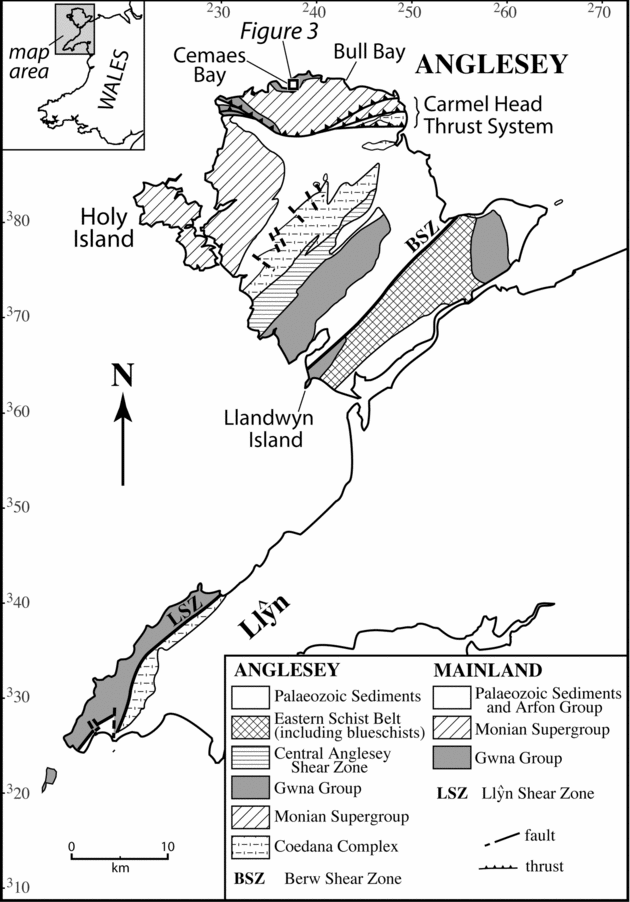
Age constraints on the depositional age of the mélange are limited. In northern Anglesey, Arenig sediments rest unconconformably on the mélange, thereby providing a minimum age limit of around 478 Ma. On the basis of poorly preserved arcritarch assemblages extracted from cherts within the basaltic suite in the mélange at Llandwyn Island (Fig. 2), SW Anglesey, Muir et al. (Reference Muir, Bliss, Grant and Fisher1979) suggested that the mélange could be no older than Early Cambrian. However, Peat (Reference Peat1984) questioned these interpretations, and refuted them on the basis of the poor state of preservation of the microfossils. Stromatolites have also been described, but not figured, from a limestone megaclast in the mélange near Llanbadrig (Fig. 3) on northern Anglesey by Wood & Nicholls (Reference Wood and Nicholls1973), who attributed unbranching stromatolites to Conophyton. Muir et al. (Reference Muir, Bliss, Grant and Fisher1979) made brief reference to more complex, branching forms that they placed in the genus Georginia. Although these authors attributed a latest Neoproterozoic to Early Cambrian age to these stromatolites, this age range is not closely constrained by the identifications given. Conophyton is a long-ranging genus with examples known from the early Proterozoic (2.1 Ga) to Cambrian (c. 515 Ma) (Grey, Reference Grey1995; Walter, Reference Walter1972). Further work by the authors and co-workers is therefore ongoing to establish if the taxonomy of the stromatolites can be refined.
Location of carbonate megaclast at Trwyn y Parc, N Anglesey.

More recently, Kawai et al. (Reference Kawai, Windley, Terabayashi, Yamamoto, Maruyama and Isozaki2006) described a prograde metamorphic sequence in SE Anglesey from metabasites of sub-greenschist facies through greenshist facies into the blueschist belt. Dallmeyer & Gibbons (Reference Dallmeyer and Gibbons1987) dated amphibole and phengite from these blueschists as recording metamorphism at c. 550–560 Ma. This would appear to constrain the age of mélange formation to pre-550 Ma. However, M. Gyopari (unpub. M.Phil. thesis, Univ. Wales, Cardiff, 1984) also examined the greenschist-facies mélange to blueschist transition and his findings contradict those of Kawai et al. (Reference Kawai, Windley, Terabayashi, Yamamoto, Maruyama and Isozaki2006), as he concluded that the boundary between the mélange and the blueschist-facies rocks was a shear zone and the two units did not form a contiguous metamorphic sequence. Clearly, characterizing the nature of the clasts and constraining the depositional age of the mélange are essential to establishing the broader tectono-sedimentary and tectono-metamorphic context in which it was formed. This paper uses a chemostratigraphic approach to re-examine the limestone megaclasts in northern Anglesey to provide additional age constraint data on the mélange.
2.a. Limestone megaclasts
A range of carbonate clasts is present within the Gwna Group mélange of Anglesey and Llŷn, showing variation in texture, composition, size and clast density. In both Llŷn and SW Anglesey, pink Mn-rich carbonate occurs interstitial to basaltic pillow lavas and as the matrix to limestone lava breccias (F. A. Gibbons, unpub. Ph.D. thesis, CNNA, 1980). Lenses of white, grey or buff limestone are dispersed throughout the mélange, and Gibbons described large, dolomitic limestone blocks from Llŷn.
The largest limestone blocks occur in northern Anglesey, where clasts from tens to hundreds of metres across have been mapped from the west side of Cemaes Bay to the west coast of Bull Bay (see Fig. 2) (Greenly, Reference Greenly1920). However, it is in the region immediately adjacent to Cemaes Bay that the largest limestone blocks occur where, associated typically with quartzite or grey-green sandstones, they dominate the mélange. The degree of dolomitization within the limestone varies, but appears to be lowest in the larger blocks such as that at Trywn y Parc (Fig. 3).
2.b. Trwyn y Parc megaclast
The Trwyn y Parc megaclast (Fig. 3) has a stratigraphic thickness of around 250 m. The exposure is almost continuous along the low cliffs, and towards the middle of the section the sequence has been exposed by an agricultural lime quarry. A steep fault runs along the southern edge of the quarry; to the north of this the bedding within the carbonate dips steeply (typically 80°) to the NNE or is sub-vertical. Stromatolitic horizons indicate that the sequence youngs towards the north. South of the fault the carbonate dips more moderately at 45° to the NE. The southern margin of the megaclast is brecciated and dolomitized, and shows an undulating contact with the underlying semi-pelitic mélange matrix, with tongues of matrix projecting into the limestone. The carbonate sequence can be subdivided into eight units, which reflect a progressive deepening from a sub- to peri-tidal environment.
The sequence comprises interbedded units of laminated, neomorphed micrite, microbially laminated carbonate, which may be variably dolomitized, more massive calcilutite, locally veined by calcite, and coarser calcirudite layers. The latter contains allochems that are dominated by peloidal cigar-shaped structures, up to 2 mm long and 0.5 mm wide, which are interpreted as intraclasts from reworked fragments of microbial laminated carbonate. Ooids are also present within this part of the sequence and are particularly apparent towards the northern margin of the megaclast. The entire sequence shows a variable degree of dolomitization, with the marginal units being most affected and the central portion least affected. A horizon of dolomitized pods (each up to 0.7 m high and 1 m long) is present towards the centre of the sequence and is well exposed on the north side of the quarry where it intersects the cliffs. A more detailed description and interpretation of the petrology will be presented elsewhere.
3. Analytical techniques
Representative samples from the lithological units described were selected for whole-rock geochemical analysis. The location of these is indicated in Figure 3. The same powders were used for whole-rock, XRD and isotopic analysis. These were first prepared by removal of all weathered surfaces; they were then crushed, and reduced to a fine powder using an agate Tema mill. Whole-rock analysis was undertaken using a ThermoElemental ICP-MS system at Cardiff University. XRD analyses to determine the mineral content of the carbonates were made using a PANalytical X'pert PRO at the National Museum of Wales. All isotopic work was completed at the NERC Isotope Geoscience Laboratories, Keyworth.
3.a. 87Sr/86Sr analysis
Approximately 100 milligrams of powder were leached in a Teflon® beaker with dilute acetic acid in a HEPA-filtered clean air hood. The leachate was converted to chloride form and the strontium was separated using standard chromatographic exchange techniques on Dowex resin (Dickin, Reference Dickin1995). The samples were loaded onto single rhenium filaments using a TaF emission enhancer (Birck, Reference Birck1986). The 87Sr/86Sr isotope composition of the strontium was determined using a Thermo Triton multi-collector mass spectrometer, which gave a reproducibility of 0.701222 ± 0.000016 (2σ, n = 35) during the analysis of these samples. All data are normalized to a value of 0.710250 for NBS 987.
3.b. δ13C and δ18O analysis
The equivalent of 10 mg of carbonate was reacted with anhydrous phosphoric acid in vacuo overnight at a constant 25 °C. The CO2 liberated was separated from water vapour under vacuum and collected for analysis. Measurements were made on a VG Optima mass spectrometer. Overall analytical reproducibility for these samples is normally better than 0.1 ‰ for δ13C and δ18O (2σ). Isotope values (δ13C, δ18O) are reported as per mil (‰) deviations of the isotopic ratios (13C/12C, 18O/16O) calculated to the VPDB scale using a within-run laboratory standard calibrated against NBS standards.
4. Whole-rock geochemistry
Whole-rock geochemical data for the samples were determined to reveal extent of dolomitization and provide geochemical indicators that might reflect post-depositional modification of the primary carbonate isotopic signatures. Data are presented in Table 1 and plotted in Figures 4 and 5.
Geochemical analyses (ICP-MS) of carbonate samples from Trwyn y Parc

Samples are arranged in sequence from the northern margin (NMW 538, top) of the megaclast to the southern margin (NMW 547, base) (see Fig. 2).
Classification of carbonate samples from Trwyn y Parc, N Anglesey (after Blatt, Middleton & Murray, Reference Blatt, Middleton and Murray1972).

Geochemical data for samples from the Trwyn y Parc megaclast (see Fig. 3 for location of samples).

All samples show high carbonate content, with a maximum SiO2 content of 3.30 wt % and a maximum quartz content of 3 % volume determined by XRD. A correlation between K2O and Al2O3 suggests that a few samples have a minor clay mineral content (NMW 513, 518, 545). A correlation between dolomite content and whole-rock MgO abundance (R2 = 0.9753) indicates that all magnesium is contained within dolomite. This permits classification of the carbonates on the relative abundance of calcite and dolomite (Fig. 4).
Two samples from the top and base of the sequence (NMW 538, NMW 547), plus one from dolomite pods within the sequence (NMW 543), fall within the dolostone field containing more than 90 % dolomite, one plots as a calcitic dolomite (60–90 % dolomite) (NMW 546), and two plot as dolomitic limestones (10–59 % dolomite) (NMW 539, NMW 542) (Fig. 4). All other samples are classified as limestone as they contain less than 10 % dolomite. The block therefore shows clear zones of dolomitization on its margins, as indicated by the high MgO content.
These zones of dolomitization also show an elevated Mn content and higher Mn/Sr ratios than the non-dolomitized samples from the centre of the megaclast (Table 1, Fig. 5). This is a product of both an increased content of Mn and a reduction of Sr in these dolomitized samples. Several workers have suggested that Mn/Sr is a valuable indicator of post-depositional modification of isotopic signatures, most notably 87Sr/86Sr, and to a lesser extent δ13C, although the specific value used to filter modified from non-modified samples varies between studies, with little consensus (e.g. Derry et al. Reference Derry, Keto, Jacobsen, Knoll and Swett1989; Asmerom et al. Reference Asmerom, Jacobsen, Knoll, Butterfield and Swett1991; Kaufman, Jacobsen & Knoll, Reference Kaufman, Jacobsen and Knoll1993; Denison et al. Reference Denison, Koepnick, Fletcher, Howell and Callaway1994; McArthur, Reference McArthur1994; Jacobsen & Kaufman, Reference Jacobsen and Kaufman1999; Fairchild et al. Reference Fairchild, Spiro, Herrington, Song, Grotzinger and James2000). However, the high Mn/Sr and low Sr values observed at the margins of the carbonate megaclast suggest that these dolomitized samples might well not have retained their primary 87Sr/86Sr isotopic signature.
5. Isotopic data
Strontium isotope data are presented in Table 2 and displayed in Figure 6, and show a systematic variation across the carbonate block. The most radiogenic 87Sr/86Sr values are found on the southern and northern margins of the clast (0.710484–0.708824, samples NMW 547, NMW 546; 0.707146–0.708192, NMW 539, NMW 538, respectively), whereas the limestone in the central part of block (NMW 541–NMW 545; Fig. 3) is typically less radiogenic 87Sr/86Sr (0.706902–0.706198).

Isotopic data for samples from the Trwyn y Parc megaclast (see Fig. 3 for location of samples).

δ18O and δ13C analyses were also undertaken on all samples. The limestone samples show strongly negative δ18O values, ranging from −15.7 to −18.89 δ18O (VPDB), whereas the dolostones, and calcitic dolomite containing 86–100 % dolomite, are significantly less depleted. No correlation is observed between 87Sr/86Sr and δ18O. Carbon isotope data show positive values from 0.2 to 1.9 δ13C ‰ (PDB) but no systematic variation with 87Sr/86Sr. However, the carbon isotope data from the limestone samples from the centre of the megaclast show a negative correlation with δ18O (R2 = 0.75) (Fig. 6d).
6. Identifying primary isotopic signatures
Although it is suggested by some researchers that the composition of seawater may have varied though time (e.g. Wadleigh & Veizer, Reference Wadleigh and Veizer1992; Veizer et al. Reference Veizer, Ala, Azmy, Bruckschen, Buhl, Bruhn, Carden, Diener, Ebneth, Godderis, Jasper, Korte, Pawellek, Podlaha and Stauss1999; Lécuyer & Allemend, Reference Lécuyer and Allemend1999), Jacobsen & Kaufman (Reference Jacobsen and Kaufman1999) present δ18O data for Neoproterozoic carbonates to indicate that values of less than −5 ‰ (PDB) are unlikely to represent primary isotopic signatures. Therefore the highly negative values observed in the Gwna Group carbonates are considered to have resulted from modification of the primary seawater signature during post-precipitation interaction with secondary fluids. Oxygen isotope composition is a sensitive indicator of alteration processes, with a decrease in δ18O values typically resulting from interaction with meteoric or hydrothermal fluids. A range of oxygen isotope values across a carbonate sequence might be anticipated as a consequence of variable oxygen mobility linked to differing degrees of recrystallization, related to the original depth of burial. Such changes are controlled by the primary carbonate texture and composition (Buick, Des Marais & Knoll, Reference Buick, Des Marais and Knoll1995). However, the megaclast does not show a unidirectional progressive variation in δ18O depletion, and the marginal isotopic values show a correlation with the degree of dolomitization on the margins of the megaclasts. This distribution of values is interpreted as representing two stages of oxygen mobility. The significance of identifying these two stages of alteration is that values from one stage show a correlation with δ13C values, thus indicating that these values are also not primary isotopic values.
The first alteration event (resulting in values as low as about −18.9 δ18O) overprinted the primary depositional δ18O values in the carbonate. Possible options for the derivation of the fluid involved are: (1) meteoric water, (2) hydrothermally driven fluids and (3) low-grade metamorphic fluids. The latter two options would invoke alteration of the limestone blocks after incorporation into the mélange, while textural evidence suggests that this occurred prior to incorporation. Both hydrothermal alteration, as recorded from Avalonian Neoproterozoic plutonic rocks and Acadian low-grade metamorphic fluids derived from the dehydration of mudrock within the Welsh Basin, can be reasonably ruled out, as both are enriched in heavy oxygen and have positive values (e.g. Beckinsale et al. Reference Beckinsale, Evans, Thorpe, Gibbons and Harmon1984; Evans, Reference Evans, Schiffman and Day1995).
This early alteration event was in turn overprinted by a less pervasive event linked to dolomitization of the outer margins of the megaclast. The restricted marginal alteration indicates that this event occurred post-emplacement of the carbonate block within the mélange, with the overprinting recorded by a shift in δ18O from highly negative values (e.g. NMW 515 −18.9 ‰) to values of −15.7 ‰ in the limestone and −9.2 to −8.7 ‰ in the dolostones. These samples with a second phase of oxygen mobility also show as positive correlation with Mn/Sr.
Carbon isotope systems may be less disturbed than oxygen systems during diagenetic overprint through meteoric or burial pathways, as the carbon in these fluids is derived dominantly from the precursor carbonate phases (Jacobsen & Kaufman, Reference Jacobsen and Kaufman1999). However, the range of carbon isotope values shown by the non-dolomitic limestone samples from the centre of the megaclast (Fig. 6; NMW 541–545, 0.2 to 1.9 δ13C ‰ (PDB)) show a positive correlation between δ18O and δ13C (Fig. 6d), suggesting that the primary values have been shifted from more positive values during the first pervasive stage of alteration recorded by the highly negative δ18O values in these samples.
Critical to this study is the question of whether the fluid interaction caused alteration, movement or contamination of the strontium isotope composition. Because of the large reservoir of Sr in limestone (444–1198 ppm), it is relatively resistant to the effects of contamination by interaction with fluids. The alteration medium would need high concentrations of strontium or strontium with a very different isotopic composition (that is, highly radiogenic) in order to affect the bulk of the rock. Strontium concentration in ground water is usually less than 1 ppm (Montgomery, Evans & Wildman, Reference Montgomery, Evans and Wildman2006). Hence, a water source of this kind, even at high water–rock ratios, is unlikely to have a significant effect on the bulk-rock isotope composition. The limited effects of interaction and isotopic exchange at the margins of the clasts, probably associated with dolomitization, are shown in Figures 5 and 6, whereas the centre of the clast retains low Sr isotope values, high Sr ppm and low magnesium contents. Consequently, the lowest Sr isotope values are taken as representative of the original seawater composition from which this limestone precipitated. The three lowest isotopic Sr values measured from the limestone are 0.70620, 0.70629 and 0.70635. High whole-rock Sr and low Mn/Sr (0.25–0.36) for these samples supports interpretation of a primary 87Sr/86Sr value in the range 0.7062–0.7064.
7. Secular variation in isotopic Sr in seawater composition
A synthesis of published isotopic Sr values for carbonates of known ages has been used by various workers to document variations in the 87Sr/86Sr ratio of seawater through geological time. Data for the Neoproterozoic include the work of Asmerom et al. (Reference Asmerom, Jacobsen, Knoll, Butterfield and Swett1991), Kaufman, Jacobsen & Knoll (Reference Kaufman, Jacobsen and Knoll1993), Derry et al. (Reference Derry, Brasier, Corfield, Yu and Yu1994), Nicholas (Reference Nicholas1996), Misi & Veizer (Reference Misi and Veizer1998), Jacobsen & Kaufman (Reference Jacobsen and Kaufman1999), Brasier & Shields (Reference Brasier and Shields2000), Montañez et al. (Reference Montañez, Osleger, Banner, Mack and Musgrove2000) and Melezhik et al. (Reference Melezhik, Gorokhov, Kuznetsov and Fallick2001). While these studies show a general overall trend of increasing 87Sr/86Sr, with minor incursions, through the Cryogenian and Ediacaran, there are also significant differences in actual isotopic values for any given point in time between studies. This is more marked in the Cryogenian as illustrated by the curves of Walter et al. (Reference Walter, Veevers, Calver, Gorgan and Hill2000) and Shields (Reference Shields1999) shown in Figure 7. These differences are the product of the methods and geochemical values used to identify samples considered to represent primary 87Sr/86Sr signatures, the analytical precision of isotopic analyses, and the quality of palaeontological or isotopic data used to determine the age of the carbonates. The most recent contribution by Halverson et al. (Reference Halverson, Dudás, Maloof and Bowring2007) presents a new seawater evolution curve for the Neoproterozoic that is based only on carbonate values that are considered to be close to original 87Sr/86Sr of seawater. This was achieved through more rigorous evaluation of existing published data, careful correlation between carbonate-bearing successions on the basis of δ13C values, and identification of samples with well-constrained age data, as well as new analyses from key areas.
Age constraints on the Gwna Group limestone megaclast at Trwyn y Parc, based on seawater 87Sr/86Sr values from the Neoproterozoic to Ordovician, from the data of Halverson et al. (Reference Halverson, Dudás, Maloof and Bowring2007) with comparative curves from Shields (Reference Shields1999) and Walter et al. (Reference Walter, Veevers, Calver, Gorgan and Hill2000).

8. Comparison of Gwna Limestone to seawater curves
The lowest 87Sr/86Sr values measured from the Gwna megaclast carbonate samples lie in the range 0.7062–0.7064. As these samples comply with the geochemical criteria identified as indicative of minimal modification of primary seawater Sr isotope values, they can be compared to the secular seawater curves for rocks of known age. Comparison of these samples with the data of Halverson et al. (Reference Halverson, Dudás, Maloof and Bowring2007) provides a minimum age of deposition of c. 800 Ma (early Cryogenian), based on data from the Grusdiev Formation, Akademikerbreen Group, Svalbard (Fig. 7) (0.7062–0.7074), with younger ages being precluded by the continued rise in seawater 87Sr/86Sr through the Cryogenian. However, these data do not provide a unique solution, as values in the range 0.7061–0.7062 have been documented from carbonates within the Little Dal Group, Mackenzie Mountains Supergroup of NW Canada dated at 862–868 Ma (Halverson et al. Reference Halverson, Dudás, Maloof and Bowring2007). Carbonates from different sequences of early Neoproterozoic age have also been correlated on the basis of their δ13C signatures, and the combined use of δ13C and 87Sr/86Sr data would potentially provide a means of distinguishing to which of these two age groups the Gwna Group carbonates equates most closely. However, it is unfortunate both that the δ13C data for the two age groups overlap (Grusdiev −0.15 to 7.0 and Little Dal Group 4.0) and that the δ13C values for the Gwna Group carbonates have been modified during the early alteration event.
9. Source of the megaclasts
The Gwna Group of Anglesey lies within the Eastern Avalonian terrane of southern Britain. Within the Eastern Avalonian, or related peri-Gondwanan terranes, carbonates are poorly represented, the Neoproterozoic sedimentary sequences being dominated by arc basinal volcaniclastics and epiclastic deposits. In the type Avalonian area of Newfoundland, these deposits have been related to four main phases of magmatic arc activity spanning the period 760–545 Ma (O'Brian et al. Reference O'Brian, O'Driscoll, Tucker and Dunning1992). Similar phases of activity can also be identified in southern Britain from c. 677 Ma to 560 Ma (Gibbons & Horák, Reference Gibbons, Horák, Nance and Thompson1996). On the basis of the Sr chemostratigraphy it is established that the Gwna Group megaclast limestone is older than any rocks exposed in southern Britain, and represents one of the earliest records of deposition found within the Avalonian terrane.
Within the broader peri-Gondwana–Avalonian setting, the Green Head Group of the Brookville Terrane, New Brunswick, contains rocks of late Tonian to early Cryogenian age (White & Barr, Reference White, Barr, Nance and Thompson1996). This is interpreted as a passive margin sequence and includes carbonate rocks within the Ashburn Formation of that group. Although much of this deposit has undergone metamorphism and ductile deformation, Matthew (Reference Matthew1890) described the columnar stromatolite Archaeozoon acadiens from less deformed parts of the sequence. More recently, Hofmann (pers. comm. cited in White & Barr, Reference White, Barr, Nance and Thompson1996) has indicated that these suggest a Tonian to Cryogenian age for the carbonates with an age of 750–880 Ma. Although the Ashburn Formation carbonates provide a tantalizing correlative for the Gwna Group limestones, no comparable geochemical or isotopic data are available at present for this unit. However, the potential for a link between these two carbonate sequences merits a re-examination of the Gwna stromatolites.
Palaeomagnetic data for Avalonian rocks suggest a position of around 30° S during the late Neoproterozoic (580 to 603 Ma) (McNamara et al. Reference McNamara, Mac Niocaill, Van der Pluijm and Van der Voo2001; Vizan et al. Reference Vizan, Carney, Turner, Ixer, Tomasso, Mullen and Clarke2003), and a slightly lower latitude for the Burin Group of Newfoundland (763 Ma: Krogh et al. Reference Krogh, Strong, O'Brien and Papezik1988) constrains the earliest position known for Avalonia (McCausland et al. Reference McCausland, Murphy, Hamilton, Pisarevsky and O'Brien2008). The presence of ooids within the Gwna carbonates may indicate deposition in warmer water at low latitude, although this should not be taken as conclusive evidence without additional corroboration. James et al. (Reference James, Narbonne, Dalrymple and Kyser2005) have documented ooids from Neoproterozoic sequences within cold water carbonates and suggest that higher marine carbonate saturation before the evolution of skeletal carbonate biota implies that Neoproterozoic ooids may have formed across the neritic palaeoenvironmental spectrum, from polar to tropical settings. As no palaeomagnetic data are available for Avalonian rock of equivalent age to the Gwna Group limestone, the latitude of deposition remains unconstrained. The 87Sr/86Sr signature, however, does indicate that these carbonates are derived from the pre-glacial Neoproterozoic, and therefore cannot be cap carbonate deposits, as such low Sr isotope values have only ever been reported from the pre-glacial Neoproterozoic (e.g. Halverson et al. Reference Halverson, Dudás, Maloof and Bowring2007).
A significant Neoproterozoic carbonate component is also present within the thick sequence of the Dalradian Supergroup of Scotland and stromatolitic carbonates have been identified within the shallow-water Bonahaven Dolomite Formation (lower Argyll Group), above the Port Askaig Tillite Formation (Fairchild, Reference Fairchild1980). This tillite has been attributed to the Sturtian glaciation which Halverson et al. (Reference Halverson, Dudás, Maloof and Bowring2007) bracket with 87Sr/86Sr values of 0.7067–0.7069. As the values for the Gwna Group limestone are considerably lower, this undermines the basis for a correlation between these limestone units. Thomas et al. (Reference Thomas, Graham, Ellam and Fallick2004) have recorded a significantly lower 87Sr/86Sr value of 0.7064 from the Dufftown Limestone (Ballachulish Subgroup, Appin Group), lower in the Dalradian succession. This indicates that it was deposited around 800 Ma, and is supported by low δ13C values that appear to equate to the c. 800 Ma Bitter Springs anomaly (Prave et al. Reference Prave, Fallick, Thomas and Graham2009). Although the Argyll Group carbonates might provide a potential correlative or source for the Gwna Group mélange limestone blocks, the interbedded siliciclastic units indicate that these were deposited in a deep-water setting (Prave et al. Reference Prave, Fallick, Thomas and Graham2009). Any association with the Dalradian succession would require the Gwna Group carbonates to be deposited close to the Laurentian margin with subsequent transfer to the Avalonian/peri-Gondwana terranes prior to the opening of Iapetus c. 600–560 Ma (Cawood et al. Reference Cawood, McCausland and Dunning2001; Li et al. Reference Li, Bogdanova, Collins, Davidson, De Waele, Ernst, Fitzsimons, Fuck, Ladkochub, Jacobs, Karlstrom, Lu, Natapov, Pease, Pisarevsky, Thrane and Vernikovsky2008).
10. Conclusions
(1) The Sr isotopic data presented in this paper establish an early Neoproterozoic Cryogenian (c. 800 Ma) or Tonian (860 Ma) age for the limestone megaclasts within the Gwna Group mélange of Northern Anglesey, and suggest that the age range for the stromatolites reported by Wood & Nicholls (Reference Wood and Nicholls1973) and Muir et al. (Reference Muir, Bliss, Grant and Fisher1979) is too young. Further study of the stromatolites should enable the original taxonomic work to be refined.
(2) Early Neoproterozoic rocks have not been documented from southern Britain prior to this study, the oldest rocks recorded being the Malvern Complex plutonic rocks (677 ± 2 Ma U–Pb zircon: Tucker & Pharaoh, Reference Tucker and Pharaoh1991) and the metapelite schist from Anglesey (666 ± 7 Ma, U–Pb zircon: Strachan et al. Reference Strachan, Collins, Buchan, Nance, Murphy and D'Lemos2007). No evidence exists to suggest that the Gwna Group limestone was derived from a source in southern Britain. The restricted distribution of the mélange in northwestern Wales is more suggestive of a derivation from a source outboard of the main Avalonian magmatic arc.
(3) The depositional ages for the Gwna limestone megaclast derived from the Sr chemostratigraphy strengthen the potential correlation between the Gwna Group limestone and the Greenhead Group (Ashburn Formation) of New Brunswick. Such a correlation would also constrain the timing of mélange formation, as the Ashburn Formation underwent regional greenschist metamorphism at 560 Ma (White & Barr, Reference White, Barr, Nance and Thompson1996) and the Gwna limestone appears not to have exceeded anchizone conditions, which would imply incorporation into the mélange prior to this metamorphic event. In addition, if the interpretation of Kawai et al. (Reference Kawai, Windley, Terabayashi, Yamamoto, Maruyama and Isozaki2006) that the Gwna Group in SE Anglesey was metamorphosed to greenschist facies during the event that produced the Anglesey blueschists at 550–560 Ma (Dallmayer & Gibbons, Reference Dallmeyer and Gibbons1987) is correct, then the minimum age of mélange formation must pre-date 550–560 Ma.
(4) Interpretation of a Neoproterozoic age for the Gwna Group mélange has implications for the accepted stratigraphy of the Monian Supergroup. The early Palaeozoic age for the basal part of the succession, the South Stack Group and the overlying New Harbour Group, established by Collins & Buchan (Reference Collins and Buchan2004), is now incompatible with the Gwna Group constituting the top unit of this succession. This suggests that the Gwna Group does not belong to the Monian Supergroup and that the stratigraphy of the group requires re-examination.
Acknowledgements
We thank Jan Zalasiewicz and Paul Smith for helpful discussion on this topic, Hilary Sloane (NIGL) for providing stable isotope data and Lin Norton for drafting Figures 1, 2 and 6. We also wish to thank J. Treagus and an anonymous referee for constructive comments that improved the text. Samples used in this study are held by the National Museum of Wales under accession no. 2010.11G.



