

Published online by Cambridge University Press: 03 March 2004
Is there a dictatorial peace that resembles the democratic peace? This paper uses a new data set compiled by Barbara Geddes to examine the conflict behavior of three types of autocratic regimes—personalist, military, and single-party dictatorships—in the post-World War II era. We find some evidence that specific types of authoritarian regimes are peaceful toward one another. No two personalist dictators or two military regimes have gone to war with each other since 1945. These dyads were not less likely to engage in militarized interstate disputes than were mixed dyads, however. Although single-party regimes were the only homogeneous dyad in this study to have experienced war, multivariate analyses of participation in militarized interstate disputes suggest that single-party states are more peaceful toward one another than are mixed dyads. Thus, while we have found no unambiguous evidence of a dictatorial peace to match the robustness of the democratic peace, there is substantial interesting variation in the conflict behavior of specific types of authoritarian regimes. The analysis presented here demonstrates that studies of the impact of regime type on conflict behavior must work from a more sophisticated conception of authoritarianism.
Is there a dictatorial peace that resembles the democratic peace? Previous research has shown that democracies almost never fight wars with one another and that democratic dyads are less likely to engage in any type of militarized dispute than are mixed dyads (Russett and Oneal 2001). But are democracies special, or is this type of conflict behavior replicated among other homogeneous dyads? Are similar authoritarian regimes peaceful toward one another?
Existing literature on the conflict behavior of autocracies has not provided a satisfactory answer to this question because it is a pale reflection of the voluminous literature on the democratic peace. While some have found that authoritarian regimes are more peaceful toward one another than are mixed dyads (Oneal and Russett 1997; Gleditsch and Hegre 1997; Raknerud and Hegre 1997), others have found no separate peace among authoritarian regimes (Russett and Oneal 2001). These findings are difficult to interpret because authoritarian regimes are treated as a residual category in studies focused on the democratic peace. Vastly different types of authoritarian regimes are coded as members of homogeneous dyads. If the personalist dictatorship of Saddam Hussein's Iraq attacks the revolutionary theocracy of Iran or if the communist regime of North Vietnam wars with the personalist dictatorship of Ngo Dinh Diem's South Vietnam, existing practice would lead these to be considered wars among homogeneous dyads.
Scholars have increasingly recognized the artificiality of the disciplinary division between the study of comparative politics and that of international relations. Domestic politics inevitably affects the foreign policies of states. The international system shapes the character of domestic political institutions and policy choices. Scholars of international relations have demonstrated conclusively that one cannot understand the central dynamics of contemporary international politics without examining the political institutions and cultural norms of liberal democracies. Indeed, the systematic study of the foreign policy behavior of liberal democracies probably represents the greatest contribution of international relations scholars in the ongoing effort to bridge the gap between the two subfields.
Nearly half of the world's states are governed by authoritarian regimes, however, and the foreign policies of this other half of the world's political regimes have been subjected to much less systematic examination. We study the conflict behavior of authoritarian regimes to deepen the integration of the comparative and international subfields of the discipline and expand our understanding of how political regimes shape foreign policy. Moreover, the democratic peace research has had important policy implications, shaping U.S. security policy to emphasize building democracy abroad. Similarly, important policy implications may come out of a deeper understanding of the conflict behavior of authoritarian regimes.
This article uses a new data set prepared by Barbara Geddes (1999a, b) to examine the conflict behavior of three specific types of authoritarian regimes: personalist dictatorships, single-party regimes, and military regimes. By disaggregating authoritarian regimes into three specific types, not only do we shed light on the conflict behavior of authoritarian regimes, but also we are able to test some of the theoretical explanations of the democratic peace. Scholars of the democratic peace debate whether shared values or domestic institutions explain why democracies are much less likely to engage in militarized interstate disputes but have difficulty distinguishing between these factors since they both typically characterize democracies. By probing the conflict behavior of specific types of nondemocratic regimes, we can isolate and test contending theoretical explanations of the relationship among domestic institutions, values, and peace. Specifically, we hypothesize that personalist regimes are most likely among the three to forge a separate peace because of a particular kind of institutional constraint. Single-party regimes are the most likely among the three to be peaceful toward one another because of shared values. We test these expectations with a multivariate analysis of conflict behavior among homogeneous authoritarian regime dyads in the post-World War II era.
We find that no two personalist dictators or two military regimes have gone to war with each other. These dyads were not less likely to engage in militarized interstate disputes than were mixed dyads, however. Although single-party regimes were the only homogeneous dyad in this study to have experienced war, multivariate analyses suggest that single-party states are more peaceful toward one another than are mixed dyads. Thus, while we have found no dictatorial peace as robust as the democratic peace, there is substantial interesting variation in the conflict behavior of specific types of authoritarian regimes.
The initial debate on the democratic peace focused on whether institutional constraints or shared normative values were the source of the separate peace among liberal states (Russett 1993). This preliminary examination of whether there is a separate peace among specific kinds of authoritarian regimes begins with a similar evaluation of the relative importance of institutions and norms.1
Subsequent work on the liberal peace has focused on the importance of shared material interests (Farber and Gowa 1995), alliance commitments (Gaubatz 1996), trade, and/or membership in international organizations (Russett and Oneal 2001). Future research will examine the importance of these factors in the context of specific types of authoritarian regimes.
Initial advocates of the institutional argument for the democratic peace accepted Kant's basic insight about the constraining impact of republican institutions. If the people who pay the costs of war in lives and treasure have a say in the decision, they are likely to use their voices and votes in favor of peace (Kant 1983). Leaders are restrained from going to war because they must answer to the electorate (Gaubatz 1991) and/or a legislature (Morgan and Campbell 1991). Shared institutional constraints inhibit war between liberal democratic states because the leaders and citizens of such states can safely assume that other democracies are equally unlikely to engage in aggression (Bueno de Mesquita and Lalman 1992).
Subsequent work on the relationship between democratic institutions and the liberal peace has not emphasized the dovish character of liberal states. Fearon (1994) and Schultz (1999), for example, argue that the key to the democratic peace is the transparent character of liberal institutions. Freedom of the press and the openness of liberal institutions make it difficult for liberal states to bluff or hide crucial information about their intentions. Once elected leaders threaten to use force, they face substantial “audience costs” from the public if they back down, making their threats to use force more credible than those made by illiberal states (Fearon 1994). Knowing this, other states will seek negotiated settlements rather than face the likely consequence of defiance. The combination of two transparent liberal states provides sufficient information to make wars of miscalculation unlikely.
Bueno de Mesquita et al. (1999), Lake (1992), and Reiter and Stam (1998) argue that democracies do not fight one another because they are more effective at fighting wars than are authoritarian regimes. Bueno de Mesquita et al. assume that all leaders make choices about war and peace based on how those choices will affect their likelihood of staying in power. Regimes are distinguished primarily by the size of the winning coalition that supports the leader. Leaders backed by large winning coalitions, as in democracies, stay in office by providing good public policy. Because democratically elected leaders are likely to be voted out of office if they fail in war, they fight harder to guarantee victory and avoid war unless they are sure to win. War is unlikely between two democracies because democracies recognize one another as dangerous targets. Large and powerful democracies will consider going to war against smaller and weaker democracies, but the weaker state is likely to accede to the demands of the more powerful one rather than fight a war it is likely to lose.
Advocates of the normative argument suggest that shared cultural and philosophical values bind liberal states together. Some emphasize a principled commitment to self-determination as the crucial shared belief that generates a liberal pacific union (Doyle 1983). Others focus on the norms of nonviolent conflict resolution engendered by democratic politics (Russett 1993; Dixon 1994). Advocates of the normative argument suggest that cultural homogeneity alone is not enough to breed peace among like-minded states. The specific content of liberal values is what creates the separate peace among liberal states.
How might these insights about democracy and war be used to understand the conflict behavior of specific types of authoritarian regimes? Previous research has not adequately addressed this question because most advocates of the liberal argument implicitly measure nondemocratic states against the liberal standard. States that lack regular free and fair elections, freedom of the press, and/or strong legislatures are considered equally unconstrained, opaque, and/or inefficient at providing public goods such as victory in war. Peoples who lack a liberal commitment to self-determination and nonviolent resolution of conflicts are considered equally unlikely to sustain peaceful relations.
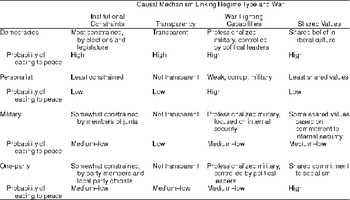
In contrast, scholars of comparative politics have long known that there exist numerous distinct types of authoritarian regimes (Linz 1975). Geddes' (1999a) data set codes three common types of autocratic regimes—military, single-party, and personalist—between 1945 and 1994. As discussed below, the most crucial factor differentiating these regimes from one another is whether the government is dominated by the military as an institution, a hegemonic political party, or a single individual. Building on the democratic peace literature, we examine four causal mechanisms that link regime type and war—institutional constraints, transparency, war fighting capabilities, and shared values—and apply these insights to the three types of authoritarian regimes catalogued by Geddes. Table 1 provides an overview of our argument. The top of each cell briefly summarizes our observations about each regime, while the bottom of each cell notes whether we consider this factor to have a high, medium, or low probability of leading to a separate peace among specific types of regimes.
There are ways in which it is appropriate to consider all of these types of autocratic regimes as fundamentally similar. We accept the liberal argument that these regimes are all less constrained than democracies in the sense that they allow a small elite tremendous leverage in determining national policy. In personalist regimes, one man possesses overwhelming authority to make decisions. Military regimes face somewhat more constraints because decisions need to be approved by a portion of the officer corps. Single-party regimes also may be somewhat constrained because decisions must have at least the tacit approval of party members.
As Bueno de Mesquita et al. (1999) point out, however, the size of the winning coalition in personalist, military, and single-party regimes may be equally small. Leaders in each of these autocratic regimes can, therefore, stay in office by providing private goods to key supporters even if they suffer defeat in war. The size of the “selectorate,” however, differs substantially in these regimes, with single-party regimes possessing large selectorates and personalist dictators and military regimes small ones. Regimes that combine a large selectorate and a small winning coalition may be least constrained of all from going to war because it is more risky for members of the winning coalition to defect in such regimes, since defectors can be easily replaced (Bueno de Mesquita et al. 1999, 797). For these reasons, we believe that decisional constraints are unlikely to be the source of a separate peace among certain types of authoritarian regimes. Indeed, the lack of such constraints could lead to conflict between similar authoritarian regimes.
Similarly, we see few systematic differences in the openness of specific types of authoritarian regimes and find them all to be more opaque than democracies. Because of the need to provide information to party members and to remain consistent with their professed ideological vision, single-party regimes may be somewhat more transparent than military or personalist regimes. None of these regimes, however, possesses the combination of a diversity of information sources, freedom of the press, and political contestation that makes democracies systematically more transparent than all forms of authoritarianism. The logic of the transparency approach, therefore, does not help us much in distinguishing between specific types of authoritarian regimes and is unlikely to account for any separate peace between specific types of autocracies.
We believe that the institutional argument about democracy and war-fighting capabilities provides important insights for understanding how political institutions could lead to a separate peace among a particular group of autocracies, personalist dictatorships. Our argument, however, emphasizes the weakness of personalist dictatorships, rather than their strength, and suggests that this weakness can generate a political dynamic similar to that anticipated by the institutional constraint argument for the democratic peace. Democracies are more effective in war not only because of the size of their winning coalitions, but also because of the professionalization of their armies and the clear subordination of those forces to civilian authorities (Huntington 1957). With a few exceptions (Mansfield and Snyder 1995) scholars of the democratic peace have underemphasized this aspect of the relationship between democracy and war and have missed the constraints imposed on the political–military capability of states by certain patterns of civil–military relations.
Among autocracies, single-party regimes have proven most successful in maintaining or enhancing the power of the coercive apparatus of the state. Single-party regimes have often proven effective at mobilizing the people and resources of their societies in support of the nation's armed forces and have forged strong civilian control over professionalized militaries. Successful single-party regimes not only maintain the unity and discipline of the armed forces but also transform the Army into an instrument of the Party. An effective military has the potential to make single-party regimes more peaceful toward each other because they recognize the threat that another single-party regime poses. Alternatively, since the war-fighting capabilities of single-party regimes are not directly related to the size of their winning coalitions, their effectiveness in war may not lead to a separate peace among single-party regimes.
The defining characteristic of a military regime is that the military as a unified institution governs the country. Thus, the military retains its cohesion and often increases the resources available to perform its national missions. As Andreski (1980, 3) notes, however, “The more often the armed forces are used internally, the less capable they become of waging a war.” Because they focus on internal security missions, military regimes are likely to be more constrained than single-party regimes. Thus, while the Argentine military proved to be very effective in killing Argentines, it was less effective in fighting the British in the Malvinas War.
We argue, however, that personalist dictatorships are substantially more constrained than either military or single-party regimes. Dictatorial regimes thrive by destroying independent institutions, personalizing all politics, and ensuring that important political decisions are funneled through the one supreme leader (Jackson and Rosberg 1982). Dictators gain allies through the creation of clientelistic patronage networks. Graft and corruption bind individual bureaucrats to the leader rather than to rational, insulated bureaucracies. Those who cannot be coopted by inclusion in the corruption, or who might become future rivals for power, are purged. To stay in power, the dictator must skillfully divide and conquer his potential adversaries in the factional politics endemic to personalist regimes.
No institution presents a greater threat to the power of a personalist dictator than the Army does. Like military regimes, personalist dictators depend on the Army and security forces to repress popular dissent. They understand, however, that the armed forces almost always represent a greater threat to their power than do civilian dissidents. Personalist dictators must be constantly on guard against the possibility of a military coup. Indeed, many personalist dictators are former military officers who took power in coups (Jackson and Rosberg 1982, 32–8).
Dictators guard against this threat by incorporating officers fully in their network of graft and corruption. Officers are promoted and given choice commands because of their loyalty to the supreme leader rather than their skills as soldiers. They report to the dictator rather than through the chain of command, to strengthen the personal ties between the dictator and officers at the expense of the institutional bonds of the military. Multiple security forces and intelligence units proliferate so that the dictator can play one group off against another. These strategies are often very effective at preserving the dictator's power. Personalist regimes last longer than military regimes (Remmer 1989; Geddes 1999a).2
Geddes (1999a) created her data set to examine whether some types of autocratic regimes were more stable and long-lived and whether they exhibited distinctive patterns of breakdowns and transitions to new regimes. She found that military regimes experienced the shortest tenure and were most likely to end in peaceful negotiated transitions to democracy. Single-party regimes were the most long-lived and were also likely to be replaced by some form of negotiated transition. Personalist regimes on average survived much longer than military regimes but not as long as single-party ones. They were also the regimes most likely to be replaced through violence.
The strategies pursued by dictators to stay in power, however, render military institutions in personalist regimes incapable of doing much more than repressing unarmed civilians. To construct a “coup-proof” regime, dictators must systematically weaken their armed forces (Quinlivan 1999). These institutional constraints make it difficult for dictators to launch aggressive foreign policies because they know that their armies are unlikely to succeed in real combat with disciplined institutionalized military opponents. Because of the constraints personalist regimes impose upon the capabilities of their armed forces, dictators will generally be cautious about using their armed forces in battle. Saddam Hussein may represent an outlier rather than the norm for personalist dictatorships. Thus, personalist dictatorships that face few of the decisional constraints found in democracies are also constrained from participation in international conflict, albeit through different political institutions.
Shared institutional constraints may lead to peaceful relations among personalistic regimes because dictators are aware that their opponents face serious costs when force is used and are likely to be cautious. They may perceive one another as “dovish,” which would reduce the probability that they will engage in wars that flow from security dilemmas (Bueno de Mesquita and Lalman 1992).
Any separate peace among personalist dictatorships is likely to be more tenuous than the one between democracies. The institutional incentives for peace are less profound among personalist regimes. Personalist regimes still experience limited decisional constraints and transparency. Furthermore, if personalist dictatorships are known to be weak, this could make them tempting targets. Even other personalist regimes might consider attacking these regimes, especially if there is a wide gap in the relative material capabilities of the two states. To help differentiate between the decisional constraints and war-fighting arguments, we examine the impact of one specific type of mixed dyad, democracy–personalist dictatorship. If constraints are key, the mutual dovishness of democracies and personalist regimes should lead to peace between them. If war fighting capabilities are key, personalist regimes may be precisely the kinds of easy targets that democracies are most likely to attack.
The political institutions of military and single-party regimes do not provide strong arguments for why these regimes might be peaceful toward one another. Indeed, their lack of decisional constraints, transparency, and weak and divided military institutions could encourage conflict among military and single-party regimes. For these regimes, we must look toward explanations focused on shared interests and/or norms to account for a possible separate peace among similar regimes.3
Weart (1994) finds that shared political culture has led to peace among one type of nondemocratic regime, oligarchic republics.
Most military regimes proclaim to be technocratic and apolitical rather than ideological. Despite this, many institutionalized military regimes, especially those concentrated in South America during the 1960s and 1970s, adhere to a well-defined “national security” ideology (Stohl and Lopez 1986). National security ideology maintains an organic concept of the state and proclaims that the military is ideally suited to be the guarantor of the nation, bringing effective government in the national interest. This ideology legitimates aggressive foreign policy “to achieve or defend national goals against existing hostilities and pressures” (Stohl and Lopez 1986, 76). While this vision emphasizes preserving the territorial integrity of the state from external invasion, it focuses more intently on internal threats to the political integrity of the nation. Many of these regimes took power to fight real or imagined communist insurgents and the democratic institutions that might allow communists to achieve power. Shared interests in cooperating against perceived leftist threats could generate a separate peace among military regimes, as illustrated by Operation Condor, in which Latin American military regimes cooperated in hunting down leftist dissidents across national borders. The common socialization shared by most professionalized military institutions could help cement these bonds. Remmer (1998) found that the military regimes of the Southern Cone cooperated extensively on a variety of issues. We test whether these regimes have also avoided engaging in wars or militarized disputes with one another.
We believe that single-party regimes are the most likely kind of authoritarian regime to belong to the same normative community. Marxism–Leninism proclaims that socialists must remain united in their zero-sum struggle against capitalism because, if given the opportunity, capitalists will inflict cumulative losses on socialism. Marxist ideology also stresses the necessity for powerful socialist states to provide assistance to radical and other antiimperialist forces abroad. Since socialist states share a common ideology that stresses unity and brotherhood, one may expect that pairs of single-party regimes will not go to war because they share similar worldviews. While they do not focus on shared values, Oren and Hays (1997) find that developed socialist states were indeed peaceful toward one another during the Cold War.
This hypothesis should be treated with caution, however. While Marxism–Leninism provides a cohesive set of norms that binds these states together, it simultaneously legitimates violent revolutionary means of resolving conflict. Furthermore, the central role and exclusive nature of ideology in socialist single-party states can lead to conflicts about ideological purity. In his classic formulation of the containment policy, Kennan (1947) argued that the Communist Party leadership in the Soviet Union needed both to spread Communism aggressively and to punish satellite states that deviated from Soviet norms to legitimate their dictatorship at home. Any threat to the party's ideological supremacy, from internal or external sources, could be seen as a direct threat to the state. Thus, states governed by single-party regimes may conflict with one another because “they attempt to derive their legitimacy from identification with an ideological corpus” (Linz 1975, 197). Focusing on this dynamic, Bebler (1987) finds that Marxist–Leninist states have been involved in numerous conflicts with one another. Since Marxist ideology contains potentially contradictory ideas, it is difficult to know which ideas will dominate foreign policy.
One additional caveat is important here. China engaged in more disputes with Taiwan than almost any other member of the international system. Each of these cases is coded as a dispute among single-party regimes according to Geddes' guidelines. Clearly, China and Taiwan do not have shared norms and common interests. Therefore, we also examine below the conflict behavior of single-party regimes with Taiwan removed from the single-party regime category, so that we can get a more accurate sense of the importance of shared norms and common interests among single-party regimes.
Finally, it is unlikely that pairs of personalistic regimes will share similar normative values. Because personalistic regimes lack a common ideology, it is difficult to know what shared set of values might unite Saddam Hussein and Mobutu Sese Seko. A defining characteristic of personalistic regimes is that the cult of the leader rather than ideology dominates political life. Therefore, it is unlikely that shared worldviews will unite these regimes.
In sum, we argue that the more sophisticated classification of autocratic regimes presented in this article can lead to a more accurate assessment of whether specific types of autocratic regimes are peaceful toward one another. We anticipate that any dictatorial peace will be less robust than the democratic peace because none of the homogeneous pairs of autocratic regimes simultaneously exhibits the combination of institutional and normative constraints from warring with one another. Nevertheless, shared constraints may provide the foundation for a separate peace among personalist dictatorships, while shared identities and normative values may generate peaceful relations among single-party regimes. Military regimes are in the middle in terms of both shared values and institutional constraints. This leads to the central hypotheses examined in this paper.
Homogeneous dyads are less likely to engage in wars and militarized interstate disputes than are mixed dyads.
If institutional constraints are most important, personalist dictatorship dyads will be less likely to engage in wars and militarized interstate disputes than mixed dyads.
If shared norms are most important, single-party regime dyads will be less likely to engage in wars and militarized interstate disputes than mixed dyads.
If institutional constraints are most important, democracy–personalist dictatorship dyads will be less likely to engage in wars and militarized interstate disputes than other mixed dyads.
If war-fighting capabilities are most important, democracy–personalist dictatorship dyads will be more likely to engage in wars and militarized interstate disputes than other mixed dyads.
The empirical analysis focuses on militarized interstate disputes (MIDs) as the dependent variable.4
The Correlates of War data set of interstate wars and the Militarized Interstate Dispute data set can be accessed at http//pss.la.psu.edu.
Two data sets are used to determine regime type. First, we use Polity IIId to classify democracies between 1945 and 1994, with a score of six on Polity's democracy scale serving as the cutoff point (Jaggers and Gurr 1995; McLaughlin et al. 1998). We do not use Polity to classify authoritarian regimes, however, because, as Gleditsch and Ward (1997) indicate, there is a variety of paths through which states can achieve the same scores on the Polity scales. Regimes with different institutions and structures are treated as though they were functionally identical. Single-party, military, and personalist regimes often receive the same score on the Polity autocracy scale. Thus, studies that have found some evidence of an authoritarian peace, such as those by Oneal and Russett (1997, 281–3), Gleditsch and Hegre (1997, 290), and Raknerud and Hegre (1997, 394–400) may not be measuring truly homogeneous dyads.5
Both Oneal and Russett (1997) and Gleditsch and Hegre (1997) follow what has become standard practice in the democratic peace field by combining the autocracy and democracy scales of the Polity data set into a single scale from −10 to +10. When Oneal and Russett (1997, 281–3) included the Polity scores of each state of a dyad in their models, they found a “cats and dogs” effect. The greater the distance between two states on the Polity scale, the more likely it was that they would enter into a militarized dispute. Gleditsch and Hegre (1997, 285) classify regimes as democracies if they score +3 or more on the DEMOC-AUTOC scale. They then differentiate between dyads that have zero, one, or two participants that qualify as democracies by this measure. They found that dyads with two nondemocracies were somewhat more likely to be peaceful toward one another than were dyads with only one democracy. Raknerud and Hegre (1997, 393) use only the democracy scale of the Polity data set and code regimes as democracies if they score 6 or above on that scale. They found that dyads with two nondemocracies were less likely to engage in war than were mixed dyads of democracies and nondemocracies but that this was a function of diffusion effects when democracies join ongoing wars on the side of other democracies. These are important, suggestive findings that help underscore the need to conduct more sophisticated tests of the possibilities for peace among specific types of authoritarian regimes.
Then, as noted above, we use Geddes' (1999a) data set, which relies on a wide range of secondary sources, to classify autocratic regimes as personalist, single-party, or military during this time period. Cases are coded as military regimes if they are governed “by an officer or retired officer, with the support of the military establishment and some routine mechanism for high level officers to influence policy choice and appointments” (Geddes 1999a, 20). Military regimes share the following characteristics: relationships within the Junta and or military council are relatively egalitarian; the regime has some kind of institutions for deciding succession questions, and for routine consultation between the leader and the rest of the officer corps; the military hierarchy remains intact; and the security apparatus is controlled by the military. Geddes (1999a, 18) does not include governments that lasted for less than three years because they represented “periods of holding customary rules in temporary abeyance, struggle over rules, or transition from one set of rules to the next,” rather than regimes, defined as “sets of formal and informal rules and procedures for selecting national leaders and policies.” Since most of these temporary authoritarian interregna involved military governments, her list of military governments may underrepresent the universe of cases of military regimes.
Single-party regimes are defined as “regimes in which the party has some influence over policy, controls most access to political power and government jobs, and has functioning local- level organizations” (Geddes 1999a, 20). The party almost always exists prior to a leader's accession to power. It retains important functions down to the local level. Single-party systems routinely require party membership for most government jobs. While there are some exceptions, such as Taiwan and Mexico, most single-party states have been socialist regimes. To determine the dividing line between single-party authoritarian regimes and single-party dominant democracies, Geddes (1999a, 18) coded cases as authoritarian if the dominant party had never lost control of the executive and won at least two-thirds of all seats in the legislature in all elections prior to 1985.
Regimes were coded as personalistic if “the leader, who usually came to power as an officer in a military coup or as the leader of a single-party government, had consolidated control over policy and recruitment in his own hands, in the process marginalizing other officers' influence and/or reducing the influence and functions of the party” (Geddes 1999a, 20). These regimes lack effective institutions and one ruler dominates politics. To distinguish between military and personalistic regimes, Geddes codes regimes as personalistic when the leader dissolves military councils and other “consultative institutions”; when military officers are forced to retire; the leader forms a “party” to form an alternative base of support; or the leader murders, demotes, or dismisses dissenting officers. A single ruler dominates these regimes and ideology plays little role in politics. Monarchies, another type of autocratic regime in which a single ruler dominates, are not included in this data set.
Regimes that are not accounted for by either of these data sets are included in an “other” category. Many autocracies exhibit important characteristics of more than one category. Regimes Geddes classifies as hybrids are placed in the “other” category in our analysis. There is also a variety of political systems in uncertain processes of political transition that do not fit clearly into either the democratic or autocratic camps. Geddes, for example, does not classify the successor states created after the collapse of the Soviet Union and Yugoslavia because of the fluid nature of the political regimes in many of these states and because insufficient time has elapsed to judge whether their regimes have become institutionalized. These cases are also included in the “other” category here. We include dummy variables for each type of homogeneous dyad, democracies, personalist dictatorships, military regimes, and single-party regimes. Because we hypothesize that homogeneous pairs of states will be less likely to engage in wars and MIDs than heterogeneous ones, we use mixed dyads (including pairs of states in the “other” category) as the excluded category in our analysis.6
Geddes constructed this data set to examine the longevity of different types of authoritarian regimes. Because she hypothesized that military regimes would be the most likely to break down quickly, while single-party regimes would last longest, she constructed a six-point scale that arrayed regimes along the range of their expected longevity: 1 = military regimes; 2 = hybrid regimes that share characteristics of military and personalist governance; 3 = personalist dictatorships; 4 = hybrids that combine elements of personalism and single-party governance; 5 = single-party regimes; and 6 = regimes that combine elements of all three types. In constructing cases of homogeneous dyads, we include only pairs of cases with the same pure type, those that are both coded as 1, 3, or 5.
We also include five control variables that previous research has shown to have an impact on war and dispute involvement. First, previous research has shown that contiguous states are much more likely to engage in conflicts with one another than are states that do not share borders. Therefore, we include contiguity in the models.7
A dyad is considered contiguous if the two states share a land border or are within 400 mi of one another by sea (Gochman 1991).
For this time period, the United States, the Soviet Union/Russia, the United Kingdom, France, and China (from 1950) are considered major powers.
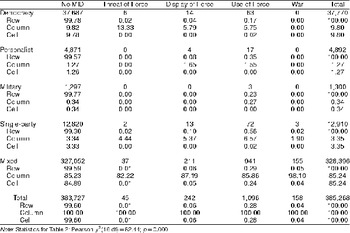
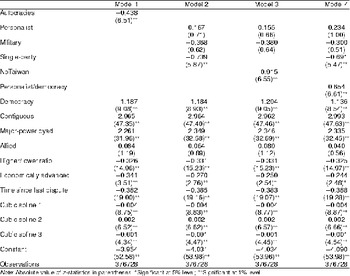
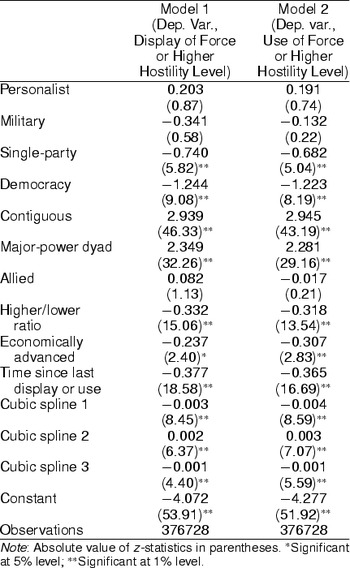
We begin by presenting the data for all levels of hostility in simple tabular form (see Table 2). We then use multivariate logit regression to estimate the impact of regime type on conflict involvement (see Table 3). We use logit splines, a technique designed by Beck et al. (1998), to address the problems associated with time dependence in analyzing time-series, cross-sectional data with a dichotomous dependent variable. We add a counter-variable to the model recording the years of peace between a state's involvement in a militarized dispute and a subsequent involvement. The occurrence of a MID resets the counter to 0. We then generate three splines for each logit equation (see Beck et al. 1998; Enterline 1998, 394). The dependent variable in the results reported in Table 3 takes the value of one in any year in which a dyad is involved in a MID of any intensity and 0 when a dyad has not participated in any type of conflict behavior during a given year. We also estimated our models at each level of hostility and found consistent results across all levels of hostility short of war, suggesting that the dynamics of participation in MIDs is not dissimilar to the dynamics of the escalation of disputes among authoritarian regimes. See Table 4 for the results of these regressions.
Our examination of the relationship between homogeneous authoritarian dyads and interstate wars between 1945 and 1994 shows that no two personalist dictators have fought one another.9
Personalist dictatorships have fought several wars with democracies, however, suggesting that a simple version of the institutional constraint argument and “dovishness” does not apply to the incidence of war.
Since we took our war data from the MID data set, the number of war dyad years reported in Table 2 is somewhat inflated compared to data taken from the Correlates of War interstate war data set. This is because the MID data set codes cases at the highest level of hostility for the entire dispute even if the dispute began at a level short of war. Since we do not report separate logit results for wars, this discrepancy does not affect our results.
Scholars have raised the question of whether the rarity of war and the rarity of democracy in the international system renders the finding of no wars between democracies statistically insignificant (Spiro 1994). This problem is considerably worse in the case of personalist dictatorships and military regimes than for democracies. States initiated wars in only .04% of the dyad years between 1945 and 1994. Personalist dictatorships and institutional military regimes are also rare. Whereas joint democratic dyads constitute 9.8% of the total dyad years during this era, pairs of personalist dictatorships accounted for only 1.27% of the total dyad years. Military regimes were even rarer, with joint military dyads accounting for only .34% of the total dyad years. The absence of war between pairs of personalist dictatorships and pairs of military regimes may, therefore, be the result of random chance.
Table 2 indicates that militarized disputes are also rare among pairs of military regimes or personalist dicatorships, but their proportion of all disputes roughly matches their share of all regime dyad years. What stands out in an examination of all militarized disputes in Table 2 is the comparison of the dispute behavior of democracies and single-party regimes. Single-party dyads have experienced more militarized disputes than democratic dyads even though there are nearly three times as many democratic dyads in the data set. Single-party dyads were involved in 5.84% of all disputes, despite representing only 3.35% of all dyad years. Therefore, a simple bivariate chi-square test of the dispute participation of single-party regimes suggests that they are significantly more likely to engage in disputes with one another than are other dyads.
Since militarized interstate disputes are more common than wars and pairs of each type of regime have engaged in disputes, we can use multivariate logit regression to analyze the relationship between regime type and MIDs. Table 3 presents the logit spline regression results of four models.11
The logit models in Table 3 include fewer cases than reported in Table 2 because we possessed control data only through 1992.
In the first model, the autocratic dyad dummy is negative and significant, suggesting that autocratic dyads are more peaceful than mixed dyads. We found this result surprising given our concern with the significant variation among authoritarian regimes. Nevertheless, this result confirms the findings of Oneal and Russett (1997), Gleditsch and Hegre (1997), and Raknerud and Hegre (1997) and suggests that autocratic dyads broadly conceived are less likely to be involved in militarized disputes than are mixed dyads of democracies and autocratic regimes.12
Russett and Oneal (2001) suggest that the “cats and dogs effect” that they had found in their 1997 study disappeared once they controlled for time dependence in their more recent analyses. Our tests include controls for time dependence and still find some evidence of a peace among authoritarian dyads.
In Models 2–4 in Table 3 and both models in Table 4, dyads made up of two personalist dictatorships or two military regimes are not significantly different from mixed dyads in their propensity to engage in MIDs. The single-party regime dyad is the only one of the homogeneous authoritarian dyads that is strongly significant across each of these models. The sign for this variable is negative, suggesting that single-party regimes are less likely to engage in MIDs with similar regimes than with other types of regimes. This finding contradicts the expectations of Bebler (1987). It also seems to be at odds with the data presented in Table 2, which suggest that single-party regimes are more likely to engage in disputes with other single-party regimes than with other regimes. These results support those of Oren and Hayes (1997), however, especially in model 3, which substitutes the NoTaiwan variable for the single-party dummy. When Taiwan is taken out of the single-party category, the coefficient increases substantially.
The control variables help account for why the single-party regime variable is negative in the logit models when the simple bivariate test suggested a positive relationship. Consistent with previous research, the results in all models in Table 3 indicate that contiguous dyads and those containing a major power are significantly more likely to experience militarized disputes than noncontiguous dyads or those without a major power. Dyads with large disparities in relative power are less likely to experience disputes. Only the alliance variable was not significant.
Single-party dyads were more likely to be contiguous than the norm and two of the five major powers, the Soviet Union and China, were governed by single-party regimes, which should increase the likelihood of conflict among these dyads. Indeed, a substantial majority of militarized disputes among single-party regimes involved either China or the Soviet Union in disputes with contiguous states. Many of these disputes pitted the USSR and China against one another. Almost none of the 90 disputes noted in Table 2 involved conflicts between two of the USSR's East European allies. The peaceful relationship among the Eastern European single-party regimes provides the strongest evidence for a separate peace among such regimes.
These results may mean that the high frequency of militarized disputes among single-party regimes is an artifact of the traditional great power behavior of China and the Soviet Union in their spheres of influence. The relative absence of conflicts among the smaller members of the Warsaw Pact could reflect Soviet hegemony. As Kennan suggested, however, conflicts between China and the Soviet Union and between the Soviet Union and its satellite states may have flowed directly from the character of their political regimes. At the core of the Sino-Soviet split was a struggle for ideological leadership in the socialist camp (Low 1976; Wich 1980; Kramer 1997a). Soviet interventions in the Eastern bloc reflected a desire, as suggested by the Brezhnev Doctrine, to enforce ideological unity in “conditions of unabating ideological war,” to “preserve the indivisible socialist system,” (LaFeber 1993, 258–9; Valenta 1991; Kramer 1997b). In any event, there may be a separate peace among single-party regimes, but the ambiguous roles of China and the USSR in the socialist world are cause for caution in the interpretation of these results.
Only joint democracy was consistently related to a lower frequency of militarized disputes. Democratic dyads were more peaceful despite the fact that they were more likely to be contiguous, as well as to include major powers and states of relatively equal power. The fact that only democratic dyads were consistently more peaceful than the norm, even at the lowest level of hostility where conflicts among transparent democracies are likely to be overrepresented in the MID data, adds further support for the empirical power of the democratic peace.
Furthermore, Model 4 provides some evidence that it is the greater war-fighting effectiveness of democracies that helps account for that peace. The variable for dyads that include a democracy and a personalist dictatorship is positive and significant. A focus on institutional constraints would have suggested that democratic–personalist dictatorship dyads would be more peaceful than other types of dyads. The increased likelihood of conflict between these dyads noted in Model 4 suggests that strong and capable democracies pick weak personalist regimes as targets.
While we have focused our analysis on authoritarian regimes, the finding that democracy–personalist dictatorship dyads are more likely to experience militarized disputes expands our knowledge of the broader relationship between regime type and conflict. Our findings support recent research on the democratic peace that it is the efficiency of democratic regimes in picking fights that they are likely to win and in fighting harder and better than their adversaries that accounts for the distinctive patterns found in the conflict behavior of democracies.
We found some evidence that suggests that there may be a dictatorial peace. No pair of personalist dictatorships fought wars in the post-World War II era. The same is true for military regimes. Authoritarian regimes in general were less likely to engage in militarized interstate disputes than were mixed dyads. Single-party regimes were less likely to conflict with one another than were mixed dyads when appropriate controls were included in the model. This was especially true when Taiwan was not counted as a homogeneous regime to the predominantly socialist regimes in the single-party category. All of these findings suggest that the separate peace among democracies may not be unique among political regimes.
We found no unambiguous evidence of a dictatorial peace, however. The rarity of war and of personalist and military regimes makes it difficult to ascertain whether the lack of war between these types of regimes reflects a causal relationship or random chance. While single-party dyads exhibited a strongly significant negative relationship with participation in militarized disputes, they are the only type of homogeneous dyad to have fought wars with one another in the post-World War II era. Furthermore, single-party regimes have been involved in numerous militarized disputes with one another. How one understands the conflict record of such regimes depends on how one interprets the role of the Soviet Union and China in the socialist world.
In the end, only shared democracy exhibits a clear and consistent negative impact on the incidence of wars and militarized interstate disputes. Furthermore, the increased possibilities for conflict found between personalist dictatorships and democracies provides evidence suggesting that it is the war-fighting capabilities of democracies that best explains the distinctive conflict behavior of democratic regimes.
While we may not have discovered an unambiguous dictatorial peace, we have shown that different types of authoritarian regimes exhibit varying patterns of conflict behavior. The analysis presented here demonstrates that studies of the impact of regime type on conflict behavior must work from a more sophisticated conception of authoritarianism. More broadly, efforts to integrate perspectives from comparative politics and international relations must concentrate as much on the impact of authoritarianism on foreign policy as they do on the impact of democracy.
Regime Type and Causal Mechanisms for War
Homogeneous Dyads and Militarized Interstate Disputes
Logit Spline Regressions: Dependent Variable, MID (Any Intensity)
Logit Spline Regressions: Dependent Variable, MID (Various Hostility Levels)
Comments
No Comments have been published for this article.