



1 Introduction
Homological algebra has provided powerful tools for measuring the complexity of algebraic structures through derived functors and homological dimensions. For a ring R, the projective dimension
$\mathrm {pd}_RM$
 of an R-module M is characterized as the minimal length of a projective resolution, which plays a fundamental role in defining the global dimension of R. Avramov–Foxby [Reference Avramov and Foxby5] generalized the projective dimension to a unbounded complex X in the derived category
$\mathrm {D}(R)$
 . This generalization unified the treatment of modules and complexes and laid the groundwork for applying homological methods in broader contexts. In 2016, Yekutieli [Reference Yekutieli27] introduced the projective dimension
$\mathrm {pd}X$
 for an object
$X\in \mathrm {D}(R)$
 in the case, where R is a differential graded (dg for short) ring from the viewpoint that
$\mathrm {pd}X$
 measures how the functor
$\mathrm {RHom}_R(X,-)$
 alters cohomology amplitudes. For ordinary rings, this invariant coincides with the definition of Avramov–Foxby up to a shift. However, traditional dg projective resolutions are insufficient for measuring homological dimensions of dg modules. Minamoto [Reference Minamoto20] thus introduced sup-projective (sppj), inf-injective (ifij), and sup-flat (spft) resolutions for dg modules over a nonpositive dg ring. A key feature of these resolutions is that their lengths determine the corresponding homological dimensions.
These developments are essentially situated within the framework of triangulated categories, specifically derived categories, and they naturally raise a question: how can one develop a homological dimension theory that applies uniformly to arbitrary triangulated categories, thereby unifying examples, such as derived categories of modules over rings or dg rings, and others? This question lies at the heart of the work by Kostas–Psaroudakis–Vit
$\acute {\mathrm {o}}$
 ria [Reference Kostas, Psaroudakis and Vitória17], who proposed a new framework for studying homological properties of triangulated categories, obtaining invariants that reflect the structural properties of the category.
Let
$\mathcal {T}$
 be a triangulated category and
$\mathcal {X},\mathcal {Y}\subseteq \mathcal {T}$
 full subcategories. We denote by
$\mathcal {X}\ast \mathcal {Y}$
 the collection of objects
$Z\in \mathcal {T}$
 appearing in an exact triangle
$X\rightarrow Z\rightarrow Y\rightarrow X[1]$
 with
$X\in \mathcal {X}$
 and
$Y\in \mathcal {Y}$
 . For an interval
$\Theta $
 of integers, denote


where
$\Theta $
 sometimes is represented by symbols
$> 0$
 or
$\leqslant 0$
 and so on with the obvious meaning. The symbol
$\perp $
 stands for
$\perp _0$
 . We denote by
$\mathrm {Add}(\mathcal {X})$
 (resp.
$\mathrm {Prod}(\mathcal {X})$
 ) the subcategory formed by the summands of the existing coproducts (resp. products) of objects in
$\mathcal {X}$
 .
From Morita theoretic viewpoint, tilting objects are of central importance. As a generalization, Aihara–Iyama [Reference Aihara and Iyama2] introduced silting objects. In particular, a compact silting generator M of a triangulated category
$\mathcal {T}$
 induces a t-structure
$(\mathrm {Add}(M)^{\bot _{>0}}, \mathrm {Add}(M)^{\bot _{\leqslant 0}})$
 whose heart
$\mathcal {H}_M=M^{\bot _{\neq 0}}$
 is an abelian category. Let
$\mathcal {H}^0_M(-)$
 be the cohomological functor
$\mathcal {T}\rightarrow \mathcal {H}_M$
 and
$\mathcal {H}^{-n}_M(-):=\mathcal {H}^0_M(-[n])$
 . This functor allows one to measure the homological position of objects in
$\mathcal {T}$
 . For
$X\in \mathcal {T}$
 , set
$\mathrm {sup}X=\mathrm {sup}\{\ell \in \mathbb {Z}\hspace {0.02cm}|\hspace {0.02cm}\mathcal {H}^\ell _M(X)\neq 0\}$
 ,
$\mathrm {inf}X=\mathrm {inf}\{\ell \in \mathbb {Z}\hspace {0.02cm}|\hspace {0.02cm}\mathcal {H}^\ell _M(X)\neq 0\}$
 , and
$\mathrm {amp}X=\mathrm {sup}X-\mathrm {inf}X$
 .
The above idea of measuring homological position via a cohomological functor already appeared in a more concrete setting: for a nonpositive dg ring A, Minamoto introduced analogous invariants, where the heart
$\mathcal {H}_A = \mathrm {Mod}(\mathrm {H}^0(A))$
 and the additive subcategory
$\mathrm {Add}(A)$
 play crucial roles. These observations motivate a natural question: can such a homological theory be established in a broader context? This leads to the first aim of this article: to extend Minamoto’s concepts from the dg setting to a triangulated category generated by a single compact silting object. We state the first main result.
Theorem A (Theorem 3.3 and Corollaries 3.5 and 3.7)
Let
$\mathcal {T}$
 be a triangulated category, let M be a compact silting generator with associated heart
$\mathcal {H}_M$
 , and let
$X\in \mathcal {T}^{-}$
 and
$d\geqslant 0$
 . Then the following are equivalent:
$(1)$
 For any sppj resolution
$P_\bullet $
 of X, there exists
$e\geqslant 0$
 such that
$X_e\in \mathrm {Add}(M)[-\mathrm {sup}X_e]$
 ,
$d=e+\mathrm {sup}X-\mathrm {sup}X_e$
 and the triangle
$X_{e}\rightarrow P_{e-1}\rightarrow X_{e-1}\rightarrow X_{e}[1]$
 is not split.
$(2)\, X$
 has an sppj resolution
$P_\bullet $
 of length e, so that
$X_e\in \mathrm {Add}(M)[-\mathrm {sup}X_e]$
 ,
$d=e+\mathrm {sup}X-\mathrm {sup}X_e$
 and the triangle
$X_{e}\rightarrow P_{e-1}\rightarrow X_{e-1}\rightarrow X_{e}[1]$
 is not split.
$(3)\, \mathrm {Hom}_{\mathcal {T}}(X,\mathcal {H}_M[i])=0$
 for
$i\not \in [-\mathrm {sup}X,-\mathrm {sup}X+d]$
 and
$\mathrm {Hom}_{\mathcal {T}}(X,\mathcal {H}_M[-\mathrm {sup}X+d])\neq 0$
 .
$(4)\, \mathrm {pd}_{\mathcal {T}}X=d$
 , that is, d is the smallest number which satisfies
$X\in \mathrm {Add}(M)[-\mathrm {sup}X]\ast \cdots \ast \mathrm {Add}(M)[-\mathrm {sup}X+d]$
 .
Theorem A provides several equivalent characterizations of the projective dimension
$\mathrm {pd}_{\mathcal {T}}X$
 . Conditions (1) and (2) describe the dimension in terms of a concrete sppj resolution (see Construction 3.2), which is useful for computations in derived categories or in contexts where resolutions can be constructed. Condition (3) translates the projective dimension into a cohomological vanishing condition, offering a criterion that is often easier to verify in practice. Condition (4) recovers the definition of projective dimension, thereby aligning with the classical notion expressed in terms of resolutions.
Analogous results for the injective dimension of objects in
$\mathcal {T}^{+}$
 and the flat dimension of objects in
$\mathcal {T}^{-}$
 are given in Theorems 3.4 and 3.12.
Let
$\mathcal {T}$
 be a triangulated category and
$\mathcal {X}\subseteq \mathcal {T}$
 a full subcategory. We denote by
$\mathrm {add}(\mathcal {X})$
 the subcategory formed by the summands of finite sums of objects in
$\mathcal {X}$
 , set
$\mathrm {thick}^0(\mathcal {X})=\mathrm {add}(\emptyset )$
 and
$\mathrm {thick}^1(\mathcal {X})=\mathrm {add}\{X[i]\hspace {0.02cm}|\hspace {0.02cm}X\in \mathcal {X}, i\in \mathbb {Z}\}$
 . For
$n\geqslant 1$
 , let
$\mathrm {thick}^n(\mathcal {X})=\mathrm {add}(\mathrm {thick}^1(\mathcal {X})\ast \mathrm {thick}^{n-1}(\mathcal {C}))$
 and
$\mathrm {thick}(\mathcal {X})=\bigcup _{n\geqslant 0}\mathrm {thick}^n(\mathcal {X})$
 .
The dimension
$\mathrm {dim}\mathcal {T}$
 for a triangulated category
$\mathcal {T}$
 was introduced by Rouquier [Reference Rouquier24], building on work by Bondal and van den Bergh [Reference Bondal and Van den Bergh10]. It is defined as the minimal integer
$n\geqslant 0$
 such that there exists an object
$X \in \mathcal {T}$
 with
$\mathcal {T} = \mathrm {thick}^{n+1}(X)$
 . The dimensions of the bounded derived category of finitely generated modules over a Noetherian ring and that of coherent sheaves on a Noetherian scheme are called the derived dimension. The dimension of the singularity category (as defined by Buchweitz [Reference Orlov23] and Orlov [Reference Buchweitz11]) is called the stable dimension. Subsequently, a relative version was introduced by Aihara et al. [Reference Aihara, Araya, Iyama, Takahashi and Yoshiwaki1], who defined the dimension of
$\mathcal {T}$
 with respect to
$\mathcal {X}$
 :

A similar notion called level was studied by Avramov–Buchweitz–Iyengar–Miller [Reference Avramov, Buchweitz, Iyengar and Miller4].
Despite the importance of these dimension notions, it remains a challenging problem to compute the precise dimension of a triangulated category
$\mathcal {T}$
 . Various approaches have been developed to import homological invariants into the triangulated setting, yet most of these invariants rely on distinguished classes of objects that are not intrinsically defined within the category itself (see, e.g., [Reference Kostas, Psaroudakis and Vitória17, p. 2]). This raises the question of whether one can define intrinsic homological invariants that capture homological behavior and unify existing results in the literature. This leads to the second aim of this article: to study several homological attributes of
$\mathcal {T}$
 that are intrinsic to the triangulated structure.
To achieve this aim, we work in a concrete yet sufficiently general framework. Let
$\mathcal {T}$
 be a triangulated category and M a compact silting generator with associated heart
$\mathcal {H}_M$
 . The global dimension of
$\mathcal {T}$
 is defined as

When
$\mathcal {T}$
 is equipped with a suitable silting or tilting object, this framework closely mirrors classical module theory and simultaneously establishes connections with the
$\mathrm {Add}(M)$
 -dimension of
$\mathcal {T}^{\mathrm {b}}$
 . More specifically, we show the following theorem.
Theorem B (Theorems 4.1, 4.6, and 4.9)
One has the following equalities:

If
$M\in \mathcal {T}^{\mathrm {b}}$
 , then
$\mathrm {Add}(M)\textrm {-}\mathrm {tri.dim}\mathcal {T}^{\mathrm {b}}\leqslant \mathrm {gldim}\mathcal {T}$
 . In additional, if M is tilting, then

Theorem B shows that, although defined in different ways, the invariants introduced above coincide under natural conditions, thereby providing a unified framework for homological dimension theory in triangulated categories. Moreover, it reveals how silting and tilting objects, together with their associated t-structures, encode fundamental homological information. As applications, we study homological properties, such as Gorensteinness and regularity for a Noetherian compactly generated triangulated category.
Structure of the article. In Section 2, we collect preliminary notions and results that are used throughout the article. In Section 3, we explain in detail the homological dimensions of objects in a triangulated category
$\mathcal {T}$
 and their associated resolutions. In Section 4, we introduce the global dimension
$\mathrm {gldim}\mathcal {T}$
 and provide several characterizations of
$\mathrm {gldim}\mathcal {T}$
 in terms of well-behaved silting objects. In Section 5, we study finiteness of global dimension, Gorensteinness, and regularity in the context of triangulated categories and discuss applications of our theory to the derived categories of modules over rings or dg rings.
2 Definitions and basic facts
This section is devoted to drawing some basic consequences for use throughout this article. For terminology, we shall follow [Reference Hoshinoa, Katoa and Miyachi14, Reference Kostas, Psaroudakis and Vitória17, Reference Neeman21, Reference Neeman22].
A triple
$(\mathcal {T},[1],\Delta )$
 is called a triangulated category, where
$\mathcal {T}$
 is an additive category,
$[1]$
 is an autoequivalence of
$\mathcal {T}$
 , and
$\Delta $
 is a full subcategory of Diag
$(\mathcal {T},[1])$
 which satisfies some axioms, where Diag
$(\mathcal {T},[1])$
 denotes the category whose objects are diagrams in
$\mathcal {T}$
 of the form
$X\rightarrow Y \rightarrow Z\rightarrow X[1]$
 . The elements of
$\Delta $
 are called exact triangles.
An object X in a triangulated category
$\mathcal {T}$
 is said to be compact if
$\mathrm {Hom}_{\mathcal {T}}(X,-)$
 commutes with all existing coproducts. Compact objects form a thick subcategory of
$\mathcal {T}$
 , denoted by
$\mathcal {T}^c$
 . If
$\mathcal {T}$
 is cocomplete,
$\mathcal {T}^c$
 is skeletally small and
$(\mathcal {T}^c)^\bot =0$
 , then we say that
$\mathcal {T}$
 is compactly generated. In this case, for a compact object C in
$\mathcal {T}$
 , there is a unique object of
$\mathcal {T}$
 , up to isomorphism, representing the functor

denote by
$C^\ast $
 , it is called the Brown–Comenetz dual of C.
A pair
$(\mathcal {U},\mathcal {V})$
 of subcategories in a triangulated category
$\mathcal {T}$
 is said to be a torsion pair if
$\mathcal {U}^\bot =\mathcal {V}, {^\bot }\mathcal {V}=\mathcal {U}$
 and
$\mathcal {U}\ast \mathcal {V}=\mathcal {T}$
 . Such a torsion pair is said to be a t-structure if
$\mathcal {U}[1]\subseteq \mathcal {U}$
 . If
$(\mathcal {U},\mathcal {V})$
 is a t-structure, then
$\mathcal {U}\cap \mathcal {V}[1]$
 is an abelian category, called the heart of
$(\mathcal {U},\mathcal {V})$
 . Let
$\mathcal {M}$
 be an additively closed subcategory of
$\mathcal {T}$
 , that is,
$\mathrm {Add}(\mathcal {M})= \mathcal {M}$
 . We say that
$\mathcal {M}$
 is silting if
$(\mathcal {M}^{\bot _{>0}}, \mathcal {M}^{\bot _{\leqslant 0}})$
 is a t-structure in
$\mathcal {T}$
 . An object M in
$\mathcal {T}$
 is silting if
$\mathrm {Add}(M)$
 is a silting subcategory. If
$\mathcal {M}$
 is a silting subcategory with
$\mathrm {Hom}_{\mathcal {T}}(\mathcal {M}, \mathcal {M}[\neq 0])=0$
 , then
$\mathcal {M}$
 is tilting. A subcategory
$\mathcal {M}$
 of
$\mathcal {T}^c$
 is said to be a far-away generated subcategory for
$\mathcal {T}^c$
 if
$\mathcal {M}\subseteq \mathcal {M}^{\bot _\ll }\cap \mathcal {M}^{\bot _\gg }$
 and
$\mathrm {thick}(\mathcal {M})=\mathcal {T}^c$
 .
Throughout this article,
$\mathcal {T}$
 is a compactly generated triangulated category and M is a compact silting generator with associated abelian heart
$\mathcal {H}_M=M^{\bot _{\neq 0}}$
 . Then
$\mathcal {T}$
 admits set-indexed coproducts and products by the Brown representability theorem. Denote
$\mathcal {P}=\mathrm {Add}(M)$
 and
$\mathcal {I}=\mathrm {Prod}(M^\ast )$
 . For
$\mathcal {X}=\mathcal {P}$
 or
$\mathcal {I}$
 , denote
$\langle \mathcal {X}\rangle _0=\{0\}$
 ,
$\langle \mathcal {X}\rangle _1=\mathrm {Add}\{X[i]\hspace {0.02cm}|\hspace {0.02cm}X\in \mathcal {X}, i\in \mathbb {Z}\}$
 , and
$\langle \mathcal {X}\rangle _n=\mathrm {Add}(\langle \mathcal {X}\rangle _1\ast \langle \mathcal {X}\rangle _{n-1})$
 for
$n\geqslant 1$
 .
The following well known facts about t-structures are taken from [Reference Beilinson, Bernstein and Deligne7, Definition 1.3.1] and [Reference Kashiwara and Schapira16, Propositions 10.1.4 and 10.1.8].
Remark 2.1 (1) For
$n\geqslant 0$
 , put
$\mathcal {T}^{< n+1}=\mathcal {T}^{\leqslant n}:=\mathcal {P}^{\perp _{>n}}$
 and
$\mathcal {T}^{\geqslant n+1}=\mathcal {T}^{>n}:=\mathcal {P}^{\perp _{\leqslant n}}$
 , and set
$\mathcal {T}^{-}:=\bigcup _{n>0}\mathcal {T}^{\leqslant n},\ \ \mathcal {T}^{+}:=\bigcup _{n>0}\mathcal {T}^{\geqslant -n},\ \mathcal {T}^{\mathrm {b}}:=\mathcal {T}^-\cap \mathcal {T}^+=\mathrm {thick}(\mathcal {H}_M)$
 .
(2) For any object
$X\in \mathcal {T}$
 and
$\ell \in \mathbb {Z}$
 , the truncation functors
$\tau ^{\leqslant \ell }$
 and
$\tau ^{\geqslant \ell }$
 (which are part of the t-structure data) yield canonical exact triangles


Example 2.2 [Reference Kostas, Psaroudakis and Vitória17, Reference Schwede and Shipley25]
(1) Let R be a ring. Then the derived category
$\mathrm {D}(R)$
 is a compactly generated triangulated category and R is a compact tilting object, such that
$\mathrm {D}(R)^c=\mathrm {K}^{\mathrm {b}}(\mathrm {proj}R)$
 is far-away generates by R, where
$\mathrm {K}^{\mathrm {b}}(\mathrm {proj}R)$
 is the bounded homotopy category of finitely generated projective R-modules.
(2) Let A be a nonpositive dg ring. Then the derived category
$\mathrm {D}(A)$
 is a compactly generated triangulated category and A is a compact silting object. If
$\mathrm {amp}A<\infty $
 , then
$\mathrm {D}(A)^c=\mathrm {thick}(A)$
 is far-away generates by A.
(3) The homotopy category
$\mathrm {K}(\Gamma )$
 of modules over a connective ring spectrum
$\Gamma $
 is a compactly generated triangulated category with a compact silting object
$\Gamma $
 .
We begin by establishing several useful lemmas.
Lemma 2.3 [Reference Kashiwara and Schapira16, Proposition 10.1.12]
The sequence
$\{\mathcal {H}^n_M\}_{n\in \mathbb {Z}}$
 is a cohomological functor in the classical sense: given any exact triangle
$X\rightarrow Y\rightarrow Z\rightarrow X[1]$
 , it induces a long exact sequence in
$\mathcal {H}_M$


Lemma 2.4 [Reference Hoshinoa, Katoa and Miyachi14, Theorem 1.3]
The functor
$\mathrm {Hom}_{\mathcal {T}}(M,-):\mathcal {H}_M\rightarrow \mathrm {Mod}(\mathrm {End}(M))$
 is an equivalence, where
$\mathrm {Mod}(\mathrm {End}(M))$
 is the category of right
$\mathrm {End}(M)$
 -modules.
Lemma 2.5 For
$P\in \mathcal {P}$
 and
$I\in \mathcal {I}$
 ,
$X\in \mathcal {T}$
 and
$\ell \in \mathbb {Z}$
 , one has


Proof Consider the exact triangle

As
$\mathrm {Hom}_{\mathcal {T}}(P[-\ell ],\tau ^{\geqslant \ell +1}(X)[-1])=0=\mathrm {Hom}_{\mathcal {T}}(P[-\ell ],\tau ^{\geqslant \ell +1}(X))$
 ,
$\mathrm {Hom}_{\mathcal {T}}(P[-\ell ],$
 $\tau ^{\leqslant \ell }(X))\stackrel {\cong }\rightarrow \mathrm {Hom}_{\mathcal {T}}(P[-\ell ],X)$
 . Consider the exact triangle

As
$\mathrm {Hom}_{\mathcal {T}}(P[-\ell ],\tau ^{\leqslant \ell -1}(X))=0=\mathrm {Hom}_{\mathcal {T}}(P[-\ell ],\tau ^{\leqslant \ell -1}(X)[1])$
 ,
$\mathrm {Hom}_{\mathcal {T}}(P[-\ell ],$
 $\tau ^{\leqslant \ell }(X))\stackrel {\cong }\rightarrow \mathrm {Hom}_{\mathcal {T}}(P[-\ell ],\mathcal {H}^\ell _M(X)[-\ell ])$
 . Consider the exact triangle

As
$\mathrm {Hom}_{\mathcal {T}}(\tau ^{\leqslant -1}(P),\mathcal {H}^\ell _M(X))=0=\mathrm {Hom}_{\mathcal {T}}(\tau ^{\leqslant -1}(P)[1],\mathcal {H}^\ell _M(X))$
 , it implies that

Since
$\mathrm {Hom}_{\mathcal {T}}(M[\ell ],M)\cong \mathrm {Hom}_{\mathcal {T}}(M,\mathcal {H}^{-\ell }_M(M))=0$
 for
$\ell \leqslant 0$
 , one has
$\mathrm {Hom}_{\mathcal {T}}(M[-\ell ],M^\ast )\cong \mathrm {Hom}_{\mathcal {T}}(M,\mathcal {H}^{\ell }_M(M^\ast ))=0$
 for
$\ell \leqslant 0$
 . Also
$\mathrm {Hom}_{\mathcal {T}}(M,M)\neq 0$
 ,
$\mathrm {Hom}_{\mathcal {T}}(M,\mathcal {H}^{0}_M(M^\ast ))\neq 0$
 . So
$M^\ast \in \mathcal {T}^{\geqslant 0}$
 and
$\mathrm {inf}M^\ast =0$
 by Lemma 2.4. The last two isomorphisms follow by dual arguments.
Lemma 2.6 Let H be an object in
$\mathcal {H}_M$
 .
$(1)$
 There is a morphism
$a:P\rightarrow H$
 with
$P\in \mathcal {P}$
 , such that
$\mathcal {H}^{0}_M(a)$
 is surjective.
$(2)$
 There is a morphism
$b:H\rightarrow I$
 with
$I\in \mathcal {I}$
 , such that
$\mathcal {H}^{0}_M(b)$
 is injective.
Proof By Lemmas 2.4 and 2.5,
$\mathcal {H}^{0}_M(M)$
 is a projective generator for
$\mathcal {H}_M$
 and
$\mathcal {H}^{0}_M(M^\ast )$
 is an injective cogenerator for
$\mathcal {H}_M$
 , as claimed.
Lemma 2.7 Let
$\{X_\lambda \}_{\lambda \in \Lambda }$
 be a family of objects in
$\mathcal {T}$
 . Then

Proof By Lemma 2.5, one has

Similarly, one has
$\mathrm {Hom}_{\mathcal {T}}(M,\mathcal {H}^\ell _M(\prod _{\lambda \in \Lambda }X_\lambda )) \cong \mathrm {Hom}_{\mathcal {T}}(M,\prod _{\lambda \in \Lambda }\mathcal {H}^\ell _M(X_\lambda ))$
 . The desired isomorphisms follow by Lemma 2.4.
Lemma 2.8
$(1)\, X\cong 0$
 if and only if
$\mathcal {H}^{\ell }_M(X)=0$
 for all
$\ell \in \mathbb {Z}$
 .
$(2)\, X\in \mathcal {T}^{\leqslant n}\, ($
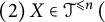 resp.
$X\in \mathcal {T}^{\geqslant n})$
 if and only if
$\mathcal {H}^{\ell }_M(X)=0$
 for all
$\ell>n\, ($
 resp.
$\ell <n)$
 .
Proof (1) By Lemma 2.5,
$\mathcal {H}^{\ell }_M(X)=0$
 for all
$\ell \in \mathbb {Z}$
 if and only if
$\mathrm {Hom}_{\mathcal {T}}(M[-\ell ],X)=0$
 for all
$\ell \in \mathbb {Z}$
 if and only if
$X\cong 0$
 .
(2) For
$\ell>n$
 , if
$\mathcal {H}^{\ell }_M(X)=0$
 , then
$\mathrm {Hom}_{\mathcal {T}}(M,X[\ell ])=0$
 by Lemma 2.5, so
$X\in \mathcal {T}^{\leqslant n}$
 . Conversely, let
$X\in \mathcal {T}^{\leqslant n}$
 . For
$\ell>n$
 , consider the exact triangle

As
$\tau ^{\leqslant \ell -1}(X)\cong \tau ^{\leqslant \ell }(X)\cong X$
 by [Reference Kashiwara and Schapira16, Proposition 10.1.6], it implies that
$\mathcal {H}^{\ell }_M(X)=0$
 . Similarly, one can show that
$X\in \mathcal {T}^{\geqslant n}$
 if and only if
$\mathcal {H}^{\ell }_M(X)=0$
 for all
$\ell <n$
 .
3 Homological dimension for objects in
$\mathcal {T}$


The aim of this section is to extend Minamoto’s concepts in [Reference Minamoto20] to triangulated categories. We introduce projective, injective, and flat dimensions and construct sppj, ifij, and spft resolutions for objects in
$\mathcal {T}$
 . Using these resolutions, we obtain several characterizations of the corresponding dimensions of objects.
Definition 3.1 Let
$X\in \mathcal {T}^{-}$
 and
$Y\in \mathcal {T}^{+}$
 and
$d\geqslant 0$
 .
(i) We call
$\mathrm {pd}_{\mathcal {T}}X=d$
 if d is the smallest number which satisfies
$X\in \mathcal {P}[-\mathrm {sup}X]\ast \cdots \ast \mathcal {P}[-\mathrm {sup}X+d]$
 .
(ii) We call
$\mathrm {id}_{\mathcal {T}}Y=d$
 if d is the smallest number which satisfies
$Y\in \mathcal {I}[-\mathrm {inf}Y-d]\ast \cdots \ast \mathcal {I}[-\mathrm {inf}Y]$
 .
The next constructions provide resolutions of objects that mirror the sppj and ifij resolutions for dg modules over nonpositive dg rings (see [Reference Minamoto20, Definitions 2.17 and 3.15].
Construction 3.2 (1) Let
$X\in \mathcal {T}^{-}$
 with
$\mathrm {sup}X=s$
 . Then
$\tau ^{\leqslant s}(X)\cong X$
 by [Reference Kashiwara and Schapira16, Proposition 10.1.6] and Lemma 2.8. Consider the following exact triangle:

By Lemma 2.6, there exists a morphism
$a_0:\bar {P}_0\rightarrow \mathcal {H}^s_M(X)$
 with
$\bar {P}_0\in \mathcal {P}$
 , such that
$\mathcal {H}^0_M(a_0)$
 is surjective. Set
$P_0=\bar {P}_0[-s]$
 . As
$\mathrm {Hom}_{\mathcal {T}}(P_0,\tau ^{\leqslant s-1}(X)[1])=0$
 , we have the following commutative diagram of exact triangles:

such that
$\mathcal {H}^s_M(f_0)$
 is surjective. We call
$f_0$
 an sppj morphism. An sppj resolution
$P_\bullet $
 of X is a sequence of exact triangles

such that
$f_n$
 is an sppj morphism for
$n\geqslant 0$
 with
$X_0=X$
 . Then
$\mathrm {sup}X_{n+1}\leqslant \mathrm {sup}X_n$
 for all
$n\geqslant 0$
 . Set
$d_n=g_{n}f_n:P_n\rightarrow P_{n-1}$
 and write

(2) Let
$Y\in \mathcal {T}^{+}$
 with
$\mathrm {inf}Y=i$
 . Then
$\tau ^{\geqslant i}(Y)\cong Y$
 . Consider the exact triangle

By Lemma 2.6, there is a morphism
$a^0:\mathcal {H}^i_M(Y)\rightarrow \bar {I}^0$
 with
$\bar {I}^0\in \mathcal {I}$
 such that
$\mathcal {H}^0_M(a^0)$
 is injective. Set
$I^0=\bar {I}^0[-i]$
 . As
$\mathrm {Hom}_{\mathcal {T}}(\tau ^{\geqslant i+1}(Y)[-1],I^0)\cong \mathrm {Hom}_{\mathcal {T}}(\mathcal {H}^{i-1}_M(\tau ^{\geqslant i+1}(Y)), \bar {I}^0)=0$
 by Lemma 2.5, we have a commutative diagram of exact triangles:

such that
$\mathcal {H}^i_M(f^0)$
 is injective. We call
$f^0$
 an ifij morphism. An ifij coresolution
$I^\bullet $
 of Y is a sequence of exact triangles

such that
$f^n$
 is an ifij morphism for
$n\geqslant 0$
 with
$Y^0=Y$
 . Then
$\mathrm {inf}Y^{n+1}\geqslant \mathrm {inf}Y^n$
 for all
$n\geqslant 0$
 . Set
$d^n=f^{n+1}g^{n+1}:I^n\rightarrow I^{n+1}$
 and write

The following is the main theorem of this section, which provides some criteria for a natural number to be an upper bound of
$\mathrm {pd}_{\mathcal {T}}X$
 .
Theorem 3.3 Let
$X\in \mathcal {T}^{-}$
 and
$d\geqslant 0$
 . The following are equivalent:
$(1)$
 For any sppj resolution
$P_\bullet $
 of X, there exists
$e\geqslant 0$
 such that
$X_e\in \mathcal {P}[-\mathrm {sup}X_e]$
 and
$e+\mathrm {sup}P_0-\mathrm {sup}P_e\leqslant d$
 ;
$(2)\, \mathrm {Hom}_{\mathcal {T}}(X,U[i])=0$
 for all
$U\in \mathcal {T}^{-}$
 and
$i>-\mathrm {sup}X+d+\mathrm {sup}U$
 ;
$(3)\, \mathrm {Hom}_{\mathcal {T}}(X,\mathcal {H}_M[i])=0$
 for
$i\not \in [-\mathrm {sup}X,-\mathrm {sup}X+d]$
 ;
$(4)\, \mathrm {pd}_{\mathcal {T}}X\leqslant d$
 .
Proof (1)
$\Rightarrow $
 (2). For any sppj resolution of X,

let
$e\geqslant 0$
 be such that
$X_e\in \mathcal {P}[-\mathrm {sup}X_e]$
 and
$e\leqslant d-\mathrm {sup}P_0+\mathrm {sup}P_e\leqslant d$
 . Then

is an sppj resolution of length e. For
$U\in \mathcal {T}^{-}$
 , as
$\mathrm {Hom}_{\mathcal {T}}(M,U[i])\cong \mathrm {Hom}_{\mathcal {T}}(M,\mathcal {H}^i_M(U))=0$
 for
$i>\mathrm {sup}U$
 by Lemma 2.5, it follows by the corresponding triangle
$(\dagger _n)$
 that (2) holds true.
(2)
$\Rightarrow $
 (4). Set
$s=\mathrm {sup}X$
 . We proceed by induction on d. For
$d=0$
 , consider the exact triangle
$Y\rightarrow P\stackrel {f}\rightarrow X[s]\rightarrow Y[1]$
 with f an sppj morphism. Then
$\mathrm {sup}Y\leqslant 0$
 , and so
$\mathrm {Hom}_{\mathcal {T}}(X[s],Y[1])=0$
 . Thus, this triangle splits and
$X\in \mathcal {P}[-s]$
 . Assume that
$d\geqslant 1$
 and
$Y\rightarrow Q\stackrel {g}\rightarrow X\rightarrow Y[1]$
 is an exact triangle such that g is an sppj morphism. For any
$U\in \mathcal {T}^{-}$
 and
$i\in \mathbb {Z}$
 , one has an exact sequence

it implies that
$\mathrm {Hom}_{\mathcal {T}}(Y,U[i])=0$
 for
$i>-s+d+\mathrm {sup}U-1$
 . By induction,
$Y\in \mathcal {P}[-s]\ast \cdots \ast \mathcal {P}[-s+d-1]$
 , and hence
$\mathrm {pd}_{\mathcal {T}}X\leqslant d$
 .
(4)
$\Rightarrow $
 (3). It follows by
$\mathrm {Hom}_{\mathcal {T}}(M,\mathcal {H}_M[\neq 0])=0$
 and
$X\in \mathcal {P}[-s]\ast \cdots \ast \mathcal {P}[-s+d]$
 .
(3)
$\Rightarrow $
 (2). For
$L\in \mathcal {T}^{\mathrm {b}}$
 , by induction on
$\mathrm {amp}L$
 , one can show that
$\mathrm {Hom}_{\mathcal {T}}(X,L[i])=0$
 for
$i\not \in [-s+\mathrm {inf}L,-s+d+\mathrm {sup}L]$
 . Let
$U\in \mathcal {T}^{-}$
 . There is a sequence in
$\mathcal {T}$


where
$\tau ^{\geqslant \mathrm {sup}U-j}(U)\in \mathcal {T}^{\mathrm {b}}$
 and
$\mathrm {sup}\tau ^{\geqslant \mathrm {sup}U-j}(U)=\mathrm {sup}U$
 for
$j\geqslant 0$
 . Put

it yields the following exact triangle:

For
$\ell \in \mathbb {Z}$
 , the above sequence induces an inverse system of epimorphisms in
$\mathcal {H}_M$


By Lemma 2.7,
$0\rightarrow \mathcal {H}^\ell _M(\bar {U})\rightarrow \prod _{j\geqslant 0}\mathcal {H}^\ell _M(\tau ^{\geqslant \mathrm {sup}U-j}(U))\rightarrow \prod _{j\geqslant 0}\mathcal {H}^\ell _M (\tau ^{\geqslant \mathrm {sup}U-j}(U)) \rightarrow 0$
 is exact. Also
$0\rightarrow \underleftarrow {\textrm {lim}}\mathcal {H}^\ell _M(\tau ^{\geqslant \mathrm {sup}U-j}(U))\rightarrow \prod _{j\geqslant 0}\mathcal {H}^\ell _M(\tau ^{\geqslant \mathrm {sup}U-j}(U))\rightarrow \prod _{j\geqslant 0}\mathcal {H}^\ell _M(\tau ^{\geqslant \mathrm {sup}U-j}(U))\rightarrow 0$
 is exact, and
$\mathcal {H}^\ell _M(\tau ^{\geqslant \mathrm {sup}U-j}(U))\cong \mathcal {H}^\ell _M(U)$
 for
$j\geqslant \mathrm {max}\{0,\mathrm {sup}U-\ell \}$
 , it implies that
$\mathcal {H}^\ell _M(\bar {U})\cong \underleftarrow {\textrm {lim}}\mathcal {H}^\ell _M(\tau ^{\geqslant \mathrm {sup}U-j}(U))=\mathcal {H}^\ell _M(U)$
 , so
$U\cong \bar {U}$
 . Thus, the exact sequence

implies that
$\mathrm {Hom}_{\mathcal {T}}(X,U[i])=0$
 for
$i>-s+d+\mathrm {sup}U+1$
 . Consider the exact triangle
$\tau ^{\leqslant \mathrm {sup}U-1}(U)\rightarrow U\rightarrow \mathcal {H}^{\mathrm {sup}U}_M(U)[-\mathrm {sup}U]\rightarrow \tau ^{\leqslant \mathrm {sup}U-1}(U)[1]$
 . For
$i'=-s+d+\mathrm {sup} U+1$
 , it follows by the exact sequence

that
$\mathrm {Hom}_{\mathcal {T}}(X,U[i])=0$
 for
$i>-s+d+\mathrm {sup}U$
 .
(2)
$\Rightarrow $
 (1). We proceed by induction on d. If
$d=0$
 , then
$e=0$
 , the statement holds. Assume that
$d\geqslant 1$
 . For any sppj resolution
$P_\bullet $
 of X, consider the exact triangle

For
$U\in \mathcal {T}^{-}$
 ,
$\mathrm {Hom}_{\mathcal {T}}(X_1,U[i])\cong \mathrm {Hom}_{\mathcal {T}}(X,U[i+1])=0$
 for
$i>-\mathrm {sup}X+d-1+\mathrm {sup}U=-\mathrm {sup}X_1+(d-1-\mathrm {sup}P_0+\mathrm {sup}P_1)+\mathrm {sup}U$
 . As
$\cdots \rightarrow P_n\rightarrow \cdots \rightarrow P_1\rightarrow X_1$
 is an sppj resolution of
$X_1$
 and
$\mathrm {sup}P_1\leqslant \mathrm {sup}P_0$
 , it follows by the induction that there is
$e\geqslant 0$
 such that
$X_e\in \mathcal {P}[-\mathrm {sup}X_e]$
 and
$e-1+\mathrm {sup}P_1-\mathrm {sup}P_e\leqslant d-1-\mathrm {sup}P_0+\mathrm {sup}P_1$
 , as desired.
Use the dual arguments as above, one has the following theorem.
Theorem 3.4 Let
$Y\in \mathcal {T}^{+}$
 and
$d\geqslant 0$
 . The following are equivalent:
$(1)$
 For any ifij coresolution
$I^\bullet $
 of Y, there exists
$e\geqslant 0$
 such that
$Y^{e}\in \mathcal {I}[-\mathrm {inf}Y^{e}]$
 and
$e+\mathrm {inf}I^e-\mathrm {inf}I^0\leqslant d$
 ;
$(2)\, \mathrm {Hom}_{\mathcal {T}}(V[i],Y)=0$
 for all
$V\in \mathcal {T}^{+}$
 and
$i<-d-\mathrm {inf}Y+\mathrm {inf}V$
 ;
$(3)\, \mathrm {Hom}_{\mathcal {T}}(\mathcal {H}_M[i],Y)=0$
 for
$i\not \in [-\mathrm {inf}Y-d,-\mathrm {inf}Y]$
 ;
$(4)\, \mathrm {id}_{\mathcal {T}}Y\leqslant d$
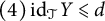 .
Corollary 3.5
$(1)$
 Let
$X\in \mathcal {T}^{-}$
 and
$d\geqslant 0$
 . Then
$\mathrm {pd}_{\mathcal {T}}X=d$
 if and only if
$\mathrm {Hom}_{\mathcal {T}} (X,\mathcal {H}_M[i])=0$
 for
$i\not \in [-\mathrm {sup}X,-\mathrm {sup}X+d]$
 and
$\mathrm {Hom}_{\mathcal {T}}(X,\mathcal {H}_M[-\mathrm {sup}X+d])\neq 0$
 .
$(2)$
 Let
$Y\in \mathcal {T}^{+}$
 and
$d\geqslant 0$
 . Then
$\mathrm {id}_{\mathcal {T}}Y=d$
 if and only if
$\mathrm {Hom}_{\mathcal {T}}(\mathcal {H}_M[i],Y)=0$
 for
$i\not \in [-\mathrm {inf}Y-d,-\mathrm {inf}Y]$
 and
$\mathrm {Hom}_{\mathcal {T}}(\mathcal {H}_M[-\mathrm {inf}Y-d],Y)\neq 0$
 .
Proof We just prove (1) since (2) is dual. Set
$s=\mathrm {sup}X$
 .
“Only if” part. If
$\mathrm {Hom}_{\mathcal {T}}(X,\mathcal {H}_M[-s+d])=0$
 , then
$\mathrm {Hom}_{\mathcal {T}}(X,\mathcal {H}_M[i])=0$
 for
$i\not \in [-s,-s+d-1]$
 , so
$\mathrm {pd}_{\mathcal {T}}X\leqslant d-1$
 by Theorem 3.3, a contradiction.
“If” part. If
$X\in \mathcal {P}[-s]\ast \cdots \ast \mathcal {P}[-s+d-1]$
 , then
$\mathrm {Hom}_{\mathcal {T}}(X,\mathcal {H}_M[-s+d])=0$
 by Theorem 3.3, a contradiction. Thus,
$\mathrm {pd}_{\mathcal {T}}X=d$
 .
Proposition 3.6
$(1)$
 Let
$X\in \mathcal {T}^{-}$
 and
$X'\rightarrow P\stackrel {f}\rightarrow X\rightarrow X'[1]$
 be an exact triangle with f an sppj morphism. If
$\mathrm {pd}_{\mathcal {T}}X\geqslant 1$
 , then
$\mathrm {pd}_{\mathcal {T}}X'-\mathrm {sup}X'=\mathrm {pd}_{\mathcal {T}}X-\mathrm {sup}X-1$
 . If
$\mathrm {pd}_{\mathcal {T}}X=0$
 , then
$X'\cong 0$
 or
$\mathrm {pd}_{\mathcal {T}}X'=0$
 .
$(2)$
 Let
$Y\in \mathcal {T}^{+}$
 and
$Y\stackrel {g}\rightarrow I\rightarrow Y'\rightarrow Y[1]$
 be an exact triangle with g an ifij morphism. If
$\mathrm {id}_{\mathcal {T}}Y\geqslant 1$
 , then
$\mathrm {id}_{\mathcal {T}}Y'+\mathrm {inf}Y'=\mathrm {id}_{\mathcal {T}}Y+\mathrm {inf}Y-1$
 . If
$\mathrm {id}_{\mathcal {T}}Y=0$
 , then
$Y'\cong 0$
 or
$\mathrm {id}_{\mathcal {T}}Y'=0$
 .
Proof Again we will just prove (1) since (2) is dual. Set
$\mathrm {pd}_{\mathcal {T}}X=d$
 and
$s=\mathrm {sup}X$
 .
If
$d\geqslant 1$
 , then
$\mathrm {Hom}_{\mathcal {T}}(X',U[i])=0$
 for
$U\in \mathcal {T}^{-}$
 and
$i>-s+d+\mathrm {sup}U-1$
 by the proof (2)
$\Rightarrow $
 (4) of Theorem 3.3, it implies that
$\mathrm {pd}_{\mathcal {T}}X'\leqslant d-s+\mathrm {sup}X'-1$
 . By Corollary 3.5, there is
$H\in \mathcal {H}_M$
 , such that
$\mathrm {Hom}_{\mathcal {T}}(X,H[-s+d])\neq 0$
 . Then the exact sequence

yields that
$\mathrm {Hom}_{\mathcal {T}}(X',H[-s+d-1])\neq 0$
 , so
$\mathrm {pd}_{\mathcal {T}}X'=d-s+\mathrm {sup}X'-1$
 by Corollary 3.5.
If
$d=0$
 , then
$\mathrm {Hom}_{\mathcal {T}}(X,X'[1])=0$
 as
$\mathrm {sup}X'\leqslant s$
 , so the triangle splits. Thus,
$X'$
 is a retract of P, and so
$X'\cong 0$
 or
$\mathrm {pd}_{\mathcal {T}}X'=0$
 .
Corollary 3.7
$(1)$
 Let
$X\in \mathcal {T}^{-}$
 and
$d\geqslant 0$
 . Then
$\mathrm {pd}_{\mathcal {T}}X=d$
 if and only if X has an sppj resolution
$X_e\rightarrow P_{e-1}\rightarrow \cdots \rightarrow P_0\rightarrow X$
 , such that
$X_e\in \mathcal {P}[-\mathrm {sup}X_e]$
 ,
$d=e+\mathrm {sup}X-\mathrm {sup}X_e$
 and the triangle
$X_{e}\rightarrow P_{e-1}\rightarrow X_{e-1}\rightarrow X_{e}[1]$
 is not split.
$(2)$
 Let
$Y\in \mathcal {T}^{+}$
 and
$d\geqslant 0$
 . Then
$\mathrm {id}_{\mathcal {T}}Y=d$
 if and only if Y has an ifij coresolution
$Y\rightarrow I^0\rightarrow \cdots \rightarrow I^{e-1}\rightarrow Y^e$
 , such that
$Y^e\in \mathcal {I}[-\mathrm {inf}Y^e]$
 ,
$d=e+\mathrm {inf}Y^e-\mathrm {inf}Y$
 and the triangle
$Y^{e-1}\rightarrow I^{e-1}\rightarrow Y^{e}\rightarrow Y^{e-1}[1]$
 is not split.
Corollary 3.8 Let
$X\rightarrow Y\rightarrow Z\rightarrow X[1]$
 be an exact triangle in
$\mathcal {T}^{\mathrm {b}}$
 .
$(1)\, \mathrm {pd}_{\mathcal {T}}Y-\mathrm {sup}Y\leqslant \mathrm {max}\{\mathrm {pd}_{\mathcal {T}}X-\mathrm {sup}X,\mathrm {pd}_{\mathcal {T}}Z-\mathrm {sup}Z\}$
 .
$(2)\, \mathrm {id}_{\mathcal {T}}Y+\mathrm {inf}Y\leqslant \mathrm {max}\{\mathrm {id}_{\mathcal {T}}X+\mathrm {inf}X,\mathrm {id}_{\mathcal {T}}Z+\mathrm {inf}Z\}$
 .
Following Beligiannis [Reference Beligiannis8] and Krause [Reference Krause18], we call an exact triangle
$X\stackrel {f}\rightarrow Y\stackrel {g}\rightarrow Z\rightarrow X[1]$
 in
$\mathcal {T}$
 pure exact if for all
$C\in \mathcal {T}^c$
 , the induced sequence

is exact. In this case, f is a pure monomorphism and g is a pure epimorphism. Let

Remark 3.9 (1) Let
$X\in \mathcal {T}^{-}$
 with
$\mathrm {sup}X=s$
 . As
$\mathcal {P}\subseteq \mathcal {F}$
 , there is a morphism
$f:F[-s]\rightarrow X$
 with
$F\in \mathcal {F}$
 such that
$\mathcal {H}^s_M(f)$
 is surjective. We call f an spft morphism. An spft resolution
$F_\bullet $
 of X is a sequence of exact triangles

such that
$f_n$
 is an spft morphism for
$n\geqslant 0$
 , where
$X_0=X$
 .
(2) If
$M\in \mathcal {T}^b$
 , then
$\mathcal {T}^{c}\subseteq \mathcal {T}^{\mathrm {b}}$
 . Let
$F\in \mathcal {F}$
 and
$L\rightarrow P\stackrel {f}\rightarrow F\rightarrow L[1]$
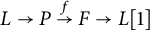 be an exact triangle with f an sppj morphism. For any
$T\in \mathcal {T}^{c}$
 and
$i\in \mathbb {Z}$
 , one has

is exact. As
$\mathrm {Hom}_{\mathcal {T}}(P,T^\ast [i])\cong \mathrm {Hom}_{\mathcal {T}}(P,\mathcal {H}^i_M(T^\ast ))=0$
 for
$i>\mathrm {sup}T^\ast $
 by Lemma 2.5, it implies that
$\mathrm {Hom}_{\mathcal {T}}(F,T^\ast [i])=0$
 for
$i>\mathrm {sup}T^\ast $
 .
(3) Let
$M\in \mathcal {T}^b$
 and
$\mathcal {F}'$
 be the class of objects in
$\mathcal {T}$
 satisfying
$F=0$
 , or
$\mathrm {sup}F=0$
 and
$\mathrm {Hom}_{\mathcal {T}}(F,T^\ast [i])=0$
 for all
$T\in \mathcal {T}^c$
 and
$i>\mathrm {sup}T^\ast $
 . Then
$\mathcal {F}\subseteq \mathcal {F}'$
 by (2).
(4) Let R be a ring and
$\mathcal {T}=\mathrm {D}(R)$
 . Then
$\mathcal {P}$
 is the class of projective R-modules, so
$\mathcal {F}$
 is the class of flat R-modules by [Reference Krause19, Lemma 2.8]. Let
$0\not \simeq F\in \mathcal {F}'$
 and
$U\in \mathrm {D}(R)$
 . There is a semi-projective resolution
$P\stackrel {\simeq }\rightarrow U$
 by [Reference Christensen, Foxby and Holm13, Theorem 5.2.15], and
$P\simeq \underrightarrow {\textrm {lim}}P_\lambda $
 with
$P_\lambda $
 a perfect complex by [Reference Bak6, Corollary 5]. Then
$\mathrm {Hom}_{\mathrm {D}(R)}(F,P_\lambda ^\ast [i])= \mathrm {H}^i(\mathrm {RHom}_{R}(F,P_\lambda ^+))\cong (\mathrm {H}^{-i}(P_\lambda \otimes _R^{\mathrm {L}}F))^+=0$
 for
$i>\mathrm {sup}P_\lambda ^+$
 , where
$(-)^*=(-)^+=\mathrm {Hom}_A(-,\mathbb {Q}/\mathbb {Z})$
 , so
$\mathrm {H}^{-i}(P_\lambda \otimes _R^{\mathrm {L}}F)=0$
 for
$-i<\mathrm {inf}P_\lambda $
 , it implies that
$\mathrm {H}^{-i}(U\otimes _R^{\mathrm {L}}F)=0$
 for
$-i<\mathrm {inf}U$
 as
$\mathrm {inf}U\leqslant \mathrm {inf}P_\lambda $
 for all
$\lambda $
 . Hence,
$F\in \mathcal {F}$
 by [Reference Christensen, Foxby and Holm13, Theorem 8.3.11], and then
$\mathcal {F}=\mathcal {F}'$
 .
Definition 3.10 Let
$X\in \mathcal {T}^{-}$
 and
$d\geqslant 0$
 . We call
$\mathrm {fd}_{\mathcal {T}}X=d$
 if d is the smallest number which satisfies
$X\in \mathcal {F}[-\mathrm {sup}X]\ast \cdots \ast \mathcal {F}[-\mathrm {sup}X+d]$
 .
Proposition 3.11 Let
$X\in \mathcal {T}^{-}$
 and
$d\geqslant 0$
 . The following are equivalent:
$(1)\, X$
 has an spft resolution
$X_{e}\rightarrow F_{e-1}\rightarrow \cdots \rightarrow F_0\rightarrow X$
 such that
$X_e\in \mathcal {F}[-\mathrm {sup}X_e]$
 and
$e+\mathrm {sup}X-\mathrm {sup}X_e\leqslant d$
 .
$(2)\, \mathrm {fd}_{\mathcal {T}}X\leqslant d$
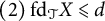 .
Proof (1)
$\Rightarrow $
 (2). The corresponding exact triangles

imply that
$X\in \mathcal {F}[-\mathrm {sup}X]\ast \mathcal {F}[-\mathrm {sup}X+(\mathrm {sup}X-\mathrm {sup}X_1)+1]\ast \cdots \ast \mathcal {F}[-\mathrm {sup}X+(\mathrm {sup}X-\mathrm {sup}X_e)+e]$
 , so
$\mathrm {fd}_{\mathcal {T}}X\leqslant d$
 .
(2)
$\Rightarrow $
 (1). Set
$s=\mathrm {sup}X$
 . We proceed by induction on d. If
$d=0$
 , then
$e=0$
 , the statement holds. Assume that
$d\geqslant 1$
 . There is an exact triangle
$Y\rightarrow F\stackrel {f}\rightarrow X\rightarrow Y[1]$
 , such that
$Y\in \mathcal {F}[-s]\ast \cdots \ast \mathcal {F}[-s+d-1]$
 and
$F\in \mathcal {F}[-s]$
 . Then Y has an spft resolution
$F_\bullet $
 such that
$Y_{e'}\in \mathcal {F}[-\mathrm {sup}Y_{e'}]$
 ,
$e'+s-\mathrm {sup}Y_{e'}\leqslant d-1$
 by induction. As
$\mathrm {sup}Y\leqslant s$
 , f is an spft morphism by Lemma 2.3, it implies that

is the desired spft resolution with
$e=e'+1$
 .
For
$M\in \mathcal {T}^b$
 , we have the following characterizations of
$\mathrm {fd}_{\mathcal {T}}X=d$
 .
Theorem 3.12 Assume that
$M\in \mathcal {T}^b$
 and
$\mathcal {F}=\mathcal {F}'$
 , and let
$X\in \mathcal {T}^{-}$
 and
$d\geqslant 0$
 . Then the following are equivalent:
$(1)$
 For any spft resolution
$F_\bullet $
 of X, there exists
$e\geqslant 0$
 such that
$X_e\in \mathcal {F}[-\mathrm {sup}X_e]$
 ,
$e+\mathrm {sup}X-\mathrm {sup}X_e=d$
 and
$g_e:X_e\rightarrow F_{e-1}$
 is not a pure monomorphism;
$(2)\, X$
 has an spft resolution
$X_{e}\rightarrow F_{e-1}\rightarrow \cdots \rightarrow F_0\rightarrow X$
 such that
$X_e\in \mathcal {F}[-\mathrm {sup}X_e]$
 ,
$e+\mathrm {sup}X-\mathrm {sup}X_e=d$
 and
$g_e:X_e\rightarrow F_{e-1}$
 is not a pure monomorphism;
$(3)\, \mathrm {Hom}_{\mathcal {T}}(X,T^\ast [i])=0$
 for all
$T\in \mathcal {T}^c$
 and
$i>d-\mathrm {sup}X+\mathrm {sup}T^\ast $
 and
$\mathrm {Hom}_{\mathcal {T}}(X,T'[d-\mathrm {sup}X+\mathrm {sup}T^{\prime \ast }])\neq 0$
 for some
$T'\in \mathcal {T}^c$
 ;
$(4)\, \mathrm {fd}_{\mathcal {T}}X=d$
 .
Proof Set
$s=\mathrm {sup}X$
 . (1)
$\Rightarrow $
 (2) is trivial.
(2)
$\Rightarrow $
 (3). Let
$0\neq F\in \mathcal {F}$
 . For any
$T\in \mathcal {T}^{c}$
 , if
$\mathrm {Hom}_{\mathcal {T}}(F,T^\ast [i])=0$
 for
$i\geqslant \mathrm {sup}T^\ast $
 , then
$\mathrm {Hom}_{\mathcal {T}}(F[1],T^\ast [i])=0$
 for
$i>\mathrm {sup}T^\ast $
 , so
$F[1]\in \mathcal {F}$
 and
$\mathrm {sup}F=-1$
 as
$\mathcal {F}=\mathcal {F}'$
 , a contradiction. Thus, there exists
$T'\in \mathcal {T}^c$
 such that
$\mathrm {Hom}_{\mathcal {T}}(F,T^{\prime \ast }[\mathrm {sup}T^{\prime \ast }])\neq 0$
 . For
$i>d-s+\mathrm {sup}T^\ast $
 , the corresponding exact triangle implies that
$\mathrm {Hom}_{\mathcal {T}}(X,T^\ast [i])\cong \mathrm {Hom}_{\mathcal {T}}(X_{e-1},T^\ast [i-e+1]) \cong \mathrm {Hom}_{\mathcal {T}}(X_e,T^\ast [i-e])=0$
 . Consider the exact triangle
$X_e\rightarrow F_{e-1}\rightarrow X_{e-1}\rightarrow X_e[1]$
 , it yields an exact sequence
$\mathrm {Hom}_{\mathcal {T}}(F_{e-1},T^\ast [-\mathrm {sup}X_e+\mathrm {sup}T^\ast ])\rightarrow \mathrm {Hom}_{\mathcal {T}}(X_{e},T^\ast [-\mathrm {sup}X_e+\mathrm {sup}T^\ast ]\rightarrow \mathrm {Hom}_{\mathcal {T}}(X_{e-1},T^\ast [-\mathrm {sup}X_e+\mathrm {sup}T^\ast +1]\rightarrow 0$
 . Assume that
$\mathrm {Hom}_{\mathcal {T}}(X,T^\ast [d-s+\mathrm {sup}T^\ast ])=0$
 for all
$T\in \mathcal {T}^c$
 . If
$\mathrm {sup}X_{e-1}-\mathrm {sup}X_e>0$
 , then
$\mathrm {Hom}_{\mathcal {T}}(F_{e-1},T^\ast [-\mathrm {sup}X_e+\mathrm {sup}T^\ast ])=0$
 , so
$\mathrm {Hom}_{\mathcal {T}}(X_{e},T^\ast [-\mathrm {sup}X_e+\mathrm {sup}T^\ast ])=0$
 for all
$T\in \mathcal {T}^c$
 , a contradiction. Thus,
$\mathrm {sup}X_{e-1}=\mathrm {sup}X_e$
 , and
$\mathrm {Hom}_{\mathcal {T}}(X_{e-1},T^\ast [-\mathrm {sup}X_e+\mathrm {sup}T^\ast +1]) \cong \mathrm {Hom}_{\mathcal {T}}(X,T^\ast [d-s+\mathrm {sup}T^\ast ])=0$
 . So
$X_{e-1}\in \mathcal {F}[-\mathrm {sup}X_{e-1}]$
 and
$g_e$
 is a pure monomorphism, a contradiction. Consequently,
$\mathrm {Hom}_{\mathcal {T}}(X,T^{\prime \ast }[d-\mathrm {sup}X+\mathrm {sup}T^{\prime \ast }])\neq 0$
 for some
$T'\in \mathcal {T}^c$
 .
(3)
$\Rightarrow $
 (4). We proceed by induction on d. The case of
$d=0$
 is trivial. Assume that
$d\geqslant 1$
 and
$X_1\rightarrow F\stackrel {f}\rightarrow X\rightarrow X_1[1]$
 is an exact triangle with f an spft morphism. For any
$T\in \mathcal {T}^{c}$
 , one has an exact sequence

it implies that
$\mathrm {Hom}_{\mathcal {T}}(X_1,T^\ast [i])=0$
 for
$i>d-1-s+\mathrm {sup}T^\ast $
 . Also there is
$T'\in \mathcal {T}^c$
 , such that
$\mathrm {Hom}_{\mathcal {T}}(X,T^{\prime \ast }[d-s+\mathrm {sup}T^{\prime \ast }])\neq 0$
 . As
$\mathrm {Hom}_{\mathcal {T}}(F[-1],T^{\prime \ast }[d-1-s+\mathrm {sup}T^{\prime \ast }])=0$
 , the following exact sequence

yields that
$\mathrm {Hom}_{\mathcal {T}}(X_1,T^{\prime \ast }[d-1-s+\mathrm {sup}T^{\prime \ast }])\neq 0$
 , so
$X_1\in \mathcal {F}[-s]\ast \cdots \ast \mathcal {F}[-s+d-1]$
 by the induction, and hence
$\mathrm {fd}_{\mathcal {T}}X\leqslant d$
 . If
$\mathrm {fd}_{\mathcal {T}}X<d$
 , then
$\mathrm {Hom}_{\mathcal {T}}(X,T^\ast [d-s+\mathrm {sup}T^\ast ])=0$
 by
$\mathrm {Hom}_{\mathcal {T}}(\mathcal {F}[-s],T^\ast [i])=0$
 for
$i>-s+\mathrm {sup}T^\ast $
 , and so
$\mathrm {Hom}_{\mathcal {T}}(X_1,T^\ast [d-1-s+\mathrm {sup}T^\ast ])=0$
 for all
$T\in \mathcal {T}^{c}$
 by the preceding proof, a contradiction. Thus,
$\mathrm {fd}_{\mathcal {T}}X=d$
 .
(4)
$\Rightarrow $
 (2). We proceed by induction on d. The case of
$d=0$
 is trivial. Assume that
$d\geqslant 1$
 . There is an exact triangle
$Y\rightarrow F\stackrel {f}\rightarrow X\rightarrow Y[1]$
 , such that
$d-1$
 is the smallest number that satisfies
$Y\in \mathcal {F}[-s]\ast \cdots \ast \mathcal {F}[-s+d-1]$
 and
$F\in \mathcal {F}[-s]$
 . Then Y has an spft resolution
$F_\bullet $
 such that
$Y_{e'}\in \mathcal {F}[-\mathrm {sup}Y_{e'}]$
 ,
$e'+s-\mathrm {sup}Y_{e'}=d-1$
 and
$Y_{e'-1}\not \in \mathcal {F}[-\mathrm {sup}Y_{e'-1}]$
 by the induction. As
$\mathrm {sup}Y\leqslant s$
 , f is an spft morphism by Lemma 2.3, it yields that

is the desired spft resolution.
(3)
$\Rightarrow $
 (1). Let
$F_\bullet $
 be spft resolution of X. For any
$T\in \mathcal {T}^{c}$
 , the corresponding exact triangle implies that
$\mathrm {Hom}_{\mathcal {T}}(X_e,T^\ast [i-e])\cong \mathrm {Hom}_{\mathcal {T}}(X,T^\ast [i])=0\, i>d-s+\mathrm {sup}T^\ast $
 and
$\mathrm {Hom}_{\mathcal {T}}(X_{e-1},T^\ast [-\mathrm {sup}X_e+\mathrm {sup}T^\ast +1]) \cong \mathrm {Hom}_{\mathcal {T}}(X,T^\ast [d-s+\mathrm {sup}T^\ast ])$
 , it implies that
$X_{e-1}\not \in \mathcal {F}[-\mathrm {sup}X_{e-1}]$
 and
$g_e$
 is not a pure monomorphism.
Corollary 3.13 Assume that
$M\in \mathcal {T}^b$
 and
$\mathcal {F}=\mathcal {F}'$
 , and let
$X\in \mathcal {T}^{-}$
 and
$X'\rightarrow F\stackrel {f}\rightarrow X\rightarrow X'[1]$
 be an exact triangle with f an spft morphism. If
$\mathrm {fd}_{\mathcal {T}}X\geqslant 1$
 , then
$\mathrm {fd}_{\mathcal {T}}X'-\mathrm {sup}X'=\mathrm {fd}_{\mathcal {T}}X-\mathrm {sup}X-1$
 . If
$\mathrm {fd}_{\mathcal {T}}X=0$
 , then
$X'\cong 0$
 or
$\mathrm {fd}_{\mathcal {T}}X'=0$
 .
Corollary 3.14 Assume that
$M\in \mathcal {T}^b$
 and
$\mathcal {F}=\mathcal {F}'$
 , and let
$X\in \mathcal {T}^{c}$
 . Then
$\mathrm {pd}_{\mathcal {T}}X=\mathrm {fd}_{\mathcal {T}}X$
 .
Proof It suffices to prove that
$\mathrm {pd}_{\mathcal {T}}X\leqslant \mathrm {fd}_{\mathcal {T}}X=d$
 . As
$X\in \mathcal {T}^{c}$
 , one can choose an sppj morphism
$P\rightarrow X$
 such that
$P\in \mathrm {add}(M)[-\mathrm {sup}X]$
 , so
$X'\rightarrow P\rightarrow X\rightarrow X'[1]$
 is an exact triangle in
$\mathcal {T}^{c}$
 . If
$d=0$
 , then the pure exact triangle is split as
$X\in \mathcal {T}^{c}$
 . If
$d\geqslant 1$
 , then
$\mathrm {fd}_{\mathcal {T}}X'=\mathrm {fd}_{\mathcal {T}}X-\mathrm {sup}X+\mathrm {sup}X'-1\leqslant d-1$
 by Corollary 3.13. By the induction,
$\mathrm {pd}_{\mathcal {T}}X'=\mathrm {fd}_{\mathcal {T}}X'$
 , so
$\mathrm {pd}_{\mathcal {T}}X=\mathrm {pd}_{\mathcal {T}}X'+\mathrm {sup}X-\mathrm {sup}X'+1 =\mathrm {fd}_{\mathcal {T}}X$
 by Proposition 3.6.
4 Global dimension of triangulated categories
This section establishes several connections between the global dimension of
$\mathcal {T}$
 , the global dimension of
$\mathcal {H}_M$
 , and the
$\mathrm {Add}(M)$
 -dimension of
$\mathcal {T}^{\mathrm {b}}$
 . These relations form a unified framework for homological dimension theory in triangulated categories.
Theorem 4.1 Consider the following numbers:

Then
$d_1=d_2=d_3=d_4$
 , this common number is called the global dimension,
$\mathrm {gldim}\mathcal {T}$
 , of
$\mathcal {T}$
 .
Proof “
$d_3\leqslant d_1$
 .” Let
$X\in \mathcal {T}^{-}$
 . We show
$\mathrm {pd}_{\mathcal {T}}X\leqslant d_1+\mathrm {amp}X$
 . In the case
$\mathrm {amp}X=\infty $
 , there is nothing to prove. We deal with the case
$\mathrm {amp}X<\infty $
 by the induction on
$\mathrm {amp}X$
 . The case of
$\mathrm {amp}X=0$
 is trivial as
$\mathrm {pd}_{\mathcal {T}}H[n]=\mathrm {pd}_{\mathcal {T}}H$
 for all
$H\in \mathcal {H}_M$
 and
$n\in \mathbb {Z}$
 . Assume that
$\mathrm {amp}X>0$
 and set
$s=\mathrm {sup}X$
 . Consider the exact triangle

As
$\mathrm {amp}\tau ^{\leqslant s-1}(X)\leqslant \mathrm {amp}X-1$
 , it follows by the induction that
$\mathrm {pd}_{\mathcal {T}}\tau ^{\leqslant s-1}(X)\leqslant d_1+\mathrm {amp}X-1$
 . So
$\mathrm {pd}_{\mathcal {T}}X-\mathrm {sup}X\leqslant d_1-\mathrm {inf}X$
 by Corollary 3.8, as required.
It is clear
$d_1\leqslant d_3$
 . Thus,
$d_1=d_3$
 . We can prove
$d_2=d_4$
 in the same way.
“
$d_1= d_2$
 .” Let
$H\in \mathcal {H}_M$
 . Then
$\mathrm {Hom}_{\mathcal {T}}(H,H'[i])\cong \mathrm {Hom}_{\mathcal {T}}(H[-i],H')=0$
 for
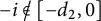
$-i\not \in [-d_2,0]$
 by Theorem 3.4 for all
$H'\in \mathcal {H}_M$
 as
$\mathrm {id}_{\mathcal {T}}H'\leqslant d_2$
 , so
$\mathrm {pd}_{\mathcal {T}}H\leqslant d_2$
 by Theorem 3.3. Hence,
$d_1\leqslant d_2$
 . Similarly, one can show that
$d_2\leqslant d_1$
 .
Definition 4.2 [Reference Christensen12]
An exact triangle
$X\rightarrow Y\rightarrow Z\stackrel {g}\rightarrow X[1]$
 in
$\mathcal {T}$
 is called M-ghost if

is exact for all
$G\in \mathcal {P}$
 and
$i\in \mathbb {Z}$
 . Equivalently, if

is exact for all
$i\in \mathbb {Z}$
 . We call g an M-ghost, denote
$\mathcal {G}_M$
 the ideal of M-ghosts in
$\mathcal {T}$
 , and
$\mathcal {G}^n_M$
 consists of the n-fold composites of M-ghost maps for
$n\geqslant 1$
 .
The following is a useful lemma.
Lemma 4.3 Let
$X\rightarrow Y\rightarrow Z\rightarrow X[1]$
 be an exact triangle in
$\mathcal {T}$
 . Then the following are equivalent:
$(1)$
 The triangle is M-ghost;
$(2)\, 0\rightarrow \mathcal {H}^\ell _M(X)\rightarrow \mathcal {H}^\ell _M(Y)\rightarrow \mathcal {H}^\ell _M(Z)\rightarrow 0$
 is exact in
$\mathcal {H}_M$
 for all
$\ell \in \mathbb {Z}$
 ;
$(3)\, \tau ^{\leqslant \ell }(X)\rightarrow \tau ^{\leqslant \ell }(Y)\rightarrow \tau ^{\leqslant \ell }(Z)\rightarrow \tau ^{\leqslant \ell }(X)[1]$
 is an exact triangle for all
$\ell \in \mathbb {Z}$
 ;
$(4)\, \tau ^{\geqslant \ell }(X)\rightarrow \tau ^{\geqslant \ell }(Y)\rightarrow \tau ^{\geqslant \ell }(Z)\rightarrow \tau ^{\geqslant \ell }(X)[1]$
 is an exact triangle for all
$\ell \in \mathbb {Z}$
 .
Proof (1)
$\Leftrightarrow $
 (2) For
$\ell \in \mathbb {Z}$
 , Lemma 2.5 yields the following isomorphism:

If
$X\rightarrow Y\rightarrow Z\rightarrow X[1]$
 is M-ghost, then the lower row is exact, so is the upper row. Thus,
$0\rightarrow \mathcal {H}^\ell _M(X)\rightarrow \mathcal {H}^\ell _M(Y)\rightarrow \mathcal {H}^\ell _M(Z)\rightarrow 0$
 is exact in
$\mathcal {H}_M$
 by Lemma 2.4. If
$0\rightarrow \mathcal {H}^\ell _M(X)\rightarrow \mathcal {H}^\ell _M(Y)\rightarrow \mathcal {H}^\ell _M(Z)\rightarrow 0$
 is exact, then the upper row is exact by Lemma 2.4, so is the lower row. Thus,
$X\rightarrow Y\rightarrow Z\rightarrow X[1]$
 is M-ghost.
(2)
$\Rightarrow $
 (3) For
$\ell \in \mathbb {Z}$
 , extend
$\tau ^{\leqslant \ell }(X)\rightarrow \tau ^{\leqslant \ell }(Y)$
 and
$\tau ^{\leqslant \ell }(Y)\rightarrow \tau ^{\leqslant \ell }(Z)$
 to exact triangles, one has a commutative diagram:

By the third row and Lemma 2.3,
$U\in \mathcal {T}^{\leqslant \ell }$
 . As
$\mathcal {H}^i_M(-)\cong \mathcal {H}^i_M(\tau ^{\leqslant \ell }(-))$
 for
$i\leqslant \ell $
 and
$-=X,Y,Z$
 , it follows that
$\mathcal {H}^i_M(U)\cong \mathcal {H}^i_M(\tau ^{\leqslant \ell }(Z))$
 for
$i\in \mathbb {Z}$
 , so
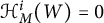
$\mathcal {H}^i_M(W)=0$
 for
$i\in \mathbb {Z}$
 by the third column. Thus,
$U\cong \tau ^{\leqslant \ell }(Z)$
 by Lemma 2.8, and
$\tau ^{\leqslant \ell }(X)\rightarrow \tau ^{\leqslant \ell }(Y)\rightarrow \tau ^{\leqslant \ell }(Z)\rightarrow \tau ^{\leqslant \ell }(X)[1]$
 is an exact triangle.
(3)
$\Rightarrow $
 (4) For
$\ell \in \mathbb {Z}$
 , by
$4\times 4$
 Lemma, one has the following commutative diagram:

such that the square at the bottom right is anti-commutative, while the others are commutative, it implies that the third row is an exact triangle.
(4)
$\Rightarrow $
 (2) For
$\ell \in \mathbb {Z}$
 , by
$4\times 4$
 Lemma, one has the following commutative diagram:

such that the square at the bottom right is anti-commutative, while the others are commutative, it implies that the third row is an exact triangle. Hence,
$0\rightarrow \mathcal {H}^\ell _M(X)\rightarrow \mathcal {H}^\ell _M(Y)\rightarrow \mathcal {H}^\ell _M(Z)\rightarrow 0$
 is exact in
$\mathcal {H}_M$
 by Lemma 2.3.
Lemma 4.4
$(1)\, Z\in \langle \mathcal {P}\rangle _{1}$
 if and only if any M-ghost triangle
$X\rightarrow Y\rightarrow Z\stackrel {h}\rightarrow X[1]$
 splits.
$(2)\, X\in \langle \mathcal {I}\rangle _{1}$
 if and only if any M-ghost triangle
$X\rightarrow Y\rightarrow Z\stackrel {h}\rightarrow X[1]$
 splits.
Proof We just prove the statement (1) since (2) is dual.
If
$Z\in \langle \mathcal {P}\rangle _{1}$
 , then
$Z\cong \bigoplus _{i\in \mathbb {Z}}P_i[-i]$
 with
$P_i\in \mathcal {P}$
 . Since
$0\rightarrow \mathrm {Hom}_{\mathcal {T}}(P_i[-i],X)\rightarrow \mathrm {Hom}_{\mathcal {T}}(P_i[-i],Y)\rightarrow \mathrm {Hom}_{\mathcal {T}}(P_i[-i],Z)\rightarrow 0$
 is exact, one has
$0\rightarrow \mathrm {Hom}_{\mathcal {T}}(\bigoplus _{i\in \mathbb {Z}}P_i[-i],X)\rightarrow \mathrm {Hom}_{\mathcal {T}}(\bigoplus _{i\in \mathbb {Z}}P_i[-i],Y)\rightarrow \mathrm {Hom}_{\mathcal {T}}(\bigoplus _{i\in \mathbb {Z}}P_i[-i],Z)\rightarrow 0$
 is exact, so
$h=0$
 . Conversely, there is a morphism
$a_i:M_i\rightarrow \mathcal {H}^i_M(Z)$
 with
$M_i\in \mathcal {P}$
 for
$i\in \mathbb {Z}$
 such that
$\mathcal {H}^0_M(a_i)$
 is surjective by Lemma 2.6, it follows by Lemma 2.5 that

As
$\mathcal {H}^\ell _M(\bigoplus _{i\in \mathbb {Z}}M_i[-i])\rightarrow \mathcal {H}^0_M(M_\ell )$
 is surjective for all
$\ell \in \mathbb {Z}$
 , it follows by the above isomorphism and Lemma 4.3 that

is an M-ghost triangle. Thus,
$h=0$
 and
$Z\in \langle \mathcal {P}\rangle _{1}$
 .
Lemma 4.5
$\mathrm{(i)}\, X\in \langle \mathcal {P}\rangle _{n+1}$
 if and only if every composite of
$n+1\, M$
 -ghosts with domain X is the zero map.
$\mathrm{(ii)}\, X'\in \langle \mathcal {I}\rangle _{n+1}$
 if and only if every composite of
$n+1\, M$
 -ghosts with target
$X'$
 is the zero map.
Proof (i) “Only if” part. The case of
$n=0$
 follows by Lemma 4.4. Assume that
$X\in \langle \mathcal {P}\rangle _{n+1}$
 ,
$P\stackrel {\alpha }\rightarrow \widetilde {X}\stackrel {\beta }\rightarrow T\rightarrow P[1]$
 is an exact triangle with
$P\in \langle \mathcal {P}\rangle _1$
 and
$T\in \langle \mathcal {P}\rangle _n$
 , and
$X\stackrel {a}\rightarrow \widetilde {X}\stackrel {b}\rightarrow X$
 are morphisms such that
$ba=1_X$
 . Let
$X\stackrel {f}\rightarrow Y\stackrel {g}\rightarrow Z$
 be a composite of
$f\in \mathcal {G}_M$
 and
$g\in \mathcal {G}^n_M$
 . Then
$fb\alpha \in \mathcal {G}_M$
 and so
$fb\alpha =0$
 . Thus, there is
$\delta :T\rightarrow Y$
 such that
$\delta \beta =fb$
 . Note that
$g\delta \in \mathcal {G}^n_M$
 , so
$gfb=g\delta \beta =0$
 by the induction, and hence
$gf=gfba=0$
 .
“If” part. By Lemma 4.4 and [Reference Christensen12, Theorem 3.5], there is an exact triangle
$T\rightarrow X\stackrel {h}\rightarrow Y\rightarrow T[1]$
 with
$T\in \langle \mathcal {P}\rangle _{n+1}$
 and
$h\in \mathcal {G}^{n+1}_M$
 . By assumption,
$gf=0$
 . Thus, X is a retract of T and so
$X\in \langle \mathcal {P}\rangle _{n+1}$
 .
(ii) This follows by the dual of (i).
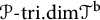
The next theorem compares three invariants
$\mathcal {P}\textrm {-}\mathrm {tri.dim}\mathcal {T}^{\mathrm {b}}$
 ,
$\mathcal {I}\textrm {-}\mathrm {tri.dim}\mathcal {T}^{\mathrm {b}}$
 , and
$\mathrm {gldim}\mathcal {T}$
 .
Theorem 4.6 Let
$M\in \mathcal {T}^{\mathrm {b}}$
 . Then
$\mathcal {P}\textrm {-}\mathrm {tri.dim}\mathcal {T}^{\mathrm {b}}=\mathcal {I}\textrm {-}\mathrm {tri.dim}\mathcal {T}^{\mathrm {b}}\leqslant \mathrm {gldim}\mathcal {T}$
 .
Proof Let
$\mathcal {P}\textrm {-}\mathrm {tri.dim}\mathcal {T}^{\mathrm {b}}=n$
 , and let
$X\in \mathcal {T}^{\mathrm {b}}$
 . By Lemma 2.6, there is a morphism
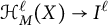
$\mathcal {H}^\ell _M(X)\rightarrow I^\ell $
 with
$I^\ell \in \mathcal {I}$
 for
$\ell \in \mathbb {Z}$
 . By Lemma 2.5,

it yields an exact triangle
$Y\stackrel {f}\rightarrow X\rightarrow \bigoplus _{\ell =\mathrm {inf}X}^{\mathrm {sup}X}I^{\ell }[-\ell ]\rightarrow Y[1]$
 in
$\mathcal {T}^{\mathrm {b}}$
 , such that
$f\in \mathcal {G}_M$
 . By the induction, one can obtain an exact triangle
$Z\stackrel {g}\rightarrow X\rightarrow T\rightarrow Z[1]$
 in
$\mathcal {T}^{\mathrm {b}}$
 , such that
$g\in \mathcal {G}^{n+1}_M$
 and
$T\in \langle \mathcal {I}\rangle _{n+1}$
 . As
$Z\in \langle \mathcal {P}\rangle _{n+1}$
 , it follows by Lemma 4.5 that
$g=0$
 , so X is a retract of T. Hence,
$\mathcal {I}\textrm {-}\mathrm {tri.dim}\mathcal {T}^{\mathrm {b}}\leqslant n$
 . Similarly, one can get the desired equality.
“
$n\leqslant \mathrm {gldim}\mathcal {T}=d$
 .” Let
$X\in \mathcal {T}^{\mathrm {b}}$
 . We may assume that
$\mathrm {amp}X>0$
 . For
$\ell \in \mathbb {Z}$
 ,
$\mathrm {pd}_{\mathcal {T}}\mathcal {H}^{\ell }_M(X)\leqslant d$
 . Set
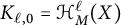
$K_{\ell ,0}=\mathcal {H}^{\ell }_M(X)$
 and fix an sppj resolution

with the corresponding exact triangle
$K_{\ell ,n+1}\rightarrow P_{\ell ,n}\stackrel {f_{\ell ,n}}\rightarrow K_{\ell ,n}\rightarrow K_{\ell ,n+1}[1]$
 for
$n\geqslant 0$
 , such that
$K_{\ell ,d+1}=0$
 . Set
$\mathrm {inf}X=i$
 . Consider the exact triangle

As
$\mathrm {Hom}_{\mathcal {T}}(P_{i+1,t}[-i-1],K_{i,t}[-i+1])=0$
 for
$t\geqslant 0$
 , by
$4\times 4$
 Lemma, one has a diagram of exact triangles

such that all squares are commutative, except the middle square above is anti-commutative, where
$L_{i+1,0}=\tau ^{\leqslant i+1}(X)$
 . As
$K_{i,d+1}=0=K_{i+1,d+1}$
 , it implies that
$L_{i+1,d+1}=0$
 and then
$\tau ^{\leqslant i+1}(X)\in \mathrm {thick}^{d+1}(\mathcal {P})$
 . As
$\mathrm {Hom}_{\mathcal {T}}(P_{i+2,t}[-i-2],\tau ^{\leqslant i+1}(X)[1])=0$
 for
$t\geqslant 0$
 , by repeating this process on the triangle
$\tau ^{\leqslant i+1}(X)\rightarrow \tau ^{\leqslant i+2}(X)\rightarrow \mathcal {H}^{i+2}_M(X)[-i-2]\rightarrow \tau ^{\leqslant i+1}(X)[1]$
 , one has
$\tau ^{\leqslant i+2}(X)\in \mathrm {thick}^{d+1}(\mathcal {P})$
 . Consequently,
$X\in \mathrm {thick}^{d+1}(\mathcal {P})$
 , as required.
We now turn to the question of when equality occurs in Theorem 4.6.
Lemma 4.7 Assume that M is tilting, and let
$H\in \mathcal {H}_M$
 and
$n\geqslant 1$
 . If
$\mathrm {Hom}_{\mathcal {T}}(H[-n],\mathcal {H}_M)\neq 0$
 , then
$H\not \in \mathrm {thick}^{n}(\mathcal {P})$
 .
Proof Let
$H=H_0$
 and fix an sppj resolution

with the corresponding exact triangle
$H_{i+1}\rightarrow P_i\rightarrow H_i\stackrel {f_{i+1}}\rightarrow H_{i+1}[1]$
 . As
$P_i\in \mathcal {H}_M$
 ,
$f_{i+1}\in \mathcal {G}_M$
 and
$H_i\in \mathcal {H}_M$
 for
$i\geqslant 1$
 by Lemma 4.3. One has a commutative diagram of exact triangles

where
$T_1=P_0$
 ,
$g_1=f_1$
 and
$g_i=f_i[i-1]f_{i-1}[i-2]\cdots f_2[1]f_1\in \mathcal {G}^i_M$
 for
$i\geqslant 2$
 . As

it follows that
$H_{n-1}\not \in \mathcal {P}$
 , and then
$H_0\not \in \mathcal {P}\ast \cdots \ast \mathcal {P}[n-1]$
 by Proposition 3.6. Thus,
$g_n\neq 0$
 . As
$\alpha _i:\mathrm {Hom}_{\mathcal {T}}(-,H_{i-1}[i-1])\rightarrow \mathrm {Hom}_{\mathcal {T}}(-,H_{i}[i])$
 vanishes on
$\mathrm {thick}^{1}(\mathcal {P})$
 for
$i\geqslant 1$
 and
$g_n\neq 0$
 , it follows by [Reference Rouquier24, Lemma 4.11] that
$H\not \in \mathrm {thick}^{n}(\mathcal {P})$
 .
For
$H\in \mathcal {H}_M$
 , let
$\mathrm {pd}_{\mathcal {H}_M}H$
 denote its projective dimension in
$\mathcal {H}_M$
 .
Lemma 4.8 If M is tilting, then
$\mathrm {pd}_{\mathcal {T}}H=\mathrm {pd}_{\mathcal {H}_M}H$
 for
$H\in \mathcal {H}_M$
 .
Proof If
$\mathrm {pd}_{\mathcal {T}}H=t$
 , then
$H\in \mathrm {thick}^{t+1}(\mathcal {P})$
 by Theorem 3.3. Consider the sppj resolution

with the corresponding exact triangle
$H_{i+1}\rightarrow P_i\rightarrow H_i\stackrel {f_{i+1}}\rightarrow H_{i+1}[1]$
 for
$i\geqslant 0$
 , where
$H_0=H$
 . Then
$\mathrm {Hom}_{\mathcal {T}}(H_{t},\mathcal {H}_M[1])\cong \mathrm {Hom}_{\mathcal {T}}(H,\mathcal {H}_M[t+1])=0$
 by Lemma 4.7. Note that
$f_{i+1}\in \mathcal {G}_M$
 , so
$H_i\in \mathcal {H}_M$
 for all
$i\geqslant 0$
 . Thus, the triangle
$H_{t+1}\rightarrow P_t\rightarrow H_t\rightarrow H_{t+1}[1]$
 splits, and then
$H_{t}\in \mathcal {P}$
 . Also by Lemma 4.3,

is exact in
$\mathcal {H}_M$
 , it implies that
$\mathrm {pd}_{\mathcal {H}_M}H\leqslant t$
 . Let
$\mathrm {pd}_{\mathcal {H}_M}H=r$
 and
$0\rightarrow Q_r\rightarrow Q_{r-1}\rightarrow \cdots \rightarrow Q_0\rightarrow H\rightarrow 0$
 be exact in
$\mathcal {H}_M$
 with each
$Q_{i}\in \mathcal {P}$
 . Set
$K_i=\mathrm {coker}(Q_i\rightarrow Q_{i-1})$
 . Then
$Q_i\rightarrow K_i$
 is an sppj morphism and
$K_{i+1}\rightarrow Q_i\rightarrow K_i\rightarrow K_{i+1}[1]$
 is an exact triangle for
$0\leqslant i\leqslant r-1$
 with
$K_0=H$
 and
$K_r=Q_r$
 , it implies that
$\mathrm {pd}_{\mathcal {T}}H\leqslant r$
 .
Theorem 4.9 Denote
$\mathrm {gldim}\mathcal {H}_M:=\mathrm {sup}\{\mathrm {pd}_{\mathcal {H}_M}H\hspace {0.02cm}|\hspace {0.02cm}H\in \mathcal {H}_M\}$
 . If M is tilting, then

Proof The first equality follows by Lemma 4.8. By Theorem 4.6, it suffices to prove that
$\mathrm {gldim}\mathcal {T}\leqslant \mathcal {P}\textrm {-}\mathrm {tri.dim}\mathcal {T}^{\mathrm {b}}=n$
 . Let
$X\in \mathcal {T}^{\mathrm {b}}$
 and set
$s=\mathrm {sup}X$
 . If
$\mathrm {amp}X=0$
 , then
$X[s]\in \mathcal {H}_M$
 . Thus,
$\mathrm {Hom}_{\mathcal {T}}(X,\mathcal {H}_M[-s+n+i])=0$
 for
$i\geqslant 1$
 by Lemma 4.7, so
$\mathrm {pd}_{\mathcal {T}}X\leqslant n$
 by Theorem 3.3. Assume
$\mathrm {amp}X>0$
 , and consider the exact triangle

As
$\mathrm {amp}\tau ^{\leqslant s-1}(X)\leqslant \mathrm {amp}X-1$
 , it follows by the induction that
$\mathrm {pd}_{\mathcal {T}}\tau ^{\leqslant s-1}(X)\leqslant n+\mathrm {amp}X-1$
 . So
$\mathrm {pd}_{\mathcal {T}}X\leqslant n+\mathrm {amp}X$
 by Corollary 3.8, as desired.
Corollary 4.10
$\mathrm {gldim}\mathcal {T}\leqslant 1$
 if and only if M is tilting and
$\mathrm {gldim}\mathcal {H}_M\leqslant 1$
 .
Proof Let
$\mathrm {gldim}\mathcal {T}\leqslant 1$
 . Consider the exact triangle

As
$\mathrm {pd}_{\mathcal {T}}\mathcal {H}^0_M(M)\leqslant 1$
 and
$\mathrm {sup}\tau ^{\leqslant -1}(M)\leqslant -1$
 ,
$\mathrm {Hom}_{\mathcal {T}}(\mathcal {H}^0_M(M),\tau ^{\leqslant -1}(M)[1])=0$
 by Theorem 3.3, so the triangle is split and
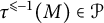
$\tau ^{\leqslant -1}(M)\in \mathcal {P}$
 . Thus, by Lemma 2.5,

it implies that
$\iota =0$
 and then
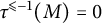
$\tau ^{\leqslant -1}(M)=0$
 . So M is tilting and
$\mathrm {gldim}\mathcal {H}_M\leqslant 1$
 by Theorem 4.9. The converse follows by Theorem 4.9.
Remark 4.11 (1) If R is a ring, then
$\mathrm {pd}_{\mathrm {D}(R)}H=\mathrm {pd}_{R}H$
 for an R-module H, and
$\mathrm {AFpd}X=\mathrm {pd}_{\mathrm {D}(R)}X-\mathrm {sup}X$
 for
$X\in \mathrm {D}^-(R)$
 by [Reference Minamoto20, Theorem 2.22 and Remark 2.2], where
$\mathrm {AFpd}X$
 is the projective dimension of Avramov–Foxby. Thus,
$\mathrm {gldim}\mathrm {D}(R)$
 is the global dimension
$\mathrm {gldim}R$
 of R by [Reference Christensen, Foxby and Holm13, Theorem 8.5.3].
(2) If A is a nonpositive dg ring, then
$\mathrm {pd}_{\mathrm {D}(A)}X=\mathrm {pd}X$
 for any
$X\in \mathrm {D}^-(A)$
 by [Reference Minamoto20, Theorem 2.22] and
$\mathrm {gldim}\mathrm {D}(A)=\mathrm {gldim}A$
 by [Reference Minamoto20, Theorem 5.1].
(3) Let
$M\in \mathcal {T}^b$
 and
$\mathcal {F}=\mathcal {F}'$
 . By analogy with the above argument, one has

this number is called the weak global dimension,
$\mathrm {wgldim}\mathcal {T}$
 , of
$\mathcal {T}$
 . If R is a ring, then
$\mathrm {wgldim}\mathrm {D}(R)$
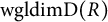 is precisely the weak global dimension
$\mathrm {wgldim}R$
 of R.
(4) Let
$M\in \mathcal {T}^b$
 and
$\mathcal {F}=\mathcal {F}'$
 . If
$\mathrm {wgldim}\mathcal {T}=0$
 , then

is exact for all
$T\in \mathcal {T}^c$
 and
$i\in \mathbb {Z}$
 , it implies that
$\mathrm {Hom}_{\mathcal {T}}(\tau ^{\leqslant -1}(M),T^\ast [i])=0$
 for all
$T\in \mathcal {T}^c$
 and
$i>\mathrm {sup}T^\ast $
 by Theorem 3.12, so
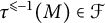
$\tau ^{\leqslant -1}(M)\in \mathcal {F}$
 . As
$\mathrm {sup}\tau ^{\leqslant -1}(M)\leqslant -1$
 , one has
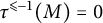
$\tau ^{\leqslant -1}(M)=0$
 and hence M is tilting.
5 Homological properties for triangulated categories
This section introduces several homological properties of
$\mathcal {T}$
 that depend entirely on the distinguished subcategories defined in the previous section. The resulting theory applies to the derived categories of modules over rings or dg rings.
Definition 5.1 [Reference Kostas, Psaroudakis and Vitória17]
Write
$\mathcal {T}^{\mathrm {b}}_p:={^{\bot _\ll }}(\mathcal {T}^{\mathrm {b}})\cap {^{\bot _\gg }}(\mathcal {T}^{\mathrm {b}})$
 and
$\mathcal {T}^{\mathrm {b}}_i:(\mathcal {T}^{\mathrm {b}})^{\bot _\gg }\cap (\mathcal {T}^{\mathrm {b}})^{\bot _\ll }$
 .
(i)
$\mathcal {T}$
 is of finite global dimension if
$\mathcal {T}^{\mathrm {b}}_p=\mathcal {T}^{\mathrm {b}}$
 , equivalently, if
$\mathcal {T}^{\mathrm {b}}_i=\mathcal {T}^{\mathrm {b}}$
 ;
(ii)
$\mathcal {T}$
 is Gorenstein if
$\mathcal {T}^{\mathrm {b}}_p=\mathcal {T}^{\mathrm {b}}_i$
 .
The following characterization links the abstract definition with concrete homological finiteness conditions.
Proposition 5.2 Assume that
$M\in \mathcal {T}^{\mathrm {b}}$
 . One has

Proof If
$M\in \mathcal {T}^{\mathrm {b}}$
 , then
$\mathcal {T}^{\mathrm {b}}_p=\mathrm {thick}(\mathcal {P})\subseteq \mathcal {T}^{\mathrm {b}}$
 and
$\mathcal {T}^{\mathrm {b}}_i=\mathrm {thick}(\mathcal {I})\subseteq \mathcal {T}^{\mathrm {b}}$
 by [Reference Kostas, Psaroudakis and Vitória17, Theorem 3.13]. Let
$X\in \mathcal {T}^{\mathrm {b}}_p$
 . Then
$X\in \mathrm {thick}^{n+1}(\mathcal {P})$
 for some
$n\geqslant 0$
 . If
$n=0$
 , then
$X=\bigoplus _{\ell =\mathrm {inf}X}^{\mathrm {sup}X}M_\ell [-\ell ]$
 with
$M_\ell \in \mathcal {P}$
 , it follows by Theorem 3.3 that
$\mathrm {pd}_{\mathcal {T}}X\leqslant \mathrm {amp}X<\infty $
 . Assume that
$n\geqslant 1$
 . Consider the exact triangle
$Y\rightarrow X\rightarrow P\rightarrow Y[1]$
 in
$\mathcal {T}^{\mathrm {b}}$
 with
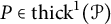
$P\in \mathrm {thick}^{1}(\mathcal {P})$
 and
$Y\in \mathrm {thick}^{n}(\mathcal {P})$
 . Then
$\mathrm {pd}_{\mathcal {T}}Y\leqslant n-1+\mathrm {amp}Y<\infty $
 by the induction, it implies that
$\mathrm {pd}_{\mathcal {T}}X<\infty $
 by Corollary 3.8. Thus,
$\mathcal {T}^{\mathrm {b}}_p=\{X\in \mathcal {T}^{\mathrm {b}}\hspace {0.02cm}|\hspace {0.02cm}\mathrm {pd}_{\mathcal {T}}X<\infty \}$
 by Theorem 3.3. Similarly, one has
$\mathcal {T}^{\mathrm {b}}_i=\{X\in \mathcal {T}^{\mathrm {b}}\hspace {0.02cm}|\hspace {0.02cm}\mathrm {id}_{\mathcal {T}}X<\infty \}$
 .
The following is a direct consequence of [Reference Yang and Li26, Theorem 4.5] and Proposition 5.2.
Corollary 5.3 [Reference Kostas, Psaroudakis and Vitória17, Proposition 5.6] and [Reference Minamoto20, Proposition 3.28 and Theorem 5.5]
Let A be a nonpositive dg ring with
$\mathrm {amp}A<\infty $
 .
$(1)\, \mathrm {D}(A)$
 is of finite global dimension if and only if
$\mathrm {pd}X<\infty $
 for all
$X\in \mathrm {D}^{\mathrm {b}}(A)$
 if and only if
$\mathrm {id}X<\infty $
 for all
$X\in \mathrm {D}^{\mathrm {b}}(A)$
 . Moreover, if A is commutative and its cohomology algebra
$\mathrm {H}(A)$
 is essentially of finite type, then A is an ordinary ring.
$(2)\, \mathrm {D}(A)$
 is Gorenstein if and only if A is Gorenstein
$(\mathrm {id}A<\infty )$
 .
The next result shows that the Gorenstein property of
$\mathcal {T}$
 is equivalent to the Gorenstein property of the abelian heart.
Proposition 5.4 If M is tilting, then the following are equivalent:
$(1)\, \{X\in \mathcal {T}^{\mathrm {b}}\hspace {0.02cm}|\hspace {0.02cm}\mathrm {pd}_{\mathcal {T}}X<\infty \}=\{X\in \mathcal {T}^{\mathrm {b}}\hspace {0.02cm}|\hspace {0.02cm}\mathrm {id}_{\mathcal {T}}X<\infty \}$
 ;
$(2)\, \{H\in \mathcal {H}_M\hspace {0.02cm}|\hspace {0.02cm}\mathrm {pd}_{\mathcal {H}_M}H<\infty \}=\{H\in \mathcal {H}_M\hspace {0.02cm}|\hspace {0.02cm}\mathrm {id}_{\mathcal {H}_M}H<\infty \}$
 .
Proof (1)
$\Rightarrow $
 (2) This follows by Lemma 4.8 and its dual.
(2)
$\Rightarrow $
 (1) For all
$H\in \mathcal {I}$
 , as
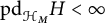
$\mathrm {pd}_{\mathcal {H}_M}H<\infty $
 , it follows by Lemma 4.8 that
$\mathrm {pd}_{\mathcal {T}}H<\infty $
 , so
$\mathcal {T}^{\mathrm {b}}_i\subseteq \mathcal {T}^{\mathrm {b}}_p$
 . For all
$H'\in \mathcal {P}$
 , as
$\mathrm {id}_{\mathcal {H}_M}H'<\infty $
 , it follows by the dual of Lemma 4.8 that
$\mathrm {id}_{\mathcal {T}}H'<\infty $
 , so
$\mathcal {T}^{\mathrm {b}}_p\subseteq \mathcal {T}^{\mathrm {b}}_i$
 , as required.
Corollary 5.5 [Reference Aihara, Araya, Iyama, Takahashi and Yoshiwaki1, Proposition 2.5] and [Reference Kostas, Psaroudakis and Vitória17, Theorem 4.3]
Let R be a ring.
$(1)\, \mathrm {gldim}\mathrm {D}(R)=\mathrm {gldim}R =\mathrm {Add}(R)\textrm {-}\mathrm {tri.dim}\mathrm {D}^{\mathrm {b}}(R)$
 .
$(2)\, \mathrm {D}(R)$
 is Gorenstein if and only if R is Gorenstein.
The triangulated categories that we work with are k-linear in this section, where k is a commutative Noetherian ring.
Definition 5.6 [Reference Kostas, Psaroudakis and Vitória17]
(1) The subcategory of bounded finite objects of a k-linear triangulated category
$\mathcal {T}$
 is denoted by
$\mathcal {T}^{\mathrm {b}}_c:=\{X\in \mathcal {T}\hspace {0.02cm}|\hspace {0.02cm}\bigoplus _{n\in \mathbb {Z}}\mathrm {Hom}_{\mathcal {T}}(T,X[n])\in \mathrm {mod}k\ \textrm {for any}\ T\in \mathcal {T}^c\}$
 .
(2) A k-linear triangulated category
$\mathcal {T}$
 is said to be regular (over k) if
$\mathcal {T}^{\mathrm {b}}_c=\mathcal {T}^c$
 .
Following [Reference Benson, Iyengar and Krause9], we call a compactly generated k-linear triangulated category
$\mathcal {T}$
 Noetherian if for any compact object C, the k-module
$\bigoplus _{n\in \mathbb {Z}}\mathrm {Hom}_{\mathcal {T}}(C,C[n])$
 is finitely generated. Equivalently, for all compact objects
$C, D$
 , the k-module
$\bigoplus _{n\in \mathbb {Z}}\mathrm {Hom}_{\mathcal {T}}(C,D[n])$
 is finitely generated. An object H in
$\mathcal {H}_M$
 is called finitely generated if there is an epimorphism
$\mathcal {H}^0_M(M)^n\rightarrow H$
 in
$\mathcal {H}_M$
 for some
$n\geqslant 1$
 .
Lemma 5.7 Assume that
$\mathcal {T}$
 is Noetherian. Then

Proof As
$\mathcal {T}$
 is Noetherian, it follows that
$M\in \mathcal {T}^{\mathrm {b}}$
 and
$\mathrm {End}_{\mathcal {T}}(M)$
 is a Noetherian ring by [Reference Anderson and Fuller3, p. 131, Exercise 7]. Let
$X\in \mathcal {T}^{\mathrm {b}}_c$
 . Then
$\bigoplus _{\ell \in \mathbb {Z}}\mathrm {Hom}_{\mathcal {T}}(M,\mathcal {H}^\ell _M(X))\cong \bigoplus _{\ell \in \mathbb {Z}}\mathrm {Hom}_{\mathcal {T}}(M,X[\ell ])\in \mathrm {mod}k$
 by Lemma 2.5, so
$X\in \mathcal {T}^{\mathrm {b}}$
 and
$\mathrm {Hom}_{\mathcal {T}}(M,\mathcal {H}^\ell _M(X))$
 is a finitely generated
$\mathrm {End}_{\mathcal {T}}(M)$
 -module for
$\ell \in \mathbb {Z}$
 , that is, there is an epimorphism

in
$\mathrm {End}_{\mathcal {T}}(M)$
 for some
$n_\ell \geqslant 1$
 . Thus,
$\mathcal {H}^\ell _M(X)$
 is finitely generated in
$\mathcal {H}_M$
 for all
$\ell \in \mathbb {Z}$
 . Conversely, it follows by the next epimorphism

and
$\mathrm {Hom}_{\mathcal {T}}(M,M)\in \mathrm {mod}k$
 that
$\bigoplus _{\ell \in \mathbb {Z}}\mathrm {Hom}_{\mathcal {T}}(M,X[\ell ])\in \mathrm {mod}k$
 , as desired.
Remark 5.8 (1)
$\mathcal {T}^{\mathrm {b}}_c\subseteq \mathcal {T}^{\mathrm {b}}$
 .
(2) If
$\mathcal {T}$
 is Noetherian, then
$\mathcal {T}^c\subseteq \mathcal {T}^{\mathrm {b}}_c$
 and
$\mathcal {T}^c$
 is far-away generated by M.
(3) If
$\mathcal {T}$
 is Noetherian, then
$\mathrm {gldim}(\mathrm {End}(M))=\mathrm {wgldim}(\mathrm {End}(M))$
 by [Reference Christensen, Foxby and Holm13, Theorem 8.5.13], it implies that
$\mathrm {gldim}\mathcal {T}=\mathrm {wgldim}\mathcal {T}$
 by Lemma 2.4.
The following result unifies several perspectives: regularity of
$\mathcal {T}$
 , finite global dimension of the heart, and bounded generation by
$\mathcal {P}$
 .
Proposition 5.9 Let
$\mathcal {T}$
 be Noetherian such that M is tilting. The following are equivalent:
$(1)\, \mathcal {T}$
 is regular with
$\mathcal {T}^{\mathrm {b}}_c=\mathrm {thick}^{d+1}(\mathrm {add}(M))$
 ;
$(2)\, \mathrm {gldim}\mathcal {H}_M=d$
 ;
$(3)\, \mathcal {T}^{\mathrm {b}}=\mathcal {T}^{\mathrm {b}}_p=\mathrm {thick}^{d+1}(\mathcal {P})$
 ;
$(4)\, \mathcal {T}$
 is Gorenstein and
$\mathrm {gldim}\mathcal {T}=d$
 .
Proof (1)
$\Rightarrow $
 (2). Let I be an ideal of
$\mathrm {End}_{\mathcal {T}}(M)$
 . Then there exists
$H\in \mathcal {H}_M$
 , such that
$\mathrm {End}_{\mathcal {T}}(M)/I\cong \mathrm {Hom}_{\mathcal {T}}(M,H)$
 by Lemma 2.4. As
$\mathrm {End}_{\mathcal {T}}(M)$
 is a Noetherian ring,
$H\in \mathcal {T}^{\mathrm {b}}_c$
 , so
$\mathrm {pd}_{\mathcal {H}_M}H\leqslant d$
 by Lemma 4.8. Thus,
$\mathrm {gldim}\mathcal {H}_M=\mathrm {gldim}\mathrm {End}_{\mathcal {T}}(M)=d$
 by Lemma 2.4.
(2)
$\Rightarrow $
 (1). Let
$X\in \mathcal {T}^{\mathrm {b}}_c$
 . By Lemma 5.7, one can choose a projective resolution

in
$\mathcal {H}_M$
 , such that
$P_{\ell ,d+1}=0$
 and
$P_{\ell ,n}\in \mathrm {add}\mathcal {H}^0_M(M)$
 for all
$n\geqslant 0$
 and
$\ell \in \mathbb {Z}$
 . Thus,
$X\in \mathrm {thick}^{d+1}(\mathrm {add}(M))$
 by the proof of Theorem 4.6.
(2)
$\Leftrightarrow $
 (3)
$\Leftrightarrow $
 (4). These follow by Theorem 4.9.
Remark 5.10 (1) Let R be a Noetherian k-algebra. Then
$\mathrm {D}(R)^{\mathrm {b}}_c=\mathrm {D}^{\mathrm {b}}_{\mathrm {f}}(R)$
 the full subcategory of
$\mathrm {D}(R)$
 consisting of R-complexes with finite and bounded cohomology.
(2) Let A be a Noetherian dg k-algebra with
$\mathrm {amp}A<\infty $
 . Then
$\mathrm {D}(A)^{\mathrm {b}}_c=\mathrm {D}^{\mathrm {b}}_{\mathrm {f}}(A)$
 the full subcategory of
$\mathrm {D}(A)$
 consisting of dg modules with finite and bounded cohomology.
(3) A commutative Noetherian ring R is regular of finite Krull dimension if and only if
$\mathrm {D}^{\mathrm {b}}_{\mathrm {f}}(R)=\mathrm {thick}^{\mathrm {dim}R+1}(\mathrm {add}(R))$
 (see [Reference Avramov, Buchweitz, Iyengar and Miller4]).
(4) When
$\Gamma $
 is a Noetherian ring spectrum (i.e.,
$\pi _*(\Gamma )$
 is a Noetherian ring) with
$\mathrm {amp}\Gamma <\infty $
 , the bounded finite subcategory
$\mathrm {K}(\Gamma )^{\mathrm {b}}_c$
 is precisely the subcategory
$\mathrm {D}^{\mathrm {b}}_{\mathrm {f}}(\Gamma )$
 consisting of
$\Gamma $
 -module spectra with finite and bounded cohomology.
(5) Let
$\Gamma $
 be a Noetherian ring spectrum with
$\mathrm {amp}\Gamma <\infty $
 such that
$\pi _*(\Gamma )$
 has finite global dimension. Then
$\mathrm {K}(\Gamma )^{\mathrm {b}}=\mathrm {K}(\Gamma )^{\mathrm {b}}_p$
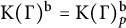 by [Reference Hovey and Lockridge15, Theorem 2.5].
Acknowledgments
I am grateful to the referee for their thorough reading and for remarks that greatly helped improve this version.



