In the summer of 1942, Bishop Gaetano Pasotti of the Ratchaburi Diocese wrote a letter to the Ministry of the Interior protesting the deteriorating status of the Catholic Church in Thailand. Since the beginning of the border conflict with French Indochina in late 1940, public sentiment had turned sharply against the Church due to its close association with France. Thai Catholics had been labelled as ‘fifth column’ and subject to all manner of persecution. All French citizens, including clergy, had been ordered to leave the country. Those priests who returned confronted new government restrictions that prevented them from administering to their former parishes. Provincial and municipal leaders banned all church services, and pressured Catholics to ‘return’ to the national religion of Buddhism. Thai mobs attacked local priests and looted Catholic churches. Government officials closed down churches, schools and dormitories and began converting them into public schools, offices or even Buddhist monasteries. Catholics who refused to convert to Buddhism could be fired from their jobs or fined. When the Church replaced deported French priests with Italian clergy, they too were threatened both by mobs and local government. Pasotti pleaded with the ministry to help protect Salesian priests and restore Catholic property to its rightful owners. ‘Such an uncivil state of affairs,’ he wrote, ‘is not in keeping with the spirit of the alliance between our two countries, Italy and Thailand, who are at this moment fighting together for a common purpose.’Footnote 1
If Pasotti truly believed that Thailand and Italy shared the same goals, then he grossly misread the national mood. The Thai viewed 1941 as their year of destiny. The conflict over the border with French Indochina was to be the beginning of a larger war to create a new Thailand that would be free of western dominance. Thailand's victory in that struggle signalled the emergence of a new era in which all the perceived injustice and humiliation it had suffered at the hands of European imperialism would finally be avenged. For this reason alone many Thais embraced Japan's vision of a Greater East Asia where a rejuvenated Thailand would play an important role. On the domestic front, Prime Minister Phibun Songkhram was attempting to free the Thai economy from the control of Chinese middlemen and European corporations. In this atmosphere of extreme nationalism, the government placed limitations on all institutions associated with western imperialism, and religious organisations were no exception. Among the government's targets, the Catholic Church received special attention due to its history of confrontation with the Thai state dating back to the reign of King Chulalongkorn. By the 1940s the Church had enjoyed four decades of peaceful coexistence with the Thai government, yet it remained a potent symbol of western arrogance and intervention. Phibun's campaign against Catholicism represented an attempt to avenge past national humiliation and destroy all symbols of the old colonial order in Southeast Asia.
Both then and now, the Thai state's persecution of Catholicism during the Second World War constitutes a sensitive issue, making sources difficult to obtain. The Phibun government was intentionally secretive regarding its religious agenda. Ministry of the Interior records confirming anti-Catholic policies do exist; but they are vague regarding the origins and exact nature of policy. Eyewitness accounts from Catholic participants are much clearer regarding the course of events, but involve questions of objectivity in addition to being carefully guarded by church stewards. Admittedly, the scarcity of documentation has created obstacles to the construction of a usable narrative detailing religious persecution.Footnote 2
In addition, historians have paid far less attention to Thailand's wartime domestic issues in order to focus on the country's foreign policy, particularly its relationship with Japan. As Thadeus Flood once wrote, few areas of Thai history were targets of as much speculation as foreign relations preceding the war in the Pacific.Footnote 3 For several decades after the Second World War, the traditional narrative on wartime conditions in Thailand emphasised the country's survival from both Japanese and Allied incursions. Thamsook Numnonda's study of this period concluded that Thailand's only goal was to emerge from the war with its independence intact, and at this it succeeded brilliantly.Footnote 4 More recent articles have challenged this perspective by demonstrating how Phibun's expansionist policies during the war did much to jeopardise Bangkok's post-war standing within the international community. Eiji Murashima's investigation into Thailand's 1942 campaign in Burma argued that it was Thai leaders who pressured Japan to allow it to conduct military operations in the Shan states, not the reverse. Disregarding the country's precarious status, Phibun saw the war as an opportunity to restore all of Thailand's ‘lost territories’, which had been the dream of Thai rulers since Chulalongkorn.Footnote 5 He intended to construct a Greater Thailand that would encompass all areas inhabited by the Thai race. It was only after the dismal failure of this offensive that Phibun began to reconsider his declaration of war on the Allies and disavow his plans to make Thailand into a great power.Footnote 6 E. Bruce Reynolds has examined Phibun's domestic and foreign agendas and characterised his policies as ‘fascist’. From 1938–44, Bangkok attempted to emulate political models in Italy and Germany by forming militant youth groups, persecuting ethnic and religious minorities, and promoting an irredentist programme aimed at recovering territories in French Indochina.Footnote 7
This study seeks to build on the work of Reynolds and Murashima by arguing that the extreme nationalism of the early 1940s represents Thailand's attempt to confront its own history of victimisation and remove the vestiges of western imperialism. Phibun's persecution of Catholicism has roots in the late nineteenth-century confrontation between the Church and the Thai state. During this period priests and missionaries appropriated political power over their congregations in order to protect converts from the demands of Thai feudalism. Clerical interference defied the nobility and frustrated Thai rulers, who searched unsuccessfully for ways to limit the Church's power without antagonising its French imperialist patrons. Fifty years later, Phibun opted for an aggressive solution to what had been a long-standing grievance of the Thai government. Second, public vehemence against Catholics reflects how the Thai government exploited a history of victimhood in order to redefine national identity. Leadership articulated new boundaries of identification in which the values ‘Catholic’ and ‘Thai’ became mutually exclusive.
Moreover, I argue that Catholicism was a soft target that helped the government to mobilise popular opinion against the idea of imperialism. Michael Murdock's work on Chinese anti-colonialism demonstrates how confronting imperialism in the theoretical sense proves unsustainable, while attacking powerful institutions, such as a military presence, can provoke a fatal backlash. For this reason Christian churches often proved to be an ideal objective for focusing public attention on the presence of foreign-ness within a country.Footnote 8 In the Thai case, Catholics were the perfect symbol of imperialism and antithesis of national identity due to their association with France, their history of political intervention, and the fact that many converts were ethnic minorities. Finally, the anti-Catholic movement indicates how both domestic and foreign policy were employed as servants of hyper-nationalism during the 1940s. Just as Phibun's aspirations of external expansion resulted in attacks on French Indochina and later British Burma, his desire for internal cleansing led to religious persecution. From the government's perspective, Catholicism was an instrument of imperialism, and for that reason alone it must be removed from Thailand.
Rama V and the Catholic question
The violence against Catholicism in the Phibun era has its roots in the late nineteenth-century political struggle between missionary and monarchy. Thai rulers dating back to Ayuthaya had viewed proselytising efforts as a subtle method of spreading French influence in their kingdom. For this very reason, when the Apostolic Vicariate of Siam was founded in the mid-seventeenth century the government carefully restricted its reach. As evidenced by the close relationship between Bishop Jean-Baptiste Pallegoix and Mongkut, church and state enjoyed a relatively harmonious relationship. Eventually, Chulalongkorn consented to issue a royal edict in 1878 granting missionary access to the northeast.Footnote 9 Even then, the Siamese government was extremely reluctant to grant passports to Catholic clergy for several reasons. French imperialist activity in Vietnam and their expansion westward towards the Mekong threatened Siamese interests in the Lao territories, which were still semi-autonomous vassal states. In order to counter this threat, Siam began gradually tightening its grip over the Lao regions, hoping to bring the northeast under direct Siamese control. Bangkok feared that the introduction of missionary work in this region would only exacerbate Lao resistance towards the centralisation of government. Furthermore, Chulalongkorn was very concerned about having French priests in cities such as Sakon Nakhon, Nakhon Phanom and Ubon, because of their military importance as strategic locations along the Mekong River. He feared that the clergy were actually spies sent to conduct surveillance activities and act as agents provocateurs in order to draw Siam into a border conflict with French Indochina.Footnote 10
Despite Chulalongkorn's apprehension, Catholic priests did not act as spies, nor did French authorities ever plan to employ them in such a manner. As J.P. Daughton has demonstrated, the nature of collaboration between Catholic missionaries and colonial officials in French Indochina was much more complex than many historians have suggested. The two groups were not simple partners. Republican administrators brought their anti-clerical attitudes with them to Indochina, while clergy seldom hesitated to pursue their ecclesiastical goals in a manner detrimental to the empire. ‘Far from being eager servants of empire,’ Daughton writes, ‘missionaries remained acutely suspicious of colonial authority.’Footnote 11 This mistrust of secular authority caused priests to safeguard their own autonomy and work to increase the mission's influence over local communities. It was this practice of operating Catholic communities as exempt from imperial jurisdiction that brought the Church into conflict with local rulers in Siam. Catholic clerics complicated relations between Bangkok and vassal states by disregarding Siamese law and acting as intermediaries between the government and the people.
Beginning in the 1880s, French Catholic priests utilised their extra-territorial status to gain credibility and build patron–client relationships with minority communities in the northeast. The Siamese nobility hesitated to confront priests for fear of provoking an international incident that might jeopardise Franco-Siamese relations. The clergy's ability to defy provincial and district officials allowed them to become advocates for the Vietnamese, Lao and hill tribe races that occupied the lower orders of the Siamese social hierarchy. In order to gain the people's trust, the Church used the same methods as the French Consulate. Priests talked of justice and equality, telling minorities that local rulers oppressed them and offering to use church influence to protect them from Siamese cruelty.Footnote 12 Thus, the Vietnamese in Siam began to equate conversion to Catholicism with limited protection from taxes, corvée labour and debt bondage. As membership in their congregations increased, the clergy assumed civic and judicial authority within Catholic communities in addition to their ecclesiastical roles. In one example from Nakhon Phanom, a priest directed all 75 families from one village to move their houses to the banks of the Mekong, thereby establishing a new village under his leadership. The Church intended these communities to operate outside the Siamese system of governance. Priests forbade their followers from drinking the water of allegiance (a Buddhist ritual) if they became civil servants.Footnote 13 Missionaries arbitrated legal disputes between fellow Christians instead of directing them to consult the Siamese magistrates. Since these communities were self-governing and composed of ethnic minorities, questions naturally arose concerning their loyalties and identity. In 1884 Chulalongkorn was shocked when he passed through a Catholic community in Lop Buri and saw the French flag flying over one of the homes. Although the governors of the Lao territories were considerably alarmed by this disregard for Siamese governance and law, they dared not actively oppose the priests before receiving instruction from Bangkok.Footnote 14
As protectors of these Catholic communities, priests caused enormous headaches for Siamese ministers by insisting that their parishioners should be exempt from both taxation and corvée labour. They claimed that the corrupt and antiquated system of revenue collection in the northeast created opportunities for tax collectors to exploit ethnic minorities. In order to correct this injustice, Catholic priests presented demands for change on three levels. First, that the northeast provinces should follow the same procedures as those already established in Bangkok. Next, they requested that the amount of taxes collected from Catholics should be substantially reduced, and finally the priests themselves wanted to act as tax collectors for all Catholic villagers. The defiant attitudes of these ecclesiastical leaders quickly spread to the Vietnamese Christians. They refused to perform labour for the local magistrate unless they were paid, choosing instead to flee to their priest for protection and register for protégé status.Footnote 15 This presented a difficult dilemma for Siamese authorities. Imposing the current quota might lead to a violent confrontation with the Church, and they feared France's reaction in such an event. Yet they could not in fairness exempt Catholics from the duties required from the rest of the population. In addition, any agreement to modify the tax rate would only further convince minorities that the power and influence of Catholic priests superseded that of the king's ministers.
French missionaries also clashed with the Siamese establishment over the issue of debt bondage, which had been abolished in Bangkok but was still practised in the northeastern regions. Along with corvée labour, indentured servants provided much of the manpower required by the Siamese nobility. Catholic priests viewed debt bondage as a form of slavery, and denounced it as an antiquated and barbaric practice that allowed the Siamese to further exploit the Vietnamese, Lao and hill tribe minorities. They began petitioning Chulalongkorn to extend the ban on debt bondage into the northeastern Lao territories, while also using their influence to protect people attempting to escape bondage. Many priests allowed runaways to hide in their homes or on church property.Footnote 16 Caught between the nobility and the Church, Chulalongkorn opted to avoid conflict with France by placating the clergy.
These incidents reinforced opinions within Chulalongkorn's government that Catholic priests were imperialist agents attempting to provoke Siam into open conflict with France. The king in particular was deeply concerned that the clergy's abolitionist activism would undermine both his relationship with the nobility and the sovereignty of the entire kingdom. Siam had carefully observed the French conquest of Vietnam and noted how disagreements between missionaries and the royal court had provided France with a pretext for armed intervention and the imposition of a colonial state. He felt certain that France intended to similarly exploit religious differences between the two countries in order to expand its own influence westwards towards the Mekong River.Footnote 17 During the 1880s, France and Siam were engaged in a race to extend state control over the region of Laos and Chulalongkorn was already in the process of widespread modernising reforms to give his kingdom the edge. The king also hoped to present Siam as a civilised nation approaching the level of Europe in order to avoid the fate that had befallen neighbouring Burma and Vietnam. The Catholic Church's activism in the northeast proved irritating because it continually accused Siam of practising slavery. By focusing attention on the institution of debt bondage, the Church weakened the king's argument that Siam was a civilised country, thereby increasing the possibility of European intervention.
Before the monarchy and nobility could agree on how best to deal with the perceived threat of Catholicism, violence in Nakhon Phanom province led local authorities to take matters into their own hands. In 1885, a crowd of Catholic converts stormed Wat Kaeng Mueang, destroying the Buddhist temple's sacred statues and relics in a fit of religious fervour. Given Siamese concern over upsetting the French consulate, the minister's retribution proved surprisingly swift and brutal. Officials ordered the destruction of several homes owned by the Church and inhabited by converts. Catholic civil servants were arrested and flogged until they promised to discontinue their association with the clergy. Other converts were threatened or blackmailed until they promised to end their membership in the foreign religion. Nor did the French priest escape reprisal, as local merchants organised a massive boycott that meant that he could rarely purchase food, and then only at exorbitant prices.Footnote 18 Fearing that the backlash in Nakhon Phanom would spread, Father Alexis travelled to Bangkok to counsel with Chulalongkorn, who also wanted to end these disturbances as quickly as possible. Eventually the Siamese government and Catholic Church adopted a strategy of compromise and mutual adaptation. The clergy agreed not to interfere with the collection of taxes, corvée labour, or the water of allegiance ritual within Catholic communities.Footnote 19 The Siamese elite realised that the exploitation of Vietnamese and other minorities drove these groups into the protection of Catholic priests, and that conflict between state and clergy only enhanced the priest's standing in the eyes of the Christian community. Chulalongkorn used the example of Catholic abolitionist activism to convince his nobles that phasing out debt bondage would help protect the country's sovereignty from European powers searching for an excuse to intervene in Siam. In doing so, he advanced royal interests and power in the northeast at the expense of local interests. In return for the Church's concessions, the government compromised by allowing priests to perform the water of allegiance ritual in a church for all Catholic civic officials.
The conflict between nobility and clergy explains why the Siamese government had been so reluctant to allow missionaries into the Lao territories from the beginning. Because the northeast was still administered by the nobility, and not under the direct control of Bangkok, social customs and legal conditions differed greatly from those in the capital. When Catholic priests perceived an absence of ‘civilised’ governance in the territory, they took steps to become that authority. In their efforts to create Christian communities and protect those communities from exploitation, priests assumed the role of intermediary between the people and the government. For their part, the Siamese assumed that the clergy was working hand-in-glove with the French Indochinese government, who would welcome any confrontation as an excuse to become more directly involved in Siam's affairs. As already mentioned, however, the Siamese government misunderstood the complex relationship between Catholic missionaries and French imperialists. In actuality, the French Consul-General viewed the Church's activities in the northeast, especially its combative relationship with the local government, as a hindrance to extending French influence in Siam:
The Siamese government is truly tired and annoyed at the mass of complaints made every day by the missionaries either directly to them or through the French consulate. Three quarters of our voluminous correspondence with the [Siamese] ministers is composed of letters and notes relating to their contestations. With Your Excellency's permission I would, within the bounds of justice, like to control this habit. For the irritation caused to the Siamese government by this practice might at any time compromise our political action and change the favourable attitude which it normally tried to show towards France.Footnote 20
Harmand's remarks demonstrate that, far from instructing priests to provoke conflict with Siamese ministers, the colonial government would have preferred to restrain the Church's activities for the sake of improving Franco-Siamese relations. The consulate's lack of encouragement for the Catholic missions created no small amount of resentment among the Church's leadership:
It is most regrettable that the French government cannot understand how important and useful its moral support would be for missionaries … Such criticisms which state publicly that the priest should confine himself to Church matters alone, have prompted attempts to deprive him of all influence. In consequence he has lost all prestige, and with all remaining social respect. Without such prestige the missionary has no further social authority in present circumstances, and his words remain without effect on the poor pagans in whose eyes he has been downgraded.Footnote 21
Thus, prior to 1893 it was the Church that relied on the political backing of the French consulate to support its religious mission, rather than the consulate making use of the clergy to extend French political influence. This evidence suggests that although clergy such as Bishop Jean-Louis Vey of Bangkok urged the French colonisation of Siam, the Catholic priesthood was not an integral part of France's strategy to annex Siam. After the Franco-Siamese crisis of 1893, however, the Church became a more important part of France's plan to extend its influence in Siam by offering diplomatic protection to ethnic and religious minorities. Consul-General Auguste Pavie recommended that all Asiatic Catholics be registered as French protégés so that France could capitalise politically from the growth of the Bangkok mission. In 1894, the French parliamentary commission awarded the Vicariate of Siam 250,000 francs to promote missionary work. Pavie believed that the Church could help counter British influence while advancing French interests in Siam.Footnote 22
The clashes between the Siamese state and the Catholic Church created two impressions that would linger in the minds of the Siamese for several decades. First, the close association between baptism and protégé registration convinced many in Siam that becoming a Christian also involved changing one's citizenship. France's manipulation and abuse of extra-territorial privileges after 1893 also caused Siamese rulers to view conversion to Catholicism as a decision to abandon Siam in favour of France. In the 1930s and 1940s when concepts such as nation, citizen and boundaries became sacred matters, history was used to question the specific loyalties of individual Catholics. Second, the clergy's attempt to act as political and judicial figures made them symbols of French imperialism in the eyes of Siam's ruling classes. Priests successfully defied the governing authorities in the Lao territories over issues such as debt bondage and taxes. This defiance had the effect of diminishing Siamese power in the eyes of the people and causing them to look to the Church, and consequently to France, for protection and leadership. Although Chulalongkorn suspected the Catholic Church of being an imperialist threat to Siamese independence, he wished to avoid a confrontation that would lead to European intervention.
As Interior Ministry correspondence from the 1940s shows, the Thai had not forgotten how the Catholic Church had embarrassed and defied Siamese rulers in the past. After Germany's occupation of France in 1940, the Thai government could attack the Catholic Church without suffering a French backlash. Proposed strategies included limiting the amount of land that foreigners could own, or preventing foreigners from purchasing land altogether. The Ministry of the Interior also considered enacting laws to restrict the number of foreigners who could enter the country to teach religion or perform humanitarian service.Footnote 23 At the end of 1940, when negotiations over the Thai–French Indochina border broke down, Phibun was determined to use this opportunity to avenge past losses to imperialism. Breaking the power of the Catholic Church in Thailand was an important part of removing French influence and restoring national pride.
Defining Catholics as non-Thai
In December 1940, as Thai troops were preparing to invade parts of Indochina and recapture the lost territories, the Thai government made preparations to smash French influence within Thailand. A principal target was the Catholic Church. In addition to deporting French priests and closing down churches, the government constructed a discourse that characterised Catholicism as a foreign ideology that threatened to destroy traditional Thai values. Propagandists achieved this by associating Catholics with French imperialists, describing them as people who had forgotten their own identity and heritage. The discourse on ‘Thai-ness’ formed the main theme of leaflets distributed by a secret organisation known only as the Thai Blood Party. It also became a frequent subject of government correspondence and speeches by civic officials and schoolteachers. One priest stationed in Sakon Nakhon province wrote to his superiors, ‘The local authorities, starting from the (district leaders) down to the least of the teachers in their public speeches, do nothing but backbite and curse the Catholic religion and all the priests.’Footnote 24 The government began disseminating the idea that Catholicism was ‘un-Thai’ during the early months of the Franco-Thai conflict in 1940. By 1942, it had become the government's official position on the Church.
An important player in the campaign to redefine Thai identity and build Thai nationalism was the secretive organisation, the Thai Blood Party. Very little is known about this group aside from the nationalist agenda found in its literature. The party probably derived its name from Wichit Wathanakan's historical drama entitled Luead Thai (Thai Blood) and some suspect that Wichit himself was the party's founder. Whatever its origins, this group became very active in stirring up public opinion in support of invading French Indochina during the last months of 1940. Thai Blood propaganda emphasised that the Thai, Lao and Khmer were actually members of the same race. Thailand had gone to war with Indochina to drive out the French colonial oppressors and bring democracy to their Lao and Khmer brethren. In order to achieve this objective it was essential for the nation to be completely united and vigilant in protecting itself from the enemy within. According to this group, the Catholics jeopardised this ultimate goal by threatening the nation's unity.
Thai Blood literature presented religion as an essential part of national identity in order to marginalise Catholics and portray them as disloyal. Whereas Buddhism had always been an integral component of ‘Thai-ness’ as defined by the ruling elite, Catholicism was represented as a definitively French religion. In a country where there was no separation between church and state, nationalists reasoned that an individual's religious devotion to a French church would naturally translate into political loyalty to Saigon. By forsaking Buddhism, Catholics had not only turned their back on their own people, they had willingly associated themselves with Thailand's historical enemy. As one pamphlet warned:
… the Thai Blood party believes [Catholics] are enemies of the nation and people who worship the doctrines of our enemy. We hold they have forgotten their nation, forgotten their religion, the true religion because they are drunk on the faith of our enemies … these are people who have been taught by our enemies. They are waiting for an opportunity to make us their slaves and completely destroy our nation.Footnote 25
Despite such inflammatory rhetoric, nationalist leaders such as Wichit understood that French Indochina was much too weak to even consider an invasion of Thailand. If Phibun, for example, really thought that the French posed a threat he would certainly not have been so verbose regarding the lost territories. And yet we cannot dismiss the effectiveness of this type of propaganda; it was effective in mobilising public opinion because it invoked the collective trauma of the Franco-Siamese crisis, which by this time had become a visible scar on the body of the nation. During the border crisis of 1940, nationalists referred back to the loss of territory in 1893 at every opportunity in order to remind people how Thailand had been humiliated by France in the past. These handbills also conjured up long-held suspicions that the Church was merely an imperialist tool employed to facilitate French expansion into Thailand. Catholic Thais had been deceived by the corrosive dogma and were now helping establish a French imperialist presence in the country. Only after Cambodia and Laos were liberated, the French driven out of Southeast Asia, and the Catholic Church eliminated, could these misguided souls finally be brought back to Buddhism:
… do not forget that we Thai have received bitterness for the past many years. But now is our time. The Thai Blood want us to be united as one to help chase out the nation that is our enemy and force him to take his wicked doctrines out of the Golden Peninsula. Then our brethren who have been deceived by these superstitions will return to the paths our ancestors built for us.Footnote 26
Until all this could be achieved, the Thai Blood encouraged people to treat Catholics in the same way they would treat French citizens. One pamphlet entitled ‘An invitation to public opinion’ provided very specific instructions on how to interact with Catholics. It discouraged Thais from associating with their Catholic neighbours, and especially forbade business dealings. Patriotic citizens should watch Catholics closely, remember their faces and avoid talking about sensitive information if they were within listening distance. The pamphlet concluded with a warning that anyone who did not follow these guidelines was a traitor to their country.Footnote 27 Economic boycotts, in particular, proved a very effective method for generating public support both for the war effort and the campaign against Catholics. People avoided Catholic merchants and Buddhist merchants often refused to sell food to Catholics as well. Even pedi-cab drivers participated by refusing to transport Catholics in their vehicles. The Thai Blood successfully organised boycotts, first in Bangkok and later Chiang Mai, and encouraged other provinces to follow these examples.Footnote 28 These boycotts made life particularly difficult for Italian priests living in the Isan. Most merchants refused to sell them food, and those who did charged inflated prices.
In the public schools, administrators organised assemblies focused on discrediting Catholicism in the minds of their students. Some teachers talked about Christianity as though it were a primary reason for the overall decline of western power. As the campaign against Catholicism gained momentum, the government shut down Catholic schools and transformed them into public schools with a new curriculum. Teachers ordered crosses and other icons to be torn down from the walls and then asked Catholic students why, if the Christian god was so powerful, did he not punish them for their sacrilege? Another instructor pointed out that the British were a Christian nation. Why could they not defeat the Thai and Japanese in the war?Footnote 29 But the most common lecture theme portrayed the religion as a ‘fifth column’, a dangerous influence that corrupted those who accepted its beliefs. In Nong Khai province, a school principal used the outcomes of the last two world wars to show students how ‘the Catholic religion destroys every country it touches’. Niyom Thongthirad told his students that France was victorious over Germany in the First World War because of the assistance that they received from German Catholic spies. Following the war, the Nazis eliminated the treacherous religion from their country. With Germany no longer plagued by Catholic espionage, the Wehrmacht took just seven days to defeat France in the Second World War. ‘For this reason,’ the principal warned, ‘we Thais cannot worship Catholicism. Whoever accepts Catholicism is not a Thai.’Footnote 30
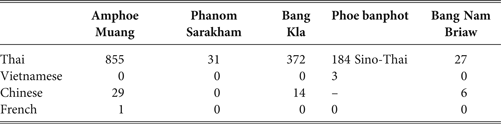
As we have seen, it was natural for Thais to perceive Catholicism as a ‘non-Thai’ religion because most of the earliest converts in Siam were Vietnamese. The first French priests to establish the Church in the northeast experienced the most success with Vietnamese immigrants who found themselves marginalised within the Siamese community. Some families had already converted to Catholicism in Vietnam and brought their religion with them. There was also a large community of Catholic Vietnamese in the Samsen district of Bangkok. Thus, when the Thai government looked for an explanation as to why many Catholics resisted efforts to convert them to Buddhism, they assumed that ethnicity was the answer. In 1942 the Ministry of the Interior instructed all governors to conduct a survey in order to ascertain the ethnic background of Catholic populations within their respective provinces. The governor of Chachoengsao province reported back some startling results. Out of almost sixteen hundred Catholics in the entire province, 93 per cent were identified as Thai, only 6 per cent as Chinese, and less than 1 per cent as Vietnamese (see Table 1).Footnote 31 Despite this evidence, some in the ministry continued to view the refusal of some Catholics to renounce their religion and adopt Buddhism as a racial trait. ‘[In regards to] those who return to Catholicism,’ wrote one exasperated official, ‘we can see they are not real Thais. They may have Thai citizenship under the law, but ethnically speaking they are foreign, probably Chinese or Vietnamese.’Footnote 32
Ethnicity of Catholics in Chachoengsao province listed by district
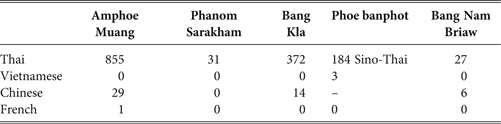
Source: NAT (1) มท. 3.1.2.10/6. Suk Anchanand to the Ministry of the Interior, 19 July 1942.
The strategy for eliminating Catholicism
The province works very closely with the people to teach and train them on how to be patriotic citizens who have repented and continue to be good Buddhists and give alms. We never cease to follow the policy of removing Catholicism from Thailand. Those people who return to Buddhism no longer observe the [Catholic] ordinances at all. They wish to live in strict accordance with the law.Footnote 33
– Governor of Nakhon Phanom province, 1942.The campaign to eliminate the Catholic Church from Thailand was directed by the Ministry of the Interior and carried out at local level by the provincial governors and especially the district chiefs. On 16 January 1941, at the height of the Franco-Thai border conflict, Bangkok sent out a communiqué to the governors of provinces with significant Catholic communities.Footnote 34 This directive communicated the government's three-fold strategy for rolling back the influence of the Church in Thailand. First, local officials were instructed to close down Catholic churches and schools, and ban Catholics from holding public services. Second, the district chiefs must ‘invite’ Catholics within their jurisdiction to return to Buddhism, the national religion. As we shall see, district leadership extended this invitation in ways that made it very difficult for Catholics to decline. Finally, the directive alerted provincial authorities to the danger posed by church buildings located in areas of military or economic importance, principally in the northeast along the Mekong River. These buildings threatened the overall wellbeing and security of the nation, and governors were charged with facilitating their relocation.Footnote 35 Although all governors received the same directive, each province implemented the ministry's policy at its own discretion. Some districts or villages proved more determined than others to resist that policy, and the confrontation between church and state often turned violent.
The Thai government banned Catholic services the moment that martial law was declared in Thailand on 30 November 1940. Police closed down churches all throughout the east, north and northeast, so that the ‘fifth column’ could not use Sunday services as a cover for their espionage activities. Anyone who refused to convert to Buddhism was informed by police that they could display crucifixes and religious icons and pray in their own homes, but public meetings were forbidden.Footnote 36 As with other measures, the Ministry of the Interior gave the order to ban religious services, but it allowed the provinces a certain degree of latitude regarding the enforcement and duration. Governors in Udon Thani, Nong Khai, Nakhon Phanom and Sakon Nakhon proved more rigid than others, since their provinces had large Catholic populations and were situated on the front lines of the border war. Most other provinces relaxed the ban after the conclusion of hostilities. Sakon Nakhon began permitting public services in 1942 before prohibiting them once again in 1943.Footnote 37 Nakhon Phanom, which had been bombed by French planes at the outset of the conflict, was the only province to maintain its ban from 1940 until the fall of the Phibun government in 1944.Footnote 38
One area of Thailand appears to have escaped this religious persecution altogether. The Ratchaburi mission west of Bangkok was a Salesian mission separate from those in Bangkok and the Isan. It appears that churches there were not affected. In 1943, the Police General in Bangkok sent out a notice to law enforcement in Ratchaburi, Kanchanburi and Samut Songkhram, directing police not to interfere with the activities of Catholics in those areas:
Police should understand that Catholics have services at the church all the time that they may attend. Also, the duties of the priests also involve going to burial services or traveling to the homes of those who are sick or injured … Police officials should understand that all these activities are permitted under your supervision and protection.Footnote 39
The Thai government sheltered the Ratchaburi Diocese from its campaign of religious nationalism because its priests and administrators were Italian, not French. Unlike France, Italy was an important ally of the Japanese and could still exert plenty of leverage in Bangkok on behalf of its citizens. Thus, the Phibun administration developed a policy of non-interference in the Ratchaburi Diocese's affairs even as it expelled the Church from the rest of the country. Eventually, however, the Diocese would come into conflict with the state when Italian priests travelled to the northeast in an attempt to restore the Catholic presence in that region.
In the rest of the country, appropriating church property turned out to be a very simple process. Most of the church buildings in the northeast were managed by French priests who were forced to leave Thailand during the border conflict. Once the priests had departed and the churches were left vacant, the civic authorities declared that the status of the buildings as religious edifices had officially expired. This change in status allowed the government to take ownership of Catholic churches, schools, houses and land. In Ban Wiankuk in Nong Khai province, local leaders claimed that they took over property only after they could not determine who actually owned the buildings.Footnote 40 When Father Lacombe was forced to leave his parish in Chang Ming, he bequeathed the church keys to a sister in his congregation. After three months he had not returned, and the woman turned the keys over to a district leader.Footnote 41 Under government direction, churches were converted into office buildings, teachers' dormitories or even Buddhist monasteries. After Thailand assumed control of Champassak in 1941, police used the city church as their provincial headquarters. Authorities closed down Catholic schools and removed the religious iconography from the classroom walls, before reopening them as public schools. Buddhist imagery and statues replaced the torn-down crucifixes. The Catholic Church also owned a considerable amount of vacant land, which it used as possible expansion sites, or as farmland to generate revenue. In Sakon Nakhon, the district took possession of church fields, which it then leased out to citizens for planting.Footnote 42 The confiscation of property provided a definite financial incentive for local officials to follow Bangkok's anti-Catholic policies.
Economic advantages notwithstanding, instructions from the Ministry of the Interior made it clear that the primary objective of appropriating this property was to limit the influence of the Catholic Church in Thailand. Since Catholicism had been designated as a threat to the Thai nation, any churches situated near areas of economic or military importance must be relocated. The decision of whether or not relocate a church was the priority of the governor of each province, but the Ministry of the Interior offered the following guidelines. In communities with substantial Catholic populations, local government was to assist in finding land where the church could be resituated. Officials should see to it that Catholic buildings were grouped together and not spread out, and try to ensure that the church's new plot was smaller than its previous plot. In towns where most Catholics had converted to Buddhism and the churches were deserted, local government should destroy the building so that it could never again be used as a meeting house.Footnote 43 By encouraging the demolition of these structures, Bangkok tried to make certain that any returning clergy would not be able to revitalise their former congregations.
Indeed, the atmosphere in Thailand following its victory over French Indochina proved very conducive to all types of violence against Catholics and their property. From 1941–44 many church buildings all across the country were damaged by vandalism, arson or looting. Since the policy of the Ministry of the Interior was to eliminate Catholic churches wherever possible, these attacks had the tacit approval of the government and were occasionally the result of direct orders from the province. In no case did the Thai police ever intervene to stop or even investigate mobs that attacked homes, schools or churches. Nor was anti-Catholic violence simply a knee-jerk response to the hysteria of the 1940 Indochina war. Records both from the Ministry of the Interior and eyewitness accounts suggest that the brunt of the destruction of property actually took place from 1942–44, long after the conclusion of hostilities with French Indochina. It is important to note that although both Saigon and Bangkok co-operated with the Japanese, due to the tensions created by the transfer of territories they did not consider themselves to be allies.Footnote 44
Several attacks against church property provide evidence of a partnership between municipal government, police and local mobs of Thai Blood party members. After Bangkok ordered Catholic buildings to shut down, the police kept a vigilant watch over the churches to make sure no one tried to reopen them and hold meetings inside. Parishioners in Tha Rae reported to Bishop Pasotti at Ratchaburi that police officers regularly prevented them from checking on the status of their church building. By contrast, non-Catholics regularly slipped past the web of surveillance in order to destroy crucifixes, break windows and steal valuable items belonging to the church. Authorities in Nakhon Phanom monitored Catholic activities very closely, but took no action to prevent arsonists from burning down the cathedral in Kham Toei in June 1942.Footnote 45 When parishioners in Chachoengsao province formed a night-watch group to protect their church, the police arrested members of the group on false charges. These arrests effectively disbanded the night watch and allowed members of the Thai Blood party to ransack the building the very next night. In the provinces of Sakon Nakhon, Udon, Nakhon Phanom and Loei, a total of seven churches were attacked, burned down or vandalised from 1942–44.
The destruction of Catholic property was not always the secret work of mobs; in many cases the government used safety concerns as an excuse for demolishing a religious edifice. In Nakhon Phanom province, the chief of Tha Utane district requested that the nuns' quarters at Ban Chiang Yeun be torn down. By 1944 most Catholics had left the area, and the empty building was considered a possible hazard since it was located near an elementary school.Footnote 46 Other demolition projects were handled in a slightly less professional manner. In neighbouring Sakon Nakhon province, a group of monks destroyed the bell tower, outhouse and other structures located in the courtyard of the Catholic church at Phanat Nikhom. When Father Forlazini protested this development to local authorities, he learned that the district chief had pre-approved the monks' actions because the buildings supposedly violated current building codes.Footnote 47 The governor of Nakhon Phanom also blamed Catholics themselves for much of the destruction of their own property. He claimed that many parishioners had lost both their respect for France and their faith in Catholicism when French artillery from across the Mekong damaged the cathedral in Nong Saeng. The destruction of this sacred edifice caused many to convert to Buddhism and express their outrage towards the French by destroying some of the church buildings and offering others to the community for public use.Footnote 48 For the Thai government, this account supported the narrative of Catholicism as a form of deception. Once Thai citizens broke free from the corrosive influence of the clergy, it was only natural that they direct their anger at those who had deceived them.
Outlawing Sunday services and confiscating church property made it easier to achieve the campaign's most important objective — convincing all citizens to adopt Buddhism as the national religion. Over a two-year period, the government held re-education meetings at district level to publicise the country's new policy on religion. Attendance was mandatory for Catholics. At such gatherings, the district chief would explain that Catholicism would no longer be tolerated in Thailand and requested that everyone present sign their names to a petition stating that they intended to become Buddhists. Rather than saying ‘convert’, however, Thai officials often used the phrase ‘return to Buddhism’. Such terminology reflected the nationalist discourse that Catholicism was not a legitimate religious alternative for Thais, and that anyone who adopted this religion had simply been misled into straying from their true identity and heritage. By signing the pledge to become a Buddhist, people underwent a process of rediscovering the path that had been laid out for the Thai people by their ancestors centuries ago. Such logic refused to acknowledge that Catholicism had a long tradition in Thailand. Many Thai Catholics were third-generation church members who knew very little about Buddhism.Footnote 49 The first group invited to ‘return’ was the civil servant class. In February 1941, the Ministry of the Interior held a mandatory meeting attended by non-Buddhist civil servants in the Bangkok area, including Muslims and Protestants, at Wat Mahathat. Anyone who did not sign a petition stating that they would adopt Buddhism could no longer work for the government.Footnote 50
The government used this same process to convert all non-Buddhist civil servants throughout Thailand. Klang Kham, a schoolteacher in Ubon province, received a letter from the district chief informing him that he and his family must convert to Buddhism. He describes his dilemma as follows:
Kamchat Phatti Suwan, the district chief, took me to his home several times during the week to persuade me. The only explanation he gave was that I must stop practicing a ‘European religion.’ I told him it was not a European religion. He told me that when I changed religions and had been a monk for one month, he would make me director of the school and increase my monthly salary. I told him I would have to consult with my family. He gave me one week.Footnote 51
Klang Kham fled to Bangkok in the hopes of avoiding the confrontation, but eventually returned home to Ubon and informed the district that he would not give up his religion. Upon hearing this news the Vice Prefect responded: ‘You must really love the Europeans. You are truly stupid.’Footnote 52 After leaving his teaching job Klang Kham worked as a ‘frontier runner’ until the status of the Catholic Church was restored, when he became a catechist.
In order to convert Catholics who were not civil servants, the government realised that it needed to use a different form of leverage. In Prachinburi province, a district chief organised a series of mandatory meetings at the district office, where he instructed Catholics to sign the petition to adopt Buddhism. When everyone refused, he forced them to return to the same event day after day so they were unable to go to work or do anything except listen to his sermons on the evils of European religion. Police arrested anyone who failed to attend. Faced with the prospect of financial ruin, most people eventually signed the petition so they could return to their lives.Footnote 53
One reason why provincial leaders were successful in using such tactics to bully religious minorities was the absence of strong leadership within the Catholic community. The declaration of martial law and the deportation of all French citizens deprived the Church of its most effective teachers and advocates. At the same time, many Thai priests were arrested and charged with conducting espionage for the French. The day after French planes bombed the Dongphraram army base in Prachinburi, police arrested Father Michel Somchin and Father Sanguen. The priests, both Thai subjects, were accused of having used flashlights to guide the French planes towards the camp, and eventually sentenced to two years' imprisonment.Footnote 54 In Korat, Father Nicolas was also arrested for being a spy and imprisoned for three years before dying of tuberculosis.Footnote 55 The persecution in Nakhon Phanom was by far the most severe. The police murdered seven individuals in Ban Song Khon who refused to stop teaching about Catholicism or encouraging their fellow parishioners to keep the faith. These eight victims of religious persecution were later beatified by the Pope and became Thailand's first Catholics martyrs.Footnote 56
With the conclusion of hostilities at the end of January 1941, most Catholic leaders believed that the government would relent in its harassment of the Church. In fact, Thailand's military victory over France only emboldened the government's efforts to remove the Catholics from Thailand. Although Bangkok rescinded the deportation order and decreed that all French citizens could return to Thailand, local officials refused to honour the decree where the Church was concerned. Priests attempting to return to parishes in Nakhon Phanom were arrested by local police and later released on the condition that they return to Bangkok.Footnote 57 Governors instructed the police to crack down on those who actively resisted the government's pressure to convert to Buddhism. In Ubon province, a nun was imprisoned for a year for trying to convince relatives not to enter a Buddhist monastery.Footnote 58 In public schools, teachers and administrators directed abuse towards Catholic students who could no longer attend religious schools. Lawrence Khai, a student in Nong Saeng, recalled his experience when his Catholic school was reopened as a state school:
At the school the teachers forced me and my friends to deny the Catholic faith and to adore the statue of Buddha. They said ‘There is no more other religion to practice except Buddhism.’ The teacher set up the statue of Buddha in the hall and they forced us students to adore. We refused to obey. They hit us with sticks. They forced us to kneel in front of the statue of Buddha, pressed our heads down with their strong hands. We tried to turn our heads away from the statue of Buddha. The teachers hit us directing our heads straight to the statue.Footnote 59
As we have seen, the arrests and violence that occurred during the border war were only part of an initial phase in a long-term campaign to force Catholics to abandon their religion. The government reasoned that once European priests had been deported and activist Thai priests imprisoned, there would be no one left to oppose government efforts to convert non-Buddhists, or provide the necessary ecclesiastical support to stop Catholic communities from crumbling under pressure.
The Vatican responds
Throughout 1940 and 1941 the Catholic Church could do little to protect either its members or its property from the orchestrated efforts of the Thai government. But contrary to the claims of Thai propaganda, the Church was not solely a French institution. It could draw on the resources of a worldwide organisation. In 1942, the Vatican reacted to anti-French sentiment in Thailand by placing the Isan under the jurisdiction of the Salesian mission at Ratchaburi. The Italian Bishop Gaetano Pasotti was assigned the task of lobbying Bangkok for the return of religious freedom.Footnote 60 Over the next two years Pasotti appealed in writing and in person to various levels of the Thai government, protesting the destruction of property and appealing for an end to the ban on public meetings and a restoration of the Church's status in Thailand. In his correspondence with the Interior Ministry, Pasotti argued the persecution was unjustified, since Catholic Thais were not Allied informants and did not represent a threat to national security. The Church taught its membership to be law-abiding citizens who were just as patriotic as any other civilian. As proof, he claimed that the Church was not experiencing this same persecution in any other country within the Japanese sphere of influence. In China, Indochina, the Philippines and even Japan itself, Catholics still enjoyed the freedom of public worship.Footnote 61 Despite Pasotti's arguments and his Italian citizenship, the Thai government continued to stonewall on returning church property and respecting the faith of its members.
Pasotti did manage to get the government's attention, however, when he sent Italian priests into northeastern provinces to replace the French clergy that had been deported. Church authorities reasoned that since Italy was an ally of both Japan and Thailand, Italian priests could provide leadership to fractured congregations and begin the process of restoring the Church's footing in provinces where it had been the target of so much harassment. Their arrival greatly alarmed the governors and district leaders in these regions. The governor of Nakhon Phanom sent a memo to the Ministry of the Interior protesting that the presence of these priests in his provinces was making it difficult to keep new Buddhist converts from backsliding towards Catholicism. He warned that if these clergy were allowed to operate freely they would soon undo all the progress that local officials had made towards eliminating Catholicism from their areas of jurisdiction.Footnote 62 While local officials were determined not to let this happen, they were initially uncertain of how to stop it. The Ministry of the Interior provided no clear instructions for dealing with Italian priests as they had done with French nationals. Thus, it was up to the provincial and district authorities to provide their own justification for neutralising the influence of Salesian missionaries within their jurisdiction.
In order to discourage Italian priests from permanently relocating to the northeast, local government denied them access to all church property. In most cases, the state was already using these buildings for other purposes anyway. In Nakhon Phanom, Father Albert sent a letter to the governor asking for the return of the priest's quarters so that a Father Giuseppe Pinafore could live there when he arrived at Chiang Yuen. The governor responded that the house was now property of the province and currently housed the chief of police. The province would allow Father Pinafore to visit Chiang Yuen and Nong Saeng, but would not permit him to stay and teach religion to the inhabitants there.Footnote 63 Upon arriving in Sakon Nakhon, Fathers Marchesi and Forlazini reported to the province as the new Catholic stewards in Chang Ming and Tha Rae. But the government prevented them from taking ownership of church property, claiming that the Italian priests were not the rightful owners.Footnote 64 Another priest, Reverend Stocker, arrived in Donthoi to find that the governor had installed Buddhist priests in his quarters. After moving into the home of a friend, he was visited by the police who informed him that he must leave the district. The state had appropriated the church and all its appendages, and ordered the people of Donthoi not to associate with Catholic priests. Therefore, what reason could there be for him to stay? Stocker, who had just come from Bangkok, expressed his amazement that the government had confiscated church property in ‘Siamese Laos’, while Catholic institutions in Bangkok remained completely unaffected.Footnote 65
The continued presence of Italian clergy in the northeast created sharp divisions within local communities and rekindled the animosities of the Franco-Thai conflict. Some who had renounced Catholicism as a result of government pressure resented the reappearance of priests in their village, while those who remained Catholic embraced the new ministers. Many Thais, still angry at France because of the border conflict, were incensed at the sight of what they thought were French missionaries living and working in their community. Even those who realised that the priests were Italian still accused them publicly of being ‘an enemy to Thailand, trying to enslave the Thai people to the Italian Nation’.Footnote 66 As priests began teaching and performing religious ordinances, people began returning to Catholicism. The government, in turn, began to fear that the Church might re-establish itself. This fear and resentment led to renewed confrontation and violence on both sides. Father Marchesi received several death threats warning him to leave Tha Rae district in Sakon Nakhon province. During the night mobs threw stones at the house where he was staying.Footnote 67 Police and local government suggested that the Italians leave the province since they could not guarantee the safety of the priests. Meanwhile, the governor of Sakon Nakhon accused the priests of stirring up religious zealotry among Catholics after a Buddhist monk was stabbed in Phanat Nikhom district.Footnote 68 As Italian priests refused to heed government warnings to leave the northeast, the church–state standoff escalated until finally the government resorted to imprisonment, a tactic it had hoped to avoid. Father Pinafore was arrested in Nakhon Phanom and transported to Champassak to be imprisoned. Thai authorities accused him of telling his congregation that the Thai army had damaged the Catholic Church, stolen church property, and injured a priest during its assault on Champassak the previous year.Footnote 69
At this point the Church's strategy of sending Italian missionaries into the northeast began to pay dividends. Pinafore's imprisonment attracted the attention of the Italian legation in Bangkok, which contacted the Ministry of Foreign Affairs that same week demanding the release of the Italian priest.Footnote 70 The Thai government, fearful of jeopardising relations with an Axis member, immediately agreed to end the harassment and imprisonment of priests, but requested that Italy confine the missionaries in question to the boundaries of the Ratchaburi mission. Italy refused to commit, saying the matter could best be settled after the war's conclusion. Thailand's ambassador in Rome advised Bangkok to be content with this arrangement, since the presence of a few priests in Thailand represented a relatively insignificant threat in comparison with the thousands of Japanese troops that were currently stationed inside the kingdom. Since Thailand had recently obtained pledges from both Italy and Germany in support of Thai independence from Japan following the war, the ambassador cautioned his home government not to risk Rome's co-operation in such a crucial matter.Footnote 71
If the Thai government could not persecute Italian priests directly, its only remaining option for limiting Catholic influence was to continue prohibiting its citizens from associating with the Church. Police officers in the northeast recorded the names of people who met regularly with priests and kept them under surveillance.Footnote 72 Prime Minister Phibun instructed local officials that they must respect the Catholic clergy, but that Thai citizens who refused to obey the government policy of converting to Buddhism must be subjected to various forms of indirect punishment. In Nong Khai this meant that civic authorities conducted inspections of kitchen gardens at Catholic residences and found obscure reasons to levy fines. A civic official then informed the resident that in order to avoid paying the fine they must go to the local temple to honour the monks, and then invite the monks for dinner at their home. Anyone who refused to follow these criteria would accumulate more fines until they ended up in jail.Footnote 73 In Ban Nong Doen, Catholic residents received fines because their toilets were insufficiently clean. The only sure method of escaping such penalties was to convert to Buddhism.Footnote 74
Persecution in Chachoengsao province
When evaluating the Thai government's treatments of Catholics during the early forties, it is tempting to dismiss instances of religious persecution as simply a by-product of the war hysteria surrounding Thailand's conflict with French Indochina. Given the close proximity of many Catholic communities to the Thai-Indochinese border, one would expect the Thai authorities to limit their activities and keep them under close surveillance during the martial law period. Anti-Catholic persecution, however, was not limited to border regions, nor was it simply a side effect of military conflict. In October 1941, over a year after Thailand began its border dispute, the Thai newspaper Ekkaraj addressed the ongoing religious intolerance in Thailand. While acknowledging that a ban on Catholic meetings in border areas may have been justified at the height of the conflict, the editorial pointed out that many Catholic churches located in the interior remained closed. Why, it asked, was this necessary when the conflict was long over and the state of the country had returned to normal?Footnote 75
One of the areas referred to in the article was immediately east of Bangkok in Chachoengsao province. Although the area had no sizeable minority population or military installations, eyewitness accounts suggest that the harassment of Catholics in Bang Kla district was quite similar to what had occurred in Sakon Nakhon or Nakhon Phanom. After the border conflict began the district chief obtained a list of all the Catholics in the district and ordered each of them to report to ‘re-education meetings’. Beginning in March 1941, about 60–70 people attended these gatherings held in the pavilion of Wat Chaeng. The district chief and assistant police chief presided and began by explaining the theme of the gathering: ‘We are Thai and we must act like Thais in flesh and blood, in our beliefs, and in our souls.’Footnote 76 The district chief set the tone early by instructing everyone: ‘We can no longer practice Catholicism in this area, we must renounce it and adopt a new religion. If you want to remain a Catholic, sit on the floor. If you are willing to convert to Buddhism, please sit in a chair.’Footnote 77
When all but three women took their places on the floor, the chief began explaining the district's new policy on Catholicism in greater detail. Catholics should not be so stubborn, he warned, since public opinion showed that most people no longer wanted the religion in Thailand. Catholicism was a religion for the French; Buddhism was the religion for the Thai. When one brave individual countered that Catholicism was not just a French religion, the district chief responded: ‘The members may not all be French, but the religion itself is definitely French.’Footnote 78 Re-education meetings also provided an opportunity to question the civic knowledge and loyalty of Catholic Thais. The district chief questioned them, for example, concerning the meaning of the different colours in the Thai flag. When someone gave the right answers he responded: ‘Correct, now why don't you want to become a real Thai?’ Thai authorities wanted to create the impression that Catholicism had adversely affected the country's unity. One woman from Tha Lad village who attended the meetings recalled the following exchange:
[The district leader] asked the question, ‘What do we do with a mango tree that has contracted ka fak?’ Someone answered ‘We must cut it down and get rid of it [before the disease spreads].’ He replied ‘Correct. Catholicism is like ka fak. It must be cut out of our midst.’Footnote 79
The residents of Bang Kla had little choice but to sit and listen to this anti-Catholic tirade for several hours. Anyone who attempted to defend themselves was immediately shouted down and accused of being ‘fifth column’. Catholics realised that speaking out would only bring more trouble, so they endured these diatribes in silence.Footnote 80 At the end of the second meeting, the district chief announced that he would no longer summon them to these gatherings. Henceforth, they should just plan on attending each day between 1 and 5 p.m. This pattern continued for weeks. Since this reorientation took up the entire afternoon Catholics had to abandon their stores and jobs, and many had to travel long distances from their villages to the district centre. The costs, both in terms of money and time, gradually wore down Catholic resolve. At the end of each meeting a few more would sign their names agreeing to renounce their religion. Their signature indicated that they now understood their duties as Thai citizens, and they became exempt from further meetings.Footnote 81
But as the majority of Catholics continued to keep the faith, the district chief began to warn them that the environment in Bang Kla was becoming increasingly dangerous. As one resident in attendance recalled:
… the district chief told us how hard he was working to keep the Catholics safe. He was watching the church very carefully, not to spy on us, to keep us safe. He said to us, ‘Catholics go to church without weapons, so if someone came to make trouble, what could you do? The Thai Blood party has hundreds of members to cause problems. Do you know how many times I've stopped them from causing harm? I heard rumors they were going to do something and I was worried about my people. So I encourage all of you Christians not to dissent because they think you are all fifth column.Footnote 82
Whether these instructions constituted a genuine warning or a subtle threat is unclear, but it awakened Catholics in Bang Kla to the reality that they could not rely on the authorities to protect their lives or property. No doubt aware of the religious violence occurring in the northeast, they formed a night-watch group to protect their church building. Each night several volunteers spent their night watching over its grounds.Footnote 83 Since Catholics could not legally possess weapons, they could offer little resistance if a mob decided to attack, but their presence formed a significant deterrent to Thai Blood members and others bent on removing the ‘foreign religion’ from Bang Kla. For several days there existed a tense calm as both sides anticipated confrontation.
The arrival of two Italian priests to the district provided a spark that would ignite widespread violence and cause Catholics to abandon the area for several years. With the Thai government refusing to allow the re-entry of French priests, the Catholic leadership began sending Italian clergy from the Ratchaburi Diocese to help fill the administration vacuum in other parts of the country. One such priest was Father Constonzo Gavalla, stationed in Kanchanaburi. During a visit to Bangkok, church officials requested that he travel to Chachoengsao province in order to provide some leadership and guidance to the membership there. In March, Father Gavalla travelled by boat to the church at the village of Tha Kwian, where he disembarked. Many locals were not pleased to learn of his arrival. One eyewitness travelling in the same boat recalled overhearing two men threatening about how they would ‘break that priest's neck’ later on that night.Footnote 84 That same day Father Gavalla reported to the civic authorities as required by law before retiring to spend the night in the priest's home next to the local church. Within hours the entire community knew about the arrival of another Catholic priest.
On the night of 14 March 1941 a mob attacked the priest's quarters in Tha Kwian and looted the church. Father Gavalla later recalled his experience:
At 11:30 PM while we were asleep, over 20 people came to the house. They used an axe to destroy the door and enter the home. They used axes, large knives, and clubs, and began destroying things within the house. When I was fully awake, I decided to try to flee, since I knew I could not fight with so many people. When I reached the market (about thirty meters from the house) the assailants caught me and ripped off my clothing. They took all the money in my bag (ten baht) and also my watch, boat and train tickets, my travel documents, and other personal papers.
Then the mob dragged me face down and threatened me so I wouldn't turn over. If I disobeyed they would kill me. Those who remained punched, kicked and hit me. There were two men. The first hit me in the head with a club. Finally they dragged me over and tied me to a tree near the church. All this caused me to lose consciousness momentarily. When I came to I saw a boy walk by and asked him to free me. He refused, saying that if he helped me he would be in trouble. I struggled until I eventually I was able to free myself.Footnote 85
Father Gavalla then returned to the priest's quarters and noticed that the house had been ransacked and many items stolen. After two hours, both the district chief and the police chief paid him a visit. When he attempted to recount the home invasion, the district chief interrupted him, saying that they had no interest in last night's events. Instead they were conducting an investigation as to whether or not the Italian priest was in Tha Kwian to conduct espionage. After searching the premises and posing several questions, the police chief concluded that Father Gavalla was not a spy. The district chief drew up a statement that affirmed the priest's innocence, and declared that the district was not responsible for the damages to the house. He then ordered the priest to sign it. That afternoon Father Gavalla returned to Bangkok, stopping only to file a police report at Baed Raew station before checking into the Hospital General St Louis to recover from his injuries.Footnote 86
The home invasion also provided local officials with the pretext that they needed to deal with Catholicism in other areas of Bang Kla district. The day after Father Gavalla's assault, police arrested seven Catholics in the village of Tha Lad on accusations that they had robbed and assaulted an Italian priest in Tha Kwian.Footnote 87 Not coincidentally, most of the detainees were also members of the watch patrol that had been guarding the local church each night. These men, including Sanan and Thong Ma, were sent to a detention facility in Phanom Sarakham sub-district. After three days a police official visited the prisoners to inform them that if they would give up Catholicism they would not be charged with the priest's assault. The district would release them and even return their guns. Each of the men signed the confession and returned to Tha Lad.
In their absence, the night-watch group had been unable to protect the church, which proved an easy target for the Thai-Blood supporters. A local Catholic woman recorded the violence the first night after the arrests:
While those men were imprisoned at Phanom district, one night many people came to ransack the church. I don't know how many there were because I took my children and fled in a boat along the river. It sounded like many people because I could hear the sounds of destruction and people shouting, Chaiyo! The next day I reported to the district chief to renounce Catholicism. He informed me that there were over four hundred people attacking the church. After that I no longer had to attend the meetings.Footnote 88
For Catholics, the church functioned not just as a gathering place but as a symbol of their spiritual solidarity. The building's desecration marked the beginning of a hiatus for the Christian community in Tha Lad, one that would last until the end of the war. When Thong Ma returned from jail he learned that the village leaders had formed a committee to itemise and sell all the belongings taken from the church. Some church property was also sold, including the former priest's. The building was abandoned and eventually demolished when the village decided to build a road through the property. In 1944 when the Thai government began making restitution to the Catholic Church for property seized or destroyed, it conducted a survey of the district. The survey noted that the Catholic Church leased out its only remaining buildings, and that there were no longer any Catholics worshipping in Bang Kla.Footnote 89
The case of Chachoengsao province demonstrates that the Thai government's motivation for persecuting the religion was not simply to improve security in provinces along the border with Indochina. Although leaders used national security as a pretext for persecution, Chachoengsao was not a northeastern border province, it had no military installations, and most of the Catholics were ethnic Thais, not Vietnamese. The fact that such an intense campaign of persecution occurred in this province suggests that local leaders had an enormous amount of discretion in implementing the directions of the Ministry of the Interior.
The end of persecution
The Thai government's commitment to breaking the power of the Catholic Church began to wane as it became clear that Japan would lose the war and western imperialism would return to Southeast Asia. After Phibun resigned as prime minister in 1944, the country's new leaders began distancing themselves from his aggressive nationalist policies and attempted to cultivate support among the Allies.Footnote 90 The anti-Catholic movement was one of the first policies to be scrapped. The Thai government realised that the Vatican could be a useful ally in trying to avoid occupation by the British following the war. As such, the government of Khuang Aphaiwongse publicly pronounced its commitment to the principles of religious freedom enshrined in the Thai constitution. For years Bishop Pasotti had written to all levels of government concerning the abuse of church members and property with almost no response. Suddenly, the Ministry of the Interior was initiating correspondence with the Bishop, informing him that the government was placing top priority on the process of returning land and buildings rightfully belonging to the Church.Footnote 91 By November 1944, the governor of Nakhon Phanom sent out a memorandum advising all district leaders of the province's new policy regarding the Catholic Church. Government organisations occupying church buildings must either vacate or make arrangements with the Catholic leadership to remain in the premises. In Loei province, Pasotti instructed civic leaders to vacate the church, which had been used as a public school, and transfer ownership to leading Catholic citizens who would act as transitional caretakers.Footnote 92 Anyone who had taken any church possessions or valuables must return them to their district office. The district must compile records of church property destroyed over the past three years. Finally, Catholic worship would be permitted under the supervision of the local police.Footnote 93 Thus, in an attempt to enlist the help of the Church in avoiding the imposition of reparations by the Allies, Thailand completely reversed its policy of trying to eliminate Catholicism from the country.
Understandably, Bangkok's abrupt policy reversal created problems for many local officials who were now expected to undo their efforts of the past three years. After the fall of Phibun, agents responsible for stamping out Catholic activity in a district watched in bewilderment as state support for their efforts quickly evaporated. The case of Roen Trisathan illustrates how the government recruited individuals to carry out their nationalist religion policy, and then abandoned them once the policy became untenable. While Thailand and France fought across the Mekong River, authorities in Phitsanulok province contacted Roen, requesting that he take charge of the ‘Catholic question’ in the Nikorn Laks area. After accepting the province's offer, he became responsible for fulfilling the nation's three-fold mission of banning meetings, converting Catholics to Buddhism, and secularising the Catholic school at the local level. Roen received police protection as he enthusiastically carried out these responsibilities, which he saw as a part of his duty to the nation. Just as Thai troops fought to regain the lost territories and defeat western imperialism, he struggled to purge the enemies within. For his efforts, he received a lucrative position as the manager of the community slaughterhouse and was also appointed the administrator of the former Catholic, now public, school.Footnote 94
As the tide of the war turned against Japan, however, Roen noticed that local government began refusing to support him in implementing its own policy. He wrote to the governor of Phitsanulok explaining that a Catholic group, which had formerly administered the church and school, had begun pressuring him to return their property so they could once again hold meetings. The new district chief refused to give him the political backing he had previously enjoyed and the police no longer protected him. Without the backing of these institutions, Roen felt that his life was in danger from resurgent Catholic elements that would hold him responsible for their persecution in Phitsanulok. His resignation illustrates how quickly the anti-Catholic campaign began to crumble once it became apparent that the war was lost.
In his correspondence, Bishop Pasotti seemed amenable to the idea of using Vatican influence to support leniency for post-war Thailand once the government had proved its willingness to support religious tolerance. Instead of railing against Thailand for injustices suffered during the war, he expressed his gratitude towards the new government for restoring the Church's property and official status as an acceptable religion:
This action reflects the government's new policy of establishing religious freedom for everyone, which the constitution protects, and which the Regent Pridi supported on Dec 8th, 1944. We believe it will also have influence on Thailand's foreign relations as well … Our devotion to Thailand is unchanging and we promise to make every effort to help increase the nation's honour and prestige and growth in the future.Footnote 95
The evidence from the final months of the war suggests that former Catholics returned to the Church once it was permissible to do so. More research must be done in order to ascertain the extent to which the Church was compensated for confiscated or damaged property as part of the post-war reconciliation. It seems clear, however, that the Catholic Church was quickly able to rebuild its organisation in Thailand despite having suffered through an intense four-year period of government persecution.
It would be inaccurate to claim that Catholics were the only denomination to suffer scrutiny during the Franco-Thai conflict. The Phibun government created an atmosphere of religious nationalism designed to pressure all non-Buddhists to adopt the one Thai faith. As religion became an indicator of one's civic allegiance, Protestants and Muslims also found themselves torn between competing loyalties of church and state. The important difference, however, is that neither Protestantism nor Islam was closely associated with France and its history of aggression in Thailand. Thus, the discrimination against these two groups does not compare with the orchestrated campaign of violence and intimidation that resulted from the government's policy towards Catholicism. In the Interior Ministry's official correspondence regarding religious policy, only the Catholic Church is repeatedly mentioned by name as a long-standing obstacle to government and a threat to national security.Footnote 96 In the public imagination, the Church was not simply a Christian organisation; it was a symbol of imperialism.
The anti-Catholic movement in Thailand can best be understood as part of a larger effort to build cultural nationalism and remove obstacles to complete independence. This process involved attacking colonial institutions as the Thai government sought to redeem itself from past defeats by European powers. Thais viewed the Catholic Church as part of the imperialist apparatus that disregarded their laws and obstructed government. Priests such as Reverend Stocker were considered subversive because they discouraged Catholics from participating in civic ceremonies that included Buddhist rituals. As we have seen, the level of church persecution varied in different parts of the country due to a variety of factors. It appears that the most intense harassment occurred in the northeast, while congregations in Bangkok and the north were only mildly affected. The exception of Chachoengsao province, however, indicates that more research is necessary if we are to understand how each region responded to the anti-Catholic policy emanating from the Ministry of the Interior.
The decline of European power and the ascension of Japan in Asia created an atmosphere in which Thailand could finally express its acrimony towards western imperialism without jeopardising its independence. In 1941 Thai newspapers celebrated the dawn of a new era in which past injustices could finally be avenged. Europeans living in Bangkok grew increasingly alarmed at the ‘anti-white’ sentiments expressed in the city's newspapers.Footnote 97 Phibun received an unprecedented amount of support for his nation-building programmes because he communicated these ideas as part of an overall process for restoring national honour and giving Thailand a place of importance within the international order. This process of restoration required the recovery of territory ceded to European imperialists and the removal of all institutions and ideas that had participated in Thailand's semi-colonial subjugation. As one of the most recognisable symbols of European influence in Thailand, the Catholic Church naturally became a primary target of this growing nationalism.