1. INTRODUCTION: THE THEORETICAL BACKGROUND
The crucial importance of institutional arrangements for market performance has become widely accepted. Following the publication of The rise of the western world by Douglass North and Robert Thomas in 1973,Footnote 1 it has become almost commonplace to assert that the ‘rules of the game’ of economy and society, and more specifically those of the market, limit, encourage and channel market incentives, and thus determine, to a large extent, the efficiency of market exchange.
It has, however, proven to be difficult to assess the effects of institutions on the functioning of the market. First, the functioning of markets is, of course, determined by more factors than institutions alone. Second, even if we accept that institutions play a large part, difficulties in measuring their effect remain great. A single institution may have many effects, some of them beneficial and others damaging to the functioning of markets: how to weigh the advantages against the disadvantages? Moreover, institutions interact: frequently a combination of institutions contributed to a single effect.Footnote 2
Not only the effects, but also the origins, of institutions have been, and still are, the subject of discussion. The notion that institutions develop more or less spontaneously because they provide a good answer to economic needs is popular, but it is also problematic. It suggests that efficient institutions – with ‘efficient’ defined as contributing most, in a given set of circumstances, to the welfare of society – will automatically prevail over less efficient alternatives. Unfortunately, reality is different. Many societies end up with obviously inefficient institutions simply because powerful groups or individuals create and sustain institutional arrangements that support their own interests, if necessary at the expense of aggregate welfare. A more credible way to account for the development of institutions is the notion that institutions are the effect of a confrontation between various social groups. The resulting institutional framework is not automatically the most efficient one for society as a whole; it is merely best suited to the interests of the elites in power.Footnote 3
While explaining the development of institutions and assessing their impact are difficult even for the modern era, the task is even more daunting for the pre-modern period because of the scarcity of reliable and detailed data. Yet, in western Europe, a number of important market-regulating institutions, such as laws on the contracting involved in selling, buying, hiring and borrowing, notaries, regular verification of weights and measures, public weigh houses, and banks, date back to the late Middle Ages. Because these fundamental market institutions emerged then, this period also offers the best opportunity to study their origins and effects.
Although we are well aware of all the difficulties, this paper is an attempt to explore possibilities for a more systematic reconstruction and analysis of pre-modern institutional change and its effects, with the further purpose of inviting discussion of these crucial issues in the field of economic history. By focusing on the rise and organisation of markets in late medieval Holland we will try to illuminate, first, the factors behind the development of the specific institutional framework of markets and, second, the effects of institutions on the functioning of the market. To this end, we have not merely focused on commodity markets, but also on factor markets, that is, the markets for land, capital and labour. Since the exchange and allocation of land, labour and capital are intimately connected to social positions and religious and cultural norms, their organisation substantially differs by region and period, and these markets are thus probably more important than the more similarly organised commodity markets in explaining differences in economic development.Footnote 4 Also, this broad scope has allowed us to study the vital ways in which the markets for land, capital, labour and commodities have interacted.
The county of Holland, in what is now the Netherlands, but then formed part of the patchwork of principalities in the Low Countries, offers a relevant test case for the effects of institutions on the development of markets. In a process that started in the eleventh and twelfth centuries, this region grew from a peripheral, backward corner of western Europe into an economic, political and cultural world power, in the course of which the economy and society underwent a profound transformation. The apogee of this development was in the seventeenth century, the Golden Age of the Dutch Republic, but it seems to have already been well on its way more than a century before. An inquiry into the economic situation of the county in 1514 shows that, already at that time, about 45 per cent of the population of Holland was living in cities, depending on grain imports for sustenance. In exchange, the region's agricultural and industrial sectors produced many export commodities. A substantial part of the population earned an income from trade or transport.Footnote 5 With respect to the labour market, about half of the labour performed in the countryside in sixteenth-century Holland consisted of wage labour.Footnote 6 The start of these developments can be dated back even further. The second half of the fourteenth century, in particular, witnessed massive urbanisation and a rise of the secondary and tertiary sectors, labelled the ‘jump-start’ of Holland's economy.Footnote 7
The idea that a key role in this development could be attributed to the organisation and institutional framework of markets is not new. Actually, in their pioneering book North and Thomas used the Dutch case to demonstrate the value of their institutional approach.Footnote 8 They did so by concentrating on market institutions in the period 1500–1700, although cursorily pointing to some medieval precursors. The same applies to the study by Jan de Vries and Ad van der Woude on the economy of the Netherlands in the early modern era.Footnote 9 They posited that in the sixteenth century Holland already possessed a highly developed market economy, characterised by a large degree of market freedom, efficient markets and low transaction costs which they tentatively explain as due to the large degree of freedom and the absence of a feudal legacy in Holland. Although these authors barely touch upon the causes and pre-history of this situation, it is obvious that the origins of the market structures of this relatively modern economy must be sought in the Middle Ages. This assumption is broadly accepted in the historiography, but hardly tested, especially not in a quantitative sense.
A close historical examination of the development of market institutions in medieval Holland results in a number of observations that allow us to analyse the effects of the institutional framework that was in place by 1500. In order to do so, we will combine insights from recent investigations by the present authors and largely based on new archival research,Footnote 10 complemented by a re-evaluation of the secondary literature and an investigation of relevant documents. In order to corroborate our findings, we use a comparative approach. The simultaneous development of similar institutions and the growth or integration of markets observed in other regions is not yet a proof of a causal relationship between the two, but such a comparison will nonetheless bring us closer to understanding the effect of institutional arrangements. In our tentative comparisons we focus mainly on the institutional framework and functioning of markets in Flanders and the English counties of Norfolk and Suffolk in East Anglia (hereafter referred to simply as East Anglia), which were, next to Holland, the parts of northwest Europe where population densities in this period were highest and economic development was most precocious. The three areas are of roughly similar size. Holland (that is, the former county of Holland) measures 6,000 square kilometres including lakes, Flanders (the former county of Flanders, without French Flanders, which lies in the west of present-day Belgium) 7,000 square kilometres, and East Anglia 9,000 square kilometres. All three are examples of pre-industrial florescence, but the exact chronologies of growth and decline differ. Flanders and East Anglia displayed great dynamism in the eleventh to thirteenth centuries but struggled after the mid-fourteenth century, which is exactly when the process of commercialisation accelerated in Holland.
Some caveats are in order, however. First, this paper does not claim to fully explain the different timing and pace of economic growth in the three areas. Its aims are much more modest. It compares the nature of the institutions and their direct effects on the functioning of markets, not on economic growth at large. Second, not all relevant indicators for the performance of markets are available for all three areas, so comparisons will at times be incomplete. Also, we would ideally start this investigation before 1300, but quantitative material for Flanders and especially for Holland is far too scarce, and we have therefore limited ourselves to the period after 1300. This omits the rapid market developments that had taken place in East Anglia during the twelfth and thirteenth centuries,Footnote 11 reducing the scope of the comparison. Third, comparisons are particularly difficult for capital markets. In line with common definitions, these are defined here as markets where savings are exchanged with titles to future payments, which usually run for at least one year. The capital market should be distinguished from the money market, where short-term loans are traded, and from the extension of trade credit, which was very common everywhere in late medieval Europe. The long-term debts that are traded in capital markets allow for the reallocation of relatively large savings, and thus enabled large investments. The financial instruments we are looking at, in particular the annuity, allowed for the creation of long-term debt that was repaid at the initiative of the debtor, and could therefore run for at least several years. Annuities were very common in northwest Europe, but not so in England, and in this respect direct comparisons with developments in East Anglia are problematic. Nevertheless, to get an impression of differences and similarities, we will discuss those financial instruments that come closest to the annuity.
We refrain from trying to measure the impact of individual institutions, since it would be impossible to isolate their effect from that of other institutions. Instead we use two indicators that – at least in part – reflect the functioning of the whole of the markets for goods, land, labour and capital: the volume of the market and the integration of markets. These indicators are chosen because they can, albeit indirectly, be linked to the quality of the institutional framework. Since other elements and the development of the real economy also influence these indicators, interpretation is not always straightforward, but this is at least a first step. It is also a necessary step, since the effects of institutions are often suggested or assumed, but much more seldom quantitatively analysed, and especially so for markets for land, labour and capital in the pre-industrial period. Before we embark on this step, we will briefly introduce the main study area, Holland, and explain how this paper will proceed.
2. THE CASE: HOLLAND IN A COMPARATIVE PERSPECTIVE
Holland is the westernmost part of the present-day Netherlands, bordering on the North Sea. The south of Holland is traversed by the rivers Meuse and Rhine. This coastal region remained under the princely rule of the Counts of Holland until it was integrated in 1433 into the Burgundian and in 1506 into the Habsburg Empire, together with a host of other principalities in the Low Countries. By that time, it had become one of the most densely populated parts of Europe and by far the most urbanised one. The region possessed one of the most vibrant economies in Europe, setting the stage for its Golden Age in the seventeenth century, when the Dutch Republic dominated world trade, with the town of Amsterdam in Holland forming the main centre.
In the eleventh century, there was nothing to suggest this future prominence of Holland's economy. The region was largely a wilderness, consisting of scarcely inhabited, inhospitable, peat bogs, Compared with neighbouring regions, such as Flanders, Brabant and the Rhineland, this was a marginal area. It was only reclaimed in the eleventh to thirteenth centuries, when the Count of Holland attracted settlers to do the hard clearing work by offering them freedom and well-defined property rights to the land. A society of free peasants emerged in which ecclesiastical and secular lords had little influence. The area had become densely populated when, in the thirteenth and fourteenth centuries, it was faced with an ecological crisis: the subsidence of the reclaimed peat soils, a process that ultimately made arable agriculture and the cultivation of bread grains nearly impossible. Despite these ecological difficulties, Holland recovered remarkably quickly from the effects of the Black Death: population declined in the region during the first decades after the epidemic, but the economy continued to develop and demographic recovery took just a few generations. Meanwhile, urbanisation continued apace during the fourteenth century. While only 14 per cent of the population lived in towns in 1300, their share increased to a quarter around 1350 and a third in 1400. About 44 per cent of the c. 260,000 inhabitants of the region lived in towns by 1500. The increase in the urbanisation rate was predominantly caused by the absolute growth of towns, which more than doubled in size between 1348 and the beginning of the sixteenth century, and not by a decline of the rural population.Footnote 12 While other European regions experienced a ‘late medieval crisis’, Holland displayed dynamism, characterised by thriving export industries and the strong development of trade and services.Footnote 13 This economic development and growth were sustained up to the seventeenth century, when stagnation set in.
These economic and demographic developments set Holland apart from the many parts of western Europe that were characterised by stagnation or crisis. The developments in Holland even contrast with dynamic, neighbouring regions such as Flanders and East Anglia. The latter two regions had been progressive in their economic development in the high Middle Ages, but after the middle of the fourteenth century population numbers stagnated or even declined, and urban growth came to a halt. In Flanders, the urbanisation rate declined from about 33–36 per cent in the fourteenth century to about 25 per cent in the fifteenth century and after.Footnote 14 In East Anglia the urbanisation rate actually increased during the fourteenth and fifteenth centuries. Around 1300, about 15 per cent of the population of Suffolk lived in towns, while 200 years later this proportion had doubled to about 30 per cent.Footnote 15 However, this growing urbanisation rate was not the result of urban population growth in absolute terms but rather of a severe decline of the rural population. In the fourteenth century, the population fell by more than half and did not begin to grow again until the early sixteenth century.Footnote 16 At the same time, markets contracted or were deserted.Footnote 17
The contrast with Holland can hardly be explained by geographical factors. Holland, Flanders and East Anglia were all located on the southern shores of the North Sea, had similar climatic conditions, and enjoyed similar advantages of location near waterways. There were differences in soil conditions, but these rather disadvantaged Holland, since the region was virtually sinking into the water. This paper can contribute to understanding this issue, by investigating to what extent the organisation of markets formed a main difference. All three regions witnessed an early rise of market exchange of goods, in the high Middle Ages, and later also of land, labour and capital. It can therefore be hypothesised, in line with the above, that the specific institutional organisation of these markets decided to what extent regions were able to cope with the ecological, economic and demographic challenges of the period from the mid-fourteenth century onwards. This leads to the following central questions: did markets in Holland function better than elsewhere, especially compared with neighbouring Flanders and East Anglia? If so, what were the underlying causes of their favourable functioning?
Our analysis of the institutional arrangement of markets in late medieval Holland starts with a reconstruction of the main institutions of market exchange and their specific characteristics (section 3). Next, we attempt to assess qualitatively and, when possible, also quantitatively what the effects of these institutions were on the growth of the volume of the market and on the integration of markets in Holland, compared with the other two cases (section 4). This will be followed by a tentative explanation of the contribution of socio-political elements to the emergence of specific institutions in Holland. We will look particularly at the elements standing out most clearly in the medieval history of Holland: the ecological situation, the occupational history and the structure of society (section 5). Conclusions follow in section 6.
3. THE DEVELOPMENT OF MARKET INSTITUTIONS IN HOLLAND 1100–1500
3.1 Property rights and personal freedom
In Holland, virtually absolute and exclusive property rights to land developed in the high Middle Ages, allowing a dynamic land market to develop which was exceptional in the context of western Europe,Footnote 18 where, in most regions, transfers of land did not involve market transactions: they remained firmly embedded in all kinds of social frameworks such as the extended family, the village community, the commons, or the manor. Even in Norfolk and other areas of eastern England – where manorialism was relatively weak in comparison with other parts of England, freehold land was substantial and the land market was lively – lords and manorial courts had a clear influence on property rights to land and their transfer.Footnote 19 In Holland, however, and to an almost equal extent in Flanders, these and the other non-market frameworks had lost their strength at an early date, or never held that position. In the early phase of settlement, most peasants in Holland acquired free ownership of the land that they reclaimed from the peatlands. In the fourteenth century, all peasants in Holland were free and the vast majority were owners of the lands they cultivated, thus opening the way for exchange of land by way of the market.
This development was accelerated by the role of local and central authorities. In Holland, and in adjacent parts of northwest Europe, local authorities in the thirteenth and fourteenth centuries had already started to register property rights to land and land transfers, mainly for fiscal reasons.Footnote 20 This increased the security of land transfers. Levies on transfers were quite low, or even completely absent, in contrast to the situation elsewhere in Europe where lords were able to extract high levies on land transfers. The latter was also true for Flanders, where seigniorial levies amounted to 8 to 16 per cent of the sale price; in East Anglia fealty paid with the transfer of free land and especially the entry fines paid with the inheritance or sale of customary land in the fifteenth and sixteenth centuries – although low in an English context – were often even higher than this.
It has to be added that in contrast to the solid legislation on land transfers and property rights, the lease market in Holland was less regulated. Rights with respect to leased land remained unclear. Peasants in Holland claimed all kinds of permanent rights to the land, even when the lease was formally for a fixed term. This situation provoked conflicts and insecurity with respect to investments in leaseholds. Only in the sixteenth century, under the legal and social pressure from the growing group of urban landowners in Holland, did lease rights become clarified – much later than in most of northwest Europe.Footnote 21
The emergence of a capital market was closely connected to the development of property rights to land. Long-term loans required debtors to use mortgages as securities, and therefore clear titles to property were of utmost importance. In Holland, and in the rest of the Low Countries, registration of real estate transactions with the local court played a vital part. The vast majority of transactions in the markets for land, and subsequently also for capital, were concluded in the presence of two or more aldermen, or other local officials, who were witnesses and attached their seals to the contract. Only a few people opted for contracts ratified by lords, clerics or even notaries, which were not fully recognised by civil law and provided little security.Footnote 22 Whereas these property rights regimes allowed for the early emergence of capital markets from the thirteenth and fourteenth centuries, in England divided rights to land and the fragmented registration of these rights among several jurisdictions hindered the emergence of a mortgage system.Footnote 23 Several seventeenth-century pamphleteers also noticed this situation and pressed for a reorganisation of registration systems in England.Footnote 24
In Holland, moreover, clear property rights were distributed among all social groups, including women, who were allowed to participate in land markets and capital markets. Access to these markets provided women with a comparatively independent position and allowed the majority of widows in Holland to run their own households.Footnote 25 In this respect, differences with East Anglia appear to have been small, but in Flanders property rights of widows declined in the fourteenth and fifteenth centuries.Footnote 26
Likewise, the history of labour in Holland is characterised by early personal freedom. In the highly commercialised regions of Holland, Flanders, Norfolk and Suffolk, the burdens of serfdom and villeinage had been reduced at an early date, either because the legal obligations of serfs and tenants were no longer enforced or because aristocratic manors comprised only a very small segment of total landholdings. Nearly 80 per cent of all peasants in Suffolk were free by 1300.Footnote 27 In Flanders serfdom from the thirteenth century became rare except in the imperial Land of Aalst, where all peasants were direct subjects of the count and still formally considered serfs.Footnote 28 In Holland the nobility and church only exploited a few domains, mainly in the sandy area behind the dunes. Labour service was limited to these domains and was completely replaced by monetary rents by the late Middle Ages.Footnote 29 In practice, there must have been a considerable degree of labour mobility in all three areas, yet, unlike Holland and Flanders, England had developed labour legislation after the Black Death that remained in place and that could be called upon whenever a need was felt by employers.Footnote 30 The aim of the fourteenth-century statutes on labour was to restrict the mobility of the landless population and to keep wages at pre-epidemic levels. They proclaimed service to be compulsory for every single man or woman without visible means of support. The breaking of contracts before the end of the usual term of one year was punishable by fines, imprisonment and corporal punishment.Footnote 31 In Flanders similar laws could be found but focused on servants. The breaking of contracts by labourers and servants was a criminal offence for which the ordinances prescribed corporal punishment.Footnote 32 In Holland labour legislation could only be found in some urban by-laws and concerned wage labourers in commercial urban industries and was mainly aimed at the prevention of strikes.Footnote 33 Labour legislation for agricultural workers and servants was virtually non-existent and remained so after 1350. Wage earners could move freely from one place to another. The Count of Holland and the Estates (the representative body of nobility and commoners increasingly dominated by the towns) never set wages, nor did they issue penal laws on wage payments above customary levels. Labourers and servants were supposed to serve the usual terms, but in all economic sectors they seem to have had more contractual freedom and therefore a stronger bargaining position as to the terms of contract than in neighbouring regions.Footnote 34
In Suffolk both the prosecution of workers who accepted higher wages and the continuing high burdens of villeinage resulted in frustration and violent uprisings of the labouring class against landlords and authorities in the late fourteenth century.Footnote 35 All over England, labour legislation led to the foundation of specialised courts and in many parts of the country to intensive prosecution.Footnote 36 In fourteenth-century Norfolk, these laws were all enforced through different types of courts. Justices enforced the established wage levels while contracting was regulated in the so-called quarter sessions.Footnote 37 Although records are lacking for the fifteenth century, Jane Whittle supposes that enforcement continued during this period because this structure was still in operation after 1532.Footnote 38 In the sixteenth century, new statutes renewed both the obligation to work and the obligation to serve long terms.Footnote 39
The development of elaborate labour legislation in England cannot be entirely related to post-1350 demographic decline. Samuel Cohn shows that labour shortages occurred in many parts of Europe in the second half of the fourteenth century; yet, the reactions of legislators differed; sometimes there was no reaction.Footnote 40 One of the factors influencing the situation in England was that the landholding gentry enjoyed important political power as they had access to parliament personally or via petitions. The legislation of the mid-fourteenth century predictably represented their interests in an attempt to strengthen the employers' control over labour.Footnote 41 This situation did not change during the subsequent centuries.
One could argue that Holland was less severely hit by the Black Death and employers there were not confronted with labour shortages to the same extent as employers in England. However, the cause may be more structural. The agricultural labour market had already been subjected to the forces of the market before 1350 and a legal tradition by which a class of agricultural employers exercised power over workers had never developed in Holland. In the by-laws of the towns there are signs of labour shortages in the early fifteenth century. In Leiden (Leyden) in 1406, for example, a by-law states that anyone, wherever he came from, would be allowed to work in Leiden (Leyden) for a servant's or journeyman's wage. However, compulsory labour was not the solution chosen by the authorities. Instead, they typically chose to open the market to immigrants.Footnote 42
There are, of course, close connections between the protection of property rights and the judicial system. In all three regions under study guarantees of greater legal security developed in the course of the Middle Ages. In East Anglia, the main driving agent behind this development was the English Crown. The legal reforms of the Angevin kings, for instance, introduced new procedures, such as the Assize of Novel Disseisin, which allowed dispossessed freeholders to take their case to a royal court and provided speedy adjudication. Although royal justice put a check on the power of the lords and clerics who dominated the local courts, it did not, however, abolish these courts: multiple jurisdictions continued to exist. Even if customary rights were not necessarily insecure, and manor courts may often have worked effectively, this system gave rise to a fragmented registration of property rights. Moreover, access to royal justice was not open to everybody. Villeins who held their land from a manorial lord could not seek redress against their lord in the king's court; they had to plead their case in the manorial court, in which that same lord held a prominent position.Footnote 43
In Holland, justice, and the responsibility for the protection of property rights that came with adjudication, were shared from the beginning between the state, represented by the Count of Holland and his government apparatus, and groups of subjects active in local administration. The cornerstone of the judiciary system was a homogeneous layer of local courts. In towns and villages representatives of local communities presided over disputes involving criminal and civil law. Their sentences over transactions involving land, capital, commodities and labour were executed by sheriffs and other government agents. As a result, disputes were hardly ever settled by other authorities, such as manorial and feudal lords, bishops and abbots.
The check on local judiciaries, that in England was achieved through royal justice, was in Holland realised through the possibility of appeal at regional courts, which were organised by bailiffs, and supreme courts in The Hague and, from the fifteenth century on, also in Malines. Combined with occasional investigations into the functioning of the government apparatus, this system of appeal put a check on nepotism and corruption. Supreme courts showed great concern for the costs of legal proceedings, and assisted people with modest means by having them represented by government agents working free of charge.Footnote 44 Some institutions specialised in the quick resolution of disputes, their procedures not costing the litigants very much. An example in the capital market is the summary execution, whereby creditors could seek compensation for default without going through formal proceedings.Footnote 45 Since similar capital markets, i.e. markets where long-term annuities were traded, did not exist in England, comparison is difficult. Still, it is our impression that institutions that helped secure the investments of creditors also existed in England, but that these seem to have been so rigorous that they discouraged debtors from contracting mortgages. This was a major element that prevented the emergence of mortgage markets in England.Footnote 46
Princely power certainly helped to create a relatively favourable situation not only in Holland but also in several parts of the Low Countries.Footnote 47 The legal framework in Holland stood out in one respect, though: whereas in other highly urbanised areas such as Flanders large parts of the countryside were gradually subjected to urban jurisdictions, in Holland rural courts managed to remain independent.Footnote 48 Together with the insignificance of feudal authorities this contributed to the transparency of the juridical system and thus helped to keep the costs of civil proceedings low.
3.2 The absence of extraction by force
The state could provide some vital economic institutions, but at the same time it could well be a major threat to property rights. The purveyances of victuals that took place in late thirteenth- and early fourteenth-century England provide a good example. Peasants were forced to sell grain, livestock and other products to the king's purveyors at prices that were often below market rates; payment was, moreover, frequently deferred endlessly or even entirely. In peacetime the effects were limited, as purveyances mainly served to supply the royal household. However, the geographical scope and the quantities requisitioned expanded significantly when military campaigns had to be prepared. Because of their rich grain fields and conveniently situated ports, the burden fell most heavily on the eastern counties, including Norfolk and Suffolk. Lords and ecclesiastical institutions were often able to acquire an exemption; usually peasants were not, and suffered badly. Sources repeatedly refer to peasants being left impoverished and deprived of the corn needed for their own sustenance, and they also mention forced sales of land after the oxen required for ploughing had been taken.Footnote 49
Even though the Counts of Holland frequently waged war, as with the conquest of the areas controlled by the high nobility and the region of Westfriesland, they were not in a position to act in the same way. They lacked the power to impose similar exactions, either in the towns or in the countryside. Army provisions therefore had to be bought at regular market rates. The accounts of the preparations for the wars with the Frisians around 1400 show that purveyors sent out by the count frequented urban markets in Holland, Utrecht and Guelders in order to purchase cattle and grain. The purveyors, well-to-do high-ranking officials, were often expected to advance part of the expenses from their own means for lengthy periods. Sometimes the sellers also had to wait for their money. However, there is no evidence that compulsion was used to force them to sell.Footnote 50
In the same vein, the English king frequently levied forced loans from municipalities and wealthier individuals throughout England, whereas the Counts of Holland seem to have lacked the necessary power to do this. Of course, the relative unimportance of forced loans also reflects the strength of market structures; particularly when the main towns underwrote the debts, the Counts of Holland had little trouble in borrowing in the capital market, and attracted credit not only from Holland, but also from Brabant and Flanders. Therefore, on a local and central level there is little evidence of this type of extra-economic pressure.Footnote 51
Likewise, labour services to local lords and central authorities had disappeared from Holland at an early stage. In medieval Europe, states or authorities could commandeer labour not only for military purposes but also for public works or other non-public goals.Footnote 52 In Holland, however, the occurrence of corvée (forced labour) was rare and from the late fourteenth century onwards was restricted to exceptional occasions when war or severe flooding threatened.Footnote 53
With respect to property rights to land, and the possible threat of expropriation, the situation in Holland was also favourable. Expropriation by the state was very rare. The reverse, that is, the state protecting peasant property rights and land, and disallowing their transfer to non-peasants, did not occur in Holland either, in contrast to Germany and France, for instance.Footnote 54 In these latter areas this policy was mainly dictated by the fiscal needs of the state, since only peasant landownership could be taxed, while the land owned by religious institutions, noblemen and patricians was often exempted from taxes. In Holland, in contrast, these exemptions had been abolished from the fourteenth century. After that, fiscal extraction no longer prompted authorities to intervene in the land market.
Similarly favourable conditions, with a near absence of non-economic coercion, applied to the relationship between town and countryside. In other regions, the accessibility of commodity markets was often severely restricted by trade monopolies. The effect is clearly visible in attitudes towards rural trade. In Flanders, for example, both the large cities and the smaller towns claimed regional trade monopolies; they required peasants to bring grain and other victuals, but also the products of specialised agriculture, such as dairy products, or those of rural industries, such as linen cloth, to the urban market. Although not all towns were equally successful in enforcing such regional monopolies, they were widespread.Footnote 55
In Holland, there is little evidence of such monopolies. Some – but not all – of the small towns in the few grain-producing regions claimed a monopoly on the grain trade in their district.Footnote 56 In addition, the counts sometimes granted monopoly rights for strategic reasons to towns situated near the border; this was a way to gain the support of the urban population, establish their authority in a contested area, and prevent the transfer of commercial activities and fiscal gains to neighbouring rulers. Geertruidenberg, on the Brabant border, is a good example. The early thirteenth-century charter of liberties of this town, situated on the overland trade route from Holland to the southern Low Countries, declared it to be the compulsory cattle market for the entire rural region of Zuid-Holland.Footnote 57 Still, such examples relate to a limited number of towns with specific characteristics. Most towns simply did not possess the political power needed for this kind of coercion.
The absence of coercive power of towns over the countryside in Holland also contributed, at the end of the fourteenth and the beginning of the fifteenth century, to the rise of a new type of rural trade venue, highly specialised in nature. On the North Sea coast informal beach markets for sea fish developed, and in the northern part of the county public weighing scales for dairy products emerged in several villages. To merchants these small-scale trade venues were convenient places for the purchase of fish and dairy produce intended for urban markets in Holland, but also in the southern Low Countries, the eastern Netherlands and the German Rhineland. Thus, fish markets and dairy scales provided fishermen and farmers with easy access to markets abroad.Footnote 58
Just like their counterparts in Holland, English towns had, at most, very limited legal or political control over their hinterlands,Footnote 59 but although urban domination of the countryside by way of non-economic means was as rare in England as in Holland, informal trade venues in the English countryside did not acquire the same strong position, probably because lords maintained at least part of their traditional grip on commercial activities in the countryside.Footnote 60
Moreover, urban markets in Holland were usually relatively open to outsiders. In Flanders, and also in England, burghers or guild members who wanted to operate as traders in the local market were frequently given priority over others. Downright exclusion was rare, but traders from other towns or from the countryside usually had to pay more for access, or were forced to accept restrictions as to when, where and what they could sell. In Holland limitations of this kind were uncommon.Footnote 61
Coercive extraction by private persons or feudal powers was even more conspicuously absent in Holland than extraction by central authorities and towns. From the reclamation and occupation in the eleventh to thirteenth centuries onwards, Holland was populated by free peasants and burghers. Nobles and religious institutions were few and weak, and did not possess the coercive power to extract surpluses. Further, manorial lords with a right to labour services and other types of extraction had never been prominent in Holland and had disappeared at an early stage. Freedom could also be obtained in the large reclamation areas. The latter also applied to Flanders, where the early rise of towns offered an additional prospect of freedom. In England, however, and even in less manorialised Norfolk, many of the owners of large estates still used at least some servile labour to cultivate their lands until the end of the fourteenth century. Villeins could use the manor court to protect their property, and rights to customary land were generally secure,Footnote 62 but villeins were subject to manorial jurisdictions, could not defend their claims to land tenancy in royal courts and had to pay fees when they wished to marry or to move away. Manorial lords could enforce their right to servile labour at local and higher courtsFootnote 63 and although we should be careful not to paint too gloomy a picture, the long history of serfdom still may be assumed to have left its traces in social relations.Footnote 64
4. EFFECTS OF INSTITUTIONAL DEVELOPMENT
Markets can be considered efficient when transaction costs are low. Low transaction costs reflect well-respected property rights and a high degree of trust between parties, elements that reduce search and information costs, as well as the costs of protecting property rights and contracting. It is almost impossible to measure these transaction costs directly, except to some extent perhaps using interest rates as a direct indicator of the efficiency of the capital market.Footnote 65 However, international comparisons of interest rates for the medieval era are difficult to make because the financial instruments used to contract long-term loans differed markedly. Therefore we have opted for more indirect ways to test the quality and efficiency of markets. One approach is to focus on the relative size of these markets; this is based on the assumption that greater dependency on markets can only exist where markets function adequately and are easily accessible to large groups. Another is to investigate the integration of markets, since this reflects the absence or presence of possible barriers. As mentioned earlier, interpretation is complex, because each of these indicators may also be influenced by factors other than the quality of the institutional framework alone. Further, data are non-homogeneous and dispersed, making any advanced quantitative tests very difficult. Still, we think the importance of the issue justifies taking this first step, that is, assembling the quantitative material and placing this in a comparative perspective.
4.1 Volume
In Holland, the volume of capital, labour and commodity markets was already growing enormously in the late Middle Ages. There was, for instance, a marked increase in long-term debt contracted by towns and villages. Initially this type of funding was limited, since it was the privilege of the Counts of Holland and some of the largest towns. However, from the end of the fourteenth century, other public bodies also began to participate in capital markets, and at the beginning of the sixteenth century all towns of Holland and 60 per cent of the villages had created long-term debt, usually at interest rates just above 6 per cent.Footnote 66 Towns elsewhere in continental northwest Europe turned to capital markets as well.Footnote 67 In East Anglia, however, towns did not create similar long-term debt: the first English town to do so was London, at the end of the fifteenth century.Footnote 68 The towns of Holland also managed to service a geographically highly dispersed public debt: they found creditors all over the Low Countries. Obviously, for foreign creditors to invest in public debt, and for Holland towns to contract and service it, efficient markets were a prerequisite.Footnote 69
Since the fourteenth century private parties also contracted large numbers of annuities. Many of these have survived, or are referred to in other sources.Footnote 70 There is ample evidence suggesting that capital markets in Holland were accessible to large parts of the population. For instance, the tax registers of Edam show that a considerable proportion of the households in this small town were either creditors or debtors for long term debt: more than 30 per cent in 1462, a little over 20 per cent in 1514, and more than 50 per cent in 1563. In the surrounding countryside figures were lower, but still significant, at 18, 5 and 23 per cent, respectively, in the same three years. Due to some shortcomings of the source, these are minimum figures. Remarkably, we encounter many women among the creditors and debtors.Footnote 71 Broad access to capital markets for women is also visible elsewhere in the Low Countries.Footnote 72 In England, access to capital markets was poor in the countryside,Footnote 73 for women and more generally, not least because of the low proportion of peasant landownership there and the resulting impossibility of using land as collateral.
An estimate of the size of the rural labour market has been attempted for the sixteenth century.Footnote 74 Around mid-century, almost half of all rural labour in central Holland was performed for wages, most of it in proto-industrial activities. This is a very high share, compared for instance with inland Flanders where the figure was about 25 per cent. It is also far more than the share of wage workers in the total rural population in various English regions, which amounted to between a quarter and a third in the sixteenth century. In Norfolk around 1525, for example, 20–35 per cent of the rural population consisted of wage labourers, a proportion which remained more or less constant throughout the sixteenth century.Footnote 75
The significance of wage labour in the countryside and the high level of urbanisation discussed earlier suggest that commodity markets were also voluminous. Moreover, agriculture was also highly market-oriented in nature. While both in Flanders and in Suffolk subsistence farming continued to exist side by side with commercial farming, in fifteenth-century Holland grain cultivation almost entirely made way for market-oriented cattle and dairy farming and the production of cash crops such as hemp and hops.Footnote 76 By the end of the Middle Ages a large share of Holland's labour input – an estimated 90 per cent around 1500 – must have been devoted to producing goods for the market,Footnote 77 and by implication a large share of the population must have depended on the market for food and other basic necessities. Admittedly, this situation was affected by more than just institutional factors. After about 1400, Holland had to import almost all of its bread grains: wheat and rye could no longer be cultivated on the subsiding peat soils. Nevertheless, the high level of commercialisation reached by 1500 would not have been possible without an efficient organisation of markets to support it.
4.2 Integration
Judging by the interest rates, it seems that capital markets in Holland were well integrated. At the beginning of the sixteenth century, large towns, small towns and villages paid about the same interest on long-term debts on average: 6.3, 6.4 and 6.5 per cent, respectively.Footnote 78 Some regions within Holland also show signs of integration, although interest rates in the north of Holland show a greater variation.Footnote 79 In the small town of Edam, we can observe some other signs of market integration: the spread around the mean for interest rates was remarkably small. In 1514, 61 per cent of long-term loans carried an average interest rate of 5.6 per cent and in 1563 this share was as high as 81 per cent of all loans.Footnote 80 Variations between town and countryside were also modest: in 1514 the average interest rate encountered in the town of Edam was 5.7 per cent and in the surrounding areas 5.3 per cent; in 1564 the figures were 5.6 and 5.8 per cent, respectively.Footnote 81
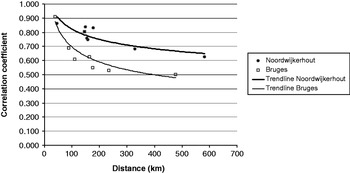
Commodity markets were also well integrated. Admittedly, on a regional level it is not surprising to find that grain prices in the late Middle Ages moved in concert; this was common enough.Footnote 82 However, an analysis of grain price movements in the early fifteenth century suggests that Holland stood out compared with commodity markets abroad. Figure 1 relates the correlations between wheat prices in Noordwijkerhout, near Leiden, and prices in eight locations in the southern Low Countries, the eastern Low Countries, and England to the distance from Noordwijkerhout to each of these locations. It does the same for wheat prices in Bruges, in Flanders. Extending the comparison with East Anglia is unfortunately not possible. Reliable fifteenth-century grain price series for this region are not available and the well-known London grain price series may not be representative, since – in contrast to some of the ports in Suffolk and especially to King's Lynn in Norfolk – London did not have a significant grain trade with the continent in normal years.Footnote 83
Correlation coefficients of logs of annual average wheat prices in Noordwijkerhout (in grams of silver per hectolitre) with prices in Bruges, Ghent, Brussels, Louvain, Utrecht, Maastricht, London and Exeter, related to the distance from Noordwijkerhout to each of these locations, 1410/1411–1439/1440, compared with identically calculated correlation coefficients of wheat prices in Bruges with prices in the eight other locations. (Based on: Jessica Dijkman, Shaping medieval markets. The organisation of commodity markets in Holland, C. 1200 – C. 1450 (Leiden, 2011), 108–58.)

The analysis of grain prices in Bruges and Noordwijkerhout in Figure 1 indicates the trend line for Noordwijkerhout lay at a higher level, suggesting that wheat markets in Holland were relatively well connected to markets abroad. The flatness of the line indicates that these markets were not only well integrated with foreign markets nearby, but also with others further away. The links with these foreign markets can, moreover, not only be observed in times of dearth, but also in normal years.Footnote 84
The driving force behind Holland's international grain trade was no doubt the demand for grains. However, if market structures had been less favourable, it is doubtful if it would have been possible to build up the same robust and far-flung international trade network.
In Holland wage differentials between town and countryside were small. In inland Flanders, nominal wages in the countryside were still close to the urban rates in the early fourteenth century. However, in the late fourteenth and fifteenth centuries urban wages were on average some 50–70 per cent higher than the rural ones, perhaps because it was in this period that urban and guild restrictions on immigration and entry into urban occupations became tighter, thus shielding off the urban labour market.Footnote 85 In Norfolk, too, urban–rural wage differentials were quite noticeable. In the late fifteenth century, wages were some 40 per cent higher for skilled and 60 per cent higher for unskilled labourers in urban areas compared with rural, and around the middle of the sixteenth century the latter differential had risen to 60–90 per cent.Footnote 86 In Holland, on the other hand, the urban–rural wage differences at the time were, and remained, very small, or were even absent altogether.Footnote 87 For the fourteenth century, this can still be attributed to the small size of the towns, but after the dramatic growth of Holland's towns in the fifteenth and sixteenth centuries, this was no longer the case, suggesting that the absence of institutional barriers was more important. Moreover, agricultural wages had to compete with the many other wage-earning opportunities for the mobile rural population, both in the countryside and in the towns. By 1500, Holland seems to have had a highly integrated labour market involving substantial seasonal migration of the rural work force in particular.Footnote 88
Furthermore, newcomers found the urban labour market highly accessible. Guilds developed very late in Holland and did not acquire the political role in urban government that their counterparts in Flanders had. Important towns such as Delft, Leiden, Haarlem, Alkmaar and Hoorn did not acquire guilds until the first half of the sixteenth century, in reaction to the competition of crafts and proto-industries from the countryside.Footnote 89 Even then, guild ordinances only mildly limited the right to set up rural crafts and sell on the urban market, and did not attempt to regulate the availability or the price of labour. Guild ordinances that contain rules for the employment of live-in apprentices and journeymen, let alone setting wages, are very rare before the late seventeenth century. Immigration was encouraged when labour ran short.
Theory predicts that favourable institutions reduce transaction costs. The indications of the impact of the institutional framework on market performance in Holland around 1500 show different results for the various types of markets. The performance of the lease market was probably less than in the other areas. On the other hand, at the end of the Middle Ages grain markets in Holland were well integrated with markets abroad, and market orientation in Holland was very high. Further, the labour market was much more mobile and flexible than in the other regions, and the capital market in Holland performed better than that in East Anglia, although differences between Holland and Flanders were probably much smaller. Of course, market performance was not exclusively determined by institutions, but these differences point to differences in the institutional framework. We can surmise, therefore, that in Holland markets for goods, and even more those for capital and labour, possessed a more favourable institutional framework than the other parts of western Europe. In trying to explain this, we will focus especially on the situation in Holland, leaving comparison with the other regions to future research.
5. A TENTATIVE EXPLANATION OF FAVOURABLE AND UNFAVOURABLE INSTITUTIONS
We suggest that the relatively favourable organisation of markets in Holland can be understood mainly from the absence of a feudal past and the social structures that developed during the medieval period. This, as has been suggested by other authors, was vital to the economic development of Holland,Footnote 90 but so far the implications for the institutional framework have remained intuitive at best. Our research now shows how in this social context the foundations were laid for institutions which favoured market efficiency, thus providing a basis for accelerated specialisation and commercialisation when, at the end of the fourteenth century, a drastic economic transformation became necessary as a result of ecological crisis.
5.1 Social developments
In the words of de Vries and van der Woude, Holland in the Middle Ages was no ‘society of orders, where each member held a legally fixed position assigned by birth’; barriers against social mobility were absent, encouraging innovation and initiative.Footnote 91 The origins of Holland's weak feudal structures are to be found in the process of land reclamation in the high Middle Ages. When settlers started to reclaim the extensive peatlands covering most of Holland, from the tenth century onwards, the counts allowed them to create a society based on direct relations between ruler and subjects. The settler communities were incorporated into the fabric of the state. The settlers recognised the count's supreme authority, paid taxes and served in the count's army at his command, but were otherwise largely free to run their own affairs. They organised themselves in public bodies that took responsibility for taxation, public debt and public works. At the local level the count's authority was represented by an appointed functionary, the sheriff. Thus a layer of local public bodies was created, characterised by broad participation but also by a balance of power: representatives of the local elite had to collaborate with government agents.Footnote 92
Towns only gradually developed, especially in the thirteenth and fourteenth centuries. This was later than in neighbouring areas such as Flanders and the Rhineland, and when village communities and princely rule were already firmly established. The towns were numerous but small- or medium-sized; no large, dominant metropolis emerged. As a consequence, the thirteenth- and fourteenth-century counts were strong enough to prevent the towns from extending their jurisdiction over the countryside. In the fifteenth and sixteenth centuries resistance by local lords and village communities, and the competition between towns, helped to keep urban greed in check.Footnote 93 Moreover, rural organisations protected villages against urban ambitions, for instance by taking sides with local lords and filing legal procedures. As a result, unlike elsewhere, villages managed to at least retain their level of public services and their self-organisation.Footnote 94
5.2 Ecology
The process of land reclamation mentioned above had another crucial effect in the long run. As the reclaimed peatland in Holland slowly started to sink and became ever wetter, some of the peasants gave up agriculture and migrated to the towns, causing urbanisation to increase and urban industries to expand. The remaining peasants adapted to the new conditions: they gave up the cultivation of bread grains, which grew during winter when water tables were highest, and switched to summer grains and livestock farming. They sold their output on the market; growing urban markets no doubt contributed to the success of this agricultural transition.Footnote 95 This favourable turn of events is certainly not self-evident: an ecological disaster on this scale could easily have led to a general depopulation. That this did not happen – in fact by the year 1400 the population of Holland was almost back to pre-Plague levels – demonstrates the influence of pre-existing institutional arrangements: clear property rights and open and transparent factor and commodity markets discouraged squeezing, stimulated a positive interaction between town and countryside and allowed Holland's economy to adapt swiftly to the changing circumstances.
A combination of ecological crisis, ample transport opportunities offered by the many waterways, and favourable market organisation, all suited the commercialisation and specialisation of the economy and the emergence of proto-industrial activities in Holland's countryside.Footnote 96 Thus, in the second half of the fourteenth century Holland witnessed a transition to a heavily commercialised economy, with little to no subsistence farming left. Its population had to market butter, cheese, peat, bricks and other proto-industrial products to earn the money they required to buy grain that was imported from northern France and later from the Baltic. The switch to labour-extensive livestock farming also provided an impetus for labour markets: a large part of the rural population had to look for additional employment, either in towns or as day labourers in rural proto-industries. Finally, capital markets may have received a boost when entrepreneurs started to seek funding to set up proto-industries.Footnote 97
It is important to note that in both the urban and rural areas of Holland the tertiary sector developed rapidly. In 1514, only 25 per cent of labour in Holland was active in agriculture, supplying less than 20 per cent of gross domestic product (GDP). If fishing and peat digging are included, the primary sector still involved no more than 39 per cent of labour, generating only 31 per cent of GDP. Industry accounted for 38 per cent of the labour force and 39 per cent of GDP, and services for 22 per cent and 30 per cent, respectively.Footnote 98 A very large share of the region's population was active in shipping and other transport services, retail, wholesale trade, measurement, or administration, whether in town or countryside. The exceptional importance of the service sector in Holland was in part forced by the ecological disaster, but it was also enabled by the flexible organisation of the labour and capital markets, and in its turn further stimulated these markets. This positive feedback cycle perhaps explains exactly why these markets developed so favourably in Holland. It perhaps also explains why the lease market in Holland lagged behind. Since this market was related to the relatively unimportant agricultural sector, and not to the services sector, it was not part of this positive interaction between economy, market development and institutions. Moreover, the society of free peasants that emerged during this period was hostile to limited rights to the land and remained so up to the sixteenth century. Only then, as peasant landownership was bought up by wealthy urban investors, did this start to change. The absence of feudal power, the strength of horizontal associations and communities, the broad participation and the fragmentation of power all went back to the high Middle Ages and made their impact felt during the following centuries. As a result, except for the lease market, no social group in late medieval Holland was able to bend institutions to their own interests, not even in reaction to the catastrophes of the Black Death and the subsidence of the soil.
This situation did not last, however. From the end of the sixteenth century, this social balance was eroded in Holland. In the towns both income and wealth inequality increased markedly between the middle of the sixteenth and the middle of the seventeenth century.Footnote 99 This process was even more pronounced in the metropolis of Amsterdam.Footnote 100 Simultaneously urban governments and patriciates became increasingly closed, and barriers to citizenship were raised.Footnote 101 Social polarisation was also found in landownership. In the sixteenth and seventeenth centuries the small-scale peasant properties, so characteristic of Holland's countryside, were consolidated into larger holdings by wealthy burgher–investors.Footnote 102 The newly reclaimed polders, in particular, became the exclusive domain of patricians from the large towns and both material and political inequality thus increased.
It can be speculated that the elite of merchant–entrepreneurs in the Holland towns, and especially in Amsterdam, used this economic and political power to freeze or adapt market institutions to their own interests. This can be observed in commodity market regimes. In the sixteenth century urban resistance to rural trade increased. For example, in 1515, the towns began pressuring the Habsburg government into banning rural trades and industries; 16 years later, in 1531, Charles V issued an ordinance to this effect. To be sure, existing activities were usually left in peace, so the towns' victory was far from complete. Still, there can be no doubt that urban policy towards rural commerce became increasingly restrictive.Footnote 103 Further research is necessary in order to assess whether this is representative of a more general development, and if the institutional framework in Holland did indeed become less favourable in the late sixteenth and seventeenth centuries.
6. FINAL OBSERVATIONS
Explaining the development of institutions and assessing their effects are never easy tasks. The limited number of indicators for market efficiency on which we focus does not solve all methodological problems, but we believe that this approach allows institutional theory and empirical data to be better linked, contributing to a better understanding of pre-modern economic development.
Our research shows, first, that in the late Middle Ages Holland did possess a favourable institutional organisation of markets for labour and capital, even compared with other advanced regions such as Flanders and East Anglia: labour and capital markets in Holland were secure, open and flexible. Differences with respect to the commodity market were smaller, since this market had highly adaptive institutions that were introduced in all three regions. Holland's lease market does not compare favourably with those in the surrounding regions.
Second, our findings confirm that the organisation of markets is not the automatic expression of a natural human drive to trade or make a profit. On the contrary, it is the result of very specific social conditions. Differences in these conditions result in markedly different organisational arrangements, even between regions situated close to each other. Holland's favourable institutional framework was rooted in the period of land reclamation and occupation. In the high Middle Ages Holland was colonised by free peasants under a territorial lord, creating a situation of exceptional freedom and a near-absence of non-economic force, with the nobility gaining only a weak position, in contrast to most other parts of western Europe. This allowed various other groups to organise themselves and acquire a role in political decision-making. The resulting balance of power precluded dominance by way of non-economic power, provided a check on rent-seeking, and ensured a positive role of the authorities in the shaping of market institutions.
Finally, the research shows that, in agreement with North's theories, institutions did indeed contribute to Holland's rapid commercialisation in the late Middle Ages. It should be added that the institutional framework was not the only cause; non-institutional factors, such as ecological problems that made the cultivation of bread grain almost impossible, and the favourable geographical location of Holland, played a part as well. However, favourable institutions facilitated an adequate response to opportunities, ecological threats and external changes, thus allowing for a strong rise of markets and excellent market performance. The effect was reinforced by the strong interaction between the various markets. In particular, the emergence of a well-functioning capital market enabled and reinforced the rise of land and labour markets. The resulting feedback cycle in Holland was positive, speeding up the growth of markets. In its turn this situation interacted with the real economy, and especially with the rise of the tertiary sector, which benefited from the favourable capital and labour markets, and probably stimulated their further development. By demonstrating the important role of institutions, this research thus reveals, at least in part, the roots of the Golden Age of Holland and the path-dependent process that preceded it. However, we cannot rule out the possibility that the favourable development of the organisation of markets was in part the result of growth of markets and the economy, instead of the cause. The debate about the causality is largely unresolved as yet; at present the best guess is that the two processes interacted in a positive way. However, such a positive interaction between institutional organisation and economic growth did not persist forever, as shown by the negative changes in Holland from the late sixteenth century on. Perhaps in an earlier period the same applied to East Anglia, where positive developments in the twelfth and thirteenth century were not fully sustained in the following period. The present investigation was not able to clarify these issues, as it was hampered by its limitation to the period after 1300, but future research perhaps will.
However limited this investigation may have been, it has illuminated at least some institutional mechanisms in long-term development. In many economies the institutional organisation of exchange played, and still plays, a negative role, limiting or blocking economic growth. This research shows how difficult it is to break or change this institutional organisation, since these institutions are hardly the result of rational economic or social decision-making, but rather of existing social relations, the balance of power, custom and vested interests. The case of Holland also suggests that even in instances where market institutions had favoured economic growth these tend to petrify and become detrimental if too much economic and political power is concentrated in the hands of a single group in society. This insight is important today, both for development economics and in the western world.
ACKNOWLEDGEMENTS
We thank Bruce Campbell, Phil Hoffman, Maarten Prak, Jean-Laurent Rosenthal and the participants at the Economic and Social History seminar at Utrecht University for their comments on an earlier version of this paper.