INTRODUCTION
The public reason criterion is a prominent theme in contemporary political theory. Debates center on the extent to which, in pluralist societies where free citizens hold a variety of incompatible belief systems (or what Rawls (Reference Rawls1971) termed “irreconcilable comprehensive doctrines”) actors engaging in political deliberation are morally obliged to adopt a secular form of discourse. Supporters of this criterion claim that comprehensive doctrines such as political ideologies and religious worldviews are fully intelligible only to their adherents, and that the use of public reason fulfills basic principles of justice and legitimacy by ensuring that the laws and policies that citizens are compelled to follow are rendered explicable in terms that all can understand (also see Rawls Reference Rawls1997).
Scholars debate the extent to which the criterion should be applied. While Rawls believed that the requirement ought to be limited to fundamental political issues, applicable to legislative decisions, judicial reasoning, the executive branch and candidates for public office (also see Habermas Reference Habermas2006), others have taken a different approach. Rorty (Reference Rorty2003), for example, maintained that citizens should not be prohibited from using arguments derived from religious doctrines in public life, but should nevertheless try to limit them as much as possible. Quong (Reference Quong2004) more assertively claims that the use of public reason should be mandated for political deliberation in all arenas where citizens are able to exert political power over each other, and Audi (Reference Audi1993; Reference Audi2000) contends that the criterion should apply to the underlying motivations for a decision as well as the justifications that are subsequently provided (also see Sajo Reference Sajo2009; Laborde Reference Laborde, D'Costa, Evans, Modood and Rivers2013; Ciszewski Reference Ciszewski2016).
Critics of the public reason criterion raise several objections. One is that the boundary between the public and the private spheres cannot be defined with precision, not least since many agencies and associations (particularly religious groups) operate at the intersection between the two (e.g., Bader Reference Bader, Levey and Modood2009). Another claim is that the public reason criterion is reductive, limiting, and ultimately contradictory, being unable to provide meaningful answers to social questions without drawing on the kind of religious or metaphysical claims that it rejects. Critics also maintain that excluding religious arguments from public deliberation is illiberal and undemocratic, evinces a clear bias toward anti-religious viewpoints (Kelly and McPherson Reference Kelly and McPherson2001; Perry Reference Perry2001; Maclure Reference Maclure2006) and forces religious citizens to act inauthentically, requiring them to set their real motivations aside when engaging in matters of public discourse (see Connolly Reference Connolly2000; Stepan Reference Stepan2000; Asad Reference Asad2003; Calhoun Reference Calhoun2008; Wolterstorff Reference Wolterstorff2010).
The parameters of these debates are well established, but problematic. One reason for this is that scholars have centered overwhelmingly on the conceptual and normative considerations involved in the use of public reason and have devoted considerably less attention to empirical questions about the kinds of language that actors choose to deploy. This is a particular problem in the case of religious actors, who are frequently involved in matters of public debate, given that their motivation for taking part in such debates are often driven by theological concerns. A small number of studies have highlighted a preference for public reason as opposed to theological arguments on the part of religious actors, suggesting that this may be a form of strategic accommodation to operating in a largely secularized social context (e.g., Jelen Reference Jelen2005; Hunt Reference Hunt2007; Reference Hunt2014; Kettell Reference Kettell2013). This paper contributes directly to this literature by examining the public discourse of religious actors taking part in debates about assisted dying in Britain. This is a timely and revealing subject for analysis. Religious adherence in Britain is in a state of progressive decline but religious actors have been at the forefront of resistance to changing the law in this area. Strong links exist between higher levels of religiosity and more conservative attitudes toward assisted dying, indicating that religious opposition is driven by theological concerns (Hamil-Luker and Smith Reference Hamil-Luker and Smith1998; Burdette et al. Reference Burdette, Hill and Moulton2005; Sikora Reference Sikora2009; Sharp et al. Reference Sharp, Carr and Macdonald2012; Sharp Reference Sharp2016). Evidence of religious actors adhering to a public reason criterion, then, could support claims of strategic adjustment.
At the present time assisted dying is only legal in a small number of countries: Switzerland (being decriminalized in 1941), the Netherlands and Belgium (since 2002), Luxembourg (since 2008), Canada (in 2016), and parts of the United States—namely, Oregon (from 1994), Washington (2009), Montana (2009), and Vermont (2013).Footnote 1 While British public opinion (including that of most religious citizens, see Clements Reference Clements2014) has been firmly in favor of legalization for several decades (British Social Attitudes 2017),Footnote 2 attempts to change the law have thus far been unsuccessful.Footnote 3 A steady stream of legal challenges brought by individuals with terminal and/or debilitating and incurable illnesses has yet to succeed, and Parliamentary campaigns have failed to secure legislative change. Since the turn of the century a series of Private Members Bills have been voted down in the House of Lords, and a more recent Bill was defeated in the House of Commons (by 330 votes to 118) in September 2015. Attempts to legalize assisted dying in Scotland (where the issue is devolved to the Scottish Parliament) have seen Bills voted down in 2010 (by 85 votes to 16) and 2015 (by 82 to 36).
To assess the extent to which religious actors have adhered to a public reason criterion in debates on assisted dying, the study conducted a qualitative, content analysis of public statements made on this issue.Footnote 4 This material was gathered using a series of extensive web-based searches centering on the Westminster and Scottish Parliaments, webpages belonging to Britain's main, national-level religious organizations, and national media sources via the LexisNexis database. These materials included transcripts of parliamentary debates, evidence given to official consultations, news reports, speeches, and press releases as well as campaign and briefing materials published by the various actors involved.
The analysis confronted several dilemmas. One immediate problem centered on the availability of documentary material. Not all religious groups were equally diligent in maintaining their digital archives, resulting in significant gaps and omissions in the empirical record. Where these were identified, the research was supplemented with the use of the internet archive (The Wayback Machine),Footnote 5 through which much of the missing material was subsequently recovered. A second dilemma involved devising a meaningful coding system. The criteria for a “religious” argument are by no means obvious and the concept of religion is one on which there is no consensus. Audi (Reference Audi1993; Reference Audi2000) maintains that an argument can be considered religious if it meets one or more of the following criteria: overtly referring to divine commands or appeals to scripture, containing premises and/or conclusions that depend on religious considerations, being motivated by a desire to achieve a religious objective or being genetically linked to another argument or proposition that is defined as religious. Following this framework, the study classified an argument as being religious if it was predominantly constructed using religious themes, concepts, assertions, propositions, or language. This considered, for example, whether justifications invoked scriptural injunctions (such as the Ten Commandments), divine commands (such as references to “sin” or God's will), or subtler but still theologically derived references to notions of the “sacred” or the “sanctity of life.”
Researchers using content analysis sometimes avoid using preconceived coding structures, preferring to allow the relevant classifications to emerge from the data in an inductive manner (see Herrera and Braumoeller Reference Herrera and Braumoeller2004; Hsieh and Shannon Reference Hsieh and Shannon2005). Because this study was interested more in the extent to which religious actors conformed to the public reason criterion than with the minutiae of their discourse, the research took a more directed approach. Being mindful of the risks of producing coding categories that were excessively narrow and fine-grained, the analysis sorted the material according to a threefold system of classification.
Theological: This was where religious arguments were adjudged to be the sole or dominant justification, or where they played the leading role alongside (more subordinate) public reason arguments. In this category there were two principal types of theological argument used by religious actors to oppose assisted dying: that killing is prohibited by religious injunction, and that life is a gift from God and hence not something that individuals are free to dispense with.
Non-theological: Public reason arguments were the sole or dominant justification, with theological arguments being absent or playing a minor role. The key public reason claims in this category included the view that the legalization of assisted dying would leave vulnerable groups of people (such as the elderly, the infirm and the disabled) at risk, that it would create pressures to expand the right to die to an ever-wider range of cases, that the legal terminology involved was often ambiguous, that medical prognoses were necessarily imperfect and that legalization would undermine trust between doctors and patients.
Qualified theological: Public reason arguments were the primary mode of justification, but theological arguments also had a significant role. An example of this category (described by Audi (Reference Audi2000) as “mixed” religious discourse) is a statement that includes a theological theme (such as the sanctity of life) but devotes most of its time to public reason arguments (such as the need to protect vulnerable citizens).
The results of this analysis suggest that religious actors engaged in the debate over assisted dying in Britain have largely adhered to the public reason criterion. For the most part, theological justifications have been downplayed or treated in vague and ambiguous fashion. The following sections explore these issues in more detail.
ASSISTED DYING IN SCOTLAND
The Scottish debate on assisted dying centered on attempts to secure legalization through the Scottish Parliament. Position statements were set out during a public consultation on legislative proposals and interested parties were also asked to set out their thoughts in a written submission.Footnote 6 The views expressed via these processes were often reported in the Scottish media, feeding into the wider public discussion of these issues (for example see Sunday Herald 2010; Herald 2015b; Scotsman 2015).
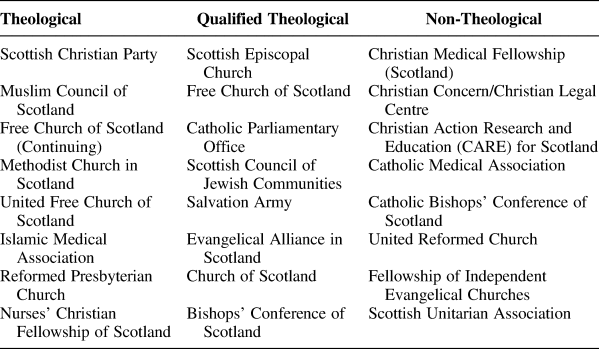
According to the website of the Scottish Parliament, a total of 24 national religious organizations submitted written evidence opposed to assisted dying. These groups were equally split between the coding categories. Eight groups based their case on overtly theological arguments, eight presented arguments based on qualified theological statements and eight adhered to the public reason criterion. One of the main campaign groups opposed to legalization, Care Not Killing, was spearheaded by prominent religious figures—Peter Saunders (head of the Christian Medical Fellowship) and Gordon Macdonald (parliamentary officer for Christian Action Research and Education)—but presented itself as a non-religious alliance and was not therefore included in the analysis. The coding of the religious actors engaged in the debate is set out in Table 1, below.
Religious Public Discourse in Scotland

Although it was later claimed that most opposition to assisted dying had been based “on theistic grounds” (Rostant-Bell Reference Rostant-Bell2014), a closer reading of the arguments made by religious actors shows that groups using overtly theological claims tended to be small and relatively peripheral. These included the Islamic Medical Association (2012), which asserted that: “the end of any human's life is FIXED only by our Almighty GOD” and that assisted suicide was “FORBIDDEN IN ISLAM,” and the Muslim Council of Scotland (2012), which maintained that: “Life is the greatest gift from God and to tamper with it or interfere to end it is the most serious sin.” A number of smaller Christian groups also made strong theological claims. The Free Church of Scotland (2012, also see 2015a and 2015b) declared that “human beings are made in God's image … this prohibits the deliberate ending of a human life, including one's own.” The Reformed Presbyterian Church of Scotland (2012) claimed that legalization would challenge “the sovereignty of God over all life and of his right to determine the boundaries of each life.”
Many other religious actors, particularly the larger and more mainstream organizations, were far more qualified in their use of theological statements. Representations made by the United Reformed Church (2012), the Fellowship of Independent Evangelical Churches (2012), and Christian Action Research and Education (CARE) for Scotland (2012 and 2015) contained no theological arguments at all (although supplementary written evidence submitted by CARE in 2015 made a strong theological case). Evidence submitted by the Scottish Episcopal Church (2012a; 2012b; 2014) made reference to theological justifications (describing life as a “creation by God” and “a gift which is in our care”) but did not elaborate beyond this general view. Oral evidence from Harriet Harris, convener of the Church's Doctrine Committee, was based solely on arguments using public reason (Scottish Episcopal Church 2015). The Evangelical Alliance in Scotland (part of the largest umbrella group for evangelical Christians in Britain) responded to the public consultation with a position statement “founded upon our faith as Christians” (namely, that: “Life and the right to life is a gift from God which should only be given and taken by him”), but made no theological claims at all in their more detailed written submission (Evangelical Alliance in Scotland 2012a; 2012b).
In a similar fashion, the Church of Scotland (the single largest religious organization in the country) deployed a qualified theological argument in its response to the public consultation, referring to “the absolute sanctity of all human life,” but made no theological claims in its written submission (Church of Scotland 2012a; 2012b). A supplementary report by its Church of Scotland (2010) also relied on public reason arguments (barring a solitary reference to “the sanctity of life”), and Sally Foster-Fulton, the convenor of the Council, made just one theological reference in her oral evidence, claiming that human life was “sacred” (Foster-Fulton Reference Foster-Fulton2015). Further evidence submitted by the Church in 2015 merely noted that care had a “spiritual” dimension (Church of Scotland, 2015).
The pattern was repeated in a series of Church reports on assisted dying. An initial document published in 1995 relied on strong theological arguments, but an updated version in 2008 set out a more qualified theological stance, referencing notions of life being a “gift from God” but centering mostly on public reason claims. A further report in 2009 contained a mixture of arguments (noting that assisted dying “would be against God's commandments and would be an attack on the sovereignty of God”) but, again, focused primarily on public reason justifications.Footnote 7
The view of the Roman Catholic Church (the second largest religious organization in Scotland) was similarly restrained. The Catholic Parliamentary Office (2012) maintained that human life was a “creation by God” and a “gift which is not in our care” but embedded these claims within a range of public reason arguments. The Catholic Medical Association (2012) made no theological arguments in its public consultation response, and neither did the Catholic Bishops’ Conference of Scotland (2012; 2015a). Public statements by John Deighan (the parliamentary officer for the Conference) also avoided the use of theological concerns (e.g., Scottish Catholic Observer 2012; the Herald 2015a), as did his oral evidence to the Scottish Parliament, in which he stated that the Church's objection to assisted suicide was “not just about faith; it is about a natural instinct in every human being and therefore every human society” (Catholic Bishops’ Conference of Scotland 2015b).
These discursive characteristics were reflected in statements made by religious actors in the national media. The qualified theological stance of the Free Church was expressed by Rev Donald MacDonald, who made a range of media interventions mixing public reason arguments (e.g., Scotsman 2013a; 2013b) with strong theological claims (for instance, that: “reverence for human life, as made in God's image, must be our starting point,” Scotsman 2012). In contrast, statements by Sally Foster-Fulton from the Church of Scotland avoided overt theological claims (noting merely that care was “spiritual as well as physical”) and centered on public reason justifications (e.g., Edinburgh Evening News 2015), referring to “the societal prohibition on the taking of human life” and emphasizing that: “Much of our opposition to assisted-dying legislation is motivated by a concern for the weakest and most vulnerable in our society” (Scottish Daily Mail 2015).
Representatives of the Catholic Church—despite acknowledging the religious underpinnings of their opposition to assisted dying (Herald 2011)—were also keen to deploy arguments based on public reason, warning, for example, that requests to die might reflect a state of temporary psychological distress (Herald 2013), and that legalization would “cross a moral boundary that no society should ever breach” (Scotsman 2010).
ASSISTED DYING IN ENGLAND AND WALES
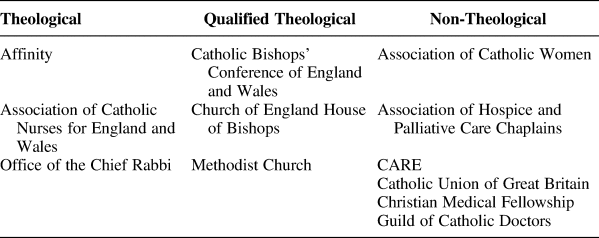
The public discourse of religious actors in England and Wales followed the dynamics of the Scottish arena, with overtly theological claims being largely downplayed in favor of arguments grounded in public reason. A useful snapshot of opinion here is provided by evidence submitted to a Select Committee inquiry into assisted dying conducted by the House of Lords in 2004. A total of 12 national-level religious organizations gave evidence to the inquiry. Of these: three deployed strongly theological arguments, three were classed as qualified theological, and six groups adhered to the public reason criterion. These positions are set out in Table 2.
Evidence to the House of Lords, 2004

As in the Scottish case, groups using theological arguments tended to be smaller and more peripheral. Affinity (formerly the British Evangelical Council) made a strongly theological case filled with scriptural references, claiming that: “All human beings are made in the image of God … Therefore, to choose, or engineer, or bring about death … without divine sanction, is to usurp God's prerogative” (Affinity 2004). The Association of Catholic Nurses for England and Wales (2004) similarly maintained that: “life is given to us by God and … only God has the right to take that life away.” The Office of the Chief Rabbi (2005) stated that in the Jewish tradition life was “a precious gift from God, not something we can dispose of at will.”
Most religious actors elected to downplay or avoid theological claims. CARE (2004) made their case against assisted dying using public reason alone. So too did the Association of Hospice and Palliative Care Chaplains (2004) as well as the Association of Catholic Women (2004), the latter adding that respect for human life was not “an exclusively Catholic, Christian or even religious concept.” A joint submission by the Catholic Union of Great Britain and the Guild of Catholic Doctors (2004) referred to “the sanctity of life” but made no theological developments beyond this. The Christian Medical Fellowship (2004), one of the leading religious organizations opposed to the legalization of assisted dying, made no theological points beyond a vague reference to “the Judeo-Christian tradition” of compassion and relied solely on arguments using public reason.
The two main national churches in England and Wales—the Church of England and the Roman Catholic Church—used a qualified theological discourse. A joint submission from the Church of England/Catholic Bishops’ Conference of England and Wales (2004) explained that their opposition to assisted dying was borne “of our belief that God himself has given to humankind the gift of life,” but made no elaboration on this general theological point before turning to a range of public reason arguments (adding that Christian beliefs about the special nature of human life were “also shared in whole or in part by many people of all faiths and none”). Church representatives highlighted this more inclusive character of their discourse in oral evidence to the Committee. Professor Gill (representing the Archbishop of Canterbury and the House of Bishops) maintained that life was “God given” but added that “to secular people, life is still given” and that the debate was “not simply a religious versus non-religious issue” (Gill Reference Gill2005). The Bishop of Plymouth (2005), representing the Archbishop of Westminster and the Catholic Bishops’ Conference, stated that his opposition was “rooted in my faith in God” but emphasized that the issues around assisted dying “touch all human beings without exception, irrespective of faith or lack of faith” (also see Catholic Bishop's Conference of England and Wales 2005).
These discursive themes were repeated in subsequent years. Strong theological claims were periodically advanced but most religious groups tended to adhere to the public reason criterion in justifying their opposition. Theological claims were used, for instance, by the Chief Rabbi of the United Hebrew Congregations of the Commonwealth, Ephraim Mirvis, who in 2014 wrote in the Telegraph (2014b) that: “There is no greater value in Judaism than the sanctity of life … It is a gift from God and it is not ours to cut short.” The Independent Methodist Churches (2011) told the Commission on Assisted Dying (a body set up by Lord Falconer as part of his attempts to secure legislative change) that: “Many Christians view life as a gift from God, and the taking of life as taking what belongs to God.” But for the most part, such theological arguments were downplayed. Press releases from the Christian Institute (one of the most high-profile Christian cause groups in Britain) were notable for their use of public reason arguments. From a total of 183 press releases on assisted dying between January 2013 (the earliest date available) and the end of January 2018, just 16 (a total of 8.7%) contained theological forms of reasoning. In contrast, public reason arguments were present in a total of 93 press releases (or 50.8% of the total).Footnote 8
The Church of England also focused on arguments using public reason. An analysis of all speeches, sermons, articles and interviews made by the Archbishop of Canterbury, Rowan Williams, between 2002 and September 2015 (when the House of Commons last rejected proposals to legalize assisted dying) found a clear desire to avoid overtly theological claims. A high-profile address to the General Synod for example, centered on public reason arguments, claiming that to endorse assisted dying would be “to enter some very dangerous territory in practical terms,” and reserved theological elements for other parts of the address (Williams Reference Williams2010). In a prominent paper for the Times (2005) the Archbishop explained that his opposition to assisted dying was religiously derived (from a life lived “in relation to God”) but stated that there were “other factors at work in this argument.” Contributions from his successor, Justin Welby, writing in the Times (2014a) and the Evening Standard (2015) centered wholly on public reason arguments. In a piece for the Observer (2015) the Archbishop maintained that faith leaders were not trying “to push the religious viewpoint on others” but were driven by concerns that assisted dying would have adverse social and individual effects. The Church of England's (2012b) response to a consultation on the legalization of assisted dying also adopted a qualified theological stance, emphasizing a religious ethos “drawing on the witness of the Christian Scriptures” but presenting the majority of its case using public reason arguments and stressing that such views “can be acknowledged by those of other faiths or none” (also see 2012a).
The limited use of theological arguments was also evident in public statements from other leading Church figures. An intervention by the Archbishop of York, John Sentamu, in the Telegraph (2012b), attempted to reframe the terms of the debate around a notion of “dying well,” but despite references to Jesus and the Book of Common Prayer made a case that was more attuned to the language of secular moral philosophy that theology (claiming, for example, that death “should be a natural extension of how we are in life”). Likewise, a public intervention by Bishop Michael Nazir-Ali (in a direct response to the ex-Archbishop of Canterbury, Lord Carey, who drew on theological arguments to mount a high-profile intervention in support of legalization during the run-up to a House of Commons vote in July 2014) also made limited theological points, referring to “Christian teaching on the value of the human person” but focusing principally on public reason arguments, such as the claim that assisted dying would lead “to a widening of the provision beyond the terminally ill to those who are disabled, depressed or just tired of life” (Telegraph 2014a). Statements and press comments from James Newcome, the Church of England's lead Bishop on the issue of health care, were even more notable for their emphasis on public reason arguments. Amongst these was the view that: “Our concern about this proposed legislation is rooted in our practical care for the most vulnerable in our society” (Huffington Post 2015; also see Telegraph 2012a; Times 2015).
Contributions from Anglican Bishops in the House of Lords made the same series of points. With the exception of the Archbishop of Canterbury referring to “the sanctity of life” during a debate in May 2006, and the Lord Bishop of Carlisle describing “the theology of compassion” in July 2014, episcopal interventions in debates on assisted dying (the most notable of which were held in July 2014, November 2014 and January 2015) again centered on arguments grounded in public reason.Footnote 9
The public discourse of the Catholic Church was also characterized by the limited use of theological arguments. A statement by the Catholic Bishop's Conference of England and Wales (2014) claimed simply that: “Everyone, not least Christians, must have a particular concern for the weakest and most vulnerable members of our society.” Church statements also drew on research conducted by the Anscombe Bioethics Centre in Oxford, an organization that describes itself as “a Roman Catholic academic institute,”Footnote 10 but which consistently framed its case against assisted dying in public reason terms. This included a series of resources and reports highlighting a range of secular arguments, drawing on empirical evidence collected from Parliamentary reports and official statistics from countries where assisted dying was legal. Amongst the key assertions made here included the claim that legalization had led to the routinization of the practice, and that public opinion surveys showing support for assisted dying were based on “hypothetical and abstracted scenarios” and were really a call for better palliative care (Anscombe Bioethics Centre 2014; 2015).
This emphasis on public reason was also evident in a range of joint statements issued by religious actors. A letter to the Times ahead of a House of Lords debate on assisted dying in May 2006 (signed by the Archbishop of Canterbury, the Archbishop of Westminster and the Chief Rabbi of the United Hebrew Congregations of the Commonwealth) presented a qualified theological position, stating: “We believe that all human life is sacred and God-given with a value that is inherent, not conditional,” before moving on to a range of public reason arguments, including concerns about the impact on “society's most vulnerable … the elderly, lonely, sick or distressed” (Times 2006). A joint statement issued in June 2009 relied on the same justifications, claiming that legalization “would surely put vulnerable people at serious risk” (Telegraph 2009). In September 2015 a letter to MPs signed by 24 faith leaders ahead of a House of Commons vote on assisted dying (with signatories including the Archbishops of Canterbury, Westminster and Wales, representatives from the Coptic Orthodox Church, CARE, the Evangelical Alliance, the Methodist Conference, the Chief Rabbi of the United Hebrew Congregations of the Commonwealth, the Muslim Council of Britain, and Sikh Organizations UK) centered overwhelmingly on public reason arguments, limiting their theological claim to a single vague proposition that: “our concern is rooted in a profoundly human and profoundly sacred calling to care for the most vulnerable in our society.”Footnote 11
A STRATEGIC SHIFT?
This downplaying of theological claims and an emphasis on arguments grounded in public reason seems to mark a divergence from historical practice. While more research would be required to establish the precise timing and nature of any such change, it is worth observing that it was not uncommon for Christian leaders engaging in debates on this topic (as well as other moral issues) throughout the 20th century to invoke theological themes (also see Machin Reference Machin1998; Kettell Reference Kettell2018). Speaking in a House of Lords debate on legalizing voluntary euthanasia in December 1936, for example, the Archbishop of Canterbury noted that opponents of legalization frequently asserted “that pain and the duration of pain must be accepted as of Divine appointment or as a means of moral and spiritual discipline which no man may rightfully decline” (Hansard, House of Lords Debates, 1/12/1936, Col. 488), and the Lord Bishop of Norwich declared his opposition on the basis that we could not know what happens after death, since: “There is only One who ever came back from that ‘bourn from which no traveller returns’” (ibid., 1/12/1936, Col. 498). Speaking in a debate on the Voluntary Euthanasia Bill in March 1969, the Lord Bishop of Durham told the Lords that while there was “no one Christian view on voluntary euthanasia … on this issue all Christians will, I think, share with all others a respect for human life … And then, as Christians, they will be guided by the work of Christ in healing and relieving distress” (ibid., 25/3/69, Cols. 1179–1180). More forcefully, the Lord Bishop of Exeter stated that:
the overwhelming weight of Christian tradition over centuries is against both suicide and assisted suicide … This principle … rests upon a conviction of the sanctity of human life … we should move, with the most extreme caution, when we attempt to make an inroad into a principle which has been upheld by the Christian churches and the Christian religion for centuries’ (ibid., 25/3/1969, Col. 1242).
A public discourse drawing on theological justifications was also evident in comments made by the Lord Bishop of Norwich during a debate on the Incurable Patients Bill in February 1976, in which he stated that: “I believe there is a sense in which life comes from God and goes to God and … human life is sacred” (ibid., 12/2/1969, Cols. 268–9), and again, in a debate on euthanasia in January 1985, during which he spoke of “the Church's concern for the sanctity of human life, which is at the very heart of the Judaeo-Christian tradition of our country” (ibid., 23/1/1985, Cols. 220–21). Similar arguments were on display during a Lords debate on Terminally Ill Patients in November 1997, in which the Lord Bishop of Southwell outlined his rejection of euthanasia with reference to “the sanctity of life, given to us by God himself, and as such a gift to be revered and cherished” (ibid., 20/11/1997, Col. 726).
The emphasis given to public reason arguments by religious actors in more recent years is derived from a number of interrelated sources. One is that the use of public reason was facilitated by the wider balance of opinion on the issue of assisted dying. Since the question of legalization did not split cleanly along religious and secular lines, with a range of non-religious organizations (such as disability groups and medical professionals) also opposing the move, religious actors were able to help construct a broader coalition of interests and draw upon a range of common, non-theological arguments in presenting their case. Care Not Killing, one of the leading campaign groups opposed to assisted dying, effectively drew both religious and secular actors together in this way. This approach was combined with a sense that public reason justifications were compatible with the underlying theological motivations involved, enabling religious actors to focus their attention on the pragmatic consequences of legalization. Explaining this position, the Archbishop of Canterbury told Radio 4's Today Programme in May 2006 that if assisted dying was against God's purposes then “we would expect there to be quite a lot of practical difficulties.” The Archbishop of Westminster added that religious actors were “speaking not just for people of religious faith” but for “the common humanity and principles of a civilised society” (Today Programme 2006).
Another part of the explanation for the use of public reason justifications might be found in the progressive secularization of British society. According to surveys conducted by British Social Attitudes (2017) the proportion of the adult population describing themselves as “Christian” fell from 67% in 1983 to 41% by 2016, and while the proportion belonging to non-Christian faiths grew from 2 to 7% over the same period the numbers self-identifying with “no religion” increased from 31 to 53%. These findings are supported by a raft of additional surveys suggesting that secularizing trends run across every indicator of religiosity, including membership of religious organizations, attendance at a place of worship, personal beliefs in God and confidence in religious institutions (see Bruce Reference Bruce2013; Field Reference Field2014; Clements Reference Clements2015).
In such a context an emphasis on public reason arguments may be suggestive of a move toward a form of “strategic secularism.” This is described by Engelke (Reference Engelke2009) as a means by which religious actors seek to promote theological issues and policies by drawing on the tactics (namely: the language, methods, and tools) of secular culture. The potential benefits of such an approach are readily apparent, enabling religious actors to widen their appeal beyond the increasingly narrow strata of society that shares their theological views. As Chaplin (Reference Chaplin2008, 61–2), writing for the Christian think-tank, Theos, explains, since “[b]are appeals to a specific religious text or authority will rarely impress,” religious groups seeking to persuade public opinion, “won't lead with their religious convictions if they know this will instantly deprive them of all influence over an important and pressing matter of justice.”
These advantages were recognized by religious actors themselves. The Christian Medical Fellowship explicitly endorsed the use of public reason arguments, maintaining that, while opposition to assisted dying was derived from a belief “in the sanctity of human life made in the image of God … to win the debate on assisted dying we need to be using arguments that will make sense to those who do not share our Christian beliefs” (Christian Medical Fellowship 2006). The point was also made in guidance contained in a background paper issued by the Church of England. Explicitly highlighting the need for the Church to engage in public debate in a way that avoided theological entanglements, this guidance called for:
An engagement with society on the basis of defensible principles such as the affirmation of life, the care of the vulnerable, the creation of a cohesive and compassionate society and respect for individuals, without requiring agreement on the theological positions that underpin them (McCarthy Reference McCarthy2012).
The limits of theological persuasion extended to religious citizens too. A study conducted by Westminster Faith Debates in 2013 found that religious individuals considered arguments about the sanctity of life to be less persuasive than arguments that were based on public reason. While almost half (48%) of religious respondents cited sanctity of life claims as being persuasive, more than half (55%) believed that assisted dying put an excessive burden on the individual doing the assisting and 60% expressed concerns about the effects on the vulnerable (Times 2014b).
Nevertheless, while downplaying or avoiding theological arguments might offer religious actors a useful route for widening their appeal in a predominantly secularized society, there are good reasons to doubt the effectiveness of this approach. One potential problem is that, where policy positions appear to be shaped by religious motivations, the use of public reason as opposed to theological arguments could well create the suspicion that religious actors are concealing their true intentions, behaving inauthenticity to obtain political advantage. As Audi (Reference Audi1993) observes, public reason arguments deployed in such a context amount to “secular rationalisations that cloak the underlying religious motivation for seeking the legislation.” More bluntly, Sajo (Reference Sajo2009, 2424) describes their use as a straightforward “abuse of the argument.”
More seriously, rather than extending their political influence, religious actors adhering to a public reason criterion may unwittingly exacerbate the long-term challenges they face in terms of religious decline. By further diminishing the presence of religious discourse in the public sphere, an emphasis on public reason may contribute to a situation in which the use of theological language is seen as increasingly deviant, at odds with the discursive norms of a secularized society, feeding a wider impression of religious organizations as being peripheral, if not irrelevant to British social and cultural life. Moreover, by locking themselves in to the use of public reason arguments, religious actors also risk losing control of their internal narratives. While religious groups can plausibly claim a certain level of expertise in their own theological reasoning, an inculcation of public reason justifications (described by Thomas (Reference Thomas2014) as a process of “internal secularisation”) exposes them to changes in the underlying evidence base that can prove fatal to the credibility of their case. Opposition to assisted dying based on public reason would thus be diminished if public opinion surveys were to show persistent (or growing) support for legalization in the face of increasing investment in palliative care, if legal ambiguities were resolved, if medical professionals gave their support for a change in the law or if evidence from countries where assisted dying is legal demonstrated the provision of adequate safeguarding for vulnerable groups. For religious actors adhering to the public reason criterion, developments such as these would leave them with precious little room for further strategic maneuver.
These dilemmas have led some to protest about what they see as the increasing marginalization of religion in public life, and to call for a more vigorous assertion of theological language (e.g., Chaplin Reference Chaplin2008; Christians in Parliament 2012). It does not necessarily follow, however, that the difficulties presented here could be resolved by the greater use of theological justifications. With processes of secularization showing little sign of abating, and with the potential constituency for overt religious appeals continuing to decline, there seems to be little reason to assume that such an approach would be successful. Adherence to the public reason criterion might compound the long-term challenges that religious actors face, yet it appears to be their most effective means of shaping public affairs.
CONCLUSION
Political theorists debating the use of public reason have tended to focus on conceptual and normative principles at the expense of empirical questions about the language used by religious actors. This creates a substantial gap in our understanding of the way in which these actors engage with processes of political deliberation. This study makes a direct contribution to debates in this area by analyzing the public discourse of religious actors opposed to the legalization of assisted dying in Britain. The findings show that while opposition to legalization has been underpinned by theological motivations, religious actors have largely adhered to the public reason criterion. Overt religious arguments have tended to be the preserve of smaller, more peripheral groups, while larger and more influential bodies have downplayed or ignored theological claims in their public statements.
This discursive pattern is consistent with the notion that religious actors have made a strategic adaptation to the pressures of an increasingly secularized environment. In this case, adherence to the public reason criterion may signify an attempt at maximizing their appeal to a wider, non-religious audience. The implications of this development extend beyond debates concerning the use of public reason, engaging themes such as the politicization of religious identity and the role of religion in the public sphere. Further exploration of these themes could productively be developed in several ways. Comparative analyses of the public and the private language used by religious actors could consolidate claims of strategic adjustment should any substantive differences between the two be found (for example, contrasting the use of secular claims in public with theological messages to members of the group). Comparative studies into the public discourse of religious actors in different national contexts and across a range of public policy issues would also help to draw out the key factors underpinning the deployment of theological and secular claims, as well as their respective consequences. Research into the way that religious actors conceive of strategic change, and the extent to which accommodation to secular norms is seen as an opportunity or a source of external constraint would deepen our understanding of these issues still further. Answering empirical questions such as these should be the next step for scholars interested in the use of public reason.