The course of an infection with the hepatitis B virus (HBV) is co-determined by the interplay of the virus and the age-dependent host immune response. The distinct phases of a chronic infection are well documented (1). Immune active chronic hepatitis B (CHB) can be treated with nucleos(t)ide analogues (NAs) that suppress viral replication. The long-term aim of this treatment is to prevent liver cirrhosis and its complications as well as hepatocellular carcinoma (HCC). Because HBV frequently develops resistance, lamivudine is no longer considered an appropriate first line treatment. Tenofovir and entecavir were introduced more recently as first line treatment in Belgium, at an annual cost for the health insurance of €4,970 and €5,221 per patient, respectively. The long-term effects, safety and tolerability of entecavir and tenofovir are still unknown (1). For NAs in general, there are no long-term randomized controlled trials available showing an effect on disease progression and hard clinical end points (Reference Horsmans, Thiry and le Polain2). Especially the effect of NA treatment on the incidence of HBV-related HCC remains a topic of discussion (Reference Colombo3). Only one randomized controlled trial of lamivudine in patients with advanced fibrosis or cirrhosis reported HCC as an outcome.
We study the cost-effectiveness of tenofovir and entecavir antiviral treatment of CHB using a Markov model. This publication is based on an evaluation of CHB in Belgium and an economic analysis by the Belgian Healthcare Knowledge Centre, available as KCE reports no 127 (Reference Horsmans, Thiry and le Polain2) and no 157 (Reference Schwierz, Thiry and Van de Sande4). We extend the discussion with results obtained using a life-time perspective and confront our results with the literature.
MATERIALS AND METHODS
Analyses
The analysis is based on a static, probabilistic Markov model with bootstrapping programmed in Visual Basic (Microsoft Corporation, Redmond, WA). Calculations of quality of life data were done using SAS (Cary, NC). The estimates of transition probabilities from the non-cirrhotic to the cirrhotic states were obtained using STATA (StataCorp, College Station, TX). All other calculations were done in Microsoft Excel (Redmond, WA).
Disease States and Transitions
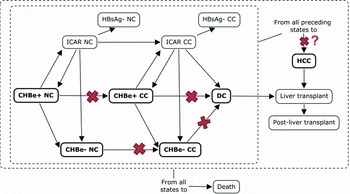
The Markov model is illustrated in Figure 1. Transition probabilities for the “no antiviral treatment” strategy are mainly based on the literature and expert opinion and are detailed in KCE report no 157 (Reference Schwierz, Thiry and Van de Sande4). In addition, we accessed unpublished data of 278 untreated Caucasian CHB patients with a mean follow-up of 7.8 years at Leuven University hospital. A detailed analysis of this cohort has been reported (Reference Schwierz, Thiry and Van de Sande4). This allowed us to compute age-specific transition probabilities for the development of cirrhosis in untreated CHBe+ and CHBe- patients, showing a major increase in transition rate to cirrhosis after the age of 50. We did not define separate disease states based on viral load as we consider there are insufficient data available today to feed such models. We grouped patients with e antigen positive chronic hepatitis B (CHBe+), inactive carrier (ICAR), and e antigen negative CHB (CHBe-) into subgroups of non-cirrhotic patients (NC) and patients with compensated cirrhosis (CC), as different state transition rates have been described. For the states of decompensated cirrhosis (DC), HCC, liver transplant, and post liver transplant, liver related death rates were applied and all-cause mortality was added; for all other states only all-cause mortality was applied. In the model, we used a broad definition for DC as we did not model liver-related mortality in CC. Our DC state thus includes all non-HCC complications associated with excess liver related mortality, such as bleeding esophageal varices.
Disease states and transitions in the model. CHBe+, chronic hepatitis B e antigen positive; CHBe-, chronic hepatitis B e antigen negative; NC, non-cirrhotic; CC, compensated cirrhosis; ICAR, inactive carrier; HBsAg-, hepatitis B surface antigen negative; DC, decompensated cirrhosis; HCC, hepatocellular carcinoma. Notes: Using a 1-year cycle length, patients move between the disease states. Patients may remain in the same state with a certain probability for more than one year except in the liver transplant state, from where they move either to the post-liver transplant state or to death. It is assumed that patients are treated in states indicated in bold: CHBe+/- NC, CHBe+/- CC, DC and HCC. The transitions that are directly blocked to a certain extent by antiviral treatment are indicated with a cross. Note that transition to ICAR is assumed to be realized when confirmed 6 months after e seroconversion, thus, at a time when antiviral treatment is discontinued.

Patient Cohorts, Treatment Strategies, and Effects
In our analyses of costs and effects, we compare a strategy of antiviral treatment (using tenofovir or entecavir) with a “no antiviral treatment” strategy. We use the natural history as comparator because lamivudine is no longer considered a state-of-the-art first line treatment of CHB, adefovir is considered a second line treatment and is more expensive than tenofovir in Belgium, and (pegylated) interferon-alpha is an appropriate first line treatment for selected patients only (1).
Based on the available (short-term) study results, entecavir and tenofovir appear to be equally effective in patients who were not treated with lamivudine. However, patients who are resistant to lamivudine may also be resistant to entecavir (1). Tenofovir is less expensive than entecavir and the price difference is assumed to remain under the planned price reductions detailed in Table 1. Therefore, the tenofovir strategy dominates (i.e., is less costly and more effective) the entecavir strategy. Further results focus on the tenofovir strategy.
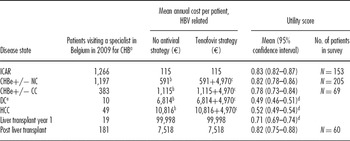
Patient Numbers, Annual Cost, and Utility Score by Disease State

aExcluding HIV or HCV co-infection.
bHBV related disease management cost after excluding antiviral drug costs.
cThis annual cost of tenofovir was reduced in the model by the anticipated reduction by 17 percent in 2015 and 19 percent in 2018.
dBased on the absolute decrease in utilities from CHB, as reported by Levy et al. (Reference Levy, Kowdley and Iloeje18).
eThe number of patients with DC is likely underestimated as patients with acute disease were excluded from participation to the survey.
As base case, we followed hypothetical cohorts of treated and untreated Caucasian patients aged 40 years, with either e antigen positive or negative chronic hepatitis B, non cirrhotic (CHBe+ NC and CHB- NC). In addition, a cohort of 50-year-old patients with compensated cirrhosis (CC) was evaluated, consisting of 30 percent CHBe+ CC and 70 percent CHBe- CC patients, reflecting the Belgian situation (Reference Horsmans, Thiry and le Polain2). For each of these three cohorts (all consisting of 70 percent male patients), we limited the time horizon to 10 and especially 20 years, as current treatment experience in (noncontrolled) trials is less than 10 years. Results for 30 years and a lifelong time horizon were performed but are mentioned only in the discussion section. These analyses were not included in the KCE report (Reference Schwierz, Thiry and Van de Sande4).
In scenario analyses, we also considered a different patient age at start of treatment and increased the transition probabilities to HCC as applicable for Asian cohorts (Reference Fattovich, Bortolotti and Donato5;Reference McMahon6). For the base-case, costs and effects were discounted at 3 percent and 1.5 percent, respectively, in agreement with Belgian guidelines. However, we also report the main results applying a 3 percent discounting rate both for costs and effects. This comes close to the 3.5 percent currently used by the National Institute of Clinical Excellence in the UK.
Our model applies antiviral treatment in agreement with national and international guidance (1;Reference Colle, Adler and Brenard7). In absence of robust findings of HBsAg seronconversion in CHBe- patients, we model tenofovir administration lifelong or until liver transplant. For liver transplants we included treatment costs, including NA costs, as it was in 2006. We did not include incremental effects and costs of tenofovir use in transplants. In absence of RCTs we use expert opinion and the results of single arm studies to include the effect of tenofovir and entecavir into the model. Antiviral treatment is believed to strongly reduce the process toward liver cirrhosis and decompensation: we applied a 75 percent (65 to 85 percent) reduction of these transition probabilities. As the incidence of HCC in cirrhotic states increases considerably (Reference Fattovich, Bortolotti and Donato5), reducing the transition to cirrhosis in our model already results in a decrease of HCC incidence. In addition, a moderate direct reduction of 25 percent (0 to 50 percent) of the transition to HCC was modeled. This reflects the high degree of uncertainty on the extent of HCC reduction under treatment.
Costs and Utilities
The analysis is based on the perspective of the healthcare payer. A multicenter study was designed to collect data on quality of life and to obtain costs by disease stage (Reference Horsmans, Thiry and le Polain2;Reference Schwierz, Thiry and Van de Sande4). We collected clinical information of 551 patients in 18 hepatology centers in Belgium, a large fraction of all hepatology centers in the country (Reference Horsmans, Thiry and le Polain2). The study was approved by the Belgian Privacy Commission and the local Ethics Committees. Written informed consent was obtained from patients who visited their liver specialist during the first half of 2009 for chronic HBV infection. Patients presenting with an acute situation were not eligible. Clinical data were recorded for 2009 and, if available, for 2006. Of the 357 patients with clinical data for 2006, 345 (96.6 percent) could be linked to the 2006 billing records of the National Institute for Health and Disability Insurance (Reference Schwierz, Thiry and Van de Sande4). A medical specialist selected costs that could possibly be attributed to CHB. The details of the calculation of the 2006 costs for the healthcare payer by disease stage have been reported (Reference Schwierz, Thiry and Van de Sande4). Costs were inflated from year 2006 to 2009 by the using the Belgian Health Index. We assumed that 10 percent (range, 5 to 15 percent) of all HCC patients received Nexavar (sorafenib) for an average of 18 weeks. In 2006, Nexavar was not yet reimbursed in Belgium; it was, however, reimbursed in 2010. This inflated the estimated disease management costs for patients with HCC by an average of €1,610 (Standard deviation €357.80). Cost data obtained for patients with decompensated cirrhosis or HCC were similar as reported for other European countries, while our cost of approximately €100,000 for the year of liver transplant is higher than the published figures of €30,075 to €86,228 (Reference Colle, Adler and Brenard7).
Utility values were based on the same survey of 2009 with 527 patients completing a EQ-5D questionnaire on quality of life. The utility scores were processed based on social preference data collected in Flanders, the northern region of Belgium (Reference Schwierz, Thiry and Van de Sande4). Utility values for disease states for which only few observations were available were adapted based on the literature (Table 1).
RESULTS
Tenofovir started in 40-year-old Caucasian patients with chronic hepatitis B reduces the number of cases of decompensated cirrhosis with approximately 90 percent over the next 20 years. According to the model the reduction in HCC cases in CHBe- patients is slightly above 50 percent while it remains slightly below 50 percent in CHBe+. For tenofovir started in 50-year-old Caucasian patients with compensated cirrhosis the model predicts a decrease of approximately 70 percent in cases with decompensation and of approximately 10 percent of HCC cases.
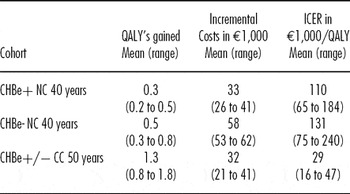
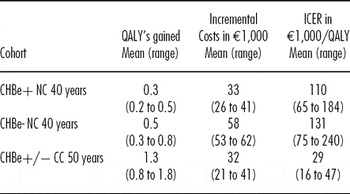
For the base-case analyses of cost-effectiveness we report results for a time horizon of 20 years. Results for a 10-year period are also reported. The base-case effects in terms of quality-adjusted life-years (QALYs) gained, incremental costs, and the incremental cost-effectiveness ratio's (ICERs) are listed in Table 2. For CHBe+/- NC patients, there are low gains in QALYs over a period of 20 years of treatment. Incremental costs are significant, leading to mean ICERs of more than €100,000/QALY. The ICER is more favorable for 50-year-old CHBe+/- CC Europeans, mostly due to higher gains in QALYs over 20 years of follow-up. At a 10-year time horizon, the ICERs are considerably higher than after 20 years, especially for the cohorts CHBe+ (€210,000 to 838,000/QALY) and CHBe- (€249,000 to 1,325,000/QALY).
Base-Case Cost-Utility Analysis, Time Horizon of 20 Years
Detailed probabilistic sensitivity analyses including tornado diagrams are shown in KCE report no 157 (Reference Schwierz, Thiry and Van de Sande4). For both the CHBe+ NC and the CHBe- cohorts, the ICER is most sensitive to changes in the cost of tenofovir, as well as to changes in utilities, such as utility in CC. The cost-effectiveness acceptability curves for the base-case show that for non-cirrhotic patients at 20 years follow-up tenofovir treatment is never an optimal strategy at ICER threshold values up to €60,000 (Reference Schwierz, Thiry and Van de Sande4). The probability that tenofovir becomes a cost-effective option increases to 40 percent if the ICER threshold value is €100,000 per QALY. For cirrhotic patients, the probability that tenofovir treatment is cost-effective increases up to 90 percent at a threshold value of €40,000 per QALY.
For non-cirrhotic patients, tenofovir treatment significantly decreases the costs (and the number of cases) of decompensated cirrhosis, HCC, and liver transplants over 20 years of follow-up. This improvement however comes at a high accumulated cost of tenofovir, accounting for most of the overall costs (Reference Schwierz, Thiry and Van de Sande4).
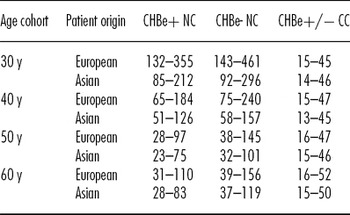
Discounting effects at 3 percent (instead of 1.5 percent) and costs at 3 percent slightly increases the mean ICER for CHBe+ and CHBe- 40-year-old Caucasian cohorts to €133,000 and €161,000 per QALY, respectively. For 50-year-old Caucasian cirrhotic patients, this way of discounting increases the mean ICER to €34,000 per QALY. Table 3 shows the results of the scenario analyses. ICERs decrease with increasing patient age from 30 to 50 years. ICERs are slightly more favorable for Asian compared with Caucasian cohorts because of a higher absolute reduction of HCC cases.
Scenario Analyses: ICER Ranges for Tenofovir Treatment of CHBe+ and CHBe- Patients by Age, Origin, and Liver Cirrhosis Status over a 20-Year Period (ICERs in €1,000/QALY)

DISCUSSION
The ICER of a continued and expensive treatment for the prevention of complications in the long-term depends on several key variables. Chief are the time to complications which can be prevented, their frequency and cost as well as the annual cost of treatment. This explains the more favorable ICER for the cirrhotic patient cohort when compared with non-cirrhotic cohorts where treatment costs accumulate over longer periods before major clinical effects of antiviral treatment are seen.
In Belgium, access to liver transplantation is high and the costs during the year of transplantation for CHB are high compared with published cost studies. However, we did not include in the model the possibility of re-transplantation. Many countries struggle with a scarcity of donor organs. In contrast to our results, reducing the need for transplantation using antiviral treatment would therefore not necessarily be matched by a similar strong decrease in the number of transplantations in those countries. The reduction in cost for the stages with a liver transplant would therefore be less than what we modeled. This would further increase the ICER. The cost of stages with a liver transplant within a time horizon of 20 years is however low when compared with the accumulated tenofovir cost. A 1 percent increase in annual cost for the stages with a liver transplant would decrease the ICER with only 0.06 percent in the CHBe- model.
The ICERs we report for treating non-cirrhotic patients are less favorable compared with those reported in other cost-effectiveness analyses, often company sponsored (Reference Spackman and Veenstra8–Reference Dakin, Bentley and Dusheiko17). How can these differences be explained?
First, many models optimistically assume (without any measurements) that the utility score immediately improves when the viral load decreases after treatment start or upon e seroconversion. The utility values used for CHB and such treatment-induced response are 0.69 and 0.78 in the model by Lacey and Gane (Reference Lacey and Gane15) 0.95 and 1.00 in the model by Veenstra et al. (Reference Veenstra, Sullivan and Lai14) 0.81 and 0.99 in the models (Reference Spackman and Veenstra8;Reference Veenstra, Spackman, Bisceglie, Kowdley and Gish9) referring to the quality of life study by Levy et al. (Reference Levy, Kowdley and Iloeje18). At a treatment cost of €5,000 per year, this latter assumption alone produces an ICER close to €25,000 per QALY. It seems important to mention that to our knowledge no health utility measurements in treatment responders were reported by Levy et al. (Reference Levy, Kowdley and Iloeje18). Dakin et al. (Reference Dakin, Bentley and Dusheiko17) assumes an utility improvement from 0.77 to 0.85 after e seroconversion. We have measured an average utility score of 0.80 in 102 patients without cirrhosis responding to NA antiviral treatment with a DNA level under 2000 IU/ml, very similar to the overall mean score of 0.82 in 205 CHB patients without cirrhosis. Also the mean utility score of 0.83 in 153 inactive carriers was very similar (Reference Horsmans, Thiry and le Polain2).
Some published models use rather high transition probabilities to cirrhosis and apply these uniformly across all age groups: 4.4 percent (Reference Spackman and Veenstra8) and 5 percent (Reference Dakin, Bentley and Dusheiko17) in CHBe+; 9 percent in CHBe- (Reference Veenstra, Sullivan and Lai14;Reference Lacey and Gane15;Reference Dakin, Bentley and Dusheiko17) based on the systematic review by Fattovich et al. (Reference Fattovich, Bortolotti and Donato5). High transition rates also result in a higher frequency of complications and lower accumulated drug costs to prevent a complication. The net effect is a more favorable ICER. However, such high transition probabilities to cirrhosis across all age groups are not in agreement with the relatively low proportion of liver cirrhosis patients of approximately 25 percent among the Caucasian CHB patients in Belgium. We were fortunate to have access to a large unpublished data set of 278 untreated Caucasian CHB patients with a mean follow-up of 7.8 years. The at risk person-years in our data set contributing to the estimation of transition rate to (biopsy-confirmed) cirrhosis in Caucasians was 2.5 times higher for active CHBe+ patients (890 versus 347 person-years) and 7.5 times higher for CHBe- patients (672 versus 90 person-years) compared with the data sets included in the systematic review by Fattovich (Reference Fattovich, Bortolotti and Donato5). To our knowledge, our model is the first that includes age-specific transition probabilities for the development of liver cirrhosis in untreated CHB patients. Without this adjustment for age one could conclude that starting antiviral treatment at an early age is more cost-effective (Reference Post, Sodhi, Peng, Wan and Pollack19), while we find the opposite.
In some published models treatment is discontinued in CHBe- when a low viral load is achieved for 1 year (Reference Post, Sodhi, Peng, Wan and Pollack19). Some models in CHBe+ assume after treatment-induced e seroconversion no disease reactivation (or no re-treatment after reactivation) or no complications leading to liver related mortality; in CHBe- some assume no liver related mortality once a low DNA value is achieved (Reference Buti, Brosa, Casado, Rueda and Esteban13;Reference Veldhuijzen, Toy and Hahne20). The assumption of absence of disease after NA induced HBeAg seroconversion is contradicted by data showing such e seroconversion is only temporary in most patients (1). To our knowledge, there are also no long-term data showing that even sustained DNA suppression will completely stop all complications from developing, such as HCC.
Most models on entecavir (Reference Veenstra, Spackman, Bisceglie, Kowdley and Gish9–Reference Costa, L ‘italien, Nita and Araujo12) and some other models (Reference Dakin, Bentley and Dusheiko17;Reference Eckman, Kaiser and Sherman21) assume high treatment effects both for progression to cirrhosis and HCC and calibrate these effects using baseline viral load levels obtained in an untreated community cohort consisting mainly of e antigen negative patients in Taiwan (Reference Iloeje, Yang and Su22;Reference Chen, Yang and Su23). It remains to be demonstrated that treatment-induced lowering of viral load results in a long-term reduction of cirrhosis and HCC to a level that is identical to a natural state of low viral load. The relation between the immune system, the viral load and the fibrosis stage is more complex. For example, an inverse association between Metavir fibrosis stage and viral load was more recently reported for CHBe+ patients in a hospital based study in Australia (Reference Croagh, Bell and Slavin24).
The effect of antiviral treatment on the development of HCC in CHB is still unclear and difficult to unravel from the fibrosis progression process. If one accepts that the presence of liver cirrhosis itself creates an increased risk of HCC, avoiding progression toward cirrhosis should also reduce HCC. In addition, there may be a direct effect of lowering viral load on HCC development, which we modeled in a conservative way. A recent report from Japan showed a similar high incidence of HCC under lamivudin or entecavir treatment of approximately 1 percent per year in 194 CHB NC patients and approximately 8 percent per year in 62 CHB CC patients, followed for an average of 4.25 years (Reference Kobashi, Miyake and Ikeda25). These data seem to exclude any major reduction of HCC under entecavir treatment over such a period.
The assumed effect of antiviral treatment on HCC is of high importance for the Asian CHB populations as they have a higher incidence of HCC compared with European patient cohorts. Treating Asian CHB patients thus results in slightly more favorable ICERs when compared with European patient cohorts. It remains unclear to what extent data obtained in Asians living in Asia can be extrapolated to sub-Saharan African patients who migrated to Europe, and who constitute approximately 25 percent of the overall CHB patient population in Belgium (Reference Horsmans, Thiry and le Polain2).
Another reason why some recently published models (Reference Dakin, Bentley and Dusheiko17;Reference Eckman, Kaiser and Sherman21) report more favorable ICERs is the lifelong time horizon that was used. However, as current treatment experience is not even 10 years, we lack data on long-term treatment adherence, drug resistance and drug toxicity, which is needed for an evidence-based estimation of the ICER using a time horizon beyond 20 years. This will change once longer-term studies with hard clinical end points become available, that could be entered in the model. Under the most optimistic assumptions of continued adherence, lack of drug resistance development and the absence of any significant drug toxicity after 30 years or more, the mean ICER estimate could decrease further. For the 40-year-old European CHBe+ and CHBe- cohorts, the mean ICERs could thus decrease to approximately €45,000 after 30 years. If a lifelong time perspective is used, the mean ICER is approximately €26,000, using a discount rate of 1.5 percent for effects and 3 percent for costs. When for this most optimistic lifelong perspective the ICERs are recalculated using 3 percent discounting for both costs and effects (approximating the current 3.5 percent UK discounting guidance), the mean estimate is approximately €39,000, both for CHBe+ and CHBe- cohorts. This intervention, even using a most optimistic scenario, would not be considered cost-effective according to UK standards.
Our findings could be tempting for decision makers to restrict reimbursement to patients with liver cirrhosis. But was the aim of antiviral treatment not to prevent liver cirrhosis? In this study we modeled patients without cirrhosis and patients with liver cirrhosis at treatment start. The selection of the cohorts was driven by the availability of transition rates. To help decide which patients should preferably be treated (to prevent cirrhosis) it might have been more appropriate to investigate patients at increased risk of developing cirrhosis, for example patients in various stages of liver fibrosis. However, this remains difficult as the specific transition rates to cirrhosis of such at risk populations are not well documented. All other input variables left unchanged, doubling the transition rate to 4 percent for age 40 to 49 years and 10 percent from 50 years onward, approximately halves the ICER estimates. Efforts should thus be steered to quantify the contribution of additional variables (comorbidity, alcohol, smoking, . . .) that indicate a clearly increased risk of progression to cirrhosis, and to include these variables into disease models.
Finally, as the current annual cost of entecavir is higher compared with tenofovir, the results in treatment naïve patients are less favorable, under the assumptions used. We did for example not include in the model any loss of QALYs or additional costs for management of drug resistance for entecavir or drug toxicity (renal impairment, possibly osteopenia) of tenofovir. Adjusting the model accordingly would result in even less favorable ICERs than the ones reported.
In conclusion, despite a better knowledge of the natural progression and quality of life, results of long-term models like the one developed here, need to be interpreted with caution. One should be aware that there are no long-term randomized controlled trials available for tenofovir or entecavir showing an effect on disease progression and hard clinical end points. Especially the effect of antiviral treatment on HCC remains highly uncertain and deserves to be studied in more detail. If considerations of cost-effectiveness are taken into account for clinical practice our results suggest the antiviral treatment may need to be targeted to cirrhotic patients and those at high risk of rapid progression to cirrhosis.
CONTACT INFORMATION
Frank Hulstaert, MD, MSc, (frank.hulstaert@kce.fgov.be), Belgian Health Care Knowledge Centre (KCE), Doorbuilding (10th floor), Kruidtuinlaan 55, 1000 Brussels, Belgium
Christoph Schwierz, PhD, Belgian Health Care Knowledge Centre (KCE), Brussels, Belgium, Frederik Nevens MD, PhD, Hepatology, UZ Gasthuisberg, KULeuven, Leuven, Belgium
Nancy Thiry, MSc, Belgian Health Care Knowledge Centre (KCE), Brussels, Belgium, Mohamed Gamil, MD, PhD, UZ Gasthuisberg KULeuven, Leuven, Belgium
Isabelle Colle, MD, PhD, Hepatology, Ghent University Hospital Ghent, Belgium
Stefaan Van de Sande, MD, Belgian Health Care Knowledge Centre (KCE), Brussels, Belgium, Yves Horsmans, MD, PhD, Hepatology, University Hospital Saint-Luc, Brussels
CONFLICTS OF INTEREST
Isabelle Colle reports grants to her institution from Bayer, having received board membership money from MSD and consultancy fees or travel funding for several pharmaceutical companies. Yves Horsmans and his institution have received funding for including patients in the clinical part of the study. The other authors report no potential conflicts of interest.