

Introduction
High-speed planting (HSP) is a relatively recent technological development within the precision agricultural community in the vein of planting at the right time. Excitement grows over the promise of the latest advancements in HSP as a means to avoid yield decline associated with delayed planting. Interest in the potential for enhanced profitability through more timely performance of this most fundamental machinery operation is especially relevant to those considering its adoption. As farmers and farm managers contemplate the opportunities afforded by HSP in their business operations economic assessment will be a vital point for consideration. Given the possible interaction of planting date with seeding and nitrogen, a whole farm analysis including a range of production management alternatives, including variable rate application, may offer insights to direct and indirect economic benefits behind HSP.
The purpose of this study is to assist farm managers considering the adoption of HSP as well as researchers and developers of this technology. This includes three objectives: 1) providing initial economic evaluation of the gains realized by employing HSP in a whole farm setting compared to conventional speed planting, 2) comparing and contrasting HSP to conventional speed results under uniform rate (noVRA) versus variable rate (VRA) nitrogen application and seeding rate (based on differing soil types) and 3) conducting sensitivity analysis of economic gains of HSP under different combinations of speed, width and efficiency of planters under both noVRA and VRA.
The study area selected is representative of a western Kentucky, USA corn (Zea mays) and soybean (Glycine max) commercial sized farm operation of 1000 ha−1 silt loam and silt clay soils with varying topsoil depth. Typical to the region, no-till without irrigation and a two-year rotation is analyzed. Farm machinery operations include pre-emergence (corn only) and post-emergence herbicide treatment, planting, fertilizer application (corn only) and insecticide treatment (soybean only).
Background
Planting at higher speeds has long intrigued the agricultural community. While prospects for added convenience and profitability of HSP creates excitement among farmers, as business managers they are also skeptical. Traditionally, problems with engineering elements such as fluctuation in seed release and seed bounce with ground contact have made dramatic speed increases infeasible without accompanying lower accuracy of seed placement. However, recent technological developments have softened impediments seemingly making HSP without substantial loss of accuracy a realizable goal. Trade literature reports promising initial results from farmers who have tested HSP, sometimes doubling speed without sacrificing accuracy (Potter, Reference Potter2014; Scott, Reference Scott2015).
Optimal planting time is critical with yield loss from later plantings of averaging 0.70% day−1 on soybean (Lee et al., Reference Lee, Egli and TeKrony2008) and 0.2% day−1 on corn (Morris and Herbek, Reference Morris and Herbek2001) depending on weather and production practices. While increasing the number of planters and tractors pulling these implements is one means of increasing the area planted during a given time period, increased field capacity (ha hr−1) is another option; increasing speed without forfeiting accuracy is the approach considered by HSP.
Several benefits and costs must be weighed when considering the possibility of HSP. Conceivably, the first benefit to mind is potential yield improvements given the ability to plant more during the agronomically optimal window. However, time might also be freed up for the performance of other, competing non-planting field operations conducted during the same time such as post-emergence herbicide spraying operations on corn with concurrent soybean planting. Another, potentially substantial, benefit is cost savings associated with spending less time performing planting for a given land area. These reductions in the operating costs associated with planting include labor, fuel and tractor repair expenses as well as the interest on operating capital of these expenditures. However, additional operating costs of repairs and maintenance associated with the more technologically advanced planter must also be considered as well as accompanying interest on operating capital. Understandably, of primary concern to farm managers considering adoption of HSP is the purchase price of the technology. Thus, ultimately the question facing decision makers considering HSP adoption is whether the benefits outweigh the costs, especially the costs of ownership like depreciation and interest.
Prior literature regarding the value of farm machinery time, specifically during planting, offers some insight regarding the possible economic advantages of HSP. Some studies display modest to high economic gains from additional planting time. Estimates by Dillon and Shockley (Reference Dillon and Shockley2011) range from US$21 to US$118 hour−1 depending on producer’s attitude towards risk when planting time is limited.
Model and data
The whole farm economic planning model for this study embodies the decision-making environment of the farm manager considering HSP. Linear programming is selected as the research method given the constrained optimization framework represented. The linear programming model is formulated with an objective function maximizing net returns above selected costs. Decision variables for this model include the production of corn and soybeans, with alternative management decisions for varying production practices and soil type described at the end of this section. Variables for marketing and accounting are also incorporated as well as requisite accounting constraints. Resource allocation constraints include a land constraint with a crop rotation component, soil type proportionality constraint depicting the VRA scenario considered formulated in parallel fashion to Dillon et al. (Reference Dillon, Mueller and Shearer2003) and farm machinery operation time.
The base case scenario relies upon the research methods of Shockley et al. (Reference Shockley, Dillon and Stombaugh2011) wherein a 16-row, 12.2 m planter operating at 9.66 km hr−1 and 70% efficiency is adjusted for autosteer usage (increasing speed 5% and width 0.3 m). A 12-row, 6.1 m planter and 65% efficiency operating at the same speed and with autosteer adjustments is also studied. Sensitivity analysis includes HSP at 150% (1.5X) and 200% (2X) the conventional speed assumed. The double speed analysis includes both no loss in efficiency and a loss in efficiency experiment as experienced by some farmers, herein represented as an assumed 10% efficiency reduction. The purchase price of the HSP planter is US$2193 per row more at the median as reported by Scott (Reference Scott2015) is assumed. Under an eight-year useful life, 45% salvage value and 6.75% interest, annual ownership costs (depreciation and capital investment) is calculated to be US$4129 and US$3097 more than traditional speed implements for the 16 and 12-row planters respectively. Production costs and crop prices are updated values from Schieffer and Dillon (Reference Schieffer and Dillon2015).
Production practices modeled include nine planting dates in weekly intervals for both corn (March 25th through May 20th) and soybeans (April 22nd through June 17th). Three maturity groups and three seeding rates modelled also represent the range of University of Kentucky Cooperative Extension Service recommendations. Corn and soybean yields were estimated using biophysical simulation model for thirty years of historical weather patterns reflecting the complex nonlinear planting time (Schieffer and Dillon, Reference Schieffer and Dillon2015). Days suitable for fieldwork by week are the median level across years from Shockley, Dillon and Stombaugh (Reference Shockley, Dillon and Stombaugh2011) wherein greater detail may be found.
Results
Results are categorized by the two row size planters examined delineated by economic and agronomic impacts. Analysis is presented within each for the different planting speed and efficiency combinations modeled, considering the use of variable rate nitrogen (corn) and variable seeding (corn and soybeans) as well as no VRA employed.
Economic Results for a 16-row Planter
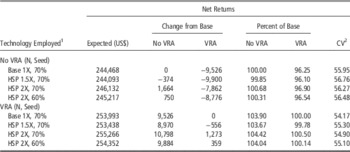
With the 16-row planter serving as the representative implement for a machinery complement well suited to the 1000 ha farm operation size, the annualized costs of ownership are calculated. An additional US$2412 in depreciation and US$1717 in opportunity cost of machinery capital is experienced annually for HSP. Partially offsetting this US$4129 yearly ownership cost is the reduction in operating costs for planting. A combination of lower labor, fuel and tractor repair expenses outweighs the anticipated increase in planter repair expenses for every case examined. Specifically, operating costs for planting are ultimately lower than conventional speed planting costs by US$2.13 ha−1, US$3.95 ha−1 and US$3.04 ha−1 for 1.5 times speed (14.49 km hr−1) scenario, 2 times speed (19.32 km hr−1) scenario and 2 times speed but 60% efficiency scenario respectively. These reduced planting costs amount to a recovery of from 51% to 96% of the additional ownership costs associated with HSP. These cost elements couple with altered production practices and yield changes in the optimal net returns obtained for the scenarios examined (Table 1). The expected net returns to management, overhead labor and bearing of risk for the base conventional speed planter with no VRA is US$244,468. HSP results are generally favorable excepting a decline of US$374 in profitability under the modest 50% increase in speed assumption. Under double speed, net returns increased 0.68% or US$1664 to US$246,132. Even when coupled with a 10% reduction in planting efficiency, doubling speed improved net returns by US$750 or 0.31% to US$245,217 (Table 1). Notably, HSP showed slightly greater yield fluctuation risk as noted by the coefficients of variations in net returns (Table 1).
Farm level economic results for conventional base speed and high-speed planting with uniform and variable rate nitrogen and seeding for a 16-row planter

1 VRA is variable rate N application and seeding rate, HSP is high-speed planting at both 1.5 times and double (2X) the conventional base planting speed under 70% and 60% efficiency.
2 CV is the coefficient of variation across years.
The use of VRA is economically preferred in all planting speed scenarios, including 3.90% or US$9526 higher net returns over uniform rate, base speed planting (Table 1). However, the 1.5 times base speed planting was still not economical with a loss of US$556 compared to VRA conventional speed planting, more than the US$374 loss under no VRA. In fact, all cases of HSP enjoyed less economic favor under VRA. This is attributable to the ability of VRA use to exploit some of the opportunity for heightened crop production practice selection, but such results would be case dependent. The highest expected net returns under all scenarios is for the HSP with double speed and standard efficiency when coupled with VRA, earning the farm US$255,266 or US$10 798 (4.42%) more than the base no VRA case. The accompanying low CV of net returns at 54.90% is second only to the 54.17% shown for base speed planting. While HSP planting has slightly more yield risk than the base speed (with a shift to higher expected but more variable yielding earlier planting), risk is slightly reduced compared to uniform rate application as reflected in CV results in all cases under VRA (Table 1). While the previously discussed net reduction in operating costs explain some of the economic gains possible, alteration in production management to take advantage of optimal planting windows also is instrumental.
Agronomic Results for a 16-row Planter
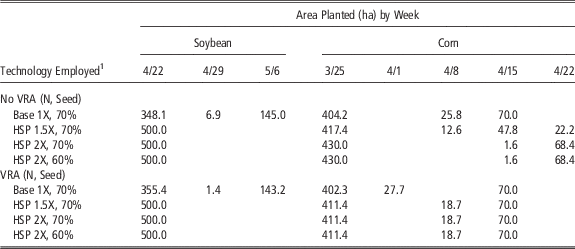
Planter performance in the base case scenarios permits about 75% of soybean to be planted in one week as well as about 80% of corn planted to be completed in one week (Table 2). Early plantings in both cases are optimal with HSP enjoying the ability to plant all 500 ha of soybean in the week of April 22nd. Farm average soybean yield of 4135 kg ha−1 under base speed planting (either VRA or not) rises inconsequentially to 4143 kg ha−1 for all HSP scenarios. Base case corn yield of 9937 kg ha−1 increases slightly under HSP to 9954 kg ha−1 and 9982 kg ha−1 for 1.5 times and 2 times speed respectively without VRA. Contrary to expectations, base case corn yield (10 272 kg ha−1) under VRA actually decreases slightly under HSP to 10 261 kg ha−1 under both speed factors. Given the varying responsiveness of corn to N and plant population by planting date, HSP enabled a reduced N and seed rate on April 8th planting dates. The cost savings of N and seed outweighed the small decreases in yield experienced. Interestingly, while western Kentucky corn is primarily planted early during the week including March 25th, a secondary planting window around April 15th or 22nd is also utilized (Table 2). This is attributable to the relative profitability of soybean coupled with the competition for time during post-emergence herbicide spraying on corn with concurrent soybean planting.
Farm level agronomic results for conventional base speed and high-speed planting with uniform and variable rate seeding and nitrogen for a 16-row planter

1 See footnote 1 Table 1.
Economic Results for a 12-row Planter
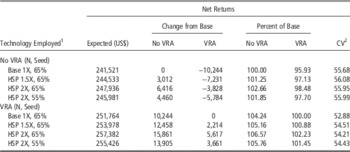
A 12-row planter is selected to investigate an alternative width implement and reflect a producer experiencing even more limited opportunities to conduct planting within desirable times. An additional US$3097 of annual ownership costs from depreciation (US$1809) and machinery investment interest (US$1288) is faced by the producer. Compared to the operating costs under conventional planting speed, HSP operating cost are reduced by US$2.87 ha−1, US$5.14 ha−1 and US$3.88 ha−1 for 1.5 times speed, 2 times speed and 2 times speed but 60% efficiency respectively. For the 1000 ha farm, these labor, fuel and net repair savings cover 69%, 124% and 94% of annual ownership costs for the three HSP scenarios respectively. Thus, doubling the speed of planting, when efficiency is maintained, reduces operating costs by more than yearly costs for this planter and land area size combination. The relevant expenses are coupled with production practice alterations permitted, and their corresponding yield impacts, in the optimal net returns obtained for the various experimental scenarios (Table 3). The expected net returns for the base conventional speed 12-row planter with no VRA is US$241,521 or US$2947 less than the 16-row planter case above. However, unlike the 16-row planter analysis, HSP results are economically favorable in all scenarios considered, up to a 2.66% increase for double speed planting with maintained efficiency. A 10% reduction in planting field efficiency or a reduction in faster planting to 50% greater than conventional speeds still prove profitable for HSP with 1.85% (to US$245,981) and 1.25% (to US$244,533) greater net returns respectively than without HSP (Table 3).
Farm level economic results for conventional base speed and high-speed planting with uniform and variable rate nitrogen and seeding for a 12-row planter

1 VRA is variable rate N application and seeding rate, HSP is high-speed planting at both 1.5 times and double (2X) the conventional base planting speed under 65% and 55% efficiency.
2 CV is the coefficient of variation across years.
For a farmer using VRA, HSP is again profitable with gains in net returns ranging from US$2214 to US$5617 (Table 3) albeit less than for the farmer not using VRA (with increases of US$3012 to US$6416). As with the 16-row planter, VRA demonstrates even more economic potential than HSP but the greatest profit may be realized from adopting the combination of HSP and VRA. Observation of CV of net returns (Table 3) again reveals that yield risk under VRA is less than without VRA. While HSP generally sees slightly greater CVs, it should be remembered that the solutions herein reflect a risk neutral producer focused solely on profit maximization.
Agronomic Results for a 12-row Planter
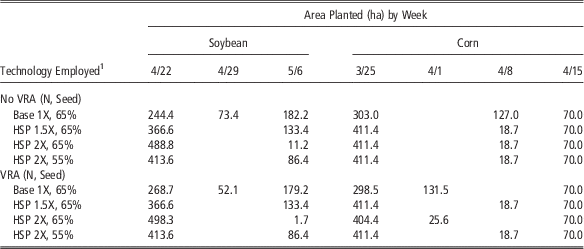
By construct, planting time was limited more than in the 16-row planter case leading to the completion of about 50% of soybean planting in one week around April 22nd as well as about 36% of corn planted during the week surrounding March 25th (Table 4). Farm average soybean yield of 4132 kg ha−1 under base speed planting (either VRA or not) rises from 4 to 11 kg ha−1 for all HSP scenarios. Base case corn yield of 9898 kg ha−1 increases slightly under HSP to 9940 kg ha−1 without VRA. With the use of VRA, base case corn yield (10 268 kg ha−1) remains relatively unchanged as well under HSP to (10 261 kg ha−1 to 10 272 kg ha−1).
Farm level agronomic results for conventional base speed and high-speed planting with uniform and variable rate seeding and nitrogen for a 12-row planter

1 See footnote 1 Table 3.
Nearly all of soybean is planted under VRA in one week under 2 times HSP and maintained efficiency, but in all cases of HSP varying amounts are planted around May 6th (Table 4). The ability of decision makers to adjust to limitations is displayed in the fact that April 22nd planted corn is no longer part of the optimal farm management plan under the 12-row planter scenario. While previously included with the 16-row planter under no VRA, the need to plant soybeans during that week provides more economic opportunity than shifting corn planting to April 15th. Even with HSP, the farmer would prefer to plant more soybeans early than is allowed by the 12-row planter. Likewise, a greater reliance on April 1st planted corn under VRA under base speed planted is needed with the smaller planter. Not surprisingly, the heightened limitations experienced with the smaller planter provides greater opportunities for HSP technology to improve production management practices and subsequently, enhance farm profits.
Conclusions
Considerable attention to recent advances in HSP merits scientific investigation of its promise, including economic feasibility. Annual technology ownership costs (depreciation and interest) were partially (51%) to more than completely (124%) recovered through operating cost savings (labor, fuel, tractor repairs) for the cases studied. While assessment of the increased yield associated with timely planting performance can be more involved and condition specific, changes in farm net returns are positive for all 12-row planter scenarios on a 1000 ha corn and soybean farm. Similarly, all doubling of speed cases for the 16-row planter demonstrated enhanced profitability for HSP, even with a 10% decline in field efficiency. Of all modeled scenarios, only the more conservative 50% estimate of the speed increase of a 16-row planter displayed a reduction in profits, under both with and without VRA. While HSP increased profitability in almost all cases considered (of up to US$6416 or 2.66% of base speed net returns was greater in cases not using VRA), VRA resulted in greater profit increases than HSP. However, the greatest profit potential occurred when adopting the combination of HSP and VRA with increased net returns of up to 6.57% compared to conventional speed no VRA for the 12-row planter. One limitation to this study and area for future research is examination of risk, especially respecting days suitable for fieldwork. Implications of HSP regarding the optimal equipment complement and land area farmed is a further notable focus for further investigation. Establishment of practical decision-making guides for farm managers, such as break-even analysis, would also be a worthwhile pursuit.
Acknowledgements
The authors wish to thank the editor and reviewers for helpful input.