INTRODUCTION
Penetration of the skin of the definitive host by a schistosome results in the cercaria losing its tail, triggering development into the schistosomulum, with the whole process being known as the cercarial/schistosomulum transformation (Stirewalt and Dorsey, 1974; He et al. 2005). This morphological transformation is accompanied by dramatic changes in the physiology and biochemistry of the larva (Stirewalt, 1974). Contraction and extension of the schistosomulum and the release of enzymes from its pre- and post-acetabular glands causes extensive tissue damage to all host structures traversed, until the larva breaches a blood vessel wall and enters a blood vessel. The timing of these early skin-schistosomulum stage events varies in schistosome species. Ninety percent of Schistosoma mansoni and S. haematobium parasites still remain in the host epidermis after 24 h while within the same period a similar number of S. japonicum schistosomula will have already reached the dermis or dermal vessels of the host (He et al. 2002).
The schistosomula then travel via the pulmonary artery to the lungs where they are located intravascularly and are now referred to as lung schistosomula (Wilson and Coulson, 1989; Dean and Mangold, 1992). Again, timing of the initial arrival and period within the lung varies between species, with peak appearance being on day 5–6 post-infection for S. mansoni with some parasites detected up to day 20, although it is not clear at this time-point whether the parasites have just arrived or have become trapped in the lungs. S. japonicum schistosomula peak in the lungs at day 3 after penetration (Gui et al. 1995). After exiting the lungs, schistosomula re-enter the venous circulation (Gui et al. 1995). The pre-adult schistosome can then reside in the liver for up to 15 days post-penetration (Mitchell et al. 1991). In the liver, the parasites grow and develop for 8–10 days before forming pairs, and finally they lodge in the portal and mesenteric vessels of the gut from day 11 (for S. japonicum) (He, 1993).
IMMUNOBIOLOGY OF THE LUNG- STAGE SCHISTOSOMULUM
After penetrating the definitive host, significant morphological and biochemical changes occur to the developing schistosomulum, including the modification of surface or secreted antigens that may otherwise stimulate an immune response (Mountford and Harrop, 1998). Skin-stage schistosomula are susceptible to humoral and cellular immune responses, but rapidly develop resistance to host immunity (Dean, 1977; El-Ridi et al. 2003). This is illustrated by the relative sensitivity of skin schistosomula to both complement-mediated killing and antibody-dependent cellular cytotoxicity, whereas the lung schistosomula and adults become increasingly resistant to both of these immunological defences (McLaren, 1980; Lawson et al. 1993; Parizade et al. 1994). This increasing degree of resistance may be linked to the shedding of the cercarial membrane and formation of the heptalaminate surface membrane several hours after penetration (Hockley and McLaren, 1973; Gobert et al. 2003).
Immune evasion was originally attributed to antigen masking but resistance of lung-stage schistosomula to immune effector mechanisms was reported regardless of host antigen adsorption (Dean, 1977). This implied structural or biochemical modifications of the membrane surface, preventing binding of antibody or reducing antigen expression (El-Ridi et al. 2003). It has been suggested that the lung-stage schistosomulum protectively confines antigenic molecules in specific, lipid-rich sites of the outer surface membrane and that, in addition to this physical barrier, biochemical and immunological barriers must exist to protect the parasite from the host immune response (Parizade et al. 1994; El-Ridi et al. 2003). This may reflect the presence of lipid-rafts on the schistosome surface membrane that effectively allow compartmentalization of regions, as an immunological camouflage (Grossmann et al. 2006). The importance of the outer membrane of the schistosomulum in the avoidance of immunological attack was examined by Tallima and El-Ridi (2005) who selectively depleted the cholesterol content of S. mansoni schistosomula, which led to binding of schistosome-specific antibodies, as shown by immunofluorescence. However, a parallel experiment in the same study, using S. haematobium schistosomula, failed to enhance antibody binding, strongly suggesting that the lipid composition differs between the two species.
In contrast to the evidence for their relative immune insusceptibility to unattenuated cercariae in mice, lung schistosomula were found to be the principal target of immune mechanisms in the rat model, in response to either radiation-attenuated (RA) or unattenuated cercariae prior to exposure (Ford et al. 1984; Knopf et al. 1986). Similarly, elimination of schistosomula from the lungs of mice after vaccination with RA cercariae (Wilson and Coulson, 1989; Hewitson et al. 2005) was found to be proportional to the time the parasites spent in the lungs (Dean and Mangold, 1992). Moreover, antigens obtained from lung-stage larvae are apparently more efficient stimulators of lymphocyte proliferation and secretion of Th1 cytokines than those from cercariae and skin-stage larvae (Mountford et al. 1995). Overall, until recently, there was a paucity of information regarding the lung-stage schistosomulum and its tegumental surface and secreted molecules, despite the acknowledged acceptance of antigens derived from this stage as being potentially important vaccine candidates (Mountford et al. 1995; Gobert et al. 1997; Mountford and Harrop, 1998; Harrop et al. 1999).
THE LUNG-STAGE SCHISTOSOMULUM AND IMMUNE EVASION
Although the immunobiology of the lung schistosomulum remains a relatively poorly investigated topic, several interpretations regarding its defences against the host response can be made from morphological observations. One critical morphological difference is the complete absence of the highly immunogenic cercarial glycocalyx on the surface of the lung-stage schistosomulum, which is retained for some time in the newly transformed schistosomulum as it migrates through the skin (Agoston et al. 2001). However, it seems that lung schistosomula do activate complement (Santoro et al. 1979) and bind antibodies at their surface (regardless of the lack of the glycocalyx); they must therefore resist immune damage by some other means, perhaps related to the formation of the heptalaminate membrane (Lawson et al. 1993; Gobert et al. 2003). Indeed, early studies suggested that the insusceptibility of post-skin-stage schistosomula to antibody-dependent killing resulted at least in part from an intrinsic structural change in the tegument of the parasite that could not be caused solely by the masking of parasite antigens by acquired host molecules (Moser et al. 1980). A similar pattern of increased insusceptibility to host immune attack by lung schistosomula compared with skin forms was demonstrated in response to nitric oxide (NO), an active component of cell-mediated killing (Ahmed et al. 1997). The mechanism of NO toxicity involves direct interaction with metabolic processes via the disruption of key enzymes. Loss of susceptibility to NO in schistosomes may be linked to the shift from aerobic to anaerobic metabolism and conversion to a less metabolically active state in lung schistosomula, and may be considered a passive defence strategy rather than active immune evasion (Ahmed et al. 1997).
Chai et al. (2006) described detailed ultrastructural analysis of the tegument of the lung schistosomulum which revealed no evidence of tegument sloughing but a dynamic state of tegumental remodelling and turnover. The suggested association of the membranous contents of elongated and membranous bodies becoming incorporated into the apical membrane of the tegument appear likely, as originally suggested by Hockley and McLaren (1973) from their observations of adult S. mansoni. Although ultrastructural analysis of the lung-stage schistosomulum can provide some insights regarding the ability of this life-cycle stage to endure immune attack through gross mechanisms such as tegument thickening or shedding, molecular/biochemical techniques must be used to address the question of why the lungs are the principal site of worm elimination. Through profiling the spectrum of proteins and glycoconjugates present at the host/parasite interface a full appreciation of the molecular defences of schistosomes can be made.
RECOVERY AND COMPARATIVE STUDY OF SCHISTOSOMULA OBTAINED BY IN VIVO AND IN VITRO PROCEDURES
Schistosomula may be recovered directly from the lungs by mincing lung tissue from the mammalian host at various times post-infection (Clegg, 1965; Gui et al. 1995). We will refer to these in vivo isolated schistosomula as LS (lung schistosomula). As an alternative, mechanically transformed schistosomula (see below) have been maintained in culture in vitro for different times to provide all the mammalian host stages, including lung-stage schistosomula, and even paired, mature adult males and females (Basch, 1981; Basch and Basch, 1982). We will refer to these in vitro isolated and maintained schistosomula as MT (mechanically transformed schistosomula). MT are now commonly used in studies of ultrastructure, genetics and gene manipulation, development, behaviour, metabolic activity, biochemistry, molecular biology, immunology and in vaccine development (Cousin et al. 1981; Salafsky et al. 1988; Marikovsky et al. 1990; Harrop and Wilson, 1993; Harrop et al. 1999; Gold and Fletcher, 2000; Loukas et al. 2001; Correnti et al. 2005). However, there is often a lack of standardization associated with the various MT methods for obtaining different intra-mammalian schistosome stages, with culturing durations or conditions being varied and sometimes arbitrary (Harrop and Wilson, 1993; Lawson et al. 1993; Curwen et al. 2004). While there is evidence that MT are structurally similar to their LS counterparts (Chai et al. 2006), the comparative molecular biology and biochemistry of schistosomes obtained by the two approaches is poorly understood (Brink et al. 1977; Samuelson et al. 1980; Cousin et al. 1981; Gold and Fletcher, 2000).
Commonly used in vitro cercarial transformation techniques include the mechanical detachment of the tail (by centrifugation, vortexing or pressure shearing), penetration of cercariae through isolated skin, and incubation of cercariae in sera, chemicals and/or media varying in glucose concentration, osmolarity, or amino acid and lipid content (Ramalho-Pinto et al. 1974, 1975; Brink et al. 1977; Cousin et al. 1981; Salafsky et al. 1988; Horemans et al. 1992). However, comprehensive comparisons of schistosomula obtained by these various procedures, and with parasites obtained directly from the lungs are lacking. MT are determined to be of a particular developmental stage by gross morphology and/or culture duration (Basch, 1981). Previous reports that have used MT in studies of protein/antigen release or antigenicity, involved culturing for 3 h (Lawson et al. 1993), 7 days (Harrop and Wilson, 1993), 8 days (Curwen et al. 2004) and up to 11 days (Mountford et al. 1995). This variation in protocol exemplifies the arbitrary nature of culture duration for MT schistosomes; while in addition it is well known that without the presence of erythrocytes in culture media, progression of the parasites to the liver stage of development was prevented (Basch, 1981).
Cousin et al. (1981) compared the ultrastructure of MT with that of in vivo skin-phase schistosomula and concluded that their developmental patterns achieved the same end-point but occurred at different rates. Samuelson et al. (1980) also found that the gross morphologies, determined by scanning electron microscopy of MT and LS were similar. However, S. mansoni MT do become more elongate with time in culture albeit not to the same extent as LS (Cousin et al. 1981).
THE TEGUMENT OF THE LUNG-STAGE SCHISTOSOMULUM AND GLUCOSE UPTAKE
Whereas cercariae derive energy only from endogenous glycogen reserves, adult schistosomes are dependent primarily on glucose absorbed from the blood of the mammalian host (Bruce et al. 1969; Halton, 1997). Glucose and other small molecular weight solutes are transported across the tegument, with adult schistosomes reportedly consuming their dry weight in glucose every 5 h, using mechanisms that include the use of glucose transporter proteins (SGTPs) (Skelly et al. 1998; Brouwers et al. 1999). The cercaria/schistosomulum transformation includes a switch from aerobic to anaerobic energy metabolism, loss of the glycocalyx and complete reconstruction of the tegumental membranes (Skelly and Shoemaker, 2000). The glucose transporter proteins SGTP1 and SGTP4 have been localized to the tegument of adult parasites and freshly obtained in vitro mechanically transformed schistosomula, but SGTP4 is absent in cercariae and the other extra-mammalian forms, all of which lack the heptalaminate membrane of the intra-mammalian parasites (Jiang et al. 1996; Skelly and Shoemaker, 1996). The presence of SGTPs has not been reported in schistosomula obtained directly from the lungs of mammalian hosts and it is unknown how schistosomula in the lung supplement their depleted internal stores of glycogen (Skelly and Shoemaker, 1995; El-Ridi et al. 2003).
GENE EXPRESSION STUDIES
Fundamental differences in gene expression between schistosomula obtained by in vivo and in vitro procedures were reported in the recent microarray study by Chai et al. (2006). A 19221 feature oligonucleotide microarray was used to compare the transcription profiles of S. japonicum schistosomula, isolated directly from the lungs of mice 3 days post-infection, with mechanically transformed schistosomula maintained in culture for the same period. Differential gene expression was correlated with biological function relating specifically to components involved in schistosome immune evasion and nutrition. The most striking aspect of the analysis was the large number (6662) of genes differentially expressed between the two forms, indicating major biochemical and physiological differences between the two schistosomula types. This suggests that data obtained from schistosomula cultured in vitro may present an under- or over-estimate of gene expression compared with parasites obtained directly from the lungs.
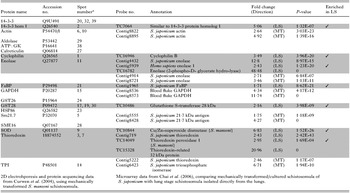
This potential anomaly is illustrated in Table 1 where a comparison has been made of the most abundant proteins from mechanically transformed/8-day in vitro cultured schistosomula of S. mansoni (Curwen et al. 2004) with transcription levels of mechanically transformed/cultured versus in vivo lung-recovered schistosomula of S. japonicum (Chai et al. 2006). Although comparison of protein and relative transcription levels are not directly comparable and the fact the 2 different schistosome species were examined in the 2 studies, the clear differential gene expression that was demonstrated for MT and LS of S. japonicum (Chai et al. 2006) suggests that the protein abundance findings of Curwen et al. (2004) may require normalization. While it is important to note that MT can be introduced to the mammalian stage via intravenous injection and progress normally (Sher et al. 1984), it is not clear whether the parasite dramatically alters its gene expression profile to adapt to the in vivo situation.
Table 1. Correlation of the most abundant proteins (genes) from mechanically transformed and cultured schistosomula (MT) with the relative transcription levels of MT with schistosomula obtained directly from the lungs (LS) (Potential under-estimations of protein abundance by using MT are highlighted; while potential over-estimations of protein abundance by using MT are not highlighted. aSpot number on 2D gel.)

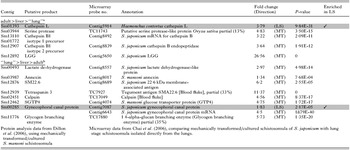
Similarly, disparity in gene expression must be considered in the microarray results of Dillon et al. (2006) who compared MT of S. mansoni with liver stage and adult parasites. Again when correlating the findings of Dillon et al. (2006) with those of Chai et al. (2006), potential over- or under-estimation of the expression of gene products in MT parasites is apparent (Table 2). Full validation of previous studies using in vitro-obtained S. mansoni schistosomula cannot be made until a comparison of S. mansoni MT and LS is undertaken. We acknowledge that gene expression differences will occur between the two closely related schistosome species, but the findings of Chai et al. (2006) do highlight the possible limitations of using MT for study, a concern raised also by others (Contreras et al. 1998).
Table 2. Comparison of the most abundant proteins from mechanically transformed/in vitro-cultured schistosomula and their relative transcription levels compared with schistosomula obtained directly from the lungs (Relative over-expressed genes in schistosomula obtained from the lungs are highlighted in grey, while under-expressed genes are not highlighted. aHighest relative gene expression in adult stage, then liver stage and lowest relative gene expression in ‘lung’ stage. bHighest relative gene expression in ‘lung’ stage, then liver stage and lowest relative gene expression in adult stage. LS, schistosomula isolated from lungs; MT, mechanically transformed and cultured schistosomula.)

CONCLUSIONS
Further mining of the microarray data from the study of Chai et al. (2006) will undoubtedly reveal many more genes or clustered sequences of basic biological interest, elucidation of the function of their expressed products, and an assessment of their potential as vaccine or drug targets.
The differential gene expression profiles of lung schistosomula and those obtained by mechanical transformation/in vitro culture suggest that the use of the latter may potentially produce under- or over-estimations of actual parasite gene expression and associated physiology/biochemistry. Schistosomes produced by in vitro methods are utilized on the premise that schistosome development can be simulated independently of the host environment, and that observed morphological similarities confer overall equivalence of in vitro with in vivo forms. However, it seems likely that factors in the host environment encountered by mammalian stage schistosomes within the host are reflected at the transcriptome level. This would suggest that studies using in vitro-derived schistosomula are useful when examining gross morphology or pre-determined patterns of schistosome development, but the use of schistosomes obtained by in vitro means for molecular or biochemical studies should be carefully considered.
The authors would like to thank Dr Danielle Smyth (QIMR) for her useful comments. This work is supported by the Wellcome Trust (UK), NHMRC (Australia) and the Sandler Foundation for Parasitic Diseases (USA).