Introduction
Cercarial dermatitis, also known as ‘swimmer's itch’, an ailment caused by the penetration of human skin by the cercariae of schistosome parasites, is a common, recurrent phenomenon in freshwater, brackish and marine habitats worldwide (Cort, Reference Cort1950). Adult schistosomes typically live in the mesenteric blood vessels of birds and mammals, and produce eggs that pass from their host's body in the faeces, then hatch and release miracidia that penetrate and develop in snail intermediate hosts. Snail infections culminate in the production of numerous cercariae that are regularly released into the water where they seek to penetrate the skin of a vertebrate definitive host. Cort (Reference Cort1928), working at Douglas Lake, Michigan, USA, was the first to implicate schistosome cercariae emerging from freshwater snails as the causative agents of a dermatitis known around Michigan lakes as swimmer's itch. He and others showed this ailment to be caused by the cercariae of several genera of schistosomes that normally use aquatic birds and non-primate mammals as their definitive hosts (e.g. Talbot, Reference Talbot1936; McMullen & Beaver, Reference McMullen and Beaver1945; Macfarlane & Macy, Reference Macfarlane and Macy1946; McMullen & Brackett, Reference McMullen and Brackett1948; Cort, Reference Cort1950; Blankespoor & Reimink, Reference Blankespoor and Reimink1991). Anyone who has spent summers swimming in freshwater ponds and lakes in North America is aware of this problem and may well have been a victim.
Although cercarial dermatitis is unquestionably annoying, as the authors can attest, there has been a tendency to dismiss the problem because the duration of infection is limited, the schistosomes die in the skin, and it is non-fatal and not directly communicable. However, there are compelling reasons to reconsider this evaluation. As early as 1953, Olivier demonstrated that three species of dermatitis-producing cercariae of Trichobilharzia Skrjabin and Zakharov, 1920 that normally develop in waterfowl, not only could penetrate the skin of mammals, but could migrate to the lungs and cause pulmonary haemorrhages in rabbits, guinea-pigs, hamsters and monkeys (Olivier, Reference Olivier1953; see also Penner, Reference Penner1941; Horak & Kolarova, Reference Horak and Kolarova2000; Bayssade-Dufour et al., Reference Horak, Dvořák, Kolářová and Trefil2001). Also, experimental exposures of primates to the cercariae of the North American rodent schistosome Schistosomatium douthitti have shown that the cercariae do not inevitably die in the skin (Penner, 1941): at least some can continue to develop into schistosomules which can reach the liver and, in some cases, persist long enough to become non-gravid adult worms in monkeys (Kagan, Reference Kagan1953).
Most strikingly, results of more recent studies undertaken in Europe indicate that the avian schistosome Trichobilharzia regenti Horák, Kolářová, & Dvořák, 1998 migrates via the central nervous system to reach its unusual oviposition site, the nasal chambers of waterbirds. Cercariae of this species will also readily penetrate the skin of mice, enter the central nervous system and cause some paralysis (Horak et al., Reference Horak, Dvořák, Kolářová and Trefil1999; Kouřilová et al., Reference Kouřilová, Syr˚ček and Kolářová2004). Furthermore, in immunocompromised mice exposed to T. regenti, even more parasites make it past the skin and enter the brain than in normal mice, again causing some paralysis (Kouřilová et al., Reference Kouřilová, Syr˚ček and Kolářová2004).
The accurate identification of species involved in causing cercarial dermatitis is complicated by a number of factors: incomplete original descriptions, difficulties in recovering intact adult worms from birds, a reliance on morphological features that are not always informative, and unknown life cycles that make it difficult to connect adult and larval stages. The ability to acquire schistosome DNA sequence data from both cercariae from intermediate hosts and adult worms from definitive hosts provides a great opportunity to disentangle the aetiology and epidemiology of cercarial dermatitis. The persistent accumulation of a schistosome database incorporating host use, sequence information and available morphology will eventually provide a comprehensive overview of all schistosome species, and help to identify which species are most frequently implicated in causing dermatitis. These data will also help to validate unique morphological features that can be used for routine identification. Our extensive reference collection of schistosomes and the continued application of molecular methods to identify such worms (Brant et al., Reference Brant, Morgan, Mkoji, Snyder, Rajapakse and Loker2006; Brant, Reference Brant2007; Brant & Loker, Reference Brant and Loker2009) create exciting new opportunities to advance our understanding of this under-appreciated, yet widespread, public health problem.
The customary view is that most cases of cercarial dermatitis originate from schistosome species of waterfowl, primarily of the genus Trichobilharzia in North America (Cort, Reference Cort1950; Lindblade, Reference Lindblade1998). In North America, cercarial dermatitis is typically a problem encountered in more northern latitudes, particularly in the upper midwest (Cort, Reference Cort1950; Jarcho & van Burkalow, Reference Jarcho and van Burkalow1952; Hunter, Reference Hunter1960; Oyoo et al., Reference Oyoo, Donnell and Prendergast1977; Verbrugge et al., Reference Verbrugge, Rainey, Reimink and Blankespoor2004a; Coady et al., Reference Coady, Muzzall, Burton, Snider, Saxton, Sergeant and Sommers2006), where large Trichobilharzia-transmitting snails of the family Lymnaeidae Rafinesque, 1815 are common. While there is a considerable body of literature on swimmer's itch in northern latitudes of North America, there is very little detailed knowledge of schistosome diversity in the south-western portion of North America. In this study, we provide results of our snail survey work with avian schistosomes in New Mexico, an area that may seem inhospitable for schistosomes, but that nonetheless supports a diversity of species that potentially can cause dermatitis outbreaks. We also discuss two recent swimmer's itch outbreaks in the southwest, one from New Mexico and one from Colorado.
Materials and methods
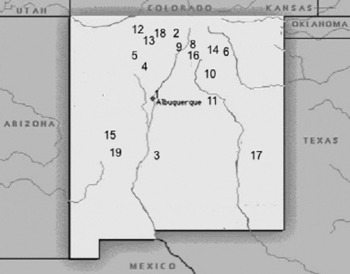
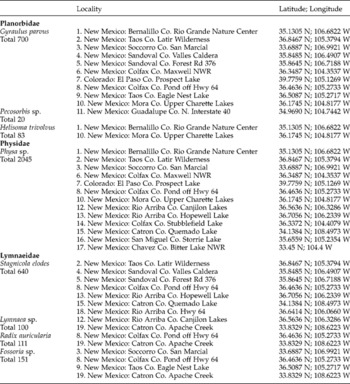
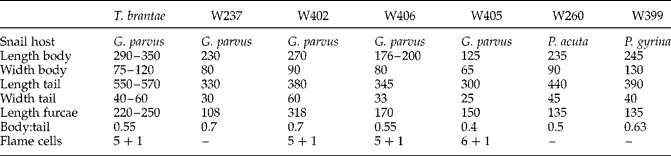
The focus of this survey from 2003 to 2008 was to examine snail intermediate hosts from a variety of habitats and elevations (fig. 1), to document the schistosomes present and thus the potential for swimmer's itch in New Mexico (table 1). Additionally, snails were collected from sites where dermatitis outbreaks were reported in July 2007: Stubblefield Lake, in northern New Mexico, and Prospect Lake, in southern Colorado (table 1). Snails were collected by hand or wire-mesh scoop and kept cool and moist until returned to the lab. Each snail was isolated individually in 24-well tissue-culture plates in artificial spring water and placed in natural light to induce shedding. In most cases, snails shed cercariae within 30 min after being placed in natural light. All schistosome cercariae were first observed and photographed while alive and were then saved in 95% ethanol. Measurements were made on temporary mounts from these samples. Morphological features measured were length of body, tail and furcae; width of body and tail; and number of flame cells.
Map of the state of New Mexico, USA. Numbers correspond to locality data in table 1.

Tally of snails screened and collection localities.

DNA was extracted from fresh or alcohol-fixed worms with HotShot Lysis (Truett et al., Reference Truett, Heeger, Mynatt, Truett, Walker and Warman2000). DNA was amplified by polymerase chain reaction (PCR) (Takara Ex Taq kit, Takara Biomedicals, Otsu, Japan) and sequenced using previously published primers. We used the mitochondrial cox1 and the nuclear marker internal transcribed spacers (ITS) to distinguish species of avian schistosomes, as described in Brant (Reference Brant2007). PCR products were purified with Montage Microcon columns (Millipore, Billerica, Maryland, USA). Sequencing reactions were performed with Applied Biosystems BigDye direct sequencing kit, version 3.1 (Applied Biosystems, Foster City, California, USA). Sequence data will be presented elsewhere. Sequences were used to identify distinct lineages, as delineated by reference to our database of avian schistosomes and to GenBank (Brant et al., Reference Brant, Morgan, Mkoji, Snyder, Rajapakse and Loker2006; Brant, Reference Brant2007; Brant & Loker, Reference Brant and Loker2009).
Results
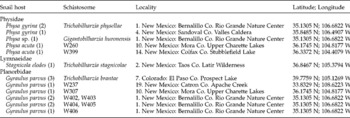
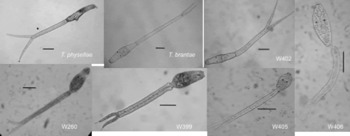
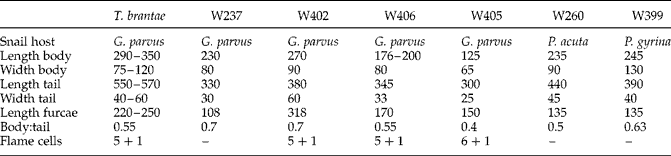
From 2003 to 2008, May–September, approximately 4000 snails of three families and eight species were examined (table 1). Most were collected in New Mexico (fig. 1), but one collection was made from Prospect Lake, in Colorado Springs, Colorado, in response to a dermatitis outbreak. We found a total of 17 snails infected with avian schistosomes (table 2). Note the importance of Gyraulus parvus (Say, 1817) in transmission of the greatest diversity of avian schistosomes in our survey. We found four species previously recognized by both genetic and morphological criteria that are also known to cause dermatitis. They were Trichobilharzia physellae (Talbot, Reference Talbot1936), T. stagnicolae (Talbot, Reference Talbot1936), T. brantae Farr & Blankemeyer, Reference Farr and Blankemeyer1956, and Gigantobilharzia huronensis Najim, 1950. Additionally, we found three genetically distinct lineages, which we were not able to match unequivocally to any species or genus previously described, either with morphological features or by matches with DNA sequence markers (tables 2 and 3; fig. 2). We did find that, morphologically, the cercariae of W404 and W405 most closely matched those of Gigantobilharzia gyrauli Brackett, Reference Brackett1940 (Brackett, Reference Brackett1942). In total, there are at least eight lineages of avian schistosomes occurring in four common species of snails potentially capable of causing cercarial dermatitis in New Mexico.
List of the snail hosts harbouring avian schistosomes. Numbers in parentheses following the name of each snail species represent the number of individuals infected per locality listed. Schistosomes for which a species name could not be assigned are labelled with the sample number and correspond to designations in fig. 2.

Cercarial measurements from ethanol preserved specimens.

Cercarial dermatitis at Stubblefield Lake, Maxwell, New Mexico 2007 and 2008
In July of 2007 there was an outbreak of cercarial dermatitis in Stubblefield Lake, a large impoundment in northern New Mexico. The Centers for Disease Control and Prevention (CDCP) received snails collected from the lake during the outbreak and collected schistosome cercariae from Physa sp. They later sent us an image of the Stubblefield Lake cercaria, which resembles T. physellae (Talbot, Reference Talbot1936) based on size and shape (Talbot, Reference Talbot1936; McMullen & Beaver, Reference McMullen and Beaver1945) and our own reference collection (Brant & Loker, Reference Brant and Loker2009). Cercarial measurements and snail host of origin are not by themselves sufficient to provide a definitive diagnosis, so this identification is considered provisional. We learned of the outbreak 5 days after the CDCP collections had been made, and at that time we collected 448 Physa sp. from the lake as well as 92 Physa sp. and 62 G. parvus from the neighbouring Maxwell National Wildlife Refuge. None of the snails were infected with schistosome cercariae.
In July, 2008, we returned to Stubblefield Lake and collected 125 Physa acuta Draparnaud, 1805. No G. parvus were found. We found one P. acuta (0.8% prevalence) infected with schistosomes, but they were distinctive in morphology and size from the cercariae collected in 2007. Based on genetic data, the cercariae collected in 2008 are of an unknown lineage that thus far has not matched any sequences obtained from adult worms from birds (table 3; fig. 2). However, these cercariae do match (in sequence and morphology) cercariae collected from snails we have collected in other locations in New Mexico and Minnesota (Brant & Loker, Reference Brant and Loker2009).
Cercarial dermatitis at Prospect Lake, Colorado Springs, Colorado 2007
On 19 July 2007, we collected 111 Physa sp. and 442 G. parvus from Prospect Lake. We had recently received reports of an outbreak of cercarial dermatitis at the lake, which lies in the heart of the city of Colorado Springs, Colorado. A public swimming area is present on the west shore of the lake. A flock of Canada geese (Branta canadensis L.) was on the east shore at the time of these collections. Three (0.7% prevalence) G. parvus subsequently shed schistosome cercariae (table 3, fig. 2) that were genetically identical to ITS sequences of morphologically and genetically identified T. brantae adults (Brant & Loker, Reference Brant and Loker2009). Adult worms of this species were originally described from B. canadensis from the eastern USA (Farr & Blankemeyer, Reference Farr and Blankemeyer1956), and we have since found adult worms in the same host species in New Mexico, and in Churchill, Manitoba, Canada (Brant & Loker, Reference Brant and Loker2009). None of the physid snails collected harboured schistosome infections.
Discussion
This survey provides new information regarding the distribution, host-use and diversity of avian schistosomes in south-western North America. One surprising outcome was the high diversity of avian schistosome lineages collected in a relatively low diversity of snail species examined, and the major role of the planorbid snail G. parvus in harbouring that diversity. Other records of schistosomes from Gyraulus Charpentier, 1837, or related small planorbid species in particular, imply that this host family has been heavily utilized by avian schistosomes, not just in North America, but across multiple continents (e.g. Cawston, Reference Cawston1917; Faust, Reference Faust1926; Brackett, Reference Brackett1940; Tanabe, Reference Tanabe1951; Khalifa, Reference Khalifa1972, Reference Khalifa1976; Laman et al., Reference Laman, Daniell and Blankespoor1984; Nassi, Reference Nassi1987, Rind, Reference Rind1991; Kolářová et al., Reference Kolářová, Horák and Sitko1997; Brant et al., Reference Brant, Morgan, Mkoji, Snyder, Rajapakse and Loker2006). With the increasing use of gene sequencing to provide consistent and solid markers for species identification, we are increasingly able to recognize the full spectrum of schistosome diversity, which will be invaluable to evaluating informative morphological characteristics essential for species diagnosis.
Compared to the northern latitudes of the USA, where cercarial dermatitis is a common summertime occurrence (Cort, Reference Cort1950), the relatively arid southwest hardly seems a likely place for this water-borne ailment to occur with any frequency. However, the past several years have seen reports of outbreaks of swimmer's itch in the southwest (though not in the primary literature), with the most notable outbreak occurring in Lake Mead in Arizona/Nevada (National Park Service). Recently, in 2007, outbreaks were reported in northern New Mexico and in central Colorado. There is nothing about the circumstances in these areas to suggest that such outbreaks will not recur: many freshwater habitats, mostly man-made, are present that support both the necessary vertebrate and snail hosts in abundance, and human water contact with such habitats is extensive and likely to become even more so as we continue to alter our water systems. Our survey has uncovered a diversity of avian schistosomes from such habitats, implying that the requirements needed for future dermatitis outbreaks in the southwest are present.
Based on our observations to date, there are some notable contrasts in the epidemiology of cercarial dermatitis in northern versus south-western areas of North America, much of this due to differences in the snail host species most often implicated in outbreaks. Cercarial dermatitis in the northern latitudes is typically caused by schistosomes that use snails of the family Lymnaeidae as intermediate hosts (Cort, Reference Cort1950). In New Mexico, we found that Physa gyrina (Say, 1821), P. acuta, and G. parvus are the snails used most commonly as intermediate hosts, but we did collect a single lymnaeid snail (Stagnicola elodes Say, 1821) with a schistosome infection (Brant & Loker, Reference Brant and Loker2009). Comparing schistosome prevalence in snails we collected in northern states (Minnesota, Michigan, Montana) to the south-western states (New Mexico, Colorado, California, Nevada) shows the following values: for lymnaeids 4.5% versus 0.11%, physids 0.3% versus 2.2% and planorbids 1.1% versus 2.8%, respectively. Here it is important to note that both physids and gyraulids can also be involved in cercarial dermatitis outbreaks in northern locations as they are also abundant there (Brant, unpublished). Physids are ubiquitous and speciose throughout North America and a few species have a cosmopolitan distribution (Taylor, Reference Taylor2003).
Another important difference between northern and south-western areas has to do with the body sizes of the snails supporting schistosome development, and the aggregate numbers of cercariae they release. Physa sp., and especially Gyraulus sp., are smaller snails than species of Lymnaea Lamark, 1799 and Stagnicola Jeffreys, 1830, which are more commonly implicated in the north. For example, the greatest shell dimension for G. parvus, P. gyrina, Stagnicola elodes and Lymnaea stagnalis L. are about 0.5 cm, 2.7 cm, 3.6 cm, and 5.0 cm, respectively (Burch, Reference Burch1989). While screening the snails, we noticed that smaller snails shed fewer cercariae per snail than the larger-bodied lymnaeid snails. For example, our experience with infected G. parvus indicates they will release fewer than 15 cercariae per day whereas L. stagnalis will consistently release several hundred cercariae per day. From an epidemiological point of view, for an outbreak to occur resulting from schistosomes transmitted by either species of Physa or Gyraulus, either the densities of infected snails present must be much greater than required for species of Lymnaea or Stagnicola, or the water volumes have to be considerably reduced or transmission confined to a restricted location where human water contact happens to be high (as around a dock or boat ramp). For example, in Prospect Lake, the tiny G. parvus was present by the hundreds on rocks and concrete surfaces near the swimming area.
Definitive hosts also play an important role in establishing the outbreak potential of a particular area. All of the avian schistosomes collected so far in North America that use lymnaeid snails as intermediate hosts use ducks as a definitive host (Brant & Loker, Reference Brant and Loker2009). This differs from schistosomes dependent on physid and planorbid snails, for which the definitive hosts are ducks, but also geese, passerine birds (e.g. red-winged blackbirds), and a diversity of other water birds (e.g. grebes). Ducks and geese often aggregate on particular lakes (many used for recreaction) in huge numbers during migratory seasons and release massive numbers of eggs, resulting eventually in infection of many snails and a concomitantly higher potential for dermatitis outbreaks, whereas other water birds, such as grebes, do not attain large aggregate numbers, especially in the southwest.
Numerous additional factors also influence the occurrence, timing and length of outbreaks (e.g. Leighton et al., Reference Leighton, Zervos and Webster2000; Levesque et al., Reference Levesque, Giovenazzo, Guerrier, Laverdiere and Prud'Homme2002; Verbrugge et al., Reference Verbrugge, Rainey, Reimink and Blankespoor2004a, Reference Verbrugge, Rainey, Reimink and Blankespoorb). Contributing factors are eutrophication that increases algae or aquatic plant populations, thus favouring increases in snail densities (Lindblade, Reference Lindblade1998), and concentrated use by both waterfowl and humans. Water shortages in the future could create greater need for irrigation, particularly in arid regions. The increase in man-made lakes and ponds in the southwest (many of which do not freeze in the winter) has increased the number of resident ducks and geese. These resident birds are further encouraged to stay by people feeding them, especially during the winter. The prolonged presence of birds increases both the likelihood that schistosome life cycles become established in snails and the amount of faeces deposited in the water, which contributes to habitat eutrophication (Unckless & Makarewicz, Reference Unckless and Makarewicz2007) and increases in snail populations. The role of birds as ‘nutrient vectors’ has been noted in New Mexico (Post et al., Reference Post, Taylor, Kitchell, Olson, Schindler and Herwig1998). Given our increased understanding of the potential health impacts of avian schistosomes and that changing ecological circumstances are likely to favour continued and increased exposure, it is important that we continue to apply new approaches to understanding the constellations of hosts and parasites involved, so we can achieve a more complete and accurate picture of the epizootiology of cercarial dermatitis.
Acknowledgements
We appreciate the co-operation and help of Judy Espinoza of New Mexico State Department of Health and Bernadette Albanese of El Paso County Department of Health and Environment, Colorado. We thank people in the Loker lab and Robin Loker for their participation in collecting snails. We thank two anonymous reviewers for their helpful suggestions that improved this manuscript. We acknowledge technical support from the University of New Mexico's Molecular Biology Facility, which is supported by NIH Grant Number 1P20RR18754 from the Institute Development Award (IDeA) Program of the National Center for Research Resources. This study was supported by funds provided by the College of Arts and Sciences at UNM and NIH grant RO1 AI44913 and P20 RR018754.