Introduction
The optical properties of glass are highly correlated with the incorporated dopants. In the early 1960s, Reference Snitzer1 scientists tried rational incorporation of Nd3+ dopant as the active ion in glass in order to realize laser operation. In the following decades, several research teams constructed various rare-earth ion-, transition-metal ion-, and other metal ion-activated photonic glasses, with the spectral range covering the ultraviolet, visible, and infrared waveband regions (270–4500 nm). Reference Balda, Fernandez and Illarramendi2–Reference Jackson12 Since then, impurity doping in glasses has emerged as a topical area across multiple disciplines, including materials science, condensed-matter physics, and photonics.
The significant issues lying at the heart of doping science in glass include (1) rational control over the chemical state of the dopant in the target matrix and (2) effective modulation of the ligand field around the dopant to achieve the desired spectroscopic features. Rare-earth ions show a relatively stable oxidation state in glass and their typical f orbital only weakly interacts with the matrix lattice. In this case, the doping methodology mainly involves handling the dopant–dopant and dopant–host interactions to avoid unexpected emission quenching. For example, the stabilization mechanism of rare-earth ions in glass has been clarified based on the local charge neutrality principle. Reference Arai, Namikawa, Kumata, Honda and Ishii13,Reference Funabiki, Kamiya and Hosono14 That is, the positive charges of rare-earth dopant must equal the sum of negative charges around it. Studies have illustrated various ways of enhancing dopant solubility and radiative transition probability. Reference Auzel and Goldner15 In stark contrast, transition-metal and other nonconventional metal dopants are more sensitive to the host, primarily because of their own rich chemical states and because their outermost orbital (d orbital for transition-metal ions and p orbital for p-block metal ions) strongly interacts with neighboring ions or molecules. Reference Zhou, Jiang, Yang, Zhu, Ye, Lakshminarayana, Hao and Qiu8,Reference Zhou, Jiang, Wu, Hao and Qiu9 Although these active ions show fascinating emission properties and are widely recognized as the key active centers of next-generation photonic glasses, grand challenges remain for better control of these dopants. Reference Zhou, Guo, Inoue, Ye, Masuno, Zheng, Yu and Qiu16 Here, we provide an overview of recent progress on control over the chemical state and ligand fields of dopants in glass through topological engineering.
Topological approach
The structure of glass is characterized by the absence of long-range order and the presence of rich short- and medium-range order. In this sense, topological structure plays a critical role in defining the properties of glass. Topological approaches to correlate the thermal, mechanical, and rheological properties of glasses with their structural parameters have been widely studied, and encouragingly, the approaches have been demonstrated to be successful. Reference Phillips17–Reference Zeng, Jiang, Liu, Li, Ren, Chen, Liu and Peng21 Moreover, several typical topological features such as packing density, sublattices, and hybrid networks have also been identified. Reference Wondraczek, Mauro, Eckert, Kühn, Horbach, Deubener and Rouxel22
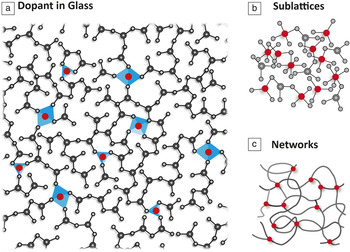
For photonic glasses, especially luminescent glasses, the incorporated dopants are embedded in the host and connect with other glass network modifiers or formers to form various unique topological units, as shown in Figure 1 . Inspired by this fact, Zhou and co-workers proposed that microscopic physics governing the optical properties of glass can be described based on the topological approach. They extended the topological strategy to photonic glass, and demonstrated success in modulating the chemical state of dopants and tuning the local crystal field around active dopants. Reference Zhou, Guo, Inoue, Ye, Masuno, Zheng, Yu and Qiu16,Reference Guo, Xu, Tan, Wang, Zheng, Jiang, Qiu and Zhou23–Reference Zhou, Li, Yang, Bi, Xu, Hong, Miura, Hirao and Qiu25
Schematic illustration of the (a) dopant in glass and various topological units in doped glass. Doping engineering can be potentially realized through tuning the (b) sublattices and (c) networks of glass.

Topological engineering for modulating chemical state of dopants
The glass matrix is special because it is formed by imposing various topological constraints on a liquid. Based on this distinct feature, it was proposed that the glass itself can be treated as a “microreactor” and topology constraints as “switches” for controlling chemical processes, including the chemical-state evolution of dopants. Reference Zhou, Jiang, Yang, Zhu, Ye, Lakshminarayana, Hao and Qiu8,Reference Zhou, Guo, Inoue, Ye, Masuno, Zheng, Yu and Qiu16 This is scientifically interconnected to the intercalation reaction in chemistry, where the chemical state of the guest dopants can be tuned by controlling the host lattice.
Recently, the effectiveness of the topological approach was experimentally demonstrated. Reference Zhou, Guo, Inoue, Ye, Masuno, Zheng, Yu and Qiu16 Bi was employed as the prototypical dopant because of the richness of its chemical state and intriguing optical functions. Bi-doped borate (BO), borosilicate (BSO), and silicate (SO) glasses were chosen as the typical hosts due to their notable contrast in topological features. The topology-dependent chemical state evolution was studied by heat treating the samples at the glass-transition temperature to allow for spontaneous activation and relaxation.
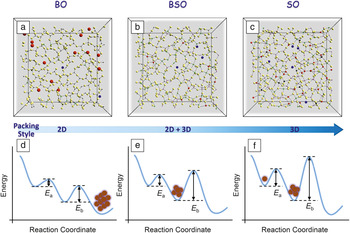
It is significant that various metastable Bi dopants over a wide range of length scales, from dispersed ions to aggregated clusters to nanoparticles, can be obtained in SO, BSO, and BO samples, respectively. The physical mechanism is believed to be associated with the network topology-dominated chemical-state evolution; a qualitative explanation is given in Figure 2 . Molecular dynamics (MD) simulations clearly indicate that the networks of investigated samples exhibit the transformation from quasi-two-dimensional to three-dimensional topological configuration (Figure 2a–c). At the same time, it should be noted that the packing density also exhibits a sharp increase. Under a viscosity of 1012 Pa·s at T g, the glass-transition temperature, it is well known that ionic diffusion exhibits strong hopping barrier dependence. The topological feature and packing density change from BO to BSO to SO may lead to remarkable enhancement of the hopping barrier, resulting in the stabilization of large Bi particles in BO, and relatively small Bi clusters or Bi ions in BSO and SO. Based on this fact, one can precisely manipulate the chemical state of dopants through the topological approach.
(a–c) Molecular dynamics simulation giving 3D models of borate (BO), borosilicate (BSO), and silicate (SO) glasses. (d–f) Schematic diagrams indicating the qualitative energetics of chemical state evolution of a dopant in the BO, BSO, and SO samples. Note: E a and E b, hopping barrier of diffusion. Reference Zhou, Guo, Inoue, Ye, Masuno, Zheng, Yu and Qiu16

The Zhou topological approach is also useful for other dopants in glass. Reference Guo, Liu and Zhou26 For example, the optical properties of rare-earth ions (Er3+, Nd3+, and Tm3+) in the BO, BSO, and SO samples were examined. Importantly, it is observed that the steady-state luminescence and decay dynamics of these active dopants also present strong topological feature dependence. The emission intensity of their near-infrared band is more than one order of magnitude higher than that in the BO and BSO samples. Moreover, the decay dynamics study also showed a notable extension in decay lifetime, indicating the success in cluster-prevention of dopants.
The proposed topological approach may upgrade the performance of doped photonic glass. The homogeneous doping of active ions in a glass matrix can greatly enhance radiative transition probability, thus potentially increasing the output power of a fiber laser. The approach can also introduce new functionalities into glass, such as the pronounced extension in optical amplification bandwidth and a prominent nonlinear effect. It should be noted that newly developed glasses, which potentially exhibit a broadband gain from 1050 nm to 1425 nm with bandwidth of ∼75 THz, could lead to a breakthrough in the transmission capacity of optical communications systems. Reference Zhou, Dong, Zeng, Feng, Yang, Zhu and Qiu6 The breakthrough is particularly promising for dealing with the “capacity crunch” problem in optical telecommunications, which could severely constrain future Internet growth. Reference Zhou, Dong, Zeng, Feng, Yang, Zhu and Qiu6,Reference Zhou, Dong, Zeng, Hao, Chen and Qiu27,Reference Richardson28
Topological engineering for modulating chemical environment of dopants
On the one hand, glass compositions are widely tunable in terms of chemistry due to their amorphous nature, leading to the availability of unique sublattices in glass. On the other hand, the spectroscopic features of doped photonic glasses are greatly affected by the surrounding ligand field around dopants. Based on these facts, it can be anticipated that the rich topological structure offers excellent opportunities for rationally tailoring the chemical environment of dopants and the corresponding optical properties.
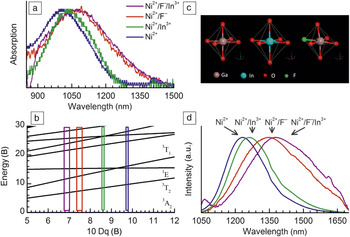
Recent progress in the development of transition-metal ion-doped glasses has been demonstrated by several excellent examples concerning topological engineering for modulating the chemical environment of dopants. A thorough study on a typical transition-metal ion (Ni2+)-doped glass was carried out in a recent study, Reference Zhou, Li, Yang, Bi, Xu, Hong, Miura, Hirao and Qiu25 where SiO2 was chosen as the basic backbone of a glass network and various structural units (e.g., -Ga-O-, -In-O-, -F) were added. Glass relaxation was initiated to induce partial crystallization and Ni2+ ions were expected to be selectively incorporated into the nanocrystalline phase with high activation rates. A careful inspection of the electronic transition from the Reference Samson, Pinckney, Wang, Beall and Borrelli3 A2(F) ground state to the Reference Samson, Pinckney, Wang, Beall and Borrelli3 T2(F) excited state of Ni2+ in the 900–1200 nm wavelength region showed an interesting topological structure-dependent absorption feature. Hybridization of glass with In3+, F–, and an In3+/F– combination notably shifted the absorption band of Ni2+ to longer wavelengths ( Figure 3a). Moreover, a prominent extension of the absorption band was also observed in the F–-containing sample.
(a) Enlarged and normalized absorption spectra of Ni2+ in Ni2+-, Ni2+/In3+-, Ni2+/F–- and Ni2+/ F–/In3+-doped glass system in the 850–1500 nm wavelength region. (b) Ligand field energy-level diagram for d Reference Zhou, Jiang, Yang, Zhu, Ye, Lakshminarayana, Hao and Qiu8 ions, in which the marked squares indicate the crystal field of Ni2+ in Ni2+-, Ni2+/In3+-, Ni2+/F–-, and Ni2+/ F–/In3+-doped glasses. Note: Dq, crystal field strength; B, Racah parameter. (c) Density functional theory calculation results showing the sublattice change. (d) Tunable luminescence from 1200, 1250, 1350 to 1400 nm in Ni2+-, Ni2+/In3+-, Ni2+/F–- and Ni2+/F–/In3+-doped glasses. Reference Zhou, Li, Yang, Bi, Xu, Hong, Miura, Hirao and Qiu25

We calculated the electronic level configuration of Ni2+ in these samples. As shown in Figure 3b, the marked squares represent the locations of energy levels of Ni2+ in Ni2+-, Ni2+/In3+-, Ni2+/F–, and Ni2+/In3+/F–-doped glasses, showing the tunable feature of the electronic structure of Ni2+ in glass. The results clearly indicate that chemical environment of dopants can be effectively modulated via the topological engineering method.
The fundamental physical mechanism of topological engineering for modulating the chemical environment of dopants can be understood via sublattice analysis. First-principles calculations based on density functional theory show that the introduction of In3+ perturbs lattice perfection, leading to prominent lattice expansion with increasing average cation-anion distance from 2.031 Å to 2.441 Å and a slight fluctuation of bond angle (∼1.677°) (Figure 3c). Reference Zhou, Li, Yang, Bi, Xu, Hong, Miura, Hirao and Qiu25 In addition, replacement of O2– by F– leads to profound ligand distortion with the average bond angle change estimated to be around 6.495° after incorporation of F– (Figure 3c). This is probably associated with the notable difference in electronegativity (χ) between O (χ = 3.44) and F (χ = 4). According to ligand-field theory, Reference Ballhausen29 the energy-level configuration of transition-metal ions is sensitive to the metal-ligand distance and the symmetry of the ligand. As a result, the spectral features and the optical performance can be rationally engineered through topological structure design. This principle is believed to be applicable to photonic glasses activated by other transition-metal dopants. For example, the chemical environment of Cu2+ ions in sodium borate glass was modified through codoping with various species such as Al3+, Si4+, P5+, Zr4+, and La3+. Reference Funabiki, Matsuishi and Hosono30 Moreover, the sublattice of Ni2+-doped glass was predesigned to achieve tunable spectral features. Reference Zhou, Jiang, Wu, Hao and Qiu9,Reference Zhou, Jiang, Dong, Zeng, Hao and Qiu31–Reference Yu, Fang, Ma, Inoue, Yang, Zheng, Chen, Yang, Masuno, Orava, Zhou and Qiu35
The success in modulating the chemical environment of dopants through topological engineering allows for obtaining new photonic glasses with various intriguing optical properties. For example, Ni2+-activated glasses show intense near-infrared luminescence from 1100–1700 nm. More importantly, the emission can be continuously tuned from 1200, 1250, 1350 to 1400 nm in Ni2+-, Ni2+/In3+-, Ni2+/F–-, and Ni2+/F–/In3+-doped glass systems, respectively (Figure 3d). Most recently, an extremely broad bandwidth up to ∼480 nm was reported in Ni2+-doped tantalate glass, which is the largest value ever reported in doped glass to date. Reference Yu, Fang, Ma, Inoue, Yang, Zheng, Chen, Yang, Masuno, Orava, Zhou and Qiu35 The observed optical properties in these glasses are especially interesting since they have provided the first observations of effective light-emitting management covering the entire telecommunication low-loss window (1200–1600 nm) through topological engineering.
Conclusions
Topological engineering of doped photonic glasses provides a unique opportunity for basic research on doping control in glass and for the development of novel photonic materials. The ability to tune the chemical state and local chemical environment of dopants allows the pursuit of novel gain materials with outstanding performance such as enhanced radiative transition, notable extension in emission bandwidth, and additional functionalities. Moreover, due to the wide applicability of the concept in engineering a wide range of dopant-dependent properties such as photonic, magnetic, electrical, and even catalytic properties, we believe that the study of topological engineering in glass will have a strong impact on materials science, photonics, condensed physics, chemistry, and various other related areas.
Acknowledgments
The authors gratefully acknowledge financial support from the National Natural Science Foundation of China (Grant 11474102), the National Science Fund for Excellent Young Scholars of China (Grant 51622206), Chinese Program for New Century Excellent Talents in University (Grant NCET-13–0221), Guangdong Natural Science Funds for Distinguished Young Scholar (Grant S2013050014549), Fundamental Research Funds for the Central University, and the Tip-Top Scientific and Technological Innovative Youth Talents of Guangdong Special Support Program (Grant 2015TQ01C362).

Shifeng Zhou has been a full professor in the State Key Laboratory of Luminescent Materials and Devices, Guangdong Engineering Technology Research and Development Center of Special Optical Fiber Materials and Devices, Guangdong Provincial Key Laboratory of Fiber Laser Materials and Applied Techniques, School of Materials Science and Engineering at South China University of Technology, China, since 2013. He received his PhD degree in materials science and engineering from Zhejiang University, China, in 2008. He was an associate professor at Zhejiang University from 2011 to 2013. He is the 2012 recipient of the Motoharu Kurata Award of The Ceramic Society of Japan. His current research focuses on photonic glasses and glass ceramics. Zhou can be reached by phone at +86 20 87113646 or by email at zhoushifeng@scut.edu.cn.

Jianrong Qiu is the Qiushi Chair Professor in the College of Optical Science and Engineering, Zhejiang University, China. He received his PhD degree in materials science and engineering from Okayama University, Japan, in 1992. He was a group leader at the Japan Science and Technology Agency, full professor at the College of Materials Science and Engineering at Zhejiang University, and chair professor of Cheung Kong Scholars Programme at South China University of Technology. He is the recipient of the Adachi Award from the Rare-Earth Society of Japan, Academic Award of the Japanese Ceramic Society, Otto-Schotto Research Award from the Abbe Fund, and the G.W. Morey Award from The American Ceramic Society. His current research focuses on photonic materials and light interaction with matter. Qiu can be reached by phone at 86-571-88925079 or by email at qjr@zju.edu.cn.