INTRODUCTION
Pathogens may cause dramatic declines even in healthy populations, and small or endangered populations are especially vulnerable (Gozlan et al. Reference Gozlan, St-Hilaire, Feist, Martin and Kent2005). Particularly problematic for conservationists is the occurrence of novel host-parasite interactions that arise if a parasite extends its host or geographical range. For example, Anguillicola crassus, a parasite from the Far East, caused few serious health problems to its native host but since expanding its geographical range into Europe, has been found to be highly pathogenic to European eels (Kirk, Reference Kirk2003). Despite strict legislation controlling the transfer of fish stocks for food or ornamental purposes this may also lead to the introduction of novel parasites to native hosts. For example, Gyrodactylus salaris is relatively benign on Baltic salmon stocks but has decimated North Atlantic stocks of this fish following its accidental introduction into Norway (reviewed by Bakke et al. Reference Bakke, Cable and Harris2007). Sunbleak (Leucaspius delineatus) have been established in the UK since their introduction in the mid-1980s (Gozlan et al. Reference Gozlan, Flower and Pinder2003), and are reportedly intermediate hosts for certain opisthorchiid digeneans. Recently 2 exotic crustacean parasites, Neoergasilus japonicus from Asia and Ergasilus briani from mainland Europe, have been detected on this fish (Beyer et al. Reference Beyer, Kochanowska, Longshaw, Feist and Gozlan2005). The ability of sunbleak to spread rapidly probably contributes to the dispersal of novel parasites throughout UK watercourses. Simpson et al. (Reference Simpson, Gibbons, Khalil and Williams2005) suggested that the digenean, Pseudamphistomum truncatum, was introduced into the UK with ornamental non-native fish, namely the sunbleak and topmouth gudgeon (Pseudorasbora parva), and could easily spread to other teleosts.
Pseudamphistomum truncatum is a gall bladder digenean native to Eastern Europe and common in a range of wild carnivores (Simpson et al. Reference Simpson, Gibbons, Khalil and Williams2005). It was first reported in Britain following examination of otter carcasses collected in Somerset in 2004 (Simpson et al. Reference Simpson, Gibbons, Khalil and Williams2005). Otters have been examined post-mortem since 1988, and retrospective assessment of previous records in the southwest of England showed abnormal gall bladders in a further 7 cases, the first of which was collected in 2000 (Simpson et al. Reference Simpson, Gibbons, Khalil and Williams2005). In contrast, Metorchis albidus is native to Europe (Bowman et al. Reference Bowman, Hendrix, Lindsey and Barr2002) but is rarely reported in otters (but see Sidorovich and Anisimova, Reference Sidorovich and Anisimova1999). This parasite has not previously been recovered from otters in the UK. Life-cycles specific to P. truncatum and M. albidus are not described in the literature but an account of similar species is given in Chandler and Read (Reference Chandler and Read1961). Opisthorchiids typically have 2 intermediate hosts; the first is commonly a species-specific gastropod (Prosobranchia) mollusc and the second a freshwater fish. The parasites reach the definitive host through consumption of infected fish and migrate to the gall bladder where they mature (Sukhdeo and Sukhdeo, Reference Sukhdeo and Sukhdeo2004). Both P. truncatum and M. albidus are generalists, potential parasites of a wide range of carnivores, including the red fox (Saeed et al. Reference Saeed, Maddox-Hyttel, Monrad and Kapel2006), mink, otters (Simpson et al. Reference Simpson, Gibbons, Khalil and Williams2005) and domestic cats (Nielsen and Guidal, Reference Nielsen and Guildal1974), with the potential to infect any piscivore including man (Simpson et al. Reference Simpson, Gibbons, Khalil and Williams2005).
The otter (Lutra lutra) is a European protected species, listed as near threatened on the IUCN Red List of Threatened Species. Populations declined severely during the 1960s and 70s (Chanin and Jefferies, Reference Chanin and Jefferies1978), but are generally believed to have made a strong recovery over the past 2 decades. Long-term studies reveal otter populations to be healthy with little indication of disease (Simpson, Reference Simpson2007), but recent detection of P. truncatum has raised concern (Simpson et al. Reference Simpson, Gibbons, Khalil and Williams2005). The Cardiff University Otter Project (CUOP) receives otter carcasses from across England and Wales for post-mortem (1994 to present). As part of a long-term study on otter ecology, we report here for the first time the presence of M. albidus in the UK and present a more detailed account of the distribution of P. truncatum.
MATERIALS AND METHODS
Sample collection
Following Simpson et al.'s (Reference Simpson, Gibbons, Khalil and Williams2005) publication, 273 gall bladders were retained from otter carcasses received by CUOP, and stored at −18°C. These otters were found dead between January 2003 and June 2008, most as road kills, and all from England and Wales.
Microscopy
Gall bladders were defrosted, immersed in 0·6% saline in a Petri dish, punctured and inverted, and examined under a Nikon dissecting microscope at ×30 magnification with fibre optic illumination. In humans and experimental animals, opisthorchiid parasites cause symptomatic damage to the gall bladder and bile ducts over the time-course of infection (Sripa et al. Reference Sripa, Kaewkes, Sithithaworn, Mairiang, Laha, Smout, Pairojkul, Bhudhisawasdi, Tesana, Thinkamrop, Bethony, Loukas and Brindley2007). Sripa and Kaewkes (Reference Sripa and Kaewkes2000) infected hamsters with Opisthorchis viverrini and found that an initial inflammatory response (due to a host cellular response and/or mechanical damage by parasite movement) was followed by periductal fibrosis in chronic infections. In the current study, histopathology of the gall bladder and bile ducts was not possible due to cell damage inflicted by the freezing process. However, a condition score of 1 to 5 (1 corresponding to a healthy gall bladder lining, 2 characterized by low level inflammation and 3–5 representing progressively more fibrous tissues) was used to describe the internal lining of the gall bladder. Parasites were then removed, counted and stored in 90% ethanol at −18°C, for identification and archiving. Samples were only recorded as positive if a parasite was found, because other factors (such as gall stones) related to dietary or genetic conditions, may also cause thickening and inflammation of this tissue.
Preliminary parasite identification was based on morphometric characteristics following Yamaguti (Reference Yamaguti1958) before multiple samples were sent to the Natural History Museum, London, for specialist identification.
Statistical analysis
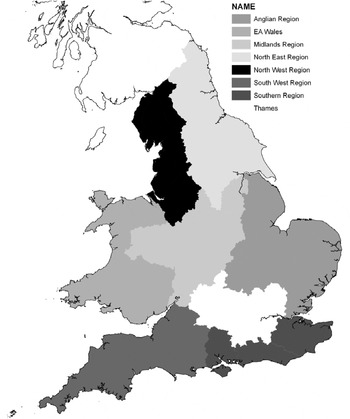
Parasite prevalence was plotted using ArcMap GIS and this was used to describe the distribution of each parasite. A bootstrap confidence interval for mean intensity was calculated for both parasites using the statistical package R version 2.8. The Environment Agency separates England and Wales into 8 ecological regions (Fig. 1) based on river catchments. Parasite prevalence across regions and between seasons was examined using the Chi-square test for association; parasite intensity across regions and seasons was examined using Kruskal-Wallis tests.
Environment Agency defined regions in England and Wales.

Due to the large number of tied observations in the prevalence and intensity data, neither variable could be normalized, so it was not possible to fit linear models. Chi-squared tests were used to compare prevalence of infections in male and female hosts, and adult, subadult and juvenile hosts. Kruskal-Wallis tests were used to examine differences in the intensity of infection between sexes and age-classes. Data for both sexes were subsequently combined after testing for differences between male and female infections. Spearman's Rank Correlations were used to examine the relationship between host size (body weight and total length) and parasite intensity. Temporal variation in parasitic infection levels were compared using Chi-squared tests, between 2005 and 2008, excluding those animals from Dorset, Somerset, Avon, Wiltshire and Hampshire because hosts from these areas were only included in the study from 2007 onwards. Finally, the same tests were used to examine the relationship between prevalence and intensity of infections with gall bladder condition.
The spatial distribution of each parasite was assessed for clustering using a modified Ripley's K statistic, K[i.](r), with Ripley's isotropic edge correction (Ripley, Reference Ripley1988). Boundaries were defined as a simplified coastal border of England and Wales. Chance distribution of the location of infections was simulated (for 1000 iterations) by maintaining the position of events whilst randomizing labels (presence or absence of parasite) to examine the extent of spatial clustering at the 95% confidence level. The estimated isotropic function is compared to the theoretical function under the null hypothesis of complete spatial randomness of parasite presence in the data set. Positive autocorrelation in parasite distribution was quantified by testing for the presence of clustering in sequentially increasing radii (1–131 km) around each data point. All statistical analysis was conducted using ArcGIS 9.1 and R version 2.8 (R Development Core Team, 2008).
RESULTS
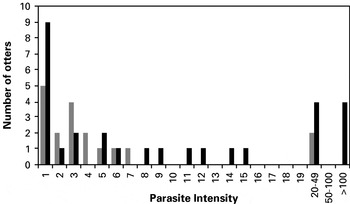
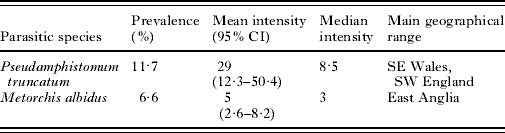
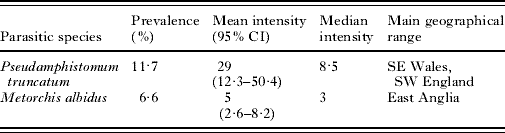
Two parasite species, Pseudamphistomum truncatum (11·7%) and Metorchis albidus (6·6%), were detected in the gall bladders of otters collected from across England and Wales, with an overall prevalence of 18·3% (50 out of 273 samples). Table 1 shows the prevalence, mean intensities and geographical ranges for each parasite species. Figure 2 describes the frequency distribution of the 2 parasite species. A co-infection of P. truncatum and M. albidus was recorded in just 1 host, which harboured 1 P. truncatum and 7 M. albidus adult specimens. This female otter had been collected in East Anglia (NGR TG304087), and interestingly only 1 other otter from East Anglia was infected with P. truncatum.
Frequency distribution of Pseudamphistomum truncatum (black bars) and Metorchis albidus (grey bars) in the Eurasian otter population of England and Wales.

Overall parasite load of gall bladders from otters collected from across England and Wales between 2003 and 2008 (N=273)
(Shown are sample size, prevalence, mean intensity with upper and lower 95% bootstrap confidence interval (10 000 iterations), median intensity and main geographical range.)
Host sex and age
There was no significant difference in prevalence of P. truncatum or M. albidus between male and female hosts (d.f.=1; χ2<0·6; P>0·4 for each parasite). Similarly, there was no significant difference in median intensity of infections between sexes or age-classes for either parasite (Kruskal-Wallis test; d.f.=1; P>0·05 in each case). Prevalence of parasitic infection in adults (N=147) (15% infected with P. truncatum; 8·2% infected with M. albidus) was greater than subadults (N=114) (8·8% P. truncatum; 5·3% M. albidus), but this was not significant (d.f.=2; χ2<4; P>0·1 for each parasite). No juvenile otters were infected (N=14). There was no significant correlation between parasite intensity and host weight (rs=−0·067; P=0·646; N=31), or length (rs=−0·186; P=0·233; N=43). The lack of significant results may be due to the small sample sizes in this study.
Geographical, seasonal and temporal distribution
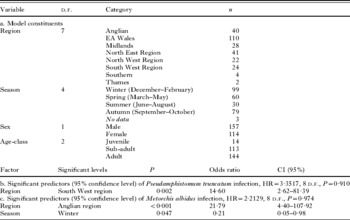
Binary logistic regression revealed that P. truncatum was over-represented in the Southwest Region (Table 2). Metorchis albidus was over-represented in the Anglian region and more likely to be found in winter (Table 2). Intensity of parasite infections did not vary significantly between regions or seasons (Kruskal-Wallis test; d.f.=7; P>0·4 for regions and d.f.=3; P>0·3 for seasons for each parasite). Spatial analysis indicated that neither P. truncatum nor M. albidus infections showed evidence of spatial clustering.
Composition of the binary logistic regression model and significant predictors for infection with gall bladder digeneans Pseudamphistomum truncatum and Metorchis albidus (based on Morgan et al. Reference Morgan, Tomlinson, Hunter, Nichols, Roberts, Fox and Taylor2008)
(HR, Hosmer-Lemeshow goodness of fit Chi-square statistic, d.f., degrees of freedom, CI, 95% confidence intervals.)

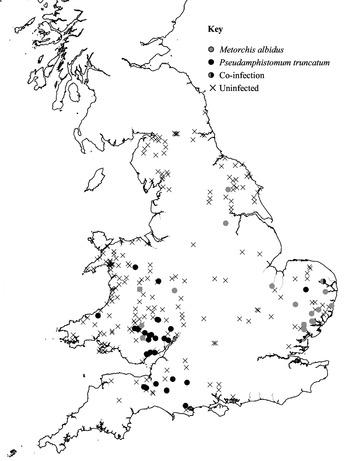
Parasites were not detected in the North West region. During the course of the study, only 4 otters were received from the Southern region, 2 from Thames region and none from west of Somerset (Cornwall and Devon) so parasite prevalence in these areas is unknown (Fig. 3) although Simpson et al. (Reference Simpson, Tomlinson and Molenaar2009) found no parasites in Cornwall in a parallel study (n=22). There was no difference in parasite prevalence between 2005 and 2008 for M. albidus (χ2=2·194; d.f.=3; P=0·533) or P. truncatum (χ2=2·228; d.f.=3; P=0·526).
Location of infected and uninfected otters across England and Wales: Metorchis albidus infections are shown in grey, Pseudamphistomum truncatum infections are shown in black and uninfected hosts are marked with a cross.

Host pathology
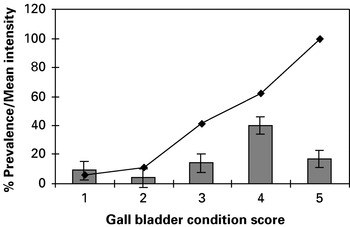
A large proportion (70%) of infected gall bladders were thickened, fibrous or inflamed. Infected hosts had gall bladders in the poorest condition (χ2=54·48; d.f.=4; P<0·001); the more fibrous gall bladders, condition classes 4 and 5, having most parasites (Fig. 4). Gall bladder condition degraded with parasite intensity (χ2=132·26; d.f.=4; P<0·001). This relationship held true even after removing the most heavily infected gall bladder (N=238 parasites) that doubled the total number of parasites in class 4. However, 18% of gall bladders with pathological damage lacked parasites and 30% of infected hosts showed no signs of gall bladder pathology.
The percentage prevalence (line) and mean intensity (grey bars with standard error bars) of parasite infections (both Pseudamphistomum truncatum and Metorchis albidus) in UK otters (Lutra lutra) in relation to gall bladder condition (ranging from 1 – healthy – to 5 – extremely fibrous and thickened).

DISCUSSION
Two species of opisthorchiid digeneans were found in UK otters. Pseudamphistomum truncatum has previously been described (Simpson et al. Reference Simpson, Gibbons, Khalil and Williams2005, Reference Simpson, Tomlinson and Molenaar2009), but here Metorchis albidus is recorded in the UK for the first time. As far as we are aware there is only one other report of M. albidus in otters; Sidorovich (Reference Sidorovich1997) found the parasite in Belarusian otters autopsied between 1960 and 1980. In a more recent study of mustelids autopsied between 1987 and 1995 in Belarus, M. albidus was found in a single mink (Mustela lutreola) (n=17), but was absent from the otters examined (n=38) (Sidorovich and Anisimova, Reference Sidorovich and Anisimova1999).
There is a marked difference in the spatial distribution of P. truncatum and M. albidus suggesting they were independently introduced to different locations across the UK and, possibly, on multiple occasions. The lack of clustering may be, in part, due to the limited data-points across central areas of England. Simpson et al.'s (Reference Simpson, Gibbons, Khalil and Williams2005) retrospective examination of post-mortem reports from otters in the southwest indicated that P. truncatum was not present in that area prior to 2000. Unfortunately, no gall bladder samples were retained by Cardiff University Otter Project prior to 2005 so it is not possible to infer whether the infections in Wales pre- or post-date those in the Southwest. The cases of M. albidus in Anglian region are interesting; during the 1990s there were multiple re-introductions of otters into this region (Copp and Roche, Reference Copp and Roche2003). Although little is known about the origin of these otters, it is possible that some were relocated from or exposed in captivity to food sourced from mainland Europe, where M. albidus is prevalent in red fox (Vulpes vulpes). The most recent case, outside East Anglia, was in the Derwent Catchment in the north east of England (in March 2008) where rehabilitated otters are known to have been released in the past (Woodroffe, Reference Woodroffe1998). Movement of fish stocks, sediment (containing parasite eggs or gastropods reported to host larval digeneans, such as Bithynia spp. (Morley et al. Reference Morley, Adam and Lewis2004)), or otters (and other definitive hosts) moving between river systems could increase the geographical range of either parasite. As noted by Kennedy (Reference Kennedy1993) re-introductions and natural colonizations contribute to the spread of British freshwater helminths, and the effect of wildlife movement is generally underestimated.
There was no relationship between parasite prevalence and otter gender; this is unsurprising as both sexes are likely to feed on the intermediate hosts, probably small cyprinids such as sunbleak (Leucaspius delineatus) or topmouth gudgeon (Pseudorasbora parva) (see Simpson et al. Reference Simpson, Gibbons, Khalil and Williams2005). No juvenile otters were infected with either parasite, possibly because they are fed on milk until roughly 2 months old when the mother begins to bring fish (Kruuk, Reference Kruuk2006). However, only 14 juveniles (~5% of the sample) were examined during this study, and so the lack of parasites may just reflect the low sample size. Simpson et al. (Reference Simpson, Tomlinson and Molenaar2009) did not recover any parasites from juvenile otters in a similar study on P. truncatum.
Opisthorchiids are renowned for their pathogenic effects. Opisthorchis viverrini causes several hepato-biliary diseases in humans and other mammals (Sripa, Reference Sripa2003), and human populations in Southeast Asia experience serious health problems, such as fatal cholangiocarcinoma, following infection (Müller et al. Reference Müller, Schmidt and Mehlhorn2007). All opisthorchiid species are thought to cause symptoms associated with obstruction of the biliary system (Müller et al. Reference Müller, Schmidt and Mehlhorn2007). We found that parasite presence negatively affects gall bladder condition; a large number of infected gall bladders were inflamed, thickened or fibrous; conditions possibly relating to varying time stages of infection (Sripa et al. Reference Sripa, Kaewkes, Sithithaworn, Mairiang, Laha, Smout, Pairojkul, Bhudhisawasdi, Tesana, Thinkamrop, Bethony, Loukas and Brindley2007). Our study agrees with previous work; Simpson et al. (Reference Simpson, Gibbons, Khalil and Williams2005) concluded that cholecystitis resulted from the presence of P. truncatum in mink and otters in southwest England. Nielsen and Guidal (Reference Nielsen and Guildal1974) found infection with M. albidus caused progressive icterus (jaundice) and cholangitis (inflammation of the bile ducts) in a cat from Copenhagen, Denmark. Interestingly, 18% of the damaged gall bladders in our study were uninfected, so either the parasites are not the sole cause of biliary pathology in otters, or these hosts had previously been infected and subsequently shed their parasites. Those animals with infections and no sign of pathology may have only recently acquired the parasites.
Unfortunately, sampling using predominantly road-killed animals often presents a biased sample of the population. It has been suggested that healthy, male and young otters tend to be over-represented in road-killed samples (Bradshaw, Reference Bradshaw1999; Chadwick, Reference Chadwick2007). The infected otters in this study were all killed on the road with the exception of 2 individuals that died from fighting injuries and 2 that were severely emaciated. This is important to consider because if parasitic infection correlates with age, the animals sampled here may under-estimate parasite loads in UK otters. Although freezing and re-freezing samples has been suggested to affect the reliability of parasite intensity data (Joy and Pennington, Reference Joy and Pennington1998), in this study the majority of parasites found were structurally normal suggesting that the freezing process did not significantly affect detection of these macroparasites.
In conclusion, this study reports 2 biliary parasites in UK otters. Infection with P. truncatum or M. albidus appears to significantly damage the biliary system in these mustelids. This study continues the work of Simpson et al. (Reference Simpson, Gibbons, Khalil and Williams2005) in establishing the prevalence of P. truncatum in the UK.
We would like to thank all collaborators of the Cardiff University Otter Project, particularly Amanda Petts, James Chen and Mattieu Durance for their practical assistance. We are very grateful to Dr Ian Vaughan for his assistance with spatial analysis and to Dr Rod Bray from the Natural History Museum, London, for his assistance in identification of Metorchis albidus. The project was funded by the Environment Agency, UK, and J.C. was supported by a Natural Environment Research Council, UK, Advanced Research Fellowship (NER/J/S/2002/00706).