INTRODUCTION
Carbonate mollusk shells are among the most abundant materials available for radiocarbon (14C) dating in island and coastal archaeology. Obtaining reliable 14C dates from this material is complicated by several factors. Slow mixing between the atmosphere and the deep ocean demands the use of separate calibration curves for samples of terrestrial and marine origin (Reimer et al. Reference Reimer, Bard, Bayliss, Beck, Blackwell, Bronk Ramsey, Buck, Cheng, Edwards, Friedrich, Grootes, Guilderson, Haflidason, Hajdas, Hatté, Heaton, Hoffman, Hogg, Hughen, Kaiser, Kromer, Manning, Niu, Reimer, Richards, Scott, Southon, Staff, Turney and van der Plicht2013). For marine samples, including marine shells, a correction term (ΔR) typically is applied to account for marine reservoir effects (MREs), local offsets from the marine calibration curve arising from a number of factors including patterns of ocean circulation and upwelling (Ascough et al. Reference Ascough, Cook and Dugmore2005; Alves et al. Reference Alves, Macario, Ascough and Bronk Ramsey2018). Reservoir effects in estuaries can be especially problematic due to variable inputs of terrestrial, geological, freshwater, and marine sources of carbon, which can fluctuate dramatically over small spatial and temporal scales (Rick et al. Reference Rick, Henkes, Lowery, Colman and Culleton2012; Reimer Reference Reimer2014; Rick and Henkes Reference Rick and Henkes2014; Hadden and Cherkinsky Reference Hadden and Cherkinsky2015, Reference Hadden and Cherkinsky2017a, Reference Hadden and Cherkinsky2017b; Olsen et al. Reference Olsen, Ascough, Lougheed, Rasmussen, Weckström, Saunders, Gell and Skilbek2017). Local factors affecting the reservoir age in estuaries include bedrock geology, water depth, rate of exchange with sea water, the source and volume of freshwater inputs, and the topography and vegetation of the catchment (Olsen et al. Reference Olsen, Ascough, Lougheed, Rasmussen, Weckström, Saunders, Gell and Skilbek2017). Estimating reservoir corrections that are both locally and temporally relevant for such settings is a major challenge for chronology building in island and coastal archaeology.
In this paper, we present a novel approach to dating estuarine mollusks. Rather than attempting to characterize the size and variability of reservoir offsets in order to “correct” shell carbonate dates, we circumvent the problem of reservoir effects entirely. We describe a compound-specific approach to 14C dating marsh periwinkle (Littorina irrorata) shells that works by isolating and dating conchiolin, the miniscule amount of organic matter bound within the shell matrix (<5% of shell weight in most mollusks). L. irrorata was selected for analysis specifically because its diet can be traced to terrestrial plants. We hypothesize that conchiolin in L. irrorata shells derives from the animal’s terrestrial diet, thus it is not expected to be strongly influenced by marine, hardwater, or other carbon reservoir effects. This intertidal snail species is ubiquitous in salt marshes along the eastern coastline of the United States. Throughout its range, archaeologists have recovered these snails in archaeological shell midden assemblages on both the Atlantic and Gulf coasts (Palmiotto Reference Palmiotto2011). Periwinkles appear to be more commonly consumed during the Late Archaic (ca. 5000–3000 cal. BP) and sometimes are even found in large lens deposits in the middens dominated by other estuarine species, especially eastern oyster (Crassostrea virginica) (DePratter Reference DePratter1980; Goodyear Reference Goodyear1988; Marrinan Reference Marrinan, Thomas and Sanger2010; Reitz et al. Reference Reitz, Hadden, Little, Waselkov and Andrus2013; Thompson Reference Thompson, Birch and Thompson2018). Native Americans continued to consume these snails in minor amounts from the Late Archaic into the historic era (see Palmiotto Reference Palmiotto2011; Bergh Reference Bergh2012). Therefore, their ubiquity on sites from a variety of time periods makes them a potential candidate for 14C age determinations.
We describe a method for recovering CO2 from the mineral-bound organic matter within the carbonate shell matrix (conchiolin) using a wet chemical oxidation procedure. We compare carbon isotopes (δ13C and Δ14C) of L. irrorata shell carbonate, conchiolin, and bulk soft tissue from six modern, live-collected specimens from Apalachicola Bay, Florida, as well as a number of environmental samples representing possible carbon sources including marsh plant tissues, surface sediments, and dissolved inorganic carbon (DIC) in water. From these data we confirm that marsh periwinkle soft tissues and conchiolin are derived from a terrestrial diet, in contrast to the shell carbonate, which is influenced by water DIC, which is affected by atmospheric carbon, marine DIC and terrestrial dissolved carbonates from limestone deposits. Finally, we demonstrate that accurate 14C dates are obtained from the wet-oxidation of L. irrorata conchiolin.
Littorina Irrorata Biology and Biogeography
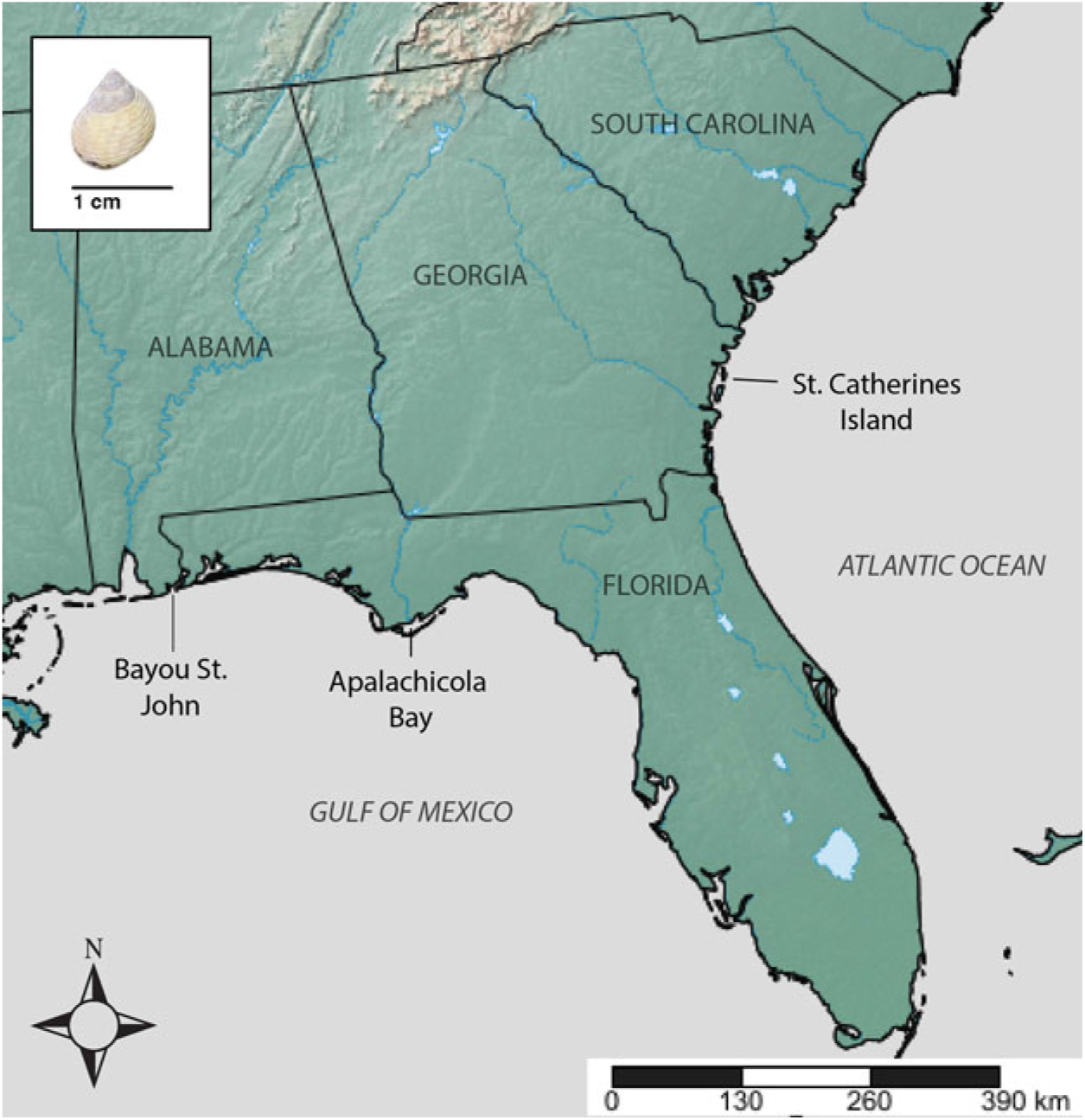
Marsh periwinkles (Figure 1 inset) are small, intertidal gastropods found in the salt marshes of the Gulf of Mexico and the Atlantic Coast of North America (Abbott Reference Abbott1974). The snails are typically found perched above the waterline on the stalks of marsh grasses, especially Spartina alterniflora, in the intertidal and supratidal zones, where densities can range from 40 to 500 snails per m2 (Shirley and Findley Reference Shirley and Findley1978; Silliman and Bortolus Reference Silliman and Bortolus2003). They are herbivores that mainly feed on plant tissues, algae, and fungi, some of which the animal “farms” itself by creating wounds on the live marsh grass, promoting fungal infection (Silliman and Newell Reference Silliman and Newell2003). Dead S. alternifora constitutes the bulk of L. irrorata diet, although assimilation of plant carbohydrates is low compared to other food substrates (Alexander Reference Alexander1979). L. irrorata mobility is quite limited and mostly vertical: snails climb above the waterline on grass stalks during high tide, and down to the sediment during low tide (Warren Reference Warren1985). An individual typically traverses only a few meters over the course of several months (Hamilton Reference Hamilton1978).
Map of study area and Littorina irrorata specimen GMNH-2922 (inset).

L. irrorata are presumed to be relatively short-lived organisms, although no studies have documented the maximum lifespan of the species. Population structures in the wild suggest two distinct age groups: small young snails, characterized by rapid growth and high mortality; and large (16–21 mm) adult snails, characterized by no or little growth and low mortality (Odum and Smalley Reference Odum and Smalley1959). Based on these observations, the lifespan is presumed to be at least 2 years (Robertson Reference Robertson1979), although longer-lived adults are assumed to exist as well (Odum and Smalley Reference Odum and Smalley1959). Maximum lifespans of other Littorina species are also undocumented but are assumed to be at least 5 years (Moore Reference Moore1937; Robertson Reference Robertson1979).
Like other gastropods L. irrorata shells grow incrementally, coiling in a logarithmic spiral around a central axis called the columella. The shell itself is composed of aragonite with a plywood-like crossed-lamellar microstructure (Taylor and Reid Reference Taylor, Reid, Johannesson, Raffaelli and Hannaford Ellis1990). The organic matrix of the shell, referred to here as conchiolin, is composed of proteins and polysaccharides, and functions in directing the formation of the calcium carbonate crystal (Bowen and Tang Reference Bowen and Tang1996; Zhang and Zhang Reference Zhang and Zhang2006). Biomineralization is thought to occur either within haemocytes or within the matrix of proteins secreted by the mantle at the mineralization front (Zhang et al Reference Zhang, Fang, Guo, Li, Luo, Xu, Yang, Zhang, Wang, Qi and Xiong2012). Shells grow by depositing a mineral layer on the interior surface of the shell, covering and extending beyond the margins of previous layers (Carriker et al. Reference Carriker, Palmer, Sick and Johnson1980). Typically, 95–99% of mollusk shell weight is carbonate, with the remaining 1–5% constituting the organic phase conchiolin (Zhang and Zhang Reference Zhang and Zhang2006).
The values of δ13C and 14C in the carbonate phase of mollusk shells are typically assumed to reflect the carbon isotopic composition of the animal’s surroundings: dissolved inorganic carbon (DIC) in aquatic environments (Tanaka et al. Reference Tanaka, Monaghan and Rye1986; Gillikin et al. Reference Gillikin, Lorrain, Meng and Dehairs2007; McConnaughey and Gillikin Reference McConnaughey and Gillikin2008), or geological carbonates, atmospheric CO2, and soil CO2 in terrestrial environments (Goodfriend and Hood Reference Goodfriend and Hood1983; Goodfriend and Stipp Reference Goodfriend and Stipp1983; Balakrishnan and Yapp Reference Balakrishnan and Yapp2004). A small proportion of shell carbonate is of metabolic origin (McConnaughey and Gillikin Reference McConnaughey and Gillikin2008). In contrast, δ13C and 14C values of soft tissues of the same animal should reflect its diet: the isotopic composition of the organic compounds at the base of its food web, with predictable levels of isotopic fractionation during metabolic processes (Peterson and Fry Reference Peterson and Fry1987). While soft tissues of mollusks generally do not preserve in the archaeological record, conchiolin is tightly bound into the mineral structure of the shell, sheltered from the external environment and thus relatively protected from diagenetic alteration (Sykes et al. Reference Sykes, Collins and Walton1995). Studies in numerous taxa confirm that conchiolin documents many of the same environmental and dietary signals as soft tissues (Watanabe et al. Reference Watanabe, Kodama and Fukuda2009; Kashiyama et al. Reference Kashiyama, Ogawa, Chikaraishi, Kashiyama, Sakai, Tanabe, Ohkouchi, Tanabe, Shigeta, Sasaki and Hirano2010; Ellis et al. Reference Ellis, Herbert and Hollander2014; Hadden et al. Reference Hadden, Loftis and Cherkinsky2018). Thus, in the case of L. irrorata, we predicted that the two shell phases would reflect the semi-aquatic habits of the animal: the inorganic shell carbonate deriving from a mix of environmental (aquatic) sources, and the organic conchiolin deriving from the terrestrial plants at the base of its food web.
MATERIALS AND METHODS
Live marsh periwinkles were collected from the western edge of Apalachicola Bay, Florida (Figure 1), during low tide, in March 2018. From each collection site we also collected samples of the marsh grasses upon which the animals were grazing, as well as surface sediment and water samples. The water samples were collected in containers void of headspace. All samples were stored on dry ice until they were returned to the lab. Once in the lab, the L. irrorata were stored at –20°C, while the water and surface sediments were stored at 4°C until processing.
Littorina specimens were freeze-dried to facilitate the removal of soft tissue, and the dry tissue weights were recorded. Soft tissue samples were rinsed 3 times with Milli-Q water, freeze-dried and pulverized in a Spex Mill. Subsamples of the soft-tissues were treated with cold, 1 N HCl to remove any carbonate salts, centrifuged, rinsed with Milli-Q water an additional 3 times, and freeze-dried. The acid-treated soft tissue samples were then loaded into Pyrex tubes with excess CuO and combusted for 3 hr at 575°C to produce CO2.
The shells were washed exhaustively in various solvents (ultrapure water, acetone, and methanol, and methylene chloride) with sonication until all superficial organic contamination (e.g., algae) was removed. The clean shells were bisected through the apex and pulverized in a Spex Mill. The inorganic shell fraction was sampled according to the laboratory’s standard procedure by reacting approximately 10 mg of powdered shell with 100% H3PO4 in evacuated reaction vessels to produce CO2. A separate subsample of 200 mg of powdered shell was treated for analysis of the organic shell fraction, referred to here as conchiolin, following a modified wet-oxidation technique as follows. Powdered shell was acidified with 2 mL of 50% H3PO4 to remove the carbonate phase, leaving the organic phase (conchiolin) in solution. The headspace of the reaction vessel was evacuated and 2 mL of 1M Na2S2O8 was added to the solution to oxidize the total organics, evolving CO2 derived from the oxidation of conchiolin. 50% H3PO4 was used because at higher concentrations the reagents form a precipitate that interferes with the oxidation of the shell organic matter. A method blank was prepared by repeating the wet oxidation preparation with no sample, in order to estimate the carbon mass and isotope composition from the wet oxidation process itself.
Environmental samples included water, sediment, and terrestrial plants from the collection sites. Following the laboratory’s standard procedure, approximately 50 mL of water was acidified in 85% H3PO4 in an evacuated flask to recover CO2 from DIC in the seawater. Sediment samples were sieved through 20 μm nylon screen to remove rootlets and treated with 1N HCl at 80°C for one hour to remove carbonates. Plant samples were freeze-dried, then pulverized in a Spex mill and treated with 1 N HCl to remove carbonates. Dried subsamples of the sediments and plant tissues were loaded into quartz tubes with excess CuO and combusted at 900°C to produce CO2.
CO2 samples were cryogenically purified from the other reaction products and the sample 13C/12C ratios were measured using a MAT-253 stable isotope ratio mass spectrometer and expressed with respect to VPDB, with measurement uncertainty of less than 0.1‰. CO2 samples were catalytically converted to graphite (Cherkinsky et al. Reference Cherkinsky, Culp, Dvoracek and Noakes2010), and graphite 14C/13C ratios were measured in 2018 using the NEC 500 kV Tandem Pelletron compact accelerator mass spectrometer (CAMS) at the Center for Applied Isotope Studies, University of Georgia, USA. The sample ratios were compared to the ratios measured from oxalic acid I (NBS SRM 4990). Size-matched standards and backgrounds (Cherkinsky et al. Reference Cherkinsky, Prasad and Dvoracek2013) were prepared for conchiolin samples. For carbonate samples, Carrara marble (IAEA C1) was used as the background, and travertine (IAEA C2) was used as a secondary standard. 14C values are reported according to Δ14C notation (Stuiver and Polach Reference Stuiver and Polach1977) and corrected for natural isotope fractionation using the IRMS value. The AMS-derived δ13C value was not used to due to the suppression of 12C transmission at higher beam currents (Prasad et al. Reference Prasad, Cherkinsky and Culp2018; Prasad et al. Reference Prasad, Culp and Cherkinsky2019).
Conchiolin results were blank-corrected for δ13C and Δ14C according to the mass-balance equation
 $${C_{sample}}{\rm{ = }}{{({m_{total}}{\rm{}} \times {\rm{}}{C_{total}}) - \left( {{m_{blank}}{\rm{}} \times {\rm{}}{C_{blank}}{\rm{}}} \right)} \over {{m_{total}}{\rm{}} - {\rm{}}{m_{blank}}}}$$
where Csample is the carbon isotope composition of the conchiolin sample (δ13C or Δ14C); mtotal is the total mass of carbon in µg recovered from the wet oxidation of the unknown, Ctotal is the measured carbon isotope composition from the wet oxidation of the unknown, mblank is the mass of carbon recovered from processing the method blank (mblank = 14 μg), and Cblank is the carbon isotope composition of the method blank (δ13C = –21.7‰ and Δ14C = –374.1 ± 10.6‰).
Statistical tests were performed in RStudio Version 0.98.507. Welch two-sample t-tests were used to determine whether the isotopic values of tissue types were equal.
RESULTS
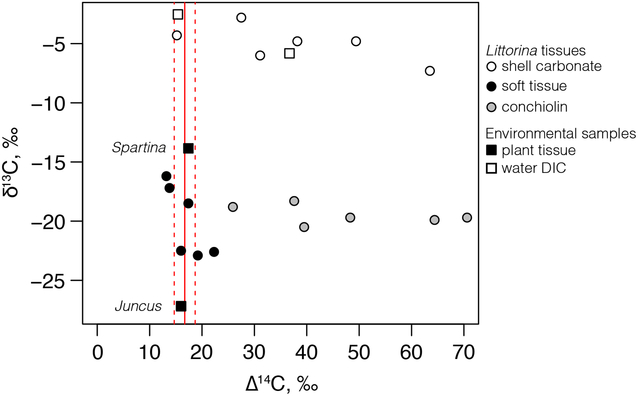
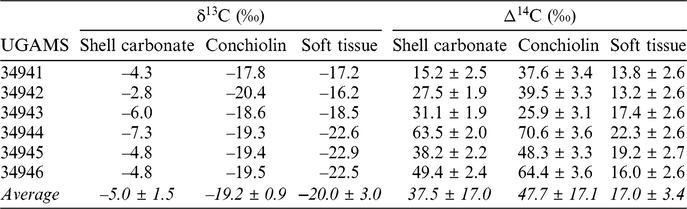
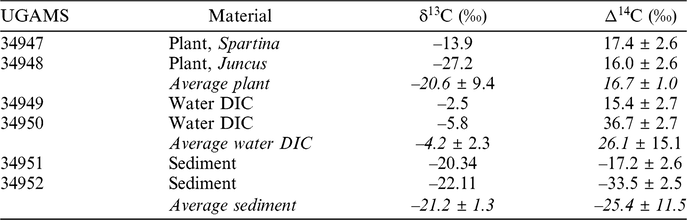
Conchiolin processed via wet oxidation yielded an average 122 ± 43 μg of carbon from 200 mg of shell, a yield of approximately 0.06% of shell weight. The δ13C and Δ14C values reported for all conchiolin samples are blank-corrected (Table 1). Results for modern specimens are presented in Table 1 and Figure 2, and environmental samples are presented in Table 2 and Figure 2.
Carbon isotopes (δ13C and Δ14C) of modern Littorina irrorata tissues and environmental samples from Apalachicola Bay, Florida. Red line indicates mean (solid) and 2σ range (dashed) of plant tissue Δ14C.

Carbon isotopes (δ13C and Δ14C) of modern Littorina irrorata from Apalachicola Bay.

Carbon isotopes (δ13C and Δ14C) of environmental samples from Apalachicola Bay.

δ13C values of L. irrorata soft tissues and conchiolin are statistically identical (p = 0.7) and consistent with a predominantly marsh-grass diet, intermediate between the C4-grass Spartina and C3-grass Juncus, suggesting a mixed diet of both C3 and C4 grasses. In contrast, shell carbonate is enriched in 13C by approximately 10–15‰ compared to soft tissues, and isotopically similar to δ13C in water DIC (Figure 2). Together, these data agree with the expectation that organic tissues (soft tissue and conchiolin) and shell carbonates should reflect distinct carbon sources. δ13C in the soft tissues and shell conchiolin both record the same dietary signals, ultimately derived from terrestrial plants, in contrast to shell carbonate, which appears to reflect water DIC.
An important finding from the current study is that surface water DI14C is quite variable within modern-day Apalachicola Bay. This is further evidence of the difficulties of dating mollusk carbonates from estuarine settings, where the mixing of marine, riverine, and terrestrial inputs results in highly variable carbon reservoirs (Hadden et al. Reference Hadden, Loftis and Cherkinsky2018). Marsh plant tissue 14C is nonetheless quite similar to water DI14C in Apalachicola Bay. Because Δ14C of plant tissues (Table 2) are assumed to reflect the 14C content of the atmosphere, the similarity between 14C of plant tissues and water DIC indicate near-equilibrium conditions between the lower atmosphere and surface water DIC in this region. Prior to the bomb period, the ocean was depleted in 14C relative to the atmosphere. In the post-bomb period, the natural carbon cycle has been redistributing bomb 14C throughout the atmosphere, biosphere, and ocean. By 1995 the surface waters of the ocean subtropics were nearly the same as the lower atmosphere, and the upper ocean became the main reservoir for bomb 14C (Key et al. Reference Key, Kozyr, Sabine, Lee, Wanninkhof, Bullister, Feely, Millero, Mordy and Peng2004; Graven et al. Reference Graven, Gruber, Key, Khatiwala and Giraud2012; Turnbull et al. Reference Turnbull, Graven, Krakauer, Schuur, Druffel and Trumbore2016). As a consequence, 14C cannot be used as an independent tracer of the source of carbon to modern L. irrorata shells and tissues. Nonetheless, the stable isotope data strongly suggest a terrestrial origin for organic tissue carbon and estuarine DIC as the origin for shell carbonates.
Although 14C data cannot be used to trace the marine versus terrestrial origin of carbon in modern snails, it does give an indication about the rate of tissue turnover, as well as the ontogentic ages of the snails. Soft tissues are statistically identical to terrestrial plants, indicating extremely rapid turnover of L. irrorata soft tissues. On the other hand, the shell (both conchiolin and carbonate) is enriched in 14C. This suggests that biomineralization occurred when ambient 14C concentrations were higher; i.e., earlier in the post-bomb period (Table 1). In short, the average age of the shell of the snail is slightly older than its soft tissues. This is consistent with the observation that the growth of the shell significantly slows as the animal reaches maturity (Odum and Smalley Reference Odum and Smalley1959).
The modern biological and environmental samples suggest (1) soft tissues and shell conchiolin derive from the same terrestrial/atmospheric origin; (2) shell carbonates derive from surface water DIC; and (3) shell materials (both conchiolin and shell carbonate) are slightly older ontogenetically than are soft tissues, due to the slowing of biomineralization upon maturation. From this, we can assume that 14C dating of conchiolin from older (e.g., archaeological) specimens can be calibrated using an atmospheric calibration curve, and that the age offset between soft tissue and conchiolin should be less than the uncertainty typically associated with the conchiolin 14C date.
Application to Known-Age Test Specimens
To test the accuracy of the method we measured the 14C content of L. irrorata conchiolin from older, known-age specimens. Test specimen conchiolins were analyzed as described previously, with 14C results presented as Fraction Modern Carbon (F14C) based on the 14C Libby half-life of 5568 yr (after blank-subtraction).
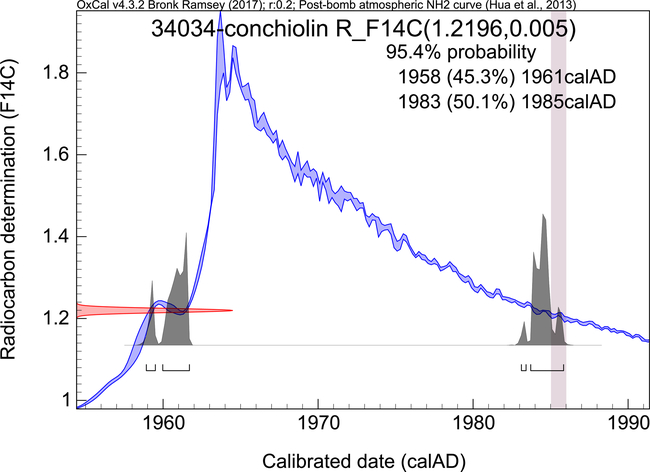
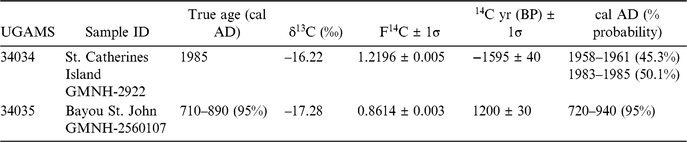
The first test specimen (UGAMS34034) was donated by the Georgia Museum of Natural History Zooarchaeology Comparative Collection (GMNH-2922; pictured in Figure 1 inset). The specimen was live-collected from St. Catherines Island, Georgia, USA, in December 1985, and accessioned into the collection in 1986. This animal lived and died during the post-bomb period, a period of rapidly declining atmospheric 14C that allows for high-precision calibration to calendar age. The wet oxidation of conchiolin yielded 59 µg of carbon (0.04% of shell weight). The conchiolin F14C value (Table 3) was calibrated in OxCal v. 4.3.2 (Bronk Ramsey Reference Bronk Ramsey2009, Reference Bronk Ramsey2017) using the Bomb13NH2 atmospheric curve (Hua et al. Reference Hua, Barbetti and Rakowski2013). Calibration resulted in two discrete calendar age ranges, one before the bomb “peak” in 1963/1964, and one after it (Figure 3). The split distribution is not related to the wet oxidation technique but is instead an artifact of the concentration of 14C in the atmosphere in the bomb- and post-bomb periods, and the shape of the calibration curve itself. The post-bomb probability range (AD 1983–1985) is in excellent agreement with the known collection date of December 1985.
Calibrated ages of known-age museum specimen plotted against post-bomb NH2 calibration curve. Mauve band indicates known collection date (1985) (Please see electronic version for color figures).

Carbon isotopes (δ13C and F14C) and calibrated ages of conchiolin from known-age test specimens.

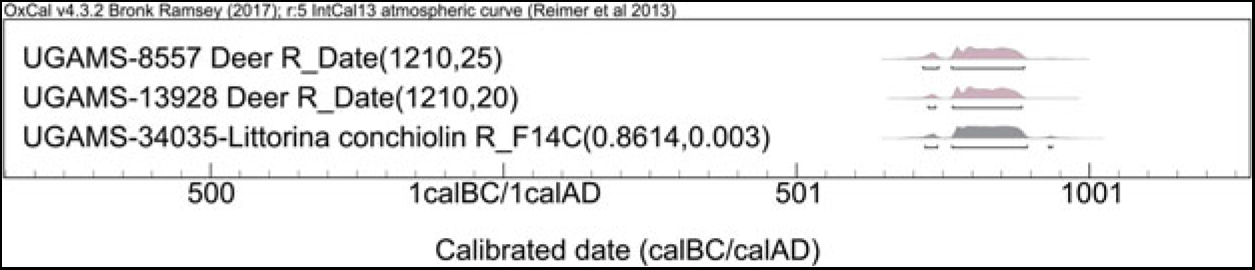
The second test specimen is an archaeological shell excavated from the Bayou St. John (1BA21) archaeological site, a pre-Columbian (1300–950 cal BP) coastal village located approximately 6 km northeast of Orange Beach, Alabama, USA (Figure 1). The site was excavated by Gregory Waselkov and the University of South Alabama Center for Archaeological Studies in 2004–2005. Among the finds was a discrete pocket of bone and shell within a basin-shaped pit, designated Feature 96, which possibly represents a single depositional event (Price Reference Price2009). Terrestrial animal bone and marine mollusk shells from this feature were previously dated for the purpose of estimating ΔR for the region (Hadden and Cherkinsky Reference Hadden and Cherkinsky2017a). This included two specimens of white-tailed deer (Odocoileus virginianus), a terrestrial herbivorous mammal. 14C ages of the collagens recovered from these bones are assumed to represent the “true” age of the deposit. For the current study we dated conchiolin from a single Littorina shell (GMNH-2560107) recovered from this archaeological context. The wet oxidation of conchiolin yielded 176 µg of carbon, 0.06% of shell weight, which is similar to the concentrations recovered from modern specimens. The F14C value (Table 3) was calibrated using the IntCal13 atmospheric curve (Reimer et al. Reference Reimer, Bard, Bayliss, Beck, Blackwell, Bronk Ramsey, Buck, Cheng, Edwards, Friedrich, Grootes, Guilderson, Haflidason, Hajdas, Hatté, Heaton, Hoffman, Hogg, Hughen, Kaiser, Kromer, Manning, Niu, Reimer, Richards, Scott, Southon, Staff, Turney and van der Plicht2013). The previously reported deer bone ages of 1210 ± 25 14C yr BP (UGAMS-8557) and 1220 ± 20 14C yr BP (UGAMS-13928) were calibrated, again using the IntCal13 curve, and presented in Figure 4 for comparison. The 95.4% probability calibrated age for the Littorina conchiolin is in excellent agreement with the previously dated deer bone collagens.
Calibrated ages of known-age museum specimen using IntCal13 calibration curve (Reimer et. al 2013). Mauve distributions indicate contemporaneous terrestrial samples from the same deposit.

DISCUSSION AND CONCLUSIONS
We applied the wet-oxidation technique to known-age archaeological and post-bomb-period marsh periwinkle specimens and calibrated the 14C ages using the IntCal13 (Reimer et al. Reference Reimer, Bard, Bayliss, Beck, Blackwell, Bronk Ramsey, Buck, Cheng, Edwards, Friedrich, Grootes, Guilderson, Haflidason, Hajdas, Hatté, Heaton, Hoffman, Hogg, Hughen, Kaiser, Kromer, Manning, Niu, Reimer, Richards, Scott, Southon, Staff, Turney and van der Plicht2013) and the post-bomb NH2 (Hua et al. Reference Hua, Barbetti and Rakowski2013) atmospheric calibration curves, respectively. In both test cases, conchiolin recovered via the wet oxidation technique produced calibrated ages that agreed with the true or known age of the specimen. This is an important result with implications for both archaeology and malacology. Given the wide geographic range of this species and its use over long time frames (i.e., the latter portion of the Holocene), our finding suggests that L. irrorata is a potentially more reliable candidate for dating when compared to other species, especially C. virginica which is often the dominate species in shell middens in the region. Previous research in Eastern North American has shown that C. virginica shells are extremely sensitive to fluctuations in 14C reservoirs, and as a consequence the dating precision that can be achieved is inherently limited (Cherkinsky et al. Reference Cherkinsky, Pluckhahn and Thompson2014; Hadden and Cherkinsky Reference Hadden and Cherkinsky2017b; Hadden et al. Reference Hadden, Loftis and Cherkinsky2018; Rick et al. Reference Rick, Henkes, Lowery, Colman and Culleton2012; Thompson and Krus Reference Thompson and Krus2018). L. irrorata conchiolin is potentially a better material for 14C dating in oyster midden contexts in the region because they preserve well, the conchiolin is not influenced by marine carbon, they are easily identified, and they are relatively short-lived animals.
A second potential application of the method is for examining estuarine carbon dynamics. If it can be determined that L. irrorata shell carbonate is derived entirely from estuarine DIC, and that shell conchiolin is entirely atmospheric in origin, then the difference between conchiolin and shell carbonate ages may provide an independent estimate of the reservoir age of the estuary, which could be useful in examining spatial and temporal variability in estuarine carbon dynamics.
While the initial results are promising, additional tests are needed to verify that the method can be used to reliably and accurately date L. irrorata specimens of various ages and from different environments. The study should be replicated on specimens from across the species range, as well as on other species with similar life histories. Specifically, conchiolin may be a more suitable material for 14C dating than shell carbonate in contexts where terrestrial snails are known to incorporate geological carbonate into their shells (e.g., Goodfriend and Hood Reference Goodfriend and Hood1983; Goodfriend and Stipp Reference Goodfriend and Stipp1983; Goodfriend Reference Goodfriend1987; Lindauer et al. Reference Lindauer, Hinderer, Steinhof and Uerpmann2016).
Though promising, the wet oxidation technique has several considerable drawbacks and limitations. Firstly, the method is relatively time-consuming and labor intensive, and carbon yields are small (<200 μg). The small yield requires either size-matched standards and backgrounds or doubling of the initial sample weight from 200 mg to 400 mg, which is not always possible. The wet oxidation technique as performed at CAIS also introduces contaminant carbon––typically around 10% of the carbon yield in this case––necessitating blank-correction. The small sample size, combined with the blank correction, results in lower precision. Future research should focus on methodological improvements to reduce carbon contamination from sample processing, as well as verifying the method on additional known-age test cases of this species and others.
ACKNOWLEDGMENTS
A version of this paper was presented at the 23rd International Radiocarbon Conference in Trondheim, Norway. We wish to thank the conference organizers for inviting us to contribute to the conference proceedings. The study was greatly improved by the input and advice of conference attendees, especially Mihály Molnár and Guaciara Santos, as well as two anonymous reviewers. We also wish to thank Elizabeth Reitz at the Georgia Museum of Natural History and Greg Waselkov at the University of South Alabama for facilitating access to known age test specimens; as well as Jeff Speakman, Ravi Prasad, Hong Sheng, Hai Pan, and Tom Maddox (Center for Applied Isotope Studies) for assistance in the lab.