Fifteen years ago, few people thought about the recruitment of children to fight in adults' wars as a threat to human rights or international peace and security. Today, child soldiering has become the most prominent issue on a laundry list decried by a transnational network of activists and organizations working in the issue domain of children and armed conflict.1
Achvarina and Reich 2006. Issue prominence is defined as the relative frequency with which an issue is referenced within a sample of advocacy discourse.
Why do activists in leading transnational organizations adopt certain issues or populations of concern but not others?3
Issue adoption occurs when a gate-keeping organization (Bob 2005) within a network champions the issue (Carpenter 2007).
See Keck and Sikkink 1998; Khagram, Riker, and Sikkink 2002; Florini 2000; Burgerman 2001; and Thomas 2002.
Ron, Ramos, and Rodgers 2005, 575.
Key explanations for the emergence of certain issues but not others on TAN agendas include the attributes of issues themselves; pressure from political entrepreneurs, donors, or the media; and a favorable normative environment; but these have seldom been tested empirically for their absence in cases where issues fail to emerge.6
With a team of graduate student coders, I attempted such an analysis by examining human rights advocates' discourse about an issue that has not emerged on the transnational child rights agenda (children born of wartime rape). Interview and focus group data with advocates in the issue area of children and armed conflict provide only mixed support for the hypotheses that issue attributes, public visibility, and international legal precedent will necessarily result in issue emergence. Instead, my findings point to the potential importance of inter-network politics in constraining issue adoption, even in such seemingly “easy” cases.This argument, if borne out across additional cases, suggests that earlier work on TANs has been unduly optimistic about the positive role of inter-network density in the promotion of advocacy around issues.7
While coalitional politics between issue networks may promote campaigns around select issues, such inter-network relationships may also impede the emergence of other issues altogether by encouraging buck-passing, increasing the number of actors whose consensus is required for an acceptable advocacy frame, and providing an environment conducive to frame disagreements. Given the importance of such inter-network politics in determining what gets on the TAN issue agenda, it is recommended that scholars of TANs look to theories of domestic agenda-setting and bureaucratic politics to explore further hypotheses about transnational issue emergence.Issue Adoption in Transnational Advocacy Networks: Hypotheses
Until recently, scholarship on TANs focused on proving (contra state-centric international relations realism) that advocacy networks have an impact on state behavior or why some campaigns (once initiated by gatekeepers) succeed at influencing state behavior while others fail.8
See Risse, Ropp, and Sikkink 1999; Khagram, Riker, and Sikkink 2002; Florini 1999; Price 2003; and True and Minstrom 2001.
The extant literature does contain (though rarely tests) some implicit hypotheses for issue adoption, which are explored below. In their ground-breaking study on TANs, Keck and Sikkink emphasized the importance of issue attributes in explaining the success of specific campaigns.9
Keck and Sikkink 1998 distinguish between problems, issues, and campaigns. In the human rights area, problems are preexisting grievances that may not yet have been defined as issues. Issues are created when advocates name a problem as a human rights violation and put it on the agenda. Campaigns involve concerted efforts by multiple organizations lobbying for a specific outcome around a certain issue. Campaigns and coalitions sometimes form around, but are distinct from, specific issues. See Khagram, Riker, and Sikkink 2002, 7. Here, I am interested in how problems become identified as issues.
Keck and Sikkink 1998, 27.
A second explanation for the success of certain international advocacy campaigns but not others is the extent to which advocates can link a new set of intersubjective understandings to preexisting applicable moral standards. This perspective, associated in particular with Price's work on weapons taboos, suggests that the promotion of new moral standards is most likely to succeed if these can be “grafted” onto preexisting taboos. For example, the chemical weapons taboo was popularized partly because it built on an earlier prohibition on the use of poisons in warfare; and advocates of the Ottawa Convention banning antipersonnel landmines sought to move debate over landmines away from arms control discourse and graft it onto the relatively robust norm of civilian immunity by emphasizing landmines' indiscriminate effects.12
According to a third line of thinking, international advocacy is best pictured as a marketplace for short-term contracts, in which public visibility toward a problem generates pressure to appear to be addressing it, and in which savvy advocates gravitate toward “hot” issues likely to draw donor funding and good media coverage for their organizations.13
This agenda-setting effect is similar to Finnemore's “norm entrepreneurship” thesis, which stresses the role of well-connected individuals with the resources and symbolic leverage to draw attention to previously unnoticed causes.14Finnemore 1996. Thus, as Bob writes, celebrities available to take up an international cause can be a vital element in issue emergence; see Bob 2005. For example, Britain's Princess Diana's advocacy around landmines has been cited as contributing to these issues' international visibility and thus salience; see Price 1998.
See Dale 1996; Ramos 2005; and Carpenter 2005. However, advocacy networks also use the media to set their own agenda (Ron, Ramos, and Rodgers 2005), so it is not always so clear whether the media drives issue emergence, with advocates responding to it strategically, or more accurately reflects advocacy frames, given other necessary conditions.
These hypotheses have rarely been tested on issues that have not emerged among gate-keeping transnational advocacy organizations.16
The failure of social science generally to systematically collect data on negative evidence, or “the significance of a thing's absence,” has been documented in Lewis and Lewis 1980.
On selecting negative cases, see Mahoney and Goertz 2004.
Barnett and Finnemore 2004.
To this end, I analyzed a condition in world politics that lacks prominence within the issue area of children and armed conflict: stigma against children born of rape and exploitation in conflict zones. Such children are at particular risk of human rights abuses in conflict zones because of community perceptions about their origin as “children of the enemy.”19
Evidence from Bosnia, Rwanda, East Timor, and most recently Darfur, has increasingly shown that such children are subject to stigma, discrimination, and even infanticide in postconflict settings.20See Becirbasic and Secic 2002; Isabel Matheson, “Darfur War Breeds ‘Dirty Babies.’ ” BBC Online, 15 December 2004, available at 〈http://news.bbc.co.uk/2/hi/africa/4099601.stm〉, accessed 15 January 2007; Siam Powell, “East Timor's Children of the Enemy,” Weekend Australian, 10 March 2001; and Emily Wax, “Rwandans Struggle to Love Children of Hate,” Washington Post, 29 March 2004, A1.
Nonetheless, there is little mention of this dimension of children's experience in conflict situations within the CaAC network discourse. As recently as 2005, no leading Web sites within the CaAC network referenced this category of child in descriptions of their issue agenda.21
Carpenter 2007.
In the next section, I briefly describe how the advocacy discourse from the CaAC network was sampled, collected, coded, and analyzed. I then describe the findings of the analysis. Mixed evidence was found for each of the hypotheses described above. However, none appeared decisive in producing the ambivalence advocates articulated in conversational settings about constructing “children born of war” as a global category of concern. Rather, the patterns in the data make most sense in the context of a meta-variable, best understood as “inter-network politics.” In the final section, I lay out the broader support for this line of thinking and suggest theoretical implications for scholarship on transnational advocacy networks.
Methodology
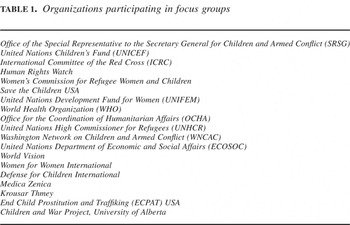
The empirical analysis here is based on data from four focus groups with activists specializing in child protection and/or gender-based violence in conflict zones, supplemented with seventy-six semi-structured interviews with human rights practitioners involved in these issue domains. Focus group participants were recruited from major human rights and humanitarian nongovernmental organizations (NGOs) such as United Nations Children's Fund (UNICEF), Save the Children, and the Women's Commission for Refugee Women and Children which might be considered “gatekeepers” in the area of children and armed conflict. According to Bob, gatekeepers are powerful and well-recognized organizations “whose decisions to back a [cause] activate other organizations and individuals across the world.”22
Bob 2005, 18.
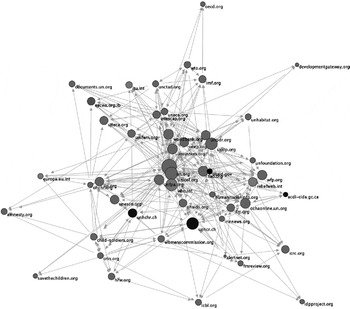
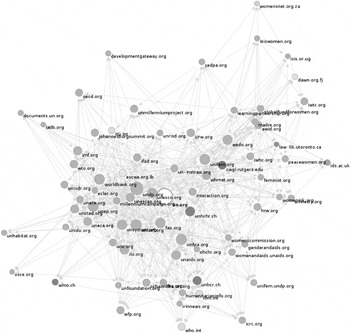
Although “women and children” are often conflated in human rights and humanitarian discourse (Carpenter 2005), Figures 1 and 2 demonstrate that these two issue networks are distinct subnetworks within the broader human rights and humanitarian networks. They do, however, overlap considerably: 60 percent of organizations appearing in one also appear in the other.
Organizations participating in focus groups

To determine how closely the resulting sample approximated the leading organizations in these two networks, I conducted two hyperlink analyses of advocacy organizations on the World Wide Web. Hyperlink analysis is, essentially, social network analysis applied to cyberspace.24
Park and Thelwall 2003.
See Barabási 2002, 5; and Henzinger 2001, 45. A study by Bae and Choi suggests that this type of linking practice is particularly relevant in the transnational human rights sector; see Bae and Choi 2000.
Rogers 2002. A potential drawback of relying on cyberspace for operationalizing a network and sampling its advocacy discourse is that this method discriminates against less-connected organizations within a network (for example, those in developing countries with lesser access to the Internet). However, this bias works methodologically in my favor, assisting in gathering a representative (though not random) sample. This is because advocacy networks themselves discriminate in this way, with central nodes (in our case, leading child rights organizations such as UNICEF) exercising a “gate-keeping” role (Bob 2005, 5) due to their disproportionate access, resources, and prestige (Lake and Wong 2005).
To gather the hyperlinks in a systematic and replicable way, I employed IssueCrawler, an algorithm developed by Govcom.org at University of Amsterdam.28
See 〈http://www.issuecrawler.net〉, accessed 7 March 2007.

“Children and armed conflict” network as rendered by IssueCrawler, using top five Google hits as starting points

“Women and armed conflict” network as rendered by IssueCrawler, using top five Google hits as starting points
During the focus groups themselves, participants were asked to comment generally on the protection needs of children and women in conflict zones before commenting on the particular issues facing children born as a result of sexual violence. They were then asked specific questions about the scope and nature of this population's needs as well as what, if anything, should be done to better protect them. Participants' answers provided not only a source of factual information around these issues and the particular obstacles to addressing them, but also a set of text data reflecting advocates' concerns about and reactions to the topic. The focus groups also provided evidence of how advocates negotiate with one another in conversational settings over the merits of committing advocacy network resources to a new issue.
To analyze the resulting text data in a replicable and transparent way, six graduate student coders associated with University of Pittsburgh's Qualitative Data Analysis Program were hired to independently annotate the text data. We combined a deductive and inductive approach in determining a coding scheme. First, four coders were assigned to do independent grounded-theory readings of the raw data.29
Grounded theory is a methodological approach requiring investigators to immerse themselves in raw data prior to developing preconceptions about what the data might show. In this way, theoretical concepts emerge from the data themselves rather than being imposed a priori through a deductive process. See Strauss and Corbin 1994.
These sets of codes were differentiated by the modifiers WB (war baby) and MTHR (mother), from general codes (GEN). Therefore for each instance of a reference to “displacement,” we could code whether the speaker was referring to displacement in general (Displacement-GEN), displacement of war babies themselves (Displacement-WB), or displacement of the mothers who had given birth to the babies (Displacement-MTHR).
In addition to these inductively derived sets of codes, a separate set of codes was developed to capture the types of dynamics that might be predicted by various extant hypotheses on issue adoption. Although children born of rape are objectively vulnerable to bodily harm and discrimination, social constructivists would argue that it is advocates' perceptions of these harms that should matter most.31
I hypothesized that Keck and Sikkink's issue attributes explanation might account for lack of advocacy in this area if advocates did not perceive these children as vulnerable. Coders were asked to look for references in the data to physical abuse, infanticide, stigma, and other impacts on these children's human rights to determine how clear it was to participants that these babies were indeed at risk. We also attempted to determine whether advocates understood these problems as “irredeemably structural” or could clearly point to perpetrators whose actions might be usefully criticized by issue advocates.32Keck and Sikkink 1998, 27.
Similarly, although conceptual space may objectively exist within human rights discourse to construct these children as needy victims, we looked for evidence that advocates themselves might not see it that way, which could lend support to Price's “grafting” thesis. How easy is it for advocates to discuss the harms to which these children are subject in the context of existing issues and using existing human rights language? To explore this question, we used a code named “issue linkage” for instances in which speakers drew a conceptual connection between children born of war rape and other issues or categories of concern already on the agenda. We also sought to code passages in which speakers appeared conceptually confused or debated how to label or define the issue. Finally, in order to explore the hypothesis that media and donor awareness was a concern in decisions about whether to advocate for children born of rape, coders also looked for references to the media or to the exigencies of funding, references to donors, public pressure, or contracts.
Three different two-coder teams then worked on these various subsets of codes. Each code was applied independently to all the primary documents by two different coders using Atlas.ti qualitative data analysis software. Inter-rater reliability was scored using the F-Measure metric, which rates the overlap between two coders' annotations on a scale between −1 and 1, where 1.00 represents 100 percent synonymity between two coders' independent annotations.33
Van Rijsbergen 1979.
The overall inter-rater reliability was 0.70.
The complete set of coded data is available to other researchers at 〈http://www.pitt.edu/∼charli/networks.htm〉, accessed 7 March 2007. Accessing this data requires the use of Atlas.ti software.
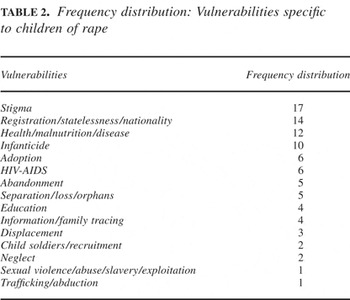
Frequency distribution: Vulnerabilities specific to children of rape

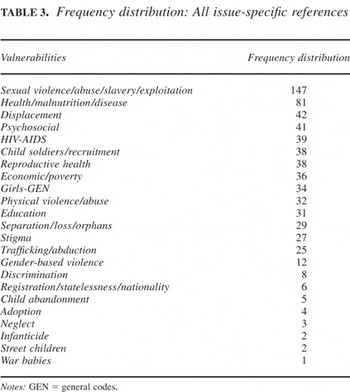
Frequency distribution: All issue-specific references

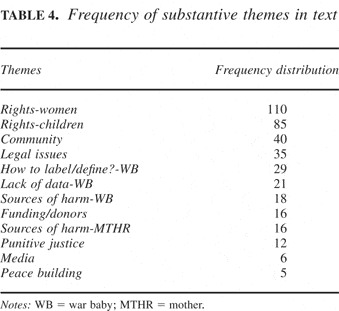
Frequency of substantive themes in text

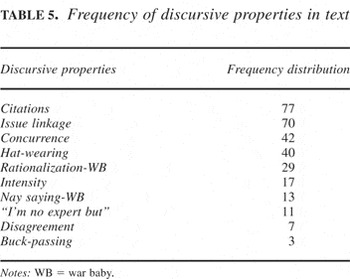
Frequency of discursive properties in text

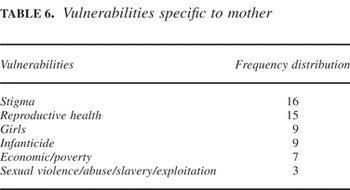
Vulnerabilities specific to mother

We used this coding scheme to explore whether advocates' logic behind the nonadoption of this particular issue correlated to the types of explanations for issue adoption prevalent in the literature on transnational advocacy networks. For example, if the sorts of issue attributes that Keck and Sikkink identify are viewed as lacking in this case (for example, if it is not obvious to advocates that these babies are vulnerable to bodily harm), we would expect few passages to be coded for references to infanticide or physical abuse; this might then be an explanation for the nonadoption of the issue and would also lend support to the issue attributes hypothesis. If Price's “grafting” hypothesis is borne out here, we would expect to see few instances of participants linking the issue of “children born of war” to existing issues or human rights standards, and we might see evidence of conceptual confusion or comments regarding “lack of fit” with existing conceptual frameworks. Similarly, if Cooley and Ron's political economy approach explains why this issue is absent from the agenda, perhaps because it is not conducive to securing contracts for protection work, then we would expect to see comments regarding the constraints posed by donors, funding, or the media.
Findings
The results of the analysis suggest mixed support for several of the above hypotheses. With respect to issue attributes, participants readily mentioned infanticide as a major impact on babies born of wartime rape, satisfying Keck and Sikkink's condition that a population of concern be exposed to bodily harm. While discrimination in the legal sense was coded only once in the data set, the more diffuse problem of social stigma was the most frequently cited impact; and other equal opportunity problems such as statelessness, lack of education, and lack of access to health care were also mentioned as problems facing this group (see Table 2). Given that advocates readily constructed the babies, when asked, as innocent individuals at risk of bodily harm or equal opportunity discrimination, it would seem puzzling from an issue attributes perspective that the same advocates were largely reluctant to consider adopting “children born of war” as a transnational cause.
Regarding Keck and Sikkink's prediction that a marketable issue must include a short, simple causal chain linking perpetrator and victim, we found that advocates easily articulated where the specific harm to children born of war came from, in particular in cases of bodily integrity violations such as infanticide, where the role of mothers and extended families was explicitly mentioned several times in the data set. In fact, more comments were coded as referencing a specific perpetrator of abuse against the babies than references to the perpetrators of harm against the rape victims themselves. Although advocates did tend to speak in broad and diffuse terms about the structural difficulties facing the babies (a factor that Keck and Sikkink's model would predict might impede issue adoption), many other issues mentioned in the focus groups that have been adopted onto the global agenda (such as forced marriage) were also treated with the same sensitivity to structural complexity.
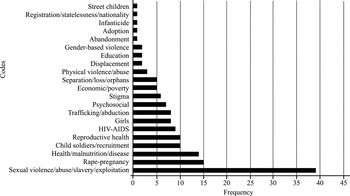
The frequency with which the code “issue linkage” appears in the data set casts doubt on the hypothesis that difficulty grafting this issue to the existing issue pool could explain its nonadoption in the CaAC network. In fact, even participants unfamiliar or uneasy with the topic readily drew connections between the obvious vulnerabilities of children born of war rape and other populations with whom they saw conceptual or programmatic similarities. For example, issues regarding stigma, which was the adverse impact most often mentioned for children born of war, were already well known to practitioners who had experience working with HIV-AIDS patients; and many participants drew connections between health programming for sexual violence survivors and the psycho-social and physical health of their children. In fact, connections were made between the subject of children born of war and twenty-one other general issues mentioned in the data set (see Figure 3).

Codes co-occurring with “issue linkage”
However, the ease with which participants linked one problem to others did not forestall disagreements over which grafting strategy was more appropriate. Overall, a notable finding of the analysis is that advocates were much readier to link “children born of war” to the wider issue of sexual violence rather than to the wider issue of child protection. For example, of all the co-occurrences with the code “issue linkage,” the code “sexual violence/exploitation/slavery/abuse” is by far the most frequent co-occurrence; codes for general factors impacting the specific population of babies including “psychosocial,” “stigma,” “poverty,” “separation/loss” and “abuse” all co-occur with “issue linkage” less frequently than codes invoking the rape victims themselves such as “rape-pregnancy,” “reproductive health” and “girls.” In the larger data set as well, the umbrella problem of sexual violence, rather than of infant health, framed the discussion. For example, 110 comments were coded as using a “women's rights” frame versus only eighty-five coded as “children's rights” (see Table 3).
Moreover, a common theme in the data set was the lack of consensus regarding which children in particular were under discussion. Much of the conversation centered on semantic trade-offs involved in conceptualizing the parameters of the population, or as one participant put it, “where you draw the boundaries around who these children are born of what?” Was the discussion limited to children born in systematic rape campaigns, or all wartime sexual violence? Would marital rape count? Why not peacetime rape as well? What about children born of sexual exploitation by peacekeepers rather than violent coercion by enemy soldiers? For example, one participant commented that it would be a conceptual mistake to link children born of genocidal forced pregnancy with those born to abducted girl “wives” in rebel groups. There was also a pragmatic question of how to label the population itself, with various positions taken as to what terminology would capture the specific issue being raised without further stigmatizing the group. Put together, these dynamics suggest that although the category “children born of war” is easily graftable onto various existing discourses, it is not obvious to advocates how and whether to engage in such grafting efforts.
Regarding the political economy thesis, which suggests that public awareness, media attention, and donor proclivities drive issue adoption, several participants did refer to these factors as important in international agenda-setting: “When reports come out and the public gets outraged by it, that is what drives change.” “Donors don't really care if you're stigmatized for the rest of your life, or infected with HIV-AIDS, or you have no security—they want to know who dies.” But others described the reverse relationship between donors and advocacy: “Without advocacy on an issue, you aren't going to get funding on an issue.” Moreover, a participant acknowledged that children born of war is “a very attractive and sexy issue for media: you can make touching documentaries about the children you are talking about,” while many participants nonetheless agreed that very little attention had been paid to these children in the advocacy community: “You ask what is known about these children? You might begin by asking what is not known.” In fact, some participants spoke disparagingly rather than optimistically of the effect of global agenda setting on the lived realities of certain populations:
I think there's something kind of instinctive that says—oh we need some sort of category like this that would … somehow grab the attention of donors or the international community or whoever. But my concern is that in examples where this has been done before there has either been a horrible backlash or it just doesn't make any logical sense.
Thus the empirical record of advocates' thinking around this particular nonissue is mixed. If appropriate issue attributes exist in this case but are insufficient to galvanize advocates' sense of moral urgency, what additional permissive conditions are missing? If a specific population is easily grafted onto existing categories of concern but advocates are hesitant to engage in such grafting, what accounts for that reticence? If media and donor attention drives issue adoption in general, and it exists in this case but has not had the predicted effect, what additional constraining factors may be evident?
Issue Adoption as a Function of Inter-Network Politics
I conclude that the lines of support for each of the above hypotheses make most sense in the context of a meta-variable: inter-network relations. In short, the findings support the need to consider the sociopolitical dynamics between networks advocating around related issues and, more generally, to understand transnational advocates as agents situated not simply in a common ideational space vis-à-vis targets of influence, but within a bureaucratic and coalitional politics constitutive of TANs themselves. In this sense, I am disputing Heclo's claim, echoed by the early literature on TANs,36
See Keck and Sikkink 1998, 32.
Heclo 1978, 102.
While this claim needs further analysis across a variety of cases, it illuminates a key theme emerging both in the focus groups analyzed here and in my broader data set of in-depth interviews with humanitarian practitioners on children born of war rape. An argument frequently given against advocating on the issue of “children born of war” is that doing so is particularly delicate and difficult due to its overlapping nature with other issues important to the CaAC network and its institutional partners, particularly the issue of wartime sexual violence. In short, what makes it difficult to develop an advocacy frame for “children born of war” is the fact that the issue bridges at least two different, though overlapping, advocacy networks: the CaAC network and the network of organizations concerned with gender-based violence in conflict zones. At least three different but interrelated processes appear to produce this result.
First, in the data set I have gathered, there appears to be a trend of issue-related “buck-passing,” suggesting that inter-network understandings of issue turf may play a role in the construction and adoption of new issues.38
Fewer examples of “buck-passing” were found in focus groups than in one-on-one interviews, perhaps due to the mixed nature of the focus groups.
I will tell you that we are not really considering specific projects on this, and if anything were to be done, it would be done in conjunction with the protection of the mothers, with these women who have been raped. And in this case, our “Women and War” project is definitely in a better position to know, what do we do to protect the woman and the newborn child?
There is no data on this that I know of…. I never tried to compile those numbers. But you should talk to UNICEF, child protection organizations must keep track of these things.
The idea that activists' construction or “image” of an issue will correlate with the “policy venue” they see as that issue's natural “policy niche” is consistent with Baumgartner and Jones's work on domestic agenda-setting. New or emerging issues, and those where the problems are “complex and pose many contradictory or unrelated questions” may logically fall across policy jurisdictions.39
Baumgartner and Jones 1993, 33.
Barnett and Finnemore 2004.
Bob 2005, 8–9.
Second, beyond questions of “fit,” TAN advocates also seem keenly concerned with the impact of new issues on the existing agenda, both in their own and also in adjacent networks' issue pools. In conversational settings such as interviews or focus groups, advocates' key disagreements over whether or why to adopt an issue had much to do with how adopting a new issue would affect advocacy around existing issues. For example, there was some concern expressed about “bypassing” rape survivors' rights to begin focusing on their children. The desire not to do so, and the perception that one issue is logically prior to the other rather than complementary, underlay a number of respondents' explanations for this advocacy gap:
I'm not sure anybody specifically looks at [the children]. The issue of sexual violence itself was under the carpet for a long time. Certainly we should look at the children too, that's a good point. Much more information on this issue is required … but right now we're still fighting to get recognition for rape survivors, let alone their babies.
How do you do sexual violence work without jeopardizing our other programs—communications, health, education—there's that thing that we run up against all the time, that challenge, it's huge, how to do that. And then the next layer of children is even harder. And we're not even doing the first part, getting to rape survivors for all their needs.
These passages suggest that decisions about whether to advocate on new issues are made not merely on their own merit as a function of their innate attributes, but in a context where the ability to continue pushing existing issues is also at stake. Moreover, for network-spanning issues, the concerns of partners in adjacent issue networks also matter in shaping advocates' consideration of whether and how to frame new problems in the context of existing agenda space.
Third, the network-spanning nature of the “children born of war” issue, and the challenges this creates in dialogues over how to give it greater attention, is also demonstrated by the difficulty interviewees and focus group participants had in choosing a frame for the discussion even among those who acknowledged some response was necessary. There was considerable disagreement across the interviews and focus groups about whether this issue was appropriately conceptualized as a child protection issue directly or dealt with in the context of programming to support sexual violence survivors as mothers.42
Some political entrepreneurs now pushing this issue in certain institutional contexts within the CaAC network argue that it needs to be both.
I would say that when working for children's rights you need to work for women's rights. Most of the issues are going back to the mother. If a mother doesn't have access to a certain facility, the children have even less.
I agree that you have the medical psycho-social and legal and other aspects, but I will say … that it's not the same for women and for children; there are differences and they are huge differences in fact.
Inter-network competition over framing was particularly obvious in the focus groups, where advocates from both child protection and gender-based violence backgrounds were asked to dialogue on this issue in the context of broader programming for children and women in conflict zones. For example, heated disagreements broke out within several focus group settings about whether to conceptualize infanticide as a crime against an infant or against the mother herself, insofar as the situation “forced her” to kill her baby, or whether to consider it criminal at all, since in some ways this constituted her last best avenue to exercise self-determination over her circumstances. If advocates raised the issue of infanticide within conflict settings as a specific child protection issue, would this constitute blaming the female victim or, in cases of genocidal rape, the targeted group?
As important as the clear-cut causal chain described by Keck and Sikkink may be the question of where the chain leads: politically acceptable perpetrators may be as or more important than politically acceptable victims—not because of the difficulty in selling the new issue to transnational publics, but because of the fallout effect on resource mobilization for existing issues. The bar may be higher when adoption of a new issue is contingent on a consensus between advocates in multiple networks with divergent interpretations of a problem.
All these three problems—organizational fit, impacts on existing issues, and frame conflicts—may be particularly acute when the networks in question exhibit a high degree of personnel overlap, as do these two networks. In such cases, potential issue adopters' professional identities are bound up in identifying issues that avoid normative conflicts between multiple communities of practice in which they are embedded. As Mische has noted, participants in social networks belong to a variety of affiliations at once: “Activists belonging to multiple networks and organizational sectors must negotiate the different identities, projects, and styles of participation associated with their various involvements.”43
Mische 2003, 262.
Hutchings 2001, 849.
Indeed respondents in my data set, when asked to discuss their professional background as a prelude to an interview, typically described their negotiation through a variety of positions in multiple networks; later, when thinking aloud through difficult questions regarding agenda setting or humanitarian response, some shifted back and forth discursively between their various organizational and issue-oriented identities. Network-spanning issues such as “children born of war” may go unarticulated because they trigger identity conflicts among practitioners who see themselves as “on the fence” between networks:
I don't know; it's complicated…. I've been sitting on that fence for the past year as a gender-based-violence officer in a child protection unit…. child protection maybe still has a little controversy to it, but sexual violence has a lot, senior managers get uncomfortable when you tell them a 13-year-old is raped … so they're very much inter-linked, very much multi-sectoral…. the children born of this population as well; you can't separate it out.
In short, what is common to these three particular patterns emerging from the qualitative analysis is the importance of dynamics between issue networks in gate-keeping organizations' consideration of “new” issues. The concerns most frequently cited in this text data have little to do with the inherent attributes, grafting potential, or potential political salience of the issue itself. Rather, the concerns expressed—the obstacles to issue adoption in this case—have more to do with whether the issue fits existing organizational goals of potential gatekeepers, defined in relation to the mandates of gatekeepers in other networks; whether consensus can be developed with coalition partners in adjacent networks; and whether advocacy around this issue would enhance or negatively affect advocacy around related issues already on the human rights agenda, both within and between networks. While these concerns do not so much refute as extend the existing theses, they suggest that scholars of TANs should look more closely at inter-network dynamics in future research.
If the evidence from this case is borne out when applied to other examples of issue nonadoption, the typical appraisals of coalitional politics in transnational advocacy may prove overly optimistic. For example, Meyer and Whittier documented how “spillover” effects between networks can provide a means of amplifying advocacy frames, but the evidence here suggests the same effects can pose disincentives for the selection of issues that do not unproblematically fit multiple network agendas.45
Meyer and Whittier 1994.
Keck and Sikkink 1998, 28.
Conclusions
I have made three arguments. First, the question of how and why certain issues do or do not become visible on the global agenda needs more attention from researchers interested in the political impact of transnational advocacy networks. There is considerable variation in the emergence and prominence of transnational causes. Capturing and explaining this variation is relevant both for international relations theorists and for transnational policymakers themselves. Second, factors explaining why advocates succeed or fail in pitching issues to states do not work unproblematically to explain why advocates take up certain causes and not others.
Instead, analyzing discourse about the nonissue of “children born of wartime rape” has yielded insights about the importance of bureaucratic and organizational politics between issue networks in explaining variation in a given network's issue agenda. Network activists do not automatically adopt issues on the basis of their attributes, their graftability to existing norms, or the visibility generated by media attention or political entrepreneurs. Given these permissive factors, they then consider (1) whether or not the issue fits their ideational “turf” relative to other networks; (2) how it will affect their existing efforts and those of their allies in adjacent issue networks; and (3) how much consensus can be forged with those allies on a suitable advocacy frame. If any of these factors represents strategic problems within a network, issue adoption is unlikely. To the extent that the issue is logically constructed as spanning multiple network agendas, each of these factors may be complicated by the same calculations in the adjacent network.
The data presented in this article hardly constitutes a definitive test, but they do suggest that theorists of issue adoption in advocacy networks should think about issue adoption in TANs through a network frame that accounts for the politics of networks, rather than primarily a transnational advocacy frame emphasizing cohesion effects against targets of influence.47
The key argument here is that the conditions driving issue adoption in TANs are likely to have as much to do with the institutional environment in which transnational advocates operate as with particular issues' attributes, existing norms, or political entrepreneurship. Cooley and Ron have argued that bureaucratic decision making in the transnational sector is driven at least as much by short-term concerns with organizational survival as by normative commitments; the analysis here suggests that the institutional environment affects not only the “tacit material relations among transnational actors,” but also their very conception of which normative concerns are properly theirs to champion.48Cooley and Ron 2002, 37.
It may therefore be useful for international relations scholarship to draw more closely on insights from the literature on domestic agenda setting and bureaucratic politics to begin capturing how inter-network dynamics influence issue adoption—or nonadoption—in world politics.49
Kingdon 1995.
Appendix
Inter-rater reliability scores