The need for environmentally sustainable practices is becoming more urgent with time, and calls within Australia and internationally are gaining momentum (Fielding & Head, Reference Fielding and Head2012; Sund & Öhman Reference Sund and Öhman2014). This article reports on aspects of the Climate Clever Energy Savers (CCES) program, established and jointly managed by the New South Wales (NSW) Department of Education and Communities and the NSW Department of Environment, Climate Change and Water. The program began in 2010 and concluded in 2014. The 3 aims of the CCES program are to:
• assist school students in Years 3–10 (i.e., students aged between 8 and 16 years) to devise proposals for reducing electricity consumption in their schools;
• provide an interdisciplinary approach to studies of sustainability;
• offer a real-world, problem-solving approach to issues of sustainability, supported by the Department and its available personnel, online and other resources to assist in implementing projects (NSW DET, 2009).
In particular, this article focuses on the process used to assist students in identifying and addressing issues related to electricity consumption. A central component of this is the Sustainability Action Process (SAP). The paper asks: To what extent and in what ways can a framework, in this case the SAP, assist students and teachers in achieving educational, sustainability, and project-related outcomes? The research team analysed surveys completed by participating teachers and transcripts of interviews with a sample of teachers, and some student work samples. These, along with school modifications, formed the main tangible sources of evidence of behavioural and knowledge change. We concede that attitudinal change is more difficult to discern and can only be inferred from the previously mentioned artefacts. Surveys enquired about the amount of funding requested, logistics of the project, such as allies, affordances and hindrances, and the extent to which, and ways in which, the project achieved its goals and met student learning outcomes.
Data analysis methods included coding using NVIVO, as well as manual categorisation of artefacts such as lesson outlines and student work samples. This article was derived from a 3-year evaluation undertaken for the Department of Education and Communities to investigate the outcomes of this school-based sustainability initiative.
Background and Context
As iterated above, the need and mandate for informed and evidence-based sustainability action are becoming increasingly urgent. In a phone poll of more than 1,500 respondents, Hamilton (Reference Hamilton2011) found that level of education affected attitudes to climate change. According to Hamilton, left-of-centre voters tended to be more concerned about anthropogenic climate change the more highly educated they were. Intriguingly, however, he found that more highly educated conservative voters tended to be more sceptical about this than those with less education. This is suggestive of a tendency to ‘cherry-pick’ evidence for or against anthropogenic climate change. Because it is young people who will be most affected by environmental impacts (Fielding & Head, Reference Fielding and Head2012), education needs to focus on them and their attitudes and behaviours. The school is an appropriate locus of action for developing in children sustainable habits of living. As Nelson and Cassell (Reference Nelson, Cassell, Wals and Corcoran2012) point out, overlooking this in the school years constitutes valuable time lost in responding to ‘a human-induced, global ecological crisis’ (p. 63). The discussion that follows addresses environmental sustainability education, its place/s in curriculum, and examples and frameworks, before focusing on the Sustainability Action Process as one such framework.
Environmental Sustainability Education
More than ever, an education is needed that can help students ‘become sustainability literate citizens capable of working together so to bring about more viable futures’ (Huckle, Reference Huckle, Wals and Corcoran2012, p. 35). One important goal of sustainability education is to provide students with skills in decision-making so that they can make choices about their behaviours that will support sustainability (Hungerford & Volk, Reference Hungerford and Volk1990). Another goal is to develop a sense of personal responsibility for the environment that will enhance students’ ability to search for innovative solutions to particular environmental problems (Griset, Reference Griset2010), as part of a problem-based learning approach (Savery, Reference Savery, Walker, Leary, Hmelo-Silver and Ertmer2015). The CCES program sought to meet such goals through its design and implementation, including personnel and online support. We note here some of the limitations of problem-based learning (Boud & Feletti, Reference Boud and Feletti1997), such as institutional and organisational impediments (Little & Sauer, Reference Little, Sauer, Boud and Feletti1997), the need for perseverance (Schwartz, Reference Schwartz, Boud and Feletti1997), and congruence between conceptualisation and implementation (Hung, Reference Hung2011). Dierking, Falk, and Storksdieck (Reference Dierking, Falk, Storksdieck, Stevenson, Brody, Dillon and Wals2012, p. 359) refer more broadly to ‘free-choice’ learning. The project- and problem-based learning aspects of the CCES projects afford scope for student creativity and innovation, and lateral and critical thinking derived from the power of ideas, even those that do not eventuate in projects.
Other features of effective sustainability education have been posited. Australia's Department of Environment and Heritage (2000) asserted that environmental education requires involvement from everyone, and needs to be holistic in nature, involving connections, causes and effects. It should be practical rather than theoretical in its approach. It is a lifelong undertaking, which should be accorded equal priority with social and economic goals, and should operate, where possible, in harmony with those goals. Moreover, effective sustainability education needs to transcend classroom behaviour. Reed (Reference Reed, Kagawa and Selby2010) speaks of ‘developing an ecological worldview’ (p. 141) and argues that change in this regard is as much cultural as it is ecological; while Holdsworth, Thomas, and Hegarty (Reference Holdsworth, Thomas, Hegarty, Stevenson, Brody, Dillon and Wals2012, p. 355) call for a ‘sustainability curriculum that is holistic, multidisciplinary and contextually relevant’. Australia's Department of the Environment and Heritage (2005, p. 7) observed that:
environmental education for sustainability pervades all aspects of the school operations, curriculum, teaching and learning, physical surroundings and relationships with the local community . . . environmental education for sustainability is a core feature of the school ethos — the value structure of the school.
A key element of environmental education is education for sustainability. As Maude (Reference Maude and Robertson2012) points out, notions of sustainability typically refer to finding a balance between current generations’ and future generations’ needs. Such views, however, arguably commodify the environment, rather than recognise its value per se. In the Australian curriculum, sustainability is a cross-curriculum priority, emphasising student agency and responsibility (see also Buchanan, Aubusson, & Schuck, Reference Buchanan, Aubusson, Schuck, Thomas and Muga2014). According to the Australian Curriculum, Assessment and Reporting Authority (ACARA, 2013):
The Sustainability priority is futures-oriented, focusing on protecting environments and creating a more ecologically and socially just world through informed action. Actions that support more sustainable patterns of living require consideration of environmental, social, cultural and economic systems and their interdependence.
This tenet of the Australian Curriculum affords a starting point for sustainability projects such as Climate Clever Energy Savers. The CCES is compatible with many of the above features: its practical nature transcends and has impact beyond classroom activity; it sets out to involve all class members and implicitly makes demands on all; and it is futures- and change-oriented.
Sustainability and Curriculum
While space here does not permit a detailed critique of local curriculum documents, we note that, in a British context, Huckle (Reference Huckle, Huckle and Sterling1996) is sceptical about the transference of lofty curricular statements into changed behaviour, and this author views such statements as tokenistic. Similarly, Smith, Collier, and Storey (Reference Smith, Collier and Storey2011, pp. 176–177) are critical of teacher professional development in sustainability, typifying it as ‘ad hoc; designed to meet short term needs of specific groups of educators; variable in terms of quality and delivery; limited in availability; and not linked or integrated across sectors, issues or fields’. Craddock, O'Halloran, McPherson, Hean, and Hammick (Reference Craddock, O'Halloran, McPherson, Hean and Hammick2013) warn that top-down approaches can impede recourse to the application of learning theory. See also Stevenson and Evans (Reference Stevenson and Evans2011) for a discussion of the characteristics of sustainability education research in Australia, such as the adoption of global and socially critical perspectives to critique and theorise the curricular structure and conceptualisation of sustainability education. Their research also brought to light gaps in environmental education. The in-service support offered to teachers for the CCES program was positively viewed by participants (Buchanan, Aubusson, & Schuck, Reference Buchanan, Aubusson, Schuck, Thomas and Muga2014; Buchanan, Schuck, & Aubusson, Reference Buchanan, Schuck and Aubusson2013, Reference Buchanan, Aubusson, Schuck, Thomas and Muga2014).
Sustainability education fits more neatly into some areas of the primary and secondary curriculum than others (Cupitt & Smith, Reference Cupitt and Smith2012; Buchanan, Reference Buchanan2012). In terms of the Australian Curriculum, sections of which are currently under development, these subjects include Geography and Science, but sustainability education also lends itself to literacy and numeracy development, and the arts, among other subject areas. Moreover, cross-curricular approaches within and beyond these two subject areas are also productive; Nowotny (Reference Nowotny2005, p. 15) refers to ‘emergent interfaces between the natural sciences, humanities and social sciences’. Hill (Reference Hill, Dale and Onyx2005) warns against treating sustainability education as an add-on, advising that complex problems demand holistic, integrated and complex responses. Summers, Childs, and Corney (Reference Summers, Childs and Corney2005) advise that Sustainability Education ideally involves ‘concepts, evidence, controversy and values — in an integrated, non-fragmented way’ (p. 627). The NSW Department of Education and Communities (DEC, 2014, para. 2) asserts:
[Learning for sustainability] is best delivered through a wide range of teaching and learning activities utilising all of the Key Learning Areas. Students will develop strong environmental knowledge, awareness and capacity for positive environmental change when it is contextualised or taught using real examples, problem solving and with active student participation.
The CCES's cross-curricular approach and philosophy aligns with such a pedagogy.
Sustainability Education Examples and Frameworks
There are many ways of categorising and evaluating sustainability education programs. Henderson and Tilbury (Reference Henderson and Tilbury2004) investigated five sustainability education programs and observed features that appeared to contribute to their effectiveness. These included community and other partnerships, a cross-curricular approach, support through professional development, mechanisms for monitoring, evaluation and reflection, and whole-school participation (Ferreira, Ryan, & Tilbury, Reference Ferreira, Ryan and Tilbury2007). Katayama and Gough (Reference Katayama and Gough2008, pp. 418–420) outlined four characteristics of sustainability education programs, describing such initiatives as being problem(-solving)-oriented, responsibility-oriented, creativity-oriented, and skills-oriented in nature. Significantly, these characteristics appear to apply as much to participants as they do to the sustainability issues being addressed. Cheong (Reference Cheong2005) outlined an approach she calls Community Problem Solving (CPS). This approach entails ‘resolving or improving local issues through a problem solving process’ (p. 98), and lends itself to addressing problems of an environmental and/or social nature. The CCES approach depends on partnerships and calls participants to responsible action.
Flannery (Reference Flannery2006), among others, draws attention to the interconnectedness of environmental systems. This system inter- and intra-connectivity can render them difficult to understand comprehensively, especially for younger children. Conceptual or procedural frameworks can assist in making this complexity conceptually manageable by breaking systems down into their constituent parts and processes, introducing a local-scale response to a global-scale problem and setting out a possible pathway of action. Sustainability frameworks typically include: the identification of a problem or area in need of improvement on a local or broader scale, creative and critical thinking about realistic responses, and recruitment of allies. Tilbury and Wortman (Reference Tilbury and Wortman2004, p. 11) offer a framework that includes: imagining a better future, critical thinking and reflection, participation in decision-making, and partnerships. They add systemic thinking to their suite of approaches, with a view to synthesising components such as imagination, critical thinking and the like. Hunting and Tilbury (Reference Hunting and Tilbury2006) recommend: adopting a clear and shared vision for the future or ‘visioning’ (p. 7), building teams rather than champions, thinking critically and reflecting, transcending stakeholder engagement (see also Brundiers & Wiek, Reference Brundiers and Wiek2011; and Wiek, Talwar, O'Shea, & Robinson, Reference Wiek, Talwar, O'Shea and Robinson2014, for similar recommendations), adopting a systemic approach, and accepting that change might not follow a linear pathway.
The complexity/simplicity dichotomy is one of a number encountered as we sought patterns of response and behaviour effected by the CCES project. One aspect of this dichotomy is isolation as opposed to systemic interconnectivity (as well as intraconnectivity). In both, teachers attempt to render the complex and the interconnected sufficiently simple and discrete, if only temporarily, to help learners, particularly young learners, come to terms with phenomena under study. While space here does not permit a detailed discussion of each of these, other dichotomies, or apparent dichotomies (Oyama, Reference Oyama2000) encountered include: attitudes and behaviours, espoused and actual lifestyles, theoretical or conceptual and practical responses to ecological crisis.
It should be noted that any given framework has potential limitations. Sterling (Reference Sterling, Tilbury and Wortman2004) advises against simply breaking systems down into their constituent parts, in the absence of identifying connections and thinking holistically or systemically. Hunting and Tilbury (Reference Hunting and Tilbury2006) also recommend a systemic approach to sustainability issues. With these caveats in mind, however, frameworks can provide a useful starting point for analysis and identification of problems and responses.
The Sustainability Action Process
The Department of the Environment, Water, Heritage and the Arts (DEWHA, 2010) proposed one such framework, the Sustainability Action Process. The SAP is described as a ‘learning and action methodology that underpins the Sustainability Curriculum Framework’, according to the Victorian Association for Environmental Education (VAEE, 2015). It is a five-step procedural framework for sustainability action: making a case for change, defining scope for action, developing a proposal for action, implementing the proposal, and evaluating and reflecting (DEWHA, 2010, p. 9). The VAEE (2015) continues: ‘Through this five step process students investigate a sustainability or resource issue, scope possible actions for the context, e.g. school, plan a suitable action and reflect on their success in addressing the original issue.’
According to the NSW Department of Education and Communities (NSW DEC, 2014, para. 3):
When sustainability action is applied as a systematic process to issues and needs, it can be modelled, reapplied to new problems and learned by students with increasing levels of sophistication and complexity. The ultimate learning goal is for students to be able to implement sustainability action with such fluency that they can operate independently of the need for a scaffolded process.
The SAP derives from knowledge of systems and repertoires of practice (DEWHA, 2010, p. 8). Knowledge of systems applies to both human and ecological systems, and repertoires of practice consist of world viewing, systems thinking, and futures and design thinking (p. 9).
The SAP is not without its critics. Maude (Reference Maude and Robertson2012) contends that the SAP makes no demands on students ‘to think about the causes of the sustainability issue they are investigating’ (p. 58). While it could be argued that this is implicit in the first step, making a case for change, the call for informed action is nonetheless apt. Indeed, Quinn and Lyons (Reference Quinn and Lyons2013, p. 1) refer to ‘action-competence’. Beyond that, there is little in the literature critiquing the SAP, thus making this study timely.
The SAP is a key component that is built into the CCES program. Sustainability action, according to ACARA (2014, p. 1), ‘is designed to intervene in ecological, social and economic systems in order to develop more sustainable patterns of living’. Arguably, one of the SAP's greatest virtues is its action component. As Quinn and Lyons (Reference Quinn and Lyons2013, p. 3) note:
A ‘disposition’ to action, desirable though it is, does not necessarily equate to action competence in the messy argumentative real world when dealing face to face with real people, power imbalances or conflicts, inertia, apathy, turgid bureaucracies and the other impediments to changing established practices.
The Program and Projects
The SAP has been adopted as a central facet of the NSW Department of Education and CCES program. As noted above, the CCES program assists students in Years 3–10 in devising proposals to reduce their school's electricity consumption. The program adopts an interdisciplinary approach to studies of sustainability, and offers a real-world problem-solving approach to issues of sustainability. Department personnel such as regional coordinators and the Sydney-based program managers provide advice and information to students and teachers undertaking their projects. This support is offered both in person and through online technologies. Students are invited to submit applications for funding to support an initiative to reduce their school's electricity consumption and costs. Each project can apply for up to $2000.
The CCES resource kit offers suggested teaching/learning activities for each of the five steps in the Sustainability Action Process (Witchard & Mulcahy, Reference Witchard and Mulcahy2010; see also Cupitt & Smith, Reference Cupitt and Smith2012, p. 20). It also suggests syllabus links in English, Human Society and its Environment, Maths and Science for Years 3–6, and in Design and Technology, Geography, Science, and in Technology (mandatory). It contains exemplar scopes and sequences, as well as annotated lists of resources, for both primary and secondary levels of study.
Conduct of the Study
The research sought to investigate the effectiveness of the CCES program in achieving the three aims of CCES indicated earlier. More specifically, the project investigated the extent to which and the ways in which the school projects achieved their aims. It achieved this by exploring questions concerning expectations, and the extent of participation, cross-curriculum emphasis, behaviour change, educational outcomes and energy savings. Related literature (see, e.g., Tilbury & Wortman, Reference Tilbury and Wortman2004) indicates that these factors are crucial to the success of sustainability education projects. The research team investigated views of participating teachers and evidence provided primarily by participating teachers on the outcomes, effectiveness, affordances and barriers to their school-based projects. Data sources included surveys, self-evaluations, case studies, and examination of artefacts such as CCES funding applications and student work samples (Buchanan, Schuck, & Aubusson, Reference Buchanan, Schuck and Aubusson2014). The surveys included Likert scale questions identifying the usefulness of various support mechanisms, and open-ended questions eliciting comments, opinions and reported outcomes provided by participating teachers.
Over the life of the project, 434 teachers furnished survey responses regarding the nature, approaches and outcomes of their school projects. This represents close to 100% of all participating teachers; furnishing the survey was a condition of receiving funding. Fowler (Reference Fowler2013) sets out the advantages and purposes of surveys as a data collection instrument. Some survey responses included student feedback, work samples, and reported sustainability modifications to the school, such as installation of skylights or timer switches. Project applications, completed as a means of acquiring funding, were also analysed (see Buchanan, Aubusson, & Schuck, Reference Buchanan, Aubusson, Schuck, Thomas and Muga2014; Buchanan, Schuck, & Aubusson, Reference Buchanan, Schuck and Aubusson2014).
In 2010, all participating teachers (n = 122) completed self-evaluations that comprised open-ended responses, exemplars of lessons and student work samples, and evaluations of project outcomes. This method gave voice to teachers and was instructive in informing the researchers as to what teachers felt had worked well in the program and what needed adjusting. In response to feedback from teachers regarding the workload required for the self-evaluations, the data collection was modified for the remaining 2 years of the study. An online survey was developed that allowed similar information to be collected more efficiently and with fewer time demands on the teachers. The reporting mechanism of an online survey, adopted in 2011, was repeated with few changes in 2012, allowing for more specific comparison of results. The limitations of self-reporting are acknowledged here. To mitigate these effects, however, participants were able to respond anonymously if they chose. Moreover, responses were post hoc: funding and other support were not contingent upon responses furnished at the completion of the project.
The self-evaluation surveys were analysed using NVIVO. Text was first analysed using a framework of key elements derived from the research questions, such as successes, failures or frustrations, and reasons for these. Additionally, open coding was used to highlight themes evident beyond the predetermined framework. The surveys were analysed quantitatively using descriptive statistics to determine frequencies of responses. For example, projects were analysed according to their salient features or purpose. The principal categories were: education campaigns, including behaviour modification campaigns (switching off lights and appliances when not in use; putting on or taking off a jumper rather than using heating/cooling); building modifications (such as installing skylights or blinds); and appliance modifications (such as timer switches). Open-ended aspects were coded for common themes. Student artefacts were analysed with regard to their achievement of project and syllabus outcomes.
The above data were supplemented by 16 illustrative project-specific site visit case studies. Site visits permitted the research team to triangulate the data, and to compare espoused and observed practices. Moreover, the project outputs and outcomes are often tangible, such as installation of skylights or timer switches. We concede, though, that the outcomes of education campaigns, and even behaviour modification campaigns, are more difficult to discern, particularly longitudinally. Typically, one teacher per project was interviewed. The choice of case study sites was designed to represent the gamut of school contexts: urban, rural and isolated, higher or lower socio-economic status, and the like. Schools and regional coordinators were also identified if they adopted what appeared to be innovative approaches to the project. We acknowledge some limitations of case studies, such as their potential for being non-representative, while noting that Merriam (Reference Merriam1998) recommends the use of interviews, observations and document analysis as part of case study research, and Yin (Reference Yin2012) advocates the use of case study for evaluations. The interviews pursued issues such as contextual and demographic information about the school, an outline of the project/s, identification of allies, breakthroughs and challenges in its implementation, and outcomes relating to learning and project metrics. The two CCES program leaders and two of the ten regional coordinators were also interviewed.
The 16 case studies, from primary and secondary, urban, regional and remote schools, allowed an in-depth and rich picture of illustrative projects in situ to emerge (Stake, Reference Stake1995). Data emerged from school visits, or phone and email communication in the case of more isolated schools, and were informed by interviews with teachers and other key stakeholders as appropriate, and analysis of documents, including student work samples. Work samples were analysed according to criteria such as age and stage of the student, and their demonstration of meeting syllabus and CCES project-related outcomes.
Findings reported here pertain principally to the effectiveness of the SAP and the extent to which and ways in which it assisted in devising, undertaking and evaluating the effectiveness of the projects undertaken by teachers and students. Other aspects of the program have been reported elsewhere (Buchanan, Reference Buchanan2012; Buchanan, Aubusson, & Schuck, Reference Buchanan, Aubusson, Schuck, Thomas and Muga2014; Buchanan, Schuck, & Aubusson, Reference Buchanan, Schuck and Aubusson2014).
Findings
Findings in this section derive from the survey data, and are illustrated by quotes and observations from the case study site visits. They report the advantages and difficulties encountered with the SAP in meeting project outcomes.
Iterative Nature and Use of the SAP
The act of developing and making a submission for CCES funding contributed to students’ active learning about environmental sustainability with a strong local focus, well before the projects themselves were implemented within their schools. The following response, from a primary school in South Western Sydney, provides an indication of the processes and strategies undertaken in preparing submissions, as well as the influence of the SAP in guiding the planning and operation of the project. Stages of the SAP are placed in square brackets. The SAP may well be iterative rather than linear in its operation. From the following, it appears that even before implementation, the other four stages of the SAP were practised. The numberings are subjective and indicative only:
Students investigated renewable and non-renewable energy and the effect of continued use of non-renewable energy sources. They performed an energy audit to find out how we use energy, why we need to act and what our needs, wants and opportunities for change were [SAP Step 1]. Students then drew conclusions from the audit to consider what else they need to know about energy and whether or not sustainability is possible on a small scale. They considered the preferred future for school use, what we need to change, why we need to change, and how to communicate ideas [SAP Step 2]. Students also discussed how they would know if change would be successful, and considered the improvements made in other schools or workplaces [SAP Step 5]. Resources were then identified, and an action plan and a timeline were agreed upon. [Students] considered the amount of funding necessary to implement their plan and then completed their proposals [SAP Step 3]. Students presented their ideas to the Principal and staff and me, to ascertain what our best options were. (Primary school teacher, 2011)
Further to the iterative nature of the SAP process, in some cases unanticipated stumbling blocks were encountered and students were required to revise their original projects and plans. The SAP allowed students to return to an earlier stage in the planning process, as the following account suggests:
Groups investigated sustainability and sources of energy, both renewable and non-renewable. Groups developed ideas to conserve energy and the best idea was selected. Posters were placed around the school encouraging and reminding people to conserve energy by switching off lights, computers etc. Automatic timers were purchased to switch off hot water systems etc. Environmental monitors were established and a weekly energy savers class award system was set up. A skylight was to be installed but even though plans were approved, workmen refused to install it because of safety concerns. The groups then decided to purchase energy efficient light bulbs in several of the schools buildings instead [of skylights]. (K–6 teacher, 2012)
Reflective Evaluation of the SAP's Contribution
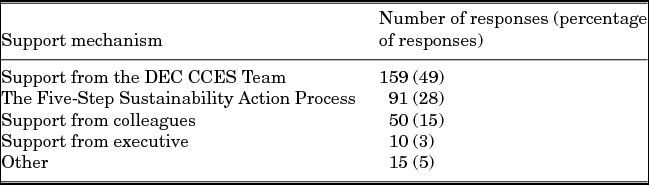
At the conclusion of the CCES projects, teachers’ reflections of the SAP were largely positive. In 2011 and 2012, participating teachers were asked to nominate the most helpful support mechanisms for their projects. See Table 1 for combined responses.
Teachers’ Views on the Most Helpful Support Mechanisms, 2011, 2012
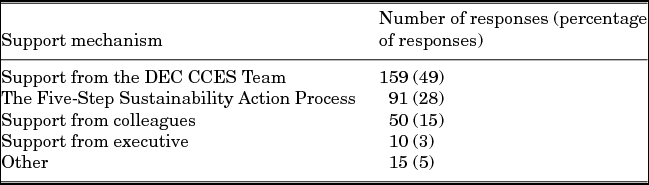
Note: n = 325; response rate 71%.
As can be seen from Table 1, the SAP was regarded as the second-most helpful resource by teachers, with more than one respondent in four nominating this. The SAP was surpassed only by support from the CCES team, in terms of meeting teachers’ approval. Support from the executive was rarely nominated as most helpful. Two respondents identified ‘support from tradespeople’ as the most useful source of support.
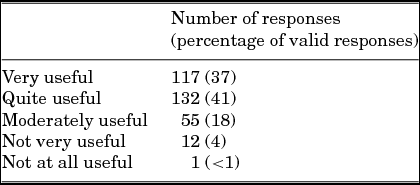
More specifically, teachers were asked to indicate the usefulness of the SAP. See Table 2 for combined results for 2011 and 2012. These percentages provide a broad-brush picture of the perceived value of the SAP.
Teachers’ Views on the Usefulness of the Sustainability Action Process, 2011, 2012
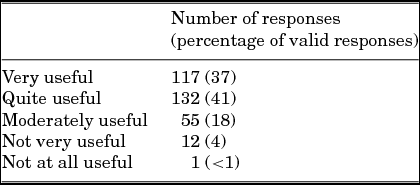
Note: n = 317; response rate 73%.
As can be seen from Table 2, just over three-quarters of participating teachers found the SAP either very or quite useful, with more than a third finding it very useful. This figure climbs to 96% of teachers when those who found the SAP moderately useful are included. Only one respondent found the process not at all useful.
Contributions of the SAP to Learning Outcomes
Many teachers highlighted the ways in which the SAP promoted rich engagement of students. The following comment illustrates a typical view of teachers in the project:
It was refreshing and enlightening for me to see the capabilities of younger students in Year 4 develop their skills and understandings using the sustainability action process. I was impressed by the level of application, diligence, critical thinking and teamwork demonstrated by this age group. (Year 4 teacher, 2010)
This teacher went on to comment that the process was simple to use and it helped her and her students to learn gradually. It also helped them to teach each other about energy, as well as related problems and solutions. This reflected a representative view of the broader teacher respondents.
Furthermore, in at least some instances it appeared that the SAP would continue to influence teaching and learning beyond the life of the projects. A secondary teacher noted that: ‘The 5-Step Sustainability Action Process is now embedded in our science programs for future teachers of this topic’ (Science secondary teacher, 2010). It is difficult to ascertain the breadth of this sentiment among teachers. The question was not specifically posed as part of the research; this was an unsolicited comment.
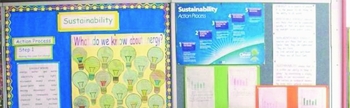
The teachers outlined a number of ways in which the SAP assisted in planning and implementing their projects. The terms ‘model’, ‘guide’ and ‘scaffold’ were regularly ascribed to the action plan and its functions. At one primary school, the steps were ‘marked off’ on the poster as they were achieved (see Figure 1). Another K–6 teacher recounted: ‘We used the [five-step] poster to plan out the steps of the project — then to follow through from step to step as we worked through the project. We also used the main headings to display our findings on our back wall (K–6 teacher, 2010).
Five-step poster on a primary school wall.

One K–6 teacher described the SAP as:
a great model to support the development, implementation and evaluation of student ideas . . . a very structured process . . . students found that it supported their thought processes and guided them . . . nothing was missed. (K–6 teacher, 2010)
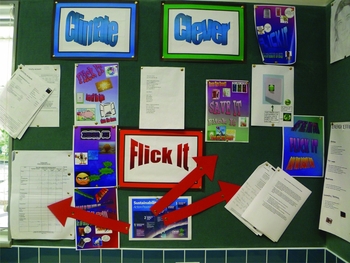
Other teachers emphasised the way the systematic approach offered by the SAP ensured that ‘outcomes were achieved’. One said, ‘This allowed us to really stay on task . . . giving all of us achievable goals.’ Other schools featured the SAP as part of their project displays, as illustrated in Figure 2.
Feature wall, student work and Sustainability Action poster, primary classroom.

Contributions of the SAP to Project Outcomes and Beyond
A key element of environmental education is that it should seek to promote actions to support sustainable living. Teachers commented on the way in which the SAP contributed to environmental action:
It was a good way to reinforce these learning objectives for active citizenship. Fieldwork is based on an action process: investigate, inquire, research, test, find solutions and take up your role as a citizen working with community groups and government agencies. (Secondary school teacher, 2011)
Although the SAP focused on initiating actions to be carried out in the school setting, teachers also commented on the potential for the impact of the school-based initiative to have on behaviour at home:
We used the process to engage the students to think about how we could become more sustainable at school and do it consistently, as well as [to] have the students take the knowledge home and share it with their families and make changes at home. (Teacher, 2012)
Indeed, when teachers were asked to identify student learning outcomes from CCES projects, the second most commonly cited outcome was sustainable behaviours at home (the most common being sustainable behaviours at schools).
Reservations and Limitations
There were, however, reservations from some teachers about the process and its use. While considerable support accrued to the five-step program, one secondary teacher noted that some aspects of steps 2 and 3 (i.e., Defining the scope for action, and Developing the proposal for action) were somewhat repetitive. These processes were, therefore, ‘quite heavy going’ and ‘left the students fairly overtaxed’. A K–6 teacher advised that the SAP was ‘a useful starting place, but needed constant explanation and guidance’ (2010). Others claimed that ‘the language of the Sustainability Action Process [was] too complex’.
Other teachers commented that projects were often driven by small numbers of motivated students. In some instances, this had a positive effect of drawing in the majority of the class. However, in other instances, ‘a small group of highly motivated students completed the bulk of the project. While the students did very well and were quite successful, I felt that it was a lot of work for only a handful of students’ (K–6 teacher).
Some teachers experienced difficulties working with the SAP, especially during the initial phase of their projects. Teachers noted that the SAP appeared particularly challenging for young children. Examples of responses from teachers who experienced difficulties are shown here:
I found it quite overwhelming at first, as I had no idea where to start. The guidelines for this project were hard to follow and the expectation of teachers was never truly explained. The SAP made sense after a while and did prove to be useful. (K–6 teacher, 2011)
I found it quite awkward to communicate the steps of the SAP to the students — particularly the Defining the Scope for Action step. When I first explained the project to them, they were very enthusiastic and full of ideas. They found it very difficult to put aside these ideas (what is described as ‘solution jumping’) until the very end. For K–6 level students, if this is to be a student-directed project, the structure of the SAP and e-folio needs a lot of simplification. (K–6 teacher, 2011)
Even these comments, however, do not express an outright rejection of the SAP, but rather are recommendations for its adaptation and implementation. It is also noted here in passing that both of these comments are from teachers of younger children, and the limitations of the SAP might be restricted with regard to such students. Moreover, such comments were in the minority.
Discussion
The comments provided above are just a small sample of the overwhelmingly positive reactions to the SAP (Buchanan, Schuck, & Aubusson, Reference Buchanan, Schuck and Aubusson2014). Evidence from the evaluation suggests that the SAP, in conjunction with support from the centralised project support team and classroom teacher, has provided helpful guidance and structure for sustainability projects undertaken by students in a variety of contexts.
The success of any environmental sustainability project can be measured by its capacity to generate ideas for, and to implement, action (Wiek, Ness, Schweizer-Ries, Brand, & Farioli, Reference Wiek, Ness, Schweizer-Ries, Brand and Farioli2012; Hacking, Cutter-Mackenzie, & Barrratt, Reference Hacking, Cutter-Mackenzie, Barrett, Stevenson, Brody, Dillon and Wals2012; Zint, Reference Zint, Stevenson, Brody, Dillon and Wals2012). Heimlich, Mony, and Yocco (Reference Heimlich, Mony, Yocco, Stevenson, Brody, Dillon and Wals2012, p. 262) speak of the ‘vital link’ between belief and behaviour. Action is a prominent theme in ACARA's (2015) explanation of sustainability. ‘Act’ and its cognates appear eight times in ACARA's discussion of sustainability. The CCES program sought to achieve these behavioural outcomes in a school setting by involving students in all aspects of the program (see Buchanan, Reference Buchanan2012). This included identifying an energy conservation problem, developing project submissions, and implementing funded projects. A critical cornerstone of the CCES program was the SAP. Its five steps of making a case for change, defining scope for action, developing a proposal for action, implementing the proposal, and evaluating and reflecting provided a scaffold for the projects. For the majority of participants, the SAP appears to have established a clear pathway for implementing the project and supported the achievement of the project's goals.
According to ACARA (2015), sustainability derives from ‘three key concepts: systems, world views and futures’. Cupitt and Smith (Reference Cupitt and Smith2012) also adopt this approach in their approach to studying energy, among other sustainability issues. While the SAP is practice- and goal-oriented, it also has a conceptual orientation. The ‘making a case for change’ and ‘defining the scope for action’ stages, in particular, require justification as to why the proposed project is worthwhile from economic and sustainability points of view. This perhaps explains why some younger children struggled with the latter of these two stages of the SAP process (defining scope for action). Lang et al. (Reference Lang, Wiek, Bergmann, Stauffaucher, Martens, Moll and Thomas2012) assert that sustainability initiatives need to find new ways of producing knowledge and guiding decisions. We have reported elsewhere more specifically on some of the related conceptual issues, such as a comparison of various energy production methods (Buchanan, Aubusson, & Schuck, Reference Buchanan, Aubusson, Schuck, Thomas and Muga2014).
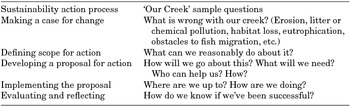
A critical feature of the CCES program was that it gave students both choice about the area with which to engage and control over the ways they implemented the projects. The literature indicates that student choice is an important contributor to successful project outcomes (see Dimick, Reference Dimick2012; English & Kitsantas, Reference English and Kitsantas2013). Although teachers reported on the projects, the responsibility for the project implementation at schools lay not with the teacher, but with the students. Teachers consistently reported that they were surprised by the capacity of students to lead the project as well as engage in critical and analytical thinking about the work. Furthermore, students monitored the impacts of their actions on energy consumption to evaluate and inform the actions they were taking. A highlight of the program included the active citizenship that emerged as students designed and conducted the projects. As a consequence, the students also influenced environmental action for sustainability in their homes. The program and its associated school-based projects could be applied to other problems and initiatives. Projects initiated and driven by students could lend themselves to a number of social and environmental causes. These could operate either at the local school/community level or, more broadly, with schools collaborating to address, for example, sustainability problems related to their river catchment area, as outlined in Table 3.
An Investigative, Problem-Solving Approach to Socio-Environmental Studies

Some teachers commented that it was often initially difficult to work with the SAP process. The CCES program was new to all teachers and students in the study. It is not clear, therefore, whether this criticism is simply a consequence of teachers and students struggling to familiarise themselves with a new initiative. Of those who reported difficulties with the SAP, many reported that they were eventually able to overcome initial challenges. However, some teachers offered suggestions that might improve the process, including simplifying the language of the SAP. The ways that younger students negotiated the initial complexity suggests that some modification of the SAP language for younger students may be appropriate. This study only focused on first-time users in each of the 3 years. Further study of teachers working with the SAP for a second or third time might produce further insights on the extent to which problems can be minimised with subsequent projects.
While the SAP incorporates questions that correspond to each stage, as outlined previously, these questions could be made more prominent and simplified. Teachers routinely ask questions of their students and this approach is therefore likely to be readily recognisable and intelligible to students. This might help students in earlier years in particular, as well as others who might struggle conceptually with the SAP for other reasons. Table 3 shows an exemplar in which the SAP can be adapted, using another local environmental issue as an example.
As noted in Table 1, the SAP was ranked in second place on the survey, in terms of its usefulness for the success of the projects. It was only surpassed by the assistance provided by the CCES leadership team. Accordingly, we assert that a good framework can supplement, but not supplant, support from dedicated personnel with expertise in the field (see Buchanan, Schuck, & Aubusson Reference Buchanan, Schuck and Aubusson2014).
Conclusions, Recommendations and Implications for Future Research
As stated above, the project's research questions were: To what extent and in what ways can a framework, in this case the SAP, assist students and teachers in achieving educational, sustainability and project-related outcomes? Based on the range of data collected in this project, the SAP has been an effective vehicle for promoting awareness and action with regard to sustainability education — a ‘significant life experience’ (Liddicoat & Kransy, Reference Liddicoat, Kransy, Stevenson, Brody, Dillon and Wals2012, p. 289). Specifically, the ‘making a case for change’ stage generated awareness of the implications and management of energy. The problem-based learning approach (in particular, the developing, implementing and evaluating stages) helped students acquire the autonomy needed to identify a local problem and develop strategies to address it, and then reflect on the success thereof. As noted previously, the vast majority of participating teachers found the SAP a useful framework and among the most useful support mechanisms for their projects. It appears to have been helpful in maintaining the motivation of children, as they were able to note the stage that they had begun or completed, while having before them a blueprint of ‘where to next’. Most importantly, the SAP appears to have assisted children in undertaking, and then evaluating the effect of, the changes they implemented.
We do note some of the problems encountered with certain projects, which align with limitations observed by Boud and Feletti (Reference Boud and Feletti1997) and others. Means for improving the SAP's usefulness in supporting school initiatives appear mainly to focus on providing teachers with more information on its operation and purposes, such as a more explicit explanation of the iterative, back-and-forth nature. A diagrammatic representation of the SAP as a flow chart might be useful in this regard. Some teachers expressed difficulties in explaining the process to younger children. We concede that a project such as this may be more complex than anything middle-primary students are accustomed to. One possible response to this could be vertical groups of students engaging in projects, with older students mentoring younger ones. A future investigation of this would be of use. Finding and discussing best practice in involving all students — not just a committed subgroup — in projects would also be worthy of research. By contrast, the effectiveness of the process in this program suggests its wider application is also worthy of further investigation both within schools and in other contexts, and in its lifelong and life-wide capacities. In a broader context (development programs), Myers, Fisher, Pickering, and Garnett (Reference Myers, Fisher, Pickering and Garnett2013) lament the dearth of longitudinal evaluations. The SAP has potential for application in other subject areas, such as Science. Similarly, the real-world learning at school transferred to the homes of at least some students in this program. These potentials could also be investigated in subsequent research. We also recognise that electricity consumption is but one of a suite of un/sustainability problems that require behaviour change, as well as the interconnectivity and subsequent outcomes and consequences of sustainability problems and responses. The extent to which student behaviours transfer, or fail to transfer, in the minds and lives of students and teachers would be another interesting focus of research.
With the support of the SAP, their teachers and the CCES leadership team, the students took responsibility for their learning and were motivated to address their concerns about energy usage. Furthermore, teachers reported that the initiative in the school influenced the way students behaved in settings outside the school, such as their homes. The SAP promoted actions that support sustainable living. In response to a global ecological crisis, we see this program as one that sets out to find hope (Kelsey & Armstrong, Reference Kelsey, Armstrong, Wals and Corcoran2012) through a ‘pedagogy of possibility’ (Bussey et al. Reference Bussey, Bjurstrom, Sannum, Avadhuta, Nadhomi-Mukisa, Ceruto, Pineda, Wals and Corcoran2012, p. 77). While a longitudinal study tracking these children into adulthood would be required to ascertain longer-term changes, we trust that the features of the projects — student-led, problem-based, project-oriented, and with tangible outcomes — will be among the elements of these children's schooling that prove to be more memorable and enduring, and will translate into subsequent sustainable life-habits.
Acknowledgments
We would like to acknowledge the teachers and students who enthusiastically and creatively responded to the challenge of devising sustainability projects, and the coordinators for their leadership and their help in setting up contacts for us.
Financial support
We would like to thank the NSW Department of Education and Communities for funding this project.
Conflicts of Interest
None.
Author Biographies
John Buchanan is Associate Professor, Teacher Education Program, Faculty of Arts and Social Sciences, University of Technology Sydney.
Sandy Schuck is Professor of Education in the Faculty of Arts and Social Sciences, University of Technology Sydney.
Peter Aubusson is Professor of Education and Head of the School of Education in the Faculty of Arts and Social Sciences, University of Technology Sydney.