INTRODUCTION
Historically, the triad of bone loss and weakening, kidney stones, and neuromuscular pain has been the defining feature of primary hyperparathyroidism (PHPT). This disease is characterized by hypercalcemia and elevated parathyroid hormone (PTH) levels which result from a benign adenoma on at least one of the four parathyroid glands (Eigelberger, Cheah, Ituarte, Streja, Duh, & Clark, Reference Eigelberger, Cheah, Ituarte, Streja, Duh and Clark2004). This adenoma causes the gland to increase secretion of PTH, which in turn alters how the body releases calcium from the bones and absorbs calcium in the intestine and kidney. Surgical excision of the overactive parathyroid gland (a usually minimally invasive procedure known as a parathyroidectomy), is the definitive treatment for symptomatic PHPT (Bilezikian, Reference Bilezikian2000).
As the biochemical abnormalities of PHPT become more easily assessed through routine laboratory tests, the disease is detected earlier in its course. With earlier detection has come a change in the presentation of the disease (Heath, Hodgson, & Kennedy, Reference Heath, Hodgson and Kennedy1980). For example, a recent review indicated that classic symptoms of the disease are occurring less frequently: occult bone disease is found in less than 2% of cases, and nephrolithiasis is seen in approximately 15–20% of cases (Bilezikian et al., Reference Bilezikian, Potts, Fuleihan, Kleerekoper, Neer and Peacock2002). Thus, nearly 80% of biochemically identified cases of PHPT are “asymptomatic” in terms of the classic symptoms (Bilezikian, Reference Bilezikian2000).
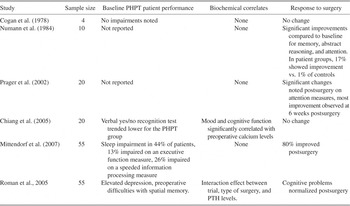
The notion that PHPT is truly “asymptomatic” in a majority of cases has recently been called into question on the grounds of health related quality of life (HRQOL) and neuropsychological outcomes. In terms of HRQOL, nonspecific complaints such as fatigue, muscle aches, back pain, polyuria, constipation, forgetfulness, and affective symptoms have been documented in 40 to 70% of patients with PHPT, a rate higher than found in other endocrine disorders such as hypothyroidism (Eigelberger et al., Reference Eigelberger, Cheah, Ituarte, Streja, Duh and Clark2004; Coker et al., Reference Coker, Rorie, Cantley, Kirkland, Stump and Burbank2005). Despite the frequency of these subjective cognitive and affective complaints, small samples, inconsistent definitions of impairment and response to treatment, and the relative underutilization of formal psychometric procedures has hampered research in this area. Conclusions from these studies are often contradictory (see Table 1).
Summary of Psychometric Studies of Cognitive and Affective Symptoms in PHPT

Note
PHPT = primary hyperparathyroidism.
Furthermore, the mechanism by which PHPT may impact cognition and mood is unclear. One hypothesis is that PTH itself may be neurotoxic. PTH receptors have been identified in the central nervous system, and PTH has been demonstrated to cross the blood brain barrier in animal and human models (Joborn et al., Reference Joborn, Hetta, Niklasson, Rastad, Wide and Agren1991; Tilvis, Kähönen-Väre, Jolkkonen, Valvanne, Pitkala, & Strandberg, Reference Tilvis, Kähönen-Väre, Jolkkonen, Valvanne, Pitkala and Strandberg2004; Weaver, Deeds, Lee, & Segre, Reference Weaver, Deeds, Lee and Segre1995). Functionally, PTH levels have been associated with neuropsychological abnormality. For example, in a study of individuals with secondary hyperparathyroidism of unspecified etiology (but not due to renal failure), strong associations between PTH level and cognition were observed in the domains of working memory, speeded information processing, and language (Jorde, Waterloo, Saleh, Haug, & Svartberg, Reference Jorde, Waterloo, Saleh, Haug and Svartberg2006). However, the role of PTH on central nervous system (CNS) functioning is still unclear, in part due to the fact that PTH can degrade into several active fragments that may have differential effects on the CNS. For example, a previous study of PTH fragments in rats demonstrated that of four PTH fragments, intraventricular administration of two facilitated shuttle box learning and administration of the other two blocked shuttle box learning (Clementi et al., Reference Clementi, Drago, Prato, Cavaliere, Di Benedetto and Leone1984). The physiological mechanisms behind PTH receptor activation in the CNS is also unclear, as PTH subtype receptors have been shown to be related to both neuroprotection in the face of hypercalcemia as well as neurotoxicity under other conditions (LaBuda & Usdin, Reference LaBuda and Usdin2004).
Calcium is also clearly implicated in CNS functioning (Horst & Burke, Reference Horst, Burke, Yudofsky and Hales2008), and hypercalcemia has long been associated cognitive deficits including dementia and psychosis, which resolve rapidly with resolution of acute hypercalcemia (Evaldsson, Ertekin, Ingvar, & Waldenström, Reference Evaldsson, Ertekin, Ingvar and Waldenström1969; Prete et al., Reference Prete, Foiani, Trasciatti, Senesi, Veneziano and Barone2005). However, even the milder hypercalcemia or normocalcemia observed in PHPT may be related to changes in cerebral metabolism, as both calcium and PTH have been shown to have vasoconstrictive effects (Nilsson, Aberg, Rastad, & Lind, Reference Nilsson, Aberg, Rastad and Lind1999). This effect may explain changes in regional cerebral functioning noted in PHPT. Mjaland and colleagues found abnormally reduced regional cerebral blood flow on SPECT imaging in 14 of 16 PHPT patients, which improved in 13 of 14 patients following surgery (Mjåland, Normann, Halvorsen, Rynning, & Egeland, Reference Mjåland, Normann, Halvorsen, Rynning and Egeland2003). Similar changes have been observed using functional magnetic resonance imaging (fMRI). For example, Perrier and colleagues studied six PHPT patients and found increased bilateral prefrontal activation during a Stroop type task, along with improved task performance on neuropsychological measures and improved health related quality of life issues after parathyroidectomy (Perrier et al., Reference Perrier, Coker, Rorie, Burbank, Kirkland and Passmore2006). While these results are promising, it is important to note that the neuropsychological improvements were of unclear clinical significance and relationships between behavioral symptoms and biochemical alterations have yet to be consistently established.
Another frequently documented biochemical abnormality in PHPT is low vitamin D (Grey, Lucas, Horne, Gamble, Davidson, & Reid, Reference Grey, Lucas, Horne, Gamble, Davidson and Reid2005), and vitamin D deficiency has been demonstrated be associated with cognitive impairments, especially in the elderly (Przybelski & Binkley, Reference Przbelski and Binkley2007).
In addition to the unclear mechanism of impairment in PHPT, the response to treatment is also confounded by two points. First, parathyroidectomy results in immediate and often dramatic drops in PTH, a marker which is monitored intra-operatively to ensure the success of the surgery (Akerström & Hellman, Reference Akerström and Hellman2004). With this change in PTH can come a rapid resolution of hypercalcemia. It is possible that these rapid changes in biochemistry may negatively impact the CNS through a rapid disturbance of homeostasis, although this hypothesis has not been explored. Additionally, while the surgical procedure for a parathyroidectomy is often minimally invasive, anesthesia is still used. Anesthesia itself may negatively impact cognition postsurgery (Newman, Stygall, Hirani, Shaefi, & Maze, Reference Newman, Stygall, Hirani, Shaefi and Maze2007), and the relationship between anesthesia and cognition following parathyroidectomy has not been documented.
The relative paucity of research regarding cognitive and affective symptoms of PHPT has resulted in these symptoms being omitted from consensus statements regarding the surgical management of PHPT (Bilezikian et al., Reference Bilezikian, Potts, Fuleihan, Kleerekoper, Neer and Peacock2002; Prager et al., Reference Prager, Kalaschek, Kaczirek, Passler, Scheuba and Sonneck2002). The lack of consideration of these symptoms in management of PHPT is particularly worrisome, given that at least some studies document both subjective and objective improvements in cognitive and affective functioning following parathyroidectomy (i.e., Mittendorf et al., Reference Mittendorf, Wefel, Meyers, Doherty, Shapiro and Lee2007; Roman et al., Reference Roman, Sosa, Mayes, Desmond, Boudourakis and Lin2005).
The purpose of the current study is to characterize presurgical impairment and postsurgical change in cognitive function and affective domains with more rigorous psychometric methods. Formal neuropsychological assessments of multiple domains of cognitive functioning and mood were completed pre and postparathyroidectomy with a large sample of PHPT patients. Changes in cognitive function and mood following parathyroidectomy were assessed using a practice-effect corrected reliable change index (RCI; Chelune, Naugle, Uders, Sedlak, & Awad, Reference Chelnue, Naugle, Uders, Sedlak and Awad1993). Biochemical and physical correlates of the disease, including pre and postoperative calcium (Ca) and PTH, magnitude of changes in Ca and PTH postsurgery, intra-operative drop in PTH, preoperative vitamin D, and anesthesia variables were evaluated for associations with cognitive or mood changes early (on average 1 month) after parathyroidectomy.
METHOD
Participants
As a part of clinical practice, patients diagnosed with PHPT at the University of Texas M.D. Anderson Cancer Center (UTMDACC) in Houston, Texas who were considered for parathyroidectomy were referred for neuropsychological evaluation. The institutional review board of UTMDACC approved the chart review. Definitive diagnosis of PHPT was based on abnormally elevated PTH levels in the context of elevated serum calcium levels. If calcium levels were elevated but within normal limits, other variables such as vitamin D deficiency were excluded before diagnosis was made.
In total, 167 charts were reviewed. Thirty-four patients were excluded from the current study for the following reasons: 13 for presurgical neurological conditions (most commonly due to a history of head injury with loss of consciousness or a long standing history of dementia), 13 because of long time spans between the baseline evaluation and date of surgery, 11 for lack of baseline evaluation, 7 for diagnosed multiple endocrine neoplasias, 7 who had previous parathyroidectomy, 4 individuals with long-standing psychiatric histories, 1 who required a translator for testing. Thus, 111 presurgical (baseline) evaluations were included in the present study. This sample was predominantly late middle-aged (M = 60.5 years; SD = 12.3; range, 27–84), female (82.9%), right-handed (91.0%), and had attended at least some college (M = 14.0 years of education, SD = 2.9; range, 7–20). Participants who underwent parathyroidectomy and returned for testing were seen an average of 20.2 days (SD = 20.3; range, 0–82) before the procedure.
Sixty-seven early postsurgical follow-up evaluations were reviewed. Early postsurgical evaluations occurred on average 1 month following surgery (M = 32.6 days; SD = 20.7) with variability due to patient travel and other appointment scheduling considerations. The reasons for the loss of patients to follow-up varied, as some patients lived far away from the center, others were followed up by non-MDACC endocrinologists, and still others failed to schedule follow-up sessions. However, patients who received baseline only or baseline and early follow-up did not differ on demographic, or baseline cognitive or affective test scores.
Materials
All patients were administered a brief neuropsychological battery intended to sample heavily from attentional, memory, processing speed, and executive function domains. Attention span was assessed with the Digit Span subtest of the Wechsler Adult Intelligence Scale-3rd edition (WAIS-III DS; Wechsler, Reference Wechsler1997). Several instruments assessed information processing speed. The Paced Auditory Serial Addition Test (PASAT) is an instrument that requires patients to add aurally presented numbers in a sequential manner (Gronwall, Reference Gronwall1977). The 3-second (PASAT3) and 2-second (PASAT2) inter-stimulus interval trials of this task, as used in the Multiple Sclerosis Functional Composite Battery, were administered to participants in this study (Rao, Leo, Haughton, St Aubin-Faubert, & Bernardin, Reference Rao, Leo, Haughton, St Aubin-Faubert and Bernardin1989). However, a significant percentage (60%) of patients were not administered the PASAT secondary to lack of appropriate normative data (80.3% of participants with missing PASAT scores were above the age of the normative sample). Thus PASAT data were more prevalent in younger patients. Visual sequencing and processing speed were assessed by the Trail Making Test Part A (TMTA; Reitan, Reference Reitan1958) and the WAIS-III Digit Symbol (WAIS-III DSYM) subtest. Verbal learning and memory were assessed with the Hopkins Verbal Learning Test-Revised (HVLT-R; Benedict, Schretlen, Groninger, & Brandt, Reference Benedict, Schretlen, Groninger and Brandt1998; Brandt, Reference Brandt1996). For the current study, total learning, delayed recall, and delayed recognition were included in the analyses. Alternate forms of the HVLT-R were used during the follow-up assessment. Executive function was assessed with the following tasks: rapid alternation of cognitive set (Trail Making Test Part B; TMT B); timed lexical fluency (Multilingual Aphasia Examination Controlled Oral Word Association, COWA, Benton & Hamsher, Reference Benton and Hamsher1989); and timed inhibition of competing stimuli as measured by the Stroop Color-Word (CW) trial (Golden, Reference Golden1976, Golden & Freshwater, Reference Golden and Freshwater2002). In addition, the Stroop color and word trials were included as additional processing speed measures. Upper extremity fine motor speed and dexterity was assessed with the Lafayette Grooved Pegboard test (Trites, Reference Trites1977).
Mood and HRQOL were assessed with several instruments. The Beck Depression Inventory, Second edition (BDI-II) is a short self-report measure that addresses a broad range of depressive symptoms (Beck & Steer, Reference Beck and Steer1987). The State-Trait Anxiety Inventory (STAI) assesses characterologic (trait) and current (state) symptoms of anxiety; only the state anxiety scale was used in this study (Speilberger, Reference Spielberger1983). HRQOL was measured by the Parathyroidectomy Assessment of Symptoms scale (PAS; Pasieka et al., Reference Pasieka, Parsons, Demeure, Wilson, Malycha and Jones2002). This instrument was created specifically to evaluate common nonspecific complaints in HPT such as weakness and fatigue. Patients respond to each symptom category on a visual analog scale from 0 to 100 across the 13 included domains; a sum score was calculated by adding the items. Of particular interest to the current study was question 9 (PAS-9) that assesses subjective memory complaints. This item was analyzed separately to determine the relationship of subjective memory complaint with objective test performance.
Data Analysis
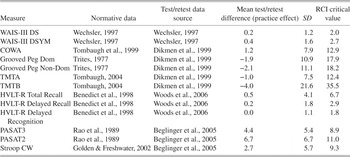
Neuropsychological measures were transformed into Z-scores on the basis of the normative data for each measure as outlined in Table 2. Mood measures were evaluated in terms of their respective published cut-off scores. For neuropsychological measures, a cut-off score of Z ≤ −1.5 (1.5 SD below the mean) was set as defining any given test score as impaired, as this score would be expected to be found in less than 7% of the neurologically intact population. To minimize the risk of false positive errors, individuals were identified as having clinically significant impairment (CSI) if performances on three or more of the 15 cognitive tests were below Z ≤ −1.5. This cut-off minimized Type I error in identifying patients as impaired according to published equations for the identification of neuropsychological impairment across a battery of measures (Ingraham & Aiken, Reference Ingraham and Aiken1996). On mood measures, published cut-offs for clinically significant distress were used: BDI-II > 14, STAI state scale Z < −1.5.
Sources and Values of Practice Effect Corrected Reliable Change Indices (RCI)

Note
WAIS-III = Wechsler Adult Intelligence Scale-3rd Edition; DS = Digit Span; DSYM = Digit Symbol; COWA = Multilingual Aphasia Examination-Controlled Oral Word Association; Grooved Peg = Lafayette Grooved Pegboard; Dom = dominant hand; Non-Dom = nondominant hand; TMT = Trail Making Test; HVLT-R = Hopkins Verbal Learning Test-Revised; PASAT = Paced Auditory Serial Addition Task; CWI = Color Word Trial.
Given the lack of an appropriate control group (i.e., a nonsurgical PHPT group or other minimally invasive neck surgery group), we used reliable change indices (RCI) to evaluate the frequency of statistically rare changes following surgery. To calculate this, the mean change in performance in normative test–retest samples was evaluated (Table 2). The difference between the means in these samples represents the extent of improvement in test performance expected to occur due being exposed to the measure twice (practice effect). The standard deviation of this difference score represents the standard error of the measurement (SEM) for this instrument. To use the RCI, a patient’s postsurgical test performance was subtracted from presurgical performance. The practice effect was then subtracted from this difference. The resulting value was then compared with critical values set at ± 1.64 times the SEM (a 90% confidence interval). Scores that exceeded this value in the direction of better performance were labeled as improved, scores that worsened beyond this value were labeled a decline; and changes that did not exceed the RCI were considered stable. For mood measures, improved, stable, and declined were defined using established cut-off points for these measures (i.e., a patient’s responses that changed from being classified as affectively distressed to not distressed would be classified as improved) as well as by comparing changes to published RCI estimates (Seggar, Lambert, & Hansen, Reference Seggar, Lambert and Hansen2002).
Using these RCI estimates, four groups were created (those who were stable-impaired, stable-unimpaired, improved, and declined). The differences of these four groups on pre, post, magnitude of change from pre- to postsurgery, and intra-operative biochemical measures, and anesthesia variables and age were evaluated via ANOVA with planned post hoc comparisons for significant results.
RESULTS
Baseline Characteristics
Cognition
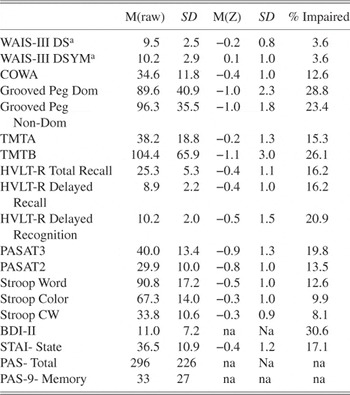
Means of raw scores and Z-scores obtained at baseline as well as percentage of participants whose performances were Z ≤ −1.5 (impaired) are found in Table 3. Evaluation of the baseline data revealed that the percentage of impaired performance on cognitive measures ranged from a low of 3.6% on WAIS-III DSYM and WAIS-III DS measures to a high of 28.8% for dominant hand Grooved Pegboard performance. Participants averaged 2.3 (SD = 2.5) impaired performances at baseline and 35.1% of patients met criteria for clinically significant impairment (CSI) (i.e., 3+ scores Z ≤ −1.5).
Descriptive Statistics from Baseline Evaluations (n = 111)

Note
WAIS-III = Wechsler Adult Intelligence Scale-3rd Edition; DS = Digit Span; DSYM = Digit Symbol; COWA = Multilingual Aphasia Examination-Controlled Oral Word Association; Grooved Peg = Lafayette Grooved Pegboard; Dom = dominant hand; Non-Dom = nondominant hand; TMT = Trail Making Test; HVLT-R = Hopkins Verbal Learning Test-Revised; PASAT = Paced Auditory Serial Addition Task; CW = Color Word Trial; BDI-II = Beck Depression Inventory, Second Edition; STAI-State = State Trait Anxiety Inventory; PAS = Parathyroidectomy Assessment of Symptoms; na = not applicable.
a Raw Mean Scores reported are standard scores.
Mood and HRQOL
A total of 30.6% of patients met criteria for clinically significant depression on the BDI-II at baseline (19% mild, 12% moderate/severe). A total of 17.1% of patients met criteria for clinically significant anxiety. Means and standard deviations for mood and HRQOL measures re found in Table 3.
Biochemical Variables and Predictors of Cognitive and Mood Functioning
Biochemical variables
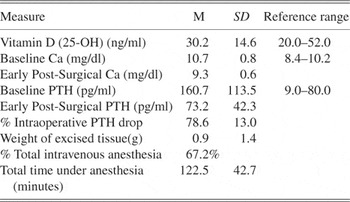
Means and standard deviations for biochemical measures are found in Table 4. Mass of the benign adenoma removed was established by pathologists within the UTMDACC.
Descriptive Statistics of Biochemical Parameters

Note
Ca = calcium; mg = milligrams; dl = deciliter; pg = picograms, PTH = parathyroid hormone, g = grams.
The distribution of biochemical measures (except for preoperative vitamin D) revealed significant non-normality that would have affected subsequent inferential statistics. Logarithmic transformation of these variables was conducted, and transformed variables are referred to and used for the analyses presented below.
Correlates of cognition and mood
No significant differences on baseline biochemical parameters or age were found between individuals who met criteria for clinically significant impairment (CSI) and those who did not. Individuals who were impaired were significantly less well educated (13.1 vs. 14.4 years; t = 1.9; p < .03) and there was a trend for higher preoperative PTH levels in patients with clinically significant impairments (t = −1.7; p = .10). No significant relationships were observed between PAS-9 (self-reported forgetfulness) and any memory measures, but subjective forgetfulness was significantly correlated with depression (r = 0.32; p < .01). No statistically significant correlation was observed between BDI scores and cognitive performance at baseline.
Response to Parathyroidectomy
Reliable changes
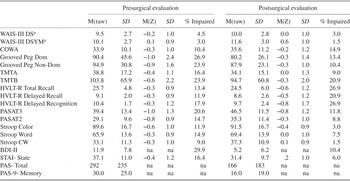
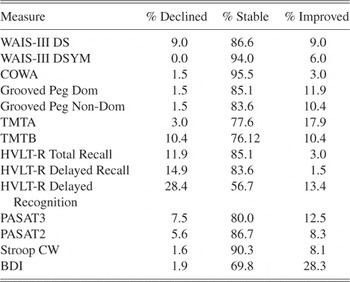
Mean performances on cognitive, mood, and HRQOL measures for the group who received baseline and follow-up evaluations can be found in Table 5. The reliable change index was computed for each measure (except Stroop color and word trials) and results are presented in Table 6. An a priori decision was made that if 10% or more of the sample showed improvements or declines, these domains would be considered to have significantly changed. Based upon this criterion, improved domains were fine motor speed (Grooved Pegboard test) and information processing speed (PASAT3 and TMTA). Mixed improvements and declines were observed on one executive functioning measure (TMTB). Memory, especially recognition memory, declined at delay (HVLT-R Delayed Recognition). In terms of depression, 28.3% showed reliable improvements at follow-up, the most improved measure administered. RCI indices were not available for the STAI-state, but only 6.2% of patients met criteria for clinically significant anxiety at follow-up. Overall, of patients who met criteria for CSI at baseline, 37.5% did not meet criteria at the early follow-up. Of patients who did not meet criteria for CSI at baseline, 18.6% did so at follow-up. Within this group, the vast majority of test declines were on memory measures (52.3%), with declines on the COWA (19.0%), PASAT (14.1%), TMTA or TMTB (9.5%), and Stroop CWI (4.7%) occurring much less often.
Mean Performances on Cognitive, Mood, and HRQOL Measures for the Group Who Received Baseline and Follow-Up Evaluations

Note
WAIS-III = Wechsler Adult Intelligence Scale-3rd Edition; DS = Digit Span; DSYM = Digit Symbol; COWA = Multilingual Aphasia Examination-Controlled Oral Word Association; Grooved Peg = Lafayette Grooved Pegboard; Dom = dominant hand; Non-Dom = nondominant hand; CW = Color Word trial; TMT = Trail Making Test; HVLT-R = Hopkins Verbal Learning Test-Revised; PASAT = Paced Auditory Serial Addition Task; BDI-II = Beck Depression Inventory, Second Edition; STAI-State = State Trait Anxiety Inventory; PAS = Parathyroidectomy Assessment of Symptoms; na = not applicable.
a Raw Mean Scores reported are standard scores.
Results of RCI Analysis for Early Follow-Up Versus Baseline Evaluations

Note
WAIS-III = Wechsler Adult Intelligence Scale-3rd Edition; DS = Digit Span; DSYM = Digit Symbol; COWA = Multilingual Aphasia Examination-Controlled Oral Word Association; Grooved Peg = Lafayette Grooved Pegboard; Dom = dominant hand; Non-Dom = nondominant hand; CW = Color Word Trial; TMT = Trail Making Test; HVLT-R = Hopkins Verbal Learning Test-Revised; PASAT = Paced Auditory Serial Addition Task; BDI = Beck Depression Inventory.
Paired samples t tests revealed that subjective complaints on the PAS and self-reported forgetfulness were significantly lower at the postsurgical evaluation (t = 4.0; p < .0001 and t = 4.6; p < .0001, respectively).
Differences Between Those Who Improved and Declined
Four groups were evaluated at follow-up based on CSI criteria: those who were stable impaired, those who were stable not-impaired, those who improved, and those who declined. The only effect that approached significance was for age (F(3,63) = 2.3; p = 0.08). Planned post hoc analyses revealed that those who improved were significantly younger than those who were stable impaired (mean difference −9.2 years; p < .05) and those who were stable impaired (mean difference −13.4 years; p < .05). There was also a trend for individuals who improved to be younger than those who declined (mean difference −10.2 years; p = .08).
As the pronounced decline on memory was an unexpected finding, this result was explored in more detail. Independent sample t tests of preoperative biochemical variables and age were conducted for those who declined on memory testing and those who remained stable on each of the three memory indices. On initial learning trials, patients who declined had greater changes in calcium (t = 3.3; p < .05) and PTH (t = 2.50; p < .05) from pre to postsurgery and had greater intraoperative PTH drops (t = 2.56; p < .05). On delayed memory measures, patients who declined had lower preoperative Vitamin D (t = −2.5; p < .05) and were older (t = 3.1; p < .05). Those who declined on a delayed recognition measure had higher preoperative vitamin D than those who were stable (t = 2.65; p < .01). Anesthesia variables (whether or not total intravenous anesthesia was obtained or total time under anesthesia) were not significantly different among these groups.
DISCUSSION
Cognitive and Emotional Profiles of PHPT
In the present study, clear neuropsychological impairments were observed in a subset of patients with PHPT. Before surgery, one-third of patients demonstrated clinically significant cognitive deficits. Furthermore, most individuals had at least two impaired test performances on the battery of tests administered. The finding of significant cognitive impairment in individuals with PHPT is in agreement with some (Mittendorf et al., Reference Mittendorf, Wefel, Meyers, Doherty, Shapiro and Lee2007; Dotzenrath et al., Reference Dotzenrath, Kaetsch, Pfingsten, Cupisti, Weyerbrock and Vossough2006; Roman et al., Reference Roman, Sosa, Mayes, Desmond, Boudourakis and Lin2005) but not all (Chiang, Andrewes, Anderson, Devere, Schweitzer, & Zajac, Reference Chiang, Andrewes, Anderson, Devere, Schweitzer and Zajac2005) previous findings.
While memory loss is a common complaint in individuals with PHPT, memory performance was not disproportionately impaired compared with other cognitive domains before surgery. No significant relationship was found between subjective complaint of memory disturbance and memory performance, suggesting that reliance on patient self-report may be inadequate for the evaluation of cognitive status. Patient’s ratings of their mood on the BDI-II were unrelated to tested cognitive performance at baseline, suggesting that objective impairments are not explained by depression alone. As noted in other populations, variables such as sleep disturbance may be related subjective memory complaint (Orff, Drummond, Nowakowski, & Perlis, Reference Orff, Drummond, Nowakowski and Perlis2007). Sleep disturbance may be an important variable to explore in future studies of hyperparathyroidism, as sleep disturbances are common and may resolve with parathyroidectomy (Mittendorf et al., Reference Mittendorf, Wefel, Meyers, Doherty, Shapiro and Lee2007).
Biochemistry and Predictors of Cognition
Overall, before surgical intervention, patients with PHPT showed a pattern of reduced cognitive and motor speed, memory, and executive function, as well as increased incidence of depression. To determine if these impairments in cognitive function and disturbed mood were related to the proposed pathology of PHPT that involves diffuse cerebral dysfunction secondary to systemic biochemical abnormalities (Cogan et al., Reference Cogan, Covey, Arieff, Wisniewski, Clark and Lazarowitz1978), we examined several biological parameters. Results did not reveal an overall pattern of significant relationships between cognition or mood and biochemical measures of PHPT at baseline. This generally null finding does not preclude the potential for other biochemical features, such as particular PTH fragments, to play an important role in this disorder, as specific PTH fragments have been demonstrated to impact various affective and behavioral responses (LaBuda & Usdin, Reference LaBuda and Usdin2004; Clementi et al., Reference Clementi, Drago, Prato, Cavaliere, Di Benedetto and Leone1984). Future studies which use more refined analysis of PTH fragments and subtypes may help to elucidate the potential relationship between cognition and neurochemistry more clearly.
Response to Parathyroidectomy
Following surgery, 37.5% of patients who met criteria for CSI no longer did so. Across the neuropsychological test battery, motor and cognitive processing speed improved most notably, while the most frequent decline was on the HVLT-R. Within the 18.2% of patients who met criteria for clinically significant decline, the majority of their observed test declines were on memory measures. Those who declined in memory showed a variable pattern of biochemical changes, although these results must be interpreted cautiously given the number of analyses conducted. Patients who struggled with initial encoding of memory, a task that requires significant attention, showed greater absolute changes in Ca, PTH, and intra-operative PTH. This suggests that the brain may be sensitive to the sometimes dramatic biochemical changes that can follow parathyroidectomy (i.e., rapid change in the homeostasis of brain chemistry may temporarily disrupt normal cognitive function, even if the direction of change was to “normal”). In contrast, older age and lower vitamin D levels were associated with worse outcomes on a delayed memory measure. Recognition memory showed the opposite pattern, with higher preoperative vitamin D scores being associated with worse outcomes. Not explored in this study, but of potential interest, is the possibility of an interaction effect between age and vitamin D and the impact of vitamin D replacement on neuropsychological status in this population. Importantly, total time under anesthesia and the means of anesthesia (intravenous or gas) did not have an appreciable impact on cognitive outcome. However, the possibility of an age and anesthesia interaction was not explored in this study.
In terms of affective features, rates of elevated depressive symptoms drop dramatically (by two-thirds) at the first follow-up evaluation. Improvements in subjective complaints were again noted postsurgery, in keeping with other studies (see Bilezikian et al., Reference Bilezikian, Potts, Fuleihan, Kleerekoper, Neer and Peacock2002, for a review).
Limitations
Several limitations exist when using retrospective evaluations of response to an intervention. The most notable limitation in the current study was the lack of a control group. To make conservative estimates of improvements, we used a rigorous criterion of only interpreting a profile as impaired if multiple tasks exceeded threshold. In addition, we interpreted changes only if they exceeded those expected based upon practice effects, the reliability of the measure, and chance. The end result of these procedures was a conservative method of evaluating both impairment and change over time at the individual case level. However, an important caveat is that inferring reliable changes in normal samples, as was done in this study, to populations with abnormal scores may result in over or under estimation of reliable changes (Heaton et al., Reference Heaton, Temkin, Dikmen, Avitable, Taylor and Marcotte2001). Unfortunately, a nonsurgical test–retest PHPT sample was not available to calculate these more rigorous and appropriate analyses. Another potential limitation to this study is the variable interval between evaluations. Time between evaluations may affect the size of the observed practice effect; thus individuals who had shorter inter-test intervals may have larger practice effects, those who had longer inter-test intervals may demonstrate smaller practice effects. The overall effect may be a tendency to overestimate improvement and underestimate decline, although the practice effect corrected RCI methodology used here helps to mitigate this issue to some extent. It is important to note that while a referral for neuropsychological testing was generated for all candidates for parathyroidectomy at the center, the current sample may not be representative because of a self-selection bias (i.e., only those individuals most concerned with cognition came for the appointment). It is also possible that the subjects lost to follow-up (n = 44) resulted in a biased sample. However, as noted in the participants section, those who came for a follow-up did not differ in terms of demographics or baseline cognitive and affective scores, which mitigate the impact of this issue to some extent. A related limitation is the missing PASAT data in older individuals. Missing this data may have made it more likely for older individuals to not be defined as CSI, and may have lead to an overestimation of improvements in younger individuals. PASAT data was included in the current analysis as it is thought to be a particularly sensitive marker of cerebral dysfunction, and may present an attractive option in evaluating the cognitive status of younger PHPT patients in future studies. Other issues such as the impact of test order and fatigue were not controlled for in this study. A final limitation of these exploratory analyses was the lack of control for multiple comparisons, especially when evaluating the post hoc evaluations of biochemical correlates of cognitive status.
Implications
Determining that younger patients appear to benefit more than older patients following parathyroidectomy may have significant implications for the management of PHPT. This is of particular relevance to management of PHPT, as current consensus criteria for parathyroidectomy suggest watchful waiting in those individuals who do not exhibit classic signs or significant physiological alterations or are over the age of 50 (Bilzekian et al., Reference Bilezikian, Potts, Fuleihan, Kleerekoper, Neer and Peacock2002). While surgically treating younger patients is likely to result in improvements in cognitive functioning, waiting for other patients, particularly older ones may reduce the effectiveness of surgical treatment on cognition. Alternatively, older subjects may not derive significant cognitive or affective benefit from the surgery, or their may be an interaction effect between age and biochemical variables such as Vitamin D. This should be a focus of future study, because if the former hypothesis is accurate, the current consensus criteria may be selecting out patients who could benefit from surgery or delaying treatment in older patients to the point where their cognitive deficits are irreversible. It is also of great interest and concern that many patients exhibited declines in memory function. It is essential to better understand this potential adverse effect as it was present in up to 28% of patients. In addition, long term postsurgical follow-up is necessary to delineate the temporal stability of changes in cognitive function over time.
ACKNOWLEDGMENTS
No pharmaceutical or corporate funding was used in the preparation of this manuscript or collection of data. Support was in part funded by the American Geriatric Society, Jahnigan Scholars grant. Portions of this work were presented previously as a poster at the 36th Annual Meeting of the International Neuropsychological Society, Waikoloa, HI.